← Collectors Gene Radio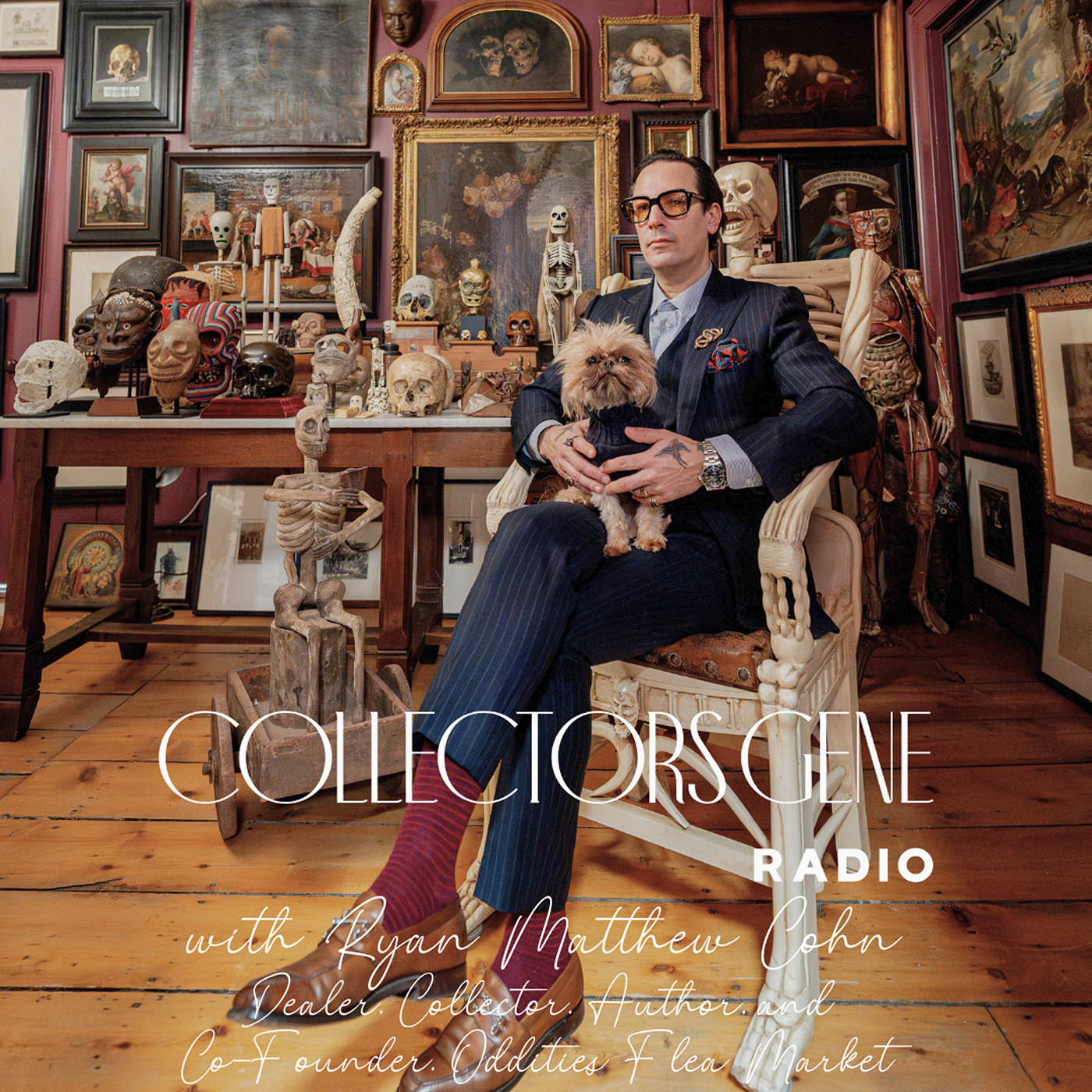
Collectors Gene Radio
Ryan Matthew Cohn - Dealer, Collector, Co-Author (The Witch's Door), and Co-Founder, Oddities Flea Market
00:36:58
Loading summary
Transcript94 lines
- [00:01]
Ryan Matthew Cohen
I had these dolls that supposedly gave us a curse. And I don't know if it was just me thinking this and perpetuating it, but a lot of strange things seemed to happen while the dolls were being housed here until we got rid of them and everything seemed to go back to normal.
- [00:17]
Cameron
What's going on, everybody? And welcome to Collector's Gene Radio. This is all about diving into the nuances of collecting and ultimately finding out whether or not our guests have what we like to call the collector's gene. If you have the time, please subs and leave a review. It truly helps.
- [00:35]
Narrator
Thanks a bunch for listening and please.
- [00:36]
Cameron
Enjoy today's guest on Collector's Dream Radio.
- [00:41]
Narrator
Today I'm thrilled to welcome Ryan Matthew Cohen, a modern day curator of curiosities and a master of the macabre. You might recognize Ryan from his groundbreaking.
- [00:50]
Cameron
Work with osteological art or perhaps as.
- [00:52]
Narrator
The co founder of the Oddities flea market, a haven for fans of the strange and unusual. Ryan's fascination with the peculiar began in his childhood exploring the woods of upstate New York and uncovering fragments of mystery and nature that sparked his imagination. That curiosity evolved into a passion for collecting some of the rarest and most unusual artifacts, from skulls and taxidermy to antique medical instruments and objects with mysterious pasts. His personal cabinet of curiosities as a testament to his passion for preserving the rare, the bizarre and the historically significant. Ryan's evolution as a collector, artist and custodian of history holds stories of uncovering treasures in unexpected places and acquiring several thousand piece collections. We'll dive into Ryan's journey from a self proclaimed seeker of the strange to an internationally recognized figure in the oddities community. We chat about how his time as a jewelry designer for Ralph Lauren paved.
- [01:46]
Cameron
The way for everything he knows about.
- [01:47]
Narrator
His passions today, how he curates his collection and the story behind one of his most intriguing finds, the wood door that inspired his book the Witch's Door. So please enjoy. This is Ryan. Matthew Cohn for Collector's Gene Radio.
- [02:05]
Cameron
Ryan, thank you so much for coming on Collector's Dream Radio this morning.
- [02:09]
Ryan Matthew Cohen
Thank you for having me.
- [02:11]
Cameron
It's my pleasure. You're a collector of what most would call, you know, Wunderkammer or a cabinet of curiosities. So before we get started, I would love it if you could tell the listeners two or three of the most maybe bizarre odd things that you're surrounded by right now.
- [02:28]
Ryan Matthew Cohen
Oh gosh. So I'm in my Victorian library study which is decorated very in the English style. I guess you could Say, and you know, this has mostly my research materials in it, but I also house some of my rarest dolls that are in my collection. So if you want to chalk those up as being weird, perhaps you could. I don't find them weird. I live with them. I'm a huge collector of early artist manne, which you maybe have seen these before and some of your listeners have probably seen them, but they were these artistic models that were made for artists to pose the body in every direction that a human body would pose in. So some of them are very mechanical, the early ones, some of them are made out of wood and metal and there's a skeletal version of the model. And I happen to be surrounded by three of them, actually two full size ones and one smaller version of which that I've never really seen. So those are three of the weirdest things in my room. And then I'm also. I have a hovering over me like a four foot turkey vulture that's stuffed. Wow. Huge.
- [03:40]
Cameron
That's amazing. Well, you're an east coaster through and through, born and raised. And you actually became fascinated with all this stuff as a kid. Do you remember the first time that you were exploring the woods of upstate New York? And you know, this would inherently turn you into the collector that you are today.
- [03:57]
Ryan Matthew Cohen
Absolutely. And you know, when I was writing this book, I was able to extract a lot of memories that I just. I never really thought about to try to get to the root of why I am the way that I am now. I could, you could easily say that I'm an obsessive collector. I mean, I go to bed thinking about collecting, I wake up thinking about collecting. You know, occasionally I think about my wife Regina as well, and my life, everyday life and everything. But I'm always thinking about collecting. And it was very much like that when I was a kid. And I think my earliest memories are actually going through the woods looking for like reptiles, like salamanders and snakes and things in nature, which ironically I would later collect, but not alive. So I remember when I was very young child, probably like four or five somewhere around there, I would spend the entire day looking for specimens and then I would like let them go at the end of the day.
- [04:56]
Cameron
Well, what's interesting to me is that usually the things that we collect as children evolve significantly as we get older, right? Specifically into new categories and tangents. But you really stuck with it all these years. Why do you think that is?
- [05:10]
Ryan Matthew Cohen
I don't know. And I still don't fully understand my fascination with the images of Death, or that being the overall subject matter, because I think that it probably is. When I look around my house, each piece, you know, sometimes I pick things that are just peculiar in nature, but sometimes it. Or typically it has to do with death in some way, shape or form. And I don't know where that comes from. And I don't know that I was necessarily fascinated with death when I was a youngster, but it seemed to evolve into that as the genre.
- [05:43]
Cameron
Did you ever think there was a career in collecting growing up?
- [05:47]
Ryan Matthew Cohen
No, but I always seemed to do it. You know, when I. When I was really young, I got into baseball cards. It was a really huge craze. I don't know if you ever collected them.
- [05:57]
Cameron
Yeah, sure.
- [05:58]
Ryan Matthew Cohen
But during, like, the 80s, I feel like the 80s and the 90s, sports cards in general became very, very popular again.
- [06:05]
Cameron
It was everything.
- [06:06]
Ryan Matthew Cohen
Yeah, it was everything. And I was collecting them during that boom heavily. And it was funny because I absolutely detested sports, despite the fact that I was forced to do them. I just liked the collecting aspect of it. So I knew that if I go and find a very rare card, I could either sell that or trade it for a bunch of other cards. And sometimes you would find a whole collection of various cards, and then you would pick through it and you'd find like, two or three really good ones. And then you were left with all the other stuff, but all that other stuff added up, and you could sell that and you could build this great collection if you knew the ins and outs, or the idea of buying a bunch of stuff, keeping the best, and then selling the rest. And I feel like that's still a technique that I use today, but I was using it when I was very, very young. I love it.
- [06:56]
Cameron
So you continue your interest in collecting the obscure as you grow up, but you actually have a stint as a jewelry designer for Ralph Lauren for a bit and running against nature. And do you see a connection between the craftsmanship of jewelry and your work with osteological art?
- [07:12]
Ryan Matthew Cohen
You know, what's interesting is when I started practicing silversmithing and leather work and all the stuff that I was doing with polo and Double rl, at first, I didn't really understand what it would mean to what I was doing on the side, which was restoring antiques and collecting antiques and buying and selling things. What it did was it gave me, like, the root of everything I needed to know. I learned about the composition of metals, I learned how to work with metals, I learned how to work with wood. And the gentleman that was teaching me was a man by the name of Arnold Goldstein, and he was actually Ralph Lauren's very first jewelry designer. Back when Ralph Lauren or Ralph Lipschitz was in the Trump Building or the Trump Tower, he found this guy to start doing his jewelry. It was a lot of the early Western stuff. And I ended up taking the skills that I learned doing this stuff and just using it to either make stands for things that I was going to elevate to resell, or use it in restoring antiques that were going to live in my own collection or even help make things to be displayed in my own collection. So it kind of taught me everything, and it really taught me how to. Arnold kind of taught me this. How to distinguish whether something's really good, meaning old, or a reproduction or something else. So I think during those years, and it was a good, I don't know, eight to a decade where that's all I did, was I was doing jewelry for. For Ralph Lauren and some other companies. And it taught me everything. It was like going to college.
- [08:47]
Cameron
Probably better than going to college.
- [08:49]
Ryan Matthew Cohen
Yeah. Because I got paid to do it. It was great.
- [08:52]
Cameron
Right. So something I would love to know more about is kind of how you source this stuff. Right. Because with anything that is collectible, a market grows, and it obviously becomes more harder and more difficult, rather, to find things. And things get more expensive because they're more known in the market. But with oddities like you collect, it seems as if it would be on the more difficult side to find, because you can't just walk into a antique store or a flea market and find this stuff.
- [09:19]
Ryan Matthew Cohen
No, you can't. And you always have to have your ears open and your eyes open, and you have to know people. So I. I go to Brimfield Antique show, usually twice a year. I don't go to the summer one because it's just grueling and miserably hot. But the spring one is great. And I used to go there, and I would find absolutely nothing. You know, I'd find, like, decorative things like furniture and a chair, you know, something like that. But I wouldn't find, you know, like, early vanitas painting because it was getting into the fields too late. You literally have to be there when people are unloading their cars, or you have to pay attention to what's happening in the auction world. And then you. It's like word of mouth. You have to, I guess, be popular enough so that people will reach out to you or have spent enough money so that people want to, like, clientele you. I'd say Some of my best pieces in my collection were because someone contacted me either via email or Instagram or somewhere else and gave me, like, a tip like, hey, this thing's coming up for auction. I didn't see it in Europe, or I just did research. I mean, I'm researching constantly, and that's really the best way. And then every so often, I'll just get an email saying, like, hey, you know, grantad had this old sculpture. Are you interested in purchasing it? So you really have to devote a lot of time to look for this stuff, and sometimes it finds you, and sometimes you just have to go seek it.
- [10:46]
Cameron
But it's hard, I would imagine. So. I mean, it's obvious that, you know, that you've become an expert in the oddities market, but how do you really go about vetting this stuff? Obviously, you have to be an expert, like I was saying. But some of this stuff is like. Like I said, you don't just walk into an antique shop and find it.
- [11:06]
Ryan Matthew Cohen
Yeah, I think that my best friend right now is narrowing in one what I specialize in, because back in the day, probably walk into an antique store and walk away with something. But I've really narrowed my searches down to very specific types of things. And you just, you have to have experience in the field. And I've certainly purchased fake pieces before or, you know, things that I thought were old that turned out to be modern. And there's a huge market of fake antiques coming through right now. And a lot of them have to do with macabre and obscure antiques. Like, there's a lot of memento mori pieces that are being stated as being from the 18th century, and it turns out they were made yesterday.
- [11:48]
Cameron
It's just 18 minutes ago.
- [11:50]
Ryan Matthew Cohen
Yeah, 18 minutes ago. Where, you know, artisans are taking antique elements and reconfiguring them to look old, but they're not. And while they aesthetically look really cool, they're not worth anything. You know, in the back of your mind, you have to think like, hey, if I'm spending X amount of dollars on this piece, if I were to resell it later on, am I going to make my money back and. Or make more as an investment? And, you know, I'm always thinking about that. You know, sometimes I'll buy something because it looks cool, but other times, especially I'm spending a lot of money. I want to be able to, you know, get back my investment or make money. And, you know, I had someone reach out to me last week who was showing me a painting, asking my opinion on It. And it was funny because the original painting was hanging on my wall right now in the next room. And I had to tell him. And it's a good friend of mine, like, sorry, man. Aesthetically, it's cool looking, but it's a reproduction, right?
- [12:43]
Cameron
This is actually oil on canvas.
- [12:45]
Ryan Matthew Cohen
Yeah, it's oil on canvas. But you know what, people get really, really creative these days and they'll take an old painting that has craquelure and they'll paint over it so that those little imperfections kind of shine through. You'll have that crackling in the paint, but it's just a paint over. And they look pretty convincing, but they're just. They're not anything. They're just like modern representations.
- [13:05]
Cameron
How does condition play a role in the oddities market? Are some things just so rare that condition doesn't matter as much?
- [13:12]
Ryan Matthew Cohen
It really depends on what you're looking at. You know, there's certainly a lot of paintings that are worth a tremendous amount of money that have been, you know, either restored or revarnished. And I don't think that that necessarily deters the value. Sometimes it does. Sometimes you don't want to touch things at all because you don't want to ruin a patina. But, yeah, it's definitely something that I pay a lot more attention to now. When I was, you know, first coming into antiques and starting to grow my collection, I didn't really care as much. And in fact, it was almost good that I bought something that maybe needed a little bit of work, because typically I could get that piece for much less restore it. And then suddenly I had this grandiose looking piece. But, yeah, it's something that you're always thinking about in the back of your mind.
- [13:55]
Cameron
Well, and you've actually learned how to really become a custodian of these objects and take care of them and repair them. Is that right?
- [14:01]
Ryan Matthew Cohen
It's something that I really enjoy doing. And, you know, it definitely saves me a lot of money because if I can restore something myself, it might be an easy fix or there's a crack in something or. You know, I've actually been studying painting restoration. And so sometimes I can do stuff on my own, but then other times I use like a museum conservateur to do that stuff for me.
- [14:24]
Cameron
The next thing that I kind of want to ask you, you said you're narrowing down what you're collecting and what you're focusing on at this time in your collecting. How do you decide what fits the narrative and is worth preserving?
- [14:38]
Ryan Matthew Cohen
You know, it has to make sense to the overall collection at this point. And that really depends. I think it's if I'm going to keep something from the permanent collection. I'm very, very careful as to what I'm adding now. If I don't have it in the collection, or if it's something I've always been looking for, great. Or if it's something that I'm reselling for a show, then maybe I'm, you know, I'm still focusing on, you know, what I'm an expert in. If you want to call me that pseudo expert. I suppose you kind of have to know a little bit about a lot. But then you go off on these tangents as you progress as a collector. And I've been doing that recently. I had this storage unit sitting in New Jersey for like 10 years and I just started taking stuff out of it and I was like, holy crap. I have like all of this 16th century furniture that I totally forgot about. So now where I'm supposed to be focusing on death related, you know, 16th, 17th century paintings, now I'm like fascinated with refectory tables from the 16th century. So it's. Your mind is always going crazy. All it takes is to add something to your collection and then you suddenly, like, go down the rabbit hole and you want to learn everything about that object and its history and its lineage.
- [15:53]
Cameron
I would have to imagine that some of the items that you collect can cause quite a controversy sometimes, right? I mean, how do you balance the line between fascination and collecting and respect? I guess, for lack of a better term, when dealing with some of these items that have maybe a more somber.
- [16:10]
Ryan Matthew Cohen
Or dark history, I think explaining what they are is your. Your biggest tool. You know, when I share things on social media, for instance, I try to, like, explain what it is, or I try to do a video and explain, you know, what its history is, even if it's an uncomfortable history. So I just think that informing the general public that may or may not be offended by what you do is all you can really do. It doesn't offend me. It doesn't offend the people that enjoy what I do. Everyone else, you know, I can't really help you there, but, you know, I guess information would be the answer to that question.
- [16:48]
Cameron
And you've been doing this, obviously for a long time now. I would have to assume that you're pretty numb to this stuff. But do you ever come across anything anymore that maybe unsettles you a little bit?
- [17:00]
Ryan Matthew Cohen
Not particularly. You know, I've had like a Couple of weird things happen within my collection. I talk about that in the Witch's Door, which is our book that we just finished that came out in October. I had these dolls that supposedly gave us a curse. And I don't know if it was just me thinking this and perpetuating it, but a lot of strange things seemed to happen while the dolls were being housed here until we got rid of them and everything seemed to go back to normal.
- [17:27]
Cameron
Then you hit the lottery.
- [17:29]
Ryan Matthew Cohen
Yeah, it was like one of those weird things that people kept warning me over the years, yo, dude, this is gonna happen. You collect all the strange stuff, you're going to get haunted, there's going to be ghosts. And I, you know, there's even a, I think a statement in the book where I'm like, yo, ghosts come and haunt me. And sure enough, they did. So I was asking for it.
- [17:47]
Cameron
Now, as small as the market may seem for oddities, it's growing more than ever. And you and your wife have launched the Oddities Flea market for fans of the macabre. And you get vendors from all over who come and showcase their objects and items. I would love to know if perhaps there was something you weren't too familiar with that you saw from another vendor that maybe sparked your interest in this realm.
- [18:10]
Ryan Matthew Cohen
You know, we're always. We get applications all day, every day, all day and night. And so, you know, sometimes I'll just find someone that I never knew about that, you know, I get excited about featuring. Like, we have a couple shows coming up, one in San Diego and in May. Think it's in March. I should probably have that information on hand. And then we also have a Chicago show coming up this year as well. So I never really know who we're going to find. People just kind of come out of the woodwork. But I've certainly found vendors that, you know, were, were great and ended up purchasing stuff and keeping in my personal collection, whether that be an artist or someone dealing in antiques.
- [18:50]
Cameron
Are there any trends currently in the oddities collecting market? I mean, what, what, what is currently really piquing folks interest in this realm?
- [19:00]
Ryan Matthew Cohen
I think that paintings have made somewhat of a splash in the, the world of collecting. And, you know, like, I think oddities is a fair enough term because I have become the guy known for oddities. And I think as a, a term it kind of explains everything I do, but that's not. I don't know if it's a term that I necessarily use when I'm like, hey, this is what I collect. But There are very, like, specific things that the oddities community collects. I feel like artwork has become very popular recently, and I don't know if that's partially, you know, with the help of me exposing it a little bit. Memento mori. Rare forms have been coming up, and they've been going for a fortune lately at places like Bonhams and Sotheby's and Christie's, and they've always been popular in the world of collecting oddities, but I feel like they've gone above and beyond in the past, like, even five years.
- [19:55]
Cameron
Become a little more blue chip.
- [19:56]
Ryan Matthew Cohen
Yeah, they've been going through the roof. I don't. I don't really know where this trend has come into play, but I have not won some of the last things at auction because they've just gone for, you know, crazy amounts of money.
- [20:10]
Cameron
I want to talk about living around these objects. You did an interview with the magazine Antiques, and they took photos of your home. And you've done such a great job at making these oddities and objects part of your everyday life and living around them. Do you view them as too precious, or do you want people to come over and be curious and learn and experience?
- [20:30]
Ryan Matthew Cohen
Yeah, I do. You know, I really do like to share this collection with the general public, and that's usually through social media. I don't have a ton of people at my house, but the people that do end up visiting the collection are people that are really interested in this stuff, and I really like sharing it with them, especially people that are fascinated with this stuff like I am. But, you know, I also want to make my house livable. I went from like a thousand square feet to, you know, I ended up moving into a brownstone in Brooklyn that was three stories, which was great. To the place that I'm in now, which is in Connecticut. And I have a ton of space, but it's slowly filled up. But I always had this rule where I need to be able to, like, comfortably live in the house and not have it set up like a museum, which you're almost forced to do in Brooklyn because we're just. We have a huge lack of space there. So I still want to, like. I want to live here.
- [21:26]
Cameron
Right. Still have to eat breakfast in the morning.
- [21:29]
Ryan Matthew Cohen
Yeah, I need to have, like, a table to eat breakfast at. Exactly. So it has to be livable.
- [21:33]
Cameron
Now, you've curated exhibitions and installations in extremely unique spaces, like, you know, the Armor Steiner House and House of Wax. But are there any venues that would be a grail for you to display all this stuff that you could just say, this is where they should exist.
- [21:50]
Ryan Matthew Cohen
Oh, my gosh. Yeah, I really like. My next endeavor is going to be an exhibition on the memento mori collection that I procured from the great Richard Harris. And I'm not talking about the actor Richard Harris, because he also passed away relatively recently, but I was lucky enough to procure a large section of the collection of Richard Harris, who was a Chicago based collector. I think he had somewhat somewhere around like 3,000 rare items in his collection. And he exhibited his collection at the Wellcome Museum in London and the Cultural Heritage center in Chicago and a couple other places, New York. And I want to do something similar, but mix my own collection with it and really show like the art of Death. And I feel like the Cloister, the Cloisters, or, you know, like the Morgan Library would be perfect spaces for this collection to exhibit for a few months. And I'm currently seeking a space to do that in. So if anyone's listening knows of one, I'm willing to travel relatively.
- [22:57]
Cameron
The Morgan Library is such a special place, and we've talked about it before on this show, and you just walk in there and it's hard to imagine living in those rooms, and especially the library itself. I mean, the fireplace is like two of me lengthwise. It's insane.
- [23:13]
Ryan Matthew Cohen
I can imagine living there. Unfortunately, with the Morgan and other museums, they typically only showcase artworks that are donated to the museum, which I'm not going to do. So that sort of limited my options as to where to show this. The Peabody would be great, just, you know, like a larger space that I can spread this collection out in and showcase it, because I have objects that are ancient and I have objects that are contemporary. And it would be really interesting to show the lineage and different artists take on death over the years.
- [23:45]
Cameron
When it comes to collecting anything, oftentimes the story can be more compelling and exhilarating than the object itself. And I find that to be the case sometimes with books. And you guys wrote a book you and your wife called the Witch's Door. For those that don't know about the book, I would love it if you could tell everyone the story behind the wooden door that you have, which is really the inspiration behind the book itself.
- [24:10]
Ryan Matthew Cohen
Yeah. So this door was found in a huge collection. You could easily call him a hoarder. We call him in the book Nick Parmesan. That was in his real name. He had the nickname because he made this amazing Parmesan. He was an Italian fellow in Carroll Gardens, Brooklyn. And he was purchasing stuff from me every single week for about a year or two until I just couldn't deal with him anymore. And I'd been to his house a couple times, and it was a massive collection, floor to ceiling, but it was all kind of just thrown in there. Fast forward to years later when I moved to his neighborhood. He looked a little different. It turned out he was getting sick. And when he passed away, I was able to make a deal and purchase everything that was in his house. So I had not seen it in a couple years. And when it went up there, you couldn't even move through the place. I mean, it was like true hoarding style, but of the best stuff we had ever seen. And so, you know, slowly over like a few weeks, we were able to take everything out. And then it came time to really research what was in there. And we came across this door, which was, you know, kind of unassuming. When you just looked at it and took it at face value. It looked like a very, very old door. Well, I ended up finding the paperwork on it, and it turns out that it's a Salem witch trial error door from New England. It belonged to this collector named Roger Bacon, who was a specialist on primitive and folk art antiques. And, you know, then came the process of showing it to some museums and trying to find more information on it because we're sort of limited in the paperwork that we had. And it's funny, when we explain the paperwork, it's like this really mysterious story where we finally, you know, find this banker box and there's this one sort of crumbled up piece of paper covered in like blood and coffee and, you know, stained and like ripped. And there it is, you know, after looking for months not knowing what the door is until then. And so, you know, we've taken it, we've shown it to like the Peabody Museum before, who deals in, you know, Salem related artifacts. And they said that the age is correct and that the carvings are, you know, most likely from that time period. And it was basically like a door used to house someone accused of witchcraft. And we use that as the catalyst for the book and the title of the book. And, you know, we start the book out with this door and explaining what it is or what we knew at the time to the middle, giving a little bit more information to the end, leaving it sort of open ended, because we've never fully figured out every aspect of the door. So we're still seeking knowledge and information about it.
- [26:51]
Cameron
Crazy, crazy story. I mean, I just can't even imagine one receiving the door, knowing a little bit of its history and having this idea in your head, but then finding the piece of paper documenting all this stuff is just wild.
- [27:03]
Ryan Matthew Cohen
I have a long history of locating things in my own collection that I didn't even know that I had. You know, I tell another story in the book about this Egyptian mummy hand of a child that I found in my own house. Now, it wasn't just like part of the house when. When I purchased it, but I had had a. An Egyptian mummy that was disarticulated from a university, ended up parting with it because it just was too large and not in great condition, but it kept some of the bundles in the collection. And it turns out one of the bundles, I unwrapped it a little bit, and there we had one of the rarest objects that was probably worth more than the entire mummy itself. And so it's the same thing with the door. I was looking at all these pieces that were very specific, like, okay, I'm going to keep this. This is a great piece that goes in the permanent collection. Or I'm going to sell this piece because, you know, I know what its value is. And then here we had this door, which is probably the rarest piece out of, like, 1500 pieces that we procured from that collection.
- [28:01]
Cameron
Now, you mentioned that you purchased a decent portion of that gentleman's collection out of Chicago, and the other parts of the collections went to, you know, different auction houses or whoever bought them. Is your plan to keep the items that you collected and purchased, or are you going to auction them off yourself, or what's your plan for them?
- [28:23]
Ryan Matthew Cohen
I think that's a broader question about any major collector. What are you, like, what happens to all this?
- [28:29]
Cameron
What are you doing?
- [28:30]
Ryan Matthew Cohen
Yeah, what are you doing with it? You know, I've not sold really anything from that collection because I want to keep it together as a whole. I sort of promised the family that I would exhibit this collection and honor their father, Richard Harris. And that is what my plan is to do. There was a lot of, like, secondary pieces that don't really make a ton of sense with the collection that'll end up going for auction or being sold at antique shows in the future. But, you know, just to get back to that question, like, what happens to all this stuff? Basically, my business, my whole life is based on people that obsessively collected and then passed away. And I don't. I don't want that to happen to myself. I hope that I have more of a plan. Prior to that happening. But that's typically what happens, is you have this grandiose plan, like, oh, you know, there's going to be this museum of Ryan Matthew Cohen that's going to open up and showcase my lifelong collection. It'll be important enough that people will give a shit. And typically that doesn't happen. You know, person gets sick or passes away, and everything just ends up at various auction houses or private collectors. So I want to try to, like, get ahead of that and probably sell my collection and move to Europe or something and live out my best years there. So that, in the back of my mind, is probably what would happen. Or if there's, like, a nuclear war in the United States, I have to be ahead of the game here and start thinking about what I want to do, because I don't even know how many thousands of pieces we have here. I mean, I'm in just my library right now, and I probably have about a thousand pieces just in this room.
- [30:00]
Cameron
Unbelievable. How do you archive?
- [30:03]
Ryan Matthew Cohen
I just. I keep a database. If I add anything important to the collection, I add it to the database. And I have a lot of different categories. You know, with the Richard Harris collection, I got, I think, 1500 pieces or so. And all of that is chronicled by, you know, like, what it is, who made it, the year when it was procured, and how much, you know, was spent on it at the time. And so I've cataloged that collection, and so I'm making a catalog now to really keep track of it. And I've tried to do that with the rest of the collection, which is vast. So I'm just always adding to it.
- [30:40]
Cameron
With a collection like that, you know, 1500 some odd items, are a majority of them in a specific category? Are they really spread out?
- [30:50]
Ryan Matthew Cohen
With Richard Harris's collection, it was predominantly on the subject of death. Like, that is what he collected. He spent his life, or, you know, I guess the other half of his life collecting that stuff and really spending a tremendous amount of money on his collection. His dream was to donate it to a museum. And in the end, it was so vast and so large and spanning that no museum would take it. There was actually a few museums that were interested in subsections of it, but it was just too big. You would have had to open up an entire building, which would just be, you know, too costly to do. So. Like with his collection, for instance, it is broken up into different categories. There's contemporary, there's traditional or, you know, old master works. There's Asian works. There is Ethnographic. And so it's broken up into categories to make it a little easier for me to navigate. He was really good at bookkeeping and keeping track of cataloging, so I'm lucky in that regard. Where, you know Nick Parmesan. Yes. There was a lot of paperwork. He was pretty meticulous in keeping, like, ebay records. And, you know, when he purchased something, there would maybe be some kind of paperwork, but a lot of it was undocumented. So I had to, like, go figure out where, when this piece came from. And, you know, with Google Image search, it's great because sometimes I can just take a picture of something and either find more information on it or find the actual listing of the piece when it sold.
- [32:18]
Cameron
Well, before we wrap it up with the collector's dream rundown, I urge everybody to go get a copy of the Witch's Door because the stories are just out of control. Even if you just read the first one about the door, I think you'll be intrigued. And it's such a testament to someone like you, Ryan, and your wife, who have just spent so much time and effort building a really, really important collection of items, and you continue to build on it. It's just. It's really impressive. So cheers to you.
- [32:45]
Ryan Matthew Cohen
Thank you, Cameron. And I hope that one day it makes a difference, that, you know, all of my time and effort has not been in vain. And maybe it is. I do it mostly for myself. It's just something that I am just fascinated with and have such a passion for that I can't do anything else. This is just what I was meant to do. So I'm glad other people appreciate it.
- [33:07]
Cameron
Well, let's wrap it up with the collector's dream rundown. You can answer these questions based on any of the things that you've collected that you currently collect, that you have interest in. First one is, what's the one that got away?
- [33:18]
Ryan Matthew Cohen
Oh, God. There's been many, and those are the only ones that you ever remember. But there was in that Richard Harris collection, actually, a little fruit wood skeleton that was intricately carved, probably about 14 inches tall. And I had made an offer, basically, like, hey, I know I'm getting a lot of these pieces donated to me, but I would love to purchase this one. They wouldn't do it. Basically, like, Bonhams wasn't even going to hold their auction unless that piece was part of it. And it went for a fortune. So I missed out on that, and now it's in a museum, so I will never get it.
- [33:50]
Cameron
How about The On Deck circle. So what's next for you in collecting? Maybe something you're hunting after.
- [33:56]
Ryan Matthew Cohen
Next thing I'm hunting after is that fruit wood skeleton that I just mentioned. Because there was actually one that was relatively similar that came up at auction at Bonham's in London and it didn't sell, but it was still such a high number that it's just not going to happen. So hopefully one day we'll come across one. There's probably about 10 in existence.
- [34:15]
Cameron
The unobtainable. So we may have just talked about it, but one that is just too expensive in a museum. Private collection, just completely complete. Unobtainium.
- [34:24]
Ryan Matthew Cohen
You know, it's funny, sometimes I just think about entire collections. Like I want this whole entire collection. That's just how my brain works. But you know, I think it's once again that fruit wood skeleton that it like kind of plagues me. I've researched, I've looked at some last night just in my photos. So I'd say like the unobtainable seems to be this one piece that I just can't seem to obtain.
- [34:48]
Cameron
How about the page one rewrite? So if you could collect anything else and money was no object, what would it be?
- [34:55]
Ryan Matthew Cohen
I could collect anything else. I'd probably collect the rarest vintage cars or something like that. Or I'd collect real estate because I do find real estate very fascinating. It's just so unobtainable right now. So it's not something that I can just do in my pastime.
- [35:12]
Cameron
How about the goat? Who do you look up to in the collecting world? Or who do you just think is a great collector?
- [35:17]
Ryan Matthew Cohen
You know, a lot of the people that I looked up to have passed away and then I ended up with their collections. So I don't want to like jinx anybody, but you know, I love you. You did an interview with Ray from Obsolete. I'm a huge admirer of the store Obsolete. So I'd say like that's one of the places that whenever they post something on Instagram, I go crazy. There's a London collector that's called the House of Scandal. I think they're absolutely fascinating. So I always look at their stuff. And then there's some dealers in Europe that I'm just absolutely fascinated with. I don't know how to say the guy's name. I think it's like George Leo or George Leo. I don't know how to say it properly. But he's a Kunst camera dealer and has some of the finest objects known to man.
- [36:05]
Cameron
The hunt or the ownership? Which one do you enjoy more?
- [36:08]
Ryan Matthew Cohen
Oh, God, it's always the hunt. Because you can find that one piece you've been seeking your whole entire life, you finally found it, goes up on your shelf, and guess what? You want another one? Yep.
- [36:19]
Cameron
Or you're on to the next thing.
- [36:20]
Ryan Matthew Cohen
Onto the next thing. That's just how the brain works.
- [36:24]
Cameron
Most importantly, Ryan, do you feel that you were born with the Collector's Gene?
- [36:27]
Ryan Matthew Cohen
Oh, yes, to a fault.
- [36:31]
Cameron
I love it. Ryan, thank you so much for coming on Collector's Gene Radio. Everyone go check out the Witch's Door, check out the Oddities flea market, and pay attention to Ryan's next exhibition. I'm sure it's going to be really special.
- [36:42]
Ryan Matthew Cohen
Thanks, Cameron. Nice talking to you.
- [36:47]
Cameron
All right, that does it for this episode. Thank you all for listening to Collector's Gene Radio.