Loading summary
Transcript25 lines
- [00:01]
A
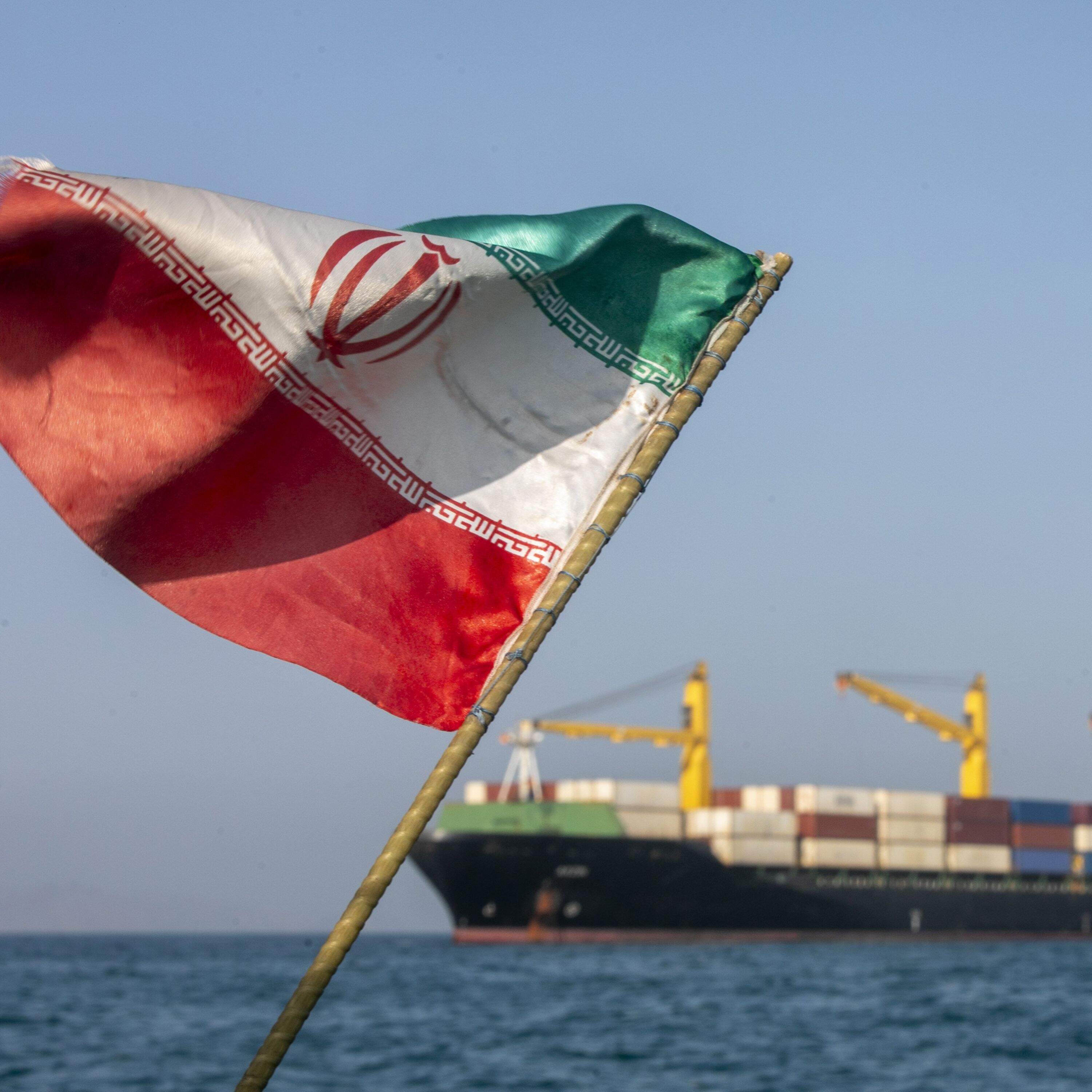
It's consider this where every day we go deep on one big news story. Iranian leaders have issued a series of demands to reopen the key waterway to shipping, demands the US Appears unlikely to meet. President Trump told Axios on Sunday that he was quote, low keying it when it came to negotiations for sailors aboard shipping vessels in the strait. Things are still dangerous.
- [00:24]
B
We are still having vessels being targeted by drones and by missiles and the number of tankers transiting through the strait is massively reduced compared to what it was pre conflict.
- [00:33]
A
Tim Wilkins is managing director of a tanker ship industry group, Intertanko. He says just 10% of the tankers that used to transit the strait on a given day are making it through.
- [00:44]
B
We had quite a severe situation last week where we had a gas tanker which was hit and did unfortunately had to be evacuated. A fire did break out. So you know, even with the US Facilitated, there are still risks and it doesn't eliminate that risk of an attack.
- [00:59]
A
Meanwhile, Yemen's Houthis said they attacked an oil facility Sunday in southwestern Saudi Arabia, the latest attack by the Iranian backed rebels. Consider this. Iran and its allied groups have so far withstood American attacks and increasing economic pressure. They've prolonged the war and they've disrupted American and Israeli strategy. From npr, I'm Rob Schmitz.
- [01:27]
C
This message comes from Progressive Insurance. Insurance isn't one size fits all. That's why drivers have enjoyed Progressive's name your price tool for years. Now with the name your price tool, you tell them what you want to pay and they'll show you options that fit your budget. So whether you're picking out your first policy or just looking for something that works better for you and your family, they make it easy to see your options. Visit progressive.com progressive casualty insurance company and affiliates price and coverage match limited by state law Support for this NPR podcast and the following message come from Carvana. Selling your car. Carvana has offers so good they're almost inexplicable. Sell your car 100% online in minutes. Visit Carvana.com today.
- [02:11]
D
This message comes from the Freedom from Religion Foundation. A healthy democracy protects the rights of people with many different beliefs. The Freedom from Religion foundation is an organization that works to keep the separation of church and state and to ensure that every American is part of the American story. Visit FFRF US Public or text Public to 511-511 to learn more. Text fees may apply.
- [02:44]
A
It's Consider this from npr. Part of what has made Iran so effective in the war with the US Is its Vast network of all in the region. Hezbollah in Lebanon, the Houthis in Yemen and Iran backed Iraqi militias. They're often referred to as the axis of resistance. Peter Salisbury wrote about them in a Foreign affairs magazine article this month. Salisbury teaches at Columbia University School of International and Public affairs. And I called him up to ask him to explain this axis of resistance and how it's shaping the war.
- [03:13]
B
The axis of resistance is a network of non state armed groups that Iran has been investing in for the last 20 to 40 years and has really built up the capacity of, to the extent that groups in Lebanon, Yemen, Iraq are all now launching drones missiles at various adversaries and in particular the Houthis and the Iraqi groups are able to launch cross border missile and drone attacks on Saudi Arabia and on commerce in the Red Sea in a way that has proved very difficult for the United States.
- [03:58]
A
Is this a top down structure like with Tehran at the top, or how do power dynamics work within this?
- [04:03]
B
It probably started something like that. But increasingly these groups, while they're still very closely tied to Tehran, still very reliant on Iran, they have their own autonomous capabilities, their own supply lines and have their own connections to one another and pool knowledge across what's less kind of a network and more an ecosystem. And that has allowed them after a series of attacks by the United States and Israel over the past several years to reconstitute themselves and continue to pose
- [04:40]
A
this kind of threat and describe the training of some of these groups and how involved Iran might be in that training.
- [04:47]
B
So maybe 20, 25 years ago, Iran started really investing in training, not just Hezbollah, who it's got this long term investment in, and not just Hamas, which it had kind of this loose connection with throughout the 1990s, but really started building up a curriculum almost from basic military education up to higher education. So you can now be trained not just in basic military tactics, but in how to use relatively advanced drones and missiles, how to build, build them, including sending people off to technical training and even kind of higher institutes of learning in Iran, but also at training sites in Iraq, in Lebanon, in Yemen. So they've essentially created a kind of tiered education system for these groups that again integrates these capabilities and knowledge into them. They're not just sending them weapons and telling them which buttons to press on
- [05:43]
A
the note of weapons. You know, I'm curious, you know, how much of role has the newer and cheaper technology that we've seen played, like the usage of drones in these groups ability to wield power?
- [05:55]
B
I mean, it's been transformative, frankly, maybe 10, 15 years ago, the US and other Western powers were able to limit access to advanced weapons because they controlled most of the technology, most of the parts, what are known as intermediate goods that were flowing around the world. So you might know how to build a weapon, but to actually get hold of the stuff that you wanted to stick into it was very, very hard. And people lacked the manufacturing expertise needed to make these things. Fast forward a decade and a half. A lot of what goes into Houthi drones, Hezbollah drones, the Iranian drones as well, are manufactured very cheaply at large scale in China in particular. So the choke point for those goods has moved. They've become cheaper and much more available, particularly for making everything up to most of what goes into the Shahed 136, which is the famous drone the Iranians have been launching on the Gulf states. But also these sort of smaller, simpler designs that the Axis groups tend to use.
- [07:03]
A
You mentioned that China makes a lot of these parts. I mean, how do these particular groups obtain these parts? I mean, are they obtaining them directly from China?
- [07:11]
B
Yeah, pretty much. I mean, most of these groups now have their own fairly sophisticated international supply chains. They work with businessmen, with traders in China, across the world, in the Gulf, to get things onto ships and either brought into ports or smuggled that kind of last mile into the territory they, they control. So again, fundamentally different than 10, 15, 20 years ago, when most of what they got had to be shipped direct from Iran.
- [07:41]
A
That's really interesting. How are the US and its allies fighting these types of groups, knowing this type of power structure?
- [07:47]
B
Well, that's part of the problem and part of the challenge that we've seen over, particularly the last six months. The assumptions behind Epic Fury and the assumptions behind things like the Trump administration's maximum pressure campaign was that they were powerful enough and that enough of the capabilities, the needs of these groups were concentrated in specific places that they could simply kill the right number of people who had the knowledge needed to run these processes, blow up enough warehouses, manufacturing sites, along with doing all the things they've been doing to try and constrain their economies. And what they're learning now is that because the pool of knowledge needed to procure the parts, build the drones, get them up in the sky, is actually sort of much more diffuse and distributed. The Israelis used to describe Iran in the Axis as an octopus with tentacles, which suggests this relatively simple, almost mechanistic structure. And really what you're dealing with something, it's like the difference between an old fashioned telephone exchange, where everything's routed through one site and the Internet, where everything kind of moves through 100 different places all at once before your data, your information gets to you.
- [09:06]
A
So given how decentralized and diffuse this network is, what kind of new strategy might be needed for the US and its allies?
- [09:13]
B
It's really tricky. I think something that's hard for people to hear but is nevertheless very true is the first thing people need to do is maybe limit their ambitions in terms of what can be achieved unless they're willing to really engage in long term, forever war in the Middle east, not just in one country, but four or five all at once. It's going to be very difficult to uproot these groups because it's not just affecting conflicts in the Middle east, it's affecting conflict all over the world, from Ukraine to Sudan to Ethiopia and beyond. And it's going to become an even bigger challenge for powerful states and for peace and security everywhere in the coming months, years, decades.
- [10:02]
A
That is Peter Salisbury. He's a professor at Columbia University School of International and Public Affairs. Thank you.
- [10:08]
B
Thanks so much for having me.
- [10:10]
A
This episode was produced by Henry Larson and Daniel Offman. It was edited by Sarah Robbins and Michael Levitt. Our interim executive producer is Courtney Dorney. It's consider this from npr, I'm Rob Schmitz.
- [10:34]
D
This message comes from Workday, the enterprise AI platform for hr, finance and it. When it comes to your company's finance and HR functions, you can't afford to get it almost right. Workday's AI platform empowers agents to work securely and accurately, following your organization's unique context and guardrails. Agents operate within predefined permissions to complete tasks, and they log every action to guarantee auditability, from automating routine data entry to flagging financial anomalies, every workflow runs within enterprise controls, so it does the work to drive real outcomes you can trust. This is the world Workday is creating, where the limitless potential of AI is combined with the certainty and predictability your enterprise needs. It's a new Workday. Learn more@workday.com.