← Consider This from NPR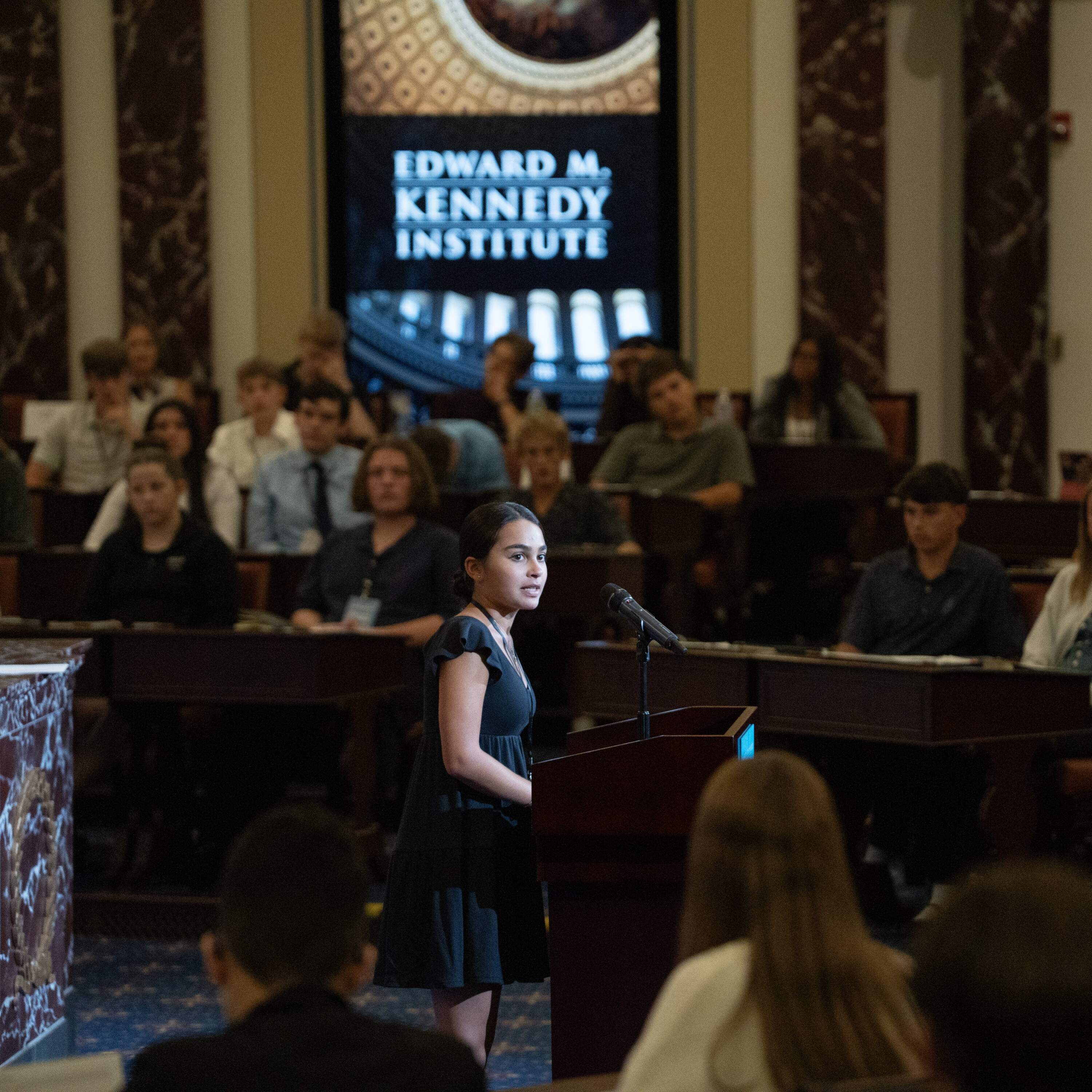
Loading summary
Transcript42 lines
- [00:00]
Juana Summers
Hey there, it's Juana Summers. I want to share something real quick before we get to the show. It's a comment that an NPR network supporter shared with us. Kim from Chicago says, I trust the news reported by npr. It's critical to have a news source that is not controlled by corporate or political interests. It's true. NPR has no shareholders and no editorial interference. It's the public. We serve. You and Public Media requires a growing community of supporters to continue its mission of creating a more informed public. A Our July fundraiser ends tomorrow. Help us end this month. Strong head to donate.NPR.org thanks. It's consider this where every day we go deep on one big news story. Today, can teenagers come up with guidance for how schools should use AI?
- [00:47]
Senate Clerk / Moderator
Are there any senators that would like to motion for a vote on Senate Bill 2026, the Student's First act here today?
- [00:52]
Cory Turner
Mr. President, I motion to close this
- [00:55]
Juana Summers
summer, teens from across the country gathered in Boston. They were participating in a mock student
- [01:00]
Senate Clerk / Moderator
senate recording of the asna's clerk being myself will call the rol Senator Acho
- [01:03]
Juana Summers
the topic artificial intelligence and coming up with a bill that would guide schools on how to use it. When we think about AI in education, the conversation shouldn't be about whether students are using AI. That's Vaheeva Ulani Gapero, a student senator from Hawaii. It should be about ensuring that they know how to use it properly and responsibly and with integrity. And I believe that this bill helps to provide that foundation. Consider this. AI is transforming the world young people will inherit. How are they thinking about how to deal with it? From npr, I'm Juana Summers. This week on the NPR Politics podcast, a surprising number of Americans from both parties agree government corruption is a big problem, but will it matter when they vote in November? What Democrats are trying to do is link it to voters. Number one issue, which is affordability. We dissect the arguments you'll be hearing more and more as the midterms get closer on the NPR Politics podcast. From the light bulb to the Internet, human history has been driven by innovation. And Shortwave is exploring how the technology of tomorrow will transform our future. Would you ride in a flying taxi? Will AI models fight wars? Hear about the technological frontier Every Monday on TechCamp, the new series from Shortwave. Listen on the NPR app or wherever you get your podcasts. The NPR app cuts through the noise, bringing you local, national and global coverage. No paywalls, no profits, no nonsense. Download it in your App Store. Today. It's consider this from NPR. Over the course of one frantic summer weekend, 98 teens representing all 50 states met in Boston to try to do something remarkable agree on one unified national policy to help schools navigate the chaos created by artificial intelligence. NPR's Cory Turner has their story.
- [03:13]
Cory Turner
These teens, most of them high school juniors and seniors, came from big cities and small towns, blue states and red states, and they had at least one thing in common when it comes to AI. They want guardrails. Without that, it's just going to go unhinged. Everyone's going to stop learning and start relying on AI. Instead of using AI as a tool, they're going to use it as a brain. Campbell McHenry goes to school in Mississippi, and he's talking here about what researchers call cognitive offloading. I asked a lot of the teens about this, and is that something that you guys have seen, that there are plenty of kids who are just looking to get through an assignment?
- [03:48]
Juana Summers
Oh, yeah, I'm friends with most of them.
- [03:52]
Cory Turner
Assignments that people just go, yeah, as soon as I get home, I'm just putting this whole thing into ChatGPT. And that's partly why Colton Larson of Idaho and Vivian Dodd of Wyoming came to Boston to be a part of this mock senate to craft an AI policy that teens and schools can agree on.
- [04:11]
Senate Clerk / Moderator
I do solemnly swear that I will support and defend.
- [04:20]
Cory Turner
The weekend began at the Edward M. Kennedy Institute for the United States Senate. In a replica of the Senate chamber, the students stood at their desks taking the oath of office.
- [04:30]
Senate Clerk / Moderator
So help me God. Give yourselves a round of applause. Welcome to the United States Senate.
- [04:37]
Cory Turner
This teen senate was handpicked by their school leaders, and the event was co sponsored by several nonprofits, including the Institute, plus AASA, the School Superintendents association, and Day of AI, a nonprofit launched out of MIT's Raise AI literacy initiative.
- [04:55]
Senate Clerk / Moderator
Your charge is pretty simple. This is an opportunity for you to tell us what you think.
- [05:00]
Cory Turner
The students were reminded whatever they come up with wouldn't become real law. After all, they're not real senators. But if they could agree, their bill would be sent to AASA's network of some 10,000 school leaders across the country, many of whom are right now crafting their own local AI policies in the absence of national regulation.
- [05:22]
Senate Clerk / Moderator
The adults themselves haven't been able to come to consensus on this.
- [05:25]
Cory Turner
Jeffrey Riley is executive director of Day of AI.
- [05:29]
Senate Clerk / Moderator
Now it falls to the kids. Let them lead the way. I think they recognize that AI is a powerful technology with some really positives, but I think they recognize there's some negatives as well.
- [05:38]
Cory Turner
After being sworn in, the students were then divided into subcommittees to turn a laundry list of proposed ideas into one coherent bill.
- [05:46]
Juana Summers
The first thing in writing is states shall require schools to provide AI literacy when students first start utilizing technology in the classroom.
- [05:54]
Cory Turner
Arkansas's Danielle Robertson and her team all agreed that schools should be required to teach students about AI and how to use it responsibly, including plagiarism, data privacy, and understanding that chatbots are designed to tell you what you want to hear. But how early should that teaching start? Elijah Martinez, representing New Mexico, argued, the earlier the better.
- [06:19]
Senate Clerk / Moderator
If we don't teach kids what these AI models are using their data for, I think it's dangerous because we're allowing kids to put in their information, and that's private, sensitive information.
- [06:30]
Cory Turner
Ultimately, the subcommittee agreed schools should be required to teach kids about AI as soon as they introduce devices into the classroom. Next up, Bina Mejia Romero of Connecticut had to defend this particular amendment in front of the full Senate.
- [06:46]
Juana Summers
We should be introduced to it when devices are introduced to our classrooms, right. If we're going to be using devices, we should know the dangers and the benefits that they have.
- [06:56]
Senate Clerk / Moderator
So fantastic. Let's get a round of applause for Senator Connecticut.
- [06:59]
Cory Turner
For older students, the senators decided to ban the use of AI on any graded tests and in the act of writing, though editing and studying with AI would be allowed after eighth grade. And for students accused of breaking those rules, Ohio's David McCon Linares told the full Senate, there should be protections. There's been many instances where students have had their work falsely flagged and they haven't been able to appeal it or they have had to spend multiple weeks appealing it. There must be an appeal process there, not just an appeal process, but the review should be done by two school adults, not just one. In another powerful moment on the Senate floor, Dylan Dornak from Iowa told his colleagues that if a student in crisis tries to get emotional support from a school chatbot, the AI should not respond. Instead, it should notify trusted school adults. It'll alert those people and then those people could go and find that student, have them come and talk to them, provide them with the resources that that student clearly needs in that moment. When asked if alerting adults might betray students trust, your friend might be mad at you for telling somebody that they have mentioned self harm or anything like that, but you might have saved their life. By the end of the weekend, the final Bill had nearly 50 provisions, but still enough inconsistencies and questions that it wasn't clear it would pass. Michael Champeny, who works for the institute, told the students, this is how legislating works. It's messy. And then he reminded them why they were there.
- [08:29]
Senate Clerk / Moderator
There is currently no AI policy across the country. Many schools have nothing in place. If you truly think that nothing is better than what you have put together, you can absolutely vote this bill down. But are you letting perfect be the enemy of good?
- [08:44]
Cory Turner
After a frantic working lunch and some quick fixes, it was time for the final vote. Dozens of students signed up to make one minute speeches before the full Senate.
- [08:54]
Juana Summers
This morning.
- [08:55]
Senate Clerk / Moderator
I was one of this bill's staunchest opponents.
- [08:58]
Cory Turner
Ethan Liu traveled to Boston from West Virginia.
- [09:01]
Senate Clerk / Moderator
I had a whole different speech planned out against this bill. Actually, it was really good. I was going to quote Charlie xcx and it was. It was really good. And I'm sad I wasn't able to give it.
- [09:10]
Cory Turner
Instead, Lou encouraged his Senate colleagues to vote yes.
- [09:14]
Senate Clerk / Moderator
After a few more speeches, time for voting has come. Senators.
- [09:17]
Cory Turner
The student senators cast their votes.
- [09:19]
Senate Clerk / Moderator
Senator Caldwell. Senator votes no. Senator Cox. Senator votes aye.
- [09:24]
Cory Turner
And held their breath.
- [09:26]
Senate Clerk / Moderator
Senators by a final vote of 83 in favor, 15 opposed. Senators, congratulations. You've passed S 2026, the Students First act here today.
- [09:32]
Juana Summers
Well done.
- [09:33]
Cory Turner
Now the bill heads to those 10,000 school leaders across the country, many of whom are debating these very questions and and who might find the student's first act a really good first step. Cory Turner, NPR News, Boston.
- [09:51]
Juana Summers
This episode was produced by Lauren Migaki, Lena Muhammad and Vincent Akovino, with audio engineering by Ted Mebane. Our director is Jonas Adams. It was edited by Nervi Shah and 10 beat Ermeus. Our interim executive producer is Courtney Dorning. It's consider this. From npr, I'm Juana Summers.
- [10:14]
Workday Announcer
This message comes from Workday, the enterprise AI platform for HR finance and it. When it comes to your company's finance and HR functions, you can't afford to get it almost right. Workday's AI platform empowers agents to work securely and accurately, following your organization's unique context and guardrails. Agents operate within predefined permissions to complete tasks, and they log every action to guarantee auditability. From automating routine data entry to flagging financial anomalies, every workflow runs within Enterprise controls, so it does the work to drive real outcomes you can trust. This is the world Workday is creating, where the limitless potential of AI is combined with the certainty and predictability your Enterprise needs. It's a new Workday. Learn more@workday.com.