← Consider This from NPR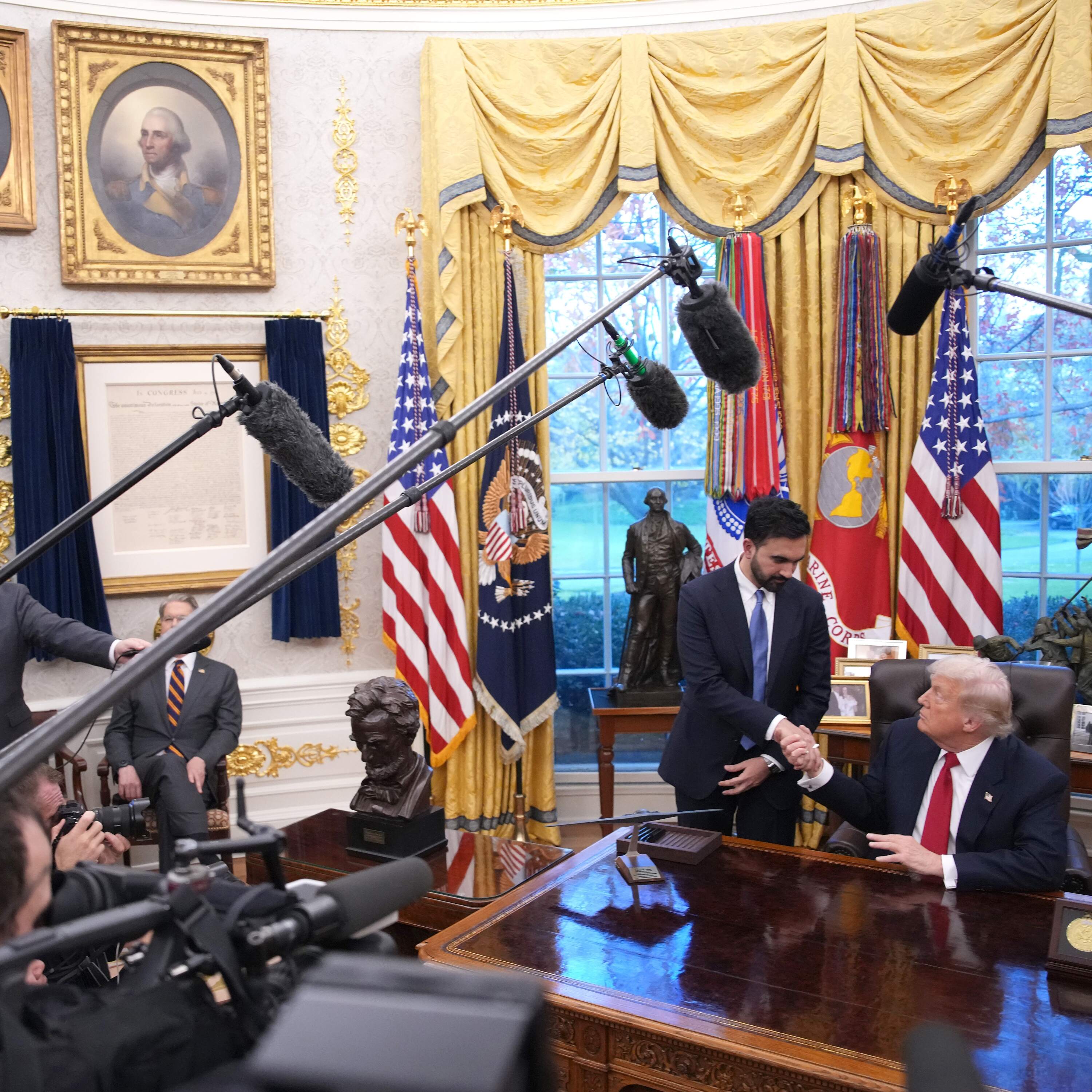
Loading summary
Transcript58 lines
- [00:00]
Sacha Pfeiffer
When Zahran Mamdani won the New York City mayoral race decisively this month, the contest was closely scrutinized to understand how a democratic socialist managed to pull off the turnout of such a broad coalition of voters and what it might mean for Democrats nationwide. Mamdani's rise has been a global phenomenon, too. It made the news across Europe. Zoran Mamdani, Democrat Zora that was audio from ARD, Rai and France 24 networks. And in France's left wing party called France Unbowed, progressive politicians like Claire Lejeune saw Mamdani's campaign as an inspiration.
- [00:40]
Podcast Sponsor Announcer
The victory of Zoran Mamdani is a beacon of hope.
- [00:43]
Mayor Michelle Wu
Its message echoes not only in the.
- [00:46]
Sacha Pfeiffer
US but also for us in France. And one surprise supporter emerged Friday, President Trump. In an unexpectedly friendly meeting with Mamdani in the Oval Office, the president said.
- [00:58]
Various Interviewees (e.g., Fernando Garrido, Mark Rubenfield, Christopher Palazzo, Bus Riders)
This to him, being the mayor of New York, and especially now because I think you're at really a turning point one way or the other. It could go great or it can go in a different direction. And I think you really have a chance to make it great.
- [01:12]
Sacha Pfeiffer
With Mamdani's rise, there's also been a surge of attention on the mayor of Boston, Michelle Wu. Madani has called her the most effective Democrat in America. Wu is Boston's first female and first Asian American mayor, and she was reelected this month in a landslide. The consider this with so many eyes on these races, many people are asking, can charismatic progressive mayors save the Democratic Party? Looking at Mayor wu's record in Boston as a case study along with Mamdani's campaign may offer some insights. We went to Boston to try to understand more about how mayors like Wu and Mamdani have been energizing voters. From npr, I'm Sacha Pfeiffer.
- [02:03]
Podcast Sponsor Announcer
Support for this podcast and the following message come from Betterment. Don't just imagine a better future, start investing in one with betterment. Betterment helps people and small businesses put their money to work by automating to make savings simpler, optimizing to make investing smarter, and building innovative technology backed by financial experts. So be invested in yourself. Be invested in your business. Be be invested in better with betterment. @betterment.com Investing involves risk performance, not guaranteed.
- [02:34]
Support for this podcast and the following message come from MIDI Health Women's midlife health issues have often been trivialized and ignored. It's time for a change. It's time for miti. MIDI is covered by major insurance companies making expert care accessible and affordable. Clinicians provide one on one Consultations where they listen to your unique needs and offer data driven solutions tailored for you. MIDI works to make you feel seen, heard and prioritized. Visit join MIDI.com to book your virtual visit MIDI the Care Women Deserve this message comes from NPR sponsor Shopify. Start selling with Shopify today. Whether you're a garage entrepreneur or IPO ready, Shopify is the only tool you need to start, run and grow your business without the struggle. Go to shopify.com NPR.
- [03:27]
Sacha Pfeiffer
It's Consider this from NPR Like Zahran Mamdani's campaign in New York, Mayor Michelle wu's campaigns in Boston have addressed affordability, especially in housing and transportation, and her style has focused on making a personal connection with voters. I live just outside Boston, and I wanted to gauge whether progressive mayors like Wu and Mamdani could, as their supporters believe, be successful models for future leaders of the Democratic Party, now widely viewed as leaderless. We have exited the Red Line onto Park Street Station. We've stepped out onto Boston Common. So I took the Red Line on the t the subway system to the Boston Common, a famous tourist destination in a city with a history of progressive politics. In recent years, the Common has had a homelessness issue. Mayor Woo has pushed to get people housed, and she's dismantled a large tent encampment in another part of the city. A visitor from Spain, Fernando Garrido, was impressed by what he saw.
- [04:28]
Various Interviewees (e.g., Fernando Garrido, Mark Rubenfield, Christopher Palazzo, Bus Riders)
When we walk and we run in by the city this morning, we didn't see any homeless people. And that surprised us because in other cities of the States, usually we saw a lot of homeless people, like in New York, in San Francisco.
- [04:44]
Sacha Pfeiffer
But the issue still exists in Boston. Boston's South End, another neighborhood, has quite a problem. In one area, in fact, there is an Instagram account, and it's just a collection of photos of people shooting up on the street. People are really upset about what's happened to their neighborhood, and they feel like they're not getting enough help from the city. And homeless people often leave one area only to move to another. In Somerville, a city a few stops away on the Red Line, I passed a group of people on a park bench surrounded by bags and backpacks and takeout containers, plus something new. And near them is a Dropbox for used needles. It was the city's response to complaints that Davis Square has become a congregating spot for homeless people, many of whom are believed to have come here because they no longer can camp out in Boston. It's a national problem that is playing out right here in the Boston Area. I ran into Somerville residents Mark and Susan Rubenfield and asked what they thought of the Needle Dropbox.
- [05:47]
Mayor Michelle Wu
I think it's a great thing.
- [05:48]
Various Interviewees (e.g., Fernando Garrido, Mark Rubenfield, Christopher Palazzo, Bus Riders)
I think anything that's sort of, you.
- [05:50]
Sacha Pfeiffer
Know, a step in the right direction. But Mark said when societal problems creep too close to home, people's ideals get tested.
- [06:01]
Various Interviewees (e.g., Fernando Garrido, Mark Rubenfield, Christopher Palazzo, Bus Riders)
One of the challenges here is that as progressive as Somerville is, when it hits your backyard, you get a lot of, oh, well, all of a sudden, I'm not sure I want that in my backyard.
- [06:12]
Sacha Pfeiffer
Solving the nation's homelessness problem requires more housing. So Mayor Wu created a tax break program to encourage converting office buildings into residences. Its first completed conversion recently opened in downtown Boston. And real estate agent Christopher Palazzo gave me a tour. Nice to meet you, Chris. Sasha. Pleasure to meet you, Sam.
- [06:31]
Various Interviewees (e.g., Fernando Garrido, Mark Rubenfield, Christopher Palazzo, Bus Riders)
It is a walk up. After you.
- [06:35]
Sacha Pfeiffer
It was an empty office building that's now 15 apartments. He says most have been rented out.
- [06:40]
Various Interviewees (e.g., Fernando Garrido, Mark Rubenfield, Christopher Palazzo, Bus Riders)
You get the exposed brick, beautiful big windows, nice city view.
- [06:47]
Sacha Pfeiffer
It's great downtown real estate, but not affordable for all.
- [06:51]
Various Interviewees (e.g., Fernando Garrido, Mark Rubenfield, Christopher Palazzo, Bus Riders)
This unit right here is currently listed for 3350.
- [07:00]
Sacha Pfeiffer
For a studio?
- [07:00]
Various Interviewees (e.g., Fernando Garrido, Mark Rubenfield, Christopher Palazzo, Bus Riders)
For a studio.
- [07:01]
Sacha Pfeiffer
And the Palazzo says it at least makes a small dent in the city's housing shortage.
- [07:05]
Various Interviewees (e.g., Fernando Garrido, Mark Rubenfield, Christopher Palazzo, Bus Riders)
You know, any little bit that you can, you know, chip away at is great. And I think that this is doing it. You know, any. Anytime you can add to the inventory.
- [07:16]
Podcast Sponsor Announcer
It'S going to help.
- [07:17]
Sacha Pfeiffer
I went to talk about all this with Mayor Michelle Wu. I'm walking into Boston City Hall. It's a big, hulking concrete building built in the 1960s. The architectural style is called brutalist. It's a building Bostonians love, love to hate, surrounded by a sea of brick and concrete. But this is where the mayor is, and we're going to go talk with her. We met the mayor in a conference room next to her office. Sasha, nice to meet you.
- [07:41]
Mayor Michelle Wu
Welcome.
- [07:41]
Sacha Pfeiffer
Thank you. We asked if we could quickly record some sound in her office, and her answer was a window into the responsibilities she's juggling inside and outside City Hall.
- [07:51]
Mayor Michelle Wu
My husband and baby are in the office right now, so I don't hear screaming, but maybe at the end I will check.
- [08:00]
Sacha Pfeiffer
Mayor wu has a 10 month old daughter as well as two young sons. Many Bostonians admire that she's an ethnically diverse working mom. They also think she has national leadership potential. But many are upset with her about rising property taxes, high rents, bike lanes, and other local issues playing out nationwide. I asked her what her approach could teach other Democratic leaders across the country.
- [08:24]
Mayor Michelle Wu
It is often easier in Politics to do nothing. It's hard to propose change, to identify what the trade offs are and then ultimately to make that decision that we are going to take a step forward. That doesn't mean we don't ever revisit it again. It doesn't mean that we got it perfect and right the first time. But to always continue holding everyone together in the same conversation about what's working and, and what we need to improve is a function of city government that builds trust. It's much needed in the world right now and maybe that's only possible to do at the pace of real life and our family's needs.
- [09:02]
Sacha Pfeiffer
At the local level, how much do you think are the limits of what you can accomplish as a mayor, given that the legislature has to sign off on a lot of what you want to do?
- [09:10]
Mayor Michelle Wu
We're also surrounded by the context of what's happening at the state and national level and around the world. And that has had a real influence on what we're able to do even with all of the resources that we're pouring into housing and housing production at the local level. On public transportation, yes, we are at three bus routes that are free in the city of Boston, fare free to our residents. They have become the highest ridership routes. They have made a huge difference in our economic connectivity and we have to do more, we have to do it faster. But we also have to really focus on making the hard decisions and that deliver and can be felt in people's lives.
- [09:50]
Sacha Pfeiffer
But some of those decisions are out of your control because the state legislature would have to approve them. So how applicable are whatever you've been able to accomplish to other cities who have those same limitations?
- [10:00]
Mayor Michelle Wu
There's always a push and pull of what resources can come to tackle big challenges and what authorities and community processes and legislative processes have to be accomplished.
- [10:11]
Sacha Pfeiffer
And how to pay for them.
- [10:12]
Mayor Michelle Wu
Where the dollars will come from for sure, especially under this environment that we're.
- [10:16]
Sacha Pfeiffer
In, with federal funding cuts to the.
- [10:18]
Mayor Michelle Wu
Cities, with outright attacks, where we are having to go to court and battle to hold on to long standing grants that communities have relied on for decades for public safety, public education, housing access, food security. However, I think Boston's example shows that every single day you can still do something. It might have to be really creative, it might have to be a new program, it might have to bring in outside partnerships.
- [10:45]
Sacha Pfeiffer
The Department of Justice has sued Boston over its immigration policies. Many people, many of your supporters, admire you for the way you've stood up to Trump and defended the city. But you also have to walk a tightrope. By not making Boston more of a target of the Trump administration. How are you walking that tightrope?
- [11:00]
Mayor Michelle Wu
We, at the local level have to fight against our own federal government. I have been in deep conversations with our most impacted community members, and what I hear loud and clear from our immigrant residents, from the organizations that they work most closely with, is that silence in the face of oppression is not an option.
- [11:18]
Sacha Pfeiffer
But as Democrats try to pick a new leader, some people are very excited by progressive, liberal, democratic, socialist views. Other think it's going to turn us into a collapsed economy like Venezuela. How are you trying to decide which direction do we go in and what advice you would give to other mayors who want to follow your lead?
- [11:36]
Mayor Michelle Wu
I grew up in an immigrant family and didn't know a thing about politics throughout my childhood. And so I'm not one to ever be too attached to a particular label or term of art or word. I think people are hungry right now to see government working again.
- [11:57]
Sacha Pfeiffer
As you try to figure out how to push back on the Trump administration, we've seen, for example, California Governor Gavin Newsom decide to do it in the style that Trump does it. BOMBASTIC TWEETS Many people think that's effective. Other people think it's childish and brings government down to a lower level. How are you finding the right way to push back without undignifying the office?
- [12:16]
Mayor Michelle Wu
The most important thing is to be in direct contact with our residents, to understand what our community needs and to try to be a platform to advocate for that as honestly and authentically and forcefully as possible. Sometimes that can lead to a charge or an accusation that I spoke too soon or came on too hard or pushed back in a way that someone disagrees with. But I would rather be accused of charging forward too much with critiques of the tone or manner compared to sitting back silently doing nothing and letting harmful things happen. This is a time for all of us to stand up, to do what we know is right to, and to build the relationships and coalitions that we have each other's backs.
- [13:08]
Sacha Pfeiffer
Parting words of advice for other people who want to try to learn from your democratic leadership. If they hope it can be applied.
- [13:13]
Mayor Michelle Wu
To other cities, well, I guess there'd be two pieces of it. One is the truth matters. And in a time where there are so many different takes on what reality is, the best and only way to get the truth is to be out in the community, out in the streets, hearing directly from residents. And then the other bit I would say is don't sit back we all need to be impatient, impatient, impatient. Every bit of delay and waiting for someone else to come in and fix something or, you know, maybe we can just tolerate the situation a little bit longer. This is what has led to such a breakdown in trust and connection with. We have to build that back up block by block, institution by institution, city by city. That's why I believe local government and our local communities will always be the ones leading the way.
- [14:06]
Sacha Pfeiffer
Mayor Michelle Wu, thank you for your time.
- [14:08]
Mayor Michelle Wu
Thank you.
- [14:09]
Sacha Pfeiffer
After our conference room interview, we briefly visited her office and we were surprised to see an upright piano.
- [14:15]
Mayor Michelle Wu
It is how I channel my many feelings that can come from what I have to do and the experiences that I get to have. You can tell what kind of a day it has been by what music is on the piano.
- [14:38]
Sacha Pfeiffer
After leaving City hall, we rode one of the city's three free bus routes. The city says more than half its riders are low income, so Our bus number 23, leaves in four minutes. One rider, Northeastern University student Pramu Kaushik, says he rides it often and appreciates the money he saves.
- [14:56]
Various Interviewees (e.g., Fernando Garrido, Mark Rubenfield, Christopher Palazzo, Bus Riders)
Oh, that's really, really helpful. It's very good for my pockets. Being an international student, we do come with a lot of loans and stuff, so not paying for transport, it's one of the most beneficial things for us.
- [15:08]
Sacha Pfeiffer
Another student on the bus, Harshit Bandari, has reservations about the government providing services for free. I don't think it's a good idea because people are going to be dependent and it's going to be like the norm to them. The bus route is only four miles, but it took almost an hour to go from beginning to end. During afternoon traffic, two little kids in the back were snoring by the time they reached their last stop. This bus is a glimpse of working class life in Boston. It shows why the affordability message resonates with voters and why Democrats focused on lowering costs could be the future of their party. That includes Michelle Wu, Zoran Mamdani, and Seattle's progressive mayor elect Katie Wilson. But their ideas are expensive and face strong opposition. And as we heard on the bus, even in liberal Boston, some people say too many government subsidies are a problematic thing. Another rider, David Lumpkins, said no single politician, Michelle Wu or otherwise, can be a savior.
- [16:14]
Various Interviewees (e.g., Fernando Garrido, Mark Rubenfield, Christopher Palazzo, Bus Riders)
I'm not so sure if she's paving the way for future Democrats. I think she's doing the best she can. She's doing everything under her own power that's within her control.
- [16:26]
Sacha Pfeiffer
Mayor Wu told us she emphasizes action over perfection. She said she's accomplishing what she can locally while hoping for national change in New York. Mamdani says he's willing to work with anyone who can help make life affordable in his city. What we heard is that as the public feels so despondent about government, even if progressive mayors are having only limited success, their small moves are resonating and their ability to connect with voters and understand their concerns is giving them big wins and generating interest from the West Wing. This episode was produced by Jordan Marie Smith and Henry Larson. It was edited by Sarah Robbins. Our executive producer is Sammy Yenig. It's Consider this from npr. I'm Sacha Pfeiffer.
- [17:21]
Podcast Sponsor Announcer
This message comes from GiveWell, a nonprofit that provides rigorous, transparent research to help donors make informed decisions about high impact giving. Join over 150,000 donors who've already trusted GiveWell to drive real impact. More@givewell.org this message comes from NPR sponsor CNN. Stream Anthony Bourdain Parts Unknown Prime Cuts now exclusively on the CNN app. These rarely seen, never before streamed episodes dig deep into the Parts Unknown archives with personal insights from Anthony Bourdain and rare behind the scenes interviews about each season. Anthony Bourdain Parts Unknown Prime Cuts now streaming exclusively on the CNN app. Subscribe now@cnn.com AllAccess available in the US only. This message comes from Greenlight Ready to start talking to your kids about financial literacy? Meet Greenlight, the debit card and money app that teaches kids and teens how to earn, save, spend wisely and invest. Start your risk free trial@greenlight.com NPR.