← Consider This from NPR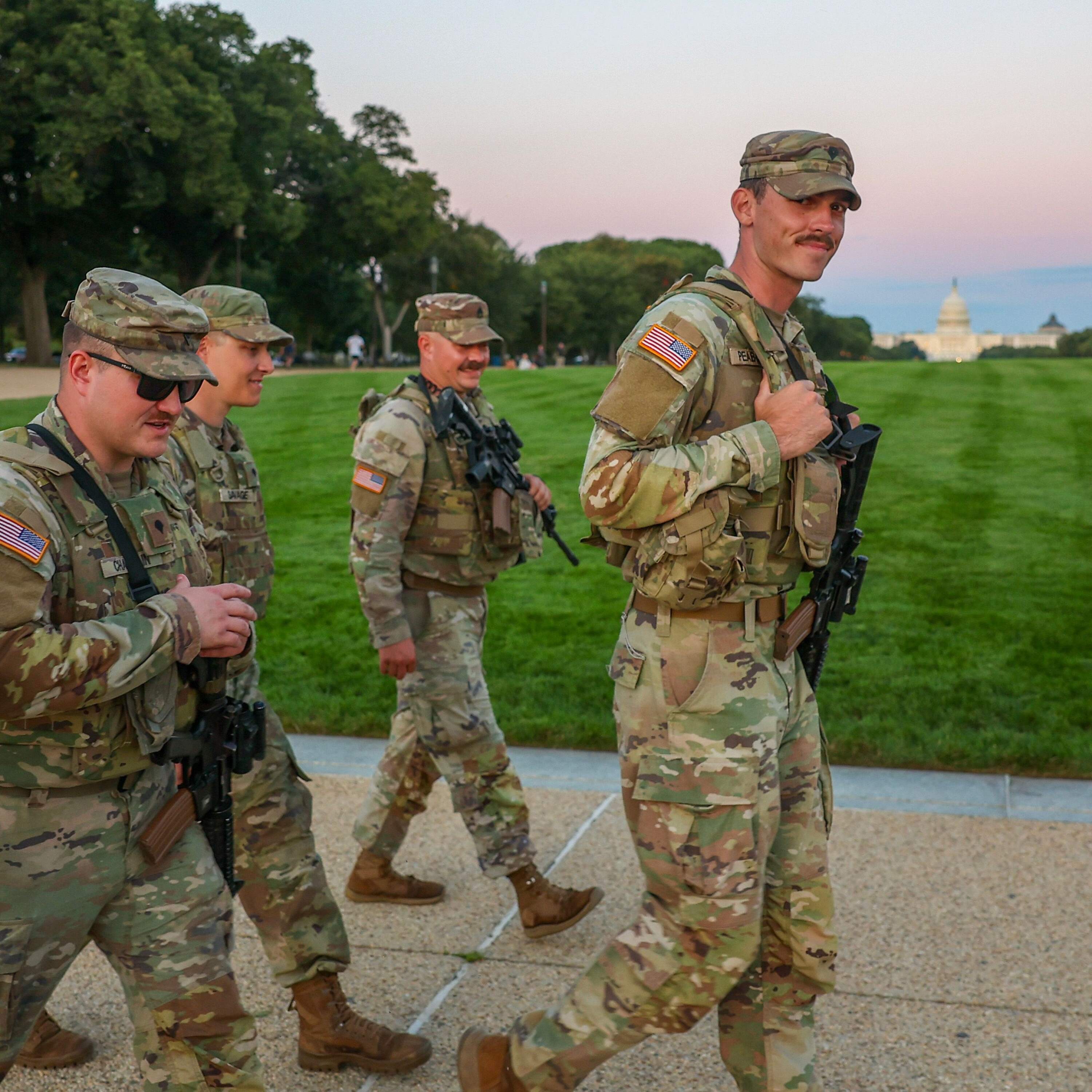
Loading summary
Transcript48 lines
- [00:00]
Ailsa Chang
For over two weeks, members of the National Guard have been walking the Streets of Washington, D.C. alongside federal law enforcement and local police. And as of a few days ago, the more than 2,000 National Guard troops in D.C. were authorized to carry weapons.
- [00:16]
Steve Vladek
Breaking overnight, members of the National Guard now carrying weapons on patrol in Washington, D.C. the move marking a major escalation in President.
- [00:25]
Ailsa Chang
It's all part of the federal crime. On what President Trump calls a, quote, crime emergency in the nation's capital. He's only escalated that rhetoric over the last two weeks. On Tuesday, he called for the death penalty for those who commit murder in Washington. Many residents in D.C. where there hasn't been an execution in over half a century, aren't buying it.
- [00:46]
Justina Wilkins Jordan
I think that he wants to destroy the Democratic Party. He knows that he can go into these cities that runs by a Democrat and control it and say, hey, we don't need Democrats. They are not doing effective, effective job.
- [00:59]
Ailsa Chang
Justina Wilkins Jordan lives in D.C. s Deanwood neighborhood where she says she does hear of shootings, violent fights and drug transactions and she would like to see more law enforcement on the streets. But she has not seen any federal officers in her neighborhood and doesn't trust the president's motives here. She spoke to NPR's Frank Langford.
- [01:21]
Unnamed Resident
If President Trump were sitting in this chair right now, what would you tell him?
- [01:25]
Justina Wilkins Jordan
I would say President Trump, sit down and listen. It's not all about you and the Republicans. You can't control the world. I feel that right now, the reason why he's doing it because he definitely want to be a dictator.
- [01:39]
Ailsa Chang
Now, crime obviously does occur in Washington, D.C. but recent Justice Department statistics show that violent crime in the city hit a three decade low in 2024. Ryan Wong, who lives in the city's U Street neighborhood, says this summer doesn't feel any more violent or dangerous than any other summer.
- [01:58]
Ryan Wong
I think the idea that this is some, like, state of emergency that we're living in, it's not how I feel and I don't think it's how the people that we know here feel.
- [02:08]
Ailsa Chang
Nearly 8 in 10 people in Washington oppose Trump's executive order to federalize law enforcement in the city, according to a recent poll by the Washington Post. And yet President Trump has openly suggested that he will send the National Guard into other cities, citing high crime.
- [02:25]
Unnamed Resident
You look at Chicago, how bad it is. You look at Los Angeles, how bad it is. We have other cities that are very bad. New York has a problem. And then you have, of course, Baltimore and Oakland.
- [02:38]
Ailsa Chang
On NPR's Morning Edition, Chicago Mayor Brandon Johnson rejected Trump's threats to deploy the National Guard to his city.
- [02:45]
Brandon Johnson
Community safety is my number one issue. The city of Chicago is not calling for American troops to occupy American cities. It's not democratic. It's unconstitutional. It's illegal and costly.
- [03:00]
Ailsa Chang
Consider this the Trump administration says it may deploy the National Guard to other Cities Beyond Washington, D.C. can the president legally do that? From NPR I'm Ailsa Changing.
- [03:22]
NPR Announcer
Support for.
- [03:22]
Jay Kalik
This podcast and the following message come from Made in Cookware President and co founder Jay Kalik shares the key ingredients that go into Made in products.
- [03:31]
We try to design products that are going to last you an incredibly long time. And to know that we're making this in places that take the raw material seriously, take the manufacturing processes seriously, that's ultimately what's going to allow us to sleep better at night selling this product to you.
- [03:47]
Learn more about Made in Cookware at M a d e I-n cookware.com this.
- [03:53]
NPR Announcer
Message comes from NPR's sponsor, Shopify. No idea where to sell? Shopify puts you in control of every sales channel. It is the commerce platform revolutionizing millions of businesses worldwide. Whether you're a garage entrepreneur or IPO ready, Shopify is the only tool you need to start, run and grow your business without the struggle. Once you've reached your audience, Shopify has the Internet's best converting checkout to help you turn them from browsers to buyers. Go to shopify.comshopify to take your business to the next level. Today.
- [04:28]
Ailsa Chang
It'S Consider this from npr. One common question that keeps coming up as the National Guard patrols the nation's capital is how, on what legal basis can the Trump administration do this? Well, Steve Vladek, a Georgetown University law professor, answers that question for us.
- [04:45]
Steve Vladek
I mean, so there really are two different authorities he's relying upon with regard to the D.C. national Guard folks who are here in D.C. all year. The president is always the commander in chief of the D.C. national Guard. He can use them at any time. He doesn't need anyone's permission. But he's also relied upon out of state National Guard troops that have been sent by a bunch of red state governors under a really obscure and not well tested authority that was enacted by Congress in 2006, it's really that authority that's a much bigger deal. If President Trump really does try to take the show on the road.
- [05:20]
Ailsa Chang
And Trump has said that his decision to deploy any National Guard troops is to fight crime, even though D.C. police data shows a double digit drop in violent crime rates the last few years. What is the National Guard allowed to do when it comes to local crime?
- [05:35]
Steve Vladek
This is where things get really, really sticky because of the uniqueness of D.C. in D.C. the National Guard has much broader power than it has almost anywhere else in the country. Because in D.C. it is always federal, it's always active under the command and control of President.
- [05:52]
Ailsa Chang
Right.
- [05:53]
Steve Vladek
In other states, in California, in Illinois, in New York, the only way President Trump could directly command the National Guard would be to formally federalize it. And that depends upon President Trump finding various things to be true on the ground that also don't appear to be true on the ground. And that would expose whatever he would try to, I think, a significant risk of litigation.
- [06:15]
Ailsa Chang
Okay, what happens to the president's authority to federalize the National Guard in parts of the country outside of D.C. when there is local pushback, like here in Los Angeles, where I am all the pushback from the mayor here and the governor did not stop Trump from federalizing the California National Guard and sending active duty Marines into LA earlier this year. And now Trump is saying more cities like Baltimore, like Chicago are next. But mayors of both of those cities and the governors there are saying no. So what allows the president to disregard the wishes of those officials?
- [06:49]
Steve Vladek
Federal law since at least 1807 has allowed the president in some circumstances to send troops in to states whether or not the governor consents. And, you know, we saw that put to good use a lot during the civil rights movement, for example, when President Eisenhower sent troops into Little Rock, Arkansas, to, you know, desegregate Central High School. The tricky part here is that what President Trump did earlier this year in California was based on his assertion that the federal forces were necessary to defend federal property and federal personnel to witness ICE officers who are going on raids in Los Angeles. He needs that kind of a target. He needs that kind of a sort of predicate. Or some broader argument that local civilian authorities have been unable to enforce the laws on the books before the law would allow him to federalize, say, the Illinois National Guard and send it into Chicago.
- [07:46]
Ailsa Chang
What specific legal arguments could city and state leaders make to challenge the Trump administration in court?
- [07:52]
Steve Vladek
So, you know, again, I think there are two different authorities he could use in these arguments will depend upon which one it is. So if President Trump tries to federalize, let's say again, the Illinois National Guard, just as one example, one of the arguments will be that the factual predicates for federalization are not present, that, you know, he didn't have the authority because there was Just no need for it. Another argument, and one we've seen in the California case already, is that even if President Trump has the authority to federalize the Illinois National Guard, he doesn't have the authority to send them into the streets to do ordinary law enforcement, that they can only do limited missions like protecting federal property or federal officers. If it's the other authority, if it is the, you know, weird 2006 statute that allows state governors to send their national Guards at their own volition into other states.
- [08:43]
Ailsa Chang
Yeah.
- [08:44]
Steve Vladek
To support a, quote, federal mission, unquote, then I think the arguments are going to be that you have to have the consent of the receiving state governor, or else you have a massive violation of the equality of states rights under the Constitution.
- [08:58]
Ailsa Chang
Well, just historically speaking for context here, explain why the US has always tried to draw some clear lines between the military and domestic law enforcement.
- [09:09]
Steve Vladek
Yeah, I mean, if we go all the way back to the founding of this country, you know, one of the charges against King George III that was leveled in the Declaration of Independence was that he was using, you know, the military to effectively supplant civilian rule in the colonies. This is why, for example, the Constitution prohibits the quartering of troops in our homes in the Third Amendment. Congress really, since 1792, has said, we recognize there are going to be some circumstances, some emergencies, in which the president's really going to need to be able to use troops on the home front, maybe to repel invaders or to suppress an insurrection. But, you know, those authorities have historically been used sparingly. We haven't even seen those authorities used since 1992, when President Bush used this statute called the Insurrection act to send troops into Los Angeles during the Rodney King riots. For President Trump to cross that line in a context in which there is such significant contestation of the factual basis, and in which it really does seem to be about partisan politics and not public safety, is not just challenging those legal precedents. It really is challenging the very, very strong norm we have in this country that we don't have the military doing law enforcement.
- [10:24]
Ailsa Chang
Well, short of the courts, is there anything stopping the President of the United States from declaring an ongoing emergency and leaving troops on the streets of D.C. indefinitely?
- [10:35]
Steve Vladek
So, not on the statutes as they are currently written. Now, you know, someone has to pay for all of this, so presumably there's gonna be a budgetary constraint at some point along the way. But, you know, for better or for worse, and I would argue for worse, Congress has given the President an awful lot of power over the District of Columbia. You know, reflecting a series of historical and structural quirks about the nation's capital. I think the most important point for folks to take away from that is that doesn't mean that the same things will be legal if and when President Trump tries them in other cities. You know, just because we're getting conditioned to and desensitized to visuals of National Guard troops in Union Station and on the National Mall doesn't mean we should feel the same if you see that in, you know, Times Square or Grant Park.
- [11:22]
Ailsa Chang
Steve Vladek of Georgetown University Law center, thank you very much.
- [11:26]
Steve Vladek
Thank you.
- [11:28]
Ailsa Chang
This episode was produced by Brianna Scott. It was edited by Patrick Jaran Watanan. Our executive producer is Sami Yenigun. It's CONSIDER THIS from npr. I'm Ailsa Chang.
- [11:45]
UP First Host
Americans are living longer than ever before. On the Sunday Story from UP first, we look at a growing number of people using these extra years to find new meaning.
- [11:54]
Ailsa Chang
You get to the point where you start asking, what did you do in your life that was significant?
- [12:00]
UP First Host
A look at the transformative power of human passion and finding your purpose in the third act of life. Listen now on the upverse podcast from npr.
- [12:09]
Ailsa Chang
On the next through line from npr.
- [12:12]
Justina Wilkins Jordan
She becomes, for lack of a better.
- [12:14]
Ailsa Chang
Word, a Tupperware queen.
- [12:16]
Unnamed Resident
It just never seemed to occur to.
- [12:18]
Steve Vladek
Her that her growth in any endeavor could be stunted because she happened to.
- [12:23]
Ailsa Chang
Be a woman, the Tupperware tycoon Brownie Wise. Listen to Throughline in the NPR app or wherever you get your podcasts.
- [12:32]
NPR Announcer
Us want to hear this podcast without sponsor breaks? Amazon prime members can listen to Consider this Sponsor free through Amazon Music. Or you can also support NPR's vital journalism and get Consider this +@ +npr.org. that's +npr.org.