← Consider This from NPR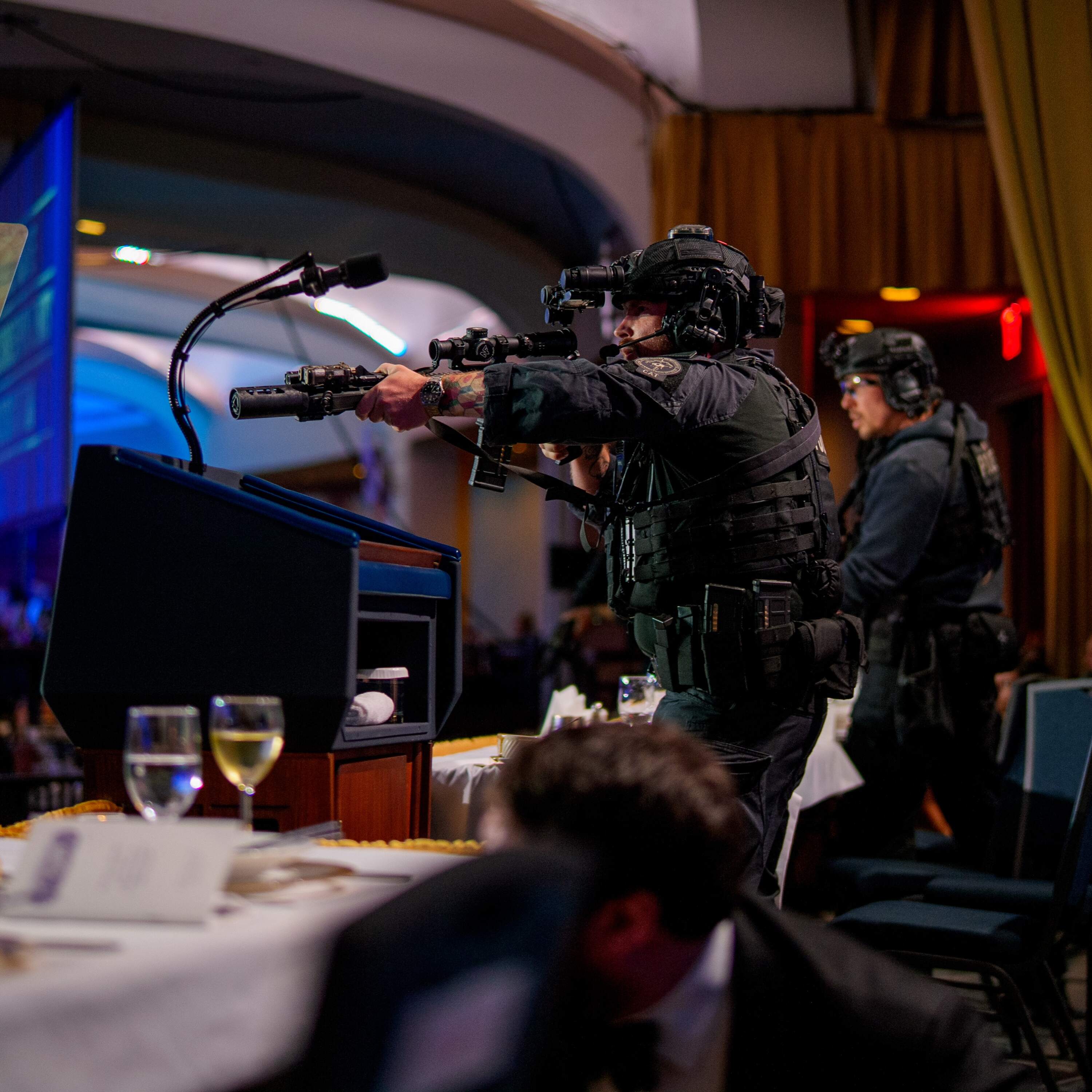
Loading summary
Transcript34 lines
- [00:01]
Scott Detrow
It's consider this where every day we go deep on one big news story. At this moment, few hard details are known about what authorities are calling an assassination attempt on President Trump at the White House Correspondent's Dinner in Washington Saturday night. But here is what we do know.
- [00:16]
Jeff Carroll
At approximately 8:36 tonight, an individual charged a US Secret Service checkpoint here in the lobby area of the hotel. He was armed with a shotgun, a handgun and multiple knives. As he ran through that checkpoint, members of law enforcement from the United States Secret Service intercepted that individual.
- [00:35]
Scott Detrow
That's Jeff Carroll, interim chief of police for the Metropolitan Police Department speaking Saturday. The individual he referenced has now been identified as 31 year old Cole Allen of Torrance, California. Meanwhile, inside the ballroom, Trump, Vice President Vance, cabinet members, lawmakers and press were having dinner and guests heard muffled popping sounds. NPR's Domenico Montanaro was also there.
- [01:00]
Domenico Montanaro
Well, a really disorienting moment here at the White House Correspondent's Dinner, the first time that President Trump has been at a White House correspondent's Dinner. And we wound up with shots fired inside.
- [01:13]
Jamie Raskin
I ended up hitting the ground with everybody else.
- [01:16]
Scott Detrow
Among them was Congressman Jamie Raskin of Maryland. He spoke to NPR Monday.
- [01:20]
Jamie Raskin
We were down on the floor for around two to three minutes before people began to get up. And we were told that, you know, there was some somebody who they got.
- [01:31]
Domenico Montanaro
Make no mistake, this was an attempted assassination of the president of the United States with the defendant making clear what his intent was. And that intent was to bring down as many of the high ranking cabinet officials as.
- [01:49]
Scott Detrow
That's Jeanine Pirro, the U.S. attorney for the District of Columbia, speaking Monday at a press conference. Consider this 48 hours into the investigation. Few details are known about what transpired Saturday and why, but that is not stopping conspiracy theorists from filling in the blanks. From npr, I'm Scott Detrow.
- [02:14]
Tom Bowman
Every day, NPR reports stories that keep you informed without fear or favor. That's the promise of a free press in a democracy. It's in the First Amendment. I'm Tom Bowman and I cover the Pentagon for npr. Stand up for independent news coverage today by donating early for public media giving days coming up on May 1st and 2nd. Give now at donate.npr.org.
- [02:44]
Scott Detrow
It's consider this from npr. Within minutes of the news of a shooting at the White House Correspondents Dinner last weekend, people claimed on social media the incident was staged. To be clear, these were conspiracy theories not supported by what we know about the suspect. But the most common of these theories claim the shooting was orchestrated in an effort to somehow boost President Trump's plans for a new White House ballroom. It isn't surprising that rampant speculation would instantly surround an act of apparently politically motivated violence. But this incident suggests that voices on the left are increasingly engaged with conspiracy theories. Molly Olmsted is a staff writer with Slate and has been following this and joins us now. Welcome.
- [03:25]
Molly Olmsted
Thank you. So happy to be here.
- [03:26]
Scott Detrow
Let's just start with the last few days.
- [03:28]
Interviewer
Run us through some of the most popular conspiracy theories surrounding this latest shooting.
- [03:33]
Molly Olmsted
Pretty much immediately when this shooting happened, the first way that people processed it was by expressing suspicion. Pretty quickly, there were some dominant narratives that happened on the left. One was just that this is sort of something that Trump arranged to boost his polling. People tried out talking about Israel's involvement and things like that, which is pretty, pretty typical for any time you have conspiracy theories. The reason that the ballroom narrative was the one that stuck so quickly was that the president himself did quickly talk about how this was a justification for his ballroom. So he handed his opponents sort of a theory, an argument that they could make.
- [04:22]
Scott Detrow
It's such an Occam's Razor thing. Like, the straightforward thing is somebody who had a deep opposition to Trump or
- [04:28]
Interviewer
whoever the target is, who in many cases has serious mental health challenges, tries
- [04:34]
Scott Detrow
to act in a violent way. That's a straightforward thing that is often happening, and yet people drift to the
- [04:40]
Interviewer
most convoluted scenario they can think of.
- [04:43]
Scott Detrow
Like, why do you think that keeps happening?
- [04:45]
Molly Olmsted
Yeah, I mean, I think the reason this has now become such a uniform reaction on the left is that social media has incentivized this in terms of this sort of attention economy that we're in. You also have a populace that is just really feeling powerless in a way that they didn't during the first Trump administration. And here I'm talking about sort of the liberal opposition, and people have just been worn down by the sort of relentless lying that does come out of the Trump administration. Which is not to say that I think it is justified to have these conspiracy theories, but I do think that at this point, this is just how people process information.
- [05:34]
Scott Detrow
What's the best way to think about
- [05:35]
Interviewer
the way that this seems to have spread on the left just as much as the right in recent years?
- [05:40]
Molly Olmsted
It is fair to say that until recently, it has been largely the purview of the right. And still, to be clear, I do think that the right and the left are different when it comes to conspiracy theories, largely because the right has politicians who spread these conspiracy theories themselves. There are are also a lot of really large social media influencers that really push these conspiracy theories. I don't think there's as much of an equivalent for the left. That being said, I think there has been sort of a journey to some of this the way that a lot of these right wing conspiracy theories have started to creep over to the left in terms of that shared paranoid thinking and because of Israel, Palestine, actually, I think that there has been such an intense overlap over the conflict with Gaza that some of the same conspiracy theories that emerged originally from the right have taken root in the left. Even if they don't know that these are conservative conspiracy theories to begin with, there's a basic distrust that guides the left's reaction to any sort of chaotic event involving Donald Trump.
- [06:52]
Interviewer
You wrote in your piece, quote, conspiracy thinking is starting to overtake partisan thinking.
- [06:57]
Scott Detrow
Can you tell me a little bit
- [06:58]
Interviewer
more about what you mean by that?
- [07:00]
Molly Olmsted
Yeah. I think most remarkably, when we look at what's happening in modern American politics, you can look at what's happening within the rift in the MAGA movement where you have a lot of people who are defecting largely because of these sort of more geopolitical issues. So Israel, Palestine is one of them. We also have people who are quite frustrated about the war. And so you get these people, such as Candace Owens, who command these huge followings, who are saying, you know, I think we can't even trust the Republican Party anymore to tell us the truth. So for them, it's conspiratorial thinking that is their guidepost instead of what Trump is telling them to think.
- [07:44]
Interviewer
My personal view, and I'm curious if you agree or if you have a different take, is that it just seems like the way that algorithms increasingly drive content that appears in front of us, the way that AI has gotten more and more realistic, and the way that people are making money by being the most outrageous front facing person that they can be. It just seems hard to see how any of this gets better in the near future.
- [08:10]
Molly Olmsted
I'm gonna be honest with you, I don't see any way for it to get better. It just seems that this is the America we live in now. This is the reality we live in now. It seems to me that for the foreseeable future, the different political factions are gonna be operating not just on different views, but in entirely different realities.
- [08:34]
Scott Detrow
That was Molly Olmsted, staff writer at Slate.
- [08:37]
Interviewer
Thanks so much for talking to us.
- [08:38]
Molly Olmsted
Thank you.
- [08:40]
Scott Detrow
This episode was produced by Tyler Bartlam and Karen Zamora. It was edited by Patrick Jaron Watananan and Courtney Dorning. Our executive producer is Sami Yenigun. It's consider this from npr. I'm Scott Detrowed.