← Consider This from NPR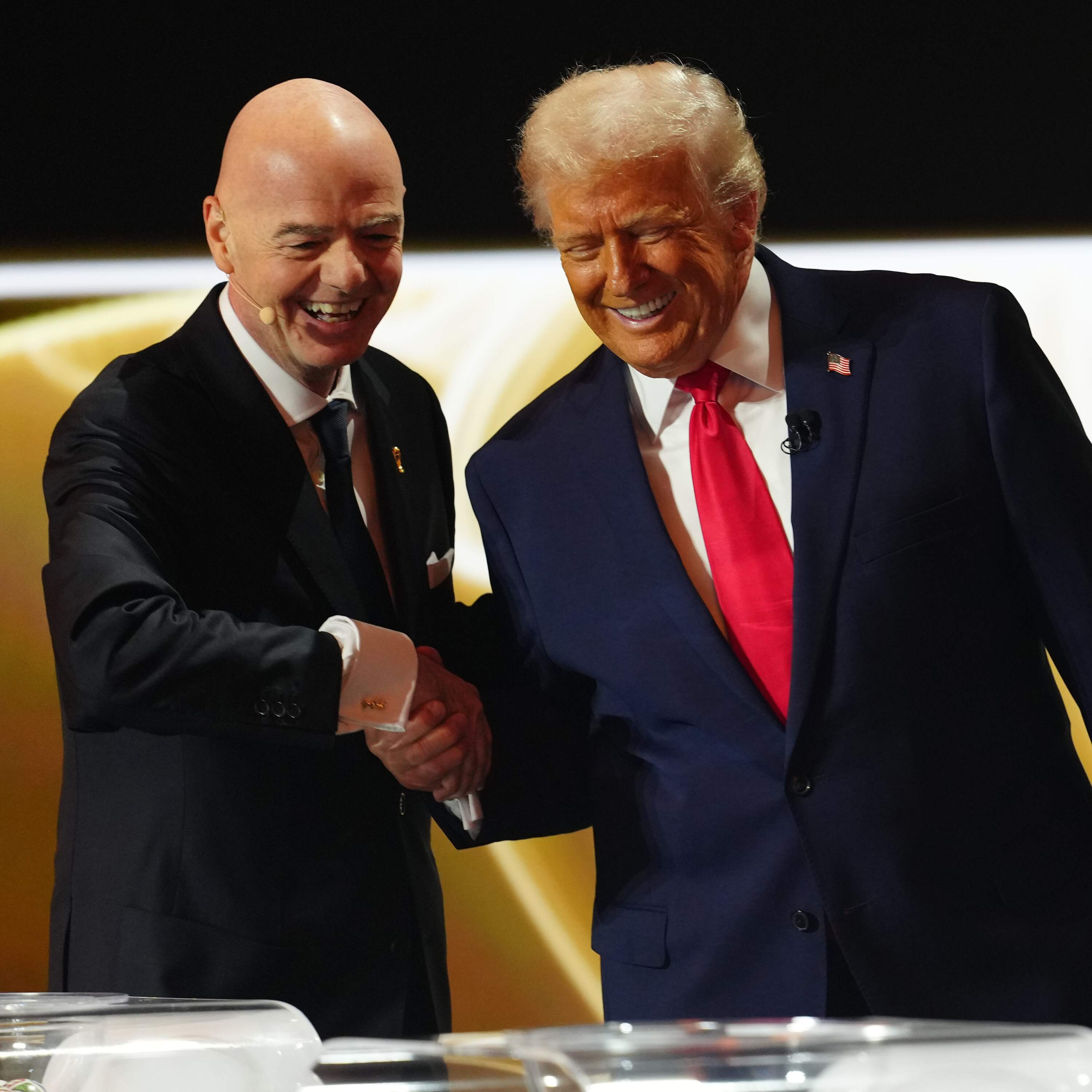
Loading summary
Transcript36 lines
- [00:01]
Scott Detrow
It's consider this where every day we go deep on one big news story today, a suspended red card and what it might say about political interference in soccer. During a World cup match on Wednesday, US Striker Florin Balogun and Bosnia Herzegovina's Tarek Muharimovic were fighting for the ball when Baligan stepped on the Bosnian defender's ankle and was given a red card. That meant Baligun, the U.S. team's leading scorer, would not be able to play in the next knockout match. Typically, a red card cannot be challenged by the team according to rules set up by FIFA, the international governing body for soccer. Then President Trump called FIFA's president, Johnny Infantino. Here's Trump on Monday recounting the call.
- [00:43]
Donald Trump
But all I did, all I did, I asked for a review because I didn't think it was a foul. And you know, again, I'm good at this stuff. I didn't think it was a foul. I thought it was two great athletes that crashed into each other and got entangled. That was not a, that was not a guy punching somebody in the face or anything. That, you know, would be different.
- [01:01]
Scott Detrow
After the review that Trump requested, a stunning move. FIFA suspended the red card. Instead of sitting out Monday's match against Belgium, Baligan would be placed on probation for one year. And that meant a key player would be on the pitch for the biggest game in U.S. soccer history. Here's trunk again.
- [01:19]
Donald Trump
And they made the right decision because, number one, it wasn't a foul. And you want to see a game with your best players.
- [01:24]
Interviewer (NPR Host)
But not everybody sees it that way.
- [01:26]
Scott Detrow
The European soccer federation UEFA says that FIFA crossed a red line by suspending the red card. Consider this. The reversal has been the talk of the soccer world and has resurfaced discussions about FIFA and corruption. Is this uncharted territory? From NPR, I'm Scott Detrow.
- [01:55]
Short Wave NPR Science Podcast Host
As America marks 250 years, remember, we the people make a free press possible. Together, we hold the powerful to account with reporting for the public, funded by the public@plus.npr.org this week on Short Wave, could your next ride to the airport be in a flying taxi?
- [02:15]
It's Been a Minute Podcast Host
So you open up your Uber app and you've got UberX and Uber Pet, and now there'll be Uber Air.
- [02:21]
Short Wave NPR Science Podcast Host
That reality may be only a few years away, but how is this futuristic travel possible? Find out on Short Wave NPR Science Podcast. Listen on the NPR app or wherever you get your podcasts.
- [02:35]
Peter Sagal
Hi, it's me, Peter Sagal, host of Wait, Wait, don't tell me, it's summer and if you want to turn your pool party into a nerdfest, check out our news quiz. We got comedians, we got celebrities, we got games to help you laugh about the week's news. Yeah, that news, it'll be just like we're all hanging out at your backyard barbecue. You listen every week to. Wait, wait, don't tell me. On the NPR app or wherever you get your podcasts,
- [03:03]
Scott Detrow
It's Consider this from NPR Sports is very often about more
- [03:07]
Interviewer (NPR Host)
than what happens on the field, and that is definitely the case with today's World cup round of 16 match between the United States and Belgium. We are talking, of course, about FIFA's decision to allow US striker Folarin Baligan to play in today's game, delaying a one match ban Baligan received following the
- [03:24]
Scott Detrow
red card for dangerous play that he
- [03:26]
Interviewer (NPR Host)
picked up in the previous game against Bosnia. The reversal by soccer's global governing body has been widely criticized ahead of today's match. Franklin Foer is a staff writer for the Atlantic and someone who has written and spoken a lot about the mix of politics in soccer. He is also the author of How Soccer Explains the World and joins us now. Welcome.
- [03:45]
Franklin Foer
Hi.
- [03:46]
Interviewer (NPR Host)
What, if anything, of all this surprised you?
- [03:50]
Franklin Foer
The overtness of it all. I mean, I know that Donald Trump likes to boast about how he's able to shift outcomes in order to claim credit for something that I think he believes will make him enormously popular here at home. He's just trumpeted the fact that he has his kind of used his relationship with FIFA and Gianni Infantino in order to get this decision that he wants. And so it's there's nothing that's happening underneath the table in close, behind closed doors. This is all happening out in the wide open.
- [04:20]
Interviewer (NPR Host)
How does this compare? Before we talk a little bit more about the moment, just putting in this context, how does this compare to what I think would widely reviewed as run of the mill corruption that often comes along with FIFA decision making over the years?
- [04:32]
Franklin Foer
All right. So we have to say that this is perfectly consistent with FIFA's and soccer's long history of political leaders trying to shape the outcomes of World cup soccer matches. If we went back to 1934, there are stories about Benito Mussolini having dinner with the referee who was refereeing Italy on the eve of that World cup final. And there are instances of military dictatorships in Brazil and Argentina bringing political pressure to bear on World cup refereeing decisions and the like. And so this isn't novel. It hasn't happened for many, many decades, which is why it feels like it's kind of this shock to the system, and it's coming out of the blue. And the fact that it's happened before doesn't mean that it's acceptable this time.
- [05:18]
Interviewer (NPR Host)
You had written about the fact that Donald Trump, that President Trump had really attached himself to FIFA, attached himself to this World cup, tried to make it a personal branding thing, and yet over the last few weeks, he had receded from the scene. There was such a focus on the amazing play so far.
- [05:34]
Scott Detrow
Now, to you, is this World cup
- [05:36]
Interviewer (NPR Host)
all about what Trump did, at least in this moment? Yeah.
- [05:39]
Franklin Foer
I mean, one of the things that's so amazing about a World cup, if we just flashback before this whole fiasco occurred, was the way in which the game is so profoundly equalizing that on. On this weekend, we watched Cape Verde, a country with half a million people, go toe to toe with Argentina, which is one which is Lionel Messi, the greatest player perhaps of all time, and has won all these World Cups. And they were able to face each other on the soccer pitch. And there were. There was nothing that separated the two teams. Their population, size, their political power didn't matter. But then to have a country's political power affecting the outcome in this tangible way, even if the decision was in isolation, just. There's something called the rule of law, and we know about this in our own court system, and it happens in sports as well, that there is a set of procedures that the red card was called on the field by the referee. It was reviewed by the video assistant referee, and that's a final decision. And we, whether we like the outcomes of elections or court decisions, part about being a citizen of a system is that we have to accept the results. And the FIFA system didn't allow for any possibility for appeal. And then Trump's, because he has this long relationship with FIFA and Infantino, he's able to wield his power in order to get the outcome that he desires that's not available to any other nation in the world.
- [07:07]
Peter Sagal
Yeah.
- [07:08]
Interviewer (NPR Host)
On the other hand, Trump is not alone.
- [07:10]
Franklin Foer
On the other hand.
- [07:11]
Interviewer (NPR Host)
On the other hand. I guess there's several on the other hand here, but let's take one of them. Trump is not alone in saying this was a pretty dubious call to begin with. Does that factor into how you're thinking about this at all?
- [07:22]
Franklin Foer
Well, when I first saw the notification on my phone that this was being overturned, my first reaction was, justice has been served. Because I was fuming after Baligan got that red card. It felt to me like a pretty dubious Red card, maybe even a dubious yellow card. And I was. I was jumping with joy. And then I started to think through the implications of everything that had happened and the way in which this is going to blow back on the U.S. national team. So if they win tonight with Baligan on the pitch, it's going to taint that victory in the eyes of the world. And so that, that makes. The more I thought about it, it didn't take me too long, but the more I thought about it, the more deeply uncomfortable I felt, but also just sad. Sad that this thing that's been such a marvelous experience is this great festival of unity with the Scots coming in and drinking Boston dry, with the way in which all these fans have come to this country and rediscovered their affection and love for America, even for ranch dressing. And then to have that all kind of come crashing down because of this one moment, it really undermined something that was. That was. It felt pure and good.
- [08:36]
Interviewer (NPR Host)
All right, so Franklin Foer, let me ask you this. You have thought a lot about all of the conflicting storylines we're talking about right now. You are also cheering for the US Men's national team. As a fan, what to you is the best case scenario for tonight's match, given all of this?
- [08:53]
Franklin Foer
There is no best case scenario anymore because I still want these guys to win. I really like this team. And the way that they've played over the course of this tournament has been so. Has just been so dazzling. They've played with swagger, they've been entertaining. It's been a really joyous thing to watch this team and the way that they've connected to fans and the way that they've connected the non soccer following universe to the soccer following universe. And so I don't want them to fail. I still want them to succeed. I would love it if some of the players could maybe speak out and say something that. That distances themselves from this. This advantage that they've had. But I fear what's going to happen is that this is just going to open up. You know, this is. This is occurring in a political context where Europe and the United States are drifting away from one another on so many other fronts. And it seems like Europe is kind of seized on this as an example of the way, you know, correctly. So it's the way the United States under Trump has thrown around its power. And so it's just again, so devastating to see something that could have bridged a divide become another flashpoint that's going to separate us.
- [10:13]
Interviewer (NPR Host)
Franklin Foyer, staff writer for the Atlantic also the author of How Soccer Explains the World. Thank you so much.
- [10:20]
Franklin Foer
Thank you.
- [10:22]
Scott Detrow
This episode was produced by Jeffrey Pierre and Karen Zamora, with audio engineering by Ted Mebane and Tiffany Vera Castro. Our director is Kai McNamee. It was edited by William Troup and Timbit Armias. Our interim executive producer is Courtney Dorning. It's Consider this from npr.
- [10:42]
Interviewer (NPR Host)
I'm Scott Detrow.
- [10:44]
It's Been a Minute Podcast Host
Every episode of it's been a minute. NPR's what's Happening in Culture podcast starts by asking three questions. Who? How? Why? Now? If the culture's asking it, we're talking about it. At npr, we stand for your right to be curious and indulge your cultural curiosity. Follow It's Been a Minute wherever you get your podcasts and we'll break down the zeitgeist y topics that are filling your feed.
- [11:08]
Short Wave NPR Science Podcast Host
Every story from shortwave NPR Science Podcast starts with a question like, why do we have nightmares? How does AI affect my energy? Bill at npr, we are here for your right to be curious about the world around you. Follow Short Wave wherever you get your podcasts because the more you ask, the more interesting the world gets.