Loading summary
Transcript50 lines
- [00:01]
A
What's playing out right now in Charlotte, North Carolina, is following a script that's become familiar. Federal agents flood into cities for massive enforcement sweeps. Videos pop up on social media showing masked agents in unmarked cars arresting people who appear to be going about their daily lives. Local elected officials loudly object, but the raids continue. The Trump administration says this is about enforcing the law against people in the country illegally. Here's Homeland Security Secretary Kristi Noem last month.
- [00:32]
B
They are on the books. They were put in place, voted on and instituted, and therefore we enforce them all. If members of Congress, senators, governors, don't like the law, then they should go through the work of changing them.
- [00:44]
A
Even though these raids are happening in local communities, immigration law sits squarely within the jurisdiction of the federal government. You could hear that tension in my interview with Gavin Newsom, the Democratic governor of California this summer. This was in the midst of a federal immigration crackdown in Los Angeles. Newsom condemned the raids, but he also said this. We do not impede upon federal authority to enforce federal law with federal resources.
- [01:09]
C
Period.
- [01:10]
A
Full stop. That's the state of California. Without the authority to stop the immigration operations. State and local politicians have tried to limit their impact in other ways. California passed a state law that bans most law enforcement officers from wearing masks. The Trump administration has sued to block it. In Illinois, Democratic Governor J.B. pritzker established an accountability committee mission to document alleged abuses by federal immigration authorities.
- [01:37]
D
There will come a time where people of good faith are empowered to uphold the law. When the time comes, Illinois will have the testimony and the records needed to pursue justice to its fullest extent.
- [01:51]
A
Other politicians have focused on preparing their communities. Here's Democratic Congressman Mike Quigley, whose district includes parts of Chicago.
- [01:59]
E
What we can do is tell people what's happening. My office has created an immigration protection kit, making sure people have completed privacy release forms so that our staff can assist them. We also can find information about finding friends and family who might have been detained.
- [02:17]
A
And Quigley told npr there's another tool available when the political process protest.
- [02:23]
E
I always endorse peaceful protesting. Now's the time to step up and let people know just how serious this has gotten. This is a president who has weaponized the tools of democracy.
- [02:38]
A
Consider this. When federal immigration authorities deployed in Chicago, one neighborhood was already prepared to resist. A group of activists thinks they have a blueprint other cities can follow to disrupt the Trump administration's mass deportation effort.
- [02:54]
E
Foreign.
- [02:58]
A
From NPR, I'm Juana Summers.
- [03:02]
C
This message comes from AT&T. America's First Network is also its fastest and most Reliable based on RootMetrics United States Root Score Report 1H 2025 tested with best commercially available smartphones on three national mobile networks across all available network types. Your experiences may vary. Rootmetrics rankings are not an endorsement of ATT or when you compare, there's no comparison.
- [03:26]
B
AT&T this message comes from MIDI Health.
- [03:30]
F
Women in midlife face a healthcare desert, but MIDI is here to fill the gap, offering expert care for perimenopause and menopause covered by insurance. Hot flashes, insomnia, brain fog, weight gain and moodiness don't have to be accepted as just another part of aging. MITI clinicians understand how these symptoms can connect to menopause and prescribe a wide range of solutions. Book your visit today@joinmidi.com that's joinmidi.com this.
- [03:56]
C
Message comes from Wise, the app for using money around the globe. When you manage your money with Wise, you'll always get the mid market exchange rate with no hidden fees. Join millions of customers and visit wise.com Ts and Cs apply.
- [04:17]
A
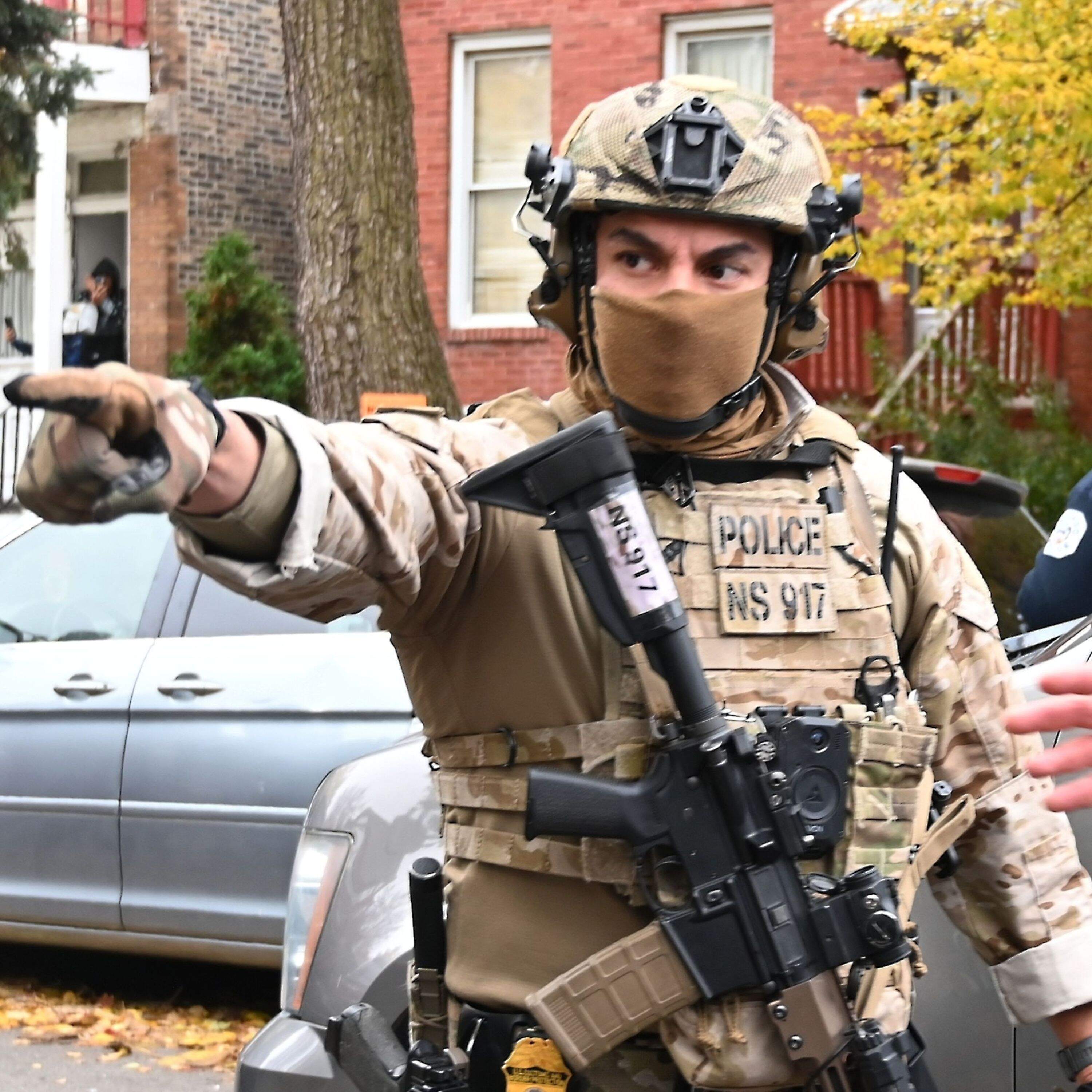
It's Consider this from NPR when it launched Operation Midway Blitz in September, the Trump administration said it was going after, quote, the worst of the worst criminal illegal aliens in Chicago. But the impact of this campaign has touched the lives of citizens and noncitizens Deeply. Heavily armed federal agents have deployed tear gas outside schools, shot pepper guns in residential areas, prompted schools to go into lockdown. The resistance to the immigration authorities has been fierce, and that is in part because some activists have been preparing, preparing for this moment for years. NPR's Odette Youssef went to see how it played out. In one Chicago neighborhood on the Monday.
- [04:58]
B
After Halloween, it was clear that federal agents were mobilizing for a morning of raids in and around the Chicago neighborhood of Rogers Park.
- [05:06]
G
You have a gas mask in your.
- [05:08]
B
Back when this happens. Jill Garvey and Gabe Gonzalez are ready to jump into a car at any moment.
- [05:14]
G
Nissan Peterson White GMC Denali, FL plates DQ.
- [05:19]
D
Which one?
- [05:20]
G
Then there's horns.
- [05:22]
B
Yeah, let's go. A blizzard of encrypted text messages had already broadcasted to rapid responders in the neighborhood. Information about a vehicle seemed to have federal agents inside. Gonzalez and another car make noise to warn people that ICE is in the neighborhood. He pulls up quickly to a biker who's also in pursuit.
- [05:44]
D
Don't get that close to them.
- [05:46]
B
They'll grab you on the sidewalk. Pedestrians are blowing whistles when the cars stop for a red light. One of them, a woman, runs into the street.
- [05:55]
D
Get that close. Do not get that.
- [05:57]
B
No, no, no, no, no. She bangs angrily against a window of the agent's vehicle.
- [06:01]
D
Get back. Come back.
- [06:02]
B
Come back. Come back. Come back.
- [06:03]
D
Come back. No, no, no, no, no, no, no.
- [06:06]
B
The other car in pursuit peels off. Gonzalez follows the agents as they turn west, but he eventually peels off, too. At this point, they're out of his neighborhood.
- [06:16]
D
It was just two agents in one car, but that car we have seen before involved in multiple abductions.
- [06:24]
B
Gonzalez is a co founder of Protect rp. RP stands for Rogers park, the neighborhood where he lives. Protect RP was launched in 2017 as a community defense network during Trump's first term. The goal was to bring the neighborhood together to resist an expected onslaught of federal immigration enforcement. In fact, that onslaught didn't happen, but now it has. And the infrastructure and strategy of Protect RP has become one model for communities across the country. Their guiding principle is to make the work of immigration enforcement as inefficient as possible.
- [07:03]
D
So that was 15, 20 minutes. I'm sure he has no intention of being where he is right now. So it's probably another 20 or, you know, another 10 or 15 minutes for him to get back. That's half an hour that he lost, right? That's half an hour where he's not going to grab somebody. That's all the time they have to pay him for not doing anything. The gas money, the. I'm sure they grabbed up our license plates, so they're going to have to have time to run all of that stuff and blah, blah, blah, and time and money, Time and money.
- [07:36]
B
Gonzalez has spent his career as a community organizer. Protect RP's team sees community organizing as exactly what's needed now when the stakes are higher than ever. Jill Garvey says they're not just standing against heavy handed immigration enforcement. They're also pushing back against what she sees as an authoritarian strategy that, unchecked, could ultimately eat away at the freedom and rights of everyone in this country.
- [08:05]
G
We often talk about places being sort of like linchpins for a region.
- [08:11]
B
Garvey is part of Protect RP's core team. She's also the founder of a nonprofit called States at the Core or Stack. Up until now, Stack has mostly worked outside of Chicago, in Tennessee or Ohio, for example. It supports local communities dealing with what it sees as authoritarian threats.
- [08:30]
G
It could be a very small town that is trying to fend off Christian nationalism, and they may be the thing that is standing in the way of that network or formation Gaining more influence in the region.
- [08:46]
B
In this moment, Garvey believes Chicago is a linchpin for the whole country.
- [08:51]
G
I think that what's happening here is an attempt to strengthen sort of a national police force and occupy a city for a long time, terrorize the city for a long time and make it normal so they can go and do that in a lot of other places.
- [09:07]
B
He can't breathe. He can't breathe. Three days before I met with Garvey and Gabe Gonzalez, it was Halloween. Illinois Governor J.B. pritzker had asked Homeland Security Secretary Kristi Noem to stand her agency down that weekend. Kids would be outside. Noam refused. It ended up being among the most violent days of this federal operation in the Chicago region. He's punching him in the face. He got three guys on him and he's touching him. Gabe Gonzalez witnessed it. He shows me the video he took. It was in Evanston, a suburb just north of Chicago. Federal agents were so active there that day, the schools canceled. Outdoor recession. Gonzalez and other residents were in cars following a vehicle that contained federal agents. They wanted to let people nearby know that immigration enforcement was close by. Gonzalez said the agents stopped suddenly and the vehicle behind crashed into them. A crowd formed as Border Patrol agents jumped out and pulled the occupants out of the damaged car behind them. Then, Gonzalez said, from amongst the crowd, a young white male ran up near the agents and they decked him. The video shows two agents kneeling down on the man's back, handcuffing him. As they pinned him down onto the street, a third agent punches the man's face again and again. Jesus Christ. The Department of Homeland Security claims the agents were aggressively tailgated by the vehicles behind them and that the young man had assaulted and grabbed an agent's genitals. So far, no video evidence has clearly shown that. DHS said three people were arrested, all U.S. citizens, and released without charges. Gonzalez and others in Protect RP say while many have been stunned by federal tactics in Chicago, they know that it's less surprising to communities of color. But Operation Midway Blitz has created a shared experience across a much broader spectrum of people. Gonzalez thinks the after effects will linger for a long time.
- [11:18]
D
They've radicalized a set of people through their own actions, and that'll be a generation before that goes away.
- [11:27]
B
DHS didn't respond to questions for this story, but speaking on Fox, Border Patrol Commander Gregory Bevino blamed the governor of Illinois and the mayor of Chicago for creating conditions hostile to immigration enforcement. And it's certainly a non permissive environment that's the goal of those working with Protect RP and similar networks, one that they hope other cities will also achieve. Odette Youssef, NPR News.
- [11:57]
A
This episode was produced by Connor Donovan and Megan Lim. It was edited by Andrew Sussman and Courtney Dorning. Our executive producer is Sammy Yenigun.
- [12:07]
B
Foreign.
- [12:15]
A
I'm Juana Summers.
- [12:17]
F
Support for NPR and the following message come from Ten Speed Press, publisher of star of the show My Life on Stage by Dolly Parton. A collection of personal stories, photos and more from a life spent center stage, available wherever books and audiobooks are sold. This message comes from GiveWell, a nonprofit that provides rigorous, transparent research to help donors make informed decisions about high impact giving. Join over 150,000 donors who've already trusted GiveWell to drive real impact.
- [12:48]
C
More@givewell.org support for NPR and the following message come from Indeed. Hiring do it the right way with Indeed's sponsored jobs claim a $75 sponsored job credit to get your jobs more visibility@ Indeed.com n terms and conditions apply.