Loading summary
Transcript24 lines
- [00:00]
A
Millions have watched the harrowing videos of federal immigration agents shooting and killing protester Alex Preddy in Minneapolis on Saturday. Most of the videos, like this one obtained by Reuters, begin like this. The agents approach Preddy and another person on a street. The confrontation quickly escalates as demonstrators yell. The agents pepper spray Preddy and the person next to him. They tackle him to the ground as he struggles. Then one agent shoots. Federal officials say Preddy had a handgun on his person. Here's Greg Bovino, head of Customs and Border Patrol. At a press conference on Saturday.
- [00:43]
B
During this operation, an individual approached U.S.
- [00:47]
C
Border Patrol agents with a 9 millimeter semiautomatic handgun. The agents attempted to disarm the individual.
- [00:55]
A
But he violently resisted. But videos of the scene show no indication that Preddy brandished the weapon and he was on the ground when an immigration agent shot him. The only interaction that we are aware of with law enforcement has been for traffic tickets, and we believe he is.
- [01:12]
C
A lawful gun owner with a permit to carry.
- [01:14]
A
That's Minneapolis Chief of Police Brian o'.
- [01:16]
D
Hara.
- [01:17]
A
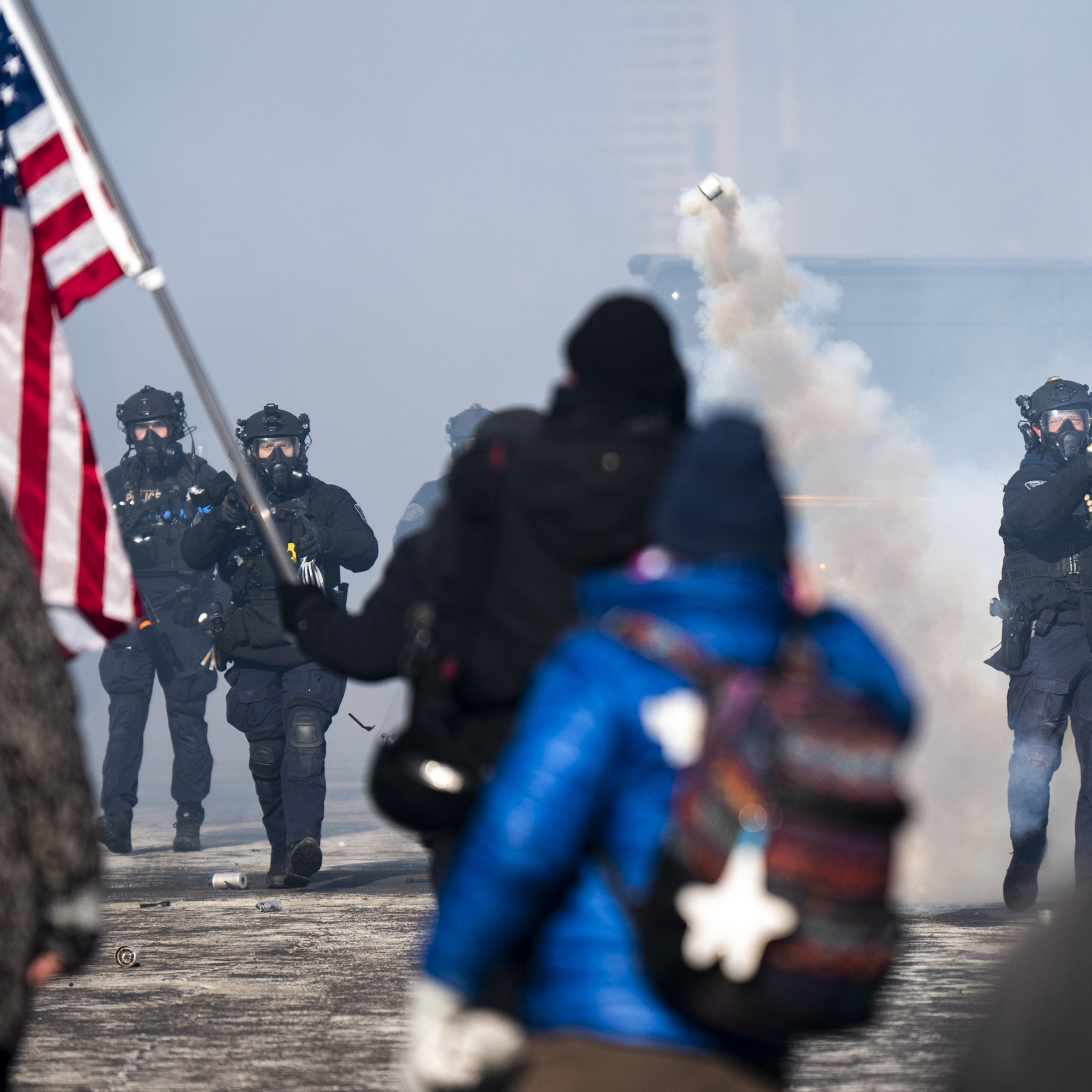
Saturday marks the second fatal shooting carried out by immigration agents in the Twin Cities in recent weeks. In the continued federal surge has sparked mass demonstrations. Those protests have overwhelmed the city's local police and sheriff's offices. Minnesota Governor Tim Walz activated the state's National Guard to assist with law enforcement efforts. Consider this the increasingly volatile situation in Minnesota has raised questions about the training of federal immigration agents and why they've acted so violently. Many have been hired en masse in recent months as the Trump administration scales up deportation operations. So how should law enforcement and federal immigration agents conduct themselves? From NPR, I'm Sarah McCammon.
- [02:18]
D
This message comes from BetterHelp. The new year isn't about doing more, it's about carrying less. Therapy can help you unpack what's been heavy and bring more clarity, calm and perspective into 2026. It's a small act that can lead to big relief and real perspective for the year ahead. You can't step into a lighter version of yourself without leaving behind what's been weighing you down. Visit betterhelp.com NPR for 10% off this message comes from Adobe. You need to make a huge presentation in an hour. Luckily, Adobe Acrobat Studio uses AI and Adobe Express to take your files and generate a presentation in a few clicks. Need a last minute pitch deck? Do that with Acrobat. Need to level up your presentation design? Do that with Acrobat. Have 30 plus documents that need to be simplified into a proposal? Do that with Acrobat learn more@adobe.com do that with Acrobat.
- [03:22]
A
It's consider this from NPR News. Chuck Wexler is the executive director of the Police Executive Research Forum and a police reform expert. He says the Border Patrol and ICE agents operating in Minneapolis aren't using the kinds of de escalating tactics that local police have been using for at least a decade. Well, Wexler watched the video of Customs and Border Patrol agents shooting Alex Preddy. I asked him how federal agents should be trained to de escalate a potentially violent situation.
- [03:51]
B
I mean, I think this, this is a very important question because in Minneapolis they've had three agent involved shootings in the last three weeks. If a police chief had three officer involved shootings in three weeks, I can tell you they would be number one. They'd say, what are we learning from these situations? How can we handle these differently? It's very important, for example, that departments have strong policies and tactics. Very important in all of these situations. In Minneapolis, tactics have played a role.
- [04:24]
A
How do you assess ICE's policies and tactics when it comes to these kinds of situations?
- [04:29]
B
Well, I mean, this is a really good question because this is an urban environment. This is different than most of the environments that ICE and Border Patrol face. And in an urban environment, you have, you know, you have to know the community. You have to be able to work with the community. You know, American police have faced the daunting challenge of officer involved shootings over the last 10 years. And one of the things they've learned is sometimes you have to slow things down, use time and distance and communicate. They, there's very little communication in that video that you see. And sometimes you have to take a tactical pause, step back. If I was looking at this from the ICE perspective, I'd say, look, we've had three agents involved shootings the last three weeks. They all involve trying to make some kind of arrest. What can we do? What can we learn from these incidents? This is ultimately about the sanctity of human life. Two people have died and, and you know, what could happen too. The other side of this is you're endangering ICE agents too. People will look at that and say, well, we need to figure out a way to ratchet down the tension. What do both sides need to do? And I think it starts with, you know, a tactical pause, stepping back and trying to assess tactics de escalation.
- [05:48]
A
I have to ask, I mean, as you know, this is the third ICE involved shooting in several weeks, the second fatal shooting. Is this a matter of a Need for better training? Or is this about the tone that's coming from the administration?
- [06:03]
B
Look, what would it take for both sides to ratchet it down? But I think that starts honestly with ICE sort of saying, look, let's step back and let's look at how we're doing these kind of cases. How can we do them differently? And if this was a local police department, they would be reaching out to the community. They would get the community involved. They would say, we need you, we need to build trust. But when you have federal agency agents coming into a community, they can sometimes come off as an occupying army. And in American policing, that's not what we've learned. We know, you know, communication, trust, all of those things are essential.
- [06:42]
A
I want to talk about the optics. We're seeing some of these images coming from Minneapolis, the way that federal ICE agents are presenting themselves. They're wearing masks. They're wearing these nondescript colors, almost a camouflage look. Whereas you see images of local Minneapolis police in their uniforms, sometimes wearing yellow safety vests. What is the significance of the way that law enforcement officials dress? And what kind of a message does it send to the public about what they're trying to achieve?
- [07:13]
B
I mean, that's a good point. American police have recognized it's important for them to have their name, their ID to be visible, to communicate. American police wear body worn cameras. All of these, these efforts have been to try to regain trust and legitimacy with the community. I think when you go into these situations, masks, it creates this image somehow whatever they're doing is not legitimate. And look, they have a difficult job. I don't envy ICE agents. I think, though, when you put them in these positions and you put masks on their face and they're not communicating, they have no relationship with the community. It really becomes almost, you know, a recipe for disaster.
- [07:57]
A
That was Chuck Wexler. He's the executive director of the Police Executive Research Forum. Thanks so much.
- [08:03]
B
Thank you.
- [08:05]
A
This episode was produced by Henry Larson. It was edited by Ahmad Damen. Our executive producer is Sami Yenigun.
- [08:19]
D
Foreign.
- [08:24]
A
It's consider this from NPR. I'm Sarah McCammon.
- [08:31]
C
This message comes from Cachava. It feels good to connect to your simpler side, simplifying your wellness with Caciava's all in one nutrition shake. Feels good too, with 25 grams of protein, 6 grams of fiber, greens and more. No fillers, just the highest quality ingredients. Simplify your nutrition@cachava.com and use code. NPR New customers get $20 off an order of two bags or more now through January 31st. That's K A C H A V A.com code NPR Want to hear this.
- [09:06]
D
Podcast without sponsor breaks? Amazon prime members can listen to Consider this sponsor free through Amazon Music. Or you can also support NPR's vital journalism. And get consider this plus@plus.NPR.org that's plus.NPR.org.