← Consider This from NPR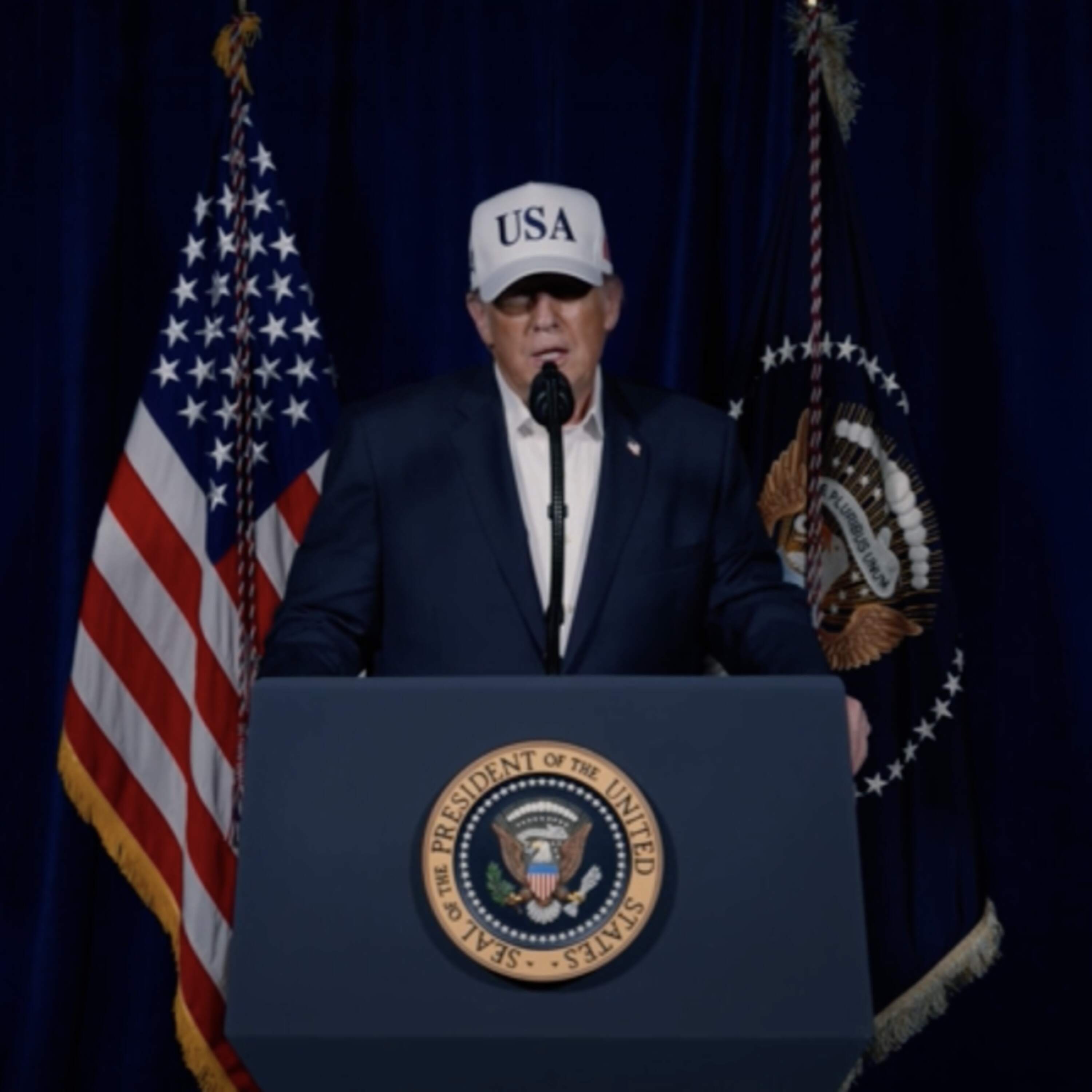
Loading summary
Transcript21 lines
- [00:01]
Scott Detrow
This past weekend, the United States went to war. The country went to war without much notice and with the justification that has shifted sometimes hour by hour, in the days since bombing began. President Trump didn't announce the war with Iran in a speech from the Oval Office or the White House's East Room, but rather in an edited video posted at 2:30am on the social media platform he owns.
- [00:23]
Susan Glasser
A short time ago, the United States military began major combat operations in Iran.
- [00:31]
Scott Detrow
Trump was wearing a baseball cap pulled low over his eyes.
- [00:35]
Susan Glasser
This regime will soon learn that no one should challenge the strength and might of the United States armed forces.
- [00:42]
Scott Detrow
Since then, he has taunted Iran's Navy and in all caps, warned Iran about even harsher US Military strikes. Those posts came between others this week, where Trump has falsely claimed elections were rigged and stolen, called for the prosecution of various people who have opposed him and lobbied to put his face on US Currency. All of this is to say the presidency and the norms surrounding it have changed a lot under President Trump. Consider this. For years, Donald Trump has ignored the norms and traditions of the presidency. With the war in Iran, has he eliminated them completely? From NPR Hi, I'm Scott Detrow.
- [01:25]
NPR Sponsor Announcer 1
This message comes from Jerry. Noticing your car insurance rate creep up even without tickets or claims you're not alone. That's why there's Jerry. Jerry handles the legwork by comparing quotes side by side from over 50 top insurers so you can confidently hit buy. No spam calls, no hidden fees. Jerry even tracks rates and alerts you when it's best to shop. Drivers who save with Jerry could save over $1,300 a year. Don't overpay, download the Jerry app or visit Jerry AI, NPR Today, support for NPR and the following message come from Washington Wise Decisions made in Washington can affect your portfolio every day. Washington Wise, from Charles Schwab, is an original podcast that unpacks the stories making news and how they may affect your finances and portfolio. Host Mike Townsend and his guests explore policy initiatives for retirement, savings, taxes, trade and more. Download the latest episode and follow@schwab.com WashingtonWise or wherever you listen.
- [02:34]
Scott Detrow
It's Consider this from npr. Susan Glasser has been writing a weekly column, letters from Trump's Washington, for the New Yorker since early 2018. She launched the column as a response to the accelerated news cycle under his leadership and as a way to mark what has happened each week in a climate where voters can quickly forget. And it seemed like a good time to check back in with her. Hi, Susan.
- [02:56]
Susan Glasser
Hi, how are you?
- [02:57]
Scott Detrow
I'M all right. And the thing I'm mostly wondering is if you'd gotten a message from the future, somehow hearing a version of that introduction when you first started this column, what would your response have been? That this is the place that President Trump has taken the presidency.
- [03:13]
Susan Glasser
You know, it's interesting you say that my very first letter from Trump's Washington for the New Yorker in The spring of 2018 was about Donald Trump and his administration arguing over Iran and whether and how to strike Iran. This has been a long running theme for the president for many of those surrounding him. And I think the difference between Trump 1.0 and Trump 2.0 is that he's much more willing to take risky, big actions like this.
- [03:46]
Scott Detrow
Yeah, you speculated a little bit about what could be driving this at a core level. You know, everything from the fact that this is, you know, the ayatollah is somebody who president after president after president had a really hard time dealing with, wanted to get rid of in one way or another, Trump can now say, I'm the guy who did it, you know, and then at a different level, maybe he just gets a rush out of ordering military strikes based on your reporting and analysis. Like, what do you think the core reasoning is here?
- [04:14]
Susan Glasser
Well, you're right. This is a president in search of legacy, and big legacy moments. We're talking in Washington where he's busy putting his name on buildings all over the city. He knocked down the East Wing of the White House, things like his interest in Greenland. What you hear from the president is someone who's in search of almost rewriting the map of the world. The Iranian government under the ayatollahs has bedeviled the United States, has launched a campaign of terror against the US And Israel and others. And Donald Trump, as you know, has nothing but disdain for most of his predecessors. So he can now say he had the boldness to act where they failed to do so. I believe that is a motivating factor here. The other important thing is this was a moment of opportunity for the United States and Israel. And I think there was a sense like if we were going to go after the Iranian regime, now was an opportunistic time to do it.
- [05:18]
Scott Detrow
I've been over the past few days comparing this war with Iran to the Gulf War in a few different ways. You happen to have written a book about Secretary of State James Baker, and you focused a lot on the diplomacy and the coalition building and the public arguments that went into that conflict. This is a cynical question, but I'm wondering If any of that matters in the end, if you see, as the, and some indications seem to show, American voters don't necessarily care about all of that not happening this time around.
- [05:47]
Susan Glasser
Yeah. I mean, look, it's a measure of how different and changed we are as a society. And our politics in particular are so much more polarized than the first Gulf War. You mentioned Secretary of State James BAKER, President George H.W. bush so intent upon showing the justice and the justification for especially that first Gulf War. So all the more remarkable that Donald Trump, the president of no new wars and Kamala Harris is going to get you into World War iii, that he would be the president to launch a war of choice without an immediate precursor event in the Middle East. It's a political flip flop, really, of epic proportions.
- [06:29]
Scott Detrow
Yeah. Trump did an interview with the New York Times earlier this year and he was asked if he sees any limitations on his power. And his response was, yeah, there's one thing. My own morality, my own mind, it's the only thing that can stop me. I'm wondering what you think about this. I mean, if Congress and the courts and other countries don't push back on Trump, is he right? In a sense,
- [06:53]
Susan Glasser
it's quite a chilling thought considering that, you know, the American experiment, 250 years old this year, is based on the premise of us having a government of laws and not of men and certainly not of one man with kingly powers. I would say this things like dramatically spiking oil prices, dramatically plummeting approval ratings for Trump and his party. Those remain constraints of a sort. You know, interest rates as well may go up. American allies and partners in the Gulf who've now been attacked by Iran may pressure Trump to pull back on the operations. I think for him, he's still holding out the option of keeping this a relatively limited and short duration conflict and getting out. Now, of course, you know, once you unleash something like this, you don't get the only vote. And events will transpire that may or may not make that possible for Trump.
- [07:49]
Scott Detrow
Susan Glasser is a staff writer for the New Yorker. Thank you so much for talking to us about all of this.
- [07:54]
Susan Glasser
Thank you.
- [07:55]
Scott Detrow
This episode was produced by Erica Ryan with audio engineering by Becky Brown and Damien Herring. It was edited by Sarah Handel and Courtney Dorning. Our executive producer is Sammy Yenigun. It's consider this from NPR. I'm Scott Detrow.
- [08:14]
NPR Sponsor Announcer 1
This message comes from NPR sponsor 1. Password. Anyone else feel like 99% of your emails and texts are password reset codes trusted by millions of users and over 175,000 businesses. 1Password lets you skip the resets and sign in securely. With strong, unique passwords that autofill across all your devices, you can safely share logins, store cards and files. And finally, stop using your pet's name as a password. Try it free for two weeks at 1Password.com NPR this message comes from Bombas.
- [08:51]
NPR Sponsor Announcer 2
Your feet hit the ground an average of 2,000 times in a mile. Bombas sport socks are designed to support you every step. Sprint to bombus.com NPR and use code NPR for 20% off. This message comes from Greenlight. Ready to start talking to your kids about financial literacy? Meet Greenlight, the debit card and money app that teaches kids and teens how to earn, save, spend wisely, and invest. Start your risk free trial@greenlight.com NPR.