← Consider This from NPR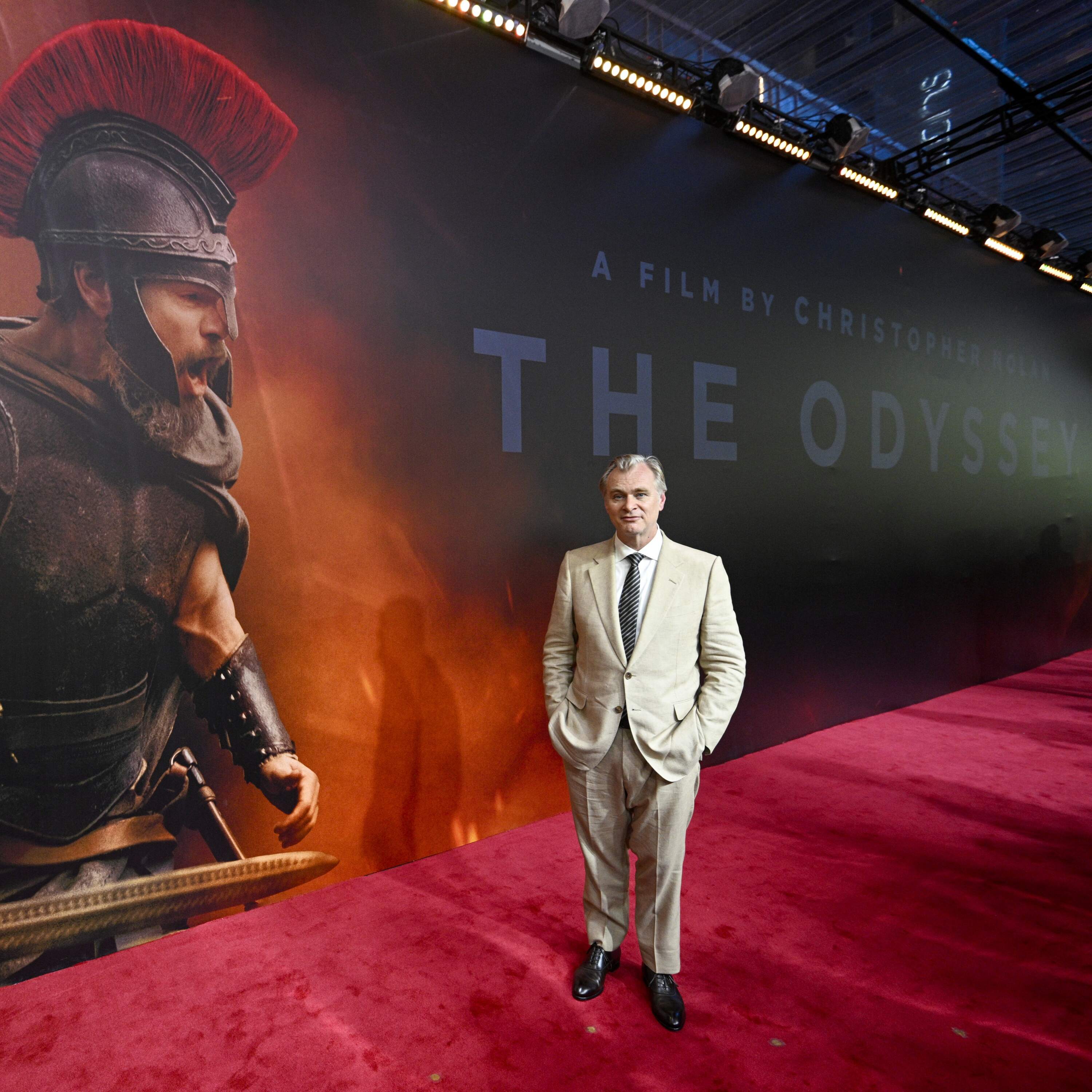
Consider This from NPR
Nolan's 'The Odyssey': a tale of a hero and trickster retold for modern times
00:13:28
Loading summary
Transcript42 lines
- [00:00]
Adrienne Ma
It's Consider this, where every day we go deep on one big news story. With each iteration, a new generation of storytellers gets a chance to portray Odysseus, the complicated man, the man of twists and turns trying to make his way to his wife, Penelope. After the Trojan War, no one could
- [00:19]
Christopher Nolan
stand between me and Homer, not even the gods.
- [00:27]
Adrienne Ma
The Odyssey, a tale of resilience, loyalty and homecoming, is resonating big with today's audiences. It's got box office numbers to prove it. Emerging from its opening weekend with at least $124 million in domestic ticket sales, director Christopher Nolan is known for depicting different kinds of heroes, like 2023's Oppenheimer.
- [00:48]
Christopher Nolan
The word most commonly associated with Odysseus or Ulysses back in the day was always wiley. And that's a that's not a word you traditionally associate with your hero.
- [01:00]
Adrienne Ma
And he's been thinking about adapting the Odyssey for more than 20 years. Consider this the Odyssey is a story that's almost 3,000 years old, a tale of a hero and trickster that's been retold time and time again. So what does it reveal in Christopher Nolan's telling? One made for a contemporary audience. From npr, I'm Adrian Ma. Support for this NPR podcast and the following message come from Carvana. SELLING your car. Carvana has offers so good they're almost inexplicable. Sell your car 100% online in minutes. Visit Carvana.com today.
- [01:51]
NPR Announcer
The NPR network has always been powered by the people it serves, not by shareholders or special interests, but by people like you and me who believe in a free and independent press. One year ago this month, Congress eliminated federal funding for public media. Together, we continue the kind of journalism that we, the public, rely on. Please give today@donate.NPR.org after a DNA test revealed a family secret, questions started swirling. Where am I in the universe?
- [02:23]
Christopher Nolan
And I had a desperate need to
- [02:25]
NPR Announcer
find out the truth. Brought dozens of strangers together, the secret family of a fertility doctor. Listen now to the Sunday story from the upfirst podcast on the NPR app.
- [02:44]
Adrienne Ma
It's Consider this from npr, as if Matt Damon, Anne Hathaway, Tom Holland and Zendaya all in the same movie weren't enough of a draw. Christopher Nolan's Odyssey is the first feature film shot entirely with IMAX cameras. And though he allowed himself two hours and 52 minutes, the director said the entirety of Homer's epic was two too much for one movie. He told my colleague Scott Detrow that he started by making choices.
- [03:13]
Christopher Nolan
I did it in Stages. And one of the first things I did after I'd reacquainted myself with the poem, I sat down and I wrote a list of what defines the Odyssey. Things like the Cyclops, things like the Sirens. I think for a lot of people, the lotus eaters would be one of those things. And so I was trying to strike a balance between your sort of thoughts on what this thing is before you get really acquainted with it and then the specifics of it.
- [03:44]
Interviewer (Scott Detrow)
And yet, at the same time, you're adding, you know, you're scaling down, but then you're adding, like, I was struck by. Both Penelope and Cersei are present characters in the poem, but they're, for a lot of reasons, kind of more in the background. And you give them both, you know, speeches almost talking about their point of view on this world.
- [04:04]
Christopher Nolan
Look at this great house.
- [04:06]
NPR Announcer
Stones as old as knowledge at the
- [04:09]
Christopher Nolan
mercy of some greedy, unwanted guests. The structure's nothing without people's respect for its meaning. Zeus's law.
- [04:18]
Interviewer (Scott Detrow)
So, I mean, I imagine that's a whole different challenge, like, where am I going to add. Where am I going to put background story in, motivations, things like that.
- [04:25]
Christopher Nolan
Sure. I mean, I don't think of it so much as adding and subtracting, as trying to translate your experience of reading the poem and absorbing the poem into the cinematic medium. And so sometimes, yes, what feels like adding things, in a way, you're sometimes just looking at the source material with a specific lens, a modern lens. And in the case of some of the female characters in the poem, they tend to be used at times purely as reflection of the hero, as opposed to being characters in their own right, at least at first blush. And when you start looking at the sort of mechanics of who does what to whom, you know, how does the story play out? You actually start to find the necessity of characterization is there in the poem. It's there, sort of implied. Just as I'm having to get on a real boat in real waves. You know, I know that I've got. And Hathaway coming to play Penelope. I've got Charlize Theron coming to play Calypso. Samantha Morton coming to play Cersei. They play people, not symbols.
- [05:31]
Interviewer (Scott Detrow)
What to you, were the core ideas that you wanted to build this movie around when you started thinking about what it would look like?
- [05:38]
Christopher Nolan
Well, there are two concepts that are most often referred to from the poem. One is nostos. That's the idea of a homecoming narrative. Coming home changed and home having changed, and the emotion of that. And the catharsis of that, and that's sort of baked into the narrative. But the other is a concept called xenia. I don't refer to it by that name in the film. In order to keep things simple, I refer to it by its other name, which is. Uses law. And that's essentially the idea that when you meet a stranger, however humble that stranger might seem, you might think that they're a beggar or whatever, they could be a God in disguise. And so you have to treat them the way you would want to be treated. So it's sort of what other cultures have referred to as the sort of golden rule. You know, treat others as you want to be treated, but with a theological underpinning. And you start to realize the more you work with it that nothing has changed. We are just as dependent on this mutual respect as we ever were. And so in that way, the theology of the piece and the relevance for a modern day audience, they're not fighting anymore. Suddenly they're all kind of pulling in the same direction, which I thought was kind of exciting.
- [06:48]
Interviewer (Scott Detrow)
I have read interviews where you talked about the fact that you had been thinking about how to shoot how to portray the Trojan horse scene for a long time, for more than a decade. I'm wondering what of the set pieces of the Odyssey you were most worried about or apprehensive about as a filmmaker? What seemed the hardest challenge?
- [07:09]
Christopher Nolan
Well, from a logistical point of view, I knew the horse would be a hard challenge. But as you said, I had actually more than two decades of figuring it out because I first I was briefly attached to direct Troy at Warner Brothers, David Benioff's adaptation of the Iliad, and he'd included the horse. And so I spent a lot of time thinking about how I wanted to do that and came up with this notion of it being half buried in the sand, about to be destroyed by the waves, because you're trying to sell it to a contemporary audience who knows that it's stuffed with Greeks. So how would this actually work? How could you sell this? Well, it has to look like the most unlikely thing that you would, you know, drag back into your city, that kind of thing. So it was a very difficult sequence to shoot, but I had a lot of time to plan it. I think what worried me the most and what took the most planning, in some ways, it's the fantasy elements. Because the Odyssey, you have to embrace the fantasy elements. That's a hugely important part of what we're telling here. But we've decided that, okay, you know, Our approach is going to be to have a grounded telling. We're going to be on real boats in real weather. We're going to be in a real cave when we go to meet the Cyclops. So how do you then find methods to maintain the tone of the film whilst embracing the fantasy elements? That was very daunting. And in the case of the Cyclops, I involved my friend Bill Irwin very early on. Bill puppeteered as well as giving voice to the robot TARS in Interstellar. So he went all over the world with us. You know, puppeteering this machine and giving it life.
- [08:44]
Interviewer (Scott Detrow)
That can be high stakes, right? Like a Cyclops could be very frightening. Or if you look at how the audience, as he's been portrayed over there is. It could be pretty campy and cheesy and just like ruin it right there.
- [08:53]
Christopher Nolan
Exactly. And so you sort of go, I knew that whatever methods we were gonna come up with would have to be driven by performance. One of the earliest things we showed everybody as well is one of the Goya black paintings that sat eating his child. It just has such a sort of chilling character of indifference during this sort of horrible process of eating a human being. So, yeah, that's the thing is finding the kind of things that move you in films, in art, in real life, sort of saying, okay, how can we give this some weight? How can we make it mean something?
- [09:29]
Interviewer (Scott Detrow)
There's been so much focus on the decision to shoot it all in imax. And how it was challenging, but you felt like it was worth it. I'm wondering, as part of that, were there any trade offs you made to shoot it all in imax?
- [09:42]
Christopher Nolan
No. And the reason I say that so emphatically is we were only going to do that if we could do it without compromise. And so for me, the big barrier, as it were, the thing we'd never been able to do before was shoot dramatic scenes with the actors because the cameras are too noisy. IMAX had built this blimping system for us. This, this high tech box that you put the camera in and it silences the camera, but it's massive and it weighs 300 pounds. And you can only shoot just under three minutes with it. So what I was asking the actors to do from a method point of view, is start the scene as it's developing in intensity, pause, keep everybody tensed up, reload the cameras quietly and efficiently as the camera could, and then pick up the scene again. And none of us knew whether that would be worth it, whether that would be a compromise to performance. And that Was something obviously we're not prepared to do. In retrospect, I think what happened was it put such intense focus on the performances, on that moment between action and cut in those dramatic scenes, that even though it feels like it would have been distracting and cumbersome, I think it actually became an advantage.
- [10:54]
Interviewer (Scott Detrow)
Would you do it again?
- [10:56]
Christopher Nolan
Not tomorrow, but maybe once I've had a holiday. I've been trying to give up IMAX for 20 years and it's just addictive. It's absolutely the most wonderful, beautiful imaging format ever devised. If we can do it, it's gonna take the audience there, it's gonna immerse them in it.
- [11:16]
Interviewer (Scott Detrow)
You're at the point in your career where everything you do is scrutinized and analyzed. And I feel like there's always this conversation of is this a reference to that movie? And are these movies talking to each other? And I'm wondering, do you feel like there are ideas you're returning to and trying to work out movie by movie?
- [11:33]
Christopher Nolan
I mean, the way I would sort of best answer that, I think, is to say that if I've done my job right, when I'm fully immersed on a film or on a project, I leave that film with unanswered questions. I leave it with themes that we haven't been able to fully address. And that will often inform my creative process on the next film. But that makes it sound a bit more conscious than it is, a bit more self conscious than it is. Certainly I got to the end of making the Odyssey. I saw some very strong connections with Oppenheimer and that made sense to me because, you know, you never fully exercise it with a film, I don't think. I think you're always slightly carrying it into the next thing.
- [12:12]
Interviewer (Scott Detrow)
I'm trying to think of how to ask that for people who haven't seen it yet. But I really felt, I know, a little tricky. It feels to me like there's a lot of thinking about the idea that once you take a certain step, you can't take it back in both those films very much.
- [12:27]
Christopher Nolan
And it was, for me also very interesting to take on mythology as you unpack it and what Homer has written, what's there. You start to realize that there are these massive sort of real world stakes. You know, what were the consequences of the Trojan War, for example? Suddenly everything takes on this much weightier, much more sort of real world quality that starts to really engage you from a modern perspective and relate to other versions of those kind of stories.
- [12:58]
Interviewer (Scott Detrow)
I don't know if you'll engage with this or not, but I'll try. I have wasted hundreds of hours of my life arguing and debating with people what their favorite five movies of yours are, and I'm wondering if that's something you've thought about and you want to share.
- [13:12]
Christopher Nolan
No. I mean, the answer to how I view my work is, you know, these films are like my children. I mean, you just, you have a relationship with each that's absolute and sort of sacrosanct. I really try and do one thing at a time and really figure out how I want to spend the next few years of my life and just, just dive into that so that at the end of the day, yeah, I, it would literally be like saying, you know, what's, what's my favorite child? And I got four kids. And it's certainly not, certainly not a question I would ever even contemplate.
- [13:44]
Interviewer (Scott Detrow)
Certainly not on the radio.
- [13:47]
Christopher Nolan
Definitely not. You know, the movies are all my favorites, and that's kind of, kind of how it works.
- [13:52]
Interviewer (Scott Detrow)
That's Christopher Nolan, director of the Odyssey, as well as many other movies that he loves equally. Well, Christopher Nolan, thank you for speaking with us.
- [14:00]
Christopher Nolan
Thank you very much.
- [14:01]
Interviewer (Scott Detrow)
We appreciate it.
- [14:03]
Adrienne Ma
This episode was produced by Mark Rivers, Zephyr Weinreich, and Henry Larson. It was edited by Mallory Yu and Sarah Robbins. Our director is Elena Burnett. Our interim executive producer is Courtney. Do
- [14:17]
Christopher Nolan
you.
- [14:24]
Adrienne Ma
It's consider this from npr. I'm Adrienne Ma.
- [14:31]
Ira Glass
This is Ira Glass of this American Life. Do you know our show? Okay, well, either way, I'm gonna tell you about it. We make stories that hopefully pull you in at the beginning with funny moments and feelings and people in surprising situations. And then you just wanna find out what is gonna happen and cannot stop listening. That's right. I'm talking about stories that make you miss appointments. This is American Life. Wherever you get your podcasts.
- [14:56]
Adrienne Ma
On our weekly politics series, if you can keep it, the focus isn't the horse race, but the stakes. You're part of the Conversation Mondays on the One, a podcast from WAMU and npr.