← Consider This from NPR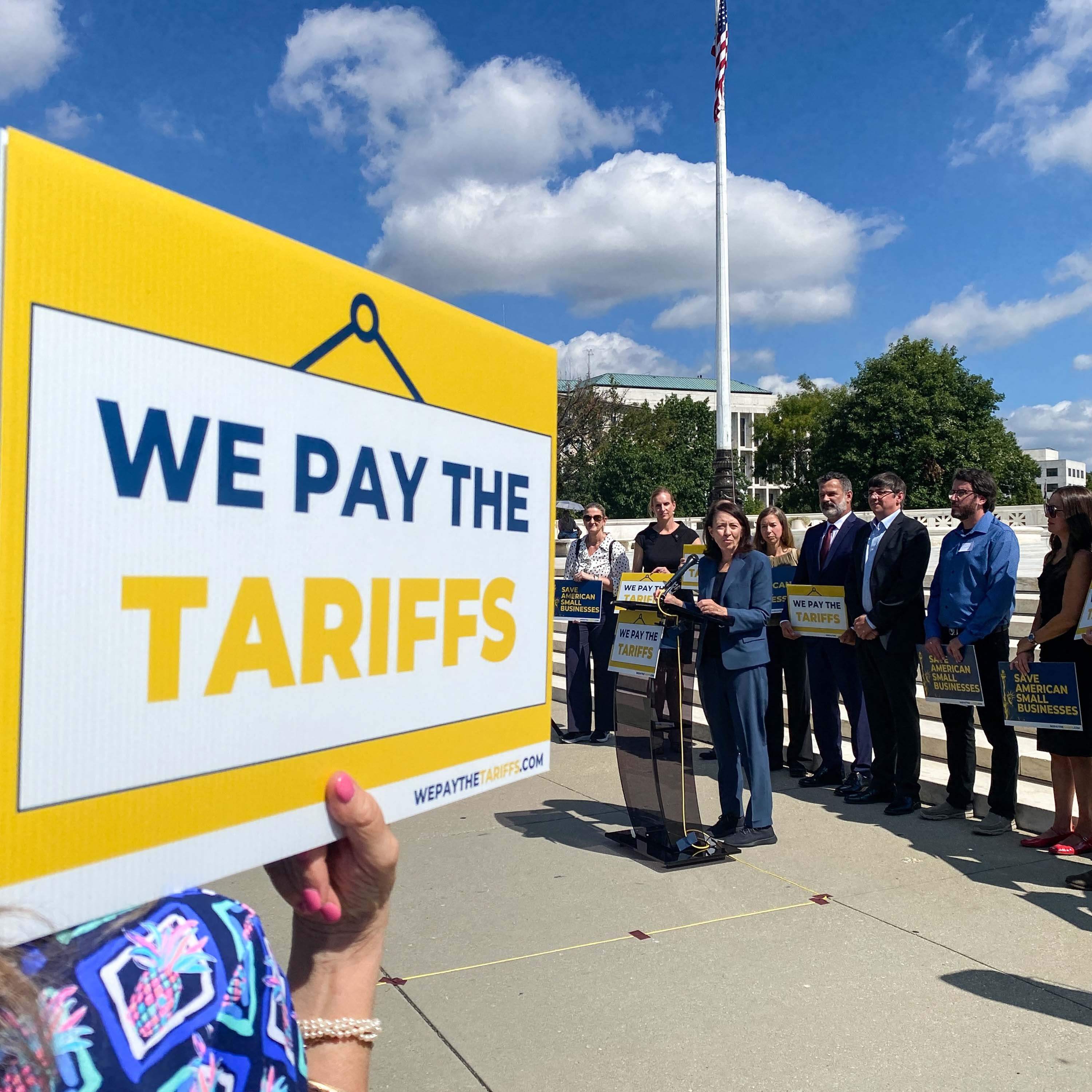
Loading summary
Transcript26 lines
- [00:01]
Debbie Elliott
It's Consider this where every day we go deep on one big news story. For years, NPR business correspondent Alina Selyuk has reported on the world of retail shoppers and sellers. From Walmart to the neighborhood cafe, Amazon
- [00:17]
Alina Selyuk
has agreed to pay $1 billion in civil penalty. What I heard from Costco and Walmart, they both said their lower gas prices have people lining up, actually.
- [00:26]
Debbie Elliott
But last year her reporting took a turn. She was starting to hear that small businesses were being hit hard by the Trump administration tariffs, especially before the Supreme Court struck many of those tariffs down.
- [00:39]
Alina Selyuk
When American small business owners scrambled to pay unexpected tariffs to the US Government, their goods landed at ports from around the world as usual, but claiming them suddenly cost tens of thousands of unbudgeted dollars.
- [00:52]
Debbie Elliott
Many couldn't cover the costs and face the prospect of not being able to get their products out of customs. Some had to t a murky world of financing to stay afloat. Here's what one small business owner, Joshua
- [01:07]
Joshua Esnard
Esnard, told they can offer you as much money as you'll take, but they will charge you whatever they want.
- [01:14]
Debbie Elliott
Esnard ended up accruing hundreds of thousands of dollars in lending costs and fees to cover those tariff payments. Consider this When President Trump invokes tariffs, he promises they'll benefit Americans. But the experience of some small business owners tells a different story. From npr, I'm Debbie Elliott.
- [01:43]
Sponsor/Announcer
Support for this podcast and the following message come from Strawberry Me. Be honest. Are you happy with your job? Are you stuck in a job you've outgrown or never wanted in the first place? Are your reasons for staying really just excuses for not leaving? Let a career coach from Strawberry Me help you get unstuck. Discover the benefits of having a dedicated career coach in your Corner and get 50% off your first coaching session at Strawberry Me NPR this message comes from HomeServe. A burst pipe? A dead water heater, the AC calling it quits? Who do you call? HomeServe is an easy way to handle unexpected home repairs with plans covering stuff basic homeowners insurance usually won't. Instead of scrambling for a contractor, you make one call to get the repair process started. Join the millions of customers who trust HomeServe right now. Go to HomeServe.com podcast for 50% less your first year savings compared to renewal price void in Florida.
- [02:49]
Debbie Elliott
With President Trump announcing new tariffs, we wanted to speak to Alina about what she's learned covering the unexpected costs small businesses are shouldering. For this week's Reporter's Notebook, I began by asking her how she started Covering
- [03:05]
Alina Selyuk
the story for me personally, actually. The day that President Trump announced his big tariffs, which was called the Liberation Day, I was physically at a fly in of small business owners organized by the National Retail Federation. So it.
- [03:21]
Debbie Elliott
Serendipitous.
- [03:22]
Alina Selyuk
It was quite serendipitous. And of course, tariffs became the conversation of the afternoon. And I met a large group of retailers at that event who immediately were able to like, give very specific examples of how tariffs will affect their specific businesses. And I stayed in touch with those folks, and then they put me in touch with other folks, the small business community, especially people who are kind of out there talking about their business quite openly. It's a pretty interconnected group. I kind of grew a long list of business owners who I text with on the regular just to check in. And that is kind of how I stayed on top of how tariffs were playing out for real humans running businesses in the U.S. so one of the
- [04:08]
Debbie Elliott
people that you met during this is this colorful entrepreneur who made millions selling haircut kits of all things. Tell us about him and where his story took you.
- [04:20]
Alina Selyuk
Yeah, you're talking about Joshua Esnard. Actually, a bit of an interesting backstory of how this happened. As I mentioned, I was in touch with a large group of retailers, small business owners, and at yet another fly in, we at NPR invited a whole bunch of them to come to the office for a roundtable, which was one of the most illuminating experiences of terrorists. So we had, I don't know, like a dozen small business owners around the table just talking about what Terrace have been like. And Joshua Esnart was one of those people. And at some point he brought up this fact that since tariffs have started costing small business owners a ton of money, they've been barraged by these never ending text messages and voicemails of people offering them cash fast. It's like, hey, you're probably struggling to pay your tariff. How about $100,000 tomorrow? And as soon as he brought up these pitches, the room just kind of erupted. Small business owners were like, oh my gosh, no one talks about this. This is like insane. Every day we're getting these pitches day, hour after hour, multiple times a day.
- [05:32]
Debbie Elliott
So who are the pitches coming from?
- [05:34]
Alina Selyuk
Many of them come from this industry called merchant cash advances. Merchant cash advances are not loans. They're kind of their own thing. But some experts compare them to like payday loans. Except for businesses, they offer extreme amounts of money, hundreds of thousands of dollars, tens of thousands of dollars, very fast, in exchange for a cut of sales. It's an Unregulated, very shadowy world of financiers. And you could get a merchant cash advance from Amazon affiliated or Amazon backed provider, or it could be like a Wall street firm. It's a really chaotic, really large industry.
- [06:17]
Debbie Elliott
So here's, here's my question. Like, so why would they need to go to these like payday loan kind of operation or this quick cash operation versus just like their line of credit from a regular bank or whatever?
- [06:33]
Alina Selyuk
Typically the main thing is that it's really fast. A traditional loan can take weeks, months. And if you need money now, a merchant cash advance can deliver that. Many small businesses do have a line of credit with a bank. Many really small businesses run out of personal credit cards. Like it's just me and my credit card buying my supplies and selling stuff on Etsy or whatever. But for a lot of people, traditional banks and traditional lenders are simply not an option. I've talked to at this point close to a dozen people who ended up taking merchant cash advances who did try to get a loan from a bank and got turned down. They went to a credit union, got turned down. A lot of it is first time business owners, really young businesses that just don't have kind of a history. And a lot of immigrants started businesses end up in merchant cash advances. And the wild thing about this is because merchant cash advances are not loans, lending laws mostly don't apply to them. So they don't have to be licensed lenders. The money that they give you comes really fast, but they take payments daily or weekly straight from your bank account. And the fees they can charge legally don't have a cap. And so to go back to Joshua, his business is selling hair care accessories. His kind of claim to fame actually is the Cud Buddy, which is this kind of template that you can hold against your head and give yourself really sharp edges as you're cutting your hair. He ended up taking, I actually have the numbers here. It was really wild. He took, ended up three cash advances for a total of $950,000 because he needed that money to pay tariffs. He just didn't have cash sitting around for that. So 9:50, 950,000 is what he borrowed with the fees. His actual debt was $1.2 million. So several hundred thousand dollars were the fees that merchant cash advances take.
- [08:31]
Joshua Esnard
So when you're desperate and customs has your product at the dock and you got to deliver to Walmart, Target or whatever, and you have to clear that out and then you're screwed because if you don't deliver to these retailers, they drop your product, so you got to pay it. So where do you get the money from? You get it from the mob and that's the mca.
- [08:50]
Alina Selyuk
And like I said, I've talked to at this point close to a dozen businesses who ended up in a similar boat. One woman I talked to took out $47,000. Her actual sum that was due back was $72,500. So 47 versus almost 73. And this kind of lending is exploding. It is by far the fastest growing way that small business owners are getting money.
- [09:15]
Debbie Elliott
Is there anything that surprised you as you went deeper into the reporting on these lenders and small businesses?
- [09:22]
Alina Selyuk
I think the thing that surprised me the most is just how common this experience is and how little people talk about it. You bring it up in a group of small business owners and everyone gets really riled up or everybody somebody knows, somebody who had struggled to pay merchant cash advance. But when you start talking to small business owners for whom merchant cash advances have snowballed, often they don't want to use their names. They don't want to talk publicly about their business. They feel like it reflects poorly on them as business owners. They feel ashamed of the choices. And that level of conversation was quite different from, you know, covering tariffs where most small business owners would quite eagerly share their experience with paying terrorists. So those two kind of in parallel were very different things to report on in the past year.
- [10:13]
Debbie Elliott
Well, thanks so much. NPR's business correspondent Alina Selyuk. Thanks.
- [10:18]
Alina Selyuk
Thank you.
- [10:20]
Debbie Elliott
This episode was produced by Gabriel Sanchez. It was edited by Adam Raney and Emily Kopp. Our director is Erica Ryan and our interim executive producer is Quite Courtney Dorney. It's consider this from npr. I'm Debbie Elliott.
- [10:42]
Sponsor/Announcer
This message comes from Workday, the enterprise AI platform for HR, finance and IT since 1949, medical technology company Medtronic has set out to provide life saving equipment for patients. Now their workforce has the ultimate tool. More time to focus on those life saving products. Before Medtronic, recruiters found their days were consumed with managing around 12,000 hires a year. With Workday's AI agents for HR, teams can automate interview scheduling and reduce processes from days to just minutes. With 80% of their HR processes safely automated, recruiters at Medtronic spend less time on routine tasks and more time making strategic decisions like hiring the next innovators in healthcare. They do it all through Workday's AI platform built with a deep understanding of their organization's unique rules and guardrails, ensuring every AI action has the permissions to get work done and get it done right. Learn more@workday.com.