← Consider This from NPR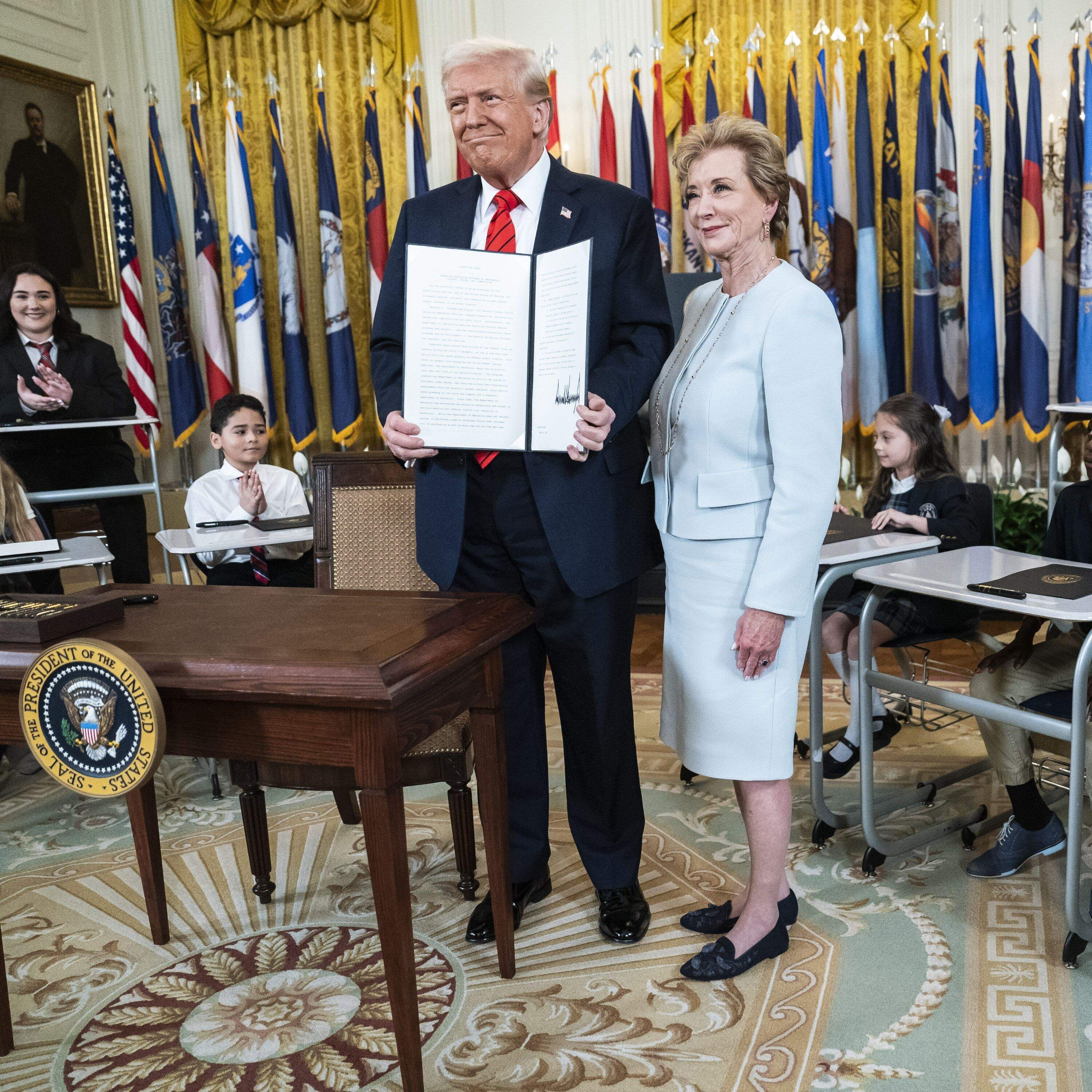
Loading summary
Transcript24 lines
- [00:01]
Juana Summers
When President Trump nominated Linda McMahon as Secretary of Education for a second term in office, this was his main directive to her.
- [00:08]
John B. King
I want Linda to put herself out of a job.
- [00:11]
Juana Summers
Put herself out of a job, in essence, dismantle the US Department of Education. And it seemed that she was ready to do that. Here's McMahon on Fox News in March. Do we need this department? No, we don't. And while such an action would need congressional approval, the Trump administration this week unveiled a plan to sidestep that altogether by breaking off redistributing the Education Department's various roles and duties to departments like labor and State. The plan was described this week in a press conference led by Lindsay Burke, the deputy chief of staff for policy and programs at the Education Department. She also happens to be author of Chapter 11 of Project 2025, which outlined a plan to dismantle her current workplace in exactly this way. Consider this Burke and McMahon say this plan is about giving power back to the states and parents. But what will it mean for students in America's public education system? From NPR, I'm Juana Summers.
- [01:12]
Sponsor/Advertisement Voice
This message comes from AT&T. America's First Network is also its fastest and most Reliable based on RootMetrics United States Root Score Report 1H2025 tested with best commercially available smartphones on three national mobile networks across all available network types. Your experiences may vary. RootMetrics rankings are not an endorsement of AT&T. When you compare, there's no comparison. AT&T this message comes from Capital One with the Capital One Saver card. Earn unlimited 3% cash back on dining and entertainment Capital One what's in your wallet? Terms apply details@capital1.com this message comes from Capital One with the Capital One Saver card. Earn unlimited 3% cash back on dining and entertainment Capital One what's in your wallet? Terms apply details@capital1.com.
- [02:12]
Juana Summers
It's consider this from NPR. The Trump administration is moving to make the U.S. department of Education irrelevant. This week it announced it would be redistributing several of its responsibilities to other federal government agencies. John King was education secretary in the Obama administration, and he joined me to talk about what these changes could mean. One of the administration's main arguments for making this change is they say American students are floundering after the pandemic. We see that American students still struggle with things like math and reading. Couldn't that be an argument that it's time to shake it up, try something new?
- [02:47]
John B. King
It's an argument, I think, for focus. And this move of Offices from the department to different agencies in an incoherent fashion is the opposite of focus. It's a distraction. We should be focused on things like intensive, high quality tutoring, which we know helps students make up ground. We should be focused on trying to attract and retain the best possible teachers. And yet the administration is cutting programs that support teacher preparation. So this is the wrong approach to what really is a very urgent crisis. Our performance today is below where it was before COVID We should be doing more, not less.
- [03:29]
Juana Summers
Current education secretary Linda McMahon makes the argument that these moves will actually make things more efficient and will improve services. It sounds like that is not something you agree with.
- [03:39]
John B. King
Look, it's going to be very confusing for schools, school districts, higher ed institutions, to even know who to call. The early evidence from one of their moves, which was to move some career and technical education programming over to the Department of Labor, is that it has slowed the distribution of money and made things more confusing for educators. It's not helping.
- [04:02]
Juana Summers
I want to ask you about one specific change that was announced last week. It was the decision to put the Labor Department in charge of Managing Title 1 funding, which of course is money that helps schools support low income students. If the money is still available, help us understand why it matters if there's a different department distributing it.
- [04:20]
John B. King
Well, you want folks involved in the distribution of the money who understand the program, who understand how the dollars are going to be used. You want them to able to help provide guidance to school districts and schools about what the rules are that Congress has set up and to make sure that the dollars are responsibly used. Moving this over to another agency that has no experience in K12 is only adding risk that the school districts won't have the help they need and that dollars won't reach the most vulnerable students.
- [04:54]
Juana Summers
Not every function of the Education Department is moving to another agency. Things like civil rights, special education, and student loans are all going to stay within the Education Department. Give us your sense of what you make of the decision to keep those in the Education Department rather than moving them elsewhere.
- [05:10]
John B. King
Well, at this point, it's hard to know if this is just a next step in their effort to dismantle the department and they'll come back with other moves. You know, I think they're trying to navigate violating the law as they do this. Right. They are doing the opposite of what Congress has set out. Congress created the Education Department. Congress appropriated funds to the Education Department. They're trying to get around that. I hope that the courts will intervene and I Hope that Congress will intervene.
- [05:41]
Juana Summers
Your current role is as chancellor of the State University of New York, which is, of course, a huge system of higher education. How do you see these moves affecting the nation's colleges and universities?
- [05:51]
John B. King
Well, interestingly, these initial moves have mostly focused outside of the core higher education functions of the department, like administering the federal financial aid system. But over the last several months, the department staff has been cut in half. There are efforts to cut the Pell Grant program, which is crucial for providing to higher education for low income students. They have canceled grant programs that provide critical student supports. You know, at suny, we see ourselves as an engine of social mobility where we're providing folks with a pathway to the middle class. But that's being undermined by the cuts that the department is making. So in addition to these administrative changes, they also, so far have had an agenda of really trying to undermine higher education, which makes no sense for our national economy or our national security.
- [06:57]
Juana Summers
What do you hear from your colleagues, other leaders in education, about what impact this might have on the nation's students?
- [07:04]
John B. King
Well, people are very worried. They already are seeing the consequences of the dismantling of the Office for Civil Rights. Regional offices have been closed. People have been laid off. And so if you are a victim of discrimination on the basis of race or sex or disability, you don't have anywhere to go. A large share of the complaints that come to the Education Department's Office for Civil Rights come from families of kids with disabilities who aren't getting the services they're entitled to. Without the Office for Civil Rights having adequate staff, those complaints go unaddressed and those students go without the services they need to access education. That is immoral from my perspective and counter to who we are as Americans and what we believe about giving everyone opportunity.
- [07:57]
Juana Summers
It's clear that access to a strong public education isn't equal in this country. If this is not the right way to improve things for American students, what is?
- [08:08]
John B. King
Look, I would love to see things like investing in teacher training, tutoring, and after school programs and early childhood programs so that kids growing up in difficult circumstances have a real shot. It would mean doubling the Pell Grant and making it possible for more low and middle income Americans to get a college education and get the skills they need for good jobs. We really need a president and an education Department that want our schools to be the best in the world, not that are focused on shuffling activities from one agency to another.
- [08:50]
Juana Summers
We've been speaking with John B. King, former Secretary of Education under President Obama. He is currently Chancellor of the State University of New York. Thank you so much.
- [08:59]
John B. King
Thank you.
- [09:01]
Juana Summers
This episode was produced by Lauren Hodges with audio engineering by Simon Laszlo Jansen and Tiffany Veracastro. It was edited by Courtney Dorning. Our executive producer is Sami Yenigun. And before we go, thank you to our Consider THIS plus listeners who support the work of NPR journalists and help keep public radio strong. Supporters also hear every episode without messages from sponsors. Learn more at plus.NPR.org It's Consider this from NPR. I'm Juana Summers.
- [09:33]
Sponsor/Advertisement Voice
Support for this podcast and the following message come from Lisa Leesa has a lineup of beautifully crafted mattresses tailored to how you sleep. Each mattress is meticulously designed and assembled in the USA and designed with specific sleep positions and feel preferences in mind. Visit Leesa.com for 25% off. Plus get an extra $50 off with promo code NPR. That's Leesa.com promo code NPR.
- [10:03]
John B. King
Hey, it's Ray from Car Talk. Are you tired of all the depth and thoughtful care that goes into NPR shows? Want some good old fashioned goofing around and stumbling to figure out what's going on? Well, I've been taking occasional car questions again. You can hear them by signing up for NPR, along with lots of other bonus content. Just go to plus.npr.org want to hear.
- [10:26]
Juana Summers
This podcast without sponsor breaks? Amazon prime members can listen to Consider this sponsor free through Amazon Music. Or you can also support NPR's vital journalism and get consider this plus@plus.NPR.org that's plus.NPR.org.