Loading summary
Transcript50 lines
- [00:00]
Ilsa Chang
It's a recent morning in Lower Manhattan, and Teddy Ogborn, along with a group of volunteers, are trying to give people a moment of peace before they head into the building at 26 Federal Plaza.
- [00:11]
Teddy Ogborn
We're offering, like, a space in the park with mutual aid and spots to just sit and have a coffee and chat and take a breather because it's really stressful and traumatic what can happen in there.
- [00:20]
Ilsa Chang
The building houses immigration courts, and some of the people heading inside will stand before a judge and learn whether or not they are permitted to stay in the US As Ogborn and the volunteers give coffee, they're also collecting contact information.
- [00:35]
Teddy Ogborn
They want to provide, you know, any information with us so that we can, like, check in where they're at with the system to know whether they've been detained or basically disappeared inside so that we can get in touch with an emergency contact.
- [00:47]
Ilsa Chang
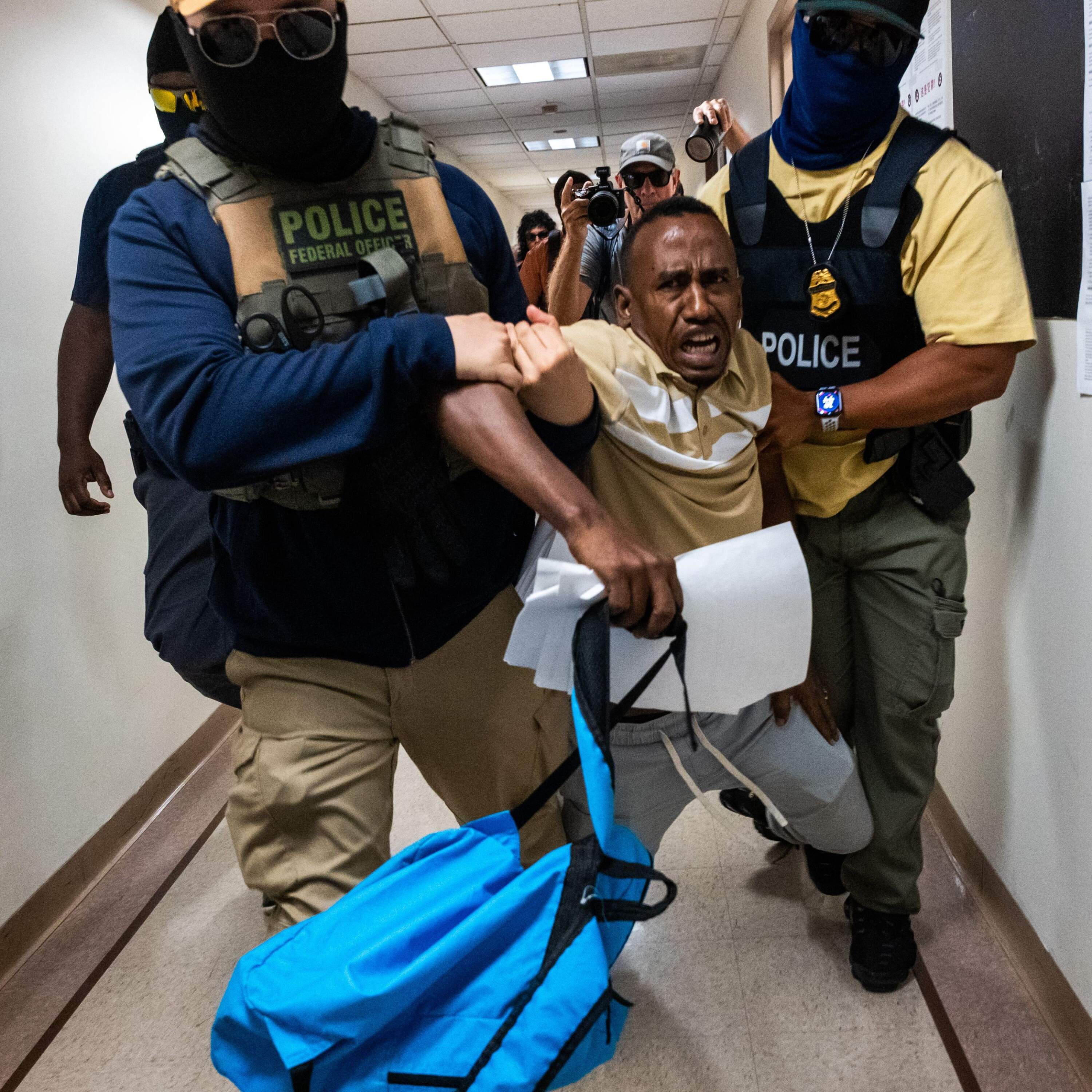
Disappeared. That's exactly how some immigration advocates describe what happens inside this building. Because the Trump administration is deploying a new strategy to speed up deportations, government lawyers are asking immigration judges to dismiss ongoing cases. But then Immigration and Customs Enforcement agents are arresting people as soon as they step out of the courtroom and putting them in a new expedited removal process.
- [01:13]
Brad Lander
These are not people who have been accused of any crime.
- [01:18]
Ilsa Chang
That is New York City Comptroller Brad Lander, who's one of many Democrats criticizing this practice.
- [01:24]
Brad Lander
These are people who are complying with the law by coming to court. So it is an abominable waste of resources.
- [01:31]
Ilsa Chang
In a legal brief opposing the arrests, the city put it this way. Quote, our judicial system cannot work as it should, as it must, if courthouses are used as traps. The Trump administration argues that courthouse arrests are common sense. They conserve law enforcement resources because officers don't have to go looking for a target. And they're safer because the immigrants will have gone through court security and will have been screened for weapons. The upshot of all of this is that for immigrants without legal status, immigration hearings bring huge risks. Whether they show up or. Or not. The Department of Homeland Security's top spokesperson, Tricia McLaughlin, confirmed as much in an interview with PBS.
- [02:14]
Tricia McLaughlin
They could be arrested and deported, especially if you've been here less than 2 years, you are eligible for expedited removal. We encourage you to go to your immigration hearing, or else you will absolutely get a final deportation order, and you will be. You will be arrested and deported.
- [02:32]
Ilsa Chang
Consider this. Immigration courts have become epicenters of the president's mass deportation plan. NPR went to see how that looks from the inside from npr I'm Ilsa Chang.
- [02:50]
Up First Host
Americans are living longer than ever before. On the Sunday Story from Up first, we look at a growing number of people using these extra years to find new meaning.
- [03:00]
Ximena Bustillo
You get to the point where you start asking, what did you do in your life that was significant?
- [03:06]
Up First Host
A look at the transformative power of human passion and finding your purpose in the third act of life. Listen now on the upverse podcast from npr.
- [03:16]
Here and Now Host
There's a lot of news happening. You want to understand it better, but let's be honest, you don't want it to be your entire life either. Well, that's sort of like our show Here and Now Anytime. Every weekday on our podcast, we talk to people all over the country about everything from political analysis to climate resilience, video games. We even talk about dumpster diving on this show. Check out Here and Now Anytime. A daily podcast from NPR and wbur.
- [03:39]
Peter Sagal
I'm Peter Sagal. NPR is very serious. Mostly, it treats newsmakers with all due respect almost all the time. It brings you the most important information about the issues that really matter usually. And it never asks famous people about things they don't know anything about, except once in a while. Join us for the great exception. Listen to Wait, Wait, don't tell Me. The news quiz from npr.
- [04:06]
Ilsa Chang
It's consider this from npr. Many immigrants in this country are in a sort of legal limbo. They don't have full legal status, but they're somewhere along a legal procedure that will end in them either getting legal status or being subject to deportation. Hearings in immigration courts are where that process normally plays out. And as we mentioned, under the Trump administration, the immigration courts have also become a sort of funnel, bringing immigrants into the path of federal agents ready to arrest them. NPR immigration policy reporter Ximena Bustillo wanted to see how all of this is actually unfolding, so she went there to an immigration court in New York City.
- [04:47]
Ximena Bustillo
I'm standing outside 26 Federal Plaza in lower Manhattan. There are barriers blocking portions of the street, police cars lined up and a mix of people making their way into the building. Many of them are dressed in nice clothes and are clutching files of paperwork for their hearings. There are also activists, community members, journalists, and sometimes even elected officials and clergy. It's quite chaotic and there's a palpable anxiety. I'm here in New York because two federal buildings have become notorious for violent scenes of people being detained by mass to federal agents, and their job is to make arrests of people coming in for routine immigration court appointments. As I go inside those same federal buildings in Lower Manhattan. It's quiet today. Lawyers and immigration advocates inside say people are afraid. Benjamin Remy, an immigration lawyer, is in court almost every day now. Many are too scared to show up.
- [05:42]
Brad Lander
He says people are being put into an absolutely impossible situation.
- [05:46]
Ximena Bustillo
Right.
- [05:47]
Brad Lander
They're being forced to gamble their their own liberty versus potentially continuing with their case, continuing with their claim. So in terms of a reduction in the amount of people showing up. Absolutely. Absolutely.
- [05:58]
Ximena Bustillo
The Manhattan courthouse halls have been one of the epicenters of such arrests. Move, move, move. The scuffles have gone on for weeks. Members of the public have been pushed out by federal officials who say that they're making it harder for them to work here. You can hear the protests against the arrests. Earlier in the month, the building was cleared out after immigration officers found an unknown white powder in their offices. Officials say it came with a threatening note telling officers, quote, nobody can escape from karma, not even you. The regular threats of violence and arrests contribute to the court's overall vibe of disorganization. The noise of individual migrants cases can be heard out of open doors, people nervously tapping their feet. In other places, those waiting cry. A woman tells me that she's here for her husband, who was afraid that he would be detained if he came in person. And one by one, migrants from Colombia, Guyana, India admit to being in the country illegally. They have to return for their next appointments in 2029. A date four years from now has become a regular feature in courts across the country as immigration Judges juggle a 3.7 million case backlog. John Cerebella from the New Sanctuary Coalition has been coming to these courts once a week for six months. And he says it wasn't always this way.
- [07:23]
Teddy Ogborn
There weren't any ICE agents in the very beginning. And in the past six months, it's increasing. And their strategies and their tactics have become more and more aggressive and assertive over the past six months.
- [07:36]
Ximena Bustillo
He said he sees arrests almost every time he comes. The scene in these courts is replayed every day on each floor while the judge ticks through the same set of questions. Federal agents mill in the doorways. They're wearing masks and sunglasses. Periodically, they can be seen escorting someone around the corner. Once their hearing is over, those people then disappear, likely into an ICE detention center.
- [08:01]
Ilsa Chang
That was NPR's Jimene Bustillo reporting there, and Ximena joins us now for more on this story. Hi, Ximena.
- [08:08]
Ximena Bustillo
Hi, Elsa.
- [08:09]
Ilsa Chang
So I understand that you personally experienced some uncertainty of not knowing who's in charge inside these courtrooms or even who's allowed public Access. What happened to you, exactly?
- [08:20]
Ximena Bustillo
On some floors of the building, we were told that we couldn't even be in public spaces, limited only to the blue carpet in front of elevators, because we were journalists. So we can be, like, in the blue? Yeah, that's it. But we can't be in the halls? No. Can I be in the hall if she stays in the blue?
- [08:37]
Peter Sagal
No.
- [08:38]
Ximena Bustillo
You guys are pressed? No. Press is. What about public? Public, yes. On other floors, we were told we could be in waiting areas, but not recording. And other times we were told to completely leave. While I was sitting in a courtroom at two ninety Broadway in the middle of a public hearing, I was told to leave, even though the judge had said her chambers were open to the public, including the press.
- [08:59]
Ilsa Chang
Wait, so were you allowed back?
- [09:01]
Ximena Bustillo
The court clerk, a few minutes later did allow me to come back in. And federal agents who had originally asked me to leave were still lingering in the doorway, looking inside the room. And keep in mind that this is all happening while someone's immigration hearing is still ongoing. And you can hear a court official then come over and slam the door on the agents. The agents start banging on the door to be let back in. There's a clear tension over who exactly is in charge here. Is it the courts, is it ice, or is it court security, who's contracted by a totally different part of dhs? I spoke with Remy, the immigration lawyer, about this tension between agencies, and here's what he said.
- [09:43]
Brad Lander
It's just to see this institution that we've been arguing cases in, that we've been representing people in for years and years, essentially just be eviscerated by the Department of Homeland Security in a matter of months has been absolutely surreal.
- [09:58]
Ilsa Chang
And, Ximena, I understand that you went back the next day. Can you explain what happened then? Like, did you have another confrontation?
- [10:05]
Ximena Bustillo
Mm. I went back to the same floor the next morning, and court security this time allowed me to walk around and sit where I wanted to in the public spaces. And as I was doing this, I noticed a man in a green plaid shirt, jeans, and a cap. He was sitting among those waiting to be called for their hearings, but it appeared that he was undercover law enforcement, since he later joined about five other agents, most masked with vests labeled police or just Federal Police, and let me paint the scene of what happened next. At one point, I open the double doors to go into the hall and almost run into the agents. That plaid shirted man turns around and yells at me to stop effing following him. I identify myself as a Journalist and say, I'm in a public space. Then a court observer starts getting into it with the same man, and she says she is not effing following him. He grabs her arm, and at this point, I take my phone out and start recording. You can hear her ask, why are you shoving me? Him asking, why are you following me? Her say that I'm not following you. And he says, hands behind your back. He takes her into a service elevator bay and the yelling continues for a few minutes. I can't see what's happening, but I can hear what sound like handcuffs. Within minutes, they all leave down the elevator. And I still don't know what happened to the court observer or even her name. I'm trying to find it.
- [11:39]
Ilsa Chang
Wow. I mean, Jimena, what do you think the big picture takeaway is here from everything that you have seen in these courtrooms in New York?
- [11:48]
Ximena Bustillo
You know, immigrant advocates say what I witnessed counts as quiet days in those buildings. But it also, you know, shows how easy it is for regular people to get caught up in this. A journalist who turns the corner at the wrong moment or a court observer that catches an agent when he has a lot of tension running through him. The agency that's in charge of immigration courts referred questions on building access to DHS and declined to comment on questions regarding the incidents and clashes between public press and law enforcement in their spaces that at this point have been ongoing for weeks. I reached out to DHS and I did not get a response. You know, this example shows just how often, often the rules are changing and how who is in charge can really change on a given day in a given person. And immigrants and others are often caught in the crosshairs.
- [12:42]
Ilsa Chang
That is NPR immigration policy reporter Ximena Bustillo. Thank you so much, Jimene.
- [12:47]
Ximena Bustillo
Thank you.
- [12:49]
Ilsa Chang
This episode was produced by Sarah Ventri, Avery Keatley, and Connor Donovan with audio engineering by Jimmy Keeley. It was edited by Anna Yukinonoff and William Troup. Our executive producer is Sami Yeniken. It's consider this from NPR. I'm Ailsa Chang.
- [13:10]
Ximena Bustillo
NPR's wild card podcast is all about embracing the unexpected. Like when Harrison Ford stopped by.
- [13:17]
Teddy Ogborn
My phone just rang.
- [13:18]
Ximena Bustillo
Jay Leno is calling you right now.
- [13:21]
Teddy Ogborn
About my toilet seat. Yeah, Jay's pretty. A 3D printed toilet seat for me.
- [13:27]
Ilsa Chang
What?
- [13:28]
Ximena Bustillo
Listen to NPR's Wild Card wherever you get your podcasts or watch it on YouTube.
- [13:35]
John Legend
Stars. They're just like us. John Legend goes to CBS. Well, that's because he has his own skincare line.
- [13:40]
Teddy Ogborn
It was so exciting. To actually go into one of those stores. We had the end caps.
- [13:46]
John Legend
Were you like, I don't want this locked up. John Legend is one of many stars riding the celebrity branding wave. He tells us about it on the indicator from Planet Money. Listen in the NPR app or wherever you get your podcasts.
- [13:58]
Ilsa Chang
Want to hear this podcast without sponsor breaks? Amazon prime members can listen to Consider this sponsor free through Amazon Music. Or you can also support NPR's vital journalism and get consider this plus@plus.NPR.org that's plus.NPR.org.