← Consider This from NPR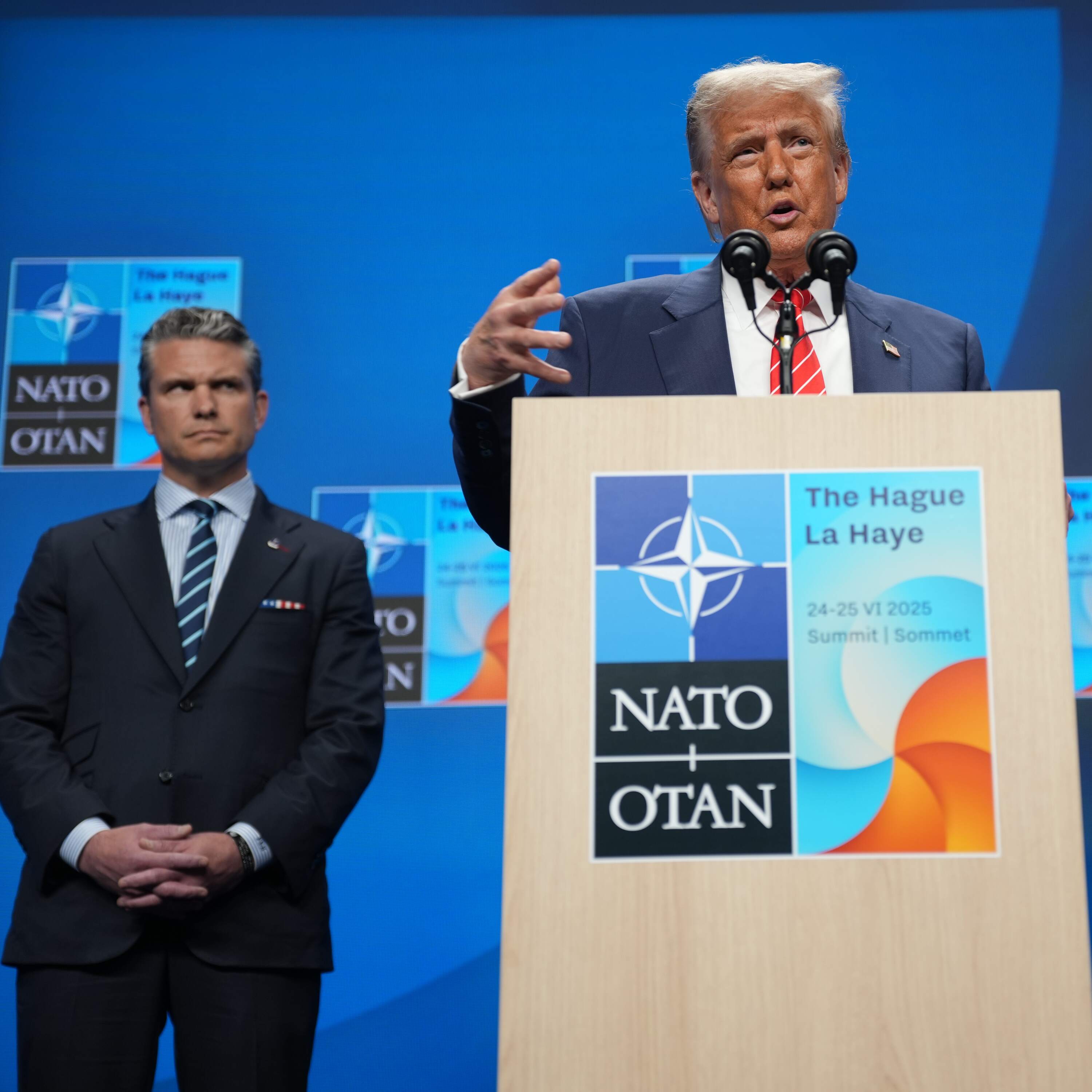
Loading summary
Transcript22 lines
- [00:00]
Don Gonyea
It's consider this where every day we go deep on one big news story. President Trump is headed to this year's North Atlantic Treaty Organization summit in Ankara. The leaders of the 32 countries which make up NATO will be hosted by Turkish President Erdogan. Going into the meeting, there's widespread anxiety about the US's changing role in the alliance. And President Trump has been dissatisfied with Europe's response to the war in Iraq, telling NATO's secretary general in June, we were let down. We didn't need help on this at all. We demolished them in literally the first week. But it would have been nice if they would have said we'd like to help. And in a social media post last week, President Trump doubled down saying about NATO ridiculous for the USA to continue along this one sided path when the relationship is not reciprocal. They were not there for us, end quote. NATO allies have also been alarmed by the Trump administration's on and off again threats to seize Greenland. Despite the various points of contention, NATO leaders want an ironclad commitment from Trump to collective defense within the alliance. For them, time is of the essence. According to recent European assessments, there are increasing threats of Russia next lashing out against Europe if the tide of the war in Ukraine shifts in kyiv's favor. Former U.S. ambassador to Poland Daniel Fried told NPR that the balance has already shifted. Russia is beginning to lose and the
- [01:46]
David M. Katler
strategic advantage is beginning to shift to Ukraine, which is astonishing considering the almost
- [01:54]
Don Gonyea
universal predictions of inevitable Russian victory and
- [01:58]
David M. Katler
the size of the country.
- [01:59]
Don Gonyea
NATO allies are closely tracking those developments in Ukraine, seeking ways to deter Russia while President Trump continues to portray the alliance as a one sided relationship where the US gets nothing. Consider this A dramatic shift is underway for NATO as the US changes its priorities. Can Europe take the lead? And what could that mean for America's national security? From npr, I'm Don Gonyea.
- [02:37]
NPR Announcer
This message comes from NPR sponsor Carvana. Carvana makes car buying easy 100% online prices down to the penny, delivered to your door. Why make car buying hard when it could be easy? Visit Carvana.com today. Terms may apply. Support for NPR and the following message come from Washington Wise Decisions made in Washington can affect your portfolio every day. Washington Wise from Charles Schwab, is an original podcast that unpacks the stories making news and how they may affect your finances and portfolio. Host Mike Townsend and his guests explore policy initiatives for retirement, savings, taxes, trade and more. Download the latest episode and follow@schwab.com WashingtonWise or wherever you listen. This message comes from Dell Technologies. Get long lasting battery life on the Dell XPS laptop powered by Series 3 Intel Core now from $699 with exclusive student pricing from $599. Visit Dell.com deals.
- [03:45]
Don Gonyea
It's consider this from NPR. It seems like NATO's been facing one crisis after another as it adapts to increasingly complex global threats. Ahead of the Ankara summit this week, we spoke with David M. Katler. He's a senior fellow at the center for European Policy Analysis and has previously served as NATO's Assistant Secretary General for intelligence and security. I asked him about the changing dynamics within the alliance and about President Trump's point about whether the US Gets anything from NATO.
- [04:22]
David M. Katler
I think it's important to take a look at the contributions that all the allies make. Certainly the United States makes the largest contributions in terms of not just our US Defense spending, but also the forces we've chosen to allocate, the capabilities that we've chosen to bring to bear. But that doesn't mean that the other allies aren't also making contributions. Many of them have also made contributions that are quite significant when you look at what their GDPs are and the capabilities that they're bringing to various NATO exercises for deterrence and defense.
- [04:51]
Don Gonyea
Military spending has been a significant sticking point for President Trump. In past NATO meetings. This year, it's been reported that all European allies met spending targets of at least 2% of GDP, though there are still more deadlines in years to come. How much of a role did the Trump administration play in pushing, really pushing hard toward that result?
- [05:16]
David M. Katler
The Trump administration in the president's first term and now in his second term has actually played a pretty significant role in attracting other nations attention to the spending level and getting that agreement not just to reach the 2% from the Wales commitment from some years ago, but also to the 5% commitment that came out of the Hague summit. But what's most important now moving forward that the spending is rising is actually translating the spending into real military capability. I think that's one of the things that this summit is going to focus on.
- [05:43]
Don Gonyea
I want to ask about boots on the ground. Washington has threatened to reduce the number of US Troops stationed in Europe. Why does that, that decision matter?
- [05:53]
David M. Katler
I think the Europeans have reacted in the way that they have to some of these force movements that seem a little bit unannounced or just less discussed in diplomatic or in military channels because it's really a twofold problem. It's the military capability which could be surged. I mean, just because you're not there full time doesn't mean you can't get there rapidly. But I think even more so now with Russia's illegal war against Ukraine still going now more than four years, on the potential for other crises to be caused by the Russians around Europe. They're looking at the placement and the numbers of American troops and in fact some European troops that are deployed for various NATO purposes as signals of the alliance's resolve.
- [06:32]
Don Gonyea
You have said that as the U.S. commitment to European defense wanes, NATO needs sufficient time to adapt to that new reality. What kind of timeline are we talking about?
- [06:44]
David M. Katler
Well, I think, Don, it depends on the scenario and the capability sets that would need to be brought to bear. What's really important right now is that European governments have reached a really important conclusion, and that's that regardless of who occupies the White House, Europe needs to be capable of carrying more of the conventional defense burden. Interestingly, recent polling suggests that European publics increasingly share that view. Europeans really want a stronger European pillar within NATO, not to replace the United States, but to make the alliance more resilient. Now, there's another factor, though that's on a lot of Europeans minds and that's how long would it take for Russia after a war in Ukraine or even during a war, to have military capability to threaten them. And I think in broad terms what you tend to hear is the closer you are to Russia, the shorter you believe that timeline to be. Some nations might tell you 12 months to 18 months, but all allies agree that Russia is an adversary to the alliance and that their appetite is not necessarily satisfied with the military conflict in Ukraine alone.
- [07:42]
Don Gonyea
The Polish Prime Minister, Donald Tusk, says he's preparing for a potential Russian lightning offensive into his country, a NATO country. That's the kind of thing you were just talking about. The closer you are to Russia, the more worried you are. How realistic are those concerns?
- [08:01]
David M. Katler
Well, I think those concerns are quite realistic. I think if you look just in the last few days, there's been reporting in the media about Poland being warned by the United States that that potential is there in fact for Russia to either directly attack Poland or to cause some incident that might involve military force. The stance that Warsaw has taken is that they need to be able to defend themselves against the range of military scenarios that they imagine threaten them, whether or not NATO or any other ally is there for them. And correspondingly, they're making the political decisions necessary to find the resources to get that done for themselves.
- [08:34]
Don Gonyea
How will you define the success of this summit this coming week in Ankara?
- [08:40]
David M. Katler
The summit won't ultimately judge by the length of its communique or even by the size of the spending pledge that comes out of it. I think history is more likely to judge this summit on whether NATO actually proved capable of converting political consensus, all that increased investment in the growing public support into some real military capability quickly enough to preserve credible deterrence. And I think when you look back over the last four or five summits, the alliance has largely chosen its strategic direction. So now is the time for the alliance to decide to deliver.
- [09:10]
Don Gonyea
David M. Katler is a senior Fellow at the center for European Policy Analysis. He previously served as NATO's Assistant Secretary General for Intelligence and Security. Thank you.
- [09:22]
David M. Katler
Thanks, Don. I really appreciate the time.
- [09:24]
Don Gonyea
This episode was produced by Daniel Offman. It was edited by Sarah Robbins. Our director is Michael Levitt. Our interim executive producer is quite Courtney Dornick. It's Consider this from npr. I'm Don Gonier.
- [09:44]
NPR Announcer
Support for NPR and the following message come from Washington Wise decisions made in Washington can affect your portfolio every day. Washington Wise from Charles Schwab is an original podcast that unpacks the stories making news in Washington. Listen@schwab.com WashingtonWise want to hear this podcast without sponsor breaks? Amazon prime members can listen to Consider this sponsor free through Amazon Music. Or you can also support NPR's vital journalism and get NPR+@ npr.org that's npr.org.