← Conversations with Coleman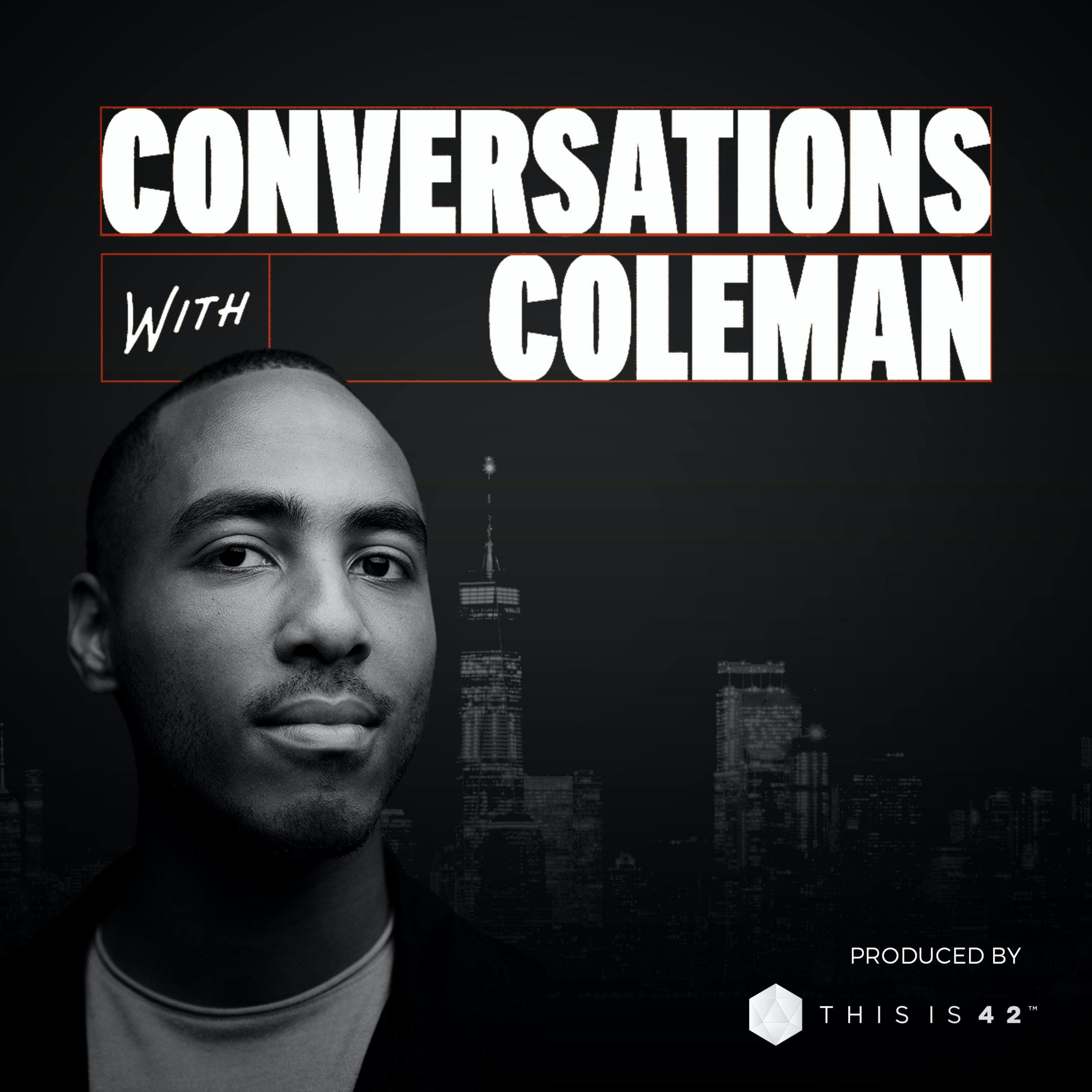
Conversations with Coleman
The Problem of Race: Glenn Loury and Coleman Hughes - Bonus Episode
01:26:12
For exclusive member-only content become a CwC subscriber via https://colemanhughes.org/ This recording was created during an event hosted by the Intercollegiate Studies Institute, which features Coleman Hughes alongside Glenn Loury. Glenn is an economist at Brown University and host of The Glenn Show at Blogging Heads. This conversation is a big picture discussion of the problem of race in America today, the narratives that compete for space in the mainstream media, and the path forward.
Loading summary
Transcript94 lines
- [00:00]
Moderator (Marina)
SA.
- [00:31]
Coleman Hughes
Welcome to another episode of Conversations with Coleman. If you're hearing this, then you're on the public feed, which means you'll get episodes a week after they come out and you'll hear advertisements. You can gain access to the subscriber feed by going to ColemanHughes.org and becoming a supporter. This means you'll have access to episodes a week early, you'll never hear ads, and you'll get access to bonus Q and A episodes. You can also support me by liking and subscribing on YouTube and sharing the show with friends and family. As always, thank you so much for your support. Today's episode is a little bit different. This was actually an event hosted by the Intercollegiate Studies Institute that featured myself alongside Glenn Lowry, who, as many of you know, is an economist at Brown University and host of the Glenn show at Bloggingheads. I thought the conversation was a good one, so I'm releasing it as a standalone podcast. This conversation is a big picture discussion of the problem of race in America today, the narratives that compete for space in the mainstream media, and the path forward. I hope you enjoy this one as much as I did. Without further ado, Glenn Lowry.
- [01:49]
Moderator (Marina)
But we're going to jump right in in just a second here, but I just want to let all you guys know who are logging on that the latter half of our conversation will be centered around your questions. So you're welcome to go ahead and start dropping the questions in the Q and A box, which you'll see on the right of your screen right next to the chat box. So make sure you put them in the Q and A tab rather than the chat tab so they don't get lost. Let's go ahead and start the discussion off by defining some terms as we go into the discussion today. So I'd just like to ask kind of broadly, how would you guys define racism and how is that different from how the term is being used today? That's a big question.
- [02:33]
Glenn Loury
Well, no, I mean, the obvious thing to say here is something like this is not a scientific definition, but it's just sort of common sense. This is a hatred or antipathy, an unreasoning disdain, a belief in derogatory, you know, characteristics of a group without evidence, a dislike of association or intimacy with, et cetera, kind of aversion to social contact. These would be things that come to mind. And how is it different from the way the term is used today? Well, I mean, today everything is racism, isn't it? I mean, every to be opposed to affirmative action is to be racist. To cite statistics about the extent of African American participation in criminal activity is to be racist. To wear a MAGA hat is to be racist. So I don't know what limits the definition of racism today. Having views or taking actions contrary to the desires of a certain set of people who've annoyed themselves as the social police of racial etiquette would appear to be the definition now current. But I would have a more parsimonious sense of racism as something of old fashioned contempt, hatred, antipathy, dislike, disdain based upon nothing other than the racial identity of the person.
- [04:12]
Coleman Hughes
Yeah, I would add. Only thing I would add to that is the move from conceptualizing racism as something that one locates at the level of the individual to something one locates at the level of the system. And whether it goes by systemic racism, structural racism, or institutional racism, the general idea is that what it means to be educated on this issue now is to understand that a system can be racist without anyone in the system being a racist. So the criminal justice system can be racist without even if no one can locate a specific police officer or judge or prosecutor that is in any way provably racially biased, the system itself, just operating by its own logic and its own inertia can produce racist outcomes. And that's what people mean by systemic racism. There's a bit of a contradiction there, because on the one hand, people want to say, well, while the racism is in the system, it doesn't require any actual racist people to operate. But on the other hand, what I see is, as Glenn observed, an endless obsession with finding people who are racists. So it seems a little bit that there's a desire to have it both ways that people want to find racists and on as expansive a definition of racism as we've ever had. And they want to find those people, the Karen in Central park that calls the cops when she arguably shouldn't have, so on and so forth. We want to find these people and punish these people as racists, but we're also supposed to believe that the really important kind of racism is the one that doesn't require anyone at all.
- [06:14]
Moderator (Marina)
Yeah, there's legitimacy to the idea of systemic racism today. Obviously it complicates the discussion often. And Glenn, you're talking about how there's confusion of terms and that anything could be declared racist, but is there some legitimacy behind that idea of systemic racism?
- [06:33]
Glenn Loury
Well, yes, I think one could make a certain kind of case. And this picks up where Coleman leaves off in distinguishing between the consequences of complex systemic processes so mass incarceration, this is law. What things are said to be illegal? War on drugs? This is policing. What activities are monitored and who gets apprehended. This is courts. How does pretrial detention work? Who gets a good lawyer, who gets a bad lawyer? What sentences are handed out? These are a lot of things that are happening all at the same time. If the net consequence of these things is to work out adversely to the well being or the interest of a racially defined group, one can, you know, invoke this idea. I mean, here's what I think is at stake. If you start with disparities, you don't get talk about systemic or any other kind of racism until you have disparities first. You have some social outcome that is uneven, some inequality, some disparity. And then you put to yourself the question of how do I account for this? And you're not a scientist, you're just an ordinary person trying to think about it roughly. You have two accounts that you can give. One of them puts the onus on the individuals who are suffering the disparity, and the other puts the onus on, quote, unquote, the system. You can in effect blame, quote the victim, close quote. Or you can blame the system. So when people say systemic racism, sometimes I think what they have in mind is, you know, this can't possibly be the consequence of the fault of the responsibility of these people because these people are, after all, disadvantaged, they're historically marginalized, et cetera. This is the consequence. Somehow I don't quite fully understand it, but long history, structures of domination, whatever, and then they have a narrative about how it's a consequence of the system. They're blaming the system, not the persons, for the disparity. When they invoke the category of systemic racism, I think. Does that make sense to you, Coleman?
- [08:46]
Coleman Hughes
Yeah, I think that's exactly right. And that's exactly why I think it's often vague when people make the charge of systemic racism. The reason it's such a useful idea is precisely because it's vague, not in spite of its vagueness. And I also agree that people do view themselves as just choosing between these two options of blaming individuals, blaming people suffering in prisons or suffering poverty, and saying actually it's society's responsibility, it's people with power, people who make policy, et cetera. And given those two choices, it seems like the obvious compassionate choice to many people at least, is to say, well, the burden is on those with power. The burden is on those who create policies, who run the system. To fix these disparities. My point of view on it is.
- [09:47]
Glenn Loury
I think.
- [09:49]
Coleman Hughes
It'S a very natural idea to have. But the more and more that I've studied Thomas Sowell's whole career and Nathan Glaser and other people who've spent a long time actually studying cultural patterns between different groups and how that alone can yield very disparate outcomes and just, you know, forget, you know, it's useful to not think about the American context because it's such a hot blooded conversation, you know, even for me, it's a very hot blooded conversation here. But you go and you study the history of ethnic groups in Europe and you know, in the 20th century and you'll find massive disparities between ethnic groups that as an American you may or may not have even heard of that can't plausibly be explained by the system. And in fact, the more you study this, I think the more you're probably going to, the more you're going to just adjust your priors to expect disparity rather than parody. And that's a big fundamental difference between the way I think about the issue of systemic racism and the way many people on the left think about the issue of systemic racism. My starting assumption is that in a multi ethnic society, no two groups are going to have equal outcomes. Probably that's not a hard and fast rule, but that's what you should bet. And you know, if we were just talking about white, if we were just talking about whites and Asians, inevitably we would have nuanced conversation about why Asians have higher incomes and so on and so forth. And we could talk about that at length without the knee jerk assumption being that this, there must be some something to fix in the system.
- [11:51]
Moderator (Marina)
Yeah, so we hear a lot of talk today about the idea of anti racism. How does that relate to the discussion of systemic racism and how does it differ from opposition to racism in general? Lynn, you want to start?
- [12:07]
Glenn Loury
Okay, I'm happy to take a crack at it. I'm not sure I understand that anti racism mania now sweeping the land. I think some of it has to do with covering your ass. If you're running an institution and you need to kind of inoculate yourself against the possibility of your brand being diminished by your career being besmirched or tarnished by accusations of failure to respond to people's concerns, microaggression, you know, tacit racism, implicit bias and so on. So, you know, the proactive thing to do is to embrace some, you know, progress of some process of institutional examination or whatnot, which. Which leads to some of this stuff. But I don't. I don't. Maybe Coleman has something interesting to say here. I don't think I do. I'm kind of befuddled by. By people, you know, kneeling and asking for forgiveness and declaring themselves to be racist and apologizing for it and acknowledging and checking their privilege and all of that. It's something that I don't fully grasp what's going on there psychologically.
- [13:32]
Coleman Hughes
Yeah. I think one of my professors at Columbia, Barbara Fields, who's a great historian and writer on these topics, she said one day in class, which I always remembered, anti racism is not a movement. It's a starting point. I thought that was interesting and it captured my feeling about this as well. It seems to me basically all people of goodwill are anti racist in the literal sense of wanting to live in a world where ultimately nobody ever experiences the stinging rejection of being discriminated against on account of something you can't possibly control. I think, you know, most. I find most children, the moment they first hear Martin Luther King speech, understand this intuition just intuitively. So that. That's a starting point. That's. But what has been branded as anti racism on the left presupposes a very particular definition of racism that is actually really should be the crux of the debate. It presupposes that you basically can't be racist against white people because prejudice plus power. It presupposes that an Asian American applicant that applies to a college and gets rejected where they wouldn't if they were, say, black or Hispanic or maybe even white. It presupposes that the definition of racism excludes instances like that, which is not at all obvious. I'm not saying it's obviously not true either. I think there's a very real philosophical first principles debate to be had about, you know, when we're thinking about situations where there's a direct trade off between having a school or a corporation, say, accurately reflect the US population by race in terms of census distribution versus racially discriminating against individual applicants. Because on one conception of racism, you know, you're failing to be anti racist if you don't discriminate against individual applicants. And on another definition of racism, you have the opposite problem. So I think, as Barbara Field said, basically everyone in this debate that I know, except for the true fringe is broadly against racism. And it's about. We can't presuppose what should be the crux of the conversation we're having.
- [16:24]
Moderator (Marina)
Yeah, no, I think that's a really helpful perspective. How would you advise conservatives who kind of oppose the idea of anti racism as a movement in the way we're seeing with like white fragility trainings or critical race theory, but are truly anti racist and are opposed to, you know, want to fight racism when it exists today? How would you encourage them to go about entering these conversations.
- [16:54]
Glenn Loury
Coma?
- [16:59]
Coleman Hughes
So, I mean, I know that people by the millions are grappling with this problem all across the country. How do I, you know, say, God forbid you're not so sympathetic to Black Lives Matter. Say you see the protests and the shouting, people shouting at people at restaurants, you know, and your mind goes to the Cultural Revolution in China. You're worried we're headed in a direction that is deeply unhealthy and bad for the country and terrifying, in fact. And say, say that's your opinion. How do you go about saying that at work, assuming the people around you are at least giving lots of lip service to Black Lives Matter, as almost every corporation in the country is? The honest truth is that from what I can see, you're unlikely to get a very fair shake if you express your opinion. That might not be true everywhere. That could be because I pay attention to the issue too much. I have a distorted view of how bad it is out there. But it does seem to me that there's almost. Unless you actually go the route that I've gone or that Glenn Lowry has gone, where you, you clear the uncanny valley of expressing a controversial opinion to the point where you are actually now known as someone who has such and such opinions so that your, your reputation can't possibly suffer more by expressing them anywhere. Unless you're in the handful of individuals in that category, which you're not, you stand a very high chance of losing face even for expressing the most nuanced and carefully worded and compelling answer that is skeptical of Black Lives Matter. And I don't, I don't. I think it's. On the one hand I want to tell people, never back down from your principles, because if you do, then you become part of the snowballing effect of self censorship that makes it harder for the next person. But at the same time, I know that people are dealing with a lot of different issues. Not everyone is in a position where they can just sacrifice as a matter of principle. So I wish I had better advice to give than that.
- [19:22]
Glenn Loury
Well, I just add something. We're culture people here, right? Intercollegiate studies, so on. So we read books. And you can learn some lessons, I think, by comparative study. By looking at other times and places in which similar kinds of dynamics have been at work. Read George Orwell, Politics in the English Language, reflecting on the debate on the left of British politics in the 1940s about communism and so on. Or read Vaclav Havel, the Czech politician playwright, about samizdat producing Eastern European intellectuals during the time of Soviet hegemony in Eastern Europe, when people were trying to break out of. How does Vaclav Havel put it? He talks about living within the lie. He asked us to envision the dilemma of a simple man, a grocer, who every morning puts a sign in the window next to his tomatoes and his lettuce that says workers of the world unite. And he inquires, why does this gentleman do this when everyone knows it's a fraud? Everyone knows that the party lies constantly, everyone knows that the official ideology of the state is completely bankrupt, and yet this goes on for decades of people reproducing and reinforcing this idea. And he talks about how some intellectuals come to see the imperative of living within the truth. And this is really a tribute to a kind of courage and a kind of heroism, if you like. Some of these people paid with their lives for their willingness. I'm not saying that the current mania about anti racism and the kind of cancel culture political correctness is anything like totalitarian rule. But I am saying the personal challenge of do I adhere to my convictions and live within the truth, or do I by degrees submit myself to a kind of tyrannical domination by others? This is bullying. This is, you know, I mean, small B bullying. This is a kind of domination of a person to feel like you have to withdraw within yourself and you can't even say what you're actually thinking. So I didn't answer the question. The question was what to do. My advice was read what the East European intellectual dissidents do in Vaclav Havel's telling in his book called the Power of the Powerless, and then think about your own situation.
- [22:12]
Moderator (Marina)
Now, both of you have spent a lot of time in college classrooms, so I'm wondering what has your experience been like there? Have you found that voicing your opinion has gotten you into any trouble, or has it been smooth sailing? What's it been like?
- [22:27]
Glenn Loury
I think we're gonna have to answer individually since my time in the classroom is as a professor in Coleman's so far is as a student. And I'll just say that I get to say what I want to say when I'm up in front of the room. And the students don't always feel entirely free to come back and tell me what they think. I do get pushbacks in the end of semester comments from some students who didn't like what I have to say. But I find that on the whole, I'm able to, as it were, get away with it. Being a curmudgeon. Maybe it's a matter of age being, as Coleman says, already out of the closet so that there are no surprises when people encounter me. And maybe also having pretty good arguments for some of the positions that I make. And I'll just say, finally having the willingness to expose myself a little bit by being vulnerable by, you know, confessing error, by changing my mind and talking about how I've changed my mind, things like that.
- [23:27]
Coleman Hughes
As for me, my experience at Columbia was completely dependent on the professor. There were some professors that were, I think of Philip Kitcher, for example, who used to be president of the American Philosophical Association. The picture of trying to teach you how to think rather than what to think. You know, we took a ethics class and he would give you two papers pro affirmative action, two papers against it, and you would just spend the whole time trying to understand the argument, the strengths and weaknesses. Unfortunately, there are lots of professors who aren't like that. And the professors that are dogmatic are invariably dogmatic. On progressive identity politics, left wing, there are no. To my knowledge, there are no dogmatic right wing professors. Right. So in that sense it's very slanted. I've been. In a. In a sense, it's not so different from the real world in that you end up affiliating with and choosing peers that you know don't hate you or will let you speak. So you end up choosing classes and screening these professors out ultimately. But if you're not. I've been. I was in a class once where a professor told me all people of color are victims of oppression. And we read Foucault. And I had so many questions that I knew that other 80 people in the class, you know, at least some of them would. I knew I would lose face with them if I even asked a skeptical question about, you know, Foucaultian postmodern epistemology. I really wanted to, but I frankly didn't have the spine to because the professor so signaled that one was not supposed to disagree. So it was boring and not intellectually stimulating at all. And there's a lot of classes like that too.
- [25:36]
Moderator (Marina)
Do you have any advice for college freshmen who perhaps doesn't know what the lay of the land Is yet obviously a lot of the anti racism classes and focus have been kind of sweeping through college campuses. And just last week at Vanderbilt, a student was docked points on a quiz for rejecting the statement that the Constitution was designed to perpetuate white supremacy and to protect the institution of slavery. So obviously right now it's, you know, kind of hostile to people who are more proud of the American founding and have perhaps more nuanced view. So do you have thoughts for someone who's just showing up on campus and is entering the fray?
- [26:19]
Coleman Hughes
I would say screen your professors before you take classes, experiment. Listen, first of all, you might be wrong. You know, I might be wrong. So take one class with a professor that you know is, is into it and see for yourself what you're able to say. And but ultimately you might, you might find you should screen your professors beforehand and only try to spend your very limited time in college with professors that are worth your time. And the second piece of advice I would say is if you're motivated to find like minded people, you're probably not crazy. There are probably a lot of other people on campus that are having the same thoughts and feelings that you are. I found that was true at Columbia. And if you find, you will find, find a group of people that are hungry to discuss all of these issues and start a club. I was part of a club like that at Columbia and it's one of my fondest memories.
- [27:25]
Moderator (Marina)
When do you have anything?
- [27:27]
Glenn Loury
I was just gonna say sounds like good advice from the younger generation.
- [27:32]
Moderator (Marina)
Yes, yes. I'd like to shift gears a little bit and talk about a more recent event that happened just this earlier this week. Trump, and I'm sure you guys may have heard about it, Trump directed federal agencies to cease and desist from using taxpayer dollars to fund what the White House referred to as divisive un American propaganda training sessions. So what are you guys thoughts on this development? Do you think it's a wise move on the President's part or will it just fuel tensions further?
- [28:05]
Glenn Loury
Well, I mean we are in an election year, let's not lose track of that. So you know, the cynic in me wants to hold my wallet here to guard against the possibility of manipulation by an interested party, that is the President of the United States, who has his own agenda. On the other hand, my sense of the matter is that a lot of these struggle sessions, and that's what they sometimes seem to descend to, in which people are in effect berated for not embracing the latter day wisdoms about racism and anti racism, are objectively problematic. I mean, they are something that a organization well might, if it's well run elect 2 SU to not get involved in. And it seems to me that it's perfectly defensible position to say, and one shouldn't say this without explicit reference to the content of these sessions because I'm stereotyping them, characterizing them without being concrete, and I don't have all the facts about what's actually going on at which this directive was targeted. But protecting employees from indoctrination sessions of the sort that I can imagine a Robin d' Angelo would propagate seems to me to be a perfectly defensible thing to do. Perfectly sensible thing to do. So I was heartened. I was heartened to hear it.
- [29:48]
Coleman Hughes
Yeah, for me, I think, I guess my opinion on the wider issue is a little bit different than my position on this particular move by Trump said Adam, it could be election posturing. To what extent does he have the ability to control what's in curriculums? Obviously there's a common core. I don't know all of this, but obviously the President's not a dictator. And there's something unnerving about the notion that a president could have the impulse to just ban something like that. That said, I completely agree with the feeling behind what he is communicating. The subtext of this is there's something deeply wrong with the 1619 retelling of American history. And that retelling is increasingly expanding into actual school curriculums and getting into the minds of children as if it were factual. And that who, you know, who is actually going to stand up to it? Who's going to stand up to it and condemn it to the degree that it should be condemned, even if lots of people disagree with the idea that the Constitution was much more a slavery preserving document than the opposite, or that slavery characterizes American history in a unique way that puts it apart from the slavery that's been practiced all over the world for 10,000 years or more. Let me put it this way. I plan to have kids one day and by the time I have kids, I'm never going to worry. I'm not going to have to worry that their textbook will whitewash slavery or will downplay the horrors of tribal slavery in the United States, as many textbooks in US History have. I'm not going to have that worry. The worry that I'm going to be justified in having is that what they're going to get in history class is going to turn them into an ungrateful, small minded hater of their own country to a degree that is totally irrational and to a degree, through propaganda that ignores the entire rest of the world. And that's going to be my worry. And so to the extent that what Trump is saying is, well, listen, guys, who's going to stop? Who actually has the balls to stand up to this? I agree with that sentiment.
- [32:43]
Glenn Loury
Let me distinguish here between what's taught in schools like the propagation of the 1619 projects view into the history classes in American high schools on the one hand, and what's done with employees of the federal government in terms of diversity training on the other. Those are different things. And I think the president does have the authority to direct federal agencies not to spend money on diversity training of a particular sort. He certainly can't tell the school district of the city of Chicago or whatever what to put in their curriculum that's going to be decided at the local level. I just want to be clear about that.
- [33:25]
Moderator (Marina)
Do you guys have recommendations on resources that students should look to or like Coleman, the type of thing that you would like your future children to see in the classroom as they're trying to have a holistic understanding of our history and of where we are today?
- [33:42]
Coleman Hughes
Any actual history book, you know, read, read Edmund Morgan, American, you know, American Slavery, American Freedom, or, you know, any of the classic history books, even if they have left wing or progressive bent to them, are better than what's being offered by, you know, by journalists with an agenda. So it's not that I want my children to come away having the same politics as I do. I just want them to have a balanced outlook, to have been exposed to both sides. And I think, you know, the resources I would recommend are sort of are no different than you would expect from just a responsible history teacher.
- [34:33]
Glenn Loury
Agreed.
- [34:35]
Moderator (Marina)
Yeah, no, I think that those are definitely good advice or good advice. I know a lot of people are asking if you have any specific books that address the current issue as opposed to just history. If you have recommendations as to resources that they should turn to.
- [34:50]
Glenn Loury
Well, I do have one. Peter Wood of the national association of Scholars has a book that's about to come out called 1620, and it is a critique of the 1619 project. And it's just beautifully done. He's an anthropologist by profession, but in fact plays the role of a historian here in recounting the early settlement of what became the United States of America in Virginia and in Massachusetts, and in looking at the nature of social, economic, political life amongst the Indies settlements into which Africans were introduced. As the 1619 project points out, but their status in law in Virginia was not yet settled into kind of racial chattel slavery for another, I don't know, 75 to 100 years. And it's just. Anyway, I don't want to try to describe this entire book. He takes on the New York Times publicity machine and how it promotes the 1619 Project. He takes on the politics of the newsroom and of the left intelligentsia in the country who have fully embraced what Coleman was decrying as a kind of account of the country that was extremely unsympathetic and disdainful of what was accomplished in the creation of the United States of America at the end of the 18th century. Peter Wood's book 1620, which will be available, I expect, in a matter of weeks, is something that I think people should know about.
- [36:28]
Coleman Hughes
And then the other One is the 1619 Project by Philip Magnus, who's written some very good long essays about the relationship between slavery and capitalism, to what extent American wealth comes as a result of slavery. He's an economist and political historian, so I recommend his book.
- [36:51]
Moderator (Marina)
Yeah, no, definitely write those down. For those of you who've been asking, I'm just wondering, have you guys found that there are a lot of kind of middle ground perspectives that are being offered? Because it seems often with these fierce national debates, there's a lot of polarization where you have the wide extremes as opposed to trying to grapple with issues. You guys are doing that, you know, and doing your work and doing great work there. But have you found that you're the outliers, or are you finding that there's more of a uprising of kind of the middle ground there?
- [37:26]
Coleman Hughes
I'm not sure I could judge whether there's an uprising of centrist political or intellectual analysis. You know, I'm not really sure how I could judge it. But on this topic, people I've read that are consistently interesting and in their analysis of issues, not predictably left or right, I would put. Kathy Young has written about the 1619 project from, I guess, as close to a centrist perspective as I've read.
- [37:59]
Moderator (Marina)
Glenn, do you have any thoughts there?
- [38:02]
Glenn Loury
Not really. I mean, there are. We live in a highly polarized time, right? I mean, there are efforts, I think, of braver angels. This is John Wood Jr. You know, let's get people around a kitchen table, metaphorically speaking, who are pro or anti, pro life or pro choice or who are pro Trump or anti Trump or whatever, and see if we can't, you know, affirm our humanity, our common humanity by agreeing to disagree about some things, but nevertheless, maintaining a constructive relationship of deliberation and so on, this kind of, this kind of talk, so that, you know, there are people who realize, I think, the threat to the Republic from allowing the fiercely partisan disagreement to harden, allowing ourselves to get settled into armed, as it were, armed camps lobbing grenades back and forth at each other and who were trying to, you know, maintain space for. For common good to be affirmed. But that's all very generic. I mean, I don't have any. I don't have anything further to offer on that. Yeah.
- [39:16]
Moderator (Marina)
So we've got a lot of questions that are building up in the Q and A over here, so I think we'll transition over into audience questions. But before we do that, if you've enjoyed what you've heard tonight, this event is just a taste of what ISI has to offer. And if you're tired of progressive orthodoxy on campus and eager to go beyond the narrow range of debate in the classroom, I'd encourage you to come learn the timeless principles of liberty with the Intercollegiate Studies Institute. ISI introduces students to the American tradition of liberty and to a vibrant community of students and scholars. Our members get an education and a community that they don't find at their universities. And in the process, they become articulate voices for conservative principals. So if you want to get the college education you deserve, I'd encourage you to become a member today@join.isi.org which is a link that's pinned to the top of the chat there. And also just encourage you guys to check out both Coleman and Glenn's podcast. Coleman's speaking over at Conversations with Coleman, and then Glenn is at the Glenn show. If you want to hear more specifically what they have to say. I highly encourage checking those both out. But just to launch off our audience questions, Trevor asks, are the ideas of white fragility and white privilege useful in understanding and addressing racism and why or why not? So, Coleman, do you want to start that off?
- [40:45]
Coleman Hughes
Sure. I don't think. I'm not sure. I could be friends with someone who actually took white fragility as a recipe for how to live. Luckily, I don't know anyone like that. But what she says in the. In the book is essentially for if, you know, say you and I are having a conversation, you're white, I'm black. There are totally normal human conversational moves and feelings that you're. You're not supposed to avail yourself of, or else you fall into the sin of committing white fragility. You can't remain silent. You can't argue back. This is. If we're talking about race, you can't express your opinion. You can't express your disagreement, no matter how understanding the mere fact that I'm black and you're white means. You have to accept what I'm saying. You have to admit that you're racist as a starting point. And anything less than that admission is just on this view, by definition, denialism. So it's a very strict. Again, like, I have intimate friendships with white people, and I don't think any of them could operate under such a rubric. It's a very strange way to show you respect me as a black person to say you'll never disagree with anything I say. In fact, what you're treating me like implicitly is like, I don't know, a petulant child who can't be pushed back against because my feelings, because I'm so unreachable by reason that you have to. Essentially, you have to be the adult in the room and I have to be the child. So I don't see how that points a path forward at all.
- [42:58]
Glenn Loury
I suppose you could say that there's some value in asking people to put themselves in the other person's shoes. So if you're an organization that's mostly white and there are relatively few people of color in it, it's not unreasonable to ask if you're a white person in that organization that you imagine yourself to be this other guy, imagine yourself to be the odd person out, the only woman on the team, or the only black in the department or something like that, how do you think it feels? How do you think it feels if people look at you and they impute to you certain views or expectations or whatever just based upon the fact of the way that you look? How do you think it feels to be in that position? And if that's what people have in mind when they talk about privilege, be aware of the fact that whiteness actually matters in certain circumstances and that people who are not white in those circumstances may have to bear certain burdens or meet certain challenges. I mean, I can go that far. Of course. You know, you could also ask the person to imagine what it's like to be the white person in that circumstance. For example, to imagine being a cop confronted with a recalcitrant citizen who might be dangerous and armed, and you're white, and you have to deal with that situation and you might be afraid and you might do whatever you do. I could ask a person to imagine and put themselves into that. So in that situation. So in a way that's just a kind of human empathy. And you can ask it of people, depending on the circumstance, whether they be white or non white. And so far I'm willing to go. But I think there's something really important to what Coleman just said, which is that often this emphasis on white silence equals violence. This idea of check your privilege presumes a certain kind of black fragility. It's kind of predicated upon the idea that black people have to be treated with kid gloves in all situations. Otherwise offense is given to them, discomfort is imposed upon them, they are made not to feel welcome. What's the new term of art? Inclusion and belonging. You know, inclusion and belonging. We have to make sure that people feel that they belong. And this infantilization of black people on the supposition that the least off word said, the smallest gesture might be, you know, somehow threatening to their very sense of well being is, I think, what's at the root of a lot of this emphasis on white privilege and so on.
- [46:03]
Moderator (Marina)
Andy has a question for us here. He wants to know if there's anywhere you see systemic racism in the United States today. So perhaps not in the entire system, but are there any systems where you do see racism?
- [46:18]
Coleman Hughes
So tabling the question of systemic, whether I would call this racism systemic, I think is a long and complicated question. Where do I see racism? Presumably, I imagine the questioner means against black American. I saw, I think, no doubt some people in the audience will also have seen a documentary. I can't remember who did it, but it came out about nine months ago. And I believe it was about the housing market, the real estate market in Long Island. I could get, I might have gotten some of these details wrong, but I think that's what it was. And they just basically did a sting operation. They put people undercover, they got two, you know, 50 year old white man, 50 year old black man, made everything about them identical other than the race, and sent them in to see real estate agents and look at houses with an undercover camera and found a disturbingly high level of disparate treatment between, in the way that a lot of people would predict, which is to say black people were treated worse. And so there's no denying that that racial bias exists. And I do think that kind of experiment is the best way to show it, the most compelling way to show it. Maybe that's what people mean by systemic racism. Again there, it's still a little confusing because you can actually locate the people in the documentary that are being racist. And their faces on camera. And these people, some of these people are mortified and have made public apologies and whatnot. So it seems very much like a case of individual racism. But again, that's a longer conversation about what people mean by those terms.
- [48:17]
Glenn Loury
I want to add something. I think there's a lot of racism. I think there's always going to be a lot of racism. I think we're, many of us guilty of it. Let's look at the marriage market. Let's look at who makes choices about intimate associations with other people. Do you think people are doing that without regard to race? Well, if there were, there would be a lot more interracial marriage than there actually is. What about adoption? Is the average waiting time for an orphan for someone to offer to adopt them an infant independent of the race? I don't think so. I think white babies are very scarce and highly prized objects of adoption. And I think that black babies languish in adoption without. Without anyone offering to take them up. What about in vitro fertilization in the market for eggs? I'm looking to purchase an egg. Do you think that value in the marketplace of a woman's egg is independent of her race? I know it's not independent of her race. So there's a lot of preferential association behavior, not just in real estate but also in life, that reflects people's differential valuation of prospective intimate partners based upon their racial identity. I don't think we need to stop the world from turning because that goes on. It's a part of life.
- [49:57]
Moderator (Marina)
So Mikal asks in a similar vein, if there's a way of talking about these racist incidents that happen and the racial biases that acknowledges the impact of things like slavery and Jim Crow laws, without employing the systemic racism rhetoric, which I know you both have taken issue with and I think rightfully so.
- [50:19]
Coleman Hughes
So you're talking about racial racist incidents.
- [50:25]
Moderator (Marina)
How can we talk about this productively when we're talking about things that do need to be changed, when there are problems in the system that are real, perhaps and could be addressed. But we have this whole issue with the rhetoric of systemic racism. Do you have advice for someone engaging in that conversation?
- [50:44]
Coleman Hughes
I'm not sure I perfectly understand the question.
- [50:46]
Glenn Loury
Maybe, Glenn, I think what's being asked is maybe I don't like a lot of this latter day fashionable emphasis on systemic racism, but I do realize that I don't know A TA Nehisi Coates has a point when he talks about redlining, creating facts on the ground that really blighted the lives of African Americans and that those effects persist. So can I acknowledge that historical link without necessarily buying the entire ideological outlook that we see in some of the anti racist literature? Isn't that. That's how I understand the question. So. Okay. To clarify the question, Coleman, I await your answer with interest.
- [51:31]
Coleman Hughes
Was that a good summary of the question?
- [51:34]
Moderator (Marina)
Yes. No, I think that gets to the point.
- [51:36]
Coleman Hughes
Yeah. Well, yeah, then definitely. I think I will say, you know, if I try to transport myself back to 15 years old before I had ever encountered anything remotely smelling like critical race theory or woke. I think my attitude towards the history of racism was one of the sincere relief that that era was over, of anger at the thought that anyone had ever experienced such horrors and pride that, you know, the civil rights movement was such a noble and peaceful and universally admired affair. Peaceful on the part of the protesters and whatnot. And a kind of pride in looking back on that as an American touchstone of progress. And implied in that was that we had overcome something horrible, something deeply unethical. And I don't think so. I don't think any of the notion that white people have to be meditating on their privilege and we have to have our racial identities on the forefront of our consciousness, that we have to condemn America as a, as a unique, uniquely evil nation. I don't think any of that is implied in a frank acknowledgement of the sins our history. I mean, the strange thing is that a lot of people I think will say things like America, you know, we don't care about the past enough. We just, we want to, we want to brush it away. We don't want to talk about it. We don't want to have the uncomfortable conversations about redlining, blah, blah, blah. I think what is actually true is that in general, people all across the world don't like talking about the, the horrible things that their country has done. For the most part, the typical person, the typical, you know, British person, the typical Chinese person doesn't like thinking about something horrible China did 50 or 100 or 200 years ago. It's just, it's not really in the typical person's nature to dwell or to feel shame for such a thing. That said, America, if anything, picks America apart. It's not the degree to which we don't look at our history. It's the degree to which we obsess over it relative to other places on earth. You know, Saudi Arabia abolished slavery in the 1960s.
- [54:24]
Glenn Loury
I would.
- [54:26]
Coleman Hughes
I'm curious how much they think about it or if they think about it at All. So that's the comparison. To me, I think often we are blaming America for things that are sort of flaws and foibles and unfortunate features of human nature. And in fact, we're not unusually bad on those issues. I would say we're unusually good.
- [54:48]
Glenn Loury
I just want to add that. I want to add two things. One is it's very hard to know as a matter of social science, the causal consequences of historical events that, you know, you have had. Redlining. How big an impact did redlining have on the nature of life in an inner city ghetto today? You had discrimination and not equal pay for equal work. What is the consequence of that fact of history for the disparity of wealth holdings between black and white families today? It's very hard to know the answer to these questions. Just as a matter of data, causal analysis, inference, statistics, it's not such an easy thing to know. What is the implication of slavery for the structure of African American family life in the 21st century? It's almost certain that the consequences of slavery were not neutral with respect to the way black people live among ourselves. But it's very hard to know. So that's one thing. The other thing is, even if one could establish a causal link for historical events, it doesn't follow that the way to best respond to that consequence is to develop policies along the same lines as the history produced. The circumstance, racial discrimination in the past which leads to poverty amongst African Americans today might be best met by the development of social policies today that take care of the problem of poverty for all people, including those who happen to be poor because their ancestors were discriminated against. I thought it was important to emphasize both of those points. One's an epistemic point. How do you know what the causal effect is? And the other is a kind of normative point about what's the best thing for society to do, given that you identify a particular causal effect. And it need not be to have a race defined remedy. In response to the history, one student.
- [57:02]
Moderator (Marina)
Mentions that you, Coleman, have spoken in the past about closing the wound, as in resolving the psychological feeling of injustice that Black Lives Matter supporters in the black community often seem to have. What do you guys think are the best ways of doing so going forward?
- [57:20]
Coleman Hughes
Yeah, so when I've spoken of closing the wound, I'm thinking of people. And I have no idea how many people there are. It's not most black people that I know. The reason I met people like this is from having talked about reparations. But there is a set of people for Whom the fact, the historical fact of slavery represents a psychic wound to them almost, Almost akin, almost as if there was trauma that they experienced in their lifetime. The desire, obviously my desire for anyone with any level of trauma, whether it is because something that happened to them or because they feel a deep connection to those who suffered during slavery, I want, you know, to figure out how that person can deal with the trauma, you know, to. To get to the place where it feels like a closed wound for them. So the question is, how do we get there? And I think a lot of. And then the wider question is, as a nation, how do we feel that. That we've not closed the chapter, but done some. Some kind of healthy, I don't know, truth and reconciliation around the topic of slavery such that it doesn't. It no longer feels like an open wound for people. Right. And that. So I think some people imagine that reparations is. Is going to help us get to that place, but I think they are misunderstanding the nature of the problem. If someone feels a deep psychic wound over something that happened hundreds of years ago, I'm not sure that there is actually anything that can be done at the level of public policy coming from Washington that can actually help that person no longer feel that this is a deep wound. There was someone who once said of therapy that, you know, often therapy can be great, but there are certain cases.
- [59:25]
Glenn Loury
Where.
- [59:28]
Coleman Hughes
You try to get to the bottom of something and you realize there actually is no bottom. And I think that's true for certain people on the issue of slavery, which is to say, if reparations happen tomorrow, they would be surprised at how little it changed in their psychology the next day. And we would be exactly where we were. So when people talk about healing the national soul, that's what comes to mind for me.
- [59:54]
Moderator (Marina)
Gwen, do you have any thoughts to add there?
- [59:58]
Glenn Loury
Yeah, but I don't know if I can say them out loud. Slavery was a long time ago. A person walking around in the year 2020. An American. An African American. We are amongst the richest people of African descent on the planet. Nigeria is a country of almost 200 million people. If I'm not mistaken, its gross domestic product is on the order of magnitude of $600 billion a year. Less than a trillion. There are 200 million Nigerians. Their GDP is less than a trillion. There are 35 million Americans. We're about a tenth of the population, maybe a little bit more. And the GDP here in the United States is on the order of magnitude of $20 trillion a year. We are not proportional we have lower incomes on average, but not half. We're vastly richer than the Nigerians. I'm sorry for that little arcane calculation, but I'm just trying to say black people in America are rich relative to the world's population. We're powerful. There was just a black president of the United States who was commander in chief of the largest, most powerful military in the history of the world. There are black billionaires, we could name them. Walking around burdened psychologically by the fact that some of your ancestors were enslaved 150 years ago, some of them because some of your ancestors are European and some of your ancestors are Native Americans. It's not a rational posture. You should be disabused of it. What is this race thing that we keep reifying and defining ourselves totally in terms of it? Some of my ancestors were enslaved, not all of them. So, I mean, I almost want to try to disabuse the person who needs to be healed from this wound of having to contemplate the fact that some of their ancestors were enslaved. Disabuse them of their. Of their. The psychological cul de sac into which they have wandered.
- [62:24]
Moderator (Marina)
Sorry, Coleman, would you agree with that?
- [62:29]
Coleman Hughes
Absolutely. I mean, I think I said it more diplomatically, as is my style, but I feel the exact same way. I mean, listen, I grew up, so I have ancestors that were slaves in America. On my father's side, on my mother's side, not. Not slaves in America, but probably, probably in the Caribbean, who knows? The bottom line is I came up very aware that I was descended of slaves. In fact, when I was a kid, my grandmother would often show me the names of our ancestors in the wills of ultimately Thomas Jefferson, because it was Wormley Hughes and Betty Brown and a few other names where we have the whole lineage from them to us because they kept great records at Monticello. So I grew up very much close to the knowledge that I myself was descended of people who were slaves in this country. But it never. And there was something interesting about that. To me, I find ancestry to be interesting. I understand why people, you know, spit in a tube and send it to ancestry.com it's fascinating to see where the people who, you know, contributed to your existence came from. But there was never any thought in my mind that because they were slaves and because I was descended from slaves who had the same last name as me, and you know, that therefore their wound was somehow mild, it would have felt totally disingenuous and posturing for me to adopt their wound, as if it was My own. In fact, it would be disingenuous of me to adopt my mother's womb as a kid who grew up in the chaos of the South Bronx in the 60s and 70s. To appropriate even her traumas would be disingenuous of me and unhealthy, detrimental to my own happiness and the happiness of those around me, much less ancestors of mine from several hundred years ago. So I do think it is a very strange way to go through the world, and it's very strange to see smart people reifying and encouraging that kind of mindset.
- [65:05]
Moderator (Marina)
So this is kind of in a bit of a similar vein. Coleman, you had talked about how it seems like there's no bottom on the push that we have in trying to close this wound or really just perpetuate it. We have a couple students who are asking, what do you guys think that Black Lives Matter supporters would need to see to conclude that systemic racism has been resolved in America? Is there anything.
- [65:32]
Glenn Loury
Well, just stop killing us is what they say. So an easy answer would be termination and end to police killings of black people in American cities. Of course that's not going to happen. I regret to report that that's not going to happen. I'm sorry. Maybe I should make myself clear. Because we're a country of 330 million people, because there are tens of thousands of encounters between police officers and citizens every day, because there's a lot of crime that's going on. There are these circumstances in which there are 1200 police killings of citizens in the United States in a year. Most of them are not black. The idea that there will be a succession of incidents where for complicated reasons, there are these conflicts between police and citizens that end up escalating the violence. It's not going to stop. I think we need to take that on board. There are going to be more and more and more of these incidents. We're going to have to find ways of society of processing these incidents that doesn't redound in violent conflict and so on on each occasion, because they are not going to stop.
- [66:46]
Moderator (Marina)
Coleman, do you have thoughts to add there?
- [66:49]
Coleman Hughes
I mean, I agree with everything that was just said. It's.
- [66:53]
Glenn Loury
Yeah.
- [66:54]
Coleman Hughes
So what would BLM have to see? Yeah, I think if there was a complete cessation of videos of unarmed black people getting shot dead by the cops, I have to imagine BLM would lose a lot of steam. And there would be, aside from the truest of the true believers, a lot of people would say, oh, we made some progress on this issue. Of course, we hardly Go a week in this country without a white person getting killed by the cops. And that is largely the result of everything Glenn just mentioned. It's partly how big America is. We just have so many more interactions per day than, you know, European countries or Canadian countries, and yet we're all watching the same six o' clock news at night, feeling that if something happened twice a week that we're all implicated because it's our country. So we face a lot of challenges that other countries don't face. We have a gun culture, we have so many legal and illegal guns that policing here is. Should be considered a different job than policing in a country where, you know, the person you're pulling over never has a pistol in the glove compartment. So we have a lot of very real challenges. The more I think about the issue, the more I don't, the more I feel it's. It's much harder to solve than people imagine. And yeah, I think that is what would have to happen for people in BLM to change their approach to the race issue.
- [68:31]
Moderator (Marina)
In light of that, we have another student who is asking what you think the path forward is as people are not the real data that you're mentioning about when it comes to issues of race. But you have the riots and the looting and the mass hysteria. Is there a path forward? Do you just see this continuing on indefinitely?
- [68:54]
Coleman Hughes
Shall I?
- [68:56]
Glenn Loury
Yeah, go ahead.
- [68:57]
Coleman Hughes
Nothing continues indefinitely. I mean, I guess I derive both hope and fear from history because everything that has looked, almost everything that has looked permanent, if you're thinking of a crisis, tends to end up being temporary. We tend to not be imaginative enough about the solutions or new equilibriums we'll come to in order to survive as a, you know, as a civilization or as a country. On the other hand, sometimes things go terribly wrong and civilizations collapse or else, you know, Jared diamond couldn't have written the book with that title. And you know, if I actually think about the details in detail, what would it take for us to engineer ourselves out of this situation where cops get into encounters with civilians, feel their lives to be threatened, pull the trigger and kill. Some number of those civilians end up being black, some number of those instances end up being filmed, get going viral. And if the weather is nice enough or not cold enough, people, people riot on account of their interpretation of what that video means about the. The country. And if I actually ask myself what would have to change in that link of causation for this not to keep happening, I can't find a single thing other than us.
- [70:27]
Glenn Loury
Go ahead.
- [70:29]
Coleman Hughes
No Just other than a total reset of how people understand those videos. You know, if everyone in America, you know, were to spend as much time watching the videos of white people getting killed by cops as black people, aside from, you know, the. The mass horror of watching these videos that would be, you know, perpetrated on the American people, I would hope that it would recalibrate people's sense of why these things happen. It would get people to rethink their jump to assuming that the only reason this could have happened is because the person in question was black. If that were to happen, then I could see us getting out of the situation where there's riots every summer for the next several decades.
- [71:26]
Glenn Loury
I was just going to observe that the same question could have been asked, was asked in the 1960s during the period of civil disturbances. In the long, hot summers of the 1960s. The Kerner Commission on Civil Disorder, big report, I think it came out in 1968, chronicled what was going on and try to give some advice about how the country might get to a better place. That was 1965, Watts, 1967, Detroit, if I'm not mistaken, 1968, a lot of cities with the assassination of King, so on. That was over 50 years ago. Fast forward to 1992. You had the Rodney King riots and uprisings, as you would have it, in Los Angeles and so on. That was a quarter century ago. And here we are. I don't see any reason to think that we're not going to be here in another 50 years. I see no reason to anticipate that somehow things are going to get better, things could get worse. You could have widespread civil unrest. We're already seeing something of an inkling of that in the reaction amongst white nationalists and so on. People. There are a lot of guns in the country. It's possible to organize small factions of very devoted people to do very horrible things because our methods of communication and connectivity are so much more powerful than they were just a couple of decades ago. I'm very concerned. I would not have an optimistic forecast. I think if we can't find some ways of countering some of the underlying problematic ideological commitments, like the commitment to race itself. I mean, I know this is going to sound pie in the sky, but after all, racial identity is a very superficial aspect of human existence. It's not very deep. It doesn't go all the way down. King had the right idea with this colorblind stuff. I mean, I know it's a microaggression. Now it's regarded as a microaggression to say that I don't see color, but. And of course it's impossible, literally not to see color, but we definitely don't have to give it the overarching significance that we now do. So maybe there's a way out, but I think it's going to require very deep rethinking about some of our basic conceptual social commitments. I don't see that happening, so I'm not optimistic.
- [74:20]
Moderator (Marina)
We have a different question here from Carl that's a little bit more personal. He is wondering how have your views developed on this issue over time? Because he's heard Coleman talk in the past about how you had more, perhaps left leaning views on the issue of race and have changed over time. Glenn, have you had a similar experience there?
- [74:44]
Glenn Loury
Yeah, I've been back and forth back and I had. Stephen Tellis, the political scientist at Johns Hopkins, was on my podcast a couple of weeks ago and I asked him where he was politically. He says, I'm where I've always been and I've watched you whiz back and forth past me, going from left to right, right to left, left to right, right to left. So I was a Reagan Republican in the 80s and I had a kind of break with the right in the 1990s. I'm old. Everybody should realize I've been around forever. Okay, so we're going back 40, 50 years. But I broke with my right wing colleagues in the early mid-1990s and became a little bit of a kind of social justice warrior in my own small way. I wrote about affirmative action in a very supportive way. I wrote about mass incarceration and very critical way. And I found myself in the last, I don't know, 10, 15 years reverting to some of my conservative instincts. And I think I've got to acknowledge that I was wrong with some of the moves that I made away from some of my more conservative instincts. And, you know, it's everybody's different. And my story is I wanted to try to mend fences with African American colleagues and friends. And I got tired of being out in the wilderness. My ability to tolerate the lonely path of the truth teller just waned and I found myself wanting the comfort of the tribe. I wanted to go home. And, you know, as a matter of fact, you can't go home again.
- [76:29]
Moderator (Marina)
Just to follow up on that. And Colman, feel free to jump in on this too. What do you think it means to be conservative on issues of race?
- [76:37]
Glenn Loury
I was gonna let Coleman comment.
- [76:39]
Coleman Hughes
No, I mean, I'd like to Hear your. Because I think, you know, it's funny, I go back and read Bayard Rustin essays from the 70s, and he would be completely considered a conservative today. You know, it's hard to know that that's always. There's a version of conservatism that is like the Roger Scruton people who have thought deeply about actually, what the hell does this word mean? What's the common thread of British conservatism in the 17th century and American conservatism today, and come up with principles that broadly make sense. The pace of change can't be too fast and preserving what you have and so on and so forth. Principles that probably to some degree, a lot of liberals might even see some nuggets of wisdom in. But then what is conservative with respect to? The issue of race in America is just ever changing. To believe in just equal treatment for individuals is basically the conservative position now. But if you had, as I think Thomas Sowell has equipped, if you believe in equal treatment, you'd be a radical in 1950, like a centrist in 1980, and a conservative today. So it's hard to know what is meant by that.
- [78:11]
Glenn Loury
I think that's right. The use of the category conservative with respect to race commentary doesn't mean the same thing as the use of the category conservative with respect to economic policy or cultural issues or something like that. It seems largely to mean a willingness to depart from the consensus view about matters of interest to African Americans. For example, an emphasis on race neutrality and colorblindness is taken to be conservative. A willingness to talk about the problems in African American family life is taken to be conservative. An appreciation of the difficulty of policing a city is taken to be conservative. But these are not conservative in any kind of deeply ideological way. This is not a theory of the state or a conception of the individual or any kind of coherent cultural vision. This is merely apostasy. Being conservative in race commentary means deviation from the party line, especially if you're an African American.
- [79:35]
Moderator (Marina)
So we have a couple students who have been asking, kind of as a follow up, do you see points of agreement between liberals on issues of race that can help to move the discussion forward? So we keep lining up in the same circle you guys have talked about. Are there any points of accord that we can find? Coleman, do you have thoughts there?
- [79:58]
Coleman Hughes
You know, I think probably more people than you might expect would agree about the world that they want to see if they could, you know, wave a magic wand. I think a lot of people at the Black Lives Matter protests Actually.
- [80:22]
Glenn Loury
If.
- [80:22]
Coleman Hughes
They had omnipotence, would create the same similar world as a lot of people on the right, which is to say somehow scrub all racial prejudice from the human mind and create a maximally maximize equality of opportunity and just get rid of all of the failing systems and bad incentives and so on and so forth. The problem is there's obviously a fringe within Black Lives Matter who like essentially speaks for Black Lives Matter that has a very different set of concerns, a very different set of goals for the world they would want to see that is much more top down and authoritarian and based on equalizing outcomes at any cost. And almost implicitly about domination, really just about domination and respect for black people at any cost. But I do think there's more agreement than you might expect on what would be the end goal on both sides.
- [81:33]
Moderator (Marina)
Lynn, do you have thoughts there?
- [81:36]
Glenn Loury
Well, I used to be a Christian and there's a passage in the Bible where the apostle Paul is one of the epistles. I can't remember which one. I wasn't that good of a Christian. He says it might be in Romans. Our struggle is not against flesh and blood, but it's against powers and principalities or something like that. Anyway, if there's a serious person out there who knows their Bible, they will know the passage that I'm referring to. And here's what I'm getting at. The bad ideas in the heads of people is the problem and they need to be combated and replaced with good ideas. Okay, so racially essentialism is a bad idea. I'm against Black Lives Matter as a political movement because it's a racially essentialist movement. You can even say it's a racist movement. I know that's a very, very radical thing to say. And I don't mean to cast aspersions. I just mean literally. It essentializes blackness. All lives matter. Now, I know you can't say that because the meaning of those words now in context is freighted with a whole lot of other stuff. If you say it, it's like saying blue lives of every. It's like taking sides. It's like being anti, anti racist. But it's just true. The notion that race is the central thing driving these outcomes is wrong. It's just an error. People should be disabused of it. Our political institutions ought not to be so organized that they think of them. The people who are actors in them think of themselves as representing racist. That's racist. That's South Africa, circa 1960. We should disabuse people of the Idea. You can't have a fetishizing of group disparity without implicitly indicting the groups who are successful. If you constantly view social outcomes in terms of racial differences in success, you've got some losers, some quote unquote victims of the system who are on the bottom. Then you've also got some winners who are on the top. What about the Jews? How can you avoid antisemitism? I'm not here indicting any particular person or movement. I'm making a logical observation. If you think that the blacks and Latinos are underrepresented, I don't know how you avoid thinking that the Jews are overrepresented. I don't know how you avoid thinking that there are too many Asians in the STEM disciplines. If you think there are too few blacks and Latinos in the STEM disciplines. Those fractions have to add up to one. You can't have an underrepresentation without having an over representation. Are the people who come out on top guilty of privilege? Did they steal their success? Do they owe their success to the denial of opportunity to someone else? Is that universally true? Is that a dictum that we have to adhere to? It's the wrong way to think about social outcomes? I think so. You know, I want to fight in the battle of ideas. I don't want to give up principle, even if it takes a long time to be able to persuade people of the correctness of the ideas. We lost Coleman.
- [85:13]
Moderator (Marina)
We do appear to have lost art.
- [85:18]
Glenn Loury
We're timing out anyway, aren't we?
- [85:21]
Moderator (Marina)
Anyways, thank you so much everyone for attending the webinar. Thank you. And Coleman, hop back in the next minute here. You talked a lot about the importance of replacing the bad ideas with the good ideas. So thank you for working to do that. Listening ISI is all about educating for liberty and putting forth the good ideas. So I'd encourage you to check out the Join ISI link at the top there. But thank you all for tuning in. We'll have more events coming up in the next couple weeks, so now for emails, you'll see more notifications there. Thank you all and have a good night.
- [86:00]
Glenn Loury
Good night everyone and good night, Marina.
- [86:04]
Moderator (Marina)
Thank you.
- [86:05]
Glenn Loury
Okay, bye. Bye. Take care. Bye.