← Creative Pep Talk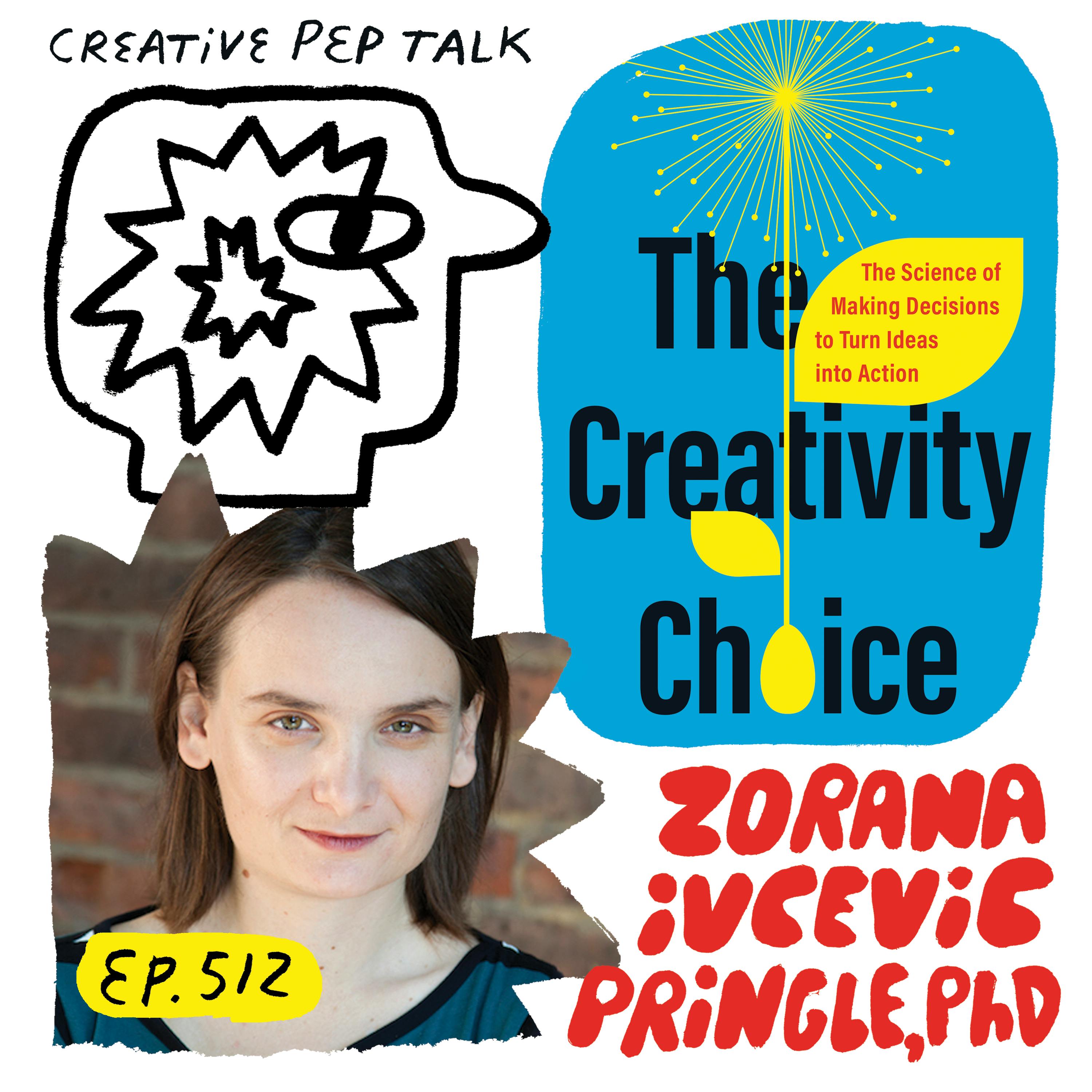
Creative Pep Talk
512 - The Science of Realizing Creative Potential with Yale Researcher Zorana Ivcevic Pringle, PhD
01:29:19
Loading summary
Transcript132 lines
- [00:00]
Dr. Zorana Evic Pringle
I think understanding the true nature of the creative process, or as true as we can possibly make it in the scientific sense, will help you in some instances, to remind yourself. So I know this research, and as I was writing the book, I kept reminding myself, on the creative journey, it's.
- [00:23]
Andy J. Pizza
Easy to get lost, but don't worry, you'll lift off. Sometimes you just need a creative pep talk.
- [00:38]
Courtney Act
All right, that's just a little tease of my chat with today's guest, Dr. Zorana Evic Pringle, and we're talking about her new book, the Creativity Choice. When I heard about this book, I knew that I had to have Dr. Zorana on the show because lots of the books out there about creativity are great, but they're all about how to be creative. If you are a creative person, naturally, you don't maybe even need those books because being creative comes natural to you. But what you might need is to figure out, how do I follow through, how do I find the motivation, how do I find the discipline, how do I regulate my emotions in order to not just start being creative, but to finish the projects, to get it to the finish line, to make them a reality? That's what this book is about. It is chock full of so many insights, some of which are things that I've experienced myself. Some of these things are new to me that I've been testing out, and some of them have been even already affecting how I go about my creative practice. So I am really pumped to get into this episode. Dr. Zarana is a senior research scientist at the Yale center for Emotional Intelligence. This book is based on all the research that she's done and that she has dug up around what it takes to not just be creative, but finish creative projects and make the choice to do that. This episode was an absolute delight. The book is really great and I hope you check it out. But first, let's get to this chat. Oh, by the way, I'll be back at the end with a little exercise, a little thing that you can do right now to put some of these ideas into practice in a way that can impact your creativity. This week, today even, it's called prime the Pep. I'll be back with that. It's about how to get the kind of emotional state you're after for your creative session this week, and so stick around for that. But for now, let's get into this chat with Dr. Zorana Evcvich Pringle and yeah, let's do it. This episode is sponsored by Squarespace. I love Squarespace. I'm a longtime user. One of the things I love about Squarespace is I will use. It's so easy to use that I will use it to create pitches. If I'm pitching a book or I'm pitching something to a client, I will use a Squarespace page in my website and I'll build the whole thing there. Then you don't have these clunky like document PDFs clogging up people's inboxes and it looks super slick. If you want to see one of those that I use all the time, I did one for my series right side out andyjpiza.com RSO and you can see how I create a little pitch summary of that project. Go to squarespace.com pep talk get building for free and trying it out and testing it. And then when you're ready to launch, use promo code pep talk all one word for 10% off your first purchase. Thanks Squarespace.
- [04:05]
Dr. Zorana Evic Pringle
When you hear Lululemon, you probably think of Align yoga pants. Weightlessly soft, like you're wearing next to nothing. That's why you see them in class, at the grocery store and in the park. But did you know about skirts with built in liner shorts so you can still jump for the Frisbee and tanks and bodysuits with Align's iconic stretch, you won't want to take it off. And with endless style options, you don't have to shop in store or online@lululemon.com.
- [04:40]
Courtney Act
So if I understand it correctly, to me the book is kind of saying there's lots of books and talks around how do you have ideas and get creative, but there's not a ton about okay, we all have lots of ideas. Problem is we don't do them. Like we don't realize them. And this book is about kind of the research behind how people actually get stuff done.
- [05:07]
Dr. Zorana Evic Pringle
Yeah, it is about how you get stuff done. Oftentimes we just talk about creativity as, oh, how did they come up with that? That. And of course that's important. They did come up with that, but they also did that. Right. I, like Monet, did not come up with an idea to paint those water lies and those, you know, the ran cathedral in different lights. He did it.
- [05:33]
Courtney Act
Yes, exactly. And then. And yeah, lots of people maybe thought to do it and didn't do it. Well, I'm super grateful for this because a through line over the past decade of making this show has been me saying why I don't hear anybody talking about how hard it is to do it, how do you get yourself? I'm ADHD too. And so just like the learning, how do I get myself to get motivated? Finish not to start something, but finish something. So my first question is just why is it so hard to do these ideas?
- [06:11]
Dr. Zorana Evic Pringle
It is so hard because creativity is uncertain. Everything about it is uncertain. You are by definition creative work is doing something new, something original. If it's original. There is no blueprint, there is no six steps to yes, you know, the self help industry would want you to believe that, but it ain't so. And we, we can find comfort in, you know, do these things and then it's going to work out. In creative work, we don't know whether it's going to work out. We don't know whether we can realize that idea. And all of these uncertainties are psychologically experienced as risks, right?
- [07:00]
Courtney Act
Okay, yeah, they're experienced as risks. And what are, what are those risks that we're worried about?
- [07:07]
Dr. Zorana Evic Pringle
Well, the first one is a risk in front of ourselves. It is, can I rise to the occasion? What will I think of myself if I don't manage to do it? And that is a big risk. We don't necessarily put it in those words in our minds, but it comes down to that. And the other one is more consciously available and we are more clear that we are worried, worried about it. What are other people going to say? And those other people can be anybody. It can be, you know, if we are talking about children, it can be their teachers. If we are talking about, you know, grown up students, it can be their mentors. If we are talking about people at work, their bosses. You are a creator, gatekeepers of various kinds, right? Editors and book buyers, and it goes on.
- [08:13]
Courtney Act
Yeah, that makes tons of sense that I want to talk a little bit about both those points. The first one about what we, the risk of what it says about ourselves if we can't do it. This, I think links to probably the biggest through line of this show is I talk about creativity like a journey for the purpose of trying to build in the fact that it's not going to be easy and that, and that's connected to the growth mindset. So it seems like, you know, you're going to have a, you're going to have a hard time trying something that you don't know if it's going to work. If you don't have the growth mindset, you have more of a fixed mindset. Is that kind of what you think might be going on there?
- [09:01]
Dr. Zorana Evic Pringle
It's totally what's going on there. When you have a growth mindset about creativity, you are acknowledging that creativity is not the trait you are born with or not born with and you have a fixed amount of it. And well, whatever you are born with is what you were given by that you can do something about it, you can learn, you can develop it, you can do something through your agency and you're acknowledging it and then you're taking action.
- [09:33]
Courtney Act
Yeah.
- [09:33]
Dr. Zorana Evic Pringle
So that believing that it can be learned, that it can be developed, well, then it's easier to take action because. Well, then there's a point in that action.
- [09:44]
Courtney Act
Yeah. And I've, you know, on the flip side, having the fixed mindset, I've realized that because in the creative world there's such a mythology around talent. Whether you have it or you don't have it, trying something, if you have that fixed mindset, it's a make or break situation. If you go to write this book and you can't do it, the first time you do, you try, then you believe you don't have it.
- [10:15]
Dr. Zorana Evic Pringle
Exactly.
- [10:15]
Courtney Act
So yeah, you've just taken that and that risk is too big. So what are things that help people take those two risks of risking what it says about you and also worried about what other people are going to think about you?
- [10:33]
Dr. Zorana Evic Pringle
I think that it really helps to hear and to know, accept that it's the case from research and from people who have studied it that creativity is something that can be developed. So if you start thinking, well, it could be something to develop, then it becomes maybe it's worth trying now that you get that first step of maybe it's worth trying. We tend to try those things that we have a belief we can do. And psychologists call that creative self efficacy. So you have the belief that you can be efficacious, you know, effective in doing something. In everyday language. We usually call that creative confidence. The idea is pretty much the same and we tend to do those things we have the belief for. But people make no mistake and the mistake is an either or I have it completely or it's not worth doing. And this confidence is not something that you need to have at 100% level. Probably there are people who have it at 100% level, but they would be an exception rather than the rule. Yeah, there are some people who are grandiose and who are, you know, never had a doubt about anything they do, but they are really an exception. The rest of us have doubts and are not 100% sure. But the good news is you don't have to be hundred percent sure if you think of this kind of confidence of self efficacy as fuel for creative action. You know you can move your car if it is a quarter full, Right. It's going to get you to a place.
- [12:38]
Courtney Act
Yeah. You don't have to have a full tank to get moving.
- [12:40]
Dr. Zorana Evic Pringle
Exactly. You are going to get to the next destination. And that next destination is going to be the first task of many tasks that are part of a big project. And when you get there you will say, oh, I was able to do that. I was not sure I was able to do that, but I was able to do it. So perhaps I can do the next task on the list. And in that way it grows.
- [13:09]
Courtney Act
Yeah, I love that. And I don't think that's. This is exactly what you're saying here, but it reminds me of another thing I wanted to ask you about. I've spoke a bit on this show about one of the things you hear a lot in the creative research world is the idea of openness to experience. And I've explored that some and I'm happy also to talk about a little bit more here too. But the thing that you. So I knew that that that's a really correlates with being a creative person. But the second thing that you brought up surprised me a bit, but it really matches my experience. You talk about creative people tend to be the people that can hold contradictions. Can you talk a little bit about that?
- [13:55]
Dr. Zorana Evic Pringle
That's how I first got interested in studying creativity. I have read a piece of research from Creativity research in the 1960s. That was the first big boom in creativity research and the reason why it happened is the space race. The US was behind in the space race and we knew we needed to develop creativity, so we cared. And in this big research boom, this author Frank Barron said that creative people, and this is a direct quote, are occasionally crazier yet adamantly saner than the rest of the population.
- [14:40]
Courtney Act
That's a great quote.
- [14:41]
Dr. Zorana Evic Pringle
It is beautifully put. So there's that. But it really made me think. It made me think, first of all, what does that mean? And next it made me think. There is something interesting in the creative personality and kind of architecture of creative personality that people don't have the need to necessarily classify themselves. Oh, I'm an introvert, I'm an extrovert. They can say, well, there are times when I act in a rather introverted ways and other times when I act very extroverted. Creative individuals are also oftentimes playful, even silly, but in the same time very serious about what they are. Doing can be almost naive and look at the world with fresh eyes, but also have a very deep knowledge of what they are doing, of their domain of work and what works in, in their particular field. So things that usually don't go together, go together in creative individuals.
- [16:00]
Courtney Act
That, that totally resonates for me. The way I usually had talked about it was with the word non dual or even non binary way of kind of moving through things. Where for me, what's been useful is to think about it like it's. I think of creativity. I think a lot of creative people think about it through that lens of the pop culture right hemisphere kind of thing where you're right brain or left brain. And one of the things I think I'm always trying to get creatives on board with, with this show is kind of a whole brain creativity. Like, and, and that for me, realizing that these contradictions exist, but in the process they often don't exist at the same time. One day I'm like this, the next day I'm like that. Or this part of the process, I'm like this, another part of the process, I'm like that. I love what you talk about where, yes, feeling happy and flowy and ideas are coming are a big part of creativity. But that's not the only part, right?
- [17:08]
Dr. Zorana Evic Pringle
Exactly. That is not the only part. And that is the part of idea generation can be very energizing. When ideas start flowing, they flow. And there's enthusiasm, there's joy, there is a feeling of power in that. But then you have to be doing things with it. In the doing part, you are going to encounter obstacles because creative work is never linear. And it's a little bit like moving through maze. If you are moving through maze, occasionally you end up in a dead alley. And well, you have to retrace your steps, take a different approach, do something, something that is different and that is going to be. Going to be of different nature. And there are times when you really need to critically think about what you have done. And in those times, you know, moods that are more subdued or even darker are going to be more beneficial. And I get frustrated when people talk about creativity is feeling creative. Because the implication is you are coming up with ideas. Yeah, but creativity is not just coming up with ideas. And that feeling creative is just helping you with one particular slice of it. It.
- [18:39]
Courtney Act
I love that. What I love also is the inverse of that, which is, you know, I was talking with, I brought this up to someone just yesterday who was saying that I love this idea. You know, I want to really do this thing. But sometimes the thing about me is sometimes I feel really on it and up and excited and making stuff. But then I have these other periods where I'm in a darker place. Or I was lower mood and I could bring up your book and be like, yeah, that's the great thing about that is that belongs to in the creative process, that there's the time for the idea generation and the writing and then there's a time for the critical editing. And it doesn't have to be like, oh, guess these are days that I'm not creative. Those are days that you're doing a different type of creativity that's essential to it. Is that what you're saying?
- [19:31]
Dr. Zorana Evic Pringle
That is certainly what I'm saying. Creative process has those times when. When we expansive and come up with ideas and those times when we are fearing critical and improve on ideas, take them apart, reassemble them, make them better. And without that part that is darker in nature and more difficult in nature, there is no creativity that is visible in products and performances and things that we cherish. Another thing that you can tell that that person that you. That you talk to is, congratulations, you're human. Yes. They times when you are feeling this and times when you're feeling that, that is absolutely normal. And the exciting thing about creativity is that there is a place for all of those feelings and all the kinds of thinking that those feelings are associated.
- [20:28]
Courtney Act
I love that connection point between the feeling and the thinking because I think we. I tend to generally think of those as two separate, unconnected things. Things I'm the way. I mean, it's a really interesting point because I don't think that's something that I've even maybe considered in that exact way of how I'm thinking. What I'm able to do with my brain is either dependent or connected to my mood. And that you can use your mood as a prompt to help you do the kind of work that you should be doing in that stage. Right.
- [21:10]
Dr. Zorana Evic Pringle
So it's like connecting and making matches. Many of us, most of us probably who are listening to this show, have just about infinite to do list. If I have my to do list in a notebook and I use a pencil and it's this thing. It has to be a pencil and it has to be a notebook.
- [21:35]
Courtney Act
Yeah.
- [21:36]
Dr. Zorana Evic Pringle
It's hilarious. And I looked at my list this morning and there were three pages of line paper full of to do list items.
- [21:47]
Courtney Act
Yeah.
- [21:48]
Dr. Zorana Evic Pringle
And it's like that for. For many people who have certain level of autonomy in what they are doing. And so essentially, whatever you are feeling, you can find something on that list that will benefit from that kind of feeling.
- [22:08]
Courtney Act
Right. Oh, I love that. It's so good too, because I think a lot of creative people who also, a lot happen to be neurodivergent, they have to move through tasks in an unorthodox way. And often that comes with a lot of shame because it's not what we think of as the typical way to work through things or get things done. It doesn't seem like the logical or efficient way. But, yeah, keeping your mood in mind as you move through it actually does make a lot of sense.
- [22:39]
Dr. Zorana Evic Pringle
And I think that there is a myth of a typical way.
- [22:43]
Courtney Act
Right? It's true.
- [22:45]
Dr. Zorana Evic Pringle
It is. People pretend as if there is a typical way, but in reality, what is that even for? Perhaps for some kinds of tasks there is such a thing, but in creative work there certainly isn't. And whatever works, whatever kind of strategy you can devise, the relevant thing is that it works for you. When I started writing a book, of course, because I'm human too, I looked at some of those pieces of advice on how to be an effective writer.
- [23:23]
Courtney Act
Yeah.
- [23:23]
Dr. Zorana Evic Pringle
And it was completely impossible for me to follow any of it because most of it boils down to get up at 4:30am and write from 5 to 8.
- [23:35]
Courtney Act
Yeah. Yeah.
- [23:36]
Dr. Zorana Evic Pringle
I do not reach consciousness. Certainly that was not doable. So it could work for some people. And I'm not saying it doesn't work. It's a bad piece of advice. It is good piece of advice for some people. It is not good piece of advice for me. So don't worry about what is typical. Don't worry about what is normal, whatever that means. Just try to figure out what works for you.
- [24:09]
Courtney Act
I love that idea of the myth of typical. This idea that a lot of the things we think of as typical are just cultural myths or cliches or they're not. They're really. It's kind of that idea that the average isn't really a good fit for anybody. It's the average of everybody. And it also reminds me of this quote from Jordan Peele, I believe it was, who said, like, you know, your creativity is an instrument that's never existed, and so therefore nobody can teach you how to play this instrument. And I love that. I also. I love that you brought up your book, because my next question is your. Your book is about having a creative idea, getting it done. And I wondered if anything from the research in particular helped you finish this, you know, massive project that is publishing a book.
- [25:01]
Dr. Zorana Evic Pringle
Really, all of the research helped me, and for me, it was personally important that I am able to put the research advice into practice.
- [25:12]
Courtney Act
Yes.
- [25:14]
Dr. Zorana Evic Pringle
I experience that as an ethical issue, actually. If I am writing something and I cannot put it to use, doesn't seem honest. I'm telling people to do something while I cannot put it to use. So what's my right to do that? That's how I experienced it. So for me, it was really important to say, okay, how do I do this? That became part of my process. That does not mean that I am perfect. That does not mean that I did not experience creative blocks. That does not mean I did not have times of overwhelming frustration. Doesn't mean any of that. It means only that I could find ways to get out of them.
- [26:03]
Courtney Act
And you did it.
- [26:05]
Dr. Zorana Evic Pringle
And I did it.
- [26:06]
Courtney Act
Yeah.
- [26:06]
Dr. Zorana Evic Pringle
And it's. So I talk about regulating emotions when they get into your way in the book. And sometimes when we say regulating emotions, people's mind goes to, oh, make yourself happier. Sometimes. That is the goal of regulating emotions. But first of all, it's not the only goal. And another thing is that if you are feeling, at this point, overwhelmingly frustrated, there is no way to go from there to being happy.
- [26:39]
Courtney Act
That's. That's so true.
- [26:41]
Dr. Zorana Evic Pringle
No matter what level of skill that you have in dealing with emotions, there is a way of managing it so that you don't feel overwhelmingly frustrated anymore, that you can take that edge off. So think of I. I love that title, the podcast title, 10% Happier.
- [27:02]
Courtney Act
Yeah. Yeah.
- [27:04]
Dr. Zorana Evic Pringle
Because it is real. That is what you can do. And 10% sounds sometimes to people. Oh, just 10%. But it makes a huge difference, because 10% less frustrated means you can at least start reaching out to people and discussing something. When you do that, with some effort there and interaction, you can start coming up with new perspectives. Okay. Now, with new perspectives, your thinking is broadening, and that's how you get out of a creative block. But it starts with that. Just 10%.
- [27:47]
Courtney Act
Yeah, I love that. And it connects to something that I've been doing recently where if I sit down, anything that requires kind of deep creative work, if it's recording a podcast or working on a painting or, you know, whatever, it maybe some client work. If I sit down and my emotions are overwhelmingly not helpful for that stage, I've given myself permission to say, now, it doesn't mean that you can just not do any work today, but it does mean that you have a half an hour to do something that would help. And that distinction you made is so true, because often in that moment, your brain says when you're in that low place, your brain says there's nothing that will fix this. And that little shift from, we're not trying to fix it, we're trying to help it. We're trying to nudge it towards something more manageable. And for me, that might look like sometimes I sit in this place and I'm going to record and I am not feeling what I just what I had been planning this week to. To come and talk about. And I think, okay, you have a half an hour to go across the street and go get a little cortado and a little pastry, and you can, you know, just go have a little fun for a minute or, you know what, whatever it might be. And yeah, a 10 shift is sometimes all it takes to get past the overwhelming level to show up for the creative discipline element of it.
- [29:15]
Dr. Zorana Evic Pringle
And cortado and the pastry go a long way in lots of things in life.
- [29:22]
Courtney Act
So true. So true. What? Did you have any go to things that helped you if you got into that state while working on the book?
- [29:28]
Dr. Zorana Evic Pringle
Not like that. I had. I had different kinds of. Different kinds of things going on. So. Well, there's always ice cream, of course, but. But. But that's a universe.
- [29:41]
Courtney Act
Yeah, that's true. That's a given. We don't even need to go.
- [29:44]
Dr. Zorana Evic Pringle
We don't even have to mention it. I had. I had particular kinds of challenges. So I had my day job, and I couldn't stop doing my. And so I had to do that. I have a child, family, and I had to do writing. So it required a lot of figuring out of schedules and a lot of giving yourself permission to say all of the work is not done. But there are times when you have to take a break because it's important. It's important for the writing itself, but it's important for survival, too. And survival is pretty necessary for finishing the work, if you. If you think about it.
- [30:39]
Courtney Act
True.
- [30:42]
Dr. Zorana Evic Pringle
So my challenge was finding the schedule and then also finding a way to disengage from one thing into another. I love my day job. The transition is very difficult. And I do. I live in New Hampshire. I work in Connecticut. Essentially. I work from home.
- [31:06]
Courtney Act
Yeah.
- [31:07]
Dr. Zorana Evic Pringle
So my office. There is no. There are no clues to say, okay, now I'm stopping this job and I'm starting this one, and that. That was a problem to be solved. It was not going to work that way. And I have experimented, and I found a way that worked for me. So big Shout out to Barnes and Noble. Barnes and Noble is very important to my life.
- [31:37]
Courtney Act
Yeah.
- [31:39]
Dr. Zorana Evic Pringle
I would physically move and physically go to the school store and sit in their cafe and strategically sit in front of the psychology section.
- [31:50]
Courtney Act
Oh, that's good. I love that. That's awesome. I, I okay, so there's a lot of little bits there. There's three things. One is the. I love what you're talking about. I just did a little episode where I was talking about externalizing your mind. So if you want to make those transitions, finding those little, little things that help you jump from a different. Because it's so difficult to just mentally compartmentalize, like, all right, now I'm gonna go to this side of the hippocampus or whatever it is. I don't know. I'm not the researcher here, but I would jump, make that jump. It's really impossible. It's too abstract, but you can do it kind of by like changing your location. So I love that tip. That's so good. So the other thing I was going to ask you about. Oh, you just kind of touched on this, too. I heard you talk about this on another podcast, but it's so good. I have to get my listeners to hear about this. You're talking about. That was a great problem to solve, and you mentioned the scheduling thing, and it reminded me of something you spoke about where you had this kind of what felt like an impossible or over constrained problem of going away on holiday. Can you talk a little bit about that and what made the difference there?
- [33:09]
Dr. Zorana Evic Pringle
Oh, I love that. I love that story.
- [33:12]
Courtney Act
Yeah.
- [33:14]
Dr. Zorana Evic Pringle
So we had. This was a few years ago when a child was still young. Now he travels on his own internationally, no problem. But he was about 7 or 8 years old, and we wanted the series of things to happen all at once, essentially in the summer. I grew up in Croatia, so his grandparents still lived there, and we wanted him to spend time with his grandparents. We also wanted to spend a time, just the two of us, my husband and I, somewhere in Europe, traveling and being on our own while the child with grandparents. And we also had several conferences at different times during the summer that we had to attend. Now we have an impossible set of things going on, and I am very emotional and I can get very high strung.
- [34:12]
Courtney Act
Right.
- [34:13]
Dr. Zorana Evic Pringle
So I am now getting worked up. Yeah, yeah, I am getting all worked up. And this is impossible. This is not going to work out. And all those things we tend to say to ourselves. And then my husband says, wait a second, let's approach this as a creative problem. To solve immediately changes our perspective on it. Well, changes my perspective. He already had that perspective. And we start playing as if it was a puzzle. So at this point I'm like thinking, okay, yes, let's approach this as a creative problem. What is the key to the creative problem solving process? Playing with the pieces of the problem.
- [35:04]
Courtney Act
Yeah.
- [35:04]
Dr. Zorana Evic Pringle
Okay, so now I have all of these constraints and all of these problematic things going on. And now imagine putting them a little pieces of paper like you know, post its and try to see how they can create a timeline, move them around. How can all of that be the case? We found a solution and it was a terrific solution and fantastic summer that we went to Istanbul. So the solution ended up being that one of the parents took the child to visit grandparents, stayed with him there for a little bit and then travel to our chosen destination for a grown up holiday. The other parent first flew into the holiday destination. We spent time there first and then the first parent went back home and the second parent went to Croatia to spend some time with the child and fetch the child and take him back home. Everything was possible. But it really helped to know that solutions don't come from focusing on a solution, they come from playing with the problem and saying, what are the pieces of the problem? Where do they fit? How we can look at them from a different angle? Because if you think of a problem, we all have to be traveling. You have this unit in your mind, traveling as a family. But if you end up breaking it, then solutions become possible. So you are looking at the problem in a different way.
- [36:52]
Courtney Act
Yeah, I, you know what is so interesting about that? And it's one of the things that, you know, as I was making this show, I, the, the further I went, the more I started to tap into research around creativity. And the more I did that, the more I found it really useful. I like you. This is something that I was dedicated to from the start of this show. I was an illustrator before I started this show. But it was always important to me to be with. This show is kind of the lab, but then I'm in the fields too. I'm doing it, I'm making stuff. So that's something that's been a big core value of mine too because I want to, I want to prove the stuff that I'm thinking about and talking about. But one of the things that happened was I would come across research around things like playing with the problem and that became second nature because I would, there'd be things in my process that would kind of buzz, buzz to Be like, this is the time, this is when you play with the problem. And it's really, really helped me. And as you were going through that story, I heard maybe two or three different things that I've heard from the research that have helped me all at play in the same solution. So you had the naming it as a creative problem. It reminds me of what you talk about in your book around whether you tell the person to be creative in this activity or not. Can you. I'll go over the other two in a second. But can you talk a little bit about what it does? Like if they tell participants, either solve this or solve this creatively, how does that affect their participation?
- [38:42]
Dr. Zorana Evic Pringle
This research was rather counterintuitive to many people when they hear about it because we tend to think of creativity cannot be done on demand. Creativity is something that comes upon you.
- [39:00]
Courtney Act
I love that, that shift. That's so true. So many artists and myself included, that's a huge obstacle to get over. Like, especially we start getting client work, that myth starts playing, you're like, I can't do this because you can't do creativity on command.
- [39:16]
Dr. Zorana Evic Pringle
Yeah, you can do creativity on demand. Actually, people have studied this specifically. So one group of people was given the standard instruction to creative thinking task. And then another group of people, standard instruction plus three new words, please be creative. And the standard instruction is please think about all the idea. List all the ideas you can think of. And these are very quick game like idea generation tasks. Like think of all the possible uses for a brick or think of what, what are the consequences? What would happen if people could become invisible at will? So they are playful and they are designed to be like that, that you don't need prior knowledge to, to engage in them. And then researchers compared the group of people who was given standard instruction. List as many as you can and the one explicitly asked to be creative. And those who were asked to be creative are actually more creative in their ideas. Well, the question is now, well, how could that be? One thing is by being told be creative, you are given permission. You do not have to wonder anymore, well, should I be creative or should I do reasonable things or what should I do? Do you know that that is expected and you gave yourself permission a little bit. And it's also that, okay, this can be done because you know, this is, this is what everybody else is doing, therefore you know, I'm going to do it too. And people rise to the occasion that.
- [41:12]
Courtney Act
Social risk too, because you're saying, yeah, this is the expectation. Yeah, we're all Doing here?
- [41:16]
Dr. Zorana Evic Pringle
Yeah, it, it doesn't fully eliminate it. Nothing is ever fully eliminated. But it eases it. It eases it so that it doesn't, it doesn't become a barrier anymore. And this has been done in different ways. So this is the most, you know, the, the neatest study. Three words make a difference. But we have seen it in other context in, in work at work.
- [41:42]
Courtney Act
When.
- [41:44]
Dr. Zorana Evic Pringle
You are expected to be creative in your job, you end up being more creative. When leaders say, I want this, I want something creative here, they end up getting something creative there. So yes, we can be creative on demand. That does not mean you can be creative on demand in a way that we sometimes imagine it.
- [42:13]
Courtney Act
Right.
- [42:13]
Dr. Zorana Evic Pringle
Sometimes when you imagine being creative on demand, it means, okay, you are asked a question and the first thing that comes out of your mouth is something amazingly creative. No, you cannot do that. Nobody can. That's just not possible. It cannot be done. Because that's not how creativity works at all. The first ideas are never the most creative or just about never the most creative. And as I was talking to my son at one point, I said, if you learn one thing and one thing only about creativity, may it be that first ideas are never the most creative. So if you are asked, okay, be creative right now. Let your creative juices flow. No, first thing is not going to be creative. But in the long run, working on that thing, you are going to be more creative.
- [43:30]
Courtney Act
Have you ever spotted McDonald's hot crispy fries right as they're being scooped into the carton? And time just stands still. Ryan Reynolds here from Mint Mobile. With the price of just about everything going up, we thought we'd bring our prices down. So to help us, we brought in a reverse auctioneer, which is apparently a thing Mint Mobile unlimited premium wireless. 30. 30. Better get 30. Better get 20. 20. 20. Better get 20. 20. Better get 15. 15.
- [44:02]
Dr. Zorana Evic Pringle
15, 15.
- [44:02]
Courtney Act
Just 15 bucks a month. Sold. Give it a try@mintmobile.com Switch upfront payment.
- [44:08]
Andy J. Pizza
Of $45 for 3 month plan equivalent.
- [44:09]
Courtney Act
To $15 per month required new customer offer for first 3 months only. Speed slower. 35 gigabytes of networks busy. Taxes and fees extra. See mint mobile.com I wanted to talk to you about this because I think it's a really essential thing that's very difficult to internalize for creative people. Why do we think that our first ideas are the best ideas when in fact that's not true?
- [44:35]
Dr. Zorana Evic Pringle
It's a great question and I think that we believe that our first ideas are the best because of that Notion of how creative process works, that ideas come to us, and if something valuable comes to us, we should take it seriously. So that's why it might feel like that. But the mind just doesn't really work like our intuition says. So if we use the example of the simplest possible creative thinking exercise, right, come up with unusual uses or, you know, as many uses as you can for a brick, where does the mind go first?
- [45:24]
Courtney Act
Building a house.
- [45:25]
Dr. Zorana Evic Pringle
Building a house. Building a house. Building a wall. Building a path in your garden. Right, Building. And then the mind next goes into smashing something.
- [45:36]
Courtney Act
Yeah, yeah.
- [45:38]
Dr. Zorana Evic Pringle
So you're going to smash a window. You are going to, you know, do who knows what in the smashing universe. And so these are the first things that come to mind, not because we are not creative, but because the first things we consider are those that have the strongest connection in our minds to a particular topic. And that connection is based from previous experience. Now think about it. You are trying to do something creative, right? That means it needs to departure from the previous experience. Yet your mind starts with previous experience. Yeah, and that might not be bad in itself. It could be you start with previous experience and those obvious things, but that prompts you in some, you know, quirky way to something that truly is more interesting and more creative. Yeah, but the first ideas are usually not the most creative ones. Almost as a rule, there are these beautiful graphs that scientists have done of what do you believe is your most creative idea and what is actually the most creative idea? And they go exact opposite directions.
- [47:00]
Courtney Act
This is so profound. And it gets to something that is. Was so difficult for me and also is something that I talk about on the show a lot. And I know even sometimes I get pushback around it because it feels so counterintuitive. But I just did my fifth hundredth episode of the show, and in it, I was talking about basically similar things to your book in that I was talking about, how do I do that? How did I do that when I'm an ADHD person, when I'm a creative person, how do you just do that? Many things? And a big part of it was. Well, I think the first one I started with was changing how I thought about unpleasant feelings in the process. And I'm not saying that there aren't. There aren't types of resistance that are maybe telling you you're going too far on the challenging side or that you're. You're really working against your strengths. There are those things. I think that that's true, but it took me so long to change how I Saw bad quote unquote bad feelings as not wrong way signs. And I think that's the other thing that comes to mind with this is I totally relate to the magic of a first idea. The feeling of you're channeling it, it's coming out of nowhere, it's a great feeling. And therefore there's an assumption that it's a great idea. And if you have to grind and work to come for, come to a another idea or a few other ideas and it gets harder and harder the further you push it. If you don't know that the bad feelings don't mean bad idea, you're not going to realize that that might be your best idea. And I had a one example I talk about sometimes. It's right here over my shoulder. There's a book that I published right outside of college called the Indie Rock Coloring Book. And the, the funny thing is that that came from a college project where I was like tasked to come up with four ideas for my final project. I came up with one idea that I thought this is the idea. I'm doing this. I love this idea. And then the night before I had to present all four ideas, I thought I'm going to come up with three trash ideas that make this first idea look amazing. And the fourth idea I came up with was what became that book. And it was literally just me trying to come up with terrible stuff. And so I love that the research is kind of supporting that.
- [49:37]
Dr. Zorana Evic Pringle
It's very much supporting that. And our intuitions can be deceiving. When you said good feelings, it's not that we shouldn't listen to our good feelings ever, but also know what they are trying to tell us. Emotion scientists call consider that feelings are information. Yeah, it sounds very cold, but, but bear with me for a second. They are trying to tell you something. They're trying to tell you something about the state of your mind or something in your environment. And the positive feelings are telling you those. You know, being happy, being satisfied, tells you all is good. Yeah, no effort needed. But that can be really tricky when you are trying to figure out whether something is done or whether something is quite right, because it only focuses on the positive. In my book, I have interviewed an artist, multi interesting person. He is a musician himself doing electronic music, but also music producer, music label owner, just overall very interesting musical person. And he has developed a really ingenious system of essentially acknowledging that sometimes you feel so good when you complete something you want to say it's done and immediately publish it and be done with It. But he knows it can be tricky at times, so he lets it sit. Now, his approach may be little bit too elaborate, a little bit too extreme for some people, but he lets it sit for a month. And if in that month no other thoughts occur and no other things emerge, then it's truly done. But it sometimes happens that there are other feelings about it, that they are doubts, that they are pieces of nagging frustration about something, and that then gives you additional information. It says, yes, that positive feeling was telling you something. It was telling you that there are great parts to it, but these feelings are telling you something too. Let's pay attention to all of them.
- [52:04]
Courtney Act
Yeah, I love that. And, you know, some might think that's not extreme enough. It makes me think of an anecdote I've mentioned a couple of times on the show is one of my favorite filmmakers is named Taika Waititi. And he says his ideal way to write a screenplay is to write it, finish it, let it sit for a year, and then come back to it. And. And then he's got. He's not precious about it. He sees so much more clarity. And I think we. We all can't wait a year to publish the project. But I think, you know, knowing about that incubation phase as a way to collect more feelings.
- [52:44]
Dr. Zorana Evic Pringle
Collect more feelings, exactly.
- [52:46]
Courtney Act
Is a good way to think about it.
- [52:48]
Dr. Zorana Evic Pringle
And, you know, we. We oftentimes these are very, very strong cases. And perhaps people would say extreme cases are not achievable, and indeed, in many circumstances, they're not achievable. So if you are doing client work, you are on a particular deadline, you cannot say, now I'm going to sit on it for a year. Maybe you cannot even say, I'm going to sit on it for a month, but perhaps you can sit on it for a day.
- [53:18]
Courtney Act
Yeah, or you could sleep on it. You know, that usually helps me because sometimes, you know, either can happen where I finish a piece and I feel great about it, and the next day I've got. I've got actually complaints. Or I finish a piece and I'm like, I hate this. It's not. It's not good. And then I sleep on it, and the next day I'm like, actually, no, it has some merit. So even just giving yourself some space to feel different things, I think is a good move. I want to go back real quick to earlier, the example of you figuring out the schedule. There were three things that came up that kind of reminded me of the research. One was naming it as a creative Problem, which we kind of went over this command to be creative. I love that because you were talking about how in the research, just saying, and we want a creative solution made it eliminated some of that social risk. And I thought that actually applies within the conversation with the marriage too, because, you know, as soon as you say to your spouse, hey, about vacation, let's be creative about it, you're giving permission to the other person to say, maybe it doesn't have to look like what we expect it to look like. And maybe, you know, because if I think about that, I'm like, oh, I'm going to assume that we both mean going on vacation. It's all of us all at the same time. Just by labeling it creative, you're giving permission to. To think differently. And the same is true in your creative business if it's, you know, I see so many creative people, and for myself included, where I'm creative in my art, but I forget to be creative in my business or get creative with my schedule and how I do that and problem solve that way. So I love this idea of like, just label it as a creative problem to solve.
- [55:03]
Dr. Zorana Evic Pringle
It gives you a signal. It gives you a signal to engage in a process that otherwise might not occur to you.
- [55:11]
Courtney Act
Yeah, I love that. And then the two other ones that I heard, one we talked about a bit, which was playing with the problem. That's one that is always on my mind. Again, I think that coming up with the first idea is often a rush to finish the problem, to not play with it, but to solve it. And you talked about that. And then the third thing you said, I wondered if. I'm not sure I understand this fully, but this realizing there was a creative problem to solve, is that connected to this problem finding thing that you speak about? Could you speak a little bit about that? Because we know a lot about problem solving. But. But I'm guessing problem finding is new as an idea for most people.
- [55:55]
Dr. Zorana Evic Pringle
I suspect problem finding as an idea is new. And to make it more complicated, I think it's a little bit of a misnomer.
- [56:04]
Courtney Act
Okay.
- [56:05]
Dr. Zorana Evic Pringle
Because when you hear problem finding, you have a particular idea in mind. Right. When you hear the phrase problem finding, what comes to your mind?
- [56:13]
Courtney Act
Yeah, finding problems.
- [56:15]
Dr. Zorana Evic Pringle
Exactly. Yeah. You are finding it. It's not quite that or that is just one small part of it. So you can think of problem finding. And I wish there was a different term we could use as there are two parts to it. One is that identifying the problem, there is some kind of opportunity to address something or Solve something. Oftentimes entrepreneurs find something that is frustrating to all of us, but they say they are going to deal with it, thank them. And we see an opportunity. Oftentimes people label it as an opportunity. And so that is that identification part that sounds like problem finding just by the term, but that's not the end of it. The other part of it is researchers call problem construction, which is another very interesting term, but it's essentially about framing the problem, looking at the problem from different angles. Then from looking at it from different angles, ideas start to emerge. But you are not focusing on the ideas themselves, but on, okay, what questions can I ask about this problem? What angles can it be viewed at? Is there something that could be an assumption here that maybe is or is not an assumption? Are there other assumptions that could be made? And then we kind of play with different pieces of the problem. So to make this much more concrete, because this is all very, very crazily abst. I want to tell you a story about how this process was first identified. And actually in research world, this was identified long ago in the early 1970s. But because all of our talk in the translating science to normal people is about coming up with ideas, this never got translated, this never got properly communicated. So they were these researchers at the University of Chicago who recruited art students from the Art Institute of Chicago. So, you know, a really well esteemed institution brought them into the lab and said, your task is, your problem is to create a still life drawing. So you would say, well, they already had a problem. Yeah, they did. They had a very general problem. But now the question is, how do you approach that problem? What aspect of the problem? What specifics do you imagine there? And they observed as they, as they're engaged in this creative process. Everybody had the same set of objects available. So there was more than 30 different objects. Anything that you can imagine that could go into still life. And what they found is that those artists who ended up being deemed as most creative in their drawings, judged by art professors and art critics, so these are really expert ratings. They did a particular thing. They did not just pick a bunch of objects, arrange them, and then spent most of their time, you know, doing details of rendering, no, they did quite something different. They picked some objects and then would arrange them, step back, look at them, rearrange them, maybe drop something, maybe add something. Then they would feel the objects themselves, weigh them, compare them, look at them side by side. There were some objects that had mechanical parts to them. Then they would play with the mechanical parts, you know, think like A little wound up robot and they would play with it. Now that seems silly in a way because they are going to make a 2D drawing. In a 2D drawing you will not see movement of the object. Right. So what's the point? You can say, what's the point of playing with the mechanical parts? It seems like a waste of time. We come back to that idea of time. Why does this process oftentimes not happen as much as it should? Because it seems like a waste of time and we think we do not have the time. But if our goal is something creative, we have to find the time. Otherwise the outcome is not going to be creative.
- [61:26]
Courtney Act
That is incredible. I think it kind of reminds me of some things you hear in like design thinking. So I'm an illustrator, but I started in graphic design and I think that maybe a lack of self efficacy. Is that what it's called?
- [61:47]
Dr. Zorana Evic Pringle
Yes.
- [61:48]
Courtney Act
Yeah. Like feeling insecure that I would rush to solve a problem. And one of the things that was really helpful was spending time with designers that would do two things that I think are kind of related to this problem finding. One, they would say like, let's define what the problem is. Like what are we actually trying to solve? That's, that's work in itself. And it's as you say, it's a creative process all on its own to get creative about what is this problem that we're trying to solve. And let's really nail it and say it and construct a brief around it. So let's think about what we want, what we don't want. Let's. Let's really understand it and spend time with it before we even get to. We're not even talking about the solution, we're just talking about the problem. And I think that shift was really helpful for me. Is that kind of a little bit getting at what you're talking about?
- [62:39]
Dr. Zorana Evic Pringle
That is very much getting to it. It seems that each of these parts of the process are little bit of a time waste. Why am I going to write a brief when we already know what it is? Why am I going to discuss what the problem exactly is? Why? Because especially if you are working with a group of people in a team, there is never going to be an instance when you all define the problem in the same way and you can learn from different views on the problem. Different views of a problem will suggest different kinds of solutions. Maybe one is better than another, but maybe multiple aspects of those solutions can be all combined into something that becomes transformative in nature. So it very much pays off to spend time discussing the problem and looking at it from different angles. A recent study, a colleague of mine who is an organizational psychologist looked at problem solving teams and they recorded all the discussions within a team. And they have expected that they are going to spend most of their time in coming up with solutions. No, most of the time was spent on discussing the problem. How different people define it, what different people think it means, what aspects of it immediately come to mind when disagreements emerge, figuring out how to reconcile those disagreements. 50% of the time in discussions was just that.
- [64:30]
Courtney Act
That, that is, that's fascinating. And it, it makes me wonder too, if it connects to another piece that you explore in the book, which is about motivation. So we, I think we tend to think about motivation. You know, this show's called Creative Pep Talk. So we talk about motivation, we're thinking about motivation. How do you stay motivated to start, to finish, to get through the whole messy middle thing? And I think we probably tend to think of motivation as like one thing. You're either motivated or you're not motivated. And I love in the book that you kind of lay out a few different pieces. One of the pieces, the third one I think you get to is like, what keeps you motivated in terms of the philosophical cause, like the cause that you're for of like, what are you contributing? That's like the big picture. And I wonder a little bit if that playing with the problem maybe contributes to getting in touch with what are we trying to do here? Which maybe helps you stay motivated because you're like, oh, I know what problem we're trying to solve. I know why it matters. You know, that maybe that kind of adds to some of that philosophical motivation. I wonder if that, if you think there's maybe anything there and if you could tell us the other types of motivation, because I think you need all of them.
- [65:56]
Dr. Zorana Evic Pringle
I love that you're bringing up this issue of motivation because it is one of those things that indeed we think we have it or we are motivated, we are not motivated and we talk about it and don't terms. But we can ask a little bit of a different question. Again, it's that how do we frame this issue of motivation is how we are motivated instead of how much we are motivated. And how we are motivated really matters. So there was a lot of research in creativity studies on intrinsic motivation and creativity. And what intrinsic motivation is, is intrinsic just means internal. You are motivated because you want to do something, because you enjoy doing it, because it's a source of positive challenge. And this can Sometimes be misinterpreted. I have seen it misinterpreted in the popular media because this is what the reasoning goes. Oh, intrinsic motivation is important for creativity. Check. It is. But right now I am trying to create whatever you are creating and I am not enjoying it. Therefore, I must not have intrinsic motivation. No, no, no. This is not what it is. Intrinsic motivation is not just every single moment you are enjoying every single piece of the process. Not at all. Because creative work is difficult. It is. We have started a conversation with that and it truly is difficult. And some of those parts we don't enjoy. Nobody enjoys. It can be frustrating. Some parts can be boring. I am a scientist and there are parts of the research process that are boring. That like yesterday I got a request for a revision from the ethics review board. That is, they are rejecting something because of the formatting that they misformatted. So, you know, there are things that are frustrating or boring or perplexing. So it's. Intrinsic motivation does not mean that you're going to enjoying every single piece of it. Intrinsic motivation means that overall, for a big picture, when you look at it as a totality, you enjoy the kind of work you're doing because it's a challenge and because it's a source of fulfillment.
- [68:45]
Courtney Act
Yeah.
- [68:47]
Dr. Zorana Evic Pringle
So that is that bigger picture. But there's another thing that there are those parts that are boring or frustrating. And there are some times when you need extrinsic motivation. You need to motivate yourself by kind of blackmailing yourself and saying, you can have a cocktail or that pastry we mentioned earlier. If you finish this one boring thing.
- [69:16]
Courtney Act
Yeah, that's great. And I want, I want to throw this scenario at you because this is the way my I think about it, because I think I do best when I've got all three. The intrinsic, the extrinsic, and the kind of cause. The cause or the, the why. The bigger philosophical why. And one way I think about at least balancing intrinsic and extrinsic is I think about it like a road trip where the, the extrinsic, like, external goal is a destination that I choose because I know the road to get there will be fun. And so I'm trying. You know, I have earlier in my career when I was like in my 20s, I was much more externally motivated because I need, you know, you, you're in more need, you need to prove yourself, you need to pay the bills, all that kind of stuff. And then eventually I realized, like, oh, not as motivated by that anymore. But I also need it as a guiding kind of post or need it at different parts of the process. So. So I try to now have. I'm kind of experimenting with an extrinsic soft focus goal that's more of like a guidepost to point towards. That's in the vein of the stuff that I'm intrinsically motivated to do. Like if I'm doing that stuff, I'll probably go close to that and it kind of gives me a direction to hit. Is that. Do you think that's kind of like what you're talking about?
- [70:45]
Dr. Zorana Evic Pringle
It's a very good way of thinking about it. If we have intrinsic motivation is necessary, but sometimes in addition to it, we need something extrinsic. If we start with extrinsic, it might not be enough, but if they're both together, they can multiply.
- [71:06]
Courtney Act
Yeah, I love that. I have one last question and then I want to just make sure there's not anything you want to add. But my last question is, as someone who is a creative person, you know most people that listen to this, and I know anybody can be creative. In this show, we're mostly talking to people that want a creative practice of some kind, whether that's a hobby or professionally or something in between reading a book like yours and becoming familiar with what the research says. Knowing some of these terms, how can that be useful? Or how can they get the most use out of knowing the good practices?
- [71:54]
Dr. Zorana Evic Pringle
Fantastic question. So essentially you're asking, what can the science of creativity teach you, considering you're already doing creative work and it can make some things easier, I believe. I think understanding the true nature of the creative process, or as true as we can possibly make it in the scientific sense, will help you in some instances to remind yourself. So I know this research and as I was writing the book, I kept reminding myself, hey, right now you're going through a creative block. That does not mean that you do not have the ability. Creative block is defined by definition. It is lack of progress that is not due to lack of ability. And sometimes repeating some of these lessons to yourself makes the process easier when you get in those emotional times. There are multiple chapters in the book that are dealing with the emotional side of. Of creative work. These things are not intuitive. It is not intuitive that all emotions contain information that can be helpful, that all emotions, different kinds of emotions are related to different kinds of thinking. What are those connections? So the book can provide you some of that information that then you can put into use. Our to do lists are infinite. You can figure out, okay, what is my current mood going to make me able to do when I don't even know where to start? Things like that are the benefits of learning from the science. It's not something that is going to teach you how to create children's books itself. It cannot do that. But it's going to make the process more effective and less. Less unpleasant at times, or when those unpleasant times happen, more equipped to handle them so that they are maybe not less unpleasant, but less lasting in that unpleasantness.
- [74:15]
Courtney Act
Or less likely to derail you.
- [74:17]
Dr. Zorana Evic Pringle
Exactly, exactly.
- [74:19]
Courtney Act
I love that. I think this idea that the different parts of the process will signal these different lessons so that you can kind of affirm what you're doing or remember things that will help you stay the course. I also, I really love what you said about the, you know, the emotions are the information, but they're. They're not intuitive. And I haven't said it this way, but another way I've thought about it is it kind of feels like your book is a bit like, I love that you bring emotions into this. Because this is exactly what I was talking about at the start, where I'm like, nobody talks about how you get. How you get it done. And so much of that is about managing your emotions and how much of a thing that is. And kind of not. Not just intuiting it, but understanding it a little bit better. And so in a way, I feel like your book. I've used this analogy before of like, it's like the dashboard of your car. The lights that come up are like the emotions, and they're not intuitive. Like, you can't. If you don't know a car. You see, I always joke, like, one of them looks like a fishbowl with a exclamation point. Like, okay, I guess my exclamation point needs a fishbowl now. I don't know. Like, no, it's not that. And the same goes for your emotions, like, in the process, just because you're like, I hate this and I shouldn't do this. Just because you feel that way, it doesn't mean that that is true. And a lot of. There's. You're having so many emotions throughout the process and so many different experiences blocks, you know, all these different things. It's really useful to get into the manual of it and be like, okay, actually, this is the fishbowl thing just means you need to air up your tires. I don't know what that correlates with the creative process, but it's something like that. And I Think you're totally, totally on it with that.
- [76:11]
Dr. Zorana Evic Pringle
Emotions are signals, but we need to learn how to read them and read them very precisely.
- [76:17]
Courtney Act
And it's really important in the creative process. Not just because the creative process is full of them, but because creative people tend to be full of these emotions. The last thing I wanted to ask you was just wanted to say, is there anything about this book that you haven't got to talk about or you feel like people miss that's really essential to you?
- [76:37]
Dr. Zorana Evic Pringle
Well, we have talked about the creative confidence. We have talked about various risks and creativity. We have talked about using the power of emotions to choose what you are doing, when to be most effective. One thing that we didn't touch upon is the social side of creativity. And creativity is social even when it does not feel like it is. So I wrote a book. I was the only writer. No ghostwriters or a team of writers or anything like that. You are creating and illustrating books probably very similar instance. But even in these instances there is a social aspect of creativity, sometimes just in implied. Because ideas could feel coming out of nowhere, but they don't come out of nowhere. They come from our own experiences interacting with others in the world. They come from conversations with others, from little sparks that we get from people. And that is something important to acknowledge because oftentimes we, we talk about it in terms of talent, in terms of skill, in terms of what we can learn and what we can do. But that is another thing that we could potentially do if you know how to read it and if you know how to use it. So if you are thinking of new ideas, people at the very outer edges of your social networks are going to be most helpful because they have different backgrounds. You don't talk to them all the time. So they don't know what you think and you don't know what they think. But if you are developing ideas now you have something you want to focus on, those people who are the closest to you will be most helpful.
- [78:39]
Courtney Act
Oh, that's so good. And I love this notion that all creativity has this social component because again, it dismantles a common myth that I think can do some damage. I get what it's at, but it's it, it the damage of like the lone artist on the desert island. Yeah, that's getting at that intrinsic motivation thing, trying to get you to get in touch with that, I think. But I, I completely agree that no matter what you're doing, if you're writing in your diary or you're making something on stage, like, there is. You're a social animal, and it's a hu. It's going to bleed into everything that you do. And I. I think that's a great point. I'm glad you brought that up. Thank you so much for your time. I. This was a blast. I hope to get to chat with you again sometime. And I think everybody should go get the book, the creativity choice. Will you tell them where the best place to get it might be?
- [79:36]
Dr. Zorana Evic Pringle
Best place to get it is anywhere you get your books, whatever your preference is. Amazon, Barnes and Noble, and everything in between.
- [79:43]
Courtney Act
Yeah. Awesome. Well, thanks for spending so much time with me.
- [79:47]
Dr. Zorana Evic Pringle
Thank you.
- [80:04]
Courtney Act
All right, I'm back, like I said I would be, with this week's Creative Call to Adventure. This week it is called prime the Pack. Prime the pep. And the idea is, we talked about in this episode that being in the right emotional state for the work that you're about to do is really essential. And in the book, they talk about how you can hack this a little bit. And I like it because it's not toxic positivity. It's not just, like, feel great all the time. It's about going with your emotions a lot of the times and doing the kinds of. When you have the flexibility, doing the kind of tasks that match your emotions, I think that's really, really healthy. But then they also address. She also addresses in the book that sometimes you don't get the choice of that. You know, when you're doing this professionally, sometimes there is an assignment and a deadline or a scheduled time where you have to show up and do a certain type of creativity, whether you feel like that or not. Now, for most of us, we don't have to be on set or, you know, on TV or whatever it is and have to record at a certain time. But we all have only certain pockets to create. And so you probably know the mornings are your time or the evenings are your time, or the Saturday morning or Sunday, whatever it is. You probably know, when do you need to get into that creative zone where it would be ideal if you were pepped, if you were in a good state of mind and not in that editing mode, but in that ideation mode, in that generative mode. And so here's my recommendation. I did this recently on the back of this book, and it really made a big difference. And this is what I did. I primed the pep. So actors, you. You might have heard this. Prime their emotions. Sometimes some actors choose to, like, listen to a particular song to get into the mood that they need. To be in for that particular scene or they imagine something from their past or watch a clip from a movie and they prime their emotions. And so you might not need to act in your creative practice, but getting into that emotional state that is ideal for the activity you're working on is really important. And so what I did was I said, okay, I know that I have to do this solo episode of the show. I need to come to the studio and record that I know what kind of state I need to be in for that topic and for this show. And so before that I'm gonna schedule a meeting, a coffee date with a friend who I know puts me in that zone more times, more often than not. And so here's my recommendation to you. So let's say you have a three hour block to create on the weekend. What if you just took 30 minutes of that and dedicated it to sharpening the ax, so to speak, rather than just using every bit of the time you have to create, what if you use some of that time to get into the right zone so that you could slip right into the creative work that you have to do. And so what if you scheduled a 30 minute, yeah, maybe, or a 30 minute or an hour coffee day, or maybe it's just a phone call, maybe it's a zoom call with someone who lives lives far away. But whoever it is that is likely to get you into that state that you would take that time to make that connection. And maybe it's not a person, maybe like an actor, it is a clip from a movie or maybe it's a show or maybe it's a song or may whatever it is, take that little bit of time to adjust and address your emotional state because it is so essential to what you have access in, in here. When you're in certain parts of your brain, when you're angry, you're in a part of your brain that is going to have a very difficult time getting into the free association in the creative side of your brain. And so prime the pep is just about setting aside that really precious creative time, just a little bit of it, to drop in and attune and try to see if you can get like Zorana said. Dr. Zorana said, I always feel like I really have. I need to show the respect. I very much admire folks in academia and sciences, but even just 10% closer to that emotional state you're after will make all the difference. And so prime the pep that is your creative call to adventure this week. Massive thanks to Dr. Zorana for giving me me so much time to hang out and chat. I hope that we get to chat again. So insightful and inspiring to me. And you have a great sense of humor and you're just cool. It was fun. I felt really lucky to get to chat with you. Massive thanks to Sophie Miller for being a editor and producer for the show. And for this chat, thanks to Connor Jones of Pending Beautiful for audio edits, video edits, animation, sound design. He's an extraordinaire. Love this guy. And I just, I always chuckle every time Connor and I have a chat. The wheels fall off, man. Like every time I try to call him about some business thing, either I or him start tangenting into just madness and, and it's just a lot of fun. So I just imagine him working on this episode, hearing me talk about him, and then it just makes me laugh. Anyway, thanks to Yoni Wolf of the band Y for our theme music and our soundtrack. And thanks to all of you for listening till we speak again. Stay pepped. Okay, the podcast is over, so I don't know why you're still listening, but I am glad that you enjoyed it enough to stick to the end. I have one more thing for you. If you're in a place where you're feeling a lack of clarity and you want to figure out your industry, market and niche and find the perfect strategic side project to do next, go sign up to our newsletter@andyjpizza.substack.com and you will get a confirmation email that will give you the download of our creative career path handbooklet. And the whole process is in there. And you might also get a few bonuses in there depending on when you sign up. But again, thanks for listening. Glad you enjoyed the episode and stay pepped up, y' all.
- [86:58]
Andy J. Pizza
I'm Courtney Act. Many of you may know me from RuPaul's Drag Race, celebrity Big Brother, Dancing with the Stars, or probably my hit album, Kaleidoscope. Well, guess what? I have got a brand new show called R and R with Courtney act and I want you to check it out. You know I hate small talk. I want to go deep and I want to go quick. And on my show, we do just that. In today's world, it feels really polarized and we're more connected than ever, but really, we can feel isolated and I don't like that. I want the story shared here on R and R to make us realize that our similarities are greater than our differences. So join me and my fabulous guests like Nicole Byer, Tom Daly, Margaret Cho, Katia Adore, Delano, Jackie Beat, and many more. If you're looking for some rest and relaxation relaxation, you've come to the wrong place, because we are peeling back the layers of superficiality and we're getting down to the real stuff. Follow RR with Courtney. Act on Apple Podcasts, Spotify, YouTube, or wherever you're listening now.