← Creative Pep Talk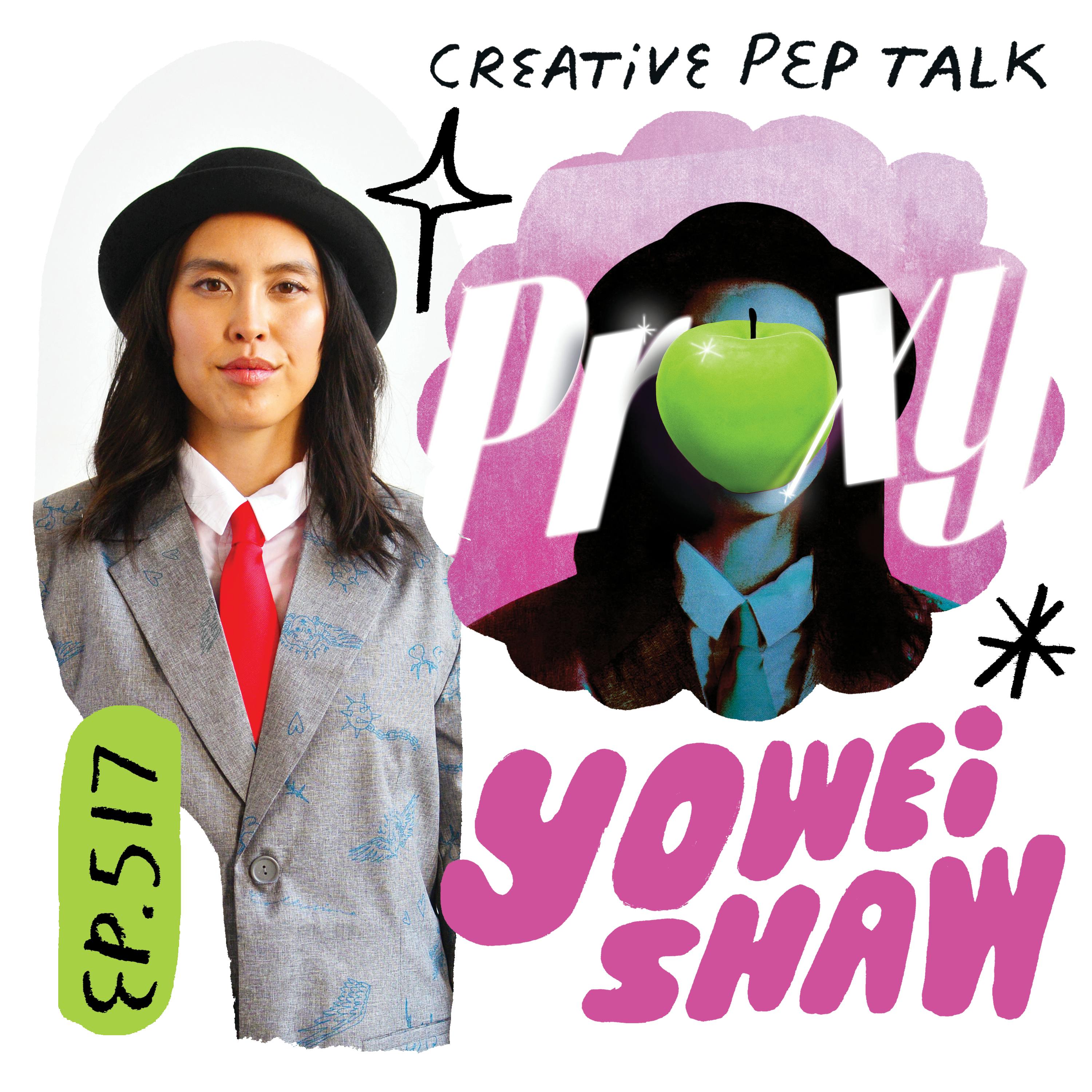
Creative Pep Talk
517 - How to Turn Business Pressures into a Fun Creative Project with Yowei Shaw
01:11:17
Loading summary
Transcript178 lines
- [00:03]
Yowei Shaw
On the creative journey, it's easy to.
- [00:06]
Host
Get lost, but don't worry, you'll lift off.
- [00:11]
Co-host
Sometimes you just need a creative pep talk. I think there comes a point in everyone's creative journey where they realize that their success or their creative practice really is on them. It depends on them to figure it out, to find the creativity within themselves as well as figure out how are they going to fund this creative outlet. And when this hits you for the first time, it can be incredibly intense and debilitating. It can really dampen your creativity when you feel that level of pressure on what you're making. However, it can also have an inverse effect. It can be the thing that causes you to rise to the occasion and show up fully and try with everything that you've got. Today I talk with Yowei Shaw, who is the host and creator behind the podcast, a very popular podcast, proxy. I will let her explain what that show is all about. But she was also a host on Invisibilia, NPR's Invisibilia before she was laid off. And that is a big part of her journey that we're going to explore today. And how this weight of having to figure it out has impacted her creativity in a positive way, how it has become an opportunity. And I think there are so many interesting, powerful takeaways in this episode that I'm excited to get to stick around to the end and I'm going come back with a call to adventure. It's the creative campaign. Create a creative campaign. It's a prompt that I'm taking from Yowei that they did with their show that I think proves that you can do a creative project that is very purposeful and strategic and how it pushes your business or financial goals for your creative work and do something incredibly artistic and creative at the same time. And so I'll be back to kind of summarize that at the end. But for now, enjoy this chat that I had with the wonderful Yowei Shaw. Hey, do you like fun? Because if you do, go check out Cookie Jam, a mobile game from Jam City. I like fun. Mobile games can be fun. Phone games, some people call them phone games can be very helpful in certain scenarios. For me, it's like airports and airplanes anywhere where I'm just like contained for a specific period of time. I need a game that's just going to be some easy fun. It's going to help me pass some time. Cookie Jam is that kind of game. Match cakes, cookies and candy, thousands of puzzles, free daily rewards, and of course, adorable pandas. What are you waiting for Download Cookie Jam now. This episode is sponsored by Squarespace. I love Squarespace. I'm a long time user. One of the things I love about Squarespace is I will use. It's so easy to use that I will use it to create pitches. If I'm pitching a book or I'm pitching something to a client, I will use a Squarespace page in my website and I'll build the whole thing there. Then you don't have these clunky like document PDFs clogging up people's inboxes and it looks super slick. If you want to see one of those that I use all the time, I did one for my series right side out. Andyjpiza.com RSO and you can see how I create a little pitch summary of that project. Go to squarespace.com pep talk. Get building for free and trying it out and testing it. And then when you're ready to launch, use promo code pep talk. All one word for 10% off your first purchase. Thanks, Squarespace. I thought we could start by you explaining your show, Proxy. There's like a kind of an ongoing gag on your show where you can't explain it, so I thought that'd be fun. But also I think you do a great job of explaining it from an outside perspective. So could you tell people what the show's all about?
- [05:01]
Yowei Shaw
Sure. Yeah. No. Thank you for noticing the gag and also acknowledging that we are trying to get better at it. So I think, yeah, I hope I'm doing a better job by now. So. Yeah. So Proxy is an emotional investigative show. I coined this term myself.
- [05:21]
Co-host
I like it.
- [05:21]
Yowei Shaw
Emotional investigative journalism. Thank you. People are like, what is that? And I'm like, I'm making it up. We're still figuring it out. So on the show, we take listener cases. People write in with niche emotional conundrums that make them feel alone, that they have trouble talking to people in their life about and getting good advice about. And then we scour the entire world for a stranger for our guests to talk to who can hopefully help them get less stuck. And that could be someone who's been through the exact same situation and has wisdom to share. Or it could be like an expert who studied their exact issue for decades and, like, has insight that can help reframe their relationship with the issue. We like to say, think of sitting at a bar next to a stranger who just happens to have the exact right experience for you to talk about an issue you're dealing with.
- [06:21]
Guest
Yeah.
- [06:22]
Co-host
And they end up Being a proxy for you, essentially.
- [06:24]
Yowei Shaw
Yes, yes, yes, yes.
- [06:26]
Co-host
Yeah. Okay, that makes sense. And my follow up question to that is kind of related to this emotional investigative journalism thing, because did that term come to you before you started the show or is it something that you developed over time?
- [06:43]
Yowei Shaw
So proxy used to not be the name of the show. I went through, like, a whole pitching process where I was, like, coming up with a pitch deck, going out to, like, podcast execs, and then, like, having question marks and feedback and then, like, going back to the table and trying to refine, refine, refine. So emotional investigative journalism was just something that I came up with. I think it was like when I was writing the trailer for the first layoff series that I did. And so it was just like me and my editor trying to come up with something, some phrase to describe what we were doing on the show. And so we were trying a bunch of different things out, and then we settled on that. It was like, oh, this sounds intriguing. Maybe this will work. And honestly, like, in the beginning, I started saying the phrase as a bit because, like, I think there's just something inherently funny about juxtaposing something so serious as investigative journalism with, like, something as squishy as emotions. So. But then. But then, like, people really responded to it, and now I'm like, it's a real thing.
- [08:00]
Co-host
And also, you know, I hadn't even. It hadn't occurred to me before, just this moment, that these two things. It feels a little bit like an oxymoron in a way.
- [08:11]
Yowei Shaw
Yes, yes.
- [08:12]
Co-host
Like, I hadn't fully thought about that. I do think journalism is a weird thing in this day and age. And I want to get to a little bit of your personal story of getting laid off and how this is like an independent project and why that perhaps makes it different as a creative endeavor. I want to get to that in a bit. But I'd like to talk about what I think makes the show so juicy, because I. I've heard people talk about it. I've just recently got hooked on it. And I think it's just that there's something going on here that maybe feels like it goes past regular journalism. And I'm wondering if. And it's complicated. I want to kind of get into why that might be complicated, but yeah.
- [09:02]
Yowei Shaw
Yeah.
- [09:03]
Co-host
I wondered if you could tell us about how your relationship to this show has changed from when you had the idea. Like, maybe. I'm assuming you started with, like, this feels like a novel idea. This feels like something fun, cool. Whereas over time, listening to you on the show, it sounds like it's become more than a novel idea in your relationship, maybe has changed to it. Am I reading that right?
- [09:29]
Yowei Shaw
You know, I. I don't know. I'm. Can I just, like, I want to pick your brain, because it's very interesting to, like, see on the other end, like, the listener, like, what their take on the show is. That doesn't totally. I mean, it is like a very. Like, I have a very complicated relationship with the show, but, like, I don't know if it has necessarily changed over time. Can you tell me, like, what is your son about? Yeah. What are you talking about? What are you. Do I seem more and more unhinged?
- [10:01]
Co-host
No, but, you know, I think any person that has tried to go alone on the creative journey, not, you know, in house in some kind of fashion. Yeah, it gets really real. So there's that element, I think, that is present in your show because you're doing this independently, whereas in the past, you've done it under, you know, bigger organizations. So I think that's palpable. That's a big part of the show. You make it a big part of the show, which is what I think makes it really interesting beyond the show. Your experience is really relevant to this, to the show. I do. But the reason I wondered if your journey with the show had evolved is because on paper, it sounds like an idea that sounds fun. It sounds like it'd make a good podcast. It also sounds like, oh, you'll get some really juicy stories and all that is true. But then as I'm, like, listening to you explore it with therapists and experts and then also having to champion it for listeners and funding and all that, I just started to wonder if it felt like more than entertainment. I guess I'm getting to go ahead what we're gonna say.
- [11:25]
Yowei Shaw
That's really interesting. Well, it for sure is more than entertainment. Like, to me, I know I said, like, oh, emotional investigative journalism. It's a bit. But, like, I'm also dead serious about it. Like, I really.
- [11:39]
Guest
Yeah.
- [11:39]
Yowei Shaw
Think that we need to be taking emotions more seriously. I think there should be more emotional investigative journalists. Emotions drive so much. They drive. They're a part of everything. Every news event, every relationship, every everything. And I think it's weird, honestly, that it's just like, oh, emotions. That's just for therapists. You know what I mean? Oh, that's just for you individually, for you to introspect. It's like, well, why wouldn't we put. Why wouldn't we as journalists try to report on these things, you know, as like a lens to analyze, you know, current events, our relationships. Looking at the sociology of emotions, the history of emotions, you know, the science of emotions. So, like, there is this kind of like highfalutin, like, I am dead ass serious as a journalist.
- [12:37]
Guest
Yeah.
- [12:37]
Yowei Shaw
About the show. But then I'm also just like, as like a creator. Like, I've just always been more interested in emotions, not just as a storytelling device, but like as the plot, you know? So, like, I think, like, for me, that's interesting.
- [12:57]
Co-host
I like that.
- [12:58]
Yowei Shaw
Yeah. So. So I guess, like, what you're maybe picking up on is I, My, my relationship is changing to the show. Actually, you're right, because I'm, I'm ex. I'm figuring this all out on the air. You know what I mean? Like, I think that that's really different from the way I used to do journalism, you know, when I was at NPR with Invisibilia, we would make seven stories a year and we would polish, polish, polish. It'd be like, you know, it was like this, like, artisanal, like, narrative. A documentary that we would, you know, spend all year perfecting and then put it out and then do the whole process over again. We would figure everything out before we shared it with our listeners. And I think there's obviously like a real. There's a lot of pros to that. It's messy what I'm doing. I have to. I'm contradicting myself at times, you know, because I learn new things about what I'm doing. We might mess up, we have messed up. But I think, like, for me, transparency is one of the only things I have going for me. Like, I don't have funding from a production company. You know what I mean? It's like transparency is one of the things that we can do that I wasn't able to do when I was at npr. Cause. No, no, no. Everything has to go through standards and practices and our lawyer and it' I can just kind of let it fly on the show.
- [14:36]
Co-host
That's an interesting way. It's, it's true. It's not just like a reframe, but it's an interesting perspective to think about as you're like, that's an advantage you have as an independent creator. And all independent creators have that. And especially I think it's extra interesting for those people who haven't experienced the opposite because they might miss that there is real value and you get to be calling the shots and taking the risks and being Transparent. A bunch of stuff you said touched on things that I want to get to in just a second, but I want to dive a little bit deeper into this. Part of the reason I asked if your relationship to the show had changed. I get the sense that when I listen to an NPR show like Invisibilia, it can be incredibly powerful, but it feels akin to, like, entertainment tv, things of that nature. Whereas when you're going on this journey on your own, partially because it's so much feels like it's riding on. On this for you, but also because of the topic of the show where you're there, there's no way to get around the fact that there's a helping component. Yeah, right.
- [15:59]
Yowei Shaw
Yes, yes.
- [15:59]
Co-host
To helping these people work through something. And I wanted to ask you about that because that creates this, like, meaning to your work that may be different, but then also complicated. I'm asking, partially, selfishly, not just from someone who does a creative self help podcast, but also someone who does art. Because I think as an artist, there is this complicated space between how we have moved from sounds really. I'm like, making a huge deal out of it. But I think. I think there's something here, a religious culture to a therapy centric culture. And there's this weird, like, yes, yes, yes. Where does art fit into this? Because I do think art. I do think it helps and matters. But. Yeah, but anytime I feel myself going to that space or other artists see other artists go into space, there's just all of this complexity because, like, we're not therapists. And I. Yes, I feel that. But yeah.
- [17:05]
Yowei Shaw
Oh, my gosh.
- [17:06]
Co-host
A little bit.
- [17:07]
Yowei Shaw
Oh, wow. I. I am loving all these questions. They're like, we're not therapists. I feel like I have to do that all the time on the show. And I have experienced that myself. And that reaction from other journalists who, Who I really respect, who are like, I don't know about what you're doing over there. Yeah. So I think I need to go back to my work at Invisibilia, which is like, that's how that was where I was raised was like in the kind of traditional, like, documentary medium, which is like, you go out and you find a compelling, important story that you think is worth telling for the public service. You talk to a source source and you get hours and hours of tape from them. You follow them over time. And then, you know, with Invisibilia, we would also talk to experts who've done, like, research that's relevant. And then we would keep. And then Those experts would help make meaning of the narrative stories that we were, you know, covering. And to me, I just always felt it was strange that, like, we would be talking to these social scientists or whoever, and they would have, like, work that would be helpful to the, quote, unquote, main characters of our stories. And I was like, it's really strange that, like, I'm gonna make them wait an entire year to hear this episode for them to get this utility out of it. Like, why wouldn't we just, like, bring them into the same space? And then it also just, like, felt especially for, like, the work that I did, which was like, we have to find the craziest, most surprising, stranger than fiction story to, like, meet the bar that, you know, we had to meet to get a story greenlit on the show. And it's like, I feel like I. I'm not going to speak for anyone else. I'm just gonna speak for myself. I feel like I would sometimes lose sight of, like, what is the source getting out of this? You know? And then I would find myself, like, trying to, like, make my case to these sources of, like, this is why it's important, and da da da, da, da, da, da, da da. But, like, I would always feel a little uncomfortable trying to, like, convince someone to tell their story because, like, it's either, like, you want to tell it or you don't.
- [19:35]
Guest
Yeah.
- [19:36]
Yowei Shaw
You know what I mean? Like, so all of these uncomfortable feelings kind of led me to Proxy and the format that we do. Because I think at my core, I am, like a service journalist, Bish. Like, I want to be useful. I want to be useful to everybody in the process. I want to be useful to myself. I want to be useful to the listener. I want to be useful to the expert. I want to be useful to the guest. I want to be useful to the. I want everyone to get concrete things out of this experience. Because I just didn't, like. It's selfish. Because I just didn't like feeling bad. I wanted to stop feeling. Feeling uncomfortable feelings.
- [20:17]
Guest
Yeah.
- [20:18]
Yowei Shaw
You know, and so this is sort of like, you know, so this helps me ethically kind of make sense of what I do. And then once. Once I get to the format, then I'm like, oh, so how do I do this ethically? You know, like, because I'm not a mental health professional.
- [20:32]
Co-host
Right.
- [20:32]
Yowei Shaw
I'm a journalist.
- [20:33]
Guest
Yeah.
- [20:34]
Yowei Shaw
It is very illegal for me to do therapy on the show. We do not do therapy, everybody.
- [20:41]
Co-host
Therapy.
- [20:42]
Yowei Shaw
This is not therapy. And so what I did was, like, what I always do is just like, I have a problem question. I go report. So then I talked to, like, a ton of therapists by now to try to, like, get their take on. Like, how is proxy. How is emotional investigative journalism, the stuff that we're doing on the show, how is that different from the work you do? How is it similar? How can I avoid. What are things that I need to avoid doing to, like, make it not therapy? And then what would you suggest I do to make it safe? You know? And so we have this, like, beautiful rubric that Anna Karen on our team put together where we have these, like, basically guidelines for, like, how we assess whether a story is worth doing, whether it's safe to do. And then, like, how we, like, set up the proxy conversation, the norms and expectations that we, like, let everyone know, like, this is not therapy. Everyone's responsible for their own boundaries. You do not have to answer any questions. Blah, blah, blah, blah, blah. All these different things. And it's still very, like, we're still very much figuring it out.
- [21:57]
Guest
Yeah.
- [21:57]
Yowei Shaw
And, like, we have it crossing my fingers. Haven't fucked up yet. Yeah, I'm sure we will. Because everyone fucks up.
- [22:07]
Co-host
There's just no way around.
- [22:08]
Yowei Shaw
There's no way that we won't fuck up.
- [22:09]
Co-host
That's just the way it goes. But, yeah.
- [22:11]
Yowei Shaw
Yeah. And so I'm just, like, hoping that we can put in a process where we're gonna try really hard to not fuck up. And if we do, like, every proxy conversation is an experiment, and we always debrief and learn from it and add to the document, because we're always like, we're figuring this out, you know, in real time.
- [22:30]
Guest
Yeah.
- [22:30]
Co-host
Part of the reason I ask you this is because even if the listener isn't making a show that borders on some topics that are like, therapy, Lots of creative people I talk to, if they. I'm often encouraging creative folks to do two things with their personal projects. One, explore things they're interested in. And two, really, without being too utilitarian about it, thinking about what is the feeling or value that someone on the other end gets from this thing that you're making. And I think both of those things when they're presented. A lot of times, the reaction is, I'm just not qualified for that. I can't speak to that, Whether it's therapy or science or, you know, whatever. But the reason I bring this up is not because I don't believe that delicate issues need to be handled by professionals. I do. I do think that I'm very serious. About that. I know all the chaos and terrible things that have happened throughout history and time with people that were not qualified or before we knew really how to handle this stuff. Being casual about dealing with trauma and all that kind of. Yeah, I am so on board with that. At the same time, I feel like I don't remember where this comes from, but it's like a classic idea that nobody knows how to make a pencil. Like, no one person knows how to make a pencil. You know, one person knows how the eraser's made and just all these little, really small elements. And I think that I'm trying to get to the bottom of how can artists find their place in culture because they are able to do something that a lot of therapists aren't, and every therapist can't be trained. And in art and vice versa and develop the craft and all that, there just seems to be something that artists can do that is unique and useful. Does that make sense?
- [24:38]
Yowei Shaw
Yeah. Yeah. No. I love thinking about this. I don't know if I have, because I don't really. You know, it's interesting. I don't think of what I do as art. I think of. Yeah, I have had a whole.
- [24:50]
Co-host
I've had a whole a. Art.
- [24:52]
Yowei Shaw
Well, I've had a whole, like, I. I've struggled with this question, okay, like, my entire career because, like, in podcasting, like, narrative podcasting, there's this whole, like, spectrum of, like, I'm a buttoned up investigative reporter who, like, would never use, like, sound design because that's false, you know, all the way to, like, the artiest sound art you can think of, and there's no plot, and it's all just vibes and blah, blah, blah, blah, blah. That doesn't think of itself as journalism at all. And I've always just been, like. I feel, like, kind of comfortable all over the place. Like, I feel like all of. I like being on all parts of the spectrum. So what am I? You know? And so the way I've made sense of it is the journalism comes first for me.
- [25:40]
Guest
Yeah.
- [25:40]
Yowei Shaw
And then I will use whatever creative tricks and art up my sleeve to get you to listen, because then the journalism will have more impact. So that's sort of like how I make sense. And so then for me, it's like, at the end of the day, if it's journalism, there are these kind of, like. There's a whole, like, set of guidelines and professional, you know, practices that I can think about. I don't have to. You know, I'm creating my own Kind of journalism now that I have to, you know, wrestle with. But it helps, like, me make sense of that puzzle. And also, so for me, it's really like journalism versus therapy versus. Instead of, like, art and therapy, like that question.
- [26:24]
Co-host
Right.
- [26:25]
Yowei Shaw
But I do think to like, answer your question around this, like, I talked to this therapist on my quest to, like, figure out what the hell is going on with my show, and he said this really interesting thing that, like, he feels like people get their hackles up too much these days about, like, oh, well, if it's therapeutic, then you have to be a professional. If you're like. If you're touching certain subjects, emotions, trauma, childhood, like, whatever, then it's like, oh, no, that's. That's really. For therapists. That's for a professional. And he's. His whole thing was like, we cannot medicalize. We should not be medicalizing genuine human interaction.
- [27:12]
Guest
Yeah.
- [27:12]
Yowei Shaw
Because genuine human interaction is healing. Yeah, it's healing.
- [27:18]
Guest
Yeah.
- [27:18]
Yowei Shaw
And it's, like, weird to be like, no, no, no. That's just for therapists. It's like, no, no. There's so many different ways you can heal connection. Art. Art is connection to, like, you know what I mean? So I don't. I just offer that. I don't have an answer for you, but that's something that feels relevant to what you're talking about.
- [27:37]
Co-host
Yes. And I. That's a big part of what I'm trying to get at too, is that even though I'm really grateful for these standards and the ways that we've evolved to think about what is helpful, what's not, not having people rampantly going rogue. Yeah, I like all of that. But they're. Not only do we fall into a trap, I think when we overly medicalize things, it also is privatizing connection and help in a way that is scary to me. Right, right.
- [28:14]
Yowei Shaw
When it's accessible and available to everybody.
- [28:18]
Co-host
Yeah, exactly.
- [28:19]
Yowei Shaw
It should be human connection.
- [28:21]
Co-host
I mean, should be.
- [28:22]
Yowei Shaw
Yeah.
- [28:22]
Co-host
Yes. So.
- [28:24]
Yowei Shaw
And it sort of isolates it. Like, if you're gonna be like, o, that's helpful and healing. And that's really the purview of therapists. Well, so then what is. So then are we just going to, like, back away from anything that feels helpful and healing in other space? Then it feels like we're avoid. We're like, not. We're like, limiting our opportunities for this.
- [28:49]
Co-host
Beautiful thing and making it more transactional, too.
- [28:54]
Yowei Shaw
That's true. Right. You have to pay someone to get the thing. Yeah.
- [28:57]
Co-host
So I feel like there's just things to like, evolve there just in case some people didn't follow it. Because I'm really into narrative pod, not podcast and radio. It sounds like what you're saying is when you're working on something like Invisibilia, which is kind of the. In npr, this American Life, these sorts of shows that are really narrative driven, you do this interview with a subject and they would have a problem or a situation, and then sometime later you would talk to an expert in the field and you'd realize, like, that would really help that person if I could connect those two people. But they might not ever hear it. Or if they do, it's going to be a year later when the episode comes out. And that proxy is designed to kind of, you know, eliminate the middleman and the time and make that work. And as you were saying that one thing that came to mind is that there are elements of journalism that must feel a bit like treating humans like an animal doctor documentary.
- [29:57]
Yowei Shaw
Oh, my God. You're like, yes, yes.
- [29:59]
Co-host
You're not supposed to.
- [30:00]
Yowei Shaw
I've never heard that yourself. I've never heard that frame. And that is so spot on.
- [30:07]
Co-host
It's.
- [30:08]
Yowei Shaw
It's so brutal and it's so true. Not always, of course, but like, it can feel like that. Yeah, sometimes because you're not supposed to, like, intervene. That's like one of the, you know, core rules of, you know, journalism traditionally, like, do not intervene.
- [30:23]
Co-host
Right.
- [30:24]
Yowei Shaw
And, you know, even if you could help, like, it's, it's, it's very, it's strange.
- [30:29]
Co-host
So it's a weird experiment.
- [30:48]
Advertiser
Abercrombie's viral denim sale is back and Spotify listeners get an extra 15% off with code Spotify AF. Abercrombie is known for their denim with 30 to 50% off all jeans. Find out how denim should feel. Shop the viral denim sale in the Abercrombie app online or in stores. Valid in stores and online through August 11, 2025 in US and Canada. Excludes clearance price. Reflects discount code. Valid in US and Canada through August 11, 2025. Exclusions apply. See details online.
- [31:18]
Yowei Shaw
You say you'll never join the Navy, that living on a submarine would be too hard. You'd never power a whole ship with nuclear energy. Never bring a patient back to life or play the national anthem for a sold out crowd. Joining the Navy sounds crazy. Saying never actually is. Start your journey@navy.com America's Navy forged by the sea.
- [31:50]
Co-host
I'd love to switch gears a little bit and talk about your creative career at this stage and how doing this independently, having to sell it yourself and how that maybe has shifted how you feel about your work. To kick that off, could you just explain how you got into this scenario?
- [32:13]
Yowei Shaw
Yes.
- [32:14]
Co-host
And being laid off and all that kind of stuff. Just take that picture a little bit.
- [32:19]
Yowei Shaw
Yeah. So I used to have a good job with benefits in the media industry. I worked for NPR and this documentary podcast, Invisibilia, for many years. Seven years. And then, you know, NPR fell on hard times like all the other media companies, and Invisibilia got canceled, and I got laid off with a bunch of other colleagues. And so at that point, I was like, huh, this sucks. And also, like, where should I go work? Where should I try to get another job? And then at that point, I looked around and I just didn't see another shop doing the kind of journalism that I wanted to do. And, you know, I don't have kids. At the time, I was 35. I'm married. I have a husband who's a music producer, which is not, you know, like, the most stable career ever. But we had some savings, and we talked it out, and he was like, I think you're gonna always regret not trying. Like, even if it doesn't work, why don't you try for a year to, like, do your own thing?
- [33:32]
Guest
Yeah.
- [33:32]
Yowei Shaw
And so, yeah, so then I started making this show, Proxy. And at first, I wasn't planning on going independent. I was planning on just, like, coming up with this concept and then pitching it to podcast companies, production companies, and then selling it, and then having some other company entity fund the entire operation. And I would have, like, you know, a job with benefits or, you know, money coming in at a regular. At a regular interval. And I did that for a summer, and it just. It just didn't work. You know, like, I did get some offers that were okay, but basically everyone, if they said they were interested, they wanted ip, they wanted intellectual property, and I was just like, I cannot let myself get into the same situation where, like, some company owns the feed, the podcast feed owns the idea. And then, like, for whatever reason, some exec is like, we're shifting strategies even if the show is doing well. So I guess I'm just going to try to do this on my own.
- [34:44]
Guest
Yeah.
- [34:44]
Yowei Shaw
And at that point, I knew nothing about how you make money in podcasts, because, like, before at npr, I was just like, I'm under a rock just making this little show, and that's it. I don't, you know, business and advertising that was handled by, like, an entire department. And there was Actually, like a firewall where actually, like, journalists are not supposed to, like, handle, talk about any of that stuff. And so, yeah, I basically was like, now I'm on the beat of, you know, now I'm a reporter who has to figure out how do you make a sustainable podcast in 2025 in a shitty podcast landscape when narrative podcasting is collapsing. And so I just, like, called. I made so many calls, I had so many meetings. I like, really, really tried to learn, like, what was up. And then I came to the conclusion, like, okay, so it's like advertising and some kind of subscription revenue membership program. And like, ads are really. You're not going to be able to, like, get to this scale. You basically have to get something like 300,000 downloads within the first month for every episode to make the kind of money to support, like a narrative podcast team. And I was like, well, that, like, it just doesn't happen anymore. Cause it's so crowded at this point. Um, and also in podcasting, audio first podcasts, there is no good algorithm.
- [36:12]
Guest
Yeah.
- [36:12]
Yowei Shaw
So, like, discovery and growth is really like, you. You're just kind of like clawing your way up through word of mouth and like feed drops and cross promos. And there's no. There's no YouTube algorithm that's going to, like, make you viral, you know, and help you find your audiences. And so it was like, okay, advertising. And then there's subscription revenue. Like, you know, what they do on Substack and Patreon, and there's a whole bunch of different services out there. And those numbers made so much more sense to me. I was like, okay, I need around 3,000 Patreon members paying $5 a month for me to be able to, like, pay myself, pay other people, make this show. And like, 3,000 versus 300,000. I was like, okay, I feel like I can. I can maybe. This feels doable. And so, yeah, bas. I have not really even paid attention to advertising and I have not really sold. I've only sold one ad. And it's really just my. My focus is really on Patreon. Yeah. Which is. I learned later, 3000 is a lot of members to try to get to. So it sounds like, oh, it's not that much. But no, it's actually really, really hard. So that's sort of where I am, which is like, I'm trying to grow the audience to the place where there will be enough. Like, basically it's all. It's all about audience growth and also, like, how I'm making my Patreon pitch. And yeah, so my husband is very helpful, and he, like, made some complicated Excel formula thing where that, like, calculates, like, how big of an audience I need to try to get to to try to get, like, the number of Patreon members that I want to get to.
- [38:09]
Co-host
So, yeah, that makes tons of sense. And obviously it's a per, it's a percentage of the total listeners are usually the ones willing to support a show.
- [38:18]
Yowei Shaw
It's very, very small.
- [38:19]
Co-host
It's very small. It's like 1%. That's my guess.
- [38:22]
Yowei Shaw
Yes. It's like 1% to 3%.
- [38:25]
Co-host
Yeah, that's my, that's my guess. And so there's so much, so much stuff that's really interesting here that I want to pick out. One is this shift from, we talk about this on the show from time to time, the classic 1000 true fans idea, shifting away from thinking, oh, I need to make these huge deals to I just need this core group of people. And then also coming to terms with the fact that 1000 true fans means, you know, I don't know, a hundred thousand passive fans or whatever. But all, all good evolutions to how you think about your practice. I think it helps you zone in on who it's for, go deep with people instead of trying to go wide and appeal to everybody. So there's a lot of really, really relevant stuff to everybody Listening to that one piece that I want to zoom in on is this is what I want to try to get at. What's good about being on your own? So there's a lot of talk and information, rightfully so, about how putting all the pressure on your creativity can get in the way of being creative. It can make it hard to access your creative self when everything feels do or die. I've experienced that. I know lots of people experience that. But what I don't think gets talked about very much is the positive side of this. And so when you were talking about earlier how at npr, you're, as the journalist, you're not really connected to the marketing of the show and these paths shouldn't cross. But then I thought, you know, I, I've heard Ira Glass talk about how he attributes part of his success in becoming a great storyteller to having to sell his show and develop the ads for this American Life for all the different NPR stations.
- [40:12]
Yowei Shaw
Yeah.
- [40:13]
Co-host
Because it's so, it's, it's a. Yeah. So I'm not going to say anymore. What, what do you, how does that sit with you in terms of now that you are deeply Connected to the selling of the show. Do you think it's changed your storytelling? Has it impacted it? Has it changed the way that you do the show?
- [40:32]
Yowei Shaw
Yeah, I mean, I have a lot of positive things to say. I think it's been huge for my creative development. Let me list the ways. Let me count the ways. So number one is, at Invisibilia, I was only reporting one or two stories a year. And at that time, I was, like, bored. I was like, I can do more. Like, I got lots of questions like, I'm fast. Let's go. And so having to make, you know, this new show where, you know, the more you make, the better it is, the more of a habit you can become. And, you know, this is all the advice I got. The more ads you can sell. Basically, there is this huge push for more and more content, which is, you know, every. Of course, there are problems with that. You can overwork. But for me, it's been really liberating to be like, okay, not everything has to be perfect. Yeah, I think I had, like, a perfectionist. Like, a lot of people have this perfectionist issue, maybe more in the beginning of their careers. And for me, it was debilitating, and it, like, you know, I think. Cause I was operating from a place of fear, and now I'm operating from a place of play and experimentation. Because there's always another. There's. I gotta make another episode, you know, so it just lowers the stakes for, like, how good does this have to be? Which, weirdly, has, I think, made my work the strongest it's ever been, you know? And I mean that in all kinds of creative choices, like, my writing, how I. How I track, you know, like, doing these, like, silly. I do this, like, silly bit with my husband, who, like, mixes the podcast for free. He's like, the running gag is he's the bedraggled podcast spouse. I'm always making him work on the weekend. You know, just, like, all of this stuff would never, like, first of all, like, like, I just needed something, and I was like, what's, like, the first idea that comes to me? Okay, let's try it. Okay. Oh, that didn't work. Let's move on to the next thing. So I think it helps with the experiment piece. And then I also think that doing things on your own has allowed me to get away with stuff that I would not. There's no way I'm making the decisions here. I have a great team. I have an amazing editor, Tim Howard, who used to be the editor of Reply All. My favorite Podcast. And he's like, I trust his taste over every. Like, I just. He's the best editor, but at the end of the day, it's my decision. And also, it's just the two of us mostly just, like, making. Making these calls, and so things just happen so much faster. There's not a lot of no. I would get a lot of no when I was at npr, and that really stifled creativity and experimentation in terms of, like, the selling of the show. And, like, I think that. I mean, frankly, it just has pushed me to try to solve new creative challenges. I find that it's, like, most helpful for me, personally, whenever there's an issue I have. Like, it's like, can I report my way out of this and. Or can this be, like, a creative challenge?
- [44:01]
Guest
Yeah.
- [44:02]
Yowei Shaw
You know? Cause that just makes it, like, fun.
- [44:05]
Guest
Yes.
- [44:05]
Yowei Shaw
Rather than, like, oh, God, I need to, like, figure out. Figure this out, or, like, you know, no more proxy, and then I'm in debt. Like, I don't. Like, I. That's not helpful for me.
- [44:17]
Guest
Yeah.
- [44:18]
Yowei Shaw
And so, I mean, I feel like the work that we do in narrative podcasting, it's all creative problem solving.
- [44:25]
Guest
Yes.
- [44:26]
Yowei Shaw
Like, that's just like, every story is a new puzzle that you have to try to crack, and, like, I'm good at that, and it's fun for me. So, you know. Okay. So I have to try to get this many Patreon members. Okay, well, so, like, what if we try this? Like, what if we tried that? Like, you know, it's just a lot of. To me, that is. I've had to reframe it. As fun.
- [44:53]
Guest
Yeah.
- [44:56]
Yowei Shaw
As, like, part of the art itself.
- [44:58]
Guest
Yeah.
- [44:59]
Co-host
I totally agree. Yes.
- [45:01]
Yowei Shaw
Otherwise, it's that.
- [45:04]
Co-host
Yeah, it's a. Yeah. Yeah. The marketing, the business, all of that. I think it's interesting, you know, when I hit a brick wall early in my creative journey as an illustrator, and I talk about my rock bottom being not drugs and alcohol, but marketing books and business magazines, and, you know, really begrudgingly going into that zone. And there were so different takeaways. But eventually I started to feel like, you know, when you're in the business world, I feel like they really want to downplay the variables and the level of creativity that is required for a business to be successful. Because they want to make it math, right?
- [45:46]
Advertiser
Yeah.
- [45:46]
Co-host
They want it to be. This is the taxes, this, the accounting. Once you got that, it's pretty much good. You're like, that's almost nothing about what makes a business successful.
- [45:55]
Yowei Shaw
Yeah.
- [45:56]
Co-host
And there's this there's huge areas of creativity that are required and once I saw that, yeah, I started to see it as a creative problem. I'm gonna just really quick summarize that with a few points because I think. And then I want to ask you a follow up question just because I think you said so many really great.
- [46:13]
Yowei Shaw
Can I just say I love this summarizing move you're doing as a host. I'm learning from you right now. I'm like, oh, this is great what you're doing. You're like making sense of my jumble of.
- [46:23]
Co-host
No, it's so good. I don't want people to miss it. And I also like to think about the utility of the show too. Like, you know, I'm constantly. Because I, A lot of the show is. And I'm talking about this just like comparing notes because so much of the show is a monologue solo show where I can control everything. I try to inject some of that energy. Not without like taking over completely, just some of the like bullet point energy.
- [46:54]
Yowei Shaw
Bullet point energy. Okay, I'm, I, I like what you're putting down.
- [46:58]
Co-host
I'm gonna remember this so I won't bore. But I think the question was about like, what does embracing the sales marketing side of your creative practice do for you? Positively. Because we've said so much about what it can do negatively and I think you said it gives you a bunch of at bats when you start like this. This change helped you to like just try things quickly, fail quickly. I think you see that in really successful creative people, like stand up people are constantly going out and trying things rather than just being perfect about it. I think there's a cutting the ego thing that happens where you have to get no bullshit of like this either has to work or it doesn't.
- [47:41]
Yowei Shaw
Yeah.
- [47:42]
Co-host
And I like the romantic side of creativity. I, I'm all about it, but sometimes I can overly romanticize and this like, this is a human connection and then it helps you with speed and perfectionism. And the fourth thing was you get to see it as a creative problem in its own right. The business.
- [48:00]
Yowei Shaw
Yeah, yeah. And I also, this is maybe gonna make me sound really not appealing, but like this whole process has also made me realize that I'm deeply competitive.
- [48:12]
Co-host
Right.
- [48:13]
Yowei Shaw
Like, I play tennis too.
- [48:15]
Guest
Yeah.
- [48:15]
Yowei Shaw
Okay, here we go. Well, yeah, so like, competition, being competitive is not seen as like generally a good trait in this culture because it's like, you know, capitalism, blah, blah, blah. And like, you know, I, I hate lots of things about capitalism. This is not what this podcast is about. But in terms of just, like, my own motivation, like, I grew up playing tennis very competitively. I competed in everything. I competed in piano. I competed in tennis. I was a theater kid. We competed in Texas, weirdly, in theater. They had one act play competitions, competed in debate. So I think just. I was trained to kind of compete and have that be fun. And so there's, like, it taps into this kind of like, I'm a jock just trying to, like, hit a winner, you know, like, really, like, hit the. You know, do an overhead shot that's gonna win the match. You know, it's. It, like, makes it. I just makes it kind of game, like, which is like, you know, again, I guess these are all just, like, emotional mind tricks we're playing with our. To make us not be motivated to do the things that we need to do to try to survive. That's how I see it. I'm trying to make myself feel too weird that I like competition. But, yeah, it's an emotional mind trick, and I get to inhabit a different Persona, which is not normal for me. I'm a really nice person. I like making people feel good. I like saying yes. Like, I don't think it's a bad thing. You know, I mean, it gets me in trouble sometimes, but I. I'm like, nice.
- [49:58]
Guest
Yeah.
- [49:59]
Yowei Shaw
And so this is, like. So this is fun for me to be like, oh, I'm gonna be a fleas ball. Like, I'm gonna be like. Like, I'm gonna be like Wolf of Wall street right now. You know what I mean? Like, it's just like, yeah, it's like a character and energy that you can inhabit. And so, like, maybe that's one takeaway. I'm gonna inhabit bullet point energy right now, which is, like, looking for the Personas and characters that motivate you.
- [50:28]
Co-host
I think that's very real. I think about that a lot. Finding those, like, archetypal characters, that they're like, I need this energy right now. And I love that, too, because, you know, you talking about the competitive side, this is something that I think about creative stuff a lot. Like, whole brain activity needing to oscillate between several different types of you. And I think when I do get the. We're so in this culture of, like, inhumane levels of competition. Yes, I get why it gets the criticism that it gets. However, I think that in order to be, like, a successful human, you have to be like a cell in the body with your own nucleus where, like, I'm going to survive and thrive And I gotta do what I gotta do to do that and realize that you're part of the body. You know what I mean?
- [51:25]
Yowei Shaw
Yeah.
- [51:25]
Co-host
So I, I think that, yeah, there's something to doing both of those things.
- [51:29]
Yowei Shaw
I mean, you can be into playing video games and board games and, like. Like playing pickup basketball.
- [51:36]
Co-host
Yes.
- [51:36]
Yowei Shaw
And not be an asshole.
- [51:37]
Co-host
Right.
- [51:38]
Yowei Shaw
You know, but, like, in the actual container of the game, it's fun to, like, compete and, like, outdo yourself and outdo other people and, you know, like. I don't know. I think. Yeah.
- [51:53]
Co-host
I think held intention is. It's really important to have an ego. It's important to be like, I'm an individual, taking care of myself, trying to do the best I can do, and I'm part of a system that, you know, hopefully is cooperative and that kind of thing.
- [52:06]
Yowei Shaw
And the system is imperfect and flawed, and we need to collectively work to try to make things more equitable and accessible for everyone. Absolutely. I recently read this memoir by Kara Swisher. Do you know who. Karis Wisher.
- [52:20]
Co-host
I know that name. But I, I.
- [52:21]
Yowei Shaw
She's, like, huge tech. Like, the most famous tech journalist there ever was. And she, you know, has a bunch of podcasts and blah, blah, blah. She covered the tech industry from, like, early on to, like, she's. She, like, was on. She's, like, on a texting basis with, like, all, like, Elon and all the people. She's covered them for years.
- [52:42]
Guest
Yeah.
- [52:42]
Yowei Shaw
She is hugely successful. And when I read her memoir, she used this phrase that I was like, oh, my God, this is. I've never heard this, but she's. She would say all the time, like, I'm gonna kill you. And I was like, what is she saying? Like, is this normal? Like, is that normal? Have you heard people. Maybe it is. In, like, the tech and business world, I've never heard anyone. But it was just a refrain like, oh, I'm gonna kill that person. I'm gonna kill you. I'm gonna bury you. I'm gonna defeat you.
- [53:16]
Co-host
Like, in a competitive way.
- [53:17]
Yowei Shaw
In a competitive, playful way. It was a playful, like, she's not actually gonna murder people, you know, I.
- [53:24]
Co-host
Was like, we're gonna find out one day from another journalist that she's got tons of skeletons literally in her basement.
- [53:31]
Yowei Shaw
Yeah. So I was like, wow, that kind of energy, like, I mean, that's maybe taking it. Like, I don't really want just to kill anyone to kill people. But I was like, oh, okay. Maybe that's the kind of, like, energy. I mean, she's very Successful. I don't know. We're not endorsing murder here.
- [53:50]
Co-host
No, absolutely not. I don't want that to be confused whatsoever. But. But I think being a grown up, being good in your creative practice, I think requires you to hold a lot of tension, like being able to have two energies or at least switch between them. All right, so I've got one more question for you. I have a thousand more, but it'll have to be another time. But my last question is about. So. So we always end the show with what I call. It's a cta, but it's a different. It's a more fun one. It's call to adventure instead of call to action. And it's about taking some of these ideas from the show and putting them to practice in your creative practice. Practice. And so I thought it would be great to learn. I thought you did this incredible thing where you really did take a marketing effort and you turned it into a creative project part of the show. Can you. Do you know what I'm talking about? Can you.
- [54:52]
Yowei Shaw
Yeah, the four part series fundraising campaign.
- [54:55]
Co-host
Is kind of incredible. So could you tell us a little bit about that and then maybe we can talk about how people could try something like this?
- [55:03]
Yowei Shaw
Yeah. So basically last summer I did a four part series about what the heck is a proxy conversation and why do they work. And so that was like the narrative series. It was like a four part series where I was like on a quest to try to figure out how to explain my show because I was running into this issue with sources and listeners where, like, I had trouble convincing experts to come on the show because they just like, I just was not able to explain it adequately to them. That is like the content. But it really also was a four part month long quest to get to 1,000 Patreon members. And spoiler, we did not make our number. So, like, you know, it's interesting that you call this a success. I mean, it was a success in that we doubled our number of Patreon members. So it was like the biggest jump that we'd seen. And it was also fun. And I learned things about. Now I know how to like explain my show better. So, you know, win, win, win. With a little minus of not making our goal, but really like the genesis of it is like, it's one of the oldest storytelling tricks I think, in the narrative podcast world, you know, startup. If anyone remembers that podcast. Alex Bloomberg is like starting a podcast company and trying to get venture capital, which later became, you know, he started Gimlet, which You know, got bought by Spotify and then flamed out. Like, you know, he documented the process and made that part of the narrative. Like he was the hero, the protagonist trying to like, get rich. Just kidding. And so that was the model. I was like, okay, so I'm the protagonist here trying to make it to this goal so that we can hire, get more hours for my producer and continue making the show. So that's already. There's a narrative cliffhanger built in of will they or won't they? And so there's that and there's also just kind of. I think there's something fun about pointing at the thing you're doing, like pointing at the selling. Otherwise it'd be very difficult for me to make these pitches because for me it is kind of. It's kind of ridiculous what we have to do. You know, to be like, please pay, please convince people to think we are worth spending money on, you know, is kind of a ridiculous. It's a ridiculous quest. And so for me to like be able to do that full heartedly, I have to like, I don't know, I need to point at the thing and kind of like, have fun with it. Yeah, that's how I make sense of it. So, yeah, in this series I talked to, I found, I discovered that proxy conversations have a history in restorative justice where, you know, victims and offenders, if they don't, if they can't talk to each other for that healing conversation or they don't want to, maybe it's too triggering, maybe someone has died, maybe someone's not remorseful. Whatever the reason, there's this tradition of like, you can talk to a proxy victim or offender for that like, healing conversation, which is sort of like the most important piece of restorative justice. And, and there's been research on this and they found that like, oh yeah, it actually works and can actually be more effective. And then I also learned, I talked to this psychodramatist. I learned that like, oh, actually, like there's this whole therapy where role playing is huge and it feels similar to what I'm doing. And then I got him to explain, like what he thinks is happening on a neurobiological level. So I don't know, I think that I got a lot of good feedback from that series. I think the lesson that I learned from that is you have to make your pitch entertaining. It has to be fun and informative. Listeners, your audience, they have to be getting something out of this. Otherwise when you make the pitch, it's just gonna Be a chore. And that's really what I want to avoid is I don't want, you know, when I start to make the Patreon pitch, everyone to be like, oh, this again. Another NPR fundraising try.
- [59:50]
Co-host
Yeah, I. What I, you know, I call it a success because I think, you know, you have a. I know it's not completely arbitrary. I know there's, like numbers behind what the goal was, but still an arbitrary metric of whether this thing succeeded or not. The fact that you doubled your patrons, and for me, what was successful is you made great episodes. And so for me, it's like this really interesting thing where you were able to do. Where you were able to hold the tension of the left brain goals versus the right brain goals and do that at the same time. And so I think it's an interesting challenge for the creative call to adventure today to think about what would it look like to create a creative project that also meets a business goal and see if I think it's even a challenge. I know this is possible. You've done it. I've done things in this realm. But the challenge is to see how you can do two things at once and. And what can be cool about that and interesting about that. And also you can be transparent about that. That like, you were. Which I think is another layer I want to say. I wanted to add one more thing. The other thing I really love about your journey here is that you have taken an obstacle and used it as a constraint to be an opportunity creatively where, like you've said, narrative podcasting, traditional narrative podcasting, which. Traditional podcasting is kind of a weird term in the first place, but narrative radio doesn't have the funding it used to have. And lots of people in that scenario see that purely as an obstacle. Whereas you turned it into a creative prompt and said, what? How could we take some of what's great about this and do it in a way that works in how people are consuming this media as companion, more passive stuff. Were you aware of that? That's what you were doing?
- [61:54]
Yowei Shaw
Yeah, absolutely. Thank you for bringing this up. Yes, absolutely. The main issue with narrative radio, why it's dying, is because it costs too much to make. It takes too long, costs too much to make the number of episodes you need to make to get to sell the ads and get the audience you want. And so this idea of, like, what is a light lift way to make narrative audio like it will. If you say those words, light lift to a narrative podcaster, they will roll their eyes because this is like what is talked about all the time.
- [62:31]
Co-host
Right.
- [62:31]
Yowei Shaw
But for me, I was always like, oh, this is like a fun creative challenge.
- [62:35]
Co-host
Yeah.
- [62:36]
Yowei Shaw
Like, because I'm honestly, I'm sick of making the honkers of stories. Like, I was like, oh. And honestly, I don't know if listeners are getting always more out of the experience, mainly the reporting. Like, let's not, you know, the reporting takes time, and that's, you know, something that I've had to dial back on my show. But anyway, so what I did was I decided, okay, how can I, like, lean into the, like, chat that people like? And that, honestly, I like, as a listener, I don't listen to any narrative podcast now. I only listen to chat. So, like, the warmth, the depth, the spontaneity, how can I, like, do that? But with, like, a narrative lens, which is, like, narrative lens, it's, like, high stakes. There's structure, there's character development. And so that's how. That really is the reason why I came up with this format of, like, segment A is narrative in its traditional form of, like, here's the story of this person's problem, sets up the stakes. You get character development. It's only. It's usually around 8 minutes to 12 minutes. And I found that these are so easy to make. There's. It's just like, I'm just like, wow, I can write that in, like, a day or two. Wow, that is bananas to me. And then the rest of the show is this proxy conversation that I prep and produce. You know, for sure, I spend time figuring out how to make it so that there's a flow, that there's, like, you know, an arc, but it feels like just a conversation that we have heavily produced and prepped. And the idea there is like, how can I make this? How can we feel the drama of a conversation? Like, how can we tap into the highs, the lows, the awkwardness, the reveals? Like, how can we feel narrative change and, like, release and tension and stakes, but, like, in a conversation? Because to me, that was something that, like, narrative podcasts didn't do enough of because we always use, like, short pieces of tape or, like, at the most, two minutes or three minutes, you know, but every encounter, like, right now, we're having this encounter. Yeah, there is, like, maybe it's not high drama, but there. There is a beginning, middle, and end here. There are, like, insights, there are discoveries. You know, there's bullet points, bullet point energy. Like, you know, things can happen. Things happen in a conversation. And so my challenge was, like, how do I make it as like, entertaining as possible.
- [65:24]
Co-host
Yeah. And I. The thing that I hear there that I feel like is really useful for me is there's again, these two ways of being in your journey where you are. There are times when, you know, when you're voting, when you're on a panel, when you're speaking to this, when you're in part of the decision making process, you can think about how the system might need to change. You can think about how, oh, it'd be better if we had better, bigger budgets for these types of shows. Or you can. There's a time and space to think about the circumstance, but then a lot of your creative energy, you don't. You have to channel in what is the circumstance that you find yourself in and making the most out of it and using it as a creative prompt. And I think what you're doing is super interesting in that way. So thanks for that and thanks for sharing all that.
- [66:26]
Yowei Shaw
Thank you. I mean, we are. We love. Who doesn't love a creative constraint? Oh, yeah, right.
- [66:33]
Co-host
Like, absolutely.
- [66:34]
Yowei Shaw
They're so fun.
- [66:35]
Co-host
As soon as you can recognize it as that that's a difficult thing, especially when you're laid off. That doesn't feel like a constraint.
- [66:42]
Yowei Shaw
No, no, no.
- [66:43]
Co-host
But it is.
- [66:44]
Yowei Shaw
It was.
- [66:45]
Co-host
And it produced something really interesting and I'm excited to see where it goes. Thank you so much for spending all this time.
- [66:52]
Yowei Shaw
Thank you.
- [66:53]
Co-host
I got so much out of it and I'm sure the listeners will too. So tell people where to start with proxy.
- [67:01]
Yowei Shaw
Okay, well, I think you should start with the layoff trilogy, which were the first three episodes, which is about the mental health toll of layoffs. And we also do our first proxy conversation. And then from there I would maybe skip ahead to the most recent episodes, maybe go to bisexual wife guy next.
- [67:21]
Co-host
I've heard that some times. Popular episode.
- [67:23]
Yowei Shaw
Yeah, yeah. And that's basically about this guy, this listener who wrote in whose wife came out as bi and then divorced him. And we pair him with a woman who also did that to her husband as his proxy to just sort of like get some of that perspective. And that person happens to be my former boss.
- [67:48]
Co-host
That's true.
- [67:48]
Yowei Shaw
Statement.
- [67:51]
Co-host
That's great. I haven't heard that episode yet. I need to go look. Listen to that one. Thank you so much for spending so much time here and hope we get to chat again soon.
- [68:00]
Yowei Shaw
Yeah, thanks for having me. This was so fun.
- [68:18]
Co-host
All right. I absolutely, absolutely loved that conversation. I had so many more things that I could ask or places I could have took it. We're just super, super rich. I hope you loved it. If you did, you're gonna love yoe's show, Proxy. Go check it out. Wherever you listen to podcasts, it's super good. Just, yeah, really different and, and both emotional and I just feel like you get a lot from it. So thank you so much for being on the show, Yowei, and hope to have you back sometime. Just quickly. I'm not going to go deep into this because I think we pretty much explored it in the conversation, but the CTA we're calling Creative Campaign and the idea put simply is what would it look like for you to do a project or a series of work where you're creating the artwork, music, podcasts, images, whatever your medium is, but the project is to meet your business goals, whether that is to get Patreon backers like Proxy was doing, or whether it's to sell what you do to clients. What would it look like if you tried to do both at the same time? If you tried to make selling yourself an art? I think that some really interesting things could come of that. Especially if I don't. I don't think. I think there are a lot of scenarios where you wouldn't have to be super explicit that that's what you are doing. But I think it could be interesting to explore that too. How can you tell people like, hey, this is a project that's trying to be a campaign for my creative business. I think that is an interesting thing and we're going to explore that. I think it's such a good prompt. I'm going to do it. We're going to do it with a podcast. I think we're going to do a Patreon campaign, substack campaign, something of that nature because I think it was so successful and interesting as a creative prompt. So hope you loved it. Go check out Proxy. Massive. Thanks to Sophie Miller for being a producer and editor on this show. Thanks to Connor Jones of Pending Beautiful for being an audio editor, a video editor, an animator and a sound designer. For Creative Pep Talk. Thanks to Yoni Wolf and the band Y for our theme song and soundtrack. Thanks to all of you for listening. Until we speak again, stay pepped up.
- [70:55]
Host
Behind every great meal is a person with a story to tell. Hear them on Culinary Characters Unlocked, the podcast that reveals the lives behind the food. Hosted by me, David Page, Emmy award winning journalist and creator of Diners Drive Ins and Dives. As I talk with everyone from culinary legends to mom and pop standouts about the creativity, grit and passion that shape the food we love. Follow culinary characters unlocked on Apple Podcasts, Spotify, or wherever you get your podcasts.