← Creative Pep Talk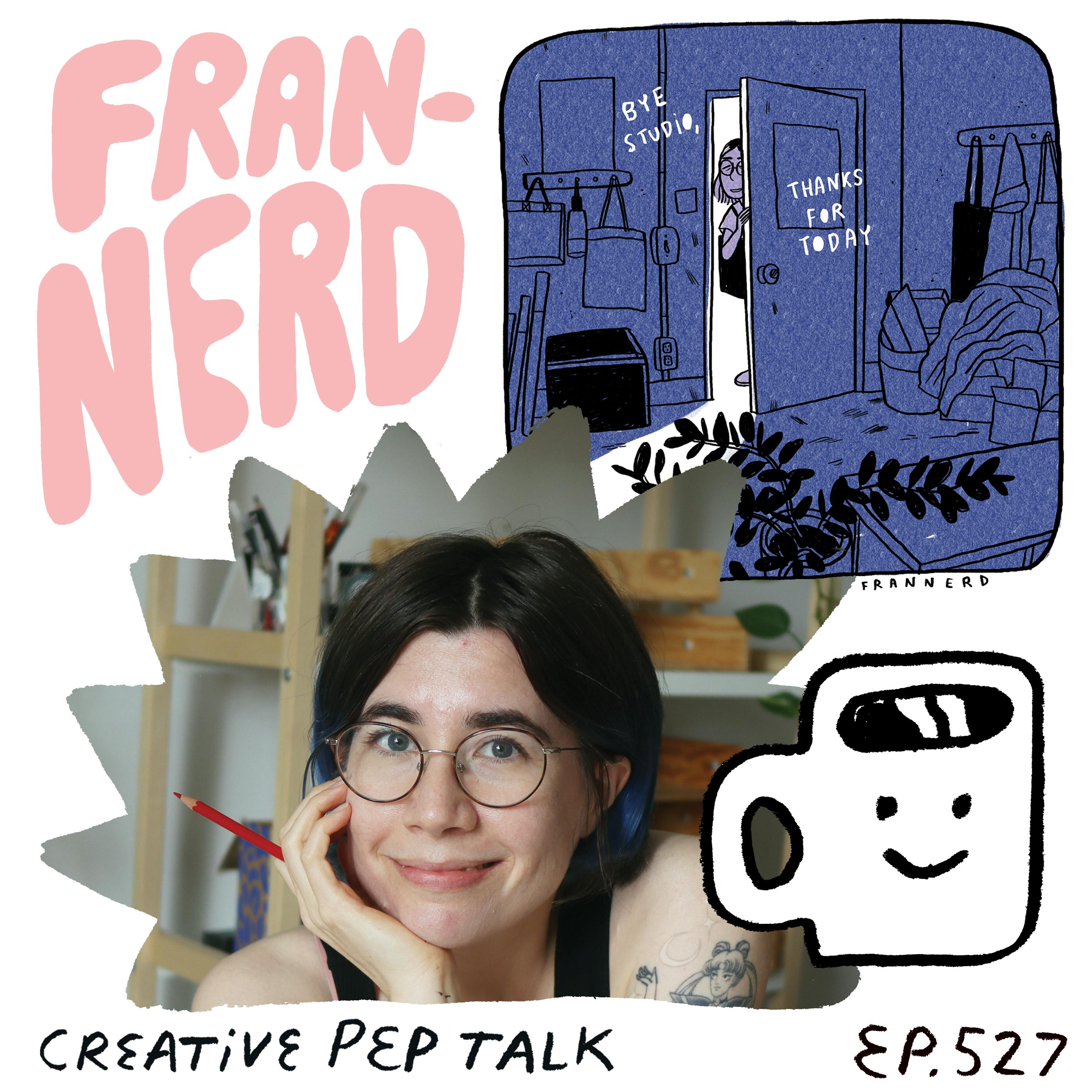
Loading summary
Transcript168 lines
- [00:01]
A
This is a huge episode because longtime friend of the show, Frannerd is back after a six year hiatus. It wasn't on purpose that we didn't do an episode together in that time. We actually had had calls and talked a little bit and caught up with each other in that break. But I am so thrilled to have Fran back on the show. We have similar creative journey in some ways, but over the past five years or so we've both been through a lot. But Fran has had a lot of big personal shifts and shifts in her creative journey and how she relates to her creativity. And I was just really excited to reconnect and walk through what she's been going through and learning. We talk about self love and how it relates to your creativity. We talk about a lot of mental health stuff, things like depression and anxiety and what it's like trying to fit creativity within that. And so if you struggle with those things, I hope that this episode is a balm for that and hopefully can, you know, make you feel less alone and then maybe even find some things that help you manage a little bit of that. We talk about loving your past work and when you get at a creative crossroads and you have to let go of something legitimately and choose something else and really double down. We talk a little bit about aging and in relationship to creativity and it was just a great chat, a great reconnection and I hope that Fran comes back on the show again soon. If you don't know Frannerd, I recommend checking out her comics on Instagram at frannord. Also, you can search franard on YouTube and check out her channel or check the show notes for the link. She's got an amazing YouTube channel. Been doing that for a long time. Hope that this conversation just gives you some relief and some pep and some refreshment creatively and then stick around to the end. I'm going to be back with a quick little creative call to adventure. Something that you can do with the information from this episode. It's called the backpack repack and it's meant to help ease the load a little bit and hopefully give you a little pep on where to direct your attention in a way that's going to be a life giving in this moment that you find yourself in. All right, without further ado, here is my chat with Fran on the creative journey. It's easy to get lost, but don't worry, you'll lift off. Sometimes you just need a creative pep talk reminder. For forgetful creative folks. Now is the time to get holiday shopping before it's too late and it's not fun anymore. Uncommon Goods makes holiday shopping stress free and joyful with thousands of one of a kind gifts that you can't find anywhere else. Uncommon Goods has products that are high quality and unique and often handmade or made in the us. Many are crafted by independent artists or small businesses, which means a lot or small batch and can sell out pretty fast. We got a bunch of great presents on there recently. A super unique pint glass from my father in law, this cool color changing umbrella for my youngest kid, A Taste of Italy snack box for my fam to remind us of our summer vacation. Uncommon Goods has stuff for everybody. Moms and dads and kids and teens, book lovers, history buffs, die hard football fans to foodies, mixologists, avid gardeners, kids. You'll find thousands of gifts that you can't find anywhere else. So shop early, have fun and cross some names off your list today. To get 15% off your next gift, go to UncommonGoods.com Pep Talk that's UncommonGoods.com Pep Talk for 15% off. Don't miss out on this limited time offer Uncommon Goods we're all out of the ordinary. Longtime listeners know running is a huge part of my creative journey. It regulates my mood, keeps me creatively tuned in and helps me focus. So as an artist and a runner, I am super into Vander Jacket. That's because it's the only running apparel company that I have ever heard of that was founded by an artist and the business and the clothing scream creativity. Vander Jacket apparel is made of leftover fabric from bigger apparel companies. That limitation of using exclusively dead stock fabric actually forces the Vander team to innovate and create unique running styles. It all is really unique and super cool. All apparel is made in Denver by the founder and a small team of brilliant clothing construction workers. They are the only running company I have ever heard of that makes one of a kind garments and does so in small batches of running clothes. It's getting colder recently and I have loved running in my Vanderjacket jacket. Deep pockets for my AirPods sleeves with thumb holes that keep my hands really warm. So good. If you're looking for something special this holiday season, whether your family's gifts need to be local, handmade, one of a kind or repurposed, Vanderjacket checks every box. Head to vanderjacket.com and use code creative in all caps. Creative for 20% off your first order. That's v a n-e r jacket.com, comma, promo code creative for 20% off your first order. So I'm super pumped to talk to you. It's been a while since we've had a podcast episode. We've had. We had. We've caught up a couple times, but do you have a guess of when the last time you were on the show was?
- [05:58]
B
Oh, my God. Was this pre pandemic?
- [06:00]
A
It was.
- [06:01]
B
It must have been 2019.
- [06:03]
A
It was 2019.
- [06:04]
B
Wow.
- [06:05]
A
I know.
- [06:06]
B
Isn't that crazy, Andy? I was a different person last time. I. So if anyone wants to be like, oh, I'm just gonna listen to Franz episodes on. Create a pep talk. They're gonna be like, who is this?
- [06:18]
A
That's someone else.
- [06:19]
B
Sorry, Can I. Can I curse and curse?
- [06:21]
A
Yeah.
- [06:24]
B
Wow. 2019. 2018. I was. Wow. I was married, I was straight. I had an online store. What was 2019?
- [06:34]
A
And the, like, I was the height of my ambition, I would say that was.
- [06:42]
B
I went to eat the world.
- [06:44]
A
I wanted to, and I thought I could. And I. I felt pretty invincible at that time. I had a right. When the pandemic hit, I had a bunch of stuff in the works that were, like, very, very exciting. That all kind of disappeared. There's a bunch of other stuff that maybe we'll get into, but I. I feel. And I'm sure. And you've had some huge markers and. And changes, but I feel like no matter who you are, who's listening to this, everyone will have experienced some level of that.
- [07:16]
B
Oh, yeah.
- [07:17]
A
And I.
- [07:18]
B
Some level of metamorphosis.
- [07:20]
A
Yes. And I wanted. That was the next question I was going to ask is because I felt like when I was thinking about you and knowing the journey that you've been on, I thought, okay, what happened in the pandemic, in the image that came to mind that I don't. I don't even have a, like, specific reason, but I thought it feels like. I don't know if you had this when you were a kid at school, but where the class is going crazy. We're all in primal, like, mode. Everyone's screaming, shouted. And then the teacher will turn the light off and everyone's like, oh, it's serious now. Like, wait, what was going on? What were we doing? Like, that's what I feel like the pandemic, on some level, it felt like that where everyone's. And that, you know, including the ambition thing of, like, when that hit. Yes. Some of those things dissolved. But then I also. I went to therapy for two years. I'd already just started it But I. It was a. For me, a thing of stepping back. Like, wait, what am I doing? Why. Why am I doing this? Is this where I want to go? Is this. You know, so does that feel it was right to you?
- [08:29]
B
Force? Absolutely. It was a forced, unconsensual, introspective period for everybody.
- [08:37]
A
It was.
- [08:38]
B
And I resonated a lot with what you said around just, like, the limitations and, like, the who we were prior the pandemic and who we are today. Because I. I was in a very similar path before the pandemic of, like, having all of these projects and all of these things that I wanted to do. And I think the things that have changed since then is accepting that there are kind of, like, a myriad of limitations, whether that's the pandemic or your body, things that you can control in ways that you have to readjust and reset and recalibrate your expectations. And that has been such a difficult lesson for me to learn and to kind of, like, cope and navigate, because I think, like, the major. I mean, like, oh, my God, we could be talking about this until tomorrow for everything that changed. But something that I'm working on right now, like, struggling with right now, is wanting to do everything. Andy. And my body presents right now the biggest limitation, which is, like, my mental health and being. And feeling very frustrated and impatience. Because I think, like. And I'm sure you relate when you're struggling with adhd, as you do, when you're suffering from depression, as I do, mixed with generalized anxiety disorder. It's just like. It's. They're like this, like, mental weights that you have to lift every morning and be like, okay, what do I want to prioritize? What am I able to do? That's why, like, this is called a disability. And it's been so hard to accept this, Andy, of like, as your. As our bodies are aging, as the. The. The circumstances are changing, it's been very. Just, like, frustrating to put this into the mix, you know?
- [10:49]
A
Yeah.
- [10:49]
B
It seems like prior pandemic, we were. I don't. I don't want to say unstoppable, because that there's also, like, a. A time in a freelancer's career when you have to reset your expectations. And now because of other circumstances, life circumstances, you're like, no, you have to actually prioritize what you want to do and what you can and you're able to do. Do you relate to this?
- [11:16]
A
Very much so. And I. It comes. What comes to mind for me is the. The way that the pandemic whenever it hit, like watching my kids and the life stages they were at which when your kids from. We have about a three year gap between the three kids each. So like when you're that age, every few years is a very different life stage because you have elementary school, middle school, high school. They're. They're very different zones. And so I'm just thinking about how we personalize the pandemic or how it might get confused with also just life stage stuff. It definitely had a massive effect on me and everyone I know. I. The world is completely different. There's no doubt about that. But as you're saying that I'm thinking about how I was going from mid-30s to late-30s in that time and I was already moving from the feeling for a lot of people, not everybody, but a lot of people. 20s and early 30s. That's when you probably feel most unstoppable anyway. That's when you're feeling ambitious. That's when you're. Then as you're moving forward, whether it's body or mental health or circumstance, you start hitting. Circumstances also tend to come in those times where you're like, shit like this. Like everything's real and, and, and it's causing you to kind of pause, which is interesting. Just to go back to what you said about the weight that you're holding with anxiety, depression and. I've had the worst anxiety and depression that I've ever had over the past two years and very. Some really bad bouts. I talked a little bit about it on the show a year ago. Last summer was particularly bad. Probably the worst depression I've ever had. There's a lot of different factors that I haven't really felt comfortable talking about. But, but the. I like what you said about the weight thing of. These are weights that you have to carry around. I think the interesting thing for me.
- [13:21]
B
Is.
- [13:23]
A
The, the hard thing is that they're always a different. It's like you're picking up a backpack, but you never know how much it's going to weigh that day.
- [13:31]
B
Oh, yes.
- [13:32]
A
You know.
- [13:33]
B
Yeah.
- [13:34]
A
Because it just, it fluctuates and there's so many factors that you can't, no matter what you do, you can't fully figure it out. What has helped with coming to terms with that?
- [13:48]
B
Oh, man. I think one of the biggest, I mean so many lessons I learned in therapy, but is trying not to be judgmental of my depression.
- [13:59]
A
Yeah.
- [13:59]
B
I think being judgmental, even though it's valid and I'm trying to be like, oh, it's okay to feel frustration and to be angry at feeling depressed, of having to slow down once again, of having to reassess and re shift your expectations. I found myself that when I feel judgmental against this thing, that it's beyond me. It doesn't help me in any way. It doesn't make me feel better in any way. It's almost like when you're going through a cold and you're like, no, no, no, I'm gonna suck it up and go outside and live my life. The only thing you're doing is prolongating, making the cold last longer. So I'm like, the only thing that I can do right now is heal as much as I can and try to accept that this is where I'm at. I think the beautiful thing about acceptance is that not because you're accepting something, it means that you're agreeing with what is happening. You can disagree with what is happening and accept at the same time. And I think understanding that dialectic around acceptance and trying to be like, okay, radically accept, this is where I'm at right now. What can I do in this state? And so I've prioritized. For example, anything that's urgent and important, I will do it. And I think this is why I've been reading so much this year, Andy, because it's one of the things that I can do as I'm laying on my couch, because even, like, being vertical, sitting straight, it takes so much of my energy. And trying to work hand in hand with fatigue, acute fatigue. It's been really challenging. And so I've been trying to be like, okay, I do want to start writing. What can I do right now in this current state that will allow me to nurture myself within reason? I found myself reading has been a great outlet not only for escapism and trying to run away from this reality that we're currently in, but also because it's not physically demanding. And also, I've been reading Andy so many books on writing, on, like, nonfiction, on writing, and like Stephen King, for example.
- [16:36]
A
I haven't read that one, but I've heard it's really great.
- [16:39]
B
If you like Stephen King, I really recommend it. That was, weirdly, my first ever Stephen King book.
- [16:46]
A
And so I don't. I've never read a Stephen King novel. So.
- [16:49]
B
Okay, yeah. But if you're a huge fan, I will say the book is meant for you because he walks you through behind the stage of what was like writing Carrie and what was his childhood and all of that. And so I Think, like, if you like his work, this is like a great window into his life and, like, the way he approaches writing and his creative routine, I guess. But so I've been reading a lot of books on writing, and I guess, like, one of the things that all of the writers agree is that if you want to write, you have to read. And so I'm like, okay, this is, I guess, the year that I will do reading, the year of reading for me. And so that's the way I've been navigating depression right now.
- [17:36]
A
Yeah, that makes tons of sense. I. It mirrors my experience almost exactly. What you said is my exact experience, where the best thing to do was I. For the longest time, if I picked up the backpack and it was way heavier that day, I would be like, no, how did I get here? How do I stop it? What do I. You know, all of those feelings, and it would actually make everything worse, make the anxiety worse, make the depression worse. Everything would be worse. And just like you said, the thing that helped me the most was if I picked up the backpack and it was super heavy that day, the first thing I would do would be kind to that thing and be like, okay, so it's a heavy day. All right. What kind of. Just like you said, my wife actually told me this same thing. She's like, think about what can you do on days like that.
- [18:31]
B
I agree.
- [18:32]
A
And it's to. It's totally, totally true. And that just that I feel like there's a kindness to yourself of. This is real. This is a. You know. And like you said, there were a lot of things. Pretty much almost everything that I had to do, I did. So it's not like I. And I was lucky enough to be well enough to do that, because not everybody is. But I totally, totally agree. There's that. And I've talked so much on this show over the past couple years on this obsession I have with the studies around some super interesting to me studies about how to. I always say to me, because I'm like, I don't know. I've never. I don't feel like I've ever met anybody that has shared my enthusiasm for this. I just don't know.
- [19:22]
B
Okay, he had me. Hit me.
- [19:24]
A
It's. It's the. There's a lot of studies around how so there's good stress and there's bad stress. So you need good stress.
- [19:32]
B
I've heard the same.
- [19:33]
A
You. And there's bad stress, which hurts you and can have all these different effects on you. And these are peer Reviewed studies. These are the good. The good. And so much about whether it is good or bad stress in your body. So much of it is whether you accept it or reject it. So it's about how you relate to it.
- [19:56]
B
Yeah.
- [19:57]
A
And so I feel like that's at play here with your mental health stuff is like if you reject it, if you're like nope, I'm not depressed. I'm not. I don't have any of this stuff. There is a way in which it becomes I think probably worse stress. Whereas if you're like oh, okay, this is a thing that I have to figure out how, how do I accommodate for this thing?
- [20:18]
B
Fascinating.
- [20:19]
A
And it actually changes how, how your body experiences the stress, the effect the stress has on you. Yeah. Anyway, so I love what you said about that same.
- [20:31]
B
And can I go back to what you said around. Because I, I struggle with the same disease, Andy of like intellectualizing or like over intellectualizing. Yep. And I remember same this year has like I spent so many hours just like trying to figure out why am I depressed? You know. And there's a lot of self invalidation comments that I'm like, but my life is so beautiful. Look at where I live. And I do and I have, I feel so privileged with all of this and like especially with what is happening in the world. There's a contrast of other people's reality in my reality. And I'm like, so why am I so sad if I have all of this? You know?
- [21:14]
A
Yeah.
- [21:15]
B
And even when explaining this to people of like I'm going back on anti oppressants. I am trying to slow down, work wise. All of this is happening. And I, my, my mom for example has been really keen on like but what is the source of this sadness? Like can you tell me when did it begin? I'm like, I, I like I'm still puzzle around this idea of like what is the source? And I think, yeah, because I, I think there's this massive solace, Andy, or this hope that if we figure out the source, if we figure out the nugget, the answer, we, we're going to be healed. It's going to be like a cathartic relief. Oh my God, I'm, I'm cure. You know, I figure out the secret. So it's good. But unfortunately with a lot of things not knowing, I mean knowing the source won't make us feel any better long term necessarily. And also intellectualizing that is like wondering over and over again what was the reason what happened at least to me. And I'm speaking on behalf of myself, but like it removes me from feeling the feelings. And I think part of the, I guess the strategy when it comes to mental health is just like noticing your feelings again. Not non judgmentally, just noticing where you feel them in your body. Can you tell? I've been on therapy for seven years, but it's been like truly revelatory because I've been spending so much time trying to understand, which is a good thing. But when it's preventing you from feeling or from noticing what is happening again, you're just delaying the cold longer and longer. And so this, that's the, I guess the anxiety that I felt all this time. It's like people are asking me what is the source of this? And because I don't have an answer, I'm like, there's something wrong with me. Why don't have a reason. And then you go on this spiral of why do I feel sad if this is my reality, you know?
- [23:29]
A
Yeah.
- [23:29]
B
It just accepts sometimes. I've had to learn the hard way that depression and anxiety, most of the times they're like retroactive. There's from things that you've been carrying for a long ass time probably. And like you said, you might not get the answer years from now, like looking at far ahead that you're like, oh, this is what was going on. And I, I was too close to the forest to see the trees, you know.
- [23:57]
A
Yeah, okay. I have so many, so many little threads to pull out. But one was this is a really delicate thing because for me, because as we're talking through this, I'm thinking, I feel like there's a way to engage with this stuff where you accept it and you acknowledge it and you don't run from it like we're saying and then also do what you can to heal and grow and all that. So it's a weird tightrope because like I said earlier, if I fall too far off on the side of how do I fix this, what's wrong with me? I end up really in a worse place. So.
- [24:48]
B
Yeah.
- [24:49]
A
And the next thing I wanted to talk about is maybe over in that camp. So I was just trying to acknowledge it because the thing that made me think about my experience, that is maybe one contributing factor and it's something I wanted to ask you about. I've labeled it the dark side of the dream. And this is what, what I mean by that is.
- [25:13]
B
Sounds like very Pink Floyd, by the way.
- [25:14]
A
I know, yeah. But it's like the one factor that I've wondered if it was a contributing element is being a freelance artist is you're so isolated. So I have my wife and kids which you know are around me a lot. And that is definitely. I'm a big deal to not feeling as isolated but I can go. I think it's hard for people to understand that don't either really work remotely but not even remotely because I'm. I'm only doing a couple meetings a week and I'm pretty introverted and I like doing all the art that I make. But I think like what you said you started today. I don't think it was. I think it was before recording of I'm the first person you talk to today. So we're like warming up and I have exactly the same thing. I was at the hardware store today and I had my headphones in. I was listening to audiobook and I'm like thinking if someone asked me a question or if I have to ask someone a question, I am unpracticed and I'm going to be weird. I'm about to be weird. I got to really think about what would a person say in that circumstance. It's anxiety and it's all these different things. But I think one thought I had because I've also read a bunch of self help books again. I always have done that. That's just. I don't know my disease for some reason. But one of the things I've come across a ton is all of the literature and books around this huge Harvard study that's the longest study of all time. And the result is just like you need people, you need lots of people in your life that you're. You can measure your. The quality of your life by how many strong connections you have and da da da da. And that's what I mean by the dark side of the dream of wanting to be an artist full time is that there are ways. Yeah. That you are spending tons of time alone even if you are in a vibrant community. And I. So I didn't. I felt like this veered a little bit close to we're trying to solve it and I didn't want to. I didn't want to propose it like that. But that's what came up for me is you and I, I assume live pretty similar lives in certain ways. There's obviously some differences. Differences because I'm married and I have kids. But that's been a lot that's on my mind a ton of. And for people that aspire to make books and do art and all that stuff, it's one element that I just don't see talked about a lot. So how do you feel about all that? Because it's kind of. That's my experience.
- [28:12]
B
It. Going back to reading books on writing, that's something that also a lot of writers have to struggle with or I guess endure. It's like being alone. Being a writer and being an artist, you. You're kind of like accepting a life of solitude. I think this is why it's so important to like yourself, Andy. Like, I. I think like a couple of years ago, I didn't like myself. I was my worst enemy. And isn't that interesting how one is so kind to others, to your relatives, to friends, and yet when it comes down to mistakes that you make or there's like an extra inch of, like, scrutiny that it comes down to when you treat yourself. And I'm like, why is this happening to me? And I think, like. And going back to, like, mental health as well, how, how much it affects your creative routine, I will say, yeah, but something that I really wanted to work on was, okay, how can I befriend myself? How can I actually like myself and be like, hey, if I actually went to a party and I will meet my. Myself, I. I will say now, absolutely, I will be my. My own friend. But because you're. We're committing to a life of solitude. And I'm saying solitude in terms of like, work from home, working by yourself, being your own boss. Yeah. Setting your own schedule. I think it's paramount. It's. So it will be great if you could enjoy your own company, which, like, it's. For a lot of people, it's like, oh, of course. But it's not a given when you're telling yourself, like, for example, especially when you're a content creator as well, and you have to edit yourself, your voice, your. Your face. Witnessing yourself aging online is an act of bravery, Andy, because we're surrounded ourselves with, like, younger generations that are doing, like, so, like, such an interesting things and at the same time is scary as well. Like, we have a decade plus online and all of these different versions of ourselves are online. All of the things that we said 15 years ago, all of the weird advice that we gave that we don't relate anymore, are there for everybody to see. And so the act of accepting not only our present self, but feeling compassion with older versions of ourselves that are still out and living online. Yeah, it's a lot. It's a lot. And so I'm not even going to start if you Speak on another language online. Which by the way, when you edit, like, my first language is Spanish.
- [31:18]
A
Yeah.
- [31:18]
B
And so like sometimes I have to edit videos and I'm like, God, that was not the word I had to like, you know, so like there's an extra, an extra layer when you're an immigrant and you're speaking another, another language, you have an accent probably that you want to erase, which by the way, don't. I think accents are endearing. They make you stand out and unique. So don't change your accent. But. Yeah, I don't know if I answered your question, Andy, but acceptance is so important when you are going to spend so much time with yourself.
- [31:56]
A
100%, I totally agree. Last year I did a series and it's been the center of a talk that I've been, I had been working on for a long time, which is about ADHD and my mom and all that. So the listeners of the show have heard me say this a billion times. But for the sake of the conversation, I'll just very quickly insert that idea of. I've, I've come to the same conclusion for different reasons. Of the central foundation of your creative practice being a loving relationship with yourself. And the way that I wrote it for the series was this idea that art is self expression. And if you want to love your art, you can't hate the thing that it's an expression of. If you hate yourself, you're never going to love your self expression. You have to have a relationship. And not only that, it sounds almost trite or like a platitude, but it's very real in that why would you, if you really were an enemy of yourself, why would you do the things necessary to put yourself out into the world? Why, like putting it onto the page. Putting in like what you won't, you'll stop yourself because you don't. You believe it'd be better if there was less of you, not more and, you know, expressed. So I, I totally agree. Yeah, it's. It's a meal. Yeah. I was going to ask you about. Because we had, we haven't talked on the podcast in 2019. It made me realize that you have the same experience that I have, which is I have at least a decade of myself on the record. And, and it's so painful. It's so painful. And I, I used to take off. Every time we hit 100 episodes, I'd take off 100 episodes off the Internet. And then when I moved to the podcast network, they were like, you should just put all Those up because it's open inventory and there could be ads on there and all this stuff. And I don't think it will earn me much money, but it forced me into this position to be like. I think, like, Sophie, my wife, talked about how everything you're talking about is a creative journey, and there's probably value to keeping it up there, even though it's really uncomfortable for you. How can you be all about the journey with. And also trying to hide your journey? But it's so.
- [34:26]
B
I agree with Sophie.
- [34:28]
A
Yeah. Yeah. How do you feel about that? Because you, like you said, you've had all these different iterations and these big revelations, and you've changed in so many ways. How do you. How do. How do you feel about that?
- [34:40]
B
I mean, that's what's preventing me from hiding all of my videos and previous Instagram posts, I will say, because in a way, I want people. There is such a, like a vulnerable thing of allowing someone to see such up close a version of yourself that you're no longer. And I feel very naked. And I'm like, oh, they're. It's almost like they're. They're witnessing like a. An onion that had too many layers, you know, and now I'm a different onion. I don't know how to explain it, but in a. In a way, it's again, going back to acceptance. I don't. I don't agree with past Fran in so many ways, but at the same time, I agree with Sophie that if we want to. If we want to convey the beautiful thing that is going on a journey and changing, and no one likes change, but it is the only constant thing. Part of the, I think, like, the decision that you have to make as a content creator is whether you want people to see where you come from and how much you have evolved and changed as well. Yeah. And part of that means, like, sometimes people are going to see, like, videos where I was in a relationship with a man, you know, living in another country, having different set of values of what I. For example, like something that pains. I mean, I don't know if pains me is the word, but like something that I struggle right now. It's how much I treasured productivity. And I love being productive and getting things done. But I remember from. Because I was coming from a place of very low self esteem, my productivity was very intertwined with my self worth.
- [36:40]
A
Yeah.
- [36:41]
B
And now I wish I could have like a. A footnote on every one of those videos of being like, this is a valid route, but it's I don't agree with this. This friend anymore.
- [36:53]
A
Yeah.
- [36:55]
B
Which is something that I wish I could do with every piece of content that is like, prior pandemic. And also sometimes the anguish that comes from sometimes, I don't know, like, looking at yourself and I wonder if this happens to you, Andy. And being like, wow, I don't recognize myself like this. I don't know who this person is. And it's kind of scary sometimes. Um. And do you feel that way when you listen to your, like, old episodes of the podcast?
- [37:26]
A
Yeah, I think. I don't know if I would phrase it that way, but sometimes we try to. Sometimes we'll replay an episode. So this is the only time that I ever go back and listen to them because I want to. Like, if I'm like, oh, maybe we'll replay that one. I did this yesterday, and this was only an episode from two years ago, and I still was like, I cannot replay this, this. And it's. And it's not like, there's. There's a lot of different reasons why I might feel like that. Like, I feel like that. I think it's always about. For me, a lot of it's about, like, subconscious motivators and things that are going on that I can sense in the recording. And so that's always uncomfortable. There's usually just, like, the odd thing where I'm like, that just doesn't feel it. The context is just not right anymore. So it just. I can't really. So it's usually only little things that truly negate me feeling like I could replay it. But the general. The whole thing is just. It's just like you just have this aerial view of where you were and what you were doing and why you were feeling the way you were feeling and. And also how you showed up to the microphone or the, you know, video or whatever. And it's just. You're just so transparent to your later self, and it's just deeply uncomfortable. But as you were saying that, I was thinking it's like, I'm great. Not only am I. Part of the reason I keep it up there is because, like, I think it's important to show the journey or at least not. Not be ashamed or. Or not love your past self. Because I think finding compassion for that person is key to not feeling cringe and negative about who you are now. Because, you know, I am. That I am doing the same thing in other ways that I won't be able to tell until five years from now and then.
- [39:30]
B
Exactly.
- [39:31]
A
So you know, I try to, I think I'm, I try to like putting him back up was partially trying to make peace with like that's, that's whoever that was. And they were going through stuff. And I'm exactly the same in that I am also unaware of what I'm.
- [39:47]
B
Unaware of five years from now. Yeah, yeah, yeah. Isn't that great and crazy at the same time?
- [39:55]
A
It is. It's.
- [39:56]
B
It's also. You can't have enough self compassion.
- [39:59]
A
Yeah.
- [40:00]
B
Just another lovely thing.
- [40:18]
A
This episode is sponsored by Squarespace. I love Squarespace. I'm a long time user. One of the things I love about Squarespace is I will use, it's so easy to use that I will use it to create pitches. If I'm pitching a book or I'm pitching something to a client, I will use a Squarespace page in my website and I'll build the whole thing there. Then you don't have these clunky like document PDFs clogging up people's inboxes and it looks super slick. If you want to see one of those that I use all the time, I did one for my series right side out. Andyjpizza.com and you can see how I create a little pitch summary of that project. Go to squarespace.com pep talk. Get building for free and trying it out and testing it. And then when you're ready to launch, use promo code pep talk all one word for 10% off your first purchase. Thanks, Squarespace.
- [41:22]
B
When did making plans get this complicated?
- [41:26]
A
It's time to streamline with WhatsApp, the secure messaging app that brings the whole group together.
- [41:31]
B
Use polls to settle dinner plans, send event invites and pin messages so no one forgets mom 60th and never miss a meme or milestone. All protected with end to end encryption.
- [41:43]
A
It's time for WhatsApp message privately with everyone.
- [41:46]
B
Learn more@WhatsApp.com.
- [41:51]
A
So one of the big changes that you had that I wanted to touch on was last time we spoke, we both had, in my experience, this relationship to our illustration career experiences around that. And then also this side of what we were doing that was kind of commenting on that. You had a YouTube channel. You still do. And I was doing the podcast. But then since then, from what I know, it seems like we both have gone pretty deep into bookmaking in different ways unexpectedly. Yeah. And so you've been working on graphic novels in this period of time?
- [42:38]
B
Yes.
- [42:40]
A
And yeah, I wanted to know like a little bit more about that. Like, what was that? Does that Feel like your main focus now?
- [42:53]
B
Yes.
- [42:53]
A
Creative.
- [42:54]
B
I mean, it can never be the main focus because I'm, I'm also, I'm divided. I'm a cake that has been sliced in many parts. And one of those parts that I'm hoping it's getting bigger and bigger as time goes by is graphic novels. But I'm also divided on like YouTube and Patreon.
- [43:15]
A
Yeah.
- [43:16]
B
And so it's been a journey. And because I remember when I so like the last time we talked, I had nice humans, which used to be my online store.
- [43:27]
A
Yeah.
- [43:28]
B
And I remember all this time, I guess like when, when I started with illustration, my goal was like, how can I make more time to illustrate? How can I make more time to draw? And inadvertently or like without knowing, when I opened the online store, I had this vision of like, oh, I just want to make my own stationery. The stationery that I see there's a gap in the market, you know, being like, how can I be my own target audience? But the thing that I miss with having an online store is that the more the store was growing, the less time I had to to draw. And so I kept going back to this, this nugget of like, if, if I could do anything, I would love to do comics. But then this, this online store that I love is my, my offspring. You know, my baby is taking me too much, too much time. There's a lot of like admin work that even if I delegate, I still have to do a lot of like, decision making and stuff like that. And so I saw myself at the end of a row, a self imposed end of the row, and being like, okay, if I really want to see the store thriving, I have to make the decision to inject more time and probably like hire more people. Do I really want to do that? And it's crazy when again, as we get older or we start getting more years of experience as a freelancer, I thought that prioritizing time and prioritizing projects will mean letting go things that you don't want to do.
- [45:12]
A
Yeah.
- [45:13]
B
And I saw myself, Andy, saying no to things that I wanted to do for things that I wanted to do even more. And so that was, I think the, the scary decision of having to pause and close the store for now was because I really wanted to give graphic novels a shot. And I couldn't do all of it at once. No matter how much younger Fran wanted to do it all and eat the world. I'm like, oh, I have a limited amount of time and energy, especially like mental Health and all of that. And so it was very scary because it felt like free falling. I'm like, I have no idea if this is going to work. There's something within me, I work a lot with intuition that is telling me this is the right thing to do, but I have no idea if this is what this is working out.
- [46:07]
A
Yeah.
- [46:08]
B
And it's also accepting that it's going to be a long term thing that I won't see results in like five years or so. This was like back in 2021 when I made the decision, so I'm not gonna see results anytime soon. And just like jumping, I jumped and I am so happy. Past friend jumped because I'm now able to draw way more than I used to when I had an online store. And even though the graphic novel is still, like, in the works, I am enjoying so much of the process because the thing that I wanted to, I guess, experiment or explore was I enjoy drawing comics so much. Most of my comics on my Instagram are like a short format, very small arc in terms of like, narrative.
- [47:06]
A
Yeah.
- [47:07]
B
And so I'm like, what will it happen if A, I write my first graphic novel because in the past I work with writers and B, what would happen if I ever write something that has like a longer arc? And so it's been fascinating to explore this. And I think this is why I enjoy illustration so much. Because we could do like, packaging design and like illustrations for packaging or illustrations for web design or editorial and newspaper magazines. We can also, like, there's a myriad of things that we can do as illustrators. And finding myself in the publishing world once again now in the, in like the US Publishing world is exciting because there's so much that I want to share. And seeing that graphic novels are becoming something for the first time, I mean, not, not for the first time, but like, more and more people are reading graphic novels. I think this is the way that I want to reach not only my audience, but more people, you know, and it's interesting how we're both tackling like different demographics when it comes to books as well. You're on the younger side and your books, like, how long does it take you from beginning to end a picture book?
- [48:38]
A
Probably, I would say if I'm involved in writing it too, it's probably like six months.
- [48:47]
B
Okay.
- [48:49]
A
I think. Yeah.
- [48:51]
B
It's a shorter timeline.
- [48:52]
A
I'm guessing.
- [48:55]
B
You.
- [48:56]
A
So you sold this book, right?
- [48:57]
B
And then I said it went on an auction, it sold November last year, which was crazy because it was prior to election so the timing was just really weird.
- [49:11]
A
Yeah.
- [49:12]
B
And I signed the deal. I think it was like February, March this year.
- [49:19]
A
Yeah.
- [49:19]
B
And it's crazy, Andy, because they. I've never worked with a publisher. They're so. They want to be part of every stage of this project. And so they want to. I'm about to finish the script now, and. And so they sent me this timeline. And for July next year, they want to see the entire book sketched, the whole book sketched out. But they also want to see the storyboard in between all of this. And I'm like, but the storyboard, it will be confusing. It's just like stick figures. And they're like, we don't care. We want to see this story. So I've never had to, like, draw an entire storyboard prior. We're talking 256 pages, by the way, of storyboards. I'm like, that's insane. Anyway, and so in the following year, I have to submit all of the final full color in pages.
- [50:15]
A
Yeah.
- [50:15]
B
And then I have to wait an extra year just for printing and distributing. So I'm like, oh, this is like the big guns. I'm so. I was so used to a way smaller publishing industry in Chile. And so I am learning so much as I go because there are lots of, like, steps that I have to follow, and suddenly it's a larger team that is going to be involved in, like, reading and whatnot and giving me feedback. Color tests. They even did, like, a font with my own handwriting, which is super cool for, like, writing the speech bubbles and whatnot. And if it ever gets translated, it will be way easier. But. So anyway, all of this to say that it's been such a new process for me to work with a larger. With first, second, but with a larger publisher in comparison to what I was used to in Chile.
- [51:16]
A
When you're going from these ideas that are these little narratives for Instagram and.
- [51:23]
B
Yeah.
- [51:24]
A
Moving from that to this bigger one, two things that come to mind. One, did the idea or the ideas or the direction show up in a similar way to these other ideas that you have? The more. The smaller ones. That's the first question. The second question is, as you move to the longer narrative, does it resolve in a similar way? Do you. And also, did you. Sorry, I'm asking so many questions. But the other piece is. I can't remember what it is because after apologizing, I lost it. So I'll come back to it. Go ahead.
- [52:01]
B
Yeah, you can interrupt me. Okay. So you asked me if the Shorter comics. The idea presents itself in a similar way that the longer one. And I will say the topics they do. So for example, I know I want to talk about finding yourself. That's one of the nuggets of the, of the book of Agnes, which is the graphic novel young adult coming of age story about this girl called Agnes.
- [52:28]
A
Yeah.
- [52:28]
B
And she's trying to figure out who she is and like what she wants to do for a living and who she likes. So like getting to know yourself one on one. And so I'm like, okay, there's certain nuggets that I want to talk to about. Like this, this finding who, like your. Your identity within clusters, within groups of people, within like who she is as a daughter, who she is as a friend, who she is as a romantic interest, for example.
- [53:01]
A
Yeah.
- [53:01]
B
And like the. Some. The same ailments that I went through as a teenager as well. And so I think like I have more time to develop it. Andy. I think like the main difference between shorter and longer format comics is that I can take the time to do a build up, which whereas in my shorter comics, it's almost like a glimpse. I'm taking you on a long way, you know, when like I don't have a dog, but I know my cousin Christina has a dog. Bianca. Shout out to Bianca. She's also an elder. She also has an elder pet, so elder pets unite. Yeah. Anyway.
- [53:38]
A
Yeah, I have a 16 year old dog, so I feel it.
- [53:41]
B
Okay. I have an almost 16 year old cat, so. God, Andy, we have to talk about that.
- [53:46]
A
Anyway, she's in diapers, so.
- [53:48]
B
Yeah, anyway, anyway, that's another grief that we. Anyway, another ailment. But sometimes she will send me an audio and she will talk to Bianca the dog and be like, sorry, Bianca, this is a shorter run. This is a shorter walk. We're just gonna walk around the block and that's it. And that's the comics on Instagram, they're a shorter walk around the block. And so you can get a quick glimpse into a fleeting feeling, a situation that happened to me, an idea. But with the longer walk, I can introduce just like the seed that gets planted and then how the main character, for example, kind of like is ruminating this idea over and over again. The intrusive thoughts that happen to her silences. What an amazing and beautiful thing to do. Also on graphic novels, that this is also like a vulnerable thing. Andy. I am so used to when I'm. The first draft of the script, I remember I was on over explaining mode.
- [54:59]
A
Yeah.
- [54:59]
B
And I Realized like, oh, part of the thing that I enjoy about doing comics or the comics that I uploaded so far is that there are times of silence. Times of just witnessing your feelings, witnessing what has happened and communicating in a visual way. But to strip the script from dialogue and allowing the audience to understand what is happening in a visual way, it's so scary because you're trusting that the work that you're doing is happening effectively. And I'm like, oh, my God, is this. Will they understand what is. You know, like, it's. It's such a. Like, again, stripping yourself from the words and trying to let your work speak for itself. And so I've been that the. The part that I'm in right now, when it. When it comes to like the editing, the script is getting rid of Killing All My Darlings, just like getting rid of the excess over explanation and trying to have this, which Studio Ghibli does so well. Like, this moments of silence in which you're marinating what it's happening, processing what it's happening.
- [56:18]
A
The thing that about that is.
- [56:24]
B
Before.
- [56:24]
A
We chatted, I went and I was looking at some of your videos just to see your most recent one. And the thing that hit me like a ton of bricks was how much they are like comics. Have you ever. Have you felt like that? Yeah. So here's what I was like, oh, my gosh. Like, it hit me really hard because the thing that you do, they're like panels. You have like, here, literally, I'm watching you water your plants and these speech bubbles pop up and it's exactly like a panel. It's like a panel of a woman watering her plants.
- [57:08]
B
I haven't seen it that having these.
- [57:09]
A
And I was like, oh, my gosh, I want. I was like, if she doesn't think of it this way, it will blow my mind. Because it's. And everything you just described about like, these moments of silence, these moments of like, that's what so much of your videos are. And so I was going to ask you about, like, whether you had, on a cerebral level, noticed the ways that vlogging has perhaps prepared you to make these books, but it sounds like you hadn't really.
- [57:47]
B
Yes and no. Like, I. I didn't make the connection. Yeah, that's why I'm speechless, because I didn't. I noticed that when you're doing storyboard, you have to put yourself a lot on like my, like a director's mindset because you're choosing like, what is going to be the camera quote, the camera angle. And so, of course, like, when. When I've been doing, like, storyboards, that's where my mind goes to. And I think editing and filming videos has helped me think about my mind as a art director, I guess. But I love moments of just, like, quiet. Just like witnessing in a quiet way this domestic bliss, you know, like, oh, this is just a person. And that's the type of videos I also enjoy myself. Like, I really enjoy watching of just, like, a person, like you said, like, watering plants and listening to someone, like, sharpen their pencil. Yeah. But again, it takes courage to allow those silences to sit. And why so many times those scenes get cut. Again, you will have to see how many of them I managed to publish in the final piece.
- [59:05]
A
But, yeah, that's. Yeah, that's. That's so interesting. I was just thinking, like, if you had. If you illustrated those little bits, just a panel each, they would just instantly feel like a comic. And it's. It's just fascinating to me because I. I have a similar trajectory in terms of how the podcast. There's a lot of storytelling on the podcast and a lot of.
- [59:31]
B
Yeah.
- [59:31]
A
Fed into being able to write picture books. But, yeah, it's. It's. It's just one of the themes that I've been exploring on the show recently is I've. The whole time I've done the show, I've talked about creativity, like a journey, and I've talked about the hero's journey. But recently I've been mentioning. I've been thinking about how the hero's journey is like a. It's actually like an inauthentic experience. So if you think about Hero's journey as, like, a psychological thing, the idea is the character is leaving home, which is who they really are. Home is. That's who they are. They're going to try something else, which is the extraordinary world. It's the world outside of themselves. But they bring it back to an authentic version. So they bring something back to this authentic self. The reason I bring it up so much is because I think the creative journey has so many of these, like, side quests. And you really have to. In the moment. I imagine like, someone like Matt Damon writing Good Will Hunting. I have to imagine, like, he's. He's convincing himself he's a writer. Like, maybe I'm a writer. I guess I'm writing as for my acting. But I just imagine, like, you have all these. I had all these periods of time where I had to, like, really think, like, this is who I am. This is what I'm doing. And I'm, you know, I'm all in on this thing, and I've had 10 different versions of that. And yet almost always there's a return to something. And like, I was trying to do picture books before I started the podcast, and I wasn't getting anywhere with it.
- [61:19]
B
Wow.
- [61:19]
A
And so there's just this. Yeah, there's just this return to. And how all these things feed into the next thing. And so as I. As I was watching your videos, that's what became.
- [61:29]
B
I mean, and the same. Yeah, yeah, I was. I published two graphic novels before in Chile, and now I'm going back to it, I think. Like Ocean Vang, the writer. Yeah. He was recently in a. In a podcast episode saying the same how he doesn't want to call himself a writer because there's this, like, constrictive hat that you're putting on. And it's the same with, I guess, like, that's the beautiful thing about illustration, that you can wear a lot of hats within the illustration realm.
- [62:01]
A
Yeah.
- [62:01]
B
But I think part of the. I think you fit a lot into, into the description of, like, a Renaissance man. And, And I think, like, I wish, like, more people. I'm trying to see myself also as a Renaissance.
- [62:16]
A
You are you' and I'm not.
- [62:18]
B
We do a lot of things.
- [62:20]
A
I do a lot of things.
- [62:21]
B
Yeah, yeah.
- [62:22]
A
And.
- [62:22]
B
And, and the, the career and, and hoping we can do this a couple of more decades, but most likely we're gonna shift gears in, like, 10 years from now. I. I was just thinking about that when, like, before we started talking something that I think, like, someone told me once that your skin changes its complexion and its consistency, its characteristics every seven years.
- [62:48]
A
Right.
- [62:49]
B
And yeah, I just began. My cells replace all of your cells. Yeah. And even, like, if you used to be, like, if you used to be like a oily skin, after seven years, you can be, like, as sensitive to dry skin. Anyway. Skin care girls, like, help me. Anyway. But I was just thinking about that because I just began my eighth year in New York City and like the metamorphosis that I've had since moving into the city, now I feel something like a snake because I am again stripping myself from this version that I used to be. And who knows if, like, seven years from now, ten years from now, we're gonna go back into, you know, the project that sometimes the time is right for certain things, and I love the cyclical aspect sometimes of freelancing, that we have no idea what we're going to be doing in 10 years within this realm, you know, who knows if Andy, you're going to be just a writer, like, and by just a writer, I mean, like, just writing books, you know?
- [63:54]
A
Yep.
- [63:55]
B
Like, who knows? And that's the. Isn't that beautiful, though, that we can, like, be flexible enough to allow those eras. Such a loaded word, but, like, eras to coexist one with each other.
- [64:12]
A
Absolutely. And it makes me curious what you feel like. So you had done these graphic novels before. You have your YouTube era. What do you think you got from the YouTube era that you're bringing into this graphic novel that's really different to what you had in these previous ones?
- [64:33]
B
Oh, my God. YouTube era. Oh, man. I love the sharing aspect of YouTube. And I think I know exactly in which way YouTube is being fed by the graphic novel, because sharing, the process of it has been strangely liberating. I remember when I started, I had so many questions about, like, oh, my God, what. How do you get an agent? How do you apply for an agent? And being able to document every step of the way has been great because I'm trying to. My. I think, like, my ethos or my. My mindset when freelancing has been like, why am I sharing and who am I sharing this with? And the, I guess my goal. And because I didn't go to university for, like, I didn't go to art school, I'm like, if I've been so thankful of people who have shared things in the past with me that I'm like, if I can help the person, like, coming behind me or even like, alongside me.
- [65:39]
A
Yeah.
- [65:39]
B
And make their journey less expensive, take less time to figure this out. I'm going to do it. And so that's the way YouTube has been fed by the graphic novel. And I guess, like the other way around, I guess it's. I don't know if the graphic novel has been. It has been influenced by my YouTube channel, I guess, like, what we were talking about in terms of, like, composition. I will say.
- [66:06]
A
Yeah.
- [66:07]
B
To help me understand composition and storyboard and camera and how one sees different scenes with a different lens and a different perspective. That has been really helpful. Other than that.
- [66:24]
A
Well, I've had a blast chatting with you and catching up.
- [66:28]
B
It went by so fast. I know. Yeah. I could talk to you, like four hours. Yeah.
- [66:34]
A
We could do a mega episode, but we'll have to do it again. Let's not wait six years or whatever it was.
- [66:43]
B
I hope so.
- [66:44]
A
Yeah.
- [66:45]
B
Has it been six? Oh, yes. It's been six years.
- [66:48]
A
And I'm really excited to see your.
- [66:50]
B
Book too, for having me. Foreign.
- [67:10]
A
Massive. Thanks for Fran Manessas coming on the show and hanging out. Go check out Fran on YouTube and Instagram. Check out the show notes for the links. I'm back with a quick creative call to adventure. It's the backpack repack. And this is about letting go of things as well as adding something that is exciting and interesting and doable in the moment that you find yourself in. And I just. This conversation, what it did for me was it caused me to pause and think about what are the things on my creative plate that. To mix metaphors that have weighed me down. What are the things that are in my creative backpack rather that have. That I put in maybe a long time ago and I just kept going with it. Maybe there are creative habits or expectations or sometimes it looks like stuff that I've include in my creative process when I'm making a book or the process of putting out an episode. Every once in a while, it's good to step back and be like, what of these things are no longer really that important or adding anything. They're just extra. They're just more weight that I'm carrying. What are these things? Maybe they're effective on some level, but they're really making the process unenjoyable. They're really making me not want to do this thing. And it's good to review and be like, okay, we need to get rid of this thing. We need to quit adding that part to the process. We need to quit posting on that channel, whatever it is. And I just thought it could be good to give you some permission. Not that I am any authority in your life, but some permission and some encouragement to say, hey, just pause for a minute and see, like, maybe the weight. If the creative practice, the creative backpack has become unnecessarily heavy and it's no longer fun, it might be time to step back and say, what of these things in my creative identity? Maybe you've called yourself a designer and an illustrator and it's time to let go of the designer. Maybe it's time to let go of the illustrator. Maybe it's. You know what? It doesn't matter what it is. It's gonna be different for every person. But I just think it's good to have a minute to say, hey, even if it's just right now, like Fran talked about in this episode, letting go of her online shop, and maybe she'll come back to that, maybe she won't. But even. Even if it's Just right now, what's something that is just making this unbearable or not fun anymore or it's killing your motivation? I think it's good to at times unpack the backpack. The other piece of it is, I like what she said about she's getting in deep into writing and that reading was a big part of that. And she started counting reading as part of the creative practice, which of course it is. That that research component, that experiential component, filling up your inspirational cup component, all of that is so essential. And I like that she acknowledged that because it gave her some sense of I'm being productive in a way that feels really manageable in this particular season. And so when it comes to maybe potentially adding something back in, instead of adding something back in because you're like, well, I took out that weight, I can carry some more productive stuff in my pack. What if you stopped and you were like, what could I add that made it all feel lighter? I've been thinking about this recently in terms of just my everyday habits. Like, we've done a few things where we were like, okay, for the next seven days, we're gonna do the big walk, we're gonna do the longer walk with the dogs. If we can't, we're gonna do the shorter walk, but we're gonna try to do the longer walk every night for seven days straight. And that shifted to the next week where I thought, okay, for the next seven days, instead of thinking, oh, I'm gonna do this many runs and I'm gonna do this many workouts, I'm gonna do that, whatever. What if I just did every, every day I have to do some type of exercise for seven days. And then if after that I wanna keep doing a version of that, fine. Or if I wanna just go back to my regular cadence, that's fine. But I felt like I needed to inject that and so is are there. And it could be a drawing thing. Could be like, instead of thinking, oh, I got to do a 100 day project, I got to do a 30 day project, whatever it is, pause and say, could I do something for seven days that just sounds exciting and fun? Because if you can find that excitement and that fun, it can have an effect. It can have a domino effect to the rest of your stuff. For me, at different times on the show, I talked about how I wanted to. There were times where it was effective to slay the dragon before breakfast kind of thing. It's this idea that you would do the thing on your list that you wanted to do. Least or that was the most pressing and do that thing first in your to dos and that it will make the rest of your day great. And that worked for me at different times. But when I'm feeling down or I'm struggling with mental health stuff, I usually can't do that. And what it means is that I actually procrastinate sitting down and doing anything. And so in those moments, what I need is to add something to my backpack that's like, hey, what's the thing that I just desperately want to do? Can I find anything that just sounds fun or really doable? And can I start my day with something? A 20 minute thing, a 30 minute thing? That's that. And that that will get me sat down, it'll get me into the practice, it'll make me feel like I'm moving and going and I don't have to then make that harder transition. So is there anything that you could do that you could count as part of your creative practice? Creative backpack that maybe it's watching a movie, maybe it's instead of TikTok, maybe it's reading a book. It could literally be anything that's contributing to your creativity and creative well being. So that's what I've been thinking about after this conversation and I found it really inspiring and a bit healing of a chat. And I really appreciate Fran's continual vulnerability both on this show and then on her YouTube channel and on the Internet. She's just someone that I am really inspired by and I'm happy to call a friend. Thank you to Fran for being on the show. Thanks to Sophie Miller for being a producer and editor on the show. Thanks to Connor Jones of Pending Beautiful for audio edits, video edits, animation, sound design. Thanks to Yoni Wolf of the band why for our theme music and for our soundtrack. And until we speak again, stay pepped up. Okay, the podcast is over, so I don't know why you're still listening, but I am glad that you enjoyed it enough to stick to the end. I have one more thing for you. If you're in a place where you're feeling a lack of clarity and you want to figure out your industry market and niche and find the perfect strategic side project to do next, go sign up to our newsletter@andyjpizza.substack.com and you will get a confirmation email that will give you the download of our Creative Career path handbooklet. And the whole process is in there and you might also get a few bonuses in there depending on when you sign up. But again, thanks for listening. Glad you enjoyed the episode and stay pepped up, y'.
- [75:23]
B
All.