← Creative Pep Talk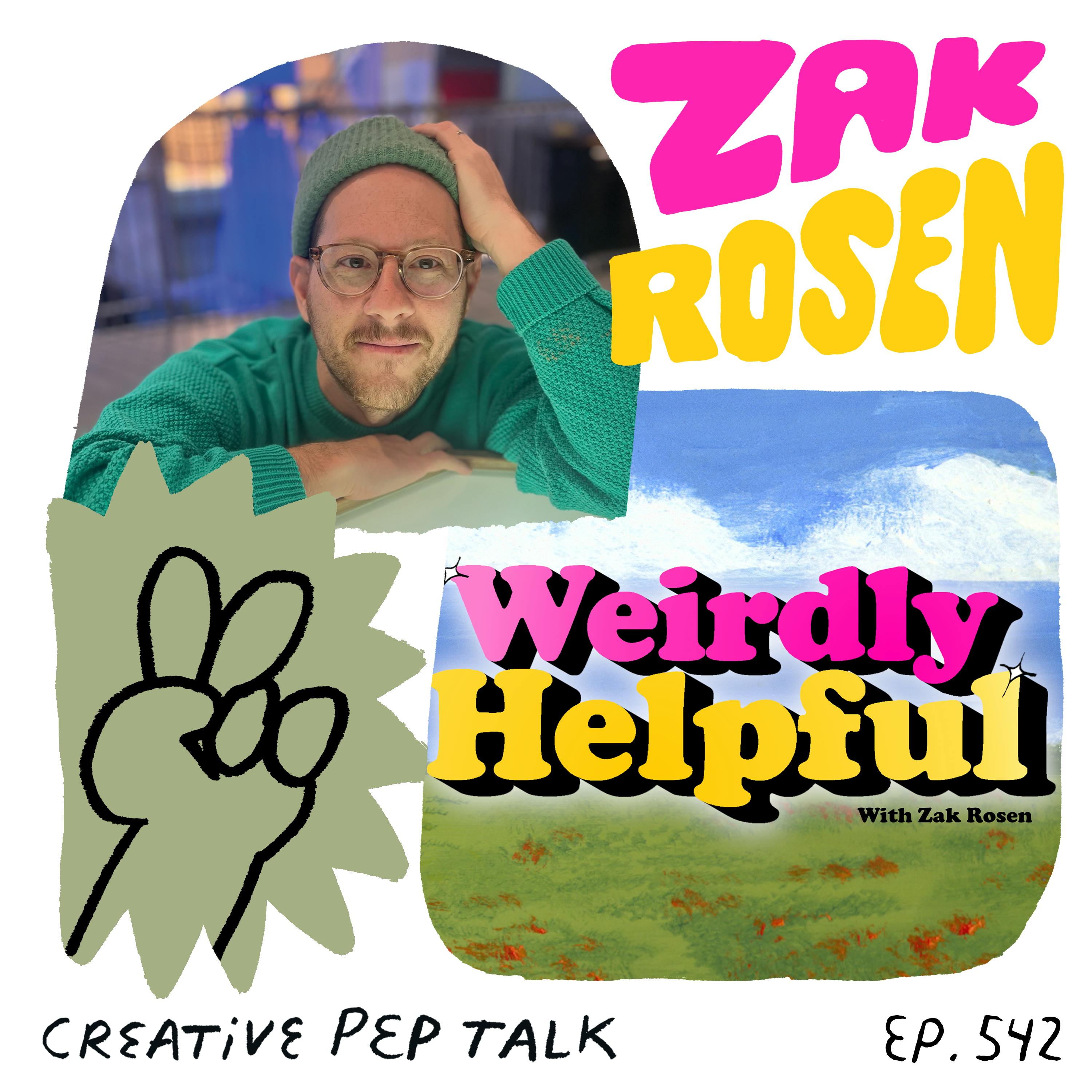
Creative Pep Talk
542 - When to Reboot Your Work + A Better Option than Beating Yourself Up with Zak Rosen
00:55:14
Loading summary
Transcript233 lines
- [00:02]
A
Hey, everyone, it's me, Gabe Gonzalez, the host of We Disrupt this Broadcast, the podcast from the Peabody Awards and the center for Media and Social Impact. We are back for season two, and we're going to talk to creatives behind TV shows like Severance, Shrinking Mo and Bad Sisters to explore how the most compelling shows are upending the status quo. So listen to We Disrupt this Broadcast, now available wherever you get your podcasts.
- [00:31]
B
Sometimes a project gets stale and you're not feeling it anymore, or it feels broken or like it never quite hit the mark in the way that you intended it to. In moments like that, you have to be comfortable reinventing yourself, blowing the thing up, rebooting it, refreshing it, rebranding it, what have you. There are these moments where you need to pivot what you're doing. I actually feel like that is a necessary, super vital part of the creative journey, that you have to work things out in real time. You try things and they don't work, and they help you get insight on how to rethink it. The next time you go out. On today's show, I have a chat with podcaster Zach Rosen. He's been on before. Before he came on the last time, he was bringing his show, the Best Advice show clips from that show, and now he's just gone through a rebrand of that show himself. It went from the Best Advice show to a show called Weirdly Helpful. And it just seems like such a good pivot, such a good rebrand. It just seemed like such a good version of this that I wanted to take him onto the show, talk about it, to see if there was anything that you could take from it or that I could take from it, because we all need to. There's always gonna be another moment to pivot or rebrand or whatever. That's just part of the process. And so this episode is designed to help you tap into that, to figure out what you might need to pivot and how you might need to think of that. I hope something in this conversation does that for you. We also go through the process of what he does on his podcast, and I ask him what is weirdly helpful to him in making his show. And then he asks me that question, and I share one. I'm gonna come back at the end with a synthesis, our two answers, but filtered through the topic. We're talking about this. I'll be back at the end with a call to adventure called what's Wrong Buddy? And it's going to help you diagnose what in your creative practice might need a reboot so stick around for that. Sounds fun. Sounds exciting to me. Hope you love this chat with Zach Rosen as much as I did on the creative journey. It's easy to get lost, but don't.
- [03:01]
A
Worry, you'll lift up.
- [03:04]
B
Sometimes you just need a creative pep talk. A well built wardrobe is about pieces that work together and hold up over time. That's what Quint does best. Premium materials, thoughtful design and everyday staples that feel easy to wear and easy to rely on even as the weather shifts. And boy is it shifting. For the longest time I was really frustrated with the fashion situation because I was aware of the ethical issues. I was aware a lot of the stuff I bought fell to pieces in seconds and I am an artist for a living with three kids and I just couldn't afford the really, really quality stuff. But that's before I knew about quints. Quints has quality ethics and no middlemen, so it's a price I can afford even as a full time creator. This is what' great about quints built to wear for a long time and still look good. Plus they partner with factories that meet rigorous standards for craftsmanship and ethical production. Refresh your wardrobe with quint. Go to quint.compep talk for free shipping on your order and 365 day returns. Now available in Canada too. That's Q U I n c e.com Pep Talk, free shipping and 365 day returns. Quince.com Pep Talk nothing hits like home cooking and HelloFresh makes it easy to do more of it this year with recipes that feel good and taste delicious night after night. I've got three kids and eating together has been one of our core values as a family since day one. But man, it is hard to get home cooked food on the table every night with all the activities and all the action, let alone create something that everybody likes. So I am stoked to have some hello fresh meals on the way. I'm looking at the Pesto, Bacon and Tomato Chicken Bake, the Tex Mex Beef Bowl, Marinara Meatballs and Mash. I think the kids are particularly going to be interested in that one. My youngest has been really into cooking lately, so I'm excited to have all the stuff together, easily accessible and ready to cook with her. I think she's going to really Love it with HelloFresh. Choose from more than 100 recipes, recipes every week, including cuisines from around the world and meals that help you beat the winter blues. Go to hellofresh.com Pep Talk 10 FM to get 10 free meals. A free Zwilling knife, a $144.99 value knife on your third box. Offer valid while supplies last. Free meals applied as discount on first box. New subscribers only. Varies by plan. So the first thing I want to talk to you about, Zach, was you're making this pretty big pivot in your show you've been doing. How long were you doing the show before this move?
- [06:04]
A
For about five years.
- [06:05]
B
Yeah. Okay. Over really consistently and tons of episodes.
- [06:10]
A
Yeah. Yeah.
- [06:11]
B
And now you're making this big shift, rebranding it. It's the same feed. Could you talk a little bit about why you made that move? Because I feel like, as a creative, there are lots of moments where you feel the urge to reinvent yourself, and it's hard to know whether it's the right thing. It's probably. There's a lot of anxiety in it, but also excitement when you need refresh. So I don't know. I'd love to hear your thoughts about it.
- [06:36]
A
I feel like there became a moment, and I think this happened years ago, and I was just kind of ignoring it until recently. There became a moment when people would ask me, what's your show? And I'd say, oh, it's called the Best Advice Show. And when I said the Best Advice Show, I didn't feel that proud of the name. Like, I was kind of just, like, rushing through the title so I could, like, start telling them about, like, specific episodes. Because I was. I was always proud of the stuff that I was making. But the name, I felt like it was really alienating to some people, or could be. Some people would be like, wait, best. Who is this guy? What is he? What is he talking about? Like, not knowing that I'm being tongue in cheek, or not knowing the kind of dumb double meaning of it. Like, what's your best advice? Which was my intention. And then the word advice, people are like, oh, no, no, no, no, no. I don't have advice. That's for smart people. That's for Tim Ferriss. You know, like, I'm. I. I like. I like learning about other people's advice, but I couldn't possibly have anything worth sharing. And my whole project is about, no, no, no, no. We all have, like, this weird stuff that we do that I think counts as advice because it is helping us make it through our life in some way. And so I started paying more attention to. Wait, if you don't like. If you don't like telling people the name of your show, like, maybe that's A problem.
- [07:56]
B
Yeah.
- [07:57]
A
And because I didn't. I don't. I hear you about the anxiety piece. Like, is this the right thing? I didn't have. I didn't have much to lose. I don't make my living off this show. This.
- [08:07]
B
Right.
- [08:07]
A
Like, I make my living helping other people with podcasts and I host a. A parenting show. And this has always just been like my passion project, but a project that I've believed long believe. Like, wait, I think this could be something maybe I could make a little bit of money from. From this. And with not much to lose and this. This urge to be proud of the name of the thing, I started. I started brainstorming and I was like, wait, what is this? What is this actually about? And the episodes of the best advice show that I love the most are when people come on and tell me something that I was just not expecting some weird thing like, oh, wait, really? You know, like just those. I want to be delighted. And I found that weirdly helpful is a more precise encapsulation of that. That impulse. And here we are.
- [08:58]
B
It makes sense. And I. The thing that is really interesting to me about that is people that listen to my show know that I never shut up about the idea of taste. And I. I get why that, you know, I just talk about too much, but I just think it's. It's a concept that I've, like, tried to imbue with a specific meaning that's maybe not inherent in it, where it's not just like what you like. It's also kind of like your taste buds creatively. It's like, as you, as you told.
- [09:30]
A
Me years ago, get high on your own supply. That was, that was your episode. Yes.
- [09:35]
B
So I'm still talking about this.
- [09:36]
A
Yeah.
- [09:37]
B
But I. That feeling of that's your kind of taste. Saying you're the word, the name of your show.
- [09:45]
A
Yeah.
- [09:45]
B
You're having this visceral taste reaction to it. And I think listening to that is kind of the creative secret is like, you have to know how to be aware enough to notice when you're having a recoiling moment or. Or if you can make yourself feel something good with your work. That's like, that's the holy grail, I think.
- [10:06]
A
Yes. Yeah.
- [10:08]
B
So, yeah.
- [10:09]
A
And like when I'm telling people the name of the show now, like, they smile, they're like, ah. Like they. They get it more clearly than the best advice show, which is vague. And then. And so became some of the interviews that I was doing, they just became like, you know what's your advice, like anything for anyone. And it was just kind of way too big the entryway. So my door is much smaller and it's like a weird looking little ramshackle door, but the people that are going to want to knock on it and come in, I'm hoping, you know, will be more excited to come eat.
- [10:41]
B
I really like that. And I think it also feels like another kind of side of this is I think a lot about like coining phrases more and more as a creative prompt, as like a part of the process, whether it's a book that you're making or a podcast episode or whatever, a concept, whatever it is. For two reasons that's been like on my mind a lot. One is I'm interested in like pop philosophy. I don't really know what I'm talking about in that world, but I like consuming stuff from that realm. And one of the things that I think is really interesting about philosophers is that they, they go about imbuing new meaning in old words or coming up with words or coining little phrases. And I also really respect. Cal Newport does this so well. He always like, he's. I've just noticed like, oh, like there's something really powerful if you can come up with a two word thing that encapsulates a feeling that we have that we were not speaking to or something that we need to be able to work with. And I think even like my picture book, Invisible Things is a little bit like that. Like trying to, trying to give a concept, a face in a shape so that we can have a conversation about it. So I like, weirdly helpful. Just feels like one of those where it's like, oh, you've done. And you're also having to like realize all the baggage that people bring to words and how we have to get rid of words sometimes, all that kind of stuff. So I think it's. It's a really interesting creative problem solve to name something.
- [12:18]
A
Thank you. It's been very. Is the word enervating? Is that the one that gives you energy? I think so I can just say energizing with the. What am I trying to do here? It's been very energizing. It's been. Been really. It feels like a new beginning or a rebirth of sorts. And that was another reason why I was doing it. I'd been making the show for five years, still excited about it, but also feeling a little bit of why, why continue. And this has given me new meaning and new and new reason to get to it.
- [12:52]
B
Yeah, I love that Last thing that it brings to mind for me is this notion of writing on stage. Like, this idea of, like, working it out in real time by making stuff, by putting stuff out there, not waiting till you have the perfect name or the perfect everything. Creative pep talk as a name came from my blog. Back in the day, I had a blog called Art Directions, which was very similar to the content of the podcast. And I, at some point, created a, like, a feature that was like an interview series thing. And I called it Creative Pep Talk. And when I came up with that, I thought, ooh, that sounds even better than the name of this blog. Like, I like that. And then that. But it came from doing stuff and putting stuff out and not just waiting till I had it all perfect. Yeah, I think that's a good argument for that.
- [13:42]
A
No, I think that's. I mean, creative pep talk. You know exactly what it is, and it feels more like you. Whereas Art directions or Art direction.
- [13:50]
B
Yeah, it's art directions.
- [13:51]
A
It's like, it's too art. It's too, like, art school. It is, you know, like, there's the art speak when, like, people are trying to, like, apply for a grant, and it's like, wait, what the. What are you saying?
- [14:01]
B
You get. You can swear on this show, by the way.
- [14:03]
A
On my show, by the way. Enervating is the opposite of energizing. Oh, damn. So it was. That's what the best advice show was. Best advice show is innovating. Really helpful. Is energizing to. To. To go back to that. But, yeah, no, I think, like, yeah. And best advice show sound and simile, like, art direction. Sim. It sounds like you're trying to, like, please someone else. Some, like, unknown other person. But, like, creative pep talk, it's, like, pleasing to you.
- [14:30]
B
I completely, completely agree. I do think that was me being a little bit more in my professional illustrator mind, trying to impress the people and that kind of. That kind of energy, which is never really great, by the way.
- [14:45]
A
By the way. Sorry. I have someone or, like, a group of people in mind when I'm thinking about, like, those people who I'm trying to impress, which is like, that I don't need. I don't need to be thinking about them.
- [14:56]
B
Yeah. Yeah.
- [14:58]
A
Do you have those people?
- [14:59]
B
I do. And I think that I. At some point, I always say that the. The breaking point of that for me was adopting the name Andy J. Pizza, because I really felt like it kind of happened on accident because I just made my website AndyJ Pizza.
- [15:15]
A
So.
- [15:16]
B
And then people thought that was my Name.
- [15:17]
A
Yeah.
- [15:17]
B
And then I just thought.
- [15:18]
A
I thought it was your name for at least the first year of knowing you.
- [15:20]
B
Let's go. Let's just do it. But I think that move really felt like, oh, almost everyone I really admire and respect in this industry is probably going to think that's stupid as hell. And because, you know, my. I think that was partially going to school and really appreciating some of the cerebral, I don't know, top of the industry illustrators that are just serious artists. And I think. And I wasn't even at the time making picture books either, so it wasn't like. There's a whole bunch of reasons why it wasn't as obvious as it feels now. But I think after that moment and then after. And then the starting the podcast was a big one, too, because I thought, I know I'm going to talk a lot about, like, business and marketing and all this stuff that I just feel like is going to negate my ability to play it cool in the industry ever again. And so I do think, like, killing that those voices in my head were. Was helpful.
- [16:23]
A
Totally.
- [16:24]
B
Even though it's still always an issue. But I think it's helped.
- [16:28]
A
Yeah.
- [16:28]
B
Yeah, you have that, too.
- [16:31]
A
Yeah. And I've learned, I think as I've gotten older, those voices have calmed down or have. Have become less prominent in my head because, you know, like, I'm not doing the same thing that they're doing. I thought I was, like, competing with these, like, auteurs or something, but first of all, I'm never gonna be like them, and I can. I can just be me.
- [16:57]
B
Yeah, I get that. I think in my. Now that I'm in the picture book world, I struggle a little bit more. I had. I was talking to a picture book author illustrator that I really respect earlier this year, and I. He kind of caught me being like, yeah, I want to do this, but I don't know what the industry is going to think of that. And he's like, dude, f the industry. What are you talking about? Like, this is your career. Like, do your thing.
- [17:19]
A
Yeah.
- [17:20]
B
And so, yeah, I probably still have a little bit of that now that I'm in this new arena. But, yeah, it's something you always have to refresh yourself with. So, okay, we wanted to do your podcast concept, your premise here, and now we're going to talk about something that's weirdly helpful to you as a creative person making stuff.
- [17:41]
A
Yes.
- [17:42]
B
And then we'll potentially go over to one of my weirdly helpful things.
- [17:45]
A
But I hope we do.
- [17:46]
B
Let's start with you. And you. You know how to do this better than, than me because this is your premise. But is that how it, how it rolls?
- [17:54]
A
Yeah. Yeah. I mean, I'm, I'm in the safe position as the host of the show of getting to just hear other people's and, and quietly judge theirs. And it's rare that I have to give my own. Weirdly helpful. So it's actually a little vulnerable. And I had to think about this.
- [18:08]
B
That's good.
- [18:09]
A
Yeah, no, I think it's a very helpful exercise to be on the side of it. So my weirdly helpful morsel is around interviewing, which is something I've been doing for my whole career, which now spans about 20 years. I've basically been doing this since I was a junior in college. And that was 20 years ago. And it's around asking questions and thinking about questions as a kind of minimalist. Like so often I'm listening. I listen to a lot of talk shows, chat shows, interview shows, more so now than narrative shows. And so frequently the host is asking four questions in one.
- [18:57]
B
Yeah. Or very true. Very true.
- [19:01]
A
Or asking a question and then rationalizing to the guest why they're asking it. So, Andy, here's an example. So, Andy, I want to ask you what was it like moving around all the time as a kid? Because it seems like. And then they go off. So you have to put the goddamn period after kid. And don't say because. Because whatever your theory is about that, it might be interesting, but all you're doing is taking up space that you want your guests to walk into. Do you know what I mean?
- [19:36]
B
I mean, this is the thing. I've thought about tons and I've gotten better over time to be like, okay, I know the kind of arena where I want to go, what is the simplest way to ask a question that gets that open? And then I will often instead of adding tacking on all that extra stuff.
- [19:56]
A
Yeah.
- [19:56]
B
I will put a note of this could be a follow up comment if it feels like it's going to push the conversation into an interesting place that's in your prep. Yeah.
- [20:06]
A
Okay. That's really smart. Yeah.
- [20:07]
B
Yeah.
- [20:08]
A
And I should say, like, I am totally guilty of asking these.
- [20:12]
B
Yeah.
- [20:13]
A
These big questions all the time. And so I'm. And I'm often cutting them in post. When I'm, when I'm cutting the interview, I'm like, okay, let me ditch the second two thirds of that bit so we can just get straight to your guest.
- [20:26]
B
Yeah.
- [20:27]
A
And it's A. It's a really simple thing, but I find it also, people also do it in real life. And I shouldn't treat real life like I shouldn't, I shouldn't judge people for their question asking skills in real life, but I do.
- [20:39]
B
You can't help it.
- [20:40]
A
I can't help it.
- [20:40]
B
Think about the same thing. Yeah.
- [20:42]
A
And I'm often in my head just like, okay, stop right there. So that's a good question. So why did you keep going? And I think all of us, actually, someone gave me this advice on the show. My friend Autumn Brown, who's, whose podcast I edit that she hosts with her sister Adrienne. It's called how to Survive the End of the World. And Autumn learned this thing. I think it's in like the facilitation world. When you're, you know, in dialogue with a group of people and you're reflecting on something or asking your questions, you do this thing called wait that you ask yourself. It's an acronym. Wait, why am I talking? You know, and often as hosts, we're taking up space because, I don't know, we're nervous to have one of our heroes on. Like, there's good, good reasons to be, to be mumbling more, but we don't need to be. And when we ask ourselves that question, wait, why am I talking? I think our questions become a lot more precise, a lot more austere and generous. You know what I mean?
- [21:39]
B
Yeah, I definitely, I definitely know what you mean. I. Because I, I've thought about prepping for an interview in a similar way to writing anything. So in the person you're talking to, it's not completely unlike when you go to write something, you're interacting with a specific part of yourself. So you're asking a part of yourself something. So you're creating this dynamic. And so going into it, I try to strike a balance between plotting and pantsing. So I'm like, I have a plan. But I don't want to ruin the organic nature of the conversation by forcing this way. But having the plan helps it helps it me feel prepared. It does all kinds of things.
- [22:23]
A
Yeah.
- [22:24]
B
I wonder if you. What. When it comes to writing an elegant question, what things have you learned that are weirdly helpful in doing that?
- [22:37]
A
Well, there's that there's a great producer, reporter, host, Alix Spiegel, who used to, who she created Invisibilia. She was a producer on this American Life for a long time. I think she might be back at this American Life right now. She does this great interview on Transom, which is how I learned mostly how to make radio. Transom.org they have a podcast called Sound School.
- [23:00]
B
Okay.
- [23:01]
A
Hosted by Rob Rosenthal. You should go and listen to her episode because she's such a master at this. But she says this thing, she says, make your mind like water when you're plotting out an interview. And so what she means by that, I think it's like she's trying to actually imagine herself in this conversation that she's going to have, like, the next day or whatever, and. And imagine the different directions that it can go and then thinking about, okay, so if it goes this way, like, if this question provokes, like, this really emotional response, then I could go here.
- [23:36]
B
That's interesting. Like a flowchart.
- [23:38]
A
Almost kind of a flowchart. But then, like you were saying, like, don't be married to it. So make it kind of anticipate where it can go, because that's going to kind of train your brain into, okay, it can go this way, it can go this way, but I'm going to flow, like, I'm going to flow with wherever it goes, but at least, like, I will have, like, the proper gear, you know, to navigate if and when it does go to this place. And it is this contradiction. Like, you know, a lot we go into these interviews sometimes with, like, these 15 questions we want to ask, and I'm sure you've had the experience where you ask one and then you're off and running, and then the other 14 don't get asked, and that's okay. But at least as long as you're kind of spending time in the world of, like, what might this be? What might this feel like? I think that can be pretty helpful.
- [24:18]
B
When you're doing these. Do you have a. Do you have an end goal in mind? I know we're talking about kind of being loose with it.
- [24:27]
A
Yeah.
- [24:27]
B
But, yeah. Do you. Do you have an end goal in mind with each guest? Like, oh, I kind of. Kind of know where I want it to go.
- [24:35]
A
Yeah. I mean, with Weirdly Helpful specifically, it's actually easier than, like, your show or other shows, because I am going for the weirdly helpful thing and just building up to it and helping people realize what theirs is for themselves. Sometimes people don't have it all worked out. Usually they don't before coming on. So I'm just trying to hold their hand and get to this thing and celebrate this weirdly helpful thing that they do, which is different than, like, interviewing someone for, you know, like, a biographical interview or interviewing them About a specific piece of work.
- [25:06]
B
Sure.
- [25:06]
A
Do you know what I mean?
- [25:07]
B
But I am trying, I am the way. Because my show is very self helpy. I am trying to find like a takeaway. So there is a similarity to that. Definitely just a journey. The other thing that comes to mind though, that I want to know what, what tricks you found for helping someone unearth these things that they know? Because. Yeah, no, I'll, I'll do that as a follow up. Let's leave. Look at you.
- [25:34]
A
You caught yourself. Look at you.
- [25:36]
B
I did. I'm learning.
- [25:39]
A
It's so fun trying to help people unearth it because. Yeah. How do I get there with them? I'm really interested in, you know, in, in Seinfeld, Elaine is like, I think it might be the Bizarro episode where she's like, I can't come into this apartment and talk about the excruciating minutiae of everyday life. Like, she's feeling disillusioned with Jerry and George and Kramer and that's why she's spending more time with Bizarro. With Bizarro Jerry because they're more bookish and interesting and extroverted. But I really love the excruciating minutiae of everyday life being like, what are you, how are you getting from getting your kids out the door and to like sitting down at your desk? Like, what are you standing up and like staring at your phone while you eat lunch? Or are you, you know, sitting down at the table and like, what is that like, so the tricks I think are like, take me to this part of your day when you're doing this weirdly helpful thing and just tell me, like, what does it look like? Because these really helpful things I'm realizing are just like these things that we're doing, like in between the big things, in between the meetings and the birthdays, but just these in between things. When Lauren is going into the shower and feeling a little bit like another day, it's a big day, I need to cheer myself up. So she lathers a bunch of soap on her belly and, and draws and draws in it and just draws a. Often a piece of pizza, actually. Really? But just. Yeah, just some. She calls it her daily shower belly. And it's just like this thing that reminds her like, oh, I'm a fucking idiot kid. Looking out for joy and delight. So she came on the show not realizing, I think, what her thing was or why she was doing it. And I. And together we realized like, oh, it's like you are tapping into this Kind of banal joy and what a gift that is to give to yourself. And so I think it's like, just take me into your day. It's very intimate, you know, like, take me into, like, this quiet part of your day. It's not a trick, I guess it's just more like being really interested in this thing that people are doing without much thought but realizing, oh, yeah, I guess this weird little ritual is a thing. It's a weirdly helpful thing that's really good.
- [28:03]
B
And I think it gets at why I asked that question. I feel like these things are examples of stories that we have to tell. So I'm really interested in how a story you have to tell. Often it's a transformation of a character. It's a transformation that you had. And so when I try to come up with stories or episodes of the show or if I'm working with someone who I'm trying to help them come up with a story, I'm always looking for different ways in to what do you know? You know, the writing, what you know, this is what I think it's kind of about is like, well, what do you know from experience? And it's hard to name because they become anything that you really know. You enter or in live, you integrate it on a subconscious level.
- [28:54]
A
Yeah.
- [28:54]
B
You know, so I like your. Your trick. I think it's a good one.
- [28:59]
A
I like what do you. So you ask explicitly, like, what do you know?
- [29:02]
B
I. There's a few different things I'll use, but one of my favorites wasn't outlined as, like, a story technique, but it's by a guy. You might have heard of him because you're in podcasting. His name's Eric Newsom. You know, I thought his book Make Noise is really great back here somewhere. Boom. I thought it was really insightful for all kinds of reasons.
- [29:25]
A
Yeah.
- [29:26]
B
But one of my favorite things that I pulled from it ended being a story thing. He says in his back pocket. He always has a question that usually leads somewhere interesting. And it's. If you're in. If you're interviewing an illustrator, you say, what do illustrators get wrong about illustration? Or what do podcasters get wrong about podcasting? Whatever. And I love that because it really gets at something that you probably learn from experience and something you feel passionate about. And it really is. It has the makings of an arc of a Act 1, Act 3 of, like, you think it's this way, and then you end up thinking it's this way.
- [30:05]
A
Totally. That is a great question.
- [30:07]
B
Yeah, that's one I think about a lot.
- [30:08]
A
Do you ask that a lot in your interviews?
- [30:10]
B
I do, I do, yeah. I would say I throw it in there when I feel like I don't. It's, it's rarely that I feel like, oh, I don't know where to go. But more like this person has, if I feel like they're able, the kind of person that can articulate their point of view. That's a really good question.
- [30:29]
A
Yeah.
- [30:30]
B
Not everybody. Some artists that you interview, you have to approach it in a totally different way because they, A big part of why they do what they do is that they don't verbalize what they do. So yeah, that's a totally different kind of interview, you know.
- [30:45]
A
Yeah, yeah.
- [30:47]
B
So. All right, well, I love that, I think, do you have any last bits to add on that?
- [30:52]
A
Sometimes it's so pretentious, but I think of questions as bonsai trees.
- [30:56]
B
Okay. I love that. I'm here for the artistry. This is, let's get the pretentiousness out there. I, I, that's one of my big beefs actually, is that artists, because of, you know, so many things, but probably a big partial part of it is the way the Internet makes fun of things.
- [31:15]
A
Yeah.
- [31:16]
B
We can't get arty about talking about stuff. Like I like that's my favorite way to think about and talk about stuff, but.
- [31:24]
A
Oh, great.
- [31:24]
B
I love that.
- [31:25]
A
Great. Good. Yeah. I mean, I don't know when I started that. I think it started with the Best Advice Show. I don't think I had thought of questions as that before. I was working because the Best Advice show and now weirdly helpful. It's a short show. Like these days it's like 10 to 15 minutes, but it was like one to five minutes when it started. And just thinking about these miniature things that don't have any extra stuff on them, you know, like, it's not like Joe Rogan is like these three hour shows are like this, these massive, like very bushy, you know, with a million branches, but like a banzai. It's like this contained thing. And like my question is hopefully short. And you know, it's just like it's what it needs to be and nothing more. I'm really self conscious about like wasting people's time. And so I just like think like, if you can just like make this like a bonsai tree, just like prune it a bit, not too much. You still want it to like evoke life and growth and green. But it should be contained, kind of organically contained.
- [32:27]
B
Yeah. I love that. And I think it's. There's such an art to it. It's very hard to ask a question, especially a simple question that elicits an emotional, invested response. It's difficult.
- [32:40]
A
It's so hard. I mean, every week I'm editing my interviews and I'm like, oh my God, shut the fuck up, Zach. Like, so I am not making. I'm not making bonsais with any kind of consistency.
- [32:52]
B
I feel you do. This is why, man, I can't. That's why the best thing I ever did was get someone else to edit it. Because my self loathing. Just through the roof. Yeah. It's so hard to listen to yourself in that way.
- [33:07]
A
What are your, what are your typical notes? If there are typical notes for your editor after, after they give it a.
- [33:13]
B
Pass, there might just be like, there might be sections where I'm like, just let's lose that. And I do sometimes do what you like. You know, on the flip side of that weirdly helpful insight I've heard if you're stuck. I think this came from Alex Bloomberg. I think he had a class on creative live. And I think this is where this is from. Or there was also Jesse Thorne. He had. Is that his name? He had a podcast all about interviewing.
- [33:47]
A
That's right.
- [33:48]
B
It was really great.
- [33:49]
A
Larry King and Ira Glass, Terry Gross.
- [33:51]
B
And it was really great. So it might have come from there, but one of the things they said was with a lot of the public radio stuff, they would really, if they ask a question and they weren't getting anything, they would answer the question and then because it was the host would answer the question. Yeah. And it was like a vulnerability thing of, oh, I'm showing you. Ah, I'm doing it so you can do it. And then later. Cut that.
- [34:18]
A
Yes. Oh, that's really good. I like that a lot.
- [34:20]
B
So that's something. We don't always get that much in the weeds, but if we do. If I feel like I'm struggling to get someone to open up, I'll do more.
- [34:28]
A
Absolutely. Just close. Yep.
- [34:30]
B
Yep.
- [34:30]
A
Yeah. It's like someone, I don't know who said it, but it's like you're hosting a party and it's like. So if you're gonna be like without, you know, you're not gonna, you're gonna not be wearing shoes, you know, you're just wearing a T shirt. You're not showing up in a suit. Like, if that's what you're going for, like, that's what you're going for it seems. But like other hosts, you know, like, Terry Gross is buttoned up, you know, she's. She's got her shoes on.
- [34:53]
B
Yeah.
- [34:53]
A
And so you're. You're kind of. The tone is dictated by the host. Always.
- [34:57]
B
I like that metaphor. It reminds me. It kind of feels like if you. If you invite all these people over and they're like. And you're like, all right, dance, everybody. And you're not dancing. That's not going to work.
- [35:08]
A
Totally.
- [35:08]
B
You got to. You got to give a little bit. But it's a delicate. And then on top of all that, for me, it's. There's the element of adhd, which there's so many reasons why that's working against me as an interviewer. Like, one of the top symptoms is interrupts people. So that's been, you know, that's been kind of a medicinal journey for me.
- [35:30]
A
Yeah. Yeah, that's great. Foreign.
- [35:49]
B
This episode is sponsored by Squarespace. I freaking love having Squarespace as a sponsor because it's easy to sell it when you love something this much. I'm a big fan. Squarespace is an all in one website platform designed to help you succeed online. Here's what I love about Squarespace. They're intuitive and super versatile. Drag and drop tools mean you can make a custom website without knowledge of code. That makes people say, whoa, who made that for you? Looks like you built that from scratch. People have really said stuff like that to me about my site, and I built it myself quite easily with Squarespace. You can check it out@andijpizza.com if you want to check that out. What I did with it, it doesn't look template and it screams my creative brand. I also love that I have all of my domains through Squarespace now, which makes it seamless and easy to manage. I know the first thing, as creative folks do when we get an idea is to grab that URL. Now you can keep track of all your websites and your domains in one place. That's super intuitive and easy to manage. Head to squarespace.com pep talk for a free trial and when you're ready to launch, use promo code pep talk, all one word to save 10% off your first purchase of a website or domain.
- [37:02]
A
Do you want to share what you're finding weirdly helpful?
- [37:05]
B
Sure. The thing that came to mind was I have a lot of. I don't know if this is normal or not, but I have a lot of time in my life where I can feel myself fighting myself. I can feel animosity towards myself, like, annoyed, realizing, like, oh, I need to do this thing. And I can tell my whole being is. Is against me doing that.
- [37:34]
A
Yes.
- [37:35]
B
And I just realized, like, oh, this energy is not aligned with, like, how I. How I want to be. What I really believe is helpful, useful. And I've found that it's kind of. It sounds kind of lame, but I found that in those moments, instead of being like, all right, I've got to figure out how to get around this idiot. I shift to, like, what's going on, bud?
- [38:04]
A
You saw you soften your.
- [38:06]
B
Yeah.
- [38:07]
A
The way you talk to yourself is.
- [38:08]
B
Really the thing I get kind of curious about.
- [38:10]
A
That's great.
- [38:11]
B
Why are you feeling so much resistance to this? I'm trying to do something good. Why are you feeling like that? And I think that it's weirdly. It really does have a weird effect on my whole.
- [38:28]
A
Yeah.
- [38:29]
B
Physicality. I can feel my.
- [38:31]
A
Yeah.
- [38:32]
B
That side of myself, like, softening. Just being like.
- [38:35]
A
Yeah.
- [38:35]
B
Okay, let's. Yeah. Let's talk about why. Why this feels overwhelming or negative or, you know, doomed to fail or whatever it is.
- [38:45]
A
When is it typically happening?
- [38:47]
B
It's around. It's all. For me, it's probably all around, like, executive function thing. It's all, like, eating better, exercise, also work. Just getting stuff done, being. Not leaving it to the last minute. All of the. Or finance stuff or just all of the kind of life, all the things you have to do. And I. And I think there's probably a part of it that's like what they call, like a. The pathological demand avoidance, which is just like a lot of neurodivergent people have that thing of if when this starts feeling like a thing I have to do, it instantly becomes much harder to do because I feel like I don't have a choice now. I have to do this thing. And I think just having a posture of. It's really. It comes down to a bigger shift in my life, which was just seeing myself and most people as fundamentally good at the bottom layer now. Tons of on top of that Faux show. I'm definitely on that bandwagon. But I think at the bottom of it, I have an assumption that most people are fundamentally good and that their desires and their.
- [40:12]
A
I agree.
- [40:12]
B
Things that they want or the. There's a good reason for it. So you can be curious even if it's not an adaptive reason.
- [40:20]
A
You know, I mean, just when you called yourself buddy.
- [40:23]
B
Yeah.
- [40:24]
A
Like, I, like, my heart went out to you. It went out to me. Like, I. I feel that softening and we're so hard on ourselves, aren't we? Very like, God, we're such assholes to. To ourselves. That's like one of the biggest through line things that people share on the show or like on the show are what are, what are some practical ways we can be kinder to ourselves.
- [40:45]
B
Yeah.
- [40:46]
A
Because I feel like it all starts with that.
- [40:49]
B
I, I completely agree. And I. And it is the buddy aspect of it.
- [40:52]
A
Buddy.
- [40:53]
B
When I say that to myself, I can feel myself being like melting a little bit and be like, okay, like, you know, it's. It'll be all right. And. And yeah, I just, I instantly have kind of an emotional reaction to it.
- [41:07]
A
And how have you gotten to the point where you're able to shift to calling yourself buddy from calling yourself whatever? What's the.
- [41:15]
B
Yeah, I think it just can't. I honestly think this is. I feel, I think what draws me to things like philosophy and self help and all of this kind of stuff is that I really want to know why. I really want to know why. And so I have a new book out that, that sort of. That's coming out, and it's really a book. Yeah, it's called Mysterious Things. It's a follow up to another book that we did. And the point of the book is kind of like giving a why to learning. And for me as a kid, the metaphor I think of is like, school felt like I'm learning guitar, but I've never heard music, so I'm just like, why are we doing this? I don't want to do this. And then. And so I think introducing like, oh, this is. Learning is like a way to engage in going deeper into experience and it becomes richer and more stimulating and more fun and all that kind of thing. You know, what's going on, bud? Like, that kind of feeling. It comes from a decade of diving into asking that question, getting to the bottom of, do I think people are good generally? And am I good generally? And I was raised all the way until I was raised this way. And I probably held a belief all the way into my mid-20s, at least, that ultimately we are fundamentally flawed. And that was a big. I think that was a huge, like, journey of really not just thinking, oh, it'd be nice if we weren't. I'll just pretend like I'm not. And really thinking about, well, okay, why would. Why would I think that we were fundamentally mentally flawed? Or why do I think that we're fundamentally good and really tried to work through every. Every question that comes up around that and so to me, it had. I think that's how it became a core belief. And then it emanates from there, like, oh, this part of me that's resisting it has a good reason, even if it's not helpful. There's something going on.
- [43:37]
A
Yeah.
- [43:37]
B
It's worth listening to.
- [43:39]
A
Yeah. Wait, so do you think that we are. You don't think that we're fundamentally flawed anymore?
- [43:44]
B
No.
- [43:45]
A
Ah, we're not flawed.
- [43:46]
B
I think we are.
- [43:47]
A
I think that we're good and I.
- [43:48]
B
Think we are flawed. I just don't think it's a fundamental thing. I don't think it's the ground of our being. Like, I think I. Because I think almost all of our flawed. Not all, but I think a lot of our flaws don't come from a bad thing about us. I think it comes mostly from being a social animal where we have to balance two things. Intention that are impossible to get right, which are. I have to take care of myself and I have to be a good member of the community. And those things are always at odds and they're always sacrificing one for the other. And you're. It's always a negotiation. I think not all, but I think most of what we think of as flaws comes down to one or the other. It's like, either I'm too much of a pushover and living for other people, or I'm too selfish and I'm, you know, only thinking about myself. And so, yeah, now there. There are exceptions to that. That's why I always say, I think we're mostly fundamentally good. Some of us have maybe some bigger brokenness than others. I think there's a good case to be made for that. The hardware's awry. Too much lead poisoning, you know.
- [45:03]
A
Right.
- [45:04]
B
Like all this kind of stuff, like. But yeah, I think the hardware is kind of a awesome thing, you know?
- [45:12]
A
That's lovely.
- [45:13]
B
Thanks.
- [45:15]
A
Do you say talk to yourself out loud? Do you call. Are you saying buddy out loud?
- [45:20]
B
Yeah. Sometimes I think if I'm in a place where I don't think, I'll get weird looks from people. Yeah. I did it in the parking lot of Whole Foods not long ago. I was, like, walking my car over and I could feel myself being like, this is what you need to get done today. How you better do this thing. We're going to make this change. And feeling my whole self, like, revolting. And I. That was the first time I think I did. It was like, I thought, all right, well, actually, this is not aligned with what I think about people. Maybe I'm going to take a different kind of tone. And I did. And it just. And ever since then, I've been. I've done it pretty frequently.
- [45:56]
A
I love it. I love it.
- [45:57]
B
Thanks.
- [45:58]
A
It reminds me of a very early episode of Weirdly Helpful. I was talking to a guy who writes about psychology, Stephen Handel, and he was saying, like, when you call yourself a fucking idiot, which is my kind of trademark, you know, self word, I.
- [46:11]
B
Use that one sometimes. Yeah.
- [46:13]
A
Fucking idiot. Constantly. He's like, don't. He says it's unrealistic to not call yourself a fucking idiot.
- [46:21]
B
Yeah.
- [46:22]
A
But as a. The way to soften it is to just be like, you know, sometimes you can be a bit of a fucking idiot.
- [46:28]
B
That's pretty good.
- [46:29]
A
It's not like you are that, but, like, sometimes. Don't ignore it. Yeah. Don't deny it. But also soften it a bit. And it's the softening that I really love.
- [46:39]
B
Yeah. I think it helps more. It's. I do think it's weirdly helpful and actually does have an effect that you feel instantly. And I think it's easier to work with yourself or someone if they're in that receptive mode.
- [46:55]
A
I'm gonna think of this as, like, the buddy advice.
- [46:58]
B
Nice.
- [46:58]
A
And whenever I hear the word buddy, now, do you know? Of course you do. Because I feel like we have the same taste. You know Pete Holmes's PODC podcast? You made it weird. Speaking of podcasts with weird in the title, he has this episode that I listen to probably annually with Josh Rubin.
- [47:15]
B
Oh, really?
- [47:16]
A
Who's this amazing impressionist, and he does this Jeff Daniels impression of Jeff Daniels. Just like, buddy, buddy. So I just can't hear the word buddy without thinking of Jeff Daniels.
- [47:28]
B
So Jeff Daniels can be your, like, inner voice for this one. Yeah.
- [47:31]
A
That's what a generous, kind of, like, dusty, loving inner voice that is, right?
- [47:36]
B
Oh, yeah, absolutely. I would love to have that as my inner voice. He's got. And he's got. He's a Michigan guy, too.
- [47:44]
A
Is he?
- [47:45]
B
Yeah, I think so. I think.
- [47:46]
A
I'm sorry, I've been saying Jeff Daniels. I meant to say Jeff Bridges.
- [47:49]
B
Oh, Jeff Bridges. Even better.
- [47:51]
A
Yeah, Jeff Bridges.
- [47:51]
B
That's a great coach. Yeah, yeah, yeah. I was thinking Jeff Daniels, which also.
- [47:55]
A
Be great because I said Jeff Daniels. Jeff Daniels would be great, too. Yep, yep. And he is a Michigan guy. Chelsea, Michigan. Yeah. Yeah. So when you heard me doing a Jeff Bridges impression and saying it was Jeff Daniels, you must have been a little confused. But it's because my impression was not.
- [48:09]
B
Good for some reason. I just thought, yeah, okay. I could see Jeff Daniels acting that way. He's pretty versatile. That's what I was thinking. I was giving you some credit for.
- [48:18]
A
It was really a compliment to Jeff Daniels.
- [48:20]
B
I don't know which role that is, but I can see it.
- [48:22]
A
Yeah, Jeff Daniels was. He came into Detroit Public Radio when I was working there in 2007 to do an interview and he was really tired and he actually napped on the couch in the lobby before his interview. Like he wasn't really in the mood to kibitz. But my, the news director, my boss at the time, said, zach, can you take Jeff Daniels after the interview into like the ancillary studio and have him do like a station id? Like, hey, this is Jeff Daniels and you're listening to wdet.
- [48:50]
B
Yeah.
- [48:51]
A
And I'm like, okay, sure. I was, you know, I just had no experience and, you know, I wasn't even smart enough to be scared. And so he's, So I asked him, I'm like, Mr. Daniels, do you mind coming and doing this?
- [49:02]
B
Did you have to wake him up?
- [49:03]
A
This was after the interview. Someone else had woken him. That would have been, that would have been even harder.
- [49:09]
B
Yeah.
- [49:10]
A
But he was still like lethargic, like, to say the least. I'm like, would you mind doing this? He's like, okay. And you know, he's public radio. Like, I'm sure he, you know, he, he seems like a mission based guy.
- [49:21]
B
Yeah.
- [49:21]
A
And so he comes in and he's like, so what do you need me to do? I'm like, like, I don't even know where I thought of this. I'm like, can you recreate the diarrhea scene from Dumb and Dumber? He cracked up. I broke him. And it's maybe still the proudest moment of my professional life. I'm so proud of it. Still 20 years on.
- [49:40]
B
Very effective for just waking somebody up. I love that. Speaking of that, I shove my 13 year old son Dumb and Dumber for the first time about a week, two weeks ago, and he gave it five out of five stars.
- [49:54]
A
Heck, yeah. Oh, that's exciting.
- [49:56]
B
It was awesome. I didn't know, I didn't know what he was gonna think of it, honestly. We have similar taste in humor, but yeah, I mean, honestly, that movie I feel like, is tight. Like every, every word is either pushing the plot forward or it's a joke or both.
- [50:11]
A
Is it Fairly Brothers?
- [50:12]
B
Yeah.
- [50:13]
A
Yeah. I gotta, I gotta go back and watch that again.
- [50:16]
B
It's very Yeah, I would say most of it holds up. There's. I don't. There's only a few things where you're like, oh, that's a little bit. But, you know, Ace Ventura is much worse in that regard.
- [50:31]
A
I haven't seen that since I was a kid.
- [50:32]
B
Yeah, I don't know if I can revisit it. It was a big.
- [50:34]
A
So you haven't shown that to your kid?
- [50:36]
B
No, I don't think so. It's. It's got some pretty big problems, I think.
- [50:40]
A
Okay.
- [50:42]
B
But, yeah. Anyway, buddy. All right, buddy.
- [50:46]
A
All right, buddy. Oh, it's so nice. It's really. It's really weirdly helpful. I love it. Thank you.
- [50:51]
B
Thank you. Thanks for having me, and thanks for chatting. Good to have you back.
- [50:54]
A
Oh, it's such a pleasure.
- [51:10]
B
I'm back with our creative Call to Adventure. Something you can do with the ideas from this episode. First, I gotta thank Zach for making time and sharing this process with us. Go check out his podcast. Weirdly Helpful. Wherever you listen to podcasts, part of this episode's gonna appear on his show. And then he is really good at getting guests and really good at making shows. So go check that out. They're short episodes. Give you a little boost, maybe give you something weirdly helpful that you didn't even know that you needed. The call is called, what's wrong, buddy? And here's what I think you should do. I think it'll be weirdly helpful. This is something I do from time to time. Often in my creative journey, I will get to a point where I'm feeling lots of tension about the stuff that I'm doing, but I'm not aware that I'm feeling that tension. I'm not aware that I'm feeling like something is wrong. Something's not hitting the mark. Something's not going the way I feel like it should, but I'm trying to, because of the economy, I'm trying to just keep going and ignore that voice because I got to get stuff done. But when I tune into that voice, that's where creativity happens. That's where the rebrand happens. That's where the reboot happens. Sometimes I'll be working on an episode for a long time, and I'm, like, feeling lots of tension, and I'm trying to ignore it because I'm, like, trying to get it done. And then when I stop and be like, whoa, there's, like, tension here. If I will ask myself, what's wrong, buddy? Like we talked about in this episode. But to do with the Creative work, I will tap into an intuition that says, hey, the way you were going is not working, but you've run into some really vital information as you've moved through it. That can mean that you can actually make something really great with where you are now. And so that's what I encourage you to do. Pause. Ask yourself, where is the tension that you've been trying to push down in your creative practice? Might be about the materials you're using. It might be the gallery show you're working on. It might be the film that you're in the middle of, or the script that you're writing, or the manuscript, Whatever it is. You probably have something you're doing where there's a growing tension that you've been trying to push down because you're just trying to get to the other side. And I get it. Sometimes you do have to just keep pushing. Sometimes those intuitions are. They're not intuitions, they're just distractions. Sometimes that happens. But you know the difference. If there is something that's calling you, saying, hey, this isn't working like it used to. This isn't working how I thought it would work, let me pause and just let me get in tune with, like, let me ask myself, what's wrong, buddy? Like, what's going on? And see, is this a distraction? Or is this an intuition? And have I learned some things that may help me reboot this thing? Maybe you had a daily project that you've been doing for ages and you need to rethink it. Maybe you have a YouTube channel that you've been doing for ages, and you need to give it a different name, a different vibe. Maybe a podcast needs a reinvent, just like Zach Rosen. And maybe not. Maybe you don't need any of that. But this process can still be helpful to address that tension. Sometimes you address that tension. You're like, hey, what's wrong? And you find out like, oh, there's not really anything wrong. You just needed to kind of talk through it. You just had to think through it. And maybe you need a buddy, another buddy. Not just the buddy that you yourself are, but somebody else who can be your buddy to talk through it and say, hey, I'm feeling tension around this. Sometimes I go through that process. I'm like, you know what? I actually feel great about it. I just needed to get my mind. I needed to get my head on straight around this. So that's what I encourage you to do. Address that tension. Think about that tension. See if there's anything there. See if there's a reboot just waiting to happen, maybe it's a little tweak. Even that would help you feel great about it. But those little tensions, I think they're worth giving a little space to. Don't let them ruin your day. Don't let them control you. But I think it's good to kind of acknowledge them and see what they know, see what that buddy inside yourself knows. Let's clip that little bit and just put that on the Internet and nobody will know what the heck I'm talking about. Hopefully you know what I'm talking about, but that makes the end of the episode upon us. Tried to end that sentence in a way that made sense. Thank you to Sophie Miller for being a producer and editor on this show. Thanks to Connor Jones of Pending Beautiful for video edits, audio edits, animation and sound design. Thanks to Yoni Wolf and the band Wai for our theme music and soundtrack. And thanks to all of you for listening. Until we speak again, stay pepped up, y'. All. Hey, I want to tell you about a podcast we're partnering with called Planet Visionaries. This show is not about the problems facing our planet, but the amazing solutions and work that's being done to save and protect our planet. If you are a sensitive, creative person like me and suffer from environmental dread from time to time, this show is for you. I was listening to a recent episode featuring actor Mark Ruffalo and Gloria Walton, the CEO of the Solutions Project, and hearing the amazing progress that they've made in the space of renewable energy really filled me with hope. Like I actively noticed. Wow. I am so comforted and inspired by this. Go check out Planet Visionaries hosted by rock climber and founder Alex Honnold wherever you listen to podcasts. Okay, the podcast is over, so I don't know why you're still listening, but I am glad that you enjoyed it enough to stick to the end. I have one more thing for you. If you're in a place where you're feeling a lack of clarity and you want to figure out your industry, market and niche and find the perfect strategic side project to do next, go sign up to our newsletter@andyjpizza.substack.com and you will get a confirmation email that will give you the download of our Creative Career Path handbooklet. And the whole process is in there. And you might also get a few bonuses in there depending on when you sign up. But again, thanks for listening. Glad you enjoyed the episode and stay pepped up y'.
- [57:43]
A
All.