← Creative Pep Talk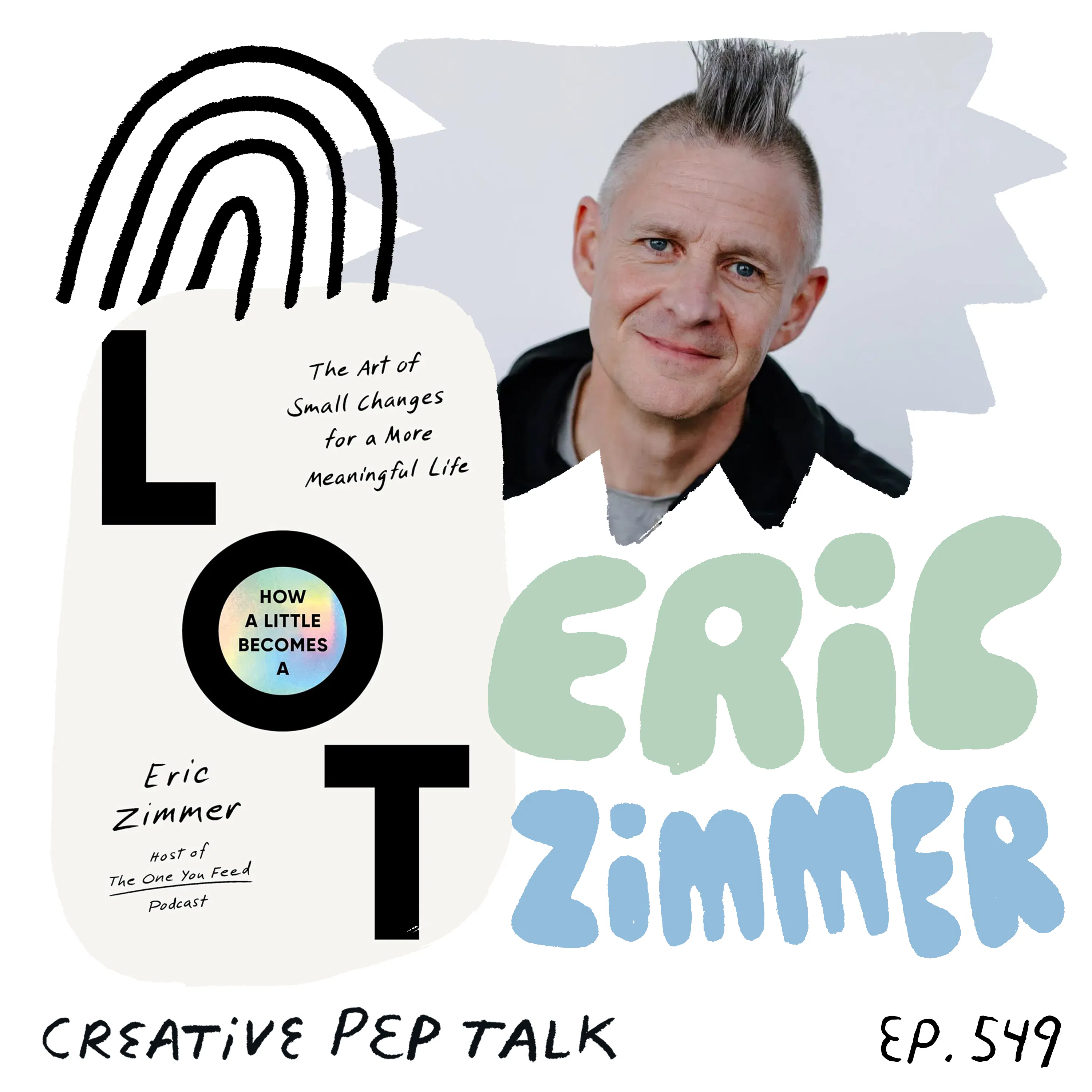
Creative Pep Talk
549 - This is How Sensitive Creative People Make Big Changes with Eric Zimmer
01:13:41
Loading summary
Transcript267 lines
- [00:01]
Andy J. Pizza
Creative discipline. You want it, you know what you want. You just don't know how to make yourself do it. It's the frickin most annoying thing in the world. You've heard all the structures, all the hacks of how to do habits and all this stuff. But most of those resources miss out on what creatives and neurodivergent people need most, which is the emotional game, the mental, emotional game of how to get yourself to act. Today on the show we have Eric Zimmer, the host and guy behind the popular podcast the one you feed, as well as the author of the new book how a little becomes a lot. And this is what I appreciate so much about Eric and this book is that he isn't someone that just came into the world fully like disciplined and just locked in. This is a guy that, that really struggled for his life with heroin addiction early in his life and became one of the most sober, grounded people that I have encountered. And he filled this book up with not just the structures, they're there, but also the emotional side, the mental side and all the fighting and games that we play with ourselves. And there's just a lot in here on how to work with yourself. And so today we are going to explore all of that and at the end I'm going to bring you a three part values exercise from the book that I found really enlightening and really surprising in terms of what my values are and what I'm trying to really achieve and be in this world. And first we're going to talk about why things from this book ideas from this book helped me have a better start to this year than I have had in years.
- [01:55]
Eric Zimmer
Easy to get lost, but don't worry, you'll lift up.
- [02:01]
Andy J. Pizza
Sometimes you just need a creative Pepsi. As a neurodivergent creative, I am always trying to strike a better balance between creating versus just consuming. That's why Dr. Anna Lemke's class dopamine take your brain back on. Masterclass piqued my interest. She is such a compelling communicator and one of the things that really hit me fresh was this idea that you want to embrace more things that make you feel uncomfortable up front but great afterwards versus great instantly but bad afterward. This insight really inspired me to action because this is exactly why I want to create more than I scroll. I am no creative prodigy or business genius, but lifelong learning has been a game changer for me. Masterclass makes it possible to learn from the best in the world at any time with video and audio only. Mode. And also, Masterclass is a great gift for family and friends with interests in business, writing, cooking, wellness, creativity, all kinds of different people, all bases covered. And with Mother's Day and Father's Day coming up, Masterclass could be an ideal option for a gift. Masterclass keeps adding new classes, so there's never been a better time to get in. Right now, as a listener of this show, you get at least 15% off any annual membership@masterclass.com peptalk that's 15% off masterclass.com peptalk head to masterclass.com pep talk to get the latest offer. Hey kids, it's Taco Tuesday again for the 800th week in a row. No, listen, I hate to admit it, but Sophie and I got into a real rut cooking and the kids were actively trolling us about it. But then we started getting some hellofresh meals and it has really helped us shake things up this year. So many dishes we've never had before or cooked and all have been super tasty and easy to make. For me, it's all about the sauces. Last night I made the curried chicken and roast sweet potato jumble, and the sauce was so simple and so delicious. I love that I'm making something yummy and broadening my cooking skills and experience in general. A couple nights prior, we had the edamame stir fry with this amazing gochujang aioli. It was vegetarian, but super flavorful and filling and just. I absolutely loved it. Nothing hits like home cooking. Go to hellofresh.com peptalk10fm. That's hellofresh.com Pep Talk 10fm. Now to get 10 free meals plus a NutriBullet Ultra plus two in one compact kitchen system. It's a $189.99 value on your third box. Free meals applied as a discount on the first box. New subscribers only. Varies by plan. Disclaimer must order the third box by May 31, 2026. First of all, okay, I just wanted to say I love, I'm loving the book. I genuinely think that it's helped me start this year better than the past five years.
- [05:15]
Eric Zimmer
Really?
- [05:16]
Andy J. Pizza
Really. And I've been kind of slowly working through it. So I'm through part one. And it relates to an episode that I did recently where I was talking about I wanted to see if this feels like what the book feels like to you. A lot of people, when they think about goals, they think about outcomes. Then there's the James Clear thing, which is like, think about actions, not outcomes. Actions that lead to outcomes. And I did an episode where I was like, well, think about before that, before the actions. What are the inputs that you're putting in? And this book feels like that feels like getting your mind right, your emotional state. Right. And letting it flow out of that. Does that feel accurate to you?
- [05:59]
Eric Zimmer
It does in the sense of the subtitle of the book is the Art of Small Changes for a More Meaningful Life. And the meaningful life part is important.
- [06:10]
Andy J. Pizza
Yeah.
- [06:10]
Eric Zimmer
Because we all are buffeted with a thousand different ideas of how we can, could, should change. But if those changes aren't aligned with what matters most to us, they don't. They don't improve our lives, they just make us busier.
- [06:27]
Andy J. Pizza
Yeah.
- [06:28]
Eric Zimmer
And so, yeah, 100%. I think being clear on. On why we're doing something is always a really good idea. And I think that the book is trying to bring together sort of two core elements I see in change. And the first is structural. And this is what James Clear writes so well about.
- [06:46]
Andy J. Pizza
Right.
- [06:47]
Eric Zimmer
BJ Fogg writes about this. Any time management, getting things done. All these books talk about having structures that allow you to do things. And that's really critically important. And I have my own approach to that in the book. But I think where most of those books stop is that there is an emotional element that underlies all of it. And you can know exactly what you should do. You should know why you're doing it. You should have it all figured out. It should be easy, simple, attractive, all those things. But then there's still the moment that you go to do it.
- [07:19]
Andy J. Pizza
Yeah.
- [07:20]
Eric Zimmer
And so I spend a lot of focus on that also. Like, what do we do in that moment? Because that's often at that choice point where we go astray.
- [07:29]
Andy J. Pizza
Yeah, I completely agree. And I feel I've read lots of material outside, you know, read Atomic Habits and other things. And I like them and they're useful, but I haven't felt seen by them because I'm not an athlete, I'm an artist. I've had my own addictions in some different ways. And there's just so much. There's so much mental game. There's so much an emotional gain to getting anything done. And I feel right from the get go of your book, there's a real acknowledgement of that. So maybe you could tell us what the book's called then. Also you could set it up for people that aren't familiar with you, why you're someone who is so concerned with living wisely. Maybe a little bit about your. Your journey to get in that place.
- [08:17]
Eric Zimmer
Sure. I mean, I'm going to repeat something back to you that you said to me quite some time ago when I was working on the book and I'd sent you an early copy. And you said, it feels to me like atomic habits with a soul. And I am not. I don't think either of us is trying to say there's not a soul to what James did. That book is outstand, and he's amazing. And I really got what you were saying, though.
- [08:41]
Andy J. Pizza
Yeah.
- [08:41]
Eric Zimmer
I was like, yeah, my book is for the folks that just don't turn into robots and just do this stuff. This book is for the people who've tried to make changes and are still struggling and will continue to struggle in some ways because life is challenging and difficult. So that was a real anchor point to me as I was working my way through the book. That really helped me think about, like, okay, I have a better idea of what I'm. What I'm really doing here, so thank you for that.
- [09:06]
Andy J. Pizza
Yeah.
- [09:07]
Eric Zimmer
The book is called How a Little Becomes A Lot. The Art of Small Changes for a More Meaningful Life. What was the second part of the
- [09:13]
Andy J. Pizza
question part was maybe you could give a little bit of. You don't have to go super deep into it, but one of the reasons why, even from the beginning, what feels like, oh, this is someone I can relate to, is a little bit of your story of why this is so essential to you.
- [09:32]
Eric Zimmer
Yeah. I mean, the book starts in a treatment center way back in 1994, when I was a homeless heroin addict. I weighed 100 pounds. My skin was jaundiced from hepatitis C. Prosecutor was talking about me going to jail for, like, 50 years. So it starts in a really pretty dark place. And out of that, I obviously became very interested in how do people change. Yeah. For my own survival. But then, as time went on, all the people that I saw come into recovery. Why do some of us get it? And why do others not? And end up dying, going to jail for a long time? And I don't think I have the answers to all those questions, but I have some ideas.
- [10:15]
Andy J. Pizza
Yeah.
- [10:15]
Eric Zimmer
So that led me, years later, to starting the podcast that I do, where, again, my two key themes were like, well, how do people change? But also, what are the deeper emotional aspects of what it means to live a good life? We could call it spiritual if we want to say that. If people like that term, spiritual to me just means connection. So I became interested in both of those things very intensely. And then as I've worked Over the years, coaching hundreds of people and running workshops, I finally hit a point where I was like, I think I have something useful to say in this space.
- [10:53]
Andy J. Pizza
I think for me, I very much relate with a slightly different angle. One of the reason I started my podcast Creative Pep Talk was because I became really obsessed with a similar thing of like, how do some creative people take action? Other people don't take action.
- [11:10]
Eric Zimmer
Yeah.
- [11:11]
Andy J. Pizza
And even myself. Some months, some years, I'm taking action. Sometimes I'm not. And maybe at a. Not as an intense level, but still sometimes I guess, like a lot of creative people do struggle with serious addictions I've had. I've lost friends to that. Like, yes, I'm familiar with that. But at all levels, I was looking around and asking the same questions, like what? Why are some people able to do this? Why am I sometimes able to do this? So I have that same kind of obsession. One thing I want, I think it's
- [11:41]
Eric Zimmer
important to say the book is not a book about recovering from serious addiction. Right.
- [11:45]
Andy J. Pizza
Yeah, it.
- [11:46]
Eric Zimmer
That's just where I started. But it's a book about people who are trying to make changes at all levels. And we all have some of the underlying addiction mechanism happening in us, which is essentially, I don't like the way I feel in certain circumstances. So I often turn to less than optimal coping strategies. Procrastination is one. Right. I get uncomfortable when it comes time to do something that's hard, so I bail out. So that's the sort of thing.
- [12:17]
Andy J. Pizza
Yeah. And I was really excited to have you here and talk about this because so many of my episodes are about how do you get yourself to do the thing? How do you. How do you align with the action, with your goals, with your aspirations? One of the distinctions that you make in the book that I think is really relevant to almost all creative people is related to feelings and the present moment and what your feelings want you to do. Creative people are instinctive and. And intuitive and high. Highly sensitive. All make good art, can make a bad life, can make it so that you don't get to make the art or.
- [12:54]
Eric Zimmer
Yeah.
- [12:55]
Andy J. Pizza
And so could you speak to a little bit around. When we talk about present decisions that make the future outcomes that you're looking for and your feelings versus your values, all of that. That gets kind of at the heart of your podcast. So maybe you could talk a little bit about the two wolves thing you're always asking people. I think last time you were here, I asked you, what does it mean to you? Maybe you could talk a Little bit about that, because I think that's a good jumping off point in all kinds of ways. So what's the two wolves thing? And then what's your take on that? And let's jump from there.
- [13:33]
Eric Zimmer
I mean, to make it quick, the two wolves thing is my podcast is about an old story where, you know, someone is saying, we have two wolves inside of us that are always at battle. A good wolf and a bad wolf, and then which one of those wins is the one that you feed? So I like it because it recognizes this pull within us that we can all relate with. The second chapter in the book is called what is worth wanting. Yeah, this chapter. This chapter almost broke me, really. I wrote about 65,000 words before I got this chapter figured out, because what I was trying to talk about was motivational complexity. We are motivationally complex creatures. The. The two wolves story makes it sound simple. Like, you just have this and you have that. But we. We want and desire all sorts of things. We value certain things. We believe certain things. There's a swirl going on inside of us that ends up pulling us in lots of different directions. And so the first place I wanted to start was like, that's what it means to be human. Like, don't think there's something wrong with you, because that's going on. That is what we are. We are motivationally complex creatures. But then I tried to say, how. How can we talk about this in a way that doesn't take 65,000 words, right? And I ended up boiling it down to two things. And this is an oversimplification, but I think it works in the sense of being practical, which is we have values inside of us and we have desires. Values are the things we've decided are worth wanting. So I've decided that it's worth built. You know, it's worth doing art.
- [15:18]
Andy J. Pizza
Right.
- [15:19]
Eric Zimmer
I've decided that's worth doing. Desires are the things that we just want. They just show up. I want a piece of cake. I want to go to a concert tonight. I want to sit down and work. I want to watch a basketball game. I want to go to lunch with Andy afterwards. But I also want to send out 10 emails that need to get done. Like, we can all relate, you know, we have lots going on inside of us. So what I tried to do then is say, let's talk about these two things. And the most obvious type of conflict that we find is a values to desires. Conflict. I want to do, or I value doing my art, but I want to watch another episode of this TV show. So those are sort of values versus desires conflicts. And the way I talk about those is what do I want most versus what do I want now? And that really frames that one up. And I think the word in there is important because I am saying I want this. We often get into a discussion with ourselves that worse, I don't want to do it. I don't want to do it. I don't want to do it. When really you do want to do it. The best part of you wants to do it. The wisest, truest part of you wants to do it. It's just that the tired and mildly annoyed part of you does it. So we have values versus desires and then we have values versus values clashes. And these are tough. Like in my life, I value the ability to be content right where I am.
- [16:52]
Andy J. Pizza
Yeah.
- [16:53]
Eric Zimmer
And I also value adventure. It's a high value of mine. Right. Those two are intention. Yeah. And that's okay because then I can. I can see it and go, oh, yeah, okay. There's. Those two are going to be intention and I'm just going to have to dance with that. I value my family. I value my career. Right. Most working people have a family. This is a values to values conflict that is going on within them.
- [17:19]
Andy J. Pizza
Yeah.
- [17:20]
Eric Zimmer
And so. But we can bring more consciousness to all of those choices. So I think that's the. That's the first part of that framework.
- [17:27]
Andy J. Pizza
It makes tons of sense. It's really useful. There's a. There's a few things that I'm trying to bullet point out here. One thing I really liked about the way you think about the two wolf scenario. The conventional way to take that is there's a good wolf and there's a bad wolf and you got to get rid of that bad wolf. And you know that kind of thing. Whereas when you talk about it as values versus desires, it feels much more like a very simple way to think about. You are multiple parts. This is one of the things that I talk about a lot on the show. Young Ian stuff. And also ifs and anything that introduces this concept that you feel like one thing. You're actually a lot of different parts trying to negotiate where you're going and how you're going to do it. And I think your book, one of the things that was really helpful for me is, yes. Clarifying values. Also just parsing out what are these different parts and getting familiar with what they're after. I love the way you talked about desires just being an innate want. This is just something you want you didn't decide to do it. It's a part that just has an instinctual movement and then you have another part that is. And it makes sense. I don't know the brain science, but I know that there are these different parts of us that. This is more animal. This is a more what we would think of as evolved part that is conscious and thinking through things. So this is what I'm thinking deserves my decisions and actions. I just thought, I think for myself and for creative people. I'm trying to encourage them to. How much overlap do they have now? They don't always have overlap. Yeah, they are definitely at odds at different times. But there's. It kind of reminds me of like why people might have a severe midlife crisis is they were all values driven. They were all. They only made decisions. And those values maybe even aren't their own values. Their values they co opted.
- [19:36]
Eric Zimmer
Right.
- [19:37]
Andy J. Pizza
But how can you. Trying to figure out how to get those two to be on the same. This whole brain approach, this whole self approach. That's what reading your book has felt like for me. Like, can we get. Let's get all the cards on the table. How can we get everybody on the same team and negotiate that? Does that sound right?
- [19:55]
Eric Zimmer
Yeah, 100%. A life where your values are divorced from what your desires is a very difficult life. Right. And a big part of the game is, okay, I've decided what I think is most important. I've decided what is worth wanting now how do I make myself actually want it? Right.
- [20:16]
Andy J. Pizza
Yeah.
- [20:16]
Eric Zimmer
Like, I mean, I can think about this from. From an addiction perspective. Right. I knew that the value I should have is getting sober.
- [20:25]
Andy J. Pizza
Right.
- [20:25]
Eric Zimmer
I mean, my life was a disaster.
- [20:27]
Andy J. Pizza
Yeah.
- [20:29]
Eric Zimmer
But I. I didn't really want that. I mean, part of me wanted the pain to go away, but another big part of me wanted to be high all time. And so I had in the beginning that tension is intense. Right. It's one of the reasons I'm most grateful to be sober is because that is gone.
- [20:46]
Andy J. Pizza
Right.
- [20:47]
Eric Zimmer
And that felt like being torn in half for me. So over time though, I began to value sobriety and I began to want it more because it felt good. I was able to like rewire that part of myself and say, oh, okay, this feels. You thought that felt good.
- [21:08]
Andy J. Pizza
Yeah.
- [21:09]
Eric Zimmer
But this feels good in a different way. And I think that's a lot of. For me, when I'm negotiating these sort of things, a big part of that is trying to get some part of me to recognize the goodness in doing the things that I value. So for me, I talk a lot about making and keeping promises to ourselves. Like, I think that's, that's really important.
- [21:34]
Andy J. Pizza
Yeah.
- [21:34]
Eric Zimmer
Because if you don't have that, you feel out of control. If you, if you make, if you don't feel like you can make promises. Right. What I try and focus on is like when I do what I said I was going to do or what I meant to do or what was important to me, I'm going to pause and have a moment where I go, oh, look, that feels good. Inside, I feel aligned. And when I don't, oh, look. Ugh, that's kind of a yucky feeling. Because there's the aspect of making change because it improves our outer life. Life. So let's say I'm like, okay, I need to be healthier because I value being able to remain mobile and be with my grandkids and all these different. Whatever I come up with all, all of that. But then I've got to bring it back to something that, that feels good. And what I mean is. Lost my train of thought.
- [22:29]
Andy J. Pizza
It's all right.
- [22:31]
Eric Zimmer
Oh, the stakes have changed.
- [22:34]
Andy J. Pizza
Yeah.
- [22:35]
Eric Zimmer
So there's the external thing. So if I don't exercise.
- [22:38]
Andy J. Pizza
Yeah.
- [22:38]
Eric Zimmer
Then I'm not going to get the outer benefit that I wanted. And that's important. Right. But there is an internal thing that's happening. And when we don't believe in our ability to change, it deeply erodes our self trust. And the problem is that that makes everything harder. Because what we know about motivation is it tends to go up when we feel good about ourselves and confident about our ability to change. And it goes down when we feel bad about ourselves and we doubt our ability to change. Which is. So that's partially why I talk about little by little. Because it's a way to start to rebuild that trust. And when you do something that you said you were going to do, you feel good about it and there's a slight boost of motivation and that there's an upward spiral. And there's a downward spiral with this game.
- [23:29]
Andy J. Pizza
Yeah. And I. The first thing I thought was making promises to yourself that you maybe know you can keep, like rather than trying to make giant promises. And that gets to the little by little thing. Exactly.
- [23:45]
Eric Zimmer
Yeah.
- [23:46]
Andy J. Pizza
I totally relate to that. And it is essential when I'm going months where I'm saying I want to do this, I want to eat this way or I want to drink less or I want to do whatever it is and I'm consistently breaking those intense. My confidence just plummets.
- [24:02]
Eric Zimmer
Yeah. I often use an example of, like, imagine you're trying to build a meditation practice.
- [24:06]
Andy J. Pizza
Yeah.
- [24:06]
Eric Zimmer
And you set out to do 30 minutes a day, and you do it three days that week.
- [24:12]
Andy J. Pizza
Yeah.
- [24:13]
Eric Zimmer
Versus you set out to do it, and you say, I'm going to do five minutes a day. But you do it every day. From the outside. You'd go, well, option one, you got 90 minutes of meditation. In option two, you got, you know, 35 minutes of meditation. You're better off doing the first. But I don't think so.
- [24:33]
Andy J. Pizza
No.
- [24:33]
Eric Zimmer
Because in the first scenario, you're only going to think about the days you didn't do it and how you failed, and you're going to feel worse about yourself, so it's going to be harder to do it. And eventually that downward spiral, you will abandon it. The other approach is, okay, I did five minutes. I feel good about it. I do that for a little while, that becomes steady. Okay. If I want to do more now, I try for 10. And you build from there, and you build confidence in yourself as you go.
- [25:01]
Andy J. Pizza
Yeah. And the other thing that I wanted to point out was I love what you said about there is when you're taking actions that are aligned with your values, yes, there is a future outcome that feels good. But noticing that inner reality, that's a positive feeling is so key. And I've noticed that too, where if I have. If I find that sweet spot between this is small enough to know that I can do it and large enough to where I'm seeing some positive growth, that inner feeling of alignment can grow pretty fast.
- [25:42]
Eric Zimmer
Yes.
- [25:42]
Andy J. Pizza
And that's really essential for me. Another thing that you said that I thought was really powerful to point out was by getting really familiar with your values, things that you've decided are important. You named adventure as a really top priority. And I just think for me, there's something about recapturing the good core that maybe even led to an addiction. Like, maybe at the heart of this, there wasn't something evil or bad. Once you got it out in the open, you said, no, I just. Adventure matters to me. And there's not just one answer for how to satisfy that value either.
- [26:29]
Eric Zimmer
Yeah, 100%. I mean, I think my addiction in the beginning was all about feeling alive.
- [26:35]
Andy J. Pizza
Yeah.
- [26:36]
Eric Zimmer
Right. In the end, it starts to become about numbing pain because the shame is so overwhelming and all of that. But in the beginning, it was all about. It made me feel more alive. And that's what I realized about adventure. I feel most alive when I'm out Doing something where I'm like, I don't know what I'm doing. I don't know where I am. I don't know how to do it. That's when I feel most alive. And so our values don't have to just be a list of all the droll things in life that we think we should do. It should emanate from who we are. And my values are going to be different than your values, but it's okay to have values that are about what makes you feel most you.
- [27:23]
Andy J. Pizza
Yeah, 100%. So you talk about it a different way. Not just wolves, also an elephant. Could you maybe explain that metaphor? Because it was really helpful for me.
- [27:34]
Eric Zimmer
Yeah. It originally is sort of a play doh type analogy that was redone, I don't know, 20 years ago by Jonathan Haidt, the social psychologist. And it talks about that we all have, like, an elephant and a rider. And so if you imagine your conscious.
- [27:51]
Andy J. Pizza
In your brain. Yeah.
- [27:52]
Eric Zimmer
Like, if you imagine your conscious self is like a rider on an elephant with the reins, and he's the one who's. Or she is the one who's trying to steer the elephant. The challenge is ultimately, if the elephant wants to go left and it really wants to, it's going to go left. The rider isn't not going to pull on the reins and make the elephant go the other way. Direction. That's our subconscious self, our emotional self, Everything that's swirling down underneath. Yeah. And the point of it is that what we want to do is get the elephant to want to go in the direction that the rider wants. And this is some of what we've been talking about.
- [28:37]
Andy J. Pizza
Yeah.
- [28:37]
Eric Zimmer
It's about recognizing, oh, that feels good. Like one of the biggest breakthroughs for me for exercise. And it's not that I don't face resistance, because I do. I have no idea why as constantly as I do.
- [28:50]
Andy J. Pizza
Yeah.
- [28:51]
Eric Zimmer
But a big unlock was it feels good. It may not feel good at the exact moment. Even though I've started. I've learned to train the elephant even on that. But, like, I feel great right after. So that's an elephant thing. Noticing that, like, oh, good. That feels good after. That's what the elephant wants. The elephant wants to feel better. So when my. When the rider is like, I need to exercise because I want to get my cholesterol down and I want it 30 years from now. The elephant doesn't care. The elephant could care less. Right. The elephant wants to feel differently. And so if we can get the elephant wanting to go in that Direction. And a lot of that is reinterpreting the way we think about these things.
- [29:33]
Andy J. Pizza
Yeah. And it feels relevant to a lot of values. Stuff is connected to where you ultimately want to go, how you wanted to have lived your life, that sort of thing. And that the writer's thinking about. This is where we're headed. I'm trying to get to the town over there and the elephants wants to feel good. Now it's just seen things that are in front of it and it's like, oh, I actually want to go off the path and go this way.
- [29:59]
Eric Zimmer
Yeah. There's a great looking fruit over there and there's a good looking elephant over there and there's, you know. Yeah.
- [30:05]
Andy J. Pizza
And I think you're absolutely right that even at the times where wasn't getting the health results that I thought I should be from running or lifting or whatever, the thing if I can remind myself of this is what keeps you happy. This is what makes you feel stable and this is what helps you beat depression. Those immediate. Just acknowledging. Yeah. Because I think my. For a long time the battle was lost because there was from in my 20s I definitely thought one wolf was bad, the elephant was bad.
- [30:43]
Eric Zimmer
Right.
- [30:44]
Andy J. Pizza
How do I just take that out of the equation? Whereas the key ends up being like, hey, you actually do want to go this way. The stuff you want is also this way.
- [30:54]
Eric Zimmer
Yeah. 100%. And we got to be careful not to turn our desires into a problem.
- [31:00]
Andy J. Pizza
Yes.
- [31:01]
Eric Zimmer
Now, Eastern philosophy talks a lot about this. I think I've been most influenced by Buddhism. I've done a lot of study in Zen. And it starts the Four Noble Truths. Start with the basic idea that the cause of your suffering is because you want things. You become attached to, you cling to things. So there's a way in which that makes desire a problem.
- [31:21]
Andy J. Pizza
Right.
- [31:21]
Eric Zimmer
And I think that is a problem.
- [31:24]
Andy J. Pizza
Yeah.
- [31:24]
Eric Zimmer
Right. Because desire is the energy. It's the. It's some of the fuel.
- [31:30]
Andy J. Pizza
Yeah.
- [31:31]
Eric Zimmer
And so desire is not the problem. Desires that are misaligned with who we are become a problem. Desires that we focus on to the exclusion of other things in life that are important become a problem. But desire itself is not. It is part of the human condition. It feels deeply wired into me. And so yeah. How do we learn to use the energy to point us towards what matters most to us?
- [32:04]
Andy J. Pizza
I love the way that you framed that. And it's one of the things I really like about Jungian analysts when they talk about. They use a term that you probably feel like you've heard you have heard it, but it's not used in the way that you think it is. They use the term libido, not just in the sexual desire, but just desire as energy.
- [32:25]
Eric Zimmer
Yeah.
- [32:25]
Andy J. Pizza
And I have noticed you kind of gave language to something that I've noticed in the past couple years, something that I've really struggled with. Sometimes I will kind of get a sense of, these are my values. This is how I want to live. And really, I'm probably overdoing it. Over aspirational also letting other people's values determine who I should be. And what ends up happening is I crowd out all desire. And even most of the time, I can't sustain that just because I can't. But even if I can, sometimes I'll sustain it for a week, two weeks, a month, two months. And all of my energy for life, my zest for life is gone. And that's a scary place to be, especially as a creative person where you need that generative energy. And it's a delicate balance. Because when I'm tapped into that, if I am a slave to the desire to the elephant, it feels like productivity because I'm going from this idea to that idea and this idea and everything. It's so magical when you get. When you really let that thing fly. It can feel very energizing because of that connection. But, yeah, you know, we know where it goes if you let that take the reins. But.
- [33:43]
Eric Zimmer
Yeah, well. And you. But you've learned to some degree that you're. Even the way you just described that when you said, like, when I let desire go, your desire, in that case, is moving you towards things that you value. Creativity. Right. Yeah. Whereas in the past, your desire may have moved you in profoundly unhelpful ways. I'm sure it still does some of the time. But. Yeah, I think. I think we. We have to be careful not to lose that. There's a study, I quote in the book. And I mean, I wrote. I mean, books take so long to come out. I wrote some of this stuff like, you know, a year and a half, two years ago.
- [34:17]
Andy J. Pizza
Sure.
- [34:18]
Eric Zimmer
So I don't remember it exactly.
- [34:19]
Andy J. Pizza
Yeah.
- [34:20]
Eric Zimmer
But it basically says they're, you know, they're starting to study people that become excessively focused on their goals only is that those people start to show a lack of ability to be flexible, to enjoy life. Their relationships often suffer because they're so rigid about what they're doing. And so that's not what we're after.
- [34:44]
Andy J. Pizza
Yeah, I know. There are all kinds of. Everyone has capacity for creativity. There are all sorts of creative people. In my experience, they tend to not struggle with that as much Now. I have definitely got into times of my life definitely where I have been like that. I only highlight that because I think I could see myself using that as fuel to do whatever I want to do. Let's not be rigid here. But I have had seasons of my life that were like that. Just ask my wife. She'll tell you. When I got really obsessed with my diet, really whatever it is. So, yeah.
- [35:23]
Eric Zimmer
And we're trying to turn ourselves into that. That's part of the problem also.
- [35:26]
Andy J. Pizza
Tr.
- [35:26]
Eric Zimmer
True. That's what we're trying to do.
- [35:28]
Andy J. Pizza
We think that would be the ideal.
- [35:31]
Eric Zimmer
It's part of the reason that I think as a culture we became obsessed with. Maybe we still are. Maybe it's fading habits. It's why Atomic Habits sold a billion copies. It's a good book. But it tapped into something.
- [35:43]
Andy J. Pizza
Right?
- [35:44]
Eric Zimmer
And what it tapped into was that's what we want. We want doing all the good things in life to just become automatic. I no longer have to wrestle with it. I no longer have to think about it. I. I don't have to struggle with it. I go to the gym as easy as I put on my seatbelt. That's not how it actually works in life for most people.
- [36:05]
Andy J. Pizza
Most people, yeah.
- [36:06]
Eric Zimmer
And we could go into the scientific reasons why most of these things we're talking about don't become habits. But that's what we think we want. We think we want all this stuff. And there is such a thing as momentum. Momentum is worth having. It is far easier for me to exercise tomorrow because I exercise today. Right. That's just a truth. It builds. It builds energy. But for me, exercise is never something that's just ever become automatic. And I've been work. And I've been doing it regularly for a long time. Yeah. It's just not automatic. So we would like a life where we don't wrestle with and struggle with these questions. But that's not life.
- [36:46]
Andy J. Pizza
And I often say that everyone has different brains and especially people that are diagnosable, neurodivergent people. I say you might have a manual engine in your head. You might not have an automatic. Some people seem to have more capacity for that than others. I don't.
- [37:07]
Eric Zimmer
That's such a great analogy.
- [37:09]
Andy J. Pizza
I am very much like. And this is why I always say to people like conventional ideas around habits are do the same thing the same way and it'll become automatic. For me, I do the same thing the same way. It'll become the bane of my existence. A prison of my own making. Right?
- [37:24]
Eric Zimmer
Yeah.
- [37:25]
Andy J. Pizza
And so for me, I have to do the same thing a different way. I have to keep it interesting. And I've heard you say this too. Like, instead of, I'm gonna do rock climbing every time you say I'm gonna move, then I can get really creative with what that looks like.
- [37:40]
Eric Zimmer
Yeah. I think early on with things, specificity and repeatability is good because the other problem that us creative folks have is that we'll take forever figuring out what to do. I'm gonna move my body today. Well, does that mean yoga? Well, what time is that yoga class again? Yeah, but I don't really feel like getting in the car. I'm gonna go do a strength training work. But then the gym. Do I have to shower afterwards? I mean, this goes. It can go on and on and on. So there's a place for Monday, Wednesday, Friday, I go to the gym at 8am sure. As a starting point for most of us because it allows us to get momentum. Right. Specificity is important because ambiguity is the mother of a lot of procrastination. So there's a place where that starts. Now, for me, with enough momentum, I can be. My goal is to move my body and I can be very flexible in how I do it. And then it'll start to get a little wobbly. At which point I then might go, okay, let's, you know, bike. Monday, Wednesday, you know, I'll tighten things up. But if you look at my exercise career, you'll be like, the guy's done boxing, he's done rock climbing, he's done strength training, he's done biking, he's done running, he's done hiking with a pack, he's done yoga, he's. He does Pilates. Because, yeah, I'm like, I need something. Okay, I'm bored with that.
- [39:17]
Andy J. Pizza
Change it up.
- [39:17]
Eric Zimmer
That's boring. Let me try something different.
- [39:19]
Andy J. Pizza
It feels a little bit like a concept that I'm always blabbing about, which is plotting versus pantsing in writing. But you see this everywhere. And I'm so inspired by Curb youb Enthusiasm, Striking this Balance, that TV show where they have an outline so they know this is where the episode's going, but they don't have a script. And so they make up how they get there scene to scene, but they know where they're trying to go. And for me, it can look like. Because, like you say, this is a huge obstacle. If I wait, I just have to move and then it's so open, so indecisive, that I end up losing myself in the potential of doing something. Whereas it could look like if I'm planning meals, instead of saying, Monday, we're having this, Tuesday, we're having that, Wednesday we're having this, I say, here's three meals we know we're gonna make Monday through Wednesday. You can pick whichever ones you wanna do when you get there. One question I had was, how do you make space for the. Changing the plans, the desire. How have you reoriented yourself towards desire? I thought it was funny that in the book, one of your biggest reoccurring distractions is solitaire, which I just thought
- [40:42]
Eric Zimmer
was so funny, so ridiculous. I mean, I'm so glad I've never tried, like, Grand Theft Auto or something. I might be a drooling zombie by then.
- [40:50]
Andy J. Pizza
I love video games. Yeah. But I thought that was really funny. Like, this is your outlet.
- [40:57]
Eric Zimmer
There's a slightly sad undertone to that, is there? There is. There is. I have almost no memories from my childhood. Oh, really? But the one. One clear memory of my mother is her sitting at the table for hours playing solitaire.
- [41:10]
Andy J. Pizza
Oh, my gosh.
- [41:11]
Eric Zimmer
So it's ironic or it's poignant in some weird way that that ends up being the thing.
- [41:18]
Andy J. Pizza
Yeah. Is it on the computer or is it cards for you?
- [41:22]
Eric Zimmer
It's on the computer. And it's interesting because I have not played solitaire now at all for seven or eight months because I realized something when I was in England this summer. I never want to play solitaire except one time. And it is when I sit down in front of my computer and something gets hard. I don't feel like I can. I don't feel like I want to get up and walk away or I'm in that semi fugue state where I can't quite tear myself away. I just realized it never occurs anywhere else. So I was like, this is just like. Feels like habit energy. It just feels like there's this one particular thing.
- [42:05]
Andy J. Pizza
I feel like this. I do that.
- [42:06]
Eric Zimmer
Yep. And most of the time, for years, I have managed it by setting a blocker. I'll be like, all right, I need to work for an hour. Set the blocker. It's not like I'm playing solitaire six hours a day, but on days where I'm. Where I'm not feeling great or struggling, I mean, I could lose an hour, hour and a half to it.
- [42:24]
Andy J. Pizza
Yeah.
- [42:25]
Eric Zimmer
Which I just don't have to spare on something that really adds no value to me.
- [42:29]
Andy J. Pizza
Right.
- [42:29]
Eric Zimmer
Like I'm perfectly happy to spend an hour, hour and a half screwing around.
- [42:33]
Andy J. Pizza
Right?
- [42:34]
Eric Zimmer
Yeah. But I want to screw around in a way that's actually edifying. Right. Yeah. So I would use a blocker, but I just finally decided, like, that's it. I'm going to try and starve this thing out and. But it's funny. It's still. I haven't played in seven months. Every once in a while I feel it stirring. And at that point I go back and at that point I go back out and I set the blocker for 24 more hours. Yeah, Most of the time I don't need it, but I think that's a really useful idea to take home also, which is that, like, we don't want to rely on just our self control
- [43:12]
Andy J. Pizza
or our willpower, which is a theme in the book. Yeah.
- [43:14]
Eric Zimmer
We want to rely on that as little as possible. The moment I sent that blocker, I've made my life easier.
- [43:21]
Andy J. Pizza
I feel that deeply. And I. For me, that that idea is really, really powerful to just be aware of. I think a lot of us think in terms of where we getting to where we want to go. It is down to self control and just acknowledging that's one component and it's a limited component.
- [43:46]
Eric Zimmer
Yeah.
- [43:46]
Andy J. Pizza
To getting where you want to go.
- [43:47]
Eric Zimmer
Yeah. I mean, I think. I think if we gathered, you know, the world's leading behavioral scientists into a room and asked them to agree on one thing, I think this is the thing they all might agree on, which is rely on self control, willpower, whatever you want to call it, as little as possible. They'll argue for nine months about what self control actually is or what willpower is, but they will all agree, like, don't rely on it.
- [44:11]
Andy J. Pizza
Yeah.
- [44:11]
Eric Zimmer
Because it's. It's a limited muscle. Some people have more of it, some people have less of it. I think you can develop more of it, but don't do it. So in my case, the solitaire blocker makes it easier. Now, of course, there are ways to get around all that, but that friction is enough for me.
- [44:28]
Andy J. Pizza
Yeah.
- [44:29]
Eric Zimmer
But I used to play with this with clients, coaching clients all the time. I mean, I had one guy tell a story in the book who had a little bit of online porn thing.
- [44:39]
Andy J. Pizza
Yeah.
- [44:40]
Eric Zimmer
I wouldn't call it an addiction. It just. But for him, it was outside his value system, wasn't aligning, it wasn't aligned with. I'm not making any judgment on what anybody wants to do. For him, it was outside his thing. His wife would go to sleep he'd go back out, he'd get on his laptop, he would do it, he would feel bad about it. So we started by saying like, well, let's, let's make it a little harder. Let's log you out of your laptop. Well, that didn't quite do it. Made a little bit harder, but he was happy. Where he eventually ended up was when we put the, when he put the laptop in the car before he went to bed, that was enough. The thought of having to get up, go out, go down to his car, come back up. And so in general, the rule would be if you're trying not to do something, make it as hard as possible to do it. Just introduce as many points of friction
- [45:29]
Andy J. Pizza
as you can find. Where that level is that works for you.
- [45:33]
Eric Zimmer
That works for you. He still exercised some self control in that situation, but you recognize he had to use a lot less of it it. And if you want to do more of something, get rid of all the friction points, make it as easy as possible to do. That will minimize to a certain degree the need for self control or the need for as much of it. We always do need it. There always is a choice point. We are at choice points where we decide to go left or we decide to go right. And knowing how to navigate those is important, but we want to come to those choice points points as well, armed as we can.
- [46:10]
Andy J. Pizza
Yeah. And so this isn't a perfect analogy because like you say, you are utilizing it quite frequently. But I like thinking of it a little bit more like this is your spare tire, like this is something you or this is your backup energy bar in your backpack. It's not what you're planning on eating, it's not how you're planning on doing, getting to where you want to go. This kind of gets at another concept in the book that I found really useful. When you're at your computer and you're about to play solitaire, you're probably trying to write this book, trying to do something that you want to, that you really want to do. And you feel yourself saying, I don't want to do that.
- [46:49]
Eric Zimmer
Yeah.
- [46:50]
Andy J. Pizza
And we all feel like that.
- [46:51]
Eric Zimmer
Yep.
- [46:52]
Andy J. Pizza
Lots of our responsibilities or lots of the things that we've decided to do. When it comes time to do it, we don't want to do it. What's the little shift that you make there?
- [47:02]
Eric Zimmer
Yeah, I mean, it goes back to the elephant. Right. I, I try and change that wording. Right. So let's say it's write the book, you know, it's time to Write the book right now and what I want to do is anything else.
- [47:15]
Andy J. Pizza
Yeah.
- [47:15]
Eric Zimmer
There were some moments like that.
- [47:17]
Andy J. Pizza
Yeah.
- [47:17]
Eric Zimmer
Instead of saying, I don't want to do it, I don't want to do it, I change it and I say, I do want to do it. Right. I'm trying to bring the elephant online. I do want to do this deeply, truly. It's what I want most.
- [47:29]
Andy J. Pizza
Yeah.
- [47:30]
Eric Zimmer
I just don't feel like it. Yeah. And for me, that distinction is really helpful. I know some people have said, I've worked with a lot of clients. Some are like, eh, I don't know. But for some people, this is huge. Unlock.
- [47:42]
Andy J. Pizza
Yeah.
- [47:42]
Eric Zimmer
Because feel like it. I immediately go, oh, that's a mood. That's just a transient thing moving through.
- [47:50]
Andy J. Pizza
Yep.
- [47:50]
Eric Zimmer
That's not that important. I want to. I want to. Now I'm at less of a battle with myself because if we are constantly in a I don't want to, but I'm going to make myself mode with things. It's hard to win that game and it's all willpower.
- [48:08]
Andy J. Pizza
You're just tapping into that self control.
- [48:10]
Eric Zimmer
It's hard to win that game. But when I'm able to rephrase it, which is why you could say, I want to, I just don't feel like it. You can also, the question is, you know, what do I want most versus what I want now? I remind myself what I want most is a book. And I'll spend a second, I'll think about, like, how good it's going to feel to have a book. Okay. I've tapped into what I want most. What I want now is to play solitaire. That has zero value to me. Now, I'm not saying I win that every single time, but I win it a lot more often when that's my framework. Instead of just do it, you have to do it.
- [48:59]
Andy J. Pizza
This podcast is brought to you by Squarespace. Squarespace is an all in one online platform to help you stand out online, get your domain, show off your best work, get paid, all in one place. I've been working on a landing page for some offerings I haven't shared yet, and I love the design options that they have now. I am more of an illustrator than a designer and this gave me a springboard to work with type and composition in a more elegant and unexpected way than I could have on my own. Plus, it was just fun. Also, domain management has been a nightmare for most of my creative career, but now I have all my domains under one umbrella, the Squarespace umbrella, and it is the easiest and most intuitive platform for managing domains that I've ever had and I have had a lot of domains. Like all creatives, I've had one for every half cooked up idea that I've ever had. Head to squarespace.com pep talk for a free trial and when you're ready to launch, use offer code PEP Talk all one word to save 10% off your first purchase of a website or domain. Warmer weather is here. Time to break out those cooler clothes. But sometimes that's not so fun. You get out those shorts or pants you wore last year on vacation and you're just flooded with memories of sticky fabrics that don't breathe and your legs are hyperventilating. That's where Quint's comes in. Quint's has the pieces you'll love this year and love to break out next year and the years to come. My wife Sophie loves linen as it's lightweight and breathable. And Quint has got a great range of linen pants and tops in classic styles which work for both casual and comfy everyday vibes that can easily be dressed up with a little bit of jewelry. No more sticky or clingy fabrics. Wick that moisture with Quince's Flow Knit activewear. That's moisture wicking, anti odor and soft enough that you'll actually want to wear it all day. The best part is their prices are 50 to 60% less than similar brands because Quince works directly with ethical factories and cuts out the middlemen. So you pay for quality, not brand markup. Refresh your wardrobe with quint. Go to quence.com pep talk for free shipping and 365 day returns. Now available in Canada too. Q-U I N C E.com pep talk for Free shipping and 365 day returns. Quint.com pep talk. Let's talk about values because I like the I every time I get to this concept in the past, it feels very amorphous and abstract.
- [51:40]
Eric Zimmer
Yeah.
- [51:41]
Andy J. Pizza
And, and also that word has lost its meaning where you're like, okay, this feel. You can end up feeling like I'm at a business seminar or something of that nature. But it's this very, very essential concept and I love the way you approach it in such a simple way. Could you talk a little bit about how you think about getting in touch with your values?
- [52:06]
Eric Zimmer
Yeah. I mean, values are incredibly important and as you said, they are nebulous and they often start to feel like something that a company puts up on its wall that it never pays any attention to.
- [52:16]
Andy J. Pizza
Right.
- [52:17]
Eric Zimmer
And it is. It is a difficult thing to pin down. What is a value exactly? Like, I could say I value my family, but someone else might say, well, that's not a real value. I mean, a real value is a trait like humility or. So I look, there's a lot of ways to come.
- [52:32]
Andy J. Pizza
Sure.
- [52:32]
Eric Zimmer
In the book, I put one, and then I have some additional three or four others in the back that I think are useful. Because most of the time, when we're asked to do value, somebody shoves A list of 100 words in front of us and asks us to pick 10.
- [52:44]
Andy J. Pizza
Yeah.
- [52:46]
Eric Zimmer
I find that impossible because, I mean, I look at them, I agree with every one of them. Who doesn't agree with, like, they're all virtuous. Yeah. Honesty, of course. I value honesty. Sure. I value. Right. So the exercise I do in the book, and it's. It's. It's one useful one, is to ask myself, you know, first, what makes me happiest? And write down some times that I've been happiest.
- [53:07]
Andy J. Pizza
Yeah.
- [53:09]
Eric Zimmer
What makes me feel most proud? Write down some times that I felt really proud. What makes me feel most fulfilled? Write down some times that I felt fulfilled. And that is a takeaway exercise that I can do. And then I can look at those things and try and start pulling out. And so for me, that's kind of how I got to adventure as a value. I looked at that and I went, oh, okay. That kind of shows up. All three kind of shows up in there. And then I was like, kindness. Oh, yeah. Kindness. I feel good. I feel happy. When I'm being kind, I feel fulfilled. When I'm being kind, I feel proud.
- [53:48]
Andy J. Pizza
Yeah.
- [53:49]
Eric Zimmer
And, you know, I'm doing some grouping in here. Right. Because a list of 30 values is not very useful.
- [53:55]
Andy J. Pizza
Right.
- [53:56]
Eric Zimmer
Right.
- [53:57]
Andy J. Pizza
So it's not practical to reach for that.
- [54:00]
Eric Zimmer
Yeah. So what I want are five to seven that allow me to just quickly judge, like, okay, I'm thinking of X or. Yeah. Let me just run through these two things, through the things that I've decided or important. You know, does it offer any adventure? No.
- [54:18]
Andy J. Pizza
Yeah.
- [54:19]
Eric Zimmer
Doesn't mean I rule it out.
- [54:20]
Andy J. Pizza
Yeah.
- [54:20]
Eric Zimmer
But then I go, does it offer me an opportunity to be kind? Yeah, it does. Does it offer me an opportunity to. Curiosity is another, I realize, like, learning. Do I learn? Oh, yeah, I will learn something as I do it, you know? You know, I then look and go, okay, that. All right, that is A satisfies three of those. B satisfies six of them.
- [54:41]
Andy J. Pizza
Let's do that, yeah, that's. That's a really good way to think about it that I hadn't fully considered. I mostly thought about it through, here's the goals that I have. And then when I'm working with my desires, I'm thinking, does this align or does this not align, but then also decision making. I know a lot of creative people can relate to this. What opportunities do you say yes to? What do you say no to? That's a great way to kind of work through it. Like, is it hitting any of these things? And if not, that's a great place to say no.
- [55:09]
Eric Zimmer
Yeah. And as you look at setting goals, you can go, does this do that? Like I set a goal Last summer I did this thing with a really cool group here in Columbus where we did a 75 mile hike over four days. It was a backpacking trip. And before I said yes, I had to think about it because there was a lot of training involved. I mean, it took a lot of my time.
- [55:31]
Andy J. Pizza
Yeah.
- [55:31]
Eric Zimmer
But when I looked at it, I was like, oh, it has adventure, it has health, which is a big goal of mine. It has connection because I'm going to be meeting all these cool people. And I went, oh yeah, all right. That's a goal worth doing because it's tying into a lot of my goals. If I had just said I'm going to go run a half marathon by myself, I might go, eh, that goal doesn't quite do it. It covers the health aspect, but it's not really that adventurous. I'm going to be out on the bike trail every Saturday. Not that that's bad, but you get what I'm saying. It. I'm not really building connection. I'm just going out and running by myself. So I'm looking for the things, the goals that I do to, to reflect as many of my values as I can because I'm getting the most benefit out of that when I do it that way.
- [56:20]
Andy J. Pizza
That's that another way to think about how this relates to creativity. Like, I like the way you talked about it. Figuring out this hike is covers more of my bases than just a marathon. Same can apply to the creative projects that you take on, the personal projects that you take on. It's hard to decide. You have all these ideas. Well, which of these ideas actually align with who you want to be and how you want to live in the world. I can see that being very powerful. For me, I did that exercise, found it really, really useful. And I. Some of the things were things I recognize of like, oh, I'm very aware of like family is very, very high for me. I know that's not unusual, but it's been true. Even before I had kids. Even before I had kids, I was thinking about what kind of dad do I wanna be, what kind of husband do I wanna be? It's very, very important to me. And it was interesting to kinda see where that fits and weighing up even integrity versus family is an interesting one of like, if your kid ended up on the run, what would you do? Like all these weird scenarios. But then one that came up that I hadn't, I was looking through all of these. They're when you're the most happy, when you are the most proud, when you're the most fulfilled. And coming up with a few of those. One that I found that I haven't really found a word for. This is the most, I think the most spiritual. I would say that I am in a more mystic way is a lot of those moments are times when I feel aligned with purpose. So maybe purpose is the word. And I can see that that is. It does feel a bit like, oh, this is what I was supposed to do. I don't know if I actually, I don't really know if I fully buy that, but that's what it feels like. And something about that is probably that it's aligned with my whole self, including not just all the parts of me now, but the young me, now me and future me, all like in a straight line. Like I can see like, oh, this is why I'm doing this because it connects to that in the past and where maybe I'm going.
- [58:35]
Eric Zimmer
Yeah.
- [58:35]
Andy J. Pizza
I don't know if I have the word for that, but it was an interesting revelation by doing that exercise that I came to.
- [58:42]
Eric Zimmer
Yeah. I mean purpose is a good one.
- [58:44]
Andy J. Pizza
Yeah.
- [58:46]
Eric Zimmer
Then you get into the question of what is my purpose.
- [58:48]
Andy J. Pizza
Right.
- [58:48]
Eric Zimmer
And like you, I don't know that I believe that there is some external like structuring of the world that is like I built Eric because he would
- [59:01]
Andy J. Pizza
do this, make a podcast. That's where both.
- [59:04]
Eric Zimmer
Yeah.
- [59:05]
Andy J. Pizza
But it's funny to think about an all knowing being, creating a human and be like, you're going to make a podcast and yet. Yeah.
- [59:15]
Eric Zimmer
And yet I think that what I'm doing.
- [59:19]
Andy J. Pizza
Yeah.
- [59:19]
Eric Zimmer
With the podcast, with the speaking, with the writing, I'm like, this seems to be like of anything I found so far in life. This lines up best with my skill set. What I like to do, what's actually useful in the world.
- [59:36]
Andy J. Pizza
It does part of who I've always been. That's another piece that I.
- [59:39]
Eric Zimmer
100%.
- [59:40]
Andy J. Pizza
Yeah.
- [59:41]
Eric Zimmer
Yeah. With the book I was reflecting on, you know, when I was in high school, all I wanted to be was an author. Now I thought I wanted to be a fiction author. And I gave that up pretty quick because I was like, I just don't think I have that aptitude.
- [59:57]
Andy J. Pizza
Right.
- [59:57]
Eric Zimmer
My brain doesn't seem to work that way. But it was fun to be back to. Oh, yeah. This is something that's always. You've always wanted. Okay, great. There's an additional motivation in there.
- [60:07]
Andy J. Pizza
Yeah. There's some purpose in there. I have one other question. What from this book. What concept or methodology or idea helped you most in the completing of the book? So it's a little meta.
- [60:20]
Eric Zimmer
Yeah.
- [60:21]
Andy J. Pizza
But, yeah, I'm curious if there's one particular idea that you're like, this thing really helped me stick at this thing because a lot of us just struggle to finish a creative project of that magnitude.
- [60:31]
Eric Zimmer
Yeah. It's ironic because both in the writing of the book and now in the marketing of the book, I'm drawing on my own material a lot.
- [60:39]
Andy J. Pizza
Yeah.
- [60:39]
Eric Zimmer
Like, I'm going into my own bag of tricks.
- [60:41]
Andy J. Pizza
Yeah.
- [60:42]
Eric Zimmer
But the one, the most obvious one was little by little, a little becomes a lot.
- [60:46]
Andy J. Pizza
Right.
- [60:46]
Eric Zimmer
Like, I wrote this book 30 minutes at a time, essentially. Now, I don't mean, like, it was only 30 minutes, but I would be like, okay, Monday, Wednesday, Thursday. Here's the times I've carved out for writing. But I approached it every time I would start, I would set a timer for 30 minutes. I put on my little playlist. I'd turn on all my little blockers, and my job was to stay in it for 30 minutes. Like, just don't bail out for 30 minutes. Now, often 30 minutes would come. I just. I'd be like, all right, I can keep rolling for a while. Reset the timer. There was something about the whole ritual of it. Yeah, reset the timer. 30 more minutes. But if 30 minutes came and I was done, I got up, I walked away, I said, great job. You did your 30 minutes. Now we just need to do it again and again and again. But by focusing it only on 30 minutes allowed me not to get overwhelmed by the process. Because the thought of writing a book is extraordinarily daunting, particularly in my case, like, I didn't know how to do it. I had not been writing. I had not. This was like I was. I was learning something new. So if I tried to measure pages, how many pages can I write a Day. I have no idea. How many words can I write a day? I don't know. I sure better not measure quality right now because it's really not any good yet. Right. So. But what I could measure is did I do my, you know, did I do my four 30 minute segments? That's that. I mean I. Quite literally, that is how the book got written. I used that same little 30 minute container just a whole bunch of times. And I ended up with a book
- [62:29]
Andy J. Pizza
that reminds me of in the creative sphere. Bird by bird. That idea. Yeah, yeah. What's her name? And Lamont. That's how a creative project comes together. It's how change comes together. I lied. I said that was the last question. I have one more. Do you have any. Go to this. So as an ADHD person, struggle with executive function. That's why I've explored these topics so much myself. And one of the things that I think about a lot is there was a time in my life there was a before and an after. There's a before of I thought, I can't do this. I can't continue on a line. I can't really make anything happen. I'm a slave to the elephant really. There were a few things that helped me little by little, things that helped me realize, oh no, I can do stuff. It's not always easy, but I can. There are ways of doing it. Is there any exercise or is there any like small example of how to start to put this to practice just to prove that you can do it? To prove. Is that. Yeah. Does that make sense?
- [63:40]
Eric Zimmer
I mean, I felt I faced levels of self doubt in writing this book that I have not felt maybe since high school. I mean, they were intense. Yeah. Because I had zero evidence that I could write a book.
- [63:54]
Andy J. Pizza
Yeah.
- [63:54]
Eric Zimmer
I saw what I wrote and it wasn't very good or it was fine. Let's call it fine.
- [64:00]
Andy J. Pizza
Sure.
- [64:01]
Eric Zimmer
Right. I'm not. I can, I can express an idea semi coherently.
- [64:06]
Andy J. Pizza
Right.
- [64:06]
Eric Zimmer
But that's a. There's a long way from that to what's. What's a great book? And I really, really wanted to write what I thought was a great book. I did not want to. Books are like my best friends. They have been for so long. I took it really seriously. This wasn't just like let me crank out a book because it's a business card.
- [64:23]
Andy J. Pizza
That's a great point to just highlight because this is one of the things that keeps creative people from doing. They start because they love this thing. Yeah. And that's all also the Thing that stops them from doing it. Like, how could I make an album when the album is this thing?
- [64:37]
Eric Zimmer
Yeah, 100%. And I just had to suspend judgment for a long part of the time. I, little by little, I just had to. My brain. I'd get done with writing for a day and my brain would be like, you didn't make any progress? All that was crap. I'd say, did you do your time? Yes. Okay. A plus. Try and shut the rest of it off. Now. What happened then is that I enlisted help early in the process. So in a lot of cases, a writer works and then they, you know, they, they give their book. Sometimes they share a chapter with their editor, their editor sends it back. My editor was more like, well, just write it and give it to me at the end. I don't think that is going to work for me.
- [65:21]
Andy J. Pizza
Right.
- [65:22]
Eric Zimmer
Yeah, right.
- [65:23]
Andy J. Pizza
You're going to have to be dealing with that doubt the whole way through.
- [65:26]
Eric Zimmer
So I engaged a developmental editor to help me a little bit. Right. And so what happened was I start, you know, I got, I get the introduction done, send it off to her. She makes all her notes, she sends it back, I fix it. I send it back to her. She does a few more things, I fix it, goes back and forth a couple times, I get it back and I go, huh, that's actually okay. That's okay. Like, I couldn't have gotten there myself, but with her, I was able to get there and that then I had a little more confidence. And each day that I sat down and I wrote, I had a little more confidence. As I saw pages began to accumulate, I had a little more confidence. So I built that confidence slowly, but I had to divorce it from the big. I can't. And so oftentimes, like, I'm not big in the cheerleader camp, like, I can't. I couldn't be like, oh, you are an amazing writer. You know, I'm going to work for me. Watch out, Hemingway, here comes Zimmer. You know, like, I'm not going to buy that. But what I can do is go, do I know I can't write a good book? No, I do not know. Even my most pessimistic self has to go, well, you don't know that that could be enough. I don't have to stomp out self doubt. I can't. I just need to settle it down enough that I can keep taking the right action. And I think that's a really important point because if we wait until we don't have self doubt, we'll never do anything. It's not going away. I've talked to on my podcast and I'm sure you have to people who've written multiple New York Times bestsellers, huge sellers. And they. I was having lunch in New York a couple months ago with one of them. I think he's got four New York Times bestsellers and he's telling me about his latest book. He's like, I just, I mean, I just don't think I can do it. I just don't have the idea. And I'm thinking, what are you talking about? You've written four New York Times bestsellers. But what his brain says is, well, yeah, you did it before, but you can't do it now. You used to have it, you don't have it now. We all have this.
- [67:35]
Andy J. Pizza
Yeah.
- [67:35]
Eric Zimmer
What those folks know how to do is not get rid of it. They know how to settle it just enough that they can do their work. And that's what we're, I think that's what we're aiming at. And so that's what I had to learn to do. How do I settle my self doubt enough? So finding what you say to yourself has to be different for everybody.
- [67:56]
Andy J. Pizza
Yeah.
- [67:57]
Eric Zimmer
But mine was a real focus on, I believe if I put the effort in, it will go somewhere good. I don't know quite where, I don't know how good, but I do know if I put the effort in, it will go somewhere good. And so I just kept coming back to that, like, okay, did you put the effort in today? You did great job. Not perfectly.
- [68:20]
Andy J. Pizza
Yep.
- [68:21]
Eric Zimmer
You miss a day. Okay. I'm not going to make a big, big fuss out of this. Like, okay, it happens tomorrow. You know, start, start the 30 minutes. And so much of this book is just about that basic idea. Like how do we start to be able to take small steps that we're able to take and take them consistently enough that they will add up to something really meaningful over time.
- [68:48]
Andy J. Pizza
Yeah. And you, and you brought up two bits there that were that are very important to me. Having someone else for accountability and collaboration is really key. And also to me there's a self respect, that part of you that is even the part of you that's self doubt having the respect to be like, I can't bullshit this guy. Can't just lie and be like, you are great, you're gonna be awesome. No, you, you can say, okay, maybe your concern is valid. Let's work with that. Let's talk about, let's get on some agreement. What can we Agree. We can agree that we don't know if we can do this. Like you said.
- [69:23]
Eric Zimmer
Yeah. And you know, in the book I talk about, we talked about that moment, those choice points.
- [69:28]
Andy J. Pizza
Yeah.
- [69:28]
Eric Zimmer
You know, and I identified in the book six, what I call six saboteurs of self control. Because at those moments when we're at choice point, do I work on my creative project? Do I not? As an example, if we don't do it, it is almost always entirely because of something we're feeling or something we're saying to ourselves. So how do we analyze that moment? You don't need to do Jungian analysis on your entire life.
- [69:51]
Andy J. Pizza
Yeah.
- [69:52]
Eric Zimmer
You just have to go at that moment, what's happening? And the self doubt stalemate is one of them. I identified. You get to that moment and there's so much doubt that you just don't do it. The next one I called the insignificance trap. It's the idea like, well, yeah, I can do 30 minutes today, but so what?
- [70:11]
Andy J. Pizza
Right, right, right.
- [70:12]
Eric Zimmer
So what? Oh, Eric, you're going to work for 30 minutes. That's not going to get you a book. But 30 minutes allows me to get to the next 30 minutes, which allows me to get to the next thirty minutes. And we have to, we have to see how all that gets moment adds up. It's not just, yeah, it's, you know, to, to be very cliched. It's how a little becomes a lot. Andy.
- [70:36]
Andy J. Pizza
Well, thank you for the book and thanks for spending so much time with me. This is a topic that is so vital to creative people and one that is left out of the creative conversation often. Yeah, so much. I, yeah, we talk all about how do you make great work and what's the difference between good and bad work and all this stuff. But to me, the first question has always been how do you get yourself to make anything right?
- [71:02]
Eric Zimmer
And there is a, in the creative space, I think there's a lot of talk about like GoPro, Steven Press.
- [71:07]
Andy J. Pizza
Right. Yeah.
- [71:08]
Eric Zimmer
Go pro, show up every day. But no one tells you how to do that.
- [71:12]
Andy J. Pizza
Right.
- [71:12]
Eric Zimmer
Like, okay, that's a great idea. But I keep trying to show up every day and I don't. Yes. Okay. Well, this is a book about how you can.
- [71:21]
Andy J. Pizza
Yeah, I love it. Well, thanks so much.
- [71:24]
Eric Zimmer
Thank you, Andy. All right.
- [71:45]
Andy J. Pizza
It's the three part values exercise. That's our creative call to adventure today. You know, we don't want to just leave you inspired. We want you to be able to act on this in a way that actually makes a Difference in your creative practice and creative journey and your life today. It's the three part values exercise that we spoke about in this conversation. In case you missed it, here's how it goes. You're going to list the three times you were the happiest in your life, the three times that you were the most proud, and the three times that you were the most fulfilled. Here's the cool thing about this. I saw patterns after doing this, I saw patterns that I didn't expect. And it helped illustrate, like, what really, really matters to me. And not only that, it showed me things that I had quit doing that some of which were because of maybe like worried about how other people are going to perceive me or, I don't know, just got busy with life and lost track of these things. As an ADHD person, I have this out of sight, out of mind thing where even things that make me super, super happy, super proud, super fulfilled are things that I will just forget about and never return to. One of those, just to be specific, was this. We did this kind of creative accelerator program back in, I think, 2016 or 2017. And it was just one of the times where I was the happiest and most fulfilled and most proud of the work I was doing. And doing this process made me think maybe I need to find space for that in my life today. I don't know exactly what that looks like yet, but stay tuned. Maybe we'll bring something like that back. I think we should because I just never felt more on fire and this exercise unlocked that. So I highly suggest it. There's a real nuance between happiest, proud and fulfilled. A lot of parenting stuff came up for me in a way that I didn't. I know that my kids matter to me more than anything. I know that my wife matters to me more than anything. I know family is huge for me. There's just something about even like putting it in order and watching like, oh, that's like. I feel so proud when something with my kids works out that we fought for, that we worked on. Yeah, it was a powerful exercise for me. I think values can feel very abstract. This makes them very concrete. And I think it's a great tool for getting your whole self on board with something so massive. Thanks to Eric Zimmer for showing up on the show. Go check out his book, How a Little Becomes a Lot. I've really enjoyed working through this. Yo, don't forget to sign up to our substack anniejpizza.substack.com so you get an email every week so you don't miss any of the pep. That's one of the I love to sign up to things that keep me accountable, that keep me aligned with my values and the things that I'm trying to accomplish. And having a little reminder every week of hey, more fresh pep is here. Remember, you wanted to have a creative practice. You wanted to be habitual in your creativity. That's what we make this show for. It's why we make it a creative habit to show up every week. So anyjpizza.substack.com so that you get that reminder every week. Thanks to all of you for listening. Thanks to Sophie Miller for being an editor and producer on the show. Thanks to Connor Jones of Pending Beautiful for audio edits, video edits, animation and sound design. Thanks to Yoni Wolf of the band Y for our theme music and soundtrack. And thanks to all of you for listening. Until we speak again, stay pepped up. Okay, the podcast is over, so I don't know why you're still listening, but I am glad that you enjoyed it enough to stick to the end. I have one more thing for you. If you're in a place where you're feeling a lack of clarity and you want to figure out your industry, market and niche and find the perfect strategic side project to do next, go sign up to our newsletter@andyjpizza.substack.com and you will get a confirmation email that will give you the download of our Creative Career Path Handbooklet. And the whole process is in there. And you might also get a few bonuses in there depending on when you sign up. But again, thanks for listening. Glad you enjoyed the episode and stay pepped up, y'. All. Hey, one more thing real quick. Just wanted to say I'm a big believer in the idea that you art what you eat. Meaning if you want to make an art practice, you need to be consuming stuff that encourages you and inspires you to become that to do that. That's why we make this podcast every week. Sign up to annie J. Pizza substack.com for our weekly newsletter so that you never miss an episode. You'll also be the first to know about workshops, events, new books. We drop that stuff into the weekly emails too. It's andyjpizza.substack.com or click the link in the show notes.