← Crime Salad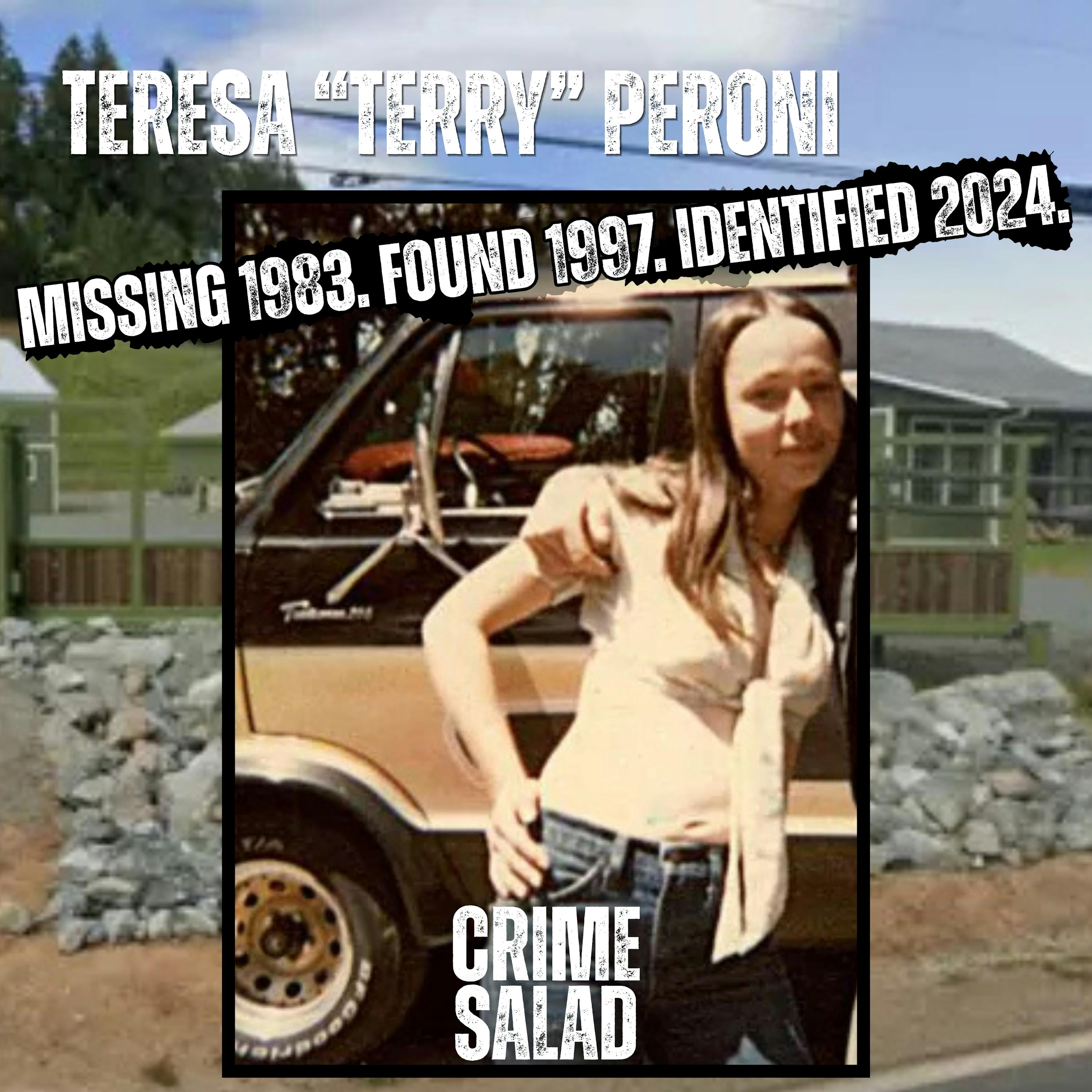
Crime Salad
Teresa “Terry” Peroni: Missing 1983. Found 1997. Identified 2024.
00:50:29
Need help now? Call or text 988 for the Suicide and Crisis Lifeline, available 24/7.
Loading summary
Transcript91 lines
- [00:13]
A
Hey everyone, I'm Ashley.
- [00:14]
B
And I'm Ricky.
- [00:15]
A
And this is Crime Salad.
- [00:17]
B
Now, before we dive in, make sure that you're subscribed wherever you're listening. It really helps keep us telling these stories.
- [00:23]
A
And if you'd like to support Crime Salad, you can listen completely ad free@patreon.com crimesaladpodcast and if you have a moment, please leave us. A positive review on Apple Podcasts. So today's case spans more than four decades, with a mystery that started in the summer of 1983 and ended only a few months ago with an arrest no one thought would ever come. It's a story about a young woman searching for belonging in a counterculture community on the edge of rural Oregon. Someone who wanted peace, belonging, and independence, but instead met someone whose control and violence changed everything. She was just 27 years old when she mysteriously disappeared, and for 42 years her family held on to hope that she would be found, even when evidence suggested otherwise. Her case went cold, files went missing, and for decades her story was frustrating, forgotten. But thanks to a small group of people who refused to give up, she finally got her name back.
- [01:30]
B
This woman's disappearance was surrounded by rumors, whispers about communes, drugs, and a mysterious man she was last seen with, but remained just out of reach of detectives on the case.
- [01:42]
A
So when police finally reopened the case and connected the dots, they uncovered a trail that stretched across state lines where the man suspected of killing Terry had been living for decades. This is the story of Teresa Peroni. Before she was Teresa Perroni, she was Teresa Neal, or Terry, as everyone called her. She was born in either 1955 or 1956 to Phyllis Vincent and Lester Neal, and she grew up alongside her brother Russell. Terri was small and slender, with long dark hair and bright blue eyes, but behind that was a childhood full of instability. Her mother had been married multiple times, and the family dynamic was fractured. Terri and Russell endured years of abuse from their stepfather, reportedly which led both of them to run away from their home at different times. Her brother would later describe their childhood as one built on fear, and it never left them. Terri also struggled with epilepsy for most of her life, which made things even harder. She struggled to hold steady work and frequent seizures left her isolated, but even then she kept trying to find her footing, and in 1974, she thought she found that in Texas. She married and began settling into what seemed like a new chapter. But it didn't last. One afternoon while visiting her family in California, Terry was blindsided with divorce papers. Her brother Russell Said that moment shattered her, throwing her life in shambles. That loss set her adrift again. And by the early 1980s, Terry was looking for something or somewhere that felt like home. And that search led her to Oregon. Like a lot of people back then, especially after the counterculture movement of the 70s, she was drawn to communities that promised freedom, music, peace, and living off the land. For people like Terry, who'd gone through so much, those groups could seem like a chance to start over. So Terri had found her way into a circle of people called the Earth People's Park Crowd, or EPP for short.
- [04:01]
B
So this wasn't an official commune. It was much more of a collection of travelers and drifters who moved up and down the west coast. Some people say the Oregon chapter of EPP actually branched from a larger commune that started in Vermont during the 1970s. That original movement had been built around the idea of free land for free people. Kind of like an open door utopia. Anyone could camp there, live there. No rent, no ownership or formal hierarchy. But the utopia didn't last forever. By the mid-1980s, law enforcement had started keeping an eye on the park. Investigators believed drugs were being grown and sold directly from the land. In 1990, a sting operation confirmed their suspicions as two residents reportedly sold 10 ounces of marijuana to an undercover agent for $500. That sale gave the federal government everything it needed to seize the land under drug forfeiture laws. And so for everyone living there, they were evicted within months. The homes they built were burned or bulldozed, and the 600 acres were turned over to the state of Vermont. Today, that land is known as Black Tern Brook State Forest.
- [05:14]
A
Yeah. So the EPP in Oregon or the Earth People's Park Crowd. It's believed to be founded as a subsect of that ideal. They planted themselves deep in the hills of southern Oregon in Josephine County. They were a group fueled by music, psychedelics, and a shared desire to live outside the rules of mainstream society. To some, including Terry, it probably seemed like freedom. But to others, it was chaos. Barely held together, everyone took nicknames. They lived off the land when they could and depended on government aid when they couldn't, like the Vermont group. There was no established hierarchy in the Oregon group, but people definitely had more influence than others. The people who supplied the drugs or ran the makeshift shelters, they tended to hold power while others followed along. And for someone like Terri, who relied on disability benefits and frequent doctor visits for her epilepsy, it was a fragile existence. This kind of lifestyle, the long nights, the stress, the Constant partying. It wasn't a great environment for her health. Because Terri lived with epilepsy, the things that could trigger her seizures were everywhere in that world. Sleep deprivation, malnutrition, dehydration, drugs and alcohol. These things could have made her vulnerable to the influence and control of others in the group. Which brings us to her disappearance. In August of 1983, Terri's family in Grants Pass, Oregon, they contacted the Josephine County Sheriff's office to say that Terry was. Was missing. And they told investigators that it wasn't unusual for Terri to be hard to reach. But this was different. There were no calls, there were no letters, and no word from anyone in her circle.
- [07:03]
B
Now, the detective assigned to her case actually knew Terry personally. He had interacted with her before and thought tracking her down would be straightforward. But every lead he followed fizzled out.
- [07:16]
A
Right. The initial investigation it did didn't produce much. Detectives talked to people in Terry's immediate circle, where they pieced together that Terry was last seen leaving her residence near the Oregon California border on July 3rd. So basically a month before she was reported missing. And when the county sheriff's office finished their initial investigation, they called Terry's disappearance suspicious. But the district attorney's office said that there wasn't enough probable cause to. To pursue criminal charges without physical evidence or willing witnesses. The file was quietly set aside.
- [07:54]
B
And I think that month long gap is something that really hurt this investigation. A month is a lifetime when someone disappears. Especially back in the 1980s, before digital records or quick communication. Leads go cold fast, memories fade. And people came and went constantly in that community.
- [08:13]
A
Yeah, but I mean, you can understand why her family didn't panic right away. Terry was a drifter, staying with friends, crashing at different houses, disappearing into the EPB circle. They probably thought she would resurface like she always did. By the time they realized something was truly wrong, so much crucial time had already been lost, which is not at all their fault. When detectives finally started asking questions, the people who might have known something were either gone, Unwilling to talk or too deep in the lifestyle to give consistent stories. It was as if Terry had just been swallowed up by the Oregon woods. A year went by without a single break in the case. But In July of 1984, an unidentified man walked into the Josephine County Sheriff's office carrying a brown purse. And inside were papers that identified Teresa Peroni, including her Oregon ID card. Was, along with her medication for epilepsy. This was a strange development that gave Terry's family a flicker of hope and investigators a reason to revisit her case.
- [09:19]
B
And that's a big detail. Teri had been known to visit the county health clinic often to pick up her medication. Her seizures were unpredictable and without that medication, she couldn't go long without risking a medical episode. The fact that her purse and medication had turned up without her was immediately concerning.
- [09:42]
A
Ever wake up sweaty, freezing or just uncomfortable?
- [09:46]
B
Yeah, I did before the switch the.
- [09:47]
A
Temperature in your bedroom. It can totally make or break your sleep. That's why we switched to Miracle Made Sheets. They use temperature regulating silver infused fabric originally inspired by NASA technology and it helps keep you comfortable all night long.
- [10:03]
B
And here's something kind of gross. Traditional bed sheets can actually hold more bacteria than a toilet seat, which is definitely not something I want to be putting my face on. Miracle Made Bedding is designed to fight bacteria and stay cleaner longer with silver infused fabrics that Prevent up to 99.7% of bacterial growth.
- [10:22]
A
These sheets help keep your body at a comfortable temperature while you sleep. So if you sleep hot or you're someone who gets cold at night, they help balance that out so you're not waking up to adjust blankets every hour.
- [10:34]
B
Plus since they stay fresher up to three times longer than regular sheets and you end up doing less laundry and the fabric feels like luxury hotel bedding. Soft, breathable and super comfortable.
- [10:45]
A
And here's something that I really love. They are great for your skin. Sleeping on cleaner bedding can help prevent clogged pores and breakouts. So it's a win all around. Upgrade your sleep or give the gift of a better rest. Go to try Miracle.com Crimesalad to try Miracle Made Sheets today you will save over 40% and when you use promo code CRIMESALAD you can you will get an extra 20% off plus a free three piece towel set. They make an amazing gift and with a 30 day money back guarantee there is no risk. That's try Miracle.com Crimesalad code Crimesalad at checkout and thank you Miracle made for sponsoring this episode.
- [11:28]
C
The holidays are approaching and everyone knows that this time of year, the sooner you can get things done, the better. For both shoppers and businesses. The best time to score great deals during the holidays is during that Black Friday Cyber Monday weekend. And if you have your own business, whether you've been around the block a few times or this is your first year going through the holiday sale rush, the most important thing you can have is a platform that can handle everything that's about to be thrown at you. This is a crucial time for your business and your customers. And with Shopify, you can be sure that your tools and platform are ready for anything that comes your way. Shopify is the commerce platform behind millions of businesses around the world and 10% of all e commerce in the US from household names to entrepreneurs who will be participating in their first Black Friday Cyber Monday this year. With everything else going on, you probably don't have time to spend hours poring over every little detail in your online store. That's why Shopify's thousands of templates and tools help you streamline website creation and make sure that your site isn't just aesthetically pleasing, but but functional and easy to use. Shopify's expedited checkout shop pay saves customer information and reduces hassle. And the best part is that it's been proven to boost conversions, meaning you'll see less abandoned carts and more profits. You can also stress less knowing that Shopify's award winning customer support team is on standby 247 to help with any issues that arise, allowing you to get back to your business as fast as possible. This Black Friday joined the thousands of new entrepreneurs hearing for the first time with Shopify. Sign up for your free trial today@shopify.com realm. That's shopify.com realm. Go to shopify.com realm and make this Black Friday one to remember.
- [13:15]
D
Do you guys hear that? Oh, that's our podcast Ruin, brought to you by me, your host, intrepid horror movie freak, Hallie Kiefer. And me, your resident scaredy cat, Alison Liby. Join us each week as Hallie forces me to listen to the twisted plot of yet another bone chilling horror movie. From classics like the Exorcist and the Thing to the latest releases to the most disgusting films on streaming, we ruin them all every Tuesday wherever you get your podcasts. So come join us. And until then, we beg you, please keep it spooky.
- [13:45]
E
Hey, Michael.
- [13:46]
B
Hey, Tom.
- [13:47]
E
So, big news to share, right?
- [13:48]
B
Yes, Huge, monumental, earth shaking heartbeat sound effect. Big.
- [13:54]
E
Meat is back.
- [13:56]
B
That's right. After a brief snack nap. We're coming back.
- [13:59]
E
We're picking snacks.
- [14:00]
B
We're eating snacks. Eating snacks like the snackologist we were born to be.
- [14:06]
E
Mates is back.
- [14:07]
B
Mike and Tom eat snacks wherever you get your podcasts. Unless you get them from a snack machine, in which case, call us, call us.
- [14:19]
F
From the darkest corners of our imagination comes a game show that's more ridiculous than terrifying. Welcome to Tickled to Death. I'm your host, Roz Hernandez, and I'll be guiding guests through the creepy questions and chaotic games, all to win the ultimate title of horror movie champion. Listen to Tickled to Death wherever you get your podcasts and hit follow unless you want the show to follow you.
- [14:59]
A
The man who brought it in told investigators that he last seen Terry sometime in late July of 1983, where she told him she was heading to a place called the Ranch in Selma, Oregon to collect her belongings and then plan to visit her mother in Grant's Pass. But Terry never made it to her mother's house, as we know now. The mention of the Ranch became very important to investigators since since this was the land that was tied to the EPP group that Terry was involved with. And when detectives began to re interview the people in Terry's life, one name kept surfacing. Marcus San Fratello. He was 29 years old at the time of Terry's disappearance. A local musician with a full beard, curly hair, and piercing blue eyes, he played guitar in a few local bands, drifting between gigs and communes in the area. By all accounts, he and Terry had been romantically involved during her time with the group. And everyone described their relationship in the same way. Passionate, chaotic, and often violent. In early 1983, Terry and Marcus were living together in a small cabin called Forest Lodge near the Oregon California border. Young members of the Earth People's crowd gravitated towards Terri. She was older than many of them, gentle and motherly, someone who understood what it was like to run away and try to start a over. She was also known by the group as someone who wasn't afraid to speak her mind. And she was very independent. She didn't want anyone to tell her what to do or who to be.
- [16:35]
B
Which is really surprising when you hear about her and Marcus's relationship. Even in that tight knit community, the relationship was volatile. On Valentine's Day of 1983, they were evicted from the Lodge and moved in with a female friend of Terry's nearby. And almost immediately, the tension began to grow.
- [16:54]
A
Yeah, so the roommate shares a lot about what happened between Terri and Marcus, which gives us a glimpse into what was going on in Terri's life leading up to her disappearance. In March of that year, Terri had become involved with a church and decided to be baptized. Her roommate and her brother Russell both remembered it vividly. Their mother and aunt were there, standing along the edge of a cold Oregon creek. Russell had the honor of lowering his sister beneath the water himself. And he said it felt like she was ready to leave the chaos of her old life behind. But Marcus, he didn't see it that way. Their aunt and the roommate. They later said that he was furious when Terry joined the church. He didn't want her finding strength or independence outside of him. And this was all according to these witnesses.
- [17:49]
B
And that's a huge red flag for abusive relationships, because it's all about control. If Terry's faith was helping her rebuild her identity, which, remember, was described by many as independent and free spirited, Marcus could have seen this church as a threat instead of a transformation.
- [18:07]
A
Exactly. And that anger, it boiled over almost immediately. The roommate later told police that an argument about the baptism, it turned physical, and Marcus shoved Terry during the fight. And in April, another argument erupted, this time over another man, someone from the commune everyone called Rat Trap. When the confrontation got physical again, Terry left and stayed with friends for a few days, possibly in California, before returning. And by May 2nd of 1983, the cycle repeated again with a verbal fight turned violent, and. And again on May 7th. Each time, Marcus would storm out and then return a short time later. On May 11, things got so bad that Terry left for California again. And when she came back a few days later, the roommate told Marcus he wasn't welcome in the home anymore.
- [18:59]
B
And honestly, I don't blame her. Imagine being in that situation. You're witnessing them fight and yell and all of this violence, and this is her home. She let them stay there out of kindness. I'd be fed up, too.
- [19:13]
A
And on top of everything else, Terry's personal situation was getting worse. Her disability benefits had been cut off, which meant no food stamps and no steady access to her epilepsy medication. She started having more seizures, and without consistent medical care or stable housing, she was surviving day to day. That's when Rat Trap started spending more time with her. He would bring her drugs, mostly mda, as people know as the love drug, and acid, which was what the EPP was known for using in their group. And some people believe Terry was using them to self medicate, maybe even to dull her seizures now that she couldn't afford proper treatment. By late May, her life had become a tangled mess of survival and dependency. She was still connected to both Marcus and Rat Trap, sometimes romantically, sometimes financially. And witnesses later said that she was selling MDA an LSD for Rat Trap to pay back what she owed him for the drugs that she was using. According to the roommate, on May 28, Terry made a trip to Crescent City in California for a sale. That same day, Rat Trap showed up at her home looking for his money. But when she wasn't there, he became enraged. The next morning, Terri returned from California and told her roommate that she was heading to Grant's Pass to check in at the Social Security office. And that was the last time her roommate ever saw her. And it's so sad to see this all spiral in the months right after she had made an attempt to turn her life around. I mean, she joined a church, she got baptized, but it seemed like there were so many barriers in her way at the time. Her loss of benefits, her partner being completely unsupportive. She was vulnerable. And it doesn't seem like either of these guys were interested in keeping her safe. So from the outside looking in, there's two possible suspects here. I mean, every warning sign was there. But no one realized how close Terry was to vanishing for good, despite these various emotionally charged situations. Now with two different men, her stepfather David, remembered that even back in late 1980, two, months before anyone called her missing, the violence between Terry and Marcus had already reached alarming levels. David said Marcus had started trying to control everything Terry did. He told her where she could go, who she could see. And when she pushed back, his temper flared. And I'm going to give a warning here because we're going to talk about details of physical abuse. So one night, the argument turned brutal. Marcus threw her across the room and kicked her over and over, hard enough to break several of her ribs, causing Terry to end up in the hospital. And when she came home, her stepfather decided he wasn't going to let it go. He went straight to Marcus's residence to confront him. But when he arrived, Marcus wasn't alone. He was sitting with another man, someone David described as having red hair and a beard. David decided not to start a fight. Instead, he sat down with them and he had a beer. He said Marcus looked sheepish, quiet, and avoiding eye contact. Eventually, David warned him directly that if he ever touched Terri again, he would have to answer to her family. David couldn't remember his exact response, but he remembers Marcus assuring him that it would never happen again.
- [22:37]
B
And that look he had says everything. It didn't read as guilt to me. It felt more like fear. Not fear, because he regretted what he did, but fear of consequences. He wasn't sorry he hurt her. He was sorry that he got caught. The family saw him. They saw exactly what he was capable of. And even after all of that, Terry went back. But that's something that we see so often in abusive relationships. Terry believed him when he said that it wouldn't happen again. And I think she wanted to believe that. She needed to. She needed support. During everything she was going through. And when someone is struggling like that, they'll cling to the hope that the person they love can change. And I think she was grasping for any kind of stability that she could find.
- [23:24]
A
Stability, passion, or any type of connection. I mean, that on top of, you know, the loss of her benefits and being isolated from her family, in some ways, she probably felt like she didn't have many options. And by early July of 1983, tensions between Terri and Marcus, they reached a breaking point. According to multiple witness statements, on the weekend of July 1st or 2nd, Terry went to a party at the ranch in Selma. It was a few acres of private land tucked in the woods, with one main house and several makeshift structures scattered around it. Well, that night it was full of people, music and drugs. And witnesses said that Terri seemed happy for the first time in a while. She was drinking and dancing and spending time with rat trap. And at some point, the two slipped off together into the rooms of one of the houses. And the next morning, Marcus showed up. People remembered the energy in the house shifting instantly. Marcus was furious. And when he found that Terry and Raptrap were together, everything exploded. Now, there's a few versions of what happened next. Some say Marcus attacked rat trap and won the fight. And others claim that rat trap, he grabbed a shotgun and fired it into the air to make it stop. But everyone police interviewed agreed on one thing. That Marcus demanded that Terry go outside and talk with him after the fight. This was the last time most witnesses saw her alive.
- [24:54]
B
And it's so hard to get a solid timeline. First of all, it's been a year since this all happened. Everyone at the party had probably been drinking or using, and their stories changed depending on who the police asked. Some said Marcus came back inside alone about an hour and a half later after the two went outside to talk, calm, like nothing happened. Others swore they both came back in, argued off and on, and then went outside again later that night to sleep in the bushes near the tree line. After that, nothing.
- [25:26]
A
Now, there was one account from someone who claimed that they saw her the next morning, that she came out of the bushes, put on her leather jacket, and left the ranch on her own. But that statement has never been verified. Another account said that they heard that someone had seen Terry later that month, around July 15th at a bar in Grants Pass. Now, according to them, she was so intoxicated that a man, possibly a biker, had to carry her out, and she was later passed out in a nearby dumpster. It sounds far fetched, and investigators eventually determined the story didn't line up with the rest of the evidence. Still, detectives followed up on the interview, and things took a darker turn. They asked the witness if they thought Terry could be buried at the ranch, and the witness said, sure, why not? And told the detectives to start digging. And when they asked if they thought Marcus could have killed Terry, they gave the same response, saying, sure. Detectives also pointed out to the witness that the people living at the ranch, they stopped drinking the water from the well and they started bringing in bottled water instead of. And this was all shortly after Terry disappeared. So it was very suspicious. Now, according to the report, the witness got nervous when confronted with this information, saying that, well, it was either because the well water was bad and it wasn't good to drink, or it had dried up. Now, shortly after, the witness stopped cooperating altogether.
- [26:54]
B
So Marcus was the last person seen with Terry, at least according to evidence detectives had, which is still limited to the public. And now this very nonchalant attitude that Marcus could have killed Terry. It's interesting, and if we think back to what happened in Vermont, a lot of people of the EPP had a personal interest in keeping police off of that property. It doesn't leave a lot of room for quality, accurate information to be put out there. But the comments about the well are definitely weird.
- [27:25]
A
And because of that, investigators zeroed in on Marcus. So according to Josephine County Sheriff Dave Daniel, Marcus San Fratello became a person of interest almost immediately after Terry's disappearance. But without any evidence, there wasn't enough to charge him, even with the new developments from witness statements. So this case stalled again. By August of 1985, Marcus San Fratello was no longer in Oregon, and he actually moved to Northern California, where he tried to start over. But it didn't take long for his violent behavior to surface again. Marcus had met and married a woman in California, though the marriage barely lasted six weeks. And in July of 1985, sheriff's deputies in Yreka, California, were dispatched to a horrifying scene. Two victims, a woman and her teenage daughter, were both brutally stabbed, but they were still alive. The pair swiftly identified the attacker as the woman's ex husband. Marcus San Fratello and the 14 year old stepdaughter told investigators as they were loading her into the ambulance that Marcus had beaten, choked, stabbed, and sexually assaulted her. They were rushed to a nearby hospital where they underwent extensive surgeries to repair the damage and ultimately survived.
- [28:45]
G
Wow.
- [28:45]
B
And thank God they survived that. Marcus was found hours later hiding in a hotel restroom. When deputies Arrested him. He reportedly told them he knew why he was being arrested, but he claimed to be somewhere else at the time of the stabbings.
- [29:00]
A
I mean, that's a stellar alibi.
- [29:02]
B
It really is. And this is the same pattern we've seen from the start. Deny, deflect, then pivot. And to me, this confirms everything witnesses had been saying about Marcus. He was violent and escalating.
- [29:15]
A
Exactly. But unlike in Terry's case, the case into California left no room for doubt. Marcus was charged with two counts of attempted murder, one count of rape, and one count of burglary. Even though he initially pled not guilty, he eventually changed his plea and accepted the attempted murder charges, receiving the maximum penalty the court could give him. He was sentenced to 15 years and four months in prison. But there was nothing moving forward in Terry's case. There was still no evidence, no solid lead, and no way to connect Marcus to Terry's disappearance besides witness speculation. With him locked up in California, the case froze again. So for more than a decade, Terry Perroni's case remained stalled up until January of 1997. On an unimproved property in Selma, Oregon, Less than a mile from the ranch where Terry was last seen, a pair of locals made a grisly discovery. Resting on the land was a human skull. Sheriff's deputies quickly called in a search team with cadaver dogs, and they combed through the surrounding woods, digging through layers of moss and dirt, hoping to find the rest of the remains. But nothing else was there. Just the skull. And when the medical examiner's office was attempting to retrieve DNA from the skull, a forensic artist created a composite sketch based on the bone structure of the skull, showing a woman estimated to be between 20 and 35 years old, with features that looked eerily familiar. The resemblance to Terry Peroni was undeniable.
- [30:50]
B
And that must have been such a bittersweet moment for the family. But Terry's family was left with an awful middle ground, because as far as public information goes, the skull stayed as Jane Doe. DNA testing wasn't nearly as advanced as it is now. And if the evidence wasn't perfect, you were basically out of luck. No one knew what happened, but there was no updates about whether the skull belonged to Terry or not.
- [31:17]
A
Right. So another decade would pass before that skull would resurface again. And around this time, Marcus San Fratello had served his sentence for his violent attack on his ex wife and stepdaughter. He eventually settled in Butte County, California, to rebuild his life, moving between small towns north of Sacramento. But this freedom didn't last long. So in 1999, San Frate Tello, he was back in trouble, this time in federal court for embezzling government property, and was sentenced to two years probation and about $4,000 in restitution.
- [31:54]
B
In simple terms, embezzling public property usually means taking or misusing something that belongs to the government. The details in this case are scarce, but some examples of this kind of offense are a federal employee pocketing funds from an account they manage, stealing government issued tools like electronics or vehicles, or taking government equipment like computers. So for Marcus, we're jumping between violence and white collar crime. So he definitely doesn't discriminate about breaking the law here.
- [32:25]
A
Right. And this gives more insight into Marcus's character, but not his guilt in Terry's case. So the case went silent again for another six years until the case landed on the desk of a new investigator, Detective Ken Selig of the Josephine County Sheriff's office. In 2004, Selig decided to take another look at the unidentified skull found near the ranch. The composite sketch had always looked like Terry, but nothing was provable without usable DNA. So Selig rewrote the file as a homicide report instead of a missing person case, and he started from scratch. He tracked down one of Terry's half sisters and collected a new DNA swab for comparison. Then he contacted the FBI, hoping to send a better sample to compare to the skull, something that could finally end the family's decades of waiting for answers. But when he reached out to the FBI, they gave him shocking news. The earlier investigator had sent tooth fillings for DNA extraction, which wouldn't contain any usable DNA, which is the mistake that stalled the case back in 1997. Determined to fix it, Selig contacted the state medical examiner, Dr. James Olson, on October 2, 2004, asking him to locate the skull for new DNA testing. There was no response. He followed up with Olson's assistant, who said he'd look for the remains at the medical examiner's office. But weeks went by without a word. On Halloween of 2004, Selig sent another email to Dr. Olson, pleading for the skull's remains, but still received no response. It wasn't until January of 2005 that Olson finally responded, saying that the skull was at the medical examiner's office and he would locate it soon. But soon never came. And by January 26, Selig warned in another email that he would have to deactivate the case by February 6th if there were no updates. Copying the local district attorney on the message and when the deadline passed without a word from Dr. Olson, Selig had no choice but to close the file again. He asked the FBI to return the DNA swabs from Terry's half sister and the tooth fillings.
- [34:44]
B
That is so frustrating and heartbreaking. Not only because of how badly things were handled, but because there was actually a detective who tried to do the right thing. Someone who saw this case had been ignored for years and made an effort to reopen it. And then everything just fell apart again simply because the evidence couldn't be located and no one communicated. My guess is that once the medical examiner realized they couldn't even find the skull, they stopped responding instead of just admitting it. And that lack of silence, that lack of accountability, is such a disservice to Terry and her entire family. They deserved honesty. They deserved care. And they didn't get that.
- [35:26]
A
And because of this error, this case Sat frozen for 15 years. But in 2020, a discovery changed everything. So after years of confusion and miscommunication, the skull was finally found, sitting in storage at a genetic genealogy lab at the University of North Texas. Investigators later learned that Josephine county authorities had sent it there years earlier for safekeeping. And then they forgot about it. Allegedly. And when the skull was finally rediscovered, investigators sent it out for new forensic testing. But despite that, there were no public updates. The case was being looked at behind the scenes, yet it still was not officially reopened. Then people started to notice something. So in 2022, the case file for the unidentified skull. It was quietly being updated to share the ex. Same case number as Terry Peroni's missing person report. This suggested that the investigators now believed the skull belonged to Terry and that they were treating her disappearance as a homicide. But again, no announcements were made, no press release, no answers. Lots of.
- [36:48]
H
Do you enjoy getting traumatized on a weekly basis? Well, neither does my co host, Neil.
- [36:55]
B
People call me a victim more than a co host.
- [36:58]
H
Anyway, welcome to the Mortal Musings podcast. I'm your host, Megan. Each week, we dive into some truly dark and disturbing cases. Do you ever find yourself listening to these horrific tales and saying to yourself, huh?
- [37:12]
A
No. Huh.
- [37:12]
B
Well, the actual.
- [37:14]
C
Why?
- [37:14]
B
Why did he do that? Solved it. Mate, there's no need for that. They're just acting. The.
- [37:21]
H
Our episodes include cases of serial killers, the story of a socialite that was held captive for 25 years, prison riots, wrongful executions, and scandals in the death industry. At the end of each episode, we throw in a tale of oddity. Anything from medical mishaps to the real life Weekend at Bernie's or Mike the Headless Chicken. New episodes every Wednesday. Available wherever you get your podcasts.
- [37:49]
B
And remember, here at the Mortal Musings podcast, we like to take the cases seriously, but not ourselves.
- [38:03]
G
If we knew more about our sleep, what would we do differently? Would we go to bed at a consistent time or take steps to reduce interruptions to our sleep? With the all new Sleep Score, Apple Watch measures your bedtime consistency, interruptions and sleep duration. Then every morning it combines these factors into an easy to understand score from 1 to 100, so you'll know how to take the quality of your sleep from good to excellent. Introducing the New Sleep Score on Apple Watch iPhone 11 or later required when.
- [38:34]
E
They were young, the five members of an elite commando group nicknamed the Stone Wolves raged against the oppressive rule of the Kratarakian Empire, which occupies and dominates most of the galaxy's inhabited planets. The Wolves fought for freedom, but they failed, leaving countless corpses in their wake. Defeated and disillusioned, they hung up their guns and went their separate ways, all hoping to find some small bit of peace amidst a universe thick with violence and oppression. Four decades decades after their heyday, they each try to stay alive and eke out a living. But a friend from the past won't let them move on, and neither will their bitterest enemy. The Stone wolves is season 11 of the Galactic Football League science fiction series by author Scott Sigler. Enjoy it as a standalone story or listen to the entire GFL series, beginning with season one. The rookie search for Scott Sigler S I G L E R wherever you get your podcasts.
- [39:38]
I
Ah, the Regency era. You might know it as the time when Bridgerton takes place, or it's the time when Jane Austen wrote her books. The Regency era was also an explosive time of social change, sex scandals, and maybe the worst king in British history. Vulgar History's new season is all about the Regency era, the balls, the gowns, and all the scandal. Listen to Vulgar History Regency Era wherever you get podcasts.
- [40:07]
B
Every horror film hides a secret. Behind the killers, the haunted houses, and the urban legends, there's a true story.
- [40:15]
A
Welcome to the Fear Archive, the podcast that digs through case files and cult classics to uncover the real crimes that inspired your favorite horror movies. We're funny, we're obsessive, and we're not afraid to get our hands dirty.
- [40:30]
B
Because the films pure fiction. But the bodies? They're always real.
- [40:37]
A
The Fear Archive, a Violet Hour Media Podcast.
- [40:40]
B
Follow now on Apple Podcasts, Spotify or wherever you listen.
- [40:49]
A
Finally, in 2024, the Josephine County Sheriff's Office formally reopened the case. With support from the Oregon Department of Justice, investigators began tracking down anyone still alive who had been involved in the original investigation or who had personal knowledge of Terry's life around the time she disappeared. But all of this work was happening out of the public eye, quietly and without any updates to Terry's family or the community who had waited more than 40 years for answers.
- [41:23]
B
And there are reasons for that. Part of it is caution, part of it is strategy. When there's a big forensic breakthrough in a cold case, investigators have to keep that information really close. They need time to double check everything, make sure the results are solid, and make sure that they're not risking the case by moving too fast. If they go public too early, they could tip off the person responsible. So holding back, building the case quietly and getting it as strong as possible before saying anything, that's what increases the chances of a conviction. But even knowing all of that, it's still incredibly frustrating because we're talking about a family who has been waiting for answers for years. They've been told to be patient, to trust the process, and yet they've seen almost no movement. So while the strategy makes sense on paper, the human side of it is just painful. They deserve updates, they deserve to know something is happening, and instead, they're just left waiting in the dark.
- [42:22]
A
Right? But because the public didn't know this was happening, they started to act behind their own scenes. People were collecting newspaper articles, requesting records, and building their own cases. In July of 2024, which marked the 41st anniversary of Terry's disappearance, John Lorden, through Seriously Mysterious, released a podcast titled is Teresa Peroni 1997 Jane Doe? Which laid out all the facts of the case. The writer of the episode, Gwen Barringer, had spent tireless hours requesting records to find the facts of the case, seeking the public's help in making connections for this case. That podcast is where we got a lot of our information for this episode, as they have access to these records that are not available publicly now. At the time, the only thing the public knew was that Terry disappeared and the case was closed. These records uncovered all of this behind the scenes investigation that we've discussed, giving the public a real glimpse into what was going on in Terry's case. But Barringer and John Lorden, they had no idea that Therese's case had just been reopened back in February. So Detective Sergeant Kyle Henrick, who had reactivated Terry's file, contacted Gwen and asked her to keep her reporting quiet, telling her that he was the one who reopened Terry's case and that he might be close to an indictment.
- [43:49]
B
And we hear that all the time in missing persons cases. Think of all the unsolved cases we've done where advocates are saying that the police knew who did it, but they just need the evidence to make a case. Sometimes cases get stuck in that spot. But it's at least good to know that investigators weren't giving up.
- [44:08]
A
Exactly. And what we didn't know is during that time was that when the skull was finally located, the testing utilized advanced mitochondrial DNA analysis capable of working with tiny degraded samples. And finally, after nearly four decades, the results came back. That the skull found less than a mile from the ranch in Selma was a confirmed match against the DNA of Terry's half sister. The skull belonged to Teresa Perroni. Since 2020, investigators had been using this forensic breakthrough to build a case against the only and named suspect throughout the entire investigation, Marcus San Fratello. On June 27th of 2025, just five months ago, from the recording of this episode, the Josephine County Sheriff's Office announced that a grand jury had indicted Mark Anthony San Fratello on the charge of second degree murder in the death of Teresa Peroni. Investigators had been locating old witnesses, verifying DNA results and piecing together what remained of a case that had gone cold before many of the detectives were even born. They had even sent additional DNA evidence to be tested against the skull, confirming completely that the skull belonged to Teresa Peroni and Marcus San Fratello's involvement. In their official statement, the sheriff's office said that after four decades, they were finally able to take this critical step towards justice for Teresa and her family. The next morning, local law enforcement in Chico, California was notified. Officers arrived at an apartment on the 1100 block of East 8th street where they took 71 year old Marcus San Fratello into custody without incident.
- [45:58]
B
After the arrest, Terry's family was notified. It was the news they had known in their hearts for years and the news that they had been waiting on for more than four decades. The year we tried to find out if Terry's mother is still alive, but we weren't able to confirm that. But we do know that her brother Russell was reached and he gave a public statement after Marcus was arrested. If Terry were alive today, she would have been around 70 years old.
- [46:23]
A
Yeah. Which makes me think that Terry's parents are likely not with us, but I mean, you never know. Marcus was booked into the Butte County Jail in California, awaiting extradition to Oregon. The Josephine County District Attorney began preparing for what could be the first ever trial ever connected to Terry's disappearance and death. And what's interesting is neighbors of Marcus in Chico said that Marcus wasn't the sort of person you would notice unless you were paying attention. He lived alone. He drove a motorcycle and could be found most Tuesdays and Thursdays at the Tackle Box bar in Grill on Park Avenue. People there knew him simply as the older guy in a leather jacket who always signed up for karaoke, singing heavy metal or rock songs.
- [47:11]
B
People in the town said that after his shows, he would hang around, talk to people, and sometimes flirt with women at the bar. Some women said he made them uncomfortable. And another resident described him as quiet, angry, and radical, but also a skilled guitar player.
- [47:27]
A
And one man who knew him casually told reporters that Marcus often talked about his past. He said that his wife had died years earlier. And after that, he moved to Chico and stayed at the Jesus Center, a local homeless outreach program, before eventually getting his own apartment. I mean, to everyone, he just seemed like this regular guy, not someone who had stabbed two people and had been charged with two other crimes. And now a third.
- [47:55]
B
Yeah, exactly. I mean, it's wild to think about someone just sitting next to you at a bar, singing karaoke and just blending in, right?
- [48:03]
A
You would never guess what he was capable of. And it makes you wonder how many people we cross paths with who have entire hidden histories we know nothing about. Marcus has since been extradited to Oregon and has been arranged on his murder charge, where the judge decided to hold him without bail. His defense attorney, Elizabeth Baker, said that he is claiming all the rights afforded to him under the law. And that's the final update we have on this case as Marcus San Fratello awaits his next court date. Among those affected were the podcasters who had spent years of digging through old files and forgotten case notes. Gwen Barringer and John Lorden. They spoke with News and Review shortly after news of the arrest broke. And John Lorden was quick to credit Gwen for most of the research and writing on the case.
- [48:53]
B
Many meaningful moments, and it was one that he would never forget.
- [48:58]
A
He also gave credit to Ken Selig, Dr. Nicky Vance, the Oregon Department of Justice, the Josephine County Sheriff's Office, the District Attorney's office, and the Chico Police Department for giving the Pironi family a long overdue shot at justice, which I think it was really a collaboration of all of them that got us here today. And Gwen said that the arrest came as a shock to her. She said that she had been hoping for Teresa's remains to be identified since 2019. And she had contacted the state medical examiner for several years without much movement. She had lost a lot of hope that this case was ever going to move forward, but she didn't give up. Gwen Barringer was actually the one who tracked Marcus to his current address in Chico, California, leading to his arrest. She said that as far as timing goes, she thinks that the podcast was at least part of the chain of events that helped this case move forward. And I definitely agree with. I mean, that's such a modest way to say it, but she spent a ton of time tracking down resources and asking questions, reminding everyone that Terry's case still mattered.
- [50:03]
B
But Gwen was so humble throughout all of it and also made sure to defend the systems that were trying to solve the case. And something that we've talked about on here before, cold cases lose priority because of changes in personnel, limited resources, and the need for better DNA technology. And once we do get developments in DNA testing, cold cases are at the back of a very long line.
- [50:27]
A
Exactly. It's a sticky situation. And even though it's very sad that Marcus stayed out of prison and uncharged for so many years, at least the patience and perseverance of some key people brought him to justice. And we've been seeing a lot more of these older cases being solved, so hopefully that continues to happen to bring closure to the families. When the news of Marcus San Fratello's arrest reached Russell Neal, Terry's brother, it brought both relief and heartbreak. He had spent more than 40 years living with unanswered questions about what happened to his sister, and now he finally had the answer he'd always feared. He told reporters that he welcomed the news and that he was grateful for the people who never gave up. But the loss still cuts as deeply as it did in 1983. Russell also said that he regrets not having spent more time with Terry after they grew up. She'd been through so much abuse, illness, the constant searching for belonging, but she never lost her tenderness. Russell said that the one solace he has is that she's in heaven. Thank you all so much for listening to this week's episode. If you would like to learn more about the Josephine County Missing Persons Project, you can visit their page on Facebook and continue supporting the cases that still need answers. We'll continue to follow what happens in Marcus San Fratello's court case, and we hope Teresa gets the justice she and her family deserves. If you want to hear more episodes like this, be sure to subscribe and leave a comment about a case that you think needs more publicity. Take care of yourselves and we'll see you next time. Did you know you can opt out of winter with VRBO? Save up to $1,500 for booking a month long stay with thousands of sunny homes. Why subject yourself to the cold? Just filter your search by monthly stays and save up to $1,500. Book now at vrbo.com this holiday. Discover meaningful gifts for everyone on your list at K. Not sure where to start? Our jewelry experts are here to help you find or create the perfect gift in store or online. Book your appointment today and unwrap. Love this season only at K There.
- [52:52]
D
Are vampires out there. They walk among you, shoulder to shoulder in the dark. Heading to work, heading home. Going to the bar. It's a life just like like anyone else's. And I have grown used to it. To the darkness, to the moon, to the taste of blood on my tongue. But vampires are dying out. We are a fading kind, and I am the first one created in so long. And that is a dangerous thing to be. Those who came before me, elders of all stripes, they do not want to see our kind gone, and they will do anything to keep their power. And for myself and for Grace, who created me. That is a sword that hangs above our heads, and the worst person of all carries our secret and he will use it however he sees fit. Who do you look to when things are at their darkest? From the creators of Parkdale Haunt comes Woodbine, a podcast about monsters, dreams and changes, those you want and those you never saw. Coming Season 2 arrives September 24th. Distributed by Realm.