Loading summary
Transcript336 lines
- [00:02]
Fandango Sponsor
This episode is brought to you by Fandango. People say fans are too distracted these days, but the truth is, when a great movie hits the screen, you show up. You stay glued, invested, part of the story. And without fans like you, there'd be no cinema magic, no shared moments. So head to fandango.com to get tickets, stream or rent or buy top movies and series. Fandango loves fans.
- [00:27]
Jonathan Hirsch
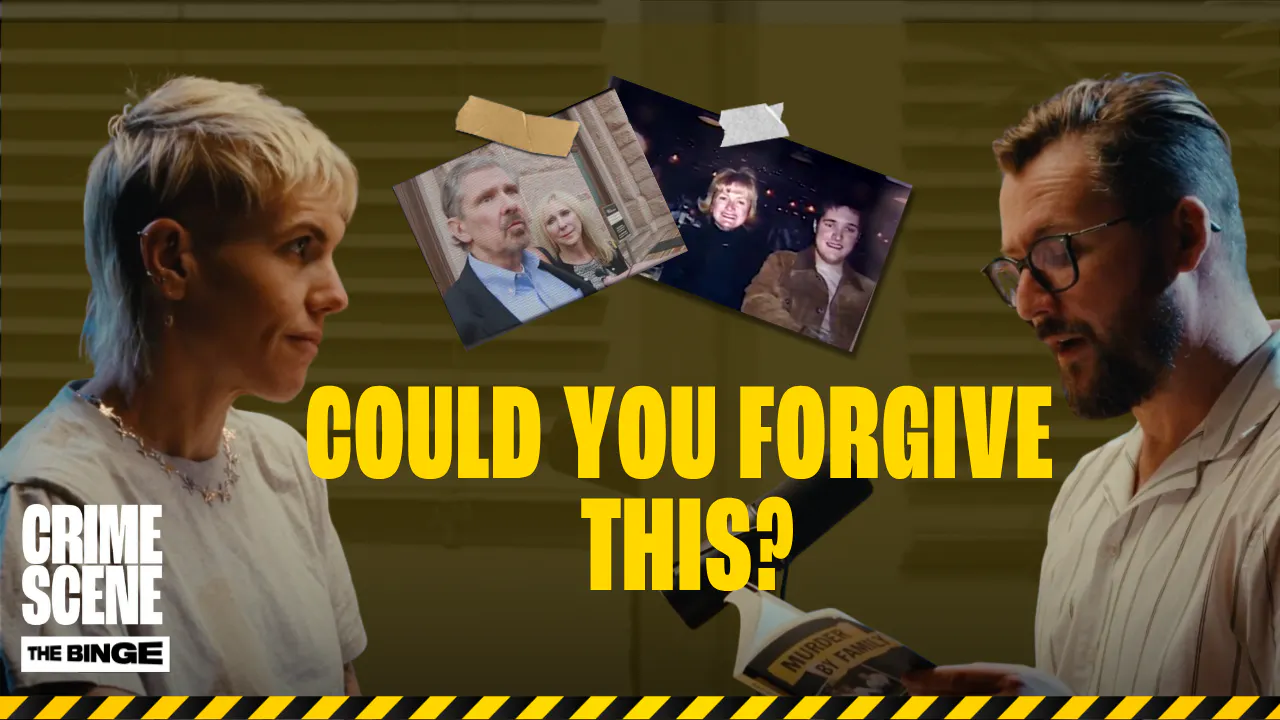
Could you forgive a killer for taking the life of someone you loved? What if that killer was also someone you loved? In 2003, a family in Sugarland, Texas, was torn apart by a gruesome crime. A crime that left everyone on the scene with blood on their hands. Welcome to Crime Scene, the show where we tell the stories behind the world's most unforgettable crimes. A family gathering turns sinister one December night in a wealthy suburb of Houston. Kent and Tricia Whitaker sit across from their sons, Bart and Kevin, surrounded by daiquiris, seafood platters, and a congratulations cake and chocolate frosting. But one of the members of this family didn't think of this meal as a celebration. More like a last supper. Today, we're bringing you the story of a family that was torn apart by a gruesome crime and. And an even worse secret. But it's also about the lengths that we go to hide things from the ones that we love. And when the truth is revealed in this case, it's more surprising than even the crime itself. From Sony podcasts and the binge, this is the story of the Sugarland murders. Hey, all. Welcome to the Crime Scene Office. My name's Jonathan Hirsch. I'm a cult survivor turned documentarian covering cults, crimes, and cons.
- [01:52]
Cooper Maul
And I'm Cooper Maul, a librarian turned podcaster obsessed with all things true crime.
- [01:58]
Jonathan Hirsch
And together, each week, we are going to bring you some of our favorite stories, the ones that have stuck with us. And we're going to dig into the case, both the criminal and legal aspects of it, but also all of the characters involved in the story. You know, the world that they inhabit. This series is part of the Binge, which is Sony's true crime podcast network. You'll probably hear me on it from time to time. You'll also hear Cooper. And you can think about this as all the things that you love from the limited series that we make, but in one episode.
- [02:31]
Cooper Maul
Well, what do you got for us today, Jonathan?
- [02:33]
Jonathan Hirsch
We've talked about this case a little bit before. It's different than every crime story I've looked into for. For this one particular reason, it almost Feels like a moral tale, if that makes sense. It's like a fable. You end up asking yourself some very serious questions about what you would do if you were in this situation.
- [02:52]
Cooper Maul
I love any story that makes me do that.
- [02:54]
Jonathan Hirsch
Yes. And I think by the end of this, it'll be interesting to hear how you feel like what you would do in the situation and what all of you would do as well. So let's go for it. Coming up after the break, the story of the Sugarland murders. So our story starts with the Whitakers. They're this upstanding, churchgoing family. They live in a brick house. They have community ties that run super deep, and they have these two boys that are on their way to adulthood.
- [03:35]
Cooper Maul
They're like a sitcom family.
- [03:36]
Jonathan Hirsch
Yeah. Kent is this successful professional, and Tricia is a devoted mother. Yeah, they sort of sound like cookie cutter in a way. It's much more complicated than that, but at least always is. And on the surface, though, you see this wonderful family. They have a likable younger son, Kevin, and then Bart, who's a little bit older, is on the verge of graduating from college and moving into adulthood. In their church, in their community, Kent is this sort of fixture. He's known to be gentle, full of faith. He talks oftentimes about forgiveness. He says that, like, when terrible things happen, people would come to him and ask for his advice, and he would often tell them about the values of trust, trust in God, and having faith to get through the worst of times. And then what happens to him has to be something that would test even the most faithful of people. Ken actually wrote a book about this, and he talks in, like, very philosophical terms about what had happened to him. And, you know, he talks about how everything that he went on in his life sort of brought prayer, forgiveness and faith and the winding roads of his life together and into the light, but not before experiencing considerable darkness all along the way.
- [04:57]
Cooper Maul
To me, it's almost as if it's like everything that he's practiced and preached is now going to be tested, Right?
- [05:03]
911 Operator
Yeah.
- [05:03]
Jonathan Hirsch
It's like that point I was making earlier about this kind of being like a moral tale. There's an element to the story where, because of Kent's voice and his perspective, it just has this very strong philosophical bent. It almost blurs the lines between what happened and how he feels. At least when you read his book, it's really quite remarkable in that way. Okay, so this case begins in December of 2003. Bart, the oldest boy, has just told his parents that he finished his College exams and is finally graduating from Sam Houston University.
- [05:36]
Cooper Maul
And if anyone thinks it's weird to graduate in December, it's not. I graduated in December, actually.
- [05:41]
Jonathan Hirsch
Did you really?
- [05:42]
Cooper Maul
Yes.
- [05:42]
Jonathan Hirsch
Okay.
- [05:42]
Cooper Maul
Not always in the summer.
- [05:44]
Jonathan Hirsch
Yeah. And so he's very excited. His family is also very excited because they weren't ever sure if this would happen. He had had some ups and downs. So they quickly arrange a celebration that night at Papa Dough, which is like the seafood chain restaurant in South Texas. They bought him a Rolex watch.
- [06:03]
Cooper Maul
Dang.
- [06:03]
Jonathan Hirsch
And a cake to mark the milestone. So this was, like, a fun event for everybody around, and it must have
- [06:08]
Cooper Maul
been a huge deal for them. That's, like, big. That's a big gift.
- [06:13]
Jonathan Hirsch
Yeah. Yeah. They were definitely a well to do family. But a Rolex is a Rolex, whoever is paying for it. So at the restaurant, Kevin is joking around. Tricia is said to have been beaming. Kent relaxes for the first time in a long time because they had had some rocky years. And look, I totally get that, like, as the dad of two boys, like, if one of your oldest son is about to graduate from college, you're like, oh, thank God. Okay, we made it through.
- [06:43]
Cooper Maul
I was definitely the kid in my family of, like, is this gonna happen? Is she ever really gonna get it there? But, yep, we did it.
- [06:52]
Jonathan Hirsch
Yeah.
- [06:52]
Kent Whitaker
Yeah.
- [06:53]
Cooper Maul
It was a big deal.
- [06:53]
Jonathan Hirsch
You can imagine that sense and comfort that the family felt now. Like, hindsight, of course. Right?
- [06:58]
Cooper Maul
Yeah, absolutely.
- [07:00]
Jonathan Hirsch
So they pose with the cake, they smile. Bart gets the Rolex. They talk about the future. But what they don't really know is that the future is very short. So the family goes home, and this is like any other night. They walk up to the front door. There's no outside signs of danger anywhere. Tricia, the mom, walks up to the front door first. She's sort of leading the pack. She opens the door, and when she opens it, she's confronted by a masked man.
- [07:29]
Cooper Maul
Nightmare.
- [07:30]
Jonathan Hirsch
Who fires a round straight into her. And she falls back. And then this individual proceeds to fire a single round into every one of the Whitakers that are there on the porch. And all of a sudden, in a matter of seconds, the entire family is mowed down and lying in a pool of blood.
- [07:52]
Narrator/Producer
Yeah.
- [07:52]
Cooper Maul
What a turn.
- [07:54]
Jonathan Hirsch
It is shocking and terrifying. The shooter runs from the house directly after doing this out the backyard, jumps over the fence, and disappears with a getaway driver into the night. But not everybody is dead from this attack. Kent is roughly still aware. He sort of raises his head. He sees his wife's blonde hair on the floor. And he also hears her coughing, sort of a wet cough, so he knows that her lungs are filling with blood. So she probably doesn't have a lot of time left. The neighbor heard the shots, rushes over and calls 911. The paramedics arrive. Kevin's dead on the scene.
- [08:44]
911 Operator
911. Someone has just shot another.
- [08:46]
Marshall Slott (Lead Investigator)
Who's been shot?
- [08:48]
911 Operator
Trisha and Kit.
- [08:49]
Marshall Slott (Lead Investigator)
Who shot them?
- [08:50]
911 Operator
We don't know. Someone in the mask.
- [08:52]
Marshall Slott (Lead Investigator)
What kind of injuries do they have?
- [08:54]
911 Operator
I. I don't know. They just been shot.
- [08:56]
Marshall Slott (Lead Investigator)
Hang on just a second. We've got them calling on another line, Sherlock.
- [09:00]
911 Operator
911 station emergency. I've been shot.
- [09:03]
Marshall Slott (Lead Investigator)
Who's been shot?
- [09:04]
911 Operator
It's my mom and my dad. My brother. Hold on one second, sir. Engine one, all, we have one subject right now. Apparently the whole family's been shot.
- [09:12]
Marshall Slott (Lead Investigator)
Standby. Is this Trisha or can't.
- [09:15]
911 Operator
The sun.
- [09:16]
Marshall Slott (Lead Investigator)
Okay, Bart, where.
- [09:17]
911 Operator
Where is your wound? In the arm. My shoulder, I think. I carry my arm.
- [09:21]
Marshall Slott (Lead Investigator)
Okay, who else has been shot in the house with you?
- [09:24]
911 Operator
I can't see.
- [09:26]
Marshall Slott (Lead Investigator)
Who else was in the house with you?
- [09:28]
911 Operator
We were walking in the house. My brother and my mom and my dad.
- [09:31]
Marshall Slott (Lead Investigator)
Okay, I need you to hang on, Bart. I've got help on the way, okay? Do you know who shot you? No. Okay. Your neighbors were telling me that he had a mask on.
- [09:40]
911 Operator
Is that true? I think I was dark in here.
- [09:44]
Marshall Slott (Lead Investigator)
Okay, do you think he was burglarizing your home, or are you guys having problems with somebody?
- [09:49]
911 Operator
Oh, God, I don't know.
- [09:53]
Marshall Slott (Lead Investigator)
How many shots did he fire?
- [09:54]
911 Operator
Bart? I don't know.
- [09:56]
Marshall Slott (Lead Investigator)
Can you tell me anything about him at all? Did he sound black, white, Hispanic, Middle Eastern, maybe?
- [10:01]
911 Operator
Black. I don't know. I couldn't.
- [10:04]
Marshall Slott (Lead Investigator)
Okay, when he left, Bart, did he leave out your back door?
- [10:06]
911 Operator
Yeah, I chased him that way.
- [10:08]
Marshall Slott (Lead Investigator)
He let you chase him out towards the back door?
- [10:10]
911 Operator
Yeah.
- [10:11]
Marshall Slott (Lead Investigator)
Okay, Bart, where were you when he shot you?
- [10:14]
911 Operator
In the living room. Oh, slow down.
- [10:16]
Marshall Slott (Lead Investigator)
Okay, they're on the way. Where are you in the house right now?
- [10:20]
911 Operator
I'm in the living room.
- [10:20]
Marshall Slott (Lead Investigator)
You're in the living room? Okay. Do you see the officers, Bart?
- [10:26]
911 Operator
Yeah.
- [10:26]
Marshall Slott (Lead Investigator)
Okay, that's the officers coming in. I'm going to go ahead and disconnect with you, okay? Okay, thank you.
- [10:32]
Jonathan Hirsch
The mom dies at the hospital, and Kent and Bart are medevaced to the hospital and brought into surgery. Emergency surgery.
- [10:42]
Cooper Maul
That flight there must have been surreal.
- [10:45]
Reporter/Interviewer
It is.
- [10:45]
Jonathan Hirsch
He talks about it. He's like having this wild moment of recollection of what had happened over the course of not like his life was flashing before his eyes, but he was remembering, like, these times that he had spent with his family when they had gone on this river rafting trip in Colorado.
- [11:05]
Cooper Maul
It was like a supercut of memories.
- [11:06]
Jonathan Hirsch
A supercut of memories is a perfect way to describe it. It's almost, like, cinematic the way he's, like, recalling his own life, and you just. You feel for him in that moment. He has no idea what's going on. Yeah. And he starts praying, and he says, father, you know, if it's my time to die, I'm ready. It's okay. But protect my family.
- [11:29]
Cooper Maul
Yeah. Because even though Kent and Bart are still alive, they're not totally in the clear, Right?
- [11:34]
Jonathan Hirsch
Yeah. And he's not in this moment understanding necessarily what is going on. But by the end of the night, the dust settles a bit, and what's clear is that two members of the Whitaker family are dead. Two of them are alive, and there's no clear explanation for why their family would have been massacred.
- [11:55]
Cooper Maul
Yeah. Like, make it make sense.
- [11:57]
Jonathan Hirsch
So the lead investigator, Marshall Slott, said that that night when we got home from the church, we got the call of the quadruple shooting. And that just doesn't happen here in Sugarland.
- [12:08]
Cooper Maul
I don't even think I've heard the term quadruple shooting.
- [12:11]
Jonathan Hirsch
Yeah, that's a first for me, too.
- [12:12]
Cooper Maul
So in the initial investigation, what kind of questions are they asking? Like this, what was the motive of these shooters? Were they trying to take stuff?
- [12:20]
Jonathan Hirsch
There's a lot to sort of sort through in something like this because there's the shooting, there's an active crime scene, and then there was what appeared to be a robbery. But when they start to look into it, that doesn't really make sense. Right. Like, the valuables weren't touched, so the place doesn't look ransacked.
- [12:38]
Cooper Maul
It looks staged.
- [12:39]
Jonathan Hirsch
It looks like it could have been staged. And the investigator sort of even alludes to that. He said in the master bedroom, the drawers, an armoire, all the drawers had been open, but they were all sort of, like, at an equal distance.
- [12:52]
Cooper Maul
Weird.
- [12:53]
Jonathan Hirsch
Like he had pulled them out together, like, one after the other. Like, it was like, don't miss the
- [12:58]
Movie Trailer Voice
Devil Wears Prada, too. In theaters.
- [13:00]
Jonathan Hirsch
Miranda.
- [13:01]
Lyndall Marks
Hi.
- [13:01]
Jonathan Hirsch
Pull yourself together. We have work to do. And by we, I mean you.
- [13:05]
Movie Trailer Voice
Meryl Streep, Anne Hathaway, Emily Blunt, and Stanley Tucci are back aw dar on May 1st.
- [13:11]
Jonathan Hirsch
Look what TJ Maxx dragged in. I am the new features editor, Renway.
- [13:14]
Lyndall Marks
No, you are not.
- [13:15]
Movie Trailer Voice
Icons reign Forever Cute.
- [13:18]
Kent Whitaker
Wait, wait.
- [13:18]
Cooper Maul
Hope to God that's not what you're
- [13:20]
Lyndall Marks
wearing to the dinner.
- [13:21]
Jonathan Hirsch
That's all.
- [13:21]
Movie Trailer Voice
Get tickets now. The Devil Wears Prada 2 May 1 Directed by David Frankel Radio PG 13 May be inappropriate for children under 13
- [13:26]
Redfin Sponsor
May this episode is brought to you by Redfin. You're listening to a podcast, which means you're probably multitasking, maybe even scrolling home listings on Redfin, saving homes without expecting to get them. But Redfin isn't just built for endless browsing. It's built to help you find and own a home with agents who close twice as many deals. When you find the one, you've got a real shot at getting it. Get started at redfin.com, own the dream set.
- [13:56]
Jonathan Hirsch
Yeah, like it was part of the job you had to do. Each one. None of the items of value inside the house had moved around. He said the electronics, the laptop, the jewelry. None of those items that are typically taken from a burglary were taken.
- [14:09]
Cooper Maul
Given that they, you know, got Barter Rolex, they probably had some really nice stuff in there.
- [14:14]
Jonathan Hirsch
Yeah, and then they did. I mean, it was a nice house and a nice neighborhood. A place where things like this don't happen to a family, where you don't expect something like this to happen. I mean, people's heads were spinning.
- [14:25]
Cooper Maul
Yeah, I bet.
- [14:26]
Jonathan Hirsch
So if the shooter wasn't a robber, then what on earth did this man have against the family? That's sort of your next line of thinking, Right?
- [14:35]
Cooper Maul
And, like, given what you've told me, they're this, like, upstanding Christian family. They don't necessarily seem like the type who are, like, in bed with criminals or having affairs or anything like that. I mean, what do they find out?
- [14:46]
Jonathan Hirsch
It can't possibly be personal, right? I mean, that is something they need to look into. You never know. You just never know who might see you as a target, as sort of one of the morals of this story, I guess. But by all accounts, as they start to ask around, they're not seeing these people sort of in bed with criminals having affairs or, you know, stepping out or betraying each other in ways that would be super evident or would be, like, the foundation of a motive. So I guess at first, like, the investigators are kind of at a loss.
- [15:17]
Cooper Maul
Yeah, they don't have a lot to go off of.
- [15:19]
Kent Whitaker
Yeah.
- [15:20]
Jonathan Hirsch
It seemed like every piece of evidence that we collected, we ran into dead ends left and right.
- [15:26]
Cooper Maul
So this all happened really fast. So to catch everybody up, this night began as a celebration For Bart's graduation and ended in bloodshed. The entire Whitaker family gunned down. Two of them have survived. Kent and Bart. So what's up with them right now?
- [15:43]
Jonathan Hirsch
So they're in the hospital. They're both going into surgery. Kent is barely holding on physically and emotionally. He's lost his wife. He's lost his youngest son, and his older son is wounded and in a hospital bed just down the way from him at the same hospital. And as a man of faith, you know, he, like, searches for meaning. You know, he's, like, telling himself, God must have left Bart alive for a reason, maybe to rebuild, maybe to carry on the family in a way that he couldn't quite understand at the moment. So he started his, like, head starting to spin about trying to figure out how to make sense of what has happened to them without yet understanding or contemplating who precisely would have done this.
- [16:31]
Cooper Maul
You know, I'm not really a religious person, but something I've always really envied about people with faith Is that in these moments that just feel so dark and heavy, that they have this sort of groundedness or this thing to kind of hold on to.
- [16:46]
Jonathan Hirsch
Right? Yeah. Like, the impossible can happen to you, and you can find a way to make it make sense. And honestly, if you were to just imagine the impossible happening to you and your family, this seems like the thing that would be impossible.
- [17:00]
Cooper Maul
Oh, this would be my undoing.
- [17:02]
Jonathan Hirsch
Yeah, me too. Me too. I can't imagine what I would do in this situation or how I would even start to try to make sense of it. It's really a remarkable kind of moral fortitude, you know, that Kent has in that moment. Okay, so the investigators are beginning to look into this. They're contacting all of the different people associated with the family. They contact the college where Bart was just graduating, and they discover something interesting. This is the first wrinkle. Bart hadn't been a student at Sam Houston university for years.
- [17:37]
Cooper Maul
So the whole party was just a sham.
- [17:40]
Jonathan Hirsch
It was entirely a pretense. You know, he's on academic probation since his freshman year and didn't complete the credits needed to graduate.
- [17:51]
Cooper Maul
So when the cops find this out.
- [17:53]
Jonathan Hirsch
Yeah.
- [17:53]
Cooper Maul
Did they tell Kent?
- [17:55]
Kent Whitaker
Yeah.
- [17:55]
Jonathan Hirsch
I mean, that's what they do. They go straight to Kent. They tell him what happened, and he's stunned and terrified. And not just that his son lied about this so completely, but that now the cops would be focusing on Bart instead of whoever really killed his family. You know, he says, what were you thinking? Like, you lied to us about being in school. You Weren't even near graduating. How could you have done that? And in retrospect, he said, like, I must have been an idiot. How could I possibly have not seen this? But the truth is, we didn't know that there were lies.
- [18:36]
Cooper Maul
Well, yeah. And I think parents see their kids in a certain way, that it's almost incomprehensible that they'd be capable of doing something like this. I mean, I'll tell you. I mean, I lied to my own parents about being enrolled in college when I wasn't really. And it's one of those things where it was like, I thought I would re enroll and get some credits and then did lie. Just kind of spiraled out of control.
- [18:59]
Jonathan Hirsch
So you just didn't tell them and, like, hoped that you would kind of figure it out. Is that what the.
- [19:03]
Cooper Maul
Yeah. And then two years went by of, you know, I'm in college where I was not, and I had a moment where I had to come clean to them. But these are these moments where, like, these little tiny things that you think you're just gonna get ahold of, the lies just buying you a little bit of time, can really spiral out of control. And I can. I can understand that. And you don't really know how to get back on track.
- [19:23]
Jonathan Hirsch
Yeah. See what I mean about the moral tale? Like, you can actually see it from different perspectives, too. Like, I can imagine the things that I kept from my parents as a young person, the things that I didn't feel like they would approve of or appreciate you. Like, you can both see how somebody would keep a lie like that, and it would get worse and worse. And in your case, too, like, kind of like. And then as a parent, I can imagine Kent looking at that situation and removing the possibility that his son had anything to do with this from his mind, leaving it sort of in the furthest corner. Because he would never want to imagine that his son had something to do with what had just happened.
- [20:07]
Cooper Maul
Yeah. I mean, our minds protect us from those types of thoughts.
- [20:10]
Jonathan Hirsch
They really do. And what would you do in that situation differently than to think, this could possibly be my son? In fact, it's getting in the way.
- [20:20]
Cooper Maul
Yeah. And there's, like, investigation what the correlation between, oh, because you lied about college, you've done something else terrible is a little bit of a stretch.
- [20:28]
Jonathan Hirsch
Yeah. But from a homicide detective's perspective, they're looking at this family that's cookie cutter, everything's perfect, and he's the fly in
- [20:34]
Cooper Maul
the ointment sort of thing.
- [20:35]
Jonathan Hirsch
Exactly. So Kent wheels himself to Bart's hospital bed after he finds out what happens. Right. And confronts him about the college lie, worried that it's gonna derail this investigation. Bart apologizes profusely. He says the work got so demanding. He was under so much pressure. He always intended to go back, but just could never really quite get it together. He didn't wanna disappoint his parents. So all the things that we were just talking about. Right. Like, he didn't wanna be in that situation. Yeah.
- [21:06]
Cooper Maul
There's a lot of shame there.
- [21:07]
Jonathan Hirsch
Right. So, yeah, Kent gets it right. Like, Bart was afraid of failing and didn't want to accept it and didn't want to come forward with the truth. So as they're recovering from their surgeries, the father and son attend a joint funeral for Kent's wife, Bart's mom, his brother, their son in the same church where Kevin's high school graduation had been celebrated.
- [21:36]
Cooper Maul
Not that long ago, another super cut in his head comes in, I'm sure.
- [21:41]
Jonathan Hirsch
And he describes it. He's sort of having these flashback moments where he's, like, remembering the good times. Right. While also having to very much be in this moment. Like, I would have fully disassociated if I were him. Yeah. It must have been a surreal experience to have to bury your family like that and then try to move on.
- [22:03]
Cooper Maul
They're trying to move on, whatever that means in this situation. What's going on with the case?
- [22:09]
Jonathan Hirsch
Well, the case is, as far as Kent is concerned, at this point, a little bit stalled out. They want answers about what had happened. And there does seem to be some questions about Bart and his involvement. But Kent also describes there were some open theories there that he felt weren't being
- [22:30]
Marshall Slott (Lead Investigator)
so.
- [22:30]
Jonathan Hirsch
He had questions at first about the Sugarland Police Department's investigation. So, for example, the night before the shooting, his youngest boy, Kevin, had this friend, a girl, who had come over near the house, like, in her truck, and they had sat in the car together and she had sort of confessed her feelings for Kevin, which Kevin did not reciprocate. And she was pretty upset about all of that on top of the fact that she had a boyfriend at the time. So there was, like, a messy relationship situation that happened just the night before.
- [23:12]
Cooper Maul
I think we've all been rejected. Right. Like. Or at least I'm speaking for myself.
- [23:16]
Jonathan Hirsch
Oh, no, no, no. That's fair.
- [23:17]
Cooper Maul
But being denied, you know, a date or, you know, I don't love you anymore, a young girl, to me doesn't track that she's then, in 24 hours, gonna go execute Kevin's whole family just because he doesn't wanna date her?
- [23:30]
Jonathan Hirsch
Yeah. No, I mean, and there were some questions. Maybe the boyfriend of this girl might've had something to do with it. And then the second sort of question mark is she shows up at the scene the next night. No, that's a bad look without a car. So nobody really knew how she got there. So that was, like, one of the theories. But again, so circumstantial. It's just sort of like the kind of thing I can imagine in his shoes. You're thinking about and playing over in your mind when you're trying to find answers.
- [23:59]
Cooper Maul
Well, and you're probably grasping for anything to not make you think that it could have been your kid.
- [24:05]
Jonathan Hirsch
Right, Exactly. He's looking for any answer. And apparently there had been a shooting that had happened not far from their house that night, and there were some questions about whether or not this could be connected to that shooting. They were just trying to find answers. And I think he felt at first like maybe they were just too focused on Bart and not on what some of the other possibilities were.
- [24:30]
Cooper Maul
And he didn't want him to be, like, fall victim to any kind of tunnel vision.
- [24:33]
Jonathan Hirsch
Yeah. And victims, families go through, have to endure this kind of uncertainty during a homicide investigation because, you know, detectives can only tell the families so much. But then, like, if there are gaps in what appear to be the way that the investigation is being pushed forward, like, the stakes couldn't be higher for a family, like, wouldn't they want to actually get in the mix there and try to, you know, try to find answers? It. I can understand how frustrating that must have been.
- [25:07]
Cooper Maul
So none of these theories are sticking. All they really have to go off of is the Bart lie.
- [25:13]
Jonathan Hirsch
Right.
- [25:14]
Cooper Maul
And I'm sure they're imagining if he's capable about lying about not graduating and being enrolled in school all this time, what else is he capable of lying about?
- [25:23]
Jonathan Hirsch
Right, Exactly. They're starting to look into that piece of it. And shortly afterward, they do get a tip, the police do, from a former roommate of Bart, Adam Hipp. He walks into the police station and reports that Bart had tried to recruit him to help kill his family.
- [25:40]
Cooper Maul
All right.
- [25:41]
Jonathan Hirsch
Yep, we're there. Two years ago. So police detectives are definitely having some of their initial thoughts confirmed here about Bart's involvement in the shootings. He claimed that he'd briefly roomed with Bart at school and that Bart had made mention of having his family murdered all the way back in 2001.
- [26:09]
Cooper Maul
And what was in it for them,
- [26:12]
Jonathan Hirsch
the motive, I mean, the motive was that he expected to inherit a significant amount of money, roughly a million dollars. So Hip states that Bart even offered him a cut of the money. You know, like this was a deal that they'd put together. He says, you know, I didn't know. I'm not proud of it. But for the simple fact that I was kind of interested to see how far he would take it.
- [26:36]
Cooper Maul
That's honest.
- [26:37]
Marshall Slott (Lead Investigator)
Yeah.
- [26:38]
Jonathan Hirsch
I mean, that's a dangerous game of chicken you're playing there, my friend. But certainly you can imagine somebody approaches you with information like that, it's also kind of dangerous. Like, do you say no to this person? Are they going to hurt you?
- [26:53]
Cooper Maul
Exactly. I mean, you're realizing that your roommate is very, you know, not who you probably imagined he was. Right? Yeah.
- [26:59]
Jonathan Hirsch
You've been unwittingly, like, roped into a criminal conspiracy at that point. So what do you say?
- [27:05]
Cooper Maul
Yeah, I don't know.
- [27:06]
Jonathan Hirsch
The plan fell apart, though, because another friend of theirs had heard about this plot and had, like, warned Bart's parents. Yeah.
- [27:14]
Cooper Maul
So they, they had some inkling that he was, you know, having maybe these are intrusive thoughts or something's going on with them where he's capable of at
- [27:23]
Jonathan Hirsch
least thinking about these things, ideating on the possibility. And I think Kent had dismissed some of those earlier situations as just teenage angst. Yeah, exactly. He didn't really connect the dots until much later, obviously.
- [27:38]
Cooper Maul
Well, the penny is definitely dropping now.
- [27:41]
Jonathan Hirsch
Okay, so detectives are digging into Bart's old roommate Adam and what he reported. And as they were doing that, they discovered this was not just like a one off comment, but a pattern of behavior. He had reached out to other roommates as early as December of 2000 to try to orchestrate some kind of ambush plot inside of the house similar to the one that happened. That was successful, except in this case, the home alarm went off when they were inside the house. So when the relatives approached, they didn't enter the house.
- [28:19]
Cooper Maul
So there's a version of this where it could have happened years before it did.
- [28:23]
Jonathan Hirsch
Exactly.
- [28:24]
911 Operator
Yeah.
- [28:25]
Jonathan Hirsch
And I mean, it's so clear that this person had been planning this. As they start to unravel and hear from different people, even planning this for a long, a long time.
- [28:35]
Cooper Maul
You know, what I can't help to think about is like, how do you even tee this conversation up amongst friends? Like, hey, guys, we stand to make some serious money here.
- [28:46]
Jonathan Hirsch
Quick question for you.
- [28:47]
Cooper Maul
Yeah, but it requires killing my whole family. I mean.
- [28:51]
Narrator/Producer
Yeah, how, how do you even Begin.
- [28:53]
Jonathan Hirsch
Yeah. It's unfathomable, but it's definitely premeditated, you know, and you think about, like, how cases are adjudicated. Right. Like, did a person commit a murder? First degree, second degree, third degree? Was it premeditated? Was there a plan? Was it willful? This has to be the most willful plan I've ever heard of in a murder case.
- [29:17]
Marshall Slott (Lead Investigator)
Yeah.
- [29:17]
Cooper Maul
I mean, Bart is not a survivor here. He's the mastermind.
- [29:21]
Jonathan Hirsch
Yeah. And it was long in the works. It just fits and starts before he found the right way to do it.
- [29:27]
Cooper Maul
So crazy. So, I mean, the first couple of guys he approached about this, you know, weren't necessarily game, or some of them were, but it didn't work out.
- [29:37]
Jonathan Hirsch
Yeah.
- [29:38]
Cooper Maul
How did he pull it off this time?
- [29:40]
Jonathan Hirsch
So he had two friends who were willing to go along with him in this plan. Chris Brashear and Stephen Champagne. Chris told the cops that Bart had wanted to make it look like a robbery. He asked them to shoot each of his relatives and him.
- [29:55]
Cooper Maul
So Chris was the shooter.
- [29:57]
Jonathan Hirsch
Yeah.
- [29:57]
Cooper Maul
And the other guy, Steve, I'm assuming, was the getaway driver. Did they talk to him, too?
- [30:01]
Jonathan Hirsch
He did. And after the cops questioned him, Steve led them actually to a bag that had been dumped at a local lake, Lake Conroe. And it contained tools that they were able to verify as being tied to the crime.
- [30:14]
Cooper Maul
Chris and Steve essentially are confirming this was a conspiracy.
- [30:17]
911 Operator
Yeah.
- [30:17]
Jonathan Hirsch
That they had acted together as Bart's accomplices. So the shooter and the getaway driver are arrested. Did you see them leave Pompadour?
- [30:27]
Reporter/Interviewer
Oh, yeah. So then I pretty much followed him home. They pulled in the driveway. I just kept going just around the block behind, like, one block over. And then within a minute, Chris came walking, like, out to the car and got in the back seat. He said that Bart's brother had walked in first, and that's when Chris shot him. He said before he shot him, he thought he smiled. Then Chris shot his mom and then shot Bart's dad in the shoulder.
- [31:00]
Cooper Maul
So at this point, I'm assuming investigators are seeing the years long, you know, solicitation.
- [31:07]
Jonathan Hirsch
Yeah.
- [31:08]
Cooper Maul
The graduation lie and the successful December ambush in 2003 as one continuous murder plot.
- [31:15]
Jonathan Hirsch
Yeah. And meanwhile, while all of this is sort of being sorted out by investigators, six months after the murder, the father and son are trying to have some kind of a normal life.
- [31:29]
Cooper Maul
Yeah. I don't really know how anything goes back to normal after that, but.
- [31:32]
Jonathan Hirsch
Right. But they're still sort of in their minds in this kind of grieving Process. Right. He doesn't know much about what the cops are gathering in the case against Bart, and he doesn't really think that his son is a mastermind behind a criminal conspiracy to have his family slaughtered. It just doesn't even enter his consciousness that that would be what is going on. Then something does happen, though, that starts to open him up to the truth. Okay, so one night, Bart is going out dancing with his girlfriend, and he never comes home.
- [32:07]
Cooper Maul
So he just leaves his dad high and dry in their time of need.
- [32:11]
Jonathan Hirsch
Yeah. Kent wakes up in the morning and discovers that $7,000 in cash is missing along with his son. And he has no idea where he is.
- [32:21]
Cooper Maul
This is getting interesting.
- [32:23]
Movie Trailer Voice
Dedication isn't born in the light of day. It's carved in the quiet hours before the world blinks awake. At Boar's Head, we rise with a mission to deliver craftsmanship worthy of your table. A slice of something special folded into every moment worth savoring. Because dedication means delivering only the very best.
- [32:47]
All Freeclear Sponsor
Thank you.
- [32:48]
Movie Trailer Voice
Welcome, Floors Head. Committed to craft since 1905.
- [32:54]
All Freeclear Sponsor
Trying to be a bit more mindful of things you buy for you and your family? Well, when it comes to laundry, choose all Freeclear. 100% free from dyes and perfumes, all Freeclear uses only essential ingredients that tackle tough stains and odors. And it's gentle on the skin. It's a powerful clean you can feel good about. So go on, Pick up a bottle of all free clear for your next laundry day.
- [33:22]
Jonathan Hirsch
Yeah, I mean, that's when the tables kind of start to turn for him.
- [33:25]
Cooper Maul
Yeah, he's probably putting the pieces together here.
- [33:27]
Jonathan Hirsch
Exactly. His son, who had troubles with the law in the past when he was younger, had had ups and downs along the way, had lied about graduating for college. Maybe he had something to do with this.
- [33:38]
Cooper Maul
Yeah, now he's missing, so cops are probably realizing they've got the right guy, right?
- [33:43]
Jonathan Hirsch
Yeah, they just let this culprit slip through their fingers while they were developing the case. So the hunt is on.
- [33:50]
Cooper Maul
But when Bart disappeared, did he leave any sort of trace?
- [33:53]
Jonathan Hirsch
He did. He abandoned his SUV at an airport parking lot, and he crossed into Mexico. Disappeared into one of the small border towns.
- [34:02]
Cooper Maul
Classic.
- [34:02]
Jonathan Hirsch
He uses his cash and goes by a different name. They don't know this at the time.
- [34:10]
All Freeclear Sponsor
Cerralvo, Mexico. It's a world away from Sugarland, Texas. And that's just fine with the American stranger who suddenly lands here looking for work and a new identity.
- [34:22]
Jonathan Hirsch
Before he abandoned his dad, he had done some planning for this life.
- [34:25]
Cooper Maul
Well, he's good at that.
- [34:27]
Jonathan Hirsch
He is. And that's how Bart became somebody new who went by the name of Rudy Rios.
- [34:34]
Cooper Maul
How the hell did he get that name?
- [34:36]
Jonathan Hirsch
He had basically convinced a friend of his to let him steal his identity for a price as a coworker. The co worker agreed. So he picks up work at a furniture shop and charms the neighbors with stories about being wounded in combat, which is how he explained his bullet wound.
- [34:55]
Cooper Maul
He's got a story for everything.
- [34:57]
Jonathan Hirsch
Hit him. His name was Rudy.
- [34:59]
All Freeclear Sponsor
But their newfound friend is no Rudy at all. He's Bart Whitaker, prime suspect in the ambush of his entire family back in Texas.
- [35:11]
Jonathan Hirsch
For nearly a year, he's living in this town. He's seen as this, like, charismatic new American. And the Texas authorities are searching high and low for Bart Whitaker. So for nearly a year, he's living this life in a Mexican town. He's like the charismatic new American. And authorities are out there looking for Bart Whitaker.
- [35:41]
Cooper Maul
But he's Rudy Rios.
- [35:43]
Jonathan Hirsch
Exactly.
- [35:43]
Cooper Maul
When did the cops eventually zero in on the guy?
- [35:46]
Jonathan Hirsch
So the story does have an ending. They find him through the help of the guy who had originally let him borrow his name and identity. Rudy Rios. Yeah. He finds out about this warrant and the call for information that includes, you know, money, if anybody can help, to, you know, advance the investigation. So.
- [36:11]
Cooper Maul
So Rudy cashed out twice off of Bart, but he advanced both the person being investigated.
- [36:18]
Jonathan Hirsch
Yeah.
- [36:18]
Cooper Maul
And the investigators investigating him.
- [36:21]
Jonathan Hirsch
Yeah. So it's the first time I've ever heard of a criminal conspiracy to kill your entire family. It's also the first time I've heard of somebody double dipping in this way on the front and the back end of the criminal conspiracy. He definitely is the one who probably made out the best out of this whole story.
- [36:40]
Cooper Maul
And he leads him to Bart.
- [36:41]
Jonathan Hirsch
He does. And so the Mexican officials work with U.S. authorities to bring Bart back to Texas to face capital murder charges.
- [36:51]
Cooper Maul
And his dad.
- [36:52]
Jonathan Hirsch
Yeah. Coming up, investigators dig for answers, and devastating secrets surface. You know, it's sort of interesting to think about what was going on in Bart's at the time, because here's somebody who committed this heinous act who, in a way, is running from the authorities because he feels like they're zeroing in. But it also feels in an odd way, and maybe I'm just too wrapped up in Kent's own version of the story that he was running from his dad.
- [37:30]
Cooper Maul
Yeah. Like he couldn't face him.
- [37:32]
Jonathan Hirsch
His dad thoroughly believed that he wouldn't have been involved in this. Believes in forgiveness.
- [37:37]
Cooper Maul
And Bart Is living it with him every single day. Probably think, look, every time he looks at him, he knows exactly what happened here.
- [37:46]
Jonathan Hirsch
Yeah, it's almost like. I can't imagine living with that. It's almost worse than living with the realities of what happened to you is living with that kind of a lie.
- [37:54]
Cooper Maul
But he has no choice now, because he's arriving back to Texas in shackles.
- [37:58]
Jonathan Hirsch
He's the mastermind of a massacre, and he's going to have to face justice. He's also, as you said, going to have to face his dad. So Bart is brought back to speak with his father, and he tells him, I accept full responsibility. This is all my fault. I did this from beginning to end. And this is where sort of drives at the heart of this being kind of a moral tale. Kent does something that I still can't imagine having the ability to do myself, which is he forgives Bart for what happened.
- [38:36]
Cooper Maul
I can't say I'm surprised by that based off what you've already told me about Kent. But what I can say is, I don't think I could do that.
- [38:44]
Jonathan Hirsch
Yeah, I don't know if I could do it either. So he said, like that first night in the hospital, I forgave everyone who was involved in this. It is a gift of God that allows me to do this. I think he gave me the gift so that when I found out that it was my son, it would be a legitimate forgiveness. Almost like God was sort of priming him to forgive his son for something that would be unforgivable.
- [39:12]
Kent Whitaker
That night, God met me in a hospital bed As I was wrestling with my faith, wondering why this had happened. He led me to a choice where I asked him to help me forgive the person, whoever it was.
- [39:27]
Jonathan Hirsch
You know, Cooper, when we've been talking about this case, I keep thinking back about my favorite novel when I was a teenager, which probably says a lot about me. It's Crime and Punishment.
- [39:37]
Cooper Maul
Yeah, it totally tracks.
- [39:38]
Jonathan Hirsch
Yeah. Dark Russian novel about murder and crime. Anyway, for those who haven't read it before, the main character is this guy Raskolnikov. He's this poor student at a university in St. Petersburg, and he develops this theory that superior individuals can transcend moral laws if the person deserves it. Basically, you can kill someone without feeling guilt or regret. You can kind of sit above morality, and he commits the crime of murder, but then is consumed with guilt and regret and can't really transcend the human emotion that is associated with taking the life of another person. And in a way, I kind of Feel like this story is the reverse of Crime and Punishment because it tells the story of someone who can forgive a willful, planned act of murder. And that's Kent, of course. And it just makes you think, because I don't know if I would be able to see past that. But it's very clear to Kent what his moral purpose is after he finds out that his son did this.
- [40:51]
Cooper Maul
Yeah. And I think when it's your own family, it really complicates it, Right?
- [40:55]
Jonathan Hirsch
Yeah. I mean, you got skin in the game. Like, there's a little bit of a bias when it's your kid.
- [41:01]
Cooper Maul
Definitely.
- [41:02]
Jonathan Hirsch
But I think what's sort of interesting, what kind of comes next for Kent is he understands the consequences that are at play, but what he doesn't feel the state should make a determination about is the life of Bart. So he believes his son should accept responsibility and serve the appropriate prison sentence for that crime, but he doesn't believe that his son should be put to death.
- [41:33]
Cooper Maul
But this is Texas.
- [41:34]
Jonathan Hirsch
This is totally not the kind of place where you want to test that law.
- [41:38]
Cooper Maul
So in a way, Kent's, like, new mission here has become twofold. Like, he has to accept his son as guilty, but also fight to keep him alive.
- [41:51]
Jonathan Hirsch
Coming up, a capital murder trial and a shocking decision.
- [42:06]
Cooper Maul
So for everyone following this is where everything is coming home, both literally and figuratively.
- [42:11]
Jonathan Hirsch
Right.
- [42:12]
Cooper Maul
Bart has been brought back to Texas, and suddenly the story is about him, like, running or being a fugitive anymore. It's a reckoning, essentially. He's here to face what he did, his dad and the state.
- [42:28]
Jonathan Hirsch
Right?
- [42:28]
Cooper Maul
Yeah.
- [42:28]
Jonathan Hirsch
And so we're in, like, 2007 at this point. A few years after the crime, Bart goes on trial for capital murder in Fort Bend County. Chris and Steve, his accomplices, are also charged with their charge separately. So prosecutors lay out the full arc in the criminal trial. Right. Like the years of recruitment attempts, the faked graduation, the staged burglary, the coordinated shooting, and of course, the oddest gap year in history, Bart's flight to Mexico under an alias.
- [42:58]
Cooper Maul
Not a lot of reasonable doubt here.
- [42:59]
Jonathan Hirsch
Yeah. And this case is fascinating to sort of walk through the trial and everything leading up to it. The prosecutor, Fred Felkman, he said during the trial, there's this term they use in psycholingo, psychobabble of sociopath. In other words, a person who knows he's doing something wrong but doesn't really care. The old time Texas thing was, he's a mean old son of a bitch. Okay. They knew what they were getting into, and they weren't about to mince words, regardless of the sort of nuanced moral territory that Kent was trafficking in.
- [43:37]
Cooper Maul
Yeah. Just because these certain principles apply to the church, they definitely don't apply to the court.
- [43:44]
Jonathan Hirsch
Exactly. And this other prosecutor was sort of saying, like, this is an act of betrayal. This is. It doesn't get any worse than this. The law has to be commensurate with the crime.
- [43:55]
Cooper Maul
Yeah. And I, you know, while I have a certain amount of respect for Ken's forgiveness and attitude through this, like, he's got to know that a conviction at this level, like, is straight to the death penalty in Texas.
- [44:10]
Jonathan Hirsch
Yeah. And, I mean, he's up against a governor who historically has not been particularly keen on commuting these kinds of sentences. So after six days of testimony in the trial, including evidence from Steve, the physical items that were recovered from Lake Conroe, the record of Bart's lies, the jury deliberates for just a few hours.
- [44:33]
Cooper Maul
Yeah. Does not surprise me at all.
- [44:35]
Jonathan Hirsch
Yeah. I mean, they knew what they were up against. So they find Bart guilty of capital murder. And during the penalty phase, Bart actually took the stand, which is really interesting. He said, I'm 100% guilty for this. I put the plan in motion. If I had not done so, it would not have happened. I mean, nothing more unequivocal than that.
- [45:00]
Cooper Maul
As a Captain Obvious statement.
- [45:03]
Jonathan Hirsch
Right. And so maybe he had hoped that that would provide some degree of leniency in the sentence. The jury sentences him to death.
- [45:13]
Cooper Maul
So you had mentioned that his accomplices, Chris and Steve also had their own trials.
- [45:17]
Jonathan Hirsch
They did. And, you know, Bart received the death sentence. The men who helped him, they get very different deals. You know, Chris was the masked gunman who actually shot the family. He pleads guilty and is sentenced to life in prison with no execution date. And then there's Steve, the getaway driver. He receives a 15 year sentence, which sort of gives him a chance to one day walk free from all of this.
- [45:43]
Cooper Maul
I mean, you can't really help but notice that, like, three young men, like, right at kind of the start of their life here.
- [45:49]
Jonathan Hirsch
Yeah.
- [45:50]
Cooper Maul
Made just awful decisions that took either their whole lives away or a lot of life away. I mean, just awful.
- [45:57]
Jonathan Hirsch
What a waste. You know, what a shame. And what a waste. So Kent testifies in the trial, but he also speaks publicly after the verdict comes down to let people know that he had forgiven Bart for the shootings and that he was very much opposed to the death sentence ruling. And he was sort of saying that, like, he's the only surviving member of his family. And that would just multiply the loss.
- [46:28]
Kent Whitaker (continued)
He's the last living member of my family.
- [46:30]
Kent Whitaker
And if this execution proceeds, it's going to mean that the state of Texas is going to take him from us in a way that nobody wants.
- [46:43]
Jonathan Hirsch
So on the one hand, the criminal justice system is there to sort of make sure that the punishment and the crime match each other. Right. But we're also supposed to be doing this on behalf of the victim's families. And here's a very unique situation in
- [46:58]
Cooper Maul
which the victim is both a survivor and a loved one.
- [47:02]
Jonathan Hirsch
Yeah, a loved one and an advocate for the person on trial. So it puts the state and Kent in a tricky situation.
- [47:16]
Cooper Maul
You know, no kidding.
- [47:17]
Jonathan Hirsch
He spends the next decade traveling around writing, appealing to anyone honestly who will listen to him, that the state has to seek mercy for his son, not just vengeance.
- [47:36]
Cooper Maul
And this is the decade that would have been Kent's like, empty nest. Golden years with his wife being spent advocating for his murderous son.
- [47:43]
Jonathan Hirsch
The entire trajectory of his life becomes defined by this event. Appeal after appeal fails. And then finally, the time has come. Right early 2018. Now breaking tonight, we are less than one hour out from Bart Whitaker's scheduled execution. Whitaker will be put to death tonight at 6 o' clock for the murders of his mother and brother unless Governor Greg Abbott decides to side with the state parole board's recommendation to spare Whitaker's life.
- [48:14]
Kent Whitaker (continued)
Still no word from Governor Greg Abbott's office as to whether he will accept the parole board's recommendation. Prison officials say until they are absolutely certain they have heard the final word from the governor's office or the Texas Attorney General's office as to whether there are any last minute appeals out there, they will not move forward with this execution even though it is scheduled for
- [48:35]
Jonathan Hirsch
6pm Bart has an execution date. And the Texas governor, Greg Abbott, has never commuted a death sentence before.
- [48:46]
Cooper Maul
Yeah, why would Bart be any different?
- [48:48]
Jonathan Hirsch
But in February 2018, the Texas Board of Pardons and Paroles unanimously recommends commuting Bart's sentence to life without parole, citing, among other things, Kent's plea and the fact that the trigger man was not sentenced to death. So why would the leader in the conspiracy be?
- [49:11]
Cooper Maul
Hmm? Okay, Ken must be so relieved.
- [49:15]
Jonathan Hirsch
Well, the recommendations are only advisory. So the governor has to step in and say, hey, don't take this man's life. So the process carries on, right? The day of the execution arrives. Bart is moved to the death chamber. He's served his last meal. He's strapped onto the gurney. He Says goodbye to Kent.
- [49:38]
Cooper Maul
The governor's, like, really making them sweat here.
- [49:41]
Jonathan Hirsch
It's down to the wire. There's 40 minutes before the scheduled lethal injection when Kent receives a phone call. Abbott is granting clemency, commuting Bart's death sentence to life in prison without the possibility of parole. In the first ever motion like that from the governor, this is.
- [50:04]
Kent Whitaker
This is Texas. This doesn't happen. And I'm just so encouraged that the system has worked. This was the right thing. This was the right thing to do. And I'm grateful to the Pardons parole board for recognizing that there was truth here that was kind of hidden away through the legal process.
- [50:34]
Jonathan Hirsch
And it's fascinating, Right? Like, not everybody agrees with this.
- [50:38]
Marshall Slott (Lead Investigator)
I'd like to see the execution go ahead. And that's saying a lot for someone who opposes the death penalty.
- [50:44]
Cooper Maul
Yeah. I mean, there's going to be strongly held opinions about this.
- [50:49]
Jonathan Hirsch
So when Governor Greg Abbott stepped in to commute that sentence, Vosick says that concerned him.
- [50:55]
Kent Whitaker
To then just toss that aside and
- [50:59]
Jonathan Hirsch
say, even though the jury heard the
- [51:00]
Kent Whitaker
evidence and said this is what ought to happen, I don't know how it can not diminish the role of the jury. He hasn't gotten any trouble. Unfathomable that. That they're claiming that he can't change. If that were the case, then every religion on earth would be a waste of time.
- [51:20]
Jonathan Hirsch
Yeah. I'm curious what all of y' all think when you hear this story. Like, do you believe that justice was served here? Would you have done the same thing as Kent? There's so many questions.
- [51:30]
Cooper Maul
Well, yeah, and this is a very hot topic of debate. Is the death penalty.
- [51:34]
Jonathan Hirsch
Yes. So Bart leaves death row for this maximum security unit, and he begins to serve his life without parole. He starts to study, he's writing a lot. He continues to express remorse. He was a very messed up young man, he says, and deserves punishment that's self aware.
- [51:53]
Kent Whitaker (continued)
When he told me that he had forgiven the shooter, I was shouting inside, well, what if that. What if that's my fault? And, of course, I didn't have the courage to say anything at the time.
- [52:04]
Cooper Maul
Yeah.
- [52:04]
Jonathan Hirsch
And Kent continues to visit his son and speak publicly about, you know, forgiveness and all of that. And he's, you know, says that, like, arguing for sparing Bart's life is a better reflection of his and Trisha's values than the execution ever would have been.
- [52:21]
Cooper Maul
Hmm. Interesting point.
- [52:23]
Jonathan Hirsch
So Kent goes on to write a book about this, which we've been talking about before. Murder by Family. It's an incredible read, and I would encourage all of y' all to take a look at it. Something that's sort of funny about Kent is, like, in the book, he's also weaving in all of these biblical stories and metaphors. And one of them that sort of stuck out to me, that seemed to be, like, resonant for him was the story of Absalom. Absalom was the son of the King of David in the Bible, and he had apparently, like, organized a rebellion against his father, but he, like, failed and ultimately died. And in a way, Kent saw his son as this sort of rebellious figure who was, like, misguided in his rebellion. And so it just, like, reinforces, as you're reading and hearing about this, that Kent is kind of this armchair philosopher of his own life and, you know, quite thoughtful.
- [53:23]
Cooper Maul
Yeah. And able to make meaning from everything.
- [53:25]
Jonathan Hirsch
And so, like, looking at this story, you know, the last image of this is not the sort of cruel justice that comes with the lethal injection of Bart, but it's actually the story of a father and son finding a way to restore their own relationship and life while their son lives a life of repentance for what he had done.
- [53:54]
Cooper Maul
Yeah. You were not kidding about this one. Being a thinker, I mean, what would you do?
- [53:58]
Jonathan Hirsch
Would you be able to forgive someone you loved, a sibling?
- [54:04]
Cooper Maul
I waver back and forth throughout this whole entire time. Right. I think the family piece really does complicate it for me.
- [54:11]
911 Operator
Right.
- [54:12]
Jonathan Hirsch
It kind of reminds me of some of the cases where you see family inserting themselves. I mean, most recently, I think there were a lot of questions about Gabby Petito just sort of came to mind and how the. You know, for those who aren't familiar, I think most of y' all who are listening to this probably know about the Gabby Petito case. A girl goes missing, her boyfriend ends up being sort of viewed as the potential assailant, and his parents come in
- [54:41]
Cooper Maul
and really protect him.
- [54:43]
Jonathan Hirsch
Yeah. And then there's a lot of evidence of them communicating with one another before, you know, she. You know, during the time that she disappears. And you have to imagine that, you know, the love for a child is so strong, love for your family is so strong that you would do anything to protect that, even if it goes against the grain of your own instincts. And in this case, I feel like Kent's love for his son is so strong that his own. That and his own moral sense sort of lifted him above the ideas of the sort of human world of crime and punishment.
- [55:30]
Narrator/Producer
Thanks so much for joining us on Crime Scene. This show is a production of Sony Podcasts and the Binge. Thank you to everyone who makes this
- [55:38]
Cooper Maul
show happen each week.
- [55:39]
Narrator/Producer
Also, we love journalism. These stories are deeply informed by the reporting that has brought these cases to light. We stand on the shoulders of giants. To learn more about our sourcing, check out the extensive bibliography listed in our show notes. Be sure to like, subscribe and follow wherever you watch or listen. You can get exclusive content from us and over 50 jaw dropping true Crime series ready to binge ad free right now by subscribing to the Binge on Apple Podcasts or go to getthebinge.com to explore all the true crime stories included in your subscription. And now before you leave us, Jonathan sat down with Lyndall Marks from Killer Story, our new series on the Binge to talk about her career as a journalist and how she used one of the worst moments in her life to affect real change and to solve a crime. We're going to play a little sneak peek from that conversation here. You can hear the entire conversation by subscribing to the Binge on Apple Podcasts or Patreon or go to get the binge.com to access over 60 jaw dropping true Crime series ad free right now.
- [56:46]
Lyndall Marks
And I have to say that when I heard the podcast, when I listened to the podcast and I heard my friend from university, Annie, describing what she saw, I've never spoken to her about it. And then you guys interviewed her and she described what happened when she walked into the room. I remember seeing her face and the sort of initial shock on her face when she saw me. But I hearing the words come out of her mouth about how I was just swollen and bloodied and my eyes were like black and blue. And that was tough. That was tough to listen to. And that made me quite emotional just to listen to that and actually to know that my girls were listening to that. So that was hard. But I'm grateful to be able to tell this story because I really want to empower other women not to fall into being a victim that you can rise above it. And you know, for me, the great pleasure is telling stories of other victims. The reason I didn't come forward earlier to tell this story is because for me, you know, this was a story. This was just a, you know, a story that I did at the time. But I very quietly, independently, without telling anybody at A Current Affair, without telling anybody that I was interviewing for the Sabrina story that I had been a victim, right? I never told anyone because I was doing my job as a journalist. But deep down, I knew that what was driving me to want to tell her story was this pure instinct, this gut feeling. Something has happened to her, something is wrong. And I beg other people to really trust yourself, advocate for those feelings you have. Because I had lawyers saying, don't you dare tell this story. You know, we'll get sued. Which they would have if. If Preston hadn't been convicted.
- [58:51]
Jonathan Hirsch
If you didn't.
- [58:52]
Lyndall Marks
Yeah, if I was wrong. And, you know, I had the lawyer saying to me, you better be right about your effects, little marks. And I'm like, yes. Shit. It was scary. It was a scary time. But I just. Jonathan, I just felt deep inside this is. Something has happened. Happened to this girl.
- [59:10]
Cooper Maul
Yeah.
- [59:11]
Lyndall Marks
Is it. Is it a victim feeling for another victim? Is it just empathy? Is it wanting to find closure for other victims, which in this case was the family? They're victims. But I think you just develop this empathy as a victim that you can actually go on, rise above it and do a lot of good and tell those stories.
- [59:35]
Jonathan Hirsch
Starting a business can seem like a daunting task unless you have a partner like Shopify.
- [59:40]
All Freeclear Sponsor
They have the tools you need to
- [59:41]
Jonathan Hirsch
start and grow your business. From designing a website to marketing to selling and beyond, Shopify can help with everything you need. There's a reason millions of companies like Mattel, Heinz and Allbirds continue to trust and use them. With Shopify on your side, turn your big business idea into sign up for your $1 per month trial@shopify.com specialoffer.