← Criminal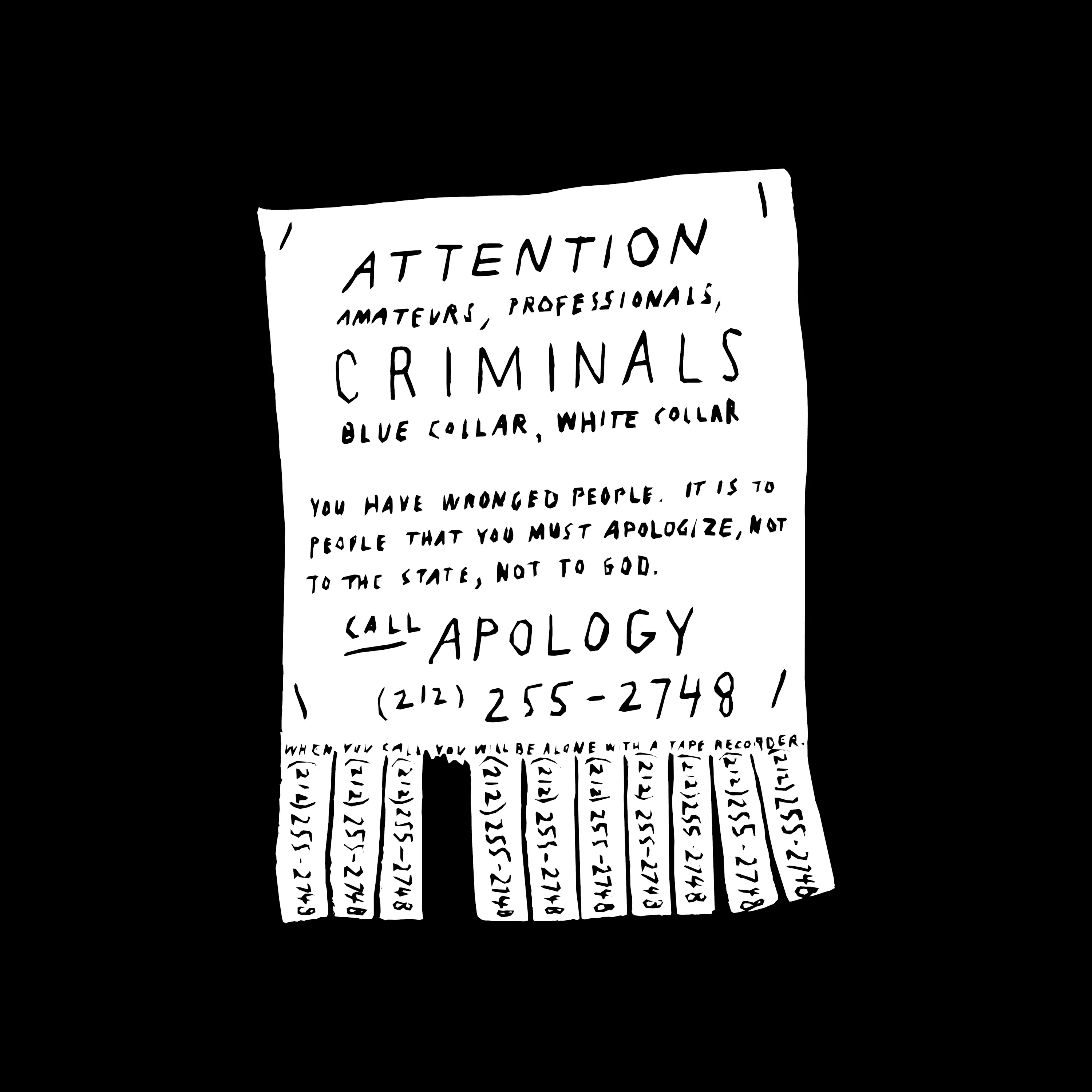
Criminal
Mr. Apology
00:51:11
In 1980, posters appeared in subway stations and on telephone poles in New York City with a phone number to call. When you called it, you would hear a message: “This is Apology. Apology is not associated with the police or any other organization but rather is a way for you to tell people what you have done wrong and how you feel about it.”
Loading summary
Transcript101 lines
- [00:01]
Phoebe Judge
Support for Criminal Comes from Squarespace if you're a business owner, you know that it matters how you present your business online. Squarespace has the tools you need to customize your website and advertise all the kinds of services you provide. Plus, you can choose the colors and fonts you like. Go to squarespace.com criminal for a free trial. When you're ready to launch, use the offer code CRIMINAL to save 10% off your first purchase of a website or domain. Support for criminal comes from BetterHelp. Whether you're working through something or just need an outside perspective to help you make sense of things, consider BetterHelp. More than 6 million people have used BetterHelp globally. BetterHelp has an average therapy session rating of 4.9 out of 5 based on over 1.7 million client reviews. See the reviews, see what stands out and see if BetterHelp is right for you. You can visit betterhelp.com criminal that's betterhelp.com criminal hi, it's Phoebe. This month we'll be sharing some of our very favorite episodes from the past 12 years of making Criminal. I remember when I first heard the tape from the one you're about to hear. I thought, oh my God. It's thanks to your support that we've been able to make episodes like these. And the very best way to support our work is becoming a Criminal plus member on Patreon. We've set a big goal of getting a thousand more members by the end of September so that we can keep making episodes. We're excited to share and try new things like the conversations with writers and reporters we've started releasing on Tuesdays. Look out for one about a criminal trial involving a volcano. Next week when you join Criminal plus, you can listen to all of our episodes without any ads, plus bonus episodes with me and Criminal co creator Lauren Spohr and we post behind the scenes material on Patreon all the time. If you join today, you'll see a post with some of the voicemail recordings we couldn't fit in the episode you're about to hear. Join us@patreon.com criminal now. Here it is, one of our very favorites from 2024. Mr. Apology.
- [02:20]
Apology Callers
This is Apology. Apology is not associated with the police or any other organization, but rather is a way for you to tell people what you have done wrong and how you feel about it. All statements received by Apology will be played back to the public, so please do not identify yourself. Talk for as long as you want. Thank you.
- [02:43]
Marissa Bridge
My first impression was that he was good looking and tall. I'm very tall. And in my mind I always had my mother's admonition to find a tall husband. And so I liked the fact that he was tall. And he asked me questions about myself. And that was something that a lot of men didn't do. I mean, it was more like the time of quick hookups. And he really wasn't like that.
- [03:12]
Phoebe Judge
In 1980, Marissa Bridge met her future husband, Alan Bridge at a bar in New York. Marissa says they were both artists and got along right away. And they ended up talking for hours about everything, including their work.
- [03:27]
Marissa Bridge
He mentioned something about an answering machine. And I didn't know anybody that had an answering machine. It was new technology back then. So I really. And I didn't really care that much. I was into him. And I actually went home with him that night. And we drove on these bumpy streets in lower Manhattan. And he took me to this loft on 28th Street. And I'd never been in a space like that. And I really didn't see too much of anything. It was late. It was probably 2 or 3 in the morning. Everything was dark. But I remember a red light that was blinking on this little object which was the answering machine. I found out later.
- [04:12]
Phoebe Judge
Did he check the messages?
- [04:14]
Marissa Bridge
He did. He did, yes. But he didn't really explain himself too much. And it wasn't till probably a week or two later that he played the tapes for me. And then I really got what he was doing and I was really blown away.
- [04:32]
Phoebe Judge
I'm Phoebe Judge. This is criminal. So what happened the week later when you. When you finally heard the messages?
- [04:47]
Marissa Bridge
Well, I was over at his apartment for dinner and he said, I want to play you some calls that came in. And I said, okay, great. And all the lights, he turned all the lights off. It was after dinner. And he put the answering machine on. And he had these giant speakers that were like 3ft high by like 2ft wide. And the first one that I heard was a teenage runaway and how she ran away from home and she was living on the streets of New York and she felt that she maybe had made a mistake. She felt very lonely.
- [05:23]
Apology Line Callers
Hi. Um, I'm. I'm a runaway. And all I want to say is that I'm kind of sorry that I left. See, I'm 15, and I saw your number in the newspaper. When I saw it, I had a call because it's like. I mean, you walk around on the street all day long just looking for someone who just might say, hey, want a Place to go, you come with me, they give you food and everything. That's all I want. I guess I take up too much time on the tape, but I just gotta talk.
- [06:17]
Marissa Bridge
And that struck me so deeply because back then, this was 1980, there was no way to hear anything like that unless you were a priest in a confessional. I mean, there was no computers, there were no cell phones. Answering machines which could record a voice were very new. So it was extraordinary to hear such a someone's inner thoughts. And it just blew me away that he had somehow set up a system where this young woman felt free enough to speak that personally about her life and her situation.
- [06:59]
Phoebe Judge
Allen had printed 1500 posters with the phone number.
- [07:03]
Marissa Bridge
Alan put the phone number out on telephone poles, in subway stations, wherever he could in New York City, and invited people to call and apologize. The poster said, attention criminals. Blue collar, white collar. It is the people you must apologize to. Not to the state, not to God. Get your misdeeds off your chest. Call, apology.
- [07:29]
Phoebe Judge
The poster Alan printed also warned callers that their calls would be recorded and that they shouldn't identify themselves and should call from a payphone so they couldn't be traced. And there was text in italics that read, apology is a private experiment. It is not associated in any way with any police, governmental, religious or other organization. Just above a row of tear off numbers, it said, when you call, you will be alone with a tape recorder.
- [08:04]
Marissa Bridge
And that that poster struck people. And right away, the first night that he put posters up, he got calls. And it was a service that he gave to people because he himself had been a petty criminal. He started shoplifting, I believe, when he was in art school, and he started shoplifting art books and art supplies. And he kept it up through college and through his 20s and into his
- [08:39]
Phoebe Judge
early 30s when he decided to stop. He made a mechanical sculpture that he called crime time. The sculpture was a box that you could stick your hand into to try to steal a marble. To do it, you had to spin a wheel of chance. Depending on the results of the spin, you, you'd either get away with the crime and get to remove a marble from the box, or you would get caught and your hand would get stuck.
- [09:09]
Apology Callers
Hi, I'd like to apologize. When I used to be a mailman, I had a job. It was between semesters in college, and it was delivered by the mail. And nobody really monitored what we did or anything. And a lot of times I would just throw it away, just toss out the people's mail, not really caring whether or not they got their letters because I just hated the job so much. Now I don't know if any people ever complained or whatever happened, because I didn't even. It was a summer job to me, you know. But I'd just like to apologize to people if they didn't get mail, like if they had important letters or bills or. Oh my God. And it just, you know, I feel bad about having done it, but when I did it, I didn't even realize, you know, how it could have a bad effect on somebody feels that not gotten their mail. So I'm just apologizing for that.
- [10:09]
Apology Line Callers
This is Joyce Savage. And I'm sorry for when I went over to visit my grandmother. I went over to a friend's house and he had a cute little dog and we were playing with it and all of a sudden he started to attack me. And so I had to keep hitting it with a stick. And I'm sorry I did that. Bye.
- [10:50]
Phoebe Judge
When you would go over there in the early days, could you even, could you get away from the phone ringing or what? What did it look like?
- [10:58]
Marissa Bridge
Well, the, the loft was a big open space and Alan's bedroom was separated from the living room only by a, like a six foot bookcase. So it didn't even go to the ceiling. So it was pretty, it was open. And the apology line sat on that bookcase. And Allen had cut out a hole on the back of the bookcase where his bed was. And he made a louvered door so he could open the louver door anytime, day or night when he was in bed and attend to the apology line answering machine. So the, the machine was there, it was in the living room, it was in the bedroom and it was on all the time. It was on 24 7, so there was no getting away from it. And we would be sleeping in his bed and if a call came in in the middle of the night, he'd have the volume up and we would hear it come in. And sometimes it was really annoying and sometimes it was like, wait a minute, this person is like incredible. Like, what are they talking about? And we'd wake up and listen, I
- [12:03]
Apology Callers
just want to apologize to all those people I was up there with in the Green Correctional Facility, Cooksackie, New York, up in the Catskills. Everybody wanted me to help them work on their case while I was an inmate in the state prison law library. But I was too busy working on my own. And I got my ass out and they're still in there. Hello, I'd like to apologize to the bank manager and to the janitor or cleaning man at the Manufacturers Hanover Trust branch at Rockefeller Center. I peed, urinated in the trash can at the little room where they have the automatic teller and 24 hour machine because I had to go back. And it's very hard to find, you know, a public restroom in New York City that's clean or at least halfway safe. So I used my little bank card and got into the room and I peed in the trash can. You know, I'm really sorry I did that, but I had to. I really did. Thank you.
- [13:19]
Phoebe Judge
Did you ever call the line?
- [13:21]
Marissa Bridge
Um, no, I. Well, I called once or twice, kind of in the early days of our relationship. I would call from my apartment in upper Manhattan and I would leave kind of like a flirty, sexy message for him.
- [13:35]
Phoebe Judge
Was it kind of like your way to reach out to him to say, this is all very hard and heavy stuff? A lot of the times you're hearing on this line, here I am, you know?
- [13:45]
Marissa Bridge
Yes. But I also think it was, hey, don't forget about me. You know, I'm up here.
- [13:50]
Apology Line Callers
You know, I.
- [13:54]
Marissa Bridge
For whatever reason, I was a very determined young woman, and I decided that Allen was it for me. I was hooked. So I. I wanted to make sure I was in the running. But other than that, I didn't call the line.
- [14:11]
Phoebe Judge
There were all kinds of calls. Some were scary. Once someone called in to say they were going to find and kill Allen. Allen had been careful about keeping his own identity a secret, only calling himself Mr. Apology. But Marissa says he went out and bought a shotgun to keep beside his bed. After that. Some of the calls were really minor, like the person who called in to apologize for stealing toilet paper at work. Some were shocking. One man called and said, quote, I don't know how to say this, but I should apologize for killing someone. I haven't been able to live with myself since.
- [14:55]
Apology Callers
Well,
- [14:58]
Apology Line Callers
for once, I think this is really original idea. My name's Mary. I'm not gonna say my last name. I steal from stores all the time. I really feel guilty. I can't stop. I'm like what you call a collective here. I don't know what to do, but, like, I can't tell my mother. I've been caught before, too, and I just caught so many times. I've been to court and everything, and I can't stop.
- [15:24]
Apology Callers
I don't know how I'm gonna clean up.
- [15:28]
Apology Line Callers
Well, talking to your tape recorder, I don't know, makes me feel a little bit better.
- [15:33]
Apology Callers
I embezzled $400,000 from a bank over a period of six years. I feel very guilty about it, but I never got caught. I did send IRS some money after I felt very guilty to cover certain tax expenses. If I have a chance to do it again, I probably would repeat it since I have been able to live like a king.
- [16:04]
Marissa Bridge
One man called and said that he accidentally killed his baby brother when he was a child, that he was fooling around with a plastic bag, a garment bag, and put it over the baby's head and the baby turned blue and died. And his parents always thought it was crib death, but it wasn't something that he was looking to confess to the authorities. It's more of something that was just so morally wrong. It was a heavy burden that he was carrying for decades. I think a lot of crimes that are committed are by all of us. We don't think of it as a crime necessarily. It is maybe illegal, but it's something that more bothers us in our souls that we have to get off our chests and confess to.
- [16:59]
Phoebe Judge
We'll be right back to listen without ads Join Criminal plus. Thanks to Squarespace for their support Making a website can be intimidating, especially because it's often the first thing people see about your business. If you want to build a website that makes a great first impression on people, you don't need years of coding experience. You just need Squarespace. It's the all in one website platform made to help you stand out online. Squarespace has the tools you need to make your website look exactly how you want it to look, sell your services, and get paid no matter what business you're in. You can choose from a library of templates designed by professionals, or if you don't want to scroll through all the template options. Squarespace's blueprint AI can build a website for you in just a couple of minutes based on a few prompts. It'll pull from different templates. To create the website you need, go to squarespace.com criminal for a free trial. When you're ready to launch, use the offer code CRIMINAL to save 10% off your first purchase of a website or domain. Support for Criminal comes from Ritual. If you're looking for a daily multivitamin, Ritual's Essential Multivitamin for Women 18 and up can be just what you need. Their capsules contain nine key nutrients, and they're designed to be gentle on the stomach so you can take them with or without food. Ritual's products are vegan, non gmo, project verified gluten and major Allergen free and made traceable. That means you can go to their website to learn where the ingredients come from and why they use them. I take a multivitamin every morning because I like knowing that all my key nutrients are covered. That's one less thing to worry about on busy days. Instead of striving for perfect health, aim for supporting foundational health. Save 25% on your first month at ritual.com criminal that's ritual.com criminal for 25% off your first month. These statements have not been evaluated by the Food and Drug Administration. This product is not intended to diagnose, treat, cure or prevent any disease. A reporter named Stephen Sabin heard about the apology line and called to get in touch with Alan Bridge. He wanted to write a story about it and Allen agreed. While Stephen Sabin was working on the story, someone called into the line and claimed he'd picked up gay men and brought them to his apartment to rob them. And in his message he said he had killed someone.
- [19:47]
Marissa Bridge
So Alan, of course, told Stephen Saban about it and Stephen said, well, you have to tell the police. And Allen said, well, you know, I just started this line and I, I told the callers that I'm not going to go to the police, so this is a safe space where they can talk about things. But Stephen went to the police and told the detectives and a detective called Alan and Alan didn't want to give him the information. But Allen had planned on doing an interview on npr. So he decided that he would play that call on the show so that he wouldn't be guilty of giving the tape to the police. But the police could hear it.
- [20:31]
Phoebe Judge
Allen never found out whether any arrests were made, but he did continue to cooperate with the police when certain kinds of calls came in.
- [20:39]
Marissa Bridge
I think he had a healthy understanding of what was what needed to be kept inside the apology line community and what actually needed to go to the police.
- [20:49]
Phoebe Judge
Did he struggle with that?
- [20:51]
Marissa Bridge
He did. He did. He did because Allen got an extraordinary response from people. He got, he got people to talk about things that, that still to this day I don't think I've ever heard the sincerity with which he got people to talk about themselves on any other, any other kind of system. And I think he did that because he provided them a safe space and a sympathetic ear. Someone who had been through things and who had done things and wasn't going to judge them. It was a very non judgmental space. And I think he struggled anytime he had to kind of break that trust with people.
- [21:33]
Phoebe Judge
He once Told a reporter, quote, my job is just to face up to the fact that criminals are in fact human beings. Part of Allen's idea for the apology line was that he would find a way to not just keep the messages on his machine, but, but to make them public. He wrote to different museums around New York asking if he could come play the tapes. And the new museum took him up on it.
- [22:01]
Marissa Bridge
So he asked the telephone company to donate four phone booths, which they did, and they were delivered to the new museum lobby. And he took out the metal box that contained the guts of the phone and he replaced that with an answering machine, with tapes that were just on a loop. So the tapes were constantly running. And you could pick up the receiver inside those phone booths and hear the tapes going. People just couldn't believe it. There were lines to get into the phone booths.
- [22:35]
Phoebe Judge
The New York Times published an article about the show and identified Allen only as Mr. Apology. Allen had worn a disguise to the opening and they printed a photograph of the phone booths. Allen's show had been a hit, this was in 1981.
- [22:53]
Marissa Bridge
But he was a little disappointed that it was more of a shishi art crowd. And he was upset that probably not a lot of the actual callers were able to hear the tapes. So he kept looking for another way to bring the tapes to the callers themselves.
- [23:12]
Phoebe Judge
And then he found it. By 1983, a few years after Allen started the apology line, the technology for answering machines had improved enough that the outgoing message could be longer than just a short greeting. Allen had been using this outgoing message to explain what the line was to callers, but now it could be almost 10 minutes long. So Alan decided that he would pick a selection of the most interesting messages, put them together into a 10 minute program, and play that on the outgoing message so that anyone who called the apology line number could hear other people's apologies.
- [23:54]
Marissa Bridge
And that's really when the community started to develop. That was the first virtual community, because that's when someone could leave a message and two weeks later they, they could hear it on the line. Other people could hear it and respond to it. And two weeks later you would hear that person's response and then you could respond. So there was a time lag of two weeks. But that's really when the line became self sufficient. And Alan decided, okay, I'm doing this, I'm doing this. I'm going to create this world for myself and for the community and whoever wants it, anyone in the world can call and participate. And that's what he did.
- [24:40]
Phoebe Judge
Marissa moved in. She remembers that a lot of times when she came home, they'd listen to a call that came in that day together and then have dinner and talk about it. Did you think that it was affecting him hearing all of these secrets?
- [24:57]
Marissa Bridge
Yes, definitely. There's a point sometime in 1983 where I had made notes. I made notes through my whole time with Alan, but I had put. Alan's voice has changed. He sounds so much more serious and somber. So it did start to weigh on him, and he did start to take it a lot more seriously.
- [25:23]
Phoebe Judge
Marissa and Alan got married the next year. And she says that not long after, she asked Allen to move the answering machine apology line equipment out of the main part of the loft. Allen made a little office for himself, or as Marissa put it, a control room. And it was around this time they started noticing calls coming in from someone who went by Richie.
- [25:49]
Marissa Bridge
And Richie was just like the bane of my existence because he became the focus of Alan's life. Richie called and confessed to be a serial killer, that he would pick up men, mostly people that he met at Times Square, you know, people that he felt were homeless or that no one would miss, and that he would take them home and torture them for days or weeks, and then he would kill them, and then he would dispose of their bodies. And he called for a couple of years and would go into great detail about what he did. And over those couple of first couple of years, Alan decided that he wanted to either stop Richie from doing what he was doing or catch him. And Alan became obsessed with Richie. And they had long conversations over the apology line. And then at some point, Allen spoke to a detective in the New York City Police Department, and they devised a plan on how to deal with Richie together. And the plan was that Allen would ask Richie to have offline conversations, like, in other words, not on the apology phone line, but on Alan's personal phone line. And Richie agreed. It took a while, and they had these hours long conversations, and they got Richie's home address and they got all his information. And then the police started surveilling Richie and, you know, watching him, and they found out a lot of information about him. But to cut a very long six year story short, they had no proof that he had done any of this. And at one point, this is something I didn't find out until much, much later. Ray Pierce, the detective, had actually called Richie in for an interview. Alan never told me that, and he must have known. And they brought Richie in for questioning, and Ray said that he didn't think that Richie was for real. He thought he was a serious fantasist is what he called it.
- [28:13]
Phoebe Judge
Eventually, Richie stopped calling and talking about murder, which was a relief to Marissa and a relief to a lot of the callers who had heard some of Richie's messages.
- [28:24]
Marissa Bridge
Some callers were very into Richie, but other callers decided, hey, no, this guy's an asshole. He says he's killing people. I don't care whether it's true or not, I don't want to hear about him. So it caused a lot of problems in our life and in the life of the apology line.
- [28:42]
Phoebe Judge
And then the line changed again. We'll be right back. Support for Criminal Comes from Cachava we all have flavors that transport us back to our childhoods, like cinnamon. Maybe it reminds you of that breakfast or dessert you grew up loving. If that's the case, you might enjoy Cachava's newest flavor, Cinnamon French Toast. Cachava provides nutrition to fuel your day wherever it takes you. It's plant based protein that actually tastes good with no artificial flavors, colors or sweeteners. Just two scoops provides lots of protein, fiber, greens and much more. It's all the nutrition your body craves in one simple shake. I've tried Cachava myself and I like that there are so many flavors to choose from. Some mornings I might be in the mood for coffee or matcha and other times I prefer flavors that remind me of some of my favorite desserts like vanilla. Treat yourself to a childhood favorite with Cachava. Go to cachava.com and use code criminal for 15% off your first order. That's Kachava. K A C H A V A dot com code criminal support for Criminal comes from Wayfair. If you want to create a home you love without overspending, you might want to try Wayfair. Wayfair Verified is your shortcut to durable pieces that fit your style and budget. Every item is hand vetted by product specialists. They test things like quality of materials, functionality, and even how long it takes to build. You can use real customer photos and feedback to help you find just what you're looking for, and Wayfair Rewards members get 5% back every day, helping you get even more value from your Wayfair purchases. I've been in need of a new blender and Wayfair offered lots of different options. The customer reviews made it easy for me to pick the one that was right for me and my kitchen. Join Wayfair Rewards today to get 5% back on every purchase and start saving on your next home Upgrade. Head to Wayfair.com to shop all things home. That's W-A-Y-F-A-I-R.com Wayfair Every style, every home.
- [31:00]
Gladys Godiva
I first called the apology line because I had a temp job in Manhattan working for an office products wholesaler and I was didn't really have anything to do. I literally had about maybe an hour or two's worth of work and then I just sat at my desk for the rest of the day and I would obsessively listen to the apology line. So I would sometimes listen on the speakerphone and if anyone came by I would shut it off and then pick the handset up and listen that way. I didn't want them to see that I was reading at my desk or doing something else beside work because I was afraid that they would actually give me work to do if they knew I wasn't doing anything and I didn't really want to do any work.
- [31:56]
Phoebe Judge
This is one of the apology line callers who prefers to remain anonymous even now. She started listening in the early 90s and when she finally decided to call in and and leave a message, she identified herself as Gladys Godiva.
- [32:11]
Gladys Godiva
Gladys is actually my middle name. I've always been kind of embarrassed about it because it was so old fashioned and nerdy and Godiva was a name I chose for myself because of Lady Godiva and she had been known to ride on a horse in the nude and I felt like I was revealing myself. I'm a little bit of an introvert. I'm not really comfortable talking to people, which is one of the reasons I was calling the apology line and not really talking to friends or making art that I would perform in front of people or anything like that before the apology line. Graffiti is something I used to do all the time in the ladies room or places like that. I would scratch things or sometimes write things with a Sharpie and this was kind of an evolution of that for me personally.
- [33:11]
Apology Line Callers
Hi, I'd like to apologize to myself for spending way too much time and effort worrying about men, the relationships and just wasting myself. I'm 30, I'll be 30 years old this year and I don't know what I, I, I don't have a, I don't know what I want to do when I grow up. I don't know what I expect these men to do, but I tonight I just have to stop wasting my life like this. Hi, I'd like to respond to the 30 year old or almost 30 year old who doesn't want know what she wants to do with her life. I hear you too. I was there. I turned 30 in September and I went through a lot of the same things that you did. This can be something that's going to take a while. And just to be patient with yourself, just try to find a couple of friends that you trust and spend time with them, probably other women for a while. You know, we get so involved with getting involved with these men that we forget all about ourselves and that's why we end up not knowing who we are. And I just wanted to wish you luck and lots of love. And I know that there's something out there that's going to make you very happy. Thank you.
- [35:10]
Gladys Godiva
It was hard to reveal myself in that way, but I was gratified to see that I wasn't the only person who was going through this kind of thing because I did feel very alone at the time.
- [35:23]
Phoebe Judge
Here's part of a message she left with a list of things she wanted to say to her ex boyfriends but never did.
- [35:29]
Apology Line Callers
When you went on vacation, I made a pass at your friend's. I don't trust you around for the win. Although I didn't exactly lie when I told you I loved you, I knew immediately after I'd said it that it wasn't true. I asked you questions about your relationships with ex girlfriends so that I can determine how much you love them and then rank myself accordingly.
- [35:57]
Gladys Godiva
After I would leave a message, I would feel some release. I felt like I was leaving a part of myself behind. A part of myself that I didn't want anymore. I think everyone had their own reasons for calling into the line. And they could be as honest as they wanted to be. They could reveal dark things about themselves without having to deal with the judgment of other people.
- [36:31]
Phoebe Judge
Do you think it's still an apology if you don't have to worry about that aspect of it?
- [36:37]
Gladys Godiva
I think it's a better apology if you don't have to deal with the judgment of other people because you can be more honest with yourself. You can really examine why you committed those acts without making excuses. Like you would maybe if you apologized to a person and you're trying to. You're trying to seem maybe better than you actually are. I think people can be overwhelmed by their own guilt and apologies are important because they allow you to move on in your life.
- [37:21]
Phoebe Judge
Around the time she started listening, Allen got the idea to start an apology line magazine with transcriptions of the most interesting messages. The apology Line had been around for almost 15 years. And the idea was that maybe he could sell some ads in the magazine to support the line. Alan was also interested in exploring what it might mean to bring a version of the apology line online. This was the mid-90s.
- [37:50]
Anonymous Apology Line Listener
We're talking about an era where the Internet wasn't really even a thing yet.
- [37:57]
Phoebe Judge
This is another caller who also prefers to remain anonymous. He was the one who told Allen to look into Internet bulletin boards. He said he would help as much as he could when he wasn't at school. He was about 15 years old when he started calling.
- [38:13]
Anonymous Apology Line Listener
There was one phone in the house. And so to do this because of where the phone was situated also meant that it wasn't necessarily easy to have like the privacy to sit there and listen to these messages for long periods of time. And like, for example, I was, you know, babysitting in those days. So then, you know, when we would put the kids to bed that we were babysitting, you know, I would be calling at that point.
- [38:41]
Phoebe Judge
Would you stretch the phone line and kind of take it into your room?
- [38:45]
Anonymous Apology Line Listener
Yeah. So because the phone was in that house, was in the kitchen. Right. Rather than sit in the kitchen, I would stretch it, but it couldn't actually reach my bedroom. So I used to usually do it in my parents bedroom. You're sitting there with a phone pressed against your ear and there's a sense that these people are talking directly to you, but then you're dealing with, you know, the reality of these are people that you will never meet, you'll never talk to. But I think that I just hit a point where I felt like I needed to say something to let them know that, you know, this kid from Brooklyn was hearing them and was, you know, wanting them to be okay. I recognized that as I got older, older, the opportunity for that kind of thing is they're few and far between as you get older. I mean, you have significant others and close friends. There are times when there's subject matter that you have a difficult time even talking about with those people.
- [39:56]
Apology Callers
Right.
- [39:57]
Anonymous Apology Line Listener
And I think that for the callers of the apology line that Alan created this forum that enabled, enabled them to have a safe space to speak about topics that elsewhere would not provide that level of safety.
- [40:15]
Phoebe Judge
One frequent caller was a man who called himself Ricky. He started calling in the early 90s.
- [40:21]
Apology Callers
I'm a 31 year old male who's having a major problem dealing with his sexuality. For years I fought it. I didn't want it to be this way. Um, I've never done anything really. I've dated women, I've made love to women. But the last couple years I feel big desire to go towards men. As raised Catholic, I'm hoping somebody that calls in can maybe give me some and put back what I should do. And speaking in a hushed tone because I'm at work now, I really feel like I'm very alone. I can't talk to nobody about this. And I talk to God about this. I hope he understands. Hi, this is for the 30 year old gentleman who is just coming to terms with his and is ambivalent and isn't sure what to do. All I can say to you from somebody who's been through similar situation. I'm slightly older than you, I'm 38, raised intensely Catholic with intense guilt feelings. You know, a lot of it simply works itself out over time. I think for you, sir, at this point the best thing for you to do is just take it a day at a time. I say you've made the first step. I just think that you're going to just learn to accept these feelings. There is no shame to it. You know, you're not doing something harmful. You're not wishing harm on anybody, including yourself. It's love, I mean, and it's, and it's, it's, it's wonderful.
- [42:19]
Phoebe Judge
Another man called in to say that he'd also gone through what Ricky was going through. And he wanted him to know that there were so many people like him. Ricky heard both messages on the outgoing program that Alan put together and he called back.
- [42:35]
Apology Callers
You both made me feel a hell of a lot better about myself. You really did.
- [42:41]
Phoebe Judge
After that message, other callers started leaving messages with advice about places he might go to meet people, groups he could join. And if you listen to the messages over time, you can tell that he's really doing it. He's going to meetings and clubs. In one of the later messages, he shares that he finally worked up the courage to go on a date.
- [43:05]
Apology Callers
And I have a lot of you to thank. And I don't feel guilty about it like I thought I would. It just felt right. That's it. Bye
- [43:19]
Phoebe Judge
bye. 1995. The apology line was getting around 100 calls a day. Allen had expanded it to include three lines. But then one day it stopped.
- [43:33]
Marissa Bridge
We had a boat that we lived on for short periods of time in Hampton Bays, New York. That's in Long Island. And we would go out there for weekends and stay on the boat. And Alan would go scuba diving in the Shinnecock Inlet, which was a short drive away. And that particular day he went scuba diving and I was on the boat. I didn't go to watch him. Sometimes I did, but I just didn't feel like it that day. So I was on the boat and he typically was gone for about two hours. And when three hours went by and four hours went by and he never came home, I started to get worried. But I didn't have a car because we only had one car. And he had driven there. And the man who ran the boatyard wasn't home. So I had no way to get over there. So I called a taxi. And that took about 45 minutes to come. And by the time I got over there, it was probably like 6 o' clock or something, but it was August, so it was still light out. And I saw our car parked in the parking lot of this restaurant. And I said, oh, shit, so he's still here. And I was walking over to the car, and this man came up to me and he said, who are you? And I said, who are you? And he said, who are you? And I didn't answer him. And he said, I'm Detective Booker from the Southampton Police Department. Who are you? And I said, well, this is my car and I'm here looking for my husband. And then I don't know if what he said next was first or if I all of a sudden heard the sound of helicopters over my head, but he told me that this couple had seen someone get hit by a jet ski and they were looking for him. And I knew Alan was dead at that point. The strange thing is that no one ever. None of us can understand. The group of people that were close with Alan at that time will understand. But Alan turned the phone line off that weekend when we left. And I didn't know about that until I got back. He'd never turned the line off in 15 years. But it was off when I got back to the apartment. And I didn't know what to do. I wanted to let the callers know that he had died. I mean, this was a guy who was available to them 24 7. And they must have been all. They were all freaking out, But I didn't know how to run the line or anything. I knew nothing.
- [46:16]
Phoebe Judge
Marissa asked the high schooler who had been helping Allen try to bring the apology line to the Internet if he could come over and try to help her turn on the line so she could put out a message letting all the callers know what had happened.
- [46:30]
Marissa Bridge
So he. I think he had a week off of before he had to start back at school. And he came to the loft and spent a week trying. Trying to figure out how to turn the line on.
- [46:40]
Phoebe Judge
He told us he had no idea what he was doing.
- [46:44]
Anonymous Apology Line Listener
Ellen hadn't actually showed me anything about how the apology line worked. I just remembered the day that I went to their house and saying, well, I have to do something here to sort of help out. I didn't want to let his wife down.
- [47:05]
Marissa Bridge
Miraculously, this young kid was able to get the line running. And then we were able to put a message out telling people that Alan had died and that we would keep them informed of services to come. And then people started leaving messages of condolence on the line.
- [47:25]
Phoebe Judge
There was a funeral for family and friends, and Marissa also arranged a special service for all of the apology line callers who wanted to come. It was at Strawberry Fields in Central Park. Very few people knew who Allen really was. They just knew him as Mr. A or Mr. Apology. But at the service, Marissa brought his photograph so they could see what he looked like for the first time.
- [47:53]
Marissa Bridge
I didn't know what I would encounter, but. Sorry, this makes me cry. There was so much love. There were people, so many people there. And some of them were in the shadows because Strawberry Fields is like a. It's not a huge area. There's a mosaic that says imagine. And then there's trees around it. And some people were in the trees. And some people came up to me and. And I saw the community. I saw the people. It was. I felt bad that Alan couldn't see it and couldn't meet them, because this was something he created that he'd done with his life. And these people were there for him. And it was unbelievable.
- [48:40]
Phoebe Judge
After Alan died, Marissa had the chance to meet Ricky, the man who had called in and said he was afraid to come out.
- [48:47]
Marissa Bridge
He was really just so. So kind to me. So kind to me. And Alan really changed his life. The apology line. And not just Alan, the apology line. And the callers changed his life because he came out and he started his new life as a gay man. And it was, you know, I mean, how many times do you get to meet someone that's life has changed for the better because of your husband's artwork? You know, it's. It's really cool. It was amazing.
- [49:18]
Gladys Godiva
The apology line was very much of its time. I don't think anything like that could exist now. Gladys Godiva, when you called and listened to the line, because it was on the phone, it was almost very confessional. People were sometimes whispering or crying, and it was very intimate. But I don't think that anything like that could exist now.
- [49:48]
Phoebe Judge
Why don't you think Alan got sick of it? You ever just think to himself, I did. I got it. It's over?
- [49:56]
Marissa Bridge
I think when you have a door open to all of humanity, you can't close it. You can't close it. I mean, he talked in one NPR interview that he did, he spoke about listening to the line, like looking at a sunset, how you never get tired of the sunset day after day. It's always different. It's always amazing. And he felt like every call was like that, that he never got tired of it because it was something new every day, a new person or something new that along caller was talking about. He just thought it was that it was everything.
- [50:42]
Apology Callers
This is apology. Apology is not associated with the police or any other organization, but rather is a way for you to tell people what you have done wrong and how you feel about it. All statements received by apology will be played back to the public. So please do not identify yourself. Talk for as long as you want. Thank you.
- [51:14]
Phoebe Judge
If you'd like to hear more stories about people deciding to pick up the phone, we've just released an episode on our other show, this is Love, all about Hotlines. You can find it@thisislovepodcast.com or anywhere you listen to podcasts. Criminal is created by Lauren Spore and me. Nadia Wilson is our senior producer. Katie Bishop is our supervising producer. Our producers are Susanna Roberson, Jackie Sajiko, Lily Clark and Lena Sillison. Our show is mixed and engineered by Veronica Simonetti. Julian Alexander makes original illustrations for each episode of Criminal. You can see them@thisiscriminal.com and you can sign up for our newsletter@thisiscriminal.com Newsletter we hope you'll consider supporting our work by joining our membership program Criminal. Plus, you can listen to Criminal, this Is Love and Phoebe reads a mystery without any ads. Plus you'll get bonus episodes. These are special episodes with me and Criminal co creator Lauren Spohr talking about everything from how we make our episodes to the crime stories that caught our attention that week to to things we've been enjoying lately. To learn more and see a preview of some of the apology line voicemail recordings we couldn't fit into this episode, go to patreon.com criminal we're on Facebook at thisiscriminal and Instagram and TikTok at CriminalPodcast. We're also on YouTube@YouTube.com CriminalPodcast Criminal is part of the Vox Media Podcast Network. Discover more great shows@podcast.voxmedia.com I'm Phoebe Judge, this is Criminal.
- [53:01]
Marissa Bridge
Hey, it's Ryan Reynolds here from Mint Mobile.
- [53:02]
Anonymous Apology Line Listener
Now I was looking for fun ways
- [53:04]
Marissa Bridge
to tell you that Mint's offer of
- [53:06]
Anonymous Apology Line Listener
unlimited Premium Wireless for $15 a month is back. So I thought it would be fun
- [53:11]
Phoebe Judge
if we made $15 bills, but it turns out that's very illegal.
- [53:17]
Anonymous Apology Line Listener
So there goes my big idea for the commercial.
- [53:19]
Marissa Bridge
Give it a try@mintmobile.com switch upfront payment
- [53:23]
Phoebe Judge
of $45 for three months, $90 for six months or $180 for a 12 month plan required $15 per month equivalent taxes and fees Extra initial plan term only greater than 50 gigabytes. Me slow when network is busy. See Terms Are you a pet owner? Every six seconds, a pet owner in the US gets hit with a vet bill over $1,000. Always an unwelcome surprise. That's where Fetch comes in. Fetch is the most complete pet insurance for dogs and cats. According to consumeradvocate.org, you get paid back up to 90% of vet bills at any vet in the US and Canada, with claims paid back in as little as two days. Go to fetchpet.com save right now for your free quote. That's fetchpet.com save.