Podcast
Crisis What Crisis with Andy Coulson
Hosted by Andy Coulson · EN
Hard-earned lessons from people who've faced the worst and come back stronger.
Hosted by Andy Coulson. Follow for weekly insights into the art of the rebuild.
Crisis What Crisis? is powered by Kingsley Napley — the lawyers you want in your corner when the pressure is on. Visit kingsleynapley.co.uk
39episodes
Episodes
Newest firstAll episodes
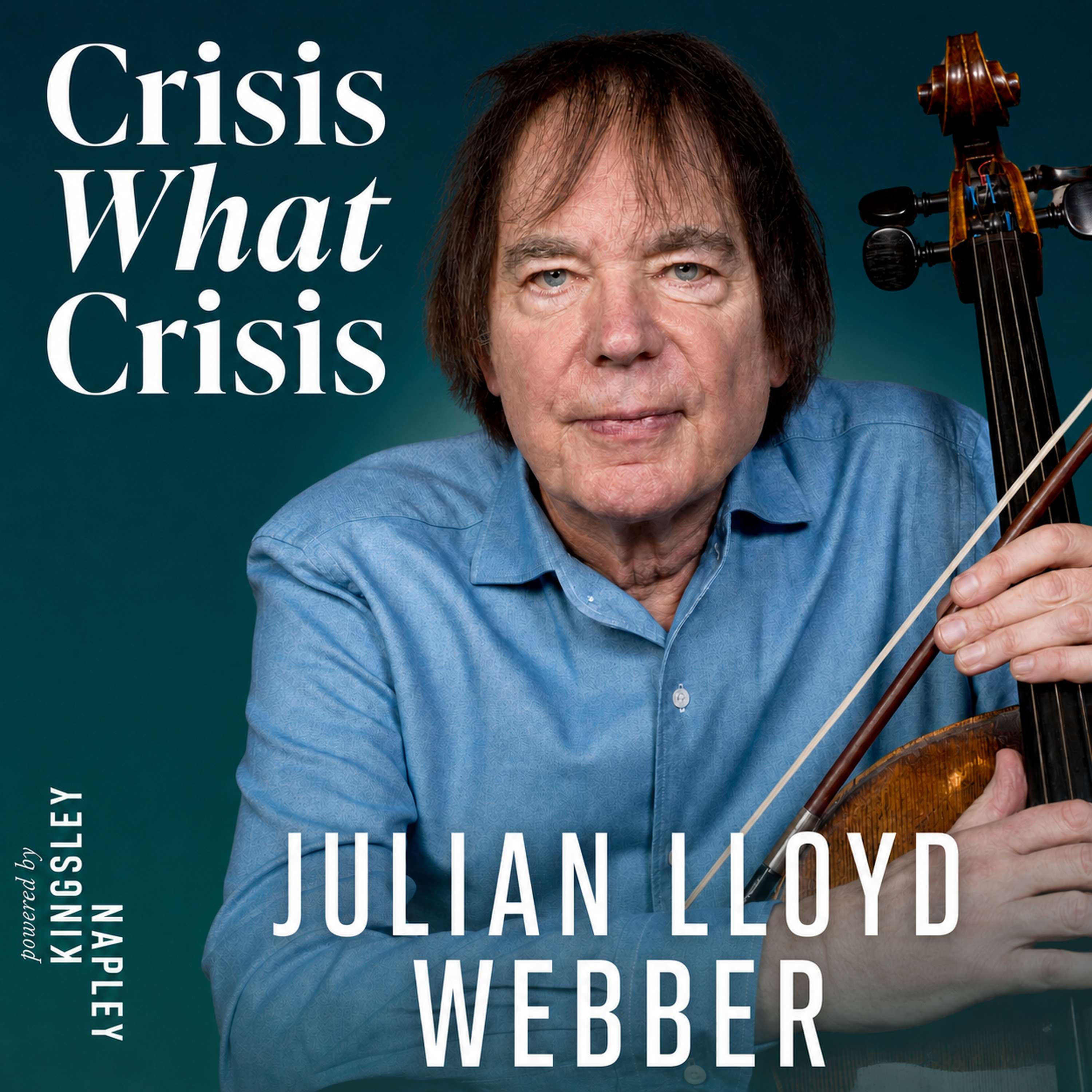
JULIAN LLOYD WEBBER: The Day the Music Stopped
1w ago00:53:04Tap to summarizeJulian Lloyd Webber is undoubtedly one of the country's greatest living musicians – the man who, perhaps more than anyone of his generation, took classical music out of the concert hall and into the mainstream. But in October 2013, ten minutes into a recital in a Suffolk seaside town, the power drained from his right arm and he found he could barely draw the bow across his cello.Within six months, at 63, he was forced to retire – unemployed overnight and stripped of the thing that had defined him since he was a boy of thirteen.For half a century, the cello had been Julian's whole life. He toured the world, playing with everyone from Yehudi Menuhin to Elton John, took an Elgar recording to a Brit Award and his brother's Variations to number two in the pop charts. He was the first officially licensed busker on the London Underground and the only classical soloist at the London Olympics closing ceremony.Then, at 64, he sat the first job interview of his life and went on to lead the Royal Birmingham Conservatoire into a £57 million new home, winning it royal status along the way. On his 75th birthday – and while quietly managing a prostate cancer diagnosis – he walked back onto the Wigmore Hall stage and played again. And now, twelve years after the power drained from his arm, Julian is touring – a full run across Ireland this autumn with his cellist wife, Jiaxin.His memoir, Bows & Arrows, is out now, and this conversation is about the abuse he survived as a boy, the instrument he loved and lost, and how you rebuild an identity when the thing that made you who you are is taken away.POWERED BY KINGSLEY NAPLEYI know what it is to have the right legal support around you when facing a crisis. Kingsley Napley are the kind of lawyers I wish more people knew about – there to help you make the right decisions, protect what matters, and build real resilience when the pressure is on. This episode is powered by Kingsley Napley.Visit www.kingsleynapley.co.uk for more details.FOUR LESSONS FROM JULIANTalent and hard work aren't enough on their own – you need passion, because that's the only thing that gets you up to do it all again after a bad night.A second string to your bow can end up saving your life. When you lose the thing that defined you, throw yourself into whatever else genuinely moves you – even if it's nothing like what you did before. Find something that truly absorbs you, and the healing takes care of itself.When a setback knocks you down, picture the alternative. For Julian, the fear of ending up disappointed with his life was the fuel that kept him going.Healing is not forgetting; it's reaching the point where the trauma you carry doesn't drag you down.CHAPTERS04:01 – Growing up in a chaotic, bohemian home09:12 – The day on the Tube that took his childhood11:03 – Why some things you don't get over – and shouldn't have to15:21 – His father's warning that lit the fire17:39 – Fifty years at the top: how he kept the flame alive27:25 – The longest relationship of his life33:12 – A football bet, a number two record, and a gold disc35:01 – The night the power drained from his arm39:02 – Losing your job, your income and your identity overnight39:59 – The first job interview of his life, at 6444:22 – The daughter's remark that brought him back to the cello47:57 – Facing a cancer diagnosis51:32 – Why he refuses to slow down, even nowBUY JULIAN'S BOOKBows & Arrows – https://www.amazon.co.uk/Bows-Arrows-Julian-Lloyd-Webber/dp/1837360588SEE JULIAN LIVEJulian's Irish tour with his wife, Jiaxin – https://julianlloydwebber.com/events/FOLLOW JULIAN LLOYD WEBBERInstagram – https://www.instagram.com/julian.lloydwebber/FOLLOW CRISIS WHAT CRISIS?Instagram – www.instagram.com/crisiswhatcrisispodcastTikTok – www.tiktok.com/@crisispodThis was a Crisis What Crisis Production – Rex Fisher (producer), Ioana Barbu (studio manager), Fred Sharp (research), Johnny Seifert (audio), Jasper Cullen (video)
Transcribe →
FRANK GARDNER'S CRISIS COMPASS
2w ago00:04:58Tap to summarizeFrank Gardner has lived, by his own description, two very different lives — and found a way to carry the best of the first into the second. Twenty years on from the attack in Riyadh that nearly killed him, the BBC Security Correspondent is still reporting from the places most of us wouldn't dare go.In this bonus episode of Crisis What Crisis, Andy sits down with Frank to discuss his Crisis Compass. The four points of navigation that he turns to in order to help survive a crisis.Frank is the BBC's Security Correspondent and the author of a series of best-selling thrillers — the latest, Ballistic, is out now. If you haven't heard the full conversation yet, go back and find it in the feed. It's well worth your time.POWERED BY KINGSLEY NAPLEY:I know what it is to have the right legal support around you when facing crisis. Kingsley Napley are the kind of lawyers I wish more people knew about – there to help you make the right decisions, protect what matters and build real resilience when the pressure is on.This episode is powered by Kingsley Napley, visit www.kingsleynapley.co.uk for more details.CHAPTERS:00:53 A Person – Himself01:21 A Habit – Lifting his eyes to the horizon, the birdwatcher's discipline of really looking02:23 A Comfort – Driving. 03:40 A Piece of Advice – Grieve it, deal with it, but don't keep defining yourself by what happenedBUY FRANK'S BOOKBallistic – https://www.amazon.co.uk/gp/product/178763549X?tag=prhmarketing2552-21FOLLOW FRANK GARDNERInstagram – https://www.instagram.com/frank.gardner/?hl=enX – https://x.com/FrankRGardnerFOLLOW CRISIS WHAT CRISIS?Instagram – www.instagram.com/crisiswhatcrisispodcastTikTok – www.tiktok.com/@crisispodThis was a Crisis What Crisis Production – Rex Fisher (producer), Ioana Barbu (studio manager), Fred Sharp (research), Johnny Seifert (audio), Jasper Cullen (video)
Transcribe →
FRANK GARDNER: The day I should have died
3w ago01:02:24Tap to summarizeOn June 6th 2004, Frank Gardner was in Riyadh filming what was meant to be a routine piece of background footage when an Al-Qaeda cell opened fire. His cameraman, Simon Cumbers, was killed. Frank was shot six times and left for dead. One surgeon later told him he'd arrived at hospital the colour of a lab coat, bleeding from every wound faster than they could pour the plasma in. It was, in the truest sense, the day Frank should have died.That day split his life in two. Before it, he was a restless Arabist who'd hitchhiked across the Middle East with nothing in his pocket, spent a decade in banking, turned down MI6, and talked his way into the BBC in his mid-30s to become its first ever security correspondent. After it, he was partially paralysed and in daily pain – yet back at work within ten months, and has spent the twenty years since reporting from the very places that nearly killed him. He describes crossing an invisible bridge to a new version of himself, this conversation is about what that crossing actually cost.POWERED BY KINGSLEY NAPLEYI know what it is to have the right legal support around you when facing a crisis. Kingsley Napley are the kind of lawyers I wish more people knew about – there to help you make the right decisions, protect what matters, and build real resilience when the pressure is on.This episode is powered by Kingsley Napley. Visit www.kingsleynapley.co.uk for more details.FOUR LESSONS FROM FRANKDon't waste your energy mourning what you can no longer change. Pour it into what you still can. When crisis hits, there's a fork in the road. One path is self-pity – and it's entirely justifiable. The other is deciding to make the most of what you've got left. Choosing the second is a daily struggle.Look outwards, not inwards. Fill your life with the things that make you feel useful and alive. Fixating on your own troubles is a trap – curiosity about the world around you is the way out.Volunteer for the work no one else wants – the weekends, the bank holidays, the night shifts. It's how you make yourself indispensable, and how you get your shot when it finally comes.CHAPTERS 05:18 – The daily indignities most people never see 08:57 – Why he refuses to let it define him 11:33 – Where his grit really came from: two extraordinary parents 14:19 – The bold early decisions that shaped a life 20:38 – Turning down MI6 – and the self-awareness to know why 27:45 – How to break into a career when there's no job at the end of it 30:27 – The attack: what actually happened that day 31:02 – Seven months in hospital, and living with the what-ifs 39:45 – The one thing he's still bitter about 42:15 – Losing Simon, and finding a way through the grief 44:37 – "You'll never walk again" – the second hammer blow 48:05 – The letter from the BBC that gave him something to aim for 50:42 – Going back to Saudi Arabia to face it down 53:52 – Why he doesn't spend his life grievingBUY FRANK'S BOOKBallistic – https://www.amazon.co.uk/gp/product/178763549X?tag=prhmarketing2552-21FOLLOW FRANK GARDNERInstagram – https://www.instagram.com/frank.gardner/?hl=en X – https://x.com/FrankRGardnerFOLLOW CRISIS WHAT CRISIS?Instagram – www.instagram.com/crisiswhatcrisispodcast TikTok – www.tiktok.com/@crisispodThis was a Crisis What Crisis Production – Rex Fisher (producer), Ioana Barbu (studio manager), Fred Sharp (research), Johnny Seifert (audio), Jasper Cullen (video)
Transcribe →
UNDERSTANDING SHOCK: The body's crisis handbreak
Jul 1400:24:50Tap to summarizeShock is a fundamental part of almost any crisis. It's a state of complete operating system override which, when left unacknowledged, can turn into something far more damaging.In this special compilation episode, Andy Coulson revisits five past guests who each experienced shock in very different ways, and found very different routes through it.POWERED BY KINGSLEY NAPLEYI know what it is to have the right legal support around you when facing crisis. Kingsley Napley are the kind of lawyers I wish more people knew about – there to help you make the right decisions, protect what matters, and build real resilience when the pressure is on. This episode is powered by Kingsley Napley. Visit www.kingsleynapley.co.uk for more details.FULL EPISODES:Johnny Mercer: https://podcasts.apple.com/gb/podcast/crisis-what-crisis-with-andy-coulson/id1517015748?i=1000482235919Rupert Soames: https://podcasts.apple.com/gb/podcast/crisis-what-crisis-with-andy-coulson/id1517015748?i=1000700198554Dr Richard Shepherd: https://podcasts.apple.com/gb/podcast/crisis-what-crisis-with-andy-coulson/id1517015748?i=1000533310865Jill Halfpenny: https://podcasts.apple.com/gb/podcast/crisis-what-crisis-with-andy-coulson/id1517015748?i=1000661591052Kate Bowler: https://podcasts.apple.com/gb/podcast/crisis-what-crisis-with-andy-coulson/id1517015748?i=1000762523544FOLLOW THE GUESTS:Johnny Mercer: https://www.instagram.com/johnnymercermp/?hl=enDr Richard Shepherd: https://www.instagram.com/drrichardshepherd/?hl=enJill Halfpenny: https://www.instagram.com/jillhalfpenny/?hl=enKate Bowler: https://www.instagram.com/katecbowler/?hl=en
Transcribe →
JEREMY KING'S CRISIS COMPASS
Jul 700:05:33Tap to summarizeJeremy King is the legendary restaurateur behind Le Caprice, The Ivy, The Wolseley and Simpson's on the Strand. His is a story of extraordinary gambles, of rooms that became London institutions, and of losing the company that carried his own name — and choosing to build all over again in his 70s.In this bonus episode of Crisis What Crisis, I sit down with Jeremy to discuss his Crisis Compass. The four points of navigation that he turns to in order to help survive a crisis – a person, a habit, a comfort and a piece of advice. If you haven't heard the full conversation yet, go back and find it in the feed. It's well worth your time.POWERED BY KINGSLEY NAPLEY:I know what it is to have the right legal support around you when facing crisis. Kingsley Napley are the kind of lawyers I wish more people knew about – there to help you make the right decisions, protect what matters and build real resilience when the pressure is on.This episode is powered by Kingsley Napley, visit www.kingsleynapley.co.uk for more details.CHAPTERS:00:59 A Person – Himself. The only person he can absolutely trust in a crisis.02:43 A Habit – Up at 5am, every day, it's the ritual that stabilises him before the world wakes up03:44 A Comfort – His children, and the different perspective they bring04:26 A Piece of Advice – Why get inordinately upset about something you'll forget about in future?BUY JEREMY'S BOOKWithout Reservation: Lessons from a Life in Restaurants – https://www.amazon.co.uk/Without-Reservation-Lessons-Life-Restaurants/dp/0008599025FOLLOW JEREMY KINGInstagram – https://www.instagram.com/jeremyrbking/?hl=enFOLLOW CRISIS WHAT CRISIS?Instagram – www.instagram.com/crisiswhatcrisispodcastTikTok – www.tiktok.com/@crisispodThis was a Crisis What Crisis Production – Rex Fisher (producer), Ioana Barbu (studio manager), Fred Sharp (research), Johnny Seifert (audio), Jasper Cullen (video)
Transcribe →
JEREMY KING: “Let them take your money but never your soul”
Jun 3001:13:42Tap to summarizeIn April 2022, after a bruising auction battle with his own investors, Jeremy King lost the company that carried his name. He walked back into the Wolseley – the restaurant he had built into the highest grossing restaurant in Britain – to find his staff in tears and the new owners already arriving. His phone and laptop were taken from him, he felt, as he puts it, like a criminal – stripped of all his possessions and then cast out onto the street.But that was just the latest chapter in a career defined again and again by gambles, diligence, loss, and extraordinary success. Jeremy once handed the biggest decisions of his life to the roll of a dice. He built and sold an empire, built another, and now, at 72, is rebuilding for a third time – with Simpson's in the Strand, London’s most talked about restaurant of the moment and a venue he first tried to buy 26 years ago.Across the last forty-five years Jeremy has revived or built from scratch some of London’s most loved restaurants: Le Caprice, The Ivy, J Sheekey, The Wolseley and The Delaunay. His patrons have ranged from royalty to the greatest artists of the age, yet his gift has always been to make anyone who walks through his doors feel like they are the most important person in the room.POWERED BY KINGSLEY NAPLEYI know what it is to have the right legal support around you when facing a crisis. Kingsley Napley are the kind of lawyers I wish more people knew about – there to help you make the right decisions, protect what matters, and build real resilience when the pressure is on.This episode is powered by Kingsley Napley. Visit www.kingsleynapley.co.uk for more details.FOUR LESSONS FROM JEREMYLook for the good before the crisis has even hit. Whatever's going wrong, there's almost always something to salvage.Let them take your money. Never let them take your soul. You'll always find another way to make money.Don't act fast just to feel in control. People panic and make the wrong moves because they think a crisis demands speed. Often the bravest, smartest thing you can do is wait and see.Do the job better than it's ever been done – even sweeping a floor. Pride is yours to keep. That standard, once set, never leaves you.CHAPTERS04:54 – Why the best operators watch before they speak08:04 – How an early knock to your confidence can shape a whole career25:00 – Where a true standard of excellence actually comes from30:08 – What it really feels like to lose the company with your name on it39:26 – Why selling too early can be the smartest deal you ever do45:00 – Holding your nerve on the worst day of your business life49:16 – Protecting your reputation when the story's out of your hands51:44 – What five years with Lucian Freud taught him about risk and danger57:18 – Why integrity is simply never trying to get away with anything58:32 – The art of defusing a crisis before it becomes one01:03:20 – Keeping perspective: why every crisis is relative01:07:09 – Starting over at 72BUY JEREMY'S BOOKWithout Reservation: Lessons from a Life in Restaurants https://www.amazon.co.uk/Without-Reservation-Lessons-Life-Restaurants/dp/0008599025FOLLOW JEREMY KINGInstagram – https://www.instagram.com/jeremyrbking/?hl=enFOLLOW CRISIS WHAT CRISIS?Instagram – www.instagram.com/crisiswhatcrisispodcastTikTok – www.tiktok.com/@crisispodThis was a Crisis What Crisis Production – Rex Fisher (producer), Ioana Barbu (studio manager), Fred Sharp (research), Johnny Seifert (audio), Jasper Cullen (video)
Transcribe →
JEREMY HUNT'S CRISIS COMPASS
Jun 2300:02:56Tap to summarizeOver 20 years in frontline politics, Sir Jeremy Hunt held three of the great offices of state – Health Secretary, Foreign Secretary, and Chancellor of the Exchequer. He survived some of the most bruising political battles of his generation, and grieved, throughout, the loss of his father, his mother, and his brother.In this bonus episode of Crisis What Crisis, I sit down with Jeremy to discuss his Crisis Compass. The four points of navigation he turns to on his darker days – a person, a habit, a comfort and a piece of advice.POWERED BY KINGSLEY NAPLEY:I know what it is to have the right legal support around you when facing crisis. Kingsley Napley are the kind of lawyers I wish more people knew about – there to help you make the right decisions, protect what matters and build real resilience when the pressure is on.This episode is powered by Kingsley Napley, visit www.kingsleynapley.co.uk for more details.CHAPTERS:01:02 A Person — the one who'll still be there when the job, the title, and the headlines are long gone01:21 A Habit — the cross-country team he was forced into at school, and why he still hasn't stopped01:55 A Comfort — six and a half weeks of Lent torture, and why Easter makes it worth it02:15 A Piece of Advice — why criticism only hurts when it comes from someone you knowBUY JEREMY'S BOOK:Can We Be Rich Again? The Surprising Potential of Britain's Economy – https://shorturl.at/4Kv0DFOLLOW JEREMY:Instagram — https://www.instagram.com/jeremyhuntmp/TikTok — https://www.tiktok.com/@jeremyrshuntmpX — https://x.com/Jeremy_HuntLinkedIn — https://www.linkedin.com/in/jeremyhuntuk/FOLLOW CRISIS WHAT CRISIS?Instagram — www.instagram.com/crisiswhatcrisispodcastTikTok — www.tiktok.com/@crisispodThis was a Crisis What Crisis Production — Rex Fisher (producer), Ioana Barbu (studio manager), Fred Sharp (research), Johnny Seifert (audio), Jasper Cullen (video)
Transcribe →
JEREMY HUNT: Frontline politics is poisonous and I'll never go back
Jun 1600:47:35Tap to summarizeIn October 2022, the British economy was in freefall. Liz Truss's mini-budget had sent the pound into a nosedive, mortgage rates were climbing at a terrifying speed, and the IMF had issued a public warning to the government to reverse course. It was, by any measure, a national crisis.Into that emergency stepped Sir Jeremy Hunt who, over a single weekend, dismantled almost the entirety of the economic programme he'd inherited.But that was just the latest chapter in a political career defined again and again by an extraordinary capacity to absorb difficulty and get on with the job. All while managing a private grief that would have broken most people in any role, let alone one of the most demanding in the country. The loss of his father, mother, and brother, all lost to cancer.His new book, Can We Be Rich Again? The Surprising Potential of Britain's Economy, is an act of deliberate optimism in a country that has largely forgotten how to be optimistic. Sir Jeremy Hunt joins Andy Coulson for a conversation about loss, resilience, reputation, and what it really takes to keep your nerve when everything is falling apart.POWERED BY KINGSLEY NAPLEYI know what it is to have the right legal support around you when facing a crisis. Kingsley Napley are the kind of lawyers I wish more people knew about – there to help you make the right decisions, protect what matters, and build real resilience when the pressure is on.This episode is powered by Kingsley Napley. Visit www.kingsleynapley.co.uk for more details.FOUR LESSONS FROM JEREMY:Start a business in your 20s if you possibly can. You've got no mortgage, no kids, no dependents – it doesn't matter if things go wrong, and you'll learn more from failure than you ever will from success.You can cope with one thing going wrong. It's when two or three things go wrong at once that life gets really hard – so close down the smaller crisis as fast as you can, even if that means caving in.The most important thing any leader can build is a team that will tell you when you're wrong. If people are afraid to speak truth to power, you will make bad decisions.Grief gives you something a successful career can't: a sense of what actually matters.CHAPTERS03:34 – Why naive goals are sometimes the most powerful ones05:20 – His father's greatest lesson07:50 – The tragedy his family never spoke about10:35 – What unconditional belief from a parent actually does to a child13:37 – Why failure in your 20s is an asset, not a setback17:07 – Why business and politics require completely different skills22:11 – Starting a business with your best friend26:43 – The junior doctors dispute30:09 – How to survive being the most unpopular politician in the country33:01 – Losing his brother Charlie: what grief teaches you that success never can36:56 – Walking into the eye of the storm as Chancellor40:59 – How to restore trust when trust is the only thing that matters44:20 – Why knowing who you are is the foundation of every crisis skill worth having44:59 – Why Britain thinks far worse of itself than the rest of the world doesBUY JEREMY'S BOOKCan We Be Rich Again? The Surprising Potential of Britain's Economy – pick up a copy here: https://shorturl.at/DfIZaFOLLOW JEREMY HUNTInstagram – https://www.instagram.com/jeremyhuntmp/TikTok – https://www.tiktok.com/@jeremyrshuntmpX – https://x.com/Jeremy_HuntLinkedIn – https://www.linkedin.com/in/jeremyhuntuk/FOLLOW CRISIS WHAT CRISIS?Instagram – www.instagram.com/crisiswhatcrisispodcastTikTok – www.tiktok.com/@crisispodThis was a Crisis What Crisis Production – Rex Fisher (producer), Ioana Barbu (studio manager), James Quinn (research), Johnny Seifert (audio), Jasper Cullen (video)
Transcribe →
LESSONS ON CONTROL: How to manage a crisis
Jun 900:17:41Tap to summarizeWhat is the single most important concept in crisis management? Andy Coulson believes it's control — a lesson he first learned sitting on a plastic mattress in a Glasgow police cell, with nothing to focus on but his own breathing.In this special compilation episode, he revisits four past guests who each arrived at the same conclusion through very different routes.POWERED BY KINGSLEY NAPLEYI know what it is to have the right legal support around you when facing crisis. Kingsley Napley are the kind of lawyers I wish more people knew about – there to help you make the right decisions, protect what matters, and build real resilience when the pressure is on. This episode is powered by Kingsley Napley. Visit www.kingsleynapley.co.uk for more details.FEATURINGRyan Holiday — bestselling author of The Obstacle is the Way and The Daily Stoic, on why Stoicism is history's greatest crisis management framework, and the remarkable story of Admiral James Stockdale tapping Epictetus through a prison wall in Vietnam.Alix Popham — former Welsh international rugby player, diagnosed with early-onset dementia and probable CTE, on how the athlete's instinct for discipline becomes a survival strategy when the stakes are as high as they get.Natasha Silver Bell — international model turned recovery coach, on the moment she stopped blaming her external circumstances and took control of her internal state.Cally Beaton — comedian, writer, and former Viacom CBS executive, on surrender, mayhem, and why she refuses to call herself a stoic — despite sounding exactly like one.Control the controllables. It sounds simple. It isn't. But as every guest in this episode shows, it is learnable — and it might just be the most important lesson crisis has to offer.FULL EPISODES:Ryan Holiday: https://podcasts.apple.com/gb/podcast/crisis-what-crisis-with-andy-coulson/id1517015748?i=1000755722247 Alix Popham: https://podcasts.apple.com/gb/podcast/crisis-what-crisis-with-andy-coulson/id1517015748?i=1000712166764 Natasha Silver Bell: https://podcasts.apple.com/gb/podcast/crisis-what-crisis-with-andy-coulson/id1517015748?i=1000722574377 Cally Beaton: https://podcasts.apple.com/gb/podcast/crisis-what-crisis-with-andy-coulson/id1517015748?i=1000717250391FOLLOW THE GUESTS:Ryan Holiday: https://www.instagram.com/ryanholiday/ Alix Popham: https://www.instagram.com/alix_popham/ Natasha Silver Bell: https://www.instagram.com/natashasilverbell/ Cally Beaton: https://www.instagram.com/callybeatoncomedian/
Transcribe →
HOMESERVE FOUNDER: Going from broke to billions | Sir Richard Harpin
Jun 200:45:36Tap to summarizeSir Richard Harpin wanted to be an entrepreneur since before he knew the word. He sold conkers in the playground, bred and sold rabbits in his garden, ran a tuck shop from his school locker, and by 15 was bunking off chemistry to cash cheques with the bank manager.In this special episode of Crisis What Crisis – recorded in front of a live audience at the Walbrook Club in the City of London – Andy sits down with the founder of HomeServe, the company Richard built over 30 years and sold in 2023 for £4.1 billion. Richard was knighted in the 2024 New Year Honours. His Sunday Times bestselling book, How to Make a Billion in Nine Steps, is out now.This episode is for anyone who has ever wanted to start something, scale something, or is simply looking for guidance on how to manage the day-to-day crises of running a business.POWERED BY KINGSLEY NAPLEYI know what it is to have the right legal support around you when facing crisis. Kingsley Napley are the kind of lawyers I wish more people knew about – there to help you make the right decisions, protect what matters, and build real resilience when the pressure is on. This episode is powered by Kingsley Napley. Visit www.kingsleynapley.co.uk for more details.FIVE BUSINESS LESSONS FROM SIR RICHARD HARPIN1) Copy. Richard didn't invent the HomeServe model – he openly admits that he copied it (and then did it better). If someone else is doing it and it works, the risk is lower. 2) Prove the model before you scale it. HomeServe burned through half a million pounds trying to grow a loss-making business. With modern technology, Richard says, you really don't have to do that.3) The best time to build is when conditions are hardest. Comfortable conditions produce cautious thinking. The best businesses are built with their backs against the wall.4) Admitting the mistake is often the fastest route out of it. Richard told the stock market he'd wasted £130 million, wrote off the assets, and said sorry. The share price went up £250 million the same day. The market doesn't punish honesty. It punishes opacity.5) Not taking a risk is itself a risk. Staying still has a cost that compounds invisibly. The test isn't whether the risk is scary. It's whether you can live with not taking it.CHAPTERS04:52 – Why Richard wanted to be an entrepreneur 10:35 – His first businesses13:28 – What working at P&G taught him 19:22 – How HomeServe started 19:22 – Running out of money at Christmas 21:07 – Taking investment at the wrong terms 22:00 – The moment he nearly quit 23:00 – The £50 letter that saved the business 24:43 – The importance of copying 25:34 – Why he hired someone to replace himself 27:06 – Breaking America30:01 – The £100m mistake he made publicly 30:59 – How he structures his day 36:10 – Negotiating a £4.1bn exit 37:37 – What selling actually feels like 38:55 – Why he's still working 42:25 – His advice on AI and careers 44:46 – Starting over with nothingBUY SIR RICHARD'S BOOKHow to Make a Billion in Nine Steps – Sunday Times Bestseller https://www.amazon.co.uk/How-Make-Billion-Nine-Steps/dp/034944644XFOLLOW SIR RICHARD HARPINLinkedIn – https://www.linkedin.com/in/rharpin/ Instagram – https://www.instagram.com/richard_harpin/ TikTok – https://www.tiktok.com/@richard.harpinFOLLOW CRISIS WHAT CRISISInstagram – www.instagram.com/crisiswhatcrisispodcastTikTok – www.tiktok.com/@crisispodFOLLOW THE WALBROOK CLUBThis episode was recorded live at the Walbrook Club, London. Special thanks to Philip Palumbo and his team for hosting us.Instagram – https://www.instagram.com/thewalbrookclub/
Transcribe →