← The Currently Reading Podcast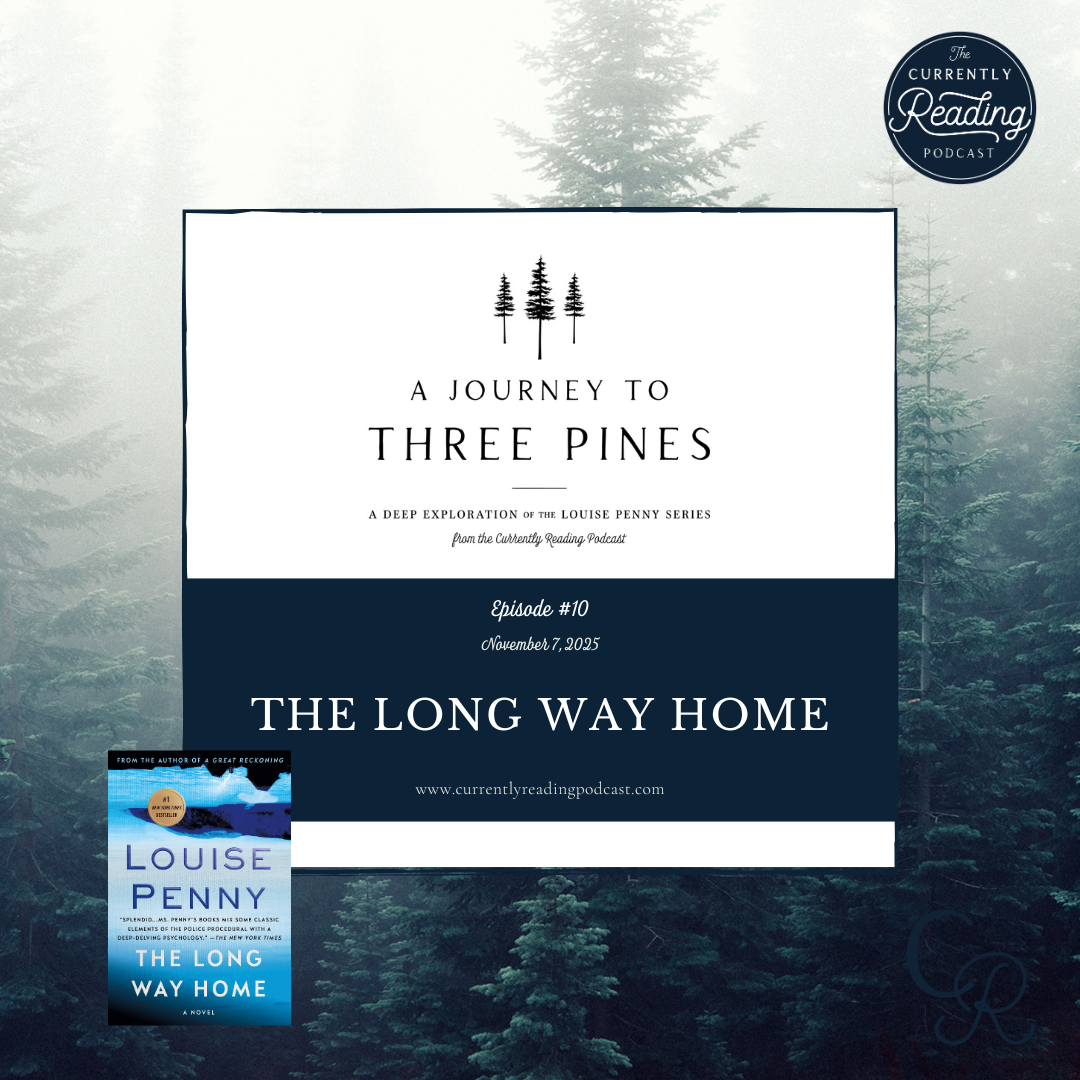
Loading summary
Transcript155 lines
- [00:00]
A
Foreign.
- [00:17]
B
Welcome to A Journey to Three Pines. In this special limited edition series from the Currently Reading podcast, we are doing a deep exploration of each book in Louise Pinney's Three Pines mystery series and we are going deep into it.
- [00:34]
A
We're talking about the mysteries, of course, but also the characters we've grown to love, the gorgeous Quebec settings, and all the deeper themes that Louise Penny weaves so masterfully into each story.
- [00:45]
B
We'll discuss why we love Armand Gamache and all of the rest of our characters so very much. I'm Meredith Mundy Schwartz, co host of the Currently Reading podcast and the Three Pines series is my favorite book series of all time.
- [01:00]
A
And I'm Roxanna Kasankara, a Canadian reader and podcast regular who is deeply obsessed with Inspector Gamache. In today's episode, we're tackling the Long way Home, the 10th book in the series.
- [01:12]
B
We will tell you that right at the top, that this podcast series is for people who have read the book we're diving into. Please know there will be spoilers about the Long Way Home in this episode, so if you haven't read it yet, you may want to press pause and come back when you've got that reading in. We'll be discussing each book in context of the series as a whole, but anything that is spoilery beyond this book we will not talk about. So you just need to be caught up through the Long Way Home to really, really enjoy this series. And yes, of course, we say this always, but we really, really mean it. This series must be read in order. Let's get that out of the way right at the top. All right, as we mentioned, Roxanna, we are going to be talking about the Long way Home, the 10th book in the series. Which means, my friend, we have arrived at the halfway point of A Journey.
- [02:09]
A
To Three Pines that is so crazy to me. I was just thinking yesterday, Meredith, as I was prepping, that means we've recorded 20, 20 hours of audio on a journey to Three Pines, roughly. We've probably spent 80 hours rereading the books and prepping for the books together. And it has felt like a journey, an incredible journey. But I feel. I feel like I know these characters and I know Louise Penny. So in on such a deeper level. And I was thinking, even as I was prepping for this book, I always start off one way. And then after our conversation and the deep read, I. I always have a deeper appreciation and sometimes have completely changed what I thought about a book. So I just, I love doing these conversations with you and with the whole journey to Three Pines community.
- [02:58]
B
Yes. And this book, the Long Way Home, is one that you and I have both been very much looking forward to discussing because it is an interesting one on its own and in its place within the series. So let's get a few details to start. Okay. The Long Way Home came out on August 26, 2014. It came out in hardback, obviously. 376 pages. It's interesting to note as we sit here today, it has a 4.07 rating on Goodreads for over 78,000 reviews. Now that is the lowest rated book in the series. Still has a 4.07. So remember, as you and I know, we can be less than glowing about a Louise Penny book, but it is still meeting a very, very high bar. Even if someone were to say this is my least favorite one in the entire series, it's still over four point, you know, four stars on Goodreads. The season that we are in here is summer. Okay, here's an interesting thing. Did this book win any awards? This book, the Long Way Home, was a finalist for the Agatha Award for best novel, but did not win the Agatha or any other award. That is, that makes it a standout.
- [04:16]
A
Okay. Yeah. All right.
- [04:18]
B
We want to take a look at how it was reviewed, which we always do with all the books. Okay. The New York Times gave it its longest review yet for any book in the series, and I think it's interesting the way that the New York Times reviewed it. Here's what they said. The making of art and the lives of artists are recurring themes throughout Ms. Penney's books, and her own work finds a smooth match between content and form here. The stately pacing dovetails nicely with the theme of Gamache's slow regeneration as he's drawn back into life after his traumatic recent cases. And his return to engagement is linked to the search for Peter himself in exile both from his marriage and from his better self, which drives the story forward at a grad, gradually accelerating pace. Kirkus says Penny develops the story behind Peter's disappearance at a slow, masterful pace, revealing each layer of the mystery alongside an introspective glance at Gamache and his comrades, who can all sympathize with Peter's search for purpose. The emotional depth accessed here is both a wonder and a joy to uncover. If only the different legs of Peter's physical journey were connected as thoughtfully as his emotional one. Gamache's 10th outing culminates in one breathless encounter, and readers may feel like they weren't prepared for this story to end. The residents of Three Pines will be back, no doubt, as they have new wounds to mend. And I will also tell you that right now is usually when I read the Publisher's Weekly review, but, Roxanna, they did not review this book for the first time in the series.
- [06:03]
A
Okay, that is so interesting. I had no idea of this piece, as I'm sure most of our listeners didn't. Also, what's interesting to me is that they all seem very cautious in how they talk about it. You know, in earlier reviews, they were all like, oh, this village mystery. Like, they were. They were eager to kind of cut Louise down a bit, you know, here I think they know she's earned her chops. People love her. And so you could tell they think it was slow and boring, but they didn't want to say that. So it's like Stately Pac, masterfully slow, because they're like, how do we say this? But still be on the right side of Louise's army now. So it just seemed like everybody found this book a bit of a slog, but they couldn't say that. But it was clearly not a favorite, it seems like, amongst the, you know, her readers and among the publishing community.
- [06:57]
B
Right, exactly. And it's. It's also worth noting Publishers Weekly is usually where I get the print run numbers, so that we've kind of watched her print runs get bigger and bigger and bigger, but they not only did they not give it a starred review, which every of the book has had, but they didn't review it at all. So that is very, very interesting. Now, Roxanna, in what format? So how many times have you read this one? The Long Way Home. And in what format have you read it?
- [07:23]
A
So I have read it twice. The first time I read it was August 2022, after you had convinced me to pick up the series again, you know, through the pandemic. And that's very key because I'm not sure, honestly, I would have finished it had you not kind of pressed me to move on through the series. I read it on Kindle that first time. The second time I picked it up was just this last month. I read it in paperback because I did my deep read. And knowing that this was, you know, spoiler, my least favorite in the series, I literally sat down one Saturday and just read it because I knew I was not going to pick this up again if I didn't keep reading it. So I just, you know, I think it was a Saturday, Friday And I just read it as quickly as I could.
- [08:14]
B
You just powered through. All right, well, this book, you know, I've. We've reached the point of the series where, you know, for many, many of these books leading up to this, I have read them three or four or many of them four times. Now we're to the point in the series where I've only read with our close read that we do for the show. It's only my second time through. So that's interesting, too, because I'm getting things out of it that, like, many things out of it that I hadn't gotten out of it before. So the first time I read it in print. This time I did my close read, which of course I do on my iPad, which is great. But let me just be sure, Roxanna, you did it in Kindle the first time, and then you have your paperback this time.
- [08:54]
A
Yes.
- [08:55]
B
Okay. So have you ever seen the hardback version?
- [08:59]
A
Yes. The blue cover? Yes. Correct. Can you show it to me if you have it?
- [09:04]
B
Yes. So.
- [09:04]
A
Yes.
- [09:05]
B
This one.
- [09:05]
A
Okay. Yes.
- [09:06]
B
Here's the thing. So this is the cup. This is the book that I'm holding in my hand is what I ordered in August 2014. By the time we got to this part of the series, I was eagerly awaiting every one of the books to come out and, you know, was doing my. The thing I do all the time, read it, drop everything, and read it as soon as I get it. So this is the actual copy that I got. However, when I went to do my close read, I pulled this book off the shelf, and I had a vague idea in my mind of, you know, what it looked like. I did not realize two things. I did realize it, but I didn't make the connection. The COVID is canvas. This is not a normal hardback cover. It's canvas.
- [09:47]
A
Oh.
- [09:48]
B
It's actually woven like a canvas of a painting.
- [09:51]
A
Okay. Really? Oh, I thought you were gonna say something else, so I was nodding, but I actually did not know that at all. Okay.
- [09:56]
B
Okay. And here's the other thing that I did not get the other time. It's done upside down.
- [10:02]
A
Yes. That I know.
- [10:04]
B
And I'll tell you, I am notoriously a not visual person. Okay.
- [10:08]
A
Yeah.
- [10:08]
B
So I'm gonna pick up the inflection in someone's voice. I am also capable of reading an entire book and not realizing the front cover shows a painting that that is upside down. So when I made that connection reading it this time, even though I read it on my iPad, I had. I had the hardback with Me, kind of as I was doing, I was like, oh, my gosh, how did I not make that connection the first time through the canvas part and the upside down part? So.
- [10:36]
A
So can I tell you one? One thing on that? So I also didn't realize that. And I am a visual person. I think part of it is that it's a. You know, it's blue on both sides. I bet you a lot of listeners didn't realize that. I am going to read you. As you know, I go through Goodreads and I read kind of the quotes and Louise Penny's highlights, and I don't usually do it this early in the episode, but there's one that's really applicable right now, so I'm going to read it to you because it also completely affected my reading of this book. Once I finished it and was like, I read this quote and approached in a complete different ways. I was prepping. Okay, okay, here's the quote, and then I'll read Louise's. There is a bomb in Gilead. She read from the back to make the wounded whole. There's power enough in heaven to cure a sin. Sick soul. Armand Gamache finished the phrase. It's from an old spiritual. Clara stared at the back cover. Do you believe it, Armand? Yes. He took the book from her and grasped it so tightly in one hand, she half expected words to squeeze out, then, what are you struggling with? When he didn't answer, she had her answer. And then Louise writes, love, love, love that spiritual hope, healing. And for Armand, at this point in his life, so wounded deep down, there is comfort. The Long Way Home is one of my personal favorite books. Perhaps because it's very quiet, inverted, even. Like the COVID we travel deeper and deeper into the search for Peter, into Quebec, and into Armand's pain, but always, always with awareness that there is a balm that can make the wounded whole. I'm often asked about the book Armand is reading. And if it's a real book, it's not just something I made up. So when I read that and realized this was one of her favorite books and that the COVID was inverted, which I didn't realize till she said it there, and that that was purposefully done to, you know, mimic kind of the quiet tone, but also going inward, I thought that was so interesting and made me approach my reading of the book differently.
- [12:39]
B
Yeah, I mean, I was shocked to hear that this is, you know, one of her personal favorites. I guess I shouldn't have been shocked.
- [12:47]
A
I was.
- [12:47]
B
Because as you read it, you really can feel how much investment that she had with it. I will just point out one more thing on the COVID So it's inverted on the front. Another reason I should have gotten it on the back. It's right. They. They've put it right side up. So again, why did I. Eleven years ago, this completely escaped me. But also, again, I just want to point out the canvassy fabric of the COVID Okay. Okay, let's continue forward here with the setup of the book. Roxanna, will you go ahead and set up the long way home for us?
- [13:22]
A
I would love to. Okay, here we go. Gamache has finally retired to Three Pines with Ren Marie. Peace feels possible. That quiet cracks when Clara knocks. She and Peter agreed to separate for a year and meet on the anniversary to see who they'd become. That day comes, but Peter doesn't. A simple check becomes a journey that follows paintings, emails and half clues through Quebec's art world and up the St. Lawrence. Clara's star has risen, while Peter's has stalled and envy has curdled into self doubt. The route grows harsher and more remote. The danger is physical and emotional. The question for the group shifts from where is Peter? To what will it cost to bring him home?
- [14:05]
B
Perfect. Excellent. Very, very well done. All right, let's read the first little bit to kind of set the stage and enter our story. Chapter one. As Clara Morrow approached, she wondered if he'd repeat the same small gesture he'd done every morning. It was so tiny, so insignificant, so easy to ignore the first time. But why did Armand Gamache keep doing it? Clara felt silly for even wondering. How could it matter? But for a man not given to secrets, this gesture had begun to look not simply secretive, but furtive. A benign act that seemed to yearn for a shadow to hide in. And yet here he was, in the full light of the new day, sitting on the bench and Gilles Sandon had recently made and placed on the brow of the hill. Stretched out before Gamache were the mountains, rolling from Quebec to Vermont, covered in thick forest. The Riviere Bellabella wound between the mountains, a silver thread in the sunlight and so easy to overlook when faced with such grandeur. The modest little village of Three Pines lay in the valley. Armand was not hiding from the view, but neither was he enjoying it. Instead, each morning, the large man sat on the wooden bench, his head bent over a book, reading. As she got closer, Clara Morrow saw Gamache do it again. He took off his half moon reading glasses, then closed the book and slipped it into his Pocket. There was a bookmark, but he never moved it. It remained where it was, like a stone marking a place near the end, a place he approached but never reached. Okay, so she gets us into the book in a way that is very meditative.
- [15:50]
A
Right.
- [15:51]
B
We're watching something happen over and over again from a distance. So unlike some of the books where we're dropped right in the middle of the action, this is letting us know, I think, right from the start. This is a meditative internal. Like we're watching the actions of someone from the outside, but we. There's so much going on inside that we're not seeing.
- [16:13]
A
Right.
- [16:13]
B
So she's really setting the tone from the beginning.
- [16:16]
A
Yeah. And completely agree. And just like he, you know, almost reaches the bookmark, but never quite does. That's symbolic, obviously, for him. Almost kind of coming through his pain and not quite getting there. And that, I think, is, you know, that first paragraph already you're getting heavy symbolism. And this book is rife with symbols and icons and passages and quotes. And I think. I think Louise Penny is very cerebral and loves that, as this is her favorite book, you know, one of her favorites. I think for readers coming off of the Crash, bang, boom of the last book, those expectations make it hard now to go into this. But I do think she's saying, look, I can do that. I did the Crash bang, boom. I've shown you I can do it. And now I'm gonna do a book for me that, you know, reflects my journey and reflects the journey Gamache would be on after something like that happened. Right.
- [17:17]
B
And we've said this over and over again. Right. We've said that we've seen her do this back and forth between a book that seems like maybe it's more for the reader and a book that seems like it's more for her. We have to talk. I think there's many things that we can appreciate about this book, especially with a close read, especially with, you know, being able to discuss it. I think this book, more than any of them, benefits from a close read and a discussion. But we have to talk about the Elephant in the Room, which is the fact that this book is so glacially slow in its pacing. We always talk about pacing right up at the top. I think when you are writing a mystery series, which is what this is. This is. That's what the Three Pine series is. Pacing is important. So we always talk about this element early this one, especially coming after how the Light Gets in, which is many people's favorite book of the Entire series. This one is just really slow. And I would say, overall, in my notes, I said, while I did find many things to appreciate about this book that I didn't appreciate the first time, this one is a tough one. And woe to anyone who starts the series with this book. Like, I really hope not a lot.
- [18:36]
A
Of people did that, and I'm GLAD it's number 10. And she was smart to do that, because as slow as it is, you know, by number 10, you're in. You know, you need to know what happens, and you will follow her through that. But I agree with you. This one was painful for me. This time I really went back to be like, what is it that is slowing it down? So I think part of it is exactly that meditative. The symbolism, the layers, all that. It's, you know, a road novel, like on the Road novel. So we leave the closed circle of Three Pines. We have some of that, but we leave that, which of always makes it harder. I'm glad she does that, because I think 20 books just sent in three pines would be hard. But it does make it harder for the reader to follow along. We follow really strangers inside, characters we don't know and we don't really care about.
- [19:26]
B
And we have no history with many of them unlikable.
- [19:29]
A
The story centers on Peter, which is tough because he's unlikable, you know, and so your investment is so low. Like, you're following a guy who's unlikable, who didn't bother to show up for his wife, doing a bunch of unlikable things with a bunch of unlikable people, you know?
- [19:46]
B
Right.
- [19:46]
A
You know, like in conventional road trip books, every stop kind of gives you a piece, and then you're going up that ladder. Here, it's like every stop yields kind of minimal action. There's lots of dead ends. Claire and the team keep reframing Peter. Yes. So they learn a bit, but it's like inch by hard, one inch, you know, there's. That first third is really exploratory. There's scattered leads, there's frequent stalls. That middle third comes tighter, I think, as some of the clues kind of coalesce. And then that final third is propulsive and stark. And that almost comes like, what? You know, you have that harsher landscape, the higher stakes, that comes out of nowhere. So the payoff does land. But that journey feels long, and it really does feel like a long way home. Meredith. Right halfway through, I was like, if I hear the 10th muse one more time, I'm going to Throw this book across the. Because I was like, I know this has nothing to do with it. I know I don't even really care about this, but I just have to keep going deep into all these symbols and understanding them and why. Why am I doing this for Pet and his unlikable friends, you know?
- [20:55]
B
Right, Exactly. I think a few things that you brought up there. The. The bookmark not moving it. She tells us right at the very beginning about a bookmark that's not moving. You, you know, ground your way through it in one day, which is a good way to do it. I gave myself, like, usually I. I tell myself, like, I can, you know, with one of these. I'll kind of inhale it in three days. I gave myself a week because I knew that this one was going to, you know, be slower. It ended up taking me 10 days to make my way through it. It was just really. It was just really, really difficult. Especially that first. Right. 60%. So I felt like my bookmark wasn't moving. I think one of. I mean, obviously another thing about this book that makes it really, really different is that we have no murder. Like, we don't. We're not solving a murder.
- [21:43]
A
Yeah.
- [21:43]
B
Right. So we've seen many of the other books where the murder doesn't happen until really far through the book. But here we are finding. We are. We are trying to find someone that we really don't know if that someone wants to be found. We don't know if that someone is in danger. There's a lot of things standing in the way of the normal straight line narrative that buoys us through her books.
- [22:07]
A
Yeah.
- [22:07]
B
The other thing is that I think this is. I think I could be wrong. We will see as we go through this back half of the series. But I think this is the only one of her books that I would describe as feeling navel gazy. Like, to me, this is a book where she is. It's. It's so freighted under the weight of all of the stuff that she's trying to make sure that we're. See, you know, the Balm of Gilead, the. The Tenth Muse, all of these things that are just kind of piling up that it just ended up feeling like she really was enjoying writing this book and it didn't really matter if we were going to enjoy reading it.
- [22:52]
A
Yes. You know, and I always say she writes in a collage kind of way. She collects, collects, collects and then puts together and somehow it works. And here it felt like she had that collage, but she kept Putting stuff on top of stuff and on top of stuff. And then she was afraid we wouldn't get it, which we didn't. So she kept explaining it more and more, but she didn't realize we didn't get it, and we didn't care to get it, because the story, it. We knew it wasn't integral to the story, and we knew it wasn't going to move us further. So, you know, some of them, like, that's the. The one. I always forget which one, but the one with the Samuel de Champlain. A lot is happening there, but that plot is so intricate that you're like, okay, I better follow this, because I bet you this is a thread that's going to, you know, go into this plot.
- [23:34]
B
Yeah. Bury your dead.
- [23:36]
A
Yeah. Bury your dead. Thank you. Yes.
- [23:38]
B
Right. And you can feel her trying to throw some bones to the reader in that many of the chapters around, especially as we get to the 50% mark, start ending with what you can feel her trying to give us, like, dread building cliffhangers or may. I mean, maybe it was her doing that. Maybe it was the editor saying, look, you've got to. We got to put something in here to make them feel like something is coming. I don't know. But you can feel that happening. But they're so out of place in the context of the rest of the story. Now, the writing is the next piece that we always kind of talk about. So we talk about pacing, and then we talk about the writing. Most of the time in most of her books, those things go very beautifully, hand in hand. I will say that in this book, I think there's a lot of very beautiful writing.
- [24:29]
A
Yes, I agree. And I think that's where, as I was doing my close read and my analysis, there was some redemption here. You know, the prose is beautiful without showboating. Like, there's really some quiet confidence. She's hit her stride here. She's not trying to do a bunch of fancy things, like, you can see it building the landscape, how she uses that as subtext. The weather and the water carrying kind of the emotion. You know, she loves books about art and seeing kind of the chaos of Peter's art sort of mirroring his mind. I think that all worked well. That dialogue. I find her dialogue is better now, in between the. You know, in between the. The Three Pines community and the way that Gamache and Clara talk, there's a lot of pauses and stuff. She's trying to kind of give you that quiet, meditative mood. And she does have some humor there with Ruth and Rosa and you know, the farting dog. Like it's cute, right? But that I, I think the biggest issue for me is that the tone overall is sober, it's harsh and it's alienating. And after the last book, Meredith Gamache and Ren Marie have finally retired to the place of their dreams. Jean Guy saved Gamache. He's gotten married to Annie. I just wanted a Hallmark book that was just happy and joyful and had them celebrating. And here I am going down the St. Lawrence with the frozen tundra and some pompous art academic self important people. And I was just like, why am I here?
- [26:04]
B
And we're trying to find Peter, which, you know, Peter's just such a jerk. He's just, you know, but okay, here's, here's one question that I have for you and I'll just. This quote illustrates what I want to talk about and then also some of her fantastic writing. This is on page 92 she talks about. It was what she'd long known about Peter Morrow. In a life filled with great good fortune, of health, of creativity, of friends, living in safety and privilege with a loving partner, there was just one bit of misfortune in his life, and that was that Peter Morrow seemed to have no idea how very fortunate he was. This has always been. There's Peter throughout the series, has always been an outlier, even as he was absolutely in our inner circle, right? He was always the person in the inner circle standing almost on the outside looking in on the rest of the cast of Three Pines and feeling an outlier and feeling derision and feeling other. And this is the piece, right, that all of the rest of them come to Three Pines and kind of have this realization of what they've come through and how grateful they are to be where they, where they've landed. He doesn't have any idea how fortunate he is. And it is that thing Ruth says a few times in the book, it is that thing that truly kept him from having any real happiness in his life, which is a theme that we get in the series overall. But Peter, you know, he's always been that other character, that othered character, and he othered himself. But here I really do feel like it's kind of beautiful in its redemption of Peter, right? Like, yes, we wonder the entire time because he's not in. We're having to wonder about him. We're not. I think a lot of other authors would have done maybe a rotating POV of what he. What was actually happening with Peter. Yeah, but she holds that back from us almost to the very end.
- [28:24]
A
Yeah.
- [28:25]
B
But I do think that there's a redemption arc here for Peter in that I think at the very end, he does really get it.
- [28:35]
A
Yeah, he does, because he says, sorry. He's the one who puts himself in the way of the bullet to save Clara before he dies. And I think she had to give us that, because if we had followed him for 400 pages or whatever he had, I mean, she didn't have to have to give us that. She doesn't always, you know, follow that. But I think it did help that it had that redemption, and I think that is what makes it different from some of the other. You know, he's not a villain. But like you said, this theme of not realizing what you have is such a strong theme through the book. Like, if you think about Francoeur and Gamache and what separates them, you know, there was that early book where Francoeur actually had more than Gamache, but Gamache appreciated what he had, and that was what made Franco mad. That's what he told him. It's not that you have this stuff. It's that you seem content with it. I can't get that. And why are you content when I have so much more than you do, and I'm not content? You know, and he was so mad about that. Or even Yvette, Nicole. You know, there's one scene where she's surrounded by family and she's an outsider, and Gamache tells her, like, you're not. Look, your family loves you. I'm here.
- [29:44]
B
I'm here.
- [29:45]
A
And she still, like it says. I think specifically she sat like an outsider in that group. So I think that's a common theme with her. And to your point, I think Peter is the one inside the group that signifies this the most, and she means to make him unlikable. Like, the fact that we think he's unlikable means she's a successful writer. That's what she meant to do. And the fact that she does give him some redemption, I think is really important. And also, you know, it makes Clara not seem like a fool. Like, she's been with him for so many years. She had to see something in him. Right. If he was just all evil, what's the point?
- [30:21]
B
Well, and I want to think about something that you just said, too, where you said, you know, it's not like we have a villain here. I actually would say that Peter has been one of the. There's a few. Frank Korb being One of them. There's a few really intense villains in the series and I think Peter consistently wears that hat all the way through because. But in a really nuanced way, because the person that he is so horrible to is Clara, who is our heroine of the series. Yes, right. And here's what I thought about as I came to the end of this book. We know that Louise has said that Clara often stands in for her in the series, but I actually think that when she writes Peter, that is another part of her that she's writing in. And I think it's that duality of her personality that is the reason that he gets that redemption at the end. I think it's to your point. I think it explains the dynamic between Peter and Clara that there is. Even at his worst, there is something that draws Clara to keeps Clara with him. Even with that one year separation, she could have been completely over him. She could have moved on. She still was waiting for that day. She was still waiting for him. She still still was planning that evening. She still was waiting with Beta, but she was still in love with him, even after a year of detoxifying, if you want to call it that.
- [31:54]
A
Right.
- [31:55]
B
So I just really think that this. He's been a villain the entire time. One of the worst villains. Like some of the stuff that he's done is so acidic and horrible to our favorite female character, and yet we can't quit him.
- [32:11]
A
Okay, so this is making me rethink and making me realize why I hate him so much. Like, you know, Frank her I hate, but Frank her I can other which Louise means to do. Like, you can be like, well, that's just a horrible human being. He belongs in hell. And be like, okay, well, some people, I guess, you know, and you don't have to think too closely, but Peter, I think we hate more because we can relate to some of that, you know, And I'll say for maybe not everybody, but for me, you know, I'm an enneagram3. So that just means I. I have ambition, I like recognition, you know, and I'm always fighting those dual forces in myself. And Peter is nothing but a really unhealthy enneagram 3. So, you know, I have the saying, when I point the finger at other people, usually the finger's pointing back at me. So when I really hate somebody, when he. When it really gets under my skin, it's usually because there's a quality in them that I don't want to see in myself, but I know is there. Right?
- [33:09]
B
Right. And I Think it's interesting because the place where Louise in this book gives voice to that is through the character of Zhangi. And in fact, on page 138, she says Zhangui liked Peter Morrow. A part of him understood Peter Morrow. The part Beauvoir admitted to very few. The fearful part, the empty part, the selfish part, the insecure part, the cowardly part of Zhangui. Beauvoir understood Peter Moro. So if we've. Like a lot of people, myself included, will argue about the enneagram type for Zhangui. If there's ever been an argument for him being a three, here we, you know, here we go. I tend to. I tend to think that he's more of a five, but here we go. This, you know, this kind of tells us. And then that piece goes on to say, but while Beauvoir had fought hard to face that part of himself, that cowardly part, Peter had simply run from it, increasing the chasm, the terror. Fear didn't make the hole bigger, Beauvoir had learned, but cowardice did. Still, Jean Guy Beauvoir liked Peter Moreau and was worried that something horrible had happened to the man. But at least no one would kill for these pictures, except perhaps Peter. He might kill to suppress them. Talking about the, you know, the. The artwork that they found and were trying to understand through the whole back half of the book. But, yeah, I thought that was interesting, that it's through Zhangui that Louise helps us realize maybe part of the reason we. We struggle with Peter is because he. We, all of us have seen some of that in us, and I think Louise is showing that. I think Louise has an incredible amount of sympathy for Peter Morrow. I think it's why we get an entire book, Book four, about his horrible family.
- [35:08]
A
Yeah, it's to give us some sympathy into him and not just other him, because, yeah, you see his mother, you know, you kind of see. See all his family. You can see why he is the way he is, and that gives you more empathy through this book. This is another argument for why the series has to be read in order. Oh, yeah. Not only would you abandon this book if you read it first, but also without book four, I think without understanding how Peter became to be who he was and without seeing his struggles to really appreciate Clara and not envy her, even though they all ultimately fail, if you didn't see him trying, you would really give up. But here, like you said, you know, he is the one who's the closest to the Three Pines community. He has tried, however feebly, to redeem himself and now you kind of want to know, well, what happens to him. Right?
- [35:58]
B
Exactly. Book four, by the way, a rule against murder. One of my favorites in the series because it is so good at painting a picture of this really broken in the worst ways. Family. One of the things I did like about the Long Way Home is that we do get to meet up once again with Peter's mom and with the stepdad and you know, who, who again is described as. In fact, I, I have this quote here because I actually think it's one of my. It's one of my favorite quotes. Oh, she says she is just. I think it's the beginning of a chapter and she says the ugliest man alive opened the door and gave Gamache a grotesque smile. And we don't know at. I think it's the beginning of a chapter. We don't know, you know, except as the ugliest man alive. We know from book four is the way that this, that Peter's stepdad, who was really the best of that family was described. So that's a piece that I like about it is that we, we don't get a lot of the Moros. We get a couple drive bys with the siblings, but Gamache goes to their home and we get a little bit of that with. With them. Just a really memorable family. But yes, to your point, if you had not. If you did not have all of the context of Peter and Peter and Clara, this book would be even more difficult than it is. I do, and I said this to you as I was reading it. You know, we, we bring to every book we read something different depending on what's going on in our lives during this period of time. While I was reading this book, I was experiencing a separation with my own husband. And that gave me a very interesting lens, this idea of saying we are going to separate and we're going to basically see what happens at the other end of that.
- [37:45]
A
Right.
- [37:46]
B
And the hopes that you have for that or the fears that you have associated with that. As Clara realized how much she was looking forward to that separation being over, that year being done, and then the disappointment of him not showing up and then that turning. Because this could have been, this book could have never been a book because Clara could have very easily been like, he didn't show up. Screw him. I'm moving on. That could, that would have made a lot of. I mean, obviously it wouldn't have been. It wouldn't have been a book. But that could have easily happened. She'd been like such a piece of crap. He doesn't even bother to close the loop. He doesn't answer my calls, whatever. I'm done. But she launches a full. She goes and gets the head of homicide and says, we. We need to find him. I know something's not right.
- [38:36]
A
And she really debates with herself, knowing this is the only piece he's found in 10 books, that she's gonna go destroy this piece for one of her closest friends. Right. Like, it's not an easy decision to go to Gamache. Right. And even throughout that journey. This is really interesting. We'll get to it when we talk about characters. But. But Gamache and Clara, I think, for the first time in an investigation, kind of share power through this investigation. Right. Gamache has only done that with Zhangi before. But to do with the civilian where she makes some of the decisions. And in fact, she's the one near the end who's like, no, we're going to keep going. We're going to get there fast. We're going to take the more difficult route because we got to go and see if Peter's there. Like, she really puts her life and their lives at risk to find Peter because she really believes, you know, something has happened. He would have been here. Which just shows you. Yeah. How her love has, you know, transcended through that time and how she has this deep kind of. They have this deep core or connection where she knows he wouldn't just abandon her like that, despite everything he's done to her. Right.
- [39:45]
B
The heart wants what the heart wants. Roxanna, you. Sometimes it does not make sense, even to the people involved, but clearly.
- [39:53]
A
Right.
- [39:53]
B
That connection was just so. And you. And you see that in that final scene where he's dying from that knife wound. Let's talk a little bit about characters, because this is another place where I feel this book does have quite a bit to offer, and it does do several things with the characters that are really beautiful. I think there's a couple characters that are really unused, unfortunately, but I think there's a. There's a couple places like this dynamic between Clara and Gamache. Those scenes where Zhang Yi is trying to convince Gamache to step into the lead and. And to. And have them go about things in a different way. But Gamache just keeps saying, I told her that I would let her make these decisions. I think that's really interesting. It's obviously the book starts out with Clara and Gmech and Clara being watching him very closely.
- [40:48]
A
Right.
- [40:48]
B
He's now in the town. So he lives there now. So she's watching him very closely. We see that they see each other. And they spend this time together very regularly. The relationship between the two of them, the friendship between the two of them really, really deepens in this book in a way that I think is really interesting. And then, of course, we also get some fantastic Ruth in this book. I love the way that Ruth is different in this book than in any of the other 20 books.
- [41:18]
A
Yeah, I agree with you. She really, you know, she's played kind of the side caricature, you know, in a lot of books now, that did deepen. You know, you can tell that Penny always meant to deepen it. Like when Rosa flies away, you know, she's not a caricature. You're seeing kind of the. The heart of Ruth. But here, the way she pushes forward the investigation at times and is like, you know, she acts as a poet. Like, she acts kind of like that visionary and that clarifier. And she continues to do that here. And she's the one who identifies, I think, that that painting. You know, she says something about the painting. You know, she's always giving these cryptic lines of her poetry that end up being clues. I think when they go see Massey, she notices that that painting. There's something about it that's not right. Right. Because it ends up being no man's painting. But there's something. And she's the one who identifies that. So she's really instrumental to the plot here.
- [42:15]
B
She is, in fact, she recognizes that painting as being truly great. And so like an outlier in the other things that were around. But she also recognizes the importance of the empty canvas in Massie's room. When they're there and she talks about that empty canvas. Someone says to her. Someone asks her, you know, like, about the fact that she admitted that at some point she was absolutely terrified of Professor Massey. She found him to be terrifying when they went to go see him. And she said, she's talking about all the other people in Three Pines. You're all something. But Professor Massey was nothing empty like the canvas. And I found that terrifying. So she cottons on to him as the true villain way before anybody else does. Also, that scene where she's kind of flirting. Ruth is just painted in a completely different light in this book. It deepens her relationship with Clara and with Myrna. The fact that she's going with them. Right. She joins them in this search. And I think that's part of the reason, too, why we're not in Three Pines, but a lot of Three Pines is with us.
- [43:32]
A
Yes.
- [43:33]
B
Like, we're not just Jeong Gi and Gamache in the abbey, right?
- [43:37]
A
Yes.
- [43:38]
B
We have a lot of the people with us, which is, I think, why this one doesn't feel so removed from. I felt like the village was kind of there with us for a lot of it.
- [43:48]
A
Yeah.
- [43:49]
B
But it is interesting to me that Ruth deepens her relationship with several members of the village throughout. Like, she becomes much more human. To your point, she's not as much that just caricature of the curmudgeon who's drinking and saying weird things off in the corner. She becomes very human in this book.
- [44:08]
A
Yes. And I'll agree with what you said. I think in this book, you see Three Pines not as just a place, but Three Pines is something you carry with you. Right. You know, like, they're not just because the people are there, but because of that sense of well being and caring and community for each other comes with them. And because they each, just like in the village, they each bring something to this investigation that is critical. Right. Like, I thought about Myrna and how she, you know, she's always, through the book, identified the patterns and kind of name the things that were happening. And here she does that not just for the case, but for Clara herself. You know, like, she helps Claire. Like, are you idealizing Peter right now, or are you really seeing him? You know, she does that a few times to help see that. Are you trying to help him? Are you trying to control the situation? You know, is this grief that you're feeling for losing him that you're now throwing into this whole journey to go find him? Like, there's a few that, like those traps that she kind of pulls Clara out of or at least recognizes. You know, I think there's a conversation where she has, like, name it, then breathe, you know, where she's saying, like, recognize what's happening here. So I just found she was really interesting in terms of moving the action along and helping because there was so much internal stuff going on. Turmoil with Clara, with Gamache, with all these people. She served as kind of the Wayfinder, you know, to name it and then be like, okay, this is what's happening, and move on, rather than spending all your time in that turmoil. So I really. I really appreciated that there were a couple more. I love Jean G. Seeing him now as a true equal to Gamache. I think he's come through this recovery. He's come out the other side. He's not there yet. But you see that logistics brain that he always have. You see momentum, but you don't see as much bravado as he had before. You know, some of that cockiness has come down now.
- [46:07]
B
It's confidence now.
- [46:08]
A
It's confidence. Right. And, you know, measured choices replace impulse. Right. So he goes to Gamache and says, why aren't you leading this? But what Gamache says, you know, I've given this to Clara. He doesn't get mad at Snap back, which he has done the last few books. Right. That impulse, he's kind of. He has that quiet courage, especially in that final leg, to push them through. So I. I just loved to see that relationship between them maturing. Both, obviously, because of Annie, but also because of what he's been through. And then finally, what you said about Clara, like, I think you're totally right. Right. They. We talked about how she drives the case. That's the urgency. They work together. I love how clear she is here. You know, she sets her boundaries. Like, she loves Peter. She wants to go find him, but she won't minimize her success to fit Peter's ego. She's very clear since that night they broke up and she shouted it at him. She's very clear that she's not gonna do that anymore. Right.
- [47:08]
B
Right. She's definitely gained a lot of insight through the separation. Like, she didn't waste that time pining over him.
- [47:14]
A
No.
- [47:15]
B
But I do think that she had arrived at a place where she was like, look, these are things that absolutely need to change. Yes, but there's enough there for us to work, to fight to make those changes together.
- [47:28]
A
Yes. And she has gained confidence in herself. I think before, it wasn't just Peter. She, like, you know, you can only hurt something that is, like, she kept piercing her soft underbelly. Now she's kind of hardened, that underbelly, you know, like. Or not even hardened. Like, just grown into herself. Like, there's a quote on page 362, an exchange with her and Gamache that I thought really showed Clara's new sense of kind of growing into who she was. Where Gamache says to her, wait, Clara, I have another question. It's about Chartrand. Clara stopped and turned. What about him? The ship's horn gave another cry. This is when they're about to get on that ship. Why do you think he came with us? Gamache could see Jean Guy waving at them from beside the Louis de Mer. Because he likes our company. Clara suggested our company. You think he came because of me. What do you think? The ship's horn was now giving off short, insistent blasts. You think he's only pretending to like me as an excuse to get close to us? Gamache remained silent. You think I'm not reason enough for a man to close up shop and join us? I've seen how he looks at you, said Gamache. How he's drawn to you and you to him. Go on. I don't think it's a complete lie. Not a complete one. How nice. And then they talk about a few things, and then she says to him, you asked why Marcel would join us, but you haven't asked why I agreed. You thought I'd lost my heart to him, the lonely woman vulnerable to a little attention. Do you really think that's likely? Well, now I don't, he said, and was so clearly embarrassed. Clara smiled. Zhangi was waving frantically from the dock, and Myrna was standing in the middle of the gangway, refusing to move for the sailors. If Marcel knew where Petyr went and didn't tell us, it's because he wanted to keep us away from Tabakin, said Clara. He might be keeping an eye on us, but I'm watching him too. That's why I wanted him with us. She turned and started walking rapidly toward the key, but before she did, she looked back and said, and I'm reason enough, Armand, for a man to give up everything. Yeah. And that's where the chapter end. I was like, yeah, yeah, Clara, you go now she knows herself, you know?
- [49:31]
B
Right, Exactly. She really has gained a different insight into herself and her worth, and she's now lived a year and realized, I'm okay on my own. I'm fine if this is what I need to do. I'm. I'm more than enough. So I do. I love watching that arc and then the arc. You know, I continue to be really amazed how much I love the female friendship aspect, which you see in a lot of different combinations, but especially with Myrna and with Clara. And I just love how much attention that gets. Let's talk a little bit about the period of time of the book where they're on the ship, because I have to say I didn't remember this at all from my first read, and I laughed a lot. The fact that Clara and Myrna got that they're different experiences, and then Zhangi and Chartrand and Gamache are in this horrible, cramped space and they're up there having high tea in their gigantic and they purposely decide not to say anything at all about it. There was something about that element which was obviously supposed to provide some light and some levity. I really enjoyed those pieces.
- [50:45]
A
It was funny you said that, because I did, too. And there's a point where she's having a conversation with Gamache, and he goes, where's Myrna? And she says, oh, in the bathtub or something. He goes, in the bathtub? And she goes. I meant that metaphorically. You know, she's upstairs. And he looks at her quizzically, like, what. What could be metaphoric about her bathtub? And she's like, anyway, moving on. Shouldn't we go do this? It's just so funny because she, like, was trying to hide it. Just thought it was.
- [51:11]
B
It was. And then when the guys figure it out and they walk into the. They walk into that space. That whole thing just made me. Just made me laugh. And then. And I do want to touch just a little bit on the Clara Chartrand relationship, which is really interesting. You do wonder the whole time. This is one of the few places of, you know, suspense, if you can put it that way. Like, was he a bad guy using Clara? Was he really interested in her? You know, when they're on the ship and he's so seasick, he's so. He's so sick. And she walks in and she was like, I knew he was really sick because absolutely no one would voluntarily stay in that horrible space if they weren't actually sick. And she's kind of, like, caring for. She's wanting to care for him, and then he's, like, very, very sick. And at one point he says, don't go. And then he kind of falls asleep. And the next line is, you know, she tucked him in and then she left. And so you really see that.
- [52:08]
A
Yeah, it.
- [52:09]
B
Maybe there's a little bit of a spark there, but it's nowhere near. Like, she's still very focused on Peter.
- [52:15]
A
Yeah.
- [52:16]
B
And then the very end, of course, where they're at the funeral and Chartran has gone. Has, you know, there. But he's standing in the. In the way back, keeping to himself. And Armand talks to him and says, maybe come back in a year. You know, maybe come back in a year. And he's like, you know, I don't know. I'll always remind her of these bad. Like, I'm always going to be a bad memory. And he was like, well, you know, maybe it'll be a bad memory, but maybe there's also. Maybe there's also really something there. So I can't remember now. I've read these books now. I don't remember well enough to remember if he comes back into the story, which kind of is driving me crazy and making me want to read the next book. I just can't remember.
- [52:56]
A
Okay. And I have one question to ask you that's a little bit out of the blue, but it just struck me, and I thought it was interesting when you. When we were talking about Peter and you said, no, he is the villain here, so I don't want to spend too much time on him because we've talked about him a lot. But why do you think, Meredith, I mean, of the two characters that have been kind of expelled from the Three Pines community so far, it's Peter and it's Olivier. Right. Both unhealthy threes. Olivier has done a lot worse, really, than Peter in. In time, in the terms of the law. Right. He hasn't insidiously undermined and hurt his partner. Right. So you could argue. No, you know, Peter's much worse, but in terms of, like, the law and, like, he has insidiously undermined a poor man who had very fragile mental health. Right. And basically caused his murder, you know, whether he did it but with his own hand or not, he's for sure responsible for that.
- [53:52]
B
But he's defrauded people.
- [53:54]
A
Right. And he really did kind of change that poor man's mental state. And he goes and spends time in jail and the whole thing, but he's allowed to come back. And, yes, you see a bit of a journey for him. But he's back in the cafe in the bistro, serving people. He's back at Three Pines. Peter is not. Given that he is slowly excluded, excluded, excluded, and then ends up dying, basically in the line of fire for Clara. So why do you think Louise Penny made those decisions? Like, allowed Olivier back but not Peter?
- [54:23]
B
I think absolutely. I mean, it's funny that you say that, because the very next note that I have here is this is the second time that she's done a really big thing with one of the core members of the Three Pines group. Both unhealthy threes.
- [54:36]
A
Okay. Oh, look, we're on the same wavelength.
- [54:39]
B
And again, I think that there's a part of Louise that is an unhealthy three.
- [54:45]
A
Yeah.
- [54:46]
B
Not that she's unhealthy, but, like, I think that those are parts of her own personality that she sees and grapples with.
- [54:52]
A
Yes.
- [54:53]
B
And I think very clearly, if you had to choose one or the other for her to put a knife to their throat, it's gonna be Peter every time. Because I think she considers his crimes much, much worse.
- [55:07]
A
Yeah.
- [55:07]
B
Than Olivier's more property related climbs or crimes or, you know, Peter's crimes are crimes of the deepest part of the heart. And I think that's what Louise Penny finds unforgivable.
- [55:20]
A
Okay, so I agree with you there, but I do, I disagree with you for part of that. So Olivier, I agree that's the property stuff. Like he's more greed, Peter's more envy. Right. So I, I think that's kind of how I see covetousness. So, you know, he sees that amazing cabin and is so greedy and wants everything in it. Like the hermit's cabin. Right. And that I could forgive. But the fact that he slowly and systematically removes every support that the hermit has tells him it's dangerous out there. Tells him you'll never survive. I'm your only link. Until he gives away everything. Like he really takes that poor man who he has no knowledge of and dismantles him to the. And basically kills him. Right. Like he might not have been the one who bludgeoned him, but he's the one who keeps him so scared that he doesn't reveal himself to his son. He doesn't form those connections. So to me, the greed isn't it, but the fact that he psychologically destroyed somebody just the way that Peter is doing that to Clara now Clara is his wife, but this other man was. The hermit was poor and defenseless and he didn't know him. So like I wonder, you know, I.
- [56:29]
B
Feel like she gives Olivier much more of a pass in that she doesn't seem. Which is not to say that he's not doing it purposefully, but I feel like she almost. She doesn't draw that as a really straight line where she draws really straight lines to the cruelty of Peter to Clara.
- [56:49]
A
Yeah.
- [56:49]
B
You know, is it also because Olivier is. Do you know, I think she kind of gives him some emotional cover to say that he wasn't, you know, he was doing it because he was trying to get X, Y and Z. But he really. The fact that it led to his death. Death or led to his, you know, not know, like that he really wasn't, he wasn't trying. He wasn't so careful or knowing or premeditated about making that happen. Whereas I think what she sees happening to Clara is just her own worst nightmare as an artist, as a, as an author would be being married to someone who slowly tries to dismantle you from the inside. So I, I feel like she gives Olivier. More cover I. And we see that as in the very next book, Olivia is invited back. Now, whether or not, I think, in large part, we are supposed to see that, in fact, Peter is invited back at the end. He does get that full arc of redemption because Clara allows him basically to pass away in Three Pines.
- [57:48]
A
Yeah, right.
- [57:49]
B
Not physically, but in. In every important way. His last thought is of being home. She gives him that full arc. It's a long way home. But Peter gets home.
- [58:02]
A
Yes.
- [58:03]
B
All right, Roxanna, let's talk a little bit about the kind of Canadian elements here, the context that you may, as a Canadian, be getting as you do your reading, that we're missing here in our American lens.
- [58:16]
A
Okay. There was some really interesting stuff here, Meredith, that I didn't get in the beginning. But as we delved deeper into the landscape, there were some interesting things that I thought might help American readers or other global readers as they're centering themselves in this book. The first is a quote that Penny wrote in Goodreads, one of her highlights that actually gave us the origin story for Three Pines, which I had never read in this way. The passage is, the homes formed a circle, and in its center was the village green. And in the center of that were the pine trees that soared over the community, three great spires that inspired the name Three Pines. These were no ordinary trees planted centuries ago. They were a code, a signal to the war weary. And Louise writes in her notes, it's funny how we pick up ideas, isn't it? I sat beside an elderly stranger at a social in a church basement, and she told me the story of the Three Pines. She had them planted in the front of her house, had been there for more than a hundred years, and that they were a signal to those loyal to the British Crown flooding across the border during the War of Independence, that they were safe in Canada. I heard that story years before starting to write and always loved the symbolism of it. The kindness of the act, the awareness of how weary and confused and frightened those immigrants must have been. And then the unimaginable power of knowing they were safe. Unbeknownst to me, in the church basement, over dinner with a stranger, the seeds, not just of the village, but the themes of Three Pines were planted. I love that. You know, she always has a passage about Three Pines and those, like the actual Three Pines and the symbolism in every book. And now I see why that she's always trying to paint it as this haven, as a place where people go, where there's kindness and no matter what the evil forces are in the book, the Heart of Three Pines is, is a kind and good heart and a welcoming place. And so you always get that set up. And I, I had never heard that story about how she kind of, you know, found like, found the symbolism of three pints.
- [60:24]
B
I love it.
- [60:25]
A
So I thought that was super interesting. And then the other piece I wanted to give was, you know, we get a lot here. Like this is a road trip book. So you are going through, you know, from Montreal north all the way to sort of the wilderness. So I wanted to take people on that journey a bit because it really is, to me it really underscored, you know, that the natural journey north really underscored sort of the cozy to exposed, unwinding. You know, like they go from this cozy village and each mile they go, they go to the spartan, windswept, kind of alienating environment that strips down everything, takes away all their coziness, right down to the bare essentials. And that really does mirror the Canadian landscape. So she, that she's taking us through. You know, we start in Montreal, which is dense and very urban and historic, but like a, you know, a very thriving city. But then we go through, north through the Laurentians where there's rolling green hills, but you get like those two lane highways, there's cabins, there's lakes everywhere. And then you're going down up the St. Lawrence, right, and the St. Lawrence river, and the Gulf of St. Lawrence is a huge river that meets the Atlantic. On one side is Quebec, the other side is Newfoundland. So you really are. That's where the force, the wind and the fog and the rain, like they're completely at you. There's freighters, there's wide water. You're not getting this picturesque, you're getting kind of bare land and all this like the sheets of rain hitting you. If you look at a map specifically right now, I thought you might be. Yeah, it's really interesting because you can see where like I, I noticed some of the place names she was talking about and you could see them there. And the set eel I think she has there. There's the, you see kind of going along that Saint River, Saint Lawrence, how it opens up into the Atlantic and you can see how it gets more and more north and more and more. Like that's a really. Yeah. I don't know, a wild kind of a windswept environment that they're going into.
- [62:27]
B
That is a. I had never looked at this on a map in this way. And I'm really glad that I did. Because, man, it really does show you that journey. And then to go from all of that back to Three Pines, right, that's that really, really long way home in so many ways. There's a lot of symbol. I mean, you know, there's a lot of symbolism here that is really beautiful. The tenth Muse, I did think that that was an, you know, I did some research on that and kind of looked up some, you know, did some reading around that. I did think that it was really interesting that, you know, that there are nine muses but there is not one for art. I thought that that was very interesting. Even though the word museum is based on the, you know, the root word from muse or amuse, you know, like, I hadn't really thought much about that entire concept, and that was really interesting. Okay, let's talk a little bit about some of our superlatives. What was your favorite, favorite scene?
- [63:24]
A
Okay, so my favorite scene is not one that you would normally pick. And I'm not going to read it out, but I will talk about it. It's the one on page 30 when Ren? Marie and Annie are talking about Gamache and Jean G's recovery. And they have a really frank kind of mother to mother daughter discussion on that. Okay, actually, you know what? I am going to read part of it because it's really good. So this piece. Would someone new to Three Pines ever suspect that the man tossing the ball to the shepherd or sipping scotch in the bistro had once been the most celebrated cop in Quebec? In Canada? Would they guess? Could they guess that the large man doing the sun salutation each morning had once hunted murderers for a living? Ren? Marie hoped not. She dared to think that that was behind them. Those lives now lived only in memory. They roamed the mountains that surrounded the village. The but had no place here, had no place now. Chief Inspector Gamache, the head of homicide for the Surete de Quebec, had done his job? It was someone else's turn. But her heart tightened as Ren? Marie remembered the door to the sitting room closing and clicking. The moth still fluttered around the light, budding and bumping against the bulb. Was it warmth it wanted? Ren? Marie wondered. Was it light the moth sought? Does it hurt? Renrue wondered. The singeing of the wings, the little legs like threads landing on the white hot glass, then pushing away. Does it hurt that the light doesn't give the moth what it so desperately desires? And then, you know, she goes and talks about it, but then she says at the end, Renru got up, watched by her Daughter and turned the porch light back on. It was in the moth's nature to do what it was doing. And Renmeri could not stop it, no matter how much she might want to.
- [65:05]
B
Yeah, that's a great scene.
- [65:07]
A
Right. Like, it's very. I know, on the nose, but just how her and Annie are talking about John G. Who's in a very vulnerable state. Gamache, who's in a very vulnerable state. They're almost out of it. And poor Ren Marie, this poor woman who, you know, sees her mythical retirement sort of dissipating into thin air.
- [65:27]
B
Right. But then her understanding, both of their understanding of the men that they married. And you can't wish away their very nature. I'm gonna be very predictable and say that my favorite scene is that ending scene. Clara knowing that Peter is dying and making sure that he's focused on coming home. I just. The redemption, the full circle. The full circle of their relationship.
- [65:48]
A
Yeah.
- [65:48]
B
I just found that to be really emotional and really beautifully done. The close I had in my notes that my close second is Clara and Myrna getting the better room on the ship and not saying anything about it, which I just. I just love that. All right, who is your character mvp?
- [66:03]
A
Okay, so my character mvp, it's Ren Marie, really kind of holding the line at home after watching Armand almost die twice, and then kind of recognizing that for him. And then also Myrna, you know, who names patterns so decisions get made cleaner and faster. Obviously, Clara is the main MVP of this book, but those two were the two low key MVPs for me that I thought were really shone in the. Yeah.
- [66:28]
B
I mean, Clara figuring herself out so fully, I had to give her my character mvp. Now I'm gonna ask you who your biggest loser is. I had my biggest loser as Myrna being underutilized. But now that we've had this discussion, I'm coming around on that completely and saying that I think I really was not properly seeing how she was being utilized as the therapist. Like her. We really needed a therapist with us on this journey for a lot of reasons.
- [66:58]
A
Yeah.
- [66:58]
B
And she really. She acts in that. In that way. So that was going to be my biggest loser.
- [67:05]
A
But you.
- [67:05]
B
You've convinced me otherwise. Who's your biggest loser?
- [67:08]
A
So this book was hard because, you know, I wanted to say Peter, but to your point, he does get partial redemption, not just in the end there, but he finally lets go of that image of himself to make chaotic bad art. And that's a victory for him. Right. To let go of the careful, perfect Constructed style that he has that is calcified and really be free to make something awful and know it's awful and be okay with that. So I, I, you know, I had him as the biggest loser and then I was like, well, no, he redeemed himself even before the ending. You could see him kind of just learning more about himself, finally growing in self awareness there.
- [67:48]
B
Right. And so, yes, everything with him allowing himself to do this art, which was. You can. And Clara says many times how incredibly hard this would have been for him. Like, she sees what a big deal that is. And then the little bit that we hear from Peter is describing how he spent the last couple of months, which was caring for this dying man, bathing him, you know, washing his linens, feeding him, cleaning the place. Like, yes, it's very un. Peter actions.
- [68:21]
A
You never would have seen it. And the way he talks about it also is so key. He doesn't say, well, I did all this amazing stuff, right? He's like, well, I wasn't gonna do.
- [68:30]
B
This, but then I did it. Yes, exactly. It's a different Peter that we meet at the end and then of course, he has this big heroic moment where he steps in front of the knife for Clara. But I really feel like the redemption has come in the past year. We just didn't get to know about it until the very, very end.
- [68:47]
A
Yes, yes.
- [68:49]
B
All right, favorite food description. I didn't find this book to have a. Again, I feel like we're not getting as many great food descriptions as we got early on, so we didn't.
- [69:00]
A
I do have one that I'll read, but I did find that the meals here, or the community of Three Pines did serve as those kind of grounding points through it. They may not have been in Three Pines, but they had moments together that did kind of ground them together. So this one is early on, but there are a few later. This one I loved. The other guests helped themselves to steak and chutney laid out on the table. Mirna smiled at the weed centerpiece, still amused. And then she stopped smiling and noticed something. It really was beautiful. Bowls of salad were passed around, and Sarah gave Monsieur Beliveau the largest of the dinner rolls she'd made that afternoon. While he gave her the tenderest piece of steak. They leaned toward each other, not quite touching. Olivier had left one of the waiters in charge of the bistro and had joined them. Conversation meandered and flowed. The sun set and sweaters and light summer jackets were put on. Tea lights were lit and placed on the table. And around the garden so that it looked like large fireflies had settled in for the evening. After Emily died and the house was closed up, I thought we'd had our last party here, said Gabriel. I'm glad I was finally wrong about something. Oh, Meredith, this might be my favorite. Just to see the exchange between Sarah and Monsieur Belliveau, to see the tea lights come on, to see this full circle moment from the first book. Like, this is the tenth book. The first book is where Emily died. And now Gamache and Marie are living in her house and they're bringing everybody together there. And Henri is like the next part of this quote. He's there to. To where he. With his old owner used to be. And I just. I loved that full circle moment and doing it around food and community.
- [70:35]
B
Yeah, no, I thought that, that that was the moment that I really cottoned onto was the.
- [70:39]
A
The.
- [70:39]
B
The best role and the tenderest piece of. Piece of steak. And again, reasons to have read the series in order, you know, those are side, side, side, side characters. Right. But we still feel some investment in their relationship, and they're still treated with that same little bit of beauty when a set gets discussed. Let's end on this question. Do you think within the series that this book is skippable?
- [71:07]
A
Absolutely not. And Meredith, if there was one I. I wanted to say was skippable, it would be this one. Because, as we said, it's a hard read. But no, and not just because obviously the arc with Peter and all that, like, you have to know what happened to Peter and how. Because that pins the rest of the series. But also it resets kind of the series post book nine. Like, there's that big fireworks in book nine. Repositions, relationships like Armand and Jean Guy, Ren Marie and Armand together. And then to me, it does feel like, you know, in old sitcoms they would have like the 10th anniversary special. So not in a cheesy, gimmicky way at all. That's not Louise. But in a quiet way. Just like in the description I just read. There is some closing of the circle coming home. That arc, you know, that has started at the beginning of the book with the drug cartels and all that. Like a closing of that and Armand and Ren Marie settling in Three Pines. That I think you. It's a good way to close that. The first Ted book arc. So I think it's really important. I don't think you can. You can skip it.
- [72:11]
B
Yeah, no, I agree. I agree. It's a. It's one that, you know, all the way through. She makes us work for it. But when you do, you, you get so much, which is the perfect mirror for the series as a whole. Like, you know, we have to work for it and this book you have to work for. But again, after having this discussion with you, I do think that I value this book and the its place in the series more than I did when I just read it by myself.
- [72:39]
A
Me too. That's why I love our conversations. I hope our listeners find that too.
- [72:43]
B
Yeah, that is our discussion of the Long Way Home by Louise Penny. We are always so glad that you join us on this journey. It's my dream for so long to spend time talking deeply about these books and it is a delight, Roxanna, always to do it with you.
- [72:59]
A
It was such a delight especially to discuss this one. Meredith. I always come in sometimes nervous about what our discussion is going to be like depending on the book. And I always walk away having enjoyed the book and I always walk away having taken so much more meaning from it. So we hope you enjoyed our conversation about the Long way home and all things Three Pines. We'll drop the next episode in A Journey to Three Pines in about eight weeks. We'll be focusing on the Nature of the Beast, book 11 and we hope you'll join us.
- [73:29]
B
Yeah, that's one that I really, really like. If you want more bookish content, join us every Monday for the Currently Reading podcast where Katie Cobb and I am and sometimes Roxanna talk about the books that we're currently reading and we tell you exactly what we thought about them. But in a spoiler free setting. You can find our show Currentlyreading Podcast on Instagram and I'm Meredith Monday Schwartz on Instagram. Katie can be found at Notes on.
- [73:56]
A
Bookmarks and I'm Roxanda the Reader on Instagram.
- [73:59]
B
Thank you so much for reading this fantastic series along with us. We are so happy you're listening. We'll see you next time on a journey to Three Pines. Happy reading, Roxanna.
- [74:10]
A
Happy reading, Meredith.