← Cybersecurity Today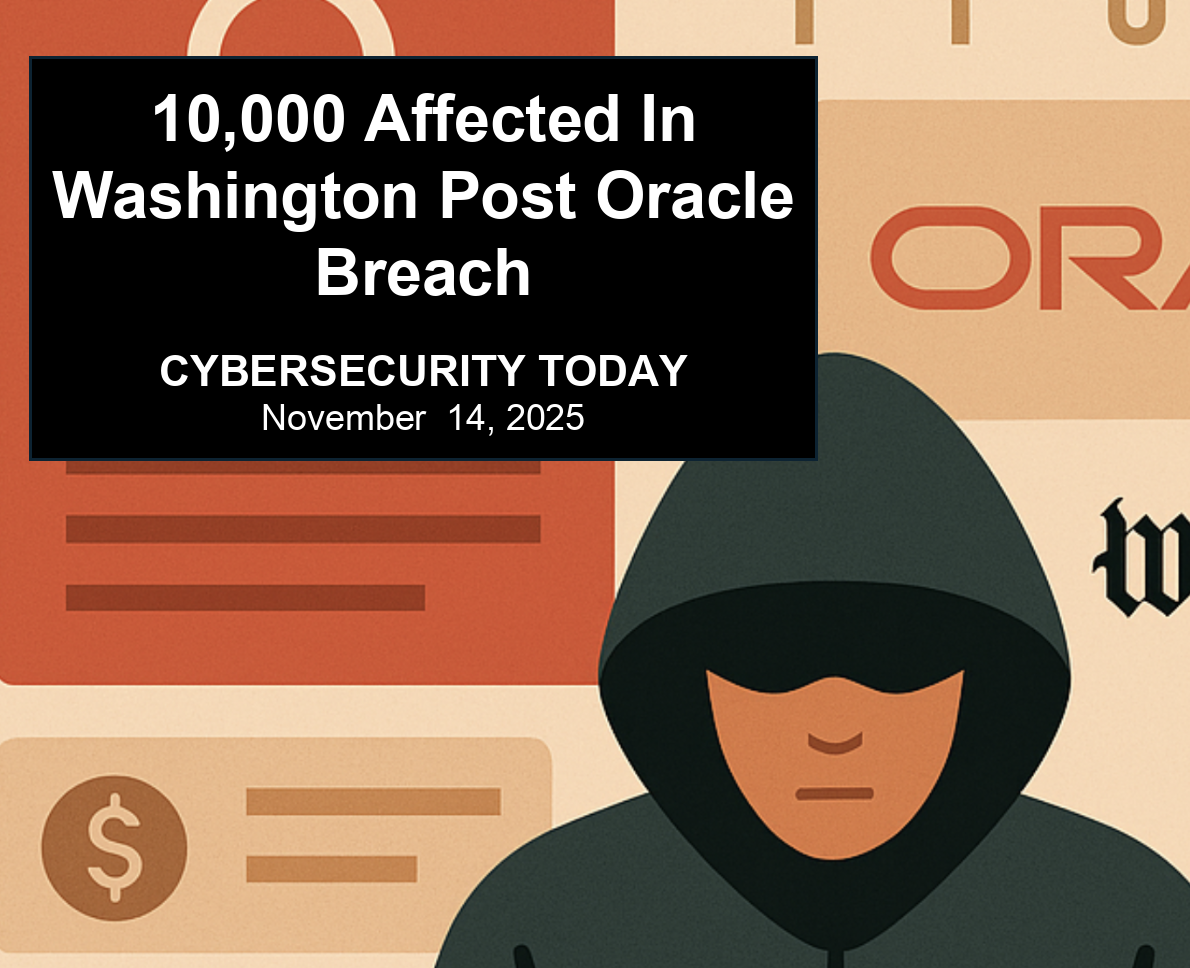
Cybersecurity Today
Cybersecurity Today: Oracle Breach, CrowdStrike Report, and New iPhone Scam
00:13:36
Loading summary
Transcript1 lines
- [00:01]
A
Cybersecurity Today would like to thank Meter for their support in bringing you this podcast. Meter delivers a complete networking stack, wired, wireless and cellular in one integrated solution that's built for performance and scale. You can find them@meter.com CST the Washington Post has 10,000 affected by an Oracle breach, CrowdStrike's global threat outlook, a new lost iPhone scam, and a listener reaches out with concerns about Sonic Wal. This is Cybersecurity Today. I'm your host Jim Love. Let's get into it. The Washington Post has confirmed that nearly 10,000 current and former employees and contractors had personal information stolen after attackers breached the newspaper's Oracle E business suite environment earlier this year. In a filing with Maine's attorney general, the Post said it was contacted on September 29 by an individual claiming to have accessed its Oracle system. An internal investigation later verified the intrusion and linked it to a previously unknown Oracle EBS vulnerability that has been exploited across multiple organizations worldwide. The filing says attackers accessed the system between July 10 and August 22, stealing data that included names, bank account numbers, routing numbers, Social Security numbers and tax identification numbers. The Post determined the scope of the breaches on October 27th and began notifying almost 10,000 affected individuals. Those whose Social Security numbers or tax IDs were taken have been offered identity protection services. This incident is part of a larger campaign attributed to the Clop ransomware group, which has posted alleged victims on its leak site. Confirmed disclosures so far include GlobalLogic, a Hitachi owned engineering firm that reported more than 10,000 of its staff impacted, and Alliance UK researchers also expect more announcements in the coming weeks as organizations review their Oracle logs. Estimates of the scale of the campaign vary widely. Some security analysts say dozens of companies have been affected, while others warn the total may exceed 100 based on the number of EBS environments seen communicating with attacker infrastructure. Oracle acknowledged the flaw in late October and issued emergency patches, but it has not said how many customers were affected or how long the bug had been exploited. Researchers believe the vulnerability may have been used at scale for several months. CrowdStrike's 2025 Global Threat Report paints a clear picture of a threat landscape moving faster, operating more quietly and acting more like modern businesses than traditional hackers. The overarching theme is the rise of the enterprising adversary attackers who organize, scale and innovate with the efficiency of legitimate enterprises. The biggest shift is in the dominance of malware free intrusions, which now account, according to the report, for 79% of all detections. Attackers are using valid credentials social engineering, remote management tools and cloud misconfigurations to enter networks without triggering classic antivirus alerts. Breakout times the moment an attacker pivots deeper into a network hit a new low of 48 minutes on average, but the fastest observed was 51 seconds. Social engineering has entered a new phase. Vishing attacks surged 442% with attackers impersonating IT staff using spam bombs to create urgency and leveraging tools like Microsoft Teams or Quick Assist to gain access. Help Desk impersonations also expanded, with adversaries calling support lines to reset MFA and take over accounts. Generative AI is now a mainstream adversary capability. Threat actors are using it to craft convincing phishing emails, run influence operations, automate coding tasks, create deep fakes for fraud and even draft early stage exploit code. A single large language model generated phishing study showed a click through rate of 54% compared with 12% for those written by humans. Nation state activity is also escalating. China linked intrusions are up 150% with some industries seeing 2 to 300% more activity than last year. China's operations show increasing specialization, stronger opsec and a heavy use of massive orb proxy networks. Meanwhile, North Korean or DPRK actors continue to grow their revenue generation schemes including sophisticated insider operations using fake developer identities and job interviews. Cloud intrusions are climbing as attackers target identity systems and SaaS apps. Valid credential abuse accounts for 35% of cloud incidents and multiple groups now pivot directly into cloud control planes to steal data or deploy ransomware. Attackers are increasingly exploiting SaaS tools such as SharePoint communication platforms, credential managers and SMS distribution apps to conduct further phishing and lateral movement. Vulnerability exploitation remains aggressive, especially against network appliances. Threat actors are chaining multiple CVEs and abusing built in product features to achieve remote code execution. Palo Alto Networks, Cisco Infrastructure and Microsoft components were among the most targeted, with exploitation often beginning within 24 hours of disclosure. CrowdStrike concludes that 2024 marked a turning point. Adversaries are maturing faster than defenders. The report recommends identity first security, cloud native monitoring, rapid patching, cross domain visibility and intelligence driven defense as the only sustainable countermeasures. There is a link to the report in our show notes@technewsday.com or CA. Just go to the Podcast tab. You may have to register to get the report. Criminals are now using a new phishing scheme to target people who've lost their iPhones, sending messages that imitate Apple's device recovery alerts to steal user credentials. The scam takes advantage of the information a user displays on a lost iPhone's lock screen. Attackers copy those details, including the phone model, color and the contact number provided by the owner, and send a text message or imessage claiming the device has been located. The message includes a link to what appears to be an official Apple page, but instead it leads to a counterfeit login site designed to harvest Apple ID usernames and passwords. Once attackers obtain those credentials, they can attempt to remove the activation lock that prevents a stolen phone from being reused. The Swiss National Cybersecurity center says messages can look convincing, especially when they reference the correct device information. The agency noted that Apple does not send text messages to report a recovered phone and urges users to avoid clicking links in unsolicited notifications. The advisory recommends enabling lost mode through the Find My app, protecting the SIM card with a pin, and ignoring any external login prompts received after reporting a device missing. And finally we got an email from a listener. It went like this. Several weeks ago you reported on a story involving SonicWall where a breach of MySonicWall cloud backup service exposed customer data. SonicWall originally stated a small set of customers were impacted, less than 5% with limited data exfiltrated, but soon after were forced to publicly admit all customers and all hosted data was actually taken as a SonicWall customer. We immediately reached out when we heard the initial less than 5% impacted news reported. Thank you again to Cybersecurity today and we're told to immediately reset all credentials, rotate all device tokens, reset all configs, and consider moving to a secure private appliance for device management until the root cause of the breach is found and fixed. We took that very seriously and immediately engaged SonicWall Enterprise support to assist with deploying Sonicwall's private management appliance in a closed network configuration as directed by Sonicwall, while performing all remediations as directed. During the on prem NSM appliance deployment with Sonicwall support, we discovered several shocking issues that underscore just how poorly many traditional firewall and security product managers manage their own product safety and development. The first was all SonicWall management devices and systems must enable and use the default user admin. You cannot change the admin login names and the account must remain enabled at all times. This obviously creates a ridiculously insecure profile where all bad actors already know the highest level management account name of all SonicWall devices and simply have to work that single user's password to gain access. This most likely explains why all Sonicwall devices are constantly being password sprayed online. And second, you must disable all MFA on all devices you wish to manage with Sonicwall's NSM appliance in order to allow them to be managed. This effectively removes the only backstop between a bad actor successfully gaining access to the well known admin account creds on every device and using them to take the devices over. We were told that these issues have been known for a long time and are all in Sonicwall's future development plans to remediate, but for now it's what you need to do if you want to manage your Sonicwall estate with a Sonicwall private management appliance. NSM and we could add our voice by submitting a future product feature request in response to our checking with this, the same person was able to provide us confidentially with copies of the correspondence to show that Sonicwall was aware of these issues. The company said it received verbal assurances that these concerns are being addressed, but nothing in writing. Doing our due diligence, we submitted these questions to Sonicwall. We gave them three full days before going forward with the story. We have not yet heard anything back. We will gladly post their reply when and if we receive it. And that's our show. If you've got a story that you think we should cover a concern that you have, let me know. Reach me at thetechnewsday.com or CA. Contact us form Catch us this weekend when we bring back researcher Tammy Harper for a conversation where she shares some of her ideas about where cybercrime is and is going. Spoiler alert. We won't have all the answers, but we might give you some things to think about. And once again, we'd like to thank Meter for their support in bringing you this podcast. Meter delivers full stack networking infrastructure, wired, wireless and cellular to leading enterprises. Working with their partners, Meter designs, deploys and manages everything required to get performant, reliable and secure connectivity in a space. They design the hardware, the firmware, they build the software, they manage deployments, and they run support. It's a single integrated solution that scales from branch offices, warehouses and large campuses to data centers. You can book a demo@meter.com CST that's M-E-T-E-R.com CST I'm your host Jim Love. Thanks for listening.