Loading summary
Transcript82 lines
- [00:01]
Narrator
This episode is brought to you by Progressive Insurance. Do you ever find yourself playing the budgeting game, shifting a little money here, a little there, and hoping it all works out well, with the name your price tool from Progressive, you can be a better budgeter and potentially lower your insurance bill, too.
- [00:16]
Advertiser
You tell Progressive what you want to.
- [00:18]
Narrator
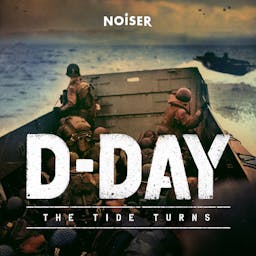
Pay for car insurance, and they'll help you find options within your budget. Try it today@progressive.com progressive casualty insurance company and affiliates price and coverage match limited by state law not available in all states. It's dawn on the 6th of June 1944, just before 6:30 hours. We're in a landing craft, a Higgins boat, a few hundred yards off the Normandy coast. Soaked to the bone and freezing cold, the men are packed in like sardines. Over the past two hours, their flimsy boat has been tossed around like a cork on the rough sea. They're knee deep in seawater and puke. They clasp their M1 rifles tightly, check their gear. Some clutch a crucifix, others draw on a lucky strike. Maybe there's a glance at a photo of a sweetheart sitting low in the water, listening to the heavy chug of their diesel engines. These 30 odd men have little sense of the bigger picture of the bombers coming in, of the heavy barrage of the naval guns, the screaming volleys of rockets. They just want to get the hell out of this stinking bathtub, some avoiding their bowels. These men are the soldiers of the U.S. infantry's 1st Division, the big Red One. They're battle hardened veterans of North Africa and Italy. They've seen some stuff, but they've never gone into combat like this. The landing craft slows, pitching and rolling. Higgins boats are made of plywood, though the ramp at the front is solid steel. A tattoo of bullets wraps against it like hail against a window. The lieutenant counts down the seconds. Finally, it's here. 0630h hour. Okay, he yells. Here we go. It's got a folksy name, this beach Omaha. It conjures images of Midwestern wheat fields, mum's apple pie. But as Big Red are about to discover, this Omaha is the ninth circle of Hell from the Noiser Network. This is D Day. Of all the D Day operations, nothing has captured the imagination like Omaha. Equal parts horrific and heroic, this battle for six miles of shoreline has been popularized in epic works of cinema, from the Longest Day to Saving Private Ryan. Today, its broad curve of sand couldn't be more tranquil. A stretch of pristine Norman coastline between the Vere river and the sleepy fishing village of Port en Bersin. There are military cemeteries, of course, flags, museums, memorials embedded into the cliffs. Remnants of the old German bunkers are overgrown, long since reclaimed by the land. On a summer's day, with the trawlers bobbing in the distance, children playing on the sand, the coast is how it always was before that June day eight decades ago, which turned this idyllic beauty spot into a killing field. It's American General Oma Bradley, in charge of U.S. first army, who is responsible for taking Omaha and D Day. He is the one who gave the beach its homely name in honor of a young private from Omaha, Nebraska, who was fitting out his headquarters. But there's nothing warm and fuzzy about what his troops will find there. Allied intelligence reports thousands of mines and tank traps, hedgehogs, Belgian gates, antipersonnel devices, not to mention the notorious Rommelschwargel, named for the German general charged with defending Normandy. Historian and author Giles Milton.
- [05:04]
Giles Milton
The first thing that the Allied troops would see were these things called Rommel's asparagus. And these were essentially poles that had been stuck into the sand and were topped by mines. And the idea was that as the landing craft came in towards the beach, they would hit these poles and blow sky high.
- [05:24]
Narrator
Landing at low tide should expose the submerged mines and obstacles laid by the Germans, meaning the boats won't be blown out of the water. But it's a trade off. Dr. John Curatola is a former US Marine and now senior historian at the National World War II Museum in New Orleans.
- [05:46]
Advertiser
The problem with Omaha beach is the fact that if you wait until the tide is out, that means you can avoid some of the mines and other obstacles that are put in the surf zone. But by the same token, that means those soldiers have to traverse that surf area wide open. To cross about 300 yards of open terrain while the enemy is shooting at you is significant.
- [06:15]
Narrator
The curve of the shoreline also gives the Germans a tactical advantage. They are able to fire on the Allied troops from multiple angles, enfilading them in military parlance, or, as is more commonly known, crossfire. The high cliffs are studded with strongholds, bunkers and machine gun emplacements, what the Germans call Wiederstandnester or resistance nets. They bristle with weaponry designed for industrial level slaughter. 88mm artillery guns, howitzers, mortars and embedded tank turrets known as Tobruks. On the shop floor, meanwhile, are the MG42s, the meat grinders, Hitler's buzz saw machine guns that can spit steel tipped bullets at 1300 rounds a minute. The largest of the D day beaches, Omaha, has been divided into four landing areas, labeled alphabetically. They are Charlie, Dog, Easy, and Fox. Each one of these is partitioned into three sectors. Green, white and Red. And the allied invaders know exactly what they're up against. They've studied carefully sculpted models of the coastline. They've observed every nook and cranny. The sea wall 10ft high, the rough gorse beyond. The sand, the cliffs, not sheer, but steep, a hundred feet or so, offering a slow, stumbling climb. They know the terrain so well that when they go ashore, their movements will be instinctive, something they could do in their sleep. Well, that's the theory. Either way, the men assigned to Omaha are some of the best. The 16th Regiment of the 1st Division, the big Red one, nicknamed for the bold scarlet numeral on their shoulder patches, are proven fighters, one of the army's most celebrated units. They'll be accompanied by men of the 116th Regiment, 29th Division. Most of them are untried, many straight out of high school, though inexperience can be an advantage. Too eager to prove themselves, they have what's known as a high risk threshold. And they'll be backed by two battalions of crack troops, the famous US Rangers. The assault force comprises 43,000 men who will be arriving in hourly waves throughout D Day. The first wave, 14,000 strong, will come ashore in 200 odd landing craft following a ferocious artillery bombardment. Though no one would admit this at the time, it's pretty much the tactics of World War I. Soften up the enemy with big guns and then charge across no man's land to meet them. When you think about super successful businesses that are selling through the roof, like Heinz or Mattel, you think about a great product, a cool brand and brilliant marketing. But there's a secret.
- [09:35]
Sir Max Hastings
The business behind the business making selling.
- [09:37]
Narrator
Simple for them and buying simple for their customers. For millions of businesses, that business is Shopify. Upgrade your business and get the same checkout as Heinz and Mattel.
- [09:48]
Sir Max Hastings
Sign up for your $1 per month.
- [09:50]
Narrator
Trial period at shopify.com promo all lowercase go to shopify.com promo to upgrade your selling today. Shopify.com promo Ryan Reynolds here from Mint Mobile. I don't know if you knew this, but anyone can get the same Premium Wireless for $15 a month plan that I've been enjoying. It's not just for celebrities. So two do like I did and have one of your assistant's assistants switch you to Mint Mobile today. I'm told it's super Easy to do@mintmobile.com Switch upfront payment of $45 for 3 month plan equivalent to $15 per month required intro rate first 3 months only, then full price plan options available. Taxes and fees, extra fee. Full terms@mintmobile.com in the early hours of D day, Allied soldiers pile into their Higgins boats and prepare for the short journey to the shore. Frank DeVita was Gunner's Mate third class on the USS Samuel Chase. Just 18 years old, he would make 15 landings on Omaha Beach.
- [10:54]
Frank DeVita
We were 11 miles out because the Germans had a gun called the 88, which had a range of 10 miles. At 4:00 in the morning, we started dropping our boats in the water. We had 26 Higgins boats. We circled the ship one time, supposed to be good luck, and we headed towards the beaches.
- [11:19]
Narrator
Suddenly, the Allied guns open up, led by the battleship USS Texas, followed by a terrifying volley of rockets launched from barges. For the men about to go ashore, the deafening bombardment is a morale boost. Donald A. McCarthy was drafted into the 116th from high school.
- [11:41]
Donald A. McCarthy
Kind of removed the fear that we had because we figured, gee, this is going to be easy. The excitement of seeing the rocket ships throw the stuff in. We figured this should be a piece of cake going in.
- [11:55]
Narrator
Right on cue comes the rattle of bullets pinging off the metal ramps of the Higgins boats. All around, the sea is exploding in great geysers. The soldiers are nauseous, sleep deprived, soaked through and scared as hell. Hardly the best condition for going into battle.
- [12:18]
Giles Milton
It's horrible, it's violent, it's bloody, it's terrifying. And then as the landing craft come into the shore, the ramp goes down. And this is the moment of truth. This is when you're going to run up that beach and you're going to come under machine gun fire. This is the most terrifying moment of all. This is what the men have trained for, but nothing quite prepares them for that moment.
- [12:39]
Frank DeVita
They give me the job of dropping the ramp. We only go about 200 yards from the beach. That's as close as we could get. And the machine guns opened fire on us and the bullets were bouncing off the ramp. So the coxswain says to me, drop the ramp. I never heard him because the roar of the cannons, two big diesel engines in the back of the boat, never heard him. Then the second time he says to me, drop the ramp. And I froze for a few seconds because I didn't want to die. And then he said to me, he says, God damn, DeVita dropped the effing ramp. So I Had no choice. I dropped the rip. The machine guns opened up fire. Killed about 14, 15 troops that were in the front of the boat. I was about 3/4 of the way back. I had soldiers in front of me. They were absorbing the bullets. But I had two stragglers. They didn't want to die. They stayed with me. They thought by staying with me they'd be safe. Unfortunately, by staying with me they would draw on fire from the hilts. The first guy got hit, ripped his stomach open. And the other guy that was 2ft away from me, he was a red headed kid. The machine gun took his helmet off and part of his, his brain, a part of it. And he was crying, help me, help me, help me. Had no morphine. I couldn't help him. So he fell at my feet. Excuse me if I get a little emotional. He fell at my feet and he was crying, help me, help me, help me. I had nothing in my kit to help. So the only thing I had was the Lord's Prayer. And I started praying, Our Father who art in heaven. I never finished it.
- [14:48]
Narrator
It's total chaos, carnage. Men are being ripped to shreds. Those that aren't huddle behind tank traps, the bullets zinging all around them. For the more seasoned soldiers, Omaha is about as bad as they expected.
- [15:09]
Advertiser
29Th Infantry Division. We have a gentleman who's in the first wave with Alpha company with the 116th Regimental Combat Team. And his commanding officer tells him, maybe one in three of you are going to live. And the same individual actually writes his sister. And he tells his sister, if you see the Western Union man bringing a telegram to mom and dad, you meet him at the door, you break the news to mom and Dad. I don't want the Western Union man to break that news.
- [15:44]
Narrator
Young or old, the soldiers going ashore right now have trained intensively for this moment. They're supposed to know the terrain like the backs of their hands. But what they're seeing in front of them isn't matching the objectives they've prepared for. Once again, the unpredictable weather in the Channel has thrown the Overlord plan into disarray. There's a 10 knot nor westerly wind, meaning that men are landing a thousand yards east of the targets they trained for. Those in command of the boats have been forced to improvise.
- [16:17]
Donald A. McCarthy
I was heading for one beach, the easy, green beach. But instead the coxswain, which is a British coxswain, told me we just ran out of space. We didn't have any place to put us. So they moved over and went From Easy Green over to Dog Red beach. And that's where I came in. At Dog Red.
- [16:35]
Narrator
From the bridge of the cruiser USS Augusta anchored offshore, General Bradley peers through his binoculars. He can see his men on Omaha are outgunned and out of position. And now comes a sobering piece of news. The U.S. heavy bombers intended to support the landing have also been affected by the weather. Nervous of hitting the boys on the beaches, they've played it safe and ended up dropping their payload three miles inland. So, Anthony Beaver, the visibility was still very bad on the 6th of June. They shouldn't have had cloud cover below 10,000ft. Well, in fact it was at 4,000ft. So the heavy bombers couldn't even see their targets. Meanwhile, the naval bombardment, which overall is landing more tons of TNT on Normandy than the Hiroshima bomb, has barely put a dent in the concrete. At Omaha, the battleships were making a huge amount of destruction, but it wasn't accurate. Bradley had high hopes for this combined bombardment. He promised his men a ringside seat at the greatest show on Earth. It's turned out to be anything but. And what about the other trick up the ally's sleeve? The inflatable tanks? The duplex drive vehicles take to the rough seas prematurely, 5,000 yards out from the shore. They simply aren't designed to float in this kind of weather.
- [18:10]
Giles Milton
The British realized this and they released them far closer to the beach than the Americans, who assumed they would still be okay in big waves.
- [18:20]
Narrator
Of the 64 tanks deployed at Omaha, half plummet straight to the bottom. Sir Max Hastings.
- [18:29]
Sir Max Hastings
The crews of those tanks were suicidally brave because down goes the ramp of their landing craft and they start driving into the sea. And the first one that drives into the sea, boom. Just disappears beneath the waves within seconds. And the second one does the saints. But they kept going.
- [18:47]
Narrator
It's not just the tanks that are sinking at low tide. Omaha is made up of sandbars carved by deep, fast flowing channels. When the Higgins boats grind ashore, what they've hit more often than not is the sand spit, not the beach proper. Men are wading into apparent shallows only to find themselves plunging suddenly into water up to 12ft deep, carrying over 60 pounds of gear. It's a struggle to stay afloat. And even worse for those carrying extra specialist kit.
- [19:23]
Donald A. McCarthy
As we were coming in, we struck another LCA that had sunk. We also hit a sandbar. The water was up to our waist. We swamped and the boat rolled over and we all went in the water. Fortunately, I got rid of my vest, got rid of all the stuff that I had with me, all I have on is my helmet, which I tied on tight. I got rid of the combat jacket, my rifle, everything.
- [19:46]
Narrator
All around, men are drowning. Some of them just inches below the surface.
- [19:52]
Donald A. McCarthy
Other guys had gone in with too much weight on them. And the next thing I noticed, his feet appearing. I grabbed one kid that was next to me that had already come up me, gone down and come back up again, and I grabbed him and used him as a shield, like a body shield, and we swam into the beach. The water was bloody and oily, and we were probably in about 10 or 15ft of water. And I swam the best I could. I got there, and it was brutal. The beach was just horrible. The smell, the stench was brutal. Burning tanks, everything.
- [20:29]
Sir Max Hastings
No amount of training, even with live ammunition, can prepare you for what it's like to be thrown into the white heat of battle.
- [20:45]
Narrator
Those that make it to the shore pinned down, disorientated, their companies all mixed up, look to their officers and squad commanders. Amid the hellfire of bullets, maps and binoculars are pulled out, and the German snipers deliberately pick off the leaders. John C. Ryan was a Captain in the 5th Ranger Battalion at Omaha.
- [21:12]
John C. Ryan
We passed landing control, which are boats, about 1,000 yards offshore, and they said, do not attempt to land. At Vierville. The casualties are 95%. Half of them killed land on Dog White Beach. So we shifted over and we landed our first wave there, two companies of the 2nd Battalion. And they were cut like everybody else on Omaha Beach. They were cut down to about 50%. All the officers killed or wounded.
- [21:48]
Narrator
With their commanders out of action, men seek out means of communication.
- [21:53]
Donald A. McCarthy
I saw this kid with a radio on his back, and I said, ha, ha, there's my savior. I started to walk down towards him, and there was an overhead burst took place. It hit him and it cut his arm off, and it destroyed the damn radio. And I went down to him, and a medic was with me, and we tried to pull him up, but his arm had been severed completely, and the kid died.
- [22:15]
Narrator
In the face of such horrors, some soldier's training deserts them.
- [22:23]
Sir Max Hastings
There on D Day were all these guys who never heard a shot fired in anger, and suddenly they find they're on a beach swept by machine gun fire and mortar fire, and they're seeing people's arms and legs blown off, and they're seeing terrible experiences all around them. And what's amazing is how many of them reacted very well but behave very bravely. But some of the others, when they find themselves being shot at, they threw themselves flat and lay on the beach, sort of waiting till the shooting stopped. And this was fatal. But they've been told again and again in training, they've been told, but your whole instinct when you're being shot at is to try and sort of dig a hole, literally. I mean, I remember reading one account, a guy who said he couldn't believe it. He was seeing people trying to dig holes in the water. I mean, below the tideline. And you think this is unbelievably stupid, but when you're frightened and you're not very experienced, you don't know much, you do stupid things.
- [23:26]
Narrator
Out at sea, General Bradley is a helpless, frustrated spectator. He weighs his options. Best estimates suggest the first wave has sustained over 80% casualties. Thirty minutes later, the second wave suffers 50%. The third wave has been held up by wreckage in the water, not to mention the sheer number of dead bodies. Bradley consults his staff officers. Can they call it off? Evacuate? Send the rest of their men to the other beaches instead? But the General knows that allowing Omaha to fail is not an option. It would leave a huge gap in the Allied plan, isolating the US forces at neighbouring Utah and seriously jeopardizing Overlord's right flank. What Bradley doesn't realize, despite his lofty view in the gallery, is that on the ground, things are already starting to improve. The situation is changing by the minute, and the General is behind the curve, because at the western end of Omaha beach, there's a glimmer of hope. Here, a huge promontory, Pointe du Hoc, dominates the coastline. Smacked between Omaha and Utah beaches, it hosts a battery of six 155mm guns. Not only can they hit anything this side of the horizon at sea, they can also wreck devastation on the beaches either side. For weeks, Allied planes have been bombing the position, but in vain. The ground around the battery is heavily cratered, but the battery itself, according to aerial reconnaissance, it remains operational. Lieutenant Colonel James E Rudder of the 2nd US Rangers has been given a simple order by his Take Point du Hoc and hold it. The instruction is delivered as nonchalantly as a request to a waiter for a cocktail. But this operation is a tricky one, requiring specialist expertise. It's not just that the guns are dug into impregnable concrete bunkers, surrounded by fearsome defenses. It's that the only way to access Pointe du Hoc is to scale its 90 foot high vertical cliffs.
- [25:59]
Advertiser
At New Balance, we believe if you run, you're a runner, however you choose.
- [26:04]
Narrator
To do it, because when you're not.
- [26:07]
Advertiser
Worried about doing things the right way. You're free to discover your way.
- [26:13]
Frank DeVita
Coming Be a winner.
- [26:18]
Narrator
And that's what running's all about.
- [26:20]
Advertiser
Run your way@newbalance.com Running this episode is brought to you by Lifelock. It's tax season, and we're all a bit tired of numbers, but here's one.
- [26:33]
Narrator
You need to hear.
- [26:35]
Advertiser
$16.5 billion. That's how much the IRS flagged for possible identity fraud last year. Now here's a good number. 100 million. That's how many data points Lifelock monitors every second. If your identity is stolen, they'll fix it. Guaranteed. Save up to 40% your first year at lifelock.com podcast terms apply.
- [26:58]
Narrator
At just after 0730, Companies D, E and F of the 2nd Ranger Battalion are in their landing craft, approaching the narrow shelf at the cliff base. Once they're spotted, the Germans unleash havoc. But the Rangers are tough in one landing craft. Raked by enemy gunfire, they break off to sing Happy Birthday to one of their number. These boats are cumbersome, slow and exposed, though they are at least made of metal. This is as far as I can get you, yells the Royal Navy coxswain before discharging the men onto the rocks. Taking hits from the Germans. Firing straight down, the Rangers pull themselves in under the overhang. At least here they have one thing that the men on the beach don't cover. For now, anyway. Hampered by mortar fire, Colonel Rudder addresses his men, all 216 of them. Now, come on, Rangers, show them what you're worth. Grappling hooks are fired. Men begin shimmying up ropes. Some carry extra long ladders they borrowed from the London fire Brigade. From the cliffs, the Germans fire down on them. But the Rangers climb and climb and climb. Some drop suddenly down onto the rocks below when an enemy knife cuts through their line. But against astonishing odds, the first men get up and over, issuing covering fire, while their comrades are hauled up behind them.
- [28:40]
John C. Ryan
First man up the cliffs was up in something like 51 seconds. He was a marvelous athlete. He climbed up some 30ft and was in the bottom of a bomb crater, had a rope with him, threw the rope out, and all of a sudden he was building up members of his.
- [28:59]
Narrator
Squad, leaping into trenches, hurling grenades through the slits of bunkers. The Rangers storm the German defenses. But when they reach the big guns, which have remained curiously silent until now, they find something surprising the huge barrels poking out beneath the camouflage netting. They're made of wood. Fake. The real ones are found soon enough, unmanned, hidden away in the Hedgerows, one of the Rangers spikes them with explosives. By 9am the battery at Point Du Hoc has been neutralized. But it remains a valuable vantage point, commanding clear views of both American beaches. When German reinforcements arrive, the Rangers will have to hold it on their own in the face of horrendous counter attacks. For two whole days. Out of the 200 odd rangers who set out to scale the cliffs, nearly half 90 men didn't make it. But with the stars and stripes flying from the clifftop, it's a symbolically significant victory. Meanwhile, on the western half of omaha beach, the 116th Regiment are sustaining heavy losses. Some, though, have made it as far as the sea wall. They huddle there for protection, and the tide is now on the turn. Thanks to a shallow incline, the sea comes in fast. At Omaha, the kill zone on the beach is rapidly shrinking. But by the same token, the one point of refuge, the narrow strip along the base of the seawall, is getting awfully crowded. As the fog of war begins to lift, it's clear that not all of Omaha is carnage. Some sectors have borne fewer casualties than others. From the far eastern end, Fox Red comes word that the troops there, drifting beyond their landing point, have already linked up with the Brits at Gold. Meanwhile, operations at both British beaches, Gold and Sword, have been progressing according to plan. Now word comes in that the Americans at Utah are making headway as well. At the Canadian beach Juneau, losses are high. But by mid morning, the men there have taken some key objectives as well. Omaha is not about to be left behind. Along the sweep of sand, more and more men are inching forward, soaking wet. Wounded, disarmed, they just take their chances and run. And more and more are making it. Finding working radios, they're able to summon naval support. 11 Allied destroyers move closer in. Within 800 yards of the beach, in the shallows, almost scraping their hulls, they can aim their guns where directed inland. RAF typhoons and American P38s are coming in low to strafe German relief column. At 10am three and a half hours since U.S. forces first landed on Omaha, men from the 1st, 2nd and 3rd battalions of the 16th attempt to regroup an ad hoc force of nearly 200 soldiers. Colonel George Taylor utters a line that will go down in legend, he said.
- [32:43]
Sir Max Hastings
There are two kinds of people on this beach. There are those who are dead and those who are going to die. And everybody else that they're smart had better get off it. And this was absolutely true. And all the smart people, they dashed up the beach and sure, they saw their mates wounded and killed, they saw all these terrible things going on around, but they kept moving.
- [33:03]
Donald A. McCarthy
Colonel Cannon, who was my regimental commander, had come along in the smoke and said, okay guys, get off the beach, get your ass up here, get up to the beach and run. And we did.
- [33:15]
Narrator
The big Red one is seizing the initiative. Taking advantage of a screen of billowing smoke, they crawled towards the bluffs, the steep hills at the back of the beach, on top of which sit the German strongpoints. For all the planning and rehearsal they've been through, the most successful troops are those who were able to improvise.
- [33:38]
Giles Milton
D day was a highly complex operation. It's been meticulously planned. But of course, what happens when, when you get underway, everything goes wrong.
- [33:47]
Narrator
It's the old story, you know, no plan survives contact with the enemy.
- [33:53]
Giles Milton
And this is where the intense training that the men had been through really played into their favor.
- [33:58]
John C. Ryan
The preparation was very good. The preparation was so good that when we landed one mile from where we were supposed to, one of my sergeants said, you know where we are, Captain? And I said, sure. The only place there's a wooden seawall is at Les Moulins. And turned out that's where we were, one mile exactly from the Vierville exit.
- [34:23]
Narrator
As the soldiers advance, the Germans inflict horrific damage. But they can't stop the steady stream of bodies moving up the beach. And the casualty rates are falling. It 80% in the first wave, 50 in the second. But by the time the third wave arrives, somewhat belatedly, just 20% of men are killed or injured. It might sound callous, but in the end, this is a numbers game. The German generals are like King Canute trying to turn back an unstoppable human tide. General Bradley, meanwhile, has been putting more of his own commanders in the field.
- [35:11]
Giles Milton
What he does is he calls upon the services of two brilliant, experienced military men, General Norman Cotter and Colonel Charles Canham. And he sends them ashore and he says, you gotta rally the men. And so these two men, they go ashore, absolutely fearless.
- [35:31]
Narrator
51 year old Norman Kota, Dutch to his mates, strides forward like a character out of a movie, brandishing his gleaming Colt.45.
- [35:41]
John C. Ryan
And they said, hey Cap, who's that guy down there on the beach? And I looked down the beach and here was a little old fat man. He was just at the very far edge of the beach where the dunes began. And I said, I don't know. He's either a crazy reporter who doesn't know what he's doing or he's a high ranking officer who does know what he's doing because he was gesticulating to the troops and waving at him and shaking his fist. He had a cigar in his mouth. And as he moved, the 29th Division troops started up the bluffs finally, and it took him about two minutes and he finally got to my position. I did a snappy hand salute, which he returned and I said, Sir, Captain Ron, 5th Ranger Infantry Battalion, we've just landed on this beach. And he said, well, welcome to Omaha Beach. But as he was leaving, he turned to my troops and said, you men are rangers. I know you won't let me down.
- [36:50]
Narrator
Kota snatches a bangalore torpedo, a bazooka like missile launcher, and blows a hole through the German barbed wire. Twirling his shooter like a western gunslinger, he steams out in front. His bastard brigade, as they will become known, scurry after him. By 11am Vieville is in US hands.
- [37:17]
Sir Max Hastings
In the end, Omaha was won by a relatively small number of very brave Americans who pushed their way forward, pushed these bangalore torpedoes to blow up the barbed wire, and then inched their way up the bluffs to take out those German positions.
- [37:34]
Narrator
Titanic ship of dreams. The new podcast from the award winning Noiser Network. Join me, Paul McGann, as we explore life and death on on Titanic. I'll delve into my own family story. Following my great uncle Jimmy as he tries to escape the engine room. We'll hear the harrowing tales of the victims and the testimonies of the lucky survivors.
- [37:56]
Sir Max Hastings
I saw that ship sink and I.
- [37:58]
Narrator
Saw that ship break in half. Titanic ship of dreams. Listen wherever you get your podcasts. By late morning, more and more men are reaching the tops of the bluffs. The defenders are starting to come out with their hands up. And there's something odd about these prisoners.
- [38:19]
Donald A. McCarthy
I saw a Ranger coming down with a couple of Jerrys. I can remember looking at them and they seemed to be either, you know, Japanese or Mongolians or something, but they weren't, you know, blue eyed, blonde Germans.
- [38:31]
Giles Milton
A lot of the men who were manning the defenses, they were what was known as OST battalion. These were not ethnic Germans. These were often ethnic Poles or even people from various areas of Russia, from the Caucasus, from Tajikistan, from Kazakhstan. They were people who were fighting with the Germans not because they liked Hitler, because they detested Stalin.
- [38:57]
Narrator
It's been a day of devastation. There are bodies everywhere, on the sand, in the water, as well as those poor souls who never got off the landing craft. Frank DeVita's boat has been ferrying the wounded away, going back and forth, back and forth, back and forth.
- [39:16]
Frank DeVita
They brought my boat up. It looked like Swiss cheese. The machines had decimated it. I'm saying to myself, how the hell did anybody live off that boat?
- [39:29]
Narrator
By 1pm on D day, barrage balloons are flying at Omaha Beach. Engineers are building makeshift roads. Trucks and equipment are pouring ashore. Inland, the east west coast road is secure. By evening, 30,000 men have landed, establishing a bridgehead that has grown to six miles wide and up to two miles deep, just part of a broader Allied front stretching more than 50 miles along the coast. Professor Jeremy Black Omaha is, in the end, a success.
- [40:11]
Sir Max Hastings
You know, there are casualties, which of course is what happens in war, but it is a success. By the end of the day, the German positions have been taken. The beachhead is more shallow than the beachhead for the other beaches, which is a concern. But because there are beaches to east and west that are in Allied hands, there is that, as it were, room of support for Omaha. The harder battle, in many senses lay ahead.
- [40:43]
Narrator
It's difficult to confirm exact figures for the Omaha assault. Estimated casualties range from 2,400 to almost 3,700. The carnage inflicted on the first wave is without doubt among the worst of the entire war. Those who survived it can scarcely believe their luck.
- [41:04]
Sir Max Hastings
I've read many, many personal accounts in which men wrote in their diaries or letters afterwards, and they said what we remember as evening came on D Day, we were just so amazed that we were still here. We thought we were going to be dead.
- [41:18]
Frank DeVita
And I said to myself, what the hell just happened and how come I'm still alive? How come I'm still alive?
- [41:29]
Donald A. McCarthy
I remember looking up to God and I yelled, God, no matter what it is you want me to do, I'll do it forever or the rest of my life.
- [41:41]
Narrator
In the decades that followed, Omaha beach has secured its place in American history, thanks in part to the magic of Hollywood.
- [41:52]
Sir Max Hastings
The battle for Omaha beach has commanded a disproportionate shower of 21st century attention, mostly because of Steven Spielberg and saving Private Rudd. It was important, but one has to remember it was one of five beaches that were stormed.
- [42:09]
Narrator
In fact, even to speak of Omaha beach as one thing is to generalize. Along that six mile stretch of coastline, there were areas where the fighting was less intense and others where it was hell on earth.
- [42:25]
Advertiser
There's actually kind of a spectrum with regard to the execution of these assaults where the Americans land. And I think that that narrative tends to get glossed over with the powerful imagery that we see you know, in the first 20 minutes of private Ryan, which, it's accurate and it certainly depicts what's going on, but it's not the full story of the entire American piece of this invasion.
- [42:51]
Sir Max Hastings
And in fact, even at Omaha, their.
- [42:54]
Narrator
Casualties were still less than what had been expected. And let's face it, fewer Americans were killed on D Day than French civilians. In fact, the Canadians, generally downplayed in the D Day story, lost more men pro rata on Juno beach than the Americans did on Omaha. And casualty figures on both beaches were well below expectations.
- [43:23]
Sir Max Hastings
One of the problems today is that the fascination with the face of battle approach to war doesn't encourage people to think strategically. Obviously, war is terrifying. Obviously casualties are horrific. At the individual level, people's sons, fathers, brothers, husbands are dying and often being seriously injured. This is really horrible. But you could say at a strategic level, to land a main invasion force in Western Europe at the casualty level of 1944 was actually quite an achievement. Omaha was the toughest moment of D Day for the Allies, but actually the price that was paid to get ashore on D Day, by the standards of the Russian front, it was nothing. The senior Allied commanders after D Day looked at the losses and thought, my God, we've established a beachhead in France, a secure beachhead in France, and It's only cost 3,4000 dead. They thought it was a sort of miracle, and we should think it was a sort of miracle, too.
- [44:49]
Narrator
In the next episode, we look at a very personal D Day story, that of my own father, Joe McGann. My brother Steve joins the podcast to talk about how D Day impacted our family and how one man's experience, experiences of combat that day, shed a light on the lives of hundreds of thousands more. That's next time. Special thanks to the American Veterans center for their partnership in highlighting the real stories from Omaha Beach. Visit their YouTube channel for more interviews and stories.