← Dan Carlin Hardcore History Archives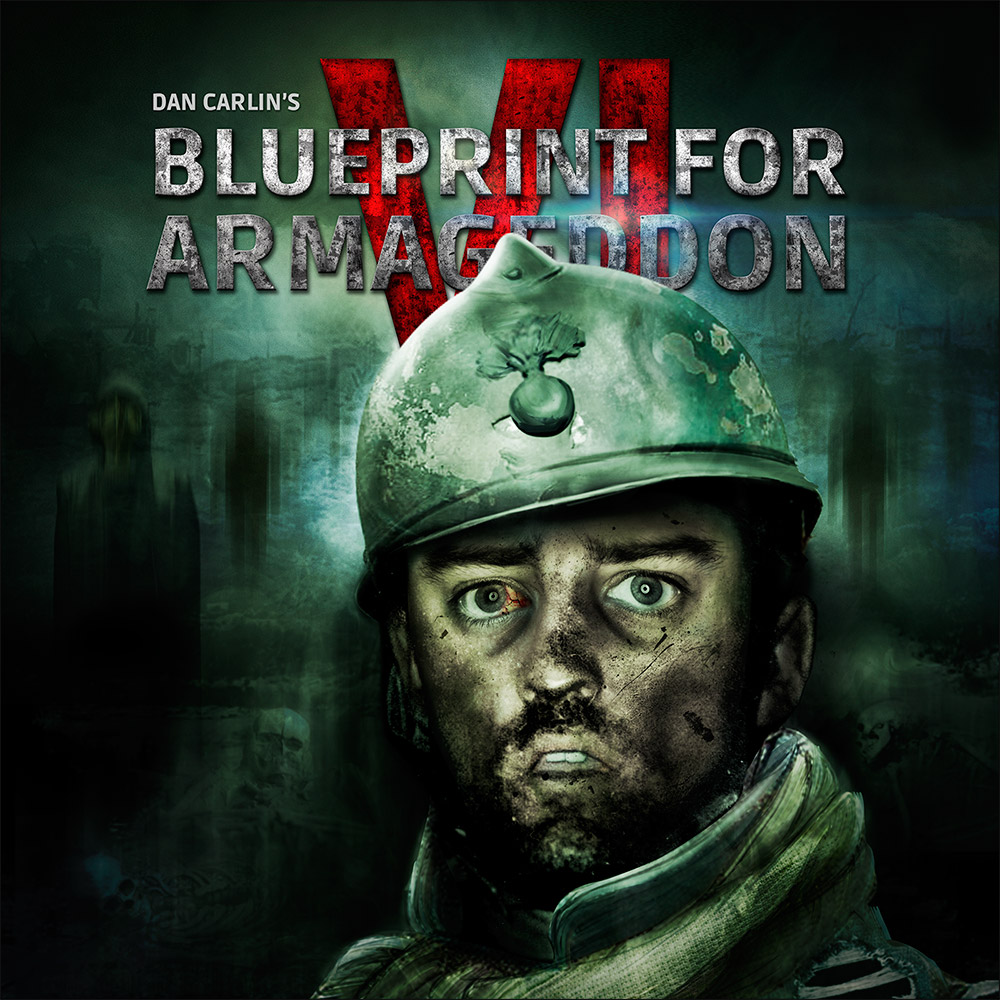
Loading summary
Transcript1 lines
- [00:00]
A
What you're about to hear is the sixth and final part of a six part series on the First World War. Traditionally, we suggest people listen to them in order, but I realize not everyone's traditional and there may be a few historical dyslexics out there. And if that's the case, it might not matter to you the order you listen in. If that's the case, please feel free to jump right in. And for those of you who've heard the previous episodes, welcome back to part six. As we said, the final part, not counting an extra show of blueprint for Armageddon. December 7, 1941, a date which will live in infamy. It's history. One small step for man, one giant leap for mankind. The events, The figure have signed it out. From this time and place. I take pride in the words ish bin ein Bialina. Mr. Gorbachev, tear down this world. Marine Six. Now it too has had a major explosion and what appears to be a complete collapse surrounding the entire area. I welcome this kind of examination because people, people have got to know whether or not their president's a crook. Well, I'm not a crook. If we dig deep in our history and our doctrine and remember that we are not descended from fearful men, it's hardcore history. What's the most dangerous weapon in the world? I've had this discussion many times with many people and I've seen it go all over the place. But generally you focus on nuclear weapons because that's an obvious thing to put, you know, in the number one spot for most dangerous weapon in the world. But there are some that are a little bit more insidious and potentially worse. Take for example, biological weapons. Think about some of the worst plagues that have ever infested mankind. Now imagine human ingenuity in a laboratory used to make such plagues worse. And now imagine releasing those upon your enemy. The reason they're so extra dangerous is because of the way they spread and the fact that once you open the Pandora's box of biological warfare, you generally lose the ability to shut the box again. You may exchange a few nuclear weapons with an opponent and decide to stop. Once you open up that box and unleash super small pox or what have you, you can't turn that off again. Another reason it's very dangerous is that super smallpox doesn't differentiate between the people you targeted and everyone else that it may spread to. It's a bit of a doomsday device when you think about how something like that could backfire on the very people who decide to use it. It's a little like deciding to get rid of your next door neighbor in your apartment complex by burning down his place. The potential for the fire to hurt you is very real. But sometimes, if you've run out of options, gambling like that might make sense. In late 1917, where we are in this story, even though we've been using sliding timescale, that's about where we are in late 1917. The Germans are desperate enough to try all sorts of things, including the equivalent of biological warfare. But instead of using some sort of contagious disease, they're using contagious ideas. But you might be able to make a case that in this situation, an actual disease would have been preferable. Whenever I think about this idea, I think about Napoleon, the famous French emperor from late 1700s, early 1800s, who was such a force in Europe. Napoleon was someone who spread an intellectual contagion. And I remember professors in college suggesting that this was the thing that scared the kings and czars and emperors of Europe the most about Napoleon. Because Napoleon arose in the wake of the French revolution, the era where Frenchmen were infused with these ideas of revolution, of equality, of republicanism, all these things that seem relatively moderate to people today, even beneficial, but those were the scariest things on earth to people who were kings and emperors and czars. And many of them figured that they would eventually be able to throw the French out of these territories and get their thrones back, but they were less sure about their ability to cleanse their population of these dangerous, radical ideas that French occupying troops had spread to them. In fact, many historians believe that the famous revolutionary period in the middle 1800s was the blossoming of seeds that were planted by Napoleon's troops as they occupied all these countries, talked to the locals, and spread the equivalent of an intellectual contagion. Of course, if you're one of those types who would view the ideas of the American Revolution or the French Revolution, or the ideas of the thinkers who helped prompt those revolutions as a negative thing, then perhaps you would view the 1800s as an example, not of a seed flowering into some wonderful plant, but as a virus beginning to morph and mutate and evolve into new and maybe more dangerous forms. The 1800s is, up until that time period, almost certainly the greatest period for intellectual examination of forms of government that's ever existed. And part of it is because of the increase in communication and how people all over Europe can begin to have conferences and discussions and write for magazines and newspapers that each Other reads and have all sorts of attempts at trying to apply rationality and logic to the idea of government, because most of the governments in a place like Europe at this time period are things that have existed in one form or another for centuries. You know, someone in the distant past was a great military leader who establishes a dynasty who rules for hundreds of years. And no one ever really asks whether or not that's the right thing to do or whether or not it's smart or anything else. In the 1800s, people began to think, along with changes in science and all kinds of different things, that maybe people could come up with smarter approaches. There was wide disagreement, though, on what that smart approach might be. And some of the great figures of the 1800s who played roles in this would become extremely important figures in the 1900s. In fact, someone who was involved in trying to come up with a system that seemed to be an improvement over what Europe was living with in the 1800s explodes in importance in 1917, exactly where we are in this first World War story. He was renowned in his own day, within his own circles, but he certainly wasn't a household name. He becomes a historical superstar in 1917. And there's a little bit of irony to that, because in 1917, this figure's been dead 34 or 35 years. One of the best or one of the worst aspects of an idea, depending on whether you consider it good or dangerous, is the fact that it doesn't die with the originator. In 1917, all of a sudden, everybody starts hearing the name Karl Marx. Marx is often credited with being the originator of modern communism or Marxism. But I think that's probably giving him a little too much credit. After all, very few people come up with ideas out of nowhere. And Marx, like most people, stood on the shoulders of giants with his ideas. He was reading guys like the German philosopher Hegel and a lot of other people. But if a guy like Hegel's an example of the intellectual contagion, then Marx is an example of someone who mutated it further. And of course, perhaps the ironic tragedy of Marx is that Marx didn't get to be the implementer of his ideas. His ideas were adapted and morphed into different forms, like many figures from history. If you could go back and show Karl Marx how he's treated in the history books and the things he's associated with, I think he might jump off a bridge. There's a lot of figures like that who are remembered for things that are almost 180 degrees different than what they devoted their lives to working for Marx thought he was doing good. And yet today we think about his role in the deaths of tens of millions of people and the creation of some of the worst slave states in all human history. If you read Marx and find out what he was all about, that's exactly what he was hoping to prevent and stop and eliminate. If you could bring Karl Marx back from the dead and have him analyze where things went wrong, I wouldn't be surprised at all if he blamed a botched implementation for the way things turned out. We might argue that Marx's ideas from the get go were poor. But I think he would probably say that you never got a chance to see what he wanted because he wasn't the guy that built the house, he was the architect, maybe, or maybe the last guy to design blueprints. The guy who actually built the dwelling was a guy named Vladimir Lenin. And I'm reminded of a quote by the writer Aldous Huxley about how ideas end up influencing people. And it's not so much a question always of how many people, but who they are. Huxley wrote, quote, it is possible to argue that the really influential book is not that which converts ten millions of casual readers, but rather that which converts the very few who at any given moment succeed in seizing power. Marx and Sorrel have been influential in the modern world not so much because they were bestsellers, but because among their few readers were two men called respectively, Lenin and Mussolini. End quote. Vladimir Lenin is the hinge point between theory and application when it comes to modern day communism. He's the implementer. If Marx is the originator, then Lenin is the implementer. And he's a figure that combines some rather unusual qualities in one human being. Oftentimes the intellectual and the deep thinker and the philosopher is a different sort of human being than the person of action. Right? You've heard of the man of action and oftentimes they're two different kinds of people. Lenin is one of these strange individuals that possesses the qualities of both an intellectual and a person of action. And his dynamic abilities were recognized even by the people who were his opponents. Take for example the description of Lloyd George, the man who is the Prime Minister of Britain during really the second half of the First World War. George will write his memoirs in the 1930s and he will say this of Vladimir Lenin, he was a communist. But whilst fanaticism does not always endow its possessor with great administrative ability, it is not incompatible with a genius for government. And no one can doubt that Lenin was One of the greatest leaders of men ever thrown up in any epic, end quote. He then goes on to compare him to what he calls a plague bacillus. Lenin was certainly a fanatic. Most revolutionaries are people who tend to not see too many shades of gray. Things tend to be black and white. Winston Churchill famously defined a fanatic as someone who can't change their mind and won't change the subject. And Churchill had his own opinion of Lenin and once again it evoked this idea of an intellectual contagion. He also compared Lenin to some sort of bacteria and he blamed the Germans for unleashing it on Europe, playing an active role in implementing a form of germ warfare that would have horrible effects down the road. Churchill wrote, quote, lenin was sent into Russia by the Germans in the same way that you might send a file containing a culture of typhoid or cholera to be poured in the water supply of a great city. And it worked with amazing accuracy, end quote. That brings us to the third person who was very important in implementing this intellectual contagion warfare kind of approach, the facilitator. If Marx is the originator and Lenin is the implementer, Lenin needed some help to get to the point where he could infect, if you will, anyone. In the beginning of 1917, Vladimir Lenin is in exile. He's living in Switzerland next to a sausage factory on the second floor of a rented flat with his wife, trying to make a living in what you might call the professional revolutionary business. He'd like to get back to Russia in 1917 because it's apparent that huge things are happening in Russia. The Tsar has been overthrown, a provisional government has taken over. But Lenin can't get from where he is to Russia. There's a war going on and there's a lot of territory in between Switzerland and Russia to deal with. And then he gets some help from the facilitator, the leader of Germany's military and for the most part by this time, civilian government, Erich Ludendorff. Ludendorff and the Germans have long been associated with Lenin's rise to power. The exact amount of responsibility that Germany has in that story is debatable and has been debated since 1917. One of the reasons historians have a hard time nailing down definitive answers is because it's one of those things that falls into the category of what we would call today covert operations or black ops, top secret stuff. Both sides in the war were trying to undermine the cohesiveness and, and the stability of their opponents. And a potentially wonderful way to do that. Was to give money or arms or sometimes military advisors to revolutionaries and insurrectionists and breakaway groups and ethnic separatists and people who lived in countries that were colonies of some of the great powers but who wanted their independence. And both sides, as I said, were doing this. There's a lot of allegations about German involvement, for example, in the famous Easter Rising in 1916 in Ireland. How much German support? That's questionable, too. And part of the reason why is nobody was exactly advertising these top secret affairs. Most of the stories trace German involvement at least as far back as 1915. Most of those stories suggest that it was contacts with leftist individuals who pointed out to the German government that there were shared goals on the part of Germany. And. And some of these Russian revolutionary figures. Take, for example, Lenin and his particular offshoot of the communist, you know, mainstream known as the Bolsheviks. One of the things Lenin was calling for was peace. That's exactly what the Germans wanted from the Russians by 1917. They wanted the Russians out of the war. The Russians were tying down millions of German troops on the Eastern Front that the Germans would love to be able to switch over to the Western Front to fight the exhausted French and British before the Americans arrived in any sort of decisive numbers. Now, the big gamble here, of course, is that the Bolsheviks, while they may share a common goal in getting Russia to leave the war, are not Germany's friends. Ludendorff deciding to use them as a tool is akin to adding another boxer into the World War I boxing match. We've used that analogy throughout this series. The idea of two boxers fighting each other. Part of Ludendorff's gamble here is he's talking about introducing a third boxer into the ring, one that wants to fight both the other two boxers. But Ludendorff has a pretty good idea that he'll go after the one Ludendorff and the Germans are fighting first. The Bolsheviks in Lenin are preaching the equivalent of a global civil war. If the American president, Woodrow Wilson, is calling the First World War the war to end all wars, Lenin has his own idea of the war to end all wars. As Irish historian William Mulligan points out, Lenin's idea of the war to end all wars is revolutionary war. The Bolsheviks are calling for the poor and the working classes of all nations to rise up and overthrow their rulers. Germany is only a little less vulnerable to that sort of message than Russia is. This is why Ludendorff is playing with fire, or in this case, plague. He stands a really good chance of getting burned by this very same weapon that he in 1917 decides to help use against Russia. The actual means to get Lenin from Switzerland back to Russia is provided by by the Germans in April 1917. So we're going backwards a little bit in this story. The Germans provide a single sealed train car for Lenin and his cohorts. Historians have disagreed over who had demanded that it be sealed. Some say the Germans wanted this train car sealed so that when Lenin and his cohorts are going through Germany, they don't intellectually infect the Germans on the way through. Others say it was Lenin and the Bolsheviks who demanded it. The last thing that they wanted was to have people in Russia find out that they were accepting help from the country Russia was fighting. Oh, yeah, and a people who happen to be capitalists too. Nonetheless, whomever it was who made the decision. As the train car goes through Germany, there's a famous incident where Lenin or one of his cohorts looks out the window and happens to notice that there are no mature men anywhere to be seen. It's children and women and old people. Germany's mature male population is either dead, wounded, or at the fronts. Lenin and his party then will have to board a ferry and go by boat for a little bit. Then they'll get back on another train. The train will then arrive in Petrograd, formerly St. Petersburg, the Russian capital, just before midnight on April 16, 1917. There will be a crowd waiting to welcome him because like many other dangerous radicals, Lenin is coming home from exile. The Tsar for decades had been exiling all these very formidable intellectual contagions. And those are the ones he wasn't executing, by the way. Lenin's brother had been executed by the Tsar. Now all these people were coming back to Russia at roughly the same time, creating a seditious soup, politically speaking, in Russia during this time period. And believe me, Russia was ready for it. They're in this precarious situation after the Tsar falls, where you have sort of a moderate government known as the Provisional Government, sharing power with these groups of soldiers and peasants and workers who have gotten together and elected leaders and who are sort of trying to lead from the bottom. And they're sharing power in a not very comfortable sort of an arrangement with the Provisional. It is absolutely a setup for problems, and yet you kind of have to feel a little bit for them. I mean, think about what these people are trying to do. They are trying to run a country after toppling the regime that had been in power for centuries. This is a tough thing to do in the best of times, but this isn't the Best of times, this is the equivalent of a bus passenger trying to get a hold of the wheel when the bus is already careening off a cliff. And then you get a guy like Lenin arriving and he gets off the platform form at a little before midnight and tells this enthusiastic crowd of supporters the piratical imperialist war is the beginning of a civil war throughout Europe. The worldwide socialist revolution has already dawned. Germany is seething. Any day now the whole of European capitalism may crash. Sailors, comrades. We have to fight for a socialist revolution. To fight until the proletariat wins full victory. Long live the worldwide socialist revolution. End quote. Even Lenin's friends thought this way too optimistic. In fact, at that very moment the current Russian government power sharing arrangement was trying to put together an offensive against the Germans scheduled for July 1st with an army that was sketchy at best. At this point, if you are Russia's Provisional Government, you are between a rock and a hard place in 1917. You are barely holding on to power. You have strikes, you have unrest, you have all kinds of problems. And now you have Lenin here taking the already kind of extreme Bolsheviks and pushing them into greater extremism. He's calling for three main things that are impossible for the Provisional Government to really contend with. He is calling for peace, bread and land. A triple threat of a message that would be effective across much of Europe in 1917. And yet the Provisional Government owes it has to prove to the British and the French that it's still a viable partner in this war. They're funneling tons of subsidies to this government. In fact, they need to convince the Germans and the Central Powers of the same fact that you can't just assume we're done. And the best way to do that is to launch an attack. The problem is that this army might have been willing to stay and defend Mother Russia's soil, but most of them are not willing to go on the offensive and run into the machine guns and the artillery barrages of the Germans. They may not give a hoot about Bolshevism or Communism or any of that, but they understand peace, bread and land. On July 1, the Kerensky offensive, as it's sometimes called, or the July Offensive led by the great Russian General Brusilov, launches an attack on a wide front against the Germans and the Austro Hungarians. It becomes a disaster. This is the way historian Peter Hart describes it. After a two day bombardment. The second Brusilov offensive attack began with a flourish with the attack of the Russian 7th and 11th Armies on the southwest front. When the infantry went over the top on 1 July, early results were promising. But then everything started to go wrong. The best and most loyal units had been chosen as the assault troops, while the follow up and reserve formations were far less committed. Indeed, when it came to moving forwards, many regiments simply refused. The attack petered out an ignominy and further planned attacks were either cancelled or abandoned. Then a vigorous Austro Hungarian counteroffensive was launched at Tarnopol in Galicia on 19 July. The Russians broke and retreated in chaos. This disaster triggered the replacement of Brusilov as Commander in chief by General Kornilov. On 1 August, the Russian army was falling apart and such attacks as had been carried out only served to cull the few remaining loyalist units still willing to actively prosecute the war. The vast majority of Russian soldiers were now content to be passive observers at best. Indeed, by the autumn it was estimated that some 2 million had deserted. For a while, the German High Command and the Austro Hungarian High Command encouraged their troops to fraternize with Russian troops to sort of undermine their willingness to fight. They stopped doing that when they found out that the Russian troops were spreading socialist and Bolshevik propaganda back to the German and Austro Hungarian troops. Nonetheless, what that disaster at the Kerensky offensive did was essentially prove that Russia's army was done and opened the door even more to the Bolshevik message calling for peace. Writer G.J. meyer describes a letter from Rudolf Hess, who in the next world war will be one of Hitler's henchmen, writing back to his parents about what the Russians are doing opposite the German lines. They're basically fighting amongst themselves. He writes, quote, yesterday we saw heavy fighting, but only among the Russians themselves. A Russian officer came over and gave himself up. He spoke perfect German. He was born in Baden, but is a Russian citizen. He told us that whole battles are going on behind their lines. Their officers are shooting each other and the soldiers are doing the same. He found it all too ridiculous. They can all get lost as far as he's concerned. We invited him to eat with us and he thanked us. He ate well and drank plenty of tea before going off. There was a lot of noise coming from the Russian side yesterday. They were fighting each other in the trenches. We also heard shots coming from their infantry, but they were firing at each other. Charming. End quote. Lenin said that the Russian soldiers were voting for peace with their feet. The failure of the July offensive was another nail in the coffin for the Provisional Government and added to the support of Lenin and the Bolsheviks, who were able to portray themselves as the real alternative to the Provisional Government, the one party that didn't have any responsibility in what was going on. And the more Russians didn't like what was going on, the more the only choice to change that seemed to be the Bolsheviks. And over the months between the February Revolution that toppled the Tsar and just about November, the Bolsheviks increased their support in these councils of peasants and soldiers and workers known as the Soviets. And on November 7, 1917, they moved. In a triumph of superior organization, they were able to take over the most important government buildings in the Russian capital in a coup that most Russians awoke to find a fait accompli already finished and the most radical government in power in a major state since the French Revolution. All of a sudden, Lenin and the Bolsheviks were in charge of Russia. And Marx and the other 19th century thinkers were about to have their ideas updated, evolved, morphed and changed, put into practice in what was about to become a giant human experiment. But to most of old Europe, this looked like a human experiment conducted by a mad scientist. To them it looked like the second coming of the French Revolution. And Lenin and the Bolsheviks might as well have been Jacobins. How long before the guillotines are brought out and everyone starts getting their head chopped off? Within 24 or so hours of taking power, Lenin starts to make good on some of his promises. Understand, though Lenin's promises had a tactical purpose in mind, they would end up in his mind helping to spread revolution to other countries. The fire caused by German General Ludendorff's attempt to burn down his neighbor's apartment were beginning to fan the flames to a degree where many other countries were likely to get burned. Lenin's decree on land said, among other things, private ownership of land shall be abolished forever. All land shall become the property of the whole people and pass into the use of those who cultivate it. End quote. Then Lenin started spreading the sort of propaganda that most horrified the powers who had been fighting the First World War for more than three years by this point. He said, we shall offer peace for the peoples of all the belligerent countries upon the basis of the Soviet terms, no annexations, no indemnities and the right of self determination of peoples. At the same time, according to our promise, we shall publish and repudiate the secret treaties. End quote. The secret treaties were the treaties amongst the allied powers that were in the files of the Winter palace that the Bolsheviks had just taken over. By making what was in those files public, the Bolsheviks were pulling the WikiLeaks maneuver or the Edward Snowden disclosure of their day. By the way, another similarity to the release of the secret treaties and the WikiLeaks Edward Snowden revelations of the more modern era are the newspaper in Britain that released the information to British readers. It was the Manchester Guardian that published in Britain the secret treaty information that Leon Trotsky and the Bolsheviks released to the world. That's the same newspaper in Britain that took the lead almost a hundred years later in revealing the Edward Snowden revelation. As historians Michael Nyberg and David Jordan write in their history of the Eastern Front in the First World War, the Bolshevik leaders had little interest in working with the capitalist Western allies. They soon published the text of the secret treaties and diplomatic understandings that they found in the Winter palace and the government archives. These agreements showed French and British support for Russian territorial gain, especially at Turkey's expense. With regard to Constantinople, this seemingly revealed what the Bolsheviks had been arguing all along. Namely that the war had been fought for imperial interests, not out of self defense. The publication of these terms embarrassed Allied diplomats who had claimed in public that no such agreements existed. This also angered the Americans who had advocated a peace without annexations. The new Bolshevik government began to tell generals along the entire front with the Germans and Austro Hungarians and Turks, that they should start making local peace treaties. They called for an Armistice for 30 days along the entire front. All of a sudden, Russia was in the process of dropping out of the war. Lenin is supposed to have said a famous quote that aptly describes this situation in November 1917. He said, There are decades when nothing happens and there are weeks when decades happen. End quote. And look at the change in fortune for him personally. Six or seven months ago, he's living in a rented flat on the second floor next to a sausage factory in Switzerland. Now by November 1917, he's basically the guy in charge of the largest nation on earth. But this leadership is not uncontested. A Russian civil war starts almost immediately with the people who oppose Lenin and the Bolsheviks. And it will go on for several years and be terribly bloody and draw in the great powers as well. It also will not include 50 million or more people who are counted as the citizens of old Russia. As some of these territories begin to break away from Russia again, one of the really dangerous things that the new Bolshevik government professes is a belief in self determination. Well, there are lots of different peoples who didn't want to be a part of the Russian government. Perhaps the Finns, the Poles, the Ukrainians and others who were starting to think maybe they would just leave. They were far from the only peoples who were members of larger state entities around the world who thought that they would like a crack at self determination. All these European countries that had colonies were in the same position and there was no message more dangerous than the idea that the time had come to perhaps allow all these people to decide for themselves whether they wanted to stay colonies. Already the plague bacillus begins to spread and threaten not just the Allies and the Entente powers, but but soon the powers that made it possible for Lenin to get back and start the fire in Russia to begin with. This is the point in the story where Russia and communism veer off into their own tale. A very long complex tale that impacts the rest of the 20th century. You can easily make the case that perhaps the most important long term effect of the First World War is the collapse of the Russian Czar and eventual replacement by the Bolsheviks. It will eventually lead to Joseph Stalin and the horrors of the Gulag and the Cold War. There was a wonderfully prophetic line around the time of Karl Marx. So you could see how long before this time period that revolutionary thinkers like Bakunin were saying, if you took the most ardent revolutionary, vested him in absolute power, within a year he would be worse than the Tsar himself. And for all his high minded rhetoric, very quickly Vladimir Lenin was proving Bakunin right. But in late 1917, early 1918, that side of the Bolsheviks and the communist regime in Russia was still debatable and unknown. If you actually read their public pronouncements, they look like an almost, and you know, in hindsight this sounds terrible, but almost a refreshing group of idealists who refused to play by the old cynical, hard bitten, you know, rules of the European powers. And to get an idea of how difficult it is to figure out what's going on there and what these people are like. You can look at diaries written during the time period where people try to make sense of what they're seeing in Russia. Take for example Evelyn Princess Blucher, and we've talked about her before. She's an English wife of a German nobleman living in Germany and she kept a diary that's often referred to to give sort of an impression of what's going on in Germany and the feelings that they have. And she writes about this new government in Russia while the peace negotiations to end the war in the east are going on. Those negotiations will end up with one of the most one sided treaties in all history. It's called Brest Litovsk. And the only reason it's so one sided is that the Bolsheviks were in such danger of getting overthrown before they had consolidated power that eventually they just agree to one of the worst deals of all time, assuming that the Communist revolution is soon going to come and sweep all these Western European governments and Central European governments away anyway. So who cares what they agree to during the negotiations? Leon Trotsky, a man we've also quoted earlier, a key figure in the Bolshevik government, is negotiating this deal. And Blusha writes in her diary in January 1918, the Brest Litovsk negotiations seem likely to come to nothing as Trotsky seems to be playing a double part and people say he's only toying with the Central Powers to be better able to sow the seeds of sedition and rebellion amongst the West European peoples. They say that already the German prisoners have been set free in Russia and that common soldiers are being placed in command over their former officers. She continues, there are many different opinions about Trotsky here. Some calling him a dreamer and idealist, others abusing him as a bloodthirsty tyrant, whilst there is a whole class of admirers who declare him to be the greatest man since Christ lived upon the earth and the prophet of a new religion which is to regenerate mankind and create a new paradise after the deluge of the war. Who knows what part this man may be going to play in the future fates of Europe. Some 120 years ago, people were saying almost the same things of a certain unknown little officer who out of the reign of terror and bloodshed developed into the vampire emperor who almost succeeded in draining the blood of all Europe, end quote. She of course is referencing Napoleon, who grew out of the French Revolution to people at the time period. That's what the revolution in Russia kind of resembled. And there are quite a few similarities that are pointed out by various historians between the French Revolution and the Napoleonic era and the era when the Bolsheviks take charge in Russia. Take for example, one of the stipulations that the Bolsheviks were making during the peace negotiations at Brest Litovsk. They wanted their troops to have the right during the negotiations to fraternize with the German and Austro Hungarian soldiers on the other side of no man's land. Why did they want that? Because they felt that just like Napoleon's troops spreading the ideas, the intellectual contagion, the sedition of the French revolutionary ideas to the lands of the kings and czars and emperors in, you know, 18th and early 19th century Europe, the Bolsheviks assumed that their troops would do the same thing to the Germans and the Austro Hungarians in early 20th century Europe. Combine that with the impact that the release of the secret treaty agreements was having. And the Russian government, the new Russian government, the idealistic, at least on the surface, new Russian government was doing amazing damage to the Allied war effort by undercutting all the propaganda. And they had help. By the way, the other really idealistic power that was starting to have an impact on the world scene was across the Atlantic, it was the United States. And to the hard bitten, cynical, Bismarckian realpolitik Europe of that day, it would have been hard for them to decide who was more idealistic, the new Russian Bolshevik government or the American government of Woodrow Wilson. In a sense, though, it's hard to blame Britain and France and these other European powers for the fact that they had gone into the war making agreements with each other and their allies for carving up this territory or exchanging that territory, because that was standard operating procedure when the war started and had been forever. The 19th century is full of those kinds of conflicts. The problem is in just a couple of years things had changed in so many ways. The First World War is the transitionary period from the 19th to the 20th century. And that includes things like the proper and moral justifications for war. And part of the problem is that for three years now the Allies, to name just one example, the Central Powers were doing similar things, had made the war aims out to be these high minded ideals, right? The war to end all wars or making the world safe for democracy or fighting, you know, German militarism. I mean, there were all these very high minded ideals. So when you sell people on those ideas, when they find out that really what those soldiers are dying for is much more pedestrian, you know, sorts of aims, it's hard to square those two realities. In fact, there were nations involved in the First World War that essentially had joined sides with, you know, the, the alliance that promised them the best outcome. Italy, Bulgaria, Romania, to name just three countries, got into this war for no other reason than, you know, one side or the other, promised them some territorial gain that was more than the other side promised them. That was a very common reality from the 19th century. Part of what changed that and made it unacceptable was the price that Europe was being forced to pay for these territorial acquisitions. I mean, a perfect example is 20 years before this time period where we are now. Instead of 1917, late 1917, imagine you're in 1898 and you're the British army in an area that's going to become part of your colonial. The territories that you have direct or indirect control over in the modern nation of Sudan, there's a very big battle called omdurman, fought in 1898. Winston Churchill was there as a very young man, his first real exposure to violence. I think he killed a couple of people in that battle. Omdurman had about 8,000 or so British troops, and then they had a bunch of allies of theirs from Egypt and places like that. Natives is not the right word because you think of like tribesmen, but troops from Egypt, and they were fighting people who were kind of tribesmen, a bunch of Sudanese under a leader in that country. More than 50,000 of them show up to this battle against this small group of British and British allies and using modern weaponry, including basically machine guns, modern rifles. I mean, it's essentially a beta version of the first World War army that Britain goes to war with. And they're fighting guys who have, like, muskets practically. And in one afternoon, they inflict some 30,000 or more casualties on the tribesmen and folks that they're facing. 10,000 dead, 5,000 captured, the rest wounded. And the British lose 45 to 50 British soldiers in the Endeavor. 45 to 50, and they just demolish this native force. When you're only losing that number of people for such great gains, sometimes you don't always think too much about the deeper questions involved in the cost, because the cost isn't that great. And let's be honest, in this era, if those British soldiers had been wiping out Frenchmen or Germans or Swedes or people like themselves, there might have been more of an outrage. It was an era where sometimes the killing of native peoples in other places was not given the same sort of sense of horror and outrage that killing people who look like yourself might engender. We all understand how that might work. And so instead of a battle of Omdurman where the changing of territory was a relatively small affair with relatively few casualties, you know, in late 1917, the Germans and the British, in just one battle in this war, you know, suffered between 200 and 500,000 casualties each. You think of deeper, different, more fundamental questions. When you not only suffer casualties like that, but you do so over and over and over again with no appreciable change, nothing certainly worth all that. And you begin asking fundamental questions about these treaties you wrote at an earlier time in this war. How many Frenchmen is it worth losing to regain the lost territories of Alsace and Lorraine? How many German young people is it worth to hold on to Belgium? How many Austro Hungarian troops or conversely, Italian troops, you know, is that particular area near Trieste worth how many Dominion lives and Indian lives and British lives is post war British involvement in the Middle east worth? Well, if it's the Battle of Omdurman and we're talking tiny numbers, it's certainly worth it. There's a number that you're going to get to when it's not. And the First World War challenges a lot of people to ask those kinds of questions. And the people that were operating under the same sort of mentality that would have been present at a Battle of Omdurman are red faced when these treaties show up showing that that's just what they're like. They haven't changed yet and the treaties are going to have to be fulfilled anyway. Meanwhile, if you didn't feel bad enough in late 1917 when the Bolsheviks released this information in January 1918, in part because the Bolsheviks did release this information, President Woodrow Wilson and the United States released something called the 14 points. Now, the 14 points, if the Bolshevik move that makes the rest of the world look like a bunch of capitalist warmongers is like a left hook, the American move in 1918 in January is like a right cross right afterwards to all these European old powers. Because the United States, hitting from the other side of the idealism scale, are suggesting that you should have a war based on things like mutual respect. Woodrow Wilson says nice things, for example, about the Germans and how the Americans and the rest of the world do not begrudge the Germans a shot at German greatness and all this kind of stuff. In other words, conciliatory stuff. If you're trying to have a deal and make everybody come to the table feeling like, yes, we can work together, but if you're the French and you've already suffered more than a million casualties against these people, you had a war against them a generation in the past. I mean, you're not really in the military mood to be very conciliatory. And then Wilson starts talking about stuff that's as idealistic as anything the Bolsheviks are putting out. And a lot of it sounds very similar. For example, here's how Wilson leads into his 14 points. And notice how often he talks about a change in what we could maybe call today global public opinion or international morality and values. He says from the beginning of his statement that's gone down in history as the 14 it will be our wish and purpose that the processes of peace, when they are begun, shall be absolutely open, and they shall involve and permit henceforth no secret understandings of any kind. The day of conquest and Aggrandizement is gone by. So is also the day of secret covenants entered into in the interest of particular governments and likely at some unlooked for moment to upset the peace of the world. It is this happy fact now clear to the view of every public man whose thoughts do not still linger in an age that is dead and gone, which makes it possible for every nation whose purposes are consistent with justice and the peace of the world to avow nor at any other time the objects it has in view. And he then goes into the kinds of things he's talking about here that will make a difference in the post war world and that everybody should start to agree to, he says, as the number one point in the 14 points open covenants of peace openly arrived at, after which there shall be no private international understandings of any kind, but diplomacy shall proceed always frankly and in the public view. Can you imagine even the governments of our world today even talking about doing that? The idea that you should have treaties with other countries and all the agreements should be public and open to everyone, I mean, that's radical stuff. Even today it sounded every bit like what the Bolsheviks were calling for. And all of a sudden you have old Europe that three, four, five years ago was sitting at the height of its fame. Everything was fine and now they've got this on both sides of them from powerful nations. It's a real change in attitude. As I said though, it's not going to be allowed to change agreements that countries have between each other. And the juiciest stuff that came out of the secret treaty release the Edward Snowden like dump to the Manchester Guardian and others was the treaties that had been signed, some of them as late as 1916. The most famous is known as the Sykes Picot Agreement. But there are others that cataloged the Great Powers plan for ripping apart the Ottoman Empire. If the great powers on the Allied side won the war, they were going to go totally imperial on the old empire. The Russians were going to finally, after hundreds of years of wanting it, get Constantinople, Istanbul, later Byzantium. Once upon a time, this great city that controls, you know, the Dardanelles and the Bosphorus and the, you know, the access to the Black Sea would be a huge coup. The Russians were prevented from doing this by the very British and French that they were now negotiating with to get it in the 1850s in the Crimean War, which propped up the Ottoman Empire for another generation. But now the Russians were on the same side as the French and the British. They had all decided that The Ottomans had to go and they were all going to agree on what pieces they got. Now, the payoff for the Russians getting Constantinople and the regions around that was that the French and the British would get to carve up much of what is now the Middle East. Now, just don't write me the emails. I know that even saying the term Middle east is a reference to their colonial past in that region, because really, if you were going to announce it properly, you should call it West Asia or something like that, but that doesn't really denote the exact area you're talking about. You could get into the areas of it, you could say the Levant or Anatolia or Mesopotamia. But those are all just pieces of the term Middle east encompasses. So I apologize, I know it's not the right phrase. Nonetheless, we all know what we mean. And certainly if we're going to talk about the era where Middle east becomes the colonial term for the era, why not start with the era where it becomes a colonial possession for non Islamic powers? The Sykes Picot Agreement and others have France carving up large chunks of the modern Arab world and the British taking northern Iraq. And I mean, they're breathtaking. They really are. And when the Bolsheviks release the secret treaties and the Ottoman government reads the secret treaties to their, you know, group of nobles is the wrong word. But governmental ministers Eugene Rogan says in his book that there's this audible gasp as they hear the plans that France and Britain and that Russia have for the future of the Ottomans. It's not going to be a slap on the wrist, it's going to be dismemberment. And the dismemberment of the Ottoman Empire is what creates the modern Middle Eastern world that is still such a part of our lives today. I had said earlier that the Bolshevik Revolution was probably the top long lasting aftershock from the First World War. But maybe it's better to say that there's a list of three or four possible claimants to the throne, if you will. And maybe another one is the changes that are created in the Middle east because the Ottoman Empire is broken up. Let's remember this is a 600 year old empire. It's hard to overstate how long the structures and the type of rule by the Ottoman impacted that area. First of all, it was a large area that was under Muslim control, with a caliphate on paper at least, and the leader of the religion, at least the Sunni branch of it in Turkey. The Turks ruled that region with an iron fist. And yet at the same time, it was in the process of having huge debates over modernization and keeping up with the rest of the world. And they were just a few years from finding out that they sat atop some of the world's greatest deposits of oil on the planet, which some more conspiratorial historians will weave into this story and point out that it wasn't an accident that the French and the British, for example, were deciding that it was worth tearing up the Ottoman Empire at this point. But if they hadn't, and somehow the Ottoman Empire had existed another 10 or 20 years, think about the inheritance it was about to come into as a giant multi ethnic Islamic state with oil wealth coming into the. I mean, it's fascinating to ponder how different the world might be, but if you're a member of the government of Ottoman Turkey, when you hear the news about how you're going to be dismembered as part of these secret that become public, you're getting that information about a week, maybe even a little less than a week, on the heels of some other information that sort of should have warned you that this was coming. Because everybody awoke to a declaration that was published on November 2, 1917, that appeared in a bunch of newspapers and kind of went viral, I guess you could say, by the standards of the early 20th century. And the statement said this. His Majesty's government view with favor the establishment in Palestine of a national home for the Jewish people and will use their best endeavors to facilitate the achievement of this object. It being clearly understood that nothing shall be done which may prejudice the civil and religious rights of existing non Jewish communities in Palestine or the rights and political status enjoyed by Jews in any other countries. End quote. So you get that on November 2nd, you get the news on the 8th or the 9th about the Sykes Picot agreement and these others that don't just tear up your empire and give it to the victorious powers if they're going to be victorious. That's still up in the air, but also gives it to peoples who are currently in your empire now, most notably Arab people, in a very similar move to what the Germans had done when they set Vladimir Lenin to go into Russia and destabilize that country. The British had been working with subjects of the Ottoman Empire and encouraging them to rebel. There were a couple of important Arab tribal leaders that were already sort of thinking along those lines and may have had contacts with the British even before war broke out, who by 1915, 1916, were convinced to rebel against the Ottoman overlords. They had a lot of British help. They eventually went from a bunch of ragtag guerrillas to a relatively nasty guerrilla force in the region. Although the impact that they had on the war has been argued about forever with historians. It's a very colorful story. It involves this person that's called Lawrence of Arabia. They made a movie about him. But there's a lot more to that, including the most important people, which were these two tribal families that the British were able to convince to rebel against the Ottomans, both of whom were important. One controlled the area around Mecca. The other had a name that now graces the front of the country that occupies the Arabian Peninsula. Saudi. And the other family put kings on the thrones of multiple post World War I Middle Eastern nations. The kings of Iraq came from this family, the kings of places like Jordan. The current king of Jordan is a descendant of this family. And that power emanated from this first World War, throwing their lot in with the Allies and then reaping the reward. Now, it should be pointed out that the reward was not what they'd planned. And the British after the war found themselves in a rather uncomfortable position when they realized that they had promised multiple things to multiple people. And oftentimes it was the same stuff. This will lead to some embarrassing moments after the war over questions about fine print and what was really said and meant. Sir Henry Wilson, who was the chief of the Imperial general staff in 1919, will tell another British general. We have made so many promises to everybody in a contradictory sense that I cannot for the life of me see how we can get out of our present mess without breaking our word to somebody, end quote. And it's easy to see why the Arabs had been promised things and what it was hoped that they would do. The rebellion. What's been more argued about and is more interesting for historians is trying to figure out, you know, what was to be achieved by the Balfour Declaration. And there are so many different rationales that have been put forward that could be a study, an interesting show in and of itself. I mean, it runs the gamut too, from people who are suggesting that the reason the British throw their weight behind a Jewish homeland in Palestine has to do with a personal relationship with the Jewish guy who helped make it easier to create a weapon. There's another theory that it was hoped that the British wanted a friendly people to occupy this important area to sort of help guard Britain's imperial possessions in places like India. But my favorite of the many, many theories out there for why the Balfour Declaration, this important benchmark moment in the history of modern Zionism, happened, my favorite is the anti Semitic Reason that it might have happened that some people put forward, which is that there were both a combination of real anti Semites out there and people who were pretty educated and pretty sure that it was just a canard when people said that Jews ruled the world. But just in case it wasn't, wouldn't it be worth it, just to be on the safe side, if we made sure that Jewish public interest the world over was on our side? In fact, the British were even worried about rumors that the Germans were going to offer the Jews a homeland if Jews sort of signed on with the German cause. And so in an effort to make sure that if the Jews controlled the world, they were on our side, that we were going to have a statement made that said we supported a return to Palestine for Jewish folks. I love that one. That's the most perverse of all the excuses. But nonetheless, what it did was plant a seed that later on we all understand will grow into, you know, the modern Middle east that we have today. There's also that one other little element that of course plays a role in this story. We mentioned it a little bit ago, that turns this region from, you know, what you easily could have suggested might be a backwater in the middle of nowhere after the war was over, with some important religious sacred sites and whatnot, but not much going on in the way of resources or value or anything where the great powers on the world stage would care much for this area and instead transforms this region into perhaps the most strategically valuable spot on the planet. It's because all of a sudden the world realizes the importance that oil and petroleum is going to play in the 20th century world, and everybody sort of realizes it at the same time. It's one of my favorite parts of the First World War story too. And it's so hard to figure out what people knew when there had been visionaries all throughout the development of the 20th century realization that oil was going to be huge when they start pumping this stuff in the 1840s, 1850s, 1860s, in a bunch of different places and refining it. And the main reason it's important in the 1800s, remember the 1800s is part of the Industrial Revolution. The Industrial Revolution was a revolution that functioned mostly with coal as the energy source, although steam was also used. The people that are making the decisions in the First World War are going to be men in age groups who grew up in a world powered by coal and steam. Oil was becoming quite valuable, but for different reasons than energy. Well, I guess you could still say it was energy. It was an illumination source. In a lot of places they used it for light. They also used it for lubrication, oil. But people did not foresee what maybe you could call the vehicular revolution that the First World War would so plainly sort of put on steroids. It was coming anyway. But you know how war tends to speed up technological progress because, well, it's life or death. One of the famous stories of the First World War is the famous Battle of the Marne, story of the taxicabs of Paris lining up to ferry troops to the very hot spot on the battlefront that was in near danger of breaking. This is all a romantic story that helps illustrate one of the really early trends in the First World War. The use of vehicles, you know, to change the situation on the battlefield. For all of human history, men have either been walking themselves or utilizing, you know, natural animal power. In this battle, they were starting to use things that were powered by gasoline. And you would go from cars and taxicabs to trucks to tanks. You'd have aircraft. Try to imagine, and I'm sure Leonardo da Vinci could do a great sketch of it in the Renaissance, but try to imagine aircraft that were coal or steam powered. You kind of needed this dense, portable energy source that became part of internal combustion engines. And all this stuff sort of happened during the war. The visionaries had been people like Churchill who had said, convert the British fleet to oil burning instead of coal. He was ahead of his time. In like 1908, the British government was making deals with an oil company in Iran. It's called the Anglo Persian Oil Company. It was very powerful and very important for a long time. But once again, it shows that some people were on top of this. Or as some historians have suggested, they may have just been doing this for the lubrication and illumination value. They may not have foreseen the vehicular revolution either. But once it strikes, even people who aren't all that visionary can see, oh my gosh. Oil is the coal of the 20th century. And I often think to myself, if you found the oil of the 21st century, some clean, burning, immensely wonderful replacement to oil that could do all these fantastic things, but it only appeared in a few separate isolated regions around the globe. What do you think the governments of the world would do today about that? I mean, here I've been critical of the great powers for some of the horse trading that was apparent in all their war aims and have probably overemphasized that to a degree, considering how much geopolitics did play a role and economics did play a role. The First World War had a lot of reasons, and the reasons that countries got into it had a lot of different causes and nuances as well. But it's the horse trading nature of territories that seems to stand out so much to modern sensibilities. It does make me think, however, that if that 21st century version of oil were found tomorrow, but in limited amounts and in limited areas, you know, I do wonder whether our governments would act any differently in terms of the way they would approach it than that First World War leadership. If anything, I would imagine that what they learned from the First World War is not what to do or what not to do, but perhaps have a better sense of how you justify what you do in the First World War to our modern sensibilities and to the changing sensibilities of the time. It all seemed a little too naked sometimes once it was exposed to the light of day. And yet it's hard to blame any of these powers for doing whatever it took to see to it that you could get yourself some of this new 20th century version of coal, because it could literally be a matter of life or death in terms of remaining a great power. And as normally happens in the lottery for natural resources, some places were blessed with lots of this stuff and other places with almost none. The United States is one of the first places where the first great, I mean, it's the Saudi Arabia of the first great oil boom. I mean, the United States, they find it in Pennsylvania initially and then in a ton of other places. The United States is one of the great oil producing nations of all time. And they really come into their own right when the oil really takes off. Very, very late 1800s, early 1900s. Russia also has some wonderful reserves that have been under development from very early on in Baku and places in what's now parts of Azerbaijan. And the problem they were having, of course, is this Bolshevik Revolution. A lot of these out of the way places on the Russian periphery were deciding maybe to go on their own and take the oil with them. So temporary problems for the Russians in Baku, but what that does is create a situation where there's a giant wonderful supply of oil sitting there with no big government controlling it temporarily because the Bolsheviks, their whole thing is in disorder and they're trying to get a handle on things and they're preaching self determination and people are taking them up on the offer. And Baku is all of a sudden going to break away and become part of some maybe Azerbaijani state. That is just too much of a temptation for a bunch of Great powers that look at it and think, I bet I could get there with an army if I tried hard enough. And what if we could seize the oil fields of Baku? The only other good source anywhere around Europe was in Romania. And about 1917, all the great powers realized we got to get ourselves some oil. And the British and the French and the Germans, three of the great powers on the world stage when the First World War started, none of them have good access to large amounts of oil. It's hard to suggest that there is any bigger national security concern for those nations at this point than to secure themselves a supply of this century's great energy source and the one that's needed to power the most cutting edge weapons that you need to win any war. It's easy to be critical of these people pursuing these kinds of policies, but look at what the stakes are. And from a purely real politique, down and dirty standard, the arguments for imperialism in this case make a certain kind of sense. I mean, what they're saying, for example, amongst British politicians, some of whom do not want to go in and control these areas, the Prime Minister before the current prime minister in 1917, Herbert Asquith, he didn't want anything to do with this region and all of its problems and factionalism. I mean, the Arab tribes that were fighting on Britain's side as part of the Arab revolt were only part of the Arabs out there. There were a lot of other Arabs that were very loyal to the Ottoman government. You had Sunni and Shiite issues to deal with. I mean, to ask with, it looked like a hornet's nest. But he had a hard time fighting against the people on the other side of the argument who were making the point that you were then going to simply cede whatever could be taken from the Ottomans once they were gone to your great power rival. I mean, the French will go in then and take the oil perhaps, and then they're strengthened while you are weakened and you don't have any access to the coal of the 20th century. As Asquith eventually said. You know, he said if we were to leave the other nations to scramble for Turkey without taking anything ourselves, we should not be doing our duty, end quote. Well, if, if not having access to your own oil meant that your country would fall to a second class status, I think there would have been a lot of people in Britain, a democratic government, who would have said that it was their politicians duty to see that that didn't happen. Now the last time we checked in with the story in the Middle east, and all that area concerning the Ottomans fighting against the British and the French and the British Dominion troops from places like, like India and South Africa and Australia and New Zealand and places like that, that the war hadn't been going particularly well. The Turks were tough. They put up a pretty darn good resistance for a country that was supposed to be basically done, having just fought a couple of wars previously, economics were in a disaster and everything. And instead the Turks put up a pretty darn spirited resistance. They've got the Germans in there helping them to modernize a little here and there. And the British simply were not prepared and. And who could be for the logistical challenges that trying to maintain large armies, which the British didn't tend to maintain in the field anyway, throughout their history in the middle of the desert. The challenges were huge. The Turks were tough. The British essentially had to retreat from Gallipoli. They got trapped in a place called Kut, like we told you in an earlier episode, and had to surrender. It was not exactly their finest hour. But in their defense, most of their effort is in the meat grinder area on the Western Front. This is an area that some people refer to as a sideshow. And this gets back to the argument we've mentioned earlier between those in the Allied camp that called themselves or were called Westerners and the others who were called Easterners, people whose ideas said that the Western Front, the meat grinder, is the focal point of the war. It's going to be decided there's. So taking troops and sending them to any other part of the war is to work against what you need to be doing, which is breaking through at the key point. The other group, the Easterners, believed that throwing troops into the meat grinder, where things were stalemated, was a callous waste of lives when there were vulnerable points all on the rest of the map that could be exploited easier. Places to go. Winston Churchill in the Second World War was always looking for the soft underbelly of Europe was the way the phrase was turned in the First World War. There were Easterners looking for the soft underbelly of Europe. And the best argument I ever heard for who was right, because I was looking at Lloyd George's memoirs the other day, and 20 years after the war, he's still justifying and wagging a finger in the face of the Westerners saying we were right and the Westerners are saying that they were right. The German General Ludendorff had pointed out that, yes, the west and the Western Front meat grinder was where the war would be decided. But if there was a catastrophe on any of the other fronts in the war that that would impact German power on the Western Front leading to a loss there so that they were interconnected. All these non Western Front battles are sideshows unless those fronts collapse and then it's a disaster. In 1917, the British, who have changed generals and who have now put a meticulous effort into just slowly but surely building up the infrastructure that you need to maintain an army in the field there. Just think of the pipelines of water that they build for miles upon miles upon miles to go out to where the troops are going to have to be in trench lines. I mean the amount of effort that's required, the buildup of troops and everything else. But by 1917 they begin to push the Turks back everywhere. The year 1917 and especially the latter half of the year sees multiple victories on the part of the British led Allied forces in places like Mesopotamia and Palestine. Lots of outflanking, some wonderfully clever spy maneuvers and some fantastic bravery and audacity on the part of some of these Dominion Mounted infantry forces for example, end up creating a situation where the British High Command can see Jerusalem, the holy city of holy cities, right, sacred to at least three major religions, Islam, Christianity and Judaism. They can see Jerusalem within range and they know that they're going to take it if this momentum continues. But after dealing with Passchendaele and the mud and the blood and the shock and the sense of never ending war, which just wraps up in mid November, Lloyd George asks British General Allenby if he can manage to capture the Holy City by Christmas. Says it would be a great Christmas present for the British people. A little pick me up, if you will. After all of the horribleness, Lloyd George gets his Wish granted. On December 11, with the British and Allied forces already in the city, they receive a surrender notice from the Turkish representatives who writes, due to the severity of the siege of the city and the suffering that this peaceful country has endured from your heavy guns and for fear that these deadly bombs will hit the holy places, we are forced to hand over to you the city through Hussein Al Husseini, the Mayor of Jerusalem, hoping that you will protect Jerusalem the way we have protected it for more than 500 years, end quote. Doesn't that note sort of bring it all home in terms of the immense age of some of these nation states that we're dealing with here? There's a ton of irony and symbolism when the Allied forces captured Jerusalem. Start with the fact that Christians had captured Jerusalem before in 1099 during the First Crusade was a very big deal at the time, followed by a terrible massacre. But the Christians managed to hold the city for a couple hundred years. The Islamic general Saladin the Great Akurd, by the way, will retake the city during the Third Crusade in the late 1200s. There will be a major crusade in the Middle Ages launched against these very Ottomans, you know, when they were a lot younger and more vigorous of an empire. And now Christian forces were once again moving into this city. The propaganda possibilities of an event like this are huge, but it also has some real world post war implications. You know that old line that possession is 9/10 of the law? Well, that will certainly be the case after the war when the British are involved in not always wonderfully nice negotiations with the French and people who are locals in that region over who gets what. There had been some agreements during the war that Palestine and Jerusalem should be internationalized. The British didn't like that idea as much after the war and since they were the ones governing there since December 1917, gave them a unique ability to decide how things were going to go. So important in a real world sense too. The entire affair and its importance of the entry into this holiest of cities was understood and stage managed to a degree. The British government had some ideas on the way we would say today the optics or the visual should go. In 1898, the German Emperor, the Kaiser, had visited Jerusalem again with lots of visuals and optics and lots of photographs and lots of propaganda benefits for doing so. And he, he kind of offended some of the religious folks by not really seeming humble enough in the face of such intense sacredness for three of the top religions on the planet. There was even a story that the Turks had to destroy a part of the ancient Old Israeli part of the walls to make room for the Kaiser's car so he could bring the car in. Whether or not that's true, it certainly made him look bad. And before Allenby becomes the first Christian conqueror in more than 500 years to walk into Jerusalem, he gets a little advice from British General Robertson, who tells him in a telegram, in the event of Jerusalem being occupied, it would be of considerable political importance if you, on officially entering the city, dismount at the city gate and enter on foot. German Emperor rode in and the saying went round and a better man than he walked. Advantage of contrast in conduct will be obvious. End quote. By December 1917, it looks as though it won't take a whole lot for the British and the French and the Dominion Forces to strike at the Turks and just sort of push the entire house of cards over. And in some ways, the Turks are not doing themselves any good, because when the Russians pull out of the war, it leaves a ton of territories that have lots of Turks in it, you know, open for Turkish conquest. And the Turks are sending armies that might be better used against the British and the French into this territory where places like Armenia and Azerbaijan and all those places are, in order to get new territory while they're losing old territory. Nonetheless, whether or not the French and the British can just push over the house of cards now becomes a bit of a moot point, because very early into 1918, when the finishing touches on any idea to do that would have to be in play, all of a sudden, everything is needed. Back on the Western Front, Allenby's gonna have his forces, his best forces, ripped from him and no reinforcements or extra forces added. Because all of a sudden, just when everything looked like the United States was gonna come in and turn the tide of the war, the Germans attempt to turn the tide of the war first. And we've mentioned before the real differences in sort of the feel and the ebb and the flow and the rhythm of the two world wars, the first and the Second World Wars. In the Second World War, there was a certain point where the outcome of the war was no longer in doubt. But it was quite a ways between that moment and the end of the war. It's probably safe to say, like late 1943, everyone knows that the Germans in their side are not winning that war. No one knows how many people are going to have to die before the outcome is finally settled, but everyone knows what the outcome is going to be. You can concoct some real, real long shot scenarios where the Germans, for example, get atomic weapons first or something like that, and change the course of history. But by and large, it was a moot point past a certain, you know, period, probably late 43. As I said, the First World War's rhythm was completely unlike that. There were, you know, if you wanted to say who had the advantage, most of the time, it was the Allied Entente forces continually putting their weight on the other side and wearing them down. But the other side, led by Germany, would strike out and lash out at certain times with huge blows that easily could have knocked the other side out. The last of these Germany throws. In early 1918, even the members of Germany's upper military caste were calling it the last card. Now, I have to set a few things up before we understand about this last Card situation. The first is understanding where the war is at this point. Germany's got some good stuff happening and some bad stuff happening. We just mentioned one of the bad things. The situation with their Turkish ally in the Middle east is starting to turn for the worst, right? The latter Part of 1917, not so great, but that is offset by good things that have been happening in that same time period we've said is so important. October, November, December 1917. The Germans send, actually not that much, but it made a big difference. Some help to their Austro Hungarian allies who've been fighting the Italians forever in the region of the river Isonzo. They have had 11 battles of the Isonzo to this point in the war. So you can tell how much things are moving, right? It's a stalemate on these Alpine peaks and they're cutting hideouts into the ice. It's this crazy Alpine war they're fighting, but both sides are really tired. And the Italian troops are really tired of the guys who's been running the show for them. The general in charge of their effort, he's really sort of a stickler and they've had it with him. And they've been like their Austro Hungarian enemies, putting up with a lot for years and a lot of senseless deaths. It's been terrible. And then all of a sudden the Germans send seven or eight divisions there to act as sort of the cutting edge of another offensive, the 12th Isonzo. But it gets known by a different name because it stands out from the other 11 battles of the Isonzo. It's often called the Battle of Corporetta. And the reason it stands out from the other battles of the Isonzo is because this time something decisive happens. The Italians get smashed, and who can blame them? The Germans are once again using an even more perfected version of new tactics and new artillery methods. As we said before, what you're quickly watching occur in the four years of the First World War is you're watching these armies transform from something more like the Franco Prussian war in the 1870s to something more like the Second World War. And you can see it as the tactics develop year after year, from stupidly walking into machine gun fire in ordered rows of men to where infiltration tactics are taking over. And you're beginning to see a lot of the same methods being employed by these armies for the very first time that every army in the world still uses today, involving fire and movement and mutual support and bypassing strong points. And the Germans do this to the poor Italians. And the Italians get. I mean, 300,000 people surrender. That's how bad it is. And yet the Italians are able to move like 60 miles back, reform their lines, keep from falling apart totally, and await help from the British and the French, who have to take, you know, troops again from the Western Front to bolster this other area. But what it means is by the end of 1917, the Germans have knocked out a bunch of their opponents in this war. When you look at how they started the war with all these enemies against them, look at what they've done. In 1915, they knock out Serbia. In 1916, they knock out Romania. In 1917, they've just knocked out Russia from the war and given Italy such a bloody lip that nothing is going to happen down there for a while. And now, in early 1918, for the first time in the war, the Germans face the British and the French without a whole lot of distractions. They don't have the Russians on the other side, and they have a small window of opportunity before millions of Americans start arriving in Europe to swamp them. This is the way Winston Churchill describes the situation, the setup, we'll say. And then I'm going to contrast that with the way Adolf Hitler does. And remember that both of these people are writing to specific audiences. Churchill's writing to people who are in the especially British and American audiences, and really a super patriotic, romantic sort of an approach. Hitler is writing this material for a bunch of bitter war veterans who still ache over what they experienced and this feeling of betrayal and the bitterness since the war ended. So they have different audiences they're writing for. But contrasting their styles and the way they set this up is intriguing. Here's how Churchill describes the situation. And remember the end of 1917. The British are still in shock from the battle that they still call Passchendaele. Churchill says, quote. As the Passchendaele struggle died away in the storms and mud of winter, the military rulers of Germany addressed themselves to a new situation. The collapse of Russia had enabled them to transport a million men and 3,000 guns from the Eastern to the Western Front. For the first time, therefore, since the invasion, they found themselves possessed of a definite superiority over the Allies in France. But this superiority was fleeting. The United States had declared war and was arming, but had not yet arrived. Once the great masses of American manhood could be trained, equipped, transported and brought into the line of battle, all the numerical advantage Germany had gained from the destruction of Russia would be more than counterbalanced. At the same time, the German main headquarters knew the grave losses the British army had suffered at Passchendaeng and felt themselves entitled to count upon a marked decline in its strength and fighting quality. Lastly, the amazing character of the German Austrian victory over the Italians at Corporetto glittered temptingly. End quote. He then goes on to say it would have been a great time for the Germans to open negotiations with us. Instead they chose to attack. And before we get to Hitler's view of the situation it's worth asking what were the Germans fighting for? What did they hope to achieve? What was the best case scenario in any sort of end to the war? And this is another difference between the first and the Second World Wars. In the Second World War, as soon as the Americans had said that unconditional surrender was supposed to be the victory conditions, it made the war one of those conflicts where you're going to get what's called a Carthaginian people peace. Reminiscent of how the Romans in the Third Punic wars treated the city of Carthage. Total destruction, total occupation, total submission and domination. Unconditional surrender are the peace terms in the First World War. Like so much of the stuff that went on during this time period, the surrender was going to, everyone presumed going to be some sort of a negotiated affair. It's going to be a bargaining session and both sides are fighting to be the superior person at the bargaining table, right? The one who can insist on better terms. As General Ludendorff, the German military leader points out what they're fighting for and why they have to keep attacking. He says Germany could only make the enemy inclined to peace by fighting. It was first of all necessary to shake the position of Lloyd George and Clemenceau by a military victory before that was done. Peace was not to be thought of, end quote. Now let's remember what Ludendorff means is that he needs this military victory to get the kind of peace he wants, right? A peace that for example, gives Germany either direct or de facto control of places like Belgium for example. That's his bargaining position in any sort of agreement that ends the war. That's what they're fighting for. And the other side is too. Although more and more one of the conditions that the Americans and the British and the French are insisting on is that the German form of government has to change. They can't be a monarchy anymore. Well that may leave Germany still alive but it means if you are the emperor of Germany or any of these high ranking people that are a part of the German monarchy, it might as well be total war against you. Germany may live on but you're not going to Be a part of it. Adolf Hitler is a soldier in the First World War. As we had mentioned earlier in his book Mein Kampf, which is written for this German veteran audience and post war audience that we mentioned a little earlier. He talks about the skulkers and the shirkers and all these people that are beginning to sort of stab the German army in the back from the home front. That's the way it's portrayed. And when you read Ludendorff's memoirs too, written during a similar time period, he has the same thing going where the reason that the German troops are in danger is not because the enemy will hurt them, because they're sort of this victorious entity on the battlefield, it's because the home front will let them down. And before Hitler sums up the situation that we're facing right here at the beginning of 1918, he goes off on some strikes that are taking place during this time period in Germany. There's a naval strike that happens in 1917 that's disconcerting. And then several hundred thousand munitions workers go on strike right at the beginning of the new year in 1918. And again when the German government punishes the ringleaders of the strikes, they send them to the front as punishment. But that means that they're infiltrating now these military units and they're infiltrating them with these ideas that Ludendorff and Hitler tie right to Bolshevism and Hitler ties Bolshevism, by the way, to Jews. So right there you begin to see the origins of the stab in the back theory, right? And here's the way Hitler in his. Well, what are you going to say? Best selling book Mein Kampf describes the situation the Germans found themselves in after they'd given the Italians the bloody nose at Corporato, after they've knocked all these other people out of the war and after finding out that they're going to attack. Toward the end of 1917, the low point of the army's dejection seems to have passed. The whole army took fresh hope and fresh courage after the Russian collapse. The conviction that the war would end with the victory of Germany after all, began to seize the troops more and more again singing could be heard and the calamity Janes became rarer again. People believed in the future of the fatherland, End quote. The calamity Janes are these skulkers and shirkers and people who say anti patriotic things or negative things about the war effort. Effort. He says, quote, especially the Italian collapse of autumn 1917. Had had the most wonderful effect. In this victory we saw proof of the possibility of breaking through the front. Even aside from the Russian theater of war, a glorious faith flowed again into the hearts of the millions, enabled them to await spring 1918 with relief and confidence. The foe was visibly depressed. In this winter he remained quieter than usual. This was the lull before the storm. End quote. Then Hitler sums up his view of this moment and what the Allies were facing now with a sort of Germany unleashed. He says, quote, in the winter of 1917-1918, dark clouds appeared for the first time in the firmament of the Allied world. For nearly four years they had been assailing the German warrior and had been unable to encompass his downfall. And all this while the German had only his shield arm free for defense, While the sword was obliged to strike now in the east, now in the south. But now at last, the giant's back was free. Streams of blood had flown before he administered final defeat to one of his foes. Now in the west, his shield was going to be joined by his sword. Up till then, the enemy had been unable to break his defense. And now he himself was facing attack. The enemy feared him and trembled for their victory. End quote. Now, in one sense, this is a post first World War Hitler putting a rosy picture on this thing. You know, here we were going to defeat them and then, you know, stabbed in the back by the Jews and Bolsheviks, right? But at the same time, there's some truth to a couple of these things. One, the Bolsheviks were having an influence on Germany. Germany. And that attempt by Ludendorff to get rid of his next door neighbor in the apartment complex by burning his apartment down is beginning to singe Germany a little bit. And Ludendorff writes about this in his memoirs in a way, remember writing years later so he can pretend to have hindsight. He basically acts like he understood the risk was dangerous. He thought they could contain the Bolshevik intellectual contagion. But he knew that there was a chance it wouldn't work out that way. And there's something to that in terms of why the Germans were all of a sudden beginning to start to show real cracks in the facade of the home front. And some of these people, it should be pointed out that a guy like Ludendorff or Hitler thinks are Bolsheviks are probably more like social democrats, you know, mild socialists. But to a guy like Ludendorff, anyone who's thinking that the war might have gone on too long or that Germany instead of an emperor, might do better with a representative democracy or a republic or something, that to them is traitorous and radical. So you might as well be a Bolshevik. Nonetheless, think about what these people are going through. Four years of war, all these countries, in a sense, sacrificing their future with each generation of youngsters that they call up and throw into the maw. And they're sacrificing their past too. They're cannibalizing their country's historical and long term assets. We've quoted the English wife of a German nobleman, Princess Blucher, Evelyn Blucher, writing in her diary. She told this story that is just heartbreaking about the fact that the Germans don't have enough ammunition anymore and they're starting to go into the society and take things to melt down. One historian I read said that during this period more than 10,000 church bells were melted down. And Princess Blucher tells a story about that. She says, quote, there are other signs too pathetic in their way of the increasing scarcity of metal. For everywhere, the old church bells and even the organ pipes are being dragged from the churches and turned into ammunition, whilst owing to the scarcity of oil, the sanctuary lamp, such a dear familiar sight in Catholic churches, may no longer shed its tender light before the tabernacle. In a small town near here, a sad little ceremony took place the other day. The ancient church bell, which had rung the people from the cradle to the grave for 300 years and more, was requisitioned by the military authorities. The grief felt by the inhabitants was so great that they determined to do their ancient friend all the honor they could. And after having performed the regular funeral service for the dead, over it a procession was formed, headed by the priest in his vestments and his acolytes swinging their incense and the inhabitants following the bell, which was covered with wreaths and flowers and handed over to the military authorities under tears and protestations. End quote. I look at that story as kind of symbolic of, you know, the greatness of old Europe at the height and the high water marks of its wealth and civilization and, you know, hundreds of years of glorious past behind them, sort of girding the whole society being ripped apart and thrown into the maw and the furnace to provide the implements that are needed to fight the war that is destroying its high place on the world stage. This is a sort of tragic irony that isn't confined to Germany, by the way. This is how Britain and France and Russia and all these old line powers kind of feel. They're trapped in this conflict now that is chewing up their wealth, destabilizing the structures of their society and once again taking the next class of draftees who reach 18 years old and throwing them into the meat grinder too. Think of the pressure on these people who are commanding all these armies on both sides. I mean, Ludendorff, you can't help but think about this guy because he's the one who gets to decide how you play Germany's last car, the Central Powers last card. Think of the people that are counting on him. From a completely human experiment, imagine the stress and responsibility that falls on this one guy's shoulders more than anyone else on that side. Obviously he's got help and staffs and, you know, other people to consult and what have you. But basically the number one person's responsibility is his. He's got to plan the biggest battle in world history. And the stakes are everything. Wow. This is the biggest encounter between the cutting edge militaries of the world that has ever happened. And that's what Ludendorff is planning. And it's an immensely complicated affair with details beyond belief. I mean, Ludendor will start moving troops from the Eastern Front who had been fighting the Russians on trains all the way over to the west before the Russians even sign a peace treaty. By the spring of 1918, he's moved a million German soldiers who had been fighting the Russians over to the west where they can now be used against the French and the British. The German army in the west numbers over 3 million soldiers by spring 1918. And Ludendorff has a plan that he's going to, you know, put into place that involves throwing multiple punches at the French and the British like a five punch combination. And he's going to use about a million soldiers to form the fist. Michael, named after St. Michael, is the first of these punches. But the entire affair will sometimes be called the 1918 Spring Offensive. The German soldiers referred to it sometimes as just the great battle in France. That shows you how big it's going to be. One part of it sometimes referred to as the peace offensive, and sometimes the entire affair is called the Kaiserschlacht, the Emperor's battle. Historians have been fascinated by these series of battles ever since for a couple of major reasons. One is the scope and the other are the stakes. This is the largest battle the world's ever seen. The complexity is unbelievable. I mean, it's a very hard battle to follow or explain or talk about. The front will be miles long, it will involve millions of men. The complexity in terms of trying to plan and arrange and get ready for one of these big offensives in five or Six months, which is your planning window, is perhaps the most complex task human beings have ever attempted to, you know, tackle. I think you could say that there are bigger things, like trying to create a global society, which we're in the process of doing right now. That's very hard. But you can do that over time and build on the achievements of previous generations and sort of evolve towards a solution to a complex problem. These people have a time window, and it's short. Get the kaiserschlach done within five months, boom, it's gotta be ready on the 21st of March. Boom, get it done. I mean, and just the attempts to keep the Allies in the dark about where it's coming are complex as heck. I mean, they will move troops and equipment at night. They will cover up the artillery gun wheels with cloth so you can't hear them. They will roust out the civilian population in all these towns and march them around in all directions to confuse Allied observers. They will scramble and use false radio messages. And just because this is sort of a transition period in history, just to cover all their bases, they will also pull out the carrier pigeons, including carrier pigeons captured from the other side, put false notes in the little compartment, you know, in their leg, and send them off. That's called covering all your bases, isn't it? But think of the planning and complexity and all the work that goes on. The other fascinating aspect to historians are the stakes. When do you have stakes like this, the biggest war in human history? And as one historian put it, Ludendorff and the Germans have six months to change the course of the war here. After that, the numerical advantage the Americans will provide will be overwhelming. So you have this window of opportunity and it's an all or nothing thing. Now, some historians have argued that the Germans should have just gone on the defensive here, dug in and made the Allied forces fight until 1920 or 1921, before the mounting losses would force them into some sort of a favorable peace. But that kind of ignores how bad things are on the home front, right? Even if the German army can withstand these Allied attacks, they're going to lose the people back at home who are a year past the infamous Turnip Winter. What happens when the Turnip Winter is the good old days, Right? So Ludendorff and the Germans don't just put this attack together, they're excited about it. The German troops are almost ecstatic. The morale is sky high. They want a chance to win the war. This is why this first punch, Operation Michael, is so important, because this is the punch where all the optimism is in place, right? Everybody's drinking the Kool Aid. Ludendorff decides to up his gamble ante a little bit more. Not only is he gambling with this attack, but he's going to essentially pull out the rocket fuel from the great mass of troops he goes through and combs his army for the best men, the healthiest, the strongest, the ones with the highest morale, the veterans who aren't cynical yet, all these people who are better than the rest of the herd and pulls them out and puts them into special units and gives them the best weapons. Again, pulled away from the great mass of people and the special training, what they called special training in the First World War today we would call standard training in a modern military. They called them stormtrooper tactics, we call them fire and move tactics and every army in the world uses them now. Nonetheless, what Ludendorff has done here is create an initial advantage for himself because his best troops are going to go up against the great mass of French and British troops that they run into. They will give out the lion's share of casualties to the French and the British and the Allies, but they will also take the lion's share of casualties. This is a gamble because when Ludendorff uses these best troops, he's going to use them up. And if they haven't won by that point, he's going to be left with the not best troops, the leftovers, people who've had their best weapons stripped from them and given to the other guys, people who haven't been trained in the latest tactics, people who it's expected are going to simply move up and occupy the trenches that have already been conquered. It's a gamble. And on March 21, it's not a gamble Ludendorff has to worry about because he's got all these stormtrooper and assault units, units waiting for the moment to jump off, synchronizing their watches and waiting for what will be the largest cannonade in history to kick off. On March 21st, Operation Michael begins. The first punch of the German multi punch combination aimed primarily at the British. Some 10,000 artillery pieces will open fire at about dawn, somewhere in the 4 o' clock hour. They will only fire only forever if you're under fire. They'll only fire for about four hours. It's what's called a hurricane bombardment, very different than what the Allies were doing through most of the war, where they will bombard for weeks on end. Sometimes right at The Somme in 1916, the big artillery battle, they'll fire 1.7 million shells in the first week. And it's famous because, oh my gosh, think of how many shells that is. But every First World War major offensive outdoes the earlier ones. And in this one they fire. You know, it becomes a contest, like a statistic in the Guinness Book of World Records, but they fire 1.1 million shells in four hours. And it's conducted like a symphony of death. The Germans have brought in all of their big, I guess you could call them military stars to this battle. One of them is this artillery conductor, Georg Bruchmiller I think his name is, but his nickname is Breakthrough Mueller. And he has a whole theory that he's been perfecting on how to use these artillery barrages. And part of his theory involves the idea that you don't need to destroy the enemy positions, which is what's always been done. All you need to do is neutralize them. All you need to do with that machine gun nest is stop them from shooting long enough so that the infantry doesn't get killed on the way to taking out the machine gun nests themselves. So he uses a lot more gas, first of all, and he has a whole order that all this comes in. I mean, first he shoots the gas that doesn't kill you, but it's like tear gas. It makes you gag and vomit and it makes you rip off your gas masks. But then he hits you with the phosgene gas that if you're not wearing your gas mask, kills you. He'll also use mustard gas, which is long lasting, so it's like spraying the ant spray that will still kill the ants a week later, even though it's dried up. The mustard gas is shot at all these important crossroads and areas and heights and observation posts so that either you get out or you're so covered up in gas masks and everything, you can hardly function. And the Germans just want you to be impeded, right? You just have to be not functioning long enough for the waves of German soldiers to be free and clear to overrun your positions. It also has the added benefit of not making the terrain in front of your advancing troops look like the cratered surface of the moon. Large shell craters have become a barrier all its own in previous battles. In this one, the German artillery was going to minimize that, keep the way open for a quick and shocking advance. The artillery opens fire on March 21st. You know, it's strange to say that there's surprise because everyone knew this was coming. But the surprise is in the intensity and the locations and whatnot. The Kaiser The Emperor of Germany and the face of the German military, Hindenburg, are reportedly at the battle. And the Kaiser was known to have this wooden tower that's sort of like a ranger station erected so he could try to see a battle, which was something that in the 19th century wouldn't have been that strange. People came out with picnic baskets in the first major battle of the US Civil War to watch. And the Kaiser and Hindenburg were supposedly at this battle to watch it unfold. Winston Churchill was also there when the cannonade opened up. And you get this feeling that he's a Zelig like figure, that he's just not going to miss any big historical event if he can avoid that. And he was at this battle too, and he gives one of the original and much quoted accounts of what it was like. He said he was walking around and everyone was waiting for something to happen. And he woke up from his sleep somewhere in the 4 o' clock hour. And it was relatively silent, silent, and then boom. Suddenly, after what seemed about a half an hour, the silence was broken by six or seven very loud and very heavy explosions several miles away. I thought they were our 12 inch guns, but they were probably mines. And then, exactly as a pianist runs his hand across the keyboard from treble to bass, there rose, in less than one minute, the most tremendous cannonade I shall ever hear. End quote. He said that the weight and intensity of the bombardment surpassed anything which anyone had ever known before. End quote. Ernst Junger, the German soldier we've talked about sometimes in this story, is also at this battle. He's on the opposite side of the shelling, right? So not even the side that's being shelled. And he says that it made every other event he'd been to in this war look like a tea party. And he was at many of the big battles, Right? Right. A tea party. He said that the shelling seemed to suspend the laws of nature. He said you couldn't light a match or anything because the shockwaves, even as far away as the German troops were, would blow it right out. He says that if you looked over to the enemy lines, all you saw is rolling clouds of flame. And it looked like the way the desert looks when you look in the distance and the heat is shimmering and makes you almost see mirages. He said that that's what it looks like. Like, you know, on the side of the people being shelled. The effect on the British troops is almost like being punch drunk. A private in the 1st West Yorkshire Regiment who was there, explained it this way nobody could stand more than three hours of sustained shelling before they started feeling sleepy and numb. You're hammered after three hours and you're there for the picking when he comes over. It's a bit like being under an anesthetic. You can't put a lot of resistance up. On the other fronts I'd been on, there had been so much of our resistance that whenever Jerry opened up, our artillery opened up and quieted him down. But there was no retaliation this time. He had a free do at us. End quote. I should point out that the Germans called the British Tommy and the British called the Germans Jerry often. So that's how that happened. Happens. Historian Alexander Watson quotes a German battalion doctor, Ernst Wittermann, who recorded that men reacted to shelling, for the most part with a feeling of enormous sleepiness, and then said that you get both emotional and physical changes in men who are being shelled. So think about the people on the receiving end of what's about to be a ground attack after they've experienced something that does this to them. Wiederman says, quote, the eyes pop out of their sockets, the expression becomes fixed and glassy. The facial skin loses all of its red color, the skin becomes yellow, the cheekbones protrude, the lips are shut tight and sticky spittle tacks up the tongue to the roof of the mouth. The heart works in short, convulsive beats. Breathing becomes slower. From time to time, a cold shudder runs through the body and the teeth chatter. Every spoken word is felt as agony. Watson goes to point out that surveys had shown that the troops were particularly scared of artillery and unsettled by it. He writes, quote, not only did artillery cause more casualties than any other weapon on the Western Front, but those injuries that it did inflict were often greedy, grievous. Contemporary psychiatrist agreed that men's primary fear was not death, but mutilation Wounds to the stomach, jaw and eyes were particularly dreaded. It is thus significant that artillery fire was more likely than any other weapon to cause head wounds. Moreover, shells were terrifying because, as Lt. St. Leger somewhat coyly observed, they could, quote, make such a mess of one. End quote. Watson continues, quote, the weapon eviscerated, maimed and disfigured. Body parts could be scattered over wide distances and legs and arms blown into trees by the force of explosions. Such sights were obviously extremely disturbing, especially when the victims were friends or comrades. As Lt. Yoxal remarked, when you have seen a shell fall into the midst of six men and packed three of them away in a sandbag, One wonders whether anything matters. End quote. This is when you realize, though, that these people are veterans in this combat and that this makes a huge difference. These people have been hardened to their current state by degrees, by seeing many horrible things in the past and living through situations that, while they might not be as extreme as what they're about to go through, are smaller versions on the way there. It's like lifting a smaller amount of weight on your way up to lifting a greater amount of weight. It's not like taking a weak civilian like yours truly and throwing him into the Kaiserschlacht tomorrow and then expecting him to endure under shellfire. And while there are certainly people that fell apart under shellfire, broke and ran under shellfire, lost their minds to shell shock, I mean, a lot of those kinds of things. The, the amazing story here, and I think this is what has amazed people throughout history, since it happened, is that the vast, vast, vast majority of people stayed there in those positions and took it, having the logical part of their brain and self control somehow overriding their animal instincts that must have been screaming at them to simply flee. But as I said, these people had been hardened by what they'd seen before. You know, the very day before March 21, before this artillery barrage happens, Ernst Junger is in a shell hole in a relatively safe part of the line. He and an officer are in one, and a whole bunch of men are in the big shell hole next to his. It's like an amphitheater, he says, and they're sort of having a meeting. Everybody stacked their weapons and it's combat and there's shellfire going on. And then all of a sudden, sort of a random stray shell falls into that big crater that's built like an amphitheater that had a hundred men in it. It's maybe the most gruesome, upsetting part of Younger's gruesome and upsetting story. And he says after the explosion, it so freaked him out. And this is Ernst Younger, one of the veteran's veterans. He goes tearing off running in a sort of a panic before eventually he'll stop himself and realizes he should go back and try to help some of those men. But then that same Ernst Younger, you know, that next morning, whatever it is, 12, 15 hours afterwards, is going to be sitting in his jumping off point, synchronizing his watch, watching this artillery drop on the British and getting ready to go over the top and attack. What's amazing is when he does so, he does so in an almost giddy fashion. It's hard to describe the mood that these soldiers going over the top, top suggest during this battle. I mean, Ernst Younger's not necessarily representative, but he says everybody else was sort of, kind of on the edge of sanity, almost berserk. But at the same time he says that they would talk to each other and it would only come out in little fragments of sentences. And he said anybody who was observing us would think we were incredibly happy. And at the same time he's talking about this rage that's coming over him and he squeezes his eyes and the tears are coming out and he's ready to hurt somebody. And what's funny when you read it is it kind of reminds you something that maybe in the back of your head you knew already. But I think when we look at these modern soldiers coming from nice backgrounds like ourselves and, you know, well trained and educated and all these kinds of things, we somehow assume that the very tendencies that we will freely admit that ancient peoples had and Vikings had and all these kinds of peoples that could get up into a berserk rage, you know, and kill a victim and stand up and celebrate in it and enjoy being a warrior, that somehow because we have aircraft and artillery and machine guns, I mean that it's all gone. And in some people it is, but in some people it's not. And Ernst Younger goes looking for someone to kill when he jumps out of these jumping off points. After the artillery barrage lifts and the German army attacks on March 21, the big sweep at Operation Michael. It's foggy, by the way. This will be one of the things that Ludendorff will get lucky with a couple of times in his multi punch combination. Fog is not great for the German attackers. It makes it difficult, but it's a nightmare for the defenders. The Germans are using what are sometimes called infiltration tactics. And if it's foggy, infiltration tactics are a lot more effective. The British have set up all these defense zones with crossing machine gun fire and all these things were all these different defense readouts can help each other, but because of the fog they can't see anything. And then all of a sudden the Germans are jumping into the trenches where the British soldiers are, you know, catching them totally off guard. Historian Peter Hart quotes Captain Charles Miller, who was on the line as the Germans approach for their initial attack, you know, before 9:00am on the morning of the 21st, through the fog, and says the first attackers were into the trench long before the mist lifted. I was so occupied with the flanks that I barely saw them before they appeared out of the mist and leapt down into the trench. In a moment we were all mixed up in hand to hand fighting. I had two men coming at me with their bayonets, one of whom I think I shot with my revolver, while a sergeant standing just behind me shot the other at point blank range with his rifle barrel over my shoulder. But almost at the same second, a German stick bomb came whistling into the trench from the parapet, right into the bunch of us and killed or wounded practically the whole lot of us, English and German alike. Whether it was actually this bomb or a bayonet stab that gave me the wound in my neck, I don't know. It might have been either. For a moment we were clear, but there was a nasty little shambles around us. Sergeant Adcock, who had just saved my life, having his head blown on off. I felt awfully weak and discovered that a river of blood was flowing from my neck. I tried to bandage it, but the bandage wouldn't hold. Before they attacked us again, they brought up some trench mortars and knocked seven bells out of us, then swarmed into the trench. By that time there were only a handful of us left on our feet and all, I suppose, wounded. I got another wound from a stick bomb which put a bit of metal into my thigh before I collapsed. I tried to give the surrender signal and hoped I succeeded thereby in saving a few lives. We had done our best, end quote. And one of the things that happens with these modern battles is that they really turn into hundreds of smaller encounters that when you add them up together, equal this big thing going on over 40 miles. But when you read the accounts of these battles, they all sound like, you know, me and 10 guys took that machine gun nest 100 yards away. And it took us three hours and we lost two men and we killed everybody in the machine gun nest. And then we continue to move on. That's an encounter in this war, right? So every time you read one, it sounds like an isolated little incident. In fact, Younger, when he comes upon the first enemy soldier he sees on March 21, it's this private encounter, this moment where Youngers, in this almost berserk mood that he just talked about, giddy, they've been drinking alcohol, they're punch drunk from all the artillery. I mean, it's just a sensory overload explode. And he sees this enemy and he says, then I saw my first enemy, a figure in brown uniform, wounded, apparently crouched 20 paces away in the middle of the battered path with his hands propped on the ground. I turned a corner and we caught sight of each other. I saw him jump as I approached and stare at me with gaping eyes while I, with my face behind my pistol, stalked up to him slowly and coldly. A bloody scene with no witnesses was about to happen. It was a relief to me finally to have the foe in front of me within reach. I set the mouth of the pistol at the man's temple. He was too frightened to move while my other fist grabbed hold of his tunic, feeling medals and badges of rank. An officer. He must have held some command post in these trenches. With a plaintive sound, he reached into his pocket, not to pull out a weapon weapon, but a photograph which he held up to me. I saw him on it surrounded by numerous family, all standing on a terrace. It was a plea from another world. Later, I thought it was blind chance that I let him go and plunged onward. That one man of all often appeared in my dreams. I hope that meant he got to see his homeland again. End quote. So even in the blind rage of the berserk moment that Younger had described earlier, he was able to pull himself from the brink and answer that plea from another world and let that soldier live. Mercy could be a dangerous commodity on a battlefield like this. It was very normal for soldiers going past something like a bunker that might have enemy troops in it to just simply throw grenades down the stairs into the bunker, not worry about it, and just keep on moving. There were also killings in hot blood. A lot of the time it was normal. For example, if troops kept firing at you all the way up till you were almost on top of them and then tried to surrender, good luck with that. There was killing in cold blood too, on all sides. But by and large, when they could, both sides liked to take prisoners. None of these armies surrendered in large numbers, though it was quite unusual. But a mark of what a great first day operation Michael has is that it sees a huge amount of British troops surrendering in numbers that you never see. 21,000 of them on the first day. 17,000 of these people had been casualties due to that four hour initial bombardment. So you can see how their nerves are shot in some cases, that they're infected by all those physical symptoms that we quoted earlier and that they're just stunned. Historian John Keegan tells the story of a British machine gunner who must have been pretty representative of this day, who is mowing down German soldiers like Ernst Junger as they approach his machine gun position. And Keegan quotes the soldier as saying, quote, I thought we'd stop them. When I felt a bump in the back back, I Turned round and there was a German officer with a revolver in my back. Come along, Tommy, you've done enough. I turned round and then said, thank you very much, sir. I know what I would have done if I'd been held up by a machine gunner and had that revolver in my hand. I'd have finished him off. He must have been a real gentleman. It was 20 past 10. I know to the minute because I looked at my watch, end quote. And if you actually had to surrender to Germans, you know, while this offensive was going on, it could be a very near run thing. British Private Alfred Groche is captured on the 22nd of March. So the next day with a boy, as he describes him, but a soldier nonetheless, who's badly hit in the head and is bleeding. And Grosch writes, the area we cross is swept by rifle and machine gun fire. We crawl and escape it. The boy is in pain and crying. Presently he jumps up. Here they come. He cries. I pull him down. Who? I ask. Jerry, he said. I look cautiously up. There he is, right enough. The first wave almost on top of us. End quote. Gro's account continues. Quote Leave it to me, boy. We're done. We're prisoners now. Do whatever I tell you. I wait a second and then up. I say, and take your helmet off. Off. We do so. The German in front of me says, ach. Raises his rifle and takes aim. I mutter to myself, I hope to God he won't pull that trigger. For 10 seconds we remain so. Then he lowers his rifle and says what I take to be wounded. I nod and say, yes, yes. He beckons. And we approach. We still have our equipment on. And the Germans utter shouts, pointing to it. Slip it off. I cry to the boy. Doing it myself, myself. The German has spared us. Would we have spared him under the circumstances? God knows, perhaps not. End quote. But that same sort of gallantry you see on the German side in cases like this is present on the French side and the British side and the Russian side. I mean, this is a human element coming forth in the midst of all this evil. And of course, just as something to juxtaposition the whole thing, you see the killing of prisoners by all sides as well. Ian Passingham calls March 21, the day of the opening of the Michael Offensive, the first punch in the multi punch combination, right, that the Germans are going to throw one of the most dramatic days of the whole war. And he says, quote, in the event and despite numerous tales of heroic last stands and derring do, 21 March was a disastrous day for Haig's Bea, meaning the British forces. It was the bloodiest day of the First World War. There were over 78,000 casualties, almost 40,000 on each side. Though the storm troops had advanced in one or two places up to 10 miles by the end of the day in the south. Overall, 21 March was a day of great sacrifice and confusion. End quote. 78,000 casualties in one day. That's your new world's record right there. The horrible battle of Waterloo a hundred years previously had seen maybe 60,000 casualties on the first day, but there was no second day at the Battle of Waterloo. Operation Michael led to 78,000 casualties on the first day of the first punch of a multi punch combination that would go on for months. Randall Gray, who wrote a piece on the Kaisersclot, said it was the greatest and most intense battle ever fought by the British Army. He also said it certainly represented the most awful, non nuclear but chemical fighting ordeal undergone by 20th century soldiers. With the possible exception of some 1941, 1945 Eastern Front battle battles and the Iran Iraq war. End quote. I always try to remind myself that what these soldiers went through at these battles scarred them forever. And you know, there's a difference. We should understand that there are a lot of people who go to war who never see any combat, who deal with paperwork or logistics or supply and they're all very important. But the people who come home after this war and change the psyche of the world, the writers, the thinkers, just the everyday people whose attitudes have been shocked into a different paradigm by what they experience in this combat, go through things that have to haunt them. I was particularly moved in one of these Kaiserschlacht battles. A German soldier under artillery barrage talks about what happened to him. And when you think about him having to live with this memory the rest of his life and how it altered him on a problem personal level. And then imagine millions of people who had seen equally scarring events in their lives, who went on to help create this post war world. And you can see how this war dug deeply into the psyche of 20th century civilization and gouged out a permanent wound. This soldier's under French artillery fire in one of these battles and he writes, quote, french shells began to hit to the right and left of us, leaving human forms writhing in agony. Agony. Our advance came to a stop and after hesitating a few minutes we drew back while the artillery fire followed us, ripping large gashes in our formation. Soon the French drum fire engulfed us. The air was filled with gas and Flying pieces of steel. We automatically mounted the machine gun for action. And then, like animals, we burrowed into the earth as if trying to find protection deep in its bosom. Something struck my back where I carried my gas mask, but I did not pay attention to it. It, a steel splinter, broke the handle of my spade and another knocked the remains out of my hand. I kept digging with my bare hands, ducking my head every time a shell exploded nearby. A boy to my side was hit in the arm and cried out for help. I crawled over to him, ripped the sleeves of his coat and shirt open and started to bind the bleeding part. The gas was now so thick that I could hardly discern what I was doing. My eyes began to water and I felt as if I would choke. Choke. I reached for my gas mask, pulling it out of its container, and then noticed to my horror, that a splinter had gone through it, leaving a large hole. I had seen death thousands of times, stared it in the face, but never experienced the fear I felt Then immediately, I reverted to the primitive. I felt like an animal cornered by hunters with the instinct of self preservation uppermost. My eyes fell on the boy whose arm I had bandaged. Somehow he'd managed to put the gas mask on his face with his one good arm. I leapt at him and in the next moment had ripped the gas mask from his face. With a feeble gesture, he tried to wrench it from my grasp, then fell back, exhausted. The last thing I saw before putting on the mask were his pleading eyes. End quote. That's related in Peter Hart's wonderful book, the Great War. He has such a way of finding those incidents that when you read about them, they boggle your mind. And then you can go, forget about them. But imagine the guy who has to live with that the rest of his life. Those kinds of moments that the extremes of human experience where these moral choices are thrust in your face. Like Ernst Junger, do I shoot this guy before he shows me the picture of his family? It's kind of what makes these wars fascinating is how do people behave when, you know, they are under this kind of intense pressure in strange, extreme circumstances. This is what's happening at the ground level, at the big picture level. This last card played by the Germans here has been shockingly effective. The British Fifth army, which, let's be honest, was in no position to be taking on a German force like this at the moment they had been recovering from a previous battle, they were holding too large a part of the front. They had. They had infrastructure and defenses that needed Some work and then they get hit with this force and this violence and it immediately shoves them backwards. The Germans penetrate the first line of their defenses. In an hour or two they're into the second line of their defenses by lunchtime. This causes the first of several of what I call soil your underpants moments that are part of the Kaiserschlacht, the multi punch combination of Ludendorffs. By the second day of the battle, historian Holger Herwig says that the fighting is intense, it's hand to hand, it's close combat with grenades and it's brutal. And he writes, After two days, Ludendorff's mobile and attack division had decimated Gough's 5th army and driven the British almost 40 miles behind the Somme and the Crozette Canal. Haig had lost 200,000 killed and wounded, 90,000 prisoners of war and 1300 guns. Most importantly, his defenses had been ruptured. A 50 mile gap driven through his lines. Open field lay ahead of the Germans, end quote. This initial advance has morale skyrocketing amongst the Kaiser and some around him. Holger says, quote, wilhelm II rushed congratulations to the troops and admonished them to push on. This is the Kaiser talking now. Much has been accomplished. Much more still remains to be conquered. Herwig continues. The Kaiser ordered schools closed in Germany to mark the victory. He presented Hindenburg with the Iron Cross with golden rays last given to Prince Blucher for ridding Prussia of Napoleon. And Wilhelm II informed his entourage over Champagne that if an English delegation came to sue for peace, it must kneel before the German standard. For it was a question here of a victory of the monarchy over democracy. Ludendorff assured his Kaiser that the British army had been defeated. Needed, end quote. But many in the upper echelons of Germany's military were much more sober about what was happening here and realized that at the pace they were getting chewed up, it was going to be a problem. The question is who was going to break first. This is like this boxing match which we've compared this entire war to throughout this entire series. We have two exhausted fighters here and the German High Command is kind of thinking, thinking we really don't have that much left. And then some in the German High Command are countering with yeah, but neither do they. The fifth army will be forced to pull back. When they pull back, the army next to them has to pull back the third army, otherwise they'll lose contact with each other. The problem is that both these armies are attached to a French army and this is the first crisis that erupts. There's a breach about to open up between the British and the French armies. Splitting those armies would be huge. This brings us to what the heck is Ludendorff trying to do right? What's his plan here in this Kaiserschlacht? Well, it's one of the big controversies of the war, theoretically. He wants to punch a hole in the line, surround the British, push the British up like a bunch of falling dominoes all the way back up to the English Channel Channel, thereby changing the entire complexion of the war. But he's flexible. He has this saying that has often been quoted afterwards because this is one of the things Ludendorff gets the most critiqued about where he says in terms of the strategy and tactics for this big multi punch combination, we will punch a hole and then we will see. We did it that way in Russia, end quote. And he and Hindenburg did kind of do that when they were commanding the Eastern front. They'd go in there, they'd punch a hole, they'd roll up a Russian army, do a bazillion casualt. And you do that long enough and eventually a rickety Russian state falls apart. But this is France and Britain. Are you really sort of gambling that you're going to open up this hole and they're just going to fall apart? Well, Ludendorff's attitude is that I'm not going to fall for the mistakes of my predecessors. Those people who have this one place, they want to attack and they run into a brick wall and they just keep throwing more troops into the meat grinder in front of that brick wall. We're not going to do that. When we break through somewhere, we're going to reinforce force success. This is supposed to be part of the latest German ideas about the war. But what happens if the breakthrough comes at a spot where there's not that much of war winning quality goals anywhere nearby? Because the Bulge, some even call it a breakthrough that the Germans have against the British Fifth army happens at a place where there's not anything close by that's going to win you the war. All those places had been, you know, extra specially defended by the best troops and the best defenses. The reason that the Germans break through here is because there wasn't some very important object nearby. But the Germans are moving so far that eventually they run into one. A place where the roads and railways all come together. A French city named Amiens. And it's at this point that something that's been an issue for the entire war comes to an almost fatal Head. And that is the fact that there is no coordinated Allied leadership at all. Because at this point, Douglas Haig, the British military commander on the scene, would like help from the French in this crisis situation. Please send me troops. And historians have argued about whether or not they did. Some historians nowadays say they not only did, they did it before they were even asked, and they did it in larger numbers. Numbers. There are British historians that have always said the French were very stingy with extra troops and put Haig in a situation where the worst possible thing could happen. I mean, a soil your underpants moment. Indeed. But Haig was asking for troops from a guy named Petain who had his own worries. He was worried he'd gotten intelligence that the Germans had another fist that was poised to attack near Paris. And as far as Petain was concerned, that was his number one concern. There's a meeting on March 26, and some historians have described Haig's mood at this point as near panic as he runs up against this brick wall where he's not getting the kind of help he feels like he needs, and he's in a crisis situation. Eric Dornbrose says gaps also opened between the British and the French across the Uez river, sending Haig into near panic as he ordered trenches dug to protect the Channel push ports, shifted six divisions from his northern armies, including three from the front line, and implored Petain to rush 20 divisions. Now he's quoting the head of the general staff, the British General Staff, Sir Henry Wilson. Quote, haig is cowed, said Wilson on March 25. Quote, he said that unless the whole of the French army came up, we were beaten, and it would be better to make peace on any terms we could, end quote. The seriousness of this situation finally leads the Allied Entente powers to disregard questions of sovereignty and jealous guarding of rights and privileges and all that, and finally decide to nominate and finally approve somebody whose job it's going to be not so much to be the boss, but to be the guy that coordinates. And this honor goes to the French military leader Ferdinand Foch. And we had talked about him in an earlier episode. Very aggressive, energetic, brave. And one of the first things he'll do is issue an order that says that there will be no retreat from this important French city that Ludendorff's gonna go after now, Amiens, that people will have to die where they stand, basically, not one step back. And he will dole out the reinforcements as he sees fit. But he's going to be very stingy, and the generals Like Haig will think that he's stingy. Lloyd George, the British Prime Minister, writes in his memoirs though, that Foch was being a gambler and that's what generals often have to be. How often have we said that Ludendorff's a gambler? But what Foch is gambling on is that he can be stingy with these reserves and that these generals can manage without them or manage without what they really want. I mean, Haig's upset he can't get 20 divisions. 20 divisions is a huge force. No wonder he can't get 20 division. Foch is trying to safeguard and stockpile a reserve force. People that could just stay back, stay in good health, ready to go chomping at the bit and then unleash a counterattack. When the German offensive is like the wave that washes up on the beach and loses its momentum right before it sinks back into the surf, that's when you want to launch a counteroffensive with fresh troops when the enemy's exhausted. What Foch sees in this multi punch combination of Ludendorffs is an opportunity to win the war. Let the Germans punch themselves out here and then take it to them with a fresh force once they're exhausted. But that fresh force can only be built by being stingy with reserves. When people like Haig are worried that he's about to be pushed into the sea and the French and the British are about to lose contact in the, you know, middle part of this front there is desperate, desperate, I mean, heroic. When you talk about some of the fighting of this battle, it's the kind of thing where you have the last four guys with the gun overrun fighting to the last man to give the rest of the army another hour of safety while they move back to reserve positions. It's really frantic, heroic stuff. And the Germans are striving. They know this is the war winning or war losing moment and they are giving it their all. And the casualties are outrageous. A lot of people talk about this time period as the end of trench warfare and the beginning of open warfare again, which hasn't existed on the Western Front since the war started. I mean, you had like six months of it and the casualties were terrible. And then everything, you know, went down underground into the trenches because it was the only way to stay alive with all that lead flying up above, you know, ground level. And now it had reverted to open warfare again. And the troops seemed to, seemed happy to be moving. But this is also much more dangerous because those trenches were there for a reason. They protected you from the kind of casualties that you're starting to see right here at Kaiserschlacht, with the resumption of open warfare, again comes the kind of casualties that we hadn't seen for a while. Something happens on March 23rd that it's hard to put it in a proper context. What happens is people in Paris, Paris start seeing and hearing explosions out of nowhere. Decent sized explosions too. And in an interesting sort of twist, the explosion comes with no sound of any shell or anything. There's just nothing. And then boom, something goes up in smoke. And it's puzzling for a while. The people in Paris can't figure out what's going on. And there are books that talk about this where people will be in cafes speculating on what's causing the explosions. And aircraft is what everybody was thinking, but the skies were clear and there were no aircraft. And then one of the theories floated by some of these people in cafes that were quoted was that the Germans had somehow smuggled an artillery piece, you know, secretly hiding it in some forest or something within range of Paris because it was so obviously an artillery piece or a bomb. Finally, what the French will figure out is that they are being shelled from a cannon firing from the German side of the line. Line. But the German side of the line is way farther than the range of any other gun that anyone's ever heard of. It turns out that Paris is not being shelled by one gun, but probably multiple guns. But they're called the Paris gun and they're being shelled from a distance of 75 miles. The gun can reportedly shoot 81 miles. And to give you an idea of how long that is, is one of the longer range guns you will ever run into. Or the 16 inch guns on the American Iowa class battleships. And they can shoot, if I recall correctly, between 25 and 30 miles. So you're talking about a gun that shoots twice as far easily. It's got a barrel that is 100ft long. They have to have a special crane like device that, that sits over the gun and holds the barrel up and keeps it from drooping. The shell that it shoots, I am told, is the first thing that humans ever launched into the stratosphere. And the distances were so long that the gunners had to reportedly account for the rotation of the earth in their calculations. But their calculations couldn't be that targeted. I mean, these people could only shoot at cities. And that accounts for why the shells sort of landed randomly. The worst occasion is a much talked about still incident during a holiday when people were in church and one of these shells came crashing through the roof and exploded in the church and killed like 80 or 90 people. It was awful. But over the course of the conflict it would only dish out a little more than 800 casualties and less than 300 deaths, which isn't wonderful. But if you have a giant artillery piece shelling your city, I think you would assume worse after a while. But some historians say this is all part of a concerted effort, that what the Germans are trying to do with their army is shock the Allies into a pro German peace. And shelling Paris is a way of working the other flank sort of on that I'm pushing you British armies back, I'm shelling Paris. And believe me, it certainly makes clear to the French the stakes involved here. The Germans are close enough to be shelling Paris. Now the key to this battle is going to be how the generals utilize the reserves that they have. Not to get too technical, but in this level of warfare, when troops are fighting each other in modern combat, they're wearing each other down and whittling away their strength. And so generals have at their disposal troops that they're holding back. And where they decide to commit those troops is part of the art of generalship. It's part of what wins or loses battles and it's part of what the generals are so concerned about when they launch these offensives. At least half the offensives, half the punches Ludendorff will throw in Kaiserschlacht are nothing but efforts to divert reserves from where he really wants to punch. But what Ludendorff decides to do is to throw, you know, some of these vital and limited reserves which are all these wonderful Stormtroopers. These. Ernst Junger says they're all kind of young, long haired, sort of wild men as opposed to the sort of buzz cut Germans. It's interesting to talk about storm troop culture. I had understood them to be members of the best and brightest, simply pulled out. But younger makes them sound like some sort of ultra cool set of long haired German Viking youngsters or something. Nonetheless, you don't have a ton of them, so where are you going to use them? Ludendorff decides to throw them into where the British army, the 5th army and the 3rd army where they're bulging back like 40 miles miles and see if you can smash through to this important railway junction. But he runs into the same problems that the British and the French could have warned him about that these First World War armies run into when they try to launch offensives and continue them day after day. After day they simply break down and they break down on multiple levels. First of all, the logistical and supply problems are immense and they're immense for the armies that still have, have a lot of good stuff like the British and the French to the Germans who are down to like, you know, horses that are underfed and not even enough of them to try to move supply up. These battles are huge challenges. At one point, some of these really important German armies, and it's sort of ironic, end up conquering and pushing into the territory that they had deliberately destroyed in a scorch erst policy to hamper their opponents, opponents and now they had to try to operate in it. The German army, right next door to the army that moved through the scorched earth territory, ended up going through the old Somme battlefield with all its craters and barbed wire and the graveyards of the dead and all this. I mean, so both these armies were kind of in bad terrain. Now they're attacking and more and more the Allies are resisting heroically and the supply is huge. The German army is starving in some cases. And you know, when you read like the memoirs of Ludendorff, he'll say something like, well, supply didn't keep up or some little comment like that as a reason why, you know, these battles bogged down. But when you actually read accounts of what these troops who are desperately trying to get the guns and the bullets, but more importantly even the food to these people who are at what they call the tip of the spear or the head of the snake, the combat troops who are actually fighting, fighting, they're being shelled and shot at while they try to overcome supply difficulties that once you hear them, you sit there and go, wow, it's a miracle they got as far as they did. Historian Alexander Watson has a reminiscence by one of these German supply troops who realizes that winning or losing the war requires that they get their stuff up to the front, but listen to what they have to contend with with and then magnify this across an entire 40 or 50 mile front as they try to move forward and continue to keep this momentum as the supply lines get stretched longer and the German says, I have the feeling that we've been marching in the wrong direction. We ask on several occasions but don't receive any useful information. And in the meantime, tomorrow their pet name for the British recall begins to shoot and not at all badly. I thus ride on ahead and come upon two recently shot up carts and two dead horses. Through a miracle, the driver remains unhurt. They warn us that we should not drive past, for in front it's hell. But what can you do? Therefore, forwards. Now, however, the way begins to get bad. Thick mud makes forward progress difficult, and soon we have a supply column stuck fast in front of the front of us. A Saxon mobile bridging unit cannot go any further. It approaches us and gets stuck. We therefore harness the horses, push, make room, unload the bridging unit's stuff, etc. All in the deepest darkness and with the least possible noise. In addition, the shells crash around, but one no longer worries about them. After much effort, the wagons are got back on the road, and we think now the comrade and his colleague who miss their way can go on. But no. Just then a narrow gauge train comes rushing along. Irresponsible chaps have thrown munitions on the rails. One jolt and the train is derailed on exactly that street along which we have to pass. What to do? With unspeakable effort, the munitions which are jammed at the front are removed. The derailed carriage is lifted by means of a winch, and then the route is full. Now the vehicles can get through and they start up again. We then come to the worst part of the road. Thick clay allows us to go forward only gradually. At every moment, a wagon and its driver gets stuck. Reserve teams are sent forward. Bridges over streams are especially difficult to cross, and on top of that, we're under heavy fire. But the fact that the troops aren't getting supplies becomes part of the reason why they can't continue to push on at the pace that the German High Command wants them to push on, the pace that they're going to have to push on if they want to achieve these objectives. Princess Evelyn Blucher, the English wife of the German nobleman who we've quoted a few times before, has a story about letters that their family was receiving from family members who were in these battles. And when you read them, you hear about an army that is literally starving and exhausted. She writes, quote, they say that no words can describe the horrors of what they've been through. They write that they're almost dying of starvation. They say they advanced so rapidly that no provisions could reach them, and their division was five days and nights fighting incessantly without food or even sleep at all. All and those of their companies who were not killed or wounded died of exhaustion. And it is only by a miracle that they themselves are left to tell the tale. Their letter ends with the significant words, send us some food somehow, as quickly as you can, or we also shall die. End quote. She then comments about the situation in this little village where she lives. The peasants and village people receive the news that sometimes one, one, sometimes even two of their sons have been killed on the same day. It has been wholesale slaughter of late. End quote. Given that situation, it's not hard to understand how once these troops began to push forward into Allied controlled area and see the supply dumps and the stores and all these things that the Allied troops have. It's funny, if you read their accounts, they think they were suffering. Suffering, Right. I mean, I remember reading one where the guy said, british soldier saying, we're eating dog biscuits. We're practically starving. But these Germans come across what these British forces have, and they just stop in some cases. G.J. meyer quotes a famous piece about a soldier investigating why the advance wasn't moving forward. A German German captain writing about events on March 26, saying, Today the advance of our infantry stopped near Albert. Nobody could understand why our airmen had reported no enemy between Albert and Amiens. The enemy's guns were only firing now and again. On the very edge of affairs, our way seemed entirely clear. I jumped into a car with orders to find out what was causing the stoppage at the front. As soon as I got near the town, I began to see curious sights. Strange figures who looked very little like soldiers and certainly showed no signs of advancing were making their way back. There were men driving cows before them on a line. Others who carried a hen under one arm and a box of notepaper under the other. Men carrying a bottle of wine under their arm and another one open in their hand. Men who had torn a silk drawing room curtain off its rod and were dragging it to the rear as a useful piece of loot. Men with writing paper and colored notebooks. Evidently they'd found it desirable to sack a stationer's shop. Men dressed up in comic disguise, men with top hats on their heads, men staggering, men who could hardly walk. When I got into the town, the streets were running with wine. Out of a cellar came a lieutenant of the 2nd Marine Division, helpless and in despair. I asked him, what is going to happen? It was essential for them to get forward immediately. He replied solemnly and emphatically, I cannot get my men out of this cellar without bloodshed. End quote. But in addition to the logistical and supply exhaustion, there's another kind of exhaustion that plays into all these World War I offensives, and it's human exhaustion. It's the part where human beings simply come to the end of their limit. You know, when you can fight a battle the way you want to you rotate people out. So after a eunuch is so tired they're not useful anymore, you know, you take them out of the line and you replace them by fresh troops. But in these battles, and especially on the German side, this was very difficult to do, and they didn't. And so these same troops are fighting for days, and they're dropping where they stand. I mean, if you believe the Princess Blucher letter, they're dying from exhaustion. But if you think about how being this tired affects your ability to resist and your willingness to continue on with. I mean, we're sitting in the comfort of our recording studio here, overwhelmed by these people's ability to put up with the shelling and the conditions and the dead bodies and all that stuff. But that's when you think of them having a full belly and a good night's sleep. Imagine it when you haven't slept in days and you're starving to death. In the Second World War, some of these armies will sometimes use things like amphetamines to prolong the amount of time people could endure before they hit the exhaustion point. I've seen it blamed by some historians for some of the more infamous massacres. You have troops that have been up for 12 days straight using speed. They might not be as rational or as collected as they might have been 12 days previously. And part of why these exhausted soldiers aren't able to force anything to a conclusion. They're moving forward. They've been successful, they've been reinforced, but they don't have any mobility. Throughout all of human history, cavalry had sort of played the role of what they needed now. Someone that could rush forward and attack retreating, or troops who are at least pulling back, really. So, you know, all sorts of chaos in the enemy rear. The Germans need tanks and they need armored personnel carriers, and they won't have it for another world war. Their opponents do have these things. They unveiled the tank a year before this time period, and they've become better and are getting continually better at figuring out how to use it. Initially, the German high command had scoffed at this whole tank idea, but they're taking it more and more seriously as time goes on. They wish they had some tanks now, I bet, because these exhausted soldiers. Soldiers are only able to march forward. Historian John Terrain considers this to have been almost criminal. That the German high command launches these offensives to win the war but don't give the troops any way to exploit their victory. He said, quote, as the year would show, the days of cavalry as an arm of exploitation on a modern battlefield were over yet feeble as it was, the cavalry was the only exploiting arm that existed. For the Germans to launch an offensive intended to win the war with none at all was not just foolish, it was criminal and it would allow the enemy to move reserves and help. And the French have unleashed divisions of troops that come to the A2 and the resistance of the Allies will stiffen heroically, you know, in front of this important railway juncture and the Germans would run out of gas essentially. They would be like that wave that lost the momentum at the end of the beach. And Ludendorff years later writing in his memoirs about what he knows is this important moment in his history, Germany's history, world history, and that he's been criticized for a ton and here's the way he puts it in his memoirs. The enemy's line was now becoming denser and in places they were even attacking themselves, themselves. While our armies were no longer strong enough to overcome them unaided. The ammunition was not sufficient and supply became difficult. The repair of roads and railways was taking too long in spite of all of our preparations. He then goes on to say it was an established fact that the enemy's resistance was beyond our strength. End quote. On April 5th, Ludendorff calls on off Operation Michael. He's inflicted 178,000 casualties on the British BAM in 15 days, 77,000 on the French. But he suffered between 230 and 250,000 casualties himself. For a man who launched this whole attack out of a fear that American reinforcements were going to come and swamp the Germans, Germans through sheer numbers, you can't trade lives at this rate and survive. And Ludendorff knows that. But he's going to continue to punch because that's his plan. He's hoping to land a clean shot somewhere. The problem is, is that there was so much invested in Michael. These offensives that have been planned for months always do the best. The troops morale was always at its highest. The failure was disheartening and the dead on the German side come disproportionately from their very best hand picked troops. When you decide to, you know, use most of the rocket fuel in the very first punch, you don't have a ton left for subsequent punches. And at this point Ludendorff starts getting really pointed, not so nice questions from subordinates about what's he thinking here, here, what are you going to do? Some of Ludendorff's staff is turning against him. They're openly questioning his decision making. In these situations at least one of Ludendorff's responses to his rebellious staff members made it into the history books. He's supposed to have said, and one historian described it as acidly, quote, what is the purpose of your crime? Croaking what do you want from me? Am I now to conclude peace at any price? End quote. Wilhelm von Leeb, who will be a field marshal in the next world War, is openly critical of Ludendorff and then says that on March 31, he totally lost his nerves. End quote. This is sort of the way they described a nervous breakdown down back then. And if Ludendorff had had one here, and he may have had another one, or he may have had the first one later, there is going to be an increasingly stressful period ahead for Ludendorff, and he's already showing signs of cracking. If he'd had one, then, that would just put him as the second German military leader in this war to have a nervous breakdown. The original architect who had to carry out the plan to win the war at the very start of the war, von Moltke, also lost his nerves. Now you say to yourself, who cares? Why does it matter? But if Ludendorff is still basically the guy making all these decisions on what to do with all these punches and how to react when opportunities or crises erupt, his state of mind is key. And if it isn't clear, how's his decision making going to be, it gets questioned increasingly as we continue onward. The second punch arrives on April 9th. So right after Michael is called off, they launch Georgette. Each of these punches, as I said, has its own name. Georgette was supposed to be George, but now it's been scaled back, hence Georgette, because of the huge losses that the first punch cost the Germans, Georgette is launched in the north in Flanders against, you know, really strong defenses where they've been fighting for years. These defenses have been weakened somewhat, though, because when the Germans were busy throwing their first punch, Haig and the British were rushing every unit that they could spare down to where the fighting was. And a bunch of those units had been up here in Flanders. A lot of what Ludendorff is going to do with these punches, as we said, is to create diversions. It'd be the equivalent in a boxing match of throwing a punch at someone's body to get them to pull their hands down, opening up their head to another punch. This is where Ludendorff really wants to win the war, though, because up in the north, here in Flanders, his goal are the Channel ports. These ports right on the other side of the English Channel from Great Britain that are supplying everything, the entire British army and in. In fact, all of the stuff that they're bringing in to share with the French and everything else. It's a key area. Everybody knows it. And when Georgette strikes once again, Ludendorff's got foggy weather helping him out. And once again, he somehow strikes units that just shouldn't be in the line of fire. They were actually moved to what was thought was a quiet part of the line. And then, boom. You have another German hurricane bombardment. You have still some stormtroopers left who are pursuing through this fall, a poor Portuguese division. This is truly becoming a world war. Now that was supposed to be leaving the front that day just disintegrates. In front of the artillery fire, a British unit pulls back. And you have a very similar situation to exactly how Michael started this German penetration. Another soil your underpants moment when Haig once again pleads for help from the French. And he gets some. Some. But it's sort of stingy in his mind how much he gets. Remember, Foch is squirreling away troops for this counter attack he wants to launch when the Germans are totally punched out. But he has to gamble that he can be stingy with troops and not have Haig fold up. No one knows whether or not that can happen. Haig issues one of his most famous speeches or proclamations, I guess you would say. It's called the Backs to the Wall proclamation. And it is literally one of those stand or die orders to the troops. Very famous, very stirring and rousing. When the situation is grim, many amongst us are now tired. To those I would say that victory will belong to the side which holds out the longest. The French army is moving rapidly and in great force to our support. There is no other course open to us but to fight it out. Every position must be held to the last minute, man. There must be no retirement. With our backs to the wall and believing in the justice of our cause, each one of us must fight on to the end. The safety of our homes and the freedom of mankind alike depend upon the conduct of each one of us at this critical moment. End quote. Nonetheless, again, due to ferocious resistance, I mean, you have to think of both sides as absolutely straining to the maximum. The British and the French are able to hold once again, the logistical supplies and the human exhaustion and the casualty levels destroy the momentum of the German attack. Again, it's a mere image. It's the same thing that the Allies had had to face the last couple of years when they tried to launch offensives and then Continue to maintain the momentum. Georgette gets to within five miles of a key objective. And both sides, by the way. Oh yeah, it's going to be mind numbing. Suffer another 110,000 casualties each. It's hard to get your mind around the numbers. I always think you figure 50 to 60,000 people fill up your average sports stadium. So your 110,000 number is a couple of sports stadiums. And Georgette by the way, is small. That's why it's named Georgette. The the big encounters are giving you multi hundreds of thousands of people. On May 27, almost a month later, Ludendorff throws the third punch. And it's a month later because it took that long to refit and reorganize and send replacements and have people in the hospital that didn't have major wounds get sent back to the front. I mean the exhaustion was such that it took a month to recover so that they could launch and another one of these punches and it's called Operation Blucher. And within a couple of days the French are discussing abandoning Paris, moving the government to Bordeaux. The British are panicked that if the French fold up here and it's a real possibility that they will, that the British army will be trapped on the continent, on French soil, they will be hostages. Hostages in the minds of some of these people that were discussing coming up with a plan to get the troops out of France. Hostages to an arm twisting German peace agreement before the Americans can come and save Europe with their massive numbers of people, the British would have had to knuckle under after the French were defeated and their army in its hundreds of thousands or low million, be held by the Germans for leverage. What we've seen happen here is a replay of what we saw in both Michael and Georgette. Where the Germans again have an initial breakthrough that's shocking. And unlike Operation Michael where the Germans broke through and there really wasn't any super fantastic goal that they could strike at this time. When they break through, it's near Paris, the French capital. Ludendorff decides to reinforce this attack as Ian passing him labels him and I think it's a pretty good label for him. He says he's ever the opportunist, never the strategist. But that can be taken kind of as a compliment too. Ludendorff thinks that the idea of pinning yourself down to one standard recipe or set of rules or objectives decreases flexibility. And he makes a move toward Paris and we have this crisis again. Another soil your underpants moment. Ferdinand Foch provides as many troops as he can without Totally destroying his opportunity to have a counterattack in the near future. The Americans, unready, untrained, get thrown into the mix because of the desperation of the times. They'll fight a small encounter at Chateau Thierry, it's called, and then they'll fight a famous battle in American military history called Billow Wolf. And the Americans, when they get into combat for the first time, they fight like the Europeans fought in 1914. They're not particularly enamored with European warfare of what they've seen. And the French have tried to train them and stuff. They'd rather storm up San Juan Hill and simply take these things. Why are we being so conniving about it? And why are we just go up and a little dash and a little American aggressiveness and you'll clear out these transfers trenches and these Germans will be on the run. And because of this, the Americans are taking 1914 level casualties. I mean, they'll suffer 10,000 casualties at Belleau Wood. Boom. Welcome to the war. Initial German reports say that the Americans are almost suicidally brave, very good marksmen, but clumsily led. And the American artillery, which is mostly stuff they borrowed from the French, they don't have any of their own heavy artillery. Artillery doesn't know how to do basic things that the European armies do all the time now, like a creeping barrage. That sort of level of cooperation and sophistication isn't yet part of the American arsenal, but it makes it hard to conduct battles the way the Europeans do. At this point, Ludendorff says his biggest fear about the Americans is that they can go and take over quiet parts of the line from the French and British soldiers that are currently there, allowing those soldiers to be most moved into positions where they can fight the Germans. But there are 10,000Americans a day arriving in France. There are almost 300,000 by this time in the story, and there will be 250,000 every month for the foreseeable future. As the emperor and great military leader Napoleon said about troops, quantity has a quality all its own. And what Ludendorff is going to find out is that the Americans make damn good soldiers. The Canadians and the Australians do too. And several historians, John Keegan among them, have started saying that by this point in the war, the Canadian and Australian divisions are the shock armies of the British Army. The British had lost a ton of their own units in 1916 at the Somme, and at this point point, the Canadians and the Australians are healthier, bigger, stronger. You're still getting sort of the pick of the litter. Whereas these British Formations involve a lot more people that, if you'd had your druthers, should be back in civilian life, you know, with kids or still finishing up school or whatever it might be. And the Canadians and Australians are so important at this point in the war that the German intelligence pays attention to where they are. And I read somewhere that said that if the German intelligence saw that the Canadians and the Australian divisions were right by each other, they knew that some offensive was going to happen right there. One German soldier quoted after being captured by the Canadians, had been shocked because he said, we thought you were up north. They'd monitored where they were. When the Germans captured the Americans, what had so impressed them was a combination of how. How strong and healthy the Americans were compared to the way that the soldiers that they were either encountering or living with were. And also that the equipment was so nice and pristine. And they marveled at the quality of the leather and the belt buckles and all those things, because the German army stuff at this point is, well, trash. Their kit, as it would be called, is trash. The guns and whatnot are still good, but in terms of clothing and whatnot, the German army is looking pretty ragged. There'll be two incidents that are celebrated in American history that show the attitude of the Americans as we've always celebrated it. One comes during one of these early battles that involve Americans, where they're going into action with the French. And there's a moment in time where the French decide to call a tactical retreat, because sometimes that's the right move to make from the playbook. And they advise the American captain, a Marine captain, I believe, that he should do the same thing. And he famously said, says retreat. Hell, we only just got here. And then there's another famous incident that has gone down into American military lore from these early battles where the Americans, due to their impetuosity and suicidal bravery, as the German commander might say, get themselves in trouble under fire in tall grass with a machine gun pinning them down and mowing people down. And at a certain point, one of their officers, an old Marine who had been been at all the classic pre First World War Marine encounters that had recently happened, from the Spanish American War to the Philippines to Central America, and all that kind of stuff is supposed to have stood up, started walking forward, firing his weapon from the hip and yelling at all the soldiers that were on their stomachs in the tall grass, come on, you sons of bitches. Do you want to live forever? Once again, the ending is a mere image of the other punches, physical and human Exhaustion combined with logistical and supply nightmares combined with, with heroic resistance. Again, I can't emphasize enough. These battles on both sides are fought with the ultimate sort of frenzied striving. I can't describe it any other way, but the Germans are starting to get weaker. As we said, they burned their rocket fuel. They're down to people that they had planned to be. The troops that you put in the trenches that the better troops had already conquered to serve in the rear and just kind of be the last line of defense. And a lot of their best weapons were taken, given to the other troops. They've never been trained in the new fire and movement, the storm troop tactics. And yet these are the people now who have to make the last few of these punches work, when the better troops at a higher state of morale at a better time couldn't make it happen. The fourth punch is thrown June 9th. It's called Gneisenau. And this time you don't see that initial period where the Germans are able to make great progress before they're stopped here. They're just stopped. By this time, the Kaiserschlacht has cost the German army between half a million and 750,000 casualties. Remember, this punch of theirs that they were going to throw was about a million to a million 300,000 man fist. And now its condition is a little like what the condition of your fist would be if you had been throwing it multiple times into a hard object. First it gets nicked, then it gets sliced up and starts to bleed, and then it starts to break. And if that wasn't enough, there are two other things impacting the ability of the German army to continue to fight like this one is perhaps the worst disease in human history, certainly top five on anyone's list in terms of nasty epidemics. It's known to history as the spirit Spanish flu. And it probably killed between 50 and 100 million people at a time when the population was less than 2 billion. Some 500 million people will come down with it. And in June and July, right at the time when all these encounters are taking place, a half million German soldiers have it. In addition to an actual contagion, they're dealing in the German army now with an intellectual one. The fire that Ludendorff had started in his next door neighbor's apartment is now coming home to roost. And as we said, it is so hard to figure out from the memoirs how much of these people are actually Bolsheviks, how much of them are much more moderate, so much socialists, and how much of it are just people that have decided that the war should be over. Guys like Ludendorff and Hitler, they put them all in the same category. And by 1918, as the replacements are coming to these German units when they need reinforcements from home, they are people that have been touched, shall we say, by the intellectual contagion let loose in Russia by the German High command to undermine their willingness to continue the war. War. And now they're part of these German units. Author Adam Hochschild writes some stuff on the Americans and then shifts gears towards this intellectual contagion issue that Ludendorff is sort of, in a karmic sort of sense, beginning to reap. He writes, quote, in addition to confronting Americans eager for battle, the German High Command found danger in another quarter. The impact of the Russian Revolution was beginning to ripple through the German army. As its divisions of Eastern front troops were transported to France and Belgium, the generals discovered that revolutionary ideas had come with them. Having read German language newspapers distributed by the Bolsheviks or fraternized with soldiers from the fast dissolving Russian army, many had lost all ardor for combat. Our victorious army on the Eastern front became rotten with Bolshev, a senior German general told an American newspaper after the war. We got to the point where we did not dare transfer certain of our Eastern divisions to the West. End quote Hochschild continues, quote Soldiers shipped to the Western Front turned rowdy, firing shots from train windows and from one troop train in May 1918, carrying 631 men, 83 deserted. Along the way, cynical troops chalked cattle for Flanders on the side of the railway cars taking them west. And in half a dozen German cities, underground networks sprang up to aid deserters. Leftist sympathizers provided men with shelter, money, forged papers and ration cards and instructions on the best spots to slip across the border into neutral Holland. End quote. A little over a month after the fourth German punch, Gneisenau is halted. Quickly, Ludendorff throws the fifth punch. And by the way, he's planning on a sixth punch up in Flanders again, where Georgette just failed. But first, this fifth punch may be to draw reserves away from Flanders and to, who knows, you know, punch a hole and see what happens. It's known to history as the Second Battle of the Marne. And the reason why people remember this name so well is because instead of the Germans breaking through and having this early success at the Second Battle of the Marne, they get hammered back. They launch a pincer movement at a couple of French cities, and one side of the pincer is immediately stopped. The Other side goes on for a couple of days, slow, grinding advances. And then it stopped. And then the French military leader, the generalissimo now of the Allied Entente Forces, Ferdinand Foch, launches a counterattack. Now, historians disagree over whether or not this counterattack counts as the beginning of the big counterattack that Foch has been saving up for. Some say it does. Others say that this counterattack is more something designed to save, stop this battle. And the next counterattack is the beginning of the big push. Nonetheless, within two days of the Second Battle of the Marne being launched by Ludendorff, the Allies are counterattacking. And they're doing it using essentially Second World War tactics. They hit the Germans in the flank, they hit a part of the salient that's a rear area, essentially, and the Germans are there trying to cut down some wheat that they've just advanced into because they're starving. And then, with no warning at all, an artillery barrage just starts. And instead of it, you know, hitting various positions all over the place, the shells instantly come together to form one of those creeping barrages, those walls of explosions. And then the creeping barrage instantly starts moving forward like a giant moving hurricane heading toward German troops. Behind this hurricane of shells, this wall of explosions, is a giant smokescreen. And charging out of a forest where they've been hiding, are hundreds of light tanks, followed by infantry and with aircraft swooping down, down, conducting what we call now ground attack missions, which is something that did not even exist three years previously. These tanks didn't either. Not only are these tanks, and, you know, hundreds of them in one place, is very uncommon. These are a new kind of tank, a light tank that even Ludendorff has to acknowledge in his memoirs, made a big difference because they're fast. Well, they can move at the speed of a jogging man. Where the heavy tanks, which are the soft size of a school bus and have 15 to 20 people in them, move at more the speed of a walking man. Hundreds of the tanks at once make a huge difference as well. And what their job is, is to go take out the things that are so damaging to the infantry, thereby making it safe for the infantry to advance. Remember, what the First World War did was combine a bunch of new weapon systems together that changed everything. Two of the most important of them were machine guns and barbed wire. The first thing these tanks do is crush the barbed wire and go after the machine guns. The machine guns can't hurt the tanks. And what they basically do, they often don't even use their guns. They often just drive right over the machine gun nest and either crush the people inside or force them to flee. But this opens up the battlefield for the infantry who are following close behind. Ludendorff also mentions in his memoir that the French are using, he calls them tanks that hold infantry. And he says this infantry drives up in the tank onto the battlefield, dismounts, sets up a machine gun nest and the tank goes back to pick up more infantry. He's basically describing armored personnel carriers. These generals throughout this war have been accused of being unimaginative butchers, are figuring out how to overcome the challenges of early 20th century warfare. The Germans on their side have some very forward thinking generals who are good at this. The Allies do too. One of them is a Canadian guy, another is an Australian general, Currie and Monash, and they're coming up with the new tactics. The French have generals who are coming up with the new tactics and together they are overcoming the traditional things that slow down in offense. You might call it a form of proto blitzkrieg. American soldier Elton E. Mackin was at this counter attack and had been told that there wouldn't be a preliminary barrage, that this wall of steel, this moving wall of steel would just appear instantly and then the infantry would rush in afterwards. And he describes the situation like one instant there was silence and then the world went mad in a smashing burst, burst of sound. Men caught off balance were hurled to the earth, which shook against the guns. Minds stupefied, refused all function for a moment and reeled. Everything within a hundred yards was gnawed in bitter tearing bites at men and trees and wire. The stately forest melted beneath a raging storm of fire and steel. Heavy branches and tree trunks crushed the life out from men who cowered among the roots for shelter. One heard a furious, awful screaming as the shellfire rolled away. Then mad waves of charging infantry came after it, mopping up. This Allied counteroffensive puts an end to all those punches that the German army had been throwing. Ludendorff will very quickly cancel that punch. He was thinking, thinking about throwing up in Flanders again. And he'll put the German army on the defensive. And the German army has now reached a point in this war that is, you see it in a lot of wars actually, but it's that point when you're not defeated but you can no longer win. How you play that card when you're dealt it is very interesting and once again, again makes us wonder about, you know, how sound the mind of the man who's going to play this card is. During this time period, Ludendorff has been spotted by Subordinates crying. At one point, they will carefully convince him to go see a psychiatrist. And the exchange is actually almost a little comical. I mean, you know, these are human beings and we should have some sympathy. But at the same time, the psychiatrist is saying things like, you never get out, you never smell the air. When was the last time you had some good food? It's just sort of. You never think about yourself. And Ludendorff was going, yes, yes, yes, you're right, it's all true, but what can I do? And then later says that the war has taken everything. In one sense, he's not exaggerating. Soon after the German German Michael Offensive starts. Ludendorff motors into territory that had been recently conquered by the Germans and some of this ground contained graves. And Ludendorff pulls up in the car, the story goes, has them dig up the remains in one of the graves, and he identifies his son, also named Erich Ludendorff. Now, this is a stepson, actually, but supposedly he was as close to them as biological sons. And this was the second son that he'd lost in this war, also the second pilot. And, you know, it's interesting to sort of compare and contrast. This is the last war where you see a lot of famous, powerful, important people lose their children in the war. I can't think of another time period after this where it's been anything quite like this. I mean, not only does Ludendorff lose two stepsons, but just off the top of my head, the Prime Minister who Britain went through the first two or so years of the war with, Herbert Asquith, he lost a son. Ferdinand Foch, the Generalissimo of the Allies, he lost a son. And famously, when he had been told the news, he was busy in the middle of an offensive and doing stuff. He was told the news. He gave himself a half hour to grieve, composed himself and got back to work. Theodore Roosevelt, the famous adventure giant junkie, encouraged his kids to get involved and then lost one, a pilot also. It's hard to know how much losing his second son in this war affected Ludendorff. I'm tempted to feel like it's just one more straw weighing down the camel's back. And he's in one of these positions. I'm always fascinated by the extreme human situations and Ludendorff's in one of those positions now in history, and there's a lot of people who've been in them where they're under. Under this extreme crushing stress and I always wonder how much they can take and is there a limit that everyone has? Or could you plug some other person with some other personality type in the situation Ludendorff's in and have them do better? I mean, look at Adolf Hitler in the last four months of the Second World War, and he's under this crushing sword of Damocles pressure and he's this palsied wreck. Could you have put someone else in that role and had them do much better? I don't know where the limits of human endurance are, are, but, you know, it's a question that's valid across the board. You don't just want to ask it about the people at the top of the food chain like the Ludendorffs. You also want to ask it about the soldiers collectively in the fight. How long can they endure? And also about the people back home. Remember, one of the things that this war really inaugurates is the idea of total war. Although you can go back to other times in history and you see it, but in the modern era, total war means the involvement of what's called the home front. And all the people are needed in this endeavor because they produce, if nothing else, all the munitions and everything the troops at the front need to keep fighting. What happens when they reach the limits of their endurance? This last part of the war, and the last couple of months will be known as the Hundred Days, is one of those. It's not a heavily studied part of the war because it's not like the trench warfare part of the First World War, but it's one of those occurrences that when you read, brings strange emotions to the fore because what you're watching is a sort of a doomed effort. And the costs of the doomed effort are beyond belief. And so as you watch it, you don't know what to think because there's some. Something unbelievably admirable about the people in this story's willingness to sacrifice, all for whatever reason, but part of you just screams out at what appears to a person not in that situation. And let's be honest, raised on much more cynical modern values, what appears to be, frankly, not that smart. Smart, right. If you think that the war is over and you are looking at it from the early 21st century as we are, and you watch these people go through unbelievable things to prolong it, you know, one second longer or something, you can't help but feel like you want to scream out against the collective waste of it. All right, you know, if you know that this is done, why let this continue? And it's a strange emotion, as I said, said there's something heroic about the last several months of the war and one side of the heroism. And again, for people in the 21st century, it's a little strange because we have this Second World War intervening in the way we think about things. And the Second World War really had a good and evil feel to it. The First World War was sold as a good and evil war, and the people at the time period kind of treated it that way. But 100 years later, later as we are now, you can look back on it and see it's really not a good evil war. It's really more of an old line power politics, international relations. I mean, it's pretty representative on a much larger scale of the kind of wars people have always fought. And once you do that, you can begin to see everyone sacrifice in a certain light. And as I said, in a strange way, the light that these people sacrifice really takes on in the last several months of the war is heroism in the very old grand sense of the term, and maybe a sort of a doomed heroism. And as we said before, you know, there's a very Tolkien esque feeling to the First World War. And many people will say that that's not an accident. Tolkien, as we mentioned in an earlier episode, was in this war as a soldier, started writing the stuff that would become things like the Lord of the Rings in this conflict, based certain scenes of the Lord of the Rings on things he'd seen in this war. And the way that Tolkien sort of underpins his whole Lord of the Rings story is a last alliance of the grand old peoples that used to be so powerful to take down the Dark power. And then one of two things can happen. Either they could lose to the Dark Power and everything will be covered in darkness, or they can beat the Dark power, but in so doing will so damage themselves that their high water mark on the world stage will also be over. It's a doomed victory. And that's kind of what we're watching in these last couple of months of the war where a frightfully high amount of damage is being done to all sides sides in this effort to bring what's now a foregone conclusion to an end. These people are dying over terms maybe can we kill enough of the enemy to make them give us a little more leeway on this point in a peace treaty. That's what these people are really dying for. But they're dying in such large numbers that these will be mortal wounds really to the British and the French empires. And if not mortal wounds in terms of replaceability, because eventually you can replace those people, maybe mortal wounds on an imperial psyche whose cost was now appearing to be unsustainable. On August 8, the Allied Powers launched the long awaited counter attack. The punch back against the exhausted German forces in the hopes that you can snap back like a rubber band. Everything that they had taken in the past couple of months, they have washed up to the top of the beach, as we said, the tide that had run out of momentum. And on August 8th, they were hit with such extreme violence in several places that Ludendorff will call it the black day of the German army in the history of this war. And he'll call it that not so much because the Germans, Germans were smashed and pushed backward, but they were, but because it seemed to be the first real confirmation that the morale limits had been reached, at least for some of these soldiers. There were a ton of surrenders, for example, which is what had happened a couple weeks before when the French had launched that battle with all those light tanks. A lot of Germans surrendered. Now they did again here. And they didn't surrender, surrender in ones or twos. You know, guys that had been cornered in shell holes. They came in groups, heavily armed men led by junior officers who would surrender to the first Allied officer. They ran into 30, 50, 75 men at a time. It was a sign of something different because the Germans didn't do this. It was a sign that we were reaching the limits of endurance, at least for some of these units. The army had become brittle. And on August 8th, you see that because some elements of the army held firm. But when you're trying to keep a solid line, if it gives way anywhere, the enemy streams through that and then surrounds all the other position, turning them into little islands amongst the enemy. And one of my favorite stories from August 8, because it really brings forward the sense of confusion, is of an officer in the second line of defense who's in a bunker on a telephone trying to get news of what the heck's going on. He could hear stuff. It's foggy that day, which is kind of like Mother Nature deciding to equal the odds because it had been foggy through so many of the punches the Germans had recently thrown in their 1918 spring offensive. It seems only fair it would be foggy the day the Allies counterattack. And it is. And that bunker commander says, you can't even see 10ft out there, there. And then as he's on the phone trying to figure out what's going on, an aide comes down the stairs and says that the Lines are broken and the enemy has bypassed this redoubt and is behind them. And he says that before the person speaking even gets the whole message out, the grenades are rolling down his staircase into his bunker. In other words, the enemy's there already throwing grenades. Sort of sums up how August 8 looked. And the Allies in the north up at Amiens, the British who are using the Canadians and Australians, as we said, as sort of shock armies, use 500 plus tanks and most of them are the big heavy ones that are like school buses and they have the aircraft come in and do the ground attack missions, they have the infantry come out, they use the wall of shells but no preliminary bombardment and German units just break in front of them. Them. The French have success, you know, in theirs that they launch a couple hours later and the Allies are pushing through German lines and making what by First World War standards is great progress. Here's how historian Nick Lloyd describes the day. Quote, the 8th of August would be one of the most remarkable days of the war. Although the position of all units was not known, the Allied assault had driven between six and eight miles into German lines, shattering the 2nd army and unhinging the flank of the 18th army on its left. German casualties had been staggering. The official history estimated that they were as high as 48,000 men, including 33,000 missing or taken prisoner. 400 guns had been lost, as well as hundreds of machine guns and trench mortars. For the battalions in the front line, often only small groups of survivors remained. He then numerous frontline battalions had been reduced to the size of companies. All that remained were clusters of shell shocked men, their will utterly broken, their faces grimy, their eyes glassy, staring straight ahead. Their stories were always the same. Horrifying accounts of iron monsters clanking out of the mists towards them, of mass infantry attacks, of being cut off and surrounded grounded, of waiting for counter attacks that never came. Some did not or perhaps could not say anything at all. Ludendorff's worst nightmare was, it seemed, coming true. End quote. In his memoirs, his very suspect and take it with a grain of salt memoirs, Ludendorff claims to have sent an observer to go and check out the scene where these units were breaking. And he says the observer came back and said that the troops at the front line were yelling at the reserves as they came up to take their place. Black legs, strike breakers, you're prolonging the war. And Ludendorff pointed out that there was no way to hide now the changes in the fighting efficiency, as he called it, of the the troops they'd become brittle. You couldn't depend on some of them. Ludendorff says, of course, that I warned you about this all the time. It's the Bolshevism taking hold. He wanted to shoot more of them, maybe as a way to stiffen the defense. But then he says that this convinced him that the war had to be ended. And then some histories say that the Kaiser a day or two later comes to the conclusion after talking with them, that the war had to be ended. And then other histories say other things. I mean, I don't even know how to describe all of the uncertainties as people try to figure out what really happened as opposed to what ended up in the history books. There's a lot of evidence to suggest that Ludendorff was more of a hardliner and held out until much later. But when you see how again the sacrifice that's going to be made because he maybe drags his feet on peace negotiations, for example, that's a hard thing to justify. After the war, if a decision like that cost an Extra hundred or 200,000 casualties, how do you look your countrymen in the eye 20, 30 years later? Right. I think if I were in Ludendorff's shoes, I might try after the war to shade things in the best light too. I mean, one of the tragedies during this period, there'll be a German general who is looking at the incoming list of 18 year olds, an entire, entire age group now being called up again to be thrown into the maw of this war when it's already decided. And he'll say, too bad about the youngblood. If one of those members of that new crop of youngbloods was your son and you lost him in that war afterwards, reading Ludendorff's memoirs, you might not be too pleased either. Nonetheless, after the black day of the German army on August 8, the allies will launch a series of regular hammer blows at the Germans. And they're all pretty darn awful. And between them there's tons of fighting going on. You know, the taking of this machine gun nest, the moving into this valley, it's pretty much constant somewhere up and down the line, pressure on the German army and the casualties. Because now we've reverted back to open warfare again. People are not hiding in trenches, which, let's be honest, are safer than being up above the trenches, which is why you had trenches to begin with. And the casualties just go through the roof again at a point in the war where really they're fighting for improved terms of an armistice. Right And Ludendorff's not exactly moving all that fast. Supposedly the Kaiser wants to open up negotiations with the Netherlands, but it's not really taken off so fast. And you're thinking in your head as you look back on this tragedy every day, day, all these people dying, you just want them to hurry, Rush. There's a time limit here. Every day you get a little closer to Armageddon. Armageddon is exactly what historian Peter Hart called this period of the war, the period after the black day of the German army, August 8, when multiple punches keep knocking the Germans backward, eventually knocking them back into those prepared defenses that they had moved forward from months ago. And everybody takes up their positions again and then the Allies smash through that. Hart says, quote, the Allied armies, British, French, American and Belgian, moved forward along most of the Western Front. They were winning alright, but casualties were still high. This was a truly murderous form of warfare. It's a sobering statistic that of the 1.2 million men serving in the British Expeditionary Force between August and November 1918, some 360,000 of them became casualties. This was unsustainable. The BEF was being consumed. The French and Americans were also suffering. This was Armageddon, end quote. Again, it reminds you of an almost Tolkien esque situation where the good guys, even if they win, are going to be a shadow of their former selves. But if it was bad for the Allies, who at least knew that they were going to win this situation, think about what it was like for the people who are enduring, enduring with the knowledge that whatever they were fighting for is already a moot point. Ian Passing him writes, most of the Kaiser's men were now utterly resigned to the prospect of defeat and despair. That they fought on in places with such tenacity and in such good order never ceases to impress and amaze many that either witnessed it then or consider it today. But it was also a truly awful experience. Soldiers bemoaned their plight and he quotes a German soldier. During these last hundred days of the war, our artillery is fired out, we have too few horses, our fresh troops are anemic boys in need of rest, who cannot carry a pack but merely know how to die. By thousands, they understand nothing about warfare. They simply go and let themselves be shot down. The summer of 1918 has been the most blood, bloody and the most terrible. Every man here knows we are losing the war. Still, the campaign goes on, the dying goes on. End quote. Again, that's another guy who might not want to read Ludendorff's memoirs after the war. After the war, the great German historian, military historian Hans Delbruck, will be a scathing critic of Ludendorff and with the same kind of rage that anyone might have from that generation and even that side of the war, when you realize that maybe several hundred thousand casualties were unnecessary, as we said. The weird human emotion that comes into play, though, is that when you look at the sacrifices and the endurance of these people, you can't help but notice the heroism in it. Right? It's a strange thing. Lloyd George knows it, though. The British Prime Minister, in his memoir, in a part that you can't really spin, goes out of his way to just talk about how amazing the whole thing was. He says the ceaseless body blows delivered with increasing power by the Allied forces left the German army breathless and helpless. But it is fair to acknowledge that they retreated, fighting for every kilometer that they ultimately had to concede it was not a chase, chase and hardly a pursuit. Starved, decimated, despairing, the German soldiers fought on, making us pay a heavy price for every mile we wrestled from them. Throughout the whole war, the Germans had shown themselves doughty fighters, but there was nothing finer in their record than the pluck with which they continued to withstand us. In the hour of their defeat, they could not but know that they were beaten at home, their families were starving. Yet in the month of October. In October, the last whole month of the war, the British forces in France suffered over 120,000 battle casualties as evidence of the resistance they encountered between July 1 and the conclusion of hostilities. The British battle casualties in fighting a beaten foe and a foe that knew he was beaten on every front, totaled 430,000 in killed, wounded, prisoners and missing. During practically the same period, The French lost 531,000 men and the Americans over 200,000. Let us do honor to a brave people with whom we've had but one deadly quarrel. They fought to the end with desperate valor. American historian Scott Stevenson wrote, quote, to be a German defender in the path of a major Allied attack late in the war was to experience the horrors of Dante's infirmity Inferno, end quote. And truthfully, when you read the stories, they sound like they could come from any part of this nightmare. The worst tragedy here is that you get the feeling like all of this is coming after the time when this conflict should be ended already. If the whole thing is already tragic, this is the extra tragic part. Historian Nick Lloyd talks about a German gunner named Ernst Kielman who recorded in his diary about the fighting going on in late September, early October. He Writes about his experience of coming under sustained British artillery bombardment, including a direct hit. He talks about three men and says that they were torn apart beyond recognition. And then he said, oh Lord, what a Monday morning. And said, I'm firing on gun four all day, day in between. We picked up the pieces of bone and flesh and put them in a box. I marked them with a red pencil, my companion at all times, so that the cemetery official will know as their metal plates with names and ranks could not be found. Try to pick up three heads, six arms and feet and whatever else there is left from your friends. And then the historian Nick Lloyd writes, kielmeyer was understandably traumatized by, by his experiences. If that's how three of us die, he wrote, I hope their families will never find out. And again, as we've done earlier in this piece, I want to emphasize that these are the survivors who go home and make the post First World War world. These are what are in their memory banks. These are what they carry with them. These are what influence their politics. Politics, their standards, their expectations and influences, what they want. The bitterness that is part of what Adolf Hitler is trying to touch in his audience reading his book Mein Kampf is the sort of bitterness that experiences like this generate. And they do so in an entire generation after this war. The British and the French will also have their poets and their writers and their thinkers and their poverty, politics. I mean, when one wonders why they seemed so willing to do whatever it took before the Second World War, even if it involved what we call today appeasement. Look at what were in those people's memory banks doing all those negotiations. The vast majority of the people that will be in decision making positions militarily and politically were people who were in the First World War. And look at what they went through and think of how it changed them. As autumn was beginning to turn to November in 1918, optimists were beginning to think that this war could be won in 1919. Pessimists still pointed out maybe 1920 was more realistic. If the Germans began a step by step dogged defense, they could hold out for a long time. You know, it's worth pointing out too, because it's kind of important that the Germans aren't on German soil yet. They're retreating, but they're still on conquered territory. Territory something that they would continually tell themselves was a sign that they were never defeated and something politicians after the war will play up too right. The never defeated German army always on conquered territory. But they're being battered pillar to post during this last hundred days offensive, they will retreat at one point to the old Hindenburg line. These great defenses gonna make a stand. They'll never break the Hindenburg line. And then American and French forces break through the Hindenburg line. Ironically, though, considering all of the debates the Allied commanders and politicians have been having for years, the Easterner, Westerner debate, where do you put the troops? Where do you win the war? Western Front or someplace else? It's someplace else that collapses first. In this case, it's what's called the Balkan Front. And for years, the Allies have been slowly but surely building up forces in a place called Salonika in Greece and doing nothing with them. Mainly the British especially, joked that they were the gardeners of Salonika because they were just sitting around. A Greek army eventually joins the French and British army that's there, the army of Serbia. Remember, Serbia has been conquered, taken over, out of the war now for a couple of years. But their army fled with the King at the head, and they've been reconstituted here at Salonika. But more people are dying from malaria there than any military fighting. And then all of a sudden, sudden, in September 1918, the Allies strike there against a bunch of Bulgarians who are poorly supplied, poorly motivated, and certainly not ready to be hit by what is now more than 400,000 allied troops. And they collapse. This imperils everything. And it's funny, because if you read the Western histories written by the British and the French and the Americans, it's clear that to them, this is a sideshow thing. It barely gets a mention. So sometimes. But if you read German accounts, this is a catastrophe. They get their oil, a lot of their food from this area. This will certainly, you know, be the last card for the Austro Hungarians, who are teetering anyway, because this is right by them. The Ottoman Empire, you know, is one second away from collapsing, too. This is sort of a final straw. But it's when Bulgaria drops out of the war in September 2020 9th that Ludendorff finally breaks down. No ifs, ands or buts about it. He goes to the Kaiser and says that the war must be ended right away. We need an armistice right now. I can't guarantee that the army will be able to stand another 24 hours. The German government contacts Woodrow Wilson, hoping that they can get a nice deal from the Americans, whereas the British and the French are not feeling very charitable. Wilson still has his idealistic 14 points out there. And maybe the Germans can get that deal now. Looks a lot better to them while they're retreating than it did while they were advancing. And as German military historian Hans Delbruck writes, and this is the most painful event he's ever lived through, and he writes this at the time to the German public and as the editor of the book points out, this is something that would have been censored three weeks before he wrote it. Right. It was so anti war or defeatist or whatever you want to say. But now, now at this point in the war, he's allowed to openly say something like this. The same day I completed the previous volume, the most terrible fate we feared overcame us. Our southeast front in the Balkans broke completely open. The Bulgarians were defeated, their king abdicated and the army of the Entente that had so long defended Salonika was on the march to the Danube River. In Syria, the English not only fought, but destroyed a Turkish army and took dominion Damascus in Constantinople. The German allied Turkish government of Enver Talat is gone. It will not be long before the English fleet has free access to the Black Sea. Austria, Hungary is also in full dissolution. On the Western Front, our hope that the enemy offensive would not pass through our Siegfried line is unfulfilled. Under heavy losses of prisoners and materiel, our army retreats from one place to another. The superiority of our combined enemies, not only in men, but also in material, airplanes, tanks and munitions far exceeds expectations and calculations. When we remember how strong we look to the world this past spring and our battlefield successes from 21 March through June, our sudden reverse is hard to believe. End quote. On October 30th, the Ottomans drop out of the war. On November 30th, 3rd, the Austrians do. While all this is going on, you have this very weird almost month long period where negotiations are opening and going on behind the scenes and everybody begins to get the impression that things are happening. I mean, the mood is quickening, the war is winding to some sort of a conclusion, but people are still dying in mass numbers. Some in the higher ups of the German Navy Navy decide that if the war is going to end like this, the German navy is going to go out heroically and they come up with an idea for an Imperial Navy death ride to sally out with everything you have, take on the British fleet, you know, in a giant head to head battle and go down fighting and take as many of them with you as you can, which sounds heroic and wonderful. And if you're some admiral somewhere, when news that this is what's going on reaches the sailors in the fleet though, who can also see that the war is winding down, everybody's gonna get to go home. It's terrible, but it's over. And then they find out they get to be part of some death ride to save some honor for a fleet that isn't going to be around whether the death ride happens or not. In a month's time, they say no, and they begin to rebel. Riot is not too strong of a word. First they have mutineers. The mutineers are captured. Then the rest of the fleet's sailors get upset about the mutineers. And long story short, they end up running through the streets, taking over the naval city of Kiel. And then they send out runners to other nearby cities and they begin to spread an idea not that dissimilar from ideas that were being spread in Russia. Russia the year before. Here is the fire from Ludendorff's neighbor's apartment finally taking flame in Germany. And there's been a lot of analysis as to how Bolshevik oriented some of this is. And the truth is, most of it isn't. The left in Germany runs the gamut from mild social democrats all the way to hardcore what are called Spartacists. And everything in between. Between. And part of what'll happen over the next six months in Germany will happen because there's no agreement on the left at all as to what should happen, except that they're pretty darn unified about one thing. The war shouldn't happen anymore. And as these people spread to other locations, city after city goes revolutionary. The great journalist Philip Gibbs, who was with the Allied Entente armies as they batter the Germans back towards Germany. Germany thinks of everything they've been through through these years of war. And he writes, quote, the thought of all the losses on the way and of all the futility of this strife smote at one's heart. What fools the Germans had been. What tragic fools. What a mad villainy there had been among rival dynasties and powers and politicians and peoples to lead to this massacre. What had one gained out of it all? Nothing except ruin. Nothing except great death and poverty and remorse and revolt. End quote. And as the German armies are collapsing, Gibbs points out that it's not a moment too soon. He writes, quote, the British army could not have gone much farther after November 11, when the armistice brought us to a halt. For three months our troops had fought incessantly, storming many villages, strongly garrisoned with machine gunners, crossing many canals under heavy fire, losing many comrades all along the way. The pace could not have been kept up. There is a limit even to the valor of British troops. And for a Time we had reached that limit, there were not many divisions who could have staggered on to new attacks without rest and relief. He then goes on to talk about the French and the Americans and then says, before them, the German troops were in revolt at last against the bloody, futile sacrifices of their manhood and people. A blinding light had come to them, revealing the criminality of their warlords in this great swindle against their race. It was defeat, an agony which enlightened them, as most people, even ourselves, are enlightened only by suffering and disillusionment and never by successes. End quote. If you read Mein Kampf, this moment in the war is the crucible of Hitler's life. And he says basically what Gibbs said, you know, when he finds out about what's going on, he is recovering from a gas attack in the hospital, and he finds out that this war is essentially winding down to an armistice, and the German government and the Allies and especially Woodrow Wilson are negotiating back and forth as people die and Hitler freaks out. And then he writes about it in Mein Kampf in a way that is tactically brilliant. I mean, Hitler is a demagogue of the highest order and knows exactly what buttons to push in his audience. And he knows that this audience, 10 years, 15 years after the war, not even that long in some cases, are still in shock and denial and disbelief and the bitterness that they are drowning in thinking of what was lost and who they knew who was lost and the limbs that they had lost and the lives that had changed. He knew that those buttons were ripe for exploiting. And yet at the same time, demagogue and manipulator though he was, Hitler understood those buttons really well because those were actually the same buttons that he was so affected by. He wrote this in Mein Kampf. And remember, imagine reading this as one of those people sitting there without an arm 15 years after the war, tortured by that experience. Experience. Still, Hitler says, And so it had all been in vain. In vain, all the sacrifices and privations, in vain the hunger and thirst of months which were often endless, in vain the hours in which, with mortal fear clutching our hearts, we nevertheless did our duty. And in vain the deaths of two millions who died. Would not the graves of all the hundreds of thousands open the graves of those who with faith in the fatherland, have had marched forth, never to return? Would they not open and send the silent mud and blood covered heroes back as spirits of vengeance to the homeland which had cheated them with such mockery of the highest sacrifices which a man can make to his people? In this world? Had they died for this, the soldiers of August and September 1914? Was it for this in the autumn of the same year that the volunteer regiments marched out after their old comrades? Comrades? Was it for this that the boys of 17 sank into the earth of Flanders? Was this the meaning of the sacrifice which the German mother made to the fatherland with sore heart as she let her best loved boys march off, never to see them again? Did all this happen only so that a gang of wretched criminals could lay hands on the fatherland? This bitterness was not just on the side of the Central Powers who lost this war, though. Though Corporal Louis Bartas in the French army is, if nothing else, almost in sympathy with the German veterans. Many of these people felt cheated by the whole thing, disillusioned by the whole thing, exploited. Even Bartas sounds like he feels more sympathy for his German enemy than he does for the people. You know that in his mind, anyway, Bartas is a socialist and believes that the people running the world world are kind of the enemy, he writes, quote. Meanwhile, the great drama was reaching its conclusion. Alone against 20 nations baying after her in a fantastic clamor. Germany, so proud in 1914, now on its knees, asked for mercy, asked for armistice. But this way of fleeing the war didn't appeal to the striped sleeves who didn't have their fill of crosses, medals, stars, stripes, ribbons, honors and glories. For these folks, war had to end with total disaster for the German army against which Jena, Waterloo and Sedan would be mere skirmishes. Thousands of captured cannon, hundreds of thousands of captured Boches, shattered enemy forces streaming back across the Rhine bridges, pursued with bayonets at their backs by our soldiers, our regiments entering the great cities beyond the Rhine, flags fluttering, bands playing. Here was the apothesis dreamed of not only by our great war warriors, but by the government, almost all the press, almost all the embuscies, and back in the rear, all those who had nothing more to lose or who had more to gain by continuing the war. What did 100,000, 200,000 more cadavers matter? A few more months of unimaginable suffering to bear? Did that matter for those who were far from the slugfest, he says. And to accomplish this monstrous dream, the so called Allied government sought to delay for as long as possible possible the hour of the last cannon shot by requiring Germany to repeat its demands for armistice several times, for simple questions of form and formulas, he says. During that time, in an orgy of murder, bloodletting and burning, the whole front was in flames from ypres to Belfor. Without exception, all the regiments were thrown into the assault on the German machine guns. He says the German armies bent back on all the points of contact without letting their line be broken, broken and their retreat didn't turn into a rout. End quote. What you hear there is admiration from a soldier to a soldier and sort of a shared understanding that when it came right down to it, you know, truces could be called and they could go in the middle of no man's land and share tobacco and chocolate with each other. But the people that, as Bartos had said earlier in the work, forced them to fight each other against their will, would continue the conflict until things were just the way they wanted. And people will die until the absolute last minute of this conflict. In fact, they will die for decades afterwards. The Germans will finally work out a deal with Woodrow Wilson and the Allies and the Entente. They have to get rid of their form of government and transition to a Republican public. Ludendorff offers his resignation at the last couple of days of October, it's accepted. He dons a disguise and flees the country. The Kaiser is told that he has to abdicate to save lives and end the war. And he tries not to, but he says, stabbed in the back too, and kind of forced to. And he flees to the Netherlands. And now this new German government, which has been sort of left behind as a landmine by guys like Ludendorff. Ludendorff famously said, again, blaming the socialists and the people back home that they did this stab in the back. So let them pick up the pieces and let them get blamed by signing all the surrender and armistice papers. And that's kind of the way Ludendorff started spinning this whole thing from minute one. Hitler picked up on that. An entire German political movement will play off the side idea that these people who signed the peace agreement, the traitors of November, were the ones who lost the war and that it was never lost at the front by the soldiers. This will set the stage for the next conflict. And when the actual peace agreement is signed, sealed and delivered, which won't happen for quite a while, there'll be long negotiations into 1919. The results are so pure punitive that people will realize, forward thinkers will realize and will say at the time that this does nothing but delay the decision and that there will be so many embittered elements after this treaty is signed, the one that will actually end the First World War. It will be a series of treaties, actually, that you're guaranteeing another world war in the near future. Yet One can't help but think of all the men in uniform, especially those in combat units at the front front, who were just glad that they were going to have a future. And at the 11th hour of the 11th day of the 11th month, 11:00am, November 11, 1918, on many different fronts, soldiers greeted this moment, this agreed moment. It's a little strange when the war would end in advance, advance. Historian, soldier and politician John Buckin was there at one part of the front the minute the war ended. Here's what he wrote. Quote, at 2 minutes to 11, opposite the south African Brigade, at the easternmost point reached by the British armies, a German machine gunner, after firing off a belt without a pause, was seen to stand up, take off his head, helmet, bow, and then walk slowly to the rear. There came a second of expectant silence and then a curious rippling sound which observers far behind the front likened to the noise of a light wind. It was the sound of men cheering from the Vosges to the sea. End quote. The future may have been poisoned, but at least these people would be there to see it. November 11th will be celebrated after the war as Armistice Day and will be celebrated with a wide mix and range of emotions. The war, however, had taken the geopolitical chess map of the world that had been basically in place since Napoleon's defeat a hundred years before, and threw it up in the air. And as the pieces fell back down to earth and people tried to reconstruct a new world, really, because countries had been totally removed from the map, a lot of people were going to suffer. Part of the reason that the First World War is so important to our modern time is that it's a little like a giant bundle of firecrackers that when you light it off, nice big chunks of firecrackers blow off in the distance and continue to explode, sometimes with more violence than the orig. I mean, that's what the Second World War is, right? A direct successor, Bolshevism in Russia, which leads to the Cold War, the situation in the Middle east and the oil and the colonial impact. The thing about the First World War is that it wasn't quite Armageddon yet. The very things that probably were needed to create an absolute global holocaust lost hadn't yet entered into the picture. Things like nuclear weapons, for example. But I think you can safely say, looking at it, that what the First World War was, was a blueprint for Armageddon. If this were a book, this would sort of be the postscript section, I guess. But one of the most Interesting aspects of the First World War. War is what came right afterwards, sort of as a result of it. It changed so much. So the catalyst for change itself is interesting, but the change it ushered in is fascinating. Start with the fact that all of a sudden the map of Europe, the great geopolitical chessboard that had existed forever, was thrown up in the air, totally scattered, and all of a sudden pieces fell down that hadn't existed in a long time. All of a sudden Poland was back. There hadn't been a Poland for quite some time. All of a sudden there was going to be like a Czechoslovakia. I mean, these are places that used to be part of larger empires, but those empires were smashed by this war. Austria, Hungary alone, when you break that up, you get a bunch of new countries. You break the Ottoman Empire up, you get the modern Middle east, you break Germany up, and you get the arguments for the Second World War, right? You get Danzig and you get this Udaitin land. And what's also apparent at the end of the First World War is you get this period of people who are trying to play the game the way it's always been played, and maybe you could make an argument always will be played, and people who are trying to utilize the flip side of bitterness, I guess you could say, to create a better world. We talked earlier about Woodrow Wilson and his idealism, or fake idealism, depends on which Woodrow Wilson you buy into into. But nonetheless, when you sell a war on the idea that it is a war to end all wars, sometimes that becomes powerful hype that you have to at least make a good argument around if you want to play things the old fashioned way. The British and the French, for example, make out like winners in the war when it comes to the territory that they acquired when the Ottoman Empire broke up. All, all those new countries didn't really get full independence. Most of them had a sort of a compromise sovereignty. Is that a good way to put it? With the French or the British Empire in charge? That 20th century version of coal thing, oil. The British will miraculously end up with a ton of it. But the Americans and others had pushed ideas like self determination, and the British had sort of mouthed that too, and they kind of believed it too. I mean, it's one of those things where whereas the Prime Minister had said he kind of would have been remiss if he didn't grab some of that area, just let the French have it. Nonetheless, they all kind of realized it didn't look that great with the new set of values in play. But self Determination became this weird thing too. Who deserves their own place? And how can you use self determination as a weapon? Hitler would use it against one of those territories that was created out of whole cloth by The World War I peace agreement's place called Czechoslovakia. Within that place was a territory that had a majority of Germans. It was called the Sudetenland. And Hitler would turn the arguments of idealism and self determination on their head when he said, hey, if self determination is what you really believe in, those Germans in the Sudetenland should be allowed to come back to Germany and bring their land with them. This would turn out to be a big problem in what are called the interwar years. It would hamstring an entity that was truly idealistic, like the League of Nations set up after the First World War by the people who were, as I said, on the flip side, sort of of the global bipolar mood. Instead of being bitter, their attitude about the First World War was a sort of a never again attitude. And things like the League of Nations and collective security were going to ensure that the world never had a tragedy like that happen again. We emphasize the bitterness at the end of the last program because the bitterness helps play into the next war. But there were a lot of people that weren't bitter and it's only fair to point that out. First of all, you had people a lot of times these were officers too. It's interesting to note who were so proud of their war service and what happened, and justifiably so. Look, what these people endured wouldn't take anything away from anyone. Some people straight up enjoyed the experience. Experience. Ernst Junger has a piece in his book where he does something that I think many people throughout history have done when they're at giant historical events. When you're at a great battle and you know, you're watching history unfold, sometimes there's a powerful feeling in that, and especially when you think you're playing a part in it. On the 50th anniversary of the Normandy landings at D Day, I remember there was a newspaper article published by an army, army psychiatrist who was talking about these kinds of moments in soldiers lives and said that for many of the men who were at D Day in the Second World War, that was the greatest experience of their lives, the greatest event they would take part in. Historian Neil Ferguson, in his book the Pity of War, describes the remembrances of a couple of soldiers who were probably representative of a whole lot of these soldiers. One's a Canadian private talking about, you know, what the First World War was to him, and he said it was, quote, the greatest adventure of my life, the memories of which will remain with me for the remainder of my days. And I would not have missed it for anything. End quote. It also had this sort of momentous feeling that was sometimes tough to, you know, recapture in private life. Ferguson also quoted another soldier that said, everything that happened after the war was an anticlimax. In some ways, the war was an anticlimax. So many people went to fight based on ideas like the war to end all wars, and yet people who were rather farsighted, but there were plenty of them before the smoke had even cleared, were predicting the Second World War. I mean, the generalissimo of the Allied Entente Forces, Ferdinand Foch, had said when he saw the Versailles Peace Treaty, this is not peace. This is a 20 year armistice. And by the way, it was almost 20 years, exactly 21. It looked to the British and the French like they made out well with territories that they were able to take over. But they were both, in terms of their great power status, mortally wounded. The eventual cost of this war especially falls on Britain's shoulders more than any others. They were sort of the banker of the Allied side, and they are still or were recently, I don't know if there are still outstanding loans, but it was only in the last few months that they paid off one of the outstanding First World War debts that were still out there. As we had said in the show. Show, the center of world trade and banking transferred from London to New York during this conflict. And as a result of the financial transfer of wealth from the old world to the New world that this conflict required. As we had said about Tolkien, this is the free peoples of Middle Earth destroying themselves to take down the Dark Lord. Right, he's gone. Imperial Germany is no threat to anyone anymore but France and Britain, to name just two countries. I mean, not even to go into Russia's backyard and mention them. France and Britain will never quite be what they were. The Russians, needless to say, aren't going to be what they are. They're going to be living under a communist regime for decades. The Tsar and his family, in the middle of 1918, will be executed by the Bolsheviks, every last one of them. And the cook. The United States comes out of the war, well, actually, they're on the receiving end of all that Old World wealth, for example. But for Americans, it was quite a change. A change that had really started with the Spanish American War, 20 or so years before the First World War, when the United States Started going abroad and involving themselves more overseas. The First World War solidified that trend. And even though after the war there would be this mood that we're not doing that again, you could tell that it was sort of like virginity. A barrier had been crossed and you really just couldn't go back to the way things were. We'd find that out as Americans. In the Second World War, Americans also got to experience other things that would not be uncommon in Europe. Things like sedition and espionage, acts imposed by the Wilson administration. Things to prevent criticism of the war, anti war activities, criminalized laws that are still on the books and still used today that most people look back on and still think that those were extreme overreaches of presidential authority. Nonetheless, you know, it was the First World War and the threat was there. Japan, as I said it would be the United States or Japan that I would nominate for the big victors in these wars. Japan had a relatively easy run of it. Took over anything that was over in their territory that was German. And then started moving in more to the Asian mainland. Already in charge of a lot of Korean folks. They started taking over territory that would eventually morph into what some historians now consider to be the really early stages of the Second World War War. Because by the time the Second World War breaks out, the Japanese have been involved in fighting with the Chinese for years and some fighting with the Russians too. Turkey will continue to have problems with violence and ethnic conflict and modernism. The fighting will never really stop over in Anatolia. And that country will continue to strive towards a more national statehood. They'll go through of a period, period under Kamal Ataturk, Mustafa Kemal, that's important in their history. They'll also have to begin to live down some of the things that were done during the First World War and famously to Armenians, but also to people like Assyrian Christians, Greeks. The Turks had an ethnic problem that they dealt with sometimes in a very heavy handed manner. The Austro Hungarians also had an ethnic problem. They, along with the Habsburg rulers that had been in power for centuries were wiped away as a result of this war. And the idea of self determination that Hitler would be able to use about the Sudetenland and whatnot would begin to raise ugly sort of questions in places like India controlled by the British, British, but not necessarily because the Indians wanted it that way. Trying to clean up after the war is one of the great efforts of modern times. First you have the bodies to deal with, then you have the damage to the battlefields and then you have the cleanup that happens in the collective populations of all these countries. The emotional cleanup, if you will, the getting past it. All of these societies that were heavily involved in the First World War will have a lot of disabled veterans around. It will be a very visible reminder. Nobody gets to just put this behind them and walk away unscathed. There's a story, Adam Hochschild in his book Religion, that dates from the time of these last German offensives. You know, the big last card being played that is a perfect example of what was going on in hundreds of thousands of homes. I mean, there's no question it was that many. I'm just playing that number safe. Hochschild talks about these cards that the officers would send to family members informing them that they're child or loved one was dead or missing. And he says, quote, the cards flowed out in a ceaseless stream. But when it came to Stephen Hobhouse's younger brother, his parents, like so many others, simply received word that in the new German offensive, the 23 year old Paul was, quote, missing, presumed killed, end quote. He had been seen fighting, then falling when his unit's position was over. Several months later, the family's hopes were raised when a fellow officer passed on a rumor that Paul was wounded and a prisoner in Germany. With mail going through contacts in neutral countries, Stephen got in touch with a pacifist committee in Berlin. I was very glad to be able to set on foot by this means in search for my brother Paul. Alas, no trace of him could be found. My poor mother for over six months persisted in the fond belief that Paul would return. Return, end quote. Hochschild continues. During that time, Margaret Hobhouse never ceased to write letters to her son, although they eventually came back marked undeliverable return to sender. Paul's body was never found, end quote. But lots and lots of other people's were, and they're still being found. You know, you don't know know how much of the really nasty stuff to get into on a program like this because you don't want to be gratuitous, but what you do want to be able to do is in your mind's eye, see what these people are seeing, right? As we always say, you can't experience or understand what they're going through, but you can try to have the tiniest little bit of emotional sympathy, but you kind of have to see things through their eyes. And what they're seeing is permanently scarring. The people who have to clean up after this war are sometimes as traumatized as the people that have to fight it after these last big German offensives that that last story dealt with the boy missing and presumed killed. The people who were killed had to be picked up by somebody. An American soldier named Robert Hoffman in August 1918 was one of those somebody. One day he writes, quote, did you ever smell a dead mouse? That will give you about as much idea of what a group of long dead soldiers smells like as will one grain of sand give you an idea of Atlantic City's beaches. A group of men were sent to Hill 204 to make a reconnaissance, to report on conditions there, as well as to bury the dead. The story was a very pathetic one, he says the men were still lying there nearly two weeks later, just as they'd fallen. I knew all of these men intimately, and it was indeed painful to learn of their condition. Some had apparently lived for some time, had tried to dress their own wounds, or their comrades had dressed them, but later they died there. I was especially pleased that the capture of the German soldiers had made it possible to bring back all the wounded in our sector. Many of the men had been pumped full of machine gun bullets, shot almost beyond recognition. A hundred or so bullets, even in a dead man's body, is not a pretty sight. One of our men was lying with a German bayonet through him, not unlike a pin through a large beetle. Bayonets are hard to remove when once they've been caught between the ribs, especially the sawtooth bayonets many of the Germans carried to dislodge them. It's usually necessary to shoot once or more to loosen the bayonet. This German had not waited, but left his gun and passed on. The little Italian boy was lying on the barbecue, Dwyer, his eyes open and his helmet hanging back on his head. There had been so much shrapnel that some of the bodies were torn beyond recognition. This was the first experience at handling and burying the dead for many of our men. It was a trying experience, as I was to personally find somewhat later. He then goes on to say, there's nothing more pitiful than a battlefield after a battle. While pitiful, yes, but dangerous is another term we might use because this cleanup is ongoing even now. There's a good side and a downside for the cleanup process with having a war that doesn't move. The great mass of Europe and places elsewhere were spared the total sort of ruinous war that the Second World War brought to so many areas. But the places where the war was actually fought were devastated. And not just devastated. Permanently scarred, maybe Permanently ruined. Ruined, certainly for several Foreseeable lifetimes. Author Donovan Webster wrote a whole book on the state of those battlefields in earlier wars today. And the most polluted, most dangerous, most impossible to imagine them ever cleaning up are all these ones that the First World War fought on the Western Front in these places where things didn't move for years because the shells buried themselves in the gate ground. I don't remember what the exact percentage that they estimated the number of duds versus the number of good shells were, but since 1946, French specialists have removed 18 million shells and they estimate that there's another 12 million just around Verdun. The biggest shells, like those Paris gun shells, the duds from the those are so deep in the earth they won't even make their way to the surface for 60 years. Hundreds and hundreds of these people who go and try to clean up these areas die. There have been farmers killed, there were like 35 killed in one year when their tractors were hitting shells. And some of these shells, as you might imagine, are chemical weapons. The problems that these people have trying to reclaim the areas is so bad that they just have cordoned off the areas since the war. War and millions upon millions of acres of France and part of Belgium are just shut down. Too dangerous. So it's like the world's biggest garbage dump with human beings all ground up through it and then it's littered with booby trapped explosives and chemical weapons. Good luck cleaning that moonscape up. The Germans had thought that they were signing something more like an armistice, more like a succession of hostilities, more like some deal along the lines of what they thought Woodrow Wilson was talking about in the 14 points. What they ended up with was more like a surrender. And truly given their military condition, that's probably what they should have been doing. But even as the war was winding down, Ludendorff changed his mind at the last minute and wanted to restart the conflict right before the armistice actually took effect. Wouldn't that have been an interesting what if scenario? Nonetheless, his army was ready to go home. And in a lot of cases, cases was going home by the end. And the Germans had at least a million people that they thought were shirking or not listening to orders or simply refusing to fight anymore. The deal at the end of the war and the difference that the Germans thought they were getting versus what they actually got was one of the seeds that sows the future bitterness. The German Navy manages to sort of give the middle finger to the Allies the year after the war is over when they're transferring their fleet to Britain. As part of the mandated things that they had to do with the peace treaty. And they intentionally sink a bunch of the ships. So they may have rioted against their own officers at the end of the war, but that didn't mean they wanted the former enemy to end up in possession of their vessels. I'd also like to quickly mention something that I think you're aware of that's been throughout this whole program. But the ripples of pain that these wars and all these deaths and maimings and sufferings caused, the number of people relating to the soldier or civilian who experienced the horribleness and how that just radiates across societies. You can go read the artists of this post war generation, and sometimes it's just so incredibly haunting. They'll talk about, for example, that there are all these women who switch sweethearts or betrothed or people that they maybe would have married somewhere down the road, didn't exist because they died in the war. So they ended up spinsters. I mean, just decades of pain rippling through these societies and a sense of loss. And oftentimes in some of these nation states plagued by chaos as they tried to find their new path. I mean, Germany's a perfect example. Russia's an even better one. One people were often confused and sometimes caught up in the wheels of things that they had no control over. How'd you like to be some civilian living in a country that went fascist on you or Bolshevik on you or that fell apart? I'd like to point out that the problem with this story that we did here is the same problem you often run into if you, if you read or speak in the English language and you want to get a hold of something about the First World War. I've often said that doing these programs has given me the most sympathy for the people who actually write these books and create the materials that we use as sources for this program, for example, because once you try to do even a pale imitation of what they're trying to do, you instantly see you have all your questions answered, right? I'll say, well, why didn't they do this? And then you start to do this kind of a show yourself and you go, oh my gosh, how am I ever going to include this without screwing something up? I mean, if there's anybody who got really shafted in this story, I mean, I can think of numerous peoples who deserved a ton more time. But I think we alluded to it earlier, the French are an enormous part of the story. I didn't even get to clemenceau that's inexcusable, right? How do you even get away with that, Carlin? All I can say is look how long this series is now. I mean, I left out tons of stuff to get it down to this enormous length. Isn't that terrible? And what about the people in the Balkans, right? This is where the whole war begins. Those are the people who've had an amazing history right before the First World War. They're finding themselves and their national identity and consciousness is all coming together. I mean, it's a fantastically both traumatic and dramatic time of change. I mean, it's colorful, it's interesting. The situation in the Middle east with the Ottomans and the modern Middle east beginning to form. Africa got totally shafted in this story. Could have been a whole podcast series on the First World War in Africa. And the Far east is busy setting the stage for the Pacific War and the Second World War. And we dealt with it minimally. As a point of explanation, though I might point out, point out the lack of good English works on this subject. We have a lot of quotes from Germans, a lot of quotes from British folks and their dominions, a lot of quotes from the United States. There are not a ton of good books, even on the French where you get a lot of first hand accounts from soldiers of their experiences. I found one really good one and we've used it in the show. But if that guy wasn't at the battle you're talking about, all of a sudden, the sources are hard to come by. Love to have more from the Russian side, the Balkans, the Ottomans. Heck, Africa would be great too. Finally, there were some subjects we could have gone into more deeply that I know a lot of you want. I mean, some of you people geek out about the military side of history as I do. We did do some discussions on airplanes that didn't make it into the show. We did some deeper stuff on the warships that did make it into another show. Those will all be rolled together with some other potpourri I put together in the extra show. Whenever we get that out, and I'm not promising when that happens, I got another one of the real regular history shows to start working on right away because you folks have been patient with me. This one took longer than any we've ever had in the past and, well, I guess you could probably see why. Go look at the reading list. Be nice to do a subject that is not as well documented next time. Thank you for everything, ladies and gentlemen. If you think the show you just heard is worth it, dollar Dan and Ben would love to have it. A buck a show. It's all we ask. Go to dancarlin.com for information on how to donate to the show.