← Dan Carlin's Hardcore History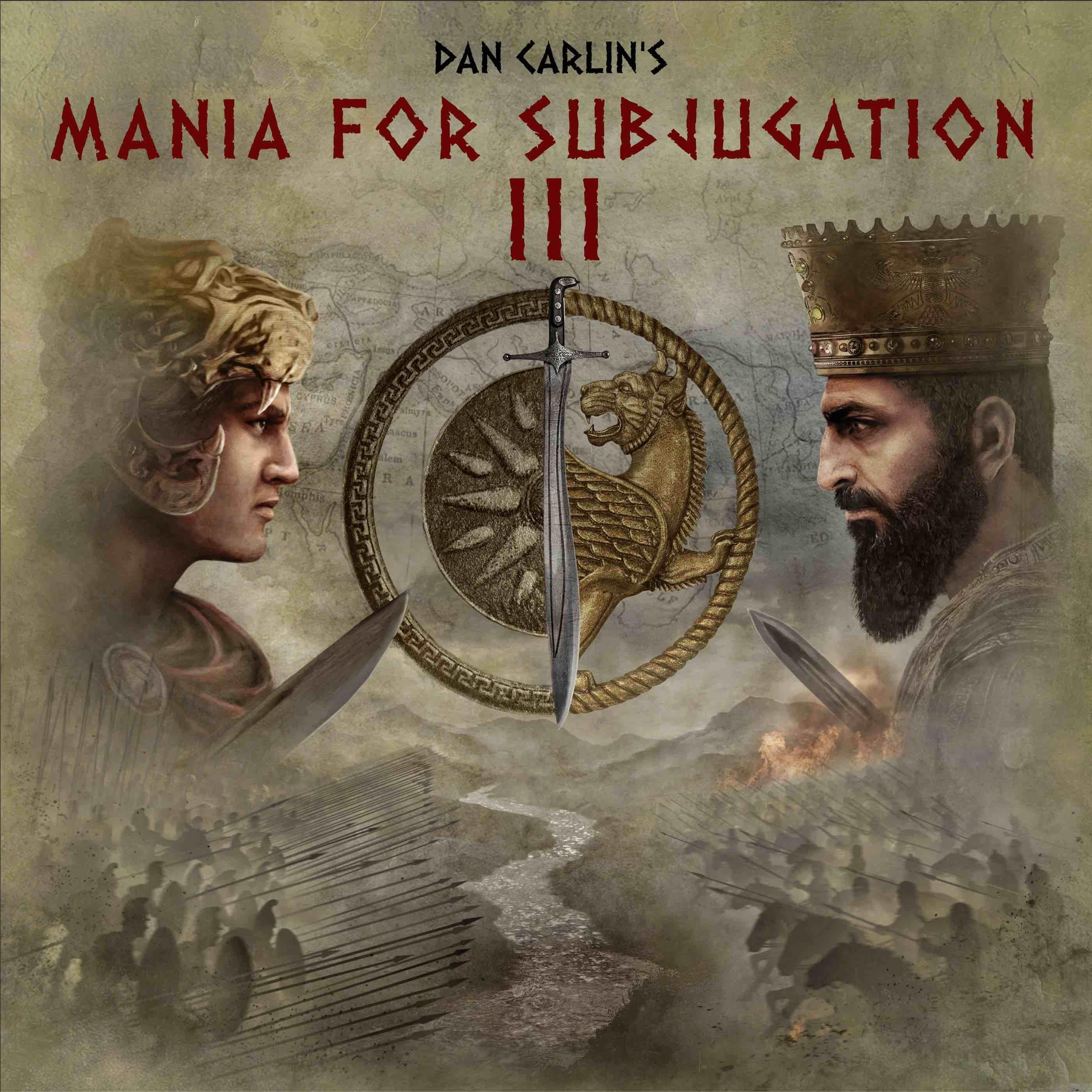
Dan Carlin's Hardcore History
Show 73 - Mania for Subjugation III
04:14:13
Attacking the largest empire the world had ever seen is a huge endeavor at any age, but try doing it at 21. Alexander, fusing the qualities of a Napoleon with a gladiator, aims for immortality. The Persians are just in his way.
Loading summary
Transcript1 lines
- [00:00]
A
What you're about to hear is part three of a multi part series on the life of Alexander the Great. If you missed the first two parts and you are like I am addicted to context, you might want to catch those first. If you don't care about anything like that, well, no worries. And if you already heard the first two parts, well, here we go. Part three of mania for subjugation. December 7, 1941. It's history. A date which will live in infamy. That's one small step for man. The events one giant leap for mankind. From this time and place. I take pride in the words ich bin ein baili drama. Mr. Gorbachev teared down this war gave six of it hadn't urgent Marine six now two has had a major explosion and what appears to be a complete collapse surrounding the entire area. I welcome this kind of examination because people have got to know whether or not their presence the deep questions. If we dig deep in our history and our doctrine and remember that we are not descended from fearful men, its hardcore history. The old world is dying and the new world struggles to be born. Now is the time of monsters. I love that quote, allegedly. And I only say that because every quote in my famous quotations book seems to have been debunked, but allegedly penned by Italian communist Antonio Gramsci from prison in Italy during the Mussolini years. And it obviously works so well for that era. But I think what gives it its enduring timelessness is the fact it's one of those phrases. And of course he would have said it if he said it in Italian. And there have been some questions about the translation, but it's a phrase that when translated into English anyway works for a lot of different eras in human history, doesn't it? For the simple reason that we can all think of lots of times when things, figuratively speaking, the old world was dying and a new world was struggling to be born and it was fertile ground for the rise of monsters. Right? No shortage of monsters in human history. We should recall though, in the same way that one man's terrorist is another man's freedom fighter. One people's monster is another's founding father. So you have to be careful. Some of these monsters are on the currencies of modern nations today. But how many of these, you know, in air quotes monsters was 21? I mean, what if, you know, Mao or George Washington or Hitler had been 21? Not of course to include Washington on the list of monsters, but had he lost the Revolutionary War, who knows what the British history books would have said about him. But Alexander, who certainly was living in a time period that with hindsight we can say, and it's been said for a long time, the old world was dying, A new world world was struggling to be born. And it was, you know, a good possible time period for a monster. And Alexander has just done the functional equivalent of drop a nuclear bomb on the great Greek city of Thebes, as we recounted in the last part of this conversation. So, you know, possible monster territory there. But how many of these guys are, you know, 21 years old, just barely able to drink alcohol in a bunch of countries today? And I was trying to figure out how one might decide to weigh this because there's, you know, on one hand we all understand 21, we can think of 21 now and go, can you imagine? You just think of all the holes in their game, so to speak, at 21, through no fault of their own, you just haven't lived long enough to accrue, you know, the experience. You're 21 and on one hand you say, well, that's why he's Alexander, right? Cause he doesn't fit the mold. Not like any 21 year old you've ever run into. Although it's worth pointing out that if you think about it, a lot of the people doing some pretty heavy stuff in even relatively recent history were all younger than you think. I mean, look at the soldiers now, but look at the enlistment men in the Second World War. Those guys are all like 17 to 21. So let's not forget that, you know, during difficult times, human beings tend to level up. Maybe tough times make monkeys eat red peppers, as boxing legend Ray Arcel once said, allegedly. But I gotta believe that the Alexander, had he lived to be a, you know, old man, Think about what that life experience added on to the natural abilities we're seeing as a 21 year old. What sort of an interesting character that would have made. I went and looked at some of the ages of people that we might call historical comparisons, and it's stark in most cases. I mean, look at some of the recent people. I mean, Stalin was in his mid-40s when he first came to the leadership. Hitler was also in his mid-40s, 43, something like that. Franklin Roosevelt was in it. I think he was just 50 or somewhere right around 50. Churchill was in his mid-60s, Caesar, late 40s, I think Napoleon now he was only about 30 or something when he became first consul in like 33, 45 when he became emperor. And Napoleon, like Stalin, like Hitler, came from nothing. He had no, there was no nepotism going on in his situation. So when you get to the top job at 30, that's impressive. Alexander, as we had said earlier, I mean he's sort of a military nepo baby that starts on third base and gets the greatest army of the age. A good comparison for him might be like Frederick the Great, who also inherited a fantastic army in military state. And he was like 28 or something, 7, 8, 9, but 21. And all you have to do to see the difference is look at the resumes of these older guys that I just mentioned. I mean these people have often had extreme levels of experience and stress and sturm and drying already in their life. So think of what they've been through that a Frederick the Great hasn't been through or an Alexander hasn't been through when they take over. It's a huge difference. I mean, if you've had 20 heavy duty jobs in your life and some kid, no matter how much of a whiz kid they are, comes in and it's their first gig, well, clearly there's gonna be a difference, right? And I can't figure out how to weigh that. Like about, I'm gonna say 97% of history fans in the world, I love playing around with counterfactuals to try to get a different look at a story. And so I wonder, in the Alexander the Great story where we are right now, right? 335 BCE, he's just done the functional equivalent of drop a nuclear bomb on Thebes, resubjugated Greece, because his dad had already done that once. And now maybe for this sacrilege, the gods strike him down, right, right outside of Thebes, drinks some bad water or something, and it's the ancient world after all, and just dies. What happens when the next person takes over? First of all, who's the next person gonna be? I mean, your choices are really Philip Paradeus. And as we said, that's Alexander's half brother and there's something wrong with Philip Aridaeus. So that might be a little bit more like the story behind the movie Tommy Boy, if that happened. Or you get, you know, some dude, as yet unknown, right? King, some dude. And either one of those guys, as my thought experiment sort of goes forward, is probably going to do the same thing Alexander's going to do. Because if you look at the constraints that were working on Alexander, they would have been working on anybody, right? Whoever takes over from Alexander, if he dies outside of Thebes, going to be looking at the same balance Sheet, for example, that Alexander's looking at. And this is part of how. I can't figure out how to assess Alexander, because if somebody else is going to do the same thing Alexander is going to do. Well, how much of this is Alexander and how much of it is the forces and various elements at work, you know, in that time period? I mean, what is Alexander known for the most? He's a military guy, right? It's conquest and stuff like that. Well, I have a pretty good sense here that if I put you in charge of that army in this time period, you could win with it. All you have to do is sit back and let the army do everything. I mean, just the generals that run it alone, but the entire officer corps, the junior officer corps, it's an amazing army and it operates almost on autopilot at this time period. You could win with it. If King Tommy Boy or King Some dude took that army and did what Alexander did, I think it still wins. And then what does that mean? How much did Alexander the Great influence this story versus that place and that time? Now, here's where I think it's different. I think Alexander has no end to his appetites. And whereas. And nobody knows, by the way, what the plan was originally under his dad, you know, how far they were going to conquer into the Persian Empire or what have you, what the goal was, nobody knows. But if all he did was take Turkey, modern day Turkey, that would be an enormous amount of land to hold and nail down and keep and absorb for, you know, a kingdom the size of Macedonia. So I think that's the difference here, is that anybody maybe could win with that army, but nobody's gonna keep using it to conquer farther and farther and farther forever until it's whittled down to the nub. And maybe that's what makes Alexander the real different figure here. He has a. And this runs the story, too, this Homeric idea, this desire to be the best. And clearly his lane, as we said in the last installment, is the Killing people lane. Now, he doesn't come across like a murderer, like somebody who wants to slit throat. I mean, he doesn't. He's not an orc or anything. But the end result of what he wants to do is going to require him to grind through peoples and kingdoms and empires in order to do it. But even if he didn't want to do it, even if he was King Tommy Boy or King Some dude, we find out at this point in the story a little about Alexander the Great's finances. And he is at the point where he is borrowing money from friends. Now, if you're examining the Alexander story from a screenwriter point of view, where we are in it now would be one of those places they'd be tempted to cut. Save a little time here because, you know, there's not a lot of action going on in this next chunk. But this is where they get it wrong so often, because we're at the part of the story where after Alexander nukes Thebes, resubjugates Greece, he goes back home, northward to Macedonia. And it's this interlude in the story between, you know, the fighting in Greece and the invasion of the Persian Empire. 335, 334 BCE, right over the winter. Just an interlude. But a bunch of things happen during that interlude, and we get some information. It really helps me at least to visualize the story because a lot of the Alexander story is polluted, as we all know, because it's been written about for thousands, literally, of years. But there are certain economic realities that would affect anybody at any time. And worst, by the way, in a period before modern banking and everything. And that's the Alexander situation. So let's talk about how we know about it. So Alexander goes home to Macedonia. It's a little bit more poignant with our knowledge of how things turn out here, because it's the last time he will ever see home. He may have had an inkling, because if you're gonna fight in the front rank and you're launching this endeavor that's gonna involve a lot of fighting, there's a good chance you might not make it home. But we know he doesn't. So it's the last time, for example, he will ever see his mother face to face, that woman he has that very interesting, intense relationship with. They will correspond for the rest of his life, but this is the last time they spend any time together. So while he's home, we're also told he murders a couple of his dad's last wife's relatives. Just a little pruning of the family tree. His father was great at that, too. But you don't want to leave people on the family tree with enough blue blood for one of Macedonia's arch foes to use as a potential puppet king. Right, and divide Macedonia and everything while you're gone away fighting. So that's just common sense. Get rid of a few of those people. But then the ancient sources, Diodorus has a whole paragraph on it, says that Alexander calls what amounts to a staff meeting here, where they're Going to discuss this Persian expedition. He calls the person that you could probably call the chief of staff of the Macedonian army, his dad's famous general, Parmenio. He calls him back from Persia. Parmenio was the guy who's commanding the advanced force that his dad sent out before his dad was assassinated to establish the beachhead, right? Send parmenia over there, eight to 10,000 guys with him, establish the beachhead to wait the arrival of the main army. And then Philip dies and the main army, you know, was never dispatched. And Parmenia's been sitting around in Turkey waiting. So Alexander calls him back over for this staff meeting. Probably gets some good intelligence from, you know, on the ground too, from Parmenio. And we should remember how Augusta figured this is, by the way. I mean, he's won some of the greatest battles in Macedonian history. Philip II had that great line, I think we mentioned it in the last installment, where he was sarcastically referring to the fact that the Athenians yearly would elect 10 generals to command their military forces. And Philip is looking at this and marveling, wondering where they get all these good candidates from. Sarcastically, he says, in my whole life, I've only ever found one good general. Parmenio. Parmenio, at this time in the story. I mean, first of all, his resume is incredible. He's won some of the biggest battles in Macedonian history. He is in his mid-60s, Winston Churchill age, basically when Winston Churchill took over. And just like the other major general here, was a force in helping Alexander nail down the succession in that chaotic coup like period after his father was assassinated. The other big general who helped was Antipater, who's also at this staff meeting, who's also one of these amazing figures and who's also in his mid-60s. And they've come to talk to a 21 year old with very little on his resume about how to continue his father's plans, plans of which they were both intimately connected to and involved with. It's at this meeting that we find out some stuff about the economic situation and it plays into how Alexander reacts to the general's advice we're told that he received. So he basically, they talk for a while and then the generals advise that he should get married, beget an heir, and then they should attack the Persian Empire. And this is where we can start to have some interesting conversations about all this. And we have to now talk about one of the major tropes that's going to be a part of Alexander's story. And it's concerning the relationship he has with these august generals. The ancient historian Justin had a great line about the Macedonian general staff and he said that it was like being in a room with all these august senators of some ancient republic, meaning these old hard bitten guys who've seen it all and done it all. You know, you think of these scarred figures who just have known Alexander. I think they've known him since he was a babe in the cradle. Certainly known him since he was. I mean, Napoleon didn't have to deal with Marshal Ney knowing him when he was a toddler or being twice or three times his age. So there's a dynamic there that if, you know, the freedom of a screenwriter in my movie would be able to play that up in some interesting ways. And because Alexander is the Michael Jackson of history and everybody's had a crack at this theory or that theory. I mean, there's a historian here or there who suggest that Alexander's the equivalent of like some, you know, talented artist or musician or something, or boy band member that's really controlled by the puppet master managers in the background, right? And he gets to be sort of the face of the regime, go off there, be charismatic, lead the cavalry on the decisive charge and all that, while guys like Parmenio and Antipater just count the money in the background. Alexander the puppet king. I don't buy that, by the way. But it's interesting that that's out there. And what it shows is it's not that hard to believe that guys as dominant and powerful and August as these mid-60s year old generals of Alexander's dad, who knew him when he was a little kid, that they might be dominating. I mean, can you imagine the relationship they would have with King Tommy Boy or King Some dude? You might have to be Alexander the Great and have everything that makes that 21 year old so unusual to push back against these guys. So the trope might be true, but we're told these generals give him some very good conservative advice. And the trope is that they continually gives him some very good conservative advice and every time Alexander says to hell with that, overrules their good conservative advice and is proven to be right about it every time. So that's the trope. And this is the first time I can remember this happening, maybe happened at earlier times in his career. But you see, this is what it's on display openly because they say that you should marry, beget an heir, and then attack the Persian Empire, as we said. And Alexander says no, he's going to attack ASAP. And this has been dissected over 2,300 years every way you can without going into every possibility. There are some good reasons why he said this. I mean, how long is it going to take to marry and beget an heir? And if the heir has to be male, well, it's a gamble anyway. You could do everything, wait the nine months at least to do it, and then end up with someone who wasn't an heir. Anyway, I read some historians that pointed out that both Antipater and Parmenio had eligible women in their family that they would have liked to have seen marry Alexander. It's always nice to be married to the king's family, but that would have maybe pissed off the other guy. So good reason to say no. Alexander's sexuality has been brought up also at this point. Although there are some parts in the story where it's relevant here. I mean, some historians would say that this demonstrates his tepid, that's the word you see often interest in sexual. Or that he's just not interested in women so he doesn't want to get married. I mean, none of that stuff makes sense when you're talking about royal weddings and begetting, you know, heirs to the kingdom. I mean, that happened. Look at Alexander's dad. Nothing constrained him. And the modern tilt anyway is more towards Alexander being more like his dad, sexuality wise and not having any problem with it at all, liking it. The point is, is that in this part of the story, even though it's brought up here, that's why he doesn't want to get married. Cause he doesn't like girls. Not really relevant. What sticks right out like a sore thumb are the finances. And the biggest drain on those finances is the army. So this is where, and we should say this because we've been extolling how great this army is. Any chance we get, there's a little bit of army fetish going on here about the Macedonian professional army and how dominant it's been this whole time. Remember what it did to the Illyrian tribesmen that shook them to their boots? All they had to do was perform some drill in front of them, turn left, turn right, spears up, spears down, you know, yell on command, scared the pants off them, they ran away. It's not that armies didn't do that kind of stuff. There are armies throughout history that did. And in this case, the great city states of the time period, the Athens, the Spartas and the Thebes, before Thebes was destroyed, they all had professional units that they built the rest of the army around. But most States didn't want to pay the piper. Literally, when it comes to what it takes to maintain these kind of armies, they almost have to pay for themselves. I mean, they almost drive your foreign policy because of the need to have them do something. Because when other powers aren't at war, most of their troops go home to job one. Right. We would think of militia armies. A lot of those people were farmers. And when there's no war, they're on the farm. That's really good for your economic situation. But what you lose is the institutional memory. You lose the ability to act as a well oiled machine. All that stuff has to sort of be relearned and reacquired every time a war happens. Whereas Alexander's dad created an army that never goes home, that's training all the time when they're not fighting. And they're fighting a lot because they're very expensive and that's the best way to pay for them. The idea that you could sit around for like nine months, you know, Mary begetting heir and the whole thing, and let this army continue to cost you money while it's just sitting around, that doesn't seem like a likely option. But this is where the downside comes in and here's the best way to think about it. The ancient sources are all different in the way that they explain Alexander's problems in the modern day. Historians who have tried to recraft this into almost like a balance sheet or an Excel type spreadsheet format. Everybody may have different numbers and different ways of expressing the problem, but the problem is clear and that's that Alexander has a ton of debt and that the ongoing burn rate for his expenses is incredible. And the ongoing burn rate for his expenses is mostly because of this army that he has to pay. But we are told, and this is important, that he inherits a ton of debt from his father. Sources differ on how much, but it's a ton. And that's totally on brand for Philip, to be honest. It's on brand for Alexander too. When Philip needed money, he went and took it from somebody who had it and he had that army to do it with. And that's how it paid for itself. Philip was no doubt planning on paying off this debt. Philip reminds you of a guy who had Pyramid credit cards, right? And he'll just go and take it from the Persian Empire. And that was, you know, he'd already started that, right. The beachhead was over there, as we said, with Parmenio. So he was getting ready to pay that debt. Off. And then he died. So Alexander inherits that debt. We're told he pays the majority of that off by selling the 30,000 plus Theban citizens into slavery before he nuked that city. That shows you once again how Alexander plans to pay for things. Right? He's gonna do it through, you know, taking everything of value in these places that he conquers and turning it into ready cash. But it's hardly enough when you think about what goes into something like an invasion of the Persian Empire. We can all conceptually understand that we're talking about a vast complex endeavor, but maybe not think of exactly what all goes into it. And I toyed with the idea of running down the list because if nothing else, it's an amazing reminder of exactly how complicated these things are and how hard it would be for us to do it without modern day computers and transportation and industrial abilities and everything that we bring to the table. These ancient people had none of it and yet still had to put it together, have it work, be synchronized time wise. Everybody had to get paid. I mean, but rather than that, I just thought I would sum up from one historian's rundown. And a bunch of historians have taken a crack at this. The bottom line is their numbers don't matter as much as what they're all saying, which is Alexander has all this debt he inherited. Remember, he also exempted the population mostly from taxation when he took over. Makes you popular, also makes you poor, and then has to hold all these lavish celebrations, we're told, and sacrifices. So he's spending like a drunken sailor and he's broke. He's actually showing off, if you want to believe some of the ancient sources and being ostentatious about it when he's broken. So historian F.S. knyden, in his book Soldier, Priest and God, added up the cost as he saw them and the burn rate for this army and put it into some sort of perspective. And he wrote. Now the arithmetic. A base of 225 talents a month for the 45,000 soldiers and up to 300 talents a month for ships, plus the costs of fodder to feed the animals and everything from horsehair to spear points. The grand total might be 7,000 to 10,000 talents a year. He now puts this in perspective. This sum was 80 or 100 times what Athens spent to build the fleet that defeated the Persians in 480. It far exceeded Philip's annual revenue, end quote. So it costs more than everything Philip paid for in his kingdom, army included. That was just his dad. That was just the guy who came right before him a year or two ago, eighty to a hundred times what Athens paid to build the fleet that defeated the Persians. I mean, those are incredible numbers. That's your burn rate right there. So if you're a king, some dude, and you come to the throne and you say, you know what? I do not want to invade the Persian Empire. I do not share that optimism in the plan that Philip and Alexander both had. I want to go 180 degrees different. Could he. I mean, first of all, would he. I mean, he might get a knife in the back by a guy like Parmenio if you change plans like that. There's a lot of people who have a lot invested in this. Which brings us to that part. I said earlier that Alexander was borrowing money from friends. The reason all this stuff, all this financial stuff is so important is because with so much fiction surrounding the few facts that are available about Alexander, when you can get your hands on something that at least seems to be the truth and that you can plug in for X, you know, in the equation, that gives us some sort of sense of answers to a bunch of questions we have about Alexander. You don't turn your nose up at that. And this financial thing seems real. And you can even. I've read several historians who talk about how Alexander's very campaign decisions against the Persian Empire are dictated by which route to take. Has more cities that we can sack. Cause we need the money. I mean, so this is a prime motivator here. And at this point in the story, Plutarch tells a tale about Alexander borrowing money from his friends. Cause he needs it now. Plutarch makes it sound like it's some sort of thing Alexander's doing as a benefactor, making sure they're all okay. Before we hear it, you need some royal land before we go take over Persia. But all the secondary sources portray this as, at best, like Alexander pawning the royal lands, right? And when he makes it big against the Persians, he'll come back and get his stuff out of hock. Or maybe just straight up selling, right? Give me some money. You can have the royal land here. And there's a wonderful story Plutarch has that you should not avoid if you're doing the Alexander movie, and I hope that you do, where he has Alexander giving away all the stuff. And then one of his friends in air quotes, these companions, a guy named Perdiccas, he's famous, is gonna say to Alexander, if you give away all this stuff, what are you gonna be left with? And he famously I mean, your movie. He's gonna turn to Perdiccas, something like that. And he's gonna say, my hopes, right? And then Perdiccas says, well, we will be your partners in those. And the reason this is good is because you get a sense now that this is a deal. This isn't one nation state going against another in the modern day. Since these are a bunch of guys who are going, hey, you know what, you let me get my share of the profits in this Persian expedition of yours and you know, I'll give you some money and I'll give you some upfront investment. I'll be an angel investor, right? We're going to start with a sort of a startup company here and these guys are going to put in these companions, these guys who are going to fight in all the battles, they're going to put in the sweat equity. And later in the story, Alexander's going to go so far as to basically say, you know, I paid you all off. In other words, this whole thing has a feel of more of a business thing. And that's why we've been focusing on the finances so much. Because Alexander might as well be a company here. This might as well be a father and son operation, you know, that has disruptive technology, this Macedonian army and they are ready to make a play at the big boys. We'd said in this show we did a long time ago on the Persian Empire in this period, they resemble a company, we called them Persia Corps. Right at this point, Persia Corps is a monopoly. They've been going for more than two centuries. No real challengers. Sure it's rough around the edges, but who cares? What are you going to do? We're the only game in town and all of a sudden you have this disruptive technology. Macadon attack. I almost called it Macadon Interactive because there's going to be a lot of interactivity, you know, Macadon Interactive operation Arete. I had all these ideas, but it is a little like what we have here is a straight up force deal. I mean, you could put all sorts of different lenses over it, sort of to change the complexity, right. It's almost like brutal dog eat dog capitalism if you view through that lens. If I was back in like my international relations class, they would talk about a geopolitical power and wealth imbalance here. Alexander's got the superior army. This hasn't been proven by the way, on the field against the great Persian empire. But it's. We know now he's got the superior army by far. But he doesn't have the cash. And yet right nearby is a giant empire that has all the cash you could ever want and an army that can't contend with yours. There's an osmosis kind of force at work here that almost draws these two places together. Right. But while it's easy to imagine most any Macedonian ruler from this era attacking and invading the Persian Empire, it seems pretty clear, if we could believe any of the stuff that's come down to us, you know, through more than 2,000 years of historical strata, building and lying and everything else. Romancing seems pretty clear to us, though. Alexander's motivation was different, and he would have done this even if he didn't have to and even when he's successful later on in his career. And all of the reasons that would have motivated any Macedonian king at this point in the story go away, right? When he has all the money he wants, when he can pay his troops, no problem at all, he's still going. So his motivation is different, and it's a key part of the story. Although I feel like we're going to miss the financial math and the surety of what we just talked about as we start to speculate about what makes this guy tick, right? What makes him get up in the morning. I had a friend who was into sales many years ago, and he told me that when he was learning how to do sales, that they would teach him all the different things that motivated a potential client. And I don't remember all of them, but some of them were like greed, fear, heartstrings, right? All these kinds of things where one way or another, everybody's got some little chink in their armor that can be exploited by the salesperson, and you just have to find out what that is. But it's all based on motivations, right? What matters to you? Why do you do what you do? And when you're looking at these great conquerors in history, it's a fascinating question, because at some point, most of these great conquerors get any of the material rewards that might have motivated them in their younger and poorer days. Once you achieve that, do you just stop? And if you don't, why don't you stop? What are you trying to do? And the stories of Alexander, all this anecdotal stuff, and all the famous incidents passed down, but tend to show a guy who's not just concerned about being great, but looks at greatness as almost a zero sum game. Remember the stories told about how he was when he was just the prince, he was upset that his dad was conquering everything because there wasn't going to be any glory left for anyone else, right? A zero sum game on glory. But if any of that is indicative of the guy's real personality, then he's essentially trying to get in the Guinness Book of World Records here. He's trying to be the best, as we talked about earlier, that Greek concept of arete which by the way is seeing a resurgence these days, right? Be the best, find out what you're born to do and then do it better than anyone else. That is a very simplistic Dan Carlin wave looking at what is obviously like all of Greek philosophy and paganism and everything else very complex. But as we said earlier, I mean, if you're a person who makes pottery or a singer or something like that, I mean, there doesn't seem to be as many downsides to this aretate question. But if what you do better than anyone else is conquering people, then you simply trying to be the best, right? To live your best life, to do what you were born to do, means you grind up a lot of people just as a byproduct, right, of you achieving your goals. I just want to be great. I don't want to hurt anybody. They're just in the way they stand between me and greatness. And this has always provided Alexander a little bit more moral cover than other people who, if we're just trying to match things like body counts and places conquered and all that seem a lot more nefarious. I mean, look at a guy like Tamerlane with the stories of the pyramids, of human skulls and all this kind of stuff. Tamerlane doesn't have that same, not in the west anyway. That same sort of overlay of somebody who's a philosopher king here. Remember some of the historians from 50 to 100 years ago, they try to find these very high minded reasons to explain Alexander's motivation, right? He's going to create, he's going to get rid of, we would say today, get rid of racism, get rid of people seeing each other as different. We're all going to be the same because we're all going to live under one king and he's going to fuse all these peoples. I mean, you know, there's a guy named Tarn back in the old days who would look at something like this as a motivation or at least a goal. Plutarch does the same thing where you're trying to find these reasons that justify and make right and sort of explain the upside of conquest and empire. People have been doing that for a long time. Because if you take that justification away, what are you left with? And it's interesting to think about that because if you take the high minded terms away, it might be something as sort of banal as fame. I mean if my sales friend with his various human motivations, you know, greed, fear, heartstrings, I mean, if he could say to somebody he was trying to make a sale to, hey, what if I could make you famous? It sounds like that might work on Alexander. Historian Edward M. Anson, in his book Alexander the Great Themes and Issues, was talking about Alexander's motivation and his desire for. And the words used were honor and recognition. Well, isn't that another way of saying fame? I mean infamy would be dishonor and recognition, but I mean it's honor and recognition. He wants to be famous. Anson clarified and said, glorious fame and a desire to be remembered for all time for one's achievements. Okay, well Alexander's going to do all these things and it's going to make him famous. And what's also interesting to me about what it is that he's doing is it's not really exactly what other people you would think belong on the same top 10 list as Alexander were doing. I mean, if I said Alexander belongs on some top 10 list, you'd think to yourself, okay, well the other people that would belong on a list with Alexander might be someone like Napoleon, for example. Let's just throw Napoleon in there. And Alexander does do the things that Napoleon does. Both men were actually running their kingdoms or their countries, so they were making the decisions over things like do we go to war or not? The foreign policy decisions. Both men were the leaders of their armies, so they were making all of the decisions on that front too. The night before the battle, they would both be in their tents with their maps and their generals organizing tomorrow's strategy and putting into place how they're gonna maneuver and how all the same. But then the morning of the battle, Napoleon is going to leave his tent, line up in the back of his army, take out his spyglass and look through it to see where the people are fighting and have runners next to him so that when he has orders for those troops in the distance that are fighting, he can send a runner to go give his orders to them to execute what he wants done. And the morning of the battle that he's engaged in, Alexander's going to leave his tent, go to his cavalry, which almost always is the strike force in his battles, and he's going to Take most of the time the tip of the spear position and fight in the front rank. Napoleon doesn't do that. Alexander's life is a combination of Napoleon mixed with like an MMA fighter who practices Charles Manson like killings. I can't imagine Napoleon doing something like karate kata maneuvers and practicing his knife moves to feint an opponent out of position, grapple with him, slit his throat. Those are the kind of things Alexander has to do too. So it's everything Napoleon does with vicious hand to hand combat type stuff. And when Alexander wants the honor and recognition for what he's doing, he wants to be recognized for both things, the Napoleon stuff and the hand to hand combat. His hero here is Achilles, right? The badass warrior of the Iliad. Go read the Iliad, by the way, if you want to see the sort of stuff that Alexander was so enamored with. It was supposed to be his favorite book, I believe. And Achilles isn't just some literary figure to Alexander. Remember on his mother's side, he was raised to believe it's a direct ancestor. One of the tutors his father hired to help raise the boy kept telling him he was Achilles's descendant and he had to live up to that. Achilles is a stone cold killer. And Alexander in this early part of his career is actually going to be trying to emulate the actions and deeds of this person he sees as his ancestor. It's part of the other weirdness to Alexander's motivations because they may not completely be terrestrial, they may be divine. And this dovetails into another story that is supposed to happen, you know, via some traditions. That's a good way to put it. I love that Plutarch gives us both the yes, it happened and no, it didn't happen versions. But in some traditions, the last major thing that happens. While Alexander has this little interlude back in Macedonia, winter of 335,334bce, he's supposed to have a get together with his mother, a last get together, if you will. And while she couldn't have known that he would never come home, when you are going to be the tip of the spear in a battle against the great, large and endlessly huge, in terms of expanses of territory, Persian Empire, it's likely to think you might not see him again. So you might want to get anything really important off your chest. Last conversation perhaps. Tell the boy anything that he really needs to know. And the story is. And Plutarch sends it back to. I think it's a contemporary source or near contemporary source that suggests that Olympias tells Alexander that Philip ii, the greatest man in the time and place where they're living, is not his father. Now, normally this is going to be something that comes as a shock, right? I mean, it's like saying that your dad's really the milkman or something like that. And if you think of yourself as maybe hoping to be a chip off the old block of the great old man and then find out he's not your dad, well, there's no place but down from there, right? Unless the person who is your dad is not human at all. And this is the tradition. Remember, Plutarch's given us all the stories. Remember the earlier conversation about the stories about Alexander's mom and snakes and maybe fooling around with Zeus and all these. I mean, so this story has been set up now, this whole way. And here's the payoff moment. She finally tells him, listen, it was a lightning bolt struck my womb. There were snakes around. You know, you figure it out. Now, the counter story here, and Elizabeth Carney, who knows as much or more about Olympias than anybody living, I think she says that historians disagree on whether or not it happened. But the counter story is that Alexander's mom turns around and tells people to stop, stop it with that story. Stop slandering me to Hera, she says, and of course, that's Zeus's wife. And she would not like to hear that Alexander's mom is fooling around with Zeus. She has enough problems keeping Zeus at home at night anyway. But if we're talking about Alexander's motivation, this becomes another thing that I don't know how to weigh. And normally a story like this might even be something worth leaving out where you just blame it on. This is the normal legendary, romantic stuff of Alexander. This is obviously chaff, and we're trying to, you know, weed out the wheat as much as we can. Except later on in Alexander's career, there's going to be stuff that happens that's much better attested to that seems to at least make a pretty good case that Alexander may think he is in one sense or another, and that itself is debatable. And we could talk about it, but in one sense or another, divine, son of a God, demigod hero, which is an intermediary step between human and divine, apparently, or God, I mean, just divine in one way or another. And it becomes logical at that point when it actually matters in the story, right? If you have a guy who's thinking he's divine running around commanding armies and, you know, influencing world affairs, I mean, Today we would think they should be institutionalized. So it's going to be important one way or the other. But it's logical to ask yourself when he first came to that conclusion. When does that thought first enter your head? You know, I might be divine. When did you first think that? That's what the psychiatrist would ask the world leaders today. When did you first think you might be a God? And the story is that in the winter of 335,334bce, here in this little interlude in Macedonia, the last time Alexander ever sees his mot is when he finds out he might be divine. Now, the reason that this is interesting from a motivational standpoint. And again, when you make your movie, you have to decide how you want to play this. But either he's a guy who decides he might be divine after doing a bazillion amazing superhuman things. You look at his career and you go, well, you can't blame him. I think I was a God too, if I did all those things. I mean, absolute power corrupts absolutely. Isn't that the Lord Acton line? It's, it's brought down many a global figure in history, hasn't it? Power goes to your head. So it's interesting to know just for those purposes, because now you've got that person you have to deal with who believes they're divine. But what if something like that predates all of the great achievements? What if Alexander goes into his career thinking this? What if he thinks it from the time his mother tells him, allegedly, I don't want to slander her to Hera, but allegedly, during this interlude, does it change your willingness to take risks, for example? I mean, I would think there'd be a whole bunch of things that, if I truly believed I was the son of a God and that I had some sort of destiny here, that might impact my willingness to take risks, my willingness to keep going, my willingness to sort of trust in fate, sure is a confidence builder, you know, even if it's sort of a placebo effect. I mean, if it's, if it's Harry Potter with the liquid luck, and if you drink it, everything just goes your way. And there's that scene where he gives a placebo to Ron, who thinks he's had the liquid luck and goes out and has an amazing day anyway, but of course, never had drunk the stuff to begin with. I mean, Alexander's got a lifetime supply of this liquid luck that he was just born with. I mean, his belief, his fervent belief that he's the direct Descendant of the greatest fighting man in the most popular book probably in his time period, the Iliad on one side and Heracles and of course through Heracles, Zeus and maybe Dionysus on his other side. Well, there's liquid luck right there. And then if your real father or you know, this is how weird Greek paganism can get, apparently you could have Philip the second is your father and Zeus, it's over my head. But if you have that going too, or instead of the Achilles and Heracles thing, I mean that's a version of liquid luck. And of course, if you have it both, well, shoot, Think about what you could accomplish with that level of confidence and belief and maybe borderline fanaticism. The current way of looking at Alexander and of course this has changed over 2,300 years. There's all kinds of different eras of the different ways they've looked at Alexander. But the latest secondary sources I've been reading suggest that the view these days is that he may have been very, very religious. You know, even judging by the standards of the time period. And there are stories and you know, anecdotal things that maybe back this up. But it's an interesting thing to consider that if you think you might be divine and you're a very, very religious person also, I mean there's almost a force multiplier effect going on there, don't you think, on one's divinity. But if we want to make the story seem very Greek indeed, throw a little tragic flaw or a built in disaster in there somewhere, you know, the seeds of his disasters sown in his gifts. I mean maybe his version of lifetime liquid luck makes you insane eventually. It's like having syphilis, but I don't know how to weigh that either. Insufficient data as they might say. If it is a confidence builder though, he's going to need that. Because when you think about what he's up against, there's a reason that there's a legendary shroud around the whole Alexander story. And that's because what he did was legendary. I mean, the line from mid 20th century historian will Durant always sticks with me where he says that what Alexander's about to do here is the most daring and romantic enterprise in the history of kings. That's a pretty rarefied air of the number of other historical incidents that would be in consideration for the top position. And Alexander still wins. It's indicative though of the size of the challenge. The Achaemenid Persian Empire is an amazing place and I've been a Big fan for a very long time. All you have to do though is consider its size to understand what a big deal this is for Alexander. It's just a little bit smaller than the United States. And the fact that in ancient peoples, with ancient technology, ancient communication, everything goes into it, could hold down an empire that size for more than 200 years, by the way, doesn't get enough attention in the story that often portrays the Persians of this period, you know, at the bottom rung of a long, slow, self inflicted decline where they become sort of the punchline or the cautionary tale in the famous, you know, wooden shoes going upstairs, silk slippers going downstairs. Voltaire era view of, you know, civilizational life cycles. Start off poor and hard scrabble, which, you know, rude, but those values then propel you to getting some wealth and civilization and some learning and the next generation can have it better than you can. And eventually you reach the golden mean, you know, pinnacle point of the balance between the hardscrabble values and the things that money buys. And you get a guy like Darius, right, of the Persians, right, the famous king who was the, you know, if you're looking at this from the Greek propaganda point of view, that was the last great Persian king. And then from, you know, Darius, you get the long slow decline. And what a lot of the really good modern historians covering the Achaemenid Persian Empire point out is this is all propaganda and bigotry and prejudice from the Greek side and also intended to show off, you know, sort of a pro Greek everything. And it's colored the way we view the entire situation here though, because if the only sources you really have for a lot of this stuff are on the Greek side and they're turning every Greek fighter in the story into Captain America, right? Captain, you know, Helene, you know, Captain Major Hellas or something like that, well then it distorts a lot of the story. And because there's not much on the Persian side to help counteract it. Pierre Brian had a great line. He said, we can plainly say that a lot of this stuff from the Greek side is nonsense. But what we can't do is suggest that the way the Persians actually were is just a mere image of that. You can't just say, oh well, they said it's A, so it's obviously B. Some things might be true, some things might be misinterpreted. So it's difficult. There's a lot of propaganda to wade through, including a ton of stuff Alexander put out himself during and after his war with Persia, intending To, you know, bolster his claim that he's the rightful king and the last guy that was running things was the wrong kind of king and our people were Superman and their people were, you know, kind of cut through propaganda, lies and crap that stem from the very time period. Right. You didn't have to wait 100 years for the crap to develop. You know, Alexander starts throwing out chaff to obscure the wheat right away. And before we look at this as somehow nefarious, polluting the historical record, if you will, there's another way to view this, and it's called genius. I mean, this is an absolutely multifaceted, you know, full spectrum dominance kind of approach here. And it is so dominant, if you will, that it still dominates the way we're trying to unravel this story today. That's some pretty good propaganda. You'd pay those people extra if it's still working 2,300 years later, wouldn't you? But it leaves plenty of room for doubt areas for the experts to fight and terrible positions to put, you know, non historian podcasters in, obviously. But I'm a fan, always have been, of the Persian Empire. I do not buy this idea that they were in this inevitable long term decline, sort of a death spiral that they couldn't get out of. And, you know, when I say anything like this, I'm not stating it based on my own archaeological dig experience. I'm just siding with one group of historians over others. But to me, the key sign here is when the Persian Empire gets good, good leadership, and it's a monarchy situation with an oligarchy involved. And I mean, it's complicated, but when they get good leadership, you see upturns in pretty much any category that's used to justify the idea that they're declining now. They have leadership issues, but that's far from abnormal, even in places, you know, that weren't in a terminal decline. I mean, look at the Roman Empire's history. So you sort of survive and maybe contract a little bit or have a few more revolts or, you know, things like that under the bad leaders. And then when the good leaders come back, they go in and repair some of the damage. And you see that in Achaemenid history, by the way. The bottom line, though is you're talking about a place that extends at its biggest, which it wasn't necessarily at its biggest during this time, but at its biggest, though, it is a place that extends into what's now Pakistan in the east, all the way west to the borders of basically modern Egypt. And everything in between, of course, from Arabia in the south up to Ukraine, over to the Balkans, all of modern day Turkey in the Middle East. I mean, the largest empire of its day and often lauded by a lot of people, yours truly included. Maybe as, you know, maybe discovering. And you don't want to say that because remember, there are other worlds. There's things going on in the Americas totally disconnected from here. There's things going on in East Asia and China totally disconnected from here. So some of this stuff develops organically in different spots, sometimes at the same time. But the Persians come up with this almost secret sauce for how you rule giant multiethnic empires. And tolerance is sort of the weapon, the hidden tactic that ends up, you know, pacifying so many of these people is a live and let live sort of approach. And it was so successful by the way. Obviously many other empires later copied it and they often get credit maybe where it's not due. I mean, you see this with the current way the Mongols are often portrayed. And you'll hear about things like their religious tolerance, as though they were somehow particularly tolerant guys. And then you look at other empires and you realize, oh no, it's just a good move because when you tell people they have to change their gods, they tend to get pretty angry about that. That's causing you long term trouble. A lot easier to just say, hey, worship anybody you want, want, just stay pacified. And the people that are one of the earliest examples, I'm leaving myself a little room here, of that approach are the Persians. And it kind of helps them that they sort of emerge from an era where a very sort of opposite approach had been the one for a long time. I mean, this is the Assyrian Babylonian era before those guys. And they're famous for carving their atrocities into stone. And you can go to the British Museum and see him today. People having their skin ripped off their still living bodies. Gardens with heads hanging from the plants on the ceiling. And these often put in the diplomatic waiting rooms where the foreign ambassadors would cool their heels waiting for an audience with the Assyrian king. And he would have just shown them probably in living color what happened to people who, you know, didn't do what they said they were going to do. And then you get the Persians in here who, even though they had some of the most horrific punishments you could ever hear about. I mean, the boats for example. More on that in our three part series. We did on the Persians a while back. Kings of kings. But the Persians could be rough and tough and nasty in everything. But when you Follow an act like the Assyrians and the Neo Babylonians, you look pretty tolerant by comparison. And when you're gonna form a tiny little crust, you know, a tiny percentage of the population that's ruling a vast empire of tons of other different people, you know, one of the best things you can do is say, hey, you know what, you live just the way you always have lived. Pay your taxes, provide troops for the army when we need it. Sometimes we're gonna need some infrastructure projects and some people for that. But basically the Persians would come in and just let you live the way you always had. In fact, some of the rulers that were ruling for the Persians were the families that had been ruling there before the Persians. They came in and just said, hey, you can stay long as you do these things that we ask for. And they did. And we'd mentioned earlier that the Persians sort of ran their empire like a business. Well, the ruling strategy here is sort of, if you imagine like a bunch of regional vice presidents, they were called satraps, governors. They were really like kinglets almost, which is why that title for the Persian ruler, King of Kings, sort of rings so true when you think about it. But it's a great strategy because when, you know, you look at the size of this place, again, imagine almost the United States and now try running it with, you know, Wells Fargo horse speed type communications. Right. And transport. And I mean, it's just smart to have governors on the scene who can make these kind of decisions over a territory that large. Now sometimes those governors, those kinglets, if you will, those regional vice presidents, get a little uppity and they revolt. And the biggest problem that the Persians have by this time period is they just deal with sort of a weakening of central authority under some kings and they deal with revolts. And both of those things are almost certainly influenced by the fact that they have a problem keeping good kings on the throne for significant periods of time. Achaemenid historical expert Pierre Briand did the calculations and he said, in the history of the Achaemenid Persian Empire, one king died on a military expedition that would be the founder, Cyrus the Great. Five died of natural causes and seven were assassinated. Add to that the fact that the problems that you see in Alexander's family in the Macedonian situation with Philip and his six or seven wives and all the kids that come from that is magnified exponentially in the Achaemenid world. And even though the king seems to have had a limited number of so called legitimate wives, they often had a lot of, you know, Concubine types. I mean, Artaxerxes ii supposedly had 360 wives. And between, depending on which source you want to pick, with 115 to 150 sons, Artaxerxes III allegedly had 80 of his brothers killed in one day. Now these may not be people that can come to the throne, although they might be, but these sort of half kings are obviously part of power blocks, Otherwise why kill 80 of them in one day? But in these systems where you know, you have hundreds of half kings running around, where bloodlines mean everything, I mean, you can see how this would create complicated court dynamics, right, and, and create circumstances where there might be assassinations and rebellions within the family. I mean, doesn't exactly lend itself to stability. And Whereas in the 20th century and all the way back to ancient Greece, so much of what happened to Persia is ascribed to things like becoming weak over time due to wealth and luxury and becoming effeminate and the tools of eunuchs and the lures of the harem and all that kind of stuff. The modern day histories point to systemic problems and one of them that's clear here is by the time Alexander's invading Persia, I mean, they have a newbie king on the throne too. And whereas you might like to jettison the lurid sort of proto Arabian Nights stereotypes involved in the view of Persia here, it's hard to totally escape it when the reason this, Darius iii, the king of Persia, when Alexander invades, the reason he's on throne in the first place, and supposedly he's put there by a guy Diodorus Ticulus describes as a militant rogue eunuch, Bagoas. He's famous. If this Bagoas did what the Greek authors said he did, then he killed multiple Persian kings by poisoning too, which is also part of the Arabian Nights sort of trope. Here he's a eunuch who uses poison to kill effeminate kings, I mean, who are led around by the nose by their many wives in the harem. I mean, there's a whole trope here, right. What's so fascinating though is if you want to read this trope written to you as though it's, you know, factual modern history, go read the way this story is told in the great Will Durant's History of Civilization book one. That's of course his life's work, the multi part series. And you can see how his style changes from book one to the last book in the series over the many decades it took for him to write it. Right. He sort of stays with the tenor of the history writing times. As standards and styles change, he changes with it. But in 1935, you see the social Darwinist stuff creep in. You definitely see the wooden shoes going upstairs, silk slippers going downstairs thing happening. And what's so fascinating about reading it now, though? And I bet I read it in the King of Kings series, so I apologize if I'm repeating myself, but it's worth it because you not only get a sense here now of the way a Greek audience would have heard this story and thought about it, but how long that way of looking at the story persisted? Because this is Will Durant writing about the decline and fall, which again, I don't even agree agree with the decline of faulting of the Persian Empire, why it happened, and then the game of thrones like transition from one ruler to another and you'll see why it's a guilty pleasure for so many of us. Durant, like many of the Greeks, saw Darius the first as sort of the golden mean of Persian leadership, right? The best combination of the ancient Stoic values the Persians had when they were poor hardscrabble types mixed with what money can buy. As I said, Darius, by the way, was called by the Greeks the huckster because he was the financial guy. He's the guy that basically keeping with our Persia core sort of metaphor here, he's the guy that took the company public, got us out of the garage doing the mail order stuff, put us on the stock market map. I think the coins were named after him. I mean, it was just one of those sort of things. And the Greeks saw him sort of the high water mark of the pinnacle of the best balance of the Persian virtues and vices. And then it's all downhill from there. And you know, 2,000 years later, 2,200 years later, will Durant's basically saying the same thing. And he writes, quote, the empire of Darius lasted hardly a century. The moral as well as the physical backbone of Persia was broken. By he means the battles of Marathon, Salamis and Plataea. The emperors exchanged Mars for Venus and the nation descended into corruption and apathy. The decline of Persia anticipated almost in detail the decline of Rome. Immorality and degeneration among the people accompanied violence and negligence on the throne. The Persians, he writes, like the Medes before them, passed from stoicism to epicureanism. In a few generations, eating became the principal occupation of the aristocracy. These men who had once made it a rule to eat but once a day, now interpreted the rule to allow them one meal prolonged from Noon to night, they stocked their larders with a thousand delicacies and often served entire animals to their guests. They stuffed themselves with rich, rare meats and spent their genius upon new sauces and desserts. A corrupt and corrupting multitude of menials filled the houses of the wealthy, while drunkenness became the common vice of every class. Cyrus and Darius created Persia. Xerxes inherited it. His successors destroyed it. End quote. Now, let me just say that I am fascinated with this way of looking at history, and I'm not the only one. Because, you know, history writers have been writing with this sort of style forever. I mean, up until relatively recently. I mean, Durant was 1935, right? This whole idea about. Well, it is. It's the silk slippers, wooden shoes thing. We did a show a long time ago where we used the Great Depression as sort of a tent pole to examine the question of whether tough times make tough people and what that even means. Right? I mean, we all understand that you can have individuals who are tough or not tough, but what does it mean if you have a society collectively that isn't? And did it matter more once upon a time, a long time ago, when you had to go out on a battlefield the size of a few football fields and slam into other human beings face to face with edged weapons or something, did it mean something different back then? I mean, there's a lot of questions. The one thing you can say, though, is that few historians in the 21st century would be comfortable with that sort of an approach, approach. If for no other reason, then how would you ever defend an idea like that in front of a peer reviewed panel of other historians, Right? How do you back that up with data and experimentation and testing? I mean, just once history becomes more like archaeology and anthropology and less like the humanities of like religion and law and language and literature, the interpretive part sort of gets stripped away for good and ill and it's both. And you lose these ideas that have pervaded history writing since the very beginning, whether or not they're true, that somehow civilizations rise and fall based on the virtue or toughness or what have you of their people. But taken at face literal value, the idea that the Persian Empire fell because they liked eating too much is both ludicrous and if true, we might be in big trouble ourselves. Nonetheless, as fascinating as that is, Durant's on more firm ground when he talks about what happened to Persian leadership after the high water mark, as he saw it, of Darius I, the huckster. When you started to see the court Intrigue and all that sort of stuff take over. And you gotta be honest, it's, it's both engrossing in a sort of a grab your popcorn and watch the game of Thrones sort of thing play out. And at the same time, if you're a Persian patriot, you just have to sort of weep at what's going on here because clearly eventually this sort of problem with succession and keeping good rulers on the throne is going to come back to bite you, right? I mean, Will Durant writes about the Persian leadership struggles after Darius I and says only the records of Rome after Tiberius could rival in bloodiness the Royal Annals of Persia. The murderer of Xerxes, a Persian king, Darius son actually was murdered by Artaxerxes I, who after a long reign came, was succeeded by Xerxes ii, who was murdered a few weeks later by his half brother Sogdianus, who was murdered six months later by Darius II who suppressed the revolt. I believe it is Teratuckmes and I think he was a satrap. The revolt of Teratuckmes by having him slain, his wife cut into pieces and his mother, brothers and sisters buried alive. Darius ii, Durant writes, was followed by his son Artaxerxes II who at the battle of Cunaxa had to fight to the death his own brother, the younger Cyrus, when the youth tried to seize the royal power. Artaxerxes II enjoyed a long reign, killed his son Darius for conspiracy and died of a broken heart on finding that another son Okus was planning to assassinate him. Okus ruled for 20 years and was poisoned by his general Bagoas. This iron livered Warwick, meaning Bagawas, placed Arces, son of Okus on the throne, assassinated Arsys brothers to make Arsis secure, then assassinated Arces and his infant children and gave the scepter to Cotomanus, a safely effeminate friend. End quote. Okay, there's a lot wrong there, including the idea that Cotomanus, the future Darius iii was a safely effeminate friend. But you get the gist, right? I mean, when you need strong Persian leadership, you're not getting it. And this would be, as we had mentioned earlier, the systemic issues that were causing the Persian empire problem. And if you want to look deeper into things, you'll note that Artaxerxes iii, who is going to be the first king that this Bagoist guy poisons, allegedly poisons, he's killed. Somehow Artaxerxes III and Philip ii, Alexander's dad, were getting into it over things and some people see that as Sort of the spark that first, you know, gets this whole interest on Philip's part to invade the Persian Empire to begin with started. This Bagoas character is fascinating. And the Greeks found him fascinating, too, but for more sort of prurient reasons. Baguas was supposedly a eunuch. And I say supposedly because Pierre Briant says that there's a Persian official title that for some reason the Greeks always translated to eunuch. Whether or not it reflected, you know, the physical traits of the person involved. So he may or may not have been physically altered. But this Bogua's character, sometimes described as a general or a vizier. Telearch, I think, was his official title. But he's someone around the king. And according to the Greek sources, he poisons multiple Persian kings. Artaxerxes iii. Then this Arsus guy, he puts on the throne. And he somehow manages to wipe out the whole royal line. So when he puts the last king on the throne, he has to sort of go away from the direct succession. Because he's already killed everybody in this direct succession. The view from more modern historians, especially people who focus on the Achaemenids, are that the focus on the militant rogue eunuch, as I think Diodorus referred to him, is more. Because that corresponds with the prejudice and the bigotry and the stereotypes and everything that the Greek audience would have wanted to believe. It's salacious. It's the same sort of thing that if you're a showrunner trying to do your Alexander movie and you go to the network, they're gonna come back with some notes. And one's gonna be play up the fact that the Persian king's got a different wife for every day of the year. And, oh, yeah, more of the militant rogue eunuch guy. We love that. People love that from, you know, the time of Alexander on. I will say, though, that if this Bagoist guy really murdered two Persian kings, wiped out a bunch of the bloodline. And then, of course, you know, in just such a wonderful ancient Greek life like fashion, you have to love the way that they do stories. And there's always karmic justice involved or something. Baguas meets his end by going to the well once too often and trying to kill yet another Persian king that he put on the throne. This Codomanus guy, the future Darius iii, the guy who's gonna face off against Alexander. Cause he decides he doesn't like the fact that Darius III's getting all, you know, uppity and like, he's the king. And like, he should be Making decisions. So they're gonna poison him too. And the Greek story is of course, that Darius III gets wind of this, pulls the old princess bride inconceivable switcheroo on him and says something like, here, have my cup and you know, make a toast to me. Which is not an optional thing in the court of the Persian king of kings. And so Bagawas has to drink the cup of the poison that he intended to murder yet another Persian king with. Wonderful Greek end. Who knows how the guy died, but try leaving him out of your story. If you leave him out of your story, how do you explain how Darius III gets on the throne? The bottom line though is, as we said, Darius III is a newbie king just like Alexander, right? You don't have some guy like Artaxerxes III or someone's been around a long time, knows all the levers of power. You have this guy. Well, Durant calls him an effeminate person, which is just picking up the ancient Greek effeminate slurpee more than 2000 years later when repeating it as though it's testable fact. When the modern day historians would point out this Codomanus guy was likely the same person who, when the Persians were challenged to a single combat duel in a battle with, I think it's the Cardusians, this is the guy who raised his hand and said he'll take on the Cardusian challenger in hand to hand combat and killed him. And that the king noticed and that, that'll get you rising up through the ranks and all that. He also was a. I mean, his grandfather, I guess, was the king's brother. So he may not be part of the direct line. But despite the fact that Alexander will claim this is an illegitimate king because he's not from the direct line, most historians of the Achaemen Persian Empire say he's just fine in terms of legitimacy. But remember, Alexander's got a real interest in tarring and feathering this guy's reputation, questioning his legitimacy for all time. And in 1935, the great will Durant is still spewing some of the propaganda that Alexander's still getting great mileage out of that this guy is an effeminate ruler that doesn't belong on the throne. And by the way, Alexander also says that the Persian king, whether this one or his predecessors, had a hand in his father's assassination too. Which, by the way, all I'm going to say is if I'm a Persian patriot. And that's true. Well, that's what I would Expect my government to do. They've had a multi generational, long geopolitical policy of keeping the Greeks from uniting because that's dangerous for Persia. And it's been working great because you probably don't even have to pay money to get the Greeks fighting each other, but you pay a lot of good gold. It's working out perfectly. Until somebody, Alexander's dad, unites the Greeks against their will, screwing up your whole disunity policy and then is going to come after you. A once in a generation or even more rare individual. What do you do with a guy like that? You get rid of him. What would the mafia do? You kill him. So if the Persians were involved in Philip II's murder, as I believe we said in the last installment of the show, that's probably just smart. That's just playing the odds. And what are the odds that you're going to replace the greatest man of his time and place with somebody even more historically significant? Right. Sometimes you play the odds and lose. So this Darius iii, though, is on the throne. When Alexander shows up in Persia, he may have been quelling revolts in Babylon and Egypt that erupted when he took the throne, which, as I said, is still relatively recently. Don't be surprised by the revolt in Egypt either. Egypt's one of the classic places that is hard to hold onto if you conquer it. In war gaming during the Ptolemaic period, they actually had a troop type and you could paint up a group of miniature figures to represent them on the battlefield called the Egyptian Mob because there was always rebelling and revolts and protests and riots in the cities. Darius III is supposed to be in his mid-40s and of course he's facing a guy who, if he's not 22 yet, is just about to be. I feel like I'm doing a sporting event broadcast, like a boxing telecast or something, and we're talking about how the two sides match up. And we just did the pregame part where they always do sort of the backstory on the opponent, explain their history and their upbringing and their training and how they got to this point. Right. So now we've set up the Persians. I suppose we would move from something like that to the tail of the tape and sort of lay out the two sides, which is easier for the Macedonian side than the Persian side because we're in one of those rare circumstances where you kind of have a pretty decent handle on at least the potential range of an army size here. And I know that seems like a very low bar to clear but numbers in ancient warfare are, well, if you'll pardon the pun, historically crazy. Might even be a good way to portray it. And we'll see some of that on the Persian side. Sometimes they just get insane. But Alexanders are pretty well attested to. Even if we don't know the right number, we know a range. The important thing to remember with these numbers right now is that all these people need to be fed, all of them need to be provided with water, most of them need to be paid. And the ancient sources are pretty clear that Alexander is running on near empty, financially speaking, maybe has about two weeks worth of payments for his troops and then what? So this is going to heavily influence, you know, the way this whole thing is approached. And maybe if you believe the traditional way this history is told, although it makes sense, maybe show us a potential missed opportunity here for the Persian Empire to have destroyed this Alexandrian invasion, you know, in the cradle. In the case of Alexander's numbers, we should point out that there are troops left behind in Macedonia and Greece. Alexander can proclaim all day long in the propaganda that he's some elected leader of a united Greek league, you know, where everybody is sort of on the same team. But the number of troops he's going to leave behind with Antipater, by the way, in charge of things sort of shows his real feelings. He doesn't trust them at all. And we should point out that this is in addition to the fact that he has with him quite a few Greek troops. And this is a classic practice in the ancient world. And sometimes it's because those troops can be very valuable, but other times it's because their value lies less in what they can do on the battlefield than the fact that they're for all intents and purposes hostages. I mean, If I have 2,000 Athenians with me, for example, and Athens decides to get rebellious while I'm far away from home, I have 2,000 of their people with me. So it's not Alexander who makes up this practice that's pretty age old. But the idea that even with a bunch of the sons of a bunch of these Greek city states with him in his power, he still thinks they might rebel and has to leave something like 12,000 or more tribes troops. With Antipater back home, we also have to recall that there was an advance force already there, the beachhead force with Parmenio. So that gets added to the total, which you'll see in different places, calculated differently. I like the way historian Ian Worthington in his book by the Spear does it And Worthington also reminds us of how many people besides the sheer number of soldiers are going to be involved in this thing. And even more in Alexander's case because like Napoleon after him, he's kind of going to an exotic little known part of the world. So he's bringing like map makers and geographers, he's bringing his own historian, at least one Callisthenes, who's going to be the fountainhead for a lot of our. It's interesting calling Plutarch and Arrian and Diodorus Siculus secondary sources, but they kind of are. And Callisthenes is ground zero for a bunch of these things. So Alexander has his own historian to tell his own history his own way. He's got his own sculptor, you know who he likes, the way he makes Alexander look, I mean it's a lot of that, but it's even more people, more people that have to be paid, fed, watered, the whole thing, right? Sheltered. And Ian Worthington in By the Spear writes, quote, Alexander commanded a mixture of Macedonian and allied general and specialist troops, including Macedonian hypaspists, the elite shield bearers and companion cavalry, Thessalian cavalry, Thracian and Agranian javelin men and general mercenaries. The actual size of his invading army, Worthington writes, is unknown because of variations in the ancient sources which put it anywhere from 30,000 infantry and 5,000 cavalry to 43,000 infantry and 5,500 cavalry. The Macedonian infantry probably numbered 12,000 based on Diodorus statement that Alexander left Antipater with the same number of Macedonian troops in Greece. We also need to take into account the non military personnel needed to maintain, equip and feed his cooks, doctors, engineers, blacksmiths, carpenters, priests and even artists and entertainers. In addition, there was a fleet of more than 160 warships and transport vessels. Finally, the vanguard force that Philip had sent to Asia in 336 was still there and comprised as many as 10,000 troops under Parmenio, end quote. So if we add Parmenio's 10,000 troops to the totals we get a low for Alexander's army of 45,000 men and a high of 58, 8500. These numbers are extra important in this era because he will only get intermittent replacements to fill the ranks from people he lost. Right. There'll be some famous periods where they'll, you know, reinforcements will show up from Macedonia or what have you, but by and large if things start getting whittled down here, they get whittled down and certain troops, I mean, you know, think about the value already of one of Alexander's veteran pikemen. I mean, these people, even if you could find local replacements, are irreplaceable and the officer corps even more so. To get an idea of size, by the way, for scope and scale, I mean, Alexander's armies, this is a big army in history in terms of size, even for lots of later periods, which always blows me away. You know, I was looking at some of the armies from the high Middle Ages. Look at the Battle of Agincourt, right? It's so famous. Some people talked about how pivotal it is, very arguable, but one of those hundred years war battles with longbowmen on the English side and French knights and all that, if you look at the highest numbers you can come up with for that battle, including using the armed servants of the knights as soldier numbers, I mean, you could get to what, like 25,000 French, 80, 100 English. I mean, that's. Alexander's army is easily the size of both of those armies put together, right? The size of both armies at Agincourt and probably more. And we should recall that he's probably going to be running into Persian armies that are larger than his. So welcome to the ancient world. It's sometimes mind boggling. Now, the Persian armies that Alexander's going to face, well, I mean, you're going to miss the specificity of 45,000 to 58,500 because no one has any idea what the size of the Persian armies are traditionally. They're insane. And the tradition, by the way, of insanely sized Persian armies goes back to the very beginning, right, in the ancient Greeks and continues well, I mean, the middle 1930s, Will Durant was taking it totally seriously and there's a lot of, I guess historical inertia might be a good way to put it, right? A sort of historical tradition. The historical tradition of these innumerable Persian armies is so strong that I was reading, you know, some of the histories, the secondaries, well, modern day secondary sources and you know, they, some historians gently chide their, you know, contemporaries because they won't lower the Persian numbers even more because there's such resistance to it because the idea has sort of endured for so long. And it explains a lot though, if you're one of the Greek writers writing about this and of course you want to make this look like some fantastic conquest of the barbarian, the debased, you know, silk slippers, downstairs eating grapes, eunuchs and, you know, the whole thing. Well, where's the, you know, heroism in that? Right? That's like an NFL team beating a high school team and spiking the football, right. And doing throat slashing gestures. It's gotta be something a little bit more, you know, awesome to have achieved. So how do you compensate for that? You just substitute quantity for quality. Right? They're not a good army, but there's bazillions of them. And that goes back to the, I mean, Herodotus was talking about million man Persian armies invading Greece during the original Persian wars in the 480s. And you know, Spartans, Thermopylae, all that, that's a million man army. Shoots its arrows and it blots out the sun. It drinks whole rivers dry. Remember the stories? And to show you how long they persisted, I mean the great Hans Dellbruck, German historian from 100 to 130 years ago, whenever he was writing some of this stuff, I mean, he made his name taking needles and popping balloons of his contemporary historians who bought into these numbers. I mean, one of them, and he takes him on. In one of the books I have sort of like publicly was believing the idea that the persians had a 2,100,000 man army that invaded Greece during the original Persian wars. And Delbruck just said, you're crazy. Remember, Delbruck is, unless he's talking about German history, where he goes completely crazy with romanticism and nationalism, everything else, he's just so freaking logical. And he's a military historian for a military academy and uses his cadets for experiments. I mean, he said to this other historian, if your calculations are right, the Persian column is going to stretch from Damascus to Berlin. By the time the front of the column, he says, reaches the battle of Thermopylae, the rear of the column will still be leaving the base in modern day Turkey at Sardis. Okay, well, hard to argue with that, but a better argument's made by guys like the late great historian from New Zealand. George Cockwell, an expert of the period, wrote the Greek wars, the Failure of Persia, and he gave really good reasons why you just wouldn't want these massive armies the Persians are supposed to have had. And he said the bigger the army, the more cumbrous its movement and less maneuverable its fighting troops. Thus there were powerful disincentives to fielding armies of immense size. And it may be postulated that no matter how large the resources in manpower of a state, the requirements of supply and maneuverability impose their own restraints. End quote. And this is a key point because the logical thinking here would seem to indicate that more is better. If the Greeks are going to bring 50,000 guys, for example, to fight the Persians. The Persians should just raise an army of 500,000 guys and crush them. Right? That would seem logical, except they're hard to maneuver, they're hard to feed and to provide other supplies and needs for. And when you get really large numbers of people together with ancient sanitation, the problem starts to develop of providing a wonderful breeding ground for things like plagues and illnesses. And there are numerous accounts of this happening to armies in the ancient world, especially during sieges. So in trying to create enough people to swamp your enemy, if you're the great king, you could inadvertently sow the seeds of your own destruction by creating a wonderful breeding ground for pathogens. Right. And that's not even to mention what you would do to the local area in terms of denuding everything it had in terms of food and resources to feed an army of such a size. But this is why modern militaries don't walk around in 500,000 or million man armies, right? We break them up into modern elements, right? Divisions, things like that. Self contained elements that can work together but are sort of kept apart separately. And they did that apparently in the ancient world too. They realized how best to move large numbers of troops. So the best thing to say about this is it's clear that the Persian army numbers are crazy and they'll be crazy in this war with Alexander too. So we know those aren't true. What you don't know is what is true, right? You have no idea the size of these Persian armies. What we're gonna do in this story is, you know, sort of quote some of the ancient sources and what they're saying and then, you know, roll our eyes a little bit at it and talk a little bit about it at the time. Maybe worth pointing out a few things though, about. I mean, it's like the tale of the tape, by the way, what we're doing here, basically we set up Alexander, we're setting up the opponent, and then these two are gonna fight for a long time. The Persian armies are, needless to say, different. Adrian Goldsworthy says, I'm not sure I buy it 100%, but he said that every Persian army is unique. So Alexander's been fighting with the same guys for a long time. We talked about, well oiled machines and all that stuff. Persian armies are raised as needed. So I see his point here. But the Persians also follow in a long line of empires and dynasties and kingdoms like the Assyrians and the Neo Babylonians and all that, who had a very interesting system where they'd have a cool core of sort of professional troops. The really good elite people that walked around with the king. They'd often call them the guard and the royal guard and all that, but they'd provide the core of armies that would then be supplemented by locals in whatever area they were fighting. And the Persians do the same thing. And in the original Greek and Persian wars they had a unit called the Immortals that were famous. 10,000 guys plus about a thousand cavalry called the Applebearers. And this sort of meets that model where the king's got his royal guard, but it's really the elite force on the battlefield when the big wars happen. And then you supplement, right? Well, there are a lot of ramifications, a lot of dominoes start tumbling in terms of what the Persian army is like. Once you jettison the idea that it's made up of innumerable ants and orcs, right? Once you lower the numbers, a bunch of things happen. The first thing that happens is all of a sudden the quality of the troops now has to be assumed to be better. The Greeks might call them a bunch of cowards who don't want to fight and all that, you know, well, if there's 600,000 of them and that's how they're defeating opponents, maybe you can make that case. But if that number is closer to 60 or 70,000, because that's the optimal number, you know, of troops on the high end, you can move around safely, healthily in supply. If it's 60 or 70,000 and it's doing what it's doing well, we have to assume it's a better army quality wise, that the troops are better, that the forces are of higher status, all that kind of stuff, better armed, better trained, everything. Also, and I never thought about this, I was reading one of the modern day sources and they had this great line, never occurred to me. But again, another domino that tumbles here. If the Persian armies are smaller, the impact of their best units and their elite forces is sort of exalted. I mean, for example, take that 10,000 man unit of Immortals, which no one knows of. It still exists by this period. If it does, it's different. But use it in the 480 example right from the original Greek and Persian wars. Well, if you have a million man army, then your 10,000 force of elites here is a tiny little drop in the bucket that probably makes no difference. If instead you're running with 60 or 70,000 man armies, well then your 10,000 men are 1 6th or 1 7th of the total the. That is a force that can make a difference, right? One sixth of your army's elite. So I'd never thought about that. But that's another domino that tumbles here as we try to figure out what the heck the armies Alexander is facing are like. We can also say that due to the nature of the size of the Persian Empire, at least this initial force he's going to run into that will contest, you know, his advance into Asia, that they're going to be made up of the locals. Right. An alliance or working together would be a better way to phrase it because they're already in the same empire. A working together of several of the regional vice presidents, these satraps, it will be their job to contest Alexander's entry into Persia. In the old days, I don't know when the old days ended, but the idea used to be that the great king is just not even afraid of Alexander. He's dismissing him, he's letting the locals deal with him. Cause who cares? It's not a big deal. Deal. The more modern way of looking at this is that Persian armies take forever to actually gather together. You know, the royal army, it's a huge process and if it took a year, that would be fast. In addition, we need to take into account the role distance plays in all this and how far away the great king is going to be from any of this action. I mean, he's got a number of royal palaces, but let's just take Persepolis for example. No, not necessarily farther or closer than any of the other major ones. But Persepolis is down by the modern Iranian city of Shiraz. I mean, that's not that far from Dubai. So that's more than 1500 miles from this area where Alexander's first landing in the Persian empire. Right. That's farther than the distance between Los Angeles and Denver, Colorado, although similar intervening terrain and geography, I must say. But you get a sense of, you know, what that distance might do to things. Right. Just traveling such a long way and the time, I mean, it's worth remembering that that is going to influence everything, including how long it would take to get messages to and from the king. This is another advantage Alexander has. The king is with the army, right. He transmits a message. They have it right now. The great king transmits a message and well, they have a great pony express style mail service in Persia and they have fantastic roads in Persia, but it's still going to be a very slow motion version of order carrying out, shall we say. And so the way of looking at it now is that the great king is putting together an army. And while he's doing so, he's going to let a coalition of regional vice presidents, his satraps, handle things with their local armies and the mercenaries that they have working for the empire or their own mercenaries. And we should talk about the mercenaries for. For a minute because while in the original Persian wars, the early ones, the Spartans at Thermopylae, ones, mercenaries would not have been a big part of the conversation by this period. They are. And part of the reason they are is because of those battles at Thermopylae and Plataea and places like that where the Persians had a problem dealing with Greek hoplites, Greek heavy infantry, of which Alexander's phalangites, by the way, are the natural and superior successor to them. So whatever problem the Persians had at Plataea and Thermopylae with heavy infantry, they're going to have the same problem with Alexander's heavy infantry unless they find a way to deal with this disruptive technology. Well, that's where the mercenaries come in. What would IBM do if they found out, you know, when they're fat and happy in the 1950s or 1960s or whatever, that there was some disruptive technology that was better than their stuff, right, that beat them head to head at Plataea and stuff like that? Well, you have two options, right? Make your own or buy somebody's version of them, right? Just buy them. And that's what the great king did. Bought so many of them. Adrian Goldsworthy said, I thought it was a great line because I hadn't thought of it. He said, listen, if you're the great king and you have all this money, there's a lot of things you can do that might compensate for the fact that you have this tactical problem where you can't face Greek hoplites on a tactical battlefield, you know, face to face. I'll buy some. And he said, buy them all. He had this great line where he said, the great king can just and did buy all the mercenaries up in a given region, like toilet paper runs during a hurricane. If Alexander wants to hire mercenaries, what happens if the great king already hired them all? Well, he's done two things, right. He's swollen the size of his own army with experienced veterans, and he's denuded the number of people anyone else could hire. It's a great idea. I hadn't thought of that. And this is one of the great differences between the early army and this army, right? The idea that all of A sudden you need a bunch of Greek mercenaries is a great way to deal with Greeks. So the great king goes into hiring long before this great king, by the way, goes into hiring lots of Greek mercenaries. It's pretty common. And the way the Greek authors deal with this is they make the Greek mercenaries the only troops worth a damn in the Persian army. Once again, we're using our prejudice and bigotry to sort of, you know, tell the Greek audience that the people who are dangerous in the Persian army are the Greek people in it. And when you put on your Persia lens instead of your Greek lens, you can see how a lot of the various slams that the Greeks took against the Persians all of a sudden look like just the kind of thing you want to do. I mean, for example, with this Greek idea that the only troops worth a damn are the Greeks. And that's why the great king trusts them and throws them into battle and just sort of leaves his own forces behind because he doesn't trust them. If you put the Persian lens in front of your eyes, all of a sudden you think, well, that's exactly if I was a Persian, what I would want him to do, right? Why would the great king throw his foreign mercenaries into battle? Second, why would he let us get killed and then throw in the hired hands? Wouldn't you use our tax dollars to throw in the hired hands for first? Kind of makes sense when you look at it that way. So there's a whole way you can spin the narrative here and all of a sudden you're looking at it from the Persian point of view and it kind of makes sense to me. I can't help noticing how this just looks like a pretty standard maneuver out of the old imperial playbook that you would have seen any of the great colonial empires of like the 19th, 18th, 17th century doing the English, the French, the Dutch, the Belgians, I mean, heck, the Americans. What are you going to do if you have to deal with Chiricahua Apaches, man, you're going to hire some Tonto Apaches to help you find. You see what I'm saying? If instead of looking at things through a Greek lens, we look at them through a Persian lens, all of a sudden these sophisticated Greek city states and Macedonian kingdoms might just be seen as a bunch of barbarian tribes on one of their frontiers, right? And what would you do about them? You just hire some other Greek type tribes to fight them. And the Persians had had a lot of contact with Greek hoplites even before the Persian wars when they took over Lydia, which was a kingdom that's now in modern day Turkey. They inherited all these Greek cities that had Greek hoplites, the very cities, by the way, that Alexander's hoping, planning and advertising that he's going to liberate now. But the Persians are going to use local tribesmen on every frontier they have. They're going to use them against the nomads in Central Asia. They're going to use other nomads. Same thing in the Indian areas, the Arabian areas. I mean, this is standard operating procedure. Right. And it just happens to compensate for a deficiency you have. The same way that British forces, you know, during things like the French and Indian war would hire natives to compensate for the fact that they might run into other natives, use them for their skill. We can't do that. They can. We'll hire them. Same thing with Greek hoplites. And we should point out that at the same time the Persians are hiring all these Greek hoplites. Most of the people who cover ancient Persia in the, you know, modern histories point out that it seems like the great king was reforming his armies to try to create their own homegrown heavy infantry, utilizing some of the youth and whatnot. But it. It sort of runs against the grain of one of the things I love about pre modern warfare, and that's that it's intimately sort of tied up to the culture and the geography and the lifestyle and the incentives and disincentives in the society. Right. It's why you can't always create troop types just because they're effective. If you want them, you'd love to have one of those Central Asian type Comanche horse archers from what's now Ukraine. Sorry. They can grow them there. But you can't make one like that. Right. There's a lot like that. You can see Roman legionaries. You can hire one of their centurions to come and train and equip your own legionaries. And they have them called imitation legionaries, but they're never quite, quite like Roman legionaries. Right. There's a lot of that. And the Persian elite can follow the orders of the king when he says, I want you to put some of your sons now in this anonymous block of infantry out there with the commoners. But those guys are all sort of. Well, Huntsdale Brook compared the whole setup of the society to feudalism, and he called those guys knights, the barons, the knights. I mean, there's a lot of cultural sort of weight involved where they're wanting their sons to stand out with honor, to distinguish themselves with great deeds. On horseback, you know, as they do. It's an area that for thousands of years has produced superior cavalry. Well, that's tied in to the culture. And a lot of those people not totally excited perhaps about having their kid hold the spear in the middle of a spear block, on the ground, on foot. Right, we get that. But what that means is that in addition to the hoplites, there's going to be all the light troops you ever want. Persia can snap its fingers and a thousand slingers or a thousand light archers just seem to appear as needed. They always have provincial people, so there's always these people who are sort of like the Greek hoplites used to be back in Greece, where they're farmers but they're used to fighting sometimes and they pick up the spear as needed. Right. They have military land that they've been granted, so they're called up as needed and they always show up. So wherever the battle's happening, I guess Avery and Goldsworthy's right, isn't he? Every army's unique because wherever the battle is, it's going to have the flavor of the locals because they'll be called up to fight in it. So you have your Greek hoplites, you have your locals, you have your innumerable light troops, perhaps, if we're going to go with the old Greek way of looking at this. And then you have your fantastic cavalry. And in the Thermopylae era it was much more skirmishy with a lot more archery, it seems like, and a lot less ability to do sort of melee type damage. They're very good at exploiting opportunities, but they're not maybe going to create them. Whereas now, 150 years later, the cavalry's job is to different and they are set up for it. Right. All of a sudden you start seeing a lot more armor, maybe even horse armor. Pretty well attested to horse armor too, especially amongst some of the Central Asian allies or subjects, whatever you want to decide they are, they're using short spears and javelins, they throw what they have until they get to the last one and then they fight hand to hand. Or they use like a tomahawk, which is an interesting and deadly looking weapon. Right. Easy to pierce armor with the narrow head or they're using swords. In other words, the whole job here is different. They're meant to be much more burly and get into it now, not with infantry, not with close order infantry, because they're not crazy. Most cavalry, especially in the pre modern world, don't want anything to do with, well, Formed, close order, you know, in good shape. Infantry from the front. Now, if you can get to their rear or their flank, it's a whole different story. But these guys can take on the cavalry of the other side, right? Then you have a hand to hand sort of contest. And these guys are really good in that regard. And there's a lot of them. Persia seems to produce a ton of these guys. They're in all the Persian armies, right? So there are certain elements, you see, and we just pretty much laid it out, the composition and the ratio of, you know, light troops to heavy. That all might be different army to army, as Goldsworthy said, but these are the elements you're going to have in play. And that's what Alexander's gonna face. But I should point out, even saying things like this Persian cavalry was really elite and great and tough can fly in the face of some historical sources that should know better. I mean, how about Xenophon, a guy who actually fought with and against the Persians? A guy who should know, right? Now, he may not have written the conclusion to his chiropedia, but maybe he did. And even if he didn't, the guy who did wrote this about the decline of Persian cavalry. He says, by the 360s. So, you know, Alexander's in the 330s here, so it's well declined by his time. And Xenophon, or some ghost writer at the end of his chiropedia wrote, quote, it used to be their custom in the past that those who held lands should provide cavalrymen from their possessions, and that these should take the field in wartime, while those who performed garrison duty in defense of the country received pay for their services. But now the author writes, the rulers make cavalrymen out of bath keepers, the attendants who place food before us, those who remove it, those who lull us to sleep, those that stand at the table, their masseurs and other servants. These are the sort of men whom they make into cavalrymen to serve for pay for them. These men, he says, make an appearance of numbers, but they are useless in war. End quote. What are you supposed to do with that? And if it's true, well, then sort of devalues the whole heroic accomplishment of, you know, anyone fighting the Persians but Alexander. Now, what was that thing? I mean, this is the most romantic, you know, great deed sort of in the history of kings. Well, not if it's going to be that easy. Right? So It's a catch 22 in how this is portrayed, and it extends beyond the army, well into the command structure. I mean, if you're reading this from the point of view of a guy like Diodora Siculus or even a guy like Arrian, and you hear about the Persian command structure in this region, well, heck, it looks like a bunch of dolts. The Three Stooges meet Abbott and Costello. Oh, and one competent guy, the Greek guy in the story, of course, his name is Memnon of Rhodes, despite the fact that Lindsay Allen mentioned maybe he was Persio Scythian. We'll just focus on the traditional view of this guy. He is the Greek guy in the Persian leadership. He's the only guy, by the way, in this early part of the story that Diodorus even mentions in the Persian leadership, a fact which outrages Pierre Briand, who uses more exclamation points in a paragraph than is normal for him, decrying the fact that the Persian leadership here, all the regional vice presidents in what's now Turkey, right, the nation of Turkey, but at the time period is the edge of the Persian empire over in that part of the world. They also control into Europe some of the areas. But Brian's contention, along with a lot of experts on Persia, is that the people who are going to be in charge of dealing with Alexander on, on site are these regional vice presidents, these Persians. But the traditional story as told by these Greek and Roman writers emphasizes the role of this Memnon of Rhodes. And if you'd been reading this history from the time about Alexander's era to, let's just say, I don't know, 50 years ago, 40 years ago, maybe even 30 years ago, the traditional story was almost unchallenged. Yeah, the king hired this fantastic general and wouldn't you. One of the advantages of money, right. This king has some deficiencies, as we've said, this king of kings with this disruptive technology on his frontier that, you know, for 150 years the Persians have been trying to figure out how you deal with it and it's just gotten worse, right? We've gone from the heavy infantry Greek hoplites that the Persians couldn't deal with tactically, you know, in the original Greek and Persian wars with Xerxes, to their, you know, souped up evolved model Alexander's phalangeites with their 16 foot or maybe 18 foot pikes by this time period, right, the super hoplites. It's just getting worse. How would you deal with that? Wouldn't you, if you had the money, you know, try to buy your way out of that tactical problem. And what the great king is supposed to have Done is hire somebody who knows the, you know, the army that you're facing. This Ferrari, he used to work for Ferrari. He's worked on these cars. He knows their vulnerabilities. He knows their weak points. Memnon of Rhodes made an unfortunate choice in his younger life, we are told, and backed the wrong side in a Persian rebellion and was forced as a younger man to flee for his life after his side collapsed and he fled to a place where he figured he would be safe and he could keep his head on his shoulders. And he fled to the court of Philip II in Macedonia where he very well may have run into Prince Alexander who would have been maybe 6 or 7 or 8 years old at the time. And recall, if you will, we told a story earlier in this conversation about Alexander supposedly meeting diplomats from the Persian Empire. I think diplomats was the word used because the story, mythical though it sounds, has Alexander, instead of asking childlike questions about, you know, the flora and the fauna and the animals you might encounter and the wealth of the great king, he's asking questions like, so what is the condition of the roads in Persia? And how far from this strategic city did this other one, you know, how many days ride? So maybe he was talking to Memnon. Wouldn't that be a little bit of, you know, fantastic stuff for your general who's gonna have to fight this guy to have in his back pocket, right, that kind of intimate knowledge of the opponent because, you know, don't you remember your patent, your film? Right. We always show the photographs of the enemy commanders and we talk about their biographies and all these kinds of stuff. Well, if, you know, knew Alexander and you knew him when, well, that might be good to know. And then if you knew the army that Alexander and his dad used, if you'd fought it before, because Memnon, supposedly the guy is the guy who's dealing with Alexander's dad's beachhead and sort of hemming it into the area where they landed. So he's done a good job fighting Alexander so far. Again, if you believe the traditional narrative, Memnon and his brother were both, in the traditional narrative, part of a fascinating class of people that has run around history pretty much all over the world during certain periods of time. These. These generals for hire, these condottieres. And there's an era in Western military history in a certain part of Europe where, you know, it's the era of these generals for hire. And sometimes they just bring themselves. And sometimes they bring, like, a prized, you know, elite super unit with them. Sometimes they Bring a whole army for hire. So the traditional view of Memnon is that guy. But what that means is that he's the only guy in this story that matters in the Greek version of it, right? The only person you have to fear in the Persian leadership is the one Greek in it, which is a little like the story you're going to get on the tactical battlefield level too, which these Greek writers are going to push the idea that the only troops you really need to be afraid of sometimes in the Persian army are the Greek ones they hire. See a pattern here. And Pierre Briand and folk like him will suggest that this is what we would today refer to as sort of a media creation, a literary fabrication, a artistic choice on the part of the filmmaker. I mean, there's a lot of phrases we could use, but I was reading Brianne. But also Valdemar Heckel in his book in the Path of Conquest has a little mention, which just sort of puts it into perspective too. And it's this idea that we're dealing with a story here where the Persians play a very specific role. And it's a role that you see all throughout media. I mean, you look at American cinema, it's really at its most in your face in the 1930s, 1940s, 1950s, but we've never gotten away from it. But pretty much every society's media does something similar whenever you have. We'll just use film now. But you. You can play this in every sort of media platform and format you can think of, but it's the idea of something set in a far away, exotic locale, right? So think about an American movie audience in the 1930s going to see a film set in China or India or Africa, right? So the whole thing is that it's exotic and different and the people are inscrutable and, you know, so you have basically a cast where none of the average people are anything but window dressing. They are spear holders, they are stormtroopers, they are guys in the original Star Trek you've never seen before in red shirts. The only halfway developed character on that side is always sort of the leader of the bad guys, the Ming the Merciless, Darth Vader, the King of Kings, if you will. But then you have the character on that side that the audience can have some sort of a formal relationship with, that they can understand, that they can relate to your Henry Fonda, your Burt Lancaster, maybe your Tom Cruise in Japan, you know, one of those guys. And before you think this is an American thing, people sort of do that everywhere. Audiences kind of require that treatment and you can see it on the part of the Greek authors. And if you believe someone like Pierre Brian, that's what this is. But even in his book in the Path of Conquest, historian and Alexandrian expert Valdemar Haeckel, you know, he says it's even worse than all of these exotic people just being spearheaders. He says the story is so, so Alexandro centric that everyone fades into the background. And he writes, quote, what we know of the command structure of the Persian forces is limited by the fact that particularly in these early stages of the campaign, the Greek historians, drawing their information primarily from Callisthenes of Olynthus, placed Alexander firmly in the center of their discussions. Even the other Macedonians and the allies were given little attention. The Persians, he writes, were thus little more than a collection of exotic names that gave color to the spectacle. End quote. Now what this means of course, is we really don't know what's going on with the Persian leadership here at all. And modern day historians, many of whom are experts on Alexander, still disagree with some taking a point of view about Memnon that's pretty close to the long held belief, right? Taking the Greek sources mostly at face value, the people on the opposite end, sort of the persio centric people who point out it's all nonsense, it's all meant for domestic consumption and the Persians had good generals, didn't need Memnon, and at this time he's not an important figure anyway to people in between. The reason it matters at this point in the story though is when Alexander lands more on that in a second, there's going to be a very famous, talked about in all three of our major sources, strategy council, if you will, held by the Persian leadership in this region, right? The guys who are going to be affected by the invasion. As we said, Diodorus doesn't mention any of the Persians at the council by name, but Arrian does. And it's pretty much the prominent regional vice presidents and then Memnon. And Memnon's advice to these people, right? He's the guy that used to work at this disruptive technology startup, used to work at Apple, used to work at micro, whatever it was called. If the Persians are looking at this from an IBM centric or a Hewlett Packardesque point of view, and they've hired this guy to explain the disruptive technology and all these sorts of things, the vulnerabilities in the system, and he tells his Persian counterparts, according to all three of The Greek sources that the way to fight Alexander here is to run from him, right? Run away, don't fight him. Burn the harvest, destroy everything in the storerooms, destroy the farms. There are implications of perhaps destroying the cities and moving the population. I mean, a scorched earth tactic. That's what you'd call it. Go all scorched earth on Alexander. And given what we know about his burn rate and his financial situation and what the great king would have known, too, because there's all sorts of people in Alexander's army that would have made sure he knew, right? A lot of people want to see Alexander fail, even on his own side. So the great king's gonna know about this. And, well, Diodorus, again, doesn't even mention any other Persian commanders. Points out how wonderful this advice by the one guy who knows what he's talking about is. And from my Robin Waterfield translation, he points out how these dumb Persians don't know better than to listen to a guy who really knows strategy. And Diodorus says Memnon of Rhodes, famous for his strategic brilliance, argued that they, meaning the Persian side, should not fight him, meaning Alexander directly, but should destroy the farmland so that shortage of provisions would prevent the Macedonians from advancing further. And he also argued that they should send both land and naval forces to Macedon and make Europe, rather than Asia, the theater of war. End quote. Now, let me just point out that this is a tactic that had actually been done in earlier invasions from Greece. So he's sort of suggesting that they do it again, right? Bog Alexander down with his army in Asia Minor. Meanwhile, send money, perhaps exiles who can foster rebellion, maybe some fleets, maybe even some soldiers back to Greece and Macedonia, raise the flag of rebellion and burn his house down while he away. Diodorus thinks this is good advice and says Memnon's was the best advice, as subsequent events made clear. But he failed to win over the rest of the Persian high command who thought the course of action he was recommending was beneath Persian dignity. So given the prevailing view was that they should fight, end quote. A lot of historical ink has been spilled over this because the benefit of hindsight is so heavy in this case, because we know how things turned out, it's tempting to say that any strategy besides the one that was actually employed would have been an improvement. So easy to say for Diodorus 200, 250 years later, that Memnon's advice was the right choice. But at the time, these Persians had some things arguing in their favor. Maybe that suggested that they shouldn't do this. And remember that they don't want to do this. These are the guys who live on that land. These are the regional vice presidents. And when Memnon says, burn the farms, destroy the harvest, you know, maybe even destroy the cities. It's their cities, it's their harvest, it's their people, it's their farms. One historian, I think it was Valdemar Haeckel, had said something about the locals not being willing to. And I'm putting words in his mouth, sort of take one for the team, for the rest of the empire, this would have been a good strategy, just not for them personally. But there's other things in play. First of all, what's the great king gonna think? You know, you're burning my cities and destroying my harvest and creating this nightmare of a problem without any of you even dying, not even sacrificing lives, just running away. Think about the people on the scene, too. Think about their. Well, we said their money, their own interests, because it's their land that they run and that they live on and that they. They tax. But I mean, think of the honor involved. And honor is like religion. Those are two human motivations that bleed out of stories pretty quickly with the passage of time. But without them, a lot of conduct is inexplicable. The honor one's a perfect example. In most eras, people in societies, especially those who rise into the upper ranks, are very interested in maintaining their honor and doing what society encourages and not doing what it discourages. Courageous. These people want to be honorable. What is honorable in their time period? Well, certainly not running away. Right. These are aristocrats. They're warriors. Heck, Hans Dellbrooke, 130 years ago or so, called them knights. So you get an idea of maybe the level of pride and honor that might be involved here, but also think about how it would completely undermine any of the honor and recognition and glory that one might get for valiantly resisting Alexander. Right, and defending the homeland. I mean, if you beat Alexander, but the way you did it was by running away and destroying everything of your own that he could take. Well, where's the honor in that? It takes all the incentive out of this. And finally, these guys had done pretty well against the beachhead. They'd done pretty well against Philip's beachhead with Parmenio, and. And they didn't get rolled. So, I mean, maybe they had every incentive to believe that they stood a chance and that honor, and maybe even the great king dictated that they should at least try. Pierre Briond Points out that Alexander's crossing and intentions were so clear and so known in advance that this whole idea of there being a strategy council here where these guys got to decide, you know, the main strategy to take is probably false because the great king probably had time, even though he was, you know, LA to Denver distance or farther away to send, you know, his views on the matter. Right. He might have said to them, no, we're fighting. You guys just figure out, you know, how you want to line the troops up and where you want to have the encounter. And of course, none of this can happen until Alexander invades, which he does in the spring of 334BCBCE Aryan has his whole route listed dot to dot to dot, point to point. According to the sources, he made the 300 mile journey from Europe to the edge of Asia in 20 days. And that ain't bad. We are told that he arrives at the Hellespont, which is the traditional crossing point from Europe to Asia. It's the Dardanelles we call it. Now there have been lots of encounters fought there over the eras. I mean, heck, the battle of Gallipoli in the first World War was fought over there. The most famous Europe to Asia conflict in, well, I was going to say human history, but it probably is human history that's ever happened. Certainly to Alexander's mind, happens right there, the war between, you know, the Greeks and the Trojans, the one chronicled by Homer in the Iliad, supposedly Alexander's favorite book. Well, it probably would have been scrolls at this era, but he's supposed to have carried them with him, annotated, by the way, his personal copy by his tutor Aristotle. I mean, this is the most famous work in Greek history. It's one of the oldest, maybe it is the oldest complete work we have in the western literary canon. In fact, I believe it is still the oldest work that is read regularly by people today from the western canon. And so when Alexander and the army arrive at the Hellespont, he lets Parmenio handle the boring actual crossing of the water from Europe to Asia, which in the Dardanelles, it's like a mile, two miles. I mean it's not a very long distance, which is why it's the point of cross crossing. And Alexander, we are told, takes several thousand troops with him, like a, like a large bodyguard and head south. I think it is about, I think it's between, I looked at a map like between 25 and 35 miles to a different crossing point, the same ones traditionally, according to Homer, that the Greeks used when they crossed over to attack Troy in the long gone Trojan Wars. Now if you've listened to me over the eras, you know how fascinated I am with the concept of what ancient people thought their ancient history was and what it looked like and what their views of it were and you know, did it sort of go into foggy myth at some point and turn into gods and demigods? Well, in Alexander's case, when he's looking back at the Trojan wars, he's looking back at something that is if they happened. Let me stress that if they happened, would have happened 800 or 900 years before Alexander's lifetime. In other words, it would be farther away from his time period in the past to him than that battle of Agincourt I referenced a little while ago is to us, right, you know, English longbowman, French knights, closer to us now than the semi legendary. What would we even call the Trojan wars were to Alexander. Add to that the fact that nothing was written down as far as we know about it, till Homer, whoever he or they are, did it 400 years before Alexander was born. Right? And then the Trojan wars that Homer is writing about are 400 years before his time. Well, you get an idea of, you know, what we're talking about here. And yet to Alexander, this isn't just, you know, history as opposed to myth, it's heritage, right? This is family history, this is personal history. Remember who the star of the Iliad is, right? It's Achilles. And who's Achilles? Well, Alexander's ancestor. Right. And so Alexander and this several thousand strong bodyguard of his, we're told, crosses at a different point, following the same sort of line of departure that his ancestor Achilles and those guys used and crosses from Europe to Asia there because he's Alexander and he's always been scrupulous about the religious sacrifices and responsibilities. We're told he holds a sacrifice on the European side, gets in the warship, begins to cross, and then stops midway between the two sides the two continents, holds another sacrifice and then heads across to Asia, supposedly again, you know, with a grain of salt, he's actually steering the ship in Homeric Iliad style. He changes into full armor at some point. And when we must imagine this warship crunching the prow, crunching onto the sand on the Asian side. According to Diodorus and others, remember, they're working from earlier sources. We don't have, he throws his spear over the side of the ship, it lands on Asian soil, sticks straight up. And Alexander is supposed to see that as a Sign or claim all of Asia as spear. One territory jumps off the side of the ship as though he's in Steven Spielberg's version of D Day, as though he's expecting to fight like in the Iliad. Because that did happen in the Iliad and the first guy who jumped off the ship was killed instantly. Alexander sacrificed to him also hoping for a better outcome than he had. And it is better because there's no Persians there. Diodorus gives the rundown in the fabulous Robin Waterfield translation and writes, quote, alexander led his army to the Hellespont and transported it over from Europe to Asia. He sailed himself with 60 warships to the Troad, and when he touched land, he hurled his spear from his ship and it stuck in the earth. Then he leapt ashore, the first of the Macedonians to do so, and declared that he accepted Asia as a spear won gift from the gods. End quote. Has there ever been in real history a more cinematic moment than this? I mean, this is right out of a superhero movie. If this story is, as Will Durant described it and we mentioned earlier, the most daring and romantic enterprise in the history of kings, this guy that literally starts it. If we're to believe this story by jumping off the side of the ship in full armor, ready to. I mean, and we're at war, one can imagine him doing it even just like those, you know, movie superheroes do, where they're in, they sort of scrap, squat down as they jump up. I mean, it's like Iron Man. I don't know if any of that's true, but boy, along with every other Alexander fan person out there, I want it to be because this is movie worthy and you get a sense, I mean, if you look at Alexander's whole career, just like his dad's career, he seems to get it when it comes to this sort of stuff. What's hard to separate, though, is that there's a decent chance he sort of buys into it too, on a personal level, which would make a lot of this sort of a window into his soul or his psychology or his motivations. But how would you know? And part of what makes Alexander, as we said earlier, so interesting is you don't have a lot of figures from 2300 years ago that there's enough sort of to work with here for us to ask some of these salient questions, questions about motivations and psychology and whatnot. But what Alexander does once he hits the other side of Asia is in keeping with his religious character holds another sacrifice. And a lot of these sacrifices are to gods that he may think he's related to. And then he heads on out with his entourage, which I saw one source that suggested it's like 6,000 guys. But think of how weird this is. I mean, I keep thinking to myself, okay, if I have the most daring and romantic enterprise in the history of kings unfolding, what was it, 25 to 35 miles from where I just came from, and Parmenia's handling it, I mean, this is the key moment in my life. I'd want to be there. So why is he here? These are the kind of questions that sort of vex us. All right? We're told that then Alexander leaves the landing site and he heads on into this town called Ilium. Now we all know that town by a different name. It's also known as Troy. And yes, it's still there, sort of. And it's sort of by where Alexander landed. In fact, the whole area is called the Troad. It's related to the name. And there are lots of thoughts as to why Alexander's doing this, but when he shows up, it can't possibly live up to expectations. If you've been reading the Iliad, because in Alexander's day, as one secondary source historian, well, I guess all of our sources are kind of secondary, aren't they? But as one historian has pointed out, by this time period, sort of a dusty tourist town. But Alexander is drawn to it, which, you know, again, begs the question why? And drawn to it importantly enough to detour from his most important, you know, moment in his life ever to swing by. Which brings us to one of the theories. And I had never heard this before, but in some of the research I was doing recently, a couple of historians had an interesting suggested answer as to what we're seeing here. And they were pointing out that with the importance of the Iliad in Greek history, to call it the equivalent of something like the modern day Bible is to show how terrible these analogies could be. But it does sort of integrate itself as part of the foundation to the culture of the Greek world. I mean, one of the ways Macedonian society is often described during this period is Homeric. Well, where do you think those values come from? Right. Well, if you get as close in an era where people didn't travel as much. Right. If you get this close to some place that important to you, and Alexander supposedly sleeping with a copy of the Iliad under his pillow. Right. Wouldn't you just go visit it? Isn't that a no brainer? And some of the historians I was reading. And I'd never run across that potential explanation before, but this may be a tourist jaunt. And the fact that Alexander's sort of following the Iliad like a travel guide. It's almost like Troy on 10 drachmas a day here. And he and the entourage go to this dusty tourist town and find the kind of. Well, I mean, go to a place today that's a religious sanctuary or a cult site or a place where our big battle was or a big tourist attraction. The locals always set up some sort of little kitschy situation where they can, you know, wheedle a few dollars or drachmas out of the locals. And that's what Troy's become, because the Troy Alexander runs into is not the Troy of the Iliad, because that Troy is going to gone, as the Iliad would suggest. You Trojan War fans out there already know this better than I do. But like a lot of ancient cities, they're often built in really good sites. And so when they get the inevitable destruction due to earthquake or flood or fire or invasion or what have you, they often rebuild them on the same site. Troy is a perfect example of that. There are multiple Troys all built on top of one another. And the archaeologists have given the layers names, I mean, numbers that correspond with eras. And the Troy of Alexander's time period is not the Troy of the earlier one, which is described with walls 30ft high. Instead, Alexander goes to a place, we're told, that has sort of a dusty, rundown temple of Athena and a bunch of little. Well, Plutarch describes them as antiquities and curiosities, but they have all the little sights that would draw, you know, a few tourists off the main drag to spend a little money. And Alexander, we are told, is excited to see them, or excited to be seen seeing them, depending on what he's really doing here. And that brings us to the second possibility as to what's going on here. This may not be a tourist trip at all. This may be an attempt to gain, what did we say, full spectrum dominance over the, you know, imaging here, the messaging, the propaganda. And he's not the first person, if the sources can be believed, to have this thought, because 150 years before him, Xerxes, going in the other direction to invade Greece, supposedly did something similar. But he obviously sort of worshipped to the Trojan side because that would have been seen as the Asians and the Greek side being seen as the Europeans. One would think that Alexander would do the reverse. But he does something, once again, completely ingenious. We're told and kind of pays tribute to both sides when he shows up to the dusty little tourist town filled with what historian F.S. kniden says, BRIC a brac. And looks around, obviously must have been a little disappointed. Promised later to, you know, come and refurbish everything and make it look good again. But he gets shown around. He gets shown all the tourist stuff. And if you've ever been to one of these places, they're all over the world. There are stories about when the Byzantines and then later the Frankish Crusaders retake the Holy Land. All of a sudden these places spring up there and they're selling trinkets and mementos and supposed legitimate artifacts. Sure. This is one of the thorns in Jesus. Crown of thorns. Would I lie to you? That kind of thing seems to be the most human of things to have happen. And Alexander is shown all the kind of things in this little tourist trap. He's shown the Lyre of Paris, right? The musical instrument of one of the key characters, Paris. But he declines to even see it, doesn't want to see it. He says that's only. That was an instrument that was meant to, you know, sort of lure women into romantic relationships. But he would gladly look at the Lyre of Achilles that was played to inspire men. See, it's that kind of gig. He is shown, we are told, some armor. This must be the crowning jewel. My mom worked in a place called Weeki Wachee, Florida, once, and it's a similar kind of gig as a tourist destination. They had a live mermaid show that was the attraction to take you off the highway. In this case, the crowning draw in this whole dusty little tourist town is this armor. Some historians say it's basically the equivalent of like a minted and notarized, they said, you know, real piece of armor from the Trojan War. Some historians say it's actually a piece of Achilles armor, or that's how it was sold to Alexander. And can you imagine the irresistibility of something like that to him? In fact, there might even be a sense of ownership here. I mean, that's his ancestor. I don't even know what you're doing with that armor. That should be in my family, but we're told that he takes it. Now, I have always thought, given what we know about the rest of the history of the physical remains, shall we say, of Alexander, that there is some karmic justice coming his way for an act like this. Because Alexander will, after he dies, be mummified and would be put on display for centuries. And because he was absolutely fascinating to at least seven and maybe more of the great Roman emperors, they would go visit him, you know, in his tomb where he is, I was going to say buried, but he's just, he's on display. And one of them, Caligula supposedly, according to Suetonius. So you know, sometimes I think he's like the gossip columnist of, you know, ancient Rome, but I'm not the only one. But according to Suetonius, Caligula takes Alexander's armor. There's a story of the Emperor Augustus touching Alexander's mummified remains, breaking the nose off. So this is maybe karmic justice for taking the armor, the live mermaid show equivalent of this poor dusty tourist town, and then promising to bring it back later. One historian said he wore it in the first battle but it got a little beaten up and after that they just sort of displayed it on a stick. But the other historians make it sound like it was displayed on a stick. Only who knows? Alexander was also shown these giant mounds, these kurgans, you see them all over the world from all different eras. They're always impressive. They're giant barrows where they, where something's under them, usually mounds and tombs and whatnot. And he's told, and the locals probably believed this, that these mounds were the graves of Achilles and Ajax, right? Alexander's hero. And I mean, can you imagine the draw? And once again, whether this is for propaganda purposes or not or a combination, right, he really feels this, but it's good propaganda. He and Hephaestion, his best friend the Robin to his Batman. More on Hephaestion as we go on. Supposedly they put garlands on the tombs, they anoint themselves with oil and run around the tombs naked, which I guess is the custom. Now I looked up those supposed tombs before this conversation and apparently they've been dated and they are far older than any of the dates for the Trojan War. So clearly not the tombs they were expected to be. So either some enterprising representative of the Ilium tourist board came up with the idea. Let's just say those are the tombs. Or it's a long held belief that goes back into the misty past, right? Remember, farther back in their past than the Battle of Azincour is to us. So who knows? But as a wonderful reminder to us all that things don't have to be real to be affecting, you know, real world events and to having an impact on reality. Because after all, doesn't matter whether Achilles ever lived or not, for real doesn't matter whether his mortal remains lie under that mound that Alexander's running naked, covered in oil around. All that has to matter is that Alexander has to believe that he does. And in fact doesn't even matter whether Alexander believes it. He can be a cynic and one of those people that just feels like, you know, the common people will buy into anything. Many leaders have been in that category. What really matters is that the people in that area believe it to be true and that other people in the Greek world believe it to be true. Although I'm going to go along with the idea that I think Alexander probably believed it to be true too. After all, it becomes difficult to explain otherwise, even for propaganda reasons, why Alexander then would be here in Troy. I almost feel like there should be air quotes around it for this version of Troy Alexander's visiting. But why he would be here in TROY Instead of 25 or 35 miles from this area, supervising the crossing of his army from Europe to Asia in the most important moment that has yet happened in his young life. Gotta be a reason that explains that. Is the propaganda enough? Well, Valdemar Haeckel said that Alexander, by doing this, sought to place his expedition, meaning his war against the Persians, on a higher plane, right? Associating it with this greatest of all Greek mythical military classics. Pierre Briant called the whole thing a Homeric pilgrimage. But it's worth asking what he's doing here and is propaganda enough. Haeckel points out that this propaganda was aimed more at the Greeks back home than anything else. Although one would think it dovetails nicely into Alexander's whole propaganda that he's coming to liberate the Greek cities of Asia. Right? It's an age old problem. They've been trading hands for a long time and Alexander and his father are hoping that these cities welcome them with open arms instead of throwing up their walls and making them conduct sieges and stuff like that when he's already got this terrible burn rate. So all of this plays nicely into this. And then he pulls a little stunt that makes it even more clear that he's going to work that angle too, right? We're all on the same side against the big bad Asians. When he does what Ian Worthington calls a neat combination of religion and politics, when instead of doing the normal thing, which is for his side to honor his side in the Trojan War, he honors the Greeks and when the Persians invade Greece, they honor the Trojans, Alexander honors the Trojans too. He basically throws his arms around them and instead of doing what herodotus does. And assuming that the Trojans are the representatives of Asia, Alexander basically casts them as the Greeks of Asia. Remember, the whole Pan Hellenic idea is so covered in what we would call today bigotry and prejudice and ethnocentrism. I mean, in the most extreme version of it, the adherents believe that the Greeks are the only people that should be free and all the barbarians should be slaves. So it matters whether or not the Trojans get classified on the barbarian side or not. Should you be a person who has slaves or should you be amongst the many who become slaves? And Alexander throwing his arms around the Trojans here is basically saying that when we talk about Pan Hellenism, of course, course we mean you too. In summing up everything Alexander's done here since he arrives on the Asian side of things, Ab Bosworth, the late, great Australian Alexandrian expert Ab Bosworth, in his book Conquest and Empire, points out that Alexander is operating, as we said, on multiple levels here, full spectrum dominance, even including incorporating the ghosts of the past into his military. And Bosworth, starting from Arrian, the historical source, who is also so focused on the stuff in the past. Bosworth writes, quote, for Arrian and possibly his sources, it was the invocation of the past that mattered most. The king, meaning Alexander, made a formal visit to the sanctuary of Athena at Ilium and gained her blessing for the war, exchanging his own ceremonial armor for venerable relics in the shrine that would be the Weeki Wachee mermaids in future, the arms from the original Pan Hellenic war, meaning the Trojan War, would be carried into battle before him. He also offered heroic honors to the great dead, notably his Iacid ancestors, Achilles and Ajax. But he did not follow the example of Herodotus and interpret the Trojan War as an early instance of the perpetual antagonism between Greek and barbarian. He had Trojan blood in him, Bosworth writes, through the Molossian royal line, which traced its origins to Achilles son Neoptolemus and the captive Trojan princess Andromache. And he was eager to reconcile the two sides of his lineage, end quote. He then points out that Alexander made a sacrifice to the king of the Trojans in the Iliad, a guy named Priam, who was murdered in a sacrilegious act, which, you know, is this sort of thing that could create bad juju resonating down a family line for generations. Well, the guy who killed him in the sacrilegious murder was Neoptolemus, who's the son of Achilles, both of whom were Alexander's ancestors. So, you know, not a Bad deal to try to at least you know, for the hicks and the rubes around that region who are gonna spread the word far and wide. And if they don't, I'll have my PR staff do it. You know that I'm making up for that. Right? Finally somebody's closing this age old wound. Right? Great propaganda. And again, as Valdemar Haeckel says, certainly also aimed at the Greeks back in Greece. But then as Bosworth points out, what he's really doing here is drawing a circle around all these people that are going to be in the in crowd. And he's incorporating the Trojans as part of the Greek crowd. And Bosworth writes, quote, for Alexander, the Trojans were not barbarians, but Hellenes on Asian soil. And both in his person and in his propaganda, he united the Greek communities on either side of the Aegean. The descendants of Achilles and Priam would now fight together against the common enemy. It was a most evocative variation on the theme of Panhellenism. And Alexander proceeded to battle with the ghosts of the past enlisted in his service. End quote. I freaking love that. That is Lord of the Rings, Paths of the Dead stuff right there. I love that. But it goes even farther than that. When we talk about Alexander's attempt at full spectrum dominance here of the propaganda and covering all his bases. There's another base and we can play with it not just with Alexander, but with all those leaders that we mentioned at the start of this installment in this conversation, the other people that might be considered the people who could give Alexander a run for his money, of the greatest military leaders or the greatest conquerors of all time, or all these people, how many of them believed in their religion or their words or their movement? In other words, how many of these people were cynical opportunists trying to fool the rubes or the crowds or the or the people and dressing up their authoritarian leanings and whatnot in all sorts of political or ideological finery. And how many of these guys really believed it? Because if I asked you to take yourself out of the world you live in now and to go back in the time machine that I've always wanted to own, by the way, you can send it to the address on my website if you invent it. Promise not to destroy reality if you send it to me. But remember that in the same way that Achilles doesn't have to be real or lie under that mound to be affecting reality, magic and ghosts and gods don't have to be real to be affecting reality either. The living just have to believe in them. And when Alexander sacrifices to someone like Priam, he's putting on a show for all the people around him. He's creating propaganda he can use to hopefully flip some of these cities nearby that he wants to come over to his side. But at the same time, if you believe in ghosts and things like that, remember these are people who pay good money to people who can read what the movements of flocks of birds mean, who have people who study their whole lives to get to positions where they slaughter animals and throw the entrails on a skillet and can tell you the future based on how it pops around while it's heating up. Kings go to temples and ask geopolitically important questions to priestesses who may be in trances when they give them the eye of the beholder. And famously interpretive answers that have allegedly, if the ancient sources are to be believed, brought down empires. For more, check out your Herodotus look up in the index. Croesus King Lydia. The point being that these people, at least some of them, buy into this. And if you do, and if you have the greatest army that the world has ever seen, you have nothing to fear. Do you? What trumps that in the game of geopolitical poker that Alexander is playing? Only a wild card. The gods are a wild card. And if you look at something like the Iliad, not as a story but as history, you can't help but notice the gods are in the thick of it too. You screw up your relationship with the gods in this deal and nothing else matters. And historian Frank Knighton, F.S. knighton points out that, you know, one of the things Alexander is doing when he is promising to build a new shrine for this rundown version of Troy, is he showing his underlings the companions how he's going to govern? Right. And part of what you do here is you restore. And part of what you restore are the shrines and the gods and the. Because if you don't. Well, there's an old line, you know, used to print it on the German belt buckles, right? God Mituns. God is with us. It's an age old line for militaries from time immemorial. Right? God's on our side because here's, here's the problem. What is the opposite of that? God's against you. And if God's against you, does it matter that you have the greatest army that's ever been? And Frank Neiden writes in God, Priest and Soldier, by promising to build a new city and shrine at Troy, Alexander defined For the Companions, his notion of ruling Asia, if a city had declined, he means mostly physically, right? If it's deteriorated, Alexander and the Companions should restore it. Above all, they should restore shrines and worship in them, honoring the gods, altars and the rites of suppliants. They should never think that the ghosts of the dead were unobservant or powerless. Ancient kings such as Priam were still alive, if only as wraiths and conquerors, needed not only to respect them, but also to regard them as models, end quote. I interpret that as saying, don't piss off the dead. You don't know what they're capable of, and certainly don't piss off the gods. Because if you don't know what they're capable of, well, you haven't been reading your Iliad, and we know Alexander's supposed to have slept with it under his pillow or something like that. One of the really interesting things about having so many of our sources, even though they're hundreds of years after Alexander lived, still being thousands of years from from now, and having the Diodoruses and the Aryans and the Plutarchs and those guys as our earliest sort of pieces of information, is that these guys, when they talk about things like the interpretation of what the flight of birds means and predicting the future, they believe that stuff too, right? They're early enough so that they're not in our era where our modern historians are reading this stuff and, and not believing in any of the statues sweating or the entrails popping or, you know, the priestesses in their trances telling you what sort of geopolitical decision to make. These guys like Arrian and Diodorus, they live in an era where, well, they do believe that stuff, so they interpret all this differently. And so, you know, to a guy like Arrian, you know, sacrificing to Priam here is a key move on Alexander's part, not just for the propaganda purposes, which is what we, we people in the modern world would notice, right? The real world, terra firma, Joseph Stalin type, realpolitik, Machiavellian type way of doing these sorts of things. A guy like Arrian's going, okay, the spirit of Priam's not going to interfere with you now. I mean, it's a whole different sort of lens through which to interpret not just reality, but Alexander's actions and the rightness or wrongness or prudentness or recklessness of them. The specificity of Arion freaks me out a little too, because it's just this giant reminder of how Much we've lost from the ancient world in terms of information, because he's farther, you know, not much farther, but farther away from Alexander than we are from the American Revolution. And he'll give you the names of unit commanders, he'll give you the route city to city to city. And all you can think about is, remember, he even said the critics were ready to pounce on him. He's writing this history of Alexander. The accuracy is so important. He's working from stuff. Well, it's just a little glimpse into what must have been out there. Information wise always freaks me out a little because I think about what's been lost. But Arrian will tell you Alexander has some cities in his path and they make different decisions about whether or not to help him. Normally he could threaten them and put them under siege, but that's going to take some time and the burn rate hinders him. This is why, why all that propaganda must have been so important, aimed at these cities to get them to come on his side, because that's what he needs. But he doesn't get a ton of that. Burn rate is still an issue. Pity the poor governors in these cities having to make this horrible decision. Alexander's sitting outside their gates, you know, threatening them basically with this great army. Meanwhile, the king of Persia, just like the king of the Babylonians, just like the king of the Neo Assyrians, all those guys are famous for reserving their most horrible tortures for people who are the governors of their cities who go all turncoat on them or something. So tough position for these governors to be in. But Arryon tells you the route and as I said, the unit commanders. It's crazy as Alexander and his force that he took to Troy link up with the main army again. Parmenio's got them across. Thanks Parmenio for that. And then they make their way. It's about three days to the river Granicus, where that's where Alexander's scouts come back and say the Persians are over there, waiting at the river's edge. Maybe more on that in a second. And this is where we get a break in our sources. This is where Diodorus and Arrian completely tell different stories. And this is why wondering about our sources is so interesting, because how do you even know about this battle? Well, clearly tens of thousands of people are going to be there who see it as eyewitnesses. It's interesting again, what Arrian must have had to work with or what Diodorus must have had to work with in terms of their Sources and their sources are clearly telling different stories. I like the way the great A.V. bosworth put it. He said in his book Conquest and Empire, quote, if he, meaning Diodorus, is correctly reproducing his source, we can only conclude that the most basic details of the engagement were contested in antiquity, end quote. This is part of the wonderful detective story here a little bit. With tens of thousands of people at this battle, how is it contested in antiquity? Brings up all kinds of questions about things like, you know, how something that might not have been true made it into the historical record. I think it's indicative of the situation that Peter Green, writing back in 1970, trying to reconcile the two main versions of this battle, right. The Arian tradition, or the Diodorus tradition, has a whole appendix chapter, and he entitled it Propaganda. At the Granicus, the battle will of course be called the Battle of the River Granicus. And one of two kinds of battle shapes up here. One is going to be a fight for the river. Essentially, Alexander has to get across the river. The Persians are defending the river. The Diodorus version, though, has Alexander waiting when he arrives, somehow getting across the river the next day before the Persians can stop him, and then having a rather traditional battle on the other side of the river. Both sides sort of having the river make no major difference. Why would we have these two traditions? Well, Arrian has a story, and again, it's totally on brand, as we said earlier, Alexander gets this good advice from these old marshals that were his dad's generals all the time. And it is almost manifestly good advice when you read it, good, conservative advice. And in the ancient world, remember, you lose one battle, that could be the entire war. It wasn't like, you know, some wars, the First World War, you could lose a battle and go, well, it's a learning experience. We'll get them next time. Because there's so many battles. It isn't like that in the ancient world. It isn't like that in most eras. And so you want to be careful, theoretically. But as we said earlier, when Alexander got that good advice that he should marry and beget an heir before he attacks Persia, he gets some good advice, according to Arian here, because Arrian says Parmenio comes up to him as they're sort of assessing what they've got here and says, this doesn't look good. Basically. Here's the setup, according to Arrian, as Alexander comes up in the late afternoon is generally the time that it's considered to have happened. The Persians are waiting on the other side of this river for him. Now, we all understand that in a military history sense, rivers are one of the key pieces of terrain any general would know about. There's a reason they often form the boundary between peoples or states or nations. Today, if somebody is defending the other side of the river, makes it very difficult to both cross the river and defend yourself. And everyone knows it, including Alexander. Now, the river Granicus in modern day Turkey, it's called the Biga. This is not a heavy duty river. This isn't the Rhine, the Danube, the Volga, nothing like that. But it doesn't have to be for the purposes the Persians are going to use it for. It's about three days from the time Alexander's army crosses from Europe to Asia that they arrive, arrive at the site of the river. Experts differ to this day, because I can't find any consensus over and, you know, be difficult to know. You have to involve a lot of other scientific specialties too, to even begin to answer the question of how much the river today is like the river in Alexander's time. What's more, there's always been sort of a, you know, let's call it a small minority view. Cause that's what it is, that the rivers changed course over time. So finding the site of the battle, well, it's still up in the air whether they have. An expert who'd been looking forward for 20 years, claims to have found it in 2024. The Turkish Tourism Board quite intelligently jumped on this. It's a little too recent for any sort of scientific consensus to develop, but it sounds like from all of my research, it's leaning that way. There's a rise, sort of like a hill that takes part in the battle, that plays a role in the battle somewhat. So people who've been trying to find the location of this use, sort of triangulate. We have the river here, there's a rise over here. You can look at it on Google Earth or some other satellite thing if you want to. The ancient authors make the river sound quite a bit more robust and the current stronger and the water deeper and all that sort of stuff than it is today. But they may have been exaggerating to make it seem more of a challenge for Alexander and make him look better. It doesn't really need to be this big river, though, to serve its purpose, which is to nullify the best part, the most hard to deal with part of Alexander's army, which is, well, it is the infantry, right, the phalangites, with that 16 to 18 foot pike that when you're marching normally breaks down into two pieces and they kind of throw it over their shoulder for marching, but it takes a minute to put it back together, as you might imagine. Are they going to try to march across a river? If there's an enemy defending that river with these 16 to 18 foot pikes and then try to stay in formation, it's not going to work. So you're going to nullify. It's almost like a football thing. Take away the other side's best weapon and then make them fight you without it. This river, because it's more than just water, right? It's a stream bed. And we're told that both banks on each side are steep. So what you essentially have here is a giant ditch with a three, three and a half foot deep amount of water going down the middle of will also nullify Alexander's great cavalry, which, you know, if you're not afraid of the Phalangites, you should be afraid of the companion cavalry. So it's a great setup. This, by the way, is right after, if we want to put everything in the proper time frame, that that meeting had happened when Memnon had told the Persians, you should just go all scratch, scorched earth, just don't fight the guy. And they were going to go and fight the guy instead. If you're going to do that, this is a good defensive position to try. This seems to be the last good move the Persians are going to make, if you believe the ancient sources, although those differ. More on that in a second because the Persian deployment seems nuts. But it's bad enough in terms of, you know, how it looks to someone like Parmenio, a guy who can recognize a death trap when he sees it. And according to Arrian, there's something like 20,000 Persian cavalry lined up horse shoulder to horse shoulder like a wall and deep along the entire riverbank. Historian Arthur Farrell, in the Origins of War, estimated maybe like a mile and a half long line just waiting for the Macedonians to have to cross this river and ready to attack them while they're in the middle of it. Not to mention, when they get to the other side, Parmenio goes up to Alexander and gives him, according to Arrian, the wonderful conservative advice we would expect a general in his 60s to give the kid, who hasn't done much of anything yet, who he knew since the, you know, the now king that he has to answer to was in diapers, right? And he gives him the kind of advice we'd all like to have if our son was running around with our Ferrari without his seatbelt on, driving it, now that you know, we bequeathed it to him. And in my deselencourt translation of Aryan, Aryan picks up the story basically from Alexander rolling up on the river. And there's a huge disagreement over how many troops he had with him, because is he taking sort of a flying column of the best troops, in which case he's got like 18 to 19,000, but they're all the best, all the cavalry, the best of the infantry, or does he have the whole army with him, which would give him more like 40,000 troops? As we said earlier, there are disagreements about that because the ancient sources don't clearly say anything like that. I've seen some wonderful fusions of these ideas suggesting that the flying column was the one that sort of crossed initially and then made it possible for the rest of the 40,000 to show up. I don't know what's right, but the Persians are supposed to have, according to Arian, 20,000 cavalry and then close to 20,000 infantry. And that infantry being placed strangely and inexplicably enough, a distance from the river up on that rise we talked about earlier. They may or may not all be Greek heavy infantry, hoplite type troops. Most of the sources I've seen would suggest Greek, get closer to about 5,000 of them as Greek hoplites, and then a bunch of locally raised forces that would have fought differently. No one knows. And it doesn't matter because they play no active role in the battle, which is part of the problem. But it all looks like, as I said, a death trap to Parmenio, as they apparently roll up on this near the latter part of the afternoon. Not a lot of daylight left to fight a battle. And Arion picks up the story from before they arrive in the the river and says, quote, Alexander meanwhile, was advancing in battle order upon the river Granicus. His infantry was massed in two groups, both wings protected by cavalry, while all transport. He means the baggage train had orders to follow in the rear. The reconnaissance parties were under the command of Hegelikas. See what I'm saying, though there's a name of a unit commander. Anyway, he continues with the lancers and about 500 light troops. Just short of the river, the scouts galloped back to report that the Persian army had taken battle positions on the further bank, whereupon Alexander gave all necessary orders in preparation for an engagement. Parmenio, however he writes, was opposed to this. Presenting himself before Alexander, my lord, he said, in my view, our best plan in the present situation is to halt here on this side of the river. The enemy infantry is heavily outnumbered by ours and I do not think they will run the risk of remaining so close to us throughout the night. So if they withdraw, we can get across at dawn without opposition. Indeed, we shall be over before they have a chance of getting into position to meet us. But to attempt the crossing in the present circumstances would, I think, be a grave risk. We cannot manage the crossing in line on a broad front because in many places the river is obviously deep, the banks are very high and here and there almost sheer. We should have to cross therefore in column and in loose order at that, with the result that their massed cavalry will be upon us just as we are struggling out of the water and at the greatest possible disadvantage. A failure at the outset would be a serious thing now and highly detrimental to our success in the long run. End quote. Now that's just good advice. And of course, Alexander, in keeping with, you know, this entire sort of motif we talked about earlier, where he gets this manifestly good advice and says to hell with that and always gets away with it. Well, he tells Parmenio, just like he did when Parmenio and Antipater told him to marry and beget an heir before attacking a rival empire where you're going to be fighting in the front rank in every battle. He tells Parmenio, now, to hell with that. Good advice, old man. Well, the actual words as recorded by Arian from my Pamela Mensch translation in the landmark Arian quote, and by the way, she says Parmenion, which is the Greek way, which is probably what I should pronounce it as. I'm going to say Parmenio for consistency's sake, as they do elsewhere, quote. But Alexander replied, I know all that, Parmenio, but I would be ashamed after having easily crossed the Hellespont if this little stream, and now Arryon says such was the phrase he used to disparage the Granicus keeps us from crossing as we are. I would consider it unworthy of the Macedonians renown and of my quickness to accept risks. And I think the Persians would take courage and think themselves a match for the Macedonians in battle, seeing that up till now their fears have not been confirmed by what they've experienced, end quote. So much for good advice. Now I should point out though, that Diodorus says none of this. There is no conversation with Parmenio, there is no question over advice. There is no sort of clash of cultures once again between, you know, this Guy in his early 60s who knew his dad and himself in his very early twenties and basically facing his first real competition here when it comes to his dad's plans to attack the Persians. Well, here they are. This isn't the great king's imperial army, but here they are. And Alexander says, to heck with you. Unless he didn't, because that's what this propaganda on the Granicus. Maybe Peter Green, I think, retracted that whole theory later, but the idea was an attempt at trying to explain the discrepancy and the way he explained it, then again retracted. But it makes sense to me is that it's covering up a defeat. Maybe that. Maybe Alexander did tell Parmenio, to heck with you, we're attacking. And he got pushed back. Doesn't look good, right? Especially when you're just at the outset here. You've got this invincibility myth. You just prayed to all these gods and made all, you know, and now this happens. That's not the story we're going with. We'll follow Parmenio's advice tomorrow, do exactly what he says, and boom, it works. So we'll cover up that little reverse. Nobody knows what happened, of course, but Diodorus story is suspiciously exactly what Parmenio is advising Alexander to do in the Arian version. So, you know, take that for what it's worth. There's a great note in the landmark area and that the editor puts in about just this question, like these conversations. And remember, ancient authors did these conversations. Well, let's be honest, what are the movie directors doing now? What are you going to do in your movie when you make it? And I hope you do, and invent a little dialogue, aren't you? But the editor throws this in there to point out the whole dialogue question and the Diodorus issue and says, quote, this first speech of the many that will be encountered in Arrian's texts raises the problem of authenticity of such speeches. This particular case is doubly problematic, however, because of the conflict among our ancient sources as to how Alexander fought the battle of the Granicus. Parmenio's speech here advises Alexander to rest for the night and attempt a crossing of the river at dawn, and Arrian represents Alexander as rejecting that advice in favor of an immediate crossing. Diodorus, however, the editor says, reports that Alexander did exactly what Parmenio here advises. After bivouacking near the stream, he brought the army across at dawn before the Persians could organize themselves to oppose him. There is no possibility of reconciling these two accounts and no agreement among historians as to which is the more credible. End quote. Well, I suppose the good news is we're not going to have this much of a problem reconstructing the other battles in Alexander's career. But what sucks about it is this is perhaps the most dramatic because this is where Alexander gets into the most trouble. And it's not the kind of trouble, by the way, that you generally see commanders getting into. Once it becomes the norm for generals to stay sort of clear of the worst part of the violence. You can't have the sort of tactic that the Persians may have been trying to employ here, such a personal tactic. If you're fighting at Waterloo, can't have the Duke of Wellington decide to send his guard troops down in the field where they can stab Napoleon in the throat with a bayonet, because Napoleon's not going to be anywhere near that scene. You wouldn't risk a genius like that so close to the danger, would you? That would be a waste of your precious genius resources. And you can see that all throughout history. It's not that these commanders don't want to fight in the front rank. You see it happen all the time. I mean, Caesar famously picks up his weapon and the shield nearby and fights in the ranks with his troops from the Gauls. Famously, the Celtic troops ambush his legions while they're sort of building stuff and not ready for it. So nobody's afraid. But again, Caesar's hoping to command, you know, from a position where he can inspire units and he can make decisions and help. I mean, you know, they got plenty of people who can fight in the front rank. It's a different expectation, though, isn't it, in the Macedonian side? As we said, it's a culture that has been described as Homeric in terms of its value system. And not only are all these people, especially the companions, right, Alexander's sort of peers or near peers, all these people seek the distinction in their culture that comes from, you know, exceeding and creating all sorts of almost Homeric type stories on the battlefield. They all want that. And the king is expected to be right in the thick of it. I mean, look how many wounds Alexander's dad had, right? One eye, leg, all mangled. And that was not unusual. So it's difficult to sort of make the distinction between the expectations that all Macedonians had for all Macedonian kings versus Alexander's, even graded on a curve exceeding of that, because the ancient sources know what the expectation is, and yet they all point out that he's driven to be the best. It's One thing to say, you've got to behave like one of the great warriors in the Iliad. It's another thing to say you've got to be Achilles and you've got to be better than Achilles, right? You're trying to beat Achilles. So again, trying to figure out this guy's psychological proclivities versus the cultural expectation and all that sort of stuff, it's hard to dissect, isn't it? But because he's going to be so conspicuous, because he's the Schwerpunkt in this Macedonian plan, it makes him vulnerable and it makes him a target. And the ancient sources make it sound like, if nothing else, they certainly had a group of people whose job it was on the Persian side of this divide. The river, the banks, the stream bed, the whole thing, to follow him around and sort of shadow him. It's like having some linebackers out there who are spying the quarterback just in case he runs. And Alexander's easily seen, the ancient sources make it clear. He's got, you know, very ostentatious armor and he's got an entourage with him, so you can't miss him. But that's by design. In the ancient war situation, it's important to have the general for your own side, very visible and everything. The problem is, you know, when you're making yourself visible for your side, you're making yourself, you know, a target for the other side. There's a line in the Diodorus version of the actual fighting where he, he says that a Persian officer spies Alexander nearby in the fight and looks at the entire moment as a gift from the gods. To have this chance to end the whole war in one moment of single combat. It's almost chess like, isn't it? I mean, take the other side's king and it's game over. This is part of what we love about ancient history, is that, you know, you just don't get these kinds of opportunities in the modern world to take out the, you know, head of state of another country that you're at war with and call it game over. I mean, it's almost like single combat and, you know, whoever wins, wins the war. And you don't want to go all great man theory on any of this because obviously the trends and the forces and all the other things, you know, the zeitgeists of previous eras are built upon one another and everything interacts on everything else to make it possible for some of these so called great figures to arise. But it's impossible to not notice, isn't it that amongst some of these people who are right place, right time, and then they become who they become, that their individual personality quirks change the way things otherwise might be? I mean, it's not hard to make an argument that the First World War, the 1920s, 1930s, I mean, make the rise of a Hitler like figure easy to explain. But it doesn't have to be that guy with his particular weird proclivities that then stamp an entire generation with his neuroses. And the same thing could be true of an Alexander. I mean, when you have an army like that, you're going to be able to conquer people and make history and also take territory. Macadonna Tech can be the disruptive technological firm that it was going to be anyway. The difference is that at a certain point, the original shareholders are going to want to cash in their stock options and call it a day. And the particular weirdness of Alexander is that he never wants to call it a day. And that's what makes him different. And that's the part that didn't have to happen. And if you kill him at the Granicus, it doesn't. Arryon actually has the lineup of Alexander's troops. I mean, it's a little like giving you the rundown before a football game. You know, he's telling you, okay, the offensive lines got this guy on the outside, goes all the way down the list and gives you the unit commanders 300 years later. I mean, all of those unit commanders are famous. The fact that he runs down certain units is where some of this confusion over whether or not that's all the units that are at the battle or whether he's just naming the most principal ones. Right, the flying column idea versus the entire army idea. But Alexander's troops are lined up basically on one bank. And then you have that steep bank followed by the riverbed, followed by the river itself, followed by the riverbed on the other side, followed by the steep bank on the other side. And that's where the Persian troops start. And in my Martin Hammond translation of Arian, he takes up the conversation about the Persians and says the Persians cavalry numbered some 20,000 and their foreign mercenary infantry a little less than that number. They were drawn up with the cavalry ranged in an extended phalanx along the riverbank and the infantry behind the cavalry. He then notes that there was high ground beyond the bank. They posted a particular concentration of cavalry squadrons on the bank opposite where they could see Alexander himself ready to attack their left front. He was easy enough to pick out for the magnificence of his armor and the awed attention of his entourage. End quote. I think one of the reasons this idea that maybe this was the Persian plan to take out the, you know, the other side's king on the chessboard is attractive is because otherwise, what the heck is their plan? This looks like a crazy sort of a setup for the Persians. And while they've attracted a lot of attention from critics ever since, the general idea here is that the wrong move is to try to hold ground with cavalry. It seems counterintuitive based on everything we moderns know about fighting with cavalry. But that's the big variable, isn't it? We don't understand how they fought in the ancient world, really. And so it's difficult to critique what they're doing because they are certainly. I mean, are we suggesting that the Persians don't understand how to use cavalry or what cavalry is good for? I mean, it boggles the mind to think we could sit here and go, well, they were just stupid. Don't they know that you're not supposed to hold ground with cavalry? I mean, doesn't that sound silly? The other thing, though, that factors into this is we can't just say that Arian's an idiot either, because he's a military commander in his background. He knows darn well what you can and can't do with cavalry. And he certainly, if he was reading his sources and they said this stuff, he would give it the, you know, the side eye. So. So something's going on here that we don't understand. And in order to try to explain this missing ingredient, there have been lots of theories. One that seems to make some sense that you'll see floated around there is that the Persians didn't intend to fight here at all, that this is some sort of a display, if you will. And it's not uncommon. I mean, there are whole eras, including this era in warfare, where maneuvering your army to try to gain leverage or an advantage on Your opponent is 9/10 of what generals do in warfare. You see this in the musket period. You see it in the Napoleonic period. This whole idea that battles just happen, well, they really, a lot of times don't. And maybe the Persians were lining up here on the riverbank as if to say, do you really want to contend with this? We've got you in an inferior position. And expect. Expect Alexander to go a different route. Remember, he's got this burn rate to deal with. If they didn't expect to fight, this would explain a whole lot about their setup. Because the other thing they do that doesn't make any sense is they put all this infantry they have, Diodora says it's over 100,000, which is crazy, but I mean, even the 20,000 of Aryans, or almost 20,000, it's up on a rise in the distance we don't have. And yours truly especially doesn't have enough understanding of how long it would take a large group of human beings to move from wherever that hill is to where they might be needed in battle. So all this stuff is very difficult for us to figure out. But what you'll read is that they are seemingly in a place where they can't be helpful. In which case you ask again, who set it up this way? What the heck are they thinking? And historians are trying to fill the gap and there are all kinds of theories. The display one is an interesting one to ponder because if they thought that they were going to basically show that they were in such a superior position that no general who knows what he's doing is going to wade into this death trap, right, You've been blocked, go around, we'll see if we can catch you on the other side. And Parmenio essentially says that. And Alexander, by discounting Parmenio's good advice here, might have actually had the right move. But it's a gamble, right? It's the right move where you just say I'm going to roll the dice. But, or maybe, maybe now that I think about it, maybe he has this intuition that this is just a display. And if it is just a display, well, the worst thing for the people who are thinking they have you in an inferior position is for somebody to call your bluff and to actually attack your position. That looks so crazy to us because it was never intended to actually fight. The other thing that comes into play here is we, as I said, just don't understand ancient warfare. And there's so many things that make it difficult to understand. I mean, we've talked over and over, haven't we, about the, the both individual psychology of the people in these battles and then how that contributes to a sort of a mass psychology. And we talk all the time, don't we, about how Phobos, the God of fear, sort of struts around the battlefield, I mean, rules it, right? All these kinds of ideas that talk about psychology and human beings and fear and all these kinds of things. But think about how you three dimensionalize that problem for a general trying to have things on the battlefield they can count on when you, you add a variable like animals to the mix, horses, camels, elephants, all used in war, how do you account for the psychology of these non human variables on the battlefield? And how much can you alter that natural psychology? I mean, that's what you're doing with people when you turn them into soldiers, aren't you? You're turning them into trained troops that have sublimated their natural instincts to do things like run when a bunch of armed men are running towards you. Right? You tame that with discipline. How much can you do that with animals? And that's been a big question forever. And we don't have a lot of good information on that either, because in our living memory of using things like horses, for example, in war, they're generally more of a baggage animal or a draft animal. If you go back to the last time cavalry was involved in war in any large numbers, mid 20th century, maybe you can have your animal and the rider developer relationship, which again would have been a much bigger thing back in earlier eras. But you can't account for how much the training impacts things. I mean, what could you get animals to do and what couldn't you get them to do and do? Some people's cultures, armies do this better than others. I mean, if you could, for example, train your horses to do something if you're a Scythian or a Sarmatian or a Hun, due to the way your culture operates and your close association with these animals and how you do war and the way that they've seen other animals do it before, you learn like sheepdogs learn. And if the Romans can't do that, how much of an advantage does that give one people over another? It's interesting to think about what a secret weapon animal training might be in an era where animals were very important to warfare. I mean, to give you one example, there's a whole theory, just one theory out there, that the way that knights broke up formations of foot soldiers was to simply put their lance against the shield of the enemy infantryman and have their horse push jostling the formation into sort of disorder. For that to happen, of course, the horse has to be trained to do that. So once again, trying to figure out how much you could train these animals is fascinating. Valdemar Haeckel talks about how the cavalry that the Persians are going to use in this battle, remember this is a provincially raised army. This is not the royal army with the king, he's going to have some units with him when the king shows up that you don't have in a battle like this, you're not going to have the cavalry that's real heavy and armored and can sit there and cut their way through other formations. The cavalry here is more like the cavalry that the Greeks would have seen 150 years ago back in the Greek and Persian wars. Probably armed with javelins more often though, than the bows of the old days. But if you think about thousands of them on the riverbank throwing their javelins either at the same time in like a volley or a fusillade, or if they were essentially allowed to individually throw their javelins as targets appeared, it's interesting to speculate what thousands of them thrown into the river as Alexander's troops were crossing would be like, because that's kind of the Aryan version of this battle, by the way. Stand up there on the 9 to 12 foot banks and throw your javelins down. Maybe gallop down there so the river breaks up their formation. The chaos caused by the mass javelin attacks does so even more, and then you can strike against the remnants as they crawl out. We haven't even mentioned the fact that there are variables in here that sound boring to your average person, but that both Alexander freaks like yours truly and PhD people who have to really understand this. There's a horseshoe sort of effect where we kind of get interested in the same sort of minutia at a certain point of our fandom. But I mean, what's the riverbed composed of, right? Is it stone, is it gravel, is it sand, is it mud? Mud and algae? And did you have time to do any reconnaissance about it or were the Persians there waiting for you so even your reconnaissance troops couldn't do a little testing so that you had some advance notice? I mean, you may find out what the surface of the riverbed is and how slippery it may be when you guys are walking through it, right? So all these variables, I mean, ancient battles turn on a lot of weird variables. Those of you who are fans know. I mean, there have been ancient battles where supposedly the sun is in one side's eyes and not the other, which is something, by the way, a good general can almost sort of arrange other battles where the wind blows up and blows sand in one side's face and not the other. So ancient battles can turn on weird things. And whether or not the riverbed is really slippery or not slippery at all, that's a variable that could matter. And Alexander may not get a chance to find out, you know, what the answer to that question is. As we said, until he's dealing with it personally, if you're Alexander, how do you attack a position like this, a position that's such a death trap that if Arrian is to be believed, Parmenio told him not to attack it. So if you're going to overrule the general's good advice, what are you going to do here? And this, of course, is where we start getting into. Not just you have the difference between the ancient historians version of the Battle of the River Granicus, but the modern historians too, because they have to fill in the gaps, just like any movie producer or whatnot would have to do as well. And it's how you fill in the gaps that change the way the battle is seen by one historian versus another. I mean, there's a whole school of historians. I remember Arthur Farrell in his seminal book, the 1985 the Origins of War, which I loved. He runs down the different schools of thought. I mean, there's a whole military historian tradition out there, that frontal assaults of the sort that Arrian is kind of describing here really didn't happen or were so deadly to your own side that no great commander like Alexander would ever do them. Therefore, there must have been things like feints involved, which Alexander was also good at. But there's another school of thought, and Farrell's one of those guys who believes that frontal assaults are possible and the way that they're carried out is what makes them possible. And that's what Arrian is describing here. Arian says Alexander has a. It's not a unit, it's several units, but it's sort of an attack force that he's going to send in across the river first. And this is. Arthur Farrell points out that this is akin to a lot of different units you can think of in history whose job it is to do this. This isn't a specialized unit. Arrian specifically says it's just their day. So it was a rotational thing. It happens to be their day of doing it. So they get to be the ones who cross the river first and draw all the enemy attention. Initially, historian Ian Worthington points out that this is known as the pawn sacrifice. Another chess metaphor there. Arthur Farrell names a couple of units that I'd forgotten about. It's one of those things that when you hear them, read them again after years, you go, I'd totally forgotten about that. There were units in the British army in the Napoleonic era. It was called the Forlorn Hope. There was a similar one in the French military called the Lost Children. And these were groups of people that had incredibly high levels of honor. But they earned that honor by sacrificing their lives in almost hopeless endeavors to create an opportunity to open up a door for the rest of the army. And there's, you know, this is sort of indicative of how it all works, though, because units like this, either volunteers, like the Forlorn Hope guys, were like volunteers and heavily rewarded and tons of honor afterwards, but they could also be prisoners of war or convicts or people who, through this, if you survive, if you're one of the 1 in 20 that makes it, you could have your freedom, or you're totally forgiven, right? All your crimes are pardoned. Or if you're the Mongols, you just capture a whole town and decide that you're going to run those people right into the ranks of your opponent and then take advantage of the disorder that that creates to hit them with a whole line of exquisitely ordered troops. And you could see one an advantage that would be. But this is basically what Farrell's pointing out in his book the Origins of War, is that this is essentially how you create that gap or that weak point that the historians who think you have to have a feint by Alexander in order to create a weak point, this is how you create one by direct frontal assault, which of course is sort of what Arrian says happened. You have to go in there and remember, Arion's going to point out that this is mixed unit of cavalry and infantry, including, you know, one. You'll often hear the word battalion, but none of that sort of makes sense in terms of the ancient equivalent. But there's going to be a unit of phalangites mixed in with this cavalry. So this is going to be a big enough threat for the Persians to have to respond to. They're going to throw a bunch of javelins, which means they have less javelins, obviously, and they're going to have to move forward and try to contest the river. But by doing so now, they're not just sitting there in formation at the top of a rise waiting for you, they're in the scrum, which makes them vulnerable to a counterstroke. And that's what Alexander's planning to do. And of course, you know, being this time, this place, those expectations, and the particular kind of Achilles sort of guy he is, he will lead himself. What we need to understand just for our mind's eye visualization purposes is that because of the nature of this terrain, there's a lot of places you just can't fight. And in Conquest and Empire, the late great A.B. bosworth points out that when you take into account what's going on here and the kind of troops that are being used, basically it's only going to be feasible to fight at the gravel areas where there's a lot of built up but dry areas near the riverbed. So open areas below the bluffs or in those areas that are cut up into pathways, natural, they sort of become. The water sort of erodes through there. And so they're natural pathways. These are going to be the places where the fighting happens. So really constrained areas which don't allow most of the troops to even come into the combat. So really it's going to be tip of the spear forces that try to force this entry. And this main tip of the spear force that gets to do this first are the forlorn hope, the lost children, the pawn sacrifice of these units that Arryon actually names and who are famous hundreds of years later. There's a truly hardcore history moment. At least it's one of those that I think about. Again, if you're making your movie this, I'm gonna have this. And the Battle of the Granicus didn't even make it into the most recent Alexander movie, I should point out. But there's this moment at the beginning of the battle that Arryon talks about. And as I've said now several times, he was a military commander. He's writing for an audience of people who would have been familiar with what makes sense and what's ludicrous in terms of a battle narrative. That doesn't mean he won't throw in there some stuff for dramatic purposes, I don't know. But he's trying to be accurate. And he talks about this hush over the battlefield as both armies are just staring at each other across this obstacle. And it is at least a football stadium's amount of people with animals. And you just think about this and you try to break it down. Because part of trying to assess really earlier cultures, we all understand this, right, Is that they're all sort of built differently. And what makes us human is. Is hammered like a piece of metal by the culture the whole time we're being raised and formed. And the incentives and disincentives in that society have a huge impact on what we think is good or bad or right or wrong or how we react to things. Even though there's human elements we could easily recognize motivating people, right? But you've got to imagine there's a lot of people scared. And the Greek playwrights and whatnot, they'll talk about this about the chattering of teeth in the ranks, the people losing control of their bowels, but they still stood there next to their neighbor with their long spears in the phalanx, that kind of thing. So it's clearly there. At the same time, it doesn't take a genius to realize some of these Macedonians, and probably some of these Persian nobles on the other side too, are looking at the other side as something good to eat, something to gain honor through. It's an opportunity for great things to happen. I mean, some people look at it that way. If you have enough confidence, you don't look at this as a bad thing. You look at this as a fantastic thing. And Arrian begins sort of his rundown of how the battle starts with this moment of silence, which Alexander will then break by leaping on his horse, saying, let's go get him. We have trumpets, we have war cries, which must sound like, don't you think, like football, soccer, stadium type chants. The trumpets are really interesting to think about. And then he's going to send the pawn sacrifice across to take it on the chin for everyone. And in my Aubrey de Selincourt translation of Arrian, Arrian says, quote, there was a profound hush as both armies stood for a while motionless on the brink of the river, as if in awe of what was to come. Then Alexander, while the Persians still waited for the crossing to begin, that they might fall upon his men as they were struggling up the further bank, leapt upon his horse and called upon his bodyguard to follow and play the man. Play the true man is how my other translations do it. His orders were that Amyntas son of Arabaeus, should lead off into the water with the advance scouts, the Paeonians, and one infantry company, preceded by Ptolemy, son of Philip, with Socrates Squadron, which was the leading cavalry squadron for that day. Then he himself, at the head of the right wing of the army with trumpets blaring and the shout going up to the God of battle, moved forward into the river. End quote. And then Arian says something that is part of what makes it so difficult in my mind's eye to picture how ancient and medieval battles actually went. Because he describes something that Alexander and Philip both did and a lot of the better armies in history could do. You have to be well trained to do it. But he talks about Alexander advancing his forces. Some translations use the term obliquely, which is a pretty military term, also others diagonally. This is part of what makes the translation so difficult because they will interchange, for example, military formations, battalions, squadrons, troops, companies, and just interchangeably and not in any sort of military sense. So it becomes confusing. The same happens when you try to figure out how these armies are lined up, because we often think about them like railroad tracks, two parallel lines facing against each other. And in a sense, Alexander's army's lined up on this one bank, facing off against the Persians lined up on the other bank of this river and stream bed. And Alexander can order his whole army across like a giant wave that swarms over the bank and then swarms up the other bank. But that's not what he does. Arion says that he goes and does what Philip and his army tend to do on flat battlefields, but he tries to advance in a diagonal sense. So think about those two railroad tracks. And now picture Alexander trying to make the railroad track bend diagonally and hit the other railroad track at an angle. You see this with waves, too. Waves can hit a beach dead on, but waves can also break sideways, right? The way a surfer takes advantage of the fact that, you know, the waves are hitting at different stages. But what this seems to do. And again, this is part of what the physics of ancient warfare sort of becomes difficult to determine. But it's sort of a progressive collapse and a roll up of the enemy line, right? You hit it at one place and destabilize it, and before you can recover from that, the rest of the, you know, unit is now hitting you. And before you can recover from that, the rest of the unit is now hitting you. So it's a progressive amount of force applied sequentially, a progressive collapse and roll up of the enemy line. It's difficult for me to imagine what that's like in a riverbed situation. AB Bosworth tries to explain it, and he does the best job in a way that I can picture it. A different historian trying to explain it might be better for you to envision it. But in My Conquest and Empire, Bozowick points out that all of this battle that really matters is happening in the few access points where troops can actually be employed. Otherwise they're sort of waiting to cross. And he says, quote, access for an army was confined to a limited number of points. And we may assume that Amyntas force, this is the pawn sacrifice force, took the easiest route, crossing the river without difficulty and continuing at speed up the opposite slope. Their mission was to get as far as possible from the bank and stem the initial charge of the Persian cavalry, so allowing the rest of the right wing to filter across the stream as they crossed. He writes, Alexander brought the rest of the companions into motion that's his heavy cavalry unit following up the access slope. This movement naturally took him downstream to the left, and he kept his forces in a diagonal line so that they would be able to use the whole width of the gravel bed, sweeping up not in column, but in successive waves, which would gradually assume the characteristic Macedonian wedge formation. End quote. I think about it again, like instead of the waves swarming over the banks all across the riverbed, it's coming down the river like a flash from flood and hitting the Persian line at an angle. But that doesn't happen until the old pawn sacrifice guys, right? The lost children, the forlorn hope gets into the river and begins to draw the Persian fire, which they do. I found a wonderful 1883 translation of Arian by E.J. chinook to give us a sense of what that was like for the poor people whose job it is to create the breach that Alexander is going to dive into. And E.J. chinook, writing in 1883, has Arian saying, the Persians began the contest by hurling missiles from above in the direction where the men of Amyntas and Socrates were the first to reach the bank, some of them casting javelins into the river from their commanding position on the bank and others stepping down along the flatter parts of it to the very edge of the water. Then ensued a violent struggle on the part of the cavalry on the one side to emerge from the river and on the other side to prevent the landing from the Persians. He writes, there was a terrible discharge of darts, but the Macedonians fought with spears. The Macedonians, being far inferior in number, suffered severely at the first onset because they were obliged to defend themselves in the river where their footing was unsteady and where they were below the level of their assailants, whereas the Persians were fighting from the top of the bank, which gave them an advantage, especially as the best of the Persian horse had been posted there. End quote. Arion then points out that our wonderful Greek figure that the Greek audiences could relate to, Memnon of Rhodes, is there with a cavalry unit and his sons. So if the Persians had set their forces up in a completely inane sort of tactical deployment, you would think Memnon would have at least spoken up another argument that that's not what happened. Arian continues quote Memnon himself as well as his sons were running every risk with these. And the Macedonians who first came into conflict with the Persians, though they showed great valor, were cut down, except those who retreated to Alexander, who was now approaching, for the king was already near, leading with him, the right wing, end quote. So Alexander is out front leading the attack here after the pawn sacrifice has done their job. And this is where I begin to have trouble with this battle. Besides the fact that Diodorus describes a different battle entirely. But my problems start right here. Cause I can't differentiate between, you know, as I had said earlier, the expectations put on a Macedonian king, any king, versus what's specifically unusual about Alexander. Cause I would think, you know, king Tommy boy or king, some dude's gonna be out there in the front ranks somewhere, Somewhere too. Maybe not leading the Companion Cavalry, but maybe. I mean, what's the expectation level here and how much is he exceeding? Does appear though once the fighting's going to start here that he likes it. So no matter what, I mean, you may have to be in the front rank to be a Macedonian king. It doesn't mean you have to actively seek out every opportunity to show how great you are, are to demonstrate your superiority. Even though that's not just his philosophy, this would have been an attitude probably amongst the Companions also. I mean, everybody's trying to outdo everyone else. It's kind of how you have this system where you all make each other better. Right. The problem is we're going to have a king put himself in really dangerous situations here where maybe even though you're in the front rank and even though you're taking a lot of risks, might be smarter. I mean, a guy like Plutarch who wrote about Alexander, suggests that it might have been smarter had he paid a little bit more attention to not putting yourself in extra risky situations. But that's not his brand. AB Bosworth says in Conquest An Empire, quote, few enterprises have ever been so dependent on the survival of a single man. Yet Alexander's career was a continuing saga of heroic self exposure. Each wound he incurred was fresh evidence of the fragility of the political structure which underpinned the campaign. Renewed warning that every victory of his army could be nullified by a random missile or the assassin's knife. There must have been widespread expectation. He writes of his imminent death. And that expectation will have fueled resistance to his regime. End quote. And I don't understand, as I've said before, how this whole layout is working in this battle. I have no mental ability to picture what it looks like. And I can't figure out what they're doing with all the people. I mean, this is a large number of people. Even if it's just the strike force part we were talking about going into. I mean, I don't know where they're putting them all. And if we're going to say that it's a giant crowd of packed people, which is possible. But then the next part of Arryon leads us to believe if I'm not taking this too literally, although, once again, this is a guy who should know better than to make up stuff that would never happen in a battle. I mean, he's got people talking to one another, and even if what they're saying is fictional, what he's displaying is essentially the ability to communicate while the combat is going on around you. And I've tried for years to find analogies that I can use to picture it in my head, because there's one whole military history school of thought that these kinds of battles are like giant crowd situations where people are pushing and shoving and cramming people in, and it's weight of force, of numbers and mass. There's others who believe that there's quite a bit of space between people and that this idea of people getting together on the battlefield really tightly is both something that happens sometimes and is known to happen with specific units. Like the Macedonian phalanx is specifically known to be really, really closely packed and tight. But that's part of what makes it so deadly and unusual. Even hoplite phalanxes that in my head you normally think of as closely packed together, shield overlapping other shield. But a historian like Hans van Wiese, in his book Greek Myths and Realities, really helps me see better the idea that this is part of what gets us in trouble. When you have a war gaming past, like I do, some of the things that manifest on the war games table that you start to internalize as maybe representing how things really were aren't the way things really were. Because you can't do it on a war games table really well. For example, the idea that units, the term that I remember hearing that was so interesting was breathe, right? They expand and contract. They. They don't stay overlapping shields all the time when they decide to move. Van Wiese has a great primary source quote where they describe the movement like wasps. They get out there and they start spreading out. And then when they need to, they can pack back into a phalanx formation. In other words, you start to see that there's more fluidity. And he also talks about, famously, the Roman legionary required a certain amount of space to wield their sword and to fight the way they did. And that's why their formations were always seen to be able, especially at the point of contact, to have some distance between Every individual fighter, the Greek system was supposed to be the opposite. Growing up, that's what they always taught us, all tightly packed together. And Van Wiese is saying that when you analyze things like the war dances they were doing and everything else, they're all maneuvering and moving their shield around and doing acrobatic things too, which you can't do if you're in an overlapping shield on shield formation. So once again, you get this idea that maybe there's more space, space in these battles than we normally thought of. And the only analogy I was able to come up with, of course, was like an American football analogy. Is it like you're the quarterback and you've got an offensive line around you and the chaos is going on everywhere of the battle, but you've got some room to sort of make communications and to set up little blocks and do things like that. I mean, with hundreds or thousands of people, obviously on a larger, hopefully than football field size space, but the same sort of distance between human beings and whatnot. When we get into trouble, in my mind's eye right here, when we've got Alexander charging in with the right wing, okay, does he hit all these people in a mass fighting in front of him? I mean, does he run his horses into them? That sounds silly. And then if he stops, you know, right before the point of contact. See, these are all the things that I call the physics of the ancient battlefield. Van Wiese refers to the. As the mechanics of battle where you just don't know. And even if you can say, well, they certainly couldn't have done that, it doesn't tell you what they did do. And it turns out certainly now that you look back on it, obviously when I was a kid, all these were hard pronouncements. Now, of course, it looks like different strokes for different folk supplies here and different types of cavalry with different sorts of background. Knights did it differently than Macedonian Companion cavalry. And of course, that just seems so obvious now. But if you think about Alexander and his front rank of cavalry stopping at this mass of fighters that are already getting into it in front of him, what happens to the thousand horsemen behind him? So I can't picture how this is shaping up in my head, I have to be honest with you. And just to make it more confusing for me, the moment of contact, if you want to call it that, between Alexander charging into the force that was fighting and what happens next is sort of glossed over by both our sources, Arrian and Diodorus. Diodorus has Alexander charging and then the Next thing you know, he's saying that once he was among them, he began to wreak havoc, which is a great line, but it doesn't tell us, you know, about the moment of contact. And then in Arrian, he has. Well, my Aubrey de Selincourt translation picks it up from when it says, alexander's leading the right wing. And he says, quote, a moment later, he was in the thick of it, charging at the head of his men, straight for the spot where the Persian commanders stood and the serried ranks of enemy horse were thickest round him. A violent struggle developed, while all the time, company by company, the Macedonians were making their way over the river more easily now than before, end quote. What we've done here, essentially, is go from the big, wide establishing shot in our movie, and Aryan's done it too. It shows you how long these sorts of techniques have been in play. You give an overall sort of view of the lay of the land. And then when the main character charges in for his moment, we zoom down and basically show what he's seeing and experiencing. There's a line I want to say, was it a Wellington line? Where he was describing the idea that a battle, in terms of having participants tell you what it was like, was like describing going to a ball, right? A dance, an old royal dance. Because he says if you talk to the people who all go to the ball, they're all going to have experienced it differently because of what happened to them while they were there. And that's kind of what a battle's like too. But of course, this movie is about Alexander. So we zoom into what's happening with him. And he clearly is athletically and militarily gifted. And as we told you earlier, it's interesting that enough people knew this guy that the story about what he was like physically and whatnot was not exaggerated, because if you didn't know what the descriptions of him were like, you're going to assume he's seven foot tall and £300, and he's not. He's below average height, whatever that means. And you can drive yourself crazy trying to do that math, right? What was the average height in Macedonia? But somehow he's a little less imposing. Not massively less, a little less imposing than your average peer. But he was very fast. He used to win, as we said earlier, the running races and everything. And he has a driving ambition to be the best. He's clever, clearly highly trained. And you can see it in the fighting. This is a person who will fight his entire life. He will fight as if it's the most important thing to him. And not because he likes to kill people, but because he wants the other people that are part of the people he cares about. And by the way, we make up part of that group, too. He wants us all, for the rest of history, to know that he never shirked a challenge, that he went in there and took on all comers, that he was the first person, you know, over the walls. I mean, he was that guy. But physically, he didn't match the movie stereotype of that guy. And somehow to me, that makes him even more compelling. And once he gets into the Persian ranks, he starts looking for people to kill. And I keep trying, once again, there's an explanation for this. But how they know who kills whom in this encounter, it must have. I mean, after the battle, they must have had, like, Persian captives that they took by the dead and say, Alexander killed this guy. And this guy, who is he? What's his background? Because it's come down to us in history, too. And what'll drive you crazy here, too, is the Persian name situation, because there's an original Persian name which always sounds very Persian. If the history books you're reading are giving you the real Persian names, then you have what the Greeks have done to the Persian names, which was convert them into some Greek version that sometimes doesn't sound anything like the Persian name. And then, of course, we've converted that ancient Greek sound into a modern one where we've taken their hard Ks, turned them into soft Cs, and we turn a guy whose name is something like Rava Duka into Rose Equis into Rhosis. I mean, and he's going to be one of the guys that's going to, you know, feel the wrath of Alexander, who, as Diodorus says, gets in amongst these Persians and creates havoc. From my Martin Hammond translation of Arian quote, the fighting was from horseback, but in some respects it was more like an infantry battle, a tangled mass of horse against horse and man against man as each side struggled to achieve its aim. The Macedonians to drive the Persians once and for all away from the bank and force them onto open ground, and the Persians to block their exit and push them back into the river. From this point on, the advantage lay with Alexander and his troops. It was not only their strength and experience, but also the fact that they were fighting with Cornell Wood lances against light, javelins. End quote. So here we have a weapons comment. And this always intrigues me, as you can imagine, because I'm trying to Figure out, you know, what's going on here. Now they're making it sound like it is a congested battle, but we know that initially infantry went over with the pawn sacrifice force and we know that there are light troops with Alexander from behind. The Agranians are either here or on the way. We're going to have infantry mixed up with this cavalry. And this is another thing that in war gaming you get the wrong idea about what this warfare was like because that's a difficult thing to model to and most people don't go to the treble and so you don't pay enough attention to the fact that this is something that everyone in the past clearly knew was a force multiplier. The ancient Germans, famously the Romans said used infantry, light infantry mixed up with their cavalry and they would have them double up on horses and stuff like this. Well, Alexander's got the same thing going and the Persians might too. Where you've got infantry here, I just can't imagine if you're on horseback, they're trying to deal with Alexander and these companions once they get in your ranks. But you have to worry about a couple of guys darting around between horses, maybe shoving their swords into the horses bellies. There's a lot going on is what I'm saying. And this sort of chaos is reflected in the moment because Alexander is, as we said, fully visible and very elaborate in the way he looks. But he's not the only one. People of distinction in the, well all pre gunpowder battles, I mean they like to show who they were and it was good to show who you were. You knew you had prominent people nearby, leaders and whatnot. So maybe that helps Alexander pick out the important dudes on the Persian side. But that's what he's going to do because like I said, we're going to know the names of the people he kills. And that's why there's for a long time been another school of thought about why this battle develops the way it does. And, and they'll say, well the Persians are basically knights and they didn't want to fight with anyone who wasn't their equal. And so people like Alexander and these Persian noblemen would seek each other out and sort of duel A lot of theories on. A lot of time for theories to develop on all this stuff obviously. But in my Pamela Mensch translation from the landmark area, she describes this zoom in moment. Now where we're in Alexander's little claustrophobic world. He's the quarterback, you know, and the chaos is erupting and the two lines are crashing together and who knows how much space there is, but apparently there's charging going on, and Alexander can see Persian nobleman leading wedges of Persian cavalry from a distance and single them out. And, well, you know, at the battle of Cunaxa, the one rebel king saw the major king and said, I see the man on the battlefield, so who knows? And Pamela Mensch has Arrian saying, quote, at a certain point in the fighting, Alexander's spear was shattered. He asked Aritus, a royal groom, for another. But as Aretas spear had also been shattered, he was fighting valiantly with the remaining half of his broken spear. He showed it to Alexander and urged him to ask someone else. Demaratus the Corinthian, one of the companions, gave Alexander his spear, taking it up and catching sight of Mithridates Darius, son in law, riding far out in front and leading a wedge formation of cavalry. Alexander also rode out ahead of the line, struck Mithridates in the face with his spear and hurled him down. At that moment, Rosakes, again one of these Persian Greek translations of names, Rosakes, rode at Alexander and struck him on the head with a scimitar. Alexander's helmet, though partially broken, checked the blow. Alexander hurled this man to the ground, too, striking with his spear through the man's breastplate and into his chest. Smithridates then raised his scimitar against Alexander from behind. But before he could use it, Cletus, son of Dropides, struck him on the shoulder, cutting his arm off with the scimitar still in its grasp. In the meantime, more and more cavalry found themselves able to cross the river, and these joined up with Alexander's forces. End quote. Plutarch says that Alexander took a javelin in a space where the shoulder joint of the armor was connected, but he doesn't seem like he was badly hurt, but that head wound might have been a little something. And when we have conversations about whether or not a guy like Alexander has PTSD getting smacked on the helmet, Plutarch says it's an axe, a battle axe. Aryan has it being a scimitar. But being injured like that right away conjures up ideas about, like, CTE and the kind of thing that people who get head injuries in sports get. You add the PTSD to it later, but he's clearly a killing machine here. And what he's doing is allowing all of the troops from across the river on his side to find a way up the riverbank and to engage the other side. And this is where we get the specter of the animals again. And if you're a cavalry line and all of a sudden all this infantry is crossing the river and able to get across now with their long pikes and you know, the elite hypaspists have long spears like hoplites. I mean that's going to be in the face of the animals and in the face of the Persian riders. And that's exactly what Arrian brings up. And my Aubrey de Selancourt translation says the Persians were now in a bad way. There was no escape for horse or rider from the thrust of the Macedonian spears. They were being forced back from their position. And in addition to the weight of the main attack, they were suffering considerable damage from the lightly armed troops who had forced their way in amongst the cavalry. They began to break just at the point where Alexander in person was bearing the brunt of things, end quote. Arion says that the route starts here like fire spreading phobos stalking the battlefield. As we said, once people start to run away, that sort of panic becomes contagious. Everybody knows, by the way that the people who get killed first during any route are the ones who retreat last. So the incentives are all there once somebody starts running to run yourself. If we think about what's going on here too psychologically and you get into all these arguments, whether ancient human beings in for example, this situation would react anything like we'd react in the same situation. It's an unanswerable question. Although there are certain things that one can assume are human being questions in any era. I mean the sensory overload that must go on at battles like this. Adrian Goldsworthy reminded me when I was reading his book of an eyewitness account from the Battle of Waterloo, talking about the sound of all of the swords during the sword fighting between two sides of cavalry. And it was described as a thousand coppersmiths all at work at the same time. So you try to. I remember reading it was a long time ago, but somebody tried to come up with what the sound at the Battle of Kenny must have been like. And it was like airplane engine type levels of sound. And one can imagine that the people at a battle like this because even Alexander's veterans are not going to be in a lot of battles like this. It's a very large battle that it's going to be somewhat overwhelming. And we forget about the smells in addition to the sounds. And we also forget because here I am describing all these human beings packed into this small space and asking where they're putting all of them. Well, what about the 25,000 or more horses, let's not forget them. So this is going to be, in a sense, a lot going on. And then you throw in the almost animal brain, the lizard brain side of our personalities. That happens when you see a bunch of people with really long spears, you know, shoulder to shoulder, heading up towards you. And if your lizard brain doesn't do something panicky about that, maybe the lizard brain of the horse you're sitting upon might. And even if you feel compelled to stand there and face the wall of spears heading your way, if you see Alexander and his companions cut through, through your best men, kill multiple of your leaders, and then gallop up the bank and begin to outflank you, you might begin to think, what's the point? And while nobody says how long this battle lasted, you get a sense that it was quick and that as soon as Alexander and his men break through in their area and gallop up the bank, it's academic. Ab Bosworth called it ominously rapid. And it's a wonderful demonstration of a battle that is both easy and extremely dangerous. Easy because if Alexander had been acting like most generals throughout most of history and stood behind the lines and sort of directed his troops, this is a nothing battle. You walk right across and it's over. But when you make yourself the apex predator on this field of battle, seeking out people to kill the best and most august people on the other side to kill, all that has to happen is you get killed and it's all over, as we've been saying. And in the Robin Waterfield translation of Diodorus, he gives a version of this battle, as we said, fundamentally different than Arrian in the sense that Alexander waits till the next day, crosses unhindered, fights the battle beyond the river, and the river plays no part. But Alexander also leads the right wing in the charge and also finds himself with his, you know, 10 to 14 foot spear with its heavy spearhead and its butt spike counterweight, and it's six to seven pounds and he's going and skewering people and then pulling out his sword and continuing. And the Diodorus version. It's funny because Ian Worthington, the historian, points out that you can see the Callisthenes and the propaganda here and the attempt to try to make Alexander look like a heroic Homeric figure, and yet you can't discount the fact that he was clearly doing this stuff too. So while we can't say it happened exactly like Diodorus said, something's going on here and he's right in the thick of it. And you can tell from the Diodorus account just how much of a battering somebody in the thick of it in one of these ancient battles takes. And as I think I pointed out earlier, I mean, Alexander is at this point a magnet to anyone on the other side that wants to make a name for himself. He's ostentatiously there. Why not go get him? And at one point in the story when Diodorus is talking about how Spithridates, who he calls Spithrobates, as if we're not confused with these names, enough starts to cut through Alexander's forces with his kinsmen. These are his elite royal family members and they're some of the best troops in this provincial army. Remember, this is not the king's royal army, but they're the best troops in Asia Minor. And they start cutting through Alexander's troops in the Diodorus version. So Alexander has to come to the rescue. And Diodorus in the fabulous Robin Waterfield translation says, quote but the Persians were no mean fighters for this contest of barbarian fervor against Macedonian caliber. Fortune had gathered together in one place the bravest men to decide the battle. There was Spithrabates, for example, a man of exceptional courage, the satrap of Ionia, a Persian by birth and the son in law of King Darius. At the head of a large force of cavalry and with 40 kinsmen by his side, all men of outstanding ability, he attacked the Macedonians and began to press hard on his adversary. Men were falling dead or wounded before his forceful onslaught. And since the Macedonians were finding it hard to stand up to the pressure, Alexander turned his horse toward the Persian satrap and rode at him. End quote Diodorus says that when the Persian realized that Alexander was coming to him, he saw this as wish fulfillment territory. And Diodorus says, quote the Persian regarded this opportunity for single combat as a gift from the gods. There was a chance that through his valor, Asia would be freed from the terrible fears that beset it. And it might be his own hands that would bring Alexander's bold enterprise to an end and redeem the glory of the Persians from shame. Before Alexander could do anything, Spithrobates hurled his javelin at him and then fell on him with such vehemence and thrust his spear with such force that he drove it through Alexander's shield and the right shoulder strap and pierced his breastplate. The weapon was impeding his arm, so Alexander shook it off, spurred his horse, and with the help of the force of his forward motion, he drove his Lance into the middle of the satrap's chest. End quote. Diodorus may be giving us another clue as to what it felt like to be on the ground, what you could see, what you could react to. You know, is it the quarterback in a collapsing pocket with all that chaos, or is it a mass of people so close together that they're all pressed up against each other like a crowd? Diodorus says people can see what Alexander just did and they react. Quote Seeing the extraordinary bravery that this feat had entailed, the nearby ranks on both sides cried out in admiration. But in fact, the tip of the lance broke off on the satrap's breastplate and the broken end of the shaft ricocheted off. The Persian then drew his sword and attacked Alexander. But the king took a firm grip on his sword, meaning his own sword, and quickly thrust at Spithrobates face. He drove the blow home and the Persian fell. But just then, Rosakes, or rosaces, if we're going to use the soft sea, his brother rode up and slashed his sword down on Alexander's head. The blow came very close to taking Alexander's life. It split open his helmet and lightly grazed his skin. Rosakes aimed another blow at the same gash, but Cletus the Black rode up and sliced off the Persian's arm. End quote. But then you get a chance to see just how much. You know, if this were a modern battle, you would talk about how much lead was flying through the air, but instead it's how many missiles are just all over the place and how many people are aiming for the guy with the ostentatious, you know, armor and helmet. Diodorus continues quote the kinsmen crowded around the two fallen men and at first tried to pick off Alexander with their javelins, but then they closed and risked being killed in their efforts to kill him. Despite the difficulty and terrible danger of his situation, Alexander refused to succumb to the enemy for all their numbers. He was struck twice on his breastplate, once on his helmet, and three times on the shield that he had found hanging in the Temple of Athena. But still he did not give in. Energized by his self confidence, he rose to every challenge. And then several more of the senior Persian officers also fell around him. End quote. And then Diodorus basically says at this point, the Persians had had enough. Now, normally it would be Alexander's custom to pursue any routing forces closely, spear them as they run away, really finish the victory. That's where most of the casualties are inflicted. But he's got other things on his mind. And because of that, only about a thousand of the Persian cavalry, according to Arrian, die here. Could have been a lot worse. But Alexander's still got stuff to deal with in this battle. He's got all those mercenary infantrymen who are facing him, you know, on that hill that rise in the distance, the ones who are too far away to actually influence this battle. And A.B. bosworth points out in Conquest and Empire probably didn't even have a clear idea what was going on. Saw a bunch of dust going on in the distance and trying to figure out what they were seeing. And by the time they, you know, saw anything that they could really identify, it was their own side's cavalry running away as fast as they could go and Alexander's troops scurrying up the bank and beginning to reform their ranks on the side of the river that these mercenaries themselves were stationed on. And this gets to a logical question that we've asked already, but how many of these mercenaries are there? Because, you know, you have a low number here of 5,000, and if it's 5,000, they're probably all hoplites. But Arrian says it was just under 20,000. He insinuates they're all Greek hoplites. The people who say that there's only 5,000 Greek hoplites sometimes say that these ranks can be filled out by locals who are not fighting like that. Whatever it is, they're sitting on this hill without cavalry support. And here comes Alexander with a combined arms army army, and he's coming straight for them. Bosworth says they were probably hoping to get an armistice or some sort of deal where they could surrender. But Alexander is in no mood for that. The justification for what he's about to do is the League of Corinth, right, the League of the Hellenes that have made him captain general. And he's cast this entire war as a war of revenge against the terrible Persians who 150 years ago came to Greece, killed all those Greeks, and, you know, all that kind of stuff. So the penalty he's going to inflict upon these people, these Greeks fighting against other Greeks, he's going to kill them. And Arrian makes it clear that because they had no cavalry support, they were going to try to sell their lives dear. But Alexander attacked them frontally with the phalanx, had the cavalry attack from the other directions. And there's all sorts of interesting scholarly discussion over the eras about how much of a fight they could have put up with, some suggesting that they probably would have broken immediately and run. In which case then they're really all dead. Others that they sold their lives dearly in a sort of a Davy Crockett last stand at The Alamo times 100 or something in terms of numbers, but arian says only 2,000 survived to be sold into slavery. So depending on how many were there in the first place, you can start to calculate how many Greeks Alexander killed. If it was only 5,000 there, well, he killed 3,000. If it was 20,000, well, he just killed 18 times more Greeks at the Battle of the Granicus than he killed Persians. And we had quoted earlier from an A.B. bosworth book book review that historian Victor Davis Hansen had penned for Military History Quarterly. And he was firmly in the camp of the Alexander as butcher school of history, but really wanted to point out the atrocity of the Granicus because it flies in the face of all of the propaganda that Alexander's using. Although one can easily see the realpolitik Machiavellian reasons on Alexander's side for doing this, Hansen, along with Bosworth and others, just want you to keep track of the body count. And he writes, at the Battle of the Granicus, May 334 BC, Alexander destroyed the Persian army outright, surrounded trapped Greek mercenaries and massacred them all except 2000, whom he sent back in chains to Macedon as a warning to other recalcitrant Greeks. Sources, he writes, disagree over the precise casualty figures, but Alexander may have exterminated between 15,000 and 18,000 Greeks after the battle was essentially won, killing more Hellenes in a single day than the entire number that had fallen to the Persians at Marathon, Thermopylae, Salamis and Plataea combined. Those are the major battles of the Greek and Persian war that this whole endeavor is being sold as revenge for. Hanson continues. In his first battle to liberate the Greeks, it turned out that Alexander had killed more of them than all the Persian kings combined. In over a century and a half of Trans Aegean campaigning, perhaps as many as 20,000 Persians fell as well at the Granicus. Casualty figures themselves far higher than than in any single hoplite battle in two centuries of warfare on the mainland. End quote. In terms of Macedonian losses, they are suspiciously low. And there's all sorts of rationales for why that might be, including the fact that maybe the amount of people who die on the winning side in these battles, especially if they're relatively quick, can be very small indeed, and that the proportion of wounded may be much, much higher instead. But Arion says that there were rather more than 60 cavalry, not counting 25 companions, the ones who were killed as part of the pawn sacrifice. Alexander had special statues made of them by his favorite artist lysippus, and all 25 of them were in the statue and you could tell who they were. I mean that's what you get to be, you know, if you're part of the Forlorn Hope or the Lost Children, you get the special accolades. And that statue just curiously enough was taken back to rome in the 140s BCE just almost, almost 200 years after this time by another conquering group of people, the Romans as spoil. In addition to those 25 companions and the rather more than 60, to use Arian's words, cavalry, about 30 infantrymen died. That's a small number of people. Could be a lie. Could be indicative of how quick, short and sharp the battle was. Could be a sign of how, you know casualties in ancient battle work. There's a lot of things you could draw from those numbers, if they're even real Theodorus casualty numbers are sort of as crazy as his actual battle numbers and army size numbers. The bottom line though is the Persians will lose at least eight named leaders. You know, these are going to be high ranking people who ran satrapies and other areas. The overall commander, the guy who thought to be the overall commander goes back home to his satrapy, probably to put his affairs in order to because he commits suicide soon afterwards as the story goes, is the way that Arrian qualifies that statement by the way. So we have to take all these people with a grain of salt as we've said over and over again. It's always useful when you can deduce certain things though. And one of the things historians point out all the time is that when you kill this many august and important Persian leaders from this locale, right, the modern day Turkey area, you're going to leave a leadership vacuum. So that's a big loss to the Persian king. And you'll read different versions of how the empire is reacting to all this. Some versions will suggest that they didn't take Alexander seriously up until now. Now this shows, okay, we have a real threat on our hands. Others that he was always taken seriously and it just takes forever for the king to get the royal army together. So in the meantime these were the only people available to try to stop Alexander. A lot of ways of looking at it, but one thing you can say for sure, all of a sudden, all of the hopes that have been placed in logistical problems, right? Alexander's doing the equivalent of the Germans or Napoleon invading Russia. Well, by this victory over the Persians at the Granicus, cities start coming over to him. Treasuries start falling into his hands and the burn rate is no longer a problem. And that right there is a full on red alert for the Persian hierarchy. Now they've got a different problem on their hands. Supply is not going to solve this for you. You're going to have to meet him on the field of battle and beat him. Or you're going to have to launch attacks with naval forces back at home behind his flank, encourage uprisings, whatever you need to do. Maybe all of these things put together needs to be accomplished now at a emergency pace. Because Alexander's here, he's moving. He's not like the great Achaemenid Empire. He's not like the Hewlett Packard or the IBM or one of these giant corporations that's very powerful once they get going. But it's like turning a giant ocean liner to change course or get anything moving. Right? Alexander's operating, you know, macadonotech's got this disruptive technology and they move fast and break things and they just broke the Persian army in Asia Minor and now they're on the way to break whatever's put in front of them. For as far as a guy who seems to have no limits on his ambitions as far as he wants to conquer, and already by conquering this part of the world, he may have gone as far as his dad had thought he was going to go, or king some dude or king Tommy boy would have gone. I mean, this is an enormous territory that has just fallen into his hands. But when you are addicted to glory, there is never enough. And he's just getting started as a young man in his early 20s racking up, you know, his tally of Homeric trophies. And of course that's going to come at the expense of everyone in his way. A buck a show. It's all we ask. Please go to dancarlin.com for information on how to donate to the show. Support us with Patreon by going to patreon.com Wrath of the Khans, Punic Nightmares, Apache Tears, and of course, Ghosts of the Ostfront. Just a few of the classic hardcore history titles available from dancarlin.com Every true fan has heard these favorites. Hey, they make great gifts too. How would you like to receive an email whenever a new hardcore history show is released? Just sign up for Dan's substance. We will send you a note when a new show drops or whenever there's something worth telling you about. It's free and it's easy. Just go to dancarlin.substack.com hi everyone. Dan here. I just wanted to say, because it is the end of the year, I'm recording this in December 2025, and we started podcasting in the year 2005. So this year was our 20th anniversary doing that, this. And I just wanted to take this opportunity to just say, as an independent podcast operation, which we are and have always been, how grateful we are for all the support over all these years from you, the people that make the show possible, the people whose feedback, by the way, has always guided how it sort of evolved. And so we don't make this show for everyone. It's not a kind of show most people can relate to, but for the people who appreciate it and the people who listen to the show and tell other people about the show and support the show, there are no words except thanks for 20 years and everything you've given to me and the people that have worked with me so we could continue doing this. And what I always say at the live events is you folk have made my life, so I can't thank you enough. I hope you have a wonderful 2026. Stay safe.