← DealBook Summit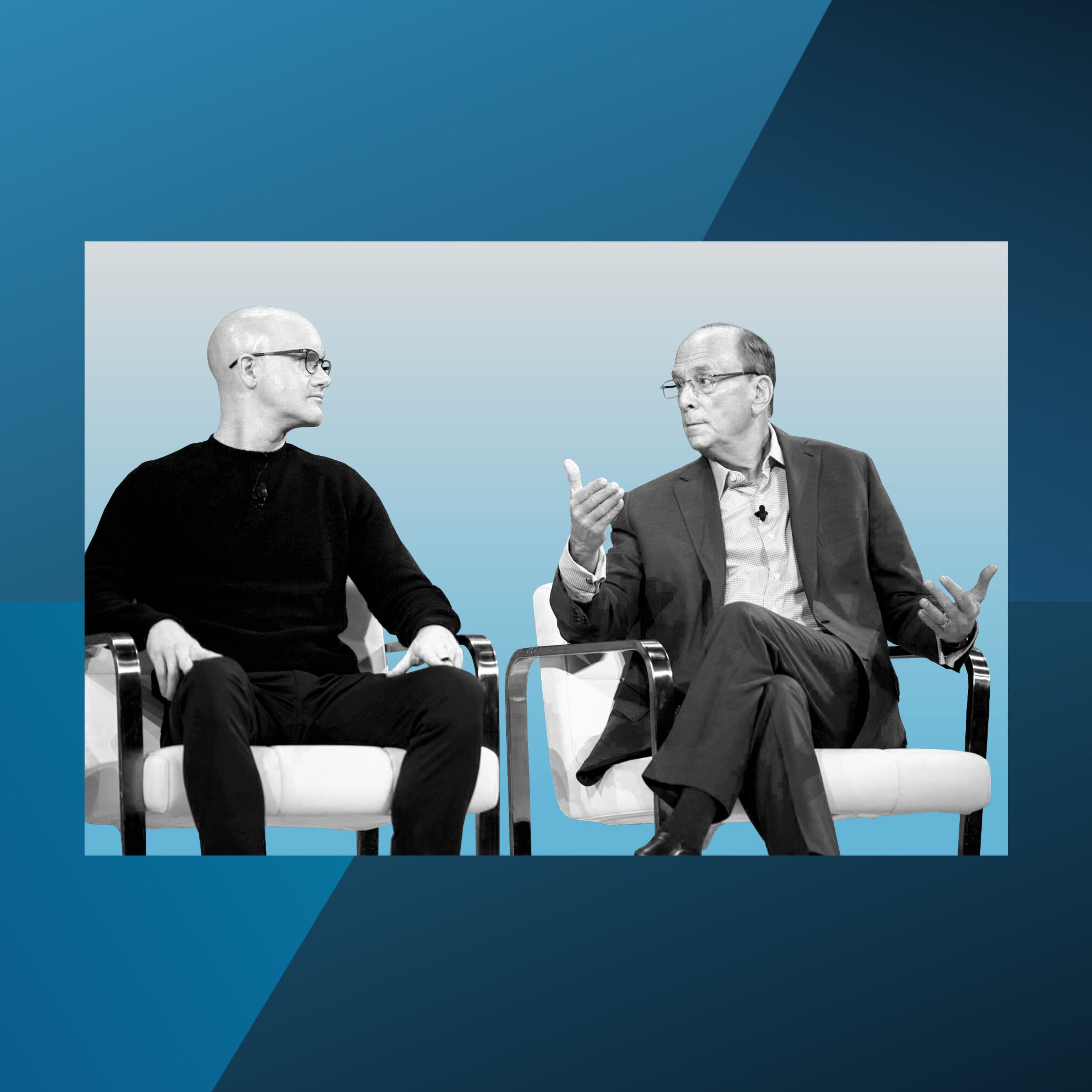
DealBook Summit
Larry Fink and Brian Armstrong Are Not Worried About Another Crypto Winter
00:34:25
Larry Fink, chief executive of BlackRock, and Brian Armstrong, chief executive of Coinbase, discuss their united and optimistic vision for the future of crypto. The two haven’t always seen eye to eye. Mr. Fink, who was once a Bitcoin skeptic, shares what made him turn positive on crypto in an interview alongside Mr. Armstrong, the chief executive of the largest crypto exchange in the United States.
Loading summary
Transcript101 lines
- [00:01]
DealBook Summit Host
This episode was recorded at the 2025 DealBook Summit. This year's Dealbook Summit sponsors include premier sponsor Accenture, associate sponsors U.S. bank Vanguard Invesco, QQQ and University of Michigan, supporting sponsor Capital One and contributing sponsor Invest Puerto Rico.
- [00:27]
Brian Armstrong
2025 is actually, we'll look back on this as the year that crypto regulation went from kind of GR to well lit establishment. And then I think we'll have the foundation to really have this industry be built in the US and we'll see a little bit less of this kind of high risk activity happening offshore.
- [00:45]
Andrew Ross Sorkin
This is Andrew Osorkin with the New York Times and you're listening to interviews from our annual Dealbook Summit recorded on December 3rd in New York City.
- [00:59]
Good morning again, everybody. I wanted to try to bring together this morning two pioneers from two different generations, dare I say to talk about the future of finance at a time when we are going through a remarkable shift in all of it from the passing of the Genius act to the surge of stablecoins prediction markets now talk of tokenization as well as where we are in our economy. And Larry Fink, of course, founded BlackRock back in 1988. Today the world's largest asset manager, overseeing $13.5 trillion. That's with a T, if you can believe it. BR Armstrong founded Coinbase in 2012. Today it is the largest crypto exchange in the US and has grand ambitions to do much more. In 2021, it became the first crypto company to go public and has half a trillion dollars in assets on its platform. So good morning to both of you. One of the reasons I wanted to put you together is you historically, over the years did not agree with each other at all about this world of crypto. If I, if I dare say, you obviously were a proponent from the beginning. I think we met about a year or two after you began this effort. Larry, you were though, on the other end of it, even on this stage in the past, you famously, in 2017 called crypto an index for money laundering. BlackRock.
- [02:22]
Larry Fink
And thieves.
- [02:23]
Andrew Ross Sorkin
And thieves, yes. Money laundering and thieves. You now have the biggest Bitcoin etf. So what happened here?
- [02:34]
Larry Fink
You know, as the secretary said, you got to evolve and change. So.
- [02:40]
I did say that. I think I said that in Washington sitting next to Jamie Dimon. But during COVID when you had a little more time on your head traveling around the world, I actually took it upon myself to visit and talk to a lot of people who were advocates of it. I wanted to understand what am I missing? Why Am I. Why do. Why do I have that belief? And so I was testing myself like I do in many other things. And I was. So around 20, 21, 22, I began to evolve those views. Those statements was not about crypto. Those statements were specifically about Bitcoin. So let me be clear, too. But I see a big, large use case for Bitcoin, and I still do today. And. And so this is one thing that I get excited about. I have very strong views, but that doesn't mean I'm not wrong. By having strong views, you have to test yourself and ask yourself, in my role, I see thousands of clients a year. I have governmental leaders, and we have these conversations that my thought process always evolves. This is a very glaring public example of a big shift in my opinions.
- [03:55]
Andrew Ross Sorkin
How much, though? And Brian, you can speak to this. Do you think that folks in the legacy or traditional industry didn't either get it, want to promote it, want to be part of it, because they were scared? Yeah.
- [04:09]
Brian Armstrong
Well, this is the classic innovator's dilemma, right? Anytime you have a new technology come around, everybody who is an incumbent has to decide do we want to embrace it or do we want to fight against it. And in some of these larger organizations, it's kind of funny, actually, because there'll be part of the organization, like their lobbying team in D.C. is actually fighting against it, kind of trying to do regulatory capture. But the innovation arm of the company is actually embracing it. And for many of the largest banks now, we're actually powering pilots with them, doing stablecoins and custody and trading and these kinds of things. And once in a while, we run into their lobbyists in D.C. and they're kind of trying to curtail it. And so I think it's like any company, you have to embrace change and be on the frontier. It's not unique to crypto.
- [04:50]
Andrew Ross Sorkin
Is there any chance in your mind at all that Warren Buffett is right? He and Charlie Munger used to call it rat poison and say, eventually it'll go to zero. It just might take a while.
- [05:02]
Larry Fink
But they're talking specifically about bitcoin.
- [05:04]
Andrew Ross Sorkin
They're talking about Bitcoin. But you offer a Bitcoin ETF so you can speak to that. Yeah, there's.
- [05:10]
Brian Armstrong
I mean, there's no chance that. I don't think that that's going to happen at this point. I mean, you know, there's something that happens from a psychology point of view as we all age and, you know, we grew up in a certain environment and were shaped by the experiences we had. And I think for Charlie and Warren, they grew up in an environment of America preeminence and the dollar was everything. And how dare you question it? And you know, we're in a world now where democracies around the world are trying to figure out how to curb deficit spending. And you know, bitcoin is kind of this new digital gold. People are going to it in times of uncertainty. And so it's tough for them to contemplate a world that is more decentralized than running on the Internet.
- [05:46]
Andrew Ross Sorkin
How much of it though, in terms of what's happening in the last year is a function of money. Money being spent? You mentioned lobbying in Washington. So you were behind the political movement that really pushed a lot of this. I mean, directly you spent about $50 million in corporate donations in the 2024 cycle. The crypto industry spent about $130 million. How much of it do you think is here now? Because the industry effectively, and some people cynically would say bought this new opportunity.
- [06:14]
Brian Armstrong
Yeah, well, our mission is to increase economic freedom in the world, and I prefer to do that just with our products and integrating crypto into the traditional financial system to update it. But it turns out over time that a big way we can accomplish our mission is actually holding bad government accountable.
- [06:29]
Andrew Ross Sorkin
Right.
- [06:29]
Brian Armstrong
So if there's 52 million Americans who have used crypto and they want to see clear rules on the books to protect consumers, I think in the last administration we saw that our representatives in government were not actually fulfilling those values that the American people had. They were actually unlawfully trying to kill the industry. A lot of it went offshore as a result of that, and a lot of consumers got harmed. And so, you know, we've always been very transparent about donations we've made to super PACs like Fairshake. But we also helped bring together a large number of voters to elect pro crypto candidates. And to me, that's democracy working.
- [07:01]
Larry Fink
I think we need to get back to what is the purpose of bitcoin. Then we get into stablecoin, you know, the 13 and a half trillion dollars that BlackRock managed on behalf of our clients. It's basically managing hope. That's all it is. I mean, why would anybody Invest in a 30 year outcome unless you're hopeful in 30 years you're going to have the compounding effect.
- [07:23]
Bitcoin is an asset of fear.
- [07:27]
And when you're less fearful, like we had a trade agreement with China, you saw a shift downward. There is conversations this week that there may be some type of settlement in Ukraine, Bitcoin fell a little bit. So you own Bitcoin because you're frightened of your physical security. You own it because you're frightened of your financial security. The long term fundamental reason. You own it because the debasement of financial assets because of deficits. And so to me even the movement in the last week and we've had about a 20, 25% drawdown and this is the third time since IBIT was created our ETFs. And so you see these shifts and they're actually pretty non correlated shifts. And so the role.
- [08:18]
Andrew Ross Sorkin
But then some people say is that really insurance? Right. If you had bought it at $125,000 but and it's now sitting at 90 some odd thousand dollars, you're saying if.
- [08:25]
Larry Fink
You bought it for a trade, you know, it's a very volatile asset. You're going to have to be really good at market timing, which most people are. If you're buying it as a hedge against all your hope, you know, then it has a meaningful impact on a portfolio. The bigger, the other big problem of Bitcoin is it is still heavily influenced by leveraged players. It is.
- [08:49]
Andrew Ross Sorkin
That's what I wanted to talk to you guys about.
- [08:50]
Larry Fink
Okay. I mean that's bitcoin. But we could see because we see where the flows are coming from. We're seeing more and more legitimate long only investors investing in it. There was an article about a foundation endowment just bought a lot of ibit. But I can tell you there are a number of sovereign funds that are standing by. They're adding incrementally at 120, at 1100 they, I know they bought more in the 80s, that's fine. And they're, they're establishing a longer position and you own it over years. This is not a trade, you own it for a purpose. But the market is skew, is heavily leveraged and that's why you're going to have more volatility.
- [09:33]
Andrew Ross Sorkin
So Brian, let's talk about that though the leverage piece because I think people don't, we all don't know where all the leverage lies. I think some people. Look, Michael Saylor has a company strategy, formerly microstrategy that seems like a big levered bet. He owns about 3% I believe of all the Bitcoin that exists. How much leverage is there really?
- [09:51]
Brian Armstrong
Well yeah, I mean we saw a little bit of this on October 10th this year and there was, there was quite a bit of leverage that got unwound as the market moved around a Little bit. But this largely happened on offshore exchanges. Right. On Coinbase, we saw very little of this. And to me it's just an example of why we need clear rules on the books in the United states. I think 2025 is actually, we'll look back on this as the year that crypto regulation went from kind of gray market to well lit establishment, because we saw the passage of the Genius act, which was huge for stablecoins. We've now seen a bipartisan vote for the market structure legislation in the House and now it's going through the Senate. And so hopefully within a few months we might get a vote on that in the Senate. And then I think we'll have the foundation to really have this industry be built in the US and we'll see a little bit less of this kind of leverage or high risk activity happening offshore.
- [10:38]
Andrew Ross Sorkin
I want to get stable coins and tokenization and blockchain and where this all goes. But you mentioned lobbying before and I just want to ask you one lobbying related question and actually it can go to both of you because you're both doing something similar, which is that you've both made donations to the new ballroom that the White House is creating. We were just talking to the Treasury Secretary earlier about David Ellison making movies and trying to placate the administration, if that's what he's doing. I want to read you what Jamie Dimon said about making donations in this context, because he says that he's not doing it and he says we have an issue which is anything we do. Since we do a lot of contracts with governments here and around the world, we have to be very careful about how anything is perceived and also how the next DOJ is going to to deal with it. So we're very quite conscious of the risk we bear by doing anything that looks like buying favors or anything like that. What do you think about that?
- [11:36]
Larry Fink
I agree with what Jamie said and everything we do is with that type of lens.
- [11:42]
Typically our political giving is split between 50% 1 party and 50% 1. How we distribute it, that is up to my public policy team. But we're very deliberate on it. We try to be equal in every category in every case, but we are very deliberate and we look through the lens at how he described.
- [12:04]
Andrew Ross Sorkin
But Bram, what do you think of that? Because I think there is a view that people are trying to buy influence in Washington and that it's more available to buy today than it used to be.
- [12:13]
Brian Armstrong
Yeah, so I think these are really two separate things. On the one hand, we're an American company. We're proud to be an American company. So we donate to various things like national monuments and milestones. And it is bipartisan, you know, in the way that Larry described. Separately, we heavily engage in lobbying. I mentioned to you this standwithcrypto.org and like fair Shake and these, all these kinds of efforts. And so those two are separate in my mind, but both important, like, we're proud to be an American company.
- [12:40]
Andrew Ross Sorkin
And do you, do you ever worry, I mean, to this Jamie Dimon point that somehow, you know, the Democrats will get into office next, next time around or maybe even after that, and then say, you know what we think that all these donations were part of some kind of quid pro quo or some kind of influencing.
- [12:57]
Larry Fink
Does that mean they're not going to use the ballroom then?
- [13:00]
Andrew Ross Sorkin
I don't know.
- [13:02]
Brian Armstrong
It's always possible. I mean, these agencies can get politicized. They seem to always get politicized. So anything's possible. But that shouldn't stop us from doing the right thing.
- [13:11]
Larry Fink
It comes down to the ethics of an organization and making sure you're looking at the entirety of what you're doing in a balanced and fair way through the lens over time.
- [13:21]
Andrew Ross Sorkin
Okay, let me ask you a different question, Larry, because you just wrote a piece in the Economist about tokenization. And I think that tokenization, some people here will know it well, some people will not. So maybe you can help level set, but I think you have a view that tokenization is effectively going to change finance forever.
- [13:39]
Larry Fink
Yeah. Want to explain?
- [13:41]
Andrew Ross Sorkin
Explain.
- [13:42]
Larry Fink
Okay.
- [13:44]
There's so much conversation going on about AI and how AI is going to be reshaping the world. There's not enough conversation about how technology is going to be reshaping the financial services area too, and the need for democratization. As Secretary Bessen talked about the democratization of investing in America.
- [14:04]
There are SLU's, a middleman in the whole financial services area. We have elongated settlements, elongated processes. If we could digitize every asset, so if we could digitize all stocks and bonds and have it more seamless going from a digital wallet of cash or stablecoin into equities or bonds through, in most categories through an etf, it will reduce the friction cost, the transaction costs, and it allows a much more free flow. So there's $4.1 trillion of money in digital wallets globally sitting in stablecoins mostly. And can you now. And right now, if they wanted to go into a bond or stock or have a real estate transaction, they have to take the Money out of the digital wallet into a traditional wallet and have all those commissions and fees and all that stuff. So the whole idea of tokenization of all assets, including real estate, ultimately is going to just reduce huge friction costs, making investing easier, simpler. As the Secretary was talking about this one account, you can do this all through your app and it's going to allow a more, I would say, a free flowing process of investing.
- [15:24]
Andrew Ross Sorkin
Brian, if all of this happens, how does the finance industry change? Would you short all the credit card companies, for example? Because invariably digitization of a dollar, well, that's a digitization. I mean, we can also get into stablecoins, which is the other piece of this, which is in some cases required for all of this. We didn't really talk the Treasury Secretary about it. But underlying all this has to be lots of Treasuries, which a lot of the banks. One of the reasons I think banks have been frustrated or anxious about some of this has been the idea that there's going to be a flight of capital effectively out of the banks that's going to go to effectively support the stablecoin business, which ultimately will support in large part some of the transactional issues and potentially even some of the tokenization projects.
- [16:07]
Brian Armstrong
Well, in that case, I think that's just the banks trying to protect their profit margin. I mean, they should have to pay rewards and higher rates to their own customers. And I think they're trying to put their thumb on the scale regulatory capture essentially to prevent crypto from doing that. But my prediction is actually the banks are going to start. We are already seeing this actually. They're going to be increasingly embracing stablecoins. And my guess is that in a year or two they'll come back and say actually we want to be able to pay interest and yield on stablecoins in our own companies. And so it goes back to that innovator's dilemma situation. I mean, the best banks are leaning into this as an opportunity and the ones who are fighting it are going to get left behind.
- [16:45]
Larry Fink
I would say as a country. We're late.
- [16:48]
Andrew Ross Sorkin
We're late.
- [16:49]
Larry Fink
Yeah, we're late.
- [16:50]
Andrew Ross Sorkin
Who's ahead of us?
- [16:51]
Larry Fink
India and Brazil. So this is the biggest issue. We are a successful nation. So much of the foundation of our success has been the role of the capital markets. If you think about how the US economy was able to restabilize itself faster after the great financial recession is because of the role of capital markets. Now that the Secretary was talking about the role of private credit, but it was really the capital markets and we are now starting to see in Brazil and in India whole transformation of a digital economy. You know, they digitized their currency. You even have now credit card purchases on the pipe in Brazil itself, the pics. And so what I am worried about we're not moving fast enough. And you know, and so, you know, I didn't put this in the article because I didn't want to be that vivid on this. But this is one of my big fundamental issues. We need to move faster. You know, we need to move faster as a country, even in AI. I mean you haven't asked the question when people say is there a AI bubble? I ask well if we don't continue to spend on this and that means we're going to have some failures and some success stories, but if we don't spend enough faster and AI and digitization and tokenization, other countries are going to beat us.
- [18:14]
Andrew Ross Sorkin
So you think by the way, do you actually I'll ask the question then. Do you think we're in an AI bubble and do you think the economics of this are all going to make sense if we were sitting here altogether five years from now, will we say that we vastly overspent?
- [18:27]
Larry Fink
What number of the hyperscaler CEOs and I have had this various conversation.
- [18:33]
They're not certain if they're overspending or underspending right now. But what they're certain is the and they're seeing it right now. Most hyperscalers are short compute. There's not enough happening the amount of demand for this. That being said, the timing of this build out may underperform their investment criteria but they're certain that the demand will be there. And this is why I love a capitalistic market. I'm not here to suggest there's not going to be some headline blow ups. I mean there are going to be some huge winners and huge failures. I mean it gets to this K economy but I would say there are going to be just incredible winners. And I've raised this question with politicians, does that mean we're going to have five $10 trillion companies? What does that mean? Societal, how are we making sure? This is why I love the new children's account, because how do we broaden the economy if these hyperscalers are these massive winners?
- [19:35]
Andrew Ross Sorkin
Brian, let me connect this back to tokenization because one of the things that we're seeing is there's an effort now to tokenize private companies. A lot of private companies in the AI space that are not public, they don't have the same disclosures that you have. But people are going to eventually get access to some of this stuff, and some of this might ultimately, by the way, end up. You're looking at me askance, Larry Fink.
- [19:57]
Larry Fink
Yeah, I haven't heard this one.
- [19:59]
Andrew Ross Sorkin
You haven't heard this one? No. There's a bunch of companies that are now being. Robinhood and others are effectively trying to tokenize private companies so that you could sell pieces of those private companies to the public without the same disclosures. What do you think about that?
- [20:14]
Brian Armstrong
Well, in that case, I think they had some footfalls because you have to do it with the permission of the company. Right. So I don't think that approach worked very well for them. But if you just zoom out for a minute and say, okay, there's. These companies are staying private longer.
- [20:26]
Larry Fink
Right.
- [20:27]
Brian Armstrong
Sarbanes, Oxley and all these things made it more difficult to go public, the amount of demand for capital in these private companies is just going to keep growing and growing. And there's so much money in crypto. How can crypto update capital formation? Just like it's updated every other part of the financial services area. So there's a big investment that we're making in how to. How to update capital formation and make it easier for private, private companies to raise money. But we want to do it with the permission of those companies. Ultimately.
- [20:50]
Andrew Ross Sorkin
Do you want to compete with Larry? Do you guys think that you're competing with each other because you've talked about broadening your offerings far beyond crypto?
- [20:59]
Brian Armstrong
No, I don't think so. In fact, we're a great partner of theirs on their ETF. You know, we're powering, I think, more than 80% of the ETFs for crypto in terms of custody and trading. And, you know, as there's an effort to tokenize their funds, Coinbase is well positioned to be the leader in just tokenization of every asset. I mean, we've done that with stablecoins. You can look at it happening now in various parts of the world with stocks. It should be happening with every fund. And what we want to do is actually market their products to our customers. The half trillion of assets that you mentioned for retail and institutional, we want to put those products in front of our customers. I think we'll work well together.
- [21:35]
Andrew Ross Sorkin
You mentioned IPOs and governance issues. I wanted to ask you a governance question. You are moving your company from Delaware to Texas. You are following Elon Musk effectively and.
- [21:48]
Brian Armstrong
Lots, lots of companies.
- [21:49]
Andrew Ross Sorkin
Yeah. Tell us why. And do you think that this is, this is Interesting to me because Larry, on the other end, I don't know, I don't know if you think you're on the other end historically has represented shareholders who want to have access to vote for things and the shareholders are going to have less access to vote for things. Likely in Texas.
- [22:08]
Brian Armstrong
Yeah, well, we want to run our company in a business friendly jurisdiction. I mean it's pretty simple, right? I think Delaware historically had a great monopoly on this and they had a lot of trust in the courts and everything. But recently we've seen really unpredictable outcomes from the court. We've seen hostility toward founder led companies and they're not deferring to the judgment of these boards. And I think even on your show, Andrew, the governor of Delaware came on and kind of made dismissive comments about one of the leading entrepreneurs of our time. And so that was a bit of a head scratcher for me. I mean, how are you going to have people come incorporated in your state if you have this anti business rhetoric, right? So luckily the founding fathers in the United States had this brilliant idea called federalism where we have a free market competition amongst the states. And we had some meetings with the folks in Delaware. I think the legislature was doing a good job trying to fix some of the court outcomes. But ultimately if you want to get reform, you know, you don't try to just use your voice internally. You have to leave and align incentives and punish bad behavior. Otherwise they're not gonna reform themselves. So we're happy to be in Texas and they seem very business friendly and you know, but when you say business.
- [23:15]
Andrew Ross Sorkin
Friendly, shareholder friendly or you're saying founder friendly is what you're saying?
- [23:19]
Brian Armstrong
I think both. Yeah. I mean it's business friendly in the sense that you can just get things done quickly. They're not gonna allow somebody who owns one share of stock of your company to like rack up hundreds of millions of dollars of legal fees. So I think it's business friendly. I think, you know, ultimately like people can choose which company they want to invest in. Like the free market is the right regulator of that. We don't want unpredictable outcomes from courts that are doing activist.
- [23:45]
Andrew Ross Sorkin
Larry, you like Texas? You want to move to Texas?
- [23:48]
Larry Fink
I mean we were one of the original founding investors in the Texas Stock Exchange. Unrelated to this topic, but, but I want to just link back to. Yes, we're responsible for all our clients equity investments and we've offered the right of each of our clients to vote their own shares. But let's just get back to tokenization. If we were able to tokenize every stock we would know instantaneous the asset owner of record. So I would be transacting the. The trade on behalf of that owner of record. If we tokenize, we ultimately democratize everything related to voting. Every holder of the asset will have the ability to vote.
- [24:34]
Andrew Ross Sorkin
But the argument always has been that most retail investors don't vote. And as a result of that.
- [24:39]
Larry Fink
But if it was on an app, on a phone now that it is so easy and clear.
- [24:45]
It can't. You know, technology can help that education.
- [24:48]
Andrew Ross Sorkin
Okay, but then the question is if you're running a company, by the way, you're the CEO of a company too that also represents shareholders. Is that a good. I mean if you're. If every quarter you have or every year rather you're. I mean you're fighting proxy. Proxy battles every year as it is.
- [25:01]
Larry Fink
Right.
- [25:02]
Andrew Ross Sorkin
If the democracy gets even larger meaning if everybody. Then you're going to be having to run massive campaigns every year.
- [25:08]
Larry Fink
No, but I think the SEC is also trying to clarify proxy access so that, you know.
- [25:15]
Paul Atkins did already said this is gonna be one of his big.
- [25:18]
Andrew Ross Sorkin
Well, one of the things that we've heard that the president wanted to potentially sign an executive order that would actually prevent big funds like a BlackRock or State street or any of your competitors effectively from voting those shares on behalf of shareholders.
- [25:34]
Larry Fink
I'm not that rumor too.
- [25:35]
Andrew Ross Sorkin
Yeah. What do you think of that?
- [25:37]
Larry Fink
I'm not clear. If that became a rule, if that became an executive order, that means foreigners will have more power voting in the United States. If they disallowed index funds to vote at this moment, it means foreign investors would have a greater percent of the vote. Is that an outcome that we want? Two, it would put much more power with the activists investing. I can tell you almost every CEO who approaches BlackRock in this is frightened of that outcome. That because let's. If the index investors own 30%, 40% of the shares, you take that out, it really will create very skewed outcomes and foreigners will have a bigger role in the voting process, as will activists. Is that the outcome you want to see instability at the corporate level? If that happened, I mean last year we voted 98.8 with management, you know, and there's only a few instances where you vote against. And so and as I said, if we get back to tokenization, which we're excited about, every asset owner of record of that moment can. Will be the ultimate voter of record.
- [26:48]
Andrew Ross Sorkin
We've only got about a minute and a half left And I have two questions for you. One is just so 30 seconds each. Where do you think we are in the economy right now? If we were back here a year or two from now, would we be in a materially better place? How do you see the markets?
- [27:04]
Brian Armstrong
I'm an optimist. Right. I think that it's kind of a golden age for freedom that's happening with democratization of access to these different products. With crypto we're seeing prediction markets really start to flourish. We have regulatory clarity now for stablecoins. We're seeing it emerging hopefully for market structure. And the US feels like it's back on offense. We have a chance to go update the financial system with crypto and just get a lot of the friction, friction out of the economy going into the midterms. Who knows, maybe the government will want to juice the markets, do some more rate cuts. So I'm generally optimistic and we try not to get caught up in any short term trends. We just try to build good products and play for the long term.
- [27:41]
Andrew Ross Sorkin
Larry, what do you say?
- [27:42]
Larry Fink
So managing 40 something percent of our assets are foreign owned assets. They have a 70 to 80% allocation of their portfolio in dollar based assets. This is the place where they want to invest in the opportunity. Obviously earlier this year we saw maybe a 3 or 4% reduction but they're still heavily overweighted. And so I think that is one of the great powers that there are very few destinations where capital is seeking long term opportunities. That being said, we have to ask the question, why is the job market in 2025 so anemic? Last year the job market averaged 154,000 new jobs every month. This year we're averaging 31,000 jobs. That is not being, that's not part of the conversation. The question is, is it the uncertainty around all the policies that are being created? If that's the case, when there's more certainty, are we going to see a surge in job growth next year? Well, that's an inflationary outcome. The counterpart is are we seeing this anemic job market? Because the future is today we're now beginning to see more labor substitution because technology, that's a very deflationary outcome. But that has profound impact on how we navigate.
- [28:59]
Andrew Ross Sorkin
Which one do you think it is?
- [29:00]
Larry Fink
I think it's both. But I think the trend of technology, you're starting to see that if you look at corporate margins, especially the leaders in every industry, the leaders in every industry are winning more and more share. So we are seeing this K economy developed in every industry and what I think is happening is more and more companies are doing more with the same amount of people or less people. I mean if you think about the ratio of I think about BlackRock, our revenues are up 40%, our headcount's up 5. Okay. So our margins are up about 300 basis points over the last few years. And so with technology you're able to, you know, transact more volume, more business, you have more technology doing much more of the fundamental, you know, the backbones of what we do as a firm. I mean having 13 and a half trillion dollars, we do a lot of trades and we have thousands and thousands of different criteria by that each investor gave it and it is all done through technology. And so this technological change is happening today. But it's going to have a profound impact on our economy. It's going to have the biggest impact is what do we do with our university system. We built a university system in the United States based on white collar jobs. That's going to be changing with technology. How is that all going to be reshaped? We need to be answering these questions and I don't hear people asking the questions.
- [30:25]
Andrew Ross Sorkin
They are important questions. Final question to you. You had a viral moment talking about the finality of at the end of your quarterly earnings call. We've been having discussions about poly market and prediction markets and everybody betting on what people are going to say at any given moment. And you read off the words that people were betting on. On the call you said Bitcoin, ethereum, blockchain, staking web. 3 tens of thousands of dollars had been bet on each of those words. People were betting on whether you would actually say those words and then you effectively we're trolling them I think. Can you tell us.
- [31:05]
Tell me what you think about that and what you think about prediction markets if you can effectively determine the winner in such a way. And by the way, there's lots of folks who are now bed their people in here. I heard that there are people making bets about what was going to happen at Dealbook. CNN just made a contract with Kalshi apparently to have people bet on news. What were you thinking during the conference call?
- [31:29]
Brian Armstrong
Yeah, well the conference call was me just having a little bit of fun. But I think the bigger picture here is that prediction markets are a big deal and for 1% of people they're trading it just like another asset class. But for 99% of people they're looking at it as an alternative, I think to traditional media actually to figure out what's going to happen in the world. And then some people are also just using it for entertainment.
- [31:51]
Larry Fink
Right.
- [31:52]
Brian Armstrong
So it's a very interesting new area. I think that actually we're going to see even more potential here. Like an example would be policymakers could actually use prediction markets to say, okay, of these three policies, which one will raise GDP or which one will lower unemployment the most or whatever metric you're trying to get. And it'll get signal from the market about which policy to actually go implement. So it's just, it's one more example of this trend of kind of taking.
- [32:15]
Andrew Ross Sorkin
Do you worry about manipulation? I mean that's the other big part of it. And by the way, you effectively manipulated the outcome.
- [32:21]
Brian Armstrong
Yeah, well, I didn't trade on it, of course, but I, you know, I actually had a really interesting conversation with one of the folks that was nominated to be CFTC commissioner about this and I, he asked me, he said, do you think we should allow insider trading in prediction markets? And I said it's actually a pretty, it's not as clear cut question. Right. Because if your goal is to actually, for the 99% of people trying to get signal about what's going to happen in the world, like is the Suez Canal going to be reopened or whatever, you actually want insider trading. You want some admiral sitting on a ship in the Suez Canal who has really good information to be trading so you get better, higher quality signal out of them. Right now if you want to preserve the integrity of those markets, maybe you don't want insider trading. So there might be like a decentralization test that has to go in here. But it's not a clear cut answer.
- [33:08]
Larry Fink
Larry.
- [33:08]
Andrew Ross Sorkin
I don't know what they're better you're going to say, but you just sort of made a face.
- [33:15]
Larry Fink
We try to help people navigate a 30 year outcome. I don't really care about what happens the next moment. I mean, I'm aware in the betting market in football you could bet every play. I mean, to me, this is not how I'm going to live my life.
- [33:31]
Andrew Ross Sorkin
Larry Fink, Brian Armstrong, thank you both very, very much.
- [33:36]
Brian Armstrong
Thank.
- [33:38]
Larry Fink
You.
- [33:41]
Andrew Ross Sorkin
Dealbook Summit is a production of the New York Times. This episode was produced by Evan Roberts, mixing by Kelly Piclo and Katie McMurran. Original music by Daniel Powell. The rest of the Dealbook events team includes Julie Zahn, Hilary Coon, Melissa Tripoli, Beth Weinstein, Angela Austin, Haley Hess, Dana Prukowski, Matt Kaiser, Chantal Rainier and Yen Wei Liyu. Special thanks to Sam Dolnick, Nina Lassom, Christina Josa and Maddie Masiel.