← DealBook Summit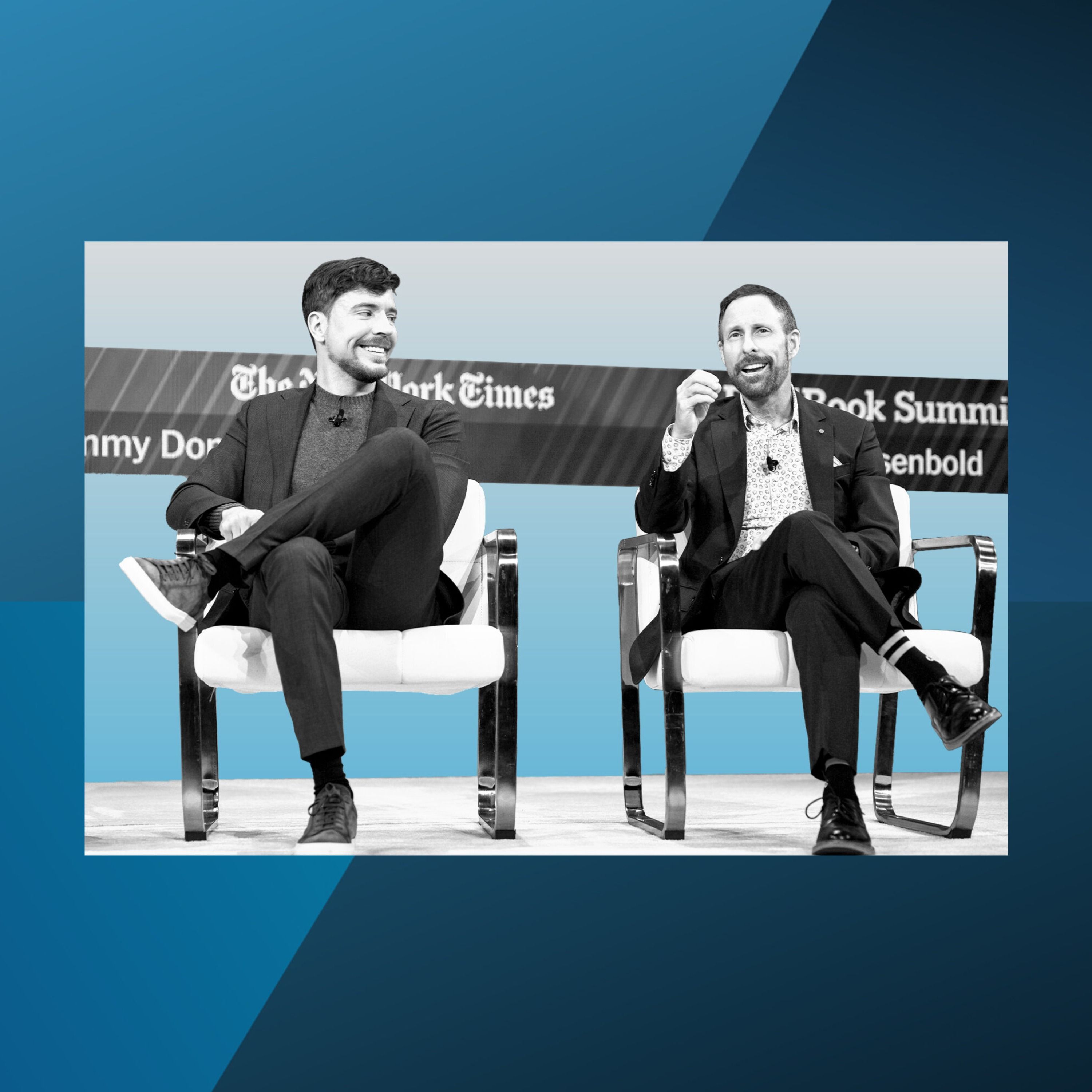
DealBook Summit
MrBeast Isn’t Looking for Controversy
00:37:29
The YouTuber Jimmy Donaldson, better known as MrBeast, discusses fame, why he thinks YouTube is the best place platform for creators and how he tries to avoid controversy. Then Chief executive of Beast Industries, Jeff Housenbold, joins Mr. Donaldson to discuss how the duo work together — and why they take so few days off.
Loading summary
Transcript189 lines
- [00:01]
A
This episode was recorded at the 2025 DealBook Summit.
- [00:04]
B
This year's Dealbook Summit sponsors include premier.
- [00:07]
A
Sponsor Accenture, associate sponsors U.S. bank Vanguard Invesco, QQQ and University of Michigan, supporting sponsor Capital One and contributing sponsor Invest Puerto Rico.
- [00:27]
C
Our mission is to be the most impactful entertainment brand in creating content that entertains, inspires and educates. And that we're helping to make kindness viral and that we're using Jimmy's fandom to make the world a better place.
- [00:45]
A
This is Andrew Osorkin with the New York Times and you're listening to interviews from our annual Dealbook Summit recorded on December 3rd in New York City.
- [00:58]
Good afternoon everybody. I am here with Jimmy Donaldson. He is the most followed person in the world, literally. He's got billions, billions of viewers. His empire spans Mr. Beast YouTube channel, Beast Games on Amazon prime, consumer goods, including his chocolate brand Feastables, philanthropy and so much more. And in just a moment, we are going to bring out the CEO of his company who is going to be joining us in a little bit as we discuss the business of all this. But I want to start with Mr. By the way, do people say to you Jimmy or do they call you Mr. Beast?
- [01:39]
B
Usually if they're over the age of 10, I prefer to go by Jimmy. So yeah, for this room you can just call me Jimmy.
- [01:44]
A
Ok. But there's a lot of people here, by the way, who wanted to bring their kids, just so you know.
- [01:48]
B
I mean, I don't know if they'd find the rest interesting, but.
- [01:52]
Especially maybe the last few ones.
- [01:58]
A
Thank you.
- [02:00]
Let me, let me ask you this though, and maybe just start with how this all happened. And I want to say happened to you because this is something that you did on your own. All of this started your first video, you were 11 years old.
- [02:13]
B
Yeah.
- [02:13]
A
And I just want to understand sort of what your childhood was like. What led you to want to actually play on YouTube and where you thought it could even go?
- [02:24]
B
Well, when I was younger, I had a weird obsession. It ended up working out, but I was really curious why certain pieces of content, you know, would get a hundred million views and other would get a hundred. And from a young age I really just studied what virality was and I found that I really enjoyed making videos and I really enjoyed telling stories. But when I was 11, 12, 13, 14, 15, 16, 17, 18, I'd work on a video for days and two people would watch it and obviously that was very frustrating. And so I spent my entire teenage years just basically studying. Right. Right now 2% of all humanity's time is spent on YouTube. Most people don't even realize that. It's pretty crazy. And that time is basically dictated by what the algorithm puts on your homepage, you know, and so why does it serve certain videos over others? And that was kind of my obsession for, like, eight or nine years, because I was just tired of making these videos and no one watching them.
- [03:19]
A
What did your mother think of all of this time you were spending?
- [03:21]
B
She thought it was crazy and I was going to get kidnapped because in her world, it was obviously go to college or you're homeless, so. But eventually she came around.
- [03:30]
A
Once it worked out, we'll talk about it working out. I want to show a video of you because this really struck me, and I think it speaks.
- [03:37]
B
Oh, boy.
- [03:38]
A
What happened in your life and where you are today. Can we. Can we roll this? This is something that you posted very recently.
- [03:46]
B
Oh, I'm going to schedule upload this video 10 years in the future. So you're gonna see this in 2025. I better have a million subscribers when you guys see this.
- [03:58]
But by the time you see this, I'll have finished high school, gone to college, probably be doing YouTube as a job. Hopefully. Maybe. Maybe, maybe, maybe.
- [04:10]
Yeah. As of right Now, I'm enjoying YouTube. Hopefully I still, future me, still enjoys it, and I don't know, I'd be crazy if I had some ridiculous amount of subscribers at the time I'm recording this video. I have 8,000 subscribers and 1.8 million views. It's crazy. That's crazy to see that.
- [04:31]
A
So, honestly, though, what. I mean, when you rewatched this.
- [04:35]
B
Yeah.
- [04:36]
A
Because you just posted it.
- [04:37]
B
Yeah. So I filmed that when I was a teenager and schedule uploaded. YouTube has a feature where you can set videos to go public in the future. So I was supposed to be studying for a history test, and I got bored. So I just grabbed a phone and started scheduling videos. Like, I still have one that goes up 10 years from now, 60 years from now. Like, random dates.
- [04:54]
A
Okay. So how ambitious do they get, though? So do you have one that you've done recently?
- [04:58]
B
Well, no, I made them all when I was a teenager. And so just throughout my.
- [05:02]
A
You should do one now. So we, you know.
- [05:03]
B
Yeah, but it's funnier because back then I was a little kid, and so just throughout my life, random videos will just go live. I don't remember what I said, so hopefully it was too bad.
- [05:13]
A
But honestly, what was it? I mean, I think we're all trying to deal and understand what we're calling the attention economy.
- [05:19]
C
Right.
- [05:20]
A
And you somehow have figured this out in a way that I don't think anybody else has. I mean, at a level that nobody. At a scale that nobody else has. And so I'm trying to understand what you think it is that you did figure out.
- [05:31]
B
Oh, boy. Well, yeah, basically, how do you get your video served? How do you get it where people watch your content? It's. I mean, what's interesting is obviously, like I mentioned a stat before. 2% of all of humans time is spent on YouTube. And obviously it wouldn't be that way if it wasn't constantly serving you videos you like. And so the more you study social media algorithms, the more you just realize it's just a reflection of what people want to watch, what they want to consume. And it does a very good job of figuring out what you're interested in and serving you it. And so in our case, if we want to make a video that people all around the world would watch, and, I mean, I'm giving you, like, tendencies, like 10 hours to speak down to, like, two minutes. But if you want to make a piece of content that someone in India and someone in America and someone in South America can enjoy, you know, obviously it probably can't be culturally relevant or things like that. It needs to be things that are more intrinsic to humans. Like, no matter where you are in the world, you. You know, you understand love. Right? So what. I mean, this might sound weird to the people in this room, but one of our more recent videos is, as a joke, we found a couple that broke up four years ago, and then we offered them $300,000 if they spend 30 days chained together. So with handcuffs on, ex boyfriend and girlfriend. If they spent a month together, they'd win 300 grand. And so that's, you know, obviously seems silly, but that's something that no matter where you are in the world, you understand that.
- [06:54]
A
But do you think you appreciated this when you were 15 years old?
- [06:57]
B
No. That's why no one watched the videos back then when you saw that.
- [07:00]
A
So what's. But what changed? And also what. Because you also tapped into something else, which I'm actually somewhat concerned about, actually longer term, which is almost a global attention deficit disorder that we all have, and this requirement that we're captured by this sort of hook, and then we can only really watch for a certain amount of time. And a couple of things have to happen quickly in a way that is so different than the way I grew up, where I would watch a two hour movie and be happy to do it.
- [07:28]
B
Yeah.
- [07:28]
A
I don't know if the next generation is.
- [07:31]
B
Well, that's. That's what it felt like for a while. But what's pretty interesting is obviously it just depends on what app. If you're on TikTok, of course, it's just crack cocaine. But on YouTube as a whole, especially in America, the average video links that do well are actually getting longer because over 50% of watch time is on television. And so right now, if you want to do really well for a US audience, you actually have to make longer content. Like our videos used to be 12, 15 minutes. Now they're closer to 25, 30. So, I mean, it obviously depends on parts of the world and stuff, but agreed. In general, yes. People's intentions are, you know.
- [08:06]
A
So when did you know this could be a business?
- [08:09]
B
Well, I mean, I guess it doesn't just like anything. It doesn't just hit you one day. You just are. We've. I've been doing it for 16 years now, so you just, you know, slowly grow and we've grown every year since I was 11. It was much easier back then, but it just, you know, kind of happens in stages.
- [08:25]
A
We're going to get into the business and Jeff's going to join us in just a little bit. But tell me just about your life now, because you literally, as I said, are one of the most famous people in the world. And by the way, we should talk about fame too, because there's something interesting that's happening right now generationally, in terms of what I call fragmented fame.
- [08:43]
B
Yeah.
- [08:44]
A
So I don't know. Tom Cruise, to me, is a big deal.
- [08:47]
B
I don't think he is as well.
- [08:48]
A
Yes. Is still a big deal to you.
- [08:50]
B
He is. But to help you articulate it. Yes. Because social media algorithms do such a good job of finding what people are interested in. There's a lot more niches and content isn't as mainstream, whereas before, theoretically, there'd be 30 television.
- [09:05]
A
So who's famous to you right now and are the people that are famous? I imagine a lot of people are famous to you are not famous to me.
- [09:12]
B
Probably not. I mean, you've heard of Ishowspeed or Kaisannat or.
- [09:18]
A
A little bit.
- [09:18]
B
Okay, well, younger people, that's. Who's, you know, relevant?
- [09:22]
A
And so then the question. But this is an interesting question, generationally, are those people that you just mentioned the next Tom cruises and whatever's 20 and 30 years from now, or is there something fundamentally different happening, do you think?
- [09:36]
B
I mean, we're a little bit of an n of 1 because we are so big. But for the most part it's just the, it's allowed people to find more specific content they want. So we're one of the. Like, Our videos average 200 million views a pop, but no one else gets.
- [09:50]
A
Anywhere near 200 million views.
- [09:52]
B
Yeah, but for most people it's like a couple million. And so no, instead of one Tom Cruise, you'd have like 20 different ones. Because people, you know, you can watch a video on, on, you know, Roblox, you can watch a video Minecraft, you can watch a video Fortnite. It's so much more fragmented. It's not like I said before, like 30 or 40 television stations. And so it's, it's very rare people get as big now where everyone are, you know.
- [10:16]
A
Well, that was my question. Do you think if you started today, you said you're an end of one right now. If you started today, could you be as big?
- [10:24]
B
Well, it would just take time because part of it is, is one of the big things is you just grow trust with people that as they watch content, they know that it's going to be good because the last 50 times they experience your content, it was a positive interaction. So it just would take a while to build the trust. But. And I also have a 300 person production team, so do I get to keep that or. No. You know, if I had to start with just myself, that would be pretty brutal again.
- [10:48]
A
So now you have a team. What's your life like now? Because my understanding is out of a, you know, 30 days in a month, you are literally working in front of a camera 28 days. 28 days, yeah.
- [10:59]
B
It's getting married. Yeah, whatever. My, the CEO, whenever you call him up, whenever he gives me time off.
- [11:06]
A
What does your fiance say?
- [11:08]
B
She knew what she signed up for. It's done.
- [11:12]
A
But. So you're working 27 to 28 days?
- [11:14]
B
Well, no, we work every day. But that was just filming. But, well, it's just right now, obviously I can hire hundreds of people to help make the videos and help pull off these, you know, giant spectacles. But you know, in terms, especially on the Mystery Channel, obviously if I'm not filming, then we're not posting. So ideally that is the most optimal use of my time at the moment.
- [11:35]
A
You took to Twitter recently, or I should say X. And you said something that struck me. You said, after some reflection, I want to say, I think some of our newer YouTube videos haven't been as good as I wanted I apologize. Ya boy is going into ultra grind mode and making the greatest content of my life. I want to paraphrase the tweet 2026.
- [11:57]
B
I don't know if this is the intended audience for that tweet.
- [12:00]
A
No, but I wanted to understand it. I wanted to understand the video or rather the tweet because you're working. You said you were going to go grind. I'm thinking this guy, if this guy's not already in grind mode, what are we talking about?
- [12:13]
B
Well, just more, because we have a lot going on, just refocusing on the content and yeah, the context with that is, you know, we've, we've been big for quite a while. So I think for just really right now, it's especially I, you know, you've talked about it a lot today with AI and stuff. What hits people more and more is just great stories and really just focusing the team on telling even more impactful stories and really getting people where they feel things. Like we spend millions of dollars a video and we do these big spectacles. But, you know, after, you know, we've been big for six, seven years now, after a while you do get a little numb to money being giveaway or numb to spectacles, but hearing a great story, something you never get numb to. So just really focusing the team on, you know, the thing that's.
- [12:53]
A
The other thing I was going to ask is it feels like, and I don't know how many people here have watched Mr. B's videos. Each one is almost amped up more than the next. I appreciate that, but oftentimes that means doing things that either have bigger prizes in terms of money or more extravagant or more dangerous or more something.
- [13:11]
B
Yeah.
- [13:12]
A
And how much do you worry that like at some point you just can't clear the bar? It's just, there's not. You keep raising it, at some point it is either going to get too dangerous or too expensive or too something.
- [13:24]
B
Yeah, well, obviously we'd never do anything that would hurt people, but. And that's what people said that seven years ago, six years ago, five years ago. But the thing is, when you, you know, if you obviously break it down, the first principles, there's a million levers that go into a video from the quality to even the cameras you use, to how you edit it to, yes. The more obvious stuff like the prize pool or the set design or this or that. So it's not as simple like, yeah, you could go from $500,000 to a million dollars to $5 million if this person Runs a mile or whatever it is. But there's a bunch of other less obvious stuff that you can pull that, you know, elevate a video that people wouldn't really be able to articulate, but they would tell if they watch the content. So it's just focusing on all those granular things and just constantly improving them every time. And that's where if you watch a video a year apart, you'll. You won't really be able to say why it's better, but you just can tell it's better.
- [14:12]
A
You started on YouTube. I'm curious how you think about the other platforms. I know there was a time when Elon Musk was tweeting at you to make his videos on his platform. I'm curious how you think about Instagram. There was a moment at which you were going to actually buy a stake potentially or be part of a group that would buy TikTok. How do you think about the different platforms today and who ultimately WINS or has YouTube already just run away with it?
- [14:36]
B
Well, if you're trying to reach as many people as possible, you should definitely be on all of them because there's a certain fragmented audience on them. It just depends what your goal is. At the end of the day, if you're trying to actually build, I guess, for lack of better words, a community or get it where a lot of people care about you, YouTube is 100% it because, you know, if you spend an hour on the toilet flipping through TikTok, you'll watch 200 TikToks and you, you know, then you quiz someone what they saw, they can't even remember. Like people with ridiculous views, with millions of followers, you know, will do a meet and greet and can't even get five people to show up. Because there's a big difference between someone, you know consuming a 5 second clip of you versus sitting down and watching a 20 minute video and hearing you speak and getting to know you. So YouTube is infinitely more dominant in terms of if you actually want to build a business or build a fan base. Like it's not even comparable the audience depth you get. But what is interesting is there just is a subset of people like that will only use TikTok versus Instagram or only use Instagram versus TikTok. So you don't make content on that platform. You essentially don't really exist in their world. So it's important you're on all of them. Like I think right now we're the third most TikTok in the world. So we try very Hard on Tik Tok. We try very hard on Instagram because like obviously Instagram, a lot of women use that, that might not use TikTok or use YouTube. And so again, in their world, if you're not on that platform, you just don't exist. So they're all important. But if you're to say which one, if you want to sell $100 million in a product would be the most important. It'd be YouTube by mile.
- [16:04]
A
Okay, I want to get into the business of it. I'm going to bring Jeff out in just a second. But I do have two other SoR. More philosophical questions. One is, are you as addicted to these services as I am? I mean, I doom scroll like everybody else, maybe in this room. Hopefully you don't.
- [16:19]
B
But they're probably too productive too.
- [16:21]
A
But, but how much time do you spend on it? Do you do anything to prevent yourself from this? Do you ever take the apps off your phone?
- [16:29]
B
Well, no, because I need to be consuming it so I can see obviously what other people see. But I think the bigger thing for me is I just try to be very intentional with. You can, if you know, when you're on TikTok, if you see something you don't want to see more of, you can tell it not to recommend it. So I try to trick my algorithms into like my YouTube homepage is just a bunch of educational content. Like this morning I watched a video on how trees grow and you know, the different layers of it. So you can curate your feed or it actually is beneficial, but it takes a lot of effort. So.
- [16:59]
A
But I think you have curated your feed and most of the things that you do try to be positive. Am I right?
- [17:05]
B
Yes. On our channel. Exactly. Because obviously we're getting a lot of attention and viewership, so obviously we should do it gently. Our people do. Good.
- [17:12]
A
Well, let me ask you just one other thing then about kids and my kids. I don't know if my kids are here. I think they are somewhere. Jonathan Haidt, I don't know if you know, Jonathan has written a book. He says that kids shouldn't have smartphones until high school and has been warning around the country about the impact of social media on kids brain. So given what you do for a living now, the success you had touching social media at a very early age. But also I think recognizing many of these issues, you don't have kids of your own. How do you think about that?
- [17:44]
B
That's actually a good question. I truly haven't put. Yeah, I haven't put too Much thought into it.
- [17:50]
Again, I think it does depend what platform because YouTube is a lot, I mean, for lack of better words, a lot less brain rot than theoretically TikTok. And, and there is a lot more educational content on it. So yeah, I wouldn't just say blanket social media bad because like I said, there's actually a plethora of really entertaining YouTube content or very educational YouTube content. Like even in our case, we did team water and we raised money to clean the oceans and we did team trees and raised money to plant trees. And there are a lot of parents who are reaching out to us cause they're like, why does my kid want to go to a tree planting event? Are you brainwashing them? And so like there are instances where it can be positive. It's just. Yeah, it just really depends what they're watching and stuff. Like in which platform.
- [18:34]
A
Let's talk about the business. Let's bring Jeff out. Jeff hasn't Bold is here. He is the CEO of Beast Industries out here.
- [18:42]
B
Come hang out.
- [18:45]
A
This company. And we have not really talked about the business of this company yet. Currently has a valuation of $5.2 billion. Is that, is that correct?
- [18:54]
B
That's right.
- [18:54]
A
Okay, you want to have an IPO at some point.
- [18:57]
C
I imagine at some point we want to be able to give the 1.4 billion unique people around the world who has watched Jimmy's content In the last 90 days a chance to be owners of the company.
- [19:08]
A
Okay, so before we get into it, how did you guys meet? How does this relationship work? Yeah, you said he, he basically gives you vacation time, but you're the.
- [19:17]
B
I give him tons of time off. Right?
- [19:19]
A
You give him tons of time off or he gives you tons of time off?
- [19:22]
C
We've been together 18 months and I've taken three days off and he's taken three days off.
- [19:26]
B
Yeah, that's not bad.
- [19:30]
A
Not bad.
- [19:30]
B
It was better than.
- [19:31]
C
We have a philosophy if it ends in why it's a work day. But we met, one of the investors introduced us and I did a 60 minute zoom with Jimmy and he had just landed from doing a charitable project in Kenya and he was in a Walmart and you would think that's kind of normal. And he's being flash mobbed in a Walmart while he's restocking our chocolate feast bowls because he has such a high bar for customers that he didn't like how it was displayed in the Walmart. So after 60 Minutes he says to me, Bro, for 55, you're not so cringe you want to hang out? And here we are.
- [20:07]
B
Here we are.
- [20:08]
A
Do you feel you have a whole new lexicon now?
- [20:11]
C
He calls me Cringe Daddy sometimes.
- [20:14]
A
Cringe Daddy.
- [20:15]
B
I know.
- [20:15]
A
So walk. Walk through.
- [20:17]
B
No, no, but did we have to invite him up? He's much better at business than jokes. I promise, I promise.
- [20:27]
A
So this business, as we said, has this $5.2 billion valuation. Walk through the various businesses and to the extent you can, tell us where the money lies, if you will.
- [20:38]
C
Sure. So we have three divisions. Our media division, which obviously, as Jimmy talked about, YouTube is the anchor. But our shorts on TikTok and Instagram, Beast Games, which season two is airing in January, we just dropped animation. We also are working on other channels. So all of the content is one division and that today is about half the revenue. And then we have a second division which is our consumer products and services, Feastables, being the anchor, our chocolate brand, the largest ethically sourced chocolate brand in the world. Our MrBeast Labs toy, where our toy is now the number one action figure in America. And our lunchly, which is our snack product. In addition to our joint venture with Jack Links for beef jerky, we're also launching a phone company, Beast Mobile, and a financial services platform. And they're wrapped in financial literacy and access to the world's information, in making sure we're doing good while doing well. And then the last one, which we're really excited about, is building a two sided marketplace and a global creator platform, matching creators with Fortune 1000 marketers who want to be able to access the creator influencer economy in an efficient way to be able to build demand for their products and services.
- [21:55]
A
So how much right now, for example, the chocolate business, is that the biggest business or you're saying the content business is the biggest?
- [22:02]
C
So we haven't launched a global creator platform yet. So half is in the consumer products division, half is in the media division.
- [22:10]
A
Half is in the media division. And how much of this is going to be a US business, you think, long term, versus a global business, international business.
- [22:17]
C
So it's fascinating. I love watching that video of Jimmy.
- [22:20]
B
Right.
- [22:20]
C
Ten years ago he was praying for a million followers and last month we hit 1 billion followers across everything across the world. And 70% of our viewers are outside of North America. So from day one we're a global media company and now we're working on monetizing that viewership, that fandom and that trust that we built through our products and services. And Feastables is a global product and so is out to me.
- [22:47]
A
And how much does it depend on you being the face of this whole thing? And do you ever say to yourself at some point we need to diversify. We need to get a cast of characters around Mr. Beast or Clone them? Yeah, you may be able to do that with AI.
- [23:04]
C
Yeah.
- [23:04]
A
But. But when you think about that, do you think it's just you in the end?
- [23:08]
B
That's. Well, right now that's why we're working on building out other channels and stuff. So it's over indexed at the moment. But a lot of the, you know, we track like we were talking about for a lot of trends and I. The skill set, whether you. It's me and the videos or not, it's, you know, I hope people like me. But it's not fundamentally why, you know, we get 200 million views every video. A lot of times it's because we do these crazy concepts and all these other things that are more replicatable. So that's why we're working on building out other channels and other ip.
- [23:36]
A
Okay, I noticed by the way. And we've now talked to each other a bunch of times over the past year. Yeah, you don't say necessarily the craziest things. I mean, we had Alex Karp here earlier who had some very provocative views.
- [23:49]
B
Really? I thought he was honestly tame.
- [23:51]
A
Tame? You thought it was? Yeah, but I was going to say nothing crazy. Do you think that you.
- [23:56]
Given this large audience that you have and that you want to have be attracted to you, that you have. You don't go into politics, for example, there. It seems like there are lanes that you just do not touch.
- [24:08]
B
Yeah.
- [24:09]
A
Is that strategic? What do you think about it? Are there things you wish you could say that you can't?
- [24:14]
B
No, not really. It's the thing is you asked some of the best questions. Usually people just ask me boring stuff. Let me think on it. Usually like what makes a video give views. I.
- [24:29]
C
Will talk about how we don't do vice.
- [24:31]
B
Yeah, well, it's just my goal. One of the things at least me personally, I'm very passionate about is. Is being a good role model for. For a lot of the younger people that watch our videos. And it just. Those things just don't seem as net positive. I mean obviously we're speaking very mile high. But like our chocolate brand, for example, we're like he said, we're the largest ethically sourced chocolate company in the world. So we. There's 1.5 million children, illegal child labor on cacao farms. And so we only work with farms that Are in remediate child labor, root cause of it. A lot of times they pay the farmers so little they can't afford to hire people that aren't kids. So we pay all our farmers living income reference price. And so, which is something I'm very passionate about.
- [25:04]
A
And we talk about go backwards for a second. So how did you decide you're going to do a chocolate company, for example, and not just any old chocolate company, but to do it like that? Meaning there was sort of a backstory and a background to each of these products having either some kind of philanthropic or mission driven something.
- [25:20]
B
Exactly. I mean, ideally, the more successful the business has become, obviously spits off free cash and things, but it also has a positive impact in the world. So in that case it just, I mean, I didn't fully realize the extent of how bad it was when we first started the chocolate company. But as I started building out the supply chain and I just like, oh, there's little kids on the farm. And they're like, yeah, that's how it is. And I was like, oh. And then I went to every supplier and I was like, is there a way I could just pay more to not have child labor? And they're like, no, that's just kind of how chocolate is. And I was like, oh, okay. Well, all right. And then that's what we've been working on in that case for three years now and figuring it out, which, you know, is a lot more complicated than it might seem because you can't just go tell a farmer, don't use a child, you know, because then what do they do? You know, that's their farm work. So it takes a lot of effort. And the root cause of it is just because farmers make on average less than a dollar a day. So we have to pay our farmers a living income reference price. So you look at the price of inflation and living and all these different things and we go, hey, we'll pay you this reference price. But in exchange you have to not, you know, blah, blah. And. And then there's just. Also we double it up with our videos. So like we have a video coming up where we're building schools around the world. And so a lot of the kids we get out of child labor now, they're not working on the farm, but their village doesn't have a school. So now we're going through and building schools. And so then it's just like, where does the work stop? So it's a very complicated issue which is, you know, convenient for people who want to be able to source cacao cheaply because then they can just hide behind it and be like, oh, there's nothing you can do. Yeah. So I don't even remember what you.
- [26:49]
C
Asked, but.
- [26:51]
The essence of it is how do we use this amazing reach for a platform for good?
- [26:57]
B
Oh yeah, so you were asking like, are there controversial things you want to talk about? Thank you. No, it's because it's like, then all that would do is just instantly make, you know, have people hate me and like, I don't really care because I want to focus on these things that, you know, we can actually make a change on because I'm never going to source all the cacao in the world. But if we can get it where we scale profitably, you know, so we can actually ethically source the cacao, you know, not use rampant illegal child labor while being profitable. And then, you know, we use our videos to shine a light on and just berate companies that do. Hopefully that could cause a snowball effect that could get over a million kids out of child labor. So it's like I'd rather use the spotlight for things like that as opposed to just saying the same old same.
- [27:34]
A
How much do you think about using social media and then thinking about legacy media? So you now have this deal with Amazon, you have the second season of your show coming out in January. Can be a big deal. How important is what might be described as legacy media to building this brand that you have this following for meaning? There's part of me that says to myself, why are you even on Amazon? What do you need them for if you've got a billion people watching on all these other platforms?
- [28:02]
B
That's a great question and honestly I didn't really know the answer. Which is why for the longest time we never did anything on streaming platforms. But the truth is when you go to YouTube, you don't go there to watch a 10 episode series. That's why you would go to a Netflix or a Prime video. And you can tell a phenomenal story in a 30 minute YouTube video, but over a 1030 minute videos you can tell an even better story. You can get people more invested in the brand, leave things in that you normally cut out in a six hour show. And so it just made sense as we're building the production company larger to make longer form content. And it's just that stuff doesn't really do well on.
- [28:38]
A
You spent a fortune on the first season.
- [28:40]
B
Yeah.
- [28:41]
A
To the point where you lost money.
- [28:42]
B
Well, you should probably give them context. Most of them probably don't shop up, but we did. Beast Games is our competition show. So we had the most contestants in history compete for the largest cash prize in entertainment history, $10 million and the largest sets in history. So it's basically we were like, what if we did a competition show but we just made everything bigger than anything's ever been done and then times it by 10. So like for example, we built a city where the contestants literally lived out of. So they literally lived in a city we built and then every day they would compete and we dwindled the numbers down for the largest cash prize ever. And so yeah, it was, it was a pretty big undertaking. And that's, that's the kind of stuff that, yeah, just wouldn't work on YouTube because no one's going there to watch a 10 episode show.
- [29:22]
C
But, but this, we don't think of it as spend, we think of it as investment.
- [29:25]
B
Yes.
- [29:26]
C
So we built this global audience where.
- [29:28]
B
We were.
- [29:30]
We did not spend.
- [29:31]
C
He's learning.
- [29:33]
B
Yes.
- [29:34]
C
We were number one in over, I.
- [29:35]
B
Invested in for the contestants.
- [29:39]
Number one.
- [29:39]
C
Show in over 80 countries. And so now what we've done is we've acquired those customers and so we could be much more efficient in season two and three. And so we've done something that's never been done before. And our great partners at Amazon were incredibly supportive of us launching what hopefully is as successful as say, your show.
- [29:59]
B
And the obvious stuff too. The demographic on streaming platforms is a little older and so it actually, it's weird because there are like, I was at a, I don't even remember why I was at the basketball game for some shoot. But someone afterwards like, I love Beast Games. And I was like, oh, do you like it more than the YouTube channel? And he's like, you do YouTube? I was like, oh yeah, I'm a YouTuber. But it was just like. And I've had those moments happen a couple times. And typically obviously it's people that are a little bit older and that's what you see. So streaming content still is good too if you want to reach an older demographic.
- [30:33]
C
But what's interesting if you think about what our real core competencies are, Jimmy has this innate ability to tell an amazing story that appeals globally. He understands virality and we have the largest platform and we incorporate making kindness viral in it, which appeals to Gen Z and Gen Alpha. And so if you go into the ideation room, there are all these ideas and what we did was say that's great for YouTube, that would be great for streaming. That's great for animation. That would be great for a theme park. Maybe that's a micro drama that's good for TikTok. And so we're taking all these crazy ideas and these amazing stories and we're putting them onto the platforms that make the most sense.
- [31:11]
A
Let me ask you a different question, and it is about Beast Games. Actually, as we were walking out, there was on the screen. You know where I'm going with this? On the screen there was a line that said, as there's more attention on you, there's more scrutiny on you, and I want to ask about.
- [31:24]
B
Shocker.
- [31:25]
A
No, no. And you said to me, oh, this is the hard question or this is the journalism question. My question to you is the lesson of the first Beast Games. There were a number of contestants who walked away unhappy and sued and complained that they weren't treated properly, that they were put in either dangerous situations or didn't have enough food or all sorts of things that were, let's just say, unattractive. Was that a lesson to you about how to do this in the future? Do you think that they were right? Is this just a Growing Pains thing? What's the.
- [31:56]
B
Yeah, well, the big thing is, obviously I learned why people don't have 2,000 people compete in a show, because you're essentially creating a scenario where 1999 aren't happy, you know, because they didn't win. So definitely that's why in season two, we reduce the numbers quite a bit. And I think a big part of it, too, is finding people who are watch more of our content, are more aware of what they're signing up for. No. You know, and then obviously, I don't know how openly I'm allowed to speak, but obviously, yeah, some people sue you. I'm sure people in here have been sued before because they just want to try to make some money.
- [32:30]
C
But, but, but listen, we're always learning and getting better, and so.
- [32:38]
Mistakes are a part of success. And so season two is a lot better.
- [32:43]
A
How far can this business go? You know, you're talking about getting into finance, getting into all sorts of other businesses. What does this ultimately look like if we're all sitting together in the future, a decade from now, you show the new video. What is Beast Industries?
- [33:01]
B
Yeah, Jeff, what is it?
- [33:03]
C
So our mission is to be the most impactful entertainment brand in the world. And so if we're sitting here 10 years ago, if we can make a video to ourselves, sitting here right now, I hope that comes true, that we're creating content that entertains inspires and educates, and that we're helping to make kindness viral, and that we're using Jimmy's fandom and our ability to tell stories and to connect on a human level to make the world a better place.
- [33:29]
A
Who do you think today? Is there a role model, either someone alive, dead, or otherwise? I know you have a poster. I think of Steve Jobs on your wall. But who is out there that you go, that's the North Star.
- [33:42]
B
There's not really Anyone who's doing YouTube content at the level we're doing while also trying to run a chocolate company, while also trying to run a bank and this and that. It's more for me. I just like to, you know, there are, you know, like, Elon has some positive things about him sometimes. You know, he might say some crazy things on Twitter and other political things. But, you know, at the end, careful you are, you know, but, you know, at the end of the day, like, him, for example, like, his ambitions, clearly endless. And, you know, he shows that you can push boundaries in multiple industries at the same time and succeed and a person can juggle it. And, like, obviously, that is, you know, I look up to that. And, you know, with Steve, I look up to his endless obsession of just making the best product possible. I mean, we all have iPhones still to this day. I mean, it literally probably will be the greatest product ever created. And I try to carry that same obsession over to the video. So I just find that, like, nuggets from People is more applicable. But, yeah, blanketly, I don't know if there's one person I would want to be.
- [34:41]
A
At the beginning of this interview, I asked you about how your mother thought about you doing all of this, and you said she's cool with it now. She now works for you.
- [34:48]
B
Yeah.
- [34:49]
A
So what does she do for you?
- [34:50]
B
I don't know. She's sitting over there. What do you do?
- [34:53]
A
Mom's here.
- [34:54]
B
Yeah, she.
- [34:55]
A
I didn't realize that. Mom's here.
- [34:56]
B
Yeah, there she is.
- [34:57]
A
So what do you think of all of this?
- [35:00]
B
She said, it's great. I remember it was. Well, yeah, she. Well, you should ask her. She was like, go to college or move out. And I didn't have enough money to move out because no one was watching the videos. So it was a community college. We could, like, sport, like, a real college. But. So I would act like I was going to college.
- [35:19]
A
You would act like you were going.
- [35:20]
B
Yes. I'd get him, like, my car and drive, and then I'd just work on videos in the car. And then I'd come home, I'd be like, yeah, I went to class. And I was like, I just hope they don't. Like, I also changed the phone number so they wouldn't call her, and they just call me. And I was like, so I probably have, like, three or four months where before she'll find out I have straight zeros. And then I actually. Then I counted 100,000. So I literally counted 1, 2, 3, 4. I counted for 40 hours straight, which was one of the first videos that blew up, because the whole world was like, what an idiot. Why did he do that? But it got attention, and I made a little bit of money, and then I told her I had straight zeros. And then she cried, and I moved out. But then a couple months later, the channel took off, and she was like, oh, this is cool.
- [36:00]
C
And then he. To continue the story, he was making enough money from YouTube that he was making more than his mom.
- [36:06]
B
Yes. And so that's when it really clicked in her head.
- [36:09]
C
Yeah.
- [36:10]
B
And then he's like, oh, okay, you're not gonna be homeless. I'm good.
- [36:13]
C
And then at some point, he said, mom, I have enough money. I could pay you. Come join me. And that's the story.
- [36:18]
B
Yeah.
- [36:19]
A
Okay. So my mom's still in charge of me. Who's in charge here? Are you in charge?
- [36:22]
B
No, Jeff is definitely in charge. He tells me what to do.
- [36:26]
C
We play good cop, bad cop. He has no idea how to do that.
- [36:28]
B
How about he forgets he works for me?
- [36:31]
A
Mr. Beast. Jimmy. Jeff. Thank you.
- [36:33]
B
Thank you. We appreciate it very, very much.
- [36:36]
A
Thank you. This is a lot of fun. A lot of fun. Thank you.
- [36:39]
B
That was a lot of fun.
- [36:40]
A
Thank you.
- [36:45]
Dealbook summit is a production of the new york times. This episode was produced by evan roberts, mixing by kelly piclo and katie mcmurran. Original music by daniel powell. The rest of the dealbook events team includes julie zahn, hilary coon, melissa tripoli, beth weinstein, angela austin, haley hess, dana prukowski, matt kaiser, chantal rainier, and yen wei liu. Special thanks to sam dolnick, nina lassom, christina josa, and maddie mas.