← DealBook Summit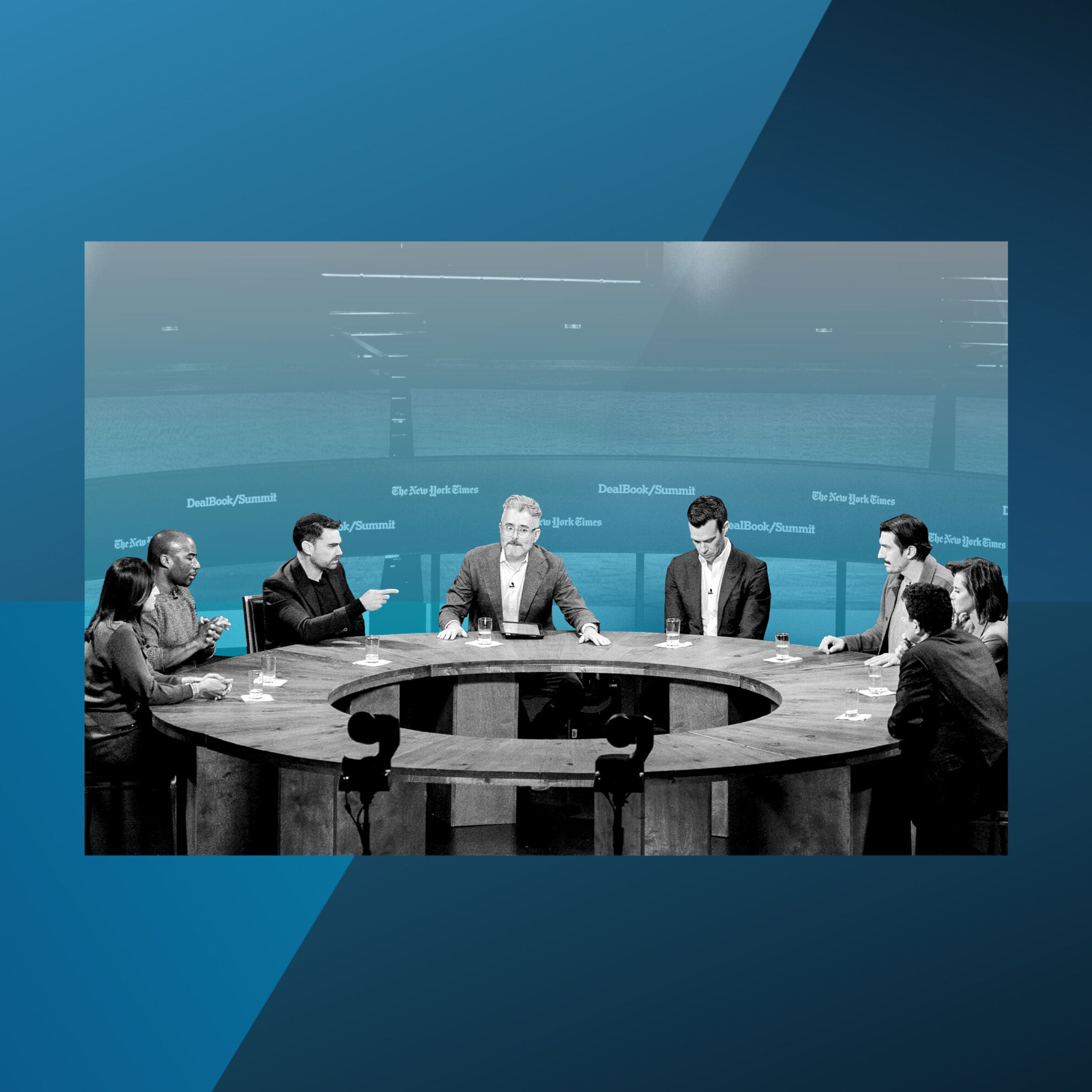
DealBook Summit
Should People Still Trust the Media in 2025?
01:32:55
Watch all of the day’s interviews: Audiences are changing the way they watch, listen and consume. We’re at an inflection point on the influence of traditional journalism and journalists versus personality-driven and perspective-driven voices. Panelists: Charlamagne tha God, co-host of “The Breakfast Club” and co-founder of The Black Effect Podcast Network; Jon Favreau, co-founder of Crooked Media and co-host of “Pod Save America”; Amna Nawaz, co-anchor and co-managing editor of “PBS NewsHour”; David Remnick, editor of The New Yorker and host of “The New Yorker Radio Hour”; Stephanie Ruhle, host of MS NOW’s “The 11th Hour With Stephanie Ruhle”; Andrew Schulz, host of “The Brilliant Idiots” and “Flagrant” with Akaash Singh; Ben Shapiro, co-founder of The Daily Wire and host of “The Ben Shapiro Show” Moderator: Michael Barbaro, journalist and co-host of “The Daily” at The New York Times Filmed live at the 2025 DealBook Summit
Loading summary
Transcript647 lines
- [00:01]
Amna Nawaz
This episode was recorded at the 2025 DealBook Summit. This year's Dealbook Summit sponsors include premier sponsor Accenture, associate sponsors U.S. bank Vanguard, Invesco, Q. Q. Q. And University of Michigan supporting sponsor Capital One and contributing sponsor Invest Puerto Rico.
- [00:22]
Andrew Ross Sorkin
This is Andrew Osorkin with the New York Times. You're about to listen to some fascinating breakout conversations from our annual Dealbook Summit, recorded on Dec in New York City. You'll hear experts, stakeholders and leaders discuss vital topics that are shaping the business world and the world at large.
- [00:44]
Moderator (DealBook Summit host)
To all of you, welcome to the Dealbook Summit and to the largest journalism panel ever assembled.
- [00:50]
Charlamagne Tha God
Thank you for having us.
- [00:51]
Ben Shapiro
Yes.
- [00:51]
Moderator (DealBook Summit host)
I am going to start by introducing each of you by asking you the same question. It's a yes, no, maybe kind of question. Amna Nawaz, co anchor, co managing editor of PBS NewsHour, host of a brand new PBS podcast, settle In. Should people trust the media in 2025? Yes or no?
- [01:15]
Amna Nawaz
Can I say more than just yes?
- [01:18]
Moderator (DealBook Summit host)
If it's brief?
- [01:19]
Ben Shapiro
Thank you.
- [01:20]
Stephanie Ruhle
Yes.
- [01:21]
Amna Nawaz
I think we all understand why people don't trust the media. We all understand why people have lost trust in a lot of institutions of power. And I'm sure we're going to talk a lot more about all of that. But I think this group you've assembled here is, over the course of our time together, going to make the case pretty strongly about why there is a lot of good information out there and why there's a lot of different ways you can practice journalism and why there's a lot of ways that people have the means to get in touch with good information that's out there to fight the bad. And I think that kind of stuff helps to build trust over time. We're undeniably at a low point. I'm not going to defend where we are right now, but I think there's a lot of really good reasons for people to say, I have a reason to trust this. I have a reason to believe this person have a reason to think this is authentic and credible and something I can hang my hat on. And we need that now more than ever. So I'm going to start with a yes, and we'll talk about it more.
- [02:11]
Moderator (DealBook Summit host)
Ben Shapiro, co founder of the Daily Wire, host of the Ben Shapiro Show Same question.
- [02:16]
Ben Shapiro
I mean, I'm going to say no, as you might imagine. I didn't know. Well, the reason that I'm going to say no, in very brief is that people just don't. And telling them that they should is not going to answer the question if you say, should people trust a particular report or particular story, I think the answer goes to whether that report is credible or whether a reporter has done a good job in the past. But saying the media writ large, I think it's too broad.
- [02:41]
Moderator (DealBook Summit host)
Charlamagne co host of the Breakfast Club co founder of the Black Effect what say you?
- [02:46]
Charlamagne Tha God
Yes, no, broadly no. But you should trust the media. That earns your trust.
- [02:53]
Moderator (DealBook Summit host)
Succinct Stephanie rule host of MSNBC's the Eleventh Hour with Stephanie Rule yes, no.
- [03:00]
Stephanie Ruhle
I would say broadly, yes. You know, unlike times when there were only three national newspapers and three national television networks, people had very limited information. Now we have more access to information than we ever have. There's more media outlets, exciting media outlets. And while you might not like them all, while you might not trust them all, I think this is an extraordinary time for, for smart, credible, trustworthy journalism. And while Ben could say no, I would say, isn't it great that Ben has the platform that he has today, whereas 20, 30 years ago he might not have that opportunity?
- [03:35]
Moderator (DealBook Summit host)
Speaking of new platforms, John Cavarro co founder of Crooked Media, former Obama White House speechwriter, host of Pod Save America should people trust the media in 2025?
- [03:44]
John Favreau
I think it depends on the definition of media, right? Because I think we're talking about so many different sources of information, endless sources of information now. And I think that there are obviously some outlets and some journalists and some media figures who are more trustworthy than others. I think if you're a consumer of media, then you have an opportunity to not just listen to or consume one kind of journalism or one media outlet, but to look at a whole bunch of. And I think that's in an age where people are distrustful of media, as Ben said. I think you need to, you know, make sure that you're consuming a variety of media and that helps build trust.
- [04:28]
Moderator (DealBook Summit host)
David Remnick Editor of the New Yorker host of the New Yorker Radio Hour maybe you'll be the first to actually just do yes or no.
- [04:34]
David Remnick
Well, I would Jewishly answer your question with a question. What's the media? Is the media. Candace Owen Is the media the New York Times? Is the media pbs? Is it the New Yorker? Well, it's all those things. And I think it's incumbent on any commentator, any institution, any news organization to establish trust over time. And that's hard. Whether you are an interviewer like Charlemagne, who I think is incredibly honest in the way he approaches his work, or there are people that are incredibly disingenuous or much Worse or dishonest. So I think you have to look hard at them and people have to establish trust over time. This is not. Trust is not something given automatically and shouldn't be.
- [05:18]
Moderator (DealBook Summit host)
Finally, Andrew Scholz. Yeah. Stand up comic. Host of the Flagrant podcast with Akash Singh and host of the Brilliant Idiots podcast.
- [05:30]
Andrew Schulz
Co host with him.
- [05:32]
Charlamagne Tha God
Yeah.
- [05:34]
Moderator (DealBook Summit host)
Should people trust the media in 2025?
- [05:38]
Andrew Schulz
Yeah. Yeah, there it is. Yeah.
- [05:42]
Ben Shapiro
I guess we're done here.
- [05:43]
Andrew Schulz
No, no, like you should. You should trust the media to serve their audience, what their audience wants. So for me, I would say, no, don't trust them or trust them to just feed their audience what they want.
- [05:57]
Moderator (DealBook Summit host)
That was a yes and a no. Is that what Brilliant Idiots means?
- [06:00]
Charlamagne Tha God
Yes.
- [06:00]
Andrew Schulz
Yes. That's why people listen. Yes. So trust the media to lie to their audience to make them feel good. All right, so y.
- [06:09]
Charlamagne Tha God
That's why. That's why I think it's broadly no. And that's why I go back to you should trust the media. That earns your trust. Because to Andrew's point, it's like everybody is serving their audience. You know what you're going to get when you tune in to Fox News. You know what you're going to get when you tune in to cnn. You know what you're going to get when you tune in to msnbc. And the reason voices like the Shapiro and the Favreaus have, you know, grown is because.
- [06:29]
Andrew Schulz
And broken through.
- [06:30]
Charlamagne Tha God
Broken through is because they're hearing something that they don't normally hear on those legacy media outlets.
- [06:35]
Stephanie Ruhle
That's an assumption. Just even saying, you know what you're.
- [06:38]
Amna Nawaz
Going to listen to.
- [06:41]
Stephanie Ruhle
Well, guess what? Yeah.
- [06:44]
Andrew Schulz
Damn it.
- [06:45]
Charlamagne Tha God
Sorry.
- [06:48]
Amna Nawaz
There you go. There you go.
- [06:51]
Stephanie Ruhle
Sorry. Continue, Stephanie. That only continues that narrative that you know what you're going to get here. You know what you're going to get there. I challenge that. You don't.
- [06:59]
Charlamagne Tha God
Oh, that's not true. I know exactly what I'm going to get when I turn on Fox News. I know exactly what angle they're going to come with. If I turn on msnbc, I know I'm getting a left angle.
- [07:07]
Andrew Schulz
Are you shocked when you turn on msnbc? Are you like, oh, my God, I didn't see this tape coming.
- [07:11]
Stephanie Ruhle
We're going to come and I invite you to watch my show any night of the week.
- [07:14]
Moderator (DealBook Summit host)
I watch your show, we're going to talk about surprise. Because actually, I think, Stephanie, you're one of the more surprising figures to emerge from msnbc. Ben, you routinely surprise me with your critiques of people on the Right. But Charlemagne, we'll come back to that. This panel I've been delaying, this is called Journalism Interrupted. And this assembly of people and your range of answers, I think, pretty clearly speaks to the interruption. And there are all kinds of ways to talk about it. But for the purpose of the this conversation, I'd like us to focus on three seismic ways that journalism is being interrupted right now. I'm going to summarize them real fast. First, by President Trump, the interrupter of media in chief. Second, by the rise of journalists as brands embodied, I'd say by more than half the people at this table, Ben Charlemagne, John Andrew. And third, by the technological disruption we're all familiar with decades in the making. But 2025 seemed to be the year that broadcast TV kind of officially broke. MSNBC isn't even MSNBC anymore. So we'll get to that, Stephanie, don't worry.
- [08:18]
I want to take these interruptions or interrupters one at a time. President Trump quite literally interrupting journalism as it exists by suing or defunding news organizations that offend him, by threatening to remove TV licenses from major broadcast networks whose content he dislikes. Andrew, we're going to get back to why you're snickering by ejecting disfavored journalists from the Pentagon and the White House. I don't know if you all noticed, but a brand new group of Pentagon reporters showed up yesterday, including Laura Loomer. And in doing all of this, the president has reoriented many news organizations out of fear of Trump or in some cases because they feel he's onto something. David, how grave I'm going to start with you, one of the elder statesmen of the, of the mainstream media. How grave a threat do you believe what I just described to be?
- [09:09]
David Remnick
I take it beyond seriously and my background as such, and that's, I guess, what I bring to the table is I my journalism career, serious journalism career, began in Moscow, where.
- [09:23]
Lived under both for the Post for the Washington Post, and lived under the latter days of complete and utter totalitarian censorship and all the systems that were in place. And then I watched it crumble thanks to the initiation of a number of forces, both dissident and even within the Communist Party, led by Gorbachev, and then continued to cover the Soviet Union, Post Soviet Russia. And so the re establishment of authoritarian censorship in Russia. And if you're not taking what Donald Trump is doing seriously and you don't see how this at least rhymes with the re establishment of authoritarian.
- [10:10]
Pressure on the free word, then you're not watching and you're not listening and you're not being serious and you can joke about it and live your daily life and speak freely and say, hey, what's wrong? Because everybody at this table has had the opportunity to speak freely. But I am telling you, the summation of these lawsuits, these threats, these pressures, these deals.
- [10:34]
That have been established between corporate overlords and the administration rhyme in the most serious way with what I've seen and what we've seen historically in other places. And you're damn right it should be taken.
- [10:52]
Moderator (DealBook Summit host)
I'd love to hear from someone who disagrees with that and thinks that what the Ben and what the President doing is a necessary corrective to the orientation of legacy media.
- [11:03]
Ben Shapiro
So I don't think that everything the President is doing is a necessary correction. I was very critical of the President over some of the measures he's taken, suing various media outlets and all the rest, which I think is inappropriate. But I think that people make two general mistakes about President Trump. One is that they see him standing over the body of journalism and they assume that he is the killer and not the coroner, meaning that journalism had widely lost credibility with the American people before President Trump became president. This goes all the way back in many cases to, for example, the Dan rather scandal of 2004, in which he was essentially making up memos in the late stages of that election. Certainly on the right, for as long as I've been alive, the critique of legacy media as a left wing, generally oriented tool has been a very live critique. And so Trump coming along and saying, you guys are pretending to be objective journalists, you're not objective journalists, let's stop pretending you're objective journalists and let's just treat you as what you are, partisan actors.
- [11:53]
David Remnick
So he's just a keen press critic.
- [11:56]
Ben Shapiro
I think that initially that is correct. That doesn't mean that again, every action that he's taking is something that I agree with. The other thing that I would say here is that President Trump, as always, tends to do the quiet part out loud. And I think that you'll hear this a lot from people who are defenders of President Trump is that a lot of the sorts of backroom deals that were happening between media and administrations were backroom when it was Democrats. And everybody just sort of commonly understood that, for example, there was coordination between the Biden administration and members of the press to pre submit questions, for example, and so there were cards that he could literally with questions on them.
- [12:28]
Stephanie Ruhle
I'm with President Biden. There was no pre submitted cards. There was no agreement beforehand. I was given 11 minutes with President Biden.
- [12:36]
Ben Shapiro
Did you sense anything amiss with him in terms of his mental state? And if so, did you report on it?
- [12:41]
Stephanie Ruhle
The first question I asked him, the first question I asked him was that in corporate America, corporations force their board members to leave when they are 75. Why should the United States elect you to be the most important CEO in the world?
- [12:57]
Amna Nawaz
And that was the first.
- [12:58]
Moderator (DealBook Summit host)
Are we not watching and listening to each other? And is that what's happening here in our program?
- [13:02]
Andrew Schulz
What did he say to that?
- [13:03]
Ben Shapiro
What did he say and what was your critique of his follow up?
- [13:05]
Stephanie Ruhle
He gave a fine answer. The problem was not president. He gave a fine answer about his qualifications.
- [13:10]
Ben Shapiro
Was it in English?
- [13:11]
Stephanie Ruhle
It absolutely was the problem. The problem and it was reported, was President Biden's staff. I had 10 or 12 minutes, and at minute 11, I asked him about his Department of Justice and his son Hunter. President Biden started to give the answer, and when he started, his team started flailing and waving their hands in front of the cameras with their.
- [13:38]
Notebooks and stopped the interview.
- [13:39]
Moderator (DealBook Summit host)
Like, kind of like take away the keys, kind of.
- [13:41]
Amna Nawaz
Correct.
- [13:42]
David Remnick
And they should have.
- [13:43]
Ben Shapiro
And how much of them did you report on the air?
- [13:45]
Stephanie Ruhle
All of it.
- [13:46]
Ben Shapiro
Okay.
- [13:47]
Stephanie Ruhle
Because it's an official interview with the President of the United States. So I turned to the president and I said, sir, you started answering that question. Will you finish? And so it was a mistake on their part. Yes. They continued to try to protect that president. And what a mistake it was because all of that was officially on the record and that became a story.
- [14:03]
Charlamagne Tha God
The media protected them too, though. MSNBC protected cnu, protected him. Like, I mean, when you see Jake Tappa come out with a book called the Original Sin, it's almost like malpractice, because it's like, you didn't see this the last three years. Like, I'm not a journalist like Jake Tappa, but I saw the decline in President Biden. I reported on the decline on President Biden. I may have done it on, you know, podcasts like Barry Ninitiots, on record on the Daily Show.
- [14:27]
Why wasn't telling that story the year before this break?
- [14:30]
David Remnick
The New Yorker had a cover drawn by Barry Blitz. And I admit we're not the National Review. I don't apologize for that. But we had a cover in which there was a road race being run, a kind of street race of Nancy Pelosi.
- [14:46]
Joe Biden and Mitch McConnell. And they were using walkers. I'm not saying it was in the Greatest taste of all time, and I don't care. But it was making a point graphically as a political cartoon on the COVID of the New Yorker a year before this all collapsed. So this was being discussed widely. Now, were the people in the White House trying to tamp this down and limit the axis?
- [15:09]
Andrew Schulz
Sure.
- [15:10]
David Remnick
Are there critiques to be made of what you call the liberal media? Absolutely. Is it healthy to see a profusion of different viewpoints in magazines and podcasts and radio? Absolutely. That's not what we're talking about. We're talking about the President of the United States calling the press as a whole, including you, enemies of the people. This is a phrase used by Stalin and used by Robespierre.
- [15:33]
Ben Shapiro
Okay. This is very serious catastrophism with regards to the fact that President Trump uses colorful language after a colorful language after a full decade of this does not ring true. The American people have been dealing with this for a decade. I've said before that what's going to be written on his epitaph, on his Gravestone, is the 45th and 47th president of the United States. He said a lot of shit. But then can I ask you, can.
- [15:54]
Moderator (DealBook Summit host)
I follow up on what you said? Does a coroner sue, and forgive me for torturing the analogy, does the coroner sue his patients in. Let's think about what President Trump has done, suing abc, the New York Times, the Wall Street Journal for reporting that was completely out.
- [16:12]
Ben Shapiro
Again, I've said that I'm against that, but I think. No, no, I'm 100% against those things. Also, one of the things that President Trump has run up against again and again are the guardrails of a system of law that exists in the United States. He shouldn't be filing those lawsuits. And those lawsuits are going to be dismissed. Right, okay. Like this is.
- [16:30]
Amna Nawaz
He's filing them. I mean, I think that is the point David's making here. I understand that whether or not the attack is successful, is that an existent.
- [16:36]
Ben Shapiro
But this is being, as a Soviet style crackdown on the press, a private lawsuit that is going to be dismissed in court.
- [16:42]
Stephanie Ruhle
You don't want to dismiss bankrupting individuals.
- [16:46]
John Favreau
We're talking about the lawsuits. But there's also what he's doing with the fcc, what he tried to do. Right. And so.
- [16:52]
Ben Shapiro
Which again I opposed.
- [16:53]
John Favreau
Right, no, I'm sorry, I'm not saying you didn't.
- [16:55]
Andrew Schulz
But like those are the examples to focus on. Yeah, like rather.
- [16:58]
Charlamagne Tha God
Right.
- [16:59]
John Favreau
So the lawsuits we get dismissed now we're talking about two different trends.
- [17:01]
Ben Shapiro
Right.
- [17:02]
John Favreau
Which is what President Trump is doing and the larger challenges that that corporate owned media is facing because the places that settled with Trump, right, like those license could get thrown out but it still costs a lot of money for all these places that are getting sued. And you're seeing that for some they.
- [17:20]
Andrew Schulz
Didn'T settle for money though for.
- [17:21]
John Favreau
Well, for some of, some of these, some of these media outlets there which are now owned by larger conglomerates.
- [17:27]
Andrew Schulz
Yes.
- [17:27]
John Favreau
The actual media outlet is a rounding error for them and so they're obviously going to settle and then, and then Trump in a sense wins even though he didn't win the lawsuit. So that is dangerous.
- [17:38]
Andrew Schulz
Right.
- [17:39]
John Favreau
I do think everything he's been doing with the FCC and what he tried to do with Jimmy Kimmel is quite dangerous. Threatening the pool, threatening pool licenses. And now every time there's going to be a media merger or a company that wants to merge with someone else, they have to make sure that they are in good graces of Donald Trump and the administration, the government, which is something that you would not want in a free democracy.
- [18:02]
Moderator (DealBook Summit host)
Andrew, you're a stand up company. What do you think of the effort by the FCC chairman to.
- [18:07]
Andrew Schulz
Horrible. Brendan Carr, is that the guy's name? Yeah, yeah, yeah, yeah, horrible.
- [18:10]
Moderator (DealBook Summit host)
I mean I spoke out about off the station.
- [18:12]
Andrew Schulz
Yeah, that was horrible. You know what I mean? And I don't even love Jimmy, you know what I mean? But I thought it was horrible. As a comedian you gotta like allow people to make jokes obviously 100%. And I don't even think you've been.
- [18:22]
Charlamagne Tha God
Committing too much white on white crime between you and Jimmy.
- [18:24]
Andrew Schulz
I'm trying to make up for lost time.
- [18:28]
What do you want me to do? What kind of reparations do you want?
- [18:31]
John Favreau
Charlamagne.
- [18:32]
Andrew Schulz
Enjoy it. Watch it. No, no. So what I think was really important what you said, which is going to.
- [18:37]
Moderator (DealBook Summit host)
Explain that standup comics now run major media organizations.
- [18:40]
Andrew Schulz
I hate that we're even in this discussion. I don't even want to be here. No, no. I want to just be a stand up comedian, not a journalist. But. But to your point, which I thought was great, which is like if there are these media networks that are hoping to make a big exit on this thing that they built for decades and they're willing to curtail their own personal constitution on like what they should put out and what media is so that they can make money, then I'm kind of like fuck em if you're willing. Because it's like why do I have to hold the constitution and the American values down? Just so that you can make more money if you're up against Trump and Brendan Carr and the fcc. And they're basically saying, well, we're not gonna do this merger. Then you go, hey, journalism is more important than this merger. Prove to us you want Americans to trust the media. Then prove you care about the media, not about.
- [19:27]
Charlamagne Tha God
Maybe they should ring the alarm. They should say, hey, the Trump administration is saying this merger is not gonna go through if we don't do X, Y and Z. Y' all have the bully pulping shows.
- [19:37]
Amna Nawaz
What happened at CBS, you saw what happened with 60 Minutes. You saw how Bill Owen stood up and said, I need you to know what's happening inside this organization.
- [19:45]
Andrew Schulz
And then they folded.
- [19:46]
Moderator (DealBook Summit host)
Right.
- [19:46]
Amna Nawaz
Pressure from. Well, he left.
- [19:48]
David Remnick
You're talking about executive Andrew makes a really good point. And the problem, the complication here is ownership, not editors.
- [19:57]
John Favreau
Ownership for sure.
- [19:59]
Andrew Schulz
Yes.
- [19:59]
David Remnick
And you know, there's just so many systems of the press in this world. There's state owned press, BBC has its state control, press has a state. Control is not the right term. But BBC is one system. And we have a lot of places like the New York Times, the New Yorker, Conde Nast that are owned by wealthy people ultimately. And of those people, those people don't see it in their interest or have the principles or the backbone to stand up to this kind of nonsense, then things go belly up. And you are absolutely right. But cbs, the editor can stand up. But if Sherry Redstone doesn't see it.
- [20:37]
Amna Nawaz
In her interest because there are private corporate interests.
- [20:40]
David Remnick
Correct.
- [20:40]
Amna Nawaz
When it comes to that journalism and that journalism doesn't exist without corporate backers.
- [20:44]
David Remnick
And there's just so many new houses. Allow me if I'm Sulzbergers in this.
- [20:47]
Amna Nawaz
World, like a case for public media.
- [20:49]
Moderator (DealBook Summit host)
We'Re get to that.
- [20:50]
Amna Nawaz
But go ahead to pick up on the point that John made earlier about the fact that.
- [20:55]
Ben Shapiro
My point, first of all, public media.
- [20:56]
Andrew Schulz
Just while we're here, because it's related.
- [20:58]
Amna Nawaz
To something John said and then I.
- [20:59]
Charlamagne Tha God
Promise you, ladies first. Schulz.
- [21:01]
Andrew Schulz
I'm trying my best to not even.
- [21:02]
Amna Nawaz
See Jeff, this issue of business interest at play of the administration seeking settlements in the form of financial forms from corporations. That's absolutely all the pressure campaign. To David's point earlier, it is so much bigger and more serious than that. It is about attacks on journalists and journalism writ large. It's about undermining the idea of that there should be a free and fair press in this country. And I think for anyone like David, like me, who has lived in a country where you don't have a free and fair press, where it's normal for military or intelligence officials to show up at your home in the middle of the night or to demand to see your files or to threaten you with consequences for your work. The parallels here are terrifying.
- [21:46]
Ben Shapiro
We have a living in fear of this.
- [21:47]
Amna Nawaz
We now have a taxpayer funded website on the White House website that lists specific journalists and specific outlets they consider to be enemies.
- [21:58]
Moderator (DealBook Summit host)
But there's a gap between that and someone showing up.
- [22:00]
Ben Shapiro
I mean, come on. James Rosen, when he was.
- [22:02]
Stephanie Ruhle
There's a gap.
- [22:02]
Ben Shapiro
During the Obama.
- [22:04]
David Remnick
It's only been 10 months.
- [22:05]
Andrew Schulz
Can we just say, yeah, just one thing, Media has become an asset class. Would we all agree with that? There are massive private equity firms that are investing in media. They're funny things. Some people made so much money selling certain things.
- [22:21]
Charlamagne Tha God
Let me.
- [22:22]
John Favreau
We own our company.
- [22:23]
Andrew Schulz
No, I know you do. I know you do.
- [22:24]
Moderator (DealBook Summit host)
Just for those listening to this, primarily you are massaging the back of.
- [22:30]
Massage.
- [22:30]
Andrew Schulz
And I'm not trying to undercut Todd. I think that you have a strong constitution. I think you would only say what I genuinely believe that. And you're somebody that I speak to outside of this panel. But what I'm trying to say is now if there are corporate interests and financial interests in media, they're going to want a return on that investment just like anything else. You invest in a building, you hope to sell it for more one day. Right? So when we know that that exists and that's part of the system, it's not wrong for the American people to look at it through that lens. Right. If we know that the pharmaceutical industry is pumping tons of ads into whatever program and they're not going to report on anything bad about the pharmaceutical industry, it's no question why we might have a little bit of distrust for that network.
- [23:06]
Stephanie Ruhle
But that's also why it's actually complicated. When people kept looking at the Jimmy Kimmel situation, it wasn't just about Jimmy Kimmel. Bob Iger has to worry about the NFL and ESPN and the massive book of business he has in front of the FCC chair.
- [23:21]
Andrew Schulz
Yeah.
- [23:21]
Moderator (DealBook Summit host)
And so I'm just gonna. I hear you. Because the.
- [23:23]
Charlamagne Tha God
So the answer to should we trust the media? Should be a resounding no based off everything I'm saying.
- [23:29]
Amna Nawaz
Can we also just stop saying the media?
- [23:31]
Stephanie Ruhle
Correct.
- [23:32]
Andrew Schulz
You think it's too much of an umbrella.
- [23:33]
Moderator (DealBook Summit host)
Well, okay, let's.
- [23:36]
Get specific.
- [23:36]
Amna Nawaz
We all don't do the same thing.
- [23:38]
Moderator (DealBook Summit host)
Let me play the president.
- [23:39]
Andrew Schulz
Let's say what we really want to say.
- [23:40]
John Favreau
The Jews.
- [23:41]
Andrew Schulz
No, no.
- [23:41]
Ben Shapiro
I'm sorry.
- [23:42]
Stephanie Ruhle
Oh, my God.
- [23:43]
Andrew Schulz
Stephanie. Stephanie, we're joking here. It's just a joke.
- [23:48]
Charlamagne Tha God
Ben is laughing.
- [23:48]
Ben Shapiro
If I can laugh, we all can laugh.
- [23:50]
Moderator (DealBook Summit host)
Let me play the president for just a moment. The president might say there have been countless moments where the mainstream media, the New York Times, the Washington Post, abc, cnn, Legacy Media Institute, traditional media, yes, failed to represent reality. And two big ones come to mind. The 2016 election and to a degree, the 2024 election, when that traditional media got very excited and started to believe that Joe Biden and Kamala Harris were stronger candidates than they ended up being and missed the profound coalition of disaffection that ultimately carried Donald Trump to reelection pretty easily. John, sitting here in 2025, it's pretty universally accepted the Democratic Party has lost its way, lost touch with American.
- [24:46]
Charlamagne Tha God
John, Reality. John, Reality, reality.
- [24:51]
Moderator (DealBook Summit host)
Did the media lose?
- [24:52]
Andrew Schulz
If you say this, you might get labeled a MAGA lunatic. I just want to be very careful.
- [24:56]
Moderator (DealBook Summit host)
Come over here, John.
- [24:58]
Ben Shapiro
Right here.
- [24:59]
Moderator (DealBook Summit host)
I think it's safe to say, and I think in your own jocular way, you agree the Democratic Party has lost its way, lost its touch with the American people, what they want allowed the Republican Party to capitalize on all this disaffection and desire for change. Did the media, and let's maybe be specific in this last campaign, also lose touch?
- [25:18]
John Favreau
It's an interesting question because I think that the challenge in 16 and 24, first of all, 24, I think the coverage throughout 24 was that it was a pretty close race, which it ended up being, I think in 16, it was much different.
- [25:31]
Moderator (DealBook Summit host)
It was a one and a half point national election. But it was a decisive electoral college victory for Donald Trump.
- [25:36]
John Favreau
It was. But if you looked at even the polling or the coverage like it, I mean, he was up in those battleground states that the Times polling at the end was pretty close.
- [25:45]
Moderator (DealBook Summit host)
Thank you.
- [25:47]
Ben Shapiro
16.
- [25:48]
John Favreau
The polls were way off. Right. And I do think that the media coverage in that election followed the polls. I think if. If you had replayed 2016 and the polls were accurate and from the time that Donald Trump was nominee and Hillary Clinton was nominee, you started seeing a close race in all the battleground states. I believe the media coverage would have been much different. I think there is a critique of legacy media following the polls too much in their coverage and political coverage, for sure. But also, like, to your point about Trump, Trump's complaint about this, he won. He won both of those elections. And so clearly the public, whatever the media was doing, the public got the information. They needed to make a decision about both of the candidates in each of those elections. Also, the largest legacy media organization on television that has the biggest audience is Fox News. And so like, plenty of people were hearing Donald Trump's version of reality. And by the time you get to 2024, millions and millions of people were hearing Donald Trump's version of reality through Ben's podcast, through a whole bunch of other right wing media. So I, I don't think, I think you could make a case a couple decades ago that the traditional media, which is liberal leaning, was the dominant source of information for people in the country. I don't think you can make that case today because I now think that there is just a diversity of voices, especially on the right, but across the political spectrum that people can tune into. So I don't necessarily think that's a challenge.
- [27:19]
Andrew Schulz
I think that's a really great point. We can't complain about the impact of legacy media while at the same time saying it's dead right? Like it's one or the other. And now are people turning to other forms of media because they don't trust it, because they're more entertaining? Who knows? Because they're more easily accessible? Who knows? But that is a, that is a great point. It's not like there was underrepresentation for the people that wanted Trump to win. There was representation. And yeah, yeah, that's a good point.
- [27:50]
Ben Shapiro
I mean, I think that there is truth to the idea that the right wing, when they say that legacy media are done, that's, that's obviously an exaggeration. It's very much not true. And the reality is that there are kind of two types of media. There's a well funded legacy media that does an enormous amount of reportage, and my show relies on a lot of that reportage. And so to not acknowledge that reality would be foolish, obviously. With that said, I think that if you were going to steel man the right wing critique of legacy media, the examples I would use would not be the 2016 election. It would be Russiagate. It would be the coverage of COVID in 2020. It would be the coverage of Joe Biden's obvious to everyone with retinas and a prefrontal cortex decline. Do you mind if I ask you do Covid. Okay, so the narrative on the right about COVID is that, yes, it was true that Covid was, at least in the initial phase, a very, very scary thing. And then universally the media coverage focused in on the idea that if you were in close proximity to anyone, including outside that it was going to kill you, that schools should be shut down, that the entire society should be shut down. But also if you were outside in the street protesting for Black Lives Matter, it was totally fine for you to be outside spitting on one another for the proper cause. And that Covid suddenly discriminated on the basis of politics and the questions about vaccines were a massive exaggeration of reality. And that anyone who questioned vaccines in any way was part of the problem. And listen, I was one of the people who was pretty credulous about the vaccines in the early going. I told people to take the vaccine in the early part of 2021, specifically because the report from the Trump administration was that it was going to prevent transmission, which of course turned out later.
- [29:25]
Moderator (DealBook Summit host)
Not no prevention and death, especially for.
- [29:29]
Ben Shapiro
The elderly and people with pre existing conditions. If you were 30 years old and healthy, the idea that you radically needed a COVID vaccine to save yourself from a condition is really not.
- [29:37]
John Favreau
Is that a media or the science?
- [29:40]
Ben Shapiro
Right.
- [29:40]
John Favreau
Like they did believe when the vaccines came out that they would prevent transmission. Then once we got into.
- [29:46]
Ben Shapiro
It's the crazy.
- [29:46]
John Favreau
I can't believe I'm going back to Covid. Once we got into Delta and then Omicron, then it was clear that the vaccines would not prevent transmission anymore, that they would just be protective of severe illness. So the facts of the science changed. And then I'm pretty sure, because I followed it way too closely for covering it and because I'm a bit of a hypochondriac, that like the science changed and then there was a new mutation. And so.
- [30:07]
Stephanie Ruhle
And that's it. It was a once in a lifetime pandemic and we were covering it real time.
- [30:12]
Ben Shapiro
I mean, so was I. And I was looking at the same data that you guys were looking at. And that's fine, but I think the idea that that was not tied to a broader narrative about the public health establishment or about the. Or about politics when it came to Black Lives Matter and the protests and the riots, or about the public policy decisions that are being made variously by Andrew Cuomo, hero of the pandemic early on, versus Ron DeSantis, great villain of the pandemic early on. Again, I think that when we look at members of the legacy media who covered this sort of stuff, they can point to their granular level coverage. The way that people actually consume media is via Gestalt. It's just the way that people consume everything via what? Like the kind of general overall sense of.
- [30:47]
Stephanie Ruhle
And one of the reasons Ron Desantis did such a good job with COVID is because he was adamant about getting those vaccines to his state, to elderly communities.
- [30:56]
Ben Shapiro
Governor DeSantis, by the way, was like, very deep in the data from very, very early on. I remember talking to him about it during the summer of 2020. But, you know, again, if we're talking about the critique of the media, the basic idea here is not that the media don't do reporting. It's what they choose to report on and how they report it and emphasis.
- [31:09]
Amna Nawaz
Can I push back on one thing? Because I think we're kind of speaking in broad terms about something that was, quite frankly, when you look back on it now, like a very worrying moment in American history, because it showed that when you see enough doubt in the traditional deliverers of information, even the scientists and the experts upon whom we as a country and a nation and society have relied to get us where we are and alive and healthy today, that it can cause real damage. I mean, over a million Americans died in that pandemic. And what we saw from the beginning, to Stephanie's point, was journalists following the science and the experts. If there was a bias in media, legacy media at the time, was that we do rely on experts. We do tend to go with what the scientists tell us, because that's where the evidence is. That's where the fact is.
- [31:53]
Moderator (DealBook Summit host)
Does anyone at the stable have a regret when it comes to Covid? I'll offer one. I think it took me too long to question, of course, shutdowns.
- [32:01]
David Remnick
I think that's right. But I think we're.
- [32:03]
Moderator (DealBook Summit host)
And whether they were working.
- [32:05]
David Remnick
We're talking about a lot of things all at once, very quickly. And I just want to make one point. It is to me arguable at once that the New York Times is the most sustained and best news gathering organization in this country.
- [32:19]
Moderator (DealBook Summit host)
That's why I'm moderating the panel.
- [32:21]
David Remnick
At the other hand, I would say that the New York Times.
- [32:26]
Also has on its history, as other news organizations do. Walter Durante, who suppressed the artificial famine in Ukraine, it failed to cover something called the Holocaust.
- [32:39]
And has made any number of really serious errors, as every serious news organization has historically. Now, does that mean that is because of the liberal media, that the flaws in the history of the New York Times, which I still think despite all its flaws, is. I don't know. I can't think of what news organization I come from, the Washington Post, this is very painful for me to admit.
- [33:04]
Surpasses the New York Times. Is it for ideological reasons? Is it because of a group of people get together and conspire to hide one thing and to reveal another. No, I think we have to admit that these collectives, these organizations are made up of human beings and that what we're talking about in the press is a first rough draft of history. And what you're discussing is totally legitimate, totally legitimate about where the coverage of went wrong. Yes. And some of it has to do with.
- [33:38]
Flaws in coverage. Some of it has to do the fact that it was happening in real time and what we're being told by credible scientists as opposed to others or Robert F. Kennedy, Jr. Or whomever whose credibility is perhaps lower than Anthony Fauci's even to this very day.
- [33:52]
Andrew Schulz
So we do know about a lot.
- [33:54]
David Remnick
Of things at once.
- [33:55]
Andrew Schulz
We are.
- [33:56]
David Remnick
And it's worthwhile to kind of slow down and say, you know, some of these organizations are both superb and flawed, including my own.
- [34:05]
Ben Shapiro
But the question is, I think, and I think this is why you've seen the rise of partisan media like my company or John's company is because if all the errors tend toward one direction, then you start to question the underlying bias of the newsroom. Right. There are very few errors in favor of Donald Trump in the New York Times. There are very few errors in favor of the Republican Party in the New York Times. Most corrections are happening in the opposite direction. And so you have to start wondering.
- [34:29]
Moderator (DealBook Summit host)
Rural corrections or course corrections over time?
- [34:31]
Ben Shapiro
Both, but I think that. But. And that's why, you know, the recommendation that I've made for news consumers, and I say this literally on my show frequently, is that if you actually want a good way of determining what is opinion versus what is fact, what you should do is listen to both my show and John's show. And any place where we agree that's the basis of fact, and then every place where we disagree, that's the opinion.
- [34:50]
David Remnick
That you're not very different. What you do is very different. You know, you guys are informed, each in your own way, but I don't know that you're spending all your days dug in and reporting on one issue, talking to sources.
- [35:06]
And producing that kind of journalism.
- [35:08]
John Favreau
That's what I reported.
- [35:09]
Amna Nawaz
And you said it, but you said.
- [35:10]
Stephanie Ruhle
It a moment ago. Without that original reporting from news organizations, that's the basis for much of what you cover. Of course. And I would just argue that every single day, thousands of stories are reported on. Right. But it's the fringiest, most incendiary things that the algorithm picks up and churns out and churns out and pumps up and pumps up and pumps up. And it's the algorithm. Right. For a moment, if we consider that what's going viral is making us sick and we can make a choice to consume what's going viral or just take a minute, lower the temperature and have open mind.
- [35:47]
Moderator (DealBook Summit host)
Stephanie, I do want to focus on something we do have a little bit more control over than the virality of the algorithm. And that, for me, means returning to the question of 2024 coverage. I suspect that President Trump, just to go back to his perspective, would say that MSNBC embodies in his mind what he's going after here, having a particularly liberal worldview, and he would argue, failing to convey certain realities to people. Let's take immigration where.
- [36:19]
The network. I would argue that the MSNBC's coverage of immigration tends to be pretty sympathetic to migrants. I don't know if you would disagree with that. How are you thinking about an issue like that post election, given how crucial immigration was to Trump's victory, do you feel like MSNBC conveyed the reality of the immigration story to America?
- [36:39]
Stephanie Ruhle
I absolutely believe that I did. And I know that I specifically asked Kamala Harris about it. Use Springfield, Ohio, as an example. No one was eating cats and dogs in Springfield, Ohio. However, Springfield, Ohio changed dramatically. And if we don't hold space and interview people and speak to people who say, my community is different, my town is different, resources are constrained, the schools are overcrowded, the hospitals are overcrowded, and immediately not call those people who are feeling those issues if we're immediate to say, well, they're xenophobic, they're racist. That's the issue that many of us are dealing with, that the United States is changing dramatically.
- [37:20]
Amna Nawaz
Right.
- [37:21]
Stephanie Ruhle
It's easy to say that we're a nation of immigrants and we have to welcome everyone. Immigration is complicated. I can't speak for my entire organization. I can say that we accurately cover the news. And I know every night on my show our goal is to help people get better and smarter. Now, do I think immigration is covered in a dramatic fashion on the other side?
- [37:42]
Amna Nawaz
Sure.
- [37:42]
Stephanie Ruhle
Right. My mother is a devoted Fox News watcher. And you can tell my mother that a violent caravan of criminals is making their way up from Venezuela. And she'll believe you because she's in Park Ridge, New Jersey. But when the right wing tells my mother that there's no inflation, she knows that they're lying because she buys London broil from shoprite every Friday, and she knows the price of it.
- [38:04]
Moderator (DealBook Summit host)
That's real Jersey.
- [38:05]
Stephanie Ruhle
So it sure is so at the end of the day, you have to tell your audience the truth. The challenge is if your audience has a particular bias and they don't like what you have to say, you have to be a strong enough journalist that they're going to stay with you. So for me, I regularly say that President Trump is a brilliant politician. I actually think that's almost irrefutable that he is. Now, lots of my audience doesn't like to hear that because they don't like him, but they haven't left. So I think the challenge for good journalists is how do you tell people a truth that they might not love, but that they accept you just tell them the truth.
- [38:39]
Charlamagne Tha God
And that's why, you know, Ben kept using the word errors. And I don't think that these newsrooms are making errors. I think they have agendas. And I think that, you know, the thing that a lot of these newsrooms don't understand now is they don't control.
- [38:50]
Ben Shapiro
What do you mean?
- [38:50]
Charlamagne Tha God
These newsrooms, msnbc, cnn, Fox News, y' all all have agendas.
- [38:54]
Stephanie Ruhle
What's happening?
- [38:54]
Charlamagne Tha God
You know how I know y' all have agendas? Msnbc, based off all the points that you just said, I conveyed those same points. And MSNBC said I was spreading MAGA messaging, you may not have done that stuff, but MSNBC as a, talked about this. So they have agendas like they, they have a, a set of programming that they want to push to a group of people. And when they see all of these different things happening on social media or on podcasts, they're realizing, oh man, the people aren't buying into our programming. So instead of actually listening to the people, they continue to try to push their program. And that's why people don't trust the.
- [39:22]
David Remnick
Media, you're saying for business reasons.
- [39:24]
Stephanie Ruhle
But, but this idea that people don't trust the media, I don't know what the reason more people are consuming media today than ever have.
- [39:30]
Andrew Schulz
Not by choice.
- [39:32]
Stephanie Ruhle
What do you mean, not by choice?
- [39:33]
Andrew Schulz
That's where we should get into algorithmic discussion.
- [39:35]
Charlamagne Tha God
No, I think they're choosing to. But they also don't trust what they're hearing, especially from what I'm saying is 17, 10, 17.
- [39:43]
Stephanie Ruhle
Is your 17 year old more engaged in the news than you were when you were 17?
- [39:47]
Charlamagne Tha God
I don't think so.
- [39:48]
Stephanie Ruhle
Mine definitely are.
- [39:49]
Andrew Schulz
Yeah, but.
- [39:50]
Stephanie Ruhle
And so there's more news outlets than there ever have been before. And the business of news is going through transformation and in crisis, but I would argue that people are more engaged and more informed than I'VE ever seen in my life.
- [40:02]
Andrew Schulz
Why is that?
- [40:02]
Stephanie Ruhle
Because democracy's at risk.
- [40:04]
Andrew Schulz
No, that's not it.
- [40:06]
John Favreau
Why is it because they're carrying that thing in their pocket? It's just filling their face.
- [40:11]
Andrew Schulz
We no longer live in monoculture. Monoculture is dead. That's why Leonardo DiCaprio can be in a movie with a superstar director and it loses $200 million because people don't even know the movie's out.
- [40:20]
Charlamagne Tha God
That's right.
- [40:20]
Andrew Schulz
We do not share the same information. We live in a thousand different realities. And we're even having this discussion right now, which is kind of almost two years late because we're having like, how have podcasts disrupted media? It's like, that was two to four years ago.
- [40:32]
Charlamagne Tha God
That's right.
- [40:33]
Andrew Schulz
We've already been disrupted again.
- [40:35]
Charlamagne Tha God
We should be talking about how AI is going to disrupt. We're having.
- [40:38]
Andrew Schulz
We're having an antiquated discussion about media on traditional media.
- [40:42]
Charlamagne Tha God
That's right. That's right.
- [40:43]
Moderator (DealBook Summit host)
It's a cellpark.
- [40:46]
Stephanie Ruhle
On one of the most listened to podcasts on the planet.
- [40:50]
Andrew Schulz
What I would say about that specifically.
- [40:52]
Moderator (DealBook Summit host)
Not after what Andrew said.
- [40:53]
Andrew Schulz
No, no, no, no, no, no. What I would say about that specifically is that you guys, part of your success is obviously your wife. Hi, Lisa. Hi, Lisa. Nice to meet you again. And you guys are very talented, but you also met the moment, right? Like going in and breaking away from maybe traditional media. And I think there is a little part of this discussion which is like, we all value traditional media, at least people over 35 years, because we've been.
- [41:15]
Charlamagne Tha God
Taught that we've learned behavior.
- [41:17]
Andrew Schulz
Maybe the young people don't, but we still hear New York Times. It means something to us. I saw my dad like unfold it every morning and it was something special.
- [41:24]
Charlamagne Tha God
Okay?
- [41:24]
Andrew Schulz
But right now we live in a thousand different realities because we went from fan clubs, which is like Instagram, right, to TikTok. TikTok drives culture whether you like it or not. And TikTok is pure algorithm.
- [41:34]
Charlamagne Tha God
Right.
- [41:35]
Andrew Schulz
What they did is they realized people actually don't want to follow their friends. They want us to feed them the most interesting thing. And interesting can be low hanging fruit. It can be chaos. Clickable, clickable, right? Once that happened, it divided us into a thousand different silos. Those silos that you're now in are getting less views, right? So people start going, oh, shoot, my views are going away. Well, what do I do to get more views? Ratchet up the dialogue, ratchet up the rhetoric. And now you're saying the most insane stuff because Only the most insane stuff crosses over completely. A point.
- [42:07]
Moderator (DealBook Summit host)
Is this a bit autobiographical here?
- [42:08]
Andrew Schulz
No, I would say the opposite. I would say the fact that, like, I'm not leaning into one vertical means I get hate from every single group, right? And it's like, that's a choice I'm making. The easiest way to make money is just to run with one fucking side and then just keep on spouting what people want to believe.
- [42:23]
Charlamagne Tha God
But Andrew is also really insane. So that's a difference.
- [42:26]
Andrew Schulz
Yeah, that helps.
- [42:27]
Charlamagne Tha God
You don't have to. Insane saying things. It's really insane.
- [42:29]
Andrew Schulz
But it's like, to me, it's important to talk to all different people, right? It's important to have these conversations. Like, I'm positioned in a certain way, obviously. We had Trump on the podcast. I've had, like, five Democratic politicians on the podcast. I've had one Republican. But I'm viewed in this certain way because it's the easiest way to get clicks. And my name is Clickability. And whatever. I'm not. I'm not. I don't know, like sorrow. Sorrow story for me. But I guess what I'm trying to say is when the rhetoric has to be so extreme to cross over, right? Because you need to hop out of your silo to get the views you used to do. Other people see it and they're like, okay, now my rhetoric needs to be extreme. There's a porn star that had sex with a thousand guys in a day. You didn't need to do that back in the day. But that's what you need to do to cross over. So what does that mean for media? What does that mean for any political discussion? Right now, the only thing that is monoculture is news, which is what you're saying, right? It's the only thing that really crosses over. Trump is such a magnetic force. Love him or hate him. The only way you can get people to talk about you every single day or watch your videos every single day.
- [43:24]
David Remnick
Andrew, what are you saying? You're saying a lot of things all at once. But what are you saying that's prescriptive?
- [43:29]
Andrew Schulz
What does that mean, prescriptive?
- [43:30]
Moderator (DealBook Summit host)
Like, what should be done? What can you recommend?
- [43:31]
Andrew Schulz
Oh, you want me to tell you what should be done? I think it's like, in your view. Well, there's multiple things now that this is number one. We didn't know that food was bad for us when we were growing up. Like McDonald's, like, when I was a kid, like, McDonald's was food.
- [43:45]
David Remnick
Right, Right.
- [43:45]
Andrew Schulz
It wasn't bad food. It was just food. And what I assume will happen in the next, like two to five years, is we'll start realizing that the Internet also needs nutrition facts. So when I open my phone and a video from an account I don't even follow is put onto my screen and it's saying some crazy, salacious, hot take, my immediate reaction should be big Mac fries, milkshake. Don't take this as truth. Don't take this as 100% reality. Understand that this is fast food meant to keep me engaged. But what's happening right now is still.
- [44:19]
John Favreau
Gonna need a gatekeeper, though. Now we're bringing the gatekeepers back. We got rid of them. Now we need to bring.
- [44:24]
Andrew Schulz
Well, the gatekeeper, I guess, could be ourselves. It could be to have that distrust of media or to have that distrust of content that we don't even subscribe to.
- [44:31]
Charlamagne Tha God
But if the gatekeeper's telling the truth, but we don't wanna believe the gatekeeper, we won't believe the truth. That the gatekeeper.
- [44:37]
Andrew Schulz
That is another problem. And there's so many people that are gonna echo the sentiments that we already feel.
- [44:41]
David Remnick
Trump, you know, he's not the first person to do this, but he's the most brilliant person to do this in the position of power. He has done more than anybody to eradicate the notion that some things are true and some things are false.
- [44:56]
Andrew Schulz
Eradicate the notion that some things are true and some things are false.
- [45:01]
Amna Nawaz
We don't live in a world where we have a precedent, a lie.
- [45:05]
David Remnick
Hardly first presidential lie.
- [45:07]
Ben Shapiro
I actually think that we're looking for solutions in many of the wrong places. Places, meaning that the more it's true, media consumption is, as Stephanie is saying, at an all time high. Are we happier? Is the country doing better because media consumption is at an all time?
- [45:18]
Stephanie Ruhle
That's a different question.
- [45:19]
Ben Shapiro
No, I think it's the only important question. Is our politics better because media consumption is at an all time high, or are we actually more atomized in our things? Worse. So I'm going to say something that's in none of our interest, which is that everybody should turn off their fucking phone and that we should all start spending time with each other in person and touch some grass and this will drop out, okay?
- [45:37]
Stephanie Ruhle
That is about decency. And when you go Back to politics, 30 years ago, lawmakers moved to Washington with their families, okay? They lived there. So while they disagreed on the Hill all day, when they left, they would go to the same Little League games as somebody on the other side of the aisle or the grocery store.
- [45:53]
Andrew Schulz
Now is the halal day, something Mamdani is putting in New York City.
- [45:56]
Stephanie Ruhle
Now, they do not live in Washington. All they do is speak to speak in silos. And then they have no incentive to actually work together. The fact that our government was just shut down for eight weeks is such a. Is so awful that our lawmakers think that they can operate that you can't operate that by the business. So what you're asking for in politics or media is the same thing. Decency. And that's what we need, a return.
- [46:24]
Ben Shapiro
But I'm also asking for people to break what is pretty clearly an addiction. And that includes politicians who are using the algorithm as a substitute for actual public opinion, which is why you're seeing on both sides, by the way. Again, I'm to both sides of this thing because it's actually true. You're seeing extremes on both sides who are programming toward the algorithm. In the is our opinion that that's actually reflective of where the American people are. And then the American people are dissatisfied with the options they're being offered. And so we keep ping ponging side to side wildly between a harder right right and a further left left. And what most Americans want is actually something pretty staid and in the middle.
- [46:55]
Andrew Schulz
But when you do that.
- [46:58]
How dare you say that.
- [47:03]
Amna Nawaz
We have some of the most powerful media personalities around this table right here. And I guess the question is we all live in this world. We're all fighting for the same attention economy, right? Like whether you're putting out straightforward journalism or partisan takes or celebrity news or whatever it is, we're all fighting for the same eyeballs out there, right? There's a reason that rage bait was the word of the year from the Oxford University Press this year. And it's because people like to go to places where they are emotionally triggered into feeling something and it becomes addictive. Last year it was brain rot. This year it's rage bait. Like, this is a vicious cycle. Things are stuck in, things are unwell. To your point, how do you. To get back to David's question, how do you fix it? What are you recommending?
- [47:45]
Moderator (DealBook Summit host)
Well, I feel like.
- [47:47]
We should all take a blood oath to stop doing our jobs tomorrow, move to Montana together with our kids.
- [47:52]
Charlamagne Tha God
Well, he didn't say all that. He just said turn your phone off every now and then and go actually talk to people. If you would have actually spoken to people two years ago, you would have known how they felt about you.
- [48:01]
Ben Shapiro
So I'm not even gonna make a political case. Maybe you pieces of information out Y' all should keep Sabbath, right? Like everyone, seriously, God had a reason for this. Friday night to Saturday night, turn off your phone, go spend some time with your family and your community.
- [48:12]
John Favreau
You'll be better off.
- [48:13]
Stephanie Ruhle
That meeting with Mamdani and Trump went yes, right. Both of their core bases were spinning.
- [48:18]
Amna Nawaz
Correct.
- [48:19]
Stephanie Ruhle
Because both expected the other to drop kick them, you know, and tell them to go F themselves.
- [48:24]
Charlamagne Tha God
And the media wasn't honest about that meeting.
- [48:27]
None of it. None of the legacy media. Because my brain was. My brain was. I'm going tell you why my brain was scrambled.
- [48:34]
Andrew Schulz
I'm a good point.
- [48:35]
Charlamagne Tha God
I'm going tell you why my brain was scrambled. I watched that meeting and I watched, you know, Mandani, who has called Donald Trump a fascist, right, Acknowledged that he's a fascist, then even in interviews afterwards say, yes, he's a fascist, but I can work with him. Is that not normalizing fascism to the highest degree by saying that?
- [48:51]
David Remnick
That's a great point.
- [48:52]
Charlamagne Tha God
And everybody just sat around and was like, yeah, I'm glad that they were smiling and giggling. That is exactly how fascism gets normalized in countries.
- [48:59]
Andrew Schulz
Well, I actually thought what Trump said in the meeting was interesting. When he goes, you know, when you get into office, you change. I've changed. And I thought it was a very real moment where it's like, before you are an elected official, you have all these great grandiose ideas about you're gonna change things. And then reality hits.
- [49:16]
John Favreau
That's right.
- [49:16]
Andrew Schulz
And you realize what you can or can't do.
- [49:18]
Ben Shapiro
By the way, we've talked a lot about critiquing Trump and I think a lot of those critiques are fair. But one thing that we should say about President Trump is actually he is not very aligned, like, in his actual governance, aside from, you know, his, his sort of revenge minded tactics that he used against, which again, we've talked about. But his actual governance is actually fairly kind of down the right side of the middle of the road in a lot of his actual, in a lot of his actual policy picks. And, and what that means is that he is not a person. I mean, if you actually watch his media consumption, okay, the President's media, he reads the New York Times, he reads the New York Post, it's physically printed out for him, like, really like. And so he actually is not responding to the algorithm in the ways that even many members of his own, but.
- [49:59]
John Favreau
He'S watching a lot of Fox. I think the interesting thing about the Trump Mundani meeting is we talked about how, you know, it's the extreme people. The algorithm sort of gives us those people, but it's also people's most extreme moments. And I think that politicians are victim to this too, because they consume the same information we do as well. And I think that Trump probably heard from his people and from all the media he consumed that Madani is this crazy communist, dangerous whatever. And he sits down with him, he's.
- [50:29]
Andrew Schulz
Like, hey, he's charming and nice and.
- [50:31]
John Favreau
Talk to him about affordability. And I'm sure that in that meeting, Trump is probably like, oh, this isn't as bad as I thought it was.
- [50:37]
Ben Shapiro
Trump is a good person. I mean, he really is. Instead of spending time with President Trump, he's an absolute people person. Well, if you put almost anyone in the room with him up to and including the current leader of Syria who was a terrorist five minutes ago.
- [50:46]
John Favreau
Right.
- [50:47]
Ben Shapiro
He would be totally nice to him.
- [50:48]
John Favreau
And so I think that, like, that is an example too, to him.
- [50:50]
Andrew Schulz
He gave him the cologne.
- [50:51]
Ben Shapiro
Exactly.
- [50:53]
John Favreau
But like, to your point about, like, point, like what we should all be doing, right, like, yes, it's turn off our phone. But some of the media that we all produce too is like watching clips of you on social media, you get a much different impression of you than listening.
- [51:11]
Moderator (DealBook Summit host)
You're speaking to Ben right now.
- [51:12]
Ben Shapiro
That's fair.
- [51:14]
John Favreau
But I think that's. Yes, I think that's true for all of us. So it's not just. Just the most extreme figures are being heard more. It's the most extreme parts of everyone.
- [51:22]
Andrew Schulz
Who'S in public life and the reaction to those things. So it's like you say one sentence on your podcast, some guy on TikTok.
- [51:32]
Ben Shapiro
Reacts to it, flips it out.
- [51:33]
John Favreau
Yes.
- [51:33]
Ben Shapiro
Yep, that's right.
- [51:34]
Andrew Schulz
Besmirches your good name. And now all of a sudden his following believes this out of context sentence that you said one time on your podcast. And I think that a really troubling thing for legacy media, and now we're seeing it even more so with what do we call this new media is facts can be corrected narratives. It is almost impossible.
- [51:57]
Ben Shapiro
Andrew's point earlier, I think is such a great point, which is that we're actually fighting a battle from two years ago and we're talking about the podcast revolution. One of the things about podcasting that was really wonderful and charming at the beginning was the idea that you were having actual long form, multi hour conversations. And then TikTok and YouTube shorts and all the rest of these programs took over and it actually destroyed that. And so you're watching a clip of Joe rogan for a minute 30, or clipping your show or my show or John's show.
- [52:20]
David Remnick
I'm not sure this point about narratives is true. With respect, I think narratives. Here was a narrative you were talking about, COVID There was a certain narrative that has gotten certainly complicated over time. There are narratives about going to war that get complicated not just by the results of that war, but by the uncovering, by reporting. What we're overlooking a lot in this conversation is the essential need for hard reporting. It is absolutely great to have criticism and press criticism and commentary on all of that, but if we lose sight of the importance of really hardcore reporting, reporters or teams of reporters being set loose on a story, and not just for a half an hour, but. But for weeks and months, then I think.
- [53:08]
Andrew Schulz
Could I say one thing on that?
- [53:12]
Stephanie Ruhle
And that's expensive.
- [53:13]
Andrew Schulz
But no, I agree with you, David.
- [53:14]
David Remnick
And it's bad business.
- [53:16]
Andrew Schulz
What I meant more. That is a great point also. It is bad business. But what I meant more was the time it takes to correct a narrative might be a decade, it might be five years. The time it takes to correct facts is immediate. And oftentimes the correction of facts does not even go close to as viral as the initial video that aligns.
- [53:35]
Charlamagne Tha God
Let me ask a question.
- [53:37]
Moderator (DealBook Summit host)
Last word on this, then I'm going to jump.
- [53:38]
Charlamagne Tha God
Okay. When, David, because I agree with you. When you talked about, you know, Donald Trump's authoritarian strategy, you know, towards the media. Right. But is that a fact? Our narrative. And the reason I say that affect our narrative, because when he gets in the.
- [53:50]
David Remnick
He announces it out loud.
- [53:51]
Charlamagne Tha God
I know. No, I think it's a fact. But when he gets in the White House with Zoran Mandani, a guy who called him a fascist, CNN will run an article that just.
- [53:58]
David Remnick
I saw that different.
- [53:59]
Charlamagne Tha God
CNN will run an article that says, Doran McDani charmed America's unruly uncle.
- [54:04]
David Remnick
Bullshit.
- [54:05]
Charlamagne Tha God
So he's just an unruly uncle now?
- [54:07]
David Remnick
No, I think what I saw in that. And you guys disagree, I saw two politicians who wanted something from each other.
- [54:15]
Charlamagne Tha God
That's a difference between. Political disagreements are a difference. That's a different than calling somebody a fascist.
- [54:20]
David Remnick
They were both performing something. Trump was having a really lousy political week and coming off unhinged, even more than usual. And then he had this hinged moment with Mamdani, who he discovered was not.
- [54:33]
Charlamagne Tha God
A monster because Mamdani normalized him in the media. Normalized. Yes, y' all did.
- [54:37]
David Remnick
Hang on, let me finish my point. And Mamdani needs Something from Trump. Of course he loathes Trump.
- [54:43]
Andrew Schulz
Of course he does. How do you know that?
- [54:44]
Charlamagne Tha God
We don't know that. And the general public does not know that. I don't know. You're giving the general public way too much credit.
- [54:49]
David Remnick
I've interviewed him. I've done the reporting. Sometimes you know something, sometimes you've heard from the horse's mouth. So if I'm so repeated. So what he needs from the President of the United States is all kinds of. He doesn't want even more ICE officers coming in.
- [55:06]
He wants to be able to run the city free of the opposition and the power of the White House. So he wanted to bring the temperature down there. I don't think they're going out on a date.
- [55:16]
Charlamagne Tha God
That's good politics. But you can do that if you're having a political disagreement, but you can't do that if you're dealing with fascism. You understand why these words matter so clearly? These words don't matter anymore.
- [55:27]
Andrew Schulz
No, I get what you're saying, and I understand. Because what we also have to hold people accountable for is how they rile up their audience.
- [55:33]
Ben Shapiro
Yes.
- [55:34]
Andrew Schulz
So, for example, if you totally.
- [55:35]
David Remnick
And I don't think it'll last, by the way, I think that was a moment in time.
- [55:39]
Andrew Schulz
But just to get this point. Just to get this point, which is like. And I think that what Charlamagne is speaking to, it's like, I'm sure his base was really riled up, and this guy's a fascist. And they're out there tweeting it, they're out there making videos. They're championing these ideas with if let's not go hate, but vitriol for these people, and then they see this guy do the right political thing, which is what you spoke to before, when congressmen would go and they'd meet at these restaurants in D.C. and they'd have brunch with each other, and they maybe really disagreed. Maybe they didn't even like each other, but they knew that was the right thing for the country and their constituents to find a way to broker a deal. So we saw this, what I thought was, like, great display of humanity between two people that really disagree. I loved it. It, like, made me really proud. I was like, why don't we all go do that? Maybe everybody should make a person.
- [56:19]
David Remnick
But that's a very optimistic view.
- [56:21]
Andrew Schulz
Fair. Fair. But what I don't like the idea of riling up your base to the point where they're making, like, hate videos and they're really dehumanizing the opposition. And then you see this beautiful display of humanity. And that's probably confusing because online, the discourse is, fuck you, Fuck you. How dare you, Communist, fascist. And then you see them in the room together, and they're like, ah, my boy. Whatever.
- [56:45]
Charlamagne Tha God
I would love that. I would love that if it was normal political times, but y' all are telling me this isn't normal political.
- [56:50]
Stephanie Ruhle
But even if it wasn't a beautiful display of humanity, it was smart media and politics in that. Every story that week for Trump was about Epstein until that meeting.
- [56:59]
Moderator (DealBook Summit host)
Can I. I want to.
- [57:00]
Charlamagne Tha God
Yo. He called for the death of Democrat opposition the day before the meeting. Literally the day before. And then y' all just.
- [57:07]
David Remnick
Normally, Donald Trump is inconsistent in his self.
- [57:09]
Charlamagne Tha God
I'm saying the media is just as inconsistent, because instead of staying on your message about, you know, his authoritarian strategy, you move the way he moved. So wherever he goes, y' all go with it. Oh, now he's charming.
- [57:21]
Ben Shapiro
One of the things you're getting at.
- [57:23]
Amna Nawaz
Between keeping a narrative and just covering the news. I'll just make this one point, which is to say we can't talk about things that didn't happen. We have to cover the news as it happened. So we saw what happened in the meeting. We covered the meeting as reporters by laying out what both sides said, by adding our own analysis and our reporting.
- [57:38]
Charlamagne Tha God
But you should still keep your narrative instead of reacting to the narrative that he creates.
- [57:41]
Moderator (DealBook Summit host)
Can I ask you what you all suspect is the actual power of some of the media organizations we're talking about to do some of the things it seems. Charlemagne. You're suggesting. I want to fast forward real quick.
- [57:53]
Andrew Schulz
Real quick, please.
- [57:53]
Ben Shapiro
Yeah.
- [57:54]
Andrew Schulz
Oh, my God. It's just real quick. You said a great point. You said a great thing about performance, right?
- [57:59]
Stephanie Ruhle
Yeah.
- [58:00]
Andrew Schulz
And what I would posit to you is, when is the performance truly beginning? Is the performance in the room with you? If he could perform for Trump, why would he not perform for you?
- [58:11]
David Remnick
I don't think it's a great revelation to discover that politicians.
- [58:14]
Andrew Schulz
But you truly believed it. You just said right here. I stacked him. I heard it from the horse's mouth.
- [58:20]
Ben Shapiro
No, no, no.
- [58:20]
Charlamagne Tha God
When in.
- [58:21]
Andrew Schulz
He could be charming you in the exact same way he could leave the room like that is dumb idiot. He believes.
- [58:25]
Moderator (DealBook Summit host)
I actually believe.
- [58:26]
Andrew Schulz
I'm gonna go over here.
- [58:27]
David Remnick
Okay, fair enough.
- [58:28]
John Favreau
Good.
- [58:28]
Andrew Schulz
So my point is.
- [58:29]
Charlamagne Tha God
Hang on.
- [58:29]
David Remnick
If you want me to answer.
- [58:30]
Andrew Schulz
Well, let me just get the point out. My performance is. Is the performance online to rile up the bass, Right?
- [58:37]
Or is the performance in the room with each other, or is it all part of the performance?
- [58:42]
Moderator (DealBook Summit host)
Either way, the question is over time, what is it?
- [58:44]
Andrew Schulz
The audience, we are the victims of it.
- [58:46]
Charlamagne Tha God
That's right.
- [58:47]
Andrew Schulz
That's right. And that is my concern.
- [58:48]
Charlamagne Tha God
That's right.
- [58:48]
David Remnick
Charlotte says that's right. What I would say is that you have to watch these people over time in what they say and what they do, what they enact and do. I think that performance, that the two of them meeting is going to last forever. I would guess not. I would guess not because politics is going to thrust them into conflict over one thing or another. And I don't think that'll last.
- [59:13]
Moderator (DealBook Summit host)
Okay, I want to move into our second interruption. That was Trump was a long interruption.
- [59:17]
Andrew Schulz
Yeah.
- [59:18]
Moderator (DealBook Summit host)
I want to interrupt the Trump interruption by making sure we cover what Andrew Scholz would say is a two year old story of the emergence of personalities, journalists as brands. Andrew, John, Charlemagne, Ben, you are the embodiment of that, at least at this table. And Charlemagne, you raise a really provocative question. What is the power of any single organization or journalists, even journalists as big as your brands at this table to rein in anything, to influence anything? And I want to put that question to the test. Ben, you recently encountered something within your own party, in your own conservative movement you found detestable, which is the anti Semitism of Nick Fuentes. And you, you on your show said this is a problem for the Republican Party and the conservative movement. It is a dangerous road. It is the radicalization of our party. You compared it to what you see as the radicalization of the left. And it can't on your watch. You don't want it to happen. When you do something like that and you try to draw a red line, does it matter?
- [60:26]
Ben Shapiro
I mean, I think that was the message for. So the message is, I think obviously directed at my audience, which is large, but I think that it's also directed at, at many of the political actors who are listening and who recognize that they have a lot of constituents who listen to my show or who take my opinion seriously on this. I will point out that I did make a full speech about Nick Fuentes in 2018 at Stanford University. So this has been a concern for me.
- [60:50]
Moderator (DealBook Summit host)
TUCKER carlson, the Heritage Foundation.
- [60:51]
Ben Shapiro
Correct. This has been a significant concern for me for a very long time. And it isn't just about the anti Semitism. I think that that is, you know, the anti Semitism, I think is in many cases the final outgrowth of an anti meritocracy standpoint that has taken root in the Republican Party. Into which I seriously object. On a broader level, the point of doing what I did is to make clear to the conservative audience that there ought to still be conservative principles. When you form political coalitions, there are enormous numbers of people of a wide variety of different viewpoints inside that coalition. But there have to be some contours other than just opposition to the other side. That tends to be papered over in the middle of an election cycle where it's you pick one or you pick the other. But you see this happen a lot within parties, where after an election happens and you win, or after an election you lose, you have to now redefine what exactly the coalition ought to be and what ought to be the tip of the spear in terms of what is acceptable and what is not acceptable. And so, for me, looking at the sort of state of play inside the Republican Party, which, again, is sort of roiling under the surface of Trump, Trump is this gigantic figure who sits on top and can kind of. He's sui generis. He can sort of fit everything within him in the same way that Barack Obama was for the Democratic Party. He could bring so many of these strands together and they could live comfortably. But post Trump, that's not going to be the case. And so the question is going to be what ideas and what attitudes and what belief systems define the conservative movement going forward? And so the point that I was making is a conspiratorial belief system that is unrooted in traditional conservatism is not something that I've been fighting for my entire career, because when I got into this, I was 17 years old, and I was not looking to make money from it. Thank God. I've made a lot of money from it. But that was not the goal. You're going to be an employer. Correct. And if you go back and you. You read my stuff and I've been writing a syndicated column for something like 25 years at this point, then what you will see is that I am almost perfectly consistent in my belief systems. From the time that I was 17 until now, there are probably issues on which I shifted. I've tried to explain why I've shifted on those issues, but I got into this because I care about the ideas, not because I care predominantly about the money. And so if you care about the things that you're talking about, then you have to be honest with your audience when you see those things being under threat.
- [62:53]
Andrew Schulz
That's a really interesting take, that Trump is such a magnetic force that the effects of Fuentes are for the Next election and the future. I never saw it that way. I thought that there was this breakup of the Republican Party now. But you think it can be held together.
- [63:09]
Charlamagne Tha God
But.
- [63:09]
Ben Shapiro
Well, Trump's in power, right? So I mean he's going to define the. So for example coalition was very factious about the Iran attack.
- [63:15]
Andrew Schulz
But more than being in power, you think that his just strength, he has that Obama esque quality to hold together the coalition.
- [63:21]
Ben Shapiro
This is FOR SURE True.
- [63:22]
Andrew Schulz
J.D. might not have it.
- [63:23]
Ben Shapiro
That's correct. Because J.D. is not a media figure. I mean J.D. is a politician, right? I mean like J.D. is very talented politician. But if you look at president and I think by the way, Tucker, who very much opposes everything that I'm saying, Tucker Carlson, he would say the same. I think he would say that this is much more about the next election in the future of the Republican Party and where it goes. And so President Trump just perfect example, when he authorized the B2 mission against Fordo, there were a lot of people Iran nuclear reactor. When that happened, there were a lot of figures, these figures that I'm talking about who are extremely critical of Trump doing that, saying it was going to lead to World War three, which I thought was absurd on its face. Just from a geopolitical standpoint they were making that case. And this was supposed to be roiling the Republican Party. President Trump does that and his approval rating actually increases inside the Republican Party. So the narrative online, this is again one of those areas where the algorithm and the narrative just don't match the reality. The narrative online, particularly on X, which I think is a cesspool, the narrative is that the Republican Party is totally fraying at the seams that's coming apart. The truth is on that issue, the Republican Party was not because of Trump.
- [64:22]
David Remnick
Can I ask?
- [64:23]
Andrew Schulz
Yeah, that issue. But it's not just a question.
- [64:25]
David Remnick
I think we have somebody.
- [64:25]
Andrew Schulz
This is a real thing.
- [64:26]
Ben Shapiro
So this is the dynamic and I think this is important. The dynamic right now is that the online, it starts off online, it is algorithmically projected and then it takes, people take it, it bleeds into real life and once that happens, it fragments of ideal tech.
- [64:39]
David Remnick
So I think we have at the table someone who would know a lot about this. There came a time in the Obama's political self regard was built around not only being able to win Chicago and its suburbs, but also lots of votes in southern Illinois and Indiana and Ohio and the rest. There was a bridging quality to him, but there came a time that we all know about that he had to give a speech on race. And the trigger for that was remarks by his own pastor, Jeremiah Wright. And that was a controversial speech in some areas. Certainly Cornel west didn't like it all that much. But it was an important moment that gave assurance to a lot of people about what the Democratic Party could include and what it needs to be wary of. I don't know that either Donald Trump or J.D. vance is capable of or interested in making any such gesture. I'd love to hear from John and Ben on this in particular.
- [65:37]
John Favreau
Yeah, I do think the equivalent of that would be for the next Republican candidate in 2028 to give a speech like that about Fuentes. Like about white nationalism. About white nationalism, white supremacist, anti Semitism. There's also a political calculation. I mean, I know you covered that. I think it was a Manhattan Institute poll that they did.
- [65:58]
Ben Shapiro
And thanks for listening to the show. I appreciate it.
- [66:01]
John Favreau
So, you know, they got like about 30% of the coalition are these like new, new Republican voters who are basically tied to Trump. There's more anti Semitism, racism in that section. And those voters, crucially, are not certain to vote for a Republican in 26 and 28. And so I do think you have an issue where a JD Vance or someone else who's running in 2028 is think to themselves, okay, well, maybe this, maybe the right thing to do would be to give a speech sort of pushing away the Fuentes and rejecting the Fuentes view of the. Of the world and not saying there.
- [66:35]
David Remnick
Are good people on both sides.
- [66:36]
John Favreau
But also you have to assemble a winning coalition. And I think that is a. Just a valuable data point to know for all of us that when. That when the next. When the Republican primary happens, that there is a part of that coalition that is. That may not vote and thus cost Republicans the election, that like Nick Fuentes.
- [66:55]
Ben Shapiro
I think one of the mistakes that politicians tend to make, and this again is true for Democrats and Republicans, it's true for Hillary Clinton. I think it's gonna be true for J.D. vance as well, is just a belief that you naturally inherit the coalition of your predecessor. And it is not true. It is not true at all. Hillary Clinton thought that everybody who voted for Barack Obama was gonna show up to vote for Hillary Clinton. And it turns out Hillary Clinton ain't Barack Obama and J.D. vance is not Donald Van Trump. And one of the problems that I see for JD Vance is how does he build a different coalition than the current Trump coalition? Because it's hard for me to see just statistically how he retains every aspect of the Trump coalition without reducing it. I think fewer Latinos vote for J.D. vance. I think fewer black Americans vote for J.D. vance than they did for Donald Trump. I think fewer Jewish Americans vote for J.D. vance than they do for Donald Trump. I think it's possible he does worse among married women, for example, than Donald Trump did. And so he's gonna have to, if he wants to win, form his own coalition in the same way that Hillary Clinton should have tried to in 2016. And if J.D. vance or any other politician tries to hold onto the predecessor's coalition without the predecessor's qualities, it's not going to work beyond the morality of it. And again, I've made very clear what I think on the morality of this, which is that morality does not change based on political consideration.
- [68:03]
Stephanie Ruhle
Okay, then is it naive to ask, how about no politicians dabble in antisemitism or racism because they're trying to win some small coalition and actually realize that the majority of people vote on what affects them, not offends them. And the person who has a winning economy behind them is the person that a lion's share of the American people vote for.
- [68:24]
Ben Shapiro
Yeah.
- [68:25]
Stephanie Ruhle
And if you actually focus on, I'm not saying kitchen table issues, but when you talk about Hillary Clinton not being Barack Obama, she wasn't Barack Obama because there was that August that she went to the Hamptons and she didn't go to Wisconsin and she didn't go to Michigan and she didn't go to Western Pennsylvania. So we're spending all this time and we're watching political candidates not denouncing, not denounce racism, not denounce sexism, instead, actually focus on how do you help people be financially secure, socially free and physically safe? Because that's what matters to the majority of the American people, most of whom don't give a hoot about politics.
- [69:00]
Charlamagne Tha God
Don't you need both, though? Or don't you need a healthy balance of both? I think you should subscribe.
- [69:06]
Stephanie Ruhle
But I'm saying it's crazy to me that we have politicians that are saying, well, well, I don't wanna denounce.
- [69:12]
This group. I don't wanna denounce the Proud Boys because I want their votes. How about spend less time figuring out how do I keep the Proud Boys? You should openly denounce their behavior and focus on how do you help the lion's share of the American people?
- [69:27]
Ben Shapiro
I think one of the things that's taken home in politics, and again, I will say this to Steel man, the right side aside, with which I Disagree is that they look at the left and they say there are a bunch of toxic personalities inside the left who promotes truly terrible things. And the left has not denounced them or moved away from them. In fact, treated them with kid gloves. And the amount of anti Semitism that has emerged inside the Democratic Party is extraordinary. And pretending that away again. So I'm friendly with Ezra Klein. A bit on Ezra's show. Ezra had on somebody to talk about the breaks inside the Republican Party. But one of the things that this person was basically saying is that there was no such problem inside the Democratic Party. That is clearly untrue. It is clearly untrue.
- [70:02]
Andrew Schulz
I think the.
- [70:02]
John Favreau
I just don't know which Democratic. I mean, we could. This is now a whole argument about politics. And I know.
- [70:09]
Moderator (DealBook Summit host)
We have long since left the journalism.
- [70:11]
Charlamagne Tha God
Oh, that's what you were here for.
- [70:14]
Andrew Schulz
We could bring it back to journalism because I do think it's important, like how we. How we position certain things. Like, is Ms. Rachel an anti Semite?
- [70:24]
Ben Shapiro
And if I think that she has. I think that she has put on her Instagram feed people who are extremely warm toward Palestinian terrorism.
- [70:33]
Andrew Schulz
Is she the number two anti Semite?
- [70:35]
Ben Shapiro
I don't run the Stop anti Semitism.
- [70:37]
Andrew Schulz
I'm just saying that type. I think that type of reporting, like, I have a daughter and she's only going to have breakfast. If Ms. Rachel is saying, I'm so happy again.
- [70:47]
Ben Shapiro
I don't want to get into a long conversation about how to fight anti Semitism. No.
- [70:51]
Andrew Schulz
I guess what I'm trying to say.
- [70:52]
David Remnick
Host might want to talk about real, real quick.
- [70:54]
Andrew Schulz
I do want to bring it back when.
- [70:56]
Ben Shapiro
When.
- [70:56]
Andrew Schulz
When there's this label that's used. I think that for things including like Ms. Rachel here. I think what happens is, is you actually muddy the water of fighting a very real thing, which is anti Semit and people that absolutely hate fucking Jews. And you see it all the time.
- [71:12]
Charlamagne Tha God
It's literally the boy who cried wolf.
- [71:15]
Andrew Schulz
And then what that does is it actually inflates and gives value to those voices that you would describe that are true antisemitism.
- [71:23]
Ben Shapiro
I've actually recommended it. And by the way, but you understand.
- [71:26]
Andrew Schulz
What I'm saying, why we have to be careful with just labeling everything.
- [71:29]
Ben Shapiro
In fact, I've suggested that people stop talking about antisemitism as its own phenomenon and simply talk about things that are bad or unh. True. I think the label has lost such unbelievable value and I think the moral anger at even the phenomenon of anti Semitism has lost such play that there is actually no purpose.
- [71:47]
Andrew Schulz
Wasn't even on that list of top 10. Ms. Rachel was there.
- [71:50]
Ben Shapiro
Again, I'm not answering.
- [71:52]
Andrew Schulz
Oh, okay.
- [71:54]
Charlamagne Tha God
Yo. What Ben is saying is so true. And it goes back to what I was saying about fascism. What you're talking about. You're trying to ring the alarm about authoritarian strategies in the media. Who's going to really believe that if we make light of things like fascism, if we act like fascism is just a normal thing that can happen in this country and we can work.
- [72:10]
John Favreau
One thing I've tried to do is explain Trump's actions as authoritarian. Like the action is authoritarian or the policy. Because I do think, like, you know, it's not an on and off switch. You don't wake up one day and it's an authoritarian country, and then it's not the other day. Right. And so I do think, like, I take your point about just throwing the word fascist or Nazi around or whatever else. I think that's. I think that's unhelpful. I think it's not a good. Like, to Ben's point, I just don't think the purpose of it is helpful. I do think if he is taking actions that are like actions that authoritarians in other countries have taken, it is worthwhile to let people know that there are parallels in history that we have seen without going over the edge.
- [72:50]
Ben Shapiro
By the way, I think that this is actually to get it back to the journalism point. I think this actually might be a good way of us looking at journalism as an act rather than as an outlet. What if you're rewarding rather than.
- [73:02]
Amna Nawaz
Andrew, can I ask you, what is that? I want to add an outlet.
- [73:05]
Ben Shapiro
So. So in. So people. People declare themselves journalists. Okay. And now they have a special preserve. Okay. Now we're supposed to believe that everything that comes out of their mouth is true as opposed to. Is each story credible? And is that if that story is credible, you have now committed an act of journalism. And I think one of the things that we've done that's quite wrong is kind of grampled, blanket, you know, credibility to a particular outlet or particular figure, as opposed to this story is true.
- [73:28]
Stephanie Ruhle
Okay, let me just separate.
- [73:31]
Amna Nawaz
I actually really agree with you on the fact that journalism is a practice that no one should be granted blanket trust or blanket immunity from the skepticism of our audience, that we have to earn that every single day. But I'll also say that we are facing unprecedented attacks on that credibility. And that doesn't. It doesn't help.
- [73:46]
Stephanie Ruhle
And I'm going to separate it. I Apologize for not being Heather Cox Richardson. Substance, which is one of the most read substacks in the world, is focused on authoritarianism. It's what she does. It's what she writes about every day. Now, here's journalists who are practicing journalism that are this week, right? The Washington Post, while everybody was kicked out of the Pentagon, and the Pentagon journalists don't even have. Now just have influencers in there, the Washington Post aggressively and accurately are covering every single thing that is happening with Pete Hegseth and Venezuela. So they are covering the news and covering news stories, saying this is the behavior that is happening here. They are practicing journalism, showing the American people what is happening and that it's potentially undemocratic. So they are doing their jobs, but it is not their job to ring a bell and say this is a pathway to authoritarianism. They are covering the news day in and day out and covering those stories and doing it right. And doing it while they have been kicked out of the Pentagon.
- [74:44]
Ben Shapiro
I will note that the New York Times sort of provided the Washington Post story.
- [74:48]
Moderator (DealBook Summit host)
There's a different emphasis on similar facts there.
- [74:50]
Charlamagne Tha God
But the reason I think it is. But the reason I think. Wait a minute. The reason I think it is the media's. It is the media. They have to do that is because we keep talking about things in extremes, right? We keep talking about, you know, we say things like fascism, authoritarian, but it starts somewhere. So I think to your point, David, and to your point, Anna, we're getting to those points. So you have to tell people every step of the way, this is what happened here. Here, like, you know, in Russia. This is what happened in Germany, and this is why it matters. And we could get to that here based off what we're seeing now, Andrew.
- [75:17]
Moderator (DealBook Summit host)
You'Re going to, you're going to maybe think I'm picking on you, but to bring this, to bring this back to journalism and to these new 18 seconds. Well, we're going to go a little long. Throw another 70 in these new faces, shut them down. There's the question of what are the responsibilities of people with an audience as big as yours.
- [75:35]
Ben Shapiro
Sure, sure.
- [75:35]
Andrew Schulz
Yeah.
- [75:36]
Moderator (DealBook Summit host)
And maybe you know where I'm going here. You sit down with, with Donald Trump.
- [75:39]
Andrew Schulz
Yes.
- [75:40]
Moderator (DealBook Summit host)
And you've been basically a truthful person and you do. And you interview him. And I just want to.
- [75:45]
Andrew Schulz
One of the greatest things I've asked.
- [75:46]
Moderator (DealBook Summit host)
This question by saying I've consumed every interview where you've talked about what it means for you to interview someone and be very clear about something. You're not asking dutiful questions. You're not asking something because you think you're supposed to. You're asking a question because you're following your curiosity.
- [76:00]
Ben Shapiro
Yes.
- [76:01]
Moderator (DealBook Summit host)
And Charlamagne, I hear you talking powerfully here about how important it is to call things what they are.
- [76:06]
Andrew Schulz
Andrew, when you sit down, I think that's my duty.
- [76:08]
Moderator (DealBook Summit host)
But when you sat down with Donald Trump a couple weeks before the 2024 election, you had a long conversation with him. And I went back and I listened to it. And I do want to push you on what you see as your responsibilities with an interview like that.
- [76:21]
Ben Shapiro
Yeah.
- [76:21]
Moderator (DealBook Summit host)
There's a section of the interview and maybe you would have thought this was dutiful in the moment. Unless you're sure I'd agree. Where the President is describing the entire, entire federal investigation into Russia as a hoax made up by Hillary Clinton. Made up. These are made up by Nancy Pelosi. That's factual. That's not accurate. But then he goes further and he says that the Pulitzer Prize Committee should give. The New York Times should take back the Pulitzer gave to the New York Times for its aggressive coverage of that investigation.
- [76:52]
David Remnick
And the Post and you in the.
- [76:54]
Moderator (DealBook Summit host)
Interview, you're nodding along to him. You're verbally agreeing with him.
- [76:59]
Andrew Schulz
Yeah.
- [76:59]
Moderator (DealBook Summit host)
And you say.
- [77:00]
Ben Shapiro
Yeah.
- [77:00]
Moderator (DealBook Summit host)
To have the New York Times keep that Pulitzer is to basically say that the lie is true.
- [77:05]
Charlamagne Tha God
Oh, that's what they bought you here for. They bought you.
- [77:11]
They needed to see you paid the same.
- [77:14]
Moderator (DealBook Summit host)
This is what you said.
- [77:15]
Andrew Schulz
Yes. This is what you said. Let's, let's do it.
- [77:19]
Moderator (DealBook Summit host)
Donald Trump, because you're actually, by taking.
- [77:21]
Andrew Schulz
All the nice things I said, Lisa.
- [77:23]
Moderator (DealBook Summit host)
By leaving the Pulitzer with the New York Times, you're sort of saying it happened and it didn't happen. And everybody. Now he goes on and you say, Andrew Schultz, this is the.
- [77:31]
Andrew Schulz
Oh, he said that.
- [77:31]
Moderator (DealBook Summit host)
No.
- [77:31]
John Favreau
Yeah.
- [77:32]
Moderator (DealBook Summit host)
And you say you're rewarding the lie and you're agreeing with him on. Yeah. For the hoax. So now are in retrospect, maybe you're, maybe you think this is the best interview you've ever done. But I wonder if in retrospect, perhaps you question whether in moments like that, you're not fulfilling what your friend and even your co host Charlemagne thinks is pretty essential about the role of journalism in this moment.
- [77:53]
Charlamagne Tha God
Wait, wait, wait.
- [77:54]
Andrew Schulz
That was a big leap right there. What was the last question?
- [77:58]
Moderator (DealBook Summit host)
Are you letting the president lie on your show and not bothering. Fact check.
- [78:02]
Andrew Schulz
I don't know anything about the Russia hoax.
- [78:04]
Moderator (DealBook Summit host)
So why interview the president? Let him talk about It.
- [78:07]
Stephanie Ruhle
And that's why Trump wants to talk about.
- [78:09]
Andrew Schulz
I didn't ask him about the Russia.
- [78:10]
Moderator (DealBook Summit host)
He brought it up every which way.
- [78:11]
Andrew Schulz
Throughout the interview, but I didn't ask him about the Russia hoax. I had three things I wanted to.
- [78:14]
John Favreau
Turns out there's no hoax.
- [78:15]
Andrew Schulz
Yeah. Well, so here's the thing that I would say.
- [78:17]
Moderator (DealBook Summit host)
First of all, you want to talk about immigration.
- [78:19]
David Remnick
Michael, as one who's getting sued, It's a member of the.
- [78:22]
Andrew Schulz
Can I just respond to it?
- [78:23]
David Remnick
David, just hang on one second. Okay, just clarify. The poster was to the Post and the Times. It wasn't about the Russia hoax. It was about Russian interference in the election, period.
- [78:35]
Moderator (DealBook Summit host)
Okay.
- [78:36]
David Remnick
And it was a collection of terrific reporting.
- [78:38]
Charlamagne Tha God
Yeah.
- [78:40]
David Remnick
So I just wanted to clarify.
- [78:41]
Moderator (DealBook Summit host)
Thank you.
- [78:42]
Andrew Schulz
So this is a perfect example of the media class, which is like, you guys, who know everything about the Russia hoax, you know everything about what it was. It actually was it not. Like, if we relitigated every single thing, was it justified, et cetera. And then the rest of us, who I do not consider myself part of the journalist class, that just go, oh, so it didn't end up being real. Oh, I guess it was a hoax. And this is the separation of knowledge.
- [79:10]
David Remnick
That's your position?
- [79:11]
Andrew Schulz
Yeah, I just said it.
- [79:12]
Moderator (DealBook Summit host)
Okay.
- [79:13]
Andrew Schulz
Yeah. So you guys are really aware of this because it's important to you. It's important if you're reporting on something that if there is truth to it. But what ended up did happen? Did he get indicted or did he get proven guilty of it? Like, what did happen with the hoax? Just to be clear, not the hoax. What did happen with the Russia investigation?
- [79:29]
Moderator (DealBook Summit host)
David, The Russia investigation is a federal inquiry into a sustained campaign by Russia to influence the 2016 election, according to US intelligence agencies on behalf of. In favor of Donald Trump. It's not an investigation. It's an investigation. Also sought to understand contacts between Russian officials and Trump and ultimately no evidence.
- [79:50]
Andrew Schulz
I'm not testing you. I'm just saying what happened. What do you think?
- [79:52]
Ben Shapiro
Mueller report.
- [79:53]
John Favreau
What do you think?
- [79:53]
David Remnick
There was no indictment.
- [79:54]
Andrew Schulz
Okay, so take this right here. Let's stop right here. There was a Mueller report, and there was what?
- [80:01]
David Remnick
No indictment.
- [80:02]
Andrew Schulz
Okay. What do you think the American people think when they hear there was no indictment? They're not looking into all this research. They're not seeing, like, ooh, there are real connections, but maybe not close enough to indict, but there is something real here. What do you think the average American thinks when they hear there was a Mueller report and there was no indictment? What do you think they clearly have an answer? I'm asking you guys speak for your audience for a second. What do you think they think when they hear that?
- [80:26]
Moderator (DealBook Summit host)
David, correct me if I'm wrong. Richard Nixon wasn't indicted in Watergate, but Americans still look back on Watergate and think that was a scandal.
- [80:31]
Andrew Schulz
You're not answering the question.
- [80:32]
Moderator (DealBook Summit host)
I am.
- [80:33]
Andrew Schulz
No, you're answering it with a different one, and I think you're avoiding it because you know the truth. The truth of the matter is I.
- [80:38]
David Remnick
Don'T think being willfully ignorant of what happened is a defense of knowing something. I'm sorry.
- [80:43]
Andrew Schulz
Look, I'm sorry. I don't know every single thing before I interview the guy. And I see that. I'm clearly being like, I don't know. Punishment.
- [80:51]
No, no, no, no.
- [80:52]
Ben Shapiro
I think.
- [80:52]
Andrew Schulz
I think it's a. Listen, all criticism are fair.
- [80:55]
Ben Shapiro
If.
- [80:55]
Andrew Schulz
If you don't think that the question was asked in the right way or. Or something like that. That's totally fair. We put things out on the Internet. We put things out in the world. These criticisms are completely allowed. I don't think there's anything wrong with that. What I'm trying to tell you is there is definitely a separation between what you guys know and what the American people know. That's true. And when you only talk to other journalists, you guys are all aligned, left or right, about, like, what the facts of these things are. But when you go to maybe not, I would think.
- [81:20]
Ben Shapiro
Ben.
- [81:23]
Andrew, remember earlier when I was talking about the gestalt of the story? This is what I mean. Like, the overall sense of the story in Russia is that there was an allegation. Okay. And again, the specifics were not quite this clean, but the takeaway for most Americans was that Donald Trump was coordinating with Russia to pervert the 2016 election. That was the takeaway. And it turned out that wasn't true.
- [81:41]
John Favreau
I think the takeaway was.
- [81:42]
Ben Shapiro
And so the idea. We won a Pulitzer for coverage of subsections of that broader narrative, a narrative which turned out not only not to be true, but that the American people then rejected wholesale in 2024 and reelected the man president, the United States. That is the reason why when Andrew says, yeah, I kind of get what you're saying. He's not wrong about that now, I mean, that's. That's. That's a different thing.
- [82:02]
Charlamagne Tha God
But to the point, I would like to know why Ben believed it wasn't true.
- [82:05]
Ben Shapiro
I just want to know, like, because. Because there is no evidence that Donald Trump directly coordinated with the Russian government in order to pervert the 2016 election.
- [82:10]
Charlamagne Tha God
Which proves Andrew's point.
- [82:12]
John Favreau
Which.
- [82:15]
Moderator (DealBook Summit host)
Which is not the source of the inquiry. The inquiry is about interference.
- [82:18]
Andrew Schulz
Of course, of course.
- [82:19]
David Remnick
That's, that's what those pieces were about.
- [82:21]
Andrew Schulz
And this is the problem with the TikTok of information.
- [82:23]
Charlamagne Tha God
Definitely you got your head and you here. But it's true. This is why you have to talk to people.
- [82:26]
Andrew Schulz
But this is the thing.
- [82:27]
Ben Shapiro
So.
- [82:27]
Andrew Schulz
And I think this is maybe an advantage.
- [82:29]
David Remnick
I'm doubting that I talk to people any less than you do. And I, I don't.
- [82:31]
Andrew Schulz
You definitely talk to them less than us. No, that's, that's false, David. That's simply false.
- [82:36]
Charlamagne Tha God
When the last time you've been in a strip club?
- [82:38]
David Remnick
Come on.
- [82:42]
Andrew Schulz
Okay, I'm not joking. No, no, no.
- [82:44]
Amna Nawaz
Work of journalists.
- [82:46]
Andrew Schulz
I'm not insulting the work of journalist.
- [82:47]
Amna Nawaz
And I'm obviously insulting David in that way.
- [82:49]
Stephanie Ruhle
You can.
- [82:50]
Andrew Schulz
No, I'm insulting David because I, I was.
- [82:51]
David Remnick
Fine, you can kidding me around. That's fine, that's fine. But if we're being serious here, those stories were about a specific thing. You can debate till the cows come home whether the Mueller.
- [83:03]
Report was interpreted by Barr in the proper way, all the rest. But those stories were solid.
- [83:11]
Andrew Schulz
Okay, I'm not saying the stories weren't solid. This whole conversation is. At least it was started by a distrust in media. Right. And a lack of understanding of what.
- [83:18]
Moderator (DealBook Summit host)
On bring it back to the Almighty.
- [83:20]
Andrew Schulz
And I think that like to what you were saying right there, the idea of what Americans think happened.
- [83:26]
David Remnick
I agree.
- [83:26]
Andrew Schulz
There was an investigation and then no indictment. When I hear there's an investigation and then no indictment, it means there's nothing there.
- [83:32]
Charlamagne Tha God
You know, else. We saw that at January 6th. January 6th, you know, we were waiting for Merrick Garland to go out there and prosecute the case against Donald Trump. They were telling us it was a threat to democracy. It never manifested the way it should have been. So to meet, it's like, so did it really happen?
- [83:47]
Andrew Schulz
So then the question is.
- [83:48]
Amna Nawaz
Well, I'm serious.
- [83:50]
Charlamagne Tha God
I mean, I know it happened.
- [83:52]
Amna Nawaz
I know it happened January 6th.
- [83:54]
Charlamagne Tha God
Yes, but if you, but if you're telling. But if you're telling. I know, I know.
- [83:57]
Andrew Schulz
But if you're talking.
- [83:58]
Charlamagne Tha God
But if you're telling me accountability.
- [84:00]
Stephanie Ruhle
Yes, right.
- [84:00]
Andrew Schulz
We're talking about how narratives can exist and what allows them to exist. Yeah, and what allows them to exist is he can easily say on my interview, and I'm sure he said on plenty of interviews it was a hoax, it was nothing here and the Americans will believe him because one, one, they're not gonna look at every single article and they're not gonna read the entire endarman. They're not gonna read the entire Mueller report.
- [84:20]
David Remnick
Right.
- [84:20]
Ben Shapiro
Of course they're not gonna read these.
- [84:21]
Stephanie Ruhle
Things and say, here's the risk. Why these narratives can exist, but here's the risk.
- [84:24]
Ben Shapiro
Yeah.
- [84:25]
Andrew Schulz
Well, you're saying it's my responsibility to read all those things and be able.
- [84:27]
Stephanie Ruhle
To push back, but here's the risk.
- [84:29]
Andrew Ross Sorkin
Yeah.
- [84:29]
Stephanie Ruhle
Donald Trump should sit down with you. You're a fantastic interviewer. You have a huge audience. But because Donald Trump has access to sit down with you and that huge audience, that means he has no need to sit down with David or Amna and answer very difficult questions to journalists that he doesn't want to answer. I'm not saying it's Andrew's fault.
- [84:50]
Andrew Schulz
I'm not saying it's not.
- [84:52]
Stephanie Ruhle
I'm just giving. I'm just laying out. The whole point is we're talking about the media landscape. And given what the media landscape is right now and the huge influential people and the huge audiences that they have, where it impacts journalism. Over here is the likes of Donald Trump. Trump or the likes of Joe Biden.
- [85:12]
Moderator (DealBook Summit host)
He's also told that if I don't wrap up this panel, I will have.
- [85:16]
Andrew Schulz
Failed to do a job. But also, we just keep going.
- [85:18]
Charlamagne Tha God
You can't moderate a podcast.
- [85:24]
Moderator (DealBook Summit host)
I want to embrace Andrew's question. Is the future here. Andrew's. Or is it also.
- [85:34]
John Favreau
I think in this conversation, we are underestimating the intelligence of the people who consume a lot of media. I do not think that anyone who tuned in to Andrew's interview with Donald Trump expected that Andrew was going to sit there and be like, no, you're wrong. This. And actually, you said this here. Like, they know what they're getting. I also think that from a politician's. And I'll put my old political hat on from a politician's point of view, the way the media is now, they're not going to sit down with David or the Times editorial board or the Post editor board.
- [86:07]
Moderator (DealBook Summit host)
Is that because those structures are flawed?
- [86:09]
John Favreau
No, that's because they're flawed because of reach, because they do not reach the number of people. And if you're a politician and it's from this you want to reach the most.
- [86:15]
Andrew Schulz
It's fighting a southpaw that is incredibly skilled but has no audience. But that's like, you could lose and you're not going to make any money because that means that he doesn't have.
- [86:25]
Stephanie Ruhle
An audience, or is it they can go to a friendly place, answer exactly how they want to answer, and then all of those words get amplified.
- [86:32]
John Favreau
So for this, they can do that, but they also don't have to sit down with anyone. They now have the ability, pleasure to have the reach to just do it themselves. But to your earlier point about, I think it's the difference between sitting down with an interviewer and doing the work of journalism, which I think is still incredibly essential. You just made the point that both are both important. Both are important, but you just made the point that. So Hegseth kicked out all the reporters, right? And everything. A horrible thing that he did, right?
- [86:56]
Stephanie Ruhle
But they got the job done.
- [86:57]
John Favreau
But the Post got the story, right. And so the actual work of reporting that journalists need to do is essential. We all depend on it. We all rely on it. But the idea that politicians are going to have to sit down with traditional media outlets, that's what tape top questions.
- [87:12]
Amna Nawaz
Like, that's going to talk about. The fact is, even after, look, PBS had our federal funding cut, right?
- [87:19]
Moderator (DealBook Summit host)
I'm glad we finally brought that up.
- [87:20]
Amna Nawaz
Even after that, we have Republicans regularly come on the show. Why? Like, according to everything we've said here, that makes absolutely no sense. But the fact is we actually still have a mixed audience. A third who identify as liberal, a third who identify as conservative, and a third who identify as independent.
- [87:36]
John Favreau
And those politicians feel like they can.
- [87:37]
Amna Nawaz
Reach those millions of people every night. We have 5 million subscribers on YouTube where the show streams live every day. Like, we actually have the credibility that people still need attached to them in some way.
- [87:47]
David Remnick
Some people do dodge. We just did a profile of Kash Patel, who for just a moment, people.
- [87:52]
Amna Nawaz
Who show up know that they can face the tough questions, right? They know that, that journalism still matters. Donald Trump won't come on the show. There's a standing invitation for the president, wherever you are, to come on the show, and he doesn't need to. So I wouldn't say all politicians are the same necessarily, but there is a choice.
- [88:08]
John Favreau
Well, and it's also, it's also not just partisan.
- [88:10]
Ben Shapiro
I mean, Andrew.
- [88:13]
Amna Nawaz
For lots of different reasons, but it's not for that.
- [88:16]
Andrew Schulz
I think the thing about, like, for us, right, we're a comedy podcast, so.
- [88:20]
Ben Shapiro
This is really important.
- [88:21]
Andrew Schulz
And like, when Donald Trump goes on snl, we don't sit here and relitigate every sketch and be like, well, why didn't he address the Mueller probe in this sketch? The expectations I want you to have when anybody comes on our pod, whether it's Madani Trump, whether it's Casey Neistat, whether it's a plethora of other guests that we've had on is the same. Are we hanging hat and are we humanizing our guests? I don't do gotcha journalism. You guys can do that. I think it's important we don't do that. Regardless about gotcha. I don't bring people on. I bring people on because I have an interest in them and I want to see the humanity on them regardless.
- [88:52]
Amna Nawaz
Of which side they're curiosity.
- [88:53]
Andrew Schulz
And I think that that has been true when I had you guys on.
- [88:56]
Ben Shapiro
Right. So Andrew, actually, remember we actually got into a bit of a tete a tete a few weeks ago. I know, like every two weeks. But this one was. I thought to what you're saying.
- [89:03]
Andrew Schulz
Yes.
- [89:04]
Ben Shapiro
And I think this is actually quite an important. We're not all in the same industry. Yes, we are broadly in the same industry. We are not specifically in the same industry. My critique was not of you, was actually of the audience, which can no longer tell the difference between the Joe Rogan podcast and a sit down with pbs.
- [89:17]
Andrew Schulz
Yeah, right.
- [89:18]
Stephanie Ruhle
And I think we should tell the difference.
- [89:20]
Ben Shapiro
No.
- [89:20]
Charlamagne Tha God
So they can't do nothing.
- [89:22]
Ben Shapiro
That is true. And I think the New York Times.
- [89:24]
Charlamagne Tha God
Had Andrew in the New York Times. What they call you America's world.
- [89:27]
Andrew Schulz
That was sarcasm.
- [89:28]
Charlamagne Tha God
But people don't know that if they see the headline.
- [89:31]
Ben Shapiro
So I think that this is it. So headline.
- [89:34]
Stephanie Ruhle
We can be in different industries.
- [89:36]
Moderator (DealBook Summit host)
And then I'm gonna have to jump in.
- [89:38]
Stephanie Ruhle
Is decent.
- [89:39]
Ben Shapiro
I agree with that. But I'm saying that the responsibility when we talk about there's a plethora of sources, which of course is true. And the audience needs to be more discerning than ever. Which of course is true. The first step toward discernment is acknowledging that what you are doing and what Andrew is doing, these are two different things. And that the hosts themselves acknowledge that these are two different things. And if you're honest with your audience, and I think this is the biggest thing for audience, all of us. I'm honest with my audience. I am a conservative. Okay. My principles are there. I'm not lying about who I am. You know that if I'm having on a Republican, I'm likely to ask friendlier questions than if I have on a Democrat because I'm very open in my biases and who I'm more likely to agree with. And the same thing is true of John and his own business with Andrew and Stephanie. I think it's true of you. I think the reason people pick on legacy media is because legacy media tries to be all things to all people by claiming that they do not have a viewpoint, that they stand somehow objectively outside the world and never bring their own viewpoints to be.
- [90:32]
Andrew Schulz
Keep it going.
- [90:34]
Amna Nawaz
Right now, actually, the point of push.
- [90:37]
Moderator (DealBook Summit host)
Back 20 minutes, I'm giving you the last word, the literal last word.
- [90:41]
Ben Shapiro
You got this.
- [90:42]
Amna Nawaz
Look, the whole thing about dirt.
- [90:45]
Charlamagne Tha God
Okay, Stop being distracted. Don't listen.
- [90:47]
John Favreau
Don't interrupt us, please.
- [90:49]
Andrew Schulz
If this goes great, you're getting funding, we're bringing a damn. You said making a call.
- [90:55]
Charlamagne Tha God
I'm making a call.
- [90:56]
Andrew Schulz
They owe me a I lied about.
- [90:58]
Charlamagne Tha God
Mullet probe for you.
- [90:59]
Amna Nawaz
Give her her footage. That's a verbal contract for a pledge from Andrew.
- [91:03]
Andrew Schulz
Yeah.
- [91:03]
Amna Nawaz
Omna in the journalism of it all. To your point, I think. And you asked this question about personality and brands and the presenters and messengers themselves. And I think the messengers matter just as much as the message today. That's the media landscape that we're in. Everyone here is terrifically authentic about who they are. We know who we're hearing from. When you do an interview, we know who you are and your background. You're a comedian. You're one of the best interviewers in the business. You're straight journalists. People know what they're getting when they tune into it. But the journalism at the heart of it, I don't think journalists are out there saying, we're better than everyone, we're neutral. We have some kind of monopoly on the truth. What we're doing is fundamentally different. We have a duty to look at things from different sides. We have a duty to remove whatever our personal biases are, and we all have them, from the conversation. We have a duty, if we have a Republican on one day to have a Democrat on one day. And you don't have those same standards. It's not good or bad, but they're different standards. And so in the practice of our journalism and what we do, we still, all of us at the table, hold ourselves to those standards. And I think that is what sets us apart.
- [92:10]
Andrew Ross Sorkin
Dealbook Summit is a production of the New York Times. This episode was produced by Evan Roberts, mixing by Kelly Pieklo and Katie McMurran. Originally music by Daniel Powell. The rest of the Dealbook events team includes Julie Zahn, Hilary Coon, Melissa Tripoli, Beth Weinstein, Angela Austin, Haley Hess, Dana Prukowski, Matt Kaiser, Chantal Rainier and Yen Wei Liu. Special thanks to Sam Dolnick, Nina Lassom, Christina Josa and Maddie Masiello SA.