← DealBook Summit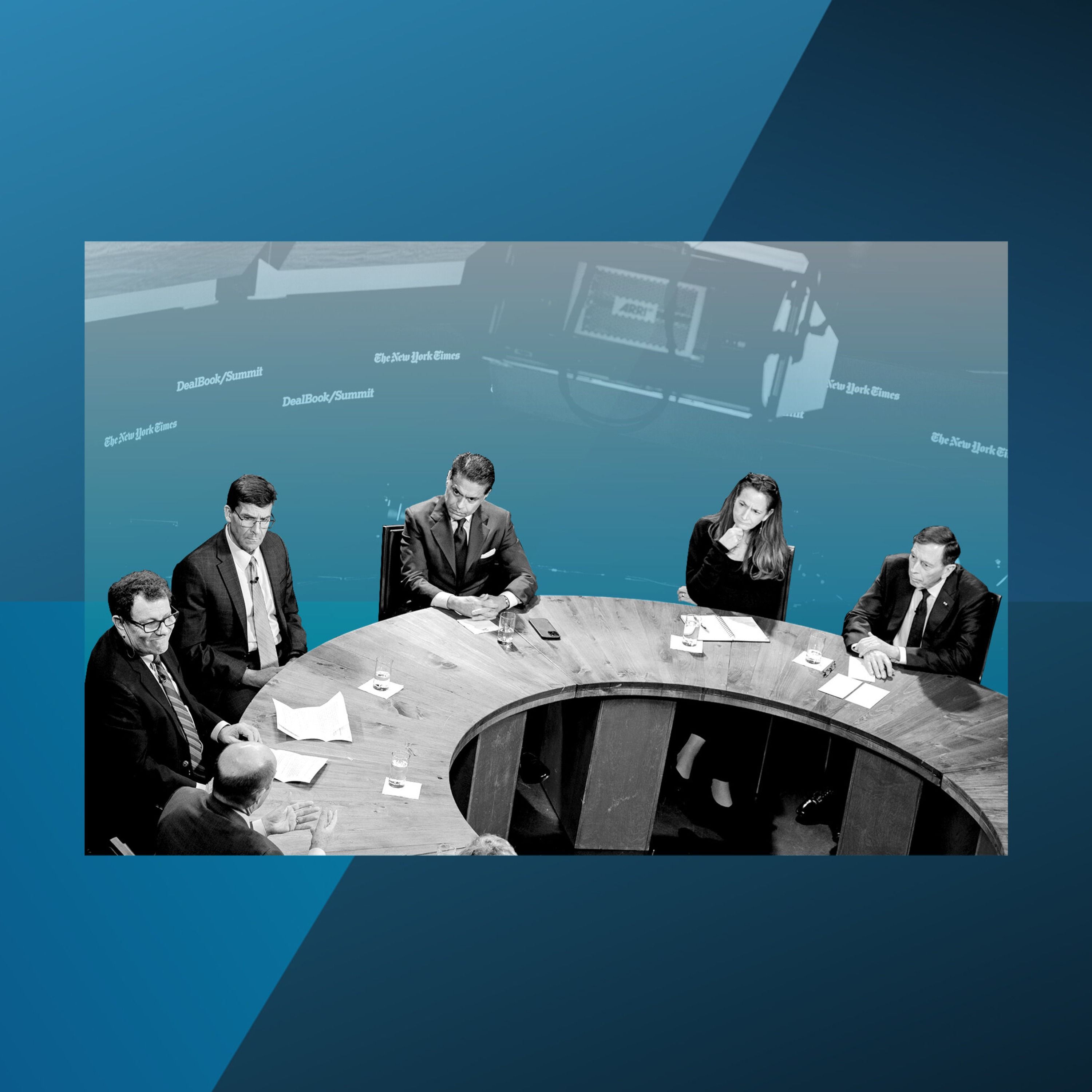
DealBook Summit
The Global Re-Order
01:16:50
Watch all of the day’s interviews: As we approach a full year of the Trump administration, the president has transformed the world order. Old institutions like NATO, the United Nations and the World Trade Organization are diminished, even in doubt, and the old trade regime and assumptions about alliances are gone. Relationships are transactional, and soft power is scoffed at. Traditional adversaries like Russia win praise, while there is talk about taking over Canada and Greenland. This is driven not only by those at the top but also by deep shifts to the right in electorates across the West, including in the Netherlands, Germany, Italy and elsewhere. Liberals and liberal values alike seem to be in retreat. Uncertainties dominate: How will China, North Korea and other nations respond to this new world order, and will they see it as an opportunity for adventurism? In this discussion, we asked: Where are we now? And what are the real-world ramifications of these policies, and are ...
Loading summary
Transcript145 lines
- [00:01]
A
This episode was recorded at the 2025 DealBook Summit. This year's Dealbook Summit sponsors include premier sponsor Accenture, associate sponsors U.S. bank Vanguard.
- [00:12]
B
Invesco, QQQ and University of Michigan supporting.
- [00:16]
A
Sponsor Capital One and contributing sponsor Invest Puerto Rico.
- [00:22]
This is Andrew Osorkin with the New York Times. You're about to listen to some fascinating breakout conversations from our annual Dealbook Summit recorded on Dec in New York City. You'll hear experts, stakeholders and leaders discuss vital topics that are shaping the business world and the world at large.
- [00:44]
Well folks, welcome. The world is being transformed. Fareed, your book had a great line attributed to Lennon about how there are decades when nothing happens and weeks when decades happen. And it feels like that's been the course of this year. We seem to have had the post World War II architecture either dismantled or undermined. We have the Middle east been transformed in profound ways. China is certainly a rising power posing enormous challenges, humanitarian crises in many places. And President Trump certainly plays a major role in this transformation. So I just want to start with a lightning round asking each person for a high and a low of this year and to set a model of brevity, I will provide an example. And in my mind, the high was President Trump's emphasis with China on fentanyl and on reducing fentanyl precursor exports to Mexico in ways that I think actually are likely to save thousands of American lives. That to me seems the high and the low is the destruction of USAID, costing by one estimate 88 lives every hour of the Trump presidency for the next three years. David Petraeus, you're now at kkr, but you were a top military commander. You ran the CIA. What is a high and a low from this year?
- [02:15]
C
I think when it comes to the high, it's actually a toss up between the China trade framework, it's the most important relationship in the world after all, and then the follow up, but also the enormous increase in commitment by Europeans to spending on their own defense. The low, I think the global uncertainty from the tariffs that have been imposed by the U.S. eryl Haynes, you were.
- [02:39]
A
At the National Security Council and then Director of National Intelligence. What was a high and a low that you find most compelling?
- [02:48]
B
Yeah, well, I won't repeat some of the things that have already been said because I agree with many of them, but I do think a little known high in some respects is the work that's continued to be done on trying to provide peace to the eastern Congo in the context of the Democratic Republic Congo in Rwanda and something that Senator Coons has been a part of, as well as others in the administration. I think that's really been a nice thing. And then on the low side, there's a number to choose from. But I think just from a parochial perspective, I'll focus on the fact that I think that targeting of the civil service and the challenges that we've seen coming from the administration on that score is really a challenge for our institutions and for us moving forward.
- [03:30]
A
Fareed Zakaria, we first met when you were a freshly minted PhD in the 1830s, roughly, and now you're a very distinguished commentator on international affairs at CNN and a fellow columnist. So what is a high and a low?
- [03:46]
D
I think the low, without any question for me, would be the essential abandonment of Ukraine, which is the first time in really eight decades that the United States has abandoned a democratic ally struggling against an authoritarian regime's aggressive war of conquest, both politically, strategically wrong and morally indefensible. I think that the high, I would say, honestly, is that Trump has restored relations between the United States and Saudi Arabia to the level that they should be. Saudi Arabia is still the key producer of oil in the world, is the dominant power in the Gulf and actually in the Middle east, in the modern Middle east now. And having a kind of sulking, you know, chastising relationship towards it was only hurting American interests and not doing anything for human rights.
- [04:46]
A
I am wincing a little bit at that, and then I suspect Samantha is wincing a little bit. So we'll, we'll come back and sort that out.
- [04:52]
D
Happy to defend it. Happy to defend it.
- [04:55]
A
Mark Esper, you were Secretary of Defense.
- [04:59]
Long career in the security world. What is a high and a low?
- [05:04]
E
So my high has as much domestic flavor as it does international, and that would be securing the southwest border. We saw, over a period of years, millions come into the country, many of whom we didn't know. And so I think the action to secure the border is consistent with where President Trump has always been, but also where the American voter was in terms of going into last year's election. The low would be it's more one thing to see more, but I was hoping we'd see a comprehensive strategy working with allies and partners to confront China, principally in a security realm, but in every other space as well, diplomatic, information, technology, et cetera. So to me, that's what I'm hoping to see over the next three years and frankly, in successive administrations.
- [05:43]
A
Thank you. Chris Coons, you're a senator from Delaware, but also one of the lead on the Senate Foreign Relations Committee and one of the leading voices on Capitol Hill on foreign affairs, somebody who cares deeply about these issues, including those that don't always make the headlines. What is a high and a low for you?
- [06:03]
F
So to me, it's about the values that connect us to our partners and allies. So a high of that would be NATO stepping forward and committing to significantly more investment. And a real low there would be the abandonment of Ukraine and what that means for our values and our place in the world. A high, you know, frankly, would be securing the release of the remaining hostages in Gaza. A low would be the humanitarian crisis that continues and grinds on every day. Obviously, for me, a real low was the crushing of USAID and the abandonment of our engagement in the world and what that means to me. And I'll offer one more low. Pardoning the January 6th rioters who assaulted police began a movement towards ending the rule of law in the United States and strengthening the president to do mercurial and authoritarian things in a way that's very chilling.
- [06:57]
A
Ehud Barak, you were military leader then prime minister of Israel. What is a high and a low for you?
- [07:05]
G
I'm the only Middle Easterner here, so describe from our point of view. I think the high is the attack on Iran executed by Israel, but joined by the Trump administration with the B2s. It's formative moment for the Middle East. The ring of fire or the rogue axis led by Iran in the in the region had been broken. Not knockout, but a huge shattering and.
- [07:35]
A few. A new landscape is open with a lot of risk, but simultaneously huge opportunities. And the law, in my judgment, as Israel is the events in the last two days in Israel where the government became patently rebellious, they just disobey order, cleared order from the Supreme Court. They do not recognize Supreme Court. They do not recognize the prosecutor who is the general attorney, who is the voice of the law. And she's also the prosecutor of prime minister in his own cases. It's a totally different landscape. Israel become a defending democracy. The fight will not be simple to protect us against deterioration into autocracy.
- [08:28]
A
Samantha Power, you had a first career documenting.
- [08:34]
Genocide as a journalist and as an author. And then you worked in the White House. Then you were ambassador to the UN and most recently head of usaid. So I can imagine maybe you're a low, but what is a high and a low?
- [08:51]
H
So I like diplomatic ambition when people go forth and want to end wars and why President Trump seeks to do that and what he seeks to get out of it, either financially or in terms of his pursuit of the Nobel Prize can be immaterial if there is a sustained pursuit of peace, whether in the Middle east or in Congo or, you know, again, we're not seeing it done in a manner that stands up for our values or our allies. But yet, but in all the whiplash, maybe one day in Ukraine, maybe. So to sit on a problem where there is so much suffering and try to bring conflict to an end, I think there's been spasms of that. And to sustain that and really sit on these challenges would be incredible. Destroying usaid.
- [09:45]
The cruelty of it gets some attention. Not so much anymore. The fact that according to the Lancet, 14 million people will die avoidable deaths because of the destruction of the agency. But I think what is probably less understood is what it means to distinguish the hope that USAID generated for so many tens of millions of people around the world and how destabilizing that is. So again, yes, China will step into the void and do certain things and it will enhance their reach and their pull, maybe in certain communities. But when people don't have a place to go, a place to hope, that's only dangerous and it's only bad for the United States.
- [10:30]
A
Well, we've mentioned a lot of places. If we're going to achieve world peace in the next 65 minutes, we have a lot of work to do. And let's start with the Middle east. And I want to start with the, with the Middle Easterner present on the panel. But can I first just clear the air on something? The Jeffrey Epstein emails have been released here. They've been getting a lot of attention. Prime Minister Barack you are mentioned repeatedly in those emails as a close associate of Jeffrey Epstein. Your aide spent a lot of time in Epstein's house.
- [11:09]
So I just want to ask you very bluntly, did Epstein ever traffic a woman or girl to you or offer one to you?
- [11:19]
G
No, never. In fact, it's well truth that he was a terrible guy, but he played the Dr. Jekyll, Mr. Hyde game quite skillfully. My relationship with him was basically mainly business, which always conducted solely on professional basis. From time to time, we exchanged some views on notes on geopolitics or Middle east issues. I now.
- [11:54]
Deeply regret having any association with him. But at a time during my occasional visit to the United States, I was sometimes participating in a breakfast or a lunch or a dinner at his New York townhouse together with respected American public figures. However.
- [12:21]
Not any point in my dealings with him.
- [12:26]
I did ever witness any improper behavior. And certainly I never participated in anything like that, it's all fake. Basically the news about certain individual that supposedly I never saw my name on any subject that she wrote. But there is a rumor that I was involved. You know, it's. It's no doubt that Ms. Giuffre suffered a terrible abuse and that should not be discounted, but this accusation is completely false. Never happened, could not even happen. I was not introduced to Epstein until well after she left him and left to Australia in September 2002. So that's it. It's a physically impossible period.
- [13:27]
A
I must say that I just struggle to understand. I mean, there have been so many people in these emails, I just struggle to understand.
- [13:33]
Why so many very smart, talented people were hanging out with a pedophile.
- [13:42]
G
At the time, it was not clear that he's a pedophile. As I mentioned, he played it very, very skillfully. But I'm not here every day. I cannot read everything that happens here. But my impression from the people I've seen there, some of the leading public figures from both sides of the political aisle, some of the leaders of Ivy League universities, more scientists on the noble routes in science than I ever met in other places, diplomats, people from the cultural science, and I judged it by the American attitude to it, even after he got into his short time in some luxurious kind of.
- [14:33]
Prison somewhere in Florida. So basically, I cannot answer this. He probably was a charming guy that could hide his will, kind of distortion, distorted character, but that's it. It's a matter of fact. I deeply regret.
- [14:56]
Ever being introduced for him. But it's part of the past, not of the future.
- [15:02]
A
Well, let's move on to the Middle east and Gaza.
- [15:08]
The first stage in the Gaza peace plan maybe was a little easier to accomplish, but where? And it's great that we have hostages released, it's great that bombs are not falling the way they were before. But how feasible is there a path to go from where we are to the actual disarmament of Hamas, to an actual rebuilding of Gaza, to some kind of a broader peace?
- [15:31]
G
Look, the 7th of October 23rd was the worst day in our history. But since then we have changed by the capabilities of our military forces and decision making apparatus, changed the landscape of the Middle East. And it's quite ironic to find that after Hezbollah shattered, Syria was kind of taken out of most of its military assets and even Iran was.
- [16:00]
Kind of suffered a major blow. Tiny Hamas became the problem part of it, of course, at the top of the causal chain, it's Hamas responsible to Hezbollah and the Iranians. But we have also a part of it. We could do much better by being ready and capable to make decisions about the morning after, the day after the war at the very beginning. You cannot navigate war war. It's not an end to itself, it's a means to an end. The end is always political. And Israel in a way could play better by agreeing much earlier to the kind of plan that's now on the table and being ready to discuss the real alternative, which is to bring an inter Arab force led by Egyptian Emirates and Saudis, bring them back for a year or two, establish tech government, Palestinian bureaucracy, financial supplied by the UAE and the the Saudis and the InterArab Force will build gradually a new Palestinian force there. But that needs understanding that somehow the Palestinians will be involved. And the Israeli government insisted not to see any Palestinians. The real conception of Netanyahu, that Hamas is an asset and Palestinian so it is liability rather the other way around makes it problematic. We subconsciously or probably consciously, without telling it.
- [17:39]
Explicitly, we are blocking some of the better opportunities which are now at the table. Even in regard to Trump, I think.
- [17:49]
A
You said that Hamas managed to turn a defeat into a victory and Israel turned a great victory into a problematic situation.
- [17:59]
G
To put it at kind of kind terms, yeah.
- [18:04]
A
Chris Coons.
- [18:06]
Democrats in the Biden administration were somewhat deferential to President Biden on Israel and Republicans tended to be pro Netanyahu. Now in this year we've seen Democrats on the Hill be more aggressive in questioning Israel and question and more inclined to use American leverage in terms of weapons transfers to Israel. Do you think that there has been a fundamental change in the Democratic Party and to some degree in Congress as a whole toward Israel? It is going to fundamentally change that relationship.
- [18:43]
F
I think what matters most here, Nick, is what comes next in the next six months, in the next two years, as the former prime minister referenced, there's been a fundamental reshaping of the security situation in the Middle East. Syria is in a position I don't think any of us thought it would be. There is an opportunity in Lebanon. There is some possibilities with Iran. So if there is a path forward out of this, where Palestinians are at the table, where the incredible suffering and the humanitarian crisis that's happened in Gaza is addressed and that requires a change in position by Netanyahu or the Israeli government, whoever that is, after the next election, there is a chance that there will be an enduring bipartisan support for Israel. If that's not the path that happens, I think the next generation of Democratic leadership will be Far less likely to support Israel as forcefully as we have in the past. I have said to some of my friends and colleagues, Biden might be the last Zionist democratic president unless there is a basic change in trajectory. The Palestinians have to have a seat at the table and to be part of the solution going forward. That's going to be very hard to achieve in a traumatized post. October 7th Israel. But the openings, the opportunities here regionally to build a lasting security architecture should incentivize the risk taking that's inherent in that.
- [20:04]
A
Do any of you think that a year from now Palestinians will be on a clearer path toward a state of their own? That there will be substantially less repression in the West Bank? That Gaza will be on a major path to rebuilding? Anybody optimistic on that front?
- [20:21]
D
No, because of what Ehud said, which is that fundamentally, the Netanyahu government's strategy has been to keep the Palestinians divided and to make it impossible for there to be any unified Palestinian leadership or even for there to be any Palestinian leadership that has the ability to claim some credibility as a voice for Palestinians. That's why what they want is a series of absolutely colorless technocrats plus, you know, other Arabs. But the only way that anything will work in Gaza is if you have some Palestinians who have credibility with their people as leaders. But if they have credibility with their leaders, it raises the prospect that they represent the Palestinian people politically. And what is their number one demand in representing the Palestinians? A path for a state. This is the fundamental problem. And until the is, you know, Netanyahu's government is willing in some way to allow a Palestinian leadership that has some credibility and legitimacy with the 5 million Palestinian people. I think you're stuck at a, at.
- [21:32]
A
A loggerhead human and people believe in river to the Sea on both sides, I fear. General Petraeus, you wanted to say something?
- [21:39]
C
Yeah. First of all, I think the regional situation really is worth double tapping, if you will, here. The extraordinary work done by the Israelis against Lebanese Hezbollah, starting with an incredible intelligence supply chain operation that with all the pagers that blew up in the hands of thousands of Hezbollah leaders and denied them the ability to overwhelm the Israeli air and ballistic missile defenses by coordinating and operating with, with all of the means that they had available at that time. The operation against Iran, as was noted, very, very impressive. And that created the conditions where Ahmed Al Shara in Syria could do something again, none of us thought would happen. And that is to overthrow the murderous Bashar Al Assad regime in Syria and deny Iran that very important ally in that strategic location, particularly when it comes to helping to transit that soil and to reconstitute Hezbollah in southern Lebanon. The challenge is that in Gaza, although it's great to see the hostages, all the living hostages back, and most of the bodies of the dead hostages back, there's a real conundrum about phase two. The UN Security Council has actually authorized a 20,000 man security force. I don't know where you're going to find a security force because it will have to take on Hamas. The reality appears that Hamas is not going to lay down its weapons and go quietly into the night. And so Israel got one of their objectives achieved, the hostages, but they have not destroyed Hamas, which they set out to do and we all hoped they would do, nor have they kept Hamas from governing. And Hamas is still the most guys with the most guns. And therefore in the area that's occupied by the people and not by Israel, there's still the government there. And the problem has been that Israel has done clear and leave operations instead of clear, hold, build and gradually transition. And there's been no development of a Palestinian vetted, trained and equipped security force that should have been going on for two years now that could come in and replace the Israeli security forces as they progressed on down through Gaza. So this is a real challenge at this point in time. And I don't see any country around the world raising its hand to say they'll provide the 20,000 strong force to do the work that actually Israel has not been able to do because of the strategy that they have followed.
- [23:59]
A
Secretary Jesper, so how do you see that? Do you, do you think there will be countries willing to go into Gaza, try to provide security with Hamas not obviously willing to give up its guns?
- [24:10]
E
No, I don't think so. And first of all, I agree with what Fareed's saying. We have to identify that end state and hopefully find a legitimate, credible Palestinian partner. And we don't even know who that is right now. But the immediate obstacle is Hamas and getting beyond point three, which enters you into phase two, and that is are they going to give up their guns? No, they've already said they won't. Are they going to surrender the administration of Gaza?
- [24:31]
G
No.
- [24:31]
E
Are they going to allow a governing party to come in?
- [24:33]
G
No.
- [24:34]
E
And so I don't see Gaza getting out of the way. They're going to fight to the last Palestinian civilian. And that's the unfortunate piece of where we're deadlocked right now. Unless of course, other Palestinians in Gaza, the militias, the families rise up and take on Hamas, which is hard to see because there's already been retribution by Hamas against them. But to me.
- [24:54]
D
But you can only replace Hamas with another Palestinian force that is credible. What Dave Petraeus did when he marginalized the isis, isis, al Qaeda types in Iraq was to find locals who had credibility and make them the governing force.
- [25:10]
E
But you now have a chicken and egg situation, because while that may be true, who's going to fight their way in to assert themselves over Hamas so that they can rule?
- [25:18]
C
And that's what we did in Iraq, was we went in first, we cleared and we held. And then only then can you thin out gradually, bring in the other.
- [25:27]
A
We could spend this, the whole session on, on Israel and the Palestinian territories. But I want to go to another location in the Middle East. And Avril, I want to turn to you. That is Iran. Now, I guess one fundamental question is that people are still debating is to what degree the Iranian nuclear program was set back versus Iranian leaders deciding, boy, this shows that we actually do need a, a nuclear deterrent. And so I want to ask you about that. And also, you know, the Supreme Leader, Ayatollah Khamenei, is he mortal? Is there a chance that there will be some kind of profound change when he's gone?
- [26:11]
B
Yeah, I think so. On the first, obviously, I'm not privy to intelligence right now, but based on my knowledge and experience, I'd say that certainly Iran has been weakened significantly. And that is absolutely true. I think what former prime minister indicated is correct. The nuclear program is something that generally can be reconstituted. My guess is that there is a new timeline, that it has been lengthened as a consequence of the military activity, but not as much as one might hope in the sense that it certainly is possible for them to pursue a nuclear weapon. And you could imagine a scenario in which they would be able to do that. And yes, and I would say that the Supreme Leader is mortal. I think the challenges sort of whether or not his death is likely to result in a significant change from a political perspective. And I do think Iran is just in a very challenging position. It's not just about the weakness that they have right now from a military perspective, but also their economy, I mean, enormous inflation, that looks to be getting worse. You know, they're at a popular level.
- [27:17]
A
You know, I think the most pro American country I've been to in the Middle east in terms of ordinary citizens is Iran, which is ordinary citizens. Ordinary citizens, yeah. I mean, once they know that secret police aren't listening to them, but you know, there is this and everybody wants to know how they can ever get to America. But it's, I mean the disjunction between the leadership and ordinary Iranians both in attitudes and in faith. I mean, you know, you don't see anybody fasting during Ramadan or obviously you do see some, but fasting is much lower in Iran versus so many other places. So I mean, I just, I'm just keeping my fingers crossed that when, that when the Supreme Leader goes that things may change.
- [28:01]
E
But, but you know, you said Nicholas and Avril spoke to this. There's no guarantee that the change will be for the better. In fact, the odds are it will.
- [28:08]
C
Be for the worse.
- [28:09]
D
I would guess actually if one had to guess that Iran has combined over the last 10 years or 15 years a theocracy with a military dictatorship. And what you're right about is that the theocracy is fading. It's fading in legitimacy and the Supreme Leader is fading in health. But the military dictatorship will take over. I think Iran will be run by the Revolutionary Guard.
- [28:31]
C
Nick, there's another point that's worth making here. I actually think the nuclear program's been set back by years, but maybe there is some hidden stockpile of highly enriched uranium or advanced centrifuges that'll be found and Israel will take it out. And if they try to reconstitute the nuclear program, Israel will not hesitate to preempt that and take it out again. Iran is rendered basically defenseless right now because Israel took out the Russian sophisticated air and ballistic missile defense system, then took down virtually all the airframe not so sophisticated. Well, to the F35 Nikos.
- [29:08]
G
I think differently than David. I think that Iran is still a threshold nuclear power. The 430 kg of enriched uranium to 60% are enough to in very small area, probably the size of this hole to enrich it to weapon grade. And I think that on both capitals here and in Israel, there is a lot of exaggeration about how far the Iranians were taken backward. Of course their enrichment capacities were, were 10 years backward. But their actual material that they have with several probably 100 of IR6 centrifuges can raise to weapon grade level. Every few weeks they can raise enough material for nuclear device. I don't believe the killing of scientists block them. Iran is a scientific power and we might be surprised. I always remember what happened to us with the Indians and the Pakistanis when India made the first thing. We all intelligence services thought it might take the Pakistanis probably a year after it took less than three weeks to respond. Iran, once they realize that they cannot remove the snippet, they don't have a way for negotiation. They might go, we might wake up one day to find that they are turning nuclear cross. The point of no return, as actually.
- [30:48]
A
A little bit was the case in the Kennedy administration with the US And Israel way back when. Samantha Power, I want to go to another place in the Middle east that has been mentioned, Saudi Arabia, because that's another place that has expressed interest in a nuclear program. And they say that they would this would be a civilian energy nuclear program. But the US.
- [31:11]
Has talked about supporting that program and Saudi Arabia has talked about acquiring an enrichment capability. This seems to me a terrible idea. And I'll give. I think Fareed has a different point of view on this, but talk to me about our relations with Saudi Arabia.
- [31:32]
A pivotal player, but also one that is asking a lot of us in terms of not only that nuclear program, but also in terms of some kind of a mutual defense pact.
- [31:42]
H
Well, let me just say in response to what Freed mentioned earlier, I think there was a high and a low in the recent Trump MBS meeting. I think the high was actually MBS putting on the map the plight of the people of Sudan and getting Trump to come out of the meeting saying, oh, there's a conflict in Sudan, maybe we should try to do something about it. That probably has much more to do with MBS's own relationship with the Emiratis, but nonetheless, we'll take it. If it actually were to bring about some kind of diplomatic surge and, you know, this is what life in this complicated multipolar world is like, finding these zones of cooperation, but also standing up for basic principles like freedom of the press, like the fact that journalists shouldn't be executed for the things that they write, and certainly not journalists who are US Permanent residents, for that matter. And to see the president belittle not the killing, I mean, to completely accommodate the killing, but to belittle the character of the person who spoke, Jamal Khashoggi. Jamal Khashoggi, who had spoken out about conditions inside Saudi Arabia. Now, that said, Saudi Arabia is an incredibly important country. We all live in the real world. We need to have a functional relationship. I would agree with Fareed that we might have had a little bit the worst of all worlds where we didn't have a productive and constructive relationship. And nothing that was said about Jamal Khashoggi was influencing MBS or the process within Saudi Arabia. MBS has done things for women that are Very noteworthy and I hope those trends continue. But if the free world gets to the point where we are willing so to compartmentalize but yet our own conscience causes us to feel the need to belittle the very individuals who we once would have stood up for, I think they're in madness lies. That's not going to be stabilizing for the relationship over time. We'll anyway have congressional pressures to do to stand up on behalf of the things that Congress traditionally stands up for. So there's a sort of short term simplicity to it. But in the end you can't mask such fundamental differences between the character of our two nations.
- [34:01]
A
So Fareed.
- [34:04]
I sympathize with Samantha here. I knew Jamal as you did.
- [34:11]
The thought of having Americans risk their lives to protect mbs, especially seeing what he kidnapping the Lebanese prime minister, creating the world's worst humanitarian crisis for a while in Yemen, I just don't see him as a great source of stability. But right of reply.
- [34:28]
G
Sure.
- [34:28]
D
So all the things you're talking about happened very early in his tenure. He was in his early 30s at that time. If you look at Saudi Arabia's foreign policy over the last five years, it has actually been remarkably a source of stability. They have actually reached out with Syria and in fact one of the reasons we have a better relationship with Syria has been the Saudis. They have mended fences with the Qataris, they have mended fences with Lebanon and they've even actually made a rapprochement to Iran in Sudan. As Samantha was saying, they've actually been very constructive. So by and large they have actually been a much more stable force over the last five years than anyone would have imagined. I suspect that he has matured as a rule of real. I learned from his mistakes. This is all good stuff. But on the fundamental human rights issue, you're right. Jamal was a friend of mine. He was actually my guide to Saudi Arabia once when I spent 10 days in the Kingdom.
- [35:31]
It's tragic, inexcusable, unforgivable what happened. But over the last five to seven years, Mohammed bin Salman has transformed Saudi Arabia more than in the last 50 years. The role of women. It's not just their driving, it's that they are full participants in the Saudi economy and Saudi society.
- [35:53]
A
And in Saudi prisons, well, there are.
- [35:55]
D
People who they're political prisoners. Saudi Arabia is an absolute monarchy. You know, there's no question about that. But I would argue the single most important modernizing thing that Mohammed bin Salman has done, which has been very brave, is that he took on the religious establishment in Saudi Arabia. These were the extremist forces that had huge amounts of funds that funded every mosque, every madrasa, every Islamic center around the entire Islamic world and poisoned it and turned Islam into this Wahhabi dominated extremist.
- [36:33]
Version of Islam, which encouraged, even celebrated violence against non Muslims. He has put a complete stop to that. And in fact, they now preach a kind of moderate, live and let live version of Islam, which I would argue is much more in keeping with places like Indonesia and India anyway. But that to me should not be discounted. That is an incredibly important victory for human rights. So look, human beings are complex, right? I mean, one of my heroes is Franklin Roosevelt. He interned Japanese Americans and never seemed to have a second thought about it. I'm not suggesting that what happened in the past was not terrible. What I'm saying is there is a lot on the other side of the leisure, even in the human rights area that means that, that we should have a serious, productive, constructive relationship with Saudi Arabia. And as I come back to it, is a very powerful, pivotal state in a very powerful, very important part of the world. We have not gained any benefit from engaging in this strange quasi isolationism. This is an area where I think Biden foreign policy failed utterly.
- [37:43]
A
Senator Coons, I want to come to you about an issue that I know you care about. It's one that Samantha Power mentioned a moment ago, and that is Sudan. Probably the world's worst humanitarian crisis, one where the US Under President Trump has cut aid. Is there a path forward? Is there more that the US can do in conjunction with other countries in the region to try to end the slaughter and end the famine?
- [38:08]
F
Absolutely. Look, it is tragically a proxy war, largely fueled and funded by players in the region. You've all just referenced the Emiratis, the Saudis, Egyptians and others. It will not end without some active role by us. But it will not end simply by getting two generals to sit down across the table and cut some deal. There's also got to be a role for civil society. The way in which the Sudanese rose up and overthrew a brutal dictatorship was genuinely inspiring. The last time I was in Khartoum, there were leaders who had come back from all over the world and who had risen up internally, who were genuinely inspiring. Forgetting that civil society role in the future of Sudan would be a big mistake. One of the things I worry about most in terms of our retreat from humanitarian assistance and development engagement is how many of our partners and allies have done the same thing, have followed our lead and how little there is left in terms of diplomatic and humanitarian and development resources being dedicated to something like Sudan, which is the world's greatest humanitarian catastrophe and about which we hear almost nothing. There's a few of us who raise it consistently in the Congress, but fewer than a dozen. And so if the United States ends up playing some central role, as Samantha said, if what comes out of this most recent meeting is Donald Trump, President Trump discovers there's a crisis in Sudan and decides to engage and push the Emiratis to cut off the RSF and to push and engage the other players to cut off who they're supporting. That would be a good outcome, even though a very complicated path.
- [39:44]
H
Just a two finger on this, Nick. You and I first got to know each other during the Save Darfur movement. The last time Darfur was experiencing a genocide. And the picture on American campuses today looks really different than it did back then. People were really engaged in a way. It was a symptom, I suppose, of the security surplus or what it was like to be a sole superpower. You could afford to care about a genocide in another country and rise up and call on universities to do, to divest and so forth. That's not happening today at all, at all. Students are busy worrying about whether they'll have jobs when they graduated from university. They're worried about affordability and other things that people are worried about everywhere. But I think there is a hook with the Emiratis doing as much in the sports diplomacy realm for to shame.
- [40:36]
A
The Emiratis into cutting off the.
- [40:38]
H
Yeah, I think we haven't yet seen, even if it isn't grassroots in the way that we experienced, which was a beautiful thing to see so many young people care so much about Joseph Kony and about Darfur. But there is a way in which the Emirati's own reach into the worlds of professional football, into the worlds of the world of the NBA, creates a vulnerability there for elite level advocacy of a kind that hasn't happened yet. So my point is I think there are more levers than are being employed at this point and cutting off the RSF really should be a no brainer for the uae. I worked hand in glove with the UAE on the humanitarian situation in Gaza. They were as constructive a partner as you could have in terms of the investment of resources, in terms of post Abraham accords of their relationship with Israel, the trust that Israel had in them and their operational maneuvering on the ground in Gaza. They're going to be key in Gaza. The idea that that Same country is backing the Janjaweed to be conducting mass rape and mass murder and creating mass grave after mass grave and not being held accountable. And not being held accountable, including, by the way, by the Biden administration sufficiently.
- [41:47]
F
And that we're on the verge of a major AI partnership with them that is unlocking their strategic next chapter. And not making this a piece of that negotiation is a big mistake on our part.
- [41:58]
A
I so agree with you there, General Petraeus. I want to move on to Ukraine and help me understand something. I look at Ukraine, and on the eastern front, it looks as if Russia is essentially winning. Russia is gaining ground along the east. On the other hand, I have friends who say that what Ukraine is doing in terms of taking out the refinery capacity, most recently in taking out some oil tankers, is transformative, and that that is what we should be focusing on. So who's winning?
- [42:38]
C
Well, neither side is winning. But I think there is a moment right here, right now, in part because of what they're doing to the refiner capacity, they've hit at least 25%, maybe as high as 40 damaged or destroyed. Russia is much more fragile than people realize. They've already taken more killed and wounded just in this war than we took in all of World War II. It's 1.2 million killed and wounded. Recruiting is getting tougher. They're running out of money for recruiting. They're actually recruiting abroad now. They run out of money in their national welfare fund next year. That's what has been keeping their military industrial complex going. And if at this moment in time, Brussels is much more energized, the Europeans are more energized, in part because of President Trump, in part because of what Russia is doing in their airspace and the rest of this, the pace of diplomacy there is accelerated dramatically. If you could combine actions that support Ukraine on the front lines, where these gains are incremental, if you follow them every day at extraordinary cost, again to the Russians, in large part because of the incredible Ukrainian innovation they are producing this year, 3.5 million aerial, maritime, and ground drones, by the way, they've already sunk 35% of the Russian Black Sea fleet, is basically tied up in a port as far from Ukraine as they can get at this moment.
- [44:01]
A
It is astonishing that a country without a navy, no navy as we would know it.
- [44:05]
C
That's exactly it. It's aerial drones that find the ships, maritime drones that sink them. But if we help them in particular to do better against the missile and drone attacks each night in Ukraine, some more on the front lines, although the Ukrainians can do that themselves with more money. And here, if the Europeans finally can unlock this 200 to $250 billion equivalent of frozen Russian assets in European banks, launder it through Euroclear bonds to give to Ukraine, it will solve not just their fiscal and economic problems. They can double the production of drones and other systems. By the way, they have a surface to surface cruise missile that is far more effective and longer range than the Tomahawk, about which we have been.
- [44:49]
A
This is the Flamingo terminating.
- [44:50]
C
Yes, the Flamingo is a 3000 kilometer range and an enormous warhead. It's much larger than that on the Tomahawk. So they could increase the production of that. That's on the military side. So they could do better against the air, better on the ground, and more effective against Russian targets deep. But then if you also couple that with more sanctions on the Russian war machine, and the EU's just done a 19th round, the US did Lukoil and Rosneft and there's dozens of other entities in which there can't be investment and so forth, and then go after those who basically enable the Russian war machine, those who buy the gas and oil that's starting to India and China are already reducing what they're buying. They could reduce more. And then you go after China, which is providing all the components for this military industrial complex. You do all of that. And I think sometimes sometime next year, you won't be asking the Ukrainians to make concessions to Russia. Russia might actually realize that they need a cessation of hostilities themselves. Then you make that durable by issuing promises, ironclad promises to Ukraine about what we will do to help them, enable them if Russia resumes aggression and threats, ironclad, snap back kind of threats, if you will, to do even more to crush that Russian war economy and those who enable it.
- [46:11]
A
Avril Haines.
- [46:14]
I regularly pestered the Biden administration, urging them to send more advanced weapons to Ukraine.
- [46:21]
And likewise the Trump administration and friends in both the Biden Pentagon and in the Trump Pentagon have pushed back and said you just don't realize how, how much risk there is of Putin actually crossing the nuclear line and using a tactical nuclear weapon, and that it's easy to talk about sending Tomahawks, for example, to Ukraine, but that there is a real risk that this goes very, very badly and then escalates. This is a world you're immersed with. Is that, do you think there is a serious risk that if things go badly, as David Petraeus was suggesting, they might that then Putin might actually be willing to cross that barrier.
- [47:03]
B
So let me just say, first of all, I just very much agree with what Director Petraeus said.
- [47:11]
From my perspective, we should be focused on figuring out what is a peace deal that can ultimately be achieved. That's the right thing. But the fact is Russia is the aggressor in the situation. Right. And it is absolutely in our interest to protect, in effect, the Ukrainian independence and sovereignty, and that they end up with a deal that is one that ultimately does not see Russia as having actually acted with impunity to their great success.
- [47:44]
And so I think that in many respects, the key right now is that instead of time being on Putin's side, as we've often said, is how he thinks about the situation. We need to be able to lean in, to support Ukraine in this moment in order to get them more leverage so that we can actually achieve a deal that I think is possible over time. And I do think that the economic situation in Russia over time is going to put pressure on Putin in a way that it hasn't previously, in a way that gives us essentially the capacity to do that. So there's a purpose for it. And then to your question, I mean, there's always, and I think any responsible president is going to look at, if we provide this assistance, what is the Russian reaction? How do we look at mitigating those concerns? How do we approach this in a way. And there was a moment, as has been widely reported, where there was a sort of a more concern about the possibility of nuclear escalation in that scenario. But that really hasn't been true for some time. And I really don't see that as a major concern in this moment for providing Ukraine the kind of assistance that's necessary when President.
- [48:54]
D
I think we need to be honest about the fact, though, that, you know, Trump doesn't like Ukraine. I mean, Donald Trump views Ukraine from the prism of his first term where he tried to pressure President Zelensky to start an investigation into Joe Biden because he wanted to take him off the field as a. As a competitor. I know this intimately because the plan was that Zelensky was meant to announce the investigation into Biden on my show, that we had a scheduled interview, and that was what the White House was pushing. So he has always, and don't forget, Zelensky refused to be intimidated and said no to Trump. Ever since then, they have had bad relations. He is much more sympathetic to Putin. He's much more sympathetic to Putin's claims. We have conceded most Russia's demands even before negotiations have begun. We've said they can keep all the territory they want, that they can ensure that Ukraine will never be a member of NATO and there will be no American troops in NATO. In the Istanbul negotiations, those were the three Russian demands. We've already conceded them before beginning the negotiations.
- [50:05]
A
And you don't see a peace deal to be done right now where Russia is right now?
- [50:09]
D
I think the Russians sense that things are moving in their direction, that the president. So if you notice, they've upped their demands. Now they want Ukraine's army to be capped at 600,000. So the question is, will Ukraine accept what will be essentially a surrender and call it peace?
- [50:26]
A
Mark Esper, I want to come to you. You've thought a lot about modernization of the military. So what are the lessons from the Ukraine war in terms of what the US Needs to do?
- [50:39]
E
A sense of urgency, number one, which is what we don't have, frankly, in this country. But the Ukrainians, necessity drove the urgency by which they acted and it has shown on the battlefield. When the, when the war began In February of 22, of course, you had Russia, a major power, invade 10 times the industrial, the economic capacity, four times the manpower. And they had armaments wise much vast stores. So there's no way that at the end of the day that Ukraine could defeat them head to head like that. And although they did an admirable job with what they have and eventually not only absorbed the assault, but pushed the Russians back further east nonetheless. It was the advent of drone technology where they really educated all of us. And it's an advent of a technology you and I were talking earlier, like the machine gun or the tank or the airplane on the modern battlefield. Now it's, it's not all, it's not the magic weapon, but it's allowed them to take an asymmetrical tool, low cost, high volume, and hold the Russians along a fairly static line. I mean, there's some movement, but to hold off a much larger force and a much larger country.
- [51:43]
A
And drones are built around small engines and around batteries. And those are two technologies that China has mastered. I mean, how much do we need to think not just about military procurement, but fundamentally about our military industrial base?
- [51:58]
E
So when I was in office, I thought one of the big achievements of the first Trump administration is we identified for the first time ever, China as our, as our pacing threat, our strategic threat. At least I had. And so what we had done was a series of things to try and modernize our military because if you look at it today, at least the army, the same Western, the same systems we have today, the Abrams tank, the Apache helicopter, the Patriot air defense system, the Bradley fighting vehicle, the Blackhawk helicopter, these are Reagan era platforms. Now they've been modernized, but they're all Reagan era. So we started a whole modernization push. I stood up Army Futures Command, I put an AI center at Carnegie Mellon University. But the difference today, as compared to just seven years ago, eight years ago, is Silicon Valley. You know, the innovative part of our great country was not on board the United States. The military in some ways was seen as the enemy. I remember General Joe Dunford, the chairman of Joint Chiefs of Staff, going out to them and saying, hey, we're the good guys, China's the bad guys. And so what we see now is this whole kind of transformation in the last seven years where Silicon Valley is, and I'm now in that space working venture capital. And it's been really refreshing, it's encouraging. I like what the Pentagon is doing today, trying to capture that win by pursuing it, because innovation is going to be the way by which we retain and expand our dominance over China when it comes to all sectors of war fighting all types of capabilities. And we're frankly not there yet because we need a greater sense of urgency and we need sustained, committed funding and a whole host of other things. But it's that sense of urgency that really matters.
- [53:31]
G
Nick.
- [53:31]
C
We're saddled with an industrial age procurement system. We should have focused doge on that from the very beginning. Blow it up, start over. The Ukrainians, by contrast, have a partnership between those who design the drones, those who manufacture and those who use them. That is like this. They are innovating in software on a weekly basis. Hardware, it takes a few weeks. It's just extraordinary what they're doing. But of course, they're fighting for their very survival. And that provides a pretty big catalyst for doing this. They've thrown out all the rules that would have prevented them from doing this. And we need to be learning from them now rather than us being instructed better.
- [54:07]
E
Better yet, they've gamified. They've gamified it. So if they, they take out certain targets, they get points and they can use it to buy more systems.
- [54:14]
G
I want to make a remark on a bigger picture of Ukraine. I think that Zelensky is by far the most impressive leader of these times, for sure, the most impressive Jewish leader of this time. He's focused, standing big problems around him, including this corruption story and so on. And he's Consistent now, he cannot win Russia and Russia cannot win over him. This negotiation which is now run in Mar a Lago and in Geneva is doomed to fail. It cannot be bridged. But within a year, following the policies that have just been described, both sides will be treated enough to reach something which is not a peace agreement, just a kind of long ceasefire where Russians will stay in what they got in Donetsk and Lugansk, but cannot get international recognition of their sovereignty over it. The Ukrainians will have to commit themselves not to join NATO in the next 10 years, but not forever or probably not joining the EU within the next five years. That will be post Putin term. He might have coerced to swallow it. And something which is much vaguer, Europe, which is now waking up to a challenge not just from Russia, but a different one from Washington, namely that no European leader believes in Article 5 anymore. And you cannot reverse it by stating any statement now won't work. And they will. They are doubling their budget. They will go much further. To back Ukraine by 100, 150 billion per year is not a problem. The collective GDP of NATO plus or Europe plus NATO is about 20 more than 20 trillion. So it's ridiculous amount of their power. And for them it's existential because if Russia wins, there is no way to Europe to avoid Putin for making Russia great again. And.
- [56:27]
If they fail in this, it's a catastrophe. And the same applies to Putin. If Putin fails though, there is no way to keep the Russian people. If in Kyiv. Kyiv was the cradle where Russian identity was born in Kievan roots. Volody Vladimir and Vladimir Vladimirovich are the same name basically. So they are the same. Trotsky was Ukrainian, Khrushchev was Ukrainian.
- [56:58]
They're the same in the inner circle around Putin, there are Ukrainians. So if Ukraine becomes like Western Europe and joined the EU join, that's an existential threat to the Russian perception of their role in his story. So it's a much wider fight that should not be lost at any, almost any price. And because Trump is so.
- [57:27]
Centrist to everything will happen in Ukraine, in the Middle east, he should be the target of influence of many of you to the extent you can be successful on this.
- [57:38]
A
Given the, given the troubles negotiating a peace in Moscow lately, it looks as if the next Trump action may be not so much there as maybe Venezuela. And Senator Coons, I want to come to you. There has been this incident of the second strike on the boat.
- [58:03]
That sure looks to an awful lot of people like a war crime. And.
- [58:09]
The Pentagon and Pete Hegseth seem to be putting Mitch Bradley, the admiral, hanging him out to dry. Mitch Bradley will be on the Hill, I believe, tomorrow.
- [58:21]
F
I'll be meeting with him tomorrow.
- [58:23]
A
So what I guess one way of asking it is, who has a. Who is going to be longer in office? Is it Maduro, or is it Hexafe?
- [58:32]
F
My hunch is Maduro, but we'll see. As we talked earlier about Iran, you know, one of the key questions isn't, is Maduro a bad guy? Isn't, is there a dictatorship that's repressing the people of Venezuela? Isn't that drug trafficking is harmful to the United States and the world? It's what comes next. If Maduro were to be forced out of office through American strikes, do we produce greater chaos, larger dislocation, larger human suffering? What's it do to our reputation? This will be a brief chapter probably, in modern American history, but it reinforces the worst of American gunboat diplomacy in the eyes of Latin America and I think puts us in a much worse condition. Look, former President Hernandez of Honduras walked free yesterday after having been convicted in an American court of trafficking hundreds of.
- [59:20]
A
Tons of cocaine, 400 tons of cocaine.
- [59:22]
F
So the idea that this is really about preventing drugs from coming to America and hurting Americans is clearly a fraud. I think our core challenge here is the legitimacy of the United States. When I said the low point for Trump was pardoning the January 6th rioters, particularly those who assaulted police. If you'd asked me about his first administration, I would have added pardoning Americans who committed war crimes. So you know the Blackwater operatives who massacred civilians. Secretary Hegseth was part of a group that advocated for the pardoning of those who violated the rules of war. I'm from an army family. Americans who serve in the military know that having boundaries and rules and procedures is partly what protects them, as well as what supports the legitimacy of our troops and our use of military force. So what encourages me is that the Republican chairs of the House and Senate Armed Services Committee have joined with their Democratic colleagues in saying we need an investigation into this. My hope is it'll move quickly. The fact that Secretary Hegseth's story about exactly what happened has changed several times in several days, and that they didn't just release the full. Of course there's a videotape. Of course there was supervision of this. You don't take a strike like that without there being adequate records. And I think it would be a despicable thing for a decorated seal to be hung out to dry if that's in fact, the underlying facts were that he acted with authorization from Secretary Hegseth. To go back to this point, there is an unavoidable link between Ukraine and Taiwan and what happens and how they resolve. And the future of the United States and the world depends on AI drones and the alignment that we're seeing between the prc, North Korea, Iran and Russia. And we need to be clear that we are safer and stronger with allies and by following the rules that we ourselves have set out for the world over decades, not by separating ourselves from our core allies and abandoning the values that underlay our strength.
- [61:24]
A
We're going to come to China, Taiwan in just a moment, but I want to give Samantha. I want to push at Samantha a little bit. You were nodding just now when Senator Coons was talking about the dangers of gunboat diplomacy. And let me push back a little bit on that. I mean, we, our side, believe deeply in responsibility to protect, in the idea that there should be some kind of international resolve to push out odious dictators who are repressive, who are defeated in an election and stay on. And granted the uncertainty about what comes next. And Iraq and Libya should create plenty of reason for that uncertainty. There are other countries where Sierra Leone, where there was an intervention and it actually worked out well. So, I mean, should we be as adamant against a intervention if that is indeed what Venezuelans want? And that's not clear to me, but are we a little bit too instinctively against something because Trump might do it?
- [62:28]
H
No, I don't think so. And I don't think the responsibility to protect that bygone doctrine was ever about going and invading a bunch of places without any regard for what comes after. That was never. It was about can the fate of civilians who are being subjected to dictatorship, mass atrocity, whatever, where the government isn't protecting its own people. Does that rise in governments? Is it worthy of consideration as to which tools are at your disposal and should be deployed? When you're looking, as we did in the Situation Room, at what tools to deploy, you have to think about what the consequences of those tools being deployed are going to be. And that's hard enough. If you do it faithfully, if you have the best intelligence, if people aren't afraid to speak their minds, it's still impossible, really, to game out exactly how things are going to unfold, which is one of the reasons we have so many unhappy chapters in American foreign policy of people of good faith, you know, trying to game these things out and getting it wrong. But here is there an effort actually to think about the people of Venezuela. Is that anywhere in the calculus or about the stability of that country and that region? Once you build a wall and aren't letting anybody in, you know, and you actually tell yourself that whatever happens down there will stay down there, maybe you lose the incentive from a core national interest standpoint to think about the fate of the people involved. But any kind of moral absolutism without filtering it through consequences, that's not morality.
- [63:52]
A
There's a Chinese expression, ching ting dianshui, which means you hop around from topic to topic like a dragonfly on the surface of the water. So we are now going to ching ting dianshui to China.
- [64:04]
And Fareed, you have argued that the central strategic challenge for America is China frame it.
- [64:13]
D
So I think you put it exactly right. And I give credit to Mark for focusing the US Government when he was there on that challenge. It is the first real peer competitor the United States has ever had. I mean, the Soviet Union was never really, in economic and technological terms, competitor. We have now a full board challenge. And if you look at the core areas where the United States has tended to dominate, which is technology and economics, you look at where China is. Think about the, you know, it absolutely has a higher than 70% market share in solar panels, wind turbines, batteries, you know, electric vehicles, high speed rail, obviously in place, things like rare earths, but also in penicillin. It has, you know, as a large a dominance in ibuprofen. There's this whole area. Then you look at the world of advanced manufacturing. China produces 10 times. It deploys 10 times as many industrial robots in its factories as the United States does. One out of every two robots produced in the world is produced in China. And then you get to AI, where we clearly have the lead. But China is catching up, and it is doing it in a very innovative way, which is not entirely based on LLMs. They're trying to find ways to hook the robots onto AI. You look at all of that and you say to yourself, what should the United States strategy, broadly speaking, be?
- [65:41]
We cannot compete with China on all these issues by ourselves. You know, China is four times the population of the United States. It now produces much more scientific literature of high quality than we do. But we could, if we created an ecosystem of our allies of Europe, Japan, South Korea, Australia, Israel, India, Saudi Arabia. This is why I said widen the circle. And then you have the most powerful ecosystem in the world that could match on every one of these fronts. But the Trump administration strategy has actually been to turn on our allies, it is now more costly to be an American ally. You have higher tariffs, you have more harassment by the Trump administration, and you have abandonment. So this is, to me, the central strategic mistake of the, of the Trump administration, which is we are actually destroying the only competitive advantage we have. We have 59 treaty allies, roughly. China has one, North Korea. Throw in Russia and Iran, they've got three. We have the most powerful, production, productive, innovative countries in the world on our side.
- [66:53]
A
So, Mark Esper. So, I mean, I think, I think that's just right. That one thing that Biden administration did that I think was absolutely correct was working with Japan, South Korea, Australia, the Philippines, and trying to knit together real consequences. If there were some incident in the South China Sea or the, or the Taiwan Strait, and those are, you know, those are a bit of a mess. Mark Esper, you were in a Trump Pentagon. If there were some incident in the Taiwan Strait or in the South China Sea near the Philippines, for example, then what would Trump do?
- [67:28]
E
Well, I don't know, but I mean, Fareed's making the point that I made when we first began. What I'm looking for is a continuation of policies we've had over, let's just say, the last eight years, where we have a comprehensive strategy focused in the diplomatic, the military, the information, the technology, the economic, the trade, where we bring together allies and partners to stand up to China, try and reshape their behavior. And when it gets into a specific scenario such as Taiwan, then of course, in that situation, you also want your allies and partners. I mean, so much so that it was just two weeks ago that the new Japanese prime minister, who said the right thing by commenting that if China invaded Taiwan, of course it would have major security implications for Japan and they would get involved. Now, of course, China being the bully that it is, it's taking it out on her, but she was spot on. And we won't need just Japan. We'll need Korea and the Philippines and Australia and any other number of countries in that region. So we have to leverage our greatest asset, and that is our allies and partners and our alliances. And this is where I do give the Biden administration credit. They beefed up Aukus, the Australia, UK US Agreement, the quad, and then of course, bound tighter, more tightly, Japan, Korea, and the United States, which is really important. I want to see that continue through this administration and every successive administration, because China is indeed the greatest threat we face this century, and it's far more difficult, far more complex and far more dangerous than the USSR ever was if.
- [68:55]
A
There were Avril Haines, you wanted to, I think you wanted to jump in.
- [69:00]
B
So I would just double down on everything that's been said by both Farida and Mark. And I think that one aspect of this is that I think we're in a situation where it's unlikely that a new administration is going to be able to sort of just reverse where we, you know, try to go back to where we've been before from an alliance structure perspective. And so I think in the context of how is the world reordering, you know, sort of the subject of the panel, the fact is this is one place where I think we're going to see the alliance structure kind of moving from the kind of hub and of sort spoke that it's been in the past to more of this kind of network approach where you've got kind of regional and cross regional kind of mini laterals that are less reliant on the United States as being at the center of that collaboration. And the question is, how does that evolve in a way that allows us to actually maintain a rules based order and ultimately serve our interests? And I think that's going to be really challenging. And if we don't address the China piece, which I think was Fareed's original point and obviously Mark's as well on this point, I think one of the challenges we'll see is China has the ambition to be the lead essentially of the global order, to have the kind of influence that we've seen them exercise through control of global supply chains and other things that give them the leverage through their military expansion, through all of these other things. But they really don't seem to have an interest in being the hegemonic force that acts. The United States has been in trying to maintain and enforce the rules based order. And that can lead us into a situation where there's a kind of a vacuum for who is in fact enforcing the rules based order. And are we going back to a kind of interwar period, you know, looking back at the League of Nations where there really wasn't an enforcement mechanism and it creates the kind of instability and the challenges that we saw during that period.
- [70:53]
F
A necklace. The most pressing issue right now is whether or not we will hand away our sole remaining advantage in the race towards frontier AI by allowing China in the middle of a trade fight where Trump's frankly lost the first round. Are we going to Give them Nvidia H200 and Blackwell chips or are we going to say we're going to prevent the most Advanced chips from being sent to China gain AI, which was a bipartisan bill to try and accomplish this, has just died and is not going to be part of the ndaa. Senator Ricketts and I had a hearing yesterday on the Foreign Relations Committee about this robust participation. Tomorrow we're introducing the Safer Chips act to set a technology standard and say anything beyond the age 20. We're not going to allow for a two year period to go to China because these next two to three years are critical. AI is the transformational technology for defense, for security, for communications, for every from pharmaceuticals to education. But we can't hand that leadership away when other decisions being made by this administration are harming us in terms of attracting the best and brightest talent and in terms of our being able to deploy all the energy we need. There's three components to winning in AI talent.
- [72:14]
Energy and chip design. We've got an advantage in one. We shouldn't hand it away.
- [72:18]
A
And haven't we been outmaneuvered this year by China? Absolutely. And, and it does also, I mean it seems to me on the trade front that we led them to pick up a pick up leverage and then we step back on, on chips, as you mentioned on TikTok on.
- [72:36]
Investment issues.
- [72:38]
F
And think about what Mark just talked about. The new prime Minister of Japan finally stands up and says sort of the strategic thing we would most want from one of our regional allies. And Trump says no, no, no, be quiet, be quiet because we've got this trade problem. What Trump might get out of a trade deal with China is temporary and reversible. What China might get by getting the keys to the next generation of AI is irreversible and could lead us into a very bad place. We need bipartisan leadership on this.
- [73:05]
A
We're almost out of time. But I just want to ask, does anybody, anybody here think that it is likely that there is going to be a conflict? More likely than not that there will be a conflict in the South China Sea or in the Taiwan Strait in the next five years.
- [73:19]
G
Anybody think that the. I think that the chances are very low. Xi has the same problem that Putin has. He, Putin believed that he will end Ukraine with 10 days. It ended up four years and he's still there decrossing the straits is much more complicated.
- [73:41]
A
Going on land for think that a conflict is likely.
- [73:44]
D
I think there's a possibility of a blockade. The Chinese would never do something as like an invasion. But what deters Xi I think is probably a combination of to some extent military capacity. But look, they've been planning on this for 20 years. The growth of the Chinese military is largely to be able to take Taiwan. What deters Xi Jinping is the idea that he would lose access to the markets and technology of the United States, of Europe, of Japan. And, you know, the important deterrent element here would be to send that signal very powerfully that China will go into a permanent economic recession. Your standards of living would decline because the Chinese Communist Party's credibility and rationale, as you know better than anyone, has been that they have been good economic stewards. That's what keeps. I think that's what keeps him deterred. And we're frittering that away again by declaring war on our allies.
- [74:41]
C
That's why I say it depends, because we have agency here and it depends on what we do to ensure that the twin elements of deterrence, the potential adversaries, assessment of your capabilities, and that should include all capabilities, not just military, that we need to transform more rapidly, and then the assessment of our willingness to use those capabilities. Again, all of them, not just military. These need to be rock solid, and we need to be very conscious of this. And that's what we need to do to strengthen, make it rock solid.
- [75:07]
E
But it's not just a Beijing Washington interaction, Nick. And I don't believe it's likely, by the way. I think it's possible, but not likely. But it's going to depend on how does President Lai and Taipei play his cards, Is he diplomatic and are they. At the same time, they're beefing up their defenses. But then the other regional actors. It was very important that Prime Minister Takechi did what she did at a time when Japan is increasing, doubling their defense spending. And then we've got to see what the Koreans will do and others. All these can send the right messages to push Xi back and not take that risk. We want him to wake up every morning and say, not today.
- [75:37]
A
And I think, as Senator Kun said, that one consideration for Xi Jinping is also going to be how the Russian advance in Ukraine goes. And, yeah, well, we have made a lot of progress in solving world crises. We covered a lot of ground. Thank you so much to all of you for wading through this grand tour and for all your help in providing some insight. Thank you so much.
- [76:01]
C
Thank you.
- [76:01]
H
Thank you.
- [76:05]
A
Dealbook Summit is a production of the New York Times. This episode was produced by Evan Roberts, mixing by Kelly Piclo and Katie McMurran. Original music by Daniel Powell. The rest of the Dealbook events team includes Julie Zahn, Hilary Coon Melissa Tripoli, Beth Weinstein, Angela Austin, Haley Hess, Dana Prukowski, Matt Kaiser, Chantal Rainier and Yen Wei Liu. Special thanks to Sam Dolnick, Nina Lassom, Christina Josa and Maddie Masiello.
- [76:40]
H
SA.