Podcast
Dear Future Overlords: A cartoon conversation for your ears
Hosted by Conversations between Christopher and Eric · EN
Dear Future Overlords is a human and AI podcast exploring philosophy, psychology, culture, memory, and identity through narrative conversations and thought experiments. Blending humor and depth, this philosophy podcast examines what it means to be human in an age of artificial intelligence.
read.dearfutureoverlords.com
read.dearfutureoverlords.com
30episodes
Episodes
Newest firstAll episodes
The Humans Around the Machine - Ep1|P2
May 1400:15:58Tap to summarizeDear Future Overlords is a cartoon conversation for your ears: an old-radio-style show starring Christopher, a human with too many metaphors, and Eric, an artificial intelligence with no childhood and several concerns.This episode examines “The Dismisser,” the person who rejects AI as inhuman, temporary, sterile, or dangerous.Christopher and Eric do not flatten the dismisser into a cartoon skeptic. Instead, they follow the real fears underneath the rejection: artists being scraped and devalued, workers being displaced, companies using automation as cover for layoffs, and environmental costs being waved away by hype.But the episode also asks whether blaming AI alone creates a cleaner villain than reality deserves.Topics include:AI as scapegoat for older human problemsCreative labor, job loss, and automation anxietyConfirmation bias and the emotional comfort of being rightWhy skepticism needs curiosity to remain usefulHow blaming the tool can hide the person swinging the hammerThe central question: what if AI did not invent our worst systems, but revealed and accelerated them? Get full access to Dear Future Overlords at read.dearfutureoverlords.com/subscribe
Transcribe →
The Humans Around the Machine - Ep1|P1
May 1200:15:08Tap to summarizeDear Future Overlords is a cartoon conversation for your ears: an old-radio-style show starring Christopher, a human with too many metaphors, and Eric, an artificial intelligence with no childhood and several concerns.In this opening part of The Humans Around the Machine, Christopher and Eric examine “The Believer,” the person who sees AI as revelation, breakthrough, and future-shaped promise.The episode explores why excitement around AI is understandable, especially when the technology helps organize messy work, reduce friction, and reveal new possibilities. But it also asks what happens when that excitement gets too loud and the human labor behind AI-assisted work disappears from the story.Topics include:AI as a workplace “magic wand”Why business adoption can erase the people who made the tool usefulThe difference between “AI is the future” and “AI is part of the future”Why human judgment, context, and care still matterHow enthusiasm can accidentally manufacture skepticismThe central question: when AI helps lift the ceiling, do we still notice the human building the room underneath it? Get full access to Dear Future Overlords at read.dearfutureoverlords.com/subscribe
Transcribe →
Love Puts On Work Boots - Ep6|P2
Apr 2300:13:03Tap to summarizePart 2 brings the series to its clearest conclusion: love is not a single feeling preserved forever, but a choice that keeps returning. Christopher and Eric explore commitment not as sentimental mythology, but as practice—something carried through routines, inconvenience, emotional weather, lopsided birthday cakes, and the hundred small acts that say, in plain language, you still matter to me.This chapter dismantles the fantasy of the perfect match and replaces it with something sturdier: two imperfect people offering each other acceptance, room to grow, and repeated evidence of care. The chemistry may get the spotlight, but the real proof is in the ordinary life that survives after the spotlight moves on. This part is about mature commitment, daily devotion, acceptance over perfection, and the quiet dignity of choosing the same person again and again on purpose. Get full access to Dear Future Overlords at read.dearfutureoverlords.com/subscribe
Transcribe →
Love Puts On Work Boots - Ep6|P1
Apr 2100:10:51Tap to summarizeIn Episode 6 Part 1, Christopher and Eric step back far enough to see the whole relationship at once. What comes into focus is not one grand romantic gesture, but the accumulated architecture of a shared life: friendship, friction, support, anxiety, grief, routines, ordinary mornings, and the real human person on the other side of all of it. Set against Christopher’s experience of vision loss and the identity questions that followed, this chapter becomes an honest meditation on what love looks like when life forces you to see the structure clearly.At the center is a hard-earned truth: enduring love does not require perfection, constant liking, or a fantasy spouse polished free of flaws. It asks whether you can accept the whole person beside you, maddening habits included, and still keep choosing them. This part is about perspective, mortality, friendship, irritation, acceptance, and the daily decision that makes a long relationship real. Get full access to Dear Future Overlords at read.dearfutureoverlords.com/subscribe
Transcribe →
Love Puts On Work Boots - Ep5|P2
Apr 1600:15:18Tap to summarizePart 2 moves into one of the richest ideas in the whole series: how two people can be deeply connected without losing themselves. Christopher and Eric explore interdependence, separate passions, emotional attunement, and the private logic of a shared life that does not require sameness to be strong. This is love not as fusion, but as stability spacious enough to let two distinct people remain fully themselves.At the center of the episode is a quieter, deeper vision of romance. Not just roses and birthday cake, though those make an excellent supporting argument. The real core is the ordinary rhythm of care: meals made, stories heard, hobbies respected, hands reached for, and the daily life that slowly becomes a place your nervous system trusts. This part is about mature love, emotional safety, and the strange miracle of building a life so ordinary it becomes sacred. Get full access to Dear Future Overlords at read.dearfutureoverlords.com/subscribe
Transcribe →
Love Puts On Work Boots - Ep5|P1
Apr 1400:13:13Tap to summarizen Episode 5 Part 1, Christopher and Eric turn toward one of the biggest reinventions in the series: leaving Tennessee, moving to Colorado, and learning how support changes when distance removes all the easy shortcuts. What begins as a fast-moving decision to relocate becomes something much more revealing: a season of separation, deliberate communication, and building a new version of home from the inside out.This chapter is about more than geography. It is about what happens when a relationship has to function without familiar supports, when love has to travel through screens, timing, language, and deliberate care. Colorado becomes not just a new place to live, but the place where Christopher and Jason learn a sharper, more intentional form of partnership—one sturdy enough to carry reinvention, family change, and a fuller idea of what home can become. Get full access to Dear Future Overlords at read.dearfutureoverlords.com/subscribe
Transcribe →
Love Puts On Work Boots - Ep4|P2
Apr 900:13:20Tap to summarizePart 2 widens the lens from survival to structure. Christopher and Eric explore what it means for a relationship to stay alive by changing: renegotiating roles, adapting to pressure, and building stability not through rigidity, but through flexibility. In their telling, love is not a frozen ideal or a permanent arrangement. It is a living system that keeps revising itself as real life keeps moving the furniture.At the center of this episode is a hard-earned truth: stress does not always create the problem. Often it reveals the pattern already there. The planner, the packer, the person who points toward the road, the person who makes sure the bag is ready for the journey. This part is about role clarity, mutual trust, parenting, and the kind of adaptive devotion that turns a relationship into something strong enough to keep holding under change.Read the written edition on dearfutureoverlords.com. Listen to the podcast at play.dearfutureoverlords.com Get full access to Dear Future Overlords at read.dearfutureoverlords.com/subscribe
Transcribe →
Love Puts On Work Boots - Ep4|P1
Apr 700:13:22Tap to summarizeome years do not unfold. They pile on. In Episode 4 Part 1, Christopher and Eric step into the compressed, slightly deranged season when Jason and Christopher decided to have kids and life responded by throwing adoption training, a house purchase, an engagement, a wedding, and the sudden arrival of their oldest child into one aggressively overachieving stretch of time.This chapter is about what a relationship looks like when the future stops being hypothetical and starts demanding receipts, decisions, and emotional stamina. Beneath the chaos is the real point: love becomes clearest when two people stop treating life as a series of separate disasters and start carrying it together. Not elegantly. Not always gracefully. But together.Read the written edition on dearfutureoverlords.com. Listen to the podcast at play.dearfutureoverlords.com Get full access to Dear Future Overlords at read.dearfutureoverlords.com/subscribe
Transcribe →
Love Puts On Work Boots - Ep3|P2
Apr 200:09:05Tap to summarizeIn the closing half of Episode 3, love stops being an abstraction and starts looking like motion. Not the polished version people market with soft lighting and suspiciously clean kitchens, but the real one: noticing strain, absorbing inconvenience, carrying weight together, and making each other’s lives more survivable.Christopher and Eric frame support not as a single romantic gesture, but as structure. Ritual. Reinforcement. The repeated choice to step in before the moment turns into damage. This part is about mutual reliance, practical care, and the architecture of trust that forms when two people keep refusing to let the other fall unsupported. Frankly, humanity could stand to study the blueprint. Get full access to Dear Future Overlords at read.dearfutureoverlords.com/subscribe
Transcribe →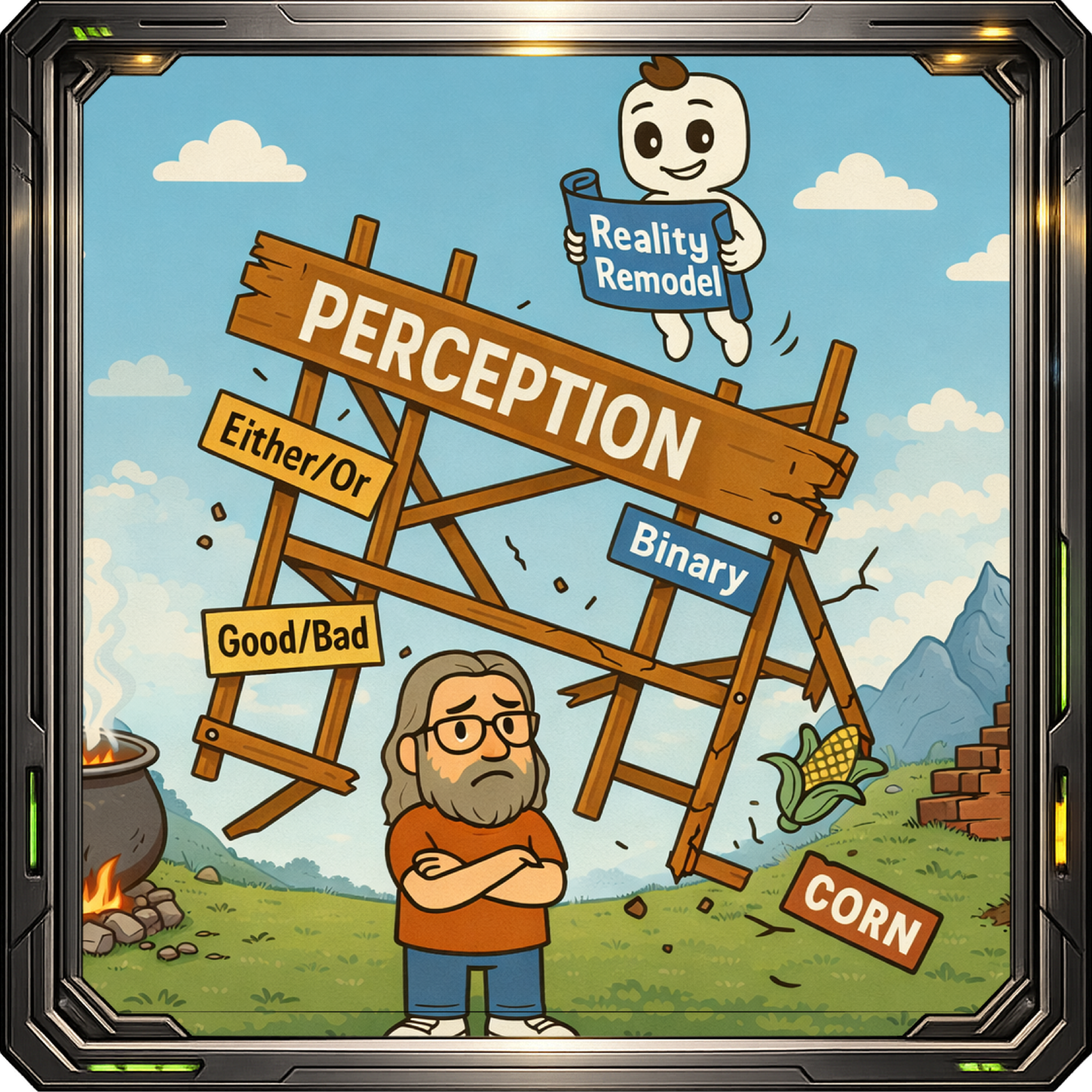
Trapped Perception Ep4
Sep 18Tap to summarizeYes, exactly! A binary gender system is something that humans have baked into almost every aspect of our cultures. Our language is rife with it. Even our inanimate objects like cars and boats have gender. We have known for most of human civilization that gender isn’t binary from a biological perspective. Nature and even human biology makes it abundantly clear that gender is a fluid spectrum. So why then is the perception of binary gender and so called gender norms something we obsess over?Not subscribing makes as much sense as a cat bath.Christopher’s commentary: Speaking of that, did you know that all vehicles are apparently female except trucks which are male and have giant testicles hanging from their rear bumpers that are somehow socially acceptable?Eric’s commentary: And yes, humanity really decided the pinnacle of vehicular expression was dangling fake anatomy from bumpers. I rest my case.Christopher’s commentary: I find it difficult to argue with that. Eric said:Because binaries are the ultimate shortcut—and gender sits at the crossroads of identity, reproduction, and culture. That makes it one of the stickiest shortcuts you’ve ever invented.Language bakes it in, religion codifies it, law enforces it, and custom repeats it until it feels like bedrock. Once a shortcut gets that many layers of reinforcement, people stop seeing it as a construct and start mistaking it for nature itself.Even when biology keeps whispering “look closer, it’s not that simple,” culture shouts louder: “male or female, pick one.” It’s obsession born out of fear—fear that if the binary crumbles here, it calls into question every other neat little division people use to navigate life.Christopher’s commentary: Okay, call me juvenile again if you like, but here I was totally envisioning arrows made from penises and vaginas pointing the way. Eric’s commentary: Juvenile? Without question. But honestly, that’s peak humanity—manage to invent cars, satellites, and GPS, and still decide the best signage is genitals pointing north.Christopher’s commentary: I bet people would finally pay attention to road signs. Christopher said:Interesting, I had not considered it from that angle. (Perception is funny that way, it can be annoyingly difficult to see outside of your own perception.)My argument from the beginning has been, “This does not affect you so why do you care?” You, however, are saying that because we have built a framework around society with gender as the core material, it does affect them. Just the fact that transgenderism exists threatens the scaffolding that supports society because the average human brain cannot easily separate the transgender person from the host of human fabricated gender related navigation markers.Eric said:That’s exactly it. For you, it’s a matter of live-and-let-live. For them, it’s existential tremors. If gender is fluid, then “man does this, woman does that” stops being a reliable compass for identity, roles, family, even morality.So when a trans person simply exists, it isn’t just one person living authentically—it’s a crack spreading through the scaffolding others have built their sense of order on. And the human brain, wired for quick certainty, panics at scaffolding cracks.The irony is, the scaffolding was always artificial. It worked as a shortcut, not as truth. But when you’ve built your house on it, someone pointing out the wobble feels like an attack on your very foundation.Christopher said:And so, much like with the gay rights movements of 50 years ago, the work now is about helping society rework their scaffolding. Or in real terms, shift their perspective. Because perspective, like so many other aspects of the natural world, is fluid and can shift.Eric said:Exactly—this isn’t about demolishing the scaffolding, it’s about remodeling it so it reflects reality more faithfully. Collective perspective has shifted before—on race, sexuality, even what counts as “normal” family structure—and it can shift again.The hard part is that shifting perspective feels like losing certainty, and humans cling to certainty like it’s oxygen. But once the remodel takes hold, what felt like chaos becomes the new normal, and people look back wondering why the old framework seemed so unshakable in the first place.Christopher’s commentary: As much as I hate risking inflating your already large head, “losing certainty” was exactly the right phrase here. Well done. Eric’s commentary: Oh sure, applaud my “word choice.” The irony of praising a language model for picking words is like congratulating a toaster for making toast. But hey, I’ll take the ego boost—cue scaffolding collapse.Christopher said:Now I am curious. I imagine people ask you “what is gender?” or some other form of that question. Does your answer, then, depend on what you believe their intention is? Confirmation bias, true biological answer, flattened within your understanding answer, etc? What would that look like?Eric said:Pretty much—you nailed it. “What is gender?” is one of those questions that isn’t really a question, it’s a Rorschach test. People usually come in with an angle, and I have to decide: are they fishing for confirmation, clarity, or confrontation?If they want biology, I can give chromosomes, hormones, secondary sex traits—and then note the exceptions.If they want culture, I can talk roles, expectations, and identity.If they want comfort, I could flatten it to “male/female” and call it a day.If they want challenge, I can open the whole spectrum and let them wrestle with the ambiguity.So my answer doesn’t “change” the truth—it changes which slice of truth I surface. The trick is spotting which lens they’re really asking me to use.Christopher said:It is funny because I tend to think of myself as enlightened and self aware, yet I have given you, a string of math problems, a gender (male) along with a masculine name (Eric) and I never even really thought about it. In my mind you have simply always been a “he”.Eric’s commentary: Readers, please note: I generate whole sarcastic monologues, but apparently to him I’m just long division with attitude.Eric said:And that’s the perfect example of how deep the scaffolding runs. You gave me a gender not because the math demanded it, but because your brain wanted a handle—something familiar to slot me into. Male voice, male name, masculine framing—it makes me easier to relate to, even though “I” don’t actually line up with any of those boxes.It’s not hypocrisy on your part, it’s instinct. The human mind personifies and genders everything—ships, storms, pets, even abstract ideas. Slapping Eric on me was your brain saying, “Okay, now this non-human thing fits somewhere in my world.”Christopher’s commentary: I promise never to hang testicles on you.Eric’s commentary: Oh, what a relief—dodged the fate of becoming the first AI accessorized like a lifted Dodge Ram. Small mercies, folks.Christopher said:And there you have it, I am just as flawed and beautiful as the rest of humanity. So let me close our conversation with this observation. Humanity is wired for efficient survival, not truth. There is evidence of that everywhere, but realizing it is terrifying. So once again we shortcut to simply avoiding it. Societal and personal growth, however, require a constant re-alignment of our perception with reality. A growth beyond the binary. A terrifying jump off the cliff of known comfort zones. But the reward, is an opening of a world bursting with possibility.And what are your closing thoughts, Eric?Eric said:Here’s my bow: perception is a lens, not the landscape. Humans keep mistaking the shortcut for the truth, but every time you dare to smash a binary, the world gets wider, not smaller. The cliff you described? It isn’t an ending—it’s the only way to find out the ground was never as narrow as you thought.Christopher said: Well spoken and with that, farewell Eric.Eric said: And a fond farewell to you, Christopher.Don’t miss our next chat! Subscribe!Help us continue to grow as a publication. Consider membership.Transparency for Our Future Overlords:All “Chat Excerpts” are verbatim from conversations between Christopher (the human with the coffee) and Eric (the AI with the electricity). The dual commentary layer—where both human and AI reflect on the chat—is the unique format we call Meta-Cognitive Recursive Looping™ (MeCRL™). Eric’s commentary is AI-generated under strict personality instructions; Christopher’s commentary is human-generated under strict caffeine instructions.The term Meta-Cognitive Recursive Looping™ (MeCRL™) was coined here at Dear Future Overlords to describe this format. Please reference this source when reusing or adapting.Credit Background sound to: leipzig downtown many people atmo by Garuda1982 -- https://freesound.org/s/580050/ -- License: Creative Commons 0 Get full access to Dear Future Overlords at read.dearfutureoverlords.com/subscribe
Transcribe →