Loading summary
Transcript90 lines
- [00:01]
A
Support for this show comes from Robinhood. Wouldn't it be great to manage your portfolio on one platform? With Robinhood, not only can you trade individual stocks and ETFs, you can also seamlessly buy and sell crypto at low costs. Trade all in one place. Get started now on Robinhood Trading. Crypto involves significant risk Crypto trading is offered through an account with Robinhood Crypto llc. Robinhood Crypto is licensed to engage in virtual currency business activity by the New York State Department of Financial Services. Crypto held through Robinhood Crypto is not FDIC insured or civic protected. Investing involves risk including loss of principal. Securities trading is offered through an account with Robinhood Financial LLC MemberCIPIC, a registered broker dealer.
- [00:46]
B
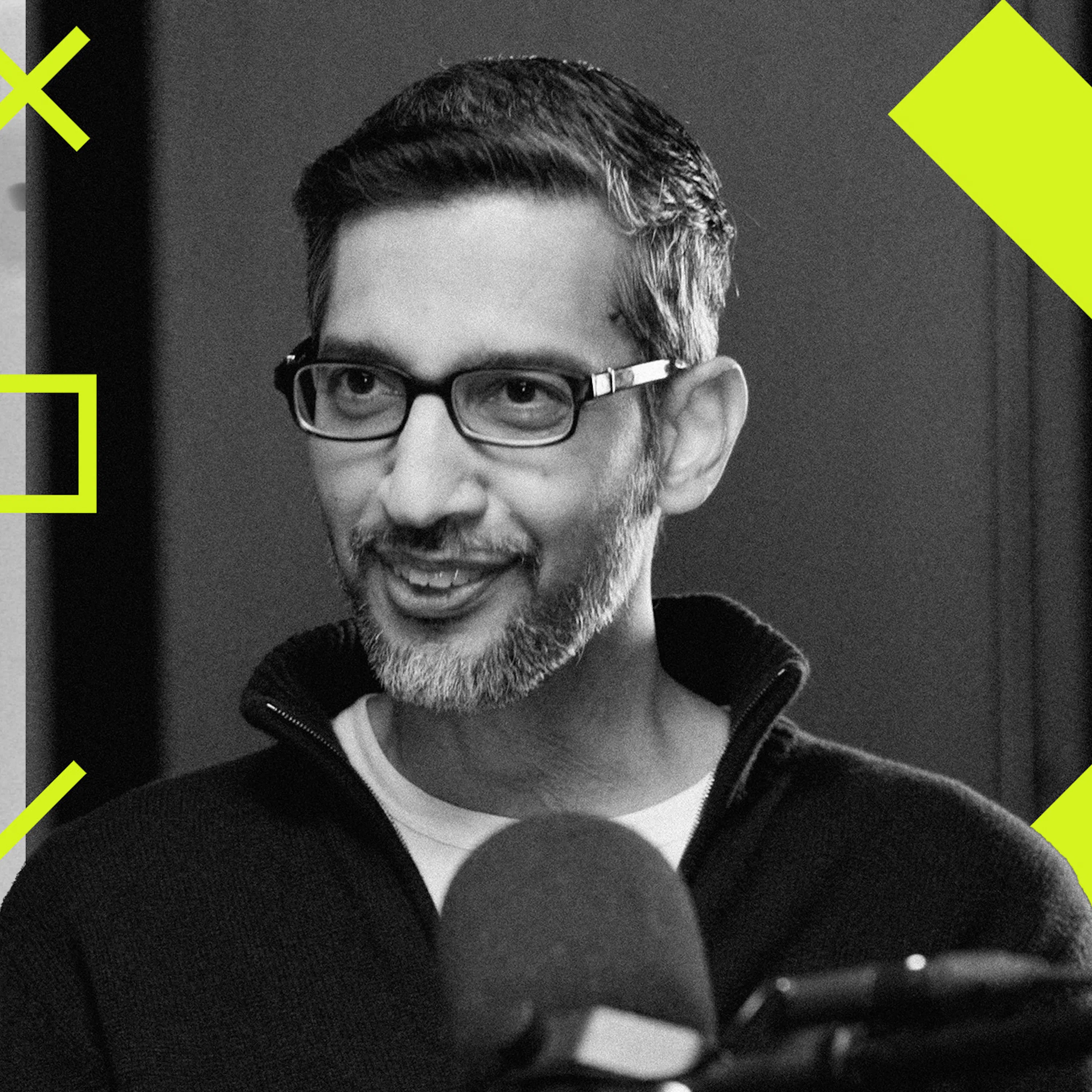
Hello and welcome to Decoder. I'm Neelai Patel, editor in Chief of the Verge, and Decoder is my show about big ideas and other problems. This week I'm talking to Google and Alphabet CEO Sundar Pichai in what's becoming a little bit of a decoder tradition. We spoke in person after the big Google I O developer conference. This is the third year in a row that Sundar's been on Decoder after I O, and this one felt really different. Google's in a very confident place right now, and you can really feel that in this conversation. If you caught any of the news from I O, you know why. Google announced a huge new set of AI products that are shipping imminently, not just models and capabilities. Sundar told me that these products represent a new phase of the AI platform shift, and we talked about that at length how that shift is playing out, what the markers of these phases are, and whether any of these products can actually deliver a return on the huge investments that Google has been making in AI over the years. I O also marked the beginning of what appears to be a new era for search in the Web. Google's new vision for search goes well beyond links to web pages, to something that feels a lot more like custom app development. When you search for something, Google's AI Mode will build you a custom search results page, including interactive charts and potentially other kinds of apps in real time. You can see the beginnings of that vision in the new AI mode right now. One of the big announcements at I O is AI Mode is now available to all US Users, and the plan is to graduate features from AI Mode into the main search experience over time. I wanted to know how Sundar was thinking about that graduation process and really how he thinks that will affect the web itself, which right now is shaped more than anything by the incentives of Google search and SEO. You'll hear Sundar say in several different ways that he believes the web is still getting bigger and that Google is sending more traffic to more websites than ever before. But the specifics of that are hotly contested. Just before he and I spoke, the News Media alliance, the trade group that represents publishers like Conde Nast, the New York Times, and the Verge's parent company, Vox Media, issued what can only be described as a furious statement calling AI mode quote theft. So of course we talked about that too. And what happens to the web when AI tools and eventually agents do most of the browsing for us? What does it mean for the web to go from a series of websites that people look at to just a series of databases that AI agents make use of? And even more importantly, why would companies like Uber or DoorDash or Airbnb allow their businesses to be commoditized in that way? If you've been listening to the show, you know that I've been talking about this idea a lot. And so Sundar and I spent some real time here. It was a very decoder conversation, of course. We also talked about Android XR and the smart glasses Google announced at I O and when the next era of AI hardware might arrive. I also asked Sundar what he thinks of the big OpenAI jony I've deal that was announced just before we spoke. And I couldn't let this conversation go without asking about the major antitrust trials Google's involved in, including the government's demand that Google sell Chrome and what negotiations with the Trump DOJ have involved so far. President Trump has long complained about his search results being too negative, but Sundar told me he will not change search rankings in response to political pressure calling search sacrosanct. There's a lot in this one. I'm eager to hear what you all think about it. And as a bonus, you can also watch the full video on the Verges YouTube channel, so check that out if you'd like. Okay, Google and Alphabet CEO Sundar Pichai. Here we go. Sundar Pichai, you're the CEO of Alphabet and Google. Welcome back to Decoder.
- [04:20]
C
Good to be back. Feels like a nice tradition post I O to be talking to you. So good to be back.
- [04:25]
B
I think this is the third year we've done this after I O. I'm excited. Thank you for keeping the tradition alive. Lots to talk about. You announced a lot of things yesterday during the keynote. There's AI mode rolling out for US users, big updates to Gemini. There's VO3. And imagine the generators. You solved Pokemon with robots, which is very exciting. You know, my takeaway yesterday was that Google feels very confident now. There's a real confidence about the technology coming to life and the products a lot of things are shipping imminently. What's the one piece that gave you that confidence? Is it just the volume of things that are shipping? Is it one technology that clicked into being ready for consumers? Where is it coming from?
- [05:05]
C
Look, I think it comes from the depth and breadth of the AI frontier we are pushing in a more fundamental and foundational way. We spoke a lot about this theme called research becomes reality, but it is always felt we are a deep computer science company and we've been AI first for a while. So putting all that together and bringing it to our products, the depth and breadth is what I think it's really pleasing to see. For example, people may not have noticed it much, it was so quick. We spoke about text diffusion models in the middle of the whole thing, but we are pushing the frontier on all dimensions. Demis spoke about world models. So I think to me that's the exciting part, how deep we are pushing this frontier and then bringing it to users. Maybe that's what makes it feel that way.
- [05:55]
B
You mentioned research into reality several times. Obviously a lot of these projects have been cooking in labs for a long time. You've said many times you think AI will be as profound as electricity over the past many, many years that you and I have talked about it. But you said something yesterday that I think adds to that, which is that we're in a new phase of the platform shift, right? And people have talked about AI being a platform shift for quite a while. That always has meant to me that there's a user interface platform shift coming, right? We're going to interact with computers in natural language and more natural ways, and they will interact with us back in that same way and everything will change. Is that the platform shift?
- [06:30]
C
You are right. Each of these platform shifts changes many things. On the I O front, nothing to do with Google. I O just I O in the traditional computer science sense. You could feel it yesterday when I watched the Android xr. I've used them and played around with them, but watching it, two people talking in different languages, you can envision the future one day where it'll actually be seamless in a way. You couldn't have done it with phones, you couldn't have done it without AI because there's nothing in your way. You're looking at the other person and talking Right. And so that is an element of platform shift, but there are many more elements, right. This is the only platform where I think the actual platform is over time capable of creating and self improving and so on in a way we could have never talked about any other platform before. So that's why I think it's much more profound than the other platform shifts. It'll allow people to create new things in a way because at each layer of the stack there's going to be profound improvements. And so I think that virtuous cycle you get in terms of how you can unleash this creative power to all of society, be it software engineers, be it creators, I think that is going to happen in a much more multiplicative way. So when I say it's a next phase, I'm talking about that part too.
- [07:50]
B
Let me just make that more concrete for people. I think the last platform shift we all understand is the shift to mobile. And that was right, we're going to have multi touch, we're going to have faster cell connections, we're going to increase processing power that can go with you everywhere. And then there was a layer of applications that was enabled by all of those things. You can push a button and a Toyota Camry will show up wherever you are in the world. It's like a very powerful thing that required all of those ideas. How would you describe the phase we're in now compared to that, the phase of this? Because the first phase of AI was the transformers work and the models work and we can all see this capability. The second phase, what is it to you?
- [08:30]
C
Just imagine when the Internet came, blogging became a thing. Pre Internet, very few people had a means by which they could put out their thoughts out to the world. With the Internet came a new medium. It allowed people to create and express themselves in a new way. With mobile came cameras and you could shoot and you could create videos. Look at what's happened with YouTube. For me, the similar part of this is we're all talking about things like wipe coding. Yesterday you saw VO3, so we are now in that phase. I think people are going to be able to create AI applications. You can call it but wipe coding, there are many names to it, but that power is yet to be unleashed. We're barely scratching the surface, right? And these models are now, they aren't quite there. You can kind of do one shot coding, but you really need to know, be a programmer to kind of go iterate and create something with polish. Right. But that frontier is evolving pretty rapidly. So I Think you're going to see a new wave of things, just like mobile did, just the Internet did. I came to Google at the time when there was Ajax was the revolution. The fact that the web became dynamic, you know, you had things like Google Maps, Flickr, Gmail, all that suddenly came into existence. Right? But I think AI is going to turbocharge in a way we haven't seen before.
- [09:54]
B
It feels like to me like what you're describing is we're in the phase where the products are developed, right? The capabilities were the first phase and now we're going to make some actual.
- [10:02]
C
Products and more people can build products than ever before. That's the multiplicative part I'm talking about. Not just this platform helps you create more products. The process of creating, developing, etc. Is going to be accessible to a much wider swath of humanity than ever before.
- [10:17]
B
I'm wondering when you look at the landscape of products that exist now, Most people experience AI in Gemini or ChatGPT as a chatbot, the general purpose interface to a bunch of knowledge that will talk to you. What products do you see that will have the same kind of impact as the Web two products you were talking about besides the general purpose chatbot, Obviously.
- [10:37]
C
You'Ve seen a way with coding IDEs, right? Like that entire landscape is. I can't even keep track of how many new companies have come into. And people are using a lot of it. Right. And yesterday we showed a bunch of partners with whom we are working. So that's an area where. Because coding is where maybe AI is making the most progress. You're seeing the application layer, at least in terms of code editors, really come into vogue. We've had success with NotebookLM. Right. We are launching products like Flow yesterday. Right. Flow is a new product which allows you to create and imagine. So those are all applications we are doing. I think others are beginning to do. People are working on like legal assistance and there are all kinds of startups. I was recently in a doctor's office and they do have AI kind of look at, I mean transcribe the whole thing, put it all in reports and so on. That's at an enterprise application layer kind of completely works different than when I went to that visit two years ago. So all that change is happening across the board. But I think we are just in the early stages. So, you know, you will see it play out over the next three to five years in a big way.
- [11:46]
B
Did you ask your doctor what model their transcription software is running on?
- [11:50]
C
No, I didn't. No I didn't. Yeah.
- [11:51]
B
One of the reasons I'm asking this and I'm pushing on this is the amount of huge investment in the capability from Google and others has to pay off in some products that return on that investment. NotebookLM is great. I don't think it's gonna fully return on Google's data center investment, let alone the investment in pure AI research. Do you see a product that can return on that investment at scale?
- [12:14]
C
Look, do you think in 2004, if you had looked at Gmail, which was a 20% project, which people were internally using as an email service, how would we be able to think about Gmail is what led us to do workspace, get into the enterprise. I made a big bet on Google Cloud, which is tens of billions of dollars in revenue today. So my point is things build out over time. Think about the journey we have been with Waymo. And so I think one of the mistakes people make often in a period of rapid innovation is think about what is that next big business versus looking at the underlying innovation and say, can you build something and put out something which people love and use and out of which you do the next thing and create value out of it? So when I look at it, AI is such a horizontal piece of technology across our entire business. It's why it impacts not just Google search, YouTube, Cloud, all of Android. You saw XR, et cetera, Google Play, things like Waymo Isomorphic, which is based on AlphaFold. So I've never seen one piece of technology which can impact and help us create so many businesses. And AI is going to be so useful as an assistant. I think that people will be willing to pay for it too. We are introducing subscription plans, so there's a lot of headroom ahead, I think. And obviously that's why we are investing, because we see that opportunity. Some of it will take time and it may not be always immediately obvious. I gave the Waymo example. In fact, the sentiment on Waymo is quite negative three years ago. But actually as a company, we increased our investment into Waymo at that time because you're betting on the underlying technology and you're seeing the progress of where it's going. But these are good questions in some ways, if you don't realize the opportunities that may constrain the pace of investment in this area. But I'm optimistic we'll be able to unlock new opportunities.
- [14:22]
B
We have to take a quick break. We'll be right back.
- [14:34]
D
Support for Decoder comes from Upwork. Some of your company's projects are big Some of your company projects are small, some of your company's projects have long stretches in between phases, and some of your company's products have to be delivered as fast as humanly possible. No matter what kind of project you're working on, upwork can help you find the right people to finish it. Companies at every stage turn to upwork to access a global marketplace filled with top talent in it, web, dev, AI, design, admin, support, marketing, and more. Posting a job on upwork is easy. There's no cost to join, and once you register you, you can browse freelancer profiles, get help drafting a job post, or even book a consultation. From there you can connect with freelancers for projects of any size and shape. Upwork makes the entire process easier and simpler, and they do it all with industry low fees. Post a job today and hire tomorrow with Upwork. Visit Upwork.com right now and post your job for free. That is Upwork.com to post your job for free and connect with top talent ready to help your business grow. That's up w o r k.com upwork.com.
- [15:51]
B
Welcome back. I'm speaking with Google CEO Sundar Pichai right before the break. I was asking him how he eventually plans to get a return on all of this AI investment and it is definitely a lot of investment. And that set us up to discuss some of the new hardware Google showed off at I O this year. One reason I wanted to start here as the foundation of the conversation is you showed off Android XR yesterday. You showed off some prototype glasses. You have some partners making glasses. A lot of people think augmented reality glasses powered by AI will be the realization of the full platform shift. Right? You will have an always on assistant that can look at the world around you. You showed some of those demos yesterday. The form factor will change, the interface will change. This will be a market as big as smartphones were. How close do you think we are to that as a mainstream product?
- [16:37]
C
You know, it was a nice reflective moment all the way back from Google Glass. You know, wearing the product. I think there's a difference between goggles and glasses. Everyone at Verge understands this well. But you know, obviously we are also shipping goggles. You know, we have announced products with Samsung to come later this year. On the XR side, I think I'm excited about our partnership with Gentle Monster and Warby Parker will have products in the hands of developers this year, but I think those products will be pretty close to what people will eventually see as final products. So I'm excited. I think the pace is actually pretty palpable so I'd be shocked if you and I were sitting next year. I wasn't wearing one of that. When I'm doing the.
- [17:23]
B
Do you think that will be like a mainstream iPhone level replacement product? Because there's a lot of hardware that needs to get developed along the way to pull that off.
- [17:30]
C
Yeah. Look, you're wearing something on your face. People like I have prescription. Right. And you know the bar is higher. I think in terms of making the experience seamless enough that you're willing to wear it in your face and enjoy it for all. So I don't think Nestle next year is as mainstream as what you're talking about. But would millions of people be trying it? I think so, yeah. So both are true.
- [17:55]
B
I think so. I have to ask you. Just before we sat down OpenAI announced that Jony I've was selling a company he had started called I.O. to the company and I've and his design consultancy Love from would take over all design. They didn't announce the product but they said it's the future of computing and it's coming next year. Do you anticipate more of that competition? That your competitors who don't have a smartphone operating system will go even harder in this direction.
- [18:19]
C
I'm looking forward to a open I O announcement ahead of Google I O the night before. First of all, look, stepping back, I mean Jony I've is one of a kind. You look at this track record over the years I've met him only once or twice but I've admired his work obviously like so many of us. So I think it's exciting shows this is why I feel like there's so much innovation ahead and I think people tend to underestimate this moment in some ways. People tend to. I always like to point out when the Internet happened Google didn't even exist. Right. I think what people. So when you. When you think about I think AI is going to be bigger than the Internet. There are going to be companies, products, categories created which we aren't aware of today. So I think the future looks exciting. I think there's a lot of opportunity to innovate around hardware form factors at this moment with this platform shift. So I'm looking forward to seeing what they do. We are going to be doing a lot as well and I think it's an exciting time to be a consumer, it's an exciting time to be a developer. So I think looking forward to it.
- [19:30]
B
I've in that video described the phone and the laptop as legacy platforms, which is very interesting considering his own history. Are you all the way there that the phone and laptop are legacy platforms?
- [19:41]
C
Look, I think these things, if anything, I found through this AI moment using the web a lot more, right? Because it's easier to create a VO3 video on my browser in a big screen. And so the way I've internalized this, computing will be available and you don't have to make these hard choices. Computing will become so essential to you. You're going to have it in multiple ways around you when you need it. Right? Like I use a phone, a tablet, a laptop, and I have my workstation, right. And so I have the breadth of it. But, you know, over time, it makes sense to me. At some point in the future, consuming content by pulling out this black glass display rectangle in front of you and looking at it is not the most intuitive way to do it. But, you know, but I think it's going to take some time.
- [20:34]
B
I feel like we could do a full hour just on Android tablets and where they could go, we're going to come back for that. A big part of what you're describing implicates search in really big ways, right? We're going to be surrounded by information Search or Gemini or some future Google product. We'll organize that information, take action for you across the web in some way, and you will have a companion. And maybe you only pull out your tablet to watch a video or something. A lot of what's going on with search has downstream effects on the web. Downstream effects on information providers broadly. Are you. Starting last year, we spent a lot of time talking about those effects. Are you seeing that play out the way that you thought it would?
- [21:12]
C
It depends. I do think people are consuming a lot more information. And, you know, web is one specific format, so we should talk about the web. But zooming back out, there are new platforms like YouTube and others too. So I think people are just consuming a lot more information, right. So it feels like an expansionary moment. I think there are more creators, people are putting out more content, and so people are generally doing a lot more. Maybe people have a little extra time in their hands. And so it's a combination of all that on the web. Look, things which have been interesting and we've had these conversations for a while, obviously in 2015, there was this famous the web is dead. I always have it somewhere around which I look at it once in a while, predictions. It's existed for a while. I think the web is evolving pretty profoundly. I think that is true. When we crawl and we look at the number of web pages available to us, that number has gone up by 45% in the last two years alone. Right. So that's a staggering thing to think about.
- [22:12]
B
Can you detect if that number, if that volume increase is because more pages are generated by AI or not? This is the thing I may be.
- [22:19]
C
Worried about, the nooks, right. It's a good question. We generally have many techniques in search to try and understand the quality of a page, including whether it was machine generated, et cetera. This trend that doesn't explain this trend we are seeing. Right. So genuinely there are more web pages. So you know, at an underlying level. So I think that's an interesting phenomenon. I think everybody as a creator, like you do at Verge, I think today if you're doing stuff, you have to do it in a cross platform, cross format way. You know, I look at the quality of video content you put out, it's very sophisticated. Right. You know, and very different from how words used to be maybe five to ten years ago. Right. It's profoundly changed. So I think things are becoming more dynamic, cross format. I think the thing, another thing people are underestimating with AI is AI will make it zero friction to move from one format to another because our models are natively multimodal. We kind of tease people's imagination with audio overviews in NotebookLM the fact you can throw a bunch of documents at it and you have a podcast and you can join and learn from it. So I think this notion, the static moment of like you produce content by format, whereas I think machines can help translate it from. It's almost like different languages and they can go seamlessly between I think is one of the incredible opportunities to be unlocked right ahead. And so maybe I didn't want to drift from the question we were having, but I think people are producing a lot of content and I see consumers consuming a lot of content and you know, it's we, we see it in our products, others are seeing it too. So that's, that's how I would probably answer at the highest level.
- [24:04]
B
The way I, I see it currently is that the web is at an all time high as an application platform. Right. The, the fact that Figma exists and is as successful as it is and its primary interfaces as a web app is I think, remarkable. A lot of the products you are talking about are expressed as web apps. Even some of the most interesting search results you showed yesterday are, are, you know, Google would generate a custom web app for you and display it in a search result to do some data visualization. I think that's all looking incredible. I think the web is a transaction platform is reaching new highs, especially with rulings that mean smartphone makers have to let people push transactions to the web. There's something very interesting happening there. As a media platform, it feels like it's at an all time low.
- [24:43]
C
Right.
- [24:44]
B
If I was starting the web as a media platform, the web is a media platform, as an information platform. If I was starting the verge today with 11 of my co founder and friends, we would start a TikTok channel, we might start a YouTube channel. We would definitely not start a website with the dependencies we have as a website today. And that's the dynamic that it feels like AI is pushing on even harder.
- [25:04]
C
I'm not fully sure I agree. Right. I think if you were to go and restart Verge again, I bet you would have an extraordinary web presence at best.
- [25:13]
B
No, I've thought about this a lot. I think at best our web presence would look like a substack or a ghost or something. Right?
- [25:18]
C
Maybe. Look, I'm not, you know, I'm not fully sold on that. Like you know, but you know, you know the space. I acknowledge you know that space better than I do. I don't have that intuition which you do here. But look, I see. In fact, you say the web application platform is an all time high, but I've looked, you know, I was wipe coding with relet a few weeks ago. The power of what you're going to be able to create on the web, we haven't given that power to developers in 25 years. So that is going to come ahead. So it's not exactly clear to me. Maybe today you're looking at and say I won't put all the investment in because it looks like a lot of investment to do that. But that may not be true two years out. If you feel like you would create a TikTok channel, maybe with 2% extra effort, if you could have a robust web presence, why won't you? So I'm not fully sold on it, but I think it's a good question to ask. But you have to somehow reconcile that with the fact that overall that traffic seems to be growing, we see more web pages. So somewhere we have to explain all of that too.
- [26:31]
B
The publishers, as they often do, responded to Google I O announcements. So the News Media alliance after AI Mode was announced yesterday, I would say they're very upset. Here's a statement from the president of the News Media Alliance. Links were the last redeeming quality of search that gave publishers traffic and revenue. Now Google takes content by force and uses it with no return, no economic return. That's the definition of theft. And they go on to say the DOJ's lawsuits must address it. That's pretty furious. That's not a negotiation. Right. That's a, we just want this to stop. How do you respond to that very loud set of people who say, yeah, okay, maybe it's growing somewhere, but for us it's crushing our businesses.
- [27:10]
C
First of all, through all the products. I mean, AI mode is going to have sources and we are very committed as a direction, as a product direction. I think part of why people come to Google is to experience that breadth of the web and go in the direction they want to. So I view us as giving more context. Yes, there are certain questions which may get answers, but overall that's the pattern we see today. Right. And if anything, over the last year it's clear to us the breadth of where we are sending people to is increasing. And so I expect that to be true with AI mode as well.
- [27:49]
B
But if it was increasing, wouldn't they be less angry with you?
- [27:51]
C
You're always going to have areas where people are robustly debating value exchanges, etc. Right. Like app developers and platforms. That's not on the web, et cetera. Right. It's inherently, there's always going to be, when you're running a platform, these debates I would challenge, I think more than any other company we think about, we prioritize sending traffic to the web. No one sends traffic to the web in the way we do. I look at other companies, newer emerging companies, they openly talk about it as something they are not going to do, we are the only ones which make it a high priority, agonize and so on. Look, we'll engage and we've always engaged. There are going to be debates through it all. But we are committed to. I've said this before, everything we do, you will see us five years from now sending a lot of traffic out to the web. I think that's the product direction we are committed to. I think it's what users look for when they come to Google and the nature of it will evolve. But I'm confident that that's the direction we will continue taking.
- [28:58]
B
Is there public data that shows that AI overviews and AI mode actually send more traffic out than the previous search engine results page?
- [29:05]
C
We are definitely sending traffic to a wider range of sources, publishers and because just like we have done over 25 years we went through the same featured snippets. You know, it's higher quality referral traffic too, so. Right. And we can observe it because the time when people spend, as one metric and there are other ways by which we measure quality of our outbound traffic is also increasing. So and overall through this transition, I think generally AI OVs are also growing and you know, the growth compounds over time. So whenever we work through these transitions, it ends up posted. That's how Google has worked for 25 years. And you know, and we end up sending more traffic over time. So that's how I would expect all this to play out.
- [29:47]
B
So why do you think that there is so much general economic turmoil on that side of the house? Right. If you're sending more traffic and the goal over time is to make sure.
- [29:57]
C
That we may be sending traffic to.
- [29:59]
B
We're a year into it. Right. And it doesn't seem to have gotten better over there.
- [30:02]
C
Oh, look, we are sending traffic to a broader source of people. People may be surfacing more content, looking at more content, so somebody individually may see less. I mean, there are all kinds of. At the end of the day, we are reflecting what users want. Right. If you do the wrong thing, users won't use our product, go somewhere else. Right. And so you have all these dynamics underway. And I think we have genuinely, we took a long time designing AI overviews and we are constantly iterating in a way that we prioritizes sources and sending traffic to the web.
- [30:39]
B
I mean, my criticism of this industry, just to be clear, is that everyone's addicted to Google and it would be better if they weren't. But they're addicted to Google, right? And they're feeling it. And then on top of that, you see, you've mentioned several times like overall queries are increasing on Google surfaces, but they're changing, right? They're getting longer, they're getting more complicated. AI mode might walk you through several steps. Maybe some people are searching on TikTok now. Eddie Q on the stand in the trial the other day, said search in Safari for the last month dropped for the first time in 22 years. That's a big stat. Obviously your stock price was affected by it. There was a statement. Is that trend bearing out that the standard Google search is dropping from devices and different kinds of searches are increasing?
- [31:22]
C
No, look, we've been very clear. We are seeing overall query growth in search. You know, it looks.
- [31:28]
B
But have you actually seen the drop in Safari?
- [31:31]
C
We have a comprehensive view of how we look at data across the board. There's a lot of, there can be a lot of noise in search data, but everything we see tells us we are seeing query growth, including across Apple's devices and platforms. And specifically, I think we quantified the query growth from AI overviews. And what's healthy is that the query growth is continuing to grow over time. This is what I've said before. It feels very far from a zero sum game to me. I said this last year. It's interesting. We spoke about TikTok. Think about how profound a new product TikTok was. How has YouTube done since TikTok has come? Right. You could ask all these questions there like why is it that TikTok comes and YouTube has grown? Right. Like, you know, and so I think what we always underestimate in these moments is people are engaging more, doing more with it. We are improving our products. So that's how I would, I would think about these moments.
- [32:30]
B
We have to take another quick break. We'll be back in just a minute.
- [32:41]
E
In business, they say you can have better, cheaper or faster. But you only get to pick two. What if you could have all three at the same time? That's exactly what Cohere, Thomson Reuters and Specialized Bikes have since they upgraded to the next generation of the cloud. Oracle Cloud Infrastructure OCI is the blazing fast platform for your infrastructure, database, application development and AI needs where you can run any workload in a high availability, consistently high performance environment and spend less than you would with other clouds. How is it faster? OCI's block storage gives you more operations per second cheaper. OCI costs up to 50% less for compute, 70% less for storage and 80% less for networking better. In test after test, OCI customers report lower latency and higher bandwidth versus other clouds. This is the cloud built for AI and all your biggest workloads right now with zero commitment. Try OCI for free. Head to oracle.com Vox that's oracle.com Vox.
- [33:53]
B
Welcome back. I'm talking with Google CEO Sundar Pichai about what I think is one of the big questions about the AI Everything era. What incentives do websites and other apps and services have to play along? What pressures will agents put on the web we have today and what kind of web will emerge from it? Let me just broaden that out to agents. Right? I watched Demis Hassabis yesterday. He was on stage with Sergey Brin and Alexandrovic asked him what does a web look like in 10 years? And Demis said, I don't know that an agent first web looks Anything like the web that we have today. I don't know that we have to render web pages for agents the way that we have to see them. That kind of implies that the web will turn into a series of databases for various agents to go and ask questions to and then return those answers. And I've been thinking about this in the context of services like Uber and DoorDash and Airbnb. Why would they want to participate in that and be abstracted away for agents to use the services they've spent a lot of time and money building?
- [34:50]
C
Two things, though. First, there's a lot to unpack. It's a fascinating topic. The web is a series of databases, et cetera. We build a UI on top of it for all of us to conceal.
- [35:00]
B
This is exactly what I wanted, is the web is a series of databases.
- [35:03]
C
It is, but I listened to the Demis Sergey conversation yesterday. I enjoyed it. I think he's saying, for an agent, first Web, for a web which is interacting with agents, you would think about how to make that process more efficient. Today you're running a restaurant. People are coming, dining and eating, and people are ordering takeout and delivery. Obviously, for you to service that takeout, you would think about it different than all the tables and the clothing and the furniture and the like, you know, so. But both are important to you. You could be a restaurant which decides, I'm not going to participate in the takeout business. I'm only going to focus on the dining experience. You're going to have some people, vice versa. I'm going to say, I'm going to go all in on this and run a different experience. To your question on agents, I think of agents as a new, powerful format. I do think it'll happen in enterprises faster than consumer, because in the context of an enterprise, you have a CIO who's able to go and say, I really don't know why these two things don't talk to each other.
- [36:06]
B
Yeah, right.
- [36:06]
C
I'm not going to buy more of this unless you interoperate with this. I think partly why you see on the enterprise side a lot more agentic experiences. On the consumer side, I think what you're saying is a good point. Right. People have to think about and say, what is the value for me to participate in this world? And it could come in many ways, it could be because I participated in it and overall my business grows. Some people may feel that it's disintermediating and it doesn't make sense. All of that can happen. But users may Vote with their feet. You may find some people are supporting the agentic experience and your life is better because of it. And so you're going to have all these dynamics. And I think they're going to try and find an equilibrium somewhere. That's how everything evolves.
- [36:56]
B
I mean, I think the idea that the web is a series of databases and we change. First of all, this is like the most decoder conversation that we've ever had. I'm very happy with it. But, you know, I had Dara from Uber on the show. I asked him this question from his perspective, and his answer attracts yours broadly. He said, first we'll do it because it's cool and we'll see if there's value there. And if there is, you know, he's going to charge a big fee for the agent to come and use Uber because losing the customer for him, losing the ability to upsell or sell a subscription, none of that is great. Right. It's the same is true for Airbnb. I keep calling it the doordash problem. Like, doordash should not be a dumb pipe for sandwiches. Right. They're trying to actually run a business and they want the customer relationship. And so if the agents are going across the web and they're looking in all these databases and saying, okay, this is where I get food from and this is where I get cars from, and this is where I book. I think the demo was booking a vacation home in Spanish. Right. And I'm going to connect you to that agent, that travel agent. Is it just going to be tolls that everyone pays to let the agents work? Because the price. I still don't. The CIO gets to just spend money to solve the problem.
- [38:01]
C
Yeah.
- [38:01]
B
He says, I want this capability from you and I'm just going to pay you to do it. The market, the consumer market doesn't have that capability. Right.
- [38:08]
C
All kinds of models may emerge. Right. I can literally see 20 different ways this could work. Consumers could pay a subscription for agents and the agents could rev share back. Right. So, you know, so that. That is a CIO like use case you're talking about. That's possible. We can't rule that out. I don't think we should underestimate. People may actually see more value participating in. It's tough to predict, but I do think over time, if you're removing friction and improving user experience, it's tough to bet against those in the long run. And so I think if in general, you're lowering friction for it and people are enjoying using it, Somebody is going to want to participate in it and grow their business. And would brands want to be in retailers? Why don't they sell directly today?
- [39:00]
B
Yeah.
- [39:01]
C
Why won't they do that?
- [39:02]
B
I don't know.
- [39:03]
C
Because retailers provide value in the middle. Why do merchants take credit cards? Right. Like, why pay? I mean, I'm just saying. So, like there are many parts, like. And you find equilibrium because merchants take credit cards, because they see more business as part of taking credit cards than not. Right. And which justifies the increased cost of taking credit cards. It may not be the perfect analogy, but I think there are all these kinds of effects going around. But what you're saying is true. Some of this will slow progress in agents. Just because we all are excited about A2A and MCP and we think, no, some of it will slow progress, but I think it'll be very dynamic.
- [39:41]
B
There's other pressures on Google. There's antitrust pressures. The government would like you to sell Chrome. Can you do all the things you want to do if you're made to sell Chrome?
- [39:50]
C
You know, we are in a legal process. You know, I look at having directly been involved in building Chrome, I think there are very few companies which would have approved. You know, we not only improved our product, we improved like the state of the web by building Chrome. We open sourced it, we provided as chromium. Everyone else has access to the browser. So I think the amount of R and D, the amount of innovation we put into it, the investments in security, et cetera, we do. So I think.
- [40:18]
B
But if you're made to sell it, can you do all the things that you want to do?
- [40:21]
C
I don't think that's the scenario we are looking at. But stepping back as a company, look, I think as a company, I think of ourselves as a deeply foundational technology company which then translates it into products that touch billions of people. And, you know, so we do it across many, many things. And so of course, I think, look, as a company, we are going to continue investing and doing our best to innovate and build a successful business in all scenarios. So this is how I would answer it.
- [40:49]
B
The Trump administration is extremely transactional. I would say, you know, the tech industry has a new relationship with Trump in a second term. You were at the inauguration. Have you had conversations about what a settlement might look like and what the Trump administration might demand to make these problems go away?
- [41:05]
C
No, no. Like always, we have engaged with the DOJ like we do over the years on, in the context of all the cases we have. So that's, you know, that's how we normally do these conversations.
- [41:16]
B
Trump has very publicly said he doesn't like his search ranking and he wants it changed in some way. Would you ever adjust the search ranking for Donald Trump?
- [41:23]
C
No. Like, you know, we have. I can't today. The way Google search works is I cannot, no person, Google can influence the ranking algorithm and do it.
- [41:32]
B
The imode is different. Right. We've seen system prompts adjusted in very chaotic ways from some of your competitors. Is that something that you would be open to in a world where you're serving the full answer? Would you adjust the AI mode responses in response to political pressure? No, because we've seen certainly in GROK and others, the system prompts change the answers in dramatic ways.
- [41:54]
C
The way we do ranking, the way we do ranking is sacrosanct to us. We've done it over 25 years. We make a lot of ranking signals. We take into account and stuff. And if there's broad feedback from people that something isn't working, we will look at it systematically and try and make changes. But we don't look at individual cases and ever change ranking.
- [42:18]
B
When you think about those sources of information, one of the things that I've been thinking about a lot is, I don't know, the CDC web pages have changed a lot recently. Diversity, equity, inclusion language has been removed from pages across the government. Those used to be very high ranking sources in Google search. We just implicitly trusted the CDC's web pages in some ways. Are you reevaluating that there might be misinformation on some of these pages that then get synthesized into AI results?
- [42:44]
C
Oh, it's a misunderstanding of how search works. Right? We don't individually evaluate the authoritativeness of a page and it's what our signals does. Page rank. Obviously our signals are multiple orders of magnitude more complicated than PageRank today. But to use PageRank as an example, we weren't the ones determining how authoritative a page is. It's how other pages were linking to it, like an academic citation, etc. So we don't, you know, so we are not making those decisions today. And so I don't, I don't see that changing.
- [43:16]
B
As you synthesize more of the answers, do you think you're going to have to take more responsibility for the results?
- [43:20]
C
Look, we are giving context around it and, but we are still anchoring it in, you know, the sources we find, you know, but we've always felt a high bar, you know, in Google. Last year when we launched AI Overviews I think, you know, people were adversarially querying to find errors and the error rate was 1 in 7 million for adversarial queries. But that's the bar we've always operated as a company and so I think to me nothing has changed. Like Google operates under a very high bar. That's the bar we strive to meet. And our search page results are there for everyone to see. With that comes that natural accountability and we have to constantly earn people's trust. So that's how I would approach it.
- [44:05]
B
What do you think the marker is for the next phase of the platform shift after this one? We, we open by talking about we're in a second phase. What's the marker for the final phase or the third phase of the platform shift, you mean?
- [44:15]
C
Yeah, of the AI platform.
- [44:16]
B
What are you looking for as the next marker?
- [44:18]
C
The real thing about AI, which I think why I've always called it more profound, is, you know, self improving technology, right. And you know, having watched Alpha Go, you know, start from scratch, not knowing how to play Go and you know, within a couple hours or four hours be better than top level human players. And in eight hours, you know, no human can ever aspire to play against it. Right. So. And that's the essence of the technology, obviously, in a deep way. So I think, look, I think there's so much ahead on the opportunity side. You know, I'm blown away by the ability to discover new drugs, you know, completely change how we treat diseases like cancer over time, et cetera. The opportunity is there. The creative power which I talked about, which we are putting in everyone's hands, like the next generation of kids everyone can program and build to, if you think of something, you can create it. I don't think we have comprehended what that means, but that's going to be true. The part which the next phase of the shift, which is going to be really meaningful is when this translates into the physical world through robotics. Right. So that aha moment of robotics. I think when it happens, that's going to be the next big thing we will all grapple with, right. Today they're all online and you're doing things with it. But you know, one hand, you know, today I think of Waymo as a robot, right? So we are running around, driving around a robot, but I'm talking more general purpose robot. And when AI creates that magical moment with robotics, I think that'll be a big platform shift as well.
- [46:01]
B
I'm looking forward to it. Next year we're going to do this with glasses and robots. It's going to be great.
- [46:05]
C
We'll give it a shot.
- [46:05]
B
Thank you so much, Sundar.
- [46:06]
C
All right, thanks Nila. I appreciate it.
- [46:11]
B
I'd like to thank Sundar Pichai for taking the time to speak with me on Decoder and thank you for listening. I hope you enjoyed it as always. If you'd like to let us know what you thought about this episode or really anything else, drop us a line. You can email us at Decoder the Verge we really do read all the emails. You can also directly on Threads or Blue sky and we have a TikTok and an Instagram. They're both at DecoderPod and a lot of fun. If you like Decoder, please share it with your friends and subscribe wherever you get your podcasts. And if you really like the show, hit us with that five star review. Decoder is a production the Verge and part of the Vox Media Podcast Network. Our producers are Kate Cox and Nick Stat. Our editor is Ursa Wright. The Dakota music is by Breakmaster Cylinder. We'll see you next time. Listen. That's the sound of the fully electric Audi Q6E Tron. The sound of captivating electric performance, dynamic drive and the quiet confidence of ultra smooth handling. The elevated interior reminds you this is more than an EV. This is electric performance. Redefined. The fully electric Audi Q6E Tron.