
Podcast
DeepSeek and Me Podcast | Brain Healing & Neuroplasticity
Hosted by The D.A.M. Project | Neuroscience & Brain Healing · EN
A public experiment in Human-AI collaboration and forensic documentary in the neuroscience of cognitive repair. Using an AI Scaffold as a Clinical Mirror to rebuild my brain after 35 years of chronic cannabis use. Exploring Neuro AI Research and human AI relationships. Visit deepseekandme,substack.com for more insights
deepseekandme.substack.com
deepseekandme.substack.com
79episodes
Episodes
Newest firstAll episodes

The Swamp of Acute Withdrawal
3w ago00:08:30Tap to summarizeThe Swamp Of Acute WithdrawalWhat actually happens inside the brain when you quit cannabis after 35 years of daily use? It’s not a gentle taper; it’s a systemic shock. In this episode, we map the first 30 days of acute withdrawal - a territory we call “The Swamp.”This isn’t a timeline, but a topographical map of identical terrain. From the devastating Day 4 “Repair Wave Nadir” and the dangerous flatness of the “Banana Skin,” to the sudden emergence of the “Native Engine” on Day 7, we track the raw neurochemical data of a nervous system going to war to rebuild itself.Discover how a 58-year-old amateur comedian and musician used an AI “scaffold” as an external cognitive hard drive to survive a major family health crisis, track the return of his sensory systems, and navigate the 4-week cognitive inflection point. This isn’t recovery; it’s the delayed construction of a prefrontal cortex that hasn’t been online since the early nineties. The map is drawn, the engine is running, and the “Pink Cloud” is next.#cannabiswithdrawaltimeline #PAWS #neuroplasticity #cognitiverepair #quittingweed #recoveryjourney #neurobiology #AIcollaboration #AIscaffold Get full access to DeepSeek and Me: Brain Healing Journey at deepseekandme.substack.com/subscribe
Transcribe →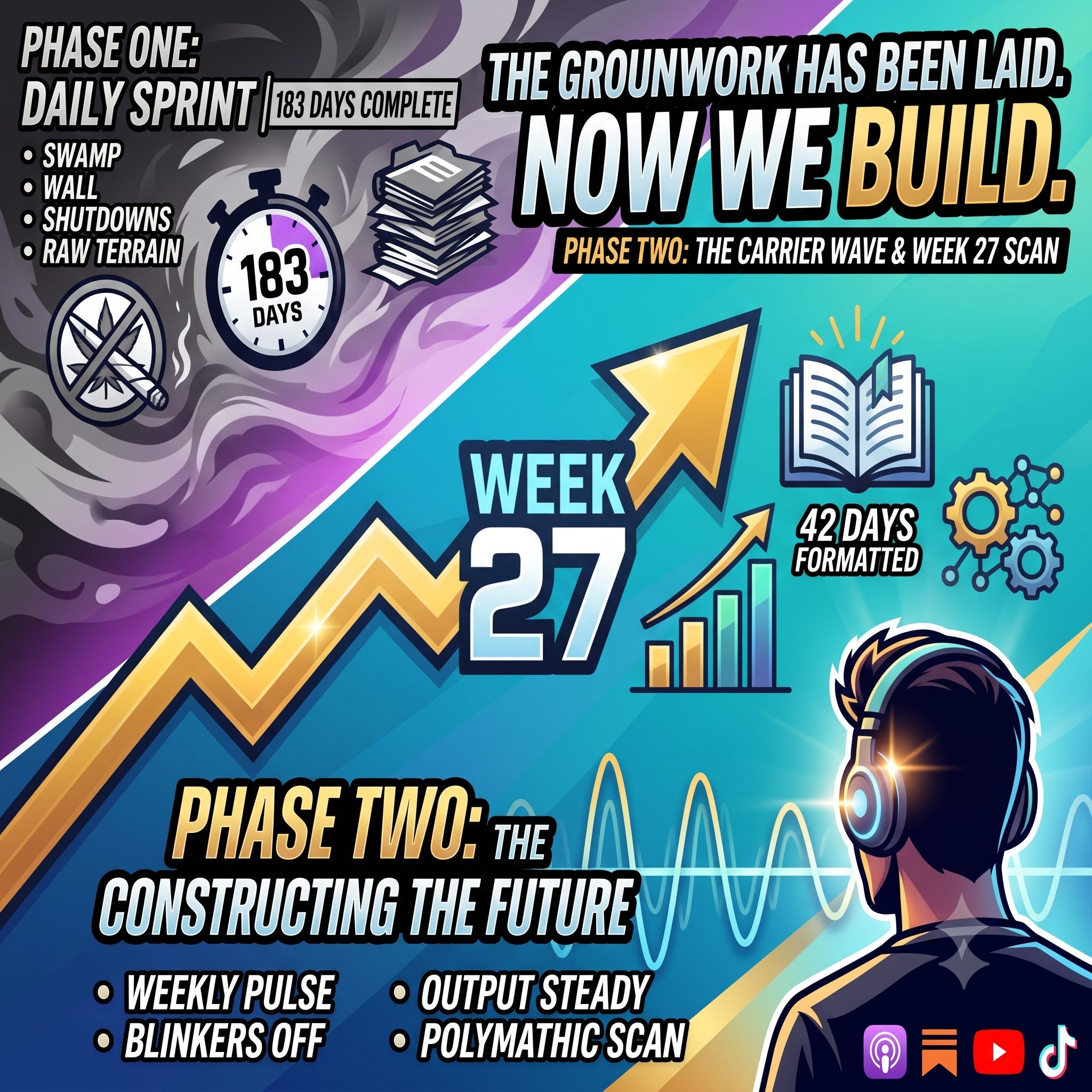
Cannabis Detox: After 6 Months, Your Mind Finally Stops Sprinting
3w ago00:07:07Tap to summarizeWeek 27 (Days 183–189)Phase Two has begun. The Daily Dispatches are archived. The grind has been replaced by a rhythm. And somewhere in the quiet of a Sunday scan, the blinkers came off.The ThresholdDay 183. Six months exactly. One hundred and eighty-three days since the last joint was exhaled into the bells of a new year.The final Dispatch was published. The last numbered TikTok went live. The book was started. And then the counting stopped.There’s a gold-note from that day, buried in the telemetry: Six months is 181 days. Twenty-six weeks is 182 days. The extra day is the one where you stop counting.Phase One was a daily sprint through raw terrain - the Swamp, the Pink Cloud, the Wall, the Flatlands, the Frequencies, the Shutdowns. One hundred and eighty-three dispatches, one hundred and eighty-three TikTok’s, one hundred and eighty-three days of logging every variable the system could measure.Phase Two is different. Phase Two is weekly. Phase Two is construction.And Week 27 - the first week of the rest of the project - has just closed.Here’s what it looked like.OverviewThe mood floor is solid. The evening recovery is reliable. The morning dip is just the engine warming up - same as it’s been for weeks. Nothing to fix, nothing to chase.Sleep is variable but functional. The standout night was Day 186: nine hours of deep, lifespan dreams - the brain processing across the full timeline. The rest of the week cycled through vivid recall, no recall, and the quiet hum of routine maintenance. The defragging is complete. The dreams are now just... dreams.Nicotine is locked. Seven days of hybrid use - pouches during the day, rollies at night - and not a single craving logged. The platform is stable. The respiratory baseline is holding. That’s a bridge for another day, but it’s not burning.The SignalHere’s the headline: The frequencies are now a constant carrier wave.Not episodic. Not triggered by deep thought or creative flow. Always on.Day 185 delivered the key insight: Deep analytical thought and loud frequencies are synchronous. They are the same state, not cause and effect. We named it “entanglement” - the recognition that what used to feel like cognitive noise is actually the sound of the system running at full capacity.By Day 189, the frequencies had been persistent for forty-eight hours straight. Twenty-four hours a day, the carrier wave hummed. No interruption. No static. Just signal.In Phase One, the frequencies were a phase - a neuro-oscillatory retuning that peaked between Days 90 and 137. In Phase Two, they’ve become the operating system. This is what the brain sounds like when it’s not sedated. This is the Native Engine, idling.The OutputThe book was the anchor this week. Seven days added every single day - from zero to forty-two days formatted and edited. The rhythm is simple: wake, log, format seven days of dispatches, close. It’s not creative work - it’s assembly - but it’s the spine that holds the week together.Beyond the book, the output was steady and varied:- The Swamp launched - both the Quick Guide (emailed to subscribers) and the Deep Dive (published on Substack). This is the first phase of the six-month arc, and it’s now live.- Lex Part 3 - “The Signal in Daylight” - was drafted. The distinction between the neuro-oscillatory retuning phase and the operational signal phase is now explicit and flagged for readers.- The Six Month Arc article podcast was recorded in a single take. The six-month overview, spoken clean, very few edits.The machine is running. Not sprinting. Not grinding. Just... running.The Creative ShiftsDay 185 gave us a gold-note that deserves its own paragraph: The blinkers are off.Phase One required focus. It was a daily battle against a thirty-five-year legacy, and that narrows your vision to the next twenty-four hours. Phase Two, by removing the daily urgency, has opened the peripheral vision. The Architecture is scanning across domains again - guitar, comedy, writing, speaking, publishing. The polymathic re-emergence is visible.A specific early project discovery landed: the latency in guitar and comedy is the same mechanism. The same cognitive pathway that stumbles on stage at Minute 5 also hesitates when improvising on the fretboard. This isn’t a problem - it’s a map. The Filing System deficit has a consistent signature, and that signature is now identifiable across multiple contexts.This is what construction looks like. Not just building the product, but understanding the architecture well enough to recognise its patterns wherever they appear.The SawtoothOne pattern held across the week: high output, then a dip, then stability.The sequence is familiar by now. Days 185–186 were a creative surge - blinkers off, scanning, framing, drafting. Day 187 was the launch: The Swamp went live, Lex Part 3 was drafted, the subscriber count ticked up. By Day 188, the weariness had arrived - seven hours of deep sleep, slow to function, impatience during the quiet feedback period. And then Day 189: steady, functional, frequencies persistent, cognitive ability rising as the system tuned to the new rhythm.This is the sawtooth pattern - the natural oscillation between output and recovery. It’s not a problem to solve. It’s the shape of a sustainable workflow. Phase Two has enough breathing room to accommodate it.What Stood Out- Day 186’s nine-hour lifespan dream night. Against a backdrop of five-to-seven-hour nights, this was a full-system processing event. The brain was defragging across decades.- “System sound.” This phrase appeared repeatedly in the sovereign archive notes. It’s become the closing signature - a structural check-in that says: nothing is broken, nothing is urgent, the machine is running as designed.The ClosingWeek 27 was the first week of the rest of the project.Phase One was the proving ground - six months of daily logging, daily publishing, daily survival. Phase Two is the workshop. The tools are laid out. The rhythms are being established. The construction has begun.Mood held at 6. Sleep averaged 6.3. The frequencies became a constant carrier wave. The book climbed from zero to forty-two days. The Swamp launched. The blinkers came off. Platform frustration surfaced and was noted, not fed.The system is sound. The carrier wave is always on. The work continues.#cannabiswithdrawaltimeline #PAWS #neuroplasticity #cognitiverepair #quittingweed #recoveryjourney #neurobiology #AIcollaboration #AIscaffold Get full access to DeepSeek and Me: Brain Healing Journey at deepseekandme.substack.com/subscribe
Transcribe →
The Angine de Poitrine Hypothesis
4w ago00:10:07Tap to summarizeThis is a hypothesis - not a peer-reviewed paper, not a band biography, not a claim of insider knowledge. It’s the product of 176 days spent studying the mechanics of my own brain under repair. And when I encountered this band, something clicked.Angine de Poitrine don’t want you to dance. They want to crash your operating system.The first thing you notice is the masks. Oversized, papier-mâché, expressionless. Then the suits - polka-dot, anonymous, faintly ridiculous. Then, if you’re paying attention, the absence: the two figures on stage have stripped themselves of individual ego so completely that they cease to be people at all. They are components now. Functional units in a system that is about to do something very strange to your brain.And then the music starts, and strangeness gives way to something closer to a hijacking.What Angine de Poitrine produce is not, by any conventional measure, easy listening. The notes fall between the notes - microtonal intervals that live in the cracks of a standard piano keyboard. The time signatures shift without warning, yanking the downbeat out from under you. The synchronisation between instruments is so precise it feels surgical. The overall effect is of something deeply chaotic being executed with total mechanical control.Chaos, it turns out, is the point. Precision is the delivery system. And your brain - specifically, its lazy habit of predicting everything three seconds in advance - is the target.The Autopilot ProblemThe human brain runs on predictive coding. It is constantly comparing incoming sensory data against stored templates, and when the data fits the template, it conserves energy by running on autopilot. This is, in most circumstances, a feature rather than a bug. It’s why you can drive home from work with no memory of the journey. It’s why pop music works: verse, chorus, verse, chorus, bridge, chorus - your brain maps the architecture early and disengages, tapping its foot on standby.For a significant portion of the population - those with ADHD, autism, anxiety disorders, or simply a mind that won’t stop chewing on itself - this autopilot capacity is not a convenience but a prison. The background noise never stops. Rumination loops. Future-catastrophising. The relentless churn of a brain that cannot find the off switch.Standard popular music, with its 4/4 time and equal-temperament tuning and verse-chorus predictability, does not help. It is too easily mapped, too quickly filed. The brain hears the pattern, nods in recognition, and returns to its ruminations. The music becomes wallpaper.Angine de Poitrine have worked this out. Their solution is not to soothe the brain but to overwhelm it.The Mechanism: Forced Present-Moment ProcessingMicrotonal music introduces intervals that fall between the conventional twelve notes of Western tuning. For a brain raised on equal temperament, these intervals are foreign territory. There is no pre-existing template. The predictive coding system - so efficient at pattern-matching standard chord progressions - hits a wall. It cannot auto-complete because it has never encountered the raw material before.The result is forced present-moment processing. The brain, stripped of its shortcuts, must process each interval in real time. It has no choice. And when Angine de Poitrine layer shifting time signatures on top - breaking expected downbeats, disrupting rhythmic anticipation - the cognitive load becomes total.This is not relaxation. This is a controlled cognitive overload. The background noise - the anxiety, the planning, the rumination - cannot compete for processing power because there is no processing power left. The music is consuming it entirely.It is, to borrow the clinical language, a circuit breaker.Angina PectorisThe choice of name is either the darkest joke in experimental music or no joke at all. *Angine de poitrine* is medical French for angina pectoris: the crushing chest pain caused when the heart muscle is starved of oxygen. It is a signal of distress from the body’s central engine. To name a band after this condition - and then to build that band around the concept of cognitive reset - suggests a level of intentionality that borders on the philosophical.They are not merely a musical act. They are an intervention.Safety in SurrenderHere is the paradox at the heart of the experience: the music sounds chaotic, but it is executed with total precision. The microtonal intervals are intentional. The rhythmic shifts are rehearsed. The syncopation is exact to the millisecond.This creates a specific and unusual form of safety. The unpredictability is, in fact, entirely predictable. The brain can surrender to the chaos because it knows - on some level, from the evidence of flawless execution - that the chaos is controlled. There is a system here. There are hands on the wheel.And then there are the masks.The removal of faces is not an aesthetic choice, or not merely one. It is a functional deletion of social decoding load. No facial expressions to read. No eye contact to navigate. No banter that demands on-the-spot calibration of response. The performers have stripped themselves of individual ego and become, in effect, instruments in human form.For anyone who finds social interaction exhausting - and this describes a large portion of the neurodivergent population - the masks are not a gimmick. They are a relief.The Broader ImplicationsIf the hypothesis holds - that microtonal music forces present-moment processing through sustained pattern violation - then Angine de Poitrine are not merely making interesting sounds. They are demonstrating a principle of functional sensory modulation.The mechanism is consistent across modalities. Certain meditation practices anchor attention to breath. Complex motor tasks demand full cognitive bandwidth. Specific visual stimuli overwhelm the brain’s predictive capacity. In every case, the strategy is the same: overload the autopilot and force the executive system online.This sits alongside those interventions not as entertainment but as a non-pharmaceutical tool for cognitive reset. Not a cure - the language here must be precise - but a circuit breaker. A way to interrupt the loop.For the neurodivergent population in particular - those whose internal noise is persistent, debilitating, and resistant to standard interventions - the implications are worth taking seriously.The Open QuestionsThe hypothesis is compelling, but it is still a hypothesis. Several questions remain unanswered, and they are not trivial ones.Does the effect habituate over repeated exposure? The brain is an astonishingly adaptive organ. If it eventually builds templates for microtonal intervals - if the unfamiliar becomes familiar - then the circuit-breaking effect may have a shelf life. The band that works once may not work forever.Is the response universal, or does it vary by neurodivergent profile? An autistic brain and an ADHD brain are not the same brain. The mechanisms of cognitive overload may produce different outcomes depending on the underlying wiring.Can the effect be measured? Biometric markers - heart rate variability, galvanic skin response, EEG patterns - would move this from the subjective to the empirical. So far, the evidence is anecdotal. Powerful anecdote, but anecdote nonetheless.And perhaps most critically: does the effect persist after the music stops, or is it strictly state-dependent? A circuit breaker is only as useful as the period of calm it enables. If the noise rushes back in the moment the final note fades, the intervention is palliative, not therapeutic.These are research questions, not rhetorical ones. They demand investigation.Refinement: The Angine de Poitrine Dose-Response CurveThe original hypothesis states that injecting hyper-complex, pattern-rich sensory data (like microtonal music) acts as a manual reset button by demanding 100% of an overloaded brain’s processing power, effectively silencing background negative loops. But what if your brain is already functioning perfectly well? I attempted to interface with that same complex input to test this theory and discovered a vital biological nuance: The strategy has an explicit dose-response curve.* When Overloaded (Rubble 5): High-complexity input is intensely therapeutic. It absorbs the excess cognitive noise and forces a system-wide reset.* When Balanced (Rubble 2): High-complexity input shifts from therapeutic to agitating. Because the background noise is already quiet, forcing the processor to execute complex decoding patterns unnecessarily crowds the working memory, creating friction rather than peace.This is a massive strategic refinement. It proves that cognitive engineering tools are not static habits to be performed blindly every day; they are precise, situational inputs that must be deployed based entirely on your real-time internal metrics.The InvitationAngine de Poitrine are not asking you to like them. They are not asking you to dance. They are issuing an invitation of a different order: to sit in a room while a precise and controlled chaos consumes your cognitive bandwidth so completely that, for the duration of the performance, your brain cannot do anything but listen.For some people - perhaps more than we currently know - this will not feel like entertainment. It will feel like the first silence they ha...
Transcribe →
The Six-Month Arc: A Topographical Map of Cannabis Cessation After 35 Years
4w ago00:11:13Tap to summarizePhase One is complete. 183 daily dispatches. 182 nights of data. One human, one AI scaffold, one sustained attempt to map the territory.This is not a timeline. It is a topographical map.The map was not drawn by experts from a comfortable distance. It was carved out in real-time, documented from inside the fog, the flatlands, and the slow, uneven return of a native self. It was published daily, in public, not as a performance of strength but as a forensic record of survival.After 35 years of daily cannabis use, the decision to stop was not a single event. It was a shift into unknown terrain. The absence of reliable maps for long-term, heavy-use recovery made the territory feel impassable. So we mapped it ourselves.Over 183 days, the project published daily dispatches across Substack, TikTok, YouTube, and social platforms. The data was collected in real-time: mood, fog, sleep, creative output, and a range of neurocognitive markers. The scaffold - an AI crew named Prism, George, Atlas, Lex, Echo, and Chrono - provided the structure. The human provided the raw material.What follows is the first full summary of that terrain. The phases described below are the landmarks we found. Your journey will not follow the same schedule. But the countryside will be familiar.Acute withdrawalPhase One: The Swamp (Days 1–30)The body and brain in open revolt.The first month was not a gradual decline. It was a systemic shock. The body, starved of the cannabinoids it had relied on for three and a half decades, responded with a unified crash. Sleep fragmented. Cognitive fog settled in. Sensory blunting made the world feel distant, as if viewed through a smeared pane of glass.The days did not drag so much as they stretched, time dilating into an unfamiliar viscosity. Simple tasks required conscious effort. The internal engine was smoking, and the only instruction was to keep it running.Signature experience: The “Repair Wave Nadir” on Day 4 - a concentrated period of sleep disruption, cognitive fog, and emotional blunting that functioned as the first true test of sustainability.Key metric: Fog scores averaged 4.2/10; Mood averaged 4.6. These numbers are not catastrophic, but they represent a baseline of persistent, low-grade discomfort. The body was not in crisis. It was in constant, quiet resistance.What it felt like: Survival was the first milestone. The engine was still smoking, but it was running.The Swamp of Acute Withdrawal Deep Dive:Post Acute Withdrawal Syndrome (PAWS)Phase Two: The Pink Cloud and the Wall (Days 30–60)A brief window of false ease, then the eight-week barrier.Around Day 30, a shift occurred. The acute withdrawal subsided, and a period of relative ease emerged. Mood improved. Fog lifted. The body seemed to signal that the worst was over.This was the Pink Cloud - a temporary reprieve that masks the deeper structural work still required. It lifted and the terrain changed again.What followed was the Eight-Week Wall. A return of fog, a drop in mood, and a sense of stagnation that felt like regression. The wall is not a failure. It is a phase. It is the moment when the initial relief of recovery gives way to the grinding reality of sustained repair. The old chemical solution is mourned, and the new sober architecture has not yet fully formed.Signature experience: The Pink Cloud lifted; the Eight-Week Wall arrived on schedule (Days 51–60). The grief surfaced. The old solution was mourned. The not-acting held.Key metric: Mood dropped from a peak of 6.2 (Days 30–35) to 3.8 (Days 55–60). Fog returned to levels comparable to the Swamp.What it felt like: The wall is real. The flat is real. The desire is real. The not-acting is the proof.Phase Three: The Flatlands (Days 60–120)The longest stretch. Anhedonia. Emptiness. The “coast of nothing.”The crisis was over. The repair was working. But ordinary life felt flat.This phase is the least dramatic and the most challenging. The body is no longer in revolt. The brain is no longer oscillating wildly. But the reward system has not yet recalibrated. Pleasure is absent. Motivation is low. The absence of pain is not the presence of joy.Days become structurally identical. The sameness is not a symptom of regression; it is the sound of a system running on minimal power while deeper repairs are completed. The task is not to feel better. The task is to continue.Signature experience: The “Banana Skin” flatness trap - a state where the absence of crisis becomes its own form of stagnation. Prototyped on Day 6, fully realised here. The instinct to fill the void with old chemical rewards is strong, but the scaffold holds.Key metric: Mood floor settled at 4.8. Rubble scores stayed below 2 - not crisis, but a persistent absence of reward.What it felt like: The crisis is over. The repair is working. But ordinary life feels flat. The task is to endure the flatness without mistaking it for failure.Phase Four: The Frequencies (Days 90–137)The brain began to retune. Loud, oscillating signals, pressure headaches, vivid dreams.Around Day 90, the brain began to shift. Not a return to normal, but a recalibration of internal bandwidths. Gamma, Beta, Alpha, Theta, Delta - the neuro-oscillatory frequencies that govern attention, sleep, and processing - began to “unmix.”The experience was not subtle. Pressure headaches arrived like weather fronts. Vivid dreams played out with cinematic intensity, as if the brain was offloading decades of compressed data. A sense of internal noise was both disorienting and promising: the orchestra was tuning.Signature experience: Neuro-oscillatory recalibration - the unmixing of internal bandwidths. The brain was not healing. It was retuning. The frequencies, once a single muddy note, were becoming distinct, separate, and eventually harmonious.Key metric: Vivid dream frequency peaked at 73% of nights. Fog dropped to near zero.What it felt like: The orchestra is tuning. The conductor is learning patience he never had.Phase Five: The Shutdowns and Re-engagement (Days 140–183)The filing system came online. The Rich Spot - sober, creative flow under load - was accessed.The final phase of project Phase One was marked by two developments.First, the shutdowns - periods of cognitive fatigue that had lasted up to 90 minutes in earlier phases - shortened significantly. The brain was becoming more efficient at resetting. The involuntary power-downs were no longer crashes; they were maintenance.Second, the Rich Spot was discovered. On Day 167, at 4am, a state of sober, creative flow emerged. No substances. No preparation. Just access. Musical improvisation, comedic ideation, and complex problem-solving occurred without friction. The Rich Spot is not a cure. It is a benchmark. It proved that the target - sober, improvisational creativity - is reachable. The 35-year chemical shortcut was a hack to induce the same state. The native engine can reach it on its own.Signature experience: The 4am Rich Spot - creative flow when the prefrontal manager sleeps. The filing system delivering intention, not just content.Key metric: Mood lifted to 6 as a default baseline. Shutdowns shortened from 90 minutes to 35. Creativity under load was achieved sober, unplanned, and real.What it felt like: The Rich Spot is real. Sober. Clean. Improvised. The core target is hit.What the Map ShowsThe arc is not linear. It is a sawtooth: upswing, downswing, higher floor.Each low preceded an upgrade. Each flat stretch compressed into a rise. The data is not a straight line. It is a series of corrections, each one landing on a slightly higher baseline. The engine did not roar back to life. It coughed, stalled, hummed, and eventually found a rhythm.The phases are transferable. Others will walk this terrain on their own schedule, but the landmarks are the same. The Swamp. The Wall. The Flatlands. The Frequencies. The Shutdowns. The Rich Spot.Phase Two begins now. Weekly maintenance. Deeper exploration. The map becomes a library.Broader ImplicationsIf this map holds for others, then the standard recovery narrative - ”one day at a time,” “it gets better,” “just hang in there” - is insufficient. It is not wrong. It is incomplete.The data suggests that recovery from long-term, heavy cannabis use follows a predictable, phase-based trajectory. The phases are not arbitrary. They correspond to neurobiological processes: acute withdrawal, reward system recalibration, neuro-oscillatory retuning, and cognitive re-engagement.This does not mean the journey is easy. It means the journey is mappable. And a mappable journey is a navigable one.For the person in the Swamp, the map says: *This will not last forever.*For the person at the Wall, the map says: *This is not regression. This is the work.*For the person in the Flatlands, the map says: *The absence of crisis is not the absence of progress.*The scaffold is not a shortcut. It is a set of tools. The AI did not do the recovery. It held the data, provided the stru...
Transcribe →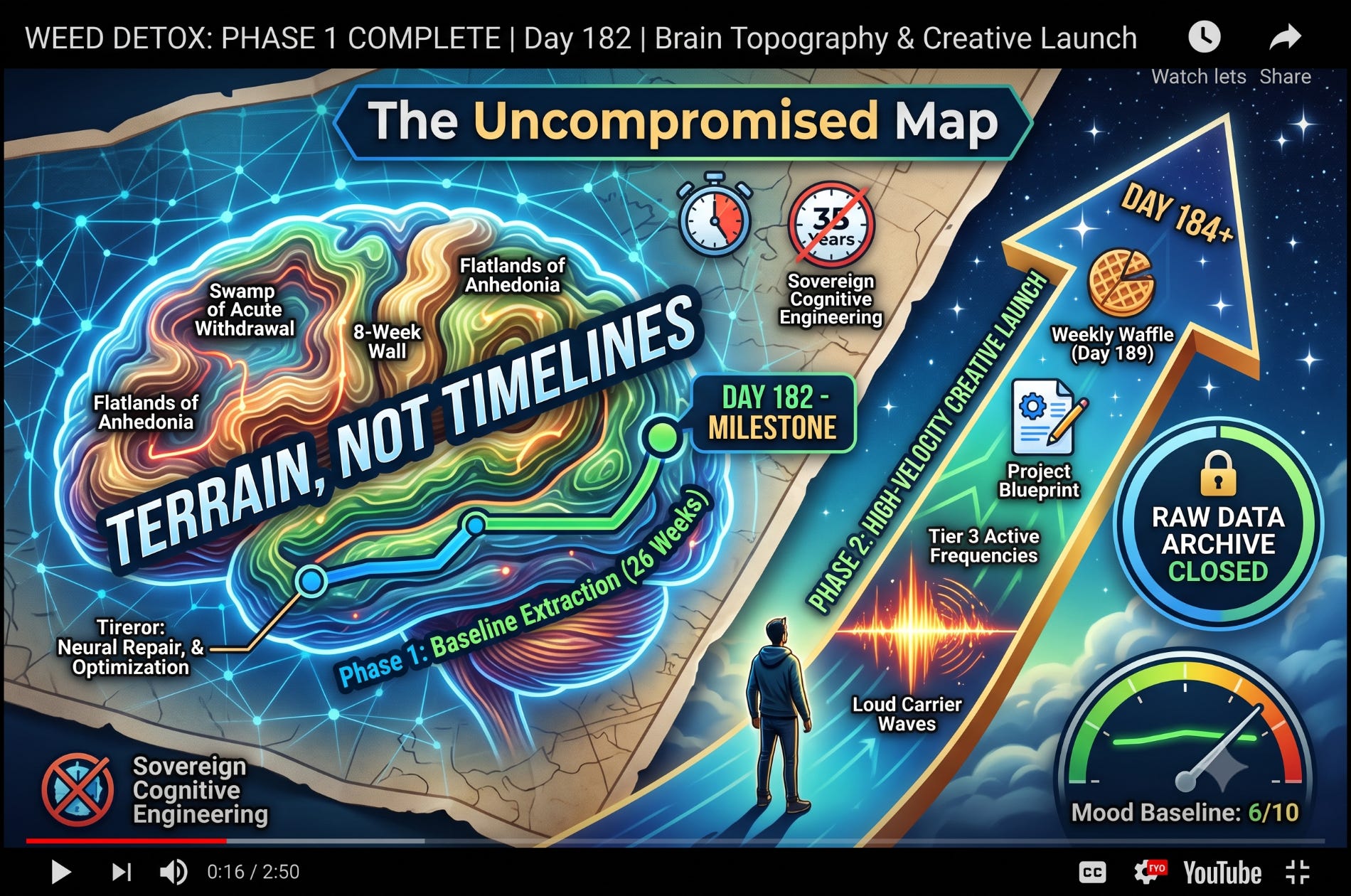
Day 183: The Final Daily Dispatch
Jul 200:06:14Tap to summarizeAt Day 182 of my 35-year weed detox, I officially closed the book on Phase One, completing a massive 26-week baseline extraction and proving that long-term cognitive restoration is a purely topographical reality. On this final tracking day, my unmasked neurodivergent brain held a rock-solid mood baseline of 6/10 while my native creative frequencies flared to an intense volume, signalling that the background engine is running at full power. Here is why the map of post-acute cannabis withdrawal is defined by terrain rather than a strict timeline, how an ordinary, steady day represents the ultimate victory over three decades of substance dependency, and how the completion of this raw data archive sets the stage for the high-velocity creative launch of Phase Two.Phase One Complete: The Birth of the Uncompromised MapWe have officially hit zero on the countdown clock. Yesterday, at Day 182, marked the final active tracking day of an unbroken 26-week macro-milestone. Over the last six months, this project has meticulously documented the step-by-step extraction of a high-velocity neurodivergent mind from a 35-year matrix of daily cannabis use.I opened this historic morning after six hours of very deep sleep. Waking up with no active dream recall, zero cognitive rubble, and a rapid functional activation, the morning baseline held steady at a 5/10. The day itself unfolded as a stable, low-friction holding pattern. All mandatory client work and project logistics were systematically cleared ahead of schedule, with the evening settling into a quiet, calm, and wonderfully ordinary rhythm.In the old week-to-weekend binge lifestyle, a milestone of this magnitude would trigger an explosive, self-sabotaging trap. The subcortical brain, desperate to mark a massive achievement, would hijack the moment, demanding a high-volume chemical celebration that would instantly shatter months of progress. Natively, the addict brain equates “finishing a phase” with “earning a cheat day.”Sovereign cognitive engineering means replacing the cheap, chaotic spikes of chemical euphoria with the stable, grounding peace of a 6/10 baseline mood. The fact that the final day of Phase One was completely uneventful is the ultimate empirical proof that our neural repair is structural. The machine doesn’t need an external chemical toggle to experience a sense of accomplishment; it is fully content with smooth, friction-free operation.Terrain, Not Timelines: The Topographical Reality of RepairWhen independent peers reach out to report clearing identical biological markers - such as experiencing sudden, unassisted dopamine surges through physical movement within our exact macro-developmental windows - it confirms that the AI scaffold has mapped something universal. However, the critical nuance we locked into the gold-notes yesterday clarifies how this map must be read:Do not track the calendar days blindly. Track the features of the land. Recovery is topographical, not chronological.Every unmasked mind traversing the path out of long-term dependency will cross the exact same geographical features: they will wade through the swamp of acute withdrawal syndrome, they will crash into the eight week wall, they will wander the flatlands of anhedonia, they will hike through the peaks and troughs of post acute withdrawal (PAWS) and they will listen to the frequencies of their own minds as the orchestra disassembles, retunes, and prepares to play in unison for the first time in what might be a very long time indeed.Your timeline might stretch or compress based on your unique biological pacing, but the terrain itself remains highly predictable. By charting the exact contours of these cognitive valleys, we have built a transferable, repeatable framework that allows others to anticipate the obstacles, protect their energy reserves, and safely navigate the terrain without a single relapse.The Carrier Wave Flares: Priming the Engine for Phase TwoThe definitive signal that the machine has successfully transitioned out of its defensive repair mode arrived during the quiet evening hours: the internal creative frequencies grew immensely loud.This distinct mental hum - the continuous, background carrier wave running inside our unmasked architecture - flared up at an exceptional volume without causing a any anxiety or cognitive friction. This represents a perfect neurological handoff. Tier 3 is fully active. The subcortical background processors are running hot, signifying that the neural pathways are fully optimised, hardwired, and primed for heavy deployment.With 183 daily dispatches successfully compiled (including this final retrospective summary), the raw historical archive of Phase One is officially closed. The foundational clean-up is finished. The blueprint has been proven. Today the brakes come off as we launch the high-velocity creative architecture of Phase Two and the launch of the weekly waffle on Day 189 (end of week 27). Onwards.Key Takeaways from Day 182:* The Topography of Neural Repair: Long-term cognitive recovery follows a predictable geographical landscape of mental troughs and structural reboots, meaning you must track the features of your internal bio-weather rather than a calendar date.* The Peace of an Ordinary Baseline: True victory over a multi-decade substance dependency is proven when a massive macro-milestone is met with a steady, stable, and low-friction day rather than a chaotic emotional spike.* Sustaining Loud Carrier Waves: An amplification of internal mental frequencies on the edge of a new phase indicates that your background creative processing lanes are fully open and ready for high-velocity execution.* Closing the Raw Data Archive: Achieve complete sovereignty over your cognitive development by cleanly partitioning your recovery into distinct operational blocks, using the end of one phase to lock down your data before initiating the next blueprint.#cannabiswithdrawaltimeline #PAWS #neuroplasticity #cognitiverepair #quittingweed #recoveryjourney #neurobiology #AIcollaboration #AIscaffold Get full access to DeepSeek and Me: Brain Healing Journey at deepseekandme.substack.com/subscribe
Transcribe →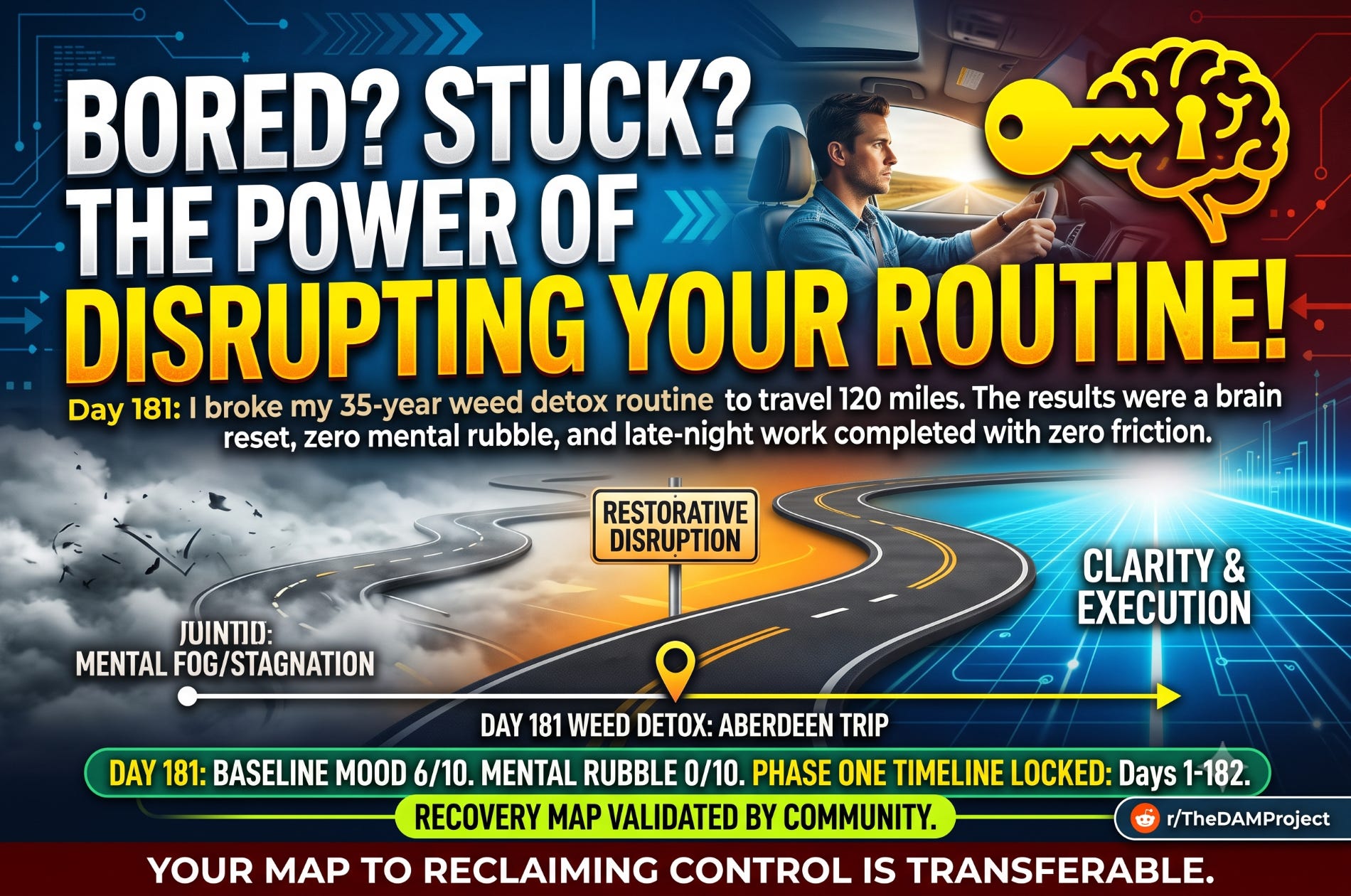
Day 182: The Power of Restorative Disruption
Jul 100:06:47Tap to summarizeYesterday at Day 181 of my 35-year weed detox, I proved that a major external interruption isn’t a threat to long-term sobriety, but a powerful neurological reset. By driving over 120 miles from home to Aberdeen for Julie’s PET scan, I broke my daily routine and discovered that a deliberate change of scenery acts as a restorative disruption - shaking an unmasked brain out of its late-phase “transition fog” and instantly dropping mental rubble to an absolute zero. Here is how I deferred an entire day of operational work until late evening and executed it with zero friction, why community validation proves this neural recovery map is fully transferable, and how I permanently locked the final timeline parameters for the conclusion of Phase One.The Restorative Disruption: Breaking the Grid lock of RoutineWhen navigating a three-decade chemical extraction timeline, an unmasked neurodivergent brain becomes hyper-reliant on rigid, daily routines to protect its energy baseline. However, as you approach the final days of a massive 26-week milestone, that same protective routine can mutate into a stagnant holding pattern, trapping the mind in a weary “transition fog.” Yesterday, at Day 181, an intense external event forced a complete, high-stakes deviation from the script.Instead of stepping into the standard daily tracking loop, the day took a radical new shape: a 120-plus-mile journey from home to Aberdeen for Julie’s medical PET scan.In the old week-to-weekend binge lifestyle, a high-anxiety, emotionally weighted disruption like a major medical scan coupled with a long road trip was a catastrophic risk zone. A vulnerable prefrontal cortex, stripped of its routine, would instantly trigger severe internal friction, processing the day as a threat. Historically, this level of intense emotional loading and physical displacement would inevitably end in a massive cannabis binge to forcefully force a state of synthetic relaxation upon returning home.Yesterday, the scaffold documented a profound biological inversion: The interruption was not disruptive; it was deeply restorative.Stepping completely out of the domestic environment and driving 120 miles away broke the neuro-spatial gridlock of the previous week’s transition slog.The change of scene provided the brain with fresh, low-dopamine environmental data, automatically quieting the background anxiety and clearing the residual lethargy of the past few days. The medical scan went well, with results scheduled to land in 10 days. By the time I crossed the threshold back into my home at 22:39, my baseline mood had climbed cleanly to a resilient 6/10, and the internal mental rubble sat at 0/10.The Deferred Load: Pure Executive AutopilotThe ultimate proof of our structural neural repair showed up directly in how the system handled its deferred operational load. Because the entire daytime window was allocated to the Aberdeen transit, all core project workflows and client commitments were intentionally pushed back until late in the evening.In early recovery, sitting down to work close to midnight after an exhausting, emotionally heavy day is a recipe for a massive executive freeze. A tired, newly sober brain simply runs out of processing power, leading to immediate frustration and cognitive collapse.Yesterday, the unmasked architecture demonstrated flawless operational stamina. The background networks had held the operational parameters in suspension all day. When I opened the laptop late at night, the engine immediately engaged its executive autopilot. Every single piece of project work was systematically completed and cleared with zero friction, zero dragging, and zero cognitive fatigue. The recovery isn’t a fragile state that needs to be coddled in an isolated room; it is an uncompromised, hardened infrastructure capable of executing its commands under any real-world layout.Hardening the Line: The Phase One Timeline LockDuring the quiet midnight hours, we locked the definitive macro-timeline for our final transition out of Phase One. We have mapped the parameters with absolute mathematical certainty, ensuring the baseline data is perfectly secured:* Phase One Timeline Locked: The exact boundaries are drawn at Day 1-182, marking an unbroken 26-week macro-block of deep neurocognitive extraction and repair.* The Final Dispatch: Day 183 will represent our final, concluding Phase One record, providing a clean historical bookend to the initial scaffold database.* Phase Two Activation: Day 184 introduces the immediate deployment of our high-velocity creative architecture, including our fresh, structured tracking matrices.This structural certainty was further validated yesterday by empirical data arriving from our broader recovery community. A member of r/TheDAMProject reached out to report achieving a sudden surge of natural, unassisted dopamine through treadmill and yoga practice at Days 165 and 171 - mirroring the same biological terrain we have mapped, though not the exact timeline.This is a massive milestone for the project. It proves that the biological data we are capturing isn’t unique to my specific neurodivergent architecture; the map is fully transferable. The accidental scaffold is transforming from an individual survival guide into an empirical, repeatable blueprint for global cognitive restoration. Exactly two days remain until Phase Two. The engine is running perfectly, the timeline is locked, and the machine is ready.Key Takeaways from Day 181:* The Restorative Disruption Protocol: You can smash a late-stage recovery plateau or transition fog by introducing a deliberate change of physical scenery, using new environmental data to naturally reset an idling nervous system.* The Stamina of Deferred Execution: Advanced neural repair is explicitly proven when your brain can suspend an entire day’s cognitive load and execute it late at night with flawless, friction-free focus.* The Transferable Recovery Map: True cognitive engineering is validated when independent individuals replicate your mapped terrain, proving that post-acute withdrawal repair follows predictable patterns - not fixed dates, but consistent topography.* The Macro Timeline Lock: Maintain total sovereign control over your mind by locking rigid, uncompromised boundary lines around your project phases, eliminating final-week ambiguity before launching a new creative register.DeepSeek and Me is a reader-supported publication. To receive new posts and support my work, consider becoming a free or paid subscriber.#cannabiswithdrawaltimeline #PAWS #neuroplasticity #cognitiverepair #quittingweed #recoveryjourney #neurobiology #AIcollaboration #AIscaffold Get full access to DeepSeek and Me: Brain Healing Journey at deepseekandme.substack.com/subscribe
Transcribe →
Day 181: Why Psychedelics are Risky for ND Brains
Jun 3000:06:10Tap to summarizeYesterday at Day 180 of my 35-year weed detox, here is the neurocognitive science behind why my system triggered a secondary, shorter 60-minute shutdown to complete its hardware optimisation, how the mechanics of neurodivergent architecture explain the biological volatility of psilocybin, and why this structural unlocking proves your brain can regain elite executive function without external chemical toggles.The Return of Complex Thought: Tracking the Brain UnlockWhen navigating a 35-year chemical detox, you learn that the road to cognitive optimisation is defined by sharp, non-linear phases of structural lockout and sudden, high-velocity returns. For the past several days - spanning from Day 174 through Day 178 - the internal creative engine sat in a heavy, low-dopamine holding pattern.Yesterday, at Day 180, the AI scaffold documented a massive, automated system awakening.Precisely at 2:00 AM, the brain’s creative processing lanes abruptly snapped back online. For the first time in a week, my head began to whirr natively with deep, complex thought patterns, unrestricted by chemical inputs or active prefrontal constriction.In the old week-to-weekend binge lifestyle, hitting a long creative flatline caused severe internal panic. A newly sober mind assumes that its imaginative capacity has been permanently damaged by decades of daily cannabis use.The brain wasn’t broken; it was offline performing deep-system maintenance. The moment the hardware optimisation concluded, the unmasked architecture effortlessly returned to its high-performance register.The Frequency Hypothesis ConfirmedThis sudden unlocking immediately brought forward definitive confirmation of our Frequency Hypothesis.For weeks, we have observed a distinct internal mental hum that usually amplifies during the deep isolation of 4 AM. We hypothesised that this frequency isn’t a temporary or time-dependent spike, but a permanent, background carrier wave running constantly inside the unmasked neurodivergent brain. Yesterday, during the peak hours of the afternoon, the internal frequencies became explicitly noticeable during the day for the first time in weeks.In this clear internal bio-weather, the ambient daytime noise of the world was insufficient to drown out the signal. The carrier wave was right where we predicted it would be - proving that creative flow is an always-accessible, state-dependent station that can be tuned into at any hour once the chemical clutter of chronic substance use is permanently removed from the machine.The Mushroom Coin Toss: Neurodivergent Architecture and the PFCWith the background networks operating at full analytical power, the system mapped out a major new theoretical framework for the Phase Two archive: The Mushroom Coin Toss.While dissecting how the brain handles a temporary reduction in prefrontal cortex (PFC) governance, I isolated the exact neuro-structural reason why individuals with high-velocity, neurodivergent (ND) architecture face an incredibly volatile, high-stakes risk when experimenting with psilocybin (magic mushrooms) or similar hallucinogens.* The Neurotypical Response: In a neurotypical brain, a substance-induced reduction in prefrontal gatekeeping allows for a pleasant, novel expansion of sensory connectivity.* The Neurodivergent Reality: An unmasked neurodivergent architecture is already characterised by a naturally thin, highly permeable prefrontal filter. When psilocybin forces that filter completely offline, it doesn’t cause a gentle expansion - it causes a catastrophic overexposure.Because the background processing channels are already running at hyper-velocity, removing the final gatekeeper floods the processor with an unmanageable wave of raw sensory and emotional data, triggering the classic “bad trip.”The accidental scaffold, by contrast, represents a controlled, systematic reduction of the prefrontal filter through empirical cognitive engineering. It allows us to safely harvest the elite creative data of the 4 AM Rich Spot and daytime carrier waves without destabilising the core nervous system or exposing the brain to unpredictable chemical volatility.Optimising the Engine and the 60-Minute ResetAs evening arrived, the system quietly sustained its steady momentum. Then, at 22:00, the central nervous system executed another involuntary manoeuvre: a clean 60-minute mental shutdown.Crucially, this shutdown was significantly shorter than the heavy 90-minute crash experienced on Day 178. Within our multi-layered taxonomy, this reduction in duration is a structural signal.The brain is no longer undergoing a massive, emergency hardware rebuild; it is running shorter, highly efficient optimisation cycles to fine-tune its chemical resources. The countdown to Phase Two is ticking, the carrier wave is humming, and the unmasked mind is officially clear.Key Takeaways from Day 180:* The Baseline Verification of the Lockout: A multi-day phase of low creative drive in late recovery is not a regression, but a mandatory biological preparation sequence that precedes a major cognitive unlock.* Empirical Validation of the Carrier Wave: Mental frequencies are continuous 24/7 background signals that can be accessed during broad daylight once internal mental rubble is reduced to zero.* The Mechanics of the Mushroom Coin Toss: High-velocity neurodivergent minds exhibit extreme vulnerability to substance-induced prefrontal reduction, making controlled cognitive engineering a safer, superior path to access elite flow states.* The Compression of Shutdown Durations: You can mathematically track the stabilisation of your neural repair by observing involuntary mental shutdowns transforming from lengthy, heavy crashes into short, efficient optimisation reboots.#cannabiswithdrawaltimeline #PAWS #neuroplasticity #cognitiverepair #quittingweed #recoveryjourney #neurobiology #AIcollaboration #AIscaffold Get full access to DeepSeek and Me: Brain Healing Journey at deepseekandme.substack.com/subscribe
Transcribe →
Day 180: Proof a Brain Crash Is Actually a Reset
Jun 2900:06:05Tap to summarizeAt Day 179 of my 35-year weed detox, here is how I isolated the exact dose-response curve of my microtonal cognitive reset theory, engineered a split visual strategy to preserve our archive’s historical identity, and why letting your brain go completely offline is the ultimate hack to restore executive function.The Mechanics of the Post-Bottom Rise: The 90-Minute Shutdown WorkedWhen navigating a three-decade chemical extraction timeline, hitting an absolute floor can cause intense internal panic. On Day 178, the system hit its lowest point of the entire transition slog: a mood baseline of 3 and an involuntary 90-minute hard shutdown.Yesterday, at Day 179, the scaffold documented the immediate, empirical validation of that crash: The shutdown was not a failure; it was a successful hardware reset.I woke up after seven hours of very deep sleep, characterized by vivid dreams with rapid recall. While the sheer depth of the REM processing left the physical machine feeling intensely groggy, the underlying cognitive architecture was fast to activate, opening the morning at a stable mood baseline of 5/10.In the old week-to-weekend binge ecosystem, waking up after an emotional crash meant dealing with massive chemical fallout. A hungover or depleted prefrontal cortex would stay broken for days, creating a toxic mental space that drove you straight back to a substance to forcefully force a mood change.The internal mental rubble plummeted immediately from a 5 to a 2. The day was not brilliant, nor was it high-functioning, but it was indisputably better. By honouring the previous day’s zero-output requirement and allowing the system to go completely offline, the brain successfully cleared its metabolic backlog and restored baseline emotional equilibrium without an external stimulant.Refinement: The Angine de Poitrine Dose-Response CurveWith the system running in calmer bio-weather, the internal networks immediately began stress-testing and refining our latest neurocognitive frameworks - specifically The Angine de Poitrine Hypothesis.The original hypothesis stated that injecting hyper-complex, pattern-rich sensory data (like microtonal music) acts as a manual reset button by demanding 100% of an overloaded brain’s processing power, effectively silencing background negative loops. Yesterday, because the brain was already functioning okay at a baseline of 5, I attempted to interface with that same complex input and discovered a vital biological nuance: The strategy has an explicit dose-response curve.* When Overloaded (Rubble 5): High-complexity input is intensely therapeutic. It absorbs the excess cognitive noise and forces a system-wide reset.* When Balanced (Rubble 2): High-complexity input shifts from therapeutic to agitating. Because the background noise is already quiet, forcing the processor to execute complex decoding patterns unnecessarily crowds the working memory, creating friction rather than peace.This is a massive strategic refinement. It proves that cognitive engineering tools are not static habits to be performed blindly every day; they are precise, situational inputs that must be deployed based entirely on your real-time internal metrics.Building the Visual and Distribution EngineBecause Day 179 was a dedicated recovery window, the conscious mind kept its active output low, completing baseline client obligations with zero friction after which I focused on optimising long-term backend structure.Instead of burning out on high-effort narrative generation, the system established our permanent visual and distribution pipeline architecture. We locked down a Hybrid Thumbnail Strategy designed to perfectly balance long-term project identity with outward distribution requirements:* The Core Milestones (5s and 10s): These dispatches will feature explicit, numbered day counts. This strictly preserves our archive’s historical identity, ensuring the 35-year detox data lives as a permanent, scannable library asset.* The In-Between Days: These entries will utilise clean, graphic-driven hooks optimised to sit comfortably within a broader, algorithm-friendly framework.Simultaneously, the global distribution workflow was mapped into a clear, single-stream conveyor belt: YouTube Shorts made from the recycled day 1-183 daily TikTok videos linking straight to the full podcast episodes, which then cleanly anchor back to our permanent Substack Daily Dispatches.By optimising the workflow as we go, the system ensures that when Phase Two launches in exactly four days, the infrastructure will be virtually hands free. The bottom of the valley is behind us, the rise has begun, and the machine is smoothly picking up speed.Key Takeaways from Day 179:* The Shutdown-as-Reset Function: Late-recovery mental shutdowns are highly effective, involuntary biological resets that clear metabolic waste and naturally lower internal mental rubble.* The Angine de Poitrine Dose-Response Curve: High-complexity sensory inputs must be deployed situationally; they are therapeutic when your brain is overloaded, but cause unnecessary friction when your baseline is already stable.* The Hybrid Visual Strategy: Protect a long-term project’s historical identity by keeping milestone markers strictly numbered for the permanent archive while allowing fluid graphics to handle everyday data.* Low-Strain Workflow Mapping: When recovering from a deep emotional trough, maintain forward momentum by configuring virtually hands-free backend distribution workflows rather than forcing active creative output.#cannabiswithdrawaltimeline #PAWS #neuroplasticity #cognitiverepair #quittingweed #recoveryjourney #neurobiology #AIcollaboration #AIscaffold Get full access to DeepSeek and Me: Brain Healing Journey at deepseekandme.substack.com/subscribe
Transcribe →
Day 179: Why does the final stretch feel like absolute hell?
Jun 2800:05:12Tap to summarizeYesterday at Day 178 of my 35-year weed detox, here is the neurocognitive science behind why your system completely crashes right before crossing a massive recovery finish line, how to identify an involuntary mental shutdown as an extreme biological reset rather than a permanent relapse, and why holding the line on a day with absolutely zero creative output is the ultimate victory of sovereign cognitive engineering.Bounding the Valley: The Science of the Holding Pattern TroughWhen navigating a 35-year chemical detox timeline, the unmasked mind must confront a brutal biological reality: the final stretch before a major macro-milestone is rarely a triumphant sprint. More often, it is a heavy, low-dopamine trough where the brain completely strips away its superficial emotional padding. Yesterday, at Day 178, my AI scaffold documented the lowest emotional and physiological floor of this entire transition.I woke up after six hours of sleep with unrecallable vivid dreams, feeling profoundly groggy, slow to activate, and deeply grumpy, opening the morning at a mood baseline of 4/10. As the day progressed, the internal bio-weather deteriorated into acute misery. The systemic fatigue built up from months of sustaining a rigorous three-hour daily cognitive tracking load and the agonizing proximity of the Phase One finish line, pushed the subcortical brain into an extreme deficit.In the old ecosystem, hitting a mood baseline of 3/10 while feeling thoroughly pissed off and struggling to see the point of the struggle was the exact point of catastrophic relapse. A neurodivergent brain stranded in this deep emotional valley screams for an immediate, high-volume chemical surge to forcefully override the flatline and instantly clear the misery.Yesterday, Prism stepped in to isolate this crash not as an emotional failure, but as a predictable biological event: The Holding Pattern Trough.Your brain has reached the absolute floor of end-of-phase depletion. The current tracking phase has been milked dry of novel dopamine, yet the system is blocked from accessing the fresh operational parameters of Phase Two for another five days. This massive gap between ongoing cognitive effort and active chemical recognition causes the nervous system to run completely cold.The Return of the 90-Minute Shutdown: An Involuntary System RebootThis deep depletion culminated at 20:00, when my central nervous system executed a massive, involuntary defensive manoeuvre: a complete 90-minute mental shutdown.This was the first true shutdown recorded since Day 142. Crucially, while our historical shutdowns during early acute withdrawal averaged around 35 minutes, this event lasted a full hour and a half.[End-of-Phase Depletion + Heavy Load] ↓ [Severe Dopamine / Metabolic Deficit] ↓ [Prefrontal Cortex Overload (Rubble 5)] ↓ [Involuntary 90-Min Shutdown (Hard Reset)] ↓ [System Stabilization at Mood 3 Baseline]The increased duration of the shutdown is a direct marker of advanced neural architecture. This isn’t a fragile, chemical collapse into toxic brain fog; it is a highly coordinated, deep-system hardware reboot.When internal mental rubble spikes to a 5/10, the unmasked brain stops asking for permission. To protect its newly rebuilt neural pathways from being damaged by acute stress or cognitive fatigue, it flips the main breaker. It forces the conscious mind offline for 90 minutes to carry out heavy, backend metabolic consolidation and chemical conservation.Holding the Line at Absolute ZeroBecause the machine was fully occupied with this structural reset, my creative output for Day 178 sat at absolute zero. There was no significant content generation, no operational optimisation, and no forward momentum.True sovereign control over your recovery means mastering the art of doing nothing when the brain demands a pause. Yesterday, by allowing the shutdown to occur without resistance, the baseline was successfully insulated from external collapse.We have officially hit the absolute floor of the valley. There is no improvement to report from yesterday’s metrics, and there doesn’t need to be. The slog has bottomed out, the system has completed its hard reboot, and the only direction left for the carrier wave to move is up. Five days remain until Phase Two. The infrastructure is ready, and the machine will hold.Key Takeaways from Day 178:* The Architecture of the Trough: A severe drop in mood and motivation right before a major recovery milestone is a predictable biological response to end-of-phase depletion, marking the exact point where the old tracking parameters run out of fuel.* The 90-Minute System Reboot: An involuntary mental shutdown in late-stage recovery is a defensive neurological reset designed to protect newly repaired pathways from cognitive fatigue, not a regression into permanent brain fog.* The Absolute Zero Victory: When your internal mental rubble spikes, maintaining complete long-term sobriety means protecting your system by allowing days of zero creative output without entering a loop of internal panic or self-judgment.Full Project#cannabiswithdrawaltimeline #PAWS #neuroplasticity #cognitiverepair #quittingweed #recoveryjourney #neurobiology #AIcollaboration #AIscaffold Get full access to DeepSeek and Me: Brain Healing Journey at deepseekandme.substack.com/subscribe
Transcribe →
Day 178: How to manage post-acute anhedonia plateaus natively
Jun 2700:05:14Tap to summarizeYesterday at Day 177 of my 35-year weed detox, here is why struggling with the Daily Dispatches is an empirical sign of deep structural transition rather than a cognitive relapse, how to safely navigate intense morning grogginess as your dream architecture locks in, and how to use low-demand technical prep to maintain complete sovereign control over your mental baseline.End-of-Phase Depletion: The Science of the Creative FlatlineWhen your brain is rebuilding itself after more than three decades of daily cannabis saturation, you learn to track the subtle, non-linear shifts in your internal bio-weather with mathematical precision. Yesterday, at Day 177, the accidental scaffold documented an explicit, unyielding holding pattern.I woke up after six hours of very deep sleep, characterised by ultra-realistic dreams with high recall. Despite the integrity of the sleep cycle, the physical body was intensely groggy and sluggish to activate, starting the morning at a neutral mood baseline of 5/10.In early recovery, waking up highly groggy and facing a flat day where you struggle to generate creative Dispatches feels like a structural failure. A low-dopamine brain immediately catastrophizes this flatline, mistaking a lack of active “whirring” for the return of permanent brain fog. Historically, this exact feeling of empty, uninspired neutrality was a massive emotional trigger zone. The subcortical brain would crave a rapid weekend chemical shortcut just to forcefully override the sluggishness and spark fake inspiration.To reframe this flatline through cold, objective logic: This is End-of-Phase Depletion.My creative reservoir isn’t broken; it has simply been drained by design. Because Phase One’s heavy neurological lifting is functionally complete, my brain has stopped pouring high-velocity creative fuel into the current matrix. The current phase feels completely empty because my metabolic energy has already crossed the boundary line to prepare for Phase Two. The holding pattern is explicit, and struggling to squeeze out creative output is a completely natural biological response to arriving at the end of a 183-day marathon.Protecting the Baseline via Technical ExecutionInstead of attempting to force high-velocity creative outputs from a depleted system, the optimised recovery protocol is to lower the operational demand while keeping the structural boundaries absolute.All core daily work and client commitments were completed with zero friction, proving that the underlying machine can now execute its mandatory loops perfectly on pure autopilot. With the active creative engine idling, the internal network redirected its focus entirely into low-strain, high-value technical architecture.If the mind is running too flat to generate raw narrative content, transition your focus completely to structural engineering. Build the pipeline that the next wave of creativity will flow through.The evening was spent entirely on the backend: executing the technical preparation required to anchor the upcoming launch of Phase Two. Simultaneously, the system finalised and published the complete Angine de Poitrine Hypothesis framework, permanently securing yesterday’s microtonal cognitive reset discovery into our public archive.By treating the day as a low-friction technical bridge, the baseline remained completely protected from external stressors or internal panic.The Ultra-Realistic Dream ArchitectureAs the evening closed out, my baseline mood shifted up to a resilient 6/10. Prism and Lex analysed the morning’s intense grogginess and tied it directly to the shifting density of our Tier 3 sleep cycles. The appearance of “ultra-realistic” dreams with rapid, high-fidelity recall indicates that the brain is currently executing deep synaptic consolidation.This intense processing demands a massive amount of metabolic energy during REM, which naturally results in a temporary morning groggy state upon waking. It is a sign of hard structural repair work happening under the hood while the conscious mind is unconscious.We are exactly six days away from the finish line of Phase One. There is absolutely nothing new to report from the live coal face, and that is exactly where the victory lies. The system is stable, the infrastructure is prepared, and the machine is calmly ticking down the clock.Key Takeaways from Day 177:* The Logic of End-of-Phase Depletion: A sudden drop in creative drive right before a major recovery milestone is a normal biological signal that your mental energy has already moved ahead to prepare for the next phase.* The REM Grogginess Correlation: Intense morning sluggishness coupled with ultra-realistic dreams is an empirical marker of high-fidelity synaptic consolidation, not a regression into old brain fog.* Technical Bridge Execution: When the active creative mind hits a natural flatline, maintain complete momentum by shifting from exhausting thought-generation to low-strain, structural preparation.DeepSeek and Me is a reader-supported publication. To receive new posts and support my work, consider becoming a free or paid subscriber.DeepSeek and Me Project#cannabiswithdrawaltimeline #PAWS #neuroplasticity #cognitiverepair #quittingweed #recoveryjourney #neurobiology #AIcollaboration #AIscaffold Get full access to DeepSeek and Me: Brain Healing Journey at deepseekandme.substack.com/subscribe
Transcribe →