← Der Große Neustart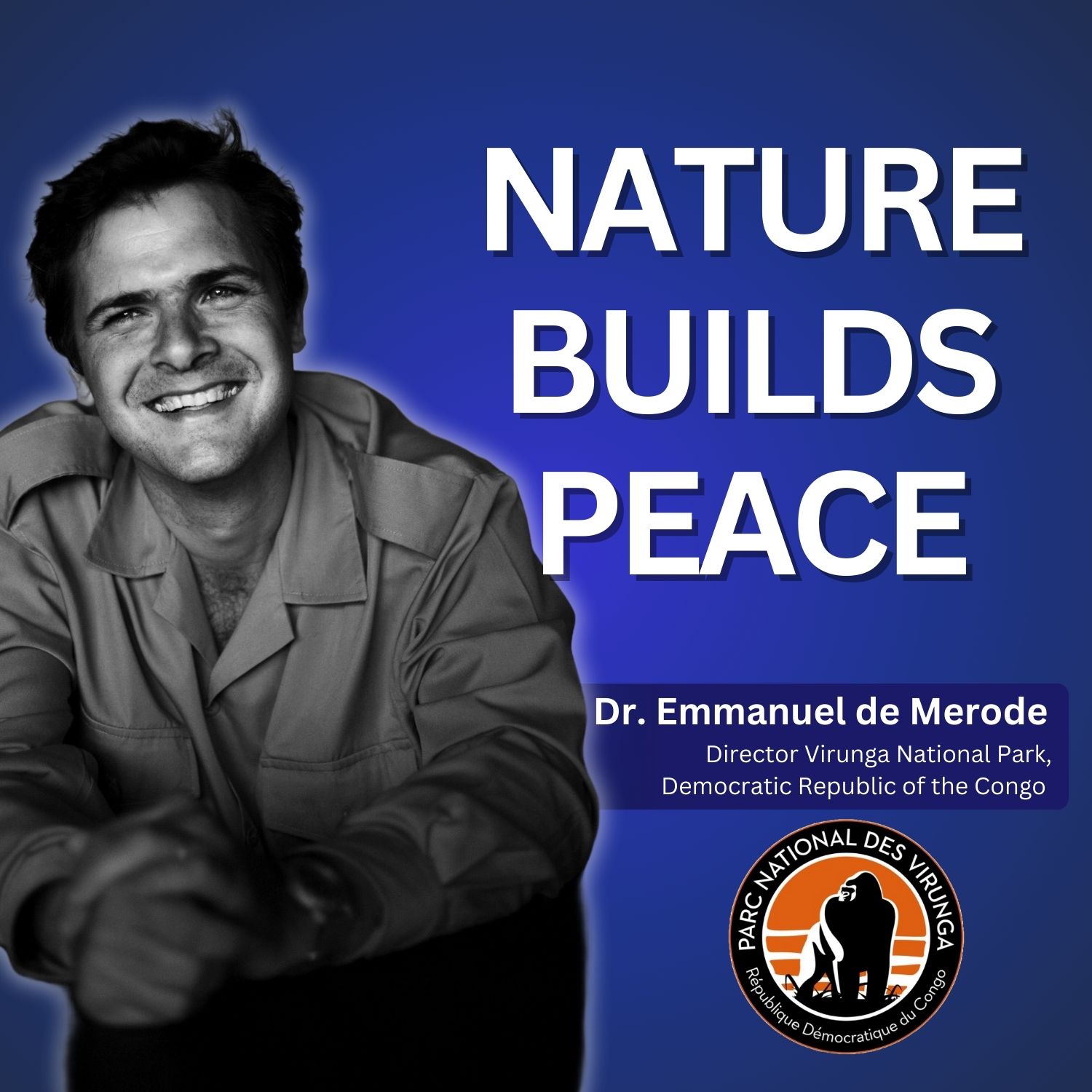
Der Große Neustart
Emmanuel de Merode on 100 Years of Virunga — A Masterclass in Quiet Leadership
01:18:56
Loading summary
Transcript35 lines
- [00:03]
Dr. Emmanuel de Merode
They weren't killing the gorillas for the meat. They weren't killing them for trafficking baby gorillas, which is something that happened in the past. They were just killing them. And what we came to realize in the months that followed was that they weren't killing the mountain gorillas because of the mountain gorillas. They were killing them because of their habitat and the value of that fire forest for charcoal to reach such high levels that the only thing that was really preventing them from cutting all the forest down were the rangers who were protecting the forest for the mountain gorillas. Welcome to the English edition of Der Grosse Neustadt, the German English podcast series by Sibylla Barton, in which she talks to pioneering leaders who, inspired by the World Economic Forum's Great Reset Initiative, create revolutionary projects that actually do make our world better, greener and fairer.
- [01:08]
Sibylla Barton
Today we turn our attention to one of the most vital, yet overlooked places on Earth. The Democratic Republic of Congo. A country the size of Western Europe, rich in natural resources and cultural diversity, yet shaped by decades of conflict and poverty. At its heart lies Virunga National Park, Africa's oldest national park and the continent's most biodiverse protected area. It is home to over 700 bird species and one third of the world's endangered mountain gorillas. But this extraordinary landscape is also the frontline of a complex struggle where climate, conservation and conflict collide. This Easter, Virunga celebrates its 100th anniversary, a century of resilience and reinvention, led today by a man whose vision has redefined what conservation means in a 21st century. My guest is Dr. Emmanuel de Merode, a Belgian prince by birth, a field anthropologist by training, and director of Virunga since 2008. Under his leadership, the park has become a global model for how nature can become a foundation for peace and prosperity. Through the Virunga alliance, his team has created 21,000 jobs, brought renewable energy to 70% of GOMA, empowered 6,000 farmers, and supported over 1,600 businesses. And now this vision is expanding into the Kivo Kinshasa Green Corridor, which could become the world's largest protected tropical forest reserve. Dr. Demurod has survived an assassination attempt, led his team through active conflict zones, and has been recognized internationally for his work. Honored by King Philip of Belgium, Prince William, Prince Albert of Monaco, and awarded by institutions including UNESCO and National Geographic. This is a story of courage, clarity, and the power of building peace through action. Good morning, Emmanuel. I'm very honored to welcome you.
- [03:23]
Dr. Emmanuel de Merode
Hello, Cyville. Good morning and thank you for your Kind invitation.
- [03:28]
Sibylla Barton
Before we talk about your wonderful park, let's ground our listeners in the sheer scale and complexity and relevance of the drc.
- [03:40]
Dr. Emmanuel de Merode
Yes, exactly. I mean, the DRC is a region of the world that suffers an extraordinary disparity in terms of the importance of the region for many reasons, and the incredible deficit in attention that it receives, again, at many levels. It's a region that is known for its very troubled history and its current difficulties tied to one of the most violent armed conflicts in our generation, one of the most tragic periods in modern history, which is barely mentioned in the media. And so that amounts to an enormous problem and also an enormous lost opportunity because it's also a country of 100 million people. Extraordinary communities, incredibly resilient, incredibly hardworking and creative, and they're known for that. They're unable to reach the enormous potential that Congo could reach tied to its populations, but also its incredibly rich resources, both under the surface in terms of its incredible mineral resources, but also its biological resources above the surface. And that's, of course, what drew me to Congo many years ago, was the fact that there is nowhere on earth quite like it and an extraordinary life to be spent there amongst the Congolese people, who always made me feel very welcome. So, yeah, altogether an amazing country that has always deserved better than the very difficult card of hands that history has dealt it.
- [05:42]
Sibylla Barton
Yeah. And we probably have to put this in perspective for our listeners somewhere else, that actually it's the second largest country in Africa, you know, the size of Western Europe. Is that right?
- [05:57]
Dr. Emmanuel de Merode
That's right, yeah. It's a vast country that stretches across almost the entire African continent, across the equator, and contains within it over 80 different ethnic communities, 80 different language groups. Seems extraordinarily diverse as a country, both in terms of its society and in terms of its resources. So it's an incredible country.
- [06:28]
Sibylla Barton
Let's zoom now into the most extraordinary place, the Virunga National Park. That is where you are. And it's not just an UNESCO site. It's the frontline of conservation, climate and conflict. And it's your home. So tell us about it.
- [06:46]
Dr. Emmanuel de Merode
Yes, it's been home for 20 years now, but it's somewhere that was always in my mind from as far back as I can remember. As a child, I was very fortunate to grow up in Eastern Africa. And, of course, as a child in Eastern Africa, you invariably are affected by the extraordinary wildlife, the extraordinary natural environment that we were so privileged to live in. And the summit of that rich, incredibly rich natural environment was this magical place in the center of Africa that had these incredible species and extraordinary landscapes. From the summit of the Ruinzori Mountains, you know, these fabled mountains of the moon that were identified over 2000 years ago as the mythical source of the Nile. And down from those glaciers on the Rinzoris, through the moorlands, down into the alpine forests, and then into this incredible lowland, tropical moist forest mass of the Congo basin. But also in Virunga, it's savannas and lakes and its wetlands. And then in the south, back into the mountains, but here, where you can actually delve into the. Right, into the center of the Earth with some of the most active volcanoes on Earth. And on the flanks of those volcanoes, this incredible wildlife. And in particular, the emblematic species that over the years really defined Virunga national park and really captured at times the world's imagination, which these extraordinary mountain gorilla populations, these families of mountain gorillas that live on the flanks of the Virunga volcanoes. But of course, Virunga is much, much more than that in terms of its wildlife. We're drawn to the mountain gorillas, but there are two other taxa, two other types of great apes. There's the lowland gorillas and the chimpanzees as well. But then what makes it the most biodiverse protected area on Earth, which are the fact that it has over 708 species of birds, more mammals, reptiles and amphibians than any protected area on Earth. And so that really makes it such an important national park to protect. But of course, just as it's incredibly rich in biodiversity, there's also this other side to it, which is that right at the heart of a region that has suffered unparalleled violence over the past 30 years. And that's really been expressed through a succession of civil wars. The first started just after I arrived in 1993, after the horrific events in. In Rwanda in 94, with an escalation of that violence into eastern Congo, and then a civil war, the AFDL civil war in 96, which spread across the whole of Congo, followed by four other wars of which were currently living through the most recent one. And that's. Well, what's very particular about Virunga is that every single one of those wars started in or around Virunga National Park. And so just as it's extraordinary wildlife and biodiversity is what defines it, it's equally perhaps more defined by the incredibly difficult, tragic circumstances in which it finds itself in recent. Recent years.
- [11:02]
Sibylla Barton
Yeah, because you talk about it so strongly. 30 years of armed conflict, 6 millions and more lives lost in Such a beautiful, beautiful area.
- [11:17]
Dr. Emmanuel de Merode
And I mean, the struggle of our lives is to work towards peace. And I didn't speak just for myself. I speak for the entire team in the entire community that I live within. That's the single thing that we work towards. So, of course, we believe in the fact that one day Congo will reach its incredible potential. And the most important aspect of that is peace. If peace can be achieved, extraordinary things will happen in Congo. And the issue is, what's the pathway to peace? And that really requires a real effort in trying to understand the deep rooted causes of violence, of armed conflict, and ultimately of civil war. And so that's a big part of the effort is to try and understand that and try and identify means of affecting that positively. And the biggest effort in Virunga is to try and make a contribution to that effort.
- [12:35]
Sibylla Barton
I remember hearing you in an interview many years ago, you were describing that there are almost, I think you said, 18 armed militias in the area protecting the various resources from ivory, fish, oil, whatever. How is the situation right now?
- [12:55]
Dr. Emmanuel de Merode
So, unfortunately, that statistic is terrifying and has largely remained constant over the years. What has changed is the scale of it. So we still have a vast number of armed militias that have an overwhelming effect on the politics of the region. And what has changed in recent years is that it's escalated to extraordinary proportions and has caused enormous suffering to the population. So there was a new war that started three years ago. Like every other war, it began in Virunga national park with the presence of an armed militia, the M23, that moved into the neighboring territories and then gradually expanded to the situation we're in now, where they've taken over the two biggest cities in the eastern provinces, Goma and Bukavu, and have spread quite significantly westwards. What it's resulted in is, with respect to our lives, is that half of the national park, which is this vast national park spreading over 300km north to south, half of it is under rebel control at the moment. And so that leaves us with a very, very difficult situation to manage and a tragic situation with respect to the populations living around the park. And that's certainly made the work a lot more difficult and tortuous in the last two years.
- [14:48]
Sibylla Barton
How many people live in and around the park?
- [14:52]
Dr. Emmanuel de Merode
So the Kivus, which are the provinces around Ranga national park, and the Ituri in the north, are some of the most densely populated rural areas in Africa, in the world. In fact, the human population density around Virunga is higher than that of Belgium or the Netherlands. And So what we have is about 11 million people who live within a day's walk. So the definition that we would use for the local community around the park, 11 million people live within about 20 kilometers of the power boundary. And so it's an enormous population, which for us is in part a challenge, because these are people who have an enormous need for land. They're agricultural populations that live from farming and therefore need. Have a very real, very genuine need for access to land. And yet we have this national park that represents 800,000 hectares of incredibly fertile land that's been set aside for conservation so that the rest of the world can benefit from the preservation of the world's biodiversity. But at the same time, you have a situation where there are also enormous costs. There are enormous benefits in preserving Virunga's biodiversity from the perspective of the whole of humanity, but the cost is almost entirely being borne by the local people who can least afford it. You've got the rest of the world, many of whom are very affluent, who enjoy the fact that the gorillas and the elephants are still being protected, but it's the local people who have to pay the price. And that's, you know, you can barely find a better definition of social injustice. And that's where you have injustice. Invariably, you get violence. And so you start to begin to understand the sources of violence. And that's what really brought us to the very harsh reality that we're actually a part of the problem. But at the same time, having 11 million people living around the park is also an extraordinary opportunity, because these are incredibly dynamic communities that have a huge untapped potential for development, for developing their own resources, their own livelihoods. And that's a real opportunity for the park to build out new ways of doing conservation that didn't exist in the past, that have become much more mainstream today and are infinitely more interesting in terms of how you manage a national park, how you manage a protected area with the communities living around. And so that's really been. You know, it's been the subject of our work for the last 15 years.
- [18:13]
Sibylla Barton
You were saying, when you live there and you live with the people and you learn and you understand the source of violence, what is it that you understand?
- [18:27]
Dr. Emmanuel de Merode
So, I mean, it would be. You know, it would probably be arrogant of me to say that I understand the sources of violence, but what we've been trying to do is to try and understand them over the years in terms of how we've experienced them. And one of the causes of violence is certainly the one I Just mentioned, when you've got vast numbers of people who can no longer refer to the laws that govern their lives, particularly with respect to natural resources, access to resources, when they can no longer consider them as fair and just, then that's very. It's a very dangerous situation because people lose trust in government institutions, they lose reference to the laws that are there to preserve the peace, as it were. So that's perhaps the first and in many ways the most important ingredient to an escalation into violence and armed conflict. But there are others as well. One of them is precisely that it's an outcome which is the breakdown of rule of law, and in particular the rule of law with respect to natural resources. And when the illegal exploitation of natural resources becomes the dominant economic activity in a society, then you get two outcomes which are really the other two deep rooted causes of violence and armed conflict. One is when revenue streams start to appear that are accessed by private armies, by militias, armies that don't answer to the state authority, they only answer to themselves. So that's the first when there's significant money available to finance these armed groups. And then the other, and it's really a correlate, it's really an outcome of the same problem which is when public institutions begin to weaken very significantly. And the main agent for weakening government institutions is corruption. And of course corruption is an outcome of the illegal exploitation of natural resources. And so I'll always sort of refer back to the fact that Congo is just extraordinarily rich in natural resources. And so the potential for these dynamics to develop is very, very high and very, very dangerous. And so that's what's happened in the region around Virunga. And it's useful just to look at the actual specifics of what I'm referring to. I think we've been talking about the theory quite a lot, but how does it translate on the ground? Well, there's around the city of Goma, a city of 2 million people on the edge of the park in the south, you've got these very rich forests. Most of those forests have been cleared for charcoal outside the park. All that is left is the forests of the national park. And it's that charcoal that's drawn from the cutting down of the forest and the turning of those trees into charcoal that's become the only source of domestic fuel for people living in the city. They have nothing else and they can't survive without it. That industry, because it's become illegal, because people are sourcing that charcoal from the national park, which is Protected by law, it becomes an illegal activity, and it becomes controlled by the armed militias, and in particular, one armed militia, which is the fdlr, which is actually a Rwandan militia that's considered responsible for the genocide in Rwanda in 1994. So it's a very, very serious problem. And they generate, it's estimated, in excess of $40 million from their control of the trafficking of charcoal from the national park. And so there you have it. You have that revenue stream that's perpetuating this armed group over the years. People often ask, how is it possible that this terrible armed group is still present after 30 years? Well, it's because they can generate so much money from the forest. But they just as they control the forest, the roads are controlled by the army and by other government institutions that are complicit in the trafficking of charcoal to the city. And so you then get the weakening of state institutions because they're involved in that same problem of illegal exploitation of natural resources. And so you have those two basic ingredients. And then the third, of course, is that people have no choice. They can't survive without domestic fuel. And if they're prevented from accessing it, they risk massive food insecurity and the effects of not being able to boil their water, which brings in waterborne diseases, which threatens their children. These are all perceived as problems tied to social justice, of being able to access what are really their rights. And so you've got all three ingredients that lead to the breakdown of rule of law and ultimately to violence and civil war.
- [24:30]
Sibylla Barton
All of that makes it now even more remarkable. If we go into what it is that you are doing, you basically help the vision of creating peace through economic hope, coming really alive and getting stronger. So you introduced a new model, and we are now talking about the creation of the Virunga Alliance. How did it all begin, and what is it that this alliance is doing?
- [25:05]
Dr. Emmanuel de Merode
Well, one could say it all began one evening in 2007 when we were at. In a camp up in the mountains, in the forests of the mountain gorilla sector, the McKenna sector of the park. And we were settling in for the evening, working on. We'd been doing some work with the mountain gorillas. And then just as night was falling, we heard a succession of gunshots in the distance. And it was coming from within the mountain gorilla sector. So that was really worrying for us. And so the first thing in the morning, as soon as it was light, we organized a patrol and walked for about an hour, and then came across an absolutely horrific scene, which was this massacre of all this entire family of, of gorillas that we knew well, the Riddock family, and some of them had been shot from very close up. And it was tragic to see because they were habituated groups. They inherently trust humans when they come close, which had obviously enabled some people to come up and shoot the gorillas at very close range. And some of the females had infants that hadn't been killed and were still on the bodies of the mothers that had been killed. And it was a terrible scene for us who lived for the protection of those mountain gorillas. And then in the weeks that followed, other similar massacres happened. And we very quickly realized that we were failing in our efforts to protect the park and protect this species in particular. And so that really led to a lot of reflection, a lot of analysis and trying to understand exactly what was going on. Because they weren't killing the gorillas for the meat, they weren't killing them for trafficking baby gorillas, which is something that happened in the past. They were just killing them. And what we came to realize in the months that followed was that they weren't killing the mountain gorillas because of the mountain gorillas. They were killing them because of their habitat. And the value of that forest for charcoal had reached such high levels that the only thing that was really preventing them from cutting all the forest down were the rangers who were protecting the forest for the mountain gorillas. So by killing the mountain gorillas, they would discourage, you know, the last remaining protection that those, those forests were getting. And of course, you know, we analyzed that and realized that it was an industry worth tens of millions of dollars, which, you know, as a small team of conservationists, that was way beyond our ability to control. We were really, we were way above our necks in this problem and we just weren't equipped to deal with a problem like that. And it really, at a personal level, it made me realise that all my training as an anthropologist and as a biologist was just inadequate for overcoming a problem of that scale. What we also realized that there were other similar problems elsewhere in the park. The fishing on Lake Edward, this vast lake in the middle of the park, was worth about $62 million. And 80% of that was illegal trafficking. There were land invasions in the park by the militias that were worth tens of millions of dollars. All of that together created an illegal industry of over $170 million a year. And that's really what we were up against. And so what it made us realize is that we as conservationists alone were completely ill equipped and inadequate in confronting problems on that scale. And we needed to look beyond our profession, but in particular beyond our institution to the communities living around the park and just see where it had gone so badly wrong over the years that something like this could have been created under our noses and we hadn't even noticed it. And so we completely changed our approach. We started working with, with economists, with social development experts, with engineers, and less and less with biologists and anthropologists like myself, and completely changed the entire approach, the entire methodology of how we were managing the park, but also tried to analyze what the alternatives were. If there was $170 million being created from illegal trafficking, what are the assets that we could draw on to out compete an industry on that scale? Because that was the only way we were going to confront it. We couldn't use law enforcement alone. It just wasn't either desirable or practical or feasible. We needed an alternative to offer the communities that was more desirable to them. And that's really when we started looking at the economic potential of the park in terms of the non destructive assets. And that's really the remarkable nature of Virunga, is that those resources exist with a bit of creative imagination. They suddenly become very, very obvious. Tourism, of course, is one. Tourism isn't just about the tourists. It's about the jobs it creates, about the infrastructure that opens the region up to not just tourists, but also investors. And that's why tourism is so important in Africa, is that it makes its potential realizable. And then two other incredible sectors of the economy that could be developed without destroying the park. One was energy. It was a mountainous park with incredibly high rainfall, So a whole network of streams that flow into rivers that become torrents and are incredibly high in energy that can be readily transformed into electricity as the motor for a whole new economy, as an engine that could transform the economy in a way that is more effective, more powerful than the illegal trafficking of natural resources. And then the third is really an outcome of that, which is we're dealing with a population that is perhaps 90% rural, 90% agricultural, but that really are unable to harness all the real value of their work because they produce agricultural products that are then exported. And all the transformation of those products happen in neighboring or countries further afield. And that's really where all the added value to those commodities are created. And part of the reason why transformation doesn't happen in Congo is because there is no available energy for that transformation industry. And suddenly it became clear that that was really a primary vocation of the national park, just as it was to protect Biodiversity for the whole of humanity. And there was this equally important opportunities to provide ecosystem services to the community in the form of electricity and investment from tourism and from the investors that it would bring into a whole new modern and green agricultural transformation industry. And so that's what we've been working on for the past 15 years with the community. It's become a roughly 300 million dollar investment. It's created 21,000 jobs in the community. And what's been really extraordinary about that is that we measure the energy generated by the parks rivers in terms of megawatts of electricity. And every one of those megawatts of electricity, when it's made available to the community so that they can develop their own industries, every one of those megawatts creates between 800 and 1,000 jobs. But what we found was that the park could generate over 100 megawatts of electricity and therefore could create upwards of 80,000 jobs around the park. Now we started looking at those jobs when they were created, talking to people, finding out what their stories were. And 11% of those 21,000 jobs that we've been able to create are young men and women who have chosen to leave the armed groups and take on gainful employment through these opportunities provided by these new industries that the park has enabled. And so suddenly we found ourselves with this incredibly compelling instrument for bringing peace and stability that was really governed by this formula of the more energy you drive into the community, the more you get agricultural transformation. And that creates jobs at a rate which we can measure. And that becomes the most interesting way of overcoming armed conflict without bloodshed and a really deep rooted solution to the problem of violence. So that's really what we refer to when we talk about the Virunga Alliance. It's this partnership with the community to enable them to control their own resources, control their own future, by building the transformation industries that enable them to get the full value out of all of their work.
- [35:56]
Sibylla Barton
When we talk about the 21,000 jobs that have been created, where do they mainly work? What do they do?
- [36:05]
Dr. Emmanuel de Merode
So we've worked across a whole number of areas and it's quite varied. It's a difficult question to answer in a nutshell because it's complex. But we try and concentrate the effort on two things. One is building up local enterprise small businesses in the community. And there you get a whole range of small businesses. Sometimes they get referred to as barefoot businesses. These are people working often out in the open on the side of the road, doing carpentry or welding mechanics and so on. And they're actually extraordinarily skilled jobs, but they don't have access to investments to be able to grow out their businesses. And so what we did was to work out a scheme where we could use the electricity network, which is this really interesting. You can build this really interesting picture of it, which is that you've got a natural network of rivers and streams flowing through the forest that build up in power as they converge to a point. And then it becomes an economic network that is really the mirror of that natural river network in the forest. And that human network is of course, a physical transmission of electricity down the power lines into the grids, power grids in the cities that we've built out. And you've got these two networks that are the mirrors of each other. And what they do is that they connect the forest's energy to what are now 50,000 homes and businesses in the cities and create a very real, a very financial interdependence between the human economic landscape and the natural ecosystems. And so what that did was that it created a discussion both locally with, on the need to preserve that forest because it stabilizes the water flows. And those stable water flows are what make the generation of electricity possible. And now the livelihoods of over 21,000 families. And those families become the best allies of the park, for obvious reasons. But it also created a whole discussion internationally. And one of those discussions brought us into contact with Muhammad Yunus when he was passing through Nairobi a couple of years ago. And I asked for 10 minutes of his time to discuss the whole issue of how do you bring financial services to people who are completely excluded from the formal banking sector because they're too poor to really be able to get through the doors of a bank? And it was meant to be a 10 minute discussion because he's incredibly busy. And it developed into a four hour discussion about his dream of achieving what he refers to as the three zeros, which are zero unemployment, which is very important to us because unemployment is one of the main drivers of violence. Zero concentration of wealth, which is something that he feels very strongly about. And I think we're all increasingly sympathetic with that point of view. And then the third, which is the zero net emissions. And it was something he said he was really struggling with on how to tie financial services to the poor to the whole issue of zero net emissions. And this model that was developing in Virunga offered an opportunity to really test that. Could you drive financial services, loans systems, small business loan system to the natural ecosystems and create that interdependence where one protects the other and vice versa. And so we developed this idea of trying to test that idea of tying financial systems to the forest, and developed a joint venture with the Grameen bank, of course, the greatest institution there is in terms of microfinance. And so we now have Grameen Barunga, which is a microfinance institution around Virunga national park that's partly owned by the Grameen bank and that uses electricity as the medium for providing loans. So when you buy a kilowatt hour of electricity, you can obtain a loan that is reimbursed with a small premium on that electricity. And what's so interesting about it is that the cost of the kilowatt hour of electricity of clean energy from the park, plus the reimbursement of the loan, amounts to 22 cents for your kilowatt hour of electricity, plus, say, 10 cents for reimbursing your loan. That's 32 cents. The cost of a diesel generator is over 60 cents a kilowatt hour. So it always costs you less to reimburse your loan than not to reimburse your loan, because that would mean going back to a diesel generator, which is more expensive. And so you've overcome one of the great challenges of financial exclusion, which is the inability for somebody living in extreme poverty to provide a guarantee, because being poor, by definition, they have nothing and they can't offer a guarantee on their loan. Now, they don't need to offer guarantee because the model makes it cheaper to pay the loan than not to pay the loan, and that becomes your guarantee. So that was incredibly interesting as a, you know, as a hypothesis. And the second, of course, was that, you know, the best proxy you have, the best correlate of business performance, is energy consumption in these small businesses. And all that data was being collected anyway by the energy company that we developed. And so you could get a due diligence analysis done at no cost for these small businesses, which is, of course, the other cause of financial exclusion is that it's so expensive to do due diligence on a small business that's asking for a very small loan of, say, $200. If your due diligence process costs $1,000, you're not going to do it. The bank, for obvious reasons, can't afford to evaluate these businesses. And so we'd have overcome that problem as well by tying the loan to clean energy from these natural ecosystems. And so that's become, in the last couple of years, a $5 million investment in small business. There's over 1500 small businesses that have received these loans. And that's part of the reason why we've created 21,000 jobs. And so it's really tied into those natural ecosystems and it's, it's performing really well. It's growing quite fast. So that's really exciting. The other aspect, so much to talk about. I'm sorry. No, please. But the other aspect is these industries that we've been able to develop in the value chains that have been coerced by the trafficking system, so the armed groups that control certain commodities and where we've managed to build industries that bypass those illegal networks and provide an alternative. A really important one to us is cocoa. You know, cocoa is obviously the primary ingredient for chocolate, and everyone likes chocolate. It gives you, you know, it gives, it gives you a good, a good feeling, but at the same time it has a very, very sinister pathway to your stomach, which is that in regions like eastern Congo, it's a very, very high value commodity that attracts the armed militias and one in particular, the adf, which is a very violent militia in the north of the park, in the north of the province. So a militia that came from Uganda, it's considered to be a jihadist militia, although it's more complex than that. And one of their main drivers is the illegal exploitation of the cocoa production systems. And what they will typically do is go into communities just before the harvest and kill people so that the communities flee just after the harvest. And then they'll go in with, often with enslaved labor and just recover the whole harvest and traffic it, smuggle it into Uganda and it gets sold on the European market, on the US market, and through what are considered to be respectable brokers as certified, often fair trade and organic cocoa, but Ugandan cocoa. And so it's a terrible situation in which the, you know, the laundering of this, of this Congolese cocoa and its fraudulent certification as Ugandan cocoa conceals the fact that there are terrible crimes committed along that value chain. And the way around that, obviously, is to create a much more resilient, much more robust Congolese value chain. But that needs to be economically viable. And so to achieve that, you need to industrialize. It's the only way of doing it is to really build out the whole cocoa transformation industry in Congo. And so what we've done is that we've worked in those communities and encouraged them to build out their own fermentation centers in the communities that are safe. And so we bring the rangers in also with the army and build out systems where it's the Community that structure their own security and they call the army. When they need the army. It's not the army going in and causing trouble. But when they feel threatened and vulnerable, they have the technology, these simple panic buttons that we've distributed where they're able to call out and support and prevent these massacres from happening. But at the same time, they no longer ferment and dry the cocoa in their fields and they're able to bring it to a safe fermentation center, get a much higher quality of cocoa, and then transfer it safely to a cocoa mass transformation plant. And, and what we now have a chocolate factory. And so we started making chocolate, very high quality chocolate within those communities and then exporting that at much, much higher value, which has made the legal cocoa value chains much more profitable and much more interesting to those communities. And so there's a big cocoa mass transformation plant that's now under construction with the support of the European Union, which the park is building, which will produce 30,000 tons of cocoa mass, which is part processed chocolate, as it were, which the European market really needs. There's a cocoa deficit on the global market. But 30,000 tons of cocoa mass represents 60% of the entire cocoa production of Congo at the moment. So the potential is amazing. But these are, you know, these are profitable businesses. You know, they're not handouts to the Congolese people. These are the Congolese people developing highly profitable businesses that can be invested in on a level playing field. So it's a really gratifying process that's taking place around the park where these illegal trafficking networks, be it illegal charcoal that's being replaced by clean energy or the illegal cocoa smuggled into Uganda, that's being replaced by processed, transformed cocoa on the legal market. And so that's really what it amounts to in terms of the sort of tangible changes that are happening on the ground.
- [49:32]
Sibylla Barton
Out of those many, many important things you said right now, two things you mentioned, the European Union. Do you think this is part of recreating value chains that you say the market is, or a lot of the products go to the European Union, that the European Union then has to make sure that the production happens in a safe and fair environment. And question two would be, you talked about the army who's coming in to protect. How efficient is that at the moment?
- [50:12]
Dr. Emmanuel de Merode
Well, I'll start with the second question because it's a really important one. The army is like many institutions in Congo, it's in a fragile state at the moment. But what that can result in is enormous problems in terms of the potential for misconduct leading to violations of people's basic rights and acts that are deeply regrettable on the part of unsupervised or inadequately supervised and trained military personnel. And that's certainly a part of the problem, but it is a problem that can be managed if it's taken very seriously, which it needs to be. The way we've worked it is that for 15 years, we've been working on building up the discipline and the sense of professionalism amongst park rangers, who are one of the government services that. That's the service that I work for. And so I'm directly responsible for their acts. And it's obviously critically important that they always behave with the highest levels of professionalism, especially when they're operating in vulnerable communities. That's the most important aspect of our work, is that that's done appropriately. And the same goes for the army. But the truth is that given the state of violence in the eastern provinces, you can't avoid the role of the army in restoring peace and restoring the rule of law in those regions. But the army is not sufficiently equipped at this stage, and so we need to work on that progressively. What we found is that perhaps the most valuable tool in achieving that is the community itself. So the community where we lived in a few years ago, which is a town called Mtwanga on the edge of the park, was very, very badly affected by these militia attacks, these ADF attacks on the community. In the first three months of 2021, there were six attacks, and 120 people were killed in that community. And this is the town we were living in. 60% of the town fled to the neighboring city of Beni. And it was in a real crisis. And we held a whole number of meetings with the community that was left and discussed this issue of how to resist these attacks. And their response was, well, the army just isn't up to the job. And so what we suggested was building a reinforced position for the army where they can be contained but called out when they're needed, and they have the necessary resources to be able to do that. And we figured that if we built what we call a forward operating base, which is a reinforced barracks for the army, and that they stay in there unless they're called out by the community, then we have some potential to strengthen, you know, the protection of that community. And so we suggested that to them and figured that it would take us about six weeks to build that base. When we came the next day to start the construction, 4,000 people from the community came and we built the whole thing in 24 hours. It was perhaps the most encouraging day of my 30 years in Congo. It was absolutely extraordinary. And the ADF attacked that position that night and three of our people who were protecting it were killed. And it was a very, very difficult moment. But since then, since April 2021, there hasn't been a single victim in that town. And all the 60 people, the 60% of the population that fled have come back and the whole economy of that town has increased very significantly. So it's been an amazing journey for that community. And the trust and the relationship in the government authorities has really been transformed. They're working together, but the authority really lies with the community, with the population. The army doesn't leave the barracks unless they're called out. And the time for an intervention when there's a massacre has reduced from about six hours on average to less than 20 minutes. And so the response time is very, very rapid because the park provides the vehicles, provides the rations and the medical support to the army so that they, you know, they remain disciplined and contained within the fob. So that's really, you know, what's created the model, as it were, for how to address the immediate causes of violence. And answers, in part, I think your question about how do you work with the army? It's not easy. It's a very, very difficult institution to work with. But there are solutions if you really engage with the community. And your second question, I've forgotten, what was it again?
- [55:58]
Sibylla Barton
My second question was if we rebuild the value chain and trying to create a better life for everybody. You were saying that the EU is a big market for you and in return the EU helps you finance your project and makes it more secure and so on. Is that. Yeah. Is that.
- [56:22]
Dr. Emmanuel de Merode
Yeah. Is that a big deal? It is, yeah. I mean, the European Union has been the biggest investor of all by quite a significant margin on the work that we do and have been not just incredibly supportive, but very consistent over the last 40 years. They started supporting Barunga in 1988, and that's incredibly unusual. I don't think there's any program, certainly not an environmental program, that's had such significant and such constant support from the European Union. The reason it's so important is that peace cannot be built on a three year project cycle. It's a generational challenge that needs that consistency and that commitment. So that's what we've had from the European Union. The US have been quite supportive, but they don't have that same level of constant commitment in fact, they suspended all of our financing in January for reasons that you probably know about. But the European Union has doubled down this year at a time when we need it most. We're real proponents of trade, not aid. We're trying to build systems that work with the European market and work in response to the needs of the European market and in response to the needs of the Congolese economy. But of course, without that initial subsidy from the European Union, we could never have got the foundations in place to be able to build this economic infrastructure around Barunda. And so we were able to benefit from very significant grant funding to get it all going. And then now we've also been the first successful investment from, well, what was a European investment bank. It was the British initially who chose to invest through DFI funding, through development finance. There hasn't been that kind of financing since 1985 in eastern Congo. And so that's one of our real prides, is to have started to normalize investment into that region, which normal investors are very risk averse and very nervous about penetrating that market. But it's absolutely essential to get wealth back to the people of Eastern Congo to get that normalized investment to start working again. So that's what the European Union have enabled us to do, is to create the foundations so that other forms of investment, blended investment, can start to happen. What's also happening is the European private sector is beginning to invest in spite of the fact that there's a war. So we've got five or six major, primarily agro industrial players who are beginning to invest in those factories, in joint ventures with the park. So the park takes care of the local risk, as it were. It creates the enabling environment for those investments to work and they bring in expertise, and that's working incredibly well. But there are always challenges along the way, and some of them are, you know, are caused by, you know, the European systems, as it were. We recently had a bit of a crisis because, you know, the certification processes are quite, quite, quite daunting, quite challenging to achieve. And one of them is the organic certification of cocoa. Most of the European purchase of Congolese cocoa is in the organic sector, and that needs to be certified in a way that's compliant with European Commission regulations. And so there are auditing firms that are authorized to do that, of which there are four that have been authorized for Congo. Three of them refuse to come to Eastern Congo because of security, because of the upsurge in armed conflict, and the fourth concealed the fact that they were no longer compliant with their requirements. To the European Commission were no longer able to carry out those orders, but they kept that quiet for almost a year. And then the Coco actors in Eastern Congo only found out about a week before the certificates expired. What that effectively does is that it delivers 40,000 Congolese families into the hands of the armed groups because they can no longer sell their cocoa on the European market. They have nowhere else to sell it, other than to sell it at a massively reduced price to traffickers who give it to the armed groups who smuggle it into Uganda, who are able to fraudulently recertify as Ugandan cocoa and sell it on the European market that way. So it's an incredibly twisted, problematic issue. And actually, there we were able to work with the Commission very, very fast. So the several directorates within the Commission really engaged with us on that problem and really shook up these auditing firms. And we were able to find one, a German auditing firm, who was willing to, even though they'd never been to eastern Congo, in the space of a few days, build up the expertise and send a team as long as the national park was there to provide them with security and logistics. And so we were able to get that to happen in the space of a couple of weeks and start the auditing process so that those 40,000 families don't lose their livelihoods. And so that's really how it happens. It's those little details that make the difference in terms of rebuilding an economy, rebuilding a society, but they're difficult, stressful moments that really need to be sorted out. But it's 40 years of working with the Commission that really enables us to solve those ways to cut through all the red tape and come to a solution very quickly.
- [63:03]
Sibylla Barton
You mentioned earlier about that one solution to it all could be scaling the model. And you presented together with the DRC government earlier this year in Davos, the idea of the Green Corridor, which is basically the vision, is to create the largest protected tropical forest reserve on Earth. Can you give us a status quo of how far this vision has gone?
- [63:37]
Dr. Emmanuel de Merode
Status quo is the wrong word because it's moving so incredibly fast. And it really started about a year ago. There were some discussions amongst different people who got very, very interested in this whole idea. There was discussion between King Philip of Belgium and the Congolese head of state about what was happening in Virunga, and that drew a certain amount of attention to what was happening around Virunga. And the DRC president sent a team in October last year, so not that long ago to try and understand what was going on because they suddenly heard something was happening in the midst of this very difficult region that was really only associated with bad news. Suddenly there were these developments that sounded interesting. So he sent a team and it was the one person within that team was incredibly, very dynamic and very positive thinking person who started a discussion with us about an idea that was really drawn from the fact that we had come to realize that there was a major development happening within Congo, which was the Chinese Belts and Roads Initiative, of which one project was the Kisingani to Beni, which basically is Kisangani to Virunga. The city of Kisingani is right in the middle of Congo and it's at the upper end of the Congo river, the upper end of the navigable part of the Congo River. And what the Chinese Belts and Roads Initiative project was going to do was build a road all the way through the Ituri to Virunga, which really effectively drives an economic corridor through the heart of the Congo Basin, all the way through the Ituri, you know, from the east all the way through the Ituri to, to Kisingani, and then 1400km down the Congo river to Kinshasa, and effectively cuts the Congo Basin in half. The Congo Basin is regarded, considered now to be the most important terrestrial asset on earth with respect to climate change. It's the only tropical forest mass that absorbs more carbon dioxide than it emits. It's critical to the whole climate effort. And suddenly you've got this road which has the potential to drive a whole number of feeder roads and to develop the tributary rivers going into the Congo river in a way that could potentially fragment the Congo Basin and undermine its whole ecosystem function, destroy the Congo basin potentially within 10 years. If you look at what's happened elsewhere in the world. And so we're faced with a dilemma. One is that the Chinese are building a road. Congo needs roads. That's non negotiable. It's an incredibly important, valuable project for Congo that the Chinese are investing in. But if measures aren't taken to mitigate the impacts of that road, we could be in an extraordinary level of trouble with the destruction of the Congo Basin as a critical global asset, but also the spreading of the violence westwards, which was a problem, a huge problem for the Congolese state, hence their interest in what was happening in Virunga. And so what we did is we developed this idea that, you know, this road is important, it's needed. It's, you know, the Congolese people need development, and roads are essential to that. But we've got four years before that road is built. We have to get something in place that's going to enable that road to reach its economic potential, but without destroying the forest or hurting the communities. And so the idea of a protected area around that corridor started to take shape. And this commission that was sent to Virunga spent a few days with us looking at all these factories and hydroelectric plants and all this development that was happening around Virunga, and really worked on the dream of replicating that all the way across Congo to the west to Kinshasa, in a way that would have a whole number of impacts. Protecting the Congo Basin as Congo's contribution to the climate effort, but also reunifying the country and then meeting these three great objectives that we felt could be achieved by developing all those sectors of the economy, so clean energy, green agrotransformation and renewable energy driven transport systems along the corridor in a way that protects the forest because the legal framework is in place, but also creates 500,000 jobs, which is what we felt the potential would be when it comes on that scale, protect 100,000 square kilometers of natural forest and transfer a million tons of food from the incredibly rich highlands of eastern Congo around Virunga, to the city of Kinshasa, which is the biggest city in Africa. 17 million people, soon to be 20 million. I think it's projected to be one of the three biggest cities in the world in the next 30 years. And so these are big, big, big issues that we're confronted with. A population that size that's completely isolated, it only gets its food from Brazil, South Africa and Europe. It's going to have massive food insecurity problems in the next few years. But there is this solution, which is the Kivus, which used to be the breadbasket of Central Africa until the war came, could suddenly restore that position, restore those industries and feed the city of Kinshasa. And so that was incredibly appealing to the government, to the head of state. And so it went straight within three days to the cabinet, who adopted it as a government program and instructed that Virunga should work with parliamentarians and with government experts to establish a, a proposal for a new law which was passed within, barely within six weeks, as a whole new way of doing conservation in Congo and as the definition of a new, what they called a community Reserve, which is 540,000 square kilometers over two and a half thousand kilometers from Kinshasa to Virunga, making it indeed the biggest forest reserve in the world. An area that's roughly the size of France and has 31 million people within it. So quite a challenge. And the idea over the next few years is to really try, in partnership with the communities above all, but with the private sector and other institutions, to build out the Virunga model along that corridor, based on a whole dialogue with the communities and based on their consent for this real surge in economic development, but also, hopefully, a stabilization of the region and a pathway for peace.
- [72:02]
Sibylla Barton
Emmanuel, listening to you for now an hour and a bit. Where does your personal commitment and your resilience come from? Because we also have to tell the listeners that you have not only been there for more than two decades, but you also have been shot. You stayed through war and you stayed through danger. And yet, from what I hear, is you are hopeful, you're doing things, you're moving forward, you build alliances, you work for a really bold vision.
- [72:37]
Dr. Emmanuel de Merode
Well, that's, you know, that's not a difficult question. You know, I'm surrounded by a team that's, I'd say, even more committed and more driven than I am. So I draw my energy from that. I have extraordinarily talented and committed people to work with. And so you have to meet their standards, and that's very motivated. Sometimes it's quite difficult. It's a difficult level to match the people I work with. But that's what keeps me going more than anything else. Certainly there have been difficult moments. There was an incident 10 years ago when we were confronted with enormous pressures apart from the oil industry. We were carrying out an investigation over five years, and it was the day that I submitted that investigation to, to the state prosecutor that I came under attack while I was driving back to the park and was quite badly injured when a group of people opened fire on the vehicle I was in. But I was very lucky. I had some people from the village picked me up in the forest and put me on a motorbike and got me to hospital. And so I survived. Many, many of my colleagues weren't so lucky. We've lost 211 of our friends, of our colleagues in the effort to try and protect Virunga since the war started. And their families have had to deal with the tragedy and all the difficulties that follow one of these horrific events of when our colleagues get killed. And that too is an incredible motivation. You have to respect their sacrifice, which is far greater than mine. And so I do find that very. A source of enormous drive and commitment. It's what they have done to keep this park going. And it's a park that is succeeding. It's a park that's refusing to die, and so you get swept along with it. And I don't regret a single day.
- [75:26]
Sibylla Barton
Of that teamwork, because we are coming to the end. Actually, we came to the end half an hour ago, but I would really. I mean, it's such an intense story. Just you alone, plus the park and the heart of the people and this endless fight for just fairness and having a life like everybody else. What gives you hope today?
- [75:57]
Dr. Emmanuel de Merode
Oh, there's so much. I mean, every day new things are happening, new ideas are developing. Every day there's a whole set of new livelihoods that are created. I love that national park. I love the wildlife within it. And the elephant numbers have increased tenfold in the last 10 years. You know, the mountain gorillas have tripled in numbers. There's so many reasons to feel hopeful, and I could go on about it for hours. Generally, when, you know, when one's committed and puts in the effort, things succeed. Of course, it's a challenging environment. You know, we're in the midst of a war and horrific things are happening. But that's all the more reason to feel that the work matters. And it's important to drive a really positive agenda on what can be achieved with the people of Congo who deserve so much more than they've suffered in the last few years. So, yeah, I think we do feel hopeful about the future. It's something that has to happen and we have to make it happen. So it's an incredibly positive period in many ways, but we have to be realistic about the challenges. But so far it's gaining momentum, so that's encouraging.
- [77:39]
Sibylla Barton
I think you said a while ago, and I quote you, it is not always the great ideas and leaders and thinkers who have the greatest impact, but the most disempowered. And Virunga is a great example of that, and I think you are an absolute, fantastic human example of that, what is possible. And I feel very honored that you took time to talk to me today. And I hope the listeners enjoy and whoever wants to help, either financially or in labor or in trade or in security, should pick up the phone and contact you.
- [78:24]
Dr. Emmanuel de Merode
Thank you. That's. That's incredibly kind and I. I really enjoyed our. Our discussion.
- [78:29]
Sibylla Barton
Thank you very much, Emmanuel. All the best.
- [78:31]
Dr. Emmanuel de Merode
Thank you. Thank you, Cybele. Bye Bye. This has been another episode of De Grosse Neustadt from Sibylla Baden. For more information, please visit zabillabarden.com or the official site of the World Economic Forum.