Loading summary
Transcript57 lines
- [00:00]
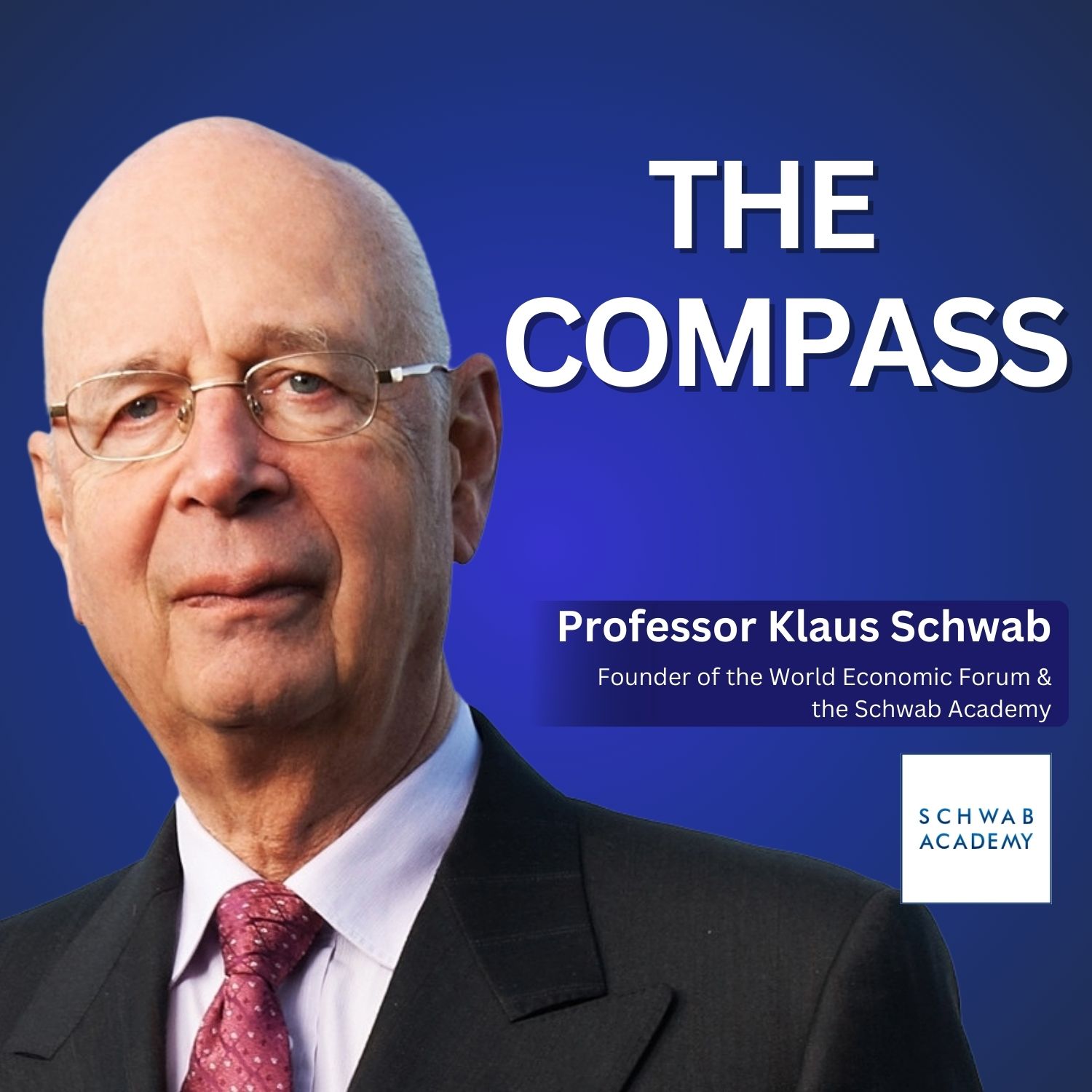
Professor Klaus Schwab
We do not have anymore the same opinion what truth really is. There are alternatives, so called alternative truth, but actually we know there's only one truth, but it's today more and more interpreted in different ways and people believe into those alternative concepts of truth. So if you think it's true, you come to the conclusion. As long as we do not have a common understanding of what's happening. We cannot have a meaningful dialogue, because a meaningful dialogue, for example requests that you have at least a good knowledge of what the facts are. And then the next step is without move, you lose trust.
- [00:56]
Sibylle Barden
Welcome to De Gorser Neustadt with Sibylle Barden. With twenty twenty six the platform enters its second series, having been dedicated to pioneers shaping global transformation, We now move the conversation forward into the Intelligent age. How do we shape our society when intelligence is no longer the monopoly of human beings? Der gosse Neustart will now be a space where leaders explore how to model a future in which we rethink our values and our value as humanity.
- [01:33]
Interviewer
We are starting the year twenty twenty six with a very special guest. Professor Klaus Schwab is the founder and for more than fifty-five years. The Architect. And chairman of the World Economic Forum. The global platform that shaped dialogue between business, governments, academia and civil society like no other institution in modern history. But today's conversation is not about Davos, it is about a new chapter. After more than half a century of institution building and global convening, Professor Schwab has entered what he calls a new phase of service, one focused on knowledge reflection, LifeLong Learning and Human-Centered Leadership in what. He defines as the Intelligent age. With the launch of the Intelligent Age series and the Schwab Academy, he's once again doing what has defined his life's naming a transformation, shaping a framework and inviting the world to sink ahead together. Good afternoon, Professor Schwab.
- [02:38]
Professor Klaus Schwab
Good afternoon.
- [02:39]
Interviewer
Very nice to see you.
- [02:40]
Professor Klaus Schwab
It's a great pleasure to see you again. Mrs. Babel.
- [02:43]
Interviewer
When I look at the last year, what strikes me is that? While public narratives were collapsing into noise, you were writing building and launching something entirely new. Three books, a new academy and a very clear articulation of what the Intelligent Age requires of leaders. Shall we begin there?
- [03:07]
Professor Klaus Schwab
Yes, of course. After my transition from the chairmanship of the World Economic Forum to the origins of my life, which are mainly academic I of course preserved my natural curiosity of what's happening, not only of what's happening, but of what's really important in the world today. And here, what you mentioned for me, the keyword is the intelligent age. If I go back two hundred years ago, we had to transition from the agricultural age to the industrial age and it changed everything, It changed our lives, it changed industry. Just think of the locomotives which and railways which open new horizons, sync of electricity which open new opportunities today. We are in a similar transition, the transition from the industrial age to the intelligent age, and we have to be aware that everything will change again. But there's a big difference between the earlier transition. Two hundred years ago, at that time, we had about three, four generations to adapt to the change Now we have a maximum of maybe ten, possibly fifteen years. I was thinking, what should I do after leaving the chairmanship. And I came to the conclusion, an important role I could fulfill is to explain to everybody what this transition into the intelligent age really means. Not to be a big philosopher and to talk about all the implications of artificial intelligence, but what artificial intelligence means today. And I should add when I talk about the intelligent age. It's not just artificial intelligence. We have many other inventions, like blockchain, like what we see in biotechnology, in human life sciences and so on. So life in ten years from now would be very different, how we live, how we communicate, how we work and so on. And I felt a useful purpose of what I could of my life now would be to explain all those changes in a very understandable way. To the general public.
- [05:59]
Interviewer
I'd like to stay here a moment in your upcoming book. An agenda for the Intelligent age. Restoring truth and trust you do place extraordinary emphasis on truth and on trust.
- [06:15]
Professor Klaus Schwab
Yes, Iron. When I was analyzing what's happening today? And if we compare, let's say the political, economic, social situation of today with maybe twenty years ago, we see the most important change which has happened is that we do not have any more the same opinion, what truth really is. There are alternatives, so called alternative truth. But actually we know there's only one truth, but it's today more and more interpreted in different ways and people believe into those alternative concepts of truth. So if you think it's true, you come to the conclusion, as long as we do not have a common understanding of what's happening. We cannot have a meaningful dialogue, because a meaningful dialogue, for example requests that you have at least a good knowledge of what the facts are. And then the next step is without lose you, lose trust. So for me, I'm planning this series of books and I've published the first one which is more let's say, target oriented book about people who are in retirement or prepare for retirement. But then suddenly I thought before I write all those books related to changes in geopolitics, in the economy, in business, in health and so on, I look at what is really crucial today and it is the fact that we will not progress as humankind. If you do not reestablish a common notion of truth and in such a way also creates a base of trust. But I have to say it's not enough just to cry about the loss of truth. I think my task is to what I'm doing in the book is to investigate why did we lose tools and here we come back again to technology. I think a major factor are the social media and the whole change in the media landscape where you do not have anymore many media which strive to let's say be based on realities. But we strive to create as many clicks or as much echo as possible, which means to adapt the truth to the appetite and taste of your audience.
- [09:22]
Interviewer
What does it mean for identity? Who am I in the Industrial Age and who can I be in the Intelligent age?
- [09:34]
Professor Klaus Schwab
Actually, this question requires two answers, because identity is questioned now on two levels. First, you have to find who you really are and this cannot come only from the inside of yourself. This comes also from the interaction with your environment with other people and so on. And through actually you form your identity. But if your interaction now with other people is disturbed by non truth, by let's say fictions, by aspirations, by political pressures and so on, you have much more difficulties to find your identity and I should add here see traditional transmitting belts for identity, like families, like schools, like churches and so on, do not have anymore today the same importance as they had before. So young people are much more forced to search for their identity and to define their identities themselves compared to older generations, which absorbed a lot of their identity from their parents, from role models and so on. But there's a second avenger today in the Intelligent age, which has which here it's a big question mark related to our identity. We define our identity by the fact, the principle that we are human beings. And then we ask ourselves what makes us different from other creatures in the world? And we come back and say yes, we are human. But what does it really mean? Some people say it's intelligence. But suddenly we have a competitor, we have artificial intelligence, we have algorithm and this competitor, I wouldn't say necessarily can be more intelligent than we are, because at least now the intelligence of bots and so on still depends on our input, may change one day. But coming back to intelligence and identity, we have lost, let's say, natural ways to transmit identities as we had them for century, actually since the beginning of humankind. And this is also one of the reasons why we have this polarization in the world, because people believe in different facts, which means they absorb different identities.
- [12:49]
Interviewer
Saying that your first book of the three books you wrote about how leaders can thrive in the intelligent age, what does it take a leader today to thrive?
- [13:04]
Professor Klaus Schwab
It's probably coming back to what I just said. We have to emphasize much more our human dimension. If I were an optimist and actually I'm an optimist, I would say this new situation forces us to define better who we are as human people. And if we cannot argue anymore, it's our intelligence which distinguishes us from, let's say my dog, it's my humanity. And then we have to think what does it mean to humanity? It's empathy, it's love, it's passion and so on. So we have to as possible if we steer this revolution from the industrial to the intelligent age, in how would say, in a prudent way, then we could even enter a new phase of humankind, where we become more human, where we become more oriented towards the values which suffer so much today. The values of empathy, the values of love, survival of social service.
- [14:30]
Interviewer
So does the intelligent age need a new governance model?
- [14:37]
Professor Klaus Schwab
See intelligent age again, different, let's say, question marks first of all, there is the technology aspect. Let me explain, At least in our liberal democracy, you entrust a government through a democratic election and you elect someone who takes over responsibility for governing you according to the law and so on for the next four year or whatever. But in the new situation where the world is changing so much, a government which is elected today, can lose perspectives and trust after a very short time. So that's again one of the big problems, because challenges, Because then you have a government where people feel it is not representing you anymore. And it creates this situation of polarization of people, not being interested into governments or elections. Look at some countries, half of the population, not going anymore to an election and so on. So what this new age means for governments, I have to say, we haven't figured out yet, we haven't figured out. I feel personally and of course I'm influenced by living here in Switzerland, I feel personally the institution of referendum of popular votes. I find a very good way to make sure that the government, even if the situation changes always keeps, very well track with the majority of people what they feel and what they vote for, because a referendum they can express a different opinion compared to what they may have expressed when they elected the representatives to the Parliament. And today I should add in the electronic age or in the intelligent age, you can facilitate those type of referenda much more compared to before. I should add one other thing Here you asked me about covenants of the future. I think the governance of the future is much more stakeholder. If you want that a decision is afterwards carried out by a majority of people, you have to engage the people and you have to engage the people already into the decision making process and you. Do it not only by you cannot do it so much anymore by delegating the power to politicians who afterwards take the decisions. I think you have to engage into the preparation of relevant decisions. You have to engage all those who will be affected by the decision.
- [17:52]
Interviewer
Which means all stakeholders coming to your stakeholders. You were always an advocate for cooperation responsibility. Multi stakeholder approach. How do we realize it now? How do we really make it work? Because at the moment it can go either way.
- [18:15]
Professor Klaus Schwab
Yes. The multi stakeholder concept, particularly related to companies is under attack and coming back to your question. How to measure, let's say multistakeholder effectiveness. I think people have, and I was very much personally involved, have developed the so called SDGs, which means social and environmental governance criteria, which allow to measures the performance of a company similar to measuring the economic success by financial criteria. Now, what we have seen is that the SDGs have been misused. In certain cases companies making big announcements, which were not followed up at the end. Although it was difficult to follow it up, because it was not always the fault of the company. It was sometimes the fault of circumstances. So that's Challenge which SDGs had. The second one was that it was used, also I would say as an ideological fight. When I wrote my book in nineteen Seventy One, and I propagated the stakeholder concept, there was on the other hand Milton Friedman, who also in Seventy One said the business of business is business. This is a fight, a cultural fight, which is not really resolved until now. For me it's clear a company is not just an economic unit, it's a social organism. And as a social organism it also has social responsibility. So I'm sure that in the long run the Stakeholder concept will prevail. Why? Because if I look at the young generation, they will not work anymore with a company which really demonstrates how it is neglecting environmental principles, the principles of safeguard, of trusteeship, of stewardship for our future. But also customers may not anymore buy products of companies whom they see as socially not responsible. So in the long run with the young generation, I'm sure the Stakeholder concept will not only survive, it will be essential to be even financially at least long term successful.
- [21:16]
Interviewer
Yeah, two things. I remember when we first spoke in twenty twenty and you explained. What ESG is and what SDG is in quite some lengths, because it was not very well known. Then you together with the forum, you shared did so much work and we saw suddenly institutions coming up like the international sustainability standard ward for example, who did all very good work. And right now I think everybody in business Certainly knows the ESGs, the SDGs and has certainly in Europe more or less committed to it. Which brings me to the next point, which is a new language. When we talk about the intelligent age, we go into a new age with a new language and you use quite a bit of new language in your books.
- [22:15]
Professor Klaus Schwab
You have written now first I think, if you look at our vocabulary today, you would find so many words which didn't exist one hundred or two hundred years ago. I mean locomotive. If I take a German rod or even a plane and so on see a new age will bring new subjects, new objects and we have to attach to those, also new names. Because if we would call just to make a very simple example, if you would call a plane still a bird, because that was the old perception, something would be wrong. So to make people really understand the change has happened, there's something new, you need also a new vocabulary and that's what I trying to do very often I have done it in the past, for example with the notion of the force industry revolution to create or public private partnership or social entrepreneurship. To create. If you may say those logans, but some to explain very well what I mean that helps to introduce this new thinking into our tadish thinking. That's the reason why I use partially new words.
- [23:45]
Interviewer
When you wrote your book in twenty fifteen, the fourth industrial revolution, which was also very successful and you look now back, how much has come real already and what has evolved which you didn't foresee.
- [24:07]
Professor Klaus Schwab
I would say In general, we are now in the exponential phase of technological development, so it's going in principle faster than what I have anticipated in my book, the first industry revolution. I had in the appendix a number of technologies which I described. And if I look at the book, the development was actually faster than what I had foreseen at the time. With one exception I have to be Frank, I underestimated the evolution, or should say the revolutionary appearance of artificial intelligence. We have a completely new damage since we have chat GTP, which is only a little bit more than three years ago. Of course we had artificial intelligence already integrated in some way into robots and so on I would call it machine learning. So I come back to another essential point here. Since this book was a success, the editors came back to me and said, why don't you write a new edition? And that actually caused me to create this notion of the intelligent age. Because I was asking myself, should I label my new book the fifth industrial revolution or should I call it forced industrial revolution plus? And I came to the conclusion, if I use the word industrial, I just provide the wrong framework because we are not anymore in the physical world of the industrial age. We are now in the intelligent age, which means, it's not so much physical, it's much more related to thinking to intelligence. So that's a reason why I coined this new expression of intelligent age to.
- [26:14]
Interviewer
Stay there a moment when did you realize that we are moving from one age to another, not just another phase, but an age. And followed by the question, how do we protect ourselves? How does society can protect itself from all the incoming technology?
- [26:37]
Professor Klaus Schwab
It wasn't a click or a moment. I think when you are so much as I am in touch with what's happening in the world and when you have, I mean by origin, I'm an engineer. When you have this technological mind system thinking you ask yourself. What is actually behind? And that's why I felt I have to find a new definition now. What can we do to prepare ourselves So is one big issue which we have today. Like in any revolution, the world is in tremendous turmoil today. And when you are in a world which is polarized, which faces a multi crisis, so many challenges simultaneously, everybody's absorbed by crisis management and nobody thinks really about how to shape the future. That was to a certain extent always my task to see with the world economic room, how can we be not just a meeting place, but a compass for the future. And I think today much to little time political, but also business attention is given to how will the world look like in twenty-Thirty-five and what do. We have to do in order to make sure that the world in twenty thirty five is a better world and has mastered this transition. One way how I try to do it is in my book, my forthcoming book Trust and truth in the Intelligent age. I have at the end two scenarios where in the first scenario I describe a world where we do not repair our notion of trust and do not repair let's say the basic elements which create truth. What would be the worst scenario and what would be not necessarily the worst. What would be the most likely scenario? I could have written a much more utopian scenario with war and so on. So I have the most likely negative scenario and I have the most likely positive scenario, also not to be too utopian about the potential realistic. And I hope we learn the lesson and we see that if we do not actively shape the future, we will run into a situation where it might be too late to regain control.
- [29:42]
Interviewer
One of the reasons leaders have always been drawn to you is is your ability to make sense of complexity without reducing it. You offer orientation a compass you often say as you just did we need to shape the future when you say that who is shaping it? How is it shaped in practice? And what role do law and regulations play?
- [30:13]
Professor Klaus Schwab
You touch upon a very sensitive point, because there's no clear answer to it. But there are several dimensions which could provide the elements to an answer. First of all we do not know exactly how the future and how particularly how technologies evolve. So might be surprises. So if we create for example regulations, we are not completely sure whether in three, four, five years, when the regulations finally have been accepted by the Parliament and so on, we will say still correspond to the real needs here. I think we have to move much more into the direction of adaptive legislation, which allows us to correct continuously our legal frameworks, our regular frameworks to see developments on the ground. There's also something which people call sandbox. Which means you have a specific situation and you try it out. You see if you do such and such a thing. What will be the consequence? It's like a small child building a castle in the sandbox and the castle breaks down or doesn't break down. It will learn and it will probably add a little bit more water in the future to make sure that the castle doesn't break down. So that's one. But the second one is to take the time now and to think about future scenario future developments. We have now a situation where the population is very alarmed because of course there are certain gurus, let's take artificial intelligence who tell us that it will solve all the problems in health and environment and the arm which we have today. So certain gurus who will say robots and masheets will take over and will enslave humankind, so the normal person is lost. So we need a factual dialogue. And here I come back to the need of truth. We need a factual dialogue with some assumptions of the future to shape the future. And then I come back to the need for stakeholder discussions. Because today political, economic, technological, social, environmental issues are so interwoven that you cannot create a solution for major global issues without not taking into account all five dimensions. And this means you have, when you prepare regulations, you have to already integrate representatives of all those dimensions to ensure that you have a systemic, a systemically viable approach and not just a one sided solution.
- [33:47]
Interviewer
Because you mentioned the multi stakeholder approach. You gave stakeholder capitalism a global home in nineteen seventy one you were carrying it through more than five decades, holding on to it. And now you're saying we move into a new age. How does the stakeholder capitalism move into the new age?
- [34:10]
Professor Klaus Schwab
I'm first concerned much more about another issue and it's the issue that the last fifty years were, let's say, dominated by what was called the end of history. Which means that we in the world all share the same concept of a liberal rules based globalized world. And this ideology or this reality it was reality, has broken down today in a world which has become much more competitive on the individual, but also on the institutional and national level. This notion of liberal globalization has broken down So before we, because every regulation, every solution for matters like artificial intelligence, like environmental safeguarding have to be of a global nature. But if we do not have a platform anymore to determine our future, then of course our future, if I may say so breaks into different pieces. And then we will have later much more difficulties again, if we even are able to do so to clue the different pieces again together.
- [35:52]
Interviewer
So a new phase in global development asks for a new platform, a place for systemic thinking, governance, ethical intelligence, multi stakeholder leadership and so on. You have created the Schwab Academy and from what I saw I saw you work with universities. We talked already about your books and it is intergenerational.
- [36:21]
Professor Klaus Schwab
Yes, of course. So Schwab Academy, I set up in order to have a framework for my future activities. I think what is very important is to like visual economy to create credibility and trust by demonstrating that you have an organism which is not necessarily profit oriented, so you serve the public. And that's what I want to do with the Schwab Academy. At the moment, the Schwab Academy is, let's say, charged to take care of publishing my books, but at a later time I see the Schwab Academy also as a vehicle to do what I have done my whole life, which means being a platform for global cooperation. But in the Schwab Academy, contrary to the World Economic Forum, which I established as a multi stakeholder platform integrating particularly governments, business, but of course also NGO's young generation, cultural leaders, academic leaders in the Schwab Academy, and the name stands also to a certain extent for it, I want to focus mainly on global cooperation of universities. We are today in a situation and that will be, by the way the title of my next book to be published later this spring, which will be called Universities, Professors and students in the Intelligent Age. And I show in the book that our universities do not fit anymore as they are structured now into the intelligent age. We have to move from learning for life to lifelong learning, because in certain areas, like artificial intelligence, cyber security, quantum computing, everything you learn today, will be outdated five years from now. So if I hire someone who has left universities five years ago, his knowledge has no value for me anymore. If he cannot prove that he has updated his knowledge during the last five years. So what I intend to do with the Schwab Academy is to create a part of framework which allows people, like it's the case already in certain professions, but between the medical profession in certain countries, to show that you are always at the latest level of knowledge and.
- [39:21]
Interviewer
It shows once again what I find so compelling in your thinking. Your understanding that ideas only matter when they travel between business, academia, society and governments and across systems and generations not only top down or bottom up, but also sideways.
- [39:42]
Professor Klaus Schwab
Yes, I believe that a common learning platform is essential if we want to reestablish the truth. If we want to keep up with the latest developments, I think we need new types of learning platforms and here you are completely right. It's not anymore the old principle where some professors transfer knowledge to young people today it's much more common learning because the development is so fast. If I have a problem with my digital devices, I would go to my grandson who would fix it immediately, so it's not anymore the old saying let's say, the young have to learn from the old. No, it's today more, very often more. The old have to learn from the young. And that's the reason why I attached so much importance at the World Economic Forum to integrate the young generation first by creating this community of young global leaders, which means leaders between thirty and forty years old. But then I came to the conclusion, you may be old already today when you are over thirty, at least in terms of having understood the latest developments. So I created this community of global shapers, ten thousand global shapers or more than ten thousand global shapers in over five hundred cities around the world. In order to make sure that those people have a voice. Just imagine, if you take any parliament, the average age would be usually probably sixty and above and they take decisions which affect the lives of the young people today. This is not anymore appropriate. You have to make sure that the young have their own voice now in learning. And what I intend to do with Schwab Academy in learning. It's not anymore a one way process. I think professors and young people have to learn together.
- [42:15]
Interviewer
Can I stay there?
- [42:17]
Professor Klaus Schwab
How do they do that by using teaching methods. I mean, I remember when I started teaching fifty years ago, the usual practice was a lecture. And already at that time, I, I changed this approach, which did make me very popular, my other colleagues, but made me very popular by the way among the students by saying to the students here you have a problem, solve this problem. And then we learn together What I usually did is to say, okay, you have now to design a strategy for a big company, let's say, Shell or whatever it was. And then I forced the students with my relationships I could do so I asked the top management of the company to listen to the students and I motivated my students because I said, you are McKinsey or Boston Consulting or whatever or Bains. And you have now to make a presentation for the future of show. And at the end everybody, at the beginning people said, look, young people will not be apt to really, it will be trivial, they will not really understand the management of those companies. Usually told me some worthwhile to spend time with young people who have no idea of our business. And at the end everybody felt it was a worst by process. So we have in some way to institutionalize this common type of learning.
- [44:06]
Interviewer
And when they go your students, when they go then into the business world and they look at how did Professor Schwab do it with the World Economic Forum or with the global shapers or the young global leaders and they look at what you do. You name it, you shape it and then you scale it. Would that still work for them?
- [44:32]
Professor Klaus Schwab
Yes, there is a but the but is related to healing. I think in the past you could take a relatively prudent approach and build on safe ground. You go step by step today. The developments are so fast and also the competitive nature has become so intense that it's not necessary or it's not sufficient anymore to go step by step. You have to run in order, not to lose out against the competitor or against the development. So it makes him much more. I would say it's much riskier today. You have to be much more resilient. You know my concept of leadership which I preach, if you may say so since many years, because people always say leadership, and I think we talked already twenty twenty about it. Leadership is something very special and so on I say no, it's very simple. You just have to bring to the table five different aspects. Soul which means purpose, brain which means intelligence, heart which means empathy and muscle which means the capability to translate your ideas into action and nerves. And I would say to come back to your question. Nerves play today very important role. You have to have the resilience and you have also to have the courage to walk on untested grounds. So that's the difference today. By the way, you need also resilience because you are today much more confronted, not only with uncertainty, but also with animosity. When you are successful, of course, there are people who are envious and today you can generate, let's say a negative wave of news relatively easy with social media. There are always people who believe in whatever you say. But I think, if you are a real leader, you have to have today unfortunately the resilience to deal with such hostile situations, which brings us back to.
- [47:15]
Interviewer
What you said before that we don't share a reality anymore. Everybody shares the reality. They choose exactly. And when you tell those young leaders how the perfect leader looks like, have you come anybody across? Who could take all the boxes?
- [47:36]
Professor Klaus Schwab
Very few, very few people. It's amazing. When I have the habit now, whether it's enjoyable or not, it's a different question. But I have to habit when I see a leader, my own framework comes always immediately into my mind. I have to say usually people are impressed by someone, because he has a great vision or he is impressing you, because He's very passionate about something and you feel he's a leader. No, he has one dimension of leadership possibly, but for me a leader must have all the five. In order to sustainable as a leader in today's intelligent age, you have to have all the five dimensions and there are very few people. You don't have to be, let's say, if you take a scale from what I usually do, I take a scale and I say as far as soul purpose, he's a seven or six and it's clear that not everybody will have everywhere a ten. But if I have made a mistake in my life and I have made quite a number of such mistakes, was to be impressed by someone, because in one or two of those dimensions he had a ten and I didn't see that in other dimensions he had only a two or three.
- [49:15]
Interviewer
So what protects one to do this.
- [49:18]
Professor Klaus Schwab
Mistake, so to do research. But I think the personal discussion and the personal interaction is very important to get the feeling and to see also strike record, but to get the feeling. And I think the now we are coming back again to the intelligent age where I said its intelligence, human dimension will be much more important than before, because that distinguishes us from let's say from other creatures on earth. So the human feeling I get in the direct interaction and that's why I have to say why. Also Davos was so successful because you could do learning, you could absorb knowledge easily via The Internet or ChatGTP, but to get a feeling about how someone is ticking what. Let's say, aura he has around himself that you feel only that hostility is harsh.
- [50:39]
Interviewer
Coming from this leadership characteristics. If I want to set standards today, what do I have to do? Using your example, You were the youngest professor in Switzerland. You had five degrees already in the age of twenty seven. You were an engineer, you went to Harvard. You set up the World Economic Forum. Everything was a success, everything you you set standards even now in the age of eighty seven, you set up another academy Standard setting today. What's your advice?
- [51:11]
Professor Klaus Schwab
I set up. I wouldn't call it standards. I set up new models of doing things. We have to look at the notion of standards. Standards means that you create rules, collective rules, rules for behavior and standard makes on me a very cold impression. It is like a law, it's a rule. And so on I feel, what is much more important than circuit standards is to create in each individual the ethical attitudes which lead him to behavior where he doesn't need standards. But he does himself out of his free will not because he's. Obliged, he does what is best for society? Because when we develop standards, what we are doing is to create a kind of protection against the collective, against the individual. But actually the collective should not be protected, the individual himself should be responsible for behaving in such a way that the collective feels he or she has taken care of our own needs, of our own objectives and so on.
- [52:46]
Interviewer
So if I break it down, you talk about very much being purpose driven.
- [52:53]
Professor Klaus Schwab
Not only purpose driven, it's driven by ethical standards and by knowing. Let's say, by creating the right equilibrium and relationship between the individual and the collective. I remember, I had a long discussion, I was fortunate to meet him relatively early and during many years I met him for regular discussions, which was Lee Kanyew and he, by the way would be someone who fits the five dimensions. And we had once, I remember vividly the discussion where we said in the west, based on history, French revolution and so on, there is tendency to protect the individual against the collective. In the eastern tradition, based also on the much dense population of soil, there was much more a tendency to protect collective against the individual. We have to find those are the extremes. What we have to do is to find the right equilibrium. There are certainly the need for regulations. But actually key is that the individuals feel part of a collective and they feel they have also duties towards the.
- [54:42]
Interviewer
Collective and from what you understood over the decades, which system is relatively close to what you're saying, is it more the Asian system? Is it more the Western system? Is it the stakeholder capitalism system?
- [54:58]
Professor Klaus Schwab
No first we have to see each system embedded into the cultural values of a country. Of course, for someone having grown up in Switzerland or in Europe, we are deep believers in the values of democracy. But I may also remind you that all countries have committed to Syuan charter, which embodies human rights. And so on. So actually we have a base for how we create this equilibrium, a theoretical base how we create this equilibrium between collective and individual rights.
- [55:47]
Interviewer
I heard you saying over time the words public servant, you see yourself as a public servant.
- [55:57]
Professor Klaus Schwab
Yes, to a certain degree, of course, many people would say a public servant is someone employed by a government and in extremes. He is a bureaucrat for me, a public servant is an individual who has public welfare in his mind, in what he is doing. He is not acting only to maximize his own interests. But he always sees also the need to serve a broader public now. Unfortunately, what has happened in the last years and I come back to truth and trust. We have lost ce trust into the future. You see humankind since its beginning developed, because there was this narrative. We have to create a better future for the next generations that was very much enshrined in the agricultural society, because you plan for the future today. One of the problems, and it may have to do with the loss of trust and truth. One of the problems we have today is that the narrative doesn't work anymore. Individuals become much more centered on their own well being at this moment, at this particular moment, so you become much more selfish on an individual level, on a national level. So if we see now movements which say our country first, or you have it also that's only on the macro, that's on the macro level, but you have it also on the micro level where people say be first. And that makes governing today so difficult that this narrative, by the way, the lots of this narrative has another negative dimension. We have seen how the global population grew now. We are faced that the population in some countries is fast shrinking. We still look at Africa, which I think one out of four people in twenty forty will be African. So we still see. But we also have seen that countries which had a enormous population growth like Egypt and some other countries now are, let's say not even producing sufficient children to keep the same population level. So that's for me an expression that we have a situation. People do not want to have children anymore. Of course, it's a choice, I respect. But if I look at it from a theoretical academic point of view, I have to say this just reinforces this notion. We don't have to care for the future because I have to add I think way of in what I'm doing, we are only the twenty twenty five, but my grandchildren, who are already teenagers, they will with all life expectancy we have today, they will still be around when we are entering the twenty-second century at the how is it called twenty one hundred? And if I think how the world will change from now on until we enter a new century, that's not my kind children will still be alive. What is the result? It means, I have to do my best to make sure that my grandchildren have at least a life as good as I have today.
- [60:26]
Interviewer
I'd like to ask a question that goes a little closer to the core. We know the importance of your lifelong work. We have spoken about what you do and how you do it you are a very private person and still I would love to understand why. Why do you do what you do?
- [60:50]
Professor Klaus Schwab
I am a very lucky person. I probably took the right decisions at the right time, but I didn't know how it would work out. When I was to come back to my age of thirty two, when I created the Forum, the World Economic Forum, I didn't have necessarily mind the impact to size. It would have today for me it was to create a foundation to promote the stakeholder concept. I could have gone into the academic direction or into the business direction, maybe even into a political directory. But I think the key is, when you feel you do something which is useful and you like it. Stick to it. Stick to it. So I had many opportunities based on my education, on my experience. Particularly when I was in my late thirties and forties, I got many attractive propositions to take on the leadership of big companies, but I liked what I was doing at the Forum, so I stuck to it and I'm so happy, so happy. I just give you one. Example I was asked to become a member of the board of one of the largest companies in Germany and I was very much tempted, because first I would have earned much more. Second there was a promise that I would take over for the chairmanship of the managing board of that company. But then after reflection and talking publicly with my wife, because we always take common decisions, we said no, I like it, I stay with it. And if I look back, it was our decision because the company doesn't exist anymore since quite some number of years.
- [63:06]
Interviewer
And I'm very glad you didn't What you created operates in a completely different dimension. Leading a single company for a period of time is one thing. But building an institution like the World Economic Forum, scaling it globally and shaping systems over decades is something else entirely in my view. You have been married to your wife Hilde, for as long as you have left the Forum. How important is a strong personal partnership, especially for a life of responsibility at this level.
- [63:46]
Professor Klaus Schwab
Hilde, my wife joined me on a professional ground and it developed into more and we are now working together since over fifty five years. I think she has brought a lot of dimension, which I was missing particularly or which I had developed as much as she has, for example her cultural anchoring, her interest for the arts and so on. So it was a perfect symbiosis. And I think this is the result of some luck and and some people do not are not as lucky as I have been. And I also recognize that today Everybody has become much more ecocentled to maintain a lucky satisfied partnership over so many years is more difficult probably than it was in the past.
- [64:52]
Interviewer
What strike me from the outside. You and your wife had all along a much bigger goal. You served a bigger purpose. You cannot run a place like the World Economic Forum as you did, if you don't have a strong partner by your side who shares your goal.
- [65:15]
Professor Klaus Schwab
I think I think the issue is. Can you give yourself at one hundred percent? Or are you absorbed with let's say other challenges you have in your life? And I was in the very lucky situation that except, and I'm here very frank, except a period where I was under the burden of a council and the same happened to my life to my to Hilde. We were always free from being absorbed by specific issues. We would have to worry about our material existence and so on. So that gives you also the lack and the chance and the gift to spend one hundred percent of your energy and of your time on your mission.
- [66:24]
Interviewer
You've done so much right in your life and before I end, I would like to say something personal. My original plan was to speak with you about your concept of constructive optimism, but there is something closer to my heart. When I first came to visit you, when you were chairman of the Forum, I had an exchange with ChatGPT and it said. To me, you are about to enter the most complex room on the planet today. I want to say something that I believe. Many listeners will feel as well after this conversation. It was never about the room. It was always about you. You are the compass, you are the visionary and you bring your heart and soul to what you built. And I'm deeply grateful that we could have this conversation today. Thank you very much.
- [67:33]
Professor Klaus Schwab
Thank you. Was a pleasure. And I have to add your presence made me more open than I usually am, because I'm very careful I'm serving and I always try to keep myself in the secret little hole which I have ticked out for me.
- [67:56]
Sibylle Barden
Thank you for listening to de Großer Neustadt with Zabilla Barton. Join us again when we next explore the people and the ideas reshaping our world. For more information, please visit zabilabarden dot com.