Loading summary
Transcript41 lines
- [00:00]
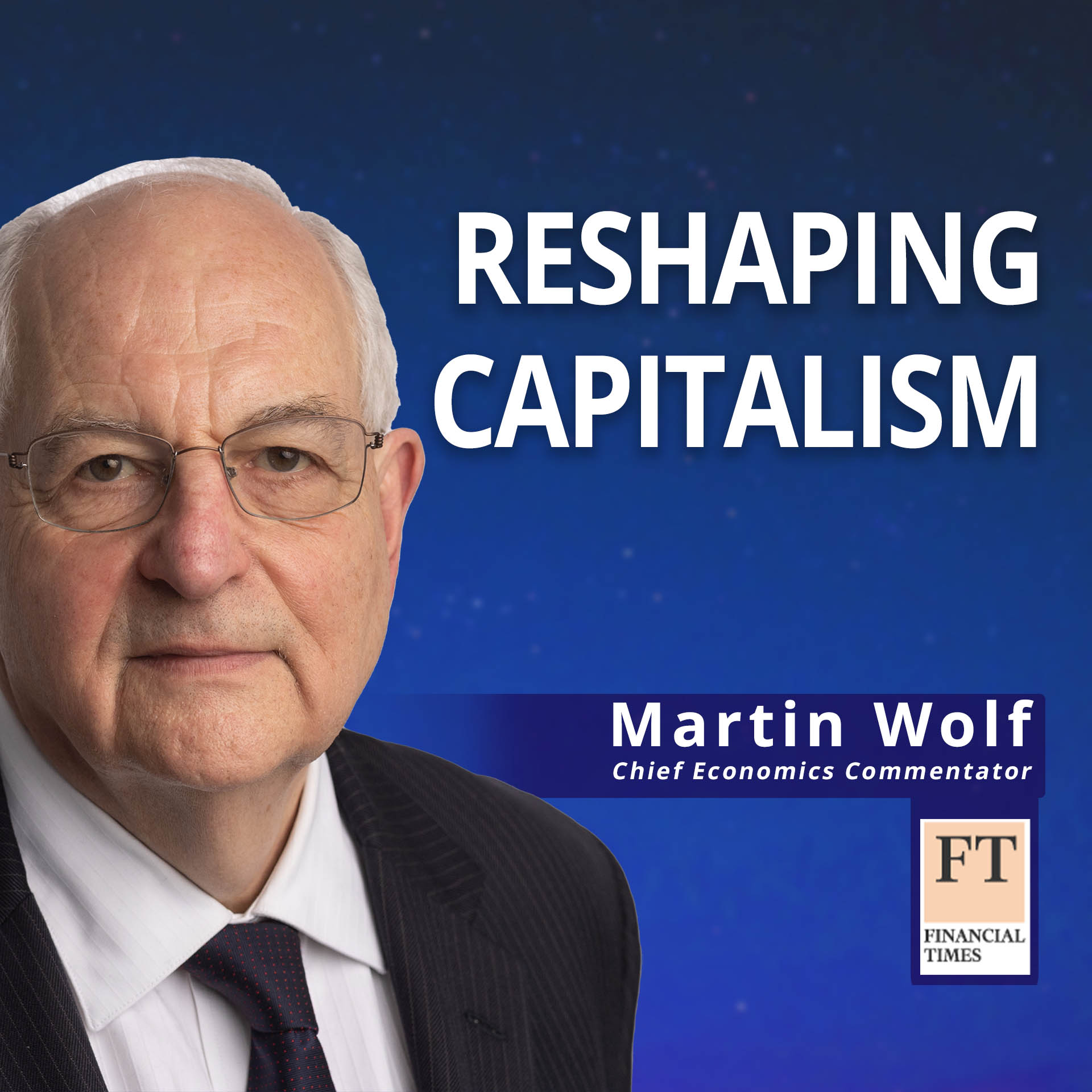
Martin Wolf
The most powerful institutions in our world are states. After that, they're corporations. But even them, even they are within states, really big and powerful ones. So if you want to reform global institutions, you have to reform states. And to reform states, you have to make the political systems of states believe reform is possible, desirable and workable. Welcome to the special English edition of Der Grosse Neustadt, a German podcast series by Sibylla Bart, in which she talks to pioneering leaders who, inspired by the World Economic Forum's Great Reset Initiative, create revolutionary projects that actually do make our world smarter, greener and fair.
- [00:52]
Sibylla Bart
We are deeply honored to host Martin Wolff, the associate editor and chief economics commentator at the Financial Times. Martin's illustrious career in financial journalism, spanning 35 years, has earned him numerous awards, including the prestigious Commander of the Order of the British Empire for his services to financial journalism. He is widely regarded as one of the most influential economic journalists globally and has been named among the top 100 global thinkers by both Prospect and Foreign Policy magazine. With such an extraordinary career, there's a wealth of topics to explore with Martin. We will begin with his new book, the Crisis of Democratic Capitalism, which he recently published. We will delve deeply into capitalism and the resurgence of geopolitics in business. We will discuss democracy and globalization, fascism and plutocracy, the pressing need for reform within the Bretton woods institutions, as well as the significance of the G20 and the lessons learned from the global financial crisis. A very warm welcome to Martin Wolff in London. How are you today?
- [02:11]
Martin Wolf
I'm fine, thank you. Very well, thank you very much.
- [02:14]
Sibylla Bart
Let's start with the wonderful book you have written, the Crisis of Democratic Capitalism, in which you discuss the fragile marriage of democracy and capitalism. How delicate is this union today?
- [02:32]
Martin Wolf
Well, I'm not sure how delicate it is and because we are still in, I think, a situation of hope rather than despair. But it's clearly more fragile than most of us thought it would be 15 or even 10 years ago. What we are seeing across much of the world is the rise of autocracy. That's true in much of many emerging and developing countries, countries. It's true of course, in countries of the former Soviet Union, above all Russia itself. That's completely obvious. And I would say that even in high income democracies that we thought of as completely stable, with an understanding of the proper relationship between democracy, the market economy, the rule of law, the electoral system, we are seeing some pretty significant reactions against this system, above all in the United States, but not exclusively so. And so I would say we have to regard where we are now as very fragile.
- [03:52]
Sibylla Bart
What do you see as the causes of this development?
- [03:58]
Martin Wolf
Well, in my book, and I still stand by this, I think a big part of it was that partly for reasons that could not have been prevented, but partly for reasons that could have been prevented, for a quite sizable proportion of the population in our countries, the last 30 or 40 years has not gone as well as they hoped and expected. There has been, and this varies across countries, very significant deindustrialization, very significant rises in inequality, reductions in the opportunities for people who are not successful graduates of prestigious universities. And in addition to these economic causes, people clearly feel pressured by cultural developments and the sense that the culture, sometimes even the country they knew is disappearing or at least weakening. And finally, for the hugely increased number of people who've been to university, many of them feel that the future opened up to them is not a very good one. They're very worried about things like climate, they're worried about the sorts of lives they were able to lead. So I think there's a lot of despair around.
- [05:34]
Sibylla Bart
How much do you think goes back to the global financial crisis?
- [05:41]
Martin Wolf
Well, I think that there are two elements in this. The global financial crisis itself was a very significant development. It was a big shock. It was a clear failure of the financial system and so of a crucial part of capitalism. And it led to an extraordinary rescue of the financial system, which I think was necessary, but obviously very expensive by governments. And so it indicated to many ordinary people that the system was both incompetent and in some deep way corrupt. But I would also add that of course, in the last few years, with the pandemic, the post pandemic disruption, the inflation and the war in Ukraine, there's been a lot more disruption which people have suffered. And in Britain we refer to this now as the cost of living crisis. And that, as in Britain, as in many other countries, followed this very long period of stagnant real incomes, which itself followed the global financial crisis. So in addition to these very long run processes which I discussed earlier, there are these very unhappy outcomes of the last 15 years.
- [07:07]
Sibylla Bart
If I think back of the global financial crisis, you were saying that it was a clear failure of the financial system, but it was much more than that because the end of the day we bailed out the financial system and we didn't bail out anybody else.
- [07:28]
Martin Wolf
Well, that's where it seems so unjust. Personally, I don't think there was any option but to bail out the financial system. That's one of the tragedies of that situation, we couldn't repeat what we did in the early 30s, which had far worse consequences. So my view is that the financial system is always at the bottom part of the state, particularly the monetary part of the financial system. So we shouldn't be surprised by what happened, but we should have been surprised by the fact that it was necessary. I mean, that is obviously is the great failure. But there's no doubt this led to a great deal of skepticism about modern capitalism and of course, antagonism to it. But what is most interesting, perhaps, which is why I stress this, is that the dominant reaction has been from the right rather than the left. We haven't seen anti capitalism as much as we've seen nationalism and anti democratic sentiments. And that must be explained in some more complicated way.
- [08:45]
Sibylla Bart
Your book focuses on the democratic capitalism. Where do you see the strengths right now?
- [08:55]
Martin Wolf
Well, my view is that democracy and the market economy, which is basically what I mean by capitalism, need each other. They are a marriage. I refer to them as a marriage of complementary opposites. We've never had large scale and stable democracy without a market economy. And I don't think there's any surprise about that. It's very clear that in practice and ideologically, they have very much in common, but they're also intention. And if you allow either the democracy to turn into a plebiscitory dictatorship, the idea of the absolute rule of the majority on the one hand, or if you think that the market must triumph over the state altogether and so democracy becomes meaningless, either of these extremes is destructive not only of the marriage, but the destructive, but destructive of the civilization that they uphold. But I remain of the view that democracy is a tremendously valuable political system. Despite all the problems, it's much better than any other political system we know in multiple ways, not least the ability to change who's in power peacefully, without war. And similarly, I think it's clear to me that the market economy is the most flexible and dynamic system economically. We know none other has ever worked, and we've really run experiments with extreme socialism into the ground in the last hundred years or so. So I think we know these are valuable systems. We know they're fragile, we know they can collapse. But it's very, very unlikely from historical experience that what will replace them if they should collapse, will be anything better.
- [11:11]
Sibylla Bart
Yes, you. You recently spoke about the crisis of capitalism and its implications for businesses and for leadership during the competent board session where I was participating in the ESG training program designed for board members. And in this discussion, you expressed your fear that fascism is on the rise. Is that so?
- [11:40]
Martin Wolf
Yes, I think that is so. Now, we need to be clear about what I mean by fascism, because it's a primitive idea, but also quite a complex idea. What I mean by fascism is a system of politics. It could actually coincide with quite a few different forms of economics, at least within a certain degree. But to me, the idea of fascism is there is a leader. The leader has more or less absolute power over society. The leader is backed by a movement of people who believe in that leader personally and believe in the importance of his authoritarian power profoundly. He runs a government and a legal system in which the participants are loyal to him. It's so far always been a him. Of course, it could logically be a woman too, but it hasn't been. And that structure may pretend to have elections, but the power of the state over the legal system, the electoral system and the media becomes so great that truly competitive elections are no longer possible. And it seems to me quite clear there are movements in the world. We can see them in many emerging countries today, already in Turkey or India. I won't even go into Russia. But we can also see similar attitudes in important Western countries. The Trump movement is, in this sense, a fascist movement. It's a movement about this idea of the great leader who should be given essentially unaccountable power to do what he wants. And that's what I think of as fascism. How oppressive it is, how brutal, how. What ideology of government it espouses is something else to me. Fascism. Fascism is an idea about power. It's not an idea about policy.
- [14:07]
Sibylla Bart
Yeah. Which I just remember that I went to talk with Jean Le Carrell in. In. In London in 2017, where he actually did talk about fascism already, and he said it is somehow a very attractive idea for people. Would you agree with that?
- [14:31]
Martin Wolf
You could say that fascism is a perverse. It's a perverse stepchild, if you like, of democracy. That is to say, there are different forms of authoritarianism. But this idea of the great leader, usually a demagogue who captures the loyalty of huge sections of society with the proposition, if only you believe in me and follow me, I will give you whatever you want, which may include mostly just destroying those you think of as your enemies. Often fascism expresses a profoundly negative aspiration rather than a positive one. It seems pretty clear to me that human beings are attracted by the idea of a charismatic leader. The great German sociologist Max Weber talked about that more than 100 years ago. And it's a pretty universal feature of Human society, the emergence of charismatic leaders, who often war leaders, not always who are seen as the people who will solve the problems of the people. And sometimes they make themselves kings, but in our time they tend to make themselves dictators. And I would say, unfortunately, because this sort of system simplifies politics. It simplifies for the followers who they are, it clarifies who their enemies are. It lifts all restrictions on what they are entitled to do to their enemies. This is clearly attractive to people, particularly when people are angry, frightened, frustrated or disappointed. And for the reasons we discussed earlier, there are plenty of those people in our society. So I'm not in the least surprised that this has happened. But of course, anyone with a knowledge of history will be and should be frightened. I'm not, by the way, be very, very clear when I use the this word, trying to suggest that what we're going through is the same as or will lead to the same outcomes as in the, the 1930s. I don't actually believe that. In fact, I discuss in my book the many differences, but I think the desire for a charismatic, quote, unquote, great leader who is in some sense above politics and above all above restraint, is a very attractive universal idea for human beings.
- [17:24]
Sibylla Bart
Martin, as I listened to your answer, it struck me that you are clearly articulating all our problems. So why don't we work to fix them better and thereby close the road for any potential dictator?
- [17:42]
Martin Wolf
Well, it's a very fundamental question and this has to be related to what's happened to political ideologies and ideas in the last, well, at least 50 years or longer, you might say. One of the things that it seems to me has happened is, and I think inevitably and rightly but tragically is that the failure of the communist project, which you will remember was a great utopian project, sort of destroyed the political and intellectual legitimacy of left wing utopianism or anything close to it. And so people don't believe in the, in the aspirations and hopefulness of sort of that the left at its best has offered. They see failure and they see tyranny, and that remains to this day. One of the most striking developments clearly everywhere is the weakening of the left. The second reason I think that left has got into great difficulty is not Something I thought 25 years ago is it's become too associated with contemporary capitalism. Its marriage with capitalism was too complete. And that means that many of the people who are not happy with capitalism also reject the contemporary moderate left here. I mean the social democratic left. And once the left has little to offer And I think it has shown itself not able to offer very much. Then you get into the problem that, well, what is the alternative? The old Reagan, Thatcher free market right just looks like the system support for the system which blew up in the financial crisis that brought all the trouble. So what's happening is that we've got a very dynamic populist, nationalist, let's be clear, xenophobic and authoritarian right which hasn't been in power in any of our societies since before the Second World War. And it looks fresh, it looks new and it doesn't look tainted by everything else that has happened in the last 30 or 40 years. And it offers this great leader. Usually it offers, well, it doesn't always, but it often offers a charismatic leader who people want to listen to. So this is why I think we've ended up where we are. The failure of the alternatives has left a large number of frustrated people to think we've got to have something better than what we've had. And who is offering something different? Well, these people are offering something different.
- [20:45]
Sibylla Bart
If I look at the UK because you were talking about the disappearance of the left, it looks certainly to me that at the next election that labor has a good chance to come back. So the left has something to offer.
- [21:05]
Martin Wolf
I think this is very interesting and I must say very encouraging. One of my colleagues wrote a rather good article recently in which she pointed out that right now the UK seems to have left has. Have less of a far right movement, far right, maybe unfair, a nationalist and xenophobic movement than other major European countries and America. And when we have Brexit, that didn't seem at all plausible. So I think that's encouraging to me. It cheers me up. I think what's happened, the good side has a good side and a bad side. The good side is we experiment it with such a movement, not one in any way extreme, not fascist in any real sense, but certainly nationalists and xenophobic. With Brexit and it failed. The people who promoted it ran the country very, very badly. And the British public, in a context in which we still have democratic elections, thank heavens nobody's trying to subvert the electoral process, seems to have decided they don't want any more of that, at least for the moment. So we got a relatively reasonable center right party and a relatively reasonable center left party, which has also rejected the much further left propositions of Jeremy Corbyn. Very old fashioned traditional left socialism, which I think is basically intellectually bankrupt now. So that's very attractive that we got this. But there's a big but. Keir Starmer and Rishi Sunak have got rid of the extremes and their parties, but they don't actually offer a credible positive alternative. No one who looks at their programs which are avoid. They are. They. They're devoid of serious mistakes, but they're also devoid of serious promises of anything better, of any radical change that can possibly believe that things are going to get significantly better. And what I'm concerned about is that after maybe four years or eight years of such government, the people will look at this and say, well, it hasn't changed anything for the better. It hasn't solved any of our problems. It's sort of its virtue is its absence of extreme promise, but its vice is the absence of any promise. And so if that's right, I am concerned, very concerned, that a more radical alternative, not necessarily credible and decent, but more the sort of alternative we talked about, will re emerge and therefore this story is not over.
- [24:12]
Sibylla Bart
I would like to ask you something a little more personal from my side. I lived during the Blair Brown years in Britain and I was very proud to do so. However, looking at Britain since 2016, I still have problems to come to terms with it and I don't really understand what happened in this country. What happened?
- [24:44]
Martin Wolf
Well, I feel much the same way since I've lived most of my life, not all my life in Britain. And I thought I knew it moderately well and I thought that whatever else, the British were fairly pragmatic, tolerant and not likely to be seduced by a seem quite clear a fraudulent set of promises. So why did this happen? Now I can only say that this is in retrospect, part of what happened is things I didn't understand, but part of it is what I did understand. So the thing I didn't understand while it was happening is that the underlying British economy which we created after the Thatcher era in the 80s 90s and early 2000s was substantially more fragile and less stable than I had thought. And in particular, we suffered particularly severely from deindustrialization, which had profound regional effects. And the financial sector we developed and which was so important to our apparent prosperity was in part a delusion and that was a nationwide delusion. And I suffered from that also. I didn't realize how I realized there will be a financial shock that was pretty clear in the early 2000s, but not on the scale that happened. And it left us without a real economic growth engine. So we've maintained very high employment and low unemployment, but we haven't generated rising real income for the majority of the population now for 15 years, and that's the longest time since the middle of the 19th century, as far as we know. That's clearly very serious. And then when the crisis hit, we had the bad fortune to be led by a government which had no philosophy for dealing with this crisis that got them into power. When the Tories came to power in 2010, they hadn't worked out anything new. They blamed Labor's fiscal policy for what was in fact the consequence of a global crisis and the mistakes we'd made in the way our economy had been restructured in the previous 30 years. They didn't recogn that in any way they wanted to repeat the Thatcher experiment, though it was pretty clear it wasn't going to work. And in order to do so, they decided to impose massive austerity, which imposed huge losses on the people who already suffered most from the crisis. And that, it turned out, created a. That combination of events created a large group of people who essentially no longer believed in anything. They didn't believe in New labor because they identified New labor with the crisis and the failure thereafter. And they didn't believe in traditional Toryism because the traditional Tories were Cameron and Osborne, and they'd imposed austerity and made things worse. So they were looking for something new. And that came in the form of Brexit and this very charismatic demagogue of a particularly British kind, Boris Johnson, in Line in Allegiance, in alliance with Nigel Farage. And that shifted the political balance very profoundly in the direction we saw in the Brexit campaign. So that's the story I would tell about how we got here. And it's complicated, as such things often are, but clearly very large failures in the political establishment, which is a theme I've already discussed, which then lead people to look for somebody or some leader or some set of ideas, or all of those that look new, that don't look part of the old, weary, failed establishment mantra.
- [29:27]
Sibylla Bart
If we are trying to move towards an ideal society, and you were saying already that the left, the socialism, communism has nothing to offer. So let's at least look into the different forms of capitalism, because thank God, we have a few different forms from stakeholder capitalism, welfare capitalism, financial capitalism, which one do you think has the best to offer from the point where we are now to tackle the problems we have on a global stage?
- [30:02]
Martin Wolf
Let me be clear. I still think the left has quite a bit to offer, but it's not the old Left. I think that people have lost, lost trust in that. And it's not likely to come back. At least I can't see it at the moment. It. It really seems enfeebled everywhere people are going back where I put this, when people are frightened and angry, they go tribal. And tribalism is a very basic human characteristic. And the nationalists and the conservatives offer tribalism, basically tribal culture and tribal identity. And well, we know that's what happens. It's what happened in the interwar period. Now what can we offer instead? I think that, and this is very much what I argue in my book in the way I do, that we need to build some sort of synthesis between a version of stakeholder capitalism and welfare capitalism. The synthesis will differ necessarily across countries, but the deal I think has to be to focus on the widest possible welfare of everybody in society, downplay identity, focus on what unites us. We need to bring make capitalism both more competitive with much stronger competition, at the same time as more accountable and responsible, particularly given the overwhelming importance of the great public goods which we need to protect the climate and all the rest of it. This sorts of synthesis in which capitalism is more responsible, it's not pure profit maximizing capitalism, which I think is pretty clearly defective. And I discuss that at length in my book With a welfare society looks to me the least bad promise we have. It should be stressed that it clearly isn't going to be easy. Even with that, even some of the most successful social democratic states are now struggling massively with the impact of reaction against immigration, xenophobia, sense of social disorder, this, these culture wars, quote unquote, which everybody hears about, these exist even in some of the most successful societies. Look at what's happening in Sweden at the moment or Finland. So I don't think there's anything very simple here. I do argue in my book that we will have to find some way of controlling, credibly controlling immigration. What I've seen in my country which interests me is people are quite happy with very high levels of immigration if they believe it's under control, that it is, as it were, a policy choice rather than just an overwhelming inflow. And I see this as one of the huge challenges of the future, how we manage that. So I don't have all the answers in any way. I don't think anyone does. There must be some way through this combination of ideas which will make the place better and more stable. I think that's what British politics is currently saying the people want and I very much hope it will work.
- [34:11]
Sibylla Bart
You are also have been traveling to Davos for the last 20 plus years. And I think they were the first ones who publicly question capitalism loudly and openly. How did the debate about capitalism change, change there among the leaders of the world?
- [34:40]
Martin Wolf
Well, I think that the West's view, which is really Schwa's view, is an attempt to present what I think of as a sort of Central European, I don't know if Central European is the right word, these geographical terms are a bit problematic. But German Austrian form of capitalism in which the idea that the dominance of the financial markets over the productive side of the economy is not really accepted, in which businesses are seen as permanent institutions in which shareholders play a significant part, but far from the dominant part. The businesses, as it were, are run by managers with very long term commitments to the future, in which the suppliers of capital, the suppliers of labor, the places where you work, all have a stake which you have to be responsible to. And I think these ideas are quite deep rooted in these societies as they evolved into capitalism in the 19th and 20th centuries. This is clearly a different flavor, very different flavor from contemporary Anglo American capitalism, particularly American capitalism. But it's to me, clearly still capitalism. To me, as I said, capitalism is about the market system. And once you have created the corporation which is one of the most remarkable creations of the last 200 years, institutionally, you might say the most remarkable creation of economically of the last 200 years, once you have corporations, sort of traditional free market models don't quite work. A corporation is in the market, but it's not run, as it were, in the market. It's a hierarchical structure, a hierarchical permanent institution which can change and evolve embedded within the market economy. And that changes everything. The pretense that it's just like a small family business is obviously ridiculous. So he's saying we should run it in a slightly different way. And I agree with that. Of course, the stakeholder proposition may never take in the US they have such a different history, it might not really work. But I think it's a flavor of capitalism, a very importantly different flavor of capitalism. And one I think that is very attractive and I hope it can be made to work.
- [37:59]
Sibylla Bart
Do you think that the slow but steady movement from the power of the G7 to the power of the G20 will help to enforce that a little?
- [38:18]
Martin Wolf
I don't really know. First of all, I think the G20 has proved to be not surprising, a very incoherent group in the sense that it contains now that it's once we went beyond the G7 to bring in the emerging and developing countries, we have brought in, in the process, extraordinary diversity. Now, I know quite a few of these countries, the countries that are in the G20, and they are really all, if you leave aside the G7, remarkably different from one another. They don't have and a shared economic system or a shared economic ideology. Other than that, they are somewhat suspicious of G7 hegemony. That's the only thing they share. It's a negative thing. So they don't have a single version of capitalism or of communism for that matter? Well, they're only. Even if you look at the Chinese system today, what sort of a system it is as between socialism and capitalism is quite difficult to answer, to put it mildly. It really isn't quite clear. So I would say the what the rise of the G20 and the emergence, the significant emergence of developing and emerging countries as forces in the world is just. It makes the world more complicated, more divergent, and we have to accept this more disordered. We have even less in common within this larger group than we used to have in the G7. So we've moved from an illegitimate hegemony of a few very powerful countries to a less illegitimate wider grouping of extreme diversity, which finds it very difficult to agree on things.
- [40:31]
Sibylla Bart
But if we come back to the whole idea of stakeholder capitalism, where, and I remember a conversation with Klaus Schwab where he said he wants to bring everybody who has a say in the world to the table to make a decision and that every single country and every sector, every industry has to change to make it happen. And we are moving to a format of the G20, which stands for 80% of the world's population. Wouldn't an agreement coming out of such diversity be more powerful than just the 10% of the rich countries?
- [41:11]
Martin Wolf
Well, as I said, there's no question this is more legitimate. If you could agree on things, then that will be very valuable. But I think agreement on the. The actual structure of national institutions, that is to say of how companies work, which is largely determined by the law and practices of the countries in which they have their homes, or at least very significant investments. Reaching agreement on that I don't think is going to happen. So the way I think about this is the G20 is more legitimate. We have to agree to differ. We're going to have to agree to differ. And that indeed is the only basis on which the west will be able to live with China. We're never going to agree on the political, our political and economic system with China and vice versa. That's just a reality. And I think the same to A lesser degree will be true with India or Brazil. So we accept the difference. That's part of the world. We live in Frank Sinatra world, we do it our way, but we can agree on certain objectives which we all share. So I think of them, I've done this many, talked about this many times. What are the things we all necessarily share? We need peace. We need a world order which will deliver peace. That's pretty big demand right now. Then we need a world order that will deliver to humanity prosperity. And that includes particularly help of developing and emerging countries where needed, and it's certainly needed now in a very big way. And finally, we need to protect our planet, which we all, the home we all share. So I think the G20 has to find a set of agreements. And this isn't impossible. It's made some progress in this regard, not enough, but some progress. The G20 has to find what I think of as a sort of minimum common set of arrangements and agreements that will allow us to do the best we can to achieve these three great objectives. Avoid war, avoid economic disaster, and promote economic betterment and protect the planet. And that's a restatement in a way, but it doesn't mean that we all have to agree on everything and certainly not how we all organize our own economies and societies, because they are going to remain inevitably, extraordinarily different.
- [44:26]
Sibylla Bart
So when it comes to addressing climate change and biodiversity, how can we as a society move forward more efficiently? Looking at the current structure of who is responsible for what, where and how it can all be financed and measured and controlled, it is not entirely clear to me where the world is heading it.
- [44:56]
Martin Wolf
Well, I mean, obviously the simple reality is we have failed so far to rise to the challenge of climate change. We've talked a lot about it and we haven't really done anything very much about it. And this is where we get to the really core issues. And it's not clear what the solutions are. And they are essentially political, economic. No one country can resolve this problem. Therefore it is one that has to be resolved by collective action. But creating collective action among a very large number of different players, not every country in the world, but the larger ones, creates well known problems of free riders. And in this case, the additional problem that the, the dangers seem to most people so remote, so difficult to imagine, so distant. So if you add the free to write free rider problem to what Mark Carney used to call the tragedy of the horizon, which is what I mentioned, we just can't get urgent enough action or even begin to and we have, in fact, basically, with the Paris Agreement, allowed countries to make their own commitments. We haven't got common commitments and not really. We don't have common mechanisms. We are basically countries have made their own commitments nationally, national determined contributions, as they call it, nationally determined contributions, if I remember correctly. And they all do it differently. And the truth is, not enough has happened, not enough has begun to happen. But is there a solution to that? Well, the tragedy of collective action and of the horizon could be dealt with in theory. If we had a single world government with a single world dictator, as it were, such a person or institution could say, this is what we're going to do and we're all going to do it together because I'm in charge. But pretty obviously no such person or institution is in charge and we're not going to get such a person or institution, and I wouldn't like it anyway. So it's not that conceptually, couldn't imagine a solution, but in practice we don't have it and we wouldn't want it. So I don't actually know where we go from here. The most plausible story, I think, is that the climate disasters build up to a level at which they become the overwhelmingly dominant issues in domestic politics in many most important countries. And that shifts the whole global debate and the urgency of it from a, well, this is something it'd be nice to fix sometime in the future sort of problem to this is the biggest problem in the world. We have to fix it now. By which time it might well be too late. I've been writing about this for 20 years, and it's always been obvious that getting action on this is going to be staggeringly difficult. And it has turned out to be staggeringly difficult for just the reasons we expected. But that's just the reality. It just is staggeringly difficult for human beings to agree on the extraordinary actions that are needed in concert in the time we have available.
- [49:08]
Sibylla Bart
But between you, you mentioned that we don't have this one dictatorial world leader. Between that and what we got right now was of Bretton woods institutions. There is a massive gap. So we could either reform the Bretton woods institution radically or we create new institutions which fresh ideas and fresh staff. Is that something you discuss already or is it out of your. Do you think it's nonsense?
- [49:47]
Martin Wolf
Well, I think for me, it would be a waste of time. My. Well, I have a very simple view about the history of global institutions. Global institutions. The creation of global institutions is the product of a huge, I mean, simply huge political effort and the situations in which this happens is essentially after a catastrophe in which all existing institutions collapse or are shown to be utterly and completely unworkable and we start anew. So in practice, if we go back over the last hundred years, there are two periods when a large number of new institutions were created which actually had teeth, which were relevant institutions. The first was a failed attempt, was in the aftermath of the First World War with the creation of the League of Nations and associated institutions. And the second was during and after the Second World War, going up to and including the creation of the eec. I won't go into all the details of that and which became the European Union. And that was the product. Those were both the product of catastrophe. Now, there's no doubt if the catastrophe is sufficiently severe, we will do this again. But since we don't want that to happen and the and it will be unbelievably horrible, we are basically stuck with the institutions we have, which aren't bad ones. I don't think they're particularly bad institutions. They cover most of the things we would want to cover. The problem are twofold. There are obviously some reforms you would want to make within them. They're quite important. But the really big problem is the connection of these institutions to domestic politics. The point I make again and again is global institutions don't mobilize resources on their own. They don't run resources on their own. They have essentially little legitimacy on their own. Their legitimacy is rooted in the support they get from their members, and particularly from their more powerful members and the capacity of their members to mobilize resources because they control the resources of very, very powerful states. The most fundamental reality of our world is sort of the obvious one, is that the most powerful institutions in our world are states. After that, they're corporations. But even them, even they are within states, really big and powerful ones. So if you want to reform global institutions, you have to reform states. And to reform states, you have to make the political systems of states believe reform is possible, desirable and workable. And our politic, political processes, and this brings us back to earlier discussions, just have proved unable to do this. On the contrary, far from doing that, it's pretty obvious that they're disintegrating. They are losing control of the political life of their own countries. And in that situation, I just don't see what having a discussion of a new Bretton woods would achieve. Nobody would turn up. There wouldn't be anyone there to discuss it. And so we have to work with what we have. The Biggest thing we need is to strengthen the climate institutions, make the COP a really effective system. But the reason they can't do that is what they have to do is to change the way all our economies run. And nobody's going to allow them to do that.
- [54:18]
Sibylla Bart
Yeah, I have so many thoughts now. Your answer was full of interesting points. And one, for example, I would like to start when you say a new institution nobody would sign up for, I'm not sure about that. I would think that the Global south would be just trade there.
- [54:39]
Martin Wolf
Yeah, but the problem is the Global south doesn't have the resources to change anything. This is brings us back to the G70. In the 1970s there was a very extensive desire for a completely new system. But with the exception of China today, the Global south doesn't have the resources to create a new order. The and China has resources to create a partial new order which it is creating. Unfortunately in some respects, really quite important respects, it's quite problematic for other members of the Global South. We discuss with highly indebted countries which have large debts to China, how difficult the experience of debt restructuring is. But there isn't the economic capacity, the financial capacity, the resources in the Global south to create a new order. And that's still today, basically the reality.
- [55:55]
Sibylla Bart
In the depth restructuring. The president of the Rockefeller foundation said in an interview to me that the World bank, for example, could lend up to a trillion dollars and would still keep their AA weighting. So why don't they?
- [56:18]
Martin Wolf
This is quite a widely shared view and be absolutely honest, I don't know whether it's true and neither does he because nobody has tried. But there is an important point here which is in order for that to happen, the shareholders of the World bank have to agree and if it turns out to be wrong, then the liabilities will have to be met by the rich country shareholders because they've supplied most of the capital to this institution. And for that to be done, essentially the new arrangements, as far as I can see, would clearly need the legal consent of the shareholders, which includes U.S. congress, you know, the Bundestag and all the rest of it. And they will be told if we increase the lending by the World bank by a trillion dollars, you will bear no more risk and we will make enormous improvements in climate change. By the way, this is just a policy change in the World bank, it's not a change in the institution. You'd still have the World Bank. So that's important in terms of what it does for institutions. I think what's happened so far is that nobody thinks they can persuade their parliaments that they should take this gamble, and that's why they're not doing it. I tend to think they should take the gamble, but they have to recognize that if it turns out not to work and you get an enormous amount of bad debt at the end of this trillion loan, that since the bonds have been floated or the insurance payments have been promised, that that money will have to be raised. And if that money is going to be raised, it will come from the taxpayers of developed countries. And that's going to be a very difficult thing to solve.
- [58:42]
Sibylla Bart
Well, on this happy note, thank you very much for an absolutely fantastic hour. I enjoyed every minute and I'm very grateful that you took time here on on a Sunday afternoon because you're about to fly off tomorrow. Thank you very much.
- [58:59]
Martin Wolf
Martin Wolf, you've been listening to a special English edition of De Gorse Neustadt, a German podcast series by Sibilla Barton in which she talks to pioneering leaders who are committed to making our world smarter, greener and fairer. For more information, please visit www.sibyllabaden.com and the official site of the World Economic Forum.