← Der Große Neustart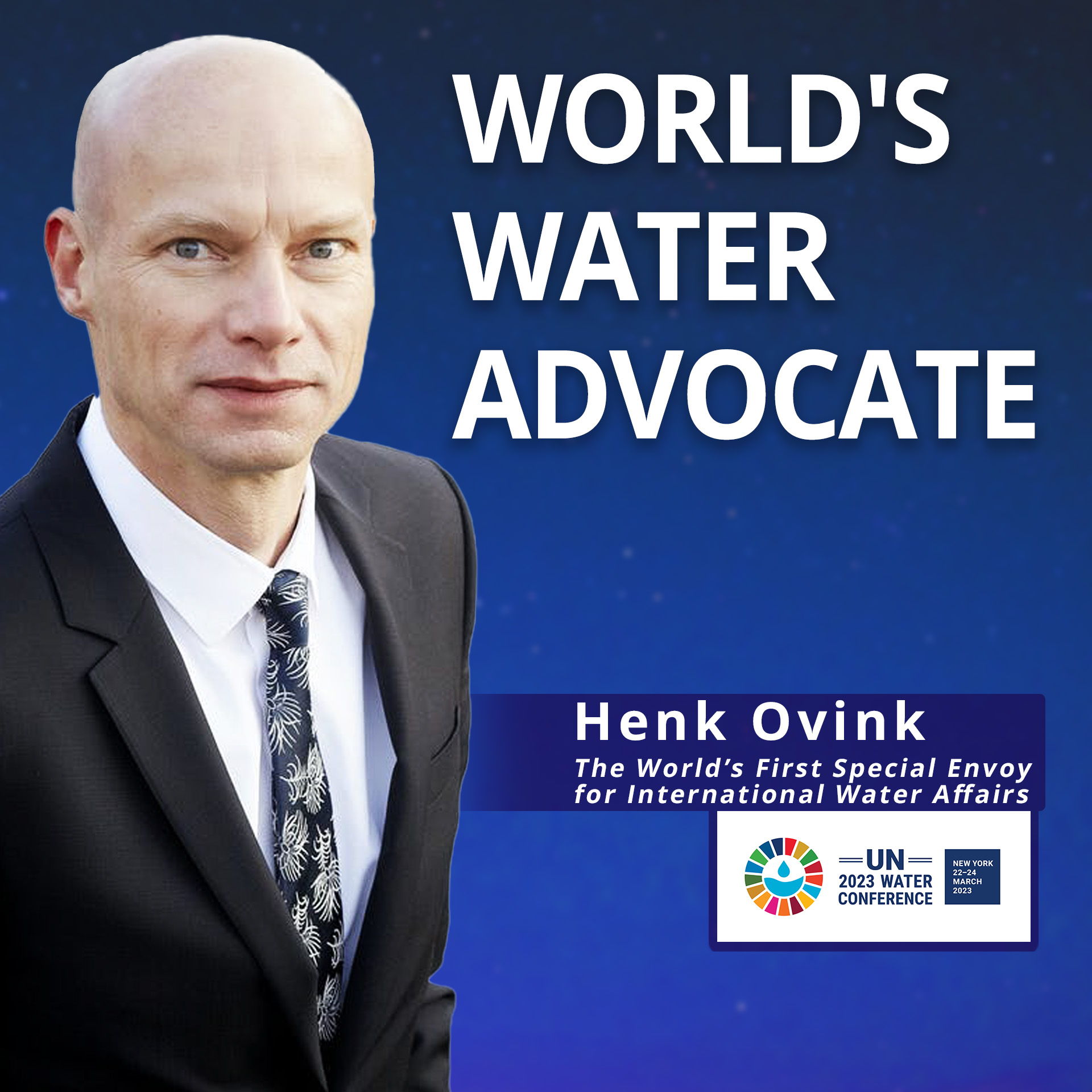
Der Große Neustart
No Water, No Climate, No Survival: Special Envoy's Fight for Global Stability
00:59:01
Loading summary
Transcript39 lines
- [00:01]
Henk Oving
The water cycle is out of balance. We have to restore that because this out of balance situation is undermining our security economy, our food security, the environment and biodiversity. Welcome to the special English edition of Der Grosse Neustadt, a German podcast series by Sibyla Bach in which she talks to pioneering leaders who, inspired by the World Economic Forum's great Reset initiative, create revolutionary projects that actually do make up our world smarter, greener and fairer.
- [00:39]
Sibylle Bach
Introducing Henk Owink, the world's first special envoy for international water affairs. In a world with urgent water challenges, 2.2 billion people have no access to drinking water and 4.2 billion people lack access to safe sanitation services. We do seek pioneers capable of transforming promises into progress. Renowned for their expertise and governance, the Netherlands assumes a leadership role in addressing these crises. And Hank Oving, armed with extensive knowledge and experience, shines as a beacon of hope for global collaboration. We will talk about the global situation, water scarcity and water related conflicts, groundwater depletion and oceans under threat. Also about how a sustainable water future can look like. Mindful of the interconnectedness of water with all of the United Nations 17 Sustainable Development Goals. Good morning. Henk Owink, you are working currently in New York. How are you?
- [01:48]
Henk Oving
I'm good. Good afternoon, Sibylle. And it's great to talk to you on this so important issue, water as you rightly address.
- [01:58]
Sibylle Bach
Hank, can you give us an overview of the current global situation and highlight some of the most pressing key challenges we face today?
- [02:11]
Henk Oving
Yeah, it's a bleak picture, sorry to say. And I think the current situation, when we think about water, there is one part which we have to address is water sanitation and hygiene. It's 2023 and still billions, billions of people around the world lack access to safe drinking water, hygiene facilities and sanitation facilities. And that has an immediate impact on their health, but also equal opportunities, limiting debt for predominantly women and girls in very vulnerable context. And I think that is, that is a critical part. Second is that freshwater availability is, is less, is becoming less and less. So we drink up the fresh water from our aquifers, our groundwater, our rivers and lakes, and what we have becomes more polluted and more saline. And that there is freshwater scarcity. And at the same time, because of land degradation, deforestorization exacerbated by climate change, we now have atmospheric rivers impacting water insecurity over continents. So water used to be something very tactile on a local scale. You had a river, a lake source, you bring water to wherever you would need it. Right now that availability is not secure. And at the same time, the influences of that water insecurity comes from across other continents. So rain events in Africa come from atmospheric rivers that originate in Latin America, as you know, as just one example. So the water cycle is out of balance and we have to restore that, because this out of balance situation is undermining our security, our economy, our food security, the environment and biodiversity. And with less fresh water available and more pollution exacerbated by climate change, we lose our wetlands, our biodiversity is in decline. And that means that that need, the resiliency needed, that environmental need, that we so much need for everything else is also challenged. And then if we look at the climate apart, is that. But you know, 90% or more of all these climate disasters are water related, with too much, too little and too polluted water. So water hurts us, but it's also the origin of climate change. And if we don't fix the water crisis, we'll never be able to fix the climate crisis. So there is massive amount of opportunity to do so. But right now we're not. And that means that the state of water security is increasingly bad and that is undermining everything else that we want to achieve. So we're not in a good place right now. We can be, because the upside is that the moment we invest in water, we invest in water in its availability, its quality, its security, it trickles down across every sustainable development goal. It helps catalyze climate action, both for mitigation as well as adaptation. So with water there's always these two. There's a real upside because it's a solution broker. It helps drive approaches, builds capacity and innovations and solutions that can help us scale and speed up sustainable development in a just and climate secure way. But if we don't, it hits us back. So it's one or the other and we have to start to understand this, incorporate water and everything we do to make sure that we increase our security. Example on how it did one and a half years ago, a little over one and a half years ago, we had a food security summit, a food system summit about food security for the world. Water was not mentioned. So we can talk about food in silos without even thinking about water security. And it's of course ridiculous from a perspective, and so I'm not a water engineer, but it's ridiculous from the perspective of food security. But we do it because we silo ourselves up. Last cop, the cop in Sharm El Sheikh was for the first time that water was mentioned and then only in a Cover text of the outcome document. So that is not part of the negotiations and only in the connection to adaptation, not mitigation. Because you know, in the climate negotiations, water is then seen as a new issue and therefore making things more complex. It's crazy. Water is. Water security is the core for climate mitigation. Water security is the core for climate. So we have to move beyond these deficits.
- [07:45]
Sibylle Bach
Yeah. Hank, may I just one question. In here you describe that, that water is not included in the whole circle or conversation and everything is in silos and you are at the center. And the governments have in 2015 already signed the Sustainable Development Goals where water and oceans, etc. Are in. In the center. And everybody knows water is life. Without water there is no life. And yet you give us this really bleak picture. Why, why is that?
- [08:35]
Henk Oving
There's there, there's no one reason there many vested interest, of course, changing course behavior. Look for instance at food and agriculture we have like millions of dollars going into food subsidies without acknowledging the relationship to water security. Water is always being taken for granted. So I think it's not so much the lack of understanding that you need water for food. There's a lack of understanding that water availability is insecure. This, this January I was part of a conversation where an agriculture minister of a large country in the world actually said no, water is a distribution problem. That is not the case. But that is still a misunderstanding, a misconception. So I think the. Of course there is a distribution question. We need infrastructure adequately in place. There is non revenue water, so that means a badly functioning infrastructure that is causing water insecurity in places where that's not necessary. But if we look at urbanization and informal settlements connected to that, that large majority of urban populations around the world do not have access to safe drinking water and it comes by truck and they pay five to 50 times as much for water that others that are connected to infrastructure and just have running from their tips. So I think there is a distribution question, but there is before that. I'm not sure if that's the right word. But the stewardship question, an understanding of that water is a scarce resource and that we have to treat it as a scarce resource. Water is also a human right and therefore it's not a commodity. But you have to put a value to water in the context of its economic, environmental, social and cultural values. And the high level panel water that I helped set up and that delivered the report in 2018, one of the outcome was really about value, really understanding the value of water in the context of our environment, our economies, our communities, our goals and the things that we want to achieve. And I think that is a lack in understanding that is changing. Luckily, the 2023 Water Conference was not for nothing a turning point. For the first time in 46 years, more than 11,000 people got together here in New York at the UN. There were over 100 mayors, ministers and presidents from across the world, NGOs and private sectors, indigenous communities, youth in large amounts, coming to New York to really say water is key and has to be core and central of the development, the humanitarian and the climate agenda. So I think there's a change, there's a change happening, but we're not there ever. In the beginning of delivering upon that promise, you saw the same with adaptation coming out of Paris. Half of the agreement was about mitigation, half on adaptation. Adaptation was also seen, rightly so, as the enemy for mitigation. The more we think that with adaptation we can delay the impact of mitigation, the less emphasis there is on mitigation in the context of really changing our behavior are the way how we are, our economies are organized the way how we, you know, how we behave ourselves. It's of course, and, and, and I remember former Secretary General Ban Ki Moon saying, you know, it was the hardest challenge to bring them together and we lost the momentum for adaptation. After Paris, it took quite a bit of time. The Netherlands hosted their first climate adaptation summit a couple of years ago to really push, not adaptation as this as the solution, no as the end. And it's mitigation and adaptation. We need them both. And within adaptation, water of course plays a critical role, but within mitigation, water plays a critical role. I think we, we lost time. Yes, I totally agree. We're catching up fast and we have to.
- [13:39]
Sibylle Bach
I pick up on a word which I, I personally found quite shocking now that you talked about the value of water. How can we live in a world that has 2.2 billion people with a lack of safe drinking water and more than 4 billion, that is every second person lacks access to sanitation services, as you said, and we still need to talk about the value of water. Isn't that ridiculous?
- [14:23]
Henk Oving
Yeah. Short answer, yes. Does it help? No.
- [14:30]
Sibylle Bach
When you talk about the wasted interests that can mean anything to anybody. Without going into too much detail now, I know there are a lot of talks going on and so on. Can you lead us a bit into a direction of where the obstacles are?
- [14:50]
Henk Oving
This is complex. Water, sanitation, hygiene, and the building that lack access to drinking water and sanitation services. And for citizens, I think the water sector itself is small and fragmented. The solutions to bring the mid scale at the same time they are there and around the world. There's a lot of effort in moving forward. There are lucky good examples on that. But it's in the context of a growing population and growing demand. Also a matter of combination of capacity in communities and service providers. There is a question on implementation and maintenance and operation. And of course there's a question on policies and regulations on leadership as well as there is a question on finance we calculated for the African continent. I think it's a quadrupling of funding that is needed, but the money itself is not enough. That has to be paired with a leadership approach, policies and regulations as well as capacity from the ground up. It is invested into the institutions, the communities and the sectors that are connected to that. I think it's all. It demands a whole government as well as a whole of society approach to be able to then deal with it. And it's improving. But we're not, you know, we're not at speed and scale where we supposed to. And that is simple. Yes, can only say it. And we need to pick up that speed there rapidly. When it comes to availability, you see that, you know, the biggest consumption of water, the food sector. Yeah. As a lack of awareness. When it comes to water, water's values, you could say it's almost free and always there. And the moment it's not there, we, you know, we now have a dam break in Ukraine that is undermining food stability not only for the Ukraine, but for the world. So that awareness on that relationship is sometimes strengthened by these type of disasters. But of course we should not need disasters to strengthen our awareness and build up capacity and action. It should come from common sense. But unluckily that is not the case. Of course.
- [17:52]
Sibylle Bach
But also if we look at water related conflicts, before we talked, I did a bit of research and there was a study that said it is estimated that around 40% of the world's population lives in water stress regions and that is of course a strong driver for conflicts. So how do you approach those problems? Are there any diplomatic strategies you can use to. Yeah, hopefully peacefully resolve disputes.
- [18:31]
Henk Oving
Yeah. So the challenge here is that water in itself is hardly ever the sole reason for a conflict, but it can be a mechanism in a context. And there was a. There's a lot of riding on Syria and how years of drought helped increase instability and led to the massive civil war. You could almost say in Syria. At the same time, in the region Jordania also drought. There was no, no conflict like that. So I mean Assad himself is to be blamed in his regime for what happens, not water. So don't attribute things to water that it can't hold. There's always a combination. But yes, water insecurity is destabilizing societies and therefore destabilizes security and exacerbated by climate and over consumption, use and production as well as pollution. It only weakens society's capacity. And I think here we saw it with the pandemic, we all set where we could was your hands. But imagine the billions of people that could not. It undermines health for many people around the world. So yes it is. Water insecurity is a destabilizing factor. So getting water right is a key foundation and foundational layer for security writ large. So I think that is what we know in the combination with climate change. And then political instability is only getting worse. So we have to again ensuring that your water governance across sector silos and divides borders is in place to take care of this scarce resource in such a way that food security is guaranteed, kids can go to school, women can work, there are jobs that are secured and you see a trickle up effect of that same water security in the context that is helping to deliver stability because there's education and jobs and that stability is of critical importance for overcoming the issues that lead to conflict. So I think the water is a key part of that in the context of a solution broker and we have to ensure that we focus more on.
- [21:34]
Sibylle Bach
You. Yeah, I pick up on your Jordan example. There was a glimpse of hope that I saw in your work and it was about the Trilateral Water Working Group with Israeli and Palestinian experts. So I hope it's a glimpse of hope. It has been facilitated by the Netherlands. Can you tell us anything about it?
- [22:05]
Henk Oving
Well, it's not a secret in the sense that we hide it, but it's also something that we do in pure confidence with the Palestinians and the Israelis with the help and support of the global community. We identified that there are many, many things in the instability in that part of the region that can be resolved. And we provide our knowledge and coordinating capacity, as said in the context of whatever is needed and needs to happen. And water is of course critical. It is also a shared resource, both freshwater availability as well as wastewater and wastewater treatment, as well as the needed care of that water by reducing water use, reusing and recycling it. So there are political and cultural as well as governance and finance and technical parts to that and Identifying them all in the context of both the west bank and Gaza led to an agenda of collaboration and you could say parallel, parallel to the political challenges and conversations that are happening. So we try to focus on the issue of water security for both to ensure that, you know, efforts everyone is taking to be able to work on that are cleared and capacity increases both individually and professionally, as well as organizationally as well as in the infrastructure and needed to deal with it. And so, you know, these processes need a long, need a long time. But you know, over the years I've been able. You really see progress. Is it fast enough? No. Yeah, yeah, yeah, yeah, yeah. Is it fast enough? No. Do we see ups and downs? Yes. I remember 2020, the first year of the pandemic. The Mediterranean in front of Gaza was blue again because wastewater treatment plants were fracturing functioning. You know, it was a better arrangement between the Israelis and the Palestinians on water provision. So. And of course the then conflict in Gaza that led to an outburst undermined it immediately. So there is these. You see the ups and downs. Right now we look at the west bank, the wastewater treatment, reducing water reusing and recycling. It also in the context of agriculture, highlight stream of opportunities of investment that are directly related to food security. And I think strategic approach to this in combination with capacity development, exchange of knowledge and good coordination among donors is, is a critical success. I mean, it's not easy. Yeah, yeah, yeah, yeah.
- [25:45]
Sibylle Bach
Can I ask you because it, it just strikes me that you were the first water international water envoy. Are they by now more than you?
- [25:56]
Henk Oving
Yeah, there are more. Yeah, yeah. So I, I don't know them all, but I know of some in Tajikistan, our colleague co host country, partner country for the UN Conference Sultan. It's now a special envoy for the president of Water Finland appointed I think last year its first water envoy. And the US also appointed the water envoy, Monica Medina, but she has a new job, so they will. They're looking for a replacement. Sometimes there are envoys dedicated to a specific task. So two countries who have a challenge, not so much a conflict, but a challenge on what I can appoint envoys on both sides, but that is different with a global envoy like myself. I think there are not a lot, but I know of Tajikistan, Finland, the US and the Netherlands for sure that have one.
- [27:02]
Sibylle Bach
Before we move to the more positive side, I would like to know a little more about the issue of wastewater management because roughly 80% of global wastewater is released into the environment without proper treatment. And I'm currently in France and learned the quite shocking Truth, when I read the, the English speaking paper here in called Connection and they talk about that less than 1% of France's water comes from reused wastewater, 1% compared to 8%, not much better in Italy or 14 in Spain and of course 80% and more in Israel. And as we know, Israel is the world leader in wastewater recycling. So what about Europe? What is the matter with us? Why aren't we more careful with water and where are the regulators?
- [28:09]
Henk Oving
Yeah, I think the why, I think it's why do we continue to invest in economies that increase emissions and increase climate change at this scale unprecedented why do we cause wars? Why? You know, existential question. I don't have a good answer to one. Of course there, there's vested interest and we hate to shy away from them, which I think is not a good thing. So there's a judgment but, and this is of course, of course decay there, there are power structures that we don't want to get, you know, say goodbye to ways of living from the past that we have a hard time dealing with saying goodbye to. So there are many, probably many, many reasons why. I think the thing is how to overcome it. It is indeed understanding the whys, but also understanding the opportunity, the alternative. And I think here we lack behind massively. So if, if, if I, if we, if I go back to the pandemic, it was not only as a health crisis, was also economic crisis that you saw economies, you know, not grinding to a hole but you know, struggling. So in, you know, the continuation of these economies for stability, social in, in the countries as well as globally was a critical importance. So we needed investment opportunities. And what we did is it was a little exercise in the beginning of the pandemic. I helped set up actually and got pretty much afraid of is that if we want to put in place the use the pandemic as a way to put in place the alternative of the existing use it also as a window of opportunity that if we are going to increase the opportunities for investment, they better be the investment in sustainable development and adjust to a, in climate action in the context of the Paris Agreement. So you could almost say the pandemic was a window of opportunity to scale up investment. Turns out those pipelines are not on the shelf and we just lack the programs, projects and pipelines that actually present those stability. So there is a, is a real need to focus on the development of those alternatives to put them in place of the existing. So yes, it's vested interest. It's you know, our past practices. It's Policies and regulations that are coming from yesterday, not from tomorrow. At the same time we have 17 SDD's that define the 2030 Agenda for Sustainable development. We have a Paris agreement that we can fulfill, but we lack the alternative for the existing. And therefore it is knowing that it is about vested interest and past practices. Even more scarier for the existing powers to move towards, towards those that alternative future because it's uncertain and we have to get rid of that uncertainty. And it's possible every time we do. You see many, you know, many opportunities that create jobs, that create opportunity, a safe environment, climate, justice. But there is a lack in scale and capacity there. The past provides us with more opportunities to invest in stupidity than that. The future now gives us, you know, helps us to step up, to develop the opportunities to invest in the things that we should invest in.
- [32:25]
Sibylle Bach
Yeah, yeah, we, we also had in 2020 the massive opportunity to make it better. Because with the great reset of the World Economic Forum, businesses were ready to do their part and they gave the esg, the environmental, social and governmental metrics really a good run. However, by now, three years later, the headwind got stronger and the window of opportunity slightly smaller. So what do we do, Hank? What is it that we need most right now? More collaboration?
- [33:08]
Henk Oving
Yes, of course we do. We need to invest heavily in these alternatives and partnerships help because the future is more uncertain. So you can't do it alone. We have to bridge divide and overcome sectoral divides. We have to step up over the lock ins we face. So yes, we need these alternatives and they are strengthened by partnerships that help also foster innovation, bring forward youth and activism, incorporate science and data to ensure that they're, you know, they're fact based and underpinned by the best available insights from around the world. So yes, it's two at the same time. It's also a level of how that alternative indeed becomes the alternative. So we need leadership and that is not only top down, but that is leadership that also starts with who do you vote for? Do you vote for the party that brings you back to the past or helps you forward to that future? Where is your money going and how do you invest it? So it's leadership, you know, across all scales, levels of society. And I think the challenges we currently face around the world perhaps make us wiser or perhaps not. You know, the way scientists now look at it, Europe is for one is in big distress. So we have more and more extremes around the world. Also on the European continent, so with longer periods of drought, they're really destabilizing our food production, our security, our environment and our economy. And at the same time, massive flood events like Dune, what is it? Three years ago in Germany, how many people died over 200 in Europe for from a flood event? That is not necessary. We don't need those casualties and that impact. Our infrastructure could be up to date. Our disaster preparedness and response should be, you know, of the best, should be the best of the world. So there is water quality. We have a European water framework, we should be able to deliver on it because it's also directly related to our economic development, etc. Etc. Etc. So yes, we can, but we're not doing enough.
- [36:04]
Sibylle Bach
Do you think with all the global frameworks we have into place and we are still where we are, that local activity and I talk more local in regions rather than nations, local activity could be a key.
- [36:24]
Henk Oving
Yeah, I think it's yes and yes. It's both that you need local action and we see local action. It, but it's not enough. And I think the, the, the, the water system showcased it and their dependency across local borders and boundaries is key. If I drink up all the water for food security in my city, you know, there's nothing left for the city and the industry downstream. If I build a dam for energy and water provision, environments upstream as well as communities are affected because all of a sudden there's a lake in the places where people were living and downstream are becoming dependent. And this is in a country, but look at a cross country, Ethiopia building a dam, Egyptian and Sudan having to deal with it. The Mekong and all these other trend boundary rivers are stuffed with infrastructure with vulnerability. So yes, local capacity and solutions are key in the context of systems that are larger than those local systems. If we don't understand it, then local solutions can actually create negative impacts beyond it. But not to say that local is not local is of key import, but it's local to global and back again. So yes, we need these global framework and these regional approaches and that understanding to inform local action where local action then can trickle up to ensure security and sustainability and justice and climate action for all. So it's a mix. But yeah, if that, that capacity and leadership and empowerment is not there on the local level, forget uni. This is where, where it, this is where implementation happens. This is where maintenance and operation should happen. This is where the investment, you know, pan out. This is where we feel the heat. So yes, but not without the relationship and the understanding of these interdependencies across scales and sectors way beyond that Local level. And to your earlier point on private sector, with the conference we saw a massive amount of private sector stand up cdp. The carbon Disclosure program in the UK helps private sector understand water related risks and helps them in presenting pathways to invest in water resiliency beyond their, their own markets to ensure that whatever they do is also good for their watershed or their supply chain for their workers. So I think there's an increasing amount of awareness and understanding among private sector and financiers that it's not so much only what matters on the scale of your business, but it's on the scale of the system where your business actually plays out. And those systems are societies and those societies are beyond communities and cities. And I think that increased understanding from private sector and financiers is very helpful. Also informing ways how governments can draft policies and regulations for them.
- [40:09]
Sibylle Bach
From my feeling, because I had an early in 21 also a long conversation with Arim Steiner, the UNDP administrator and we were talking about similar things and I said is there not an increase now on collaboration? Isn't it. Aren't. Isn't the business sector now coming to help? Well, he was quite wary about it. And if you say we see now a huge increase and I can see that as well. The point is also that they deliver on the promises. Do they deliver on the promises?
- [40:58]
Henk Oving
Yeah, well, bit is for everybody. Yeah, it's, it's the good question for everybody. I don't know. And we put in place transparency mechanisms, accountability mechanisms. You know, the proof of the pudding is in the eating right now. And I think, I think interesting and challenging and you know, the climate is changing at the scale that the impacts of that are felt across the world in the developed and in the developing world. There's no escape. So do we deliver? We'll see. We face the consequences of non delivery. This is not an, you know, not in my backyard. It's in our front and backyard. It's in our basement, in our, you know, it's in our family. Yeah, this is where we feel the heat. Literally. So we better get to work.
- [42:01]
Sibylle Bach
Hank, can you, can you share a success story or an example of a country that has effectively managed its water resources and achieved a sustainable water security?
- [42:19]
Henk Oving
Huh? It's a. Okay, that's a good question. I think the, I think there is a there. I mean we don't have paradise. I think this world, I think we have. Can we can be very honest. I also don't think we look for paradise. Right. Because that would mean that there is a country that really, you know, is almost like in works in isolation. The world is so connected, there's always rested interest. I think there are many amazing examples within, you know, even within countries where you see also many failures. There are many examples how things work and across continents. So Senegal got a price for the transboundary water. Doesn't mean that Senegal gets everything right. No, but the way they work transboundary is amazing. Tadikstan is a freshwater custodian agent. They, you know, they their glacier compact impacted by climate change. Now it's providing two thirds of all the fresh water in Central Asia. But it doesn't mean all of a sudden that you can drink the water that's coming from their tap, you can drink it from the rivers. But they still need a massive amount of investment for water cementation and id. So there is now we have in the Netherlands an amazing border governance system that is almost thousand years old that is baked into not only our constitution but also our culture. It helps us really to step up in the context of water and climate related challenges. But hey, on the European Water Framework Directive we're still looking behind in the context of drought, we don't have everything fixed that. So in the current situation, I mean it's not so much about salvation and paradise. It's about, you know, in a very pragmatic way how are we moving forward and scaling and speeding up that moving forward in the context of the SDGs and the Paris Agreement in what we want to achieve. And I think there is Costa Rica is, you know, embedded nature in the constitution are working to do this. The rights to nature, the same for water. So there are many amazing practices around the world where countries, cities, private sector communities, indigenous groups really are water stewards. There is massive amount of water stewardship among the indigenous community. But their dependency with others and also their own interests sometimes are in the way of delivering on a full circle approach. So I think there are many amazing examples. I you know, as I said, I developed this innovation challenge in Asia. Water is leverage where we do deliver projects and programs in India, Bangladesh and Indonesia. Now also in in Colombia. But in itself amazing programs and projects, but not all of a sudden salvation that doesn't exist. So we have to be realistic. There is no heaven on earth, but there are many amazing examples and partnership that can help us move progress in the way we need to progress.
- [45:44]
Sibylle Bach
But looking for example your own country, the Netherlands, you're doing very well. I mean you have for example, you are the best protected delta in the world. Right? So and as you said you have a long history of innovative water infrastructure projects. Can you share any successful examples of Dutch water management projects that have been adopted in other countries?
- [46:15]
Henk Oving
Yeah, so I think here as luckily with many countries, there are many good examples. But I also really want to make sure we are no saints either. For us, it is as hard for many other places, but we are, you know, there is a. We, we try hard and I think we have an advantage here. I said there. Our water governance comes from 900 years ago. So our delta turned below sea levels 60, 70% flood prone. Is, you know, because of that, always this challenge, always with water. Also started to manage water institutionally. Water is Water governance is therefore a critical part of our constitution. We have four layers, government, local, regional, national and water. So I think there is a. That helps. At the same time, it's also about our knowledge and entrepreneurial capacity, as well as our focus on systems that we were able to develop not only governance and knowledge solutions, but also practical solutions. And I think one of the, one of the inspiring programs that we did post, you know, 1994, 1995, we saw massive amounts of water coming in to our country. And in 1995 we had to evacuate 250,000 people to safeguard them for a possible water disaster. And it, you know, also woke us up. But we were already working on a plan for our river. And that plan led to a law. And that law became the program that we then called Room for the River. A program in 39 locations, really literally making more room for water, taking into account safety and quality aspects. Safety for our water and security, but also safety for our citizens and economies and the environment. And quality in the same manner. Quality for that environment, biodiversity, but also quality for the economy and urban development. So that program, now, you know, it's been implemented, you can look at all those projects showcases how living with water can be future proof. We more or less did the same on our coast with our coastal resiliency program. And both led to the understanding that we have to institutionalize this forward looking, comprehensive and inclusive way of working. And that led to a delta and a delta program. And that program now has a knowledge program that looks at sea level rise to 200 years ahead, incorporating that in programmatic approaches across the different geographies and teams in the Netherlands. So we divided the country up in geographies, but also looked at freshwater availability and water quality and work on that programmatically. Always have a 50 and 100 year outlook, building that into a program with projects where there's always funding for the next 15 years. So beyond yearly budget and it's a program, a Delta program that is nationally led but collaborative, bringing on board local governments and communities, regional water authorities, provinces and ministerial agencies across water and environment and economy as well as bringing in private sector knowledge capacity. So I think this collaborative capacity of the program itself, comprehensive approach and that longer term outlook with a very action oriented way. I think those are, you know, language room for the river. The Delta program, our knowledge capacity are good, good examples on governance, on collaboration, on implementation, on financing, how water security can really be security at large and lead to better environment and a better living quality. So the work we do there, we try to connect with countries in Europe as well as around the world. For the UN water companies, we set up a new network of countries where we try to connect and share knowledge to ensure that what we learn in the Netherlands can be applied elsewhere and the other way as well. The challenges we currently face, we can learn a lot from places around the world. So it's the core is this collaborative capacity is the way how you institutionalize collaboration so it can drive innovation and resiliency and sustainability.
- [51:28]
Sibylle Bach
Can I ask you two more questions? I know your time is very valuable and you probably off to your next meeting, but just two more questions. One, one is quite a bold one and the other one, let's end it on a positive note. The bold one would be to put a value on water, which is actually a human right. Is. Yeah, well, it is what it is right now. How are the chances that for example the UN decides to nationalize water? What would happen?
- [52:07]
Henk Oving
No, I think that won't of course. And we said the water cycle should be seen as a global common good. So there needs to be protection for that water, global water cycle. But it is different than putting a price on a water drop. I think also we, we've come to an insight that pricing water related infrastructure and surfaces is of course a way to address but also stimulate water and water related innovation. We set up the Value and Water initiative coming out of the high level panel Water where we really look at journeys from across the world where those valuing water principles are and can be applied. And you know, with Columbia coffee farmers all the way to the worldwide World Wildlife Fund for Nature in Zambia, to working with Peruvian national water authorities and in India with water leverage programs, we see examples on how water valuing water can really drive water security at large. But it's beyond just the only, you know, beyond putting a price on a drop of water. We all know that in itself that is not the solution. But as part of the package there is, you know, we have to understand the scarcity of water. Also, in an economic sense.
- [53:53]
Sibylle Bach
It makes.
- [53:54]
Henk Oving
Sometimes more sense to focus on the massive amount of subsidies that go into food without taking into account water than to put a price on that same water.
- [54:08]
Sibylle Bach
Yeah, well, looking at that, every fourth person in the world has no water. But we should look at every possibility, every solution.
- [54:17]
Henk Oving
Yeah, yeah, I totally agree, Hank.
- [54:20]
Sibylle Bach
Let's end our really, really good, quite frightening conversation with a note of looking ahead. What are your priorities and what is your vision for the future?
- [54:41]
Henk Oving
That's a good question. Personally, I think water conference put a clear marker on the road towards water security, but a lot needs to happen. So we have commitments way over 800, but we still lack a process moving forward. And it's, you know, with climate, you know, after the conference you have another meeting to prep for the next. And I'm not saying I need a lot of water conferences, but we agreed that water can never leave the agendas of anything else. We're doing so for the SDG summit, the copy in the Emirates, the summit of the future, the social forum in the year after, another food systems summit and so forth and so forth. Water is going to be baked into these general and sometimes light as the beginning and sometimes more progressed because we are further ahead. Yes. There also needs to be another moment to bring the world together and perhaps thirdly, a framework, a convention, an agreement, I don't know how to call it, but we need something to hold us accountable to. So that means a process and step by step where we're heading as well as a framework in which order security red large is addressed. And I think this is a long reach, not easily being delivered and we don't need paper for paper. We need to ensure that we keep within those boundaries. And I think taking inspiration from the Earth Commission that was co led by Johan Rockstrom and Jojita Gupta, we see that we pass these boundaries, but there's also opportunities to keep us back in. And water is being addressed by the Earth Commission as one of those trajectories that we can safeguard, safeguard for the environment, our economies and our society. I think yes we can. There is massive opportunity to do so. Instrumentalizing that there, you know, for policymakers or regulators, for politicians and decision makers, for private sectors and community, for individuals and indigenous, for our youth and more grownups, is going to be of critical importance to present the alternative, alternative we so much need and we can take inspiration from and I know by practice that we can do it because we did it in the past and we're doing it right now in Cema, in Kulna, in Samar, in Cartagena, and in many other places around the world. So, yes, we will continue to do so for sure.
- [57:41]
Sibylle Bach
Thank you very much, Heng, for this positive outlook at the end. And I pretty much liked your holding us accountable. Yeah. Us meaning society, the private sector, public sector, all of us that we are. Yeah. Keep on doing our best. Hank Oving, the first special water envoy for International Water Affairs. It was a pleasure and a privilege to have you. Thank you very much. And we wish you all the best and lots of energy. Yeah. For the weeks and months and years ahead.
- [58:19]
Henk Oving
Thanks so much, Sibyl. It was an honor and a pleasure to be able to talk with you on the thing that inspires me, Water. So thanks very much for this opportunity. You've been listening to a special English edition of Der Grosse Neustadt, a German podcast series by Sibylla Barton in which she talks to pioneering leaders who are committed to making our world smarter, greener and fairer. For more information, please visit www.sibilabaden.com and the official site of the World Economic For.