← Der Große Neustart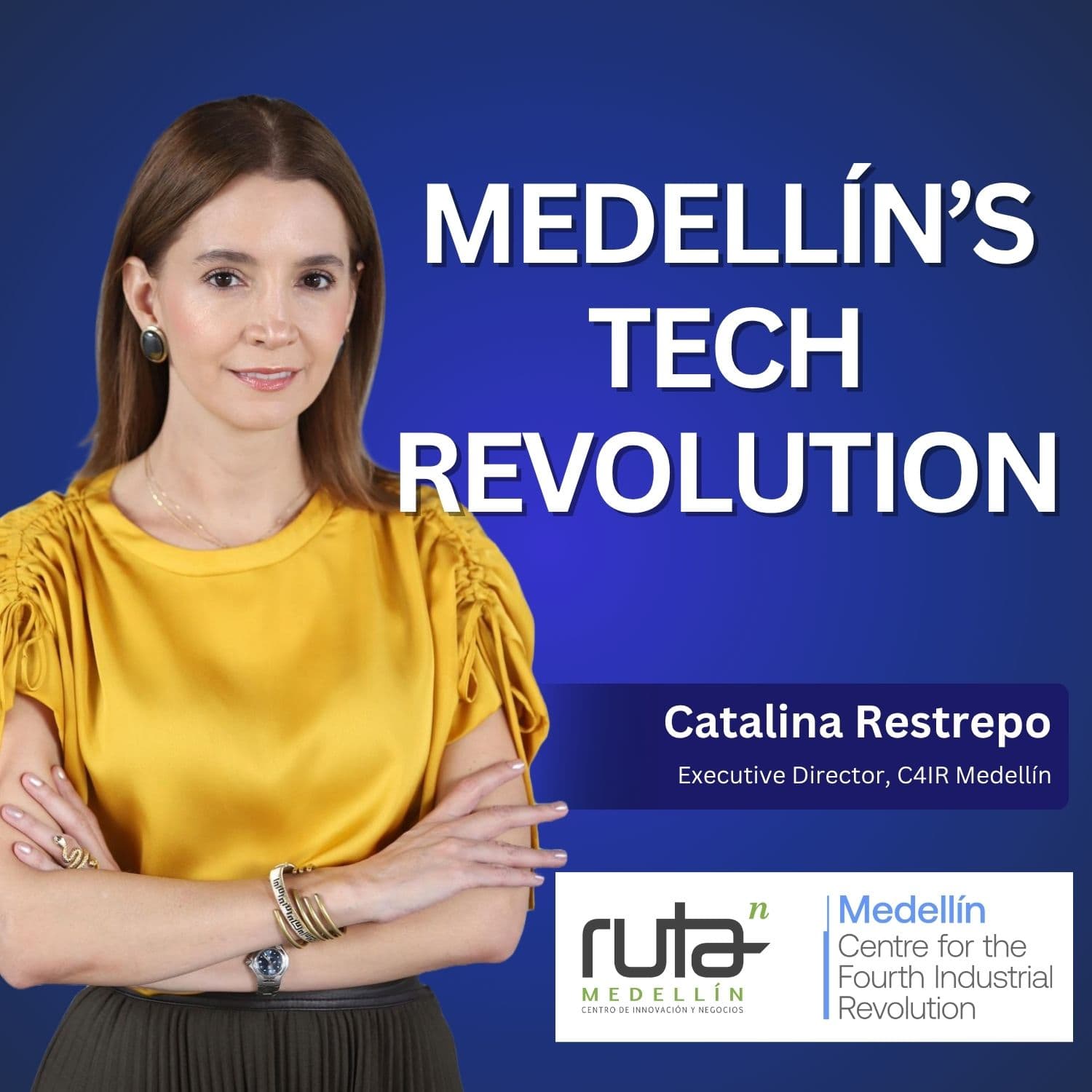
Der Große Neustart
Shaping the Fourth Industrial Revolution: Inside Medellín’s C4IR with Catalina Restrepo
00:57:35
Loading summary
Transcript74 lines
- [00:00]
A
I know I'm here to serve and I love, like, build bridges, connect people. So I like to connect people, sectors and countries and ideas. So I think that if you ask me, yes, I never lost hope, even though it was a really rough time, because when I was in school, it was a really rough time in Nevedin. I always had hope.
- [00:25]
B
Welcome to the English edition of Der Grosse Neustadt, the German English podcast series by Sibylla Baden, in which she talks to pioneering leaders who, inspired by the World Economic Forum's Great Reset initiative, create revolutionary projects that actually do make our world better, greener and fairer. Today we travel in spirit to Madeleine, Colombia, a city that that once made headlines for violence, now stands at the forefront of digital transformation, artificial intelligence and urban innovation. It is one of Latin America's most compelling reinventions and perhaps one of the world's most underestimated futures. My guest is Catalina Restrepo Carvajal, who leads the center for the Fourth Industrial Revolution, Medellin, a unique initiative developed in collaboration with the World Economic Forum and and the only one of its kind in Latin America. Her work is bold, complex and deeply human. From AI education and govtech to the ethical design of cities and systems. In this conversation we explore not just technology, but trust. Not just innovation, but inclusion, and above all, what it takes to lead responsibly in times of fast change. A very warm welcome to you. Good morning, Catalina. What's happening in the city right now that gives you energy?
- [01:53]
A
I mean, first of all, thank you so much for taking the time and for this valuable invitation. I'm going to tell you that what gives us energy in Medellin today, it's the convergence of purpose, talent and public private vision. The city once known for its resilience is now internationally recognized as one of Latin America's top startups ecosystem and a rising capital for artificial intelligence and digital transformation. And that didn't happen by chance. Civil it is the result of a deliberate long term investment in innovation, education and inclusive development.
- [02:33]
B
And what makes your city different when it comes to innovation and community engagement?
- [02:42]
A
What sets Medellinists apart is that innovation here is not just technological, it is cultural, social and deeply collective. We come from a history that require us to reinvent ourselves through trust building. And that legacy continues today in how we approach innovation. And I'm going to tell you a little bit how public private collaboration is in our DNA. Medellin's transformation has always depend on on strong alliances between government, academia, businesses and communities. And that same structure now powers our tech ecosystem trust has been earned through transparency and proximity. We work directly with community. We just not just deploy technology, but we co design it so people are involved, not just consult. And innovation has been a social mandate for a long time here in the we do not innovate for scale alone. We innovate to close gaps and improve quality of life. And that gives our ecosystem a sense of purpose and urgency. And one example that the pisa, as we are called here in Medellin and in Colombia and around the world we deeply about is EPM. It's Medellin's public utility company. It reinvests about 2.5 trillion pesos directly into social initiatives that significantly benefit citizens. These resources funds critical programs like Buenco Mienzo, which is an early childhood development. It also improves educational structure, infrastructure and more others. So this unique public model, because EPM is 100% public entity, but it runs like a private company. And this like is an example. And that's what makes us different from and set us apart from other cities from Colombia and also from Latin America. So this model ensures that profits generated from essential services are used to foster equitable growth, improve quality of life and strengthen social cohesion across Medellin.
- [04:50]
B
And because you're going into that, Madeline's transformation isn't just digital. From recent reports, it's also ecological. I remember that the city's tree planting and green corridor initiatives, I think they lowered surface temperatures by up to 2 degrees. So how does the environmental innovation fit into your wider vision of urban transformation?
- [05:16]
A
It fits perfectly because as you said, we just not like our transformation is not only technological, it is we innovate to better the quality of the citizens of Medellin. So that's why the green corridors have become such an important program. And it started on the first term of majors Federico in 2016 up to 2019. And now we are doing it again. So we are only not doing green corridors, but we also have the blue corridors. So that's how we innovate. And in order to do this, we use technology. So the technology complements what we do. And this is better, as you mentioned, the quality of the citizens that also it has lowered the temperature of the city. Butterflies have come to the city. So when you go around the green corridor, you see butterflies, you see the birds. So like we're making home for the species that it was home. So we're bringing the species back.
- [06:17]
B
Wonderful, wonderful. Let's go into why we are here today. We want to talk about the center of the fourth Industrial revolution where you are. Tell us about your mission and your work. What is it that you're doing?
- [06:33]
A
So C4IR Medad actively promotes the responsible adoption and integration of artificial intelligence, fostering collaboration among the public sector, private industry, academia and civil society. We facilitate dialogue and knowledge exchange. We support initiatives that leverage AI to drive inclusive growth, improve public services and position Medellin as a living city in ethical and innovative AI applications. How we do that, we have three work streams. One of them is education, the other one is GovTech, and the third one is Urban transformation.
- [07:12]
B
Should we focus on urban transformation first? So tell me about it.
- [07:17]
A
So Medellin is one of the world's most compelling examples of urban transformation. Just a few decades ago, Seville, it was known globally for violence and no one wanted to come to visit Medellin. Today it's a vibrant, forward looking city that people from all around the world is curious to discover. Everybody is coming to Medellin to see how Medellin became an epicenter of culture, innovation and civic trust. If you see now, we have like most well known fingers around the world are here from Medellin. We have Carol G, we have Maluma, we have J. Baldin, we have Sebastian Chatra, all the reggaeton singers are from here, but. And now we're exporting the talent. We also have great people that exports. So now it's a place also where cable cars, the ones that you guys use in Europe to go skiing, we use it to connect the hillside neighborhoods. We use libraries to serve as a hubs of community life. And it's a place where public private collaboration drives inclusive development. So in recognition of this extraordinary journey and transformation, Medellin was awarded the Le Quint U World City Prize, which is one of the most prestigious honors for urban excellence. And as we often say in Medellin, cvo here the mountains make you believe that the sky is not too far away. So the history has changed. Why we now focus on the intersection of artificial intelligence and urban transformation. And AI is giving us powerful tools to address our cities issues and opportunities. Because we have come a long way, we're doing things right, but we have a lot of work to do. And AI will help us do better our job if we only apply it ethically, inclusively and with a deep civic understanding.
- [09:21]
B
When you mentioned also education, can you talk about the educational transformation?
- [09:28]
A
Of course. We believe, and I personally believe Sibyl, that human talent is the heart of every transformation. So a civic education strategy to democratize knowledge about artificial intelligence and digital tools. I across all levels of society, from students to public officials, from kids to elders, and from hairdressers to CEOs. So and here in Latin America, we have a huge challenge because we have a lot of gaps in digital, also structural gaps and also infrastructural gaps. So the digital divides in Latin America are very deep. So as AI is rapidly integrated into public and private systems, it is essential that citizens understand how it works and how to engage critically and constructively. We are starting, actually it started Monday, education project where we are educating our young from public schools, 9th, 10th and 11th grade and digital skills. But we are not only educating them, but we are preparing them for the workforce and depends on the grade they are. They are developing challenges and projects that Medellin has. So when they graduate, we can analyze them and see how we can integrate them into the work that we do.
- [10:59]
B
And in that integration, I how do you balance the technology and keep the communities inside and make them trust you?
- [11:10]
A
When you take consensus and you make a consensus in taking decision, and you just not innovate for the sake of it, but you consult the community and then you understand their need, that's how we build trust. So if you know what they need, if you know what you can give, and then you have a common point and you have a common purpose, then you find trust and then you can go ahead and do the job.
- [11:36]
B
And is your center right in the middle of the city or how many people work there? How does it work?
- [11:45]
A
We are located at the north of the city of Medellin. We are hosted, but Rutaen we Bhutan. It's an entity that was born 16 years ago. It was born because at the heart of the transformation of Medellin, when public, private and academia came together, thought and saw the need to have an entity that will be the epicenter of local innovation. So we are located and that's the host entity. That's where we work. That's our office. We have right now six people on the team. And each of them are focused on the lines of work streams that I told you and other ones is communications. Like they have two transversal team members. And then why are we located in Rutaen? It's because where innovation happens, that's the hub of innovation of Medellin. That's the half of the innovation of Colombia. And we are well known as a corporation in Latin America. And now we export our knowledge and we also import good practices from the world to better our jobs. So it's on the north of the city and we are surrounded by University of Antioquia, the Botanical Garden, El Parque Explora, some hospitals. And we are aiming for that part of the city to become like the future of Medellin. There is a project that is called Futumen and the Futomet, we want that to be that like urban laboratory, like the Sandbox, so where we can test technologies, implement them and then use them to better the quality of lives of our citizens.
- [13:27]
B
You, you just mentioned futurmat. I wanted to go with you into your most important initiatives because the center for the Fourth Industrial Revolution sounds magnificent. So break it down a little bit for our listeners into what initiatives did you create and how does it really apply to the community?
- [13:51]
A
So we already talked to education and I share the projects with you also I'm gonna, I already talk about FutureMed. I'm going to share with you GovTech. What's GovTech? Because many people do not. So I'm just gonna give you a brief definition about govtech. So govtech is a cross cutting effort to modernize government operations through digital solutions that will improve transparency, efficiency and citizen engagement. Why do we like, do governments have to focus on govtech and invest in govtech? It's because public institutions in Latin America open gaps in trust, agility, service delivery. So gap that will help us close those gaps and will help us to improve the way we serve our citizens. And we're gonna start like continuing, not start, but continuing building the trust and we'll be more smarter, more inclusive and we can like we can do. GOVTIC is a really huge and it has a huge opportunity and investment. And the last one, which is urban transformation and that I already talked about, about school to Med. So those are the work streams and that's how it's going to impact the lives of people of Medellini. And we are also connecting with the global network, since we are on the global network of the Forum, which are 22 centers today, we are the only one in Latin America. The only one in Spanish is speaking Contact. So. So what we're doing is we're referencing what other centers are doing that we can adapt to Medellin, but we are also are contributing to other initiatives that in the centers in the network are doing. And we are sharing examples of Medellin. For example, in Govtech there is a Govtech intelligence hub which is lead by Berlin and Kiev. And we have been sharing some experience of Medellin, but we know that we can contribute to some other cities. But at the C4 Medicine, we do not believe Only that we can get. We also believe in giving. So if we do a win win relationship, we can enrich the network and of course it will better our work.
- [16:15]
B
Two things, when you talk about modernizing government and using technology and AI, can you go a little more into detail what that means on day to day basis? And the other question is, I remember that recently the Forum opened a govtech center in Berlin, Germany. Do you work together with them?
- [16:39]
A
Yes, I do work a lot with Berlin. That's the center that we are closely working together. We're actually meeting next week in San Francisco for the GTR meeting, which is global retreat and where many of the heads of the centers will convene and explore more collaboration opportunities together. And when you ask me like, how do we ensure that innovation benefits and reach the entire city? I mean, in Medellin, if you ask me, inclusive innovation is part of the system. We have built institutions designed to ensure that the benefit of progress reach every corner of the city, especially those historically left behind. So a big part of that comes from our public conglomerate model. Medellin is the second conglomerate model, biggest in Colombia. The first one is Ecopatrol, which is the oil company of the of the country. And we have a network of public enterprises like epm, as I mentioned before, our public utility company. We also have the Metro of Medellin and Rutani. And they just do not just don't provide services, but we reinvest in equity and innovation. For example, the Metro doesn't just move people, it connects community that we're once isolated and it shaped a culture of civic pride. So we're here in Medellin, very proud of la cultura Metro, which is like metro culture. When you come to Medellin and you see how people treat the Metro, when you see people lining up to get into the Metro, like you don't see congestion when you are getting into the Metro. But what the Metro did with the cable cars and everything was like kids and people, because Medellin is a valley and then we're surrounded by mountains. And the city has been growing up into the mountains. So to come down from the mountain to a school, school to work, it will take them, I don't know, maybe two hours in the morning. Now it takes them 20 minutes. So that's how like a example that like we can bring to real life. Another one is epm. It funds education, culture and innovation with public profits. Is not just like a shareholder returns. So it's just like if the city comes back, like the money and comes Back to the CE and Ruta N serves as a neutral space where government startups and citizens co create technology solutions. So those are like some samples that we can bring into like the real life and where we ensure that innovation benefits enrich the entire city.
- [19:28]
B
Can we touch health a little more in detail? We know now that transport is accepted exception works exceptionally well. In your place, have you made progress on any of the health issues?
- [19:42]
A
On the health issues, yes, we are advancing on the health issues right now. We are using tech in order to diagnose more rapidly. And we are like Medellin, because of its history, has been a pioneer model of transformation plan or organ transplant. So we were like the first ones to do heart transplant with something special. We have been always using technology in health issues. So maybe we do not talk about much, but if we do a little bit of research, we are very a leading city on that and especially on transplants. Because of the a violence era that we lived, we needed to start doing things quickly. And then the doctors start professionalizing even more in order to do that.
- [20:38]
B
It sounds all very efficient. So you work together with local government, business, academia, civil society. Is that the base? Is that the secret if you want of your success?
- [20:56]
A
Yes, it is. I mean, we cannot like the governments cannot do it along cbo. So it's like you had a word. It's like have Medellin craft the code. And when you ask me if Medellin has cracked the code, I will say yes, because when early 2000, when we were like coming back from our past, we had the determination to build the kuit, which is the committee of universities, business and civil society and where the private sector comes and they meet every month. So when you ask me when do you catalyze the transformation of Medellin and is that the secret? Yes, collaboration has been the secret of the success of Medellin. Also, the better of Medellin is its people. Like we believe in Medellin. We are very proud of being from Medellin. And because of our history, again we said, I mean, we're more than this, we're more than our path. So how can we reinvent, how can we collaborate together? And let's dream about what is the Medellin that we want. So you see in every single progress and every single infrastructure project and every single project that the government's telling that the city of Medellin is doing right now, you see that, you see the hope and you see that collaboration. And it's very nice when you go to the some of the colleagues from the World Economic Forum had the chance to participate on a KUA meeting. We meet every month, every Friday, the first Friday of every month, we meet in Rutaen, we convene in Rutaen and we just share. What are we going to do? We have a talent work table, we have economic development worktable. And I think that's the key. That's the secret, if we can call it a secret. But I think that's how Medellin has scrapped the code. And you can see the difference between other cities that do not collaborate on this, like on this strata. You see the difference.
- [23:16]
B
When you sit there with all the stakeholders of this wonderful city there at the table and you start the collaboration. What is, according to you, the key to establish trust, the key for making progress?
- [23:32]
A
The CUIM started as a space for a dialogue and develop ideas, but it has been evolving. So I think one of the keys, and what you're asking me is that it has evolved depending on the needs of the city. So the CUA has been becoming a permanent mechanism for strategic coordination, is an open dialogue where many of the stakeholders of the city can share their ideas and come to a common purpose. It's a space where science, policy and entrepreneurship converge and it's a cultural shift, like from working in silos to co creating solutions. So I think that's like how we can, like that's. I think that's the answer to your question.
- [24:20]
B
Working in silos, quite absolutely. This is a very important point. So how did you get the different groups into one room? Were they all willing? Was it easy or how did it work?
- [24:36]
A
If like I was actually, when I was like preparing and going through Sprint for this podcast, I had the honor to talk with the person that like, is a very well known businessman here in Medellin. And I asked him how was it when like you be like, you came with the idea and was it easy? The same question that you just asked me. And he, the answer was like, definitely, it was really easy because we knew that we were better than what we had and that we deserve a better city. And that's. And they just had determination and say, okay, you know what, we're just going to have to come together and do it. So it was like willingness a decision. And I don't think it was thought about it. So. And that's one thing that like it resonates with us. Like here in Medine, we, we have a saying that is acemos que las cosas pasing. We make things happen. So like we are Very perseverant, we're very resilient. And I think that's one like, that's one characteristic that the PISA had.
- [25:49]
B
We make things happen. Yeah, very interesting. Can you share a story where this collaboration really made a difference?
- [25:55]
A
Another story, like as I said, Ruth. No, no, I'm just thinking, I'm just thinking, like I already told you about Ruthen, which is like a huge milestone in our transformation. Also the metro. Lets don't go too so far hosting C4I or Medellin. Last year, when the major decided we want to have the center in Medellin, we need the World Economic Forum to come to Medellin because we had to advance, we had to be better for our people. So it was a political will, it was a decision, let's do it. And when the center came back to Medellin, it just that synonym of trust, civil. So that's another example, very close to my heart and very close to yours, that having a C4R in Medellin, that's another example of how the public, private academia and civil society come together and make a decision that will better the quality of lives. The citizens of Melody.
- [27:04]
B
How well is technology and AI received in Colombia?
- [27:11]
A
Actually, it's very well received, but, you know, it's like it's half, half. Many people don't know what is it like. When I talked to my. When I was appointed for this role, my mom and my dad, they are elderly people. They asked me, what, what are you going to do for work? And I was trying to explain this to. It was so hard because I don't know, it's like, what is Chat dpt? What is Gemini? What is artificial intelligence? How come you talk to a machine and they will give you answers? Yeah. And like my dad is 84, you know, I was like, no, he doesn't even have a smartphone. He. I think he started using a smartphone when my brother and I moved away, but he doesn't have one. My mom is the one that has it. And now when he talked to my nephews, he talks like in video camera and he's like super surprised. And then when I do like zoom meeting and maybe I'm at home, he goes to the zoom meeting and he greets the people because he says I have to greet. And I'm like, no, puppy. This is. This is like a virtual meeting that he thinks like the persons are at home, you know? And so I try, I was trying to explain this. And when they start like realizing that many of the things that they do on a daily basis are related to technology, are relating to artificial intelligence. They say, ah, okay, okay, so they got that. And then when you go to that was I was mentioning before, even the hairdressers, the people that do the nails, everyone has to understand what is technology, how we can benefit from technology, what is artificial intelligence, what is not artificial intelligence? And then from there, how can I benefit from it? Can I be more productive? Can I be more. Take better decisions, act more efficient? And now the kids, of course, are very excited. The young people, those young people that we are starting to educate on digital skills and all this, they're very excited. And the, let's say the challenge was to convince the teachers. But then when the teachers saw that they were going to be educated too, and they were going to be able to replicate that on their community and some other spaces, they were really into it. So once again we come to trust. How you can get, like, how you can build trust with the beneficiaries, in this case the citizens and the people, when you do understand their needs and when do you explain them, when you educate them, what are the benefits behind all this?
- [30:18]
B
I absolutely agree with you on, on that, Catalina, because you said you have to convince the teachers and once they understand and the purpose and so on, it's. Then it's easier to translate it into the work. If you look at different sectors from academia, government and so on, are there in some sectors the hurdles a little higher? And if, yes, what's the problem? And the other way around as well.
- [30:51]
A
I say convince, but it was just like work with them so they could understand how this will benefit their work, the daily work that this was not take, like technology. Because many people is really concerned about, like, why technology, how can benefit them, or is this technology going to take my job? No, it's not going to replace you. Humans cannot be replaceable. It's going to help you. But then you have to keep up with technology in order to be up to date. So it was more like that than just like, it wasn't a hazard to, to do it. Just like conversations and socialization. There is a word that we use here in Medellin which is appropriation that means ownership. So let's do this, let's, let's take ownership of this and you're going to see the results. You educate better, your, your, your children's, the young adults here, and then you'll see the results in the city later.
- [31:57]
B
So if you think about the whole of Latin America, how does the Madeleine story resonate across Latin America, Latin America.
- [32:08]
A
I remember when I was. No, no, no. Because when I say this is like when I'm remembering stories from the past. I remember when I was in high school, that's been like quite a few years ago. We had like a class that they were telling a story that Medellin is in Antioquia. It's a department that Medellin is the capital of. It's going to be the best in 2020. Antioquia is going to be the best corner of America Latina. And. Yeah, and we have been the best corner so far. So I think we lead as an example because we have transformed from the city that no one wanted to come, that many people want to come to discover. And we also show the cities that cities can evolve and lead global conversation on innovation, not by copying model, but creating their own. And that means you cannot copy paste. Like, I mean, Berlin, Medellin, they're very different cities. But how can we learn from Berlin and adapt the great experience of Berlin into Medellin? Because they are having results. So how can we adapt? So, and our story resonates a lot in Latin America, Sibylle, because we have turned adversity into purpose and building a trust based collaboration and tech with equity at the core from AI in public. So it's like, once again, we are like human centered and we are very. And we at the C4IR are like our clients as the citizens. It doesn't matter who you are, what you do. Like, we are a center for the people. And that resonated a lot with the, with the forum colleagues because they say you are the only center that you tell me that you are for the people. It's like, yeah, because I'm here because of the people and because of the people of Meridin. So that's why I think it makes us unique within the network and it resonates with Latin America and some other cities. And what we want to do with the center being the only one in Latin America, it's that if we do a project that we see like great results, we want other cities in Latin America to replicate the project. So it's where from Medellin. But we can replicate everything we do that we see a good impact because we're in trial error. You know, we have been around for six months. But if we have one like championed project, we want that project to be replicated not only in Colombia, but also in Latin America.
- [35:00]
B
Because you talk about replication, I think that's an important point. How do you replicate? Are you going actively to other countries, do they come to you? What are the most urgent issues and what exactly if you look around now, of all the projects you do, what could work best to be replicated?
- [35:25]
A
Education. Like, we have a huge challenge in education here in Colombia, here in Medellin. And education is the, as I told you before, is the heart of every transformation. So I think education can be replicated easily. And if we have like this project that is starting that Dell started with the 9th, 10 and 11th grade kids, we can replicate this one. We're also starting our education program with a multinational. It's a multinationals here, but it's a very well known company around the world. And we're starting, I cannot say the name because we haven't signed the agreement yet, but it's going to be coming out soon. I will share with you the news that can be easily replicated because this company, it's everywhere in Latin America. So education, I think that will be the easiest one to replicate. But we are already replicating the urban transformation model. I think we can do that in GovTech. We can also not only replicate, but also learn. Like Brazil has done a lot of work in Govtech. And then we're leading here in Medellin, in Govtech. So that one can be replicated, but the easiest one will be education. 100%.
- [36:42]
B
You mentioned that the center for the Fourth Industrial Revolution, we have now 21 centers all over the world. And I noticed that Rwanda made also huge progress. We have them in India, China. When you talk to them, what are the key issues? Do you have key issues that you have in common or do you. Do they all have different. Yeah, different directions.
- [37:10]
A
Because we have such a different context in every place that we are. And we are so different. But we also have a common challenge, one that I have found once again is education. Because like, if you see the Malaysia one has had AI literacy program that educated, I don't know, like a million people in basic AI. And I'm trying to bring that program here too, with the collaboration of the C4IR, because we have found out that many people doesn't know what is it and what is not and how can we benefit from it. So that's a common thing that we have found also. We also have found that regulatory issues are not as easy as they might appeal. So it's like, okay, so you have done this. Like many conversations that I have had with Beverlyn center. It's like, okay, you have done this in Govtech. I mean, you are Europe, you are The European Union. We are Colombia, Medellin, Latin America. How can we do that? So it's like how we can shorten the journey and adapt it to the cities. But even though we have a very different context, we are in a very different environment, we have the same issues, and we also have, like, the same purpose and objective. It's just to better serve the citizens. How can we help the city or the country to grow? And how we can, like, do better, to collaborate and make a better world?
- [38:48]
B
Catalina, I'm quite grateful that you mentioned the core idea of why the Forum was. Was built by Klaus Schwab many decades ago. Make a better world. And when I prepared for our conversation, I reread his really visionary book about the Fourth Industrial Revolution, which he, of course, had written almost 10 years ago. And he called for a new kind of global collaboration around emerging technologies, which nobody had talked about that before. So out of this vision, the Forum launched its first center in your neighborhood in San Francisco. And now there are more than 21 centers worldwide, from Rwanda and India to Germany, China, and, of course, Colombia. How does your center in Medellin reflect the original spirit of the forced Industrial Revolution?
- [39:47]
A
Sibylle, when, like, when you stay in a room or when you hear that the four Industrial Revolution, you feel overwhelmed because it's like, what is that? How do I eat that? How do I work with that? So, you know, but it's like, okay, so how can we. How can we just, like, make this more relatable to an everyday life? Because I remember the first time, like, the fourth neutral evolution. Are we already on the fourth point? How come? I mean, because we're like. We used to like the first one, the second one, and the third, and from now on the fourth, and now they're talking about the fifth. But what I believe is that it's like, it's more human. It's just more. Once again, let's go back to the people. It's not that overwhelming. It's. How can technology can better our lives, our daily life? So can it give me a better quality of life? Wonderful. How can I use it? I can be more productive at my work. Great. I can be more productive when I go to school. Wonderful. How is this going to better my relationships? Okay, so now we can communicate every day. Before, we couldn't. Well, we could communicate, but not every day, because we needed to write letters and everything. So it's going back. And what I do and when I try to do, it's just like, remember that we're like people and let's try to bring it to like the real lives, to examples of the real lives.
- [41:25]
B
How open is the Colombian government, and I'm just meaning now government to the whole development of new technologies.
- [41:35]
A
I mean, in 2019, for example, Colombia, one of the pioneer countries in Latin America to have regulatory policy in emerging technologies, in AI. So I think we're open and it's just a matter that like, it is just like if you get on the train, if you get behind. So now the world is rolling on technologies and emerging technologies. One challenge that everyone has, and one of the focus of the center and one of the mandates of the major is to do it responsible, ethically and with purpose.
- [42:10]
B
And Catalina, coming back to you, why are you there? Because from, from your development, I saw that you worked across continents and systems and sectors, but now you're there, you are heading the center. Why?
- [42:28]
A
Hi, cv My love for Medellin runs deep, as Medellin is so much of who I am and I owe to the city. So working for Medellin has been one of the most meaningful and rewarding experiences of my life. And this is the second time that I had the chance to work for Medellin. So is the city where I grew up, where my family and Jewish friends are. So I mean, it's everything about the love that I have for the city, and that's why I'm here.
- [43:06]
B
When you think of the time when you went to school and now, did you think your city would evolve like that?
- [43:16]
A
Yes, because I always knew and this comes from my parents, especially from my mom. It's like we're better than this and we deserve a better city than this. So. And. But I never thought I will enroll in the, or do my, my professional career in the public sector because I all I always wanted to be a business administrator, which I study international business, so that check. But I thought it was going to work for like a huge company, a multinational company. And then I started working for a bank. I remember my first job was at Wells Fargo bank in the US and thank God people like finances and excel, that's not me. And I figured out very quickly that numbers were not for me. And then like life and destiny, if you could say, took me when I came back from the US to Colombia to start working on the public center and on the public sector. And then I started like working on international cooperation and, and all that. And I found my purpose because like, I mean, I know I'm here to serve and I love like the build bridges, connect people. So I Like to connect people, sectors and countries and ideas. So I think that if you ask me, yes, I never lost hope, even though it was a really rough time, because when I was in school, it was a really rough time in Nevadine. I always had hope.
- [44:54]
B
And what does the city has taught you personally about resilience?
- [45:00]
A
I have a good idea. I have a very personal experience of resilience. But Medellin has taught me and reminded me that real changes take time. The real changes takes trust and collective effort. You cannot do it on your own. If you like, yeah, you can do it on your own, but you want to do bigger and better. Let's do it together, let's collaborate. So the city has gone through a profound challenge, but it never gave up. So it has also do not give up and to listen, to learn and build again, because you can tell down, I don't know how many times, but you always have to stand up and go back and maybe not go back to the things how they were, but to create something better. So, and that's like my mantra. If you say it's I believe in collaboration, I believe in public value and the powers, the power of the community. So I do believe in collaboration and everything. So Medellin has taught me a lot.
- [46:09]
B
If you look at other cities trying to become innovation hubs, for example, what would be your message to them?
- [46:17]
A
One I would do advice to collaborate, work together, get together, find a common purpose and build from there. Because if everyone starts thinking I have the better idea, I have the better idea and they go on their own, it's going to take more time. If it's collaborating takes time. If you do it on your own, it's going to take more time. So I think collaboration is the key and trust and building trust, because you.
- [46:48]
B
Mentioned that if you do it on your own, it's just not working. So how do you ensure that inclusiveness actually in an AI driven transformation, once.
- [46:58]
A
Again we go back to conversation, communication. It's very important communication, being inclusive. Build in like institutions or work and design institutions to ensure that the benefits of progress reach every corner of a city. And passion a lot of work and believing in yourself and what you're doing and believe that you are doing this with a purpose and that it's a common purpose. And I will be Inclusion is key, communication is key and respect is key.
- [47:40]
B
And I think probably also honesty about what AI can lead to if we are not careful. So how do you bridge that? This doing good for the community and having all these benefits, but also Looking at with open eyes.
- [48:02]
A
I mean, once again, go back to inclusiveness in AI. It's making it a priority from the start. Education, what is it, what is not? And just like, make aware, like, awareness of people because, like, use it responsible and use it with, as I was saying before, ethically and with a purpose.
- [48:28]
B
So.
- [48:29]
A
And what we do in Medellin, and what we try to do every day, is to use AI to solve public challenges that matter. So access to education. So if we educate people see us, so they're going to see, okay, I get it. So that's education mobility, because that's inclusion. When you, when you get public services to the people, it's when you feel included. And when you feel included, you perform better in a community. And we choose projects where technology can close gaps, not widen them. So I think that's like a cocktail recipe where we're focusing on making AI a priority from the start and not just an afterthought.
- [49:24]
B
I read an example given by a professor of an American university who ask AI to create a seminar or a whole course on business or on whatever, and it did it excellently. So what is. If the academia is sitting next to do and says, but okay, today I create together with AI, an educational program. What about tomorrow? Do you go through those questions or. Not yet.
- [50:01]
A
Not yet. But if you ask me, because you're asking me right now, is you have to evolve. Like, you have to move with the flow, maybe. I've been telling you today investment In a generative AI has increased 18% from last year, but maybe tomorrow it's going to be 23%, because technology is taking us to another phase. So if you ask me, the next transformation of Medellin is digital, no doubt about it. So it's like, you have to keep it up. I mean, like, chop, chop, chop, chop, chop. Because this is like a marathon, but it's like a technology marathon. So if you have created a course, then how can you improve the course to better teach the student and the business people everywhere?
- [50:49]
B
Does ethics and morals play so far a role in your work, or is it minor?
- [50:55]
A
I have three things, and I'm going to tell you why. Respect, passion, and ethics. And of course, moral. That are the values that run every decision I make, especially navigating the tension between innovation, technology, and equity. So, because I deeply believe that technology should serve people, not the other way around. And that's very important for me. So respect ensures I listen and understand the realities of diverse communities, my neighbors, people from other part of the city, and My friends from, I don't know, from Singapore. Passion fuels my commitment to create meaningful, lasting change. And moral and ethics remind me that innovation without inclusion can't widen gaps, not close them. So I always work and I wake up every day to build solutions that are not only like cutting edge and might not be built like, wow, this is like, it's going to win a prize. But solutions that are fair and human centered and do really transform and make a real impact in my community.
- [52:17]
B
Because we are coming slowly to the end. I just wanted to ask you a couple more questions, and one would be, where do you see gaps at the moment in your line of work?
- [52:27]
A
Digital gaps, inequality gaps. Because many people here in Medellin, a lot of people can go to school, but many, many people cannot go. So how can we work to get everyone to go to school? That's one thing. So education is one challenge, but we have, like tackling that one and we have to work more on that. But that's a huge gap. It's not. And it's like in the whole, like in the whole chain of education, not only about technology, it's access to education. And because many people do not believe that children should go to education, it's because they were not educated. So it's the whole shame. So how we can change that mindset that if you educate, if you go to school, then it's going to be a real transformation. So that's one thing that I will.
- [53:23]
B
Say, Catalina, why that might sound naive to you now, but why can't they go to school? Why can't many kids not go to school?
- [53:32]
A
Because their parents just won't take them, because they all have access. But it could be like a personal disposition. It's. The Medellin context is very special. Like, we can have like three podcasts on this one. But yeah, it's, it's. But we're doing. We're doing and we're still working on it. Maybe they have not, because they have not economic resources. So it could be many, many options, like many reasons.
- [54:05]
B
Economic resources doesn't mean you pay for school.
- [54:08]
A
Some of it pay, some of them not. And the ones that do not have to pay, maybe it. Because it's a personal choice. So it's like, I'm not an expert on the context, but I know we have a lot of talented.
- [54:25]
B
But you're on a very good way. So a lot of that has already improved. And yeah. Is there anything we have not talked about, anything which is close to your heart you want to talk about?
- [54:40]
A
You asked me, like, in the middle of the podcast, I believe, like, what gives me hope if I still have hope? And I will say to you, yes, because what gives me hope every day? And I think we all should have hope. And when I see people driven by purposes and genuine desire to do the right thing, that gives me hope. And the like. In the moment that the world is living right now, is this to have determination whether if you're a community leader, a public servant, like a young entrepreneur, like, change is possible, just like maybe you are not doing a huge impact. And then you say, I'm going to quit. No, the changes start, like, with one, when one rise, two rises, three risers. And on a personal level, my nephews fill me with hope every time I talk to them, and they tell me stories about, I'm going to do this, I'm going to do that. And when I see their genuine and their enthusiasm every day, it's like, okay, I'm on the right track. These guys are going to enjoy the things that I'm doing right now, and they're going to have a better place to live. And that's why I always have hope. And one final thought is, innovation means nothing if it doesn't improve life. So once again, technology must serve people and not the other way around. That would be my final thought for today.
- [56:19]
B
Wonderful. No? This is a wonderful ending to taking us through the journey of the tech revolution in Colombia. No, I'm glad. I find your work absolutely fascinating and I hope it sets a great example and also that you work in collaboration with all the other centers. Yeah, you do fantastic work. I'm very happy that I had the chance to talk to you, and I wish you all the best.
- [56:46]
A
Thank you, Sibylle. I had a wonderful time. English is the second language. Being my first podcast in English, I had a really, really good time, and it was lovely having the conversation with you. And I've been following you since you reach out to me. I just love this, this space that you have created in order to exchange some ideas. And we'll definitely be in touch. And thank you so much.
- [57:14]
B
This has been another episode of De Grosse Neustadt from Sibylla Baden. For more information, please visit sibyllabaden.com or the official site of the World Economic Forum Forum.