← Der Große Neustart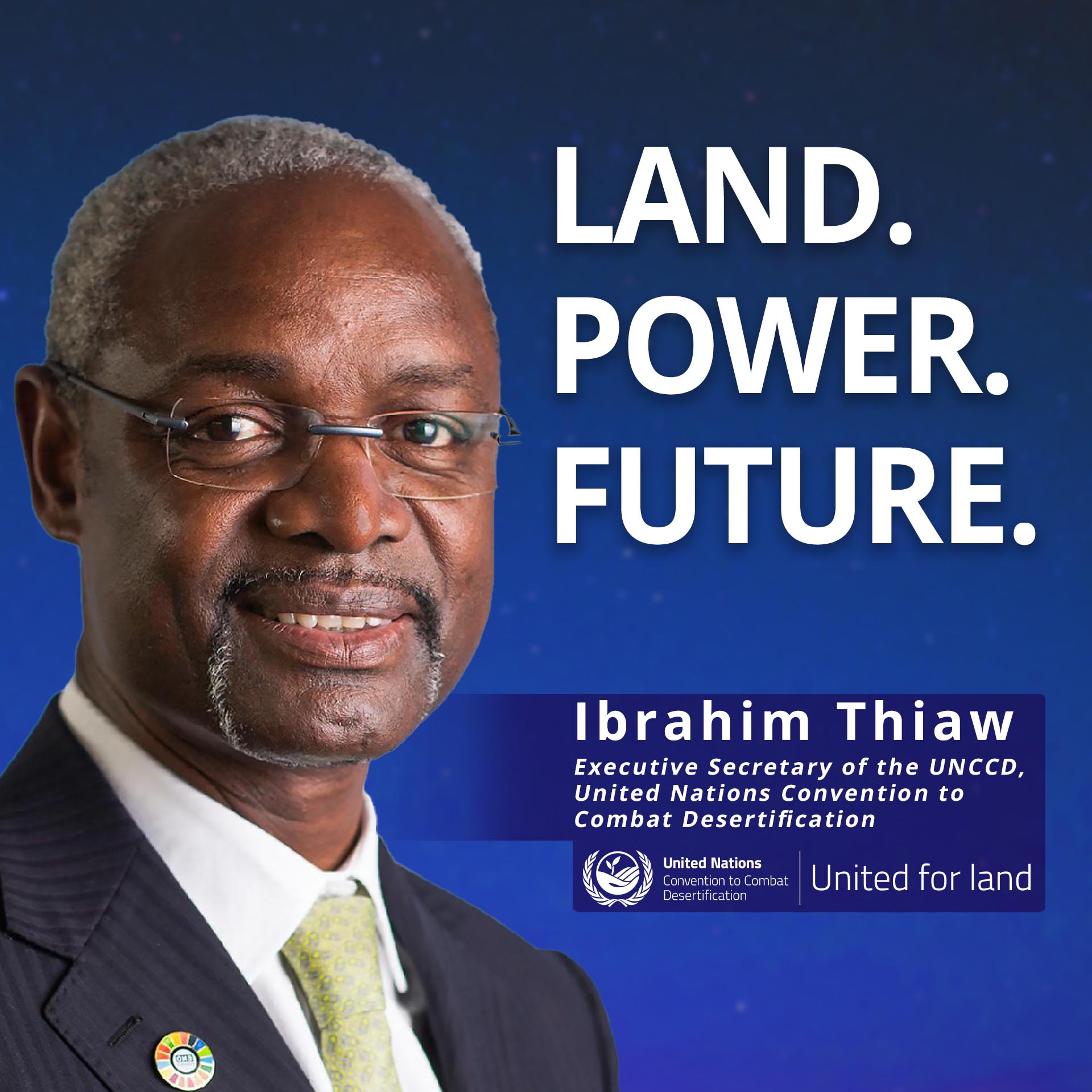
Loading summary
Transcript63 lines
- [00:00]
Ibrahim Shor
The number one driver of land degradation in the world is our food systems. So we are really talking about resetting our relationships with land in terms of how we produce food, how much food we produce, how much water we harvest, and how much we are able to regenerate ecosystems that are already degraded or being degraded.
- [00:20]
Sibylla Barton
Welcome to the special English edition of Der Grosse Neustadt, a German podcast series by Sibylla Barton in which she talks to pioneering leaders who, inspired by the World Economic Forum's great Reset Initiative, create revolutionary projects that actually do make our world smarter, greener and fairer.
- [00:44]
Interviewer
Land degradation is one of the most pressing, yet often overlooked crisis of our time. Right now, 40% of the world's land is already degraded, affecting nearly half of humanity. Every year, we lose another 100 million hectares, an area the size of Egypt. This isn't just an environmental problem. It threatens food security, fuels migration and drives conflict. So the big question, who is leading the way in reversing this crisis? Today I'm honored to be speaking with Ibrahim Shor, Executive Secretary of the United Nations Convention to combat desertification, UNCCD. His organization is at the forefront of restoring 1.5 billion hectares of degraded land by 20. With over 40 years of experience in global environmental leadership, Ibrahim has shaped policies at the unccd, the UN Environment Program, and the UN Framework Convention on Climate Change. His expertise spans forestry, sustainable development and global climate resilience. Recently, he was recognized as one of the top 10 most read Sword leaders on nature, a testament to his influence in driving global awareness and action. Good morning, Ibrahim, and first of all, congratulations on this recognition.
- [02:10]
Ibrahim Shor
Thank you very much, Sibyl. Good morning.
- [02:13]
Interviewer
So we have a lot to talk about and I think we start with understanding the global land crisis. Can we start with the big picture and unfortunately quite alarming reality?
- [02:31]
Ibrahim Shor
The big picture is that 40% of the land is degraded in some parts of the world, severely degraded. And the population is growing, the demands are growing. So in a way, we are depleting the natural capital which is sustaining life on earth.
- [02:55]
Interviewer
When we talk about degraded, to what degree do you talk about degraded?
- [03:03]
Ibrahim Shor
We say degraded when the land is not in balance anymore. So you have ecosystems that are being depleted or habitat that is being degraded, soils are being lost, and the quality of the water is diminishing. These are indicators that something is going wrong on our land.
- [03:27]
Interviewer
When one looks at the statistics, it is quite a frightening picture we see here. You were speaking with your fellow experts in Davos this year earlier, and I remember that you said by 2050 if we carry on like that, we will have lost land equivalent to the size of South America. So what does it tell us about the scale of the challenge?
- [04:00]
Ibrahim Shor
The challenge is really to continue to feed a growing population and a growing middle class, while maintaining our ecosystems. So at the moment, we are extracting much more resources than nature can regenerate itself. So since we have a growing demand and nature is not in a position to re establish itself, so in a way, we are eroding our capacity to produce food and good quality food, and we are eroding our economy. Since 50% of the GDP of the world is derived from nature, so it is alarming.
- [04:51]
Interviewer
When you say 50% of the GDP of the world comes from nature, can you go a little deeper into that, what that actually means?
- [05:01]
Ibrahim Shor
In essence, our food is coming from land. Essentially, 99% of our calories are provided for by land, by our land. In a way, our terrestrial ecosystems, including biodiversity that is found on land, not talking about marine biodiversity, but terrestrial biodiversity is absolutely critical. In a way, part of our medicines are coming from land and from biodiversity. In a way, part of the air we breathe is coming from the land. And water we drink, good quality of water we drink, is also coming from the land. So all of that, if you estimate the contribution in terms of services that are provided to humanity, it is estimated that it represents half of global wealth.
- [05:55]
Interviewer
So we hear a lot about climate change and biodiversity loss, but land degradation often gets less attention. Why is that?
- [06:09]
Ibrahim Shor
We take land for granted and we have always considered that land can continue to produce the services without even asking it anything. And therefore we have not paid much attention to it. Secondly, I think there has been in the past some misunderstanding about this convention that I have the honor of leading, because the title is Desert Convention to Combat Desertification. And desertification has been associated somehow with deserts. So those people who do not live in deserts or close to deserts feel safe. But the concept of land degradation is much broader than just sand dunes or barren land that is found somewhere in the world. So the whole of humanity live on land, and therefore this is our capital. It is important whether you live in a boreal forest or in a glacier somewhere, or in the mountain or in the Sahel. You live on land and we live off land. Therefore, it is important that we consider this as a natural capital. We will not be able to achieve anything on biodiversity conservation or on climate change unless we also include the absolute necessity to protect land and to conserve it and to make sure that we continue to benefit from it.
- [07:36]
Interviewer
And it's I think also important to see it all interconnected, because we talk also a lot about water and. But all in single. Yeah, we divided into single problems. Are we on the wrong path here?
- [07:53]
Ibrahim Shor
We are, because we are not taking the planet as a whole. We are taking bits and pieces. And if. For those who are familiar with the concept of the planetary boundaries that have been developed by scientists and tested for many years, out of the nine planetary boundaries, seven have already been surplus, meaning that we no longer live in a safe space in terms of the planet being able to reproduce itself. And according to these main scientists that have been developing this, including Johann Rockstrom, who is in the Potterdam Institute of Climate here in Germany, according to them, most of the seven planetary boundaries that have been surfaced have a connection with land. So it is therefore important that we see this and it is not difficult to understand it, because as human beings we live on the land. We are terrestrial species. Therefore our impact on land is much higher than our impact on oceans, let's say, or in space.
- [09:03]
Interviewer
Your organization has set a goal of restoring 1.5 billion hectares of land by 2030. So if we look at what you were saying, that everything is interconnected, how feasible is this?
- [09:22]
Ibrahim Shor
It is not an easy task. Let me just be very honest with everybody. But it is feasible in a sense that we are not talking about the public sector only coming to plant trees. We are not talking about pre planting only. We are talking about agriculture. So we already have an impact on land through our farms. So every farmer, small or large, has a role to play in land restoration. We are talking about new techniques like agroforestry that are more integrated. We are talking about regenerative agriculture. So the number one driver of land degradation in the world is our food systems. So we are really talking about resetting our relationships with landscape in terms of how we produce food, how much food we produce, how much water we harvest, and how much we are able to regenerate ecosystems that are already degraded or being degraded. So we are not talking about 1.5 billion hectares of barren land that needs to be put back to health. We are talking about land that may be slightly degraded and land that may be severely degraded. Altogether combined is with the 1.5 billion hectares that we are talking about now. Let me also confirm that commitments have already been made by countries to the tune of 900 million hectares of land to be restored. So we are not starting from scratch. We are really saying we need to probably enhance our capacity and we need to certainly boost our capacity to have A restoration economy rather than having piloting projects. So there are large scale restoration programs that are going on in the world today, but we need to boost them. But we also need to make sure that private investors do no longer consider land restoration as a non repayable investment, but rather as a business, as a profitable business. And it is possible to have it as a profitable business.
- [11:35]
Interviewer
Yeah, can I just. Because you mentioned the number one driver are our food systems, what exactly does.
- [11:45]
Ibrahim Shor
That mean, the impact we are having on land as human beings? Land degradation is due essentially to two factors. One is human activities, the other one is climate change, changing climate. Human activities are essentially for food production or for animal feed, but animal feed is also for our food in a way. And secondly, it's cotton production for our fashion. So these are the two main. So if you combine them, it's all agriculture with a capital A. Because essentially we are extracting resources from the land through planting some sort of vegetation that we are harvesting for some sort of need.
- [12:34]
Interviewer
When we look at the human and economic impact of land degradation, what are the biggest social and economic consequences?
- [12:49]
Ibrahim Shor
Land degradation is essentially. And land degradation is soil loss. And soil loss is essentially the erosion of our capacity to produce food and to produce nutritious food. In a way, land degradation is an infection on our soil and our vegetation and water. So in very simple terms, we are depleting the capital that we are using to produce food. So food insecurity is one of the number one risks of land degradation for us. We may not be able to produce enough food for a growing population. And according to some scientists, we may need to produce up to 70% more food by 2050, according to the Food and Agriculture Organization. So how can we produce more food for a growing population and a growing middle class? I have to say it's a combination of both. So how can we produce more food when nature is being depleted? So we have shrinking resources and a growing demand. So somehow we have to reconcile these two. No question that we need to feed everybody. No question that no one should go to bed hungry. But the question is, how can we do that at the same time achieve the sustainability and the protection of our planet? So people and planet together. Land degradation has severe consequences in terms of forced migration. You see, when a family head, mother or father is no longer able to feed their people, their children, they lose anything, including their dignity. Therefore, they have no choice but to go somewhere else to recover that dignity and to secure their family. And that migration can be short term, migration can be seasonal, migration can be far Away migration or close migration. So you can go to the next city, to the next country, to the next region or further afield, but it is not possible to stay in the same place. What is left to the young gentleman or girl from Haiti to do but to flee when they cannot produce any more for their. For their families? What is left to the young gentleman or girl from the Sahel to do when they can no longer produce? They will not stay in the same place until, you know, until they die, essentially. So land degradation is also an amplifier of conflicts. Competition over access to fertile land and water is much higher right now than it was the case when the population was smaller in size. So therefore, the more you need to produce, the more mouth that you have to feed, the higher the competition for access to scarce land and water and land degradation provides that scarcity that we are talking about. So it is therefore an amplifier of conflicts. And you see growing conflicts all over the world, especially in dry lands, where people have no longer the capacity to have a balanced life. So it happens in Somalia, it happens in the Sahel, it happened in Syria. You see, most of the conflicts in the world happen in areas where there's scarcity of land, fertile land and water.
- [16:45]
Interviewer
When you say that we already suffer from 40% of degraded land, and as a result of that we have food insecurity. This growing migration, etc. Should we not call it an emergency?
- [17:04]
Ibrahim Shor
It is an emergency. It is indeed an emergency. You see, the question is, how can we call it a global emergency? It is already an emergency at the local level in some regions. But the response we have so far as humanity, as good soldiers as we are, is to help them get more food. So we ship tons of food to provide them with emergency responses, food distribution, and we have humanitarian response. What we need to do is to move away from being reactive to being proactive. What we have been good doing in some parts of the world is to build walls of offenses in order to protect ourselves from migrants that are coming to invade us. We are not good enough in trying to help those people who are migrating stay home and restore their land in order to produce and keep the dignity of theirs and their families and safety of their families. What we are not good at is to help them with different techniques, reduce the impact of droughts. We are very good at responding to emergencies, in other words, and we should shift now our attention and invest more on a proactive way in areas where we know that there are risks of explosion, implosion, and these risks are not local. We know that There are multiple links right now between forced migration and insecurity. We know that there are links between land degradation and global security from around the world. If these are well understood by decision makers, by private sector investors, then it may be easier to change that narrative. But for now, they are seeing as oh, poor people, let's ship some food, they will be safe.
- [19:25]
Interviewer
I remember at your panel there was also the president of Iraq talking about the devastating impact of war on land. What do those conflict and post conflict regions need to restore their land?
- [19:47]
Ibrahim Shor
What they need most is two things. One is policies at the national level that would reduce the risks. Policies meaning they need to have to incentivize investments in their countries. They probably need to review some land tenure regulations in order to attract more investments. They need to secure their own people, indigenous peoples, women and young people who are investing on land. So policy change is absolutely important. And they need to reduce land harmful subsidies that are depleting the land right now in order to repurpose that investment, that public money for land restoration. What they also need is to look at new technologies that exist at the moment and see how these can be invested in a positive way to help restore the land. That would mean that they will probably need to go and build some private partnerships or blended finance of some sort in order to bring investors to land not as a non repayable investment, but as a profitable business. Land restoration can be profitable provided there are right policies and regulations at the national level and provided that countries also reduce the harmful subsidies that are poured right now from public money. Taxpayers are basically using their own money to degrade the land that is the foundation of their economy. Again, 50% of the GDP. So it is important that we understand this and reset our relationships, both public sector and the private sector.
- [21:54]
Interviewer
When I prepared myself for the conversation with you, I did quite a bit of research and I kept on seeing the number 50, which was really a concern. 50%, it said, of land worldwide is not declared, meaning its ownership is unknown. So how can that be? How can that be? We are talking on the one hand about 40% of the land in the world is degraded, and on the other hand, I see the numbers and I actually want to verify with you whether it is true. We are saying 50% of the land worldwide is not declared. So who do we hold to account here?
- [22:44]
Ibrahim Shor
You see, there are multiple reasons why the 50% I cannot confirm, but I know it's a large proportion of land of the land that is not properly documented and people do not have documents. And that may due to multiple reasons. One is customary law still is very present in many parts of the world. It doesn't mean that that land doesn't belong to anybody, but it belongs to a community. So it is not individualized. It is not like in the west, where everybody has an individual piece of land. In many parts of the countries of the world, you have tribes and communities and pastoralists and farmers who own land in common and they know where the boundaries are between the different communities. So it is not that they don't know, but they don't have documents for that. In most parts of the world you also have small holders, including women, who are producing but do not own the land. It is very clear that only 15% of agricultural land is owned by women. Whereas they have their hands in most of the land that is produced right now for smallholders, they actually, according to some studies, they have a contribution up to 80% of the small farmers economy. But they only own 15% of the land. And in some regions that 15%, that percentage can go down as low as 4%. Like in the Middle east and North Africa region, only 4% of the land is owned by women. So that is also a fact. There are lots of disparities. And that insecurity, that vulnerability is one of the reasons why they are not investing on land restoration. Because they don't have the security and because they don't have the documents, the titles that would make them eligible to any funding from a bank, they cannot use it as a collateral. Therefore, that land is left unattended or very little investments. And what we do as humanity, we are very good at harvesting and extracting, but not necessarily good at reinvesting to rebuild that capital. Land tenure is one of the really challenges that we face at the moment in terms of land restoration. Because no one will come on someone else's land and invest for 30 years, for 50 years before they see that how long it takes to regenerate ecosystems. So yes, land tenure is a big issue.
- [25:55]
Interviewer
One additional question to that, one of our previous guests talked about how investment banks, foundations, royal families, corporations bought and still buy thousands and hundreds, thousands of hectares of land. But because of legal loopholes, they can't be held to account. So who controls them, who approaches them?
- [26:21]
Ibrahim Shor
Inequalities are important from around the world. And large holders essentially amongst the most important contributors to land degradation in the world. Because unlike small holders, who have nothing else than the piece of land that they hold on, large holders can have multiple other revenues, they have other assets, small landholders have nothing else but as an asset, but their land. So they have to survive on that land and they will do everything possible to maintain the productivity of that small piece of land, whereas large holders have. They can diversify, they can divest here and reinvest there. And it is therefore important that we all consider land for what it is, which is the natural capital. So it is important for all investors, for all business people, be they from large corporations or large families, that they understand that the four capitals. It is important to maintain the relationship between the financial capital, the human capital, the social capital and the natural capital. We live in a world where, if we want to achieve anything meaningful on the planet, that we all play our role and we all take responsibility, regardless of who we are and regardless of how large is the size of the portfolio or how deep is the pocket.
- [28:08]
Interviewer
So I think we quite stated now the global state of land degradation and its problems. We want to talk now about how do we reverse it. So, and let's start with COP16, which launched the Riyadh Global Drought Resilience partnership with a $12.15 billion pledge. What do you expect from this initiative?
- [28:42]
Ibrahim Shor
Riyadh COP16 was a turning point as far as land, but more importantly, drought is concerned. The Riyadh Partnership aims at shifting the way we deal with drought. Before the COP the Conference of the Parties in Riyadh, I met with many leaders from around the world who were telling me essentially we can do nothing with drought. This is God given and what can we do as humanity? And our task was to convince them that while you cannot stop droughts from occurring, you can mitigate the impact of drought on humanity. So therefore, we need to shift from the reactive mode, which is essentially providing humanitarian support, to a more proactive mode which goes from early warning systems. With now science and technology, it is possible to anticipate and to prepare. From early warning to building drought resilience, to economic resilience, resilience of ecosystems, resilience of societies and communities, going all the way down to humanitarian aid. So it is a package that needs to be developed. So the Riyadh Partnership is essentially a partnership that will be bringing together the lowest economies in the world, the LDCs and the lower middle income countries, together with financial institutions and hopefully a larger pool of financial institutions. In Riyadh, we only got 10, but we hope we will get more in order to build that partnership and forge that alliance whereby public money will be blended with private investments in order to bring that shift that we are talking about. And for those countries who can lose up to 20% of the economy with one event of drought for the poorest of the poor countries. So building that resilience means that building more resilient economies, economy for them so that they don't. They don't have a drop of 10 to 20% of the economy overnight, which is really a disaster. So the real partnership is really to build that alliance of partners, institutions, actors, civil society organizations and private companies to actually join forces with science and technology and technical institutions, partners to turn the tide on drought.
- [31:45]
Interviewer
Absolutely. And we have of course, also reached already some success through global alliances. And I would like to look into a few with you and hopefully you can tell us a bit more about it. For example, the Great Green Wall in Africa. Let's start with that.
- [32:09]
Ibrahim Shor
The Great Green Wall is an initiative of African governments. Initially it was 11 countries from Senegal to Djibouti and Eritrea, from Mauritania and Senegal to Djibouti and Eritrea and coming together to join forces and develop a joint program. It is not a project, it is a partnership once again to restore 100 million hectares of land, of degraded land across. All along in the, basically the southern border of the Sahara, it got political support from the African Union. And these different countries came to merge their efforts and combine their efforts to combat desertification and to propose land restoration. Many people initially saw it with a smile saying that, yes, it is one of these good projects, but it will never succeed because it is difficult. Indeed, it is difficult. We are dealing here with the poorest region in the world. We are dealing here with the highest growth rate in terms of population growth. We are having here the most severely degraded ecosystem in the world, the Sahara and the Sahel and the largest desert in the world. So it is. If it was. If we were looking for a difficult case, we got it.
- [33:55]
Interviewer
Yeah, yeah, yeah.
- [33:57]
Ibrahim Shor
So the Great Green Wall is therefore that ambition to restore land and to bring it back to health in order to produce more food for a growing population, in order to propose to promote stability and security for millions of people from around. This is now a lot of progress has been made, but a long way to go to actually achieve the ambition of 100 million hectares. The good thing about it is that it has served now as an example, as an example to many other regions, including the Middle east, with the Middle East Green Initiative, which is promoted essentially by the Kingdom of Saudi Arabia, 200 million hectares of land to be restored between Central Asia all the way to North Africa and some countries in Sub Saharan Africa and then the southern African countries of The Sadc region, the Southern African Development Community Region, also decided to have its own great Green wall in the south. So I think there is an understanding right now that large scale restoration programs can work and they can produce good results. And countries are willing to put their money, be it domestic money or through loans combined with grants, in order to regenerate these ecosystems for agriculture, for ecotourism, all the mining sites that can be restored in order to bring that land back to health and produce again, or simply to restore wetlands and water points that are essential for food. I have to say that in Latin America there is a similar initiative called Dry Corridor that is also affecting all the countries in that region that are willing to work together. So I think it is being replicated in many parts of the world. I was very happy to see that Uzbekistan is also investing a lot of resources in the Aral Sea together with Kazakhstan to restore that land. China is known as being the number one country in terms of land restoration in the world. Not only in the Lost Plateau, but also in the Taklamakan Desert and in the northwestern part of the country. So it is, I think blooming as, as investments, but mostly private public investments, mostly public investments for now.
- [36:42]
Interviewer
When, when you. Just for clarification, when you talk about to restore 100 million hectares of land or 200 million hectares of land, and I remember that you mentioned in, in Davos that please don't imagine it is only planting trees.
- [37:05]
Ibrahim Shor
Yeah.
- [37:05]
Interviewer
Can you go into bit more detail what it actually means on the ground?
- [37:11]
Ibrahim Shor
We are talking about, of course we are talking about restoring ecosystems. So don't get me wrong, we also need to restore ecosystems. But in the Sahel, the program has six components, including renewable energy. You can do nothing without energy, so you need to reduce food loss, post harvest loss, and that can be improved through energy and conserving the food that otherwise will be rotten by the sun. So using that same sun and solarization to produce cold in order to conserve the food. So in other words, it's transforming heat to cold and conserving food. And therefore renewable energy is important. It has a component on social aspects like women and children and young people. It is now in the Sahel. The Sahel has the youngest population in the world and the fastest, fastest growing population in the world. So otherwise, unless you invest in these young people, you will not achieve anything meaningful. So it is important that you invest in them and you help them be what we call landpreneurs. So young entrepreneurs that are reinvesting on the land in order to have A more integrated approach in producing food, but also being able to process that food and create the added value that is absolutely necessary before they ship it to next city or to the next countries. So it's a transformation that is needed there that goes beyond just ecosystem restoration, but also includes ecosystem restoration. But it is essentially food, energy, peace and security, water quality in order to make sure that you have water not only for drinking, but also for irrigation, for agriculture and so forth. And saving water is an essential part of it.
- [39:27]
Interviewer
But this is exactly what they lack. Food, water, peace, security.
- [39:34]
Ibrahim Shor
And jobs.
- [39:35]
Interviewer
And jobs, yeah. So how can we do better?
- [39:40]
Ibrahim Shor
Well, essentially the program is to help them get, you know, to, for the program to provide responses to these solutions you see in the Sahel. Since you are bringing me, bringing me back to that point. We have insecurity and extreme violence is going on there. And most of these young people, they are not doing it because they are, you know, they have a religious belief or whatever, it is not about their religion. They are doing it because they have nothing else to do. And when they get 100 or $200, it's a lot of money for them. They don't ask where that money is coming from. So therefore they can be driven to a process which is not initially theirs, but simply because they have no other choice. So it is clear that we need to understand that the military responses that were provided at that time and are still provided will not be sufficient to bring peace back. Because we are not talking about armies that are fighting each other. Even armies will have to sit in the negotiating table at some point in time. So it is important that we understand that the big disease that is affecting the Sahel right now is really a crisis of ecosystems, land, water and capacity to produce food and to essentially bring peace and security to families.
- [41:11]
Interviewer
We have all these United nations organizations, we have the willing of the private public partnerships, and yet we are kind of going into circles, it seems, from where I'm standing. Am I wrong?
- [41:29]
Ibrahim Shor
We need to really rethink altogether with humility. I think that's the point. Number one, no one should be certain that this is the solution and the only solution. Secondly, we need to understand that investing in land restoration is an investment, is something that is providing short term, but most importantly long term gains. So governments will have to come together with private sector. At the moment, what we observe is that investments from the private sector on land restoration globally represent 6% of the investments that have been made so far. So somehow the public sector and we as United nations have not been Able to. Either we have not been able to track investments that have been made, or we have not been able to convince the private sector to invest on land restoration rather than just investing on land extraction of minerals and resources. So it is, I think, a responsibility that we all have to say that yes, we need to reset our relationship. We are not winning the battle at the moment.
- [42:59]
Interviewer
Looking at China's success in the transformation, do you think this top down approach is maybe something we should all take a look at?
- [43:14]
Ibrahim Shor
I don't think we can have a straight jacket and say that, yes, they have been successful in one part of the world because of their system. They have a system, they have a governance system which is theirs. It works for them. Whether that system will work for other countries, I don't know. I think every country will have to design its own plan according to its sociology, according to its political systems, in order to come up with a solution. The one thing in common that all countries have is that there is a responsibility from governments, regardless of the regimes or the elections and so forth. There is a responsibility that we all need to understand and we all need to really take very seriously. Land restoration is compulsory. We do not have additional land. There is no planet B. And if you have a growing population and shrinking resources, I think that is sufficient, a warning that something is not going right in the world. And it would not be sufficient to hide in the borders, national borders of one country. Just to think that, yeah, that is their problem, they will fix it. We all share the same planet and no matter how many walls are being built in the world, people will migrate if they don't have a choice. So it is. And when a disease occurs, these infectious diseases, they don't know borders. And we know that there are lots of diseases in the world today, infectious diseases that are zoonotic, originating from animals. And what is happening is that we as humans are destroying habitats and going to some places where we were not before. And we don't have the immunity against these new diseases, new infectious diseases. So if the World Health Organization keeps telling us that up to 75% of new infectious diseases are coming from animals and some of these diseases were unknown to us, it means that we have brought them to our families. They were somewhere else, they existed, these viruses. So it is therefore important that we understand that land degradation has multiple other consequences, including health, including economy, including security and peace, and on so forth. So it is. We are all interconnected as society and humanity.
- [45:52]
Interviewer
Earlier on you started on talking about technology and AI when I probably rudely Interrupted you. Can AI and satellite monitoring and other technologies help with the complexity?
- [46:10]
Ibrahim Shor
Yes, thank you for raising that question. In my view, two conditions have to be met in order to achieve the ambitions of ours. One is the policy at the policy level. So we should have more consistency of decisions when cops are being organized. And there are multiple cops being organized every year. So it's not only biodiversity or climate or land degradation. There are multiple other cops, but they are all interconnected, like land is interconnected with pollution. We did not even mention the pollution conventions that are there. So it's a very complex issue. So policy has to be more consistent. And we have science that is now clear. And scientists are doing a great job in trying to explain the connectivity between these two different issues. Second condition is the technology aspect that you are talking about. We have tools right now which our grandparents or even our parents did not have. And probably our children will have more tools than we do have. It is important that all of these tools are now being deployed as far as land, climate, biodiversity and nature is concerned to actually bring these solutions there. Because we have more intelligence. We have more intelligence, meaning, you know, we are more. It's not intel.
- [47:48]
Interviewer
I would. Otherwise I would doubt it.
- [47:50]
Ibrahim Shor
Yes, we have more tools right now. We have satellites, human. You are right. We have drones that can help a lot. And we have, even the nuclear science can help us with civil applications that are absolutely fascinating, coming together in terms of water saving, in terms of erosion, reducing erosion in the world and so forth in food production. So I think it is a package that needs to be put in place and some sort of transformation of those institutions that were created 80 years ago, 60 years ago, 40 years ago, to actually bring them to the new world that we have in front of us. And that technology will also mean that as far as land is concerned, that our farmers, you see on average farmers, smallholders are 60 years old on average. So in a way, the use of the world, the 1 billion young people in the world that are ready to engage are not yet fully associated with agriculture because it's painful, it's manual, it's not attractive to them. Yet they have now new technologies that can be helping them. With a little bit of support, probably you can create new businesses that are very adapted through the new world that we are in, essentially deploying the artificial intelligence and new technologies that we are talking about. So I think it is possible, but it will require some coordination, it will require some leadership in some countries instead of fighting each other and competing, maybe joining forces and seeing how can we do this for good, AI for good business for good. And certainly taking care of the planet will require more cooperation than exists at the moment.
- [50:10]
Interviewer
IBRAHIM if we look from a different perspective, that for example, many countries enjoy living in the fourth industrial revolution already and probably half of the world's citizens haven't even reached the second industrial revolution, meaning they can't even enjoy energy security. And yet when we talk about technology, finance, partnerships, AI we cannot seriously leave to tackle land degradation or water problems to the one single farmer between Sahel and Saudi Arabia. Don't we need stronger collaboration here and stronger communities and of course, far more commitment?
- [51:01]
Ibrahim Shor
Yes. And the question is, how can we accelerate access by these small farmers to technology? And they are not closed. I mean, they are not closing their doors, they are very open. And you go to any place, remote village somewhere in Africa, you will find that they have mobile technology. Or if they don't, maybe the new technology using satellites will help them have access to that technology. So I think we are in a revolution that can even though they may be in the second revolution, they may actually shift right away to the force technology without necessarily so in a way it can be accelerated. This is one of the ambitions of the Riyadh Drought Resilience Partnership that we talked about earlier. The early warning systems that we are talking about are not using traditional technologies. We are advocating for access to new technologies to those communities who may have maybe 2G, 3G network that can be boosted to a much larger access to technology.
- [52:14]
Interviewer
And the role of governments here, Governments have budgets, governments have taxes. Wouldn't be in for the and this is just an idea, I hope you can respond positively to that. What would happen if government calls a kind of state of an emergency in poorer countries and says, okay, here we go, this is what our country needs to restore the land, help with the water and all the problems you mentioned. We pre finance it and the farmers in our case here pay us back. Is that a possibility?
- [52:58]
Ibrahim Shor
Yes, it is. But in my view, what governments ought to do first and foremost is to have adapted regulations. Governments are here. The most important function of government is regulation. Governments are not rich, they don't have large budgets and they only have budget as far as they can take taxes from you and myself. But the powerful tool they have is regulation that can attract more investments both from the private sector, domestic, private sector, or regional or even global. You see, most of the poorest countries in the world have the largest assets in terms of land, minerals, rare earth and all the technology that is absolutely necessary to get to the new net zero technologies that we are talking about. So the question is how much good governance can be promoted there and how much interference would be. I mean, how much would we be able to reduce interference? To have these countries promote peace and security in order to restore. I mean, to have a good value on their resources and to benefit from these resources. They have a lot of assets, but these are not used properly right now to generate development, sustainable development, peace and security. So there is another angle to that point that you are raising. Since there is no peace and security, which may be really essentially due to extraction and appetite from others, therefore, the rate of investments is very high and there are no incentives for companies to come and invest. Let me give you an example. How come that with all the renewable energy that we have in Africa, only 2% of investments on renewable energy in the world are coming to Africa? What is that?
- [55:27]
Interviewer
What is that? Yeah, yes.
- [55:34]
Ibrahim Shor
And without energy, there is no land restoration, there is no food security, there is no SO energy is absolutely fascinating. So why is it that investments are not coming to this continent? Because essentially, you know, people do their math and they feel like, yeah, it's risky to invest there. Since it is risky, I will have a higher rate of the loan. So the dollar is much higher in Africa than it is in Europe, for example, for investments in renewables. So it is therefore they have more incentives and they feel more secure in investing in renewables in Europe, even though there is not much sun in some parts of the world in some seasons. So it is therefore an issue that should be looked at more globally, more coherently, in a more cooperative way. And it may be idealistic, an approach, or maybe naive, but I am absolutely convinced that if everybody understands that there will be no peace and security in Europe or the United States unless there is peace in the Middle east or Africa, and there will be no peace in Norway unless there is peace in drc, then it will be possible maybe to achieve something in common.
- [56:59]
Interviewer
I would like to round up our discussions now with, if you. If you could state an urgent message here to world leaders, what would it be?
- [57:18]
Ibrahim Shor
When world leaders meet to consider the state of the planet, regardless of the cop they attend, regardless of the label that is attributed to that cop, they should really look at the planet as a whole and the nine planetary boundaries that have been identified by scientists and see that, understand that you cannot just address one boundary at the expense of the others. Therefore, it is important to have a more coherent approach. It doesn't help that a doctor tries to treat a patient for disease while inducing other diseases. It is important that we look at the body as a whole and see where we can actually treat the body in a consistent and coherent manner.
- [58:18]
Interviewer
I think that, yeah, that was a very clear message. Ibrahim, thank you for this really incredible discussions. I think your insights highlight the urgency and the solutions we need to focus on. We will be following the UNCCD's work closely. I certainly will. And to our listeners I can say this is a global challenge that affects us all. As we have heard today. Get involved, stay informed and take action where you can. Thank you very much, Ibrahim Shaw for your knowledge that you shared with us today and all the best and lots of energy.
- [59:05]
Ibrahim Shor
Thank you very much. Seville so it was good talking to you.
- [59:08]
Sibylla Barton
You've been listening to a special English edition of Der Grosse Neustadt, a German podcast series by Sibylla Barton in which she talks to pioneering leaders who are committed to making our our world smarter, greener and fairer. For more information Please visit www. Zabilabaden.com and the official site of the World Economic For.