← Der Große Neustart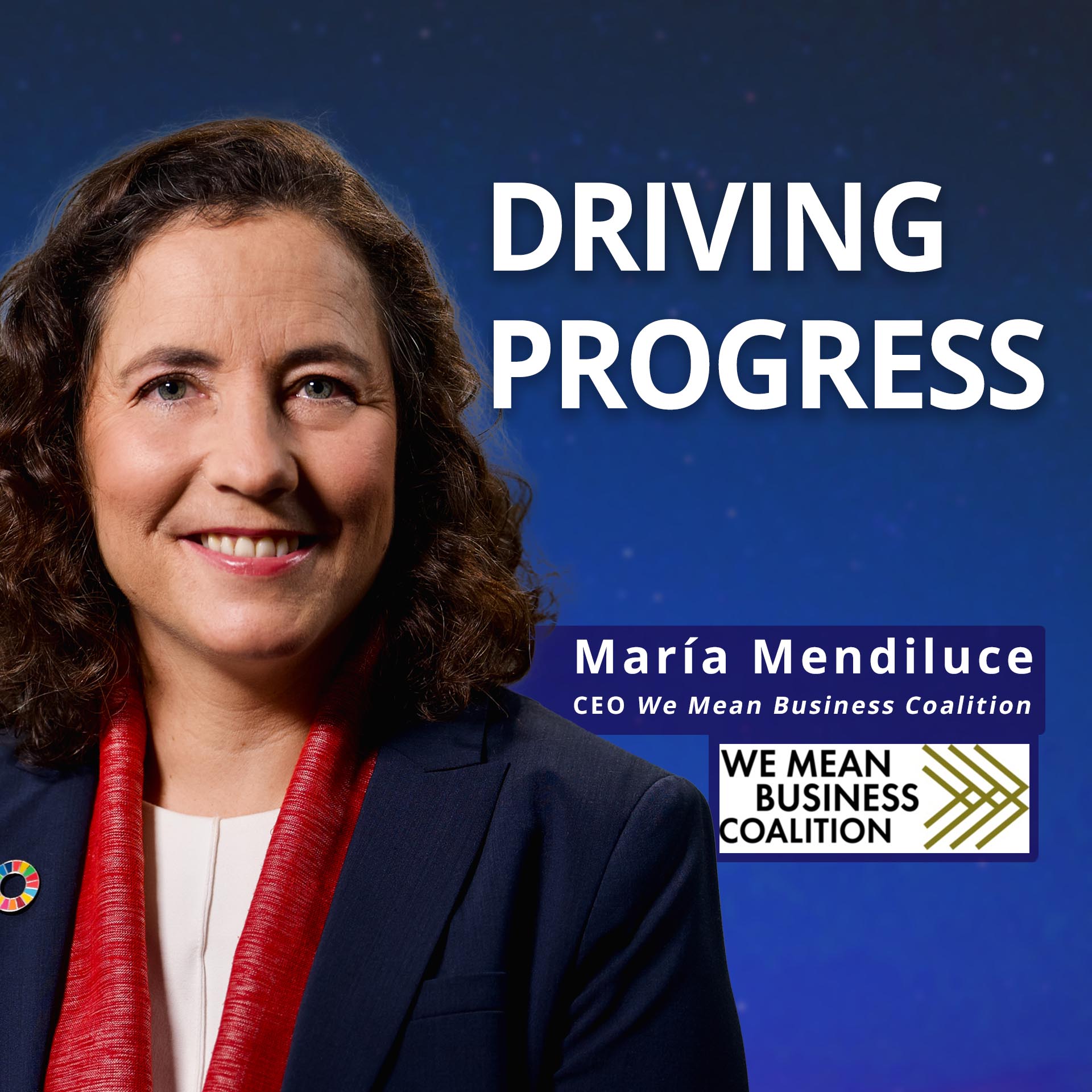
Loading summary
Transcript55 lines
- [00:00]
Maria Mendelous
And the Chinese industry has accelerated to the point that now they sell very competitive cars. And you know, and I look forward to seeing them in the market because they will be cheaper, more competitive, more reliable, fantastic batteries. They're really good because they took it seriously. Now to the point that now Europe needs to learn from China.
- [00:23]
Sibylle Barton
Welcome to the special English edition of Der Grosse Neustadt, a German podcast series by Sibylle Barton in which she talks to pioneering leaders who, inspired by the World Economic Forum's Great Reset initiative, create revolutionary projects that actually do make our world smarter, greener and fairer.
- [00:47]
Interviewer
I am pleased to welcome Maria Mendelous, the Chief Executive Officer of the We Mean Business Coalition who was recently named one of Times 100 Most Influential Climate Leaders in Business. With over 25 years of experience in sustainable development, energy and climate action, Maria has been at the forefront of driving global business leadership in the fight against climate change. Under her guidance, the coalition has mobilized nearly 17,000 companies worldwide to commit to reducing emissions in line with the Paris Agreement. Her work continues to catalyze a transition to a net zero economy. And today we will talk about the need for radical collaboration, enhancing corporate and governmental accountability, the organization's 10 year anniversary, as well as what lies ahead of us. Good morning Maria. 10 years of we mean business coalition. Congratulations. First, can you share with us the initial vision behind the organization?
- [01:56]
Maria Mendelous
Yes. Well, thank you very much for having me on this podcast. It's a real pleasure to be with you and pushing together for greater impact. We need to position ourselves back in 2014 when women business was created and what was the mindset of business and governments at that moment? It was prior to the Paris agreement and there was not what now we call decisive action on climate. So within business Coalition was founded with a very clear vision to unite the power of business to accelerate climate action at global scale. Initially, the goal was to create a collective voice for the private sector that could push for more ambitious climate policies at the COP21 at Paris. Within the first year of the Coalition, we saw the success of the Paris Agreement. And over the past decade, this vision has evolved in response to the growing needs of climate and nature to respond to the crisis. The Coalition has expanded its focus from simply advocating for climate action to actively supporting business in the transition to an ethio economy. This includes initiatives that help set science based targets, decarbonize supply chains, invest in nature and engage in policy advocacy. The Coalition role has become increasingly pivotal in ensuring that businesses not only commit to climate goals, but also achieve them in a Manner that promotes inclusivity and resilience.
- [03:35]
Interviewer
Can I take you back to the beginning? You received the first funding I read from the IKEA Foundation.
- [03:46]
Maria Mendelous
Well, it is clear that IKEA foundation has very strong values that are very aligned with now our values at women business. And they saw that there was a necessity to bring the different business organizations to collaborate, to unite against a single voice. Until then, the different organizations that form the coalition have their individual activities. And we know that when we are together, we can be stronger and we can go farther. And that's the philosophy behind the creation of women Business. Ikea foundation has been such a fundamental partner in the life of women business and continues to be because they invested in a collaboration that had never been done before. And so they had a lot of faith on our chair, Steve Howard, and on the willingness of the CEOs of the coalition partners to be united and to work on this. And it is true that everything we ask, except one thing that we ask for, the Paris Agreement was included in the Paris Agreement. So it was very successful. And since then, they've been focusing and evolving with us in the climate action, corporate climate action journey.
- [05:07]
Interviewer
But just coming back to your 10 years in business, which would you consider the most significant achievements?
- [05:21]
Maria Mendelous
Well, so I think the first one was the Paris Agreement. Even Cristian La Figueres called the former CEO of women business, Nigel Toppin, the day of the Paris Agreement to thank them, because the voice of progressive business at that time was fundamental for governments to go ahead and sign the most ambitious climate agreement. Then the coalition continued. And in 2018, we were the first organization to say that we needed to keep the 1.5 targets. It used to be 2 degrees, and then we move it to 1.5. That meant that a little bit later when Covid came, we were the first ones as well to say, you know, we need to build back better. You know, we need to, to take lessons from the COVID pandemic and reinvesting, you know, in ensuring that this will not happen again. And also that climate change and nature and biodiversity laws, which are bigger crisis, you know, can be, can be tackled by investing, you know, on this build back better on those infrastructure. And then we have been behind and pushing governments to set ambitious indices in Europe, in the US and the policymakers have acknowledged the role of our coalition partners and ourselves in pushing for that ambition. And that means that both the US and Europe have an objective that is aligned with what the science says we need to do by 2030, which is to halve emissions because there is a lot of emphasis from companies on net zero and 2050. We say, well, that doesn't work. We need to focus on what can be actionable in the next 10 years. And that's why we created the campaign all in for 2030 and now more recently in the Last Cop. And we're very proud of this. We were the first organization to say, vasta, we need to phase out fossil fuels. You know, if we want to tackle, if we're serious about tackling climate change, we need to tackle the very source of climate change which is burning fossil fuels. And so we mobilize around 200 companies. We were very active on the lead up to COP28. And we're very happy to see this included in the final text, which is really, it's incredible to say because we should have included this day one. But cop 28, finally there is a text that says that we need to face at fossil fuel transition. You know the words.
- [07:57]
Interviewer
Yeah. Well, that's very impressive because the COP28 in Dubai marked the beginning of the end of the fossil fuel era and was the first time in history that we have a global agreement to transition away from all fossil fuels. And I think in line with science was the sentence. So all of that goes back to your hard work and your idea of radical collaboration.
- [08:31]
Maria Mendelous
Obviously there are many, many actors that are pushing in that direction, but I think what we do is that we bring the business community in this direction and we know that these things are hard to say. As a company, I'm going to face out fossil fuels. It's not easy because for some users there's no alternatives. But we are not radical. We're just saying, okay, from now until 2030, we're going to create a plan to transition away from fossil fuels and then, or unabated fossil fuels, honestly, because, you know, if we manage to capture CO2, fantastic. So it is pragmatic, but it's ambitious and it is, you know, we always need to push the next boundaries and I suppose that's what we do, we push the next boundary. We work with leading companies so that they show that it is possible. Other companies follow governments, listen, and then they put in place policies that will allow this to be implemented by the large majority of businesses. This is the ambition loop and it's a key part of our theory of change.
- [09:35]
Interviewer
And of course, the ambition and everything comes with collaboration and your, your drive for collaboration. Just looking at your seven founding partners, you, you have not only seven partners, but you also work with another, what, 80 and probably by now more organizations that are really big players. So can you, can you explain a little bit about how this collaboration has been instrumental in driving the coalition schools?
- [10:12]
Maria Mendelous
Yes. So you know, I'm always remind of the importance of collaboration when I, when I talk to companies and there's no single company that doesn't tell us I want to, to fight climate change, I want to reduce my emissions. But I know that if I don't work with others, there are many things that I cannot do by myself that we need to do together. And so the business community is collaborating unusual suspects. Competitors are collaborating to tackle some of these most important challenges. So the same happens with the coalition. So we're very lucky to have incredible members, partners in the coalition that cover all parts of climate leadership from the accounting on emissions and disclosing, which is cdp, you know, to the actions, you know, that is BSR and the World Business Council for Sustainable Development of Cambridge Institute of Sustainable Leadership to advocacy with partners like Series B Team, Cambridge leaders groups or ambitious commitments in terms of renewables electric vehicles, like the climate group. So it's an incredible group and I think the value of the collaboration is that instead of duplicating the work once we are partners, you know that someone is going to be doing certain things. Well, let's not duplicate. We know that CDP will be doing disclosure. We have an incredible ambitious initiative on renewables. So let's all point companies towards that initiative and let's all unite our voice to advocate for the policy change that is needed. Now of course this important, this, these partners are, were and are very important partners, but there are many more partners out there. And so we entered into strategic partnerships with the Science Based Targets Initiative which actually we were one of the founding partners and it's been a key success of the coalition with the B Lab, B Corporation, the B Corporation movement. You know, we just spoke to them very recently and they are sending their companies for our commitments, both the SME Climate hub SBTI and our advocacy action to E Environment Defense Fund, an incredible think tank, American Think Tank for VCM Markets Initiative. So and, and with those we have more close relationships and then we work with many, many partners because you know, in any, any of the activities that we, we do have at least three partners with whom we work and push for this because, because it's just, this is not about being the smartest, it's about working together to create this smartest thing together.
- [13:12]
Interviewer
Can one say that the coalition's role is basically to push for company disclosure through voluntary standards and Regulations. Is, is that correct?
- [13:27]
Maria Mendelous
Well, we think that we, we talk to companies about the 4A's of climate leadership. So the first one is ambition. So we think, well, obviously first companies need to understand the footprint, okay? So they need to do some calculations and say, okay, this is my footprint scope one, which is the direct emissions scope two, electricity emissions, scope three, value chain emissions. And within scope three, that is very complicated, understand where are the most material emissions. Okay. So once they know that, then we say, you know, you should set a target. If you're a big company, go to svti. If you're small, come to the SME Climate Hub, which is a program that we, we created and we're running from women in business. Then we say you just need to move to action. So you need to purchase 100 renewables, electric vehicles and different and different activities that companies are doing anyway. But you know, we try to help them and remove the barriers etc through the work with the partners, okay? And then we bring the business voice, that testimony, those lessons learned, that ambition to policymakers through advocacy. We tell them, okay, you know, you need to be more ambitious. Your NDCs need to be aligned and need to be investable. You need to have this kind of policies that will help unlock some of the barriers that etc. And then finally is accountability is again report progress, report your emissions, report your participation. So it's one important thing that we launched a couple of years ago that is taking a lot of momentum is companies need to be consistent in how they talk to policymakers. They do policy advocacy and login. And so it doesn't work if a company has an SVTI target, but they are logging for policies that will go against the achievement of that target. Because there's no consistence and coherence. We call on governments to be coherent. So business need to also be coherent. And that's what we call responsible policy engagement. And we ask companies to report on what are the position of the different trade associations and industry groups and lobbying groups regarding climate change so that we drive alignment. Because here it's very important the keyboard is alignment. You know, it doesn't work if we have different rules in different geographies in different sectors creating, you know, when avoiding any kind of level playing field, you know, business wants to play by the rules. They want to have transparency on those rules and that will allow them to go much farther. And that's why it's important that that alignment and, and policy drive.
- [16:10]
Interviewer
Yeah, and you of course have been also involved, of course in with the international Sustainability Standards Board, who helped to create this one language, if you want. Right. What was the coalition's involvement in there?
- [16:27]
Maria Mendelous
Well, we have been actively supporting them and participating in the different working groups. Our partner, CDP is the key partner that is working with them in ensuring alignment and ensuring that both the CDP questionnaire and what it is being asked is aligned and interoperable. ISCV. It's really important. It's important to have a global baseline, something that at least all governments, all countries will apply to, so that then companies can report emissions in a similar way in different geographies and then it can be comparable. So I know you had in previous chapters, Emmanuel Faver, so I'm sure he will explain it in full detail then.
- [17:14]
Interviewer
Yeah, yeah, no, it was wonderful. And it struck me at the time he was saying one thing, that we all have to learn a new economic language together. And that is if you are open and willing to learn and you understand the context, of course, then it's a given. But if you're not, it is a major barrier. How do you experience that, this learning, this new economic language? How do companies react when you first talk to them?
- [17:53]
Maria Mendelous
Well, I agree with Emmanuel. That is a new language and one. It's like the financial statements. It took, I think about 100 years to do them and we want to do environmental standards in 10 years or 20 years. So it is normal. That is difficult. It is also very difficult to do them. It is also very difficult to have a good understanding of your footprint as a company, especially those that have very low supply chains. But I always say the same, if you want to manage, you need to measure. So start by measuring and then suddenly you will start to reap the benefits of that measurement. Because if you reduce emissions, you're reducing cost most of the time, and there is an incredible potential to do so. So it is, you know, it is inevitably in the journey of any business big and small to, to measure emissions, to report them according to the regulations. And yes, at the beginning is hard, like for you and for me, you know, when we need to do something new, it's not easy. But, you know, luckily they're not going to be the first companies to do it right. So there's been a lot of companies that have been doing it for a while that can share their learnings. And so we're not started at zero, we're starting maybe at 20 and we need to get to 100. But there is a lot of learnings. And so to those companies I say, yeah, yeah, talk to others, speak with Your different trade associations and governments peers. Because there is an interest from any business that every business does account their emissions because we're all, all businesses are part of someone else supply chain business. And because companies commit to reduce the scope 3 emissions, they need others to report emissions and to reduce them. And so this is a fantastic place to collaboration. One that is a win win for others, for everybody.
- [20:07]
Interviewer
Yeah, and Maria, we were just talking about it just before we started the interview. You were also managing director of one of your current partners right now, the World Business Council for Sustainable Development. And if one takes a very good look into this organization, it is quite something here. It's a global community of 230 of the world's leading businesses representing a combined revenue of more than $8.5 trillion. Talk to me a bit about that.
- [20:43]
Maria Mendelous
Well, it's an organization that I love because I spent 12 years working with them and that's where I have matured professionally. And it has an incredible leader, Peter Bakker, with whom I work very closely and continue to work because he now sits in the board of Women Business. You know, Peter has completely transformed the organization in the past years and retransformed and transformed and his ability to look at the future and to respond with what is needed from the business community is very visionary and advanced. The World Business Council for Sustainable Development, you know, works in different pathways. So they work with companies on how to transform the energy system, transport, industry, buildings, nature, agriculture, food in a way that is so profound, deep of understanding. And it is business. So it's not a think tank. It's the business community sharing everything what they know. You know, for this public good in terms of climate action, plastics, social equity issues that are more transform transversal. They also have a lot of activities. We also, when I was there, created a women program. They do some education courses for leading women, which is amazing and you know, it's, you name it, circular economy, education. I think they're at the forefront of, of many of these aspects and it is an invaluable player. And you know, most of the things that they do are public. And so I invite everybody that is listening to go to the website and learn because there's so much to be learned and so much to see this continuous transformation that the sustainable world is going through that is very well represented by him, by Peter, but also the organization and it's incredible. My former colleagues now World Business Council also created some regional chapters and those are run by people from the country. For example, yesterday I spoke to Cedis, which is the Brazilian Business Council for Sul Development. And I know them, Marina, the president for many years. And they are mobilizing the Brazilian business actors, you know, to, to support COP30 and its success. Fantastic. There is another one in Australia, in many Latin American countries. So what they do globally, then it is translated to that local level, to the local reality. And so it creates a tissue of business working on sustainability both at global and at local level that is very, very influential and interesting.
- [23:40]
Interviewer
You were talking a bit about ambition of companies, but it takes also a personal ambition to make that journey. So I said in the introduction already that you were named one of Time's 100 Most Influential Climate leaders in business. Congratulations, by the way. So what took you there? When, when did you realize there is more to life than just going to work?
- [24:10]
Maria Mendelous
Yeah. Thank you. So I think everybody, yeah. Has some sort of personal journey into this. I mean, for me, since I joined the World Business Council, it was very clear and I have a strong belief on the power of business to drive positive change. And both there and now at the coalition, you know, this is what we are driving for and empowering. I also come to this with a huge sense of responsibility like you and like many other leaders, you know, when you are in a position that you can influence, you know, you need to take that with a lot of responsibility. And so I think, and in many aspects, you know, I will never say no to a new idea and see where it can bring us if that's going to drive for this shit and common good and to advance both sustainability and climate change. I think the people like us, like you, civil me and many others that you have had in this podcast, it takes a lot of resilience as well, because let's face it, climate change is not being solved and emissions continue to grow, temperatures continue to increase, and it's hard. And so it also takes a huge amount of resilience and resistance and keep going, right? And then when you look back, then you realize, wow, it's incredible the amount of things that happen. If you look in one moment might be frustrated, but if you look in the past 10 years, you say, well, there was no company that had the targets aligned with net zero 1.5. Now, you know, there are 17,000 companies. Okay, wow. And they are, I think half of, of the world market cap. Okay, well that's a big achievement. Now we need to see that in emission reductions, of course. And then, and then we just saw some numbers that companies that have science based targets, you know, reduce maybe 4 percentage points more Emissions than other companies. So in other words, if you don't have a science based target, your emissions have probably increased by 2%. If you have science based targets, your emissions have reduced at least 2% to 4%. Okay, so then you say, okay, well, yeah, what we're doing, it's having an impact. But yeah, when you see the catastrophes, you know, the fires, the droughts, migration, it's, it's really, it's really difficult to see that we need to do more. We need many more like you and me, you know, to join us in this moment.
- [26:54]
Interviewer
Yeah, many more. And since you go into this area now, maybe we can spend a bit of time about talking the major barriers of change which you encountered.
- [27:07]
Maria Mendelous
Yeah, well, there are many, let's say, yeah, let's take now something, you know, from your country. You know, electric vehicles. So, so I think, I think, you know, they, you know, many more people should have electric vehicles because they are very, very efficient and competitive and the prices are, are starting to be similar to, to cars, even better than hybrid cars. I have one, you know, I spent one third of euros in terms of the energy that the car uses and the driving. It's amazing. Okay, but we're stuck and there is this fear, you know, of the anxiety range. Even if, you know, my car, you know, I don't need to charge, I charge it at home and I don't need to charge it, I charge it once a week at home. So I don't need to go to the gas station. But people say, yeah, what am I going to do and what I'm going to charge. And then what, what when I go to a place. Well, when you go to that place, it's once a year and then you figure that out. But that shouldn't be the barrier. Right? So, so I think, yeah, moving people and changing the mindset, it's very important. Now with that same example, we need more infrastructure for recharging, okay. So that people not have that anxiety and they see that that works. And then the last point, which is one that you probably have seen, I have seen it is the level of this information that is out there is incredible. That is driven by certain actors that do not want electric vehicles to succeed. So electric vehicles, they burn. Their life cycle emissions are worse. All that is not true, but it makes the headlines and then it kind of reinforces this sentiment, no, no, I'm not going to go electric. I'll continue with hybrid. No. So, but then moving to more to the business side, so, so permitting is a, is A huge issue. So it takes three, four years to put. I don't know, I went to the park. That. That's unacceptable. Unacceptable. You know, it takes that long, really. Yeah, yeah. And yeah, then there is. So. So that's a huge issue then supporting infrastructure. So that's more. Maybe in developing countries, yes, you can put, they have a lot of, you know, solar capacity. You know, they can put a lot of solar capacity, but if there is not a grid infrastructure that provides backup power, then, then it is not viable to move there. And then, you know, companies prefer to use diesel generators that are more reliable. So. So at the, at different levels, mindset, red tape and big investments in infrastructure are some of the big barriers that we face. Then there are technologies like green hydrogen that are very expensive. And so for those, we need policy interventions like we did, like we saw with solar PV back in the year 2000, with a strong subsidy by government so that those companies, they learn, they reduce the cost, they take economies of scale, they reduce part of the cost, and then they become, become more competitive and, and companies can use it. Yeah.
- [30:33]
Interviewer
You have not mentioned finance.
- [30:39]
Maria Mendelous
It's, it's quite interest because if you talk often, you know, investor says, no, there's money, there's no bankable projects, and company says, no, no one wants to fund my project. No. So I don't come from that, from that world. But I was talking to a big company in the fashion industry and they were telling this week, and they were telling me that when they talk to their suppliers in developing countries about the need to integrate renewables in their plants, for example, the question that the suppliers are asking is, can you help me do it? Because I don't know how to do it. It's not, yeah, give me more money to do it. Okay. Because if this big fashion company is asking, you know, a supplier to do that, they will buy the product from this supplier. And that for them is the biggest, the best finance that they can get because they will sell their product to it. But of course, financing large infrastructures in developing countries is fundamental. And in developing countries, the country risk is very high. And multilateral development banks, the World bank and others need to make an effort in reducing those risk premiums, country risk premiums, so that then business and other institutions can invest in those countries. So, yes, it is a big issue, but not always.
- [32:05]
Interviewer
Yeah, Maria, because you mentioned the car industry and specifically in my country, Germany, a short episode. I remember speaking to a group of German business leaders around 2018. I just came back from London equipped with The Financial Times and the latest article about the car industry. And they talked about how does the car of the future looks like. And they had many ideas. Batteries, clearly, and this and that. And the essence was they were saying, we don't know how the car of the future looks like, but what we do know for sure is the car won't come out of Germany. So you can imagine in front of those people, they looked at me with horror. And I did some research into lobbyism of major industry leaders. So I wonder today, should we have targeted those directly and earlier. And the other question would be, would they have listened or to whom would they have listened to? What's your experience?
- [33:34]
Maria Mendelous
Yeah, well, I first, you know, let's all assume, you know, really positive intent. So there are great people working in these companies that are trying their best, but sometimes they don't see the way forward. Okay. Now I find that the European, you know, car industry has been dragging their feet which meant that then the Chinese. And the Chinese industry has accelerated. Yeah. To the point that now they sell very competitive cars. And you know, and I look forward to seeing them in the market because they will be cheaper, more competitive, more reliable. Fantastic batteries. They're really good because they took it seriously.
- [34:16]
Interviewer
Yeah.
- [34:17]
Maria Mendelous
Now to the point that now Europe needs to learn from China. And so China is not anymore the one that was coping is, I think rather it would happen the other way around. Now it is true that the European industry, on the other hand, has not had the support from the governments that the Chinese have given to their industries. And so in Europe the, the approach has been, let me regulate, let me put targets, let me, you know, the sticks, we say sticks and carrots. So there's a lot of sticks. The Americans, it's all about carrots. And I think the Chinese is both. Okay. And so a little bit more of carrots, you know, would help the industry. And a more holistic industry strategy for the automotive industry will help. Now coming with tariffs now last minute fast. Yeah, it sounds a bit, you know, a last minute decision, you know, and last resort decision. And it's very unfortunate. I would rather see, you know, a strong industry that emerges that one that is very focused on what the, the future of the car it is and which means that we need to invest in such infrastructure. We need to change the mindset of people, we need to, to increase the sales of electric vehicles, publicize them more, etc. So, so I think it's a lesson learned from, from the industry because you talk to any of the executives of the Industry, you tell them, you know, how do you think they come in 2035 drive is going to be and it says electric. So then if you know that it's going to electric, why don't you go thousand percent to be electric? Yeah, no, just in case etc. And so, so yeah, I, you know, I understand the, the level of cautiousness, I understand that there hasn't been that much support, but still Tesla, you know, went all the way here we are now. A positive news that I read this summer. Yes, BMW has sold more electric vehicles in Europe. I think that Tesla, which was probably the one that was selling the most, so it's not all, you know, but yeah, yeah.
- [36:29]
Interviewer
And I think they also, the countries here in the north, of course, who don't have a car industry, like I can't remember, was it Sweden? I think it was Sweden who sells now more electric cars than old combustion cars. And of course China as well, sells now more electric cars than old cars. So that is a major change. Right. And it's so fast.
- [36:57]
Maria Mendelous
It is a fantastic. I think it's Norway, the example that you refer to. And yes, because it's all electric. Why? Because they give a lot of incentives. So you don't pay taxes, you can go and park in the city, you know, their registration tax is much reduced. And that meant that then all the car manufacturers are starting to sell electric vehicles in Norway. So it is true that, you know, that that incentive, you know, has created, you know. Yeah. And, and, and they did it in 10 years. It's 10 years. It's not so. So the transformation in the car industry can go really fast. Other sectors, it takes longer because of the stock, no replacement. But in the industry it does. But I, I can say as a user of an electric vehicle, you know, and every time I talk about it, I go to the app of my car and compare. I have only, you know, since March, you know, it cost me the energy 200 francs. Yeah. If I would have had an internal combustion engine, it would have been 800. So.
- [38:05]
Interviewer
Yeah, yeah, I absolutely agree with you here. And I have an electric car, I think for the last six years and it's been a dream. It starts with a community first. I remember we were driving over the Alps and there were a few stations where you could do quick charging and people were starting talking to each other. So all the new things created also new kind of communities. Because you talked about it now, the role of technology, how, how strong do you see all these emerging technologies? I mean, AI blockchain, et Cetera, they play already a major role. What's your idea of how it will work out in the next 10 years?
- [39:03]
Maria Mendelous
Obviously, I'm a little bit worried of the amount of energy they consume. And so I think the industry needs to rationalize the use of AI for whatever is important and accelerate the decarbonization, the efficiency of it and the decarbonization, because the industry has done great progress and certainly in a year or two it's emissions are skyrocketing and it's a disaster. So there's a lot to be done there. But I think everything that has to do, digitalization and the power of AI to track emissions and also to disseminate location and ways of solving problems is so powerful and so important for climate. And I'm quite impressed on how much efficiencies can be achieved by companies when using these instruments to manage their stock, to manage how they use transportation, to manage the different routes. And so what it is important that in all of them they integrate sustainability elements and ways to reduce emissions. Because now, for example, Google can give you the route where you will consume less energy. Right. I think there's plenty of opportunities which are win wins, you know, reduce emission, reduce cost, as I said before. But yeah, be careful with how AI is deployed and so that it is deployed for the right uses because it requires a lot of energy as well.
- [40:48]
Interviewer
And in the spirit of collaboration, we have New York Climate Week this month and COP 29 in Baku is coming up, I think in November. What are your expectations?
- [41:05]
Maria Mendelous
Well, I think Lament Week is going to be quite interesting. The climate journey is very influenced by what is happening in the governments, in the politics of the countries. And so we were a little bit afraid with the European Union elections and then with France and I think things more or less are coming to terms and we're very hopeful on what we've seen in the UK with the new government and increased ambition. And I'm convinced that also Brazil is going to be a fantastic job for setting an NDC at the ambition level. The NDC is the National Emission Reduction Plan that the countries need to present for next, you know, next spring. And I think they were going to set the example, but present in a very ambitious one. So I think for Baku it's, yeah, it's, let's see what we can achieve. But the reality is that Baku was not even on the line to prepare the conference and it was a political compromise to do it there. So I feel for the IBAKU team that suddenly they, they need to organize this big, big conference when they have not been in the past so active in doing so. And also because we have the elections in the US right at the time of COP 29. So for political reasons, this COP, I think is going to be, you know, not as, as strong as last year in Dubai. And next year the COP 30 is really important because that's when the new NDCs are presented. And now what we need is that those national plans are more ambitious, that we reduce the gap that exists between the current NDCs and the 1.5 goal. And that also those NDCs are more mature because this is the second or third time that countries do them. And so they need to include a policy framework that will go along that ambition. So because we need rules, policies, incentives, carbon pricing, removal of subsidies to fossil fuel, a very clear introduction on phase out dates for fossil fuel uses in different sectors in a way that we have not seen before. So I think the policymakers need to learn and be more ambitious and the business community is going to push for that. And through women, business and our partners, we're going to push for NDCs to be investable, for the policy framework to contain certain elements. Importantly, as I repeat, fossil fuel phase out dates. So this is not tomorrow, but from now until 2040, 2050, there needs to be plan to replace those fossil fuels by renewable energy, energy efficient measures, etc. And the halting and reversing deforestation and forest degradation. This is also a place we tend to talk more about energy. But land represents 30% of emissions. It's only going to increase if we don't tackle it. We need to stop deforestation and degradation and then we need to also reinvest in nature. It is a very important part of the work we do as well.
- [44:21]
Interviewer
I'm grateful that you've mentioned the fossil fuel dependency because we have, of course extreme numbers are existing. You have on the one side the profit in the oil industry. It's a profit of a lifetime. I mean they have a very good time. You have on the other hand, the IEA who said years ago we shouldn't exploit any more fossil fuels, we should leave the earth alone. And in between are many organizations, companies, governments who try their best. What is your approach to.
- [45:14]
Maria Mendelous
So last year we created this campaign which is called Fossil to Clean with the idea that we need to transition from fossil to clean if we want to address climate change. We need to stop burning fossil fuels. And because we are so dependent on them, we need to create that pathway to reduce that Dependency and to replace it by fossil fuels. A sister campaign was the tripling of renewables and doubling of energy efficiency, which was really successful as well. And we are a partner of which meant, okay, we need to triple renewable double energy efficiency. And I think they are talking about multiplying by five, I think energy storage. So which is new. This is being developed as we speak. Really interesting developments there. So from our perspective we say okay, well this is great, but you know, what does it mean for companies? So then we went to, to the different companies. So if you are a company that is demanding fossil fuels, you need to create a plan on how you're going to stop consuming them and replace them by clean sources from now until 2040. If you are an investor, you need to change your investment ratios. Now it is luckily now we have increased. It used to be much more investment in fossil fuel and on renewables then it was one to one and now I think last year it was two to one. So we invest 2 million on renewables and one. Unfortunately. Okay, I mean that proportion. Okay, well it needs to be according to. I think the AAA is 4 to 1. Okay, four investments in clean energy, not including energy efficiency. If you include energy efficiency, I think it's 71. But anyway in clean energy, 4 and 1 because you need to maintain some of the investment solar for operational purposes of the existing fossil fuel assets. Then if you are a fossil fuel producer, and this is the toughest part, you also need to transition from fossil to clean. So you need to stop new exploration, that's for sure. And then little by little you need to create a plan on how you're going to be facing out your plants and replacing them by renewals of what? By whatever as an industry you want to do. Obviously, you know, there was no oil and gas company that signed our campaign, but we had quite a lot of companies that did sign. From the demand side. Yeah. And I think many support from the investor side that we focus more on that demand side because at the end if the demand decreases, then production will decrease. But on the other hand, that's not enough because what I'm very worried is that the oil and gas industry is investing in Africa and in developing countries. Large amount of infrastructure that will lock the country to fossil fuel. You know, if we want to help Africa, we need to invest in clean energy. We don't want to invest in an energy source that will be banned at some point.
- [48:16]
Interviewer
Yeah, well, hoping for the governments to do something about it. I don't know if you're in charge if you've been elected for a couple of years, or four or five years. Yeah. When you were talking, I thought.
- [48:31]
Maria Mendelous
Would.
- [48:31]
Interviewer
It help the planet? Let's say if we declare a kind of emergency for the planet and who could do that?
- [48:41]
Maria Mendelous
Or is it an illusion? No, but I think inevitably if we continue to not tackle climate change, temperatures continue to rise, there's going to be the amount of extreme weather events is going to increase, the economic losses are going to skyrocket, and there's going to be a point when the government will say, well, this is a global emergency, like a Covid emergency with requires drastic action because solving climate change, you know, it's about, you know, putting more money on the table as well because the technologies are available. It's just that some are very expensive. And so when we saw Covid, there were some very strong restrictions and a lot of money that was put to the development of solutions. So I can envisage that in the future this can happen. It would be very traumatic and dramatic. That's why we need to work so that we can transition in the most orderly way as possible to that. But I do think that it could be inevitable at some point. The other thing that we haven't spoken is about the need to capture CO2 as well. Yeah. So now technologies to capture, of course you can forest capture in the forest and we are pushing for that, but it has some limitations in terms of leakage and permanence, et cetera. And then there is some technological development in that sense that are very expensive. But I can envisage in the future that it will be mandatory to also reduce, remove emissions from the atmosphere. And in the IPCC models, that's what it says at the end. If you see the graphs, everything that is underneath is, is about removal. So. And nature can do certain parts, but we will need others. So I think that that is inevitable. It's just, it's all about timing what we see in the next 10 years, 20 years, but for sure that we will see it before 2050.
- [50:46]
Interviewer
Yeah. What strikes me here, Maria, you, you work with the most influential organizations and companies like Makani's, gfans, the World Economic Forum, unicef, efrac, World bank and so on. So it's the who is who in the whole climate business. But then there is the effort. We have the results, we see change. We have many good examples, as we just heard from you, and yet they don't find their way into the mainstream media. Yes, selective into probably Bloomberg, Time magazine and Fortune 500. But worse, they they hardly find their way to the average citizen.
- [51:41]
Maria Mendelous
I think you're, you're touching on a very relevant and sensitive topic. Yeah. Because unfortunately some of the headlines focus more on greenwashing of companies than actually on what companies are doing. And I think we need to change that because it is not easy. What we're trying to do here, what the companies are trying to do, to map all their supply chains, emissions, when they don't even know the names of the, the suppliers sometimes, or where are they located to invest in technologies that are completely new, that can succeed, or not to invest in technologies that are not competitive, but that, you know, that you need to invest so that you can learn. So you're going to lose a lot of money to go to the board and convince your board to invest or to, to set that target when you don't know the rules on how you're going to report on it. So, so I think the level of ambition of many companies and, and the level of, you know, trust in the system has been very high. But then, then in return, you know, some of these companies are accused with false allegations or other times good allegations. Right. So I tend to say that, you know, it would be good if journalism, you know, instead of focusing on those that are doing something but not doing it perfectly, you know, instead of focusing on those that have big names and big brand names, okay, which attract headlines, I know that they are honestly trying to do something good, but might not be perfect or not of the liking of some. Instead of that, why don't we focus on putting pressure on the laggards, on those that are not doing anything? Because in our network we have these 17,000 companies, okay. There are millions of companies that are not doing anything.
- [53:38]
Interviewer
Yeah.
- [53:39]
Maria Mendelous
Or maybe they are doing things that we don't know. Right. I think the emphasis needs to be on those that are not taking responsibility and doing what is required for them. You know, in this moment in time.
- [53:49]
Interviewer
If we look beyond 2030, regarding your work and the work of all your partners, who else needs to be brought into the boat and where does it need more ambition and action?
- [54:06]
Maria Mendelous
Well, I think there are many boats to be brought and there are many, many boats being also quite filled with people. I find that it would be good to have more alignment across the different boats so that we go in the same direction. Because also sometimes the efforts are quite fragmented and so we need to bring coherence in the different, the systems. For example, central government and local governments need to be more aligned. Unfortunately, sometimes if there are different parties, they are not so aligned. I think we just also again, elevate ourselves. What is the bigger, bigger good? This is good for every political party, every ideology. You know, this is good for your people kind of thing. I think, you know, as you said, this is very complex. You know, even those companies that invest a lot of time, knowledge, etc. They still have not come to the, to the end of knowledge. Right. They are learning every day. And so let's take that approach and learn and as communicators, you know, as the ones that we are carrying the message, let's also simplify the message so that people can understand the complexity in ways that they can understand. And so more alignment, more ambition, more clear rules. I think those are key ingredients for success.
- [55:36]
Interviewer
Let's say one of those. Many companies out there have listened to that now, but they haven't been involved in anything. But they do know that they have to in the near future. What, what's your advice? Should be the first steps. Let's say it's a small to medium sized company.
- [55:56]
Maria Mendelous
Well, go to the SME Climate Hub upgraded. Sorry for the publicity. Seriously. So as an SME. Yeah. First, you know, try to measure your emissions. There's plenty of calculators out there now there are many education tools that will help you get the knowledge to understand what you need to do. Then talk to your peers and talk to your clients to see what they need and to adapt and do the numbers. Because often some of these investments are, you know, have a very positive payback period. I think once you do that, then raise your voice, you know, talk to others, explain and become an advocate and mobilize others to do the same. Because I said before, it's not about one company doing something. We need millions of companies and we need to have some peer pressure and peer support in the journey and then speak and present your case so that others can learn and be motivated to act.
- [57:06]
Interviewer
You quite rightly said, Maria, we need millions of companies to join. So what does it mean for your road ahead in the short term as well as in the long term?
- [57:21]
Maria Mendelous
Yes, so I think it's going to be a bumpy road, but definitely I think the direction of travel is very clear. So I think the compromises, the agreement, the Paris agreement and the subsequent steps in that direction of keeping temperature as close as possible to 1.5, it's still very valid. We are seeing growth in terms of commitment of 100% growth every year. Companies are being asked by regulators to report their emissions and to act upon them. Companies that reduce Their emissions are going to be valued more positively and will receive loans at better interest rates. We have seen that this is already happening. So I think the direction of travel is inevitable. We're going in that direction. The sooner companies join the boat, the better. And that will then unlock an incredible wave of innovation and new business opportunity. So I say that there are three important message messages for the next few years. One, it is responsibility. You know, every one of us and every business has the responsibility to do less harm, to reduce emissions and to other things also in relation to sustainability. The second one is opportunity. We are seeing the reduction of cost of renewable energy, of electric vehicles, of batteries and so on, so forth that make the transition very competitive. And lastly, the risk, the risk of not doing anything is enormous. The impact that this is going to have on your employees, on your families, on the communities where you operate, on migration, it's enormous. And so. So we need to do and to act responsibly now. And don't wait because later it's too late.
- [59:33]
Interviewer
We need to act responsibly now. I think on this note, I think I want to say thank you very much, Maria, for this very, very interesting hour. And please, if we haven't covered anything yet, what is close to your heart, please then use now the last minute or so to do so. Otherwise, I'm very grateful. You do fantastic work with all your partners and we wish you much success.
- [60:09]
Maria Mendelous
Well, thanks to you and the fantastic podcast that you are creating. And yeah, let's. Let's make the positive voice be heard widely across the world because we need everybody on this journey. Thank you.
- [60:24]
Sibylle Barton
You've been listening to a special English edition of Der Grosse Neustadt, a German podcast series by Sibylla Barton, in which she talks to pioneering leaders who are committed to making our world smarter, greener and fairer. For more information, please visit www.sibilabaden.com and the official site of the World Economic Forum.