← Design Better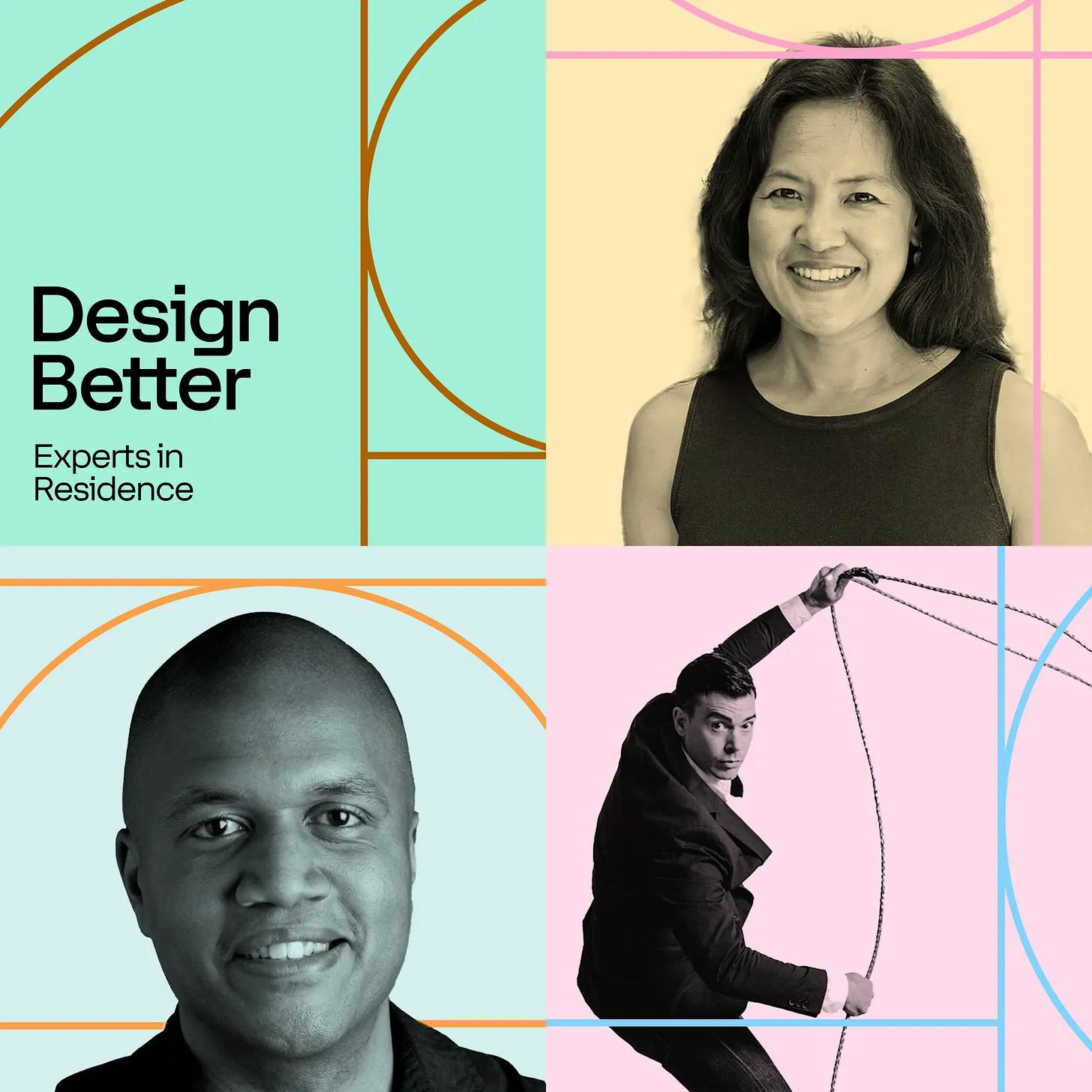
Design Better
Design Better Experts in Residence: Roundtable at Sequoia Capital
00:59:30
In this special live episode at Sequoia Capital with our Design Better Experts in Residence, we cover the evolution of design in technology, the value of diverse backgrounds in design, how technology is reshaping what designers do and how they work, cross-cultural design perspectives, and much more.
Loading summary
Transcript93 lines
- [00:00]
James Buckhouse
The startup isn't just making a piece of software or a piece of technology. Startup is always designing a product that is going to transform its customers. So it's taking the customers from the person they were before they used your thing to the person they're going to become because they have your thing now that they can use. Thinking about that process of transformation of your audience, of the person experiencing what you have to offer, well, then design is as well suited as anything to get that done.
- [00:29]
Aaron Walter
At Design Better, our primary mission is to produce work that helps people like you refine your craft, improve your collaboration skills, and get inspired by the creative process of others. If you enjoy what we do here, the best way to support us is to become a Premium subscriber@designbetterpodcast.com subscribe. We'll return to the conversation after this quick break. Design Better is brought to you by WIX Studio, the platform built for all web creators to design, develop and manage exceptional web projects at scale. Learn more@wix.com studio and now back to the show. We are here at Sequoia Capital in Silicon Valley for a special live episode of Design Better. With some familiar faces here, we've got our experts in residence, Irene Au, Kevin Bethune and James Buckhouse. Thank you all for joining us today.
- [01:42]
Irene Au
Thanks for having us.
- [01:43]
Kevin Bethune
Yeah.
- [01:44]
Aaron Walter
Longtime listeners will recognize Irene's name because she was our guest in episode one of Design Better. You occupy a very special place in our hearts, Irene, as do you. And Kevin has been on the show before as well, where he talked about your interesting career journey as a nuclear engineer to designing Nikes. And you can't see it on camera today, but you have a special pair of Nikes on that are really cool.
- [02:11]
Eli Woolery
We'll get a zoomed in shot later.
- [02:12]
Kevin Bethune
There we go.
- [02:14]
Aaron Walter
And James, we've been here with you before for a special AMA last year. And we're back at Sequoia because you're such a great host.
- [02:21]
James Buckhouse
Thanks. Thanks for having me.
- [02:22]
Eli Woolery
Yeah. So it's worth going back and revisiting each of those episodes because together we have some real amazing pioneers with us who shaped how businesses are built, how design operates at scale, and how creativity thrives inside technology and venture capital space. Speaking of where we are today, Irene, you led the design practices at Yahoo and Google. You actually helped design the very first commercial Internet browser, Netscape. And now you're as a design partner at Coastal Ventures. You coach designers to get executives and founders from seed stage through exit. Kevin, you're a multidisciplinary design and Innovation executive Aaron already touched on some of your experience spanning nuclear engineering, product creation at Nike, formal training at ArtCenter. And you've also written two books which recently came out, Non Linear Year most recently. And then Reimagining Design. And you're the host of a TV show, which is Pretty cool, America by Design on cbs. And then James, your design partner here at Sequoia, working with founders from idea to ipo. But you started your career in the film industry with Shrek, Madagascar, Matrix, You've done fine art, exhibited at the Guggenheim, you've been involved with ballet. And your technology experience started at Twitter and has carried on through your role here.
- [03:37]
Aaron Walter
So as listeners probably gathered from what Eli was sharing, you've been around for a while, you've seen a lot of stuff and design has changed a lot. Before we started taping Irene, we were talking about how your experience when you were at Google was very different. Like design was such a small aspect of what Google was doing. It's very much an engineering company, has been for a long time and now it has one of the largest design teams in the world. Each one of you is working with different design companies and guiding those teams and executives. Curious. Maybe. Irene, we'll start with you. What have you seen over the course of your career, design's influence and how that's changed?
- [04:19]
Irene Au
There's so many chapters. So I'm thinking about how to break this down into different chapters. I began my career in 1996 and so it was kind of the dawn of the Internet. So there were very few designers who worked in software. And those who did usually came from backgrounds in graphic design. They were creating icons or they were laying out the screens. There were user interface designers, but it wasn't something that most people got formally trained in or anything like that. So in the early days of the Internet, when I was building the team at Yahoo, a lot of the people that I recruited had to come from adjacent fields like computer science or architecture. And it was less about what they knew, but more about their eagerness to learn and how they thought about problems and how to go about solving them. So we were mostly making it up as we went along, but many people came from backgrounds in cognitive science, architecture. It was about how you move people through an experience. It was less about the adornment on the page because the big design insight that Yahoo had and later Google. Google was that the successful design was one that was performant because people were accessing the Internet on 24 or 4800 baud modems. I was talking to my daughter the other day and she didn't even know what a modem was. So that just knows how far we've come along. And then the other part of it was about bringing insights about people and psychology to the development team. So I built Yahoo's human Centered design program, which really meant incorporating user research at the core of all of our design practice. So having an empathetic understanding of people, how they thought, what motivated them, how they perceive the world, how you move people through an experience. And that was really elucidating for the development team because they had never watched anybody use their products before. Fast forward to Google. There was an abundance of usability research, but not a lot of insight into people's needs or how this powerful technology could solve people's needs. We were stuck in these old mental models of how people use the Internet. But Google was really on the forefront of thinking about how can the power of the algorithm make what people want to do easier to attain. But Google was famously engineering dominant. Larry Page used to actively control the ratio of engineers to everyone else. So by definition everyone in a non engineering function was outnumbered by engineers. Which you can attribute Google's amazing prowess in technology and the algorithm towards that heavy weight. But at some point, and I would say like a lot of times, what motivates companies to invest in design is existential threat. Usually there's some sort of competitive pressure or market pressure. And I would say the same is true for Google. Around the time that Google started to really invest heavily in design, there was increasing competitive pressure from Facebook and Microsoft at the time, or Apple and Larry Page became CEO, which I think was really the pivotal time. I mean like, I think it's very hard to create design with a very clear point of view when you have three bosses. And for a while there was this trifecta of Eric Schmidt, Larry Page, Sergey Brin as the heads. I mean there was one CEO, but they were kind of co CEOs really in practice. And when Larry became CEO, that just kind of unclogged a lot of the decision making. And you could see the ripple effects of that not only in the products, but also the infrastructure as well as the design. What's interesting now that I see is design still plays a major role, but all the roles are starting to mesh together. Roles are collapsing. When I started my career, you had very clear specialists, you had backend engineers, you had front end engineers, you had interaction designers, visual designers, illustrators, user researchers. I adopted that model from Netscape and carried it through when I was building the team at Yahoo. We continued to carry it forward at Google and somewhere along the way, and I see this now with startups and part of it is a function of these. Startups don't have the headcount to have these specialist roles and people have to wear many hats. But increasingly even in larger companies there's this desire to have people with blended skills. So product managers are doing more user research. We've already witnessed the blending of interaction design and visual design getting meshed into product design, interactive design. Design in my opinion should have always engaged in user research. So we see more of that. And then there's this new job title that more and more companies are looking at filling called design engineers. So it's like the designer who can code and the mashup between the front end engineer and the designer. I think we've had this long standing debate in this profession like should designers know how to code? And I think that's kind of been proven. We've played that out. Now, you know, you don't have to in order to be a successful designer, but if you do know how to code and you can design well, you're going to be that much more valuable. So roles are collapsing. And I would say among the many changes over the 30 years that I've been in this profession, that's one of the biggest things that I've seen is everything's just getting compressed.
- [09:34]
Eli Woolery
Kevin, you started your career in the physical products world first as an engineer and then at Nike. And Nike is obviously a very design centric company. But I'm curious of the companies consulted with. How have you seen designs influence change over the years?
- [09:49]
Kevin Bethune
Yeah, I mean coming from that physical heritage, what I did credit my time at Nike for was any product that left the door had sort of this like triad influence across, you know, design, the manufacturing insight as well as sort of the product management and or business case around that product. That was sort of the initial rooting that I had around multidisciplinary. So that was an early entry into design for me. And as I navigated into my career, invested in more in my design education, I think digital allowed me a strong entry point to enter some choppy waters. Environments that didn't necessarily understand the power of creative problem solving. But based on existing business relationships, I was allowed into the room. But we didn't have a playbook to represent like what design could do in those early team formations. So it was show what design could do through fight or flight, through the different projects, through the different clients and then over time, the business stakeholders wanted more of that and more of the investment in expanding the bandwidth and collaboration appetite for multidisciplinary teaming. And so we sort of wired ourselves that way until bcg, the Boston Consulting Group, decided to acquire our team. And then it really invested and scaled us and we kept that multidisciplinary sort of secret sauce going and at scale. So I'm very thankful for that exposure, especially for bcg, to give us that empowerment to do that and to keep ourselves protected and not get absorbed into the larger mothership of bcg. So that was that experience until when I left in 2018 to start my own practice in Dreams, Design and Life. I started working with two types of clients, startups and founding teams on one side, where perhaps it was easier to have an argument for multidisciplinary collaboration because everyone's wearing so many hats anyway, we cared less about titles, just getting the work done. It was Runway, ample Runway to show what design could do in those environments. But the other half of my business practice was advisory for large organizations, innovation teams, creative teams within those organizations and trying to convince them to allocate the bandwidth, at least more than the typical siloed realities that a lot of my bigger clients faced of just carving more space for multidisciplinary teaming and seeing what evidence could breed from that and then showing design's uniqueness in that, in terms of the evidence that we would create. And so just very encouraging to follow that trajectory. Until recently, I would say, where I think a lot of the volatility that we've all experienced in the market over the last 18 to 24 months, I hate to say a short term myopia has sort of crept in because everyone's holding onto their votes and maybe they're throwing things overboard that they don't feel like they need at the moment. So feature foresight tends to get thrown.
- [12:23]
Eli Woolery
Overboard, but it doesn't have AI in the title, let's say garbage, right?
- [12:26]
Kevin Bethune
Exactly. It was not AI focused. You know, future foresight gets thrown over, marketing gets thrown over, certain elements of design gets thrown over. And we've seen, I think, some celebrated design leaders, some celebrated studios dissolve. And that's been concerning. I've had a vantage point to that in my involvement with the Design Management Institute, where we get to see design leadership across all industries gather together and share best practices. And some brave leaders that were affected by some of these paradigms openly shared what happened and their rhyme and reason in terms of, like, what led to that. I'm hopeful that the lessons from that, we talk about that more. And ideally, we embolden ourselves to want to invest and get back to our design roots more than ever, especially where the future's going.
- [13:10]
Aaron Walter
James, you've got an interesting perspective because you're working inside of Sequoia and you're working with different design teams. And generally, I think people would consider venture is thinking about a whole lot of different dimensions of an investment and how they put chips on the table. And maybe design is not one of those dimensions or not a primary. And yet here you are. And there are other designers here at Sequoia who play this really important role in guiding companies and helping them understand design and its advantage, how it can be strategic. I'm curious, where do things stand today with design and investment? And what are you seeing inside the different companies that you're supporting?
- [13:50]
James Buckhouse
So I got to hang out with an Obama speechwriter who was quite an interesting speechwriter. She had this very interesting approach to how you would even organize an answer to a question. Right. Her name is Sarada Perry, and her answer to how you should start is, what is your urgent burning truth? And so my urgent burning truth to reply to that would be design makes a difference. Design makes a difference. And you can see it over and over on design makes a difference. And so what I have found is in all the different things that I've been working on, from movies to fine art to startups to ballets, is, well, what am I designing? I'm designing this story of transformation where I hope that the audience enters in one state of mind, one point of view. Something happens through the experience. They watch the movie, they watch the ballet, they use your product, they go to the exhibit, they read the book, and then when they leave that experience, they're transformed, even just a little bit, hopefully in a way that helps them become the person they want to be. So how do you apply that to startups? Well, a couple of ways. One is the startup isn't just making a piece of software or a piece of technology. Startup is always designing a product that is going to transform its customers. So it's taking the customers from the person they were before they used your thing to the person they're going to become because they have your thing now that they can use. And so thinking about that process of transformation, not of you, but of your customer, of your audience, of the person experiencing what you have to offer, well, then design is as well suited as anything to get that done.
- [15:37]
Aaron Walter
What do you think is the perspective of partners at Sequoia on Design and how they think about which companies are worth investing in. Is that part of their calculus of which companies they want to be close to?
- [15:53]
James Buckhouse
I don't vote on investments, but I do hang around in the corners and listen. And what I've heard is a focus on who is this person? Is the founder someone that is a real outlier, special person, not just a hard worker, not just a smart person, but they've got a reason that they deeply care about this problem. They've got an insight that's different, not merely better, and they've got the will to the agency to go and do it. So what I see is those are the conversations that mostly the investors have is does the founder possess those qualities? And then of course there's a bunch of other business talk about the market or about how businesses are functioning. And depending on where you are from early to growth, the different parts of that matter more than others. And then how design fits in is really at the level of what are you trying to accomplish? And have they designed an idea in their mind that is going to yield something really special on the other end?
- [16:57]
Eli Woolery
Wanted to talk a little bit about efficiency and we almost had a conversation about this before. And I know Aaron has a perspective that he might want to follow up on. But what I'm curious about is these tools are enabling really massive efficiency from sort of an individual contributor standpoint as like a personal example. So we're working on a little E commerce page for our site. So I was able to go to Figma make one morning and say, okay, here's a screenshot of our site. I want to design an E commerce site essentially, and within like an hour, basically, not only I designed it, but I integrated with Shopify and it was more or less functional. It didn't look great, but it was a really good starting point. And so you think of these tools and like the massive efficiency that ICs can leverage. But what is lost during that too, like there's sort of a creative friction, I think that's really necessary to make good work a lot of the time. So what does that balance like? And what are y' all seeing?
- [17:47]
James Buckhouse
Okay, so we have anyone listening or watching that is a current product designer has a job somewhere trying to do this. A couple of ways that this goes down. One is, oh my goodness, now I gotta be a front end engineer at the same time. And so I don't really know how I'm gonna describe that I was good at being a designer. But here we go. I'll use my favorite Way to generated code and get out the door. And let's try it. Step one and you get something pretty interesting. Sometimes it's great, sometimes it's not, but it's interesting, right? The step two is for like, oh, wait a minute, what else do we have as designers? We have a design system and it's been well thought through and there's decisions that we made for specific reasons. And mostly those design systems are tied to a series of code components. Probably a react library, maybe it's something else. Probably react library. And so as you are making this transition from being just a designer to being either a design engineer or a builder, or this new kind of hybrid mode of someone that generates what they want to create in the world, then into your vocabulary, imagine into your prerequisites, imagine into your understanding of your design system. Imagine then how to reference your own react library. So if I could give anyone a hands on tip right now that you would just use is as you're prompting away or as you're building your own system, prompts that you're shoving in each time, or as you're writing your own little MD files that you want it to look up to be able to behave how you want it to. Consider a couple things. One, consider a document that describes all the things you like in design, literally in words. Think of it as natural language css. Just write out all the stuff that if you were the creative director looking over the shoulder of a junior designer, telling them what you wanted, what are the things that you'd say? It's like here in RStudio we hang things from the top. Here in RStudio we have an 8 pixel grid or whatever it is. Here in RStudio we have the following ratios. You just rattle that out and then also just pay strict attention to your component library. Not only will the rest of the engineering team love what you're doing, but it's a way where you then get results from the AI that are building within your vocabulary rather than, okay, well, I'll do the most common answer. And the most common answer is, I don't know, maybe something good they got from Bootstrap or somewhere else like that. You know, something common, right? But what you want is the answer that matches the system you built and that is hidden in your library of react components. So reference that. And it's not that hard as designers for us to like bring that into our process when we're prompting for new components.
- [19:55]
Aaron Walter
There's another way to look at efficiency too, which is on the team level. And there have been some amazing strides in design teams, namely around design operations, design ops that has its origins with Hot Studio being purchased by Facebook now Meta bringing that in. And then many of those people went out into the world and formalized design operations. You know, design teams became way more efficient, integrated with companies more effectively. I wonder if there's also another side, because when I think about efficiency in design, there's a good thing like we can be part of the story, we can be part of the strategy. And there's a downside to that too, which is design also needs space for ambiguity, uncertainty, exploration, discovery, which is very unique with our discipline. And I wonder if the obsession with operations, not just design Ops but also OKRs, I've never really resonated with the idea of an OKR feels very manufactured. Sort of like let's write our own script and then perform to that. Lots of people have different perspectives on that. Kevin, let's go to you because I think you've got some feelings about efficiency in design.
- [21:03]
Kevin Bethune
It definitely evokes strong feelings. It makes me reflect not only for myself, but also the teams that I've been a part of. Where are we spending our calories? And I'll just simplify it in the sense that there's like been typically three buckets. One, it's like usually there's a lot of stakeholder management in the work that we have to do. Second, there's a lot of production time to build assets to convince said stakeholder we need to go forward on a certain initiative. And the last bucket is what I would deem the most precious. It's that creative problem solving time. My hope is that with efficiency, with automation and these kind of things, we can allow the first two buckets to reduce to expand our bandwidth and appetite and energy around the creative problem solving and really tapping into the deeper why. Because I do have concerns about the role that hyper consumption and the flywheel of marketers, marketing, consumers consuming and everything being like described through market funnel speak and okrs and KPI's that are very much rooted in conclusive data fed by clicks versus what's typically missing in a lot of opportunities is just really interrogating the why around. How are we actually showing up for people and planet and if we do that well, hopefully the business concern and the data will be satiated. But I don't think there's enough time being spent to really interrogate that why. So the optimist in me says with efficiency we'll open that third bucket a little bit more.
- [22:21]
Aaron Walter
I Had this conversation with a major Corporation recently where OKRs almost never mention what the user wants and needs. 99.9% of the time is what the company needs. And really it's, we're trying to build relationships and we're creating products and putting them into the world. We probably all had relationships where it feels very transactional. That someone is always asking of us instead of, you know, we take care of one another feels a little ironic. But Irene, how do you think about efficiency in the companies that you supported?
- [22:51]
Irene Au
I think it's really important for us to remember that the design ops and the style guides and the design libraries and things like that, it's a means to an end. It's not the point itself. The whole point of having all of that design infrastructure is so that designers can have more, more time and space to be creative, to generate a lot of ideas for any given solution, to make tangible the unseen, to go deeper into understanding. Is this really meeting people's needs and is it really driving the transformation that we seek to drive? I think about all the design activities that so many startups say, oh, we would love to do this, but we don't have the time. Well, now you have the time. Created multiple ideas for any kind of problem to help visualize what are all the trade offs if we go with direction A, B or C to solve this problem? Design A is focusing on this as the point of view. Design B is emphasizing this other thing. But you can't have both because if you have both, then it's too confusing. And a lot of times decision makers, like stakeholders, can't really see the trade offs until they actually see that come to life. And I have met so many designers who have pushed back on designing solutions that they know will never get implemented. They say, well, I don't want to create a design until the product manager, the CEO or whoever knows exactly what they want to build. And it's like, well, a lot of times they don't know what they want to build until they see it. Yeah, and this is the whole promise that we make when we say that design can help you get to the right answer faster. And is that the good designers are going to be mocking up multiple different alternative paths so that stakeholders can see the consequences of their decisions and make informed choices. There's a lot of talk in the last several years about design has a seat at the table now, what and that sort of thing. And your job is to make vision tangible as a designer. That's what you're supposed to do. And A lot of times designers don't feel like they have the space to do that because they're stuck in this production grind. But if things become more efficient and we can produce more quickly, then theoretically that means we should be able to create alternate possible realities for stakeholders.
- [25:05]
Aaron Walter
I want a T shirt that says, make vision tangible.
- [25:07]
Irene Au
Yeah.
- [25:10]
Eli Woolery
So as we kind of hinted at roles collapsing, a lot of companies are reducing the size of their teams. That's not just design teams, but engineering teams as well. Love to hear how deep do you think these cuts might go? And also, if I'm a designer, design leader, how do I best position myself to be valuable to a company? So. So I don't find myself cut from my role.
- [25:30]
Irene Au
One thing I find troubling in the hiring market these days, and I don't know if you guys are seeing this right now, but a lot of startups are kind of adopting this996 work ethic. They want people to work six, sometimes seven days a week. I see more and more startups creating hacker houses where everybody in the startup lives together. It's troubling for many reasons that we don't need to get into. But on one side of the market I see startups having trouble filling these positions. And then on the flip side, I see very talented designers who are on the job market and there isn't a fit. So there's this mismatch that needs to be reconciled. I don't know how that's going to go.
- [26:11]
James Buckhouse
I would have a different hope that it would be how large will the blend become? So as you blend what you can do between. At first, maybe it was blending between visual and product, or maybe visual and ux, or Visual UX and research, or Visual UX researching some front end to becoming a builder, kind of a creator of dreams who has an idea and works it out where the three different options aren't just for some other approver out there, but you literally do those for yourself because you yourself are exploring the different options. And that to me is the most wonderful feeling when you're creating a solution, is trying out the different answers. Not because I secretly know this is the only one that I want to do. And these other ones I'm just doing because I've got some other person that is somehow in charge of me. No, I am doing the different options because I am trying to deeply understand the problem from all angles and accept the humility that there might be something in an option that at first I don't like. But I trust that I'm an interesting enough solver of problems that I can find something in there that's going to be instructive to me. So I would hope the era we're entering is one of curiosity and growth. Where instead of great, this means we can keep the headcount low. The answer is going to be awesome, this means that we can create more. That's my hope. That's my hope. It may not be reality. And these words don't feel good to someone who's just lost their job because some other manager took a different point of view than what I have and said, ah, awesome. Now I can cut you. That feels awful to hear, but for that same person, I'm hoping that there is some encouragement that there will be another place for that person to grow.
- [27:49]
Aaron Walter
What you're describing, James, is in my experience, it's the most rewarding, the most exciting type of work where the gap between an idea and execution and trying something out is as small as possible. And in my experience, the larger the team, the more the overhead and coordination. There's a tax that comes with all of that and the gap between those different things gets so wide and the work becomes so much more tedious because there's a lot of just we need to have meetings and coordinate and that's why Agile is developed, is to counteract that. I'm curious if Agile might even like sort of slide into the background a little bit with the blending of these roles because we're already just closely coordinated. Either a person is doing these many things or such a small team is doing all of those things. We don't need all of these formalized rituals and so forth. Do you have feelings about that, Kevin?
- [28:47]
Kevin Bethune
Yeah, I mean maybe it's a two sided coin on one side. I think about some of the loud party lines that pervade the business world around efficiency where it's like because that business did it and they cut 10%, we're seeing headlines of XYZ companies are doing the same. You hope that it's not just based on reckless decision making because you're just following the leader over here. Yeah, I would hope just based on experience, being part of teams that scaled is that we're hyper conscious of what the actual work is. Even if it's fluid in the systems, the underpinnings, the foundations are changing, the design ingredients are transforming, the hybridization of roles, role clarity is getting revisited, that we're honest about what we're learning from the work iterations to inform what that next hire should be. And unfortunately a lot of job descriptions that we find now. The language is based on rote tried and paths to product creation versus like what's actually happening in the moment and who has the breadth and depth of skill to navigate an increasingly multidisciplinary situations that we're all finding ourselves in but still bring their depth of expertise to be able to leverage AI or leverage design systems and the ongoing evolution of these ingredients that we get to design with.
- [30:01]
Aaron Walter
We'll return to the conversation after this quick break.
- [30:04]
James Buckhouse
Foreign.
- [30:08]
Aaron Walter
Is supported by masterclass at the start of every year, I like to set goals for learning and growth, and the tool that I turn to to help me kickstart these efforts is masterclass, which lets you learn from the best to become your best. I found that building the right habit stack is essential to becoming the person that I want to be. James Clear, the author of Atomic Habits, has the perfect Masterclass to help you develop good, repeatable habits. And if you have ambitions to get ahead at work this year, check out psychotherapist Esther Perel's Masterclass on strengthening personal and professional relationships. I think you'll find it rewarding. And last year, Rage against the Machines. Tom Morello's Masterclass helped me breathe new life into my guitar practice, and Joanna Gaines Masterclass on Interior Design inspired me to rethink my living space. I love Masterclass and I really think that you will too. And right now our listeners get an additional 15% off any annual membership@masterclass.com DesignBetter that's 15% off masterclass.com DesignBetter masterclass.com DesignBetter to be the best you in 2026 DesignBetter is supported by Miro. Do you know what is the most difficult aspect of a career in tech? It's getting people to collaborate effectively. But there's a way to make it easier. Miro is the smart canvas that brings everyone together to explore product ideas, lay out marketing plans, and sort through the details of all your product releases in one space, no matter where they are in the world. Miro AI can turn unstructured data like sticky notes or screenshots into usable diagrams, product briefs, data tables and prototypes in minutes. You can also generate roadmaps, diagram tables, content and more with Miro AI dropping it all into a collaborative canvas. Whether your role is in ux, design ops, product management, marketing, engineering or anything adjacent, Miro will help you be better at your job because it makes it easier to work together. Help your teams get great done with miro. Check out miro.com to find out how. That's miro.com and now back to the show.
- [32:35]
Eli Woolery
Irene, I'm curious, as the person who helped design the first commercial Internet browser, what's your thought on this new trend we're seeing of AI companies building browsers? And I've only done a little bit of experimentation, but on the one hand it seems like, well, amazing. You have this kind of agentic experience where they can go out and do things for you. And then also scary, do I want to give this thing my bank information when it can kind of act independently. So what role does that design have to play there?
- [33:01]
Irene Au
I think a lot of this is still playing out. But one should never adopt these browsers without fully acknowledging and being okay with the fact that they're going to be sucking up all the information you're giving it. Any kind of query, any kind of information, you're surrendering. So that's a remarkable difference from the browser of 30 years ago. It's getting hyper personalized and it also comes with a balance sheet. You will get results that are hyper personalized to you, but you're also surrendering a lot of information about yourself. It also potentially leads you further down into this very narrow echo chamber where you're not seeing all this other stuff that actually could be very eye opening and present alternative points of view. And I remember the first Coastal Ventures summit that I went to, Condoleezza Rice spoke and this was 2014, where she was talking about the advent of personalized news was a national security threat. And we've seen that play out over the decade that has ensued. And so you can just imagine how extreme that could become when we're in our own little filter bubble with the blinders on. The other thing that I'm concerned about is our own ability to trust ourselves. We are becoming so reliant on just ask ChatGPT, like any kind of question you have, you don't even have to click into 10 different websites to do your own research anymore. Like the answer just comes. And some friends of mine and coworkers, we talked about how the younger generations, they almost don't have an internal compass around what to do next or how to navigate their lives. And so we risk losing that, our own sense of agency, our own connection with who we are, what we want, what is right, because we're just being told all of that now. So those are some stark differences I see.
- [34:48]
Aaron Walter
I want to push back on this, the idea of surrendering because the same argument could be made of Google that it gobbles up all of our data, all of our queries. It is the zeitgeist of human consciousness. It has our email, our documents, et cetera. How does it feel different if, let's say, Perplexity or OpenAI, with its new browser, Atlas, has this information instead of Google?
- [35:13]
Irene Au
I think because Google, when it's presenting search results, it's still showing you this is what's out there, and then you're on your own to kind of investigate and explore the range of what is out there in the world for you to understand. On this topic, AI companies, they're spitting out a definitive answer. And yes, there are links, but we're kind of lazy. We don't really need to. We won't click on them if we don't need to. You don't even get ads. I mean, it's just wonderful. It's like you're having a conversation with someone. So it's very seductive and alluring and creates this illusion that it's this oracle, that this is the source of truth and this is all you need. And so I think that's the key difference. It's an interaction design paradigm.
- [35:52]
Eli Woolery
There's also just the idea of a browser having agency, and this hasn't happened so far, but let's imagine that we did good fit access to our banking and all this stuff. And it knows that you're sort of frustrated how expensive it is to live here in California. So it says, oh, I have a great idea. I sold your house, I bought you a house in Nashville, Tennessee. You're going to move. Wait a minute, I didn't ask for this. It's just Nashville seemed cool, though. Nashville's cool. That's what we think of some other place. But yeah, that idea of these browsers being able to act without you necessarily being able to guide it as much.
- [36:19]
Irene Au
Well, and then, you know, the most important decisions in our lives really come down to how we feel about something. Who to marry, what job to take, things like that. But even in terms of what flight should I take to New York, if you leave that in the hands of an agent, who knows how they're going to prioritize this constellation of things like price and departure time and, you know, number of connections and things like that, but also other fuzzy kinds of things like what Airbnb to stay in, for example, those decisions are always based on gut feeling and impression. Oh, I like the way this looks. This feels like a nice place to stay, that sort of thing. And that's something that you can't really delegate to an agent. Or even define to an agent yet.
- [36:59]
James Buckhouse
Let's just pretend for a second you could though, and it was always right. Let's just pretend like maybe it does, maybe it's awesome. Let's just look at another aspect of this, which is super interesting. So about four months ago now, interesting paper out of MIT that said you spend just a couple of months where you allow ChatGPT or some other LLM to do all of your writing, your writing will be perfectly fine and you will have measurable cognitive decline. And didn't take long. Took a couple of months to do it. I think it was three months in the thing, like measurable cognitive decline. And it makes me think of the Carvonnegate book called Galapagos where like, you know, humans started to play around the water and eventually become kind of like dolphin like creatures. Their brains smooth out, they have a grand time, but they're not thinking in the same way. Right? And I think of like the neuroplasticity of the brain, the things that you bring into your life, how you can like have reinforcing pathways, how you can learn new things, how you can forget things like memories that you don't revisit often, how those can disappear, how you can like have inborn prejudices, or you can have expansive creativity depending on what you practice, right. With your brain, you can practice making connections between different things, or you can always tell yourself the same thing over and over sometimes maybe a negative self message over and over, pretty soon you're going to believe it. Or positive self message over and over. Pretty soon you're going to believe it. So if you look at all of that research around the neuroplasticity of the brain and you think about, okay, if every piece of stimuli that comes in ever so subtly changes the configuration of my brain, well then that's a design problem. How are we designing the what we bring into our lives so that we might have the kind of brain we want to have, whatever that is. How might you create that? And so what I find super interesting both about filter bubbles, which you talked about before, which if the audience listening here hasn't seen the classic TED talk on filter bubbles, it's worth revisiting because it's quite eye opening to imagine what happens when you only see stuff that you like. At first it seems good because it's the stuff you like, but then it's like, oh, wait a minute, but I'm only always getting a single message and I'm never getting input from the outside that's gonna help me See new things or different things or reaffirm my own beliefs because I'm seeing something else that I don't agree with or something. Okay, now what's happening though? If you decide, ah, it is such a pleasure to not have to really think through how to structure that argument. I don't have to really think through how to piece together what is really going on in my mind about my point of view on this because some other LLM does this for me so well. Well then pretty soon imagine what's going on in the neuroplasticity of your brain. You're losing that ability to do that well versus if you practice that. So will we get to a place where we no longer are moving around all day we sit at desk jobs. So now we exercise. Will we start to exercise our minds in a certain way so that we can stay cognitively sharp? What will that be like? What activities will we choose with our free time so that we might increase our problem solving, increase our creativity, increase our ability to make new connections? How will we approach designing our own beneficial stimuli, our own cognitive diet to have the brain we want? How we design our own brains?
- [39:56]
Irene Au
I mean that's an interesting provocation because you're asking how do you.
- [40:00]
James Buckhouse
I'm invoking you.
- [40:01]
Irene Au
How do we design our own brains? The word design implies that there's intentionality. And I think the problem is is that we are by nature pretty lazy and non intentional. I mean just look at the amount of time people spend on social media. I like the way you're framing it. I fear that we end up like the people on Wall E. I love.
- [40:19]
Aaron Walter
To use it as a sidekick. Like if I'm reading a book, tell me a little bit about what was going on in this time period so I can understand that narrative differently. I often use it to fill a gap versus do my homework for me which keeps me dumb and ineffective.
- [40:36]
James Buckhouse
I have a super weird one. I do all. So I have a Delphi training all my substack posts and stuff and I call it just to spar with myself all the time. So it's me talking back at me in AI form. Right. Which is a little weird and sort of self loving in an embarrassing way. But it's nice to have a research buddy.
- [40:52]
Kevin Bethune
Yeah.
- [40:53]
James Buckhouse
That you spar with. I'm like trying to figure out how you think about something but that's totally different than like a lean back experience where you're just kicking back and having it do it for you.
- [41:00]
Aaron Walter
So I want to zoom out a little bit because to me, this is the classic problem that we've been wrestling with for some time, which is man versus the machine. And we can really see that if you're a student of history and you know about the industrial age, 1830s to late 1800s, there's this battle back and forth. We want to industrialize everything. And there's so much prosperity that's created from that and so many unintended side effects. But one of the pushbacks there was the Arts and crafts movement that we want to reconnect with things that are handmade. There's the Greene and Greene Brothers house. I think it's the Johnson House. That's not too far from here. Lots of different examples of Arts and crafts movement where we want to physically make things. I have a hunch that the way that the conversations around AI are going will bring us back to that type of dynamic where there are some things we want the tedium taken out of our lives and some places where we want to feel a human connection. And I know that each one of you has thought about this idea of beauty and craft, and I've heard it both of us, Eli and I have heard this come up in design teams at big companies that we all know and love. What's your feeling about that relationship between a human touch and technology and where that fits into the commercial space?
- [42:18]
Kevin Bethune
I mean, my immediate reaction to that is we're creatures of habit, but at the same time, we're idiosyncratic human beings. We're sensorial. We can't literally interpret the world just through flat interfaces. And so how do we remember that marvelous feeling when you have an epiphany? Maybe for some people, it comes through their hands when they're making something. Someone's sketching, storyboarding. These different acts of creation are beautiful, but also less intuitive. They're not obvious, they're sometimes counterintuitive. And when people still appreciate that or encounter that, it's still a wonderful feeling, even if we're wrestling with an imperfection. I think it screams authenticity at the end of the day. And if automation can help eliminate some of the mundane, fine. But I think people are going to value more, hopefully the less than obvious human touch. And how do we scale that, Kevin.
- [43:07]
Eli Woolery
To go a little deeper into that? I know you do a lot of sketching. You post on LinkedIn, which I enjoy your sketches. And how do you make the argument to say that somebody is a student coming into the field or even somewhere midway or along their career? What's valuable about that to you when AI can churn out, you know, a million sketches in like five minutes. What's valuable about putting it pen to paper and doing that whole process?
- [43:27]
Kevin Bethune
You know, I definitely feel my brain working just as much as my hand is working. I feel like I'm problem solving even before I know what the next line is, I'm going to throw down. There's something happening in my brain that I feel like some sense of autonomy and non linear control as I navigate toward the answer that I want. You know, I'm experimenting with AI tools. I'm no expert at it. I'm experimenting just like everyone. But I find myself having to do this a lot when I could just easily whip out my number two pencil and sketch what I want, what I'm thinking of. Even if it's a divergent idea, I'm not convinced yet that the speed to convergence is going to be solved by these tools over here. At least right now.
- [44:02]
Aaron Walter
Irene, I know you've got deep feelings.
- [44:05]
Irene Au
Well, first I think this tension between machine versus nature, it is kind of like a pendulum that swings back and forth. And if you look at just how art and technology have co evolved together over the years, new technology gets invented and then all this innovation happens and it also enables new and different forms of creative expression and then the next cycle continues. What's exciting and interesting now now is that as technology becomes more ubiquitous and AI allows us to engage with the technology in ways that are beyond the screen, like it's allowing us to interact in more ambient ways. My hope is that it will free us, it will liberate us from the screens and to be able to engage with the world in ways that maybe we traditionally have engaged with the world is like through more senses than just eyes on the screen. But there's a lot of research that points to how healing nature is. And ultimately whatever nature makes, it's very difficult for people to replicate that. There's something very beautiful about the organic that is very healing. It's nurturing to us. So I posit, and I haven't researched this thoroughly, but when we look at the pendulum swings back and forth over centuries, my guess is that it's our own natural way of recalibrating, reharmonizing, rebalancing. When we go from the machine to things that are more organic and more natural, until a new technology arises again to throw us out of balance. It is part of nature too, when we go out of balance and swing back into balance.
- [45:46]
James Buckhouse
I'm almost certain when you were describing sketching, you did a Little air sketching with your handers now, did you anyone else catch that? Diddy? So I do a lot of work with the ballet. I'm not a dancer in the ballet. I design sets and costumes. And the ballet dancers have wisdom in their bodies. Yes, right.
- [46:03]
Eli Woolery
Yeah.
- [46:04]
James Buckhouse
Sometimes they only pretend to even be counting. They'll kind of pretend to be counting, but they're not really counting. I mean, occasionally there's a little bit, you know, counting eights, but a little bit. But mostly what they're doing is they do this thing where they kind of mark the steps of their body. Right. And they're kind of encoding into their body the music, and they're encoding into their body the decisions they make, the emphasis they have with that music in that moment. And like a pianist, they talk about it being in their hands when they play it. So there's something about the wisdom in the body. I watched the. I don't know, Hobbs vs. Shaw, the rock movie. It's a spinoff from the Fast and the Furious. And the rock character quotes Nietzsche where he talks about having wisdom in the body. I mean, it was kind of a tough guy moment, but there is something quite there. And so part of the reason to draw isn't because the job to be done of drawing is to produce an image. The job to be done of drawing is to access the wisdom in your body and your understanding of a shape or form or problem solving technique to get to an answer. The job to be done of drawing is to solve a problem, to think through an idea, to work through how you understand, to express your understanding of the world. Not can I generate a perfectly shaped box?
- [47:10]
Aaron Walter
There's a fair bit of research that I cannot cite right now, but maybe we could add that to show notes for folks to dive into that, these sorts of activities. It's thinking, and it's not unlike what you described with your Delphi oracle that you call and debate yourself, that when we draw, when we write, when we're even like out in nature, that it's a way of thinking, that we take action and then we consume that action as if we are not the one who just created that action. Our brains are sort of multi, threaded, that we can observe that. And anyone who has a meditation or mindfulness practice, you can do this. You can just watch your brain do all kinds of things that you did not ask it to do, but it's activating.
- [47:53]
Irene Au
Yeah, I wouldn't describe it necessarily as a different way of thinking, but it's a movement of energy. Any shape that we Assume with our bodies, because, you know, I taught yoga for 10 years. And any shape that we make with our bodies, but also any kind of color or sound or angle or proportion or whatever number, those all have energetic qualities. And when we engage the senses, like taste is another one. When we engage the senses, we are effectively moving energy within ourselves. And often with whatever we're engaging with, wherever we're placing our attention. That's the essence of creativity. Because when energy moves, that's when new inspiration comes. That's when healing happens.
- [48:34]
Aaron Walter
It has come up in prior conversations with Chris from A16Z. He listens to frequency music for creative thinking, for calming. I use it to take, like, the shortest nap that I can during the day.
- [48:48]
Irene Au
So I didn't wear it today, but I've been experimenting with frequency medicine. And I have this watch that has like 1100 different sound frequencies on it, and they all correspond to different ways that it can move energy in the body. And it emits the sound through a speaker in the watch that I can turn the volume down, but just the vibration of those frequencies starts to turn, emit and change the frequencies that are resonating in my cells in the whole body. And so there are some for sleep, there's some for mood, there's some for organ repair, you know, bladder health, whatever, anything Lyme support, things like that. And it is pretty amazing.
- [49:28]
Aaron Walter
So Ivy Ross at Google, she also does this stuff. She carries tuning forks, and I think they're two different frequencies. And she's at a very high level. And if you're at a very high level in Google, that's a high burn rate. It's a very challenging job. You have to think about recovery as much as, you know, being good at what you're doing. And she's had people who just sort of melt down in meetings and struggle, you know, hit the tuning forks and put one over each ear to chill them out and bring them back down to Earth. And I think that's fascinating.
- [49:58]
Irene Au
I have tuning forks also.
- [50:00]
Aaron Walter
Yeah, very cool.
- [50:02]
James Buckhouse
Yeah, that stuff is real time on tuning forks. But I did spend some time with, you know, the art of tidying Marie Kondo. And to meet with her, the first thing that she would do would be to tune the room. She had tuning forks with her. She would tune the room. She made a series of salt pyramids in front of us. You know, whatever energy she didn't want in the room would go up and channeled out through the salt pyramids. And we did that as a moment of ritual together before we began and it did some amazing things. It kind of chilled out everyone in the room to like, also made everyone pay attention because no one in the room had seen a ritual like that before. And so it was okay, this is different. I don't know everything that happens in the world, like I'm experiencing something I haven't seen before. And so there was intense focus and interest. Everyone was quiet. There was a lot less. Just sort of chatter, but more intentional conversation. It was wild. It was wild. Makes me want to get a tuning fork. If we now have three examples of.
- [50:55]
Irene Au
Tuning forks, beyond tuning forks and sound, though, I mean, really anything that is qualitative, emits an energy and can have an impact on our environment and then in turn have an impact on us. So it's not just sound, it's color. I mean, just like the color of this room. Like, what if we painted the walls red or, you know, how is our color?
- [51:12]
James Buckhouse
Is this one going to be okay?
- [51:13]
Irene Au
It's really calming.
- [51:14]
James Buckhouse
Is it? Is it all right? Yeah. All right.
- [51:16]
Irene Au
Yeah, it feels very secure and calming.
- [51:19]
Kevin Bethune
Yeah.
- [51:19]
Eli Woolery
So this may be adjacent to the energy or maybe they're kind of overlapping. But before we had this discussion, we were talking a little bit about beauty and how beauty. There's maybe a resurgence of beauty as being important to well designed products. And my assumption or thought is that maybe part of that is there's a connection between beauty and truth. Like something that's really beautiful. There's an element of truth to it too. And we're so inundated with stuff that's fake right now that maybe that beauty element, and maybe part of that beauty is an imperfection, let's say an imperfection of a hand drawn sketch that we're drawn to as humans.
- [51:53]
James Buckhouse
A mole on the face.
- [51:54]
Eli Woolery
A mole in the face or. Yeah. So maybe we could talk a little bit about that and how the beauty and human touch we can bring that.
- [52:00]
Irene Au
Well, there have been studies that have found that like gazing at naturally occurring fractals can have a very healing effect on the body. But the same effect does not hold if you're looking at computer generated fractals because they're too complex. So it's like this balance between complexity and simplicity and nature is a really interesting source of inspiration when you look at what are the things that we naturally find beautiful, whether it's a beautiful flower or some succulent or whatever, the shapes that those assume. And this also exists in faces of humans or like the shape of a beetle or a butterfly or another mammal. I mean, it's like in all living things there's this golden ratio. I think there's some really interesting lessons to be drawn from studying the golden ratio because ultimately it's about again, finding balance. It's about harmonizing two extremes. Like if you look at the way a golden spiral gets created, the way sunflower seeds grow, it's always 135 degree angle from the originating one. Because that is the angle at which all of the seeds and the petals can get maximum sunlight. Ultimately, any context in which you see this golden ratio at play, it's about sharing, it's about finding harmony between two opposites. It's about the masculine and the feminine coexisting. It's about a minimum and maximum. I mean it gets really deep into Buddhist principles and things like. But I think that if we study what we naturally find beautiful, that can point us to a lot of interesting solutions for us in the material world and what we create as artificial. One of my favorite books on design is the Geometry of Design. They cite this study. They kind of survey people looking at different rectangles created with different proportions. The majority will usually point to the rectangle that has the golden ratio in it. So it's like we as human beings are naturally drawn.
- [54:04]
Aaron Walter
It's built into our bodies too. The ratio of our belly buttons to the top of our head and belly button to the bottom. Like the Virtuvian man illustrates.
- [54:11]
James Buckhouse
Yeah, so that's a designer's favorite topic. Right. And we think of it as the Vitruvian Man. We think of Leonardo da Vinci, you for that. But where does the name Vitruvian man come from? Vitruvius. Right, Vitruvius, the architect and designer who then created this. I don't know what it's nine or 11, I can't remember how many volumes. Maybe it's 11, but we only have nine of them, whatever this multi volume set called De art architectura. And in it is describing all these ratios. Ratios of the body. Ratios of the body reflected in optimal building design. Ratios of the body reflected an optimal type design. So if you thought you were a type nerd, go all the way. Go all the way to your actual body.
- [54:53]
Aaron Walter
That's right.
- [54:53]
James Buckhouse
Yeah. You have a place. And so what Da Vinci was doing that was so interesting was he looked at that work from Vitruvius and said, let's find out. And so then did all his own secondary measurements to like basically fact check and say, let's find out and see. And he proposed slight variations cause his body was different. Than the one that Vitruvius had and stuff. But it was this kind of long history, back all the way to Vitruvius. And what was Vitruvius accessing, talking about? Where did Vitruvius get his ideas for ratios? Well, that goes back to Archimedes, because Archimedes main brilliant math was to examine not calculation, but ratios. And his ratio math was built on physical levers, weighted physical levers. And he would do his problem solving by drawing circles in the sand and playing these what if games on things that were just outside or just inside. He invented a proto calculus, you know, what is that, 1300 years before Newton did? Right. But it will take another hour if I tell you how much I love Archimedes, so I will stop. Other than.
- [55:55]
Irene Au
Well, you're pointing to something that I think is really exciting, which is there's no separation between the qualitative and the quantitative, or art and math and science. Like, it's all the same. And I think over the past several decades, we've created this artificial divide, you know, all the way down to, like, how we educate our children. And then they have to choose a path, and it's this path or that path. And you're either a humanities person or a stem person. Just in the same way that we talk about roles and design collapsing, my hope is that all these disciplines will start to collapse too, so we don't have this artificial divide anymore.
- [56:29]
Kevin Bethune
I love this thread of historical relevance as you describe, and this notion of the patterns, the visual form that nature already sort of gives us. It's given us a curriculum, I think of the eames power of 10 movie is sort of playing in my head as you both were talking.
- [56:42]
Aaron Walter
You can find flip books on ebay for about 10, 12 bucks.
- [56:44]
James Buckhouse
They're.
- [56:45]
Kevin Bethune
Those are.
- [56:45]
James Buckhouse
It's wonderful. Yeah. Well, you know, it's like that movie is working exponential numbers, right? And then there are other traditions, though, that we tend to not focus on that are also looking at brilliant ratios. And the one that I would like to call to everyone's attention because it's so phenomenal and like, right in front of our faces is if you go to Spain, in your mind, you think, Spain, Spain, that's Europe. Like, Spain, that's Catholic. That's like Western Christian stuff, right? Well, Spain, for the longest time existed at the intersection of different religions, peacefully coexisting. We had Islamic scholars, we had Jewish scholars, and we had Christian scholars all working together on the same math. And they had a very cool system of ratios for architecture, design, I'm going to tell you because it's super cool. You're going to like it now once you hear it, which is, you know how we have our golden ratio, which is like you know, 1, 6, 6 to 1 or whatever. You know, we have something like that. They would have first 1 to 1 over 1, so 1 to 1 square, then 1, 2 square root of 2, then 12 square root of 3, 1, 2 square root of 4. So they're going as ascending square roots of integers compared to one. And that's their ratio system that they were using to design in that era. I love that you get shapes that are not only harmonious, you're like, oh, this is quite interesting, but feel different than what we sometimes are used to because we're used to a more a different set of ratios, but they're all based on that same moments in nature, things that exist through the nature of numbers and math, just seen from a different point of view.
- [58:20]
Aaron Walter
Are you referencing like the Alhambra and some of the geometric design there?
- [58:24]
James Buckhouse
You can trace it in the Alhambra, Absolutely. It's not just the Alhambra, though. It's actually spread out through all of that era of structured Islamic architecture.
- [58:33]
Aaron Walter
I think we've beautifully threaded the needle here of this idea of collapsing roles in the modern role of design in the software space in particular, and what nature already has, you know, message for us, to use your word, a curriculum for us of how these two things really intersect in a beautiful way. Well, Irene, Kevin James, thank you so much for being on Design Better. Thank you for being experts in residence. It's a great conversation.
- [58:59]
Kevin Bethune
Thank you.
- [58:59]
Irene Au
Thanks for having us.
- [59:05]
Aaron Walter
This episode was produced by Eli Woolery and me, Aaron Walter, with engineering and production support from Brian Paik of Pacific Audio. If you found this episode useful, we hope that you'll leave us a review on Apple Podcasts, Spotify or wherever you listen to finer shows, or simply drop a link to the show in your team's Slack channel, designbetterpodcast.com It'll really help others discover the show. Until next time.