← Design Better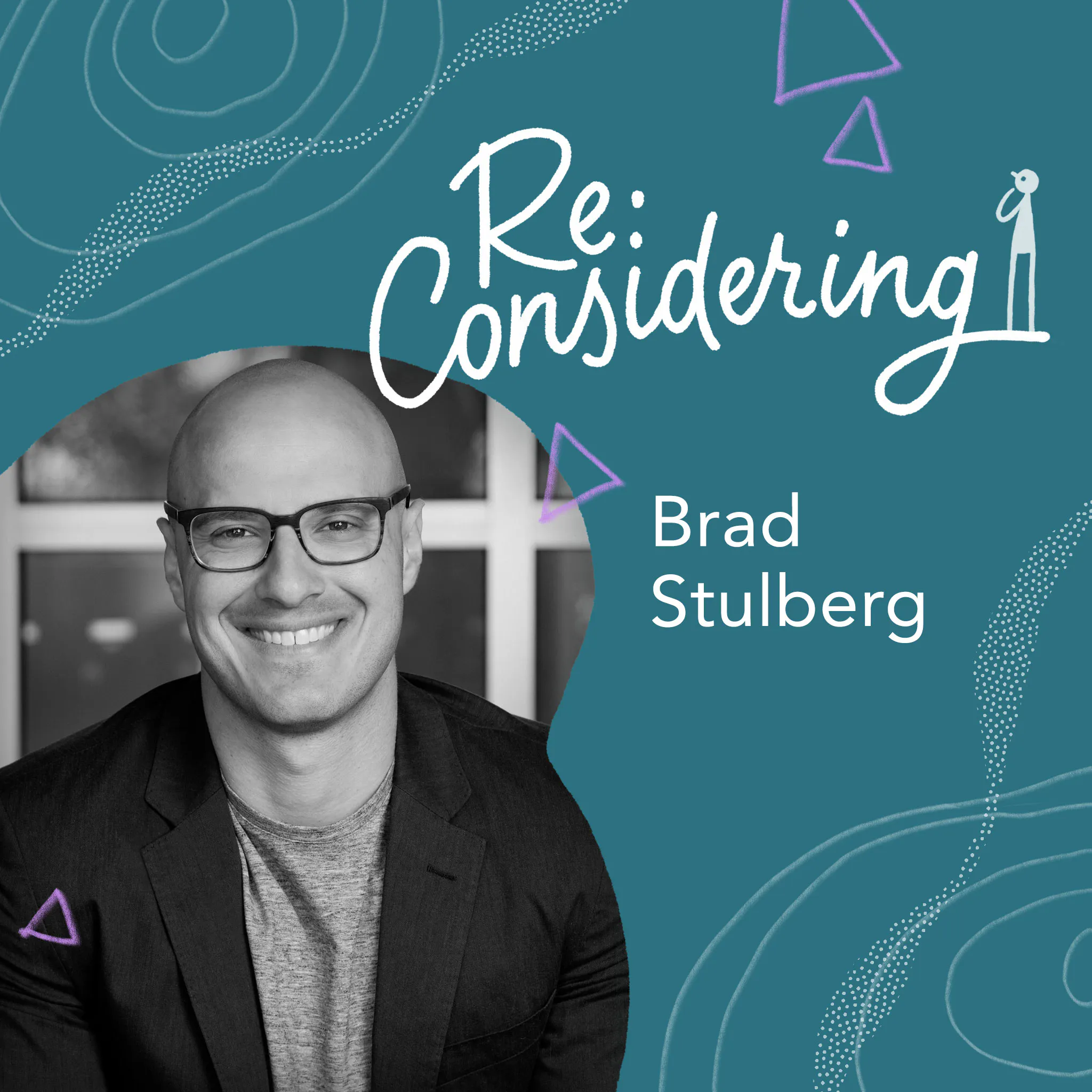
Design Better
Reconsidering: Mastering change with Brad Stulberg
01:03:19
We're sharing an episode from our new show called Reconsidering that turns a designer's mindset to living a better life.
Loading summary
Transcript107 lines
- [00:00]
Aaron Walter
It's a new year and we've got something new for you. Our podcast network, the Curiosity Department, is introducing a new show. It's called Reconsidering. Though design and your work are a big part of who you are, we know that you're so much more. Reconsidering is a show hosted by designers that aims to bring fresh eyes to the important things in life. Co host, Meredith Black, formerly at Pinterest and Figma, Bob Baxley, formerly at Apple and Thoughtspot, and me, Aaron Walter. Explore topics like how to build a fulfilling career career navigate big life changes like illness and death. And we talk with experts about the skills you need to cultivate to become the healthy, well adjusted adult that we all want to become. You can learn more about Reconsidering and subscribe to the show@reconsidering.org but to give you a taste for what Reconsidering has to offer, we're sharing an episode here. Bob, Meredith and I talked to Brad Stalberg, who writes about excellence, resilience, performance and well being. He contributes to the New York Times, Time Magazine, Wall Street Journal, and he's written a lot of books. His latest book, Mastering Change, is a New York Times bestseller and it's a great read as we enter the new year with big goals for ourselves. Brad's in depth research and lucid guidance made an impression on us, and we know it will do the same for you. Enjoy. Like it or not, change is inevitable. Your career, your relationships, your body, your health and your mood are all in constant motion. We can fight it, but it's not very productive and it typically leads to suffering. Our pal Brad Stulberg is back on the show to help us look at change differently. His new book, Master of How to Excel when Everything is Changing, including you, is full of deeply researched wisdom from science and philosophy that will help you become more resilient and adaptable. This is Reconsidering, a podcast about life and how to make it better. I'm Aaron Walter.
- [02:10]
Bob Baxley
I'm Bob Baxley.
- [02:11]
Meredith Black
I'm Meredith Black.
- [02:13]
Aaron Walter
Welcome to Reconsidering.
- [02:19]
Brad Stalberg
I'm Brad Stalberg and I'm the author of Master of Change.
- [02:24]
Bob Baxley
Brad, you might recall from our show previously, we began with this lightning round thing. You ready to play?
- [02:29]
Brad Stalberg
Bring them on.
- [02:30]
Bob Baxley
Okay, here we go. City or country?
- [02:32]
Brad Stalberg
Country.
- [02:34]
Bob Baxley
Hug or handshake?
- [02:36]
Brad Stalberg
Hug.
- [02:37]
Bob Baxley
Direct or diplomatic?
- [02:39]
Brad Stalberg
Direct.
- [02:41]
Bob Baxley
Independent or interdependent? Both by the book or against the rules?
- [02:47]
Brad Stalberg
By the book.
- [02:49]
Bob Baxley
Writer or student?
- [02:51]
Brad Stalberg
Writer.
- [02:52]
Bob Baxley
Warrior or sage?
- [02:54]
Brad Stalberg
Sage.
- [02:55]
Bob Baxley
Road or path?
- [02:57]
Brad Stalberg
Path.
- [02:59]
Bob Baxley
Inspiration or persistence?
- [03:01]
Brad Stalberg
Persistence.
- [03:03]
Bob Baxley
Sunrise or sunset, sunrise, Being or evolving?
- [03:09]
Brad Stalberg
One in the same.
- [03:10]
Bob Baxley
Nice. Thanks.
- [03:11]
Brad Stalberg
Thank you. That's a great list.
- [03:14]
Aaron Walter
So, Brad, welcome back to the show. You're one of our few repeat guests and we loved your prior book, but you have a new one that's coming out September of 2023, about change. So why this topic? Why was it important for you to write?
- [03:29]
Brad Stalberg
You know, you write the book, or at least I write the book that I need to read or on the topic that I need to explore. So the simplest answer is that in my own life I was undergoing what felt like just an onslaught of rapid change in a fairly constrained period of time. We can get into details, if that's helpful in a bit. And at the same time, the idea for this book occurred concurrently with what I'm going to call like peak early Covid, when everybody was trying to figure out when we were going to get back to normal. And there was just something about those headlines getting back to normal that kind of struck me is a fool's errand that there probably will be no getting back to normal. And I'm not sure if you ever get back to normal in anything like, you know, time travel, as far as we know, is not a thing. So this big societal change combined with a whole bunch of personal changes combines with my own trying to get back to normal, whatever that means, and failing, and then seeing society get clinged on to this idea, or I guess not get clinged on, get latched onto. This idea of trying to get back to normal led me to investigate various ways of thinking of change and how I personally came to think of change the way I did, how most people do, and whether or not there aren't better fit models.
- [05:03]
Bob Baxley
Yeah, I love this data point you had earlier in the book that there's 36 disorder events in a typical adult life, which was like every 18 months. And it's true, we all kind of think like, oh, this is going to be steady state, but it never is. There's just always another thing just around the horizon.
- [05:19]
Brad Stalberg
Yeah, that's right. That data point comes from the author, Bruce Fieler, who wrote a book called Life is in the Transitions. And he set out to do a large anthropological case report study and found just that, that the average adult life has 36 major transitions, which when you first hear that, you go, wow. But then you think about your own life in starting a job, ending a job, switching jobs, getting a big promotion, dating someone, getting engaged, getting married, moving, buying a new house, selling a house, having kids, kids leave the house, getting ill, recovering, losing a loved one, making a new best friend, distancing from a best friend, and suddenly you're very quickly at that 36 number. And what it got me thinking is that we think that change is this aberration and it's something that will happen to us when in fact change is just the water that we swim in. Everything is changing always. Even when we think that we're stable, things are changing. And this isn't like a novel idea. It's the first law of physics, right? Entropy. Things are always moving and shifting. It's not to say that things are chaotic all the time, but that our rote resistance to change, born out of seeing change, is something that happens to us, does not work in our service. And perhaps if we shifted our mindset to being in conversation with change, and change is the ongoing reality of life, which is again, a very like, empirically true way to think about the world. Things can open up and we get empowered to. To use your language, to reconsider without it being so scary.
- [07:03]
Bob Baxley
Why do you think, particularly in the west, we've seen, you know, you talk about the Western idea of homeostasis, if I'm pronouncing that correctly, that's right. You know, and it does feel like there's this Western concept of static ness, you know, and that we're trying to get into a fixed position and get back to normal, whatever normal was. Right. And I think your observation is correct that that attitude doesn't seem to be as prevalent in most Eastern cultures. And in the book, I couldn't quite tell where you were getting with, like, how did you explain that? Like, what do you think those cultural differences came from? Was that differences in religion, orientation, or like, how those values ran through these two different mindsets?
- [07:38]
Brad Stalberg
So you're right. There are definitely differences between the east and the West. And in terms of what are the forces underlying those differences, I think there are two big ones. The first is the west operates very dualistically in terms of how we think. So this or that. And dualistic thinking really lies at the heart of empirical science. Like, you have a hypothesis and you try to invalidate it. You are making all of these logical judgments that separate things and carve things and test things. So there's absolutely nothing wrong with dualistic thinking. It is like part and parcel of innovation in the west and many of the great things that have come out of the west. However, this kind of dualistic this or that thinking, when applied to change, gets us into this trap where we think there's either change or stability. And we cannot conceive of those two things co occurring at the same time. Whereas in the east, non dual thinking, this and that is a lot more prevalent. And I think that that's one driving force. And then the second driving force is there's all sorts of research, only some of it which is cited in the book, but really like, you know, piles and piles of work that shows that western countries tend to be more independent minded, where we think of ourselves as separate from our surroundings, whereas eastern countries tend to be more interdependent minding. So we are one with our surroundings. And if you're one with your surroundings and your surroundings are always changing, you're kind of like just in this dance and in this flow. Whereas in the west we try to exert control over our surroundings. So I think it's this combination of linear thinking and dualistic thinking in being separate from our surroundings. And the goal being to control our surroundings in the west versus in the east, more cyclical non dual thinking and being in conversation, being interdependent. And I want to be really clear and I hope I did a good job of this in the book. This is values neutral. Both these ways of seeing the world and thinking can be really beneficial and both can kind of become traps. And in the West, I think the trap is that we mishandle change because of these ways of thinking.
- [09:51]
Meredith Black
That's really interesting. I also think there's something about kind of like different Personas when we talk about people and when we talk about change. What I mean by that, and maybe you can help me elaborate is I think there's the people who are like, yep, it's time to change. Yep, I got to do something, I'm going to make it happen, I'm going to go do it. Done. And then there's the people that really resist it. Why are some people so adverse to change while some people just grok to it and are like, I'm going to do it, I'm going to go do this, this is what's best for me. Or this outcome is what's going to be best.
- [10:24]
Brad Stalberg
There are definitely some temperamental differences. So you look at the big five personality traits and openness to experience is one. And the more open you are to experience. Well again, the first law of physics, experience is changed. So some of this is fairly innate and then a portion of it is also learned. And I think that if you are raised in practice exerting control over things and you're rewarded for exerting Control over things, that is, you've had a really successful academic and professional career in the west, then those become well worn behaviors that work until they get in your way. And when it comes to change, often viewing ourselves in opposition to it, I sound like a broken record. And trying to control it can get in our way. But you think about what makes for a successful leadership or management or to some extent even individual contributor, career and knowledge. Work is the ability to exert control and influence and take ambiguity and structure it. So these are really good things, except we can overshoot the target and that's when we get into trouble. So nature and nurture, like all things, is probably the shorter answer. But a lot of nurture in the west, and it's a theme that comes up again and again in the book. A lot of like, what works, works until it gets in the way. So, you know, learning to control things and bend things to your will is really great until it's not those who.
- [12:00]
Aaron Walter
Are adverse to change, who struggle with that. You point out in the book that that's where a lot of suffering comes from. And there's a lot of religious beliefs and parables and stories and so forth that explain that. Could you unpack that a little bit? What does religion have to tell us about change?
- [12:16]
Brad Stalberg
Yeah. So whether east or West, Judeo, Christian, Islam or Buddhism, Taoism, there's a pretty common pattern which is to control what you can control and then release from what you can't. And the what you can't is often change. Now that's not to say that you can't be an agent in change and you can't shape change and you can't work with change, but you can't hit pause on it. Particularly with big life changes. Aging, love, loss, grief, these are things that we cannot control. We think we can. There's an enormous wellness industrial complex selling us the illusion of control of these things. And it's not to say, throw the baby out with the bathwater, yolo, I'm going to live. Extremely unhealthy. But there's a wise middle ground of controlling what we can while not fighting what we can't. Because you can live your whole life fighting change and then die. Or you can learn to dance with it and accept that, hey, some things you just kind of have to roll with the punches, or as Bruce Lee said, be like water. I don't want to get too conceptual. So the old way of thinking about change, very Western homeostasis, is you have order, stability, and then there's disorder, change, and then you try to get back to order. And this was the scientific model underlying change for two centuries. And more recently, researchers have said that actually that's not the best fit model for describing change. The best fit model is called allostasis, which says you have order and then change and then reorder. So, yes, living systems, all of us, we crave stability, but that stability is constantly somewhere new. In the trap is when we get latched on not to stability, but to stability at a certain place. So it's okay to want to be stable, but the way to be stable is by learning how to change. And to me, that was like, the biggest mindset shift that I experienced myself in researching and reporting this book is there's nothing wrong with wanting to be stable. The challenge, or the trap, is when we try to be stable where we are, instead of constantly kind of bouncing from new stability to new stability as we dance with all the disorder in our life. Someone more elegant than me would say a prime example, or I guess I'm saying it. So my most elegant version would say that the prime example is like aging. So you can fight aging and try to be stable at your current age and what that means for your fitness and your skin and all these different things. Or you can age with grace and still feel real stable, but not by fighting this thing. And what all the wisdom traditions show is that the way to happiness is the latter path, not the former.
- [15:15]
Aaron Walter
Just want to dig into that a little bit more, because I think there's a really. You just kind of laid out an important concept that the tendency, the human tendency, is to sort of try to preserve a moment, preserve a state. And what you've just described is flow. It does kind of sound like the Bruce Lee metaphor of, like, it's like water. I. I was reading a book recently, don't remember which one it was. And they described time flowing through them when they were talking about the aging process. That we're not experiencing time. It's just flowing through us. It's a very different way to think about life and circumstances, that it's a state of flow, and it's not something that we can hold onto.
- [15:56]
Brad Stalberg
That's right. And what I argue is, is I think that what we hold onto are our core values, the things that we aspire towards that really make us who we are. And how we apply those core values is always going to change based on the circumstances around us. So the metaphor that I use in the book is water in a river, and a river can flow. It's really flexible. And you can't step into the same river twice. It's that famous Heraclitus quote, right? So a river embodies change, but if you have a river without any bank, then it's just chaos. It's just water everywhere. So a part of what makes a river a river is a river's bank. And I think when we think about ourselves and we think about our identities, our bank, those are our core values, the aspirational qualities that we really want to embody and stand for. And that really helps us form our identity over time. But how we manifest those values, how we act on them, how we apply them, that's got to be like water that's constantly changing. So your core value could be creativity. And that's very different than saying, my core value is a book writer, because maybe I'll have books that flop. Maybe book writing won't be a thing in 40 years. I can't imagine it. But guess what? No one can imagine these big changes. So if I define myself as a book writer and I do everything I can to cling to that and get back to that, always there's a chance I'll suffer when things change. Whereas if I remember that my actual core value is creativity or intellect or wisdom, there's multitudes of ways to practice that. So it also, to me, really gets to this profound passage in Buddhist literature where the Buddha is asked by someone, if there's such a thing as a self. And the Buddha basically says, yes and no. And I think that talk about non dual, when it comes to change, instability, and identity, yes, we have identity, but our identity is always changing. And both those things can be true at once.
- [17:56]
Meredith Black
You mentioned a word that I want to pull back on a little bit and talk about, which was suffering. In the book, you talk about the difference between pain and suffering. Somebody like me, I have chronic migraines, so I definitely understand that spectrum. But can you explain to the folks listening to this podcast what the difference is between pain and suffering?
- [18:17]
Brad Stalberg
Well, first off, there's an entire field of pain science, and no one can agree on what the definition of pain is within the field of pain science. Like, you go to the big pain science conference, and they're still arguing about how to define pain. So I can just give you, like, my best definition. Knowing it's really hard. So pain is a physical or psychological sensation that is causing discomfort or distress. That's how I define pain. Suffering is layering onto that pain, a resistance of it really trying to make it go away. A Freaking out about it. Now, I am not one of those bros that says like, you know, pain is great and don't turn it into suffering. Like pain fucking sucks. Being in pain sucks. Chronic pain is terrible. It's debilitating. So this isn't to say that pain is good, it's simply to say that generally for most people, trying too hard to get rid of pain just makes the experience worse. Not trying to get rid of pain. Right, but trying too hard. And there is such a fine line. And this is like, I think what so much of the pain scientists that I interviewed for the book talk about between like skillful trying to get rid of pain versus over trying to get rid of pain. And I define pain really broadly. So I think that that is true psychologically and it's true for everything. So there are things that we don't like and we can try to problem solve and work on them and make them better, but we reach a point where we try too hard or we rotely resist the experience and then it becomes worse. So the equation that I use in the book is suffering equals pain times resistance. So you can have really shitty pain, you can have pain at 9 or a 10, and you still have suffering at a 10 because that pain sucks. But then if you layer on like 4 units of resistance, now it's 10 times 4, it's 40. That's how I think about, I guess, the dichotomy between pain and suffering without romanticizing or glamorizing pain and without saying that you should just sit with pain. Because like, it really comes down to like trying to get rid of it versus over trying to get rid of it. So let me give you an example. Let's use the hypothetical example of back pain. And a person is somewhat susceptible to back pain and they have the experience of what feels like they throw out their back. Now pretending that you didn't throw out your back and not trying to do anything about it is not very skillful. So maybe you take some Advil or Motrin, you call a physical therapist, you do the exercises and you're really uncomfortable and you're a little bit worried about it because you had all these plans for the weekend and it kind of sucks and you do what you can to get rid of it. That's pretty skillful. Now contrast that with spending nine hours on Google researching all the various supplements that might make your back pain go away, calling nine physical therapists to try to find the best one, completely freaking out that your weekend is absolutely ruined, even though it's not till five days. Because your back hurts. Because that's how it always is when your back hurts. So to me, that's the difference between skillful trying to make pain go away and unskillful trying to make pain go away.
- [21:23]
Meredith Black
I keep thinking of the word acceptance somewhere in there too. And that's like a tricky one, right? Because I think part of the suffering that you can have is because you don't accept that this might be a situation that you are now in. So great example with the back pain, right? Like you might have back pain from here on out, like something horrible might have happened and you might have back pain from here on out. But how do you get into a mental state of being, okay, not necessarily out of pain, I don't mean that at all. But accepting the fact that this is kind of your new way, like this is part of your new life or this is part of the change that you're going to be having for the rest of your days.
- [22:02]
Brad Stalberg
Right, exactly. And that and change can be painful. So like, I know we're talking about back pain, you mentioned migraines. But I ultimately think this is all change. And my answer to that is again, non dual thinking. So the Western mind would say you either accept it or you problem solve and try to make it go away. And those are your two binary choices. And what I would say is you do both. You accept it and you try to make it go away as best as you can, realizing the limits and that it might never completely go away. And this is how to work with change. Like, accept change, but don't just sit there and be swallowed by it. Engage with it, be an agent. But don't overestimate the power of your agency. And we know that pain is psychosocial, biological. So there's all sorts of studies that show that someone's experience of pain differs dramatically based on the people they're with, the activity they're doing, whether or not they had the expectation to be in pain. So there's some research that I talk about in the book that's just fascinating where you look at people that suffer from traumatic events. So let's take the example of a gunshot wound in a soldier that gets wounded on the battlefield feels significantly less pain than a person that is wounded in a drive by shooting or in a mass shooting or at a grocery store. Same gunshot wound, same area of the body. The soldier feels much less pain. Why? Because there's an expectancy around that happening. So accepting that pain is a part of life and that change is a part of life immediately lessens the suffering and the pain. Because when you expect these things to happen, they still hurt, but they don't hurt as much is when they completely catch you by surprise.
- [23:50]
Aaron Walter
We'll be right back after this word from our sponsors. Meredith, I've recently become a really big fan of Athletic Greens and their product, AG1. Have you tried it, Meredith?
- [24:03]
Meredith Black
Yeah, I've tried it, and I have to say, I look forward to taking it every day now.
- [24:08]
Aaron Walter
Yeah, for me, you know, the idea of having one super research drink that has everything I need. It's got all the vitamins and minerals that I need, prebiotics, probiotic. It's good for gut health. You're keeping your immune system tuned up and just like feeling your best. The idea of that being in one single drink that I can take every day in the morning is very attractive.
- [24:30]
Meredith Black
Yeah. And you know what else I really Love is that AG1 is just one scoop that you put in 8 ounces of water. It's not like you have to go out and buy a million different supplements and keep taking all of these pills. You've just got everything in one scoop. So it's so nice and convenient and it's also so much more affordable.
- [24:48]
Aaron Walter
And it actually tastes good, too. I mean, I enjoy drinking it every morning along with my coffee. And when I travel, you know, they give you these great travel packs so I can just slip it in my duffel bag when I'm visiting family going on vacation, I've got it with me, so I'm always at my best.
- [25:05]
Meredith Black
So if you're curious and want to check out athletic greens like Erin and I and their AG1 formula, there's no better time to do it than now. You'll get a year supply of vitamin D3 and K2 and five travel packs for free. So go to athleticgreens.com reconsidering and get your AG1 today.
- [25:23]
Aaron Walter
That's athleticgreens.com reconsidering. Now back to the show. What about, you know, just kind of transferring this thinking over to emotional trauma and suffering. There's a person that I see when I walk my dog every morning and I saw her walking alone. She normally walks with her husband. And she told me on one trip that he wasn't walking because he had a brain tumor. And they just found out and it was, you know, stage four. Week later, I saw her again and he wasn't there. And I said, you know, how's he doing? And she said, he died. And I mean, her whole world Just got upended in a very short period of time. And that's the sort of thing like accepting that she did have some acceptance of like he had an amazing life. But it is just traumatic change. How do we think about that? How do some of these ideas that you're talking about apply? Or maybe there's new ideas that we should bring to that sort of change in our life.
- [26:36]
Brad Stalberg
So for that level of change, the last thing I would want to do is give that person my book, or any book for that matter. What an insult to the pain that they're going through. The only way to get through that kind of change is just that, just to get through it. It's probably the part of the book that I'm most proud that I wrote and that I was really stern on including is the book's got these six chapters in the last chapter is sometimes you can do everything that this book says and it just sucks. And that is a prime example where it just sucks. And by trying to force meaning and growth on something that just sucks, you actually delay the process of meaning and growth. So it is true that most people tend to grow from most changes, including trauma. Like the most prevalent outcome of trauma is post traumatic growth. It's not post traumatic distress, however, saying that, oh, I had this once in a lifetime, God awful thing happen, but it's going to make me stronger because that's what the self help books say. That is just lying to yourself. So in those situations, all that you need to focus on doing is just staying alive and showing up and getting through it. How do you do that? Different people have different mechanisms. I think the best is a sense of community and just letting other people help you and then releasing from all expectations for meaning or growth. And then if meaning and growth are going to happen, they'll happen on their own time and on the other side of those experiences. And they don't always happen. So adverse childhood events, it's very hard to grow from being sexually assaulted as a child or as an adult for that matter. So sometimes trauma is just trauma and it sucks for what I'm going to call like trauma that is not out of the ordinary, such as loss of a spouse. Most people do overcome that. And you can both wish that that never happened and still find it utterly painless, but have learned a thing or two and grow from it. But that process has to play out on its own time. In the book I cite the research of Dan Gilbert, who's a psychologist at Harvard, and he coined this term psychological immune system to Basically say we have a psychological immune system and like a physical immune system. For minor colds or cuts, you heal pretty fast. But for major trauma, it takes months to heal sometimes. Sometimes you need to be in a hospital bed with medicine to heal. And the same is true for psychological pain. So, you know, a bad breakup, a layoff, the loss of a job, those are like flus, they suck. But you tend to be able to turn around and move forward and find some meaning and lessons. Most of the time, not everyone, right? But within two weeks span, everything's fine. And then your partner of X years is gone. You have to give yourself time and trying again. Trying to force meaning or growth onto those experiences just slows it down. This is something that happened to me and I talk about this a little bit in the book and by no means to the extent of that trauma, but we talked about this last time I was on the show too. At age 30, I was just utterly blindsided by really bad obsessive compulsive disorder and secondary depression to that. And I mean, like, you know, a year of my life just wasted to this. And at the time it felt like that. Now I have lessons and I've derived meaning and all this, but when I was really going through it, right? I'm someone that reads the kind of books that I write. I believe in this stuff, I use it, it's defensible. But I kept telling my therapist and like, you know, won't I be able to grow from this? Like, isn't there some meaning in this? And she's like, why can't this just fucking suck? Like, why does it have to be meaningful? What if the growth is that you're okay with? Sometimes things in life just suck. And that was a real turning point for me in therapy was like giving myself some grace and realizing this could just suck. And guess what? A year later, when I was out of the woods, there was all this meaning and growth. But the real meaning and growth was realizing that for like capital T trauma or capital I illness, just getting through it is enough.
- [30:47]
Bob Baxley
I'm curious why you use the phrase a year was wasted. Why didn't you say a year was spent?
- [30:53]
Brad Stalberg
Well, it wasn't wasted and I caught myself. But when I was in the middle of it, it felt like I was wasting it. And my therapist's point is like, that's fine, maybe you are. Just get through it. Now I look back and what a powerful look. I am so much more compassionate and so much less an asshole because of that experience. So it wasn't wasted. You could argue it was one of the most important years of my life. But if during the process of suffering I would have said, oh, this has to be important and this is going to make me compassionate and I'm going to grow so much, it would have just been so much stickier and worse because you take this negative, which is like pain, and then you apply a double negative to it, which is judging yourself for not finding meaning or depth or growth. And back to the psychological immune system for smaller things, like, you know, an article gets rejected or I can't tell you, like book proposals and ideas don't do well. Like that hurts. But to me those are like colds. And I learn and I grow from those pretty fast. And if I get really down the next day, like I learn, I'm like, wow, like, you know, that hurt too much. I wonder why. Or maybe not too much, but what's going on there? So it sometimes, yeah, it does make sense to say, like, I'm going to grow from this voluntary suffering. Signing up for a triathlon or CrossFit or a marathon, joining like a spiritual retreat where you have to fast or you're meditating all day. Like, yeah, voluntary suffering, I think you do go into with the hope to get growth and meaning. But involuntary suffering, especially around our health and the health of our loved ones, the meaning has to come on its own time. It's not to say it doesn't come. It's not to say there aren't little nudges that you can do to nourish it and nurture it. But it's got to come on its own time.
- [32:26]
Bob Baxley
I'm curious if you've had much time to think about applying some of these concepts and learnings to at more the societal level. Like, I feel like as a almost as a global community, we just came through this kind of crazy trauma of COVID Some of the things you were talking about getting blindsided because we weren't expecting it when if we'd been paying attention, we could easily expected it. And I'm wondering, do you think we've at a social level or societal level? Do you think we've learned anything? You think we've grown or improved in any way?
- [32:54]
Brad Stalberg
It depends on who you ask and when you ask them. My hope is that this book does help the societal conversation because I look at our current politics and I see a segment of people who are really suffering. And a lot of that suffering is born out of rote resistance to change. And that rote resistance to change is then causing even more suffering. So it's no coincidence that Make America Great Again was about getting back to some illusory good old days, even though they weren't so good. It's no coincidence that Make America Great Again also was very quick to try to like deny or delude ourselves on Covid because that was a big change. It's no coincidence that Make America Great Again is absolutely terrified by something as simple as hey, let's talk about our pronouns before we get into a meeting, like who cares? But these all represent changes and threats to stability and to certain people that like cling to that stability. I ultimately think like this is what demagogues and authoritarian governments do across the board is they present an illusion of certainty and stability. And I actually think the best way to describe it, and I'm not a political science, is it's kind of like a grift. And I actually genuinely feel for a lot of the marks. I don't think most people are evil. Right. I try to practice Buddhism. I think we all have Buddha nature. It's not that people can't do evil things. They can. Most people are generally trying to be good. But I think it's a lot of people that fear change and then they see this stability and we're going to go back to where things are and I'm not going to have to think about things differently. And I think that that leads to a lot of then global societal suffering. You can also change too fast though, right? Because the flip side would say if you change at such warp speed, then it is going to feel like getting swallowed. So it's back to this non dual thinking. It's like you want to change, but perhaps not all at once.
- [34:49]
Bob Baxley
Yeah. I wonder if this plugs into your concept of the brain as a prediction machine and that there are so many variables in play right now that your brain is kind of overloaded trying to predict what comes next and that that creates an enormous amount of internal tension. I mean, even for those of us who aren't prone to, you know, maybe some, I don't know, different types of thinking, I mean, I feel like I'm fairly grounded, but there's still so many changes happening technically and socially and internationally and politically. And like just to be able to sit with all those variables and realize that my brain is actually not going to be able to accurately predict anything in this scenario. It's a hard thing to do.
- [35:28]
Brad Stalberg
That's right. And that's why snuck into this book somewhere, I talk about the importance of routine and Voluntary simplicity in your own life. Because I think the value of having a routine and trying to make your personal life as simple as possible is it gives your brain stuff that is predictable and that you can control, which then helps you go meet the world on its terms. So being able to show up and meet your friends for a walk or go to the gym and exercise, or do your stained glass, not adding needless complexity to your own life kind of gives your brain that fix of. I can control this. I forgot the philosopher that talked about the will to power, but I can exert the will to power. I can change things in my own life and control things in my own life. And therefore I feel strong enough to then go meet the crazy chaotic world on its own hands. You know, I joke around with and everyone gets it their own way. There's no like morally superior way to do it. But I joke around with my gym buddies that like the best thing to do when the world is on fire is to like go lift weights for an hour. And then it's not to say you don't disengage from the world, but like the lifting weights for an hour is what gives you the power to then go engage with the world. And again, there's nothing special about lifting weights, but it's about like having that thing that you can master and that you can control. And again, that's like. It's this common theme in this conversation in the book. It's like it's non dual thinking. Like being able to deal with extreme change requires some sources of extreme stability in your life.
- [36:52]
Bob Baxley
I think that's an undersold aspect of the concept of habits and routines is that it does ground you and it frees up so much cognitive energy and emotional energy for you to process all the other chaos that's going on. When I look back across my tech career, I sort of marvel at the most successful long lived executives that I witnessed. They all had retreats and they all had very steady routines, you know, and somebody like Tim Cook I think manifests that, you know, Tim is one of the most disciplined, routine driven people imaginable.
- [37:22]
Brad Stalberg
I am so glad that you're saying this, Bob, and sorry, I'm interjecting because like. No, no, go ahead. And I never, I never heard someone use that example. But what you're making me think is there is enough weather pattern changing when you're running a big company or you're even a manager. And the best managers make everything as simple as possible that they can control to free up as you Said the cognitive bandwidth to deal with the uncontrollable, the most insufferable, worst leaders and managers create needless complexity. And I think like that is really an important thing to remember. Like there's enough complexity out there. Anything additional that you're bringing to the table just makes no sense. So to the extent you can, it's like, yeah, focus on extreme simplicity and control and routine where it makes sense to. So that you're then empowered to meet the changes elsewhere.
- [38:17]
Bob Baxley
Yeah, I mean having worked at Apple for a big chunk of my career, the thing that really makes that company function is they just have incredible routines. There's like weekly routines, there's monthly routines, there's quarterly reviews, there's, you know, twice a year, there's big release cycles. Wwc. Like the whole thing just runs on this frankly fairly relentless cadence that eventually wears a lot of people out. But when you're there, you know exactly what that rhythm and routine feels like. And it keeps you moving forward and particularly keeps you moving forward creatively. Because in other environments that I think all of us have worked in, if you don't have that routine creatively, you can get super lost and overwhelmed and you procrastinate and you get anxious and frustrated and burned out. Like all sorts of negative things happen. I mean it kind of goes back to like how you raise kids. You know, like well adjusted kids come from homes where there's like routine because they know what to expect. Like the same thing with dogs. Like dogs need routine because that's how they can predict what's going to happen.
- [39:10]
Brad Stalberg
Yeah, I think you're onto something. And the irony is for as internally structured as you're describing Apple, many would say that Apple is the most innovative company of our times. And innovation is just about changing. So it's almost like that internal structure and routine is what enables them to then go meet the world and adapt and evolve and change.
- [39:29]
Bob Baxley
Yeah. It's not just Apple. I've studied, as I'm sure you have too, the routines of a lot of famous writers. Almost all of them are maniacal about their work habits. I mean there's obviously exceptions, but most of them get up early, they write for some specific period of time every day or certain word count or something. They have their T's in a certain place. Everything's very, very specific and fastidious. And then the afternoons are maybe more chaotic.
- [39:54]
Brad Stalberg
But yeah, having that sense of stability. The advice that I give new parents is, and I follow this advice myself and I would have been completely overwhelmed if I didn't. Is radical acceptance. So, yes, you're going to have no control, everything's going to get blown up. But find 30 minutes a day to do something that is the same thing that you want to do, whether it's having a coffee and meditating, whether it's having a coffee and work, whether it's having a coffee and exercising. Coffee is got to be a part of it because you're, you know, piss tired. But, like, have something that you can control amidst the chaos. And yeah, there's a lot of power in that. Taking these binary things and putting them together. Yeah.
- [40:35]
Meredith Black
I think a lot of people that was the big struggle with the beginning of COVID right. Is that you had a majority of the workforce that was used to going into an office, having their routine of, you know, getting the coffee, going to your desk, going to your first meeting, doing all this, and then literally overnight. And we thought just for a couple weeks, right. It was, how am I going to work from home? How am I going to set boundaries? How am I going to recreate my structure in a way that's going to make me feel like I can still control something. Right. And I just think it's really interesting because now you've got this push from people wanting to be in the office to now people don't want to go back to the office because they've adapted to change and now they like the change. And so I think it's going to be an interesting situation, at least I think, from where we come from in the tech world, at least where these conversations are happening all of the time and how we are going to address them. Is innovation going to get better if everyone goes into the office? Is it going to stay better if people stay out of it? And like, I think right now we're just having that conversation. Right. And so it's going to be interesting to see what happens and if people have to restructure all over again.
- [41:42]
Brad Stalberg
Yeah, that's right. You can just think of the polarities. So way too much routine in rigidity and neuroticism generally leads to anxiety and eventually depression. And you could say that's true for individuals. You could say that's true at the level of a company. However, complete flexibility in no constraints and no structure looks a lot like psychosis. And that's also terrible. So it's about having like this balance, you know, keep on coming back to not this or that, but this and that of routine and flexibility. And my gestalt is that the companies that seem to be figuring it out are kind of landing somewhere in between, but it's still really early and there's a whole lot of variation. And I have clients that work in tech and are leaders in tech and some are executives in tech. And I don't think there's a right answer. And if there is, it hasn't emerged yet. So I'm very sympathetic to the people, especially the leaders, that say managing remote, especially as an executive team, is just too hard. And I'm happy, like there's enough good talent in San Francisco or Austin or Salt Lake where I don't need a national talent pool. I'm happy to lose some talent if that means we can all be in the same room. I'm sympathetic to that argument. I don't know if it's right. I'm equally sympathetic to the argument of that's just lazy management and it requires more work and more trust initially to manage a distributed workforce. But you can do it and you actually empower people and you trust them more. Because if you need someone to be in person with you to trust them or to get work done or to innovate, then there's nothing special about being in person. It means you haven't put the time and effort into the structures to do it remotely. And as somebody that struggles to be too judgmental in my own life, I hold no judgment towards either of those. I think that they're both extremely valid arguments and time will tell if there's a better one. And like all these things, right? The answer is probably it depends on the person, the industry, the team, so on and so forth.
- [43:38]
Aaron Walter
Brad, what about the stories we tell ourselves about who we are, that we are, the work that we do, the things we do day to day, all of these things change. Like when you get let go from a job or you choose to like, you know, move on from a role. That can be an existential crisis for a lot of people because we get so wrapped up in that work and how it defines us, especially in the US if you go to a social gathering, what do you do? Is the way that we describe ourselves, which is very shallow way of understanding each other. How do we develop a more fluid sense of ourself and what does that bring to our life?
- [44:19]
Brad Stalberg
Well, I think the first thing that comes to mind is that, yes, fusing your identity to a certain pursuit or accomplishment makes you fragile because eventually that pursuit or accomplishment is going to change. And the extreme example where you see this play out all the time is elite athletes whose entire identity is their athletic pursuit. Often experience depression or substance use disorder when they retire. And that is not at all surprising. So then the question becomes, well, look at the athletes who don't retire, go through as rough of a transition, and what they tend to have in common is a couple of things. Number one, they view their role in sport broadly. So they don't view themselves as a championship runner. They view themselves as someone that loves running. And that's a lot more flexible because now you can coach or you can mentor or you become a sportscaster versus I just need to compete and run. And then the second thing is that even though they can be quote, unquote, all in on their pursuit, they still have other areas of their lives that they stay curious about. So when it's time to not be all in, there are other rooms available. So the metaphor I use in the book is, it's okay to put all your eggs in one basket so long as you keep other baskets open and available. So this might mean, hey, I'm going to go all in on career right now, but I'm going to do just enough with these other four things that are important to me so that when the next season of my life comes, I won't have an existential crisis. And then the only other thing that comes to mind is just this notion of trying to identify with values and ways of being versus things that you have. So no one can take a value of ingenuity or competitiveness or athleticism or creativity away from you. Like, you cannot take that away. You can take away certain ways to practice that. But if you identify with your values, you can generally apply those values in all kinds of different environments. So something I've worked really hard toward is to not identify with my craft, but to identify with the value that underlies why I want to do the craft and then have other creative ways that I can express that value.
- [46:31]
Aaron Walter
How do you articulate those values? Do you have a process?
- [46:35]
Brad Stalberg
Yeah, I do. So generally, I think most people find it helpful to have between three and five core values. And then for each value, you want to define it in really concrete terms, and then you want to come up with ways to practice that. So in my own life, for example, intellect is a core value of mine. I define intellect as exploring and getting caught up in wrestling with ideas. How do I practice that? I read a lot. I take notes when I read, I write, I go on podcasts. I have interesting conversations with people. So you can't really take intellect away from me. You can, however, take writing or podcasts, like any One of those things is fragile, but the value underneath them, the exploring, the wrestling with big ideas, a lot would have to change for me not to have that be a part of my life. Another example is athleticism or being an athlete. When I meet really truly elite level athletes, Olympics pros, I talk to them about identify as an athlete, not as a point guard in the NBA, because you're not going to be a point guard in the NBA forever, but you can be an athlete forever. So that's how I think about it. It sounds almost like a McKinsey consultant would tell you to do. List your five values, define them, come up with a way to practice them. And it's kind of like an internal dashboard. But I think it can be really helpful, especially if you feel yourself fusing really closely with this one thing. Just kind of ask yourself, like, what is it I'd like about this thing? And for some people, the answer might require, like, going to therapy. Like a lot of people, like, what if the answer is like, I like status and I like being known? Well, be honest with yourself and then ask yourself, like, are there other ways you could be known? Or is that, like, maybe not the best core value? And maybe there's a whole history of your parents rewarding you for good behavior and blah, blah, blah that led you to that. And maybe you need to work to change that. But I think this process can be really good because you very quickly can get two executives or two writers or two artists or two athletes, and you can find that one is really just doing the thing because they like being known, and the other is doing the thing because they like some underlying internal drive. And that's really important to know about yourself.
- [48:46]
Bob Baxley
Yeah, just. If I could paraphrase that. It's sort of. I think what you're saying is if you can figure out who you are, that that's wildly more stable than thinking about what you are. And that, as you mentioned earlier in the conversation, is that, like, who you are is something that can last for a very long time and is really core to who you are. And it's consistent with what we heard from one of our other guests in season one, Maria Giadis, who talked about her superpower as a leader and how she'd been able to apply that superpower through multiple different jobs. And now that she'd kind of left traditional operational roles, she was continuing to apply that in what she was doing now with coaching and consulting and writing and stuff. But she kind of held onto that idea of, like, no, this is kind of How I move through the world. This is the superpower I have. And she found all these different environments where she could apply that. It was a really, really powerful idea.
- [49:34]
Brad Stalberg
Yeah, I think that's right. The mid 20th century polymath Eric Fromm talks about the difference between a having orientation and a being orientation. And I think you're saying the exact same thing, Bob. So the having orientation is like what you have or what you are in the being orientation is who you are. And Fromm's whole theory is that we're a lot happier and healthier when we have a being orientation versus a having orientation.
- [50:01]
Bob Baxley
So we're going to wrap up here, Brad, and what I want you to do is engage in a little bit of reverse mentoring. And I want you to take a moment and kind of remember who you were when you were 25 and try to bring that version of Brad fully into your consciousness. And then I want you to imagine hanging out with that Brad. Maybe you're having coffee or walking together or something. And traditionally people say, well, what advice would you give to your younger self? And I'd like you instead to flip that around and what advice would your younger self give to you today? What did 25 year old Brad know that Brad today has maybe lost touch with?
- [50:36]
Brad Stalberg
Huh? This is so interesting and so hard. The reason I say that is like I'm hard on myself and I guess I'm harder on my younger self. I can't really think of much that current Brad has lost touch with from 25 year old Brad. Maybe it'd be like, go play pickup basketball. You really like that? Something as simple as that. And I can elaborate on that too. And the reason for that is there is no like progression or pursuit. So like I got really into running marathons and you get faster and it's great and you run and then I lift weights and you get stronger and it's great. But playing pickup basketball, like it's just play because I think is adults, we lose the ability to play for play sake. I mean people have written books on this topic, so it's not just me.
- [51:18]
Bob Baxley
Boom.
- [51:18]
Brad Stalberg
That's great.
- [51:19]
Meredith Black
One more question before we let you go. So where can more people find information about you and your most recent book?
- [51:27]
Brad Stalberg
Yeah, thanks, Meredith. The most recent book is called Master of How to Excel When Everything is Changing, including you. And it's available wherever books are sold. So your local bookstore, Barnes and Noble, Amazon, Audible, Hard Copy, ebook, whatever format you most fancy. And you can find more about me at my website, which is just my name www.bradstullberg.com. and that's where my writing lives.
- [51:56]
Meredith Black
Thank you.
- [51:57]
Aaron Walter
Fantastic. Brad Stolberg. Thank you so much.
- [52:00]
Brad Stalberg
Thank you all. That was great. As I expected it to.
- [52:16]
Aaron Walter
Our old pal Brad was back on the show. I just love talking to that guy.
- [52:21]
Bob Baxley
Yeah.
- [52:21]
Meredith Black
It was so nice to have him back on.
- [52:23]
Aaron Walter
Yeah.
- [52:23]
Meredith Black
And his second book is so good.
- [52:26]
Aaron Walter
Yeah. And it covers a lot of territory. You know, I feel like, especially coming out of the pandemic. And I will preface that. I'm tired of saying pandemic, talking about the pandemic. But, I mean, it really was this forcing function on life that, you know, we kind of rethought everything about our lives. It feels like this book was like kind of a Rosetta Stone of like, hey, here's what you've just been through and here's why you felt that way, and here's how you could think about that going forward. So what were the highlights for you, Meredith? I know that you were super into the book.
- [52:58]
Meredith Black
Yeah. Really liked the book. I think one of the things that I really like is Brad's writing style and how he gives so many good examples and talks about people's stories, in a way. And I think that's one of the things we actually didn't talk to him about because we had so many other questions.
- [53:13]
Aaron Walter
But that's true.
- [53:14]
Meredith Black
He really dives into telling stories about people and why those are important. And so one of the stories he talks about is the climber and how he had to pivot so quickly to be like, well, am I never climbing? And there I am. And they kind of beat all odds, and he's, you know, out there climbing with the rest of them still. And so I think the one thing that this book kind of taught me is that just because change is happening doesn't mean that change has to be necessarily a bad thing or looked at in a pessimistic point of view. And people hear the word change, and for me, it's usually anxiety inducing, like, oh, God, what does this mean, going to change? Or if this is going to change? And I think he just told so many great stories about people who have made change and who have successfully changed their lives for the better and have come out on top, you know, and then I think the other thing is that he said something that said, just getting through something is enough. And I think we put so much pressure on ourselves already and our jobs and our daily lives and our families as it is. And there are these moments in life that are going to be really stressful and are going to be, you know, enormous milestones in your life. And I think part of it is that you need to give yourself permission to just be in that moment and not feel like you've got to do that and so much more. So him just saying, just getting through is enough, I think is what I'm taking away from. This is something really positive.
- [54:45]
Bob Baxley
Well, just a quick little aside there because you mentioned the climber Tommy Caldwell. And listeners, if you're not familiar with Tommy Caldwell, but you happen to see the movie Free Solo, Tommy Caldwell is the training partner that Alex had during Free Solo. So that's a little context about some of the things that Tommy went through. And the fact that he's a world class climber and is missing a finger is just mind boggling. Back to the conversation with Brad. He started off kind of at the beginning talking about the nature of dualistic thinking in most Western thought. And that the trick was to sort of get out of that and to move into a mindset of. And instead of a mindset of or which I've often thought about myself, I actually kind of find an interesting expression of that in the game. Chess versus Go, I think, are two interesting ways of thinking about Eastern thought versus Western thought. And so that idea that change and stability can coexist I found really compelling. And then again, kind of towards the end of our conversation, there's kind of this theme of focus on who you are, not what you are. And he spoke about having three to five core values and that was really who you are. And I found that really satisfying because, like, oh, maybe that's the stability that I need to stay focused on because I'm at this stage in my life facing different kinds of identity shifts. You know, maybe I need to focus on who I am from a kind of a values perspective. And then what I am is something that's still quite malleable and something I need to not hold onto quite as tight. And I found that those two concepts together was comforting to me because this idea that change is constant and that, I mean, he was almost kind of describing this world where there really is no stability, everything is changing all the time. And that, that is very disorienting and anxiety provoking for most people or certainly for me. So to have like, oh no, there's actually this anchor, this, like, I can use my values, who I am, as sort of a ballast to deal with all this other change that's happening around me.
- [56:39]
Aaron Walter
Yeah, I'm with you on that. The values thing, I Found really useful and meaningful. And I like how he tried to kind of pull himself out of the specifics of his identity as a writer. But he's a person who like, creates things. He's not a book writer, you know, he's. He's just a creative person. I like that because it gives such latitude. It's latitude in terms of like, what you can allow yourself to do. And it also creates opportunities because when you define those values and they're so open ended and you check back in with those values on a regular basis, it can be a prompt for like, what's new? To help discover a new path. That seems just incredibly valuable.
- [57:23]
Bob Baxley
The metaphor that's coming to mind is when you think about a chef, right. You can present a chef with the same set of ingredients, you know, and one day they might make one dish and another day they might make a different dish. Right. And that's maybe that's a useful way of thinking about how we all move through the world. Right. You have kind of the set palette of ingredients, but you can dial them up in different ways, you can mix them in different ways, you can prepare them in different ways and you can get really different dishes, you know?
- [57:47]
Aaron Walter
Yeah. Especially if you know which ingredients to keep on hand, which I think is another metaphor for life. But how about changes that you've gone through in your life that were uncomfortable? How did what you learned from our conversation with Brad and from the book inform your kind of retrospective view of what that experience was like?
- [58:08]
Meredith Black
I think for me, it made me realize that your experiences can be incredibly personal but also incredibly relatable.
- [58:16]
Brad Stalberg
Right.
- [58:17]
Meredith Black
Like, just because you're going through something doesn't mean you're the only one going through it. And there could be others who relate. And I think that's where when he talks about, like having a community and kind of having a support system, I think it's really important. And you know, he was specifically talking about, you know, instances of trauma, for example. And I think that it doesn't matter what the trauma is, as long as you can talk to people or have a community of people who understand what going through the trauma is like, is really important and something that, I don't know, we all as humans face. And so for me, it's like to stop internalizing things and realizing there's. There's other people out there who are going to be able to resonate with you and who are going to be able to help get you through the hard times.
- [59:00]
Aaron Walter
Yeah, yeah.
- [59:01]
Bob Baxley
Personally, I've always found it really Comforting to find books about these large transitions. You know, I was divorced early in my life, obviously had kids, then I was an empty nester. I've moved into different levels of jobs, et cetera. And, you know, and then I was adopted. So, like, trying to process that trauma might be a harsh word to use for it, but, you know, it's sort of a thing to have to orient towards, you know, being able to find books and realize that there's patterns. And what I'm experiencing is just how humans process things like intimate relationships ending or changing their identity as they move through different stages of their career, or becoming a parent or then having your kids out of the house. Like, those are all pretty major changes. And turns out my experience actually isn't that novel or unique. It's personal and the conditions are maybe different, but the pattern is very similar. Losing a parent's another one. And so when you go and you read books or you reach out to people who are just describing that experience, it's very comforting. You know, knowing how comforting it is that I've been able to read other people talk about their experiences actually makes me much more open and desirous of sharing my experiences because I know there's going to be kind of these downstream people, they're going to hear that and they're going to go, oh, yeah, that resonates with me. I'm not alone. Even though, again, I might be struggling with my own personal circumstances and my own way of processing my specific thing, at least I can realize, oh, I'm part of humanity and this is a common thing. And I'm, you know, I'm not an oddball. This is kind of how it goes. And that's. I don't know, I think it's very comforting for these things.
- [60:32]
Aaron Walter
Yeah, I like what Brad had to say about, it's okay to put all your eggs in one basket as long as you have other baskets. That was a lesson for me. Years ago. I. I left a job that was more than a job to me. It was just like something I was very emotionally invested in. And that was traumatic for me. I, you know, I departed on my own terms, but I was so wrapped up in my work. All of my eggs were in that basket and one basket, and I had to kind of slowly build the other baskets of like, what am I interested in, what am I excited about? Who else am I if I'm not the professional work that I was doing? You know, I've talked to someone else who is a super successful person and, you know, they're the sort of person where you think like, well, what do they have to worry about? It's, you know, lots of things going for them. And they went through a similar transition and was just like, I don't even know what I'm interested in. I don't even know who I am and what's next.
- [61:28]
Brad Stalberg
It's just.
- [61:29]
Aaron Walter
It's very dangerous. So I loved in the book how he, you know, was. Was talking about this idea of a fluid self that we're ever changing. Just like our biology, our cells are constantly changing and our identities need to change as well. You know, there are lots of different circumstances in our lives that shift on us, and we have to move with that flow.
- [61:50]
Bob Baxley
It turns out what's true in investing is true in life, man. Like diversify people. Diversify.
- [61:55]
Brad Stalberg
That's right.
- [61:55]
Aaron Walter
That's right. So true. Yeah. Diversify your interests and where your joy and satisfaction comes from. Well, I love Brad's book. I can't wait until he writes yet another one because I want to talk to him some more.
- [62:08]
Bob Baxley
Yeah, it's so fun to have these folks back on for a second time. It feels like reuniting with some friends. It does. It's always lovely. Yeah.
- [62:15]
Aaron Walter
I hope everybody checks out Brad's new book, Master of Change, because it's definitely worth a read.
- [62:25]
Meredith Black
Reconsidering is created by Aaron Walter, Bob Baxley, and me, Meredith Black, with editing help from Brian Paik of Pacific Audio. Original music for the show was written and performed by Kimo Maraki. You'll find a full transcript of this episode and all the links mentioned at Reconstruction. If you've enjoyed this episode, hit subscribe and your favorite podcast player to catch future episodes and discover the treasures of the Reconsidering library to support the show. We'd be ever so grateful if you'd leave a review on Apple Podcasts or Google Podcasts. Your review will help others discover the show and life, like the seasons, is ever changing. But satisfaction can be found every day when we tune in. Until next time.