← Design Better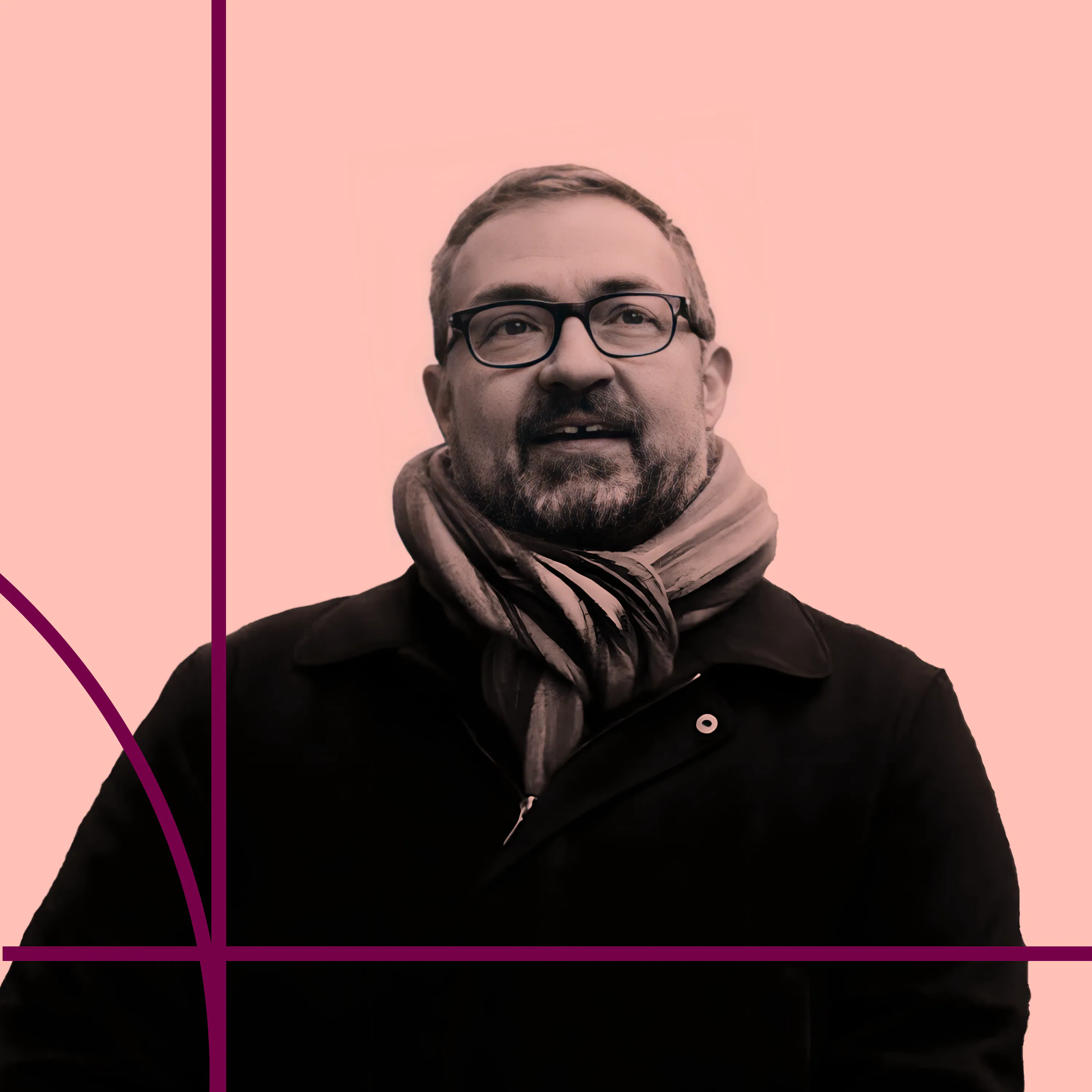
Design Better
Rewind: Jonathan Hoefler: Typography legend on type history, philosophy, and entrepreneurship
01:05:57
We talk with legendary type designer Jonathan Hoefler about his typographic influences, his philosophical views on the value of presentation and why he views entrepreneurship as an invitation
Loading summary
Transcript59 lines
- [00:00]
Eli Woolery
Hey folks, we hope you're having a wonderful holiday season and have plenty of opportunities to relax and spend time with friends and family. This week we're rewinding to one of our favorite episodes with Jonathan Heffler, the legendary type designer. Enjoy the episode and we'll see you in the new year.
- [00:18]
Jonathan Heffler
I can say as a blanket statement, I think the best typography ever is happening right now. I mean, the best typefaces being produced are happening at this moment. There are more people coming into the field than ever before, which means more new ideas and even bad ideas that are revisited later as great ideas are fantastic.
- [00:37]
Aaron Walter
Chances are you have a few fonts on your computer right now designed by Jonathan Heffler. Since 1991, Apple has included Heffler Text on every Mac they ship. Ideal Sans Knockout, Archer Verlag and Sentinel are a few more of Heffler's well known typefaces, each steeped in history and timelessly beautiful. It's no wonder that Jonathan was featured in the Netflix series Abstract, which explores design and creativity as he's truly a typography legend.
- [01:08]
Eli Woolery
As part of our series on design history, we talk with Jonathan about his typographic influences, his philosophical views on the value of presentation, and why he views entrepreneurship as an invitation. We also talk about some of the themes in his work like unfinished business and conservation and preservation. This is the first episode of our tenth season of Design Better. We'll be continuing our exploration of design history and the creative process, but also adding new themes like how we can design a better future and the secrets of living a more creative life. This is Design Better, where we explore creativity at the intersection of design and technology. I'm Eli Wooler.
- [01:47]
Aaron Walter
And I'm Aaron Walter. You can get ad free episodes a week early and get access to our monthly AMAs with big names in design and tech by becoming a DB subscriber. It's also the best way to support the show. Visit DesignBetter plus to learn more. We'll return to the conversation after this quick break.
- [02:16]
Unknown
DesignBetter is supported by Masterclass. It's usually around the holidays, as the year draws to an end, that I start to really reflect on my goals and how I want to grow in the coming year. I've often turned to Masterclass to help me expand my knowledge and satiate my seemingly unending curiosities about disciplines that I've yet to explore. Masterclass is the only streaming platform where you can learn and grow with over 200 of the world's best thinkers. I'm talking about people like Steph Curry, Paul Krugman, Malcolm Gladwell, Diane von Furstenberg, Margaret Atkins, Atwood LeVar Burton, and so many more inspiring thinkers who share their wisdom in a format that's easy to follow and can be streamed anywhere. On a smartphone, on your computer, your smart tv, even in audio mode. Former Design Better guest David Sedaris teaches a class on storytelling and humor. And I loved Bob Iger's class on business strategy and Anna Wintour's class on creativity and leadership. Oh, and Sarah Blakely, she's the founder of Spanx, has an amazing class on entrepreneurship that taught me so much. I've been through so many classes and I just learned so much each time. The wirecutter calls Masterclass an invaluable gift, and I can attest to the truth of that claim. I gave my wife a Masterclass subscription last year for her birthday and she got so much value from it all year long. With Masterclass, your loved ones can learn from the best to become their best. Masterclass always has great offers during the holidays, sometimes up to as much as 50% off. You should definitely head over to masterclass.com designbetter for their current offer. That's masterclass.com designbetter I'm so excited for you to try it. Masterclass.com designbetter.
- [04:12]
Aaron Walter
And now back to the show. Jonathan Heffler, thank you so much for joining us on the Design Better podcast.
- [04:23]
Jonathan Heffler
It's my pleasure to be here.
- [04:25]
Aaron Walter
So, Jonathan, those listening to the podcast can't see what's behind you, which is an impressive library of books. And if anyone who's listening has seen your episode of Abstract, you're sort of combing through these giant stacks of type specimens and so forth, and I presume a lot of what you have in your library here is type specimens, is that right?
- [04:49]
Jonathan Heffler
It is. The room I'm in right now, it's probably about a third type specimens, a third books on books, a third miscellany. There's all kinds of design ephemera that I find inspiring that's made its way into my work over the years.
- [05:02]
Aaron Walter
That's great. And before we hit record, you had mentioned that there was a flood recently. So you've kind of just got things up there willy nilly. And you're a very particular guy, which I think is a big part of your success as a type designer. Is there a specific taxonomy? How do you organize these books?
- [05:20]
Jonathan Heffler
I asked this question of a librarian recently and she told me that the entirety of typography is stuffed into one Dewey decimal number, basically. So from there you need to figure out what to do. I try to arrange things in a way that makes sense to me, but it's not very extensible. Some things are arranged, my nation of origin or chronologically within that. And then I have the inevitable things I bought at that one fair and an entire shelf of books my friend Jerry Kelly gave me. So it's kind of erratic. Type is hard to categorize. That's. I mean, the library is a good metaphor for that. The history of letterforms is complex and it is not just typography, which technically speaking is the history of letters made for printing. But it's calligraphy, it's stone cutting, it's sign painting, it's digital inventions as well. It's very hard to weave a single story from all of these complex inputs. And it makes typography fascinating but kind of vexing at the same time.
- [06:18]
Aaron Walter
Could you just take us back to the beginning? So you've been designing type fonts for decades and your work is some of the best known out there. Anyone who's got a Mac has used Heffler text probably many times. That's been on all Macs for quite some time, right?
- [06:39]
Jonathan Heffler
It has since System 7, the operating system in the 90s for which Apple commissioned Heffler text. And it's been theirs ever since.
- [06:46]
Aaron Walter
That's incredible. What got you into this space?
- [06:50]
Jonathan Heffler
I've always loved lettering. It's something I've always paid attention to even as a kid. My dad was a set designer in the theater and made most of his living in the 70s and the 60s working on industrial musicals, which were these strange invention sales groups who bring together their sales staffs from around the country to have a three day weekend at a hotel and be dazzled by song and dance and the new products and so on. And he did those. And that ranged in his case from doing set design and sometimes costumes and so on to doing all the multimedia. So he always had dry transfer lettering in the house. Presstype was the brand at the time. Letra Set was the next one. I grew up with these things as a kid and I knew the names of typefaces from childhood and desperately wanted to make them as an adult and found when I turned 18 that you could study graphic design and you could be an art director, but there weren't yet programs to study typeface design or really jobs in typeface design. So I found myself kind of doing this as a freelancer very quickly, but at a time when the Macintosh was New and magazines especially were converting to electronic publishing. And there was this sudden appetite for fonts on the computer. So I learned by doing some work for some very respectable designers early in my career and then branching out to do freelance work for art directors. And it all unfolded from there.
- [08:16]
Eli Woolery
Quick side question. Your dad's career, is that where the kind of dog and pony show term came from? Is there any relation there to the industrial musical? It just came to mind when you're talking about it, you know, I don't.
- [08:27]
Jonathan Heffler
Know, but it wouldn't surprise me. These really were theatrical events and they're fascinating. My dad's big show from the 1960s, he did a lot of Broadway and Off Broadway as well. But his biggest show was for ge. It was called Got to Investigate Silicones. And they had a Broadway composer and lyricist writing all these songs about silicone rubber. And they had Broadway stars dancing and singing and telling you things about sealants and rubber shoes worn by astronauts and so on. And they were properly theatrical. They were wonderful things, but strange. A strange kind of applied art. I guess. Typeface design is similarly oblique to the culture in that way.
- [09:00]
Eli Woolery
If we're going to kind of rewind a bit to the historical perspective that we're hoping to capture in this series of interviews, where would you kind of start modern typography? I mean, would you rewind all the way to the Gutenberg press? Is there stuff before that? I know you said it's very complex, but if you were to kind of like give it a starting point, where would you start?
- [09:19]
Jonathan Heffler
I don't have a good handle on what modern necessarily means in different applied arts. But I would say in typography it's been a series of unfoldings in which different ideas about communications affected the shape of letterforms. We think of typeface design today as being largely aesthetic. Being a person has an idea for a shape of an Alphabet and they create this as a product and that is what it's evolved into. But going back over history, you find that a lot of the ideas that shaped the Alphabet came from elsewhere. I can think the most important one after Gutenberg probably is around 1500, when Aldus Manutius, who was a printer in Venice, had this marvelous idea to print books you could actually carry around. Books at the time were folio sized or quarto size, these big things that sat on desks. He invented the pocket sized book and found that Roman printing type wasn't especially space efficient for small books. So he had a man named Griffo cut the world's first italic typeface. So italics at the time were a form of handwriting. Essentially, Grifo adapted this handwritten style into printing type. And because it was narrower and the proportions were such, you could stack it more tightly, vertically, you could fit a lot more words per page. So this is all just 523 years ago, not thinking about something stylistically for the sake of what it evokes or how it might function semantically, but how it functions as a tool part, how you can actually use this kind of thing to yield this kind of result. And of course, italic typefaces didn't sweep the world for setting books, but 30 years later, they became an analog to Romans. So suddenly you have people like Claude Garamond, whose name lives on in typefaces today, creating families of typefaces with both Romans and italics. And suddenly the italic has this role as an auxiliary. It's not just a different style, it's a secondary style that can articulate text in some way. And so in type history, you have this series of events that have to do with people trying new things for different reasons, and the corpus of type absorbing some of these ideas into our understanding of what type is. The bold face is a great example as well. It didn't exist until the 1820s, when a series of Georgian printers, I suppose, began trying different kinds of visual novelties to see what would attract people's attention in poster types. And one of these novelties was to massively inflate the stems of a typeface. And there are all these period piece typefaces that came from this period that are recognizable and fun. But the more interesting idea is that making a typeface physically heavier could again provide a new semantic way of distinguishing text. So suddenly, three centuries after Gutenberg, we have the idea that a typeface can be Roman or Italic, or it can be regular or bold. And this goes on and on and on. We have sans serifs entering the lexicon around the same time, condensed typefaces in the late 19th century as well. And so it really isn't until the turn of the last century, or, I guess, the previous century now in the 1890s, that there is really any kind of conscious approach to looking at typography in some kind of curatorial way. And this goes back to Aaron's question about taxonomy. In 1892, there were a series of, I think it was 23 different American type makers that formed a cartel called ATF, the American Type Founders Company. And when they organized under one heading, suddenly there was the question of which member foundry's library had the best version of a certain style, who had the best French Clarendon condensed. And they appointed a man named Morris Fuller Benton to the task of first, going through all of these disparate collections and finding the best example of all these different typefaces, and then second, expanding this work into larger families. So for the first time in history, and again, this is now 400 years after Gutenberg, we have somebody looking at typography in terms of all of these different styles in a critical way and beginning to say these are the good features or the bad features of a typeface. These are the parts of a typeface that might recommend themselves to being expanded into a family. And most importantly, here is a family. This suddenly is a new idea to type. Where we'd had Romans and italics, and later we had Romans and bolds. Now we have the sense that a family of designs can have as many things as it needs to to help users, printers at the time articulate information in different kinds of ways. And so this is happening around 1900, and you'd like to think that the trend continued until the present day. But there were a couple of drop offs that happened over the years, one of which it was in the 1980s, and it was just as my career was beginning and the Macintosh came out. The exciting thing about the Mac was that you could summon typography being proper printing types from your keyboard, and ultimately you could make fonts of your own. But we were also at this historical moment when typography had suddenly become very narrowly defined. The expectation was that families had four styles only, regular italic, bold and bold italic. And we still live with this in programs like Word, and we know the key commands for bold and italic and so on. But to look at typefaces from the 1920s and see things like 12 different weights, this concept had been lost in the transition from classical typography, foundry types and later phototypes into desktop publishing. And so when I began working, one of my questions was, well, how can we fix this? How can we go back to the time of font families being not just larger, but more expressive? How can they be more unique and express some of the things the designer wanted? How can character sets be broader as well? By the 80s, we were looking at character sets that had 256 glyphs in them, and that was it. And there wasn't really a space to say my typeface has two different kinds of ampersand, or my typeface doesn't need mathematical Operators Type, in the ensuing 35 years, has really been about expanding what technical affordances, technical allowances permitted in terms of what designers wanted to do. And so that was really one of the first things I was dedicating myself to, is trying to make font families more expressive, trying to make typeface glyph sets more interesting, and really trying to avoid the obvious, trying to avoid the expectation that every typeface needed to have an italic and a bold. And a bold italic, which is just kind of a strange fossil of this one moment in our digital history.
- [16:01]
Aaron Walter
This is one thing that I've always just loved about your work, is how generous the families are. They're just. I remember the first time I found Knockout, and I was just like, wow, I can kind of design anything for any situation digitally with Knockout, because Knockout, how many faces are in that?
- [16:24]
Jonathan Heffler
Knockout is 32. That was a fun project. It's had kind of three iterations of its life. Knockout began as my first typeface, Champion Gothic, that I designed for Steve Hoffman at Sports Illustrated. Champion is this kind of celebration of American wood types, the things, you know, from banner headlines that say, you know, president elected in the 1940s and so on.
- [16:45]
Aaron Walter
Hatch Show Print.
- [16:46]
Jonathan Heffler
Hatch Show Print, exactly. Is the kind of main purveyor of these kinds of things right now. And the Hamilton Wood Type Museum in Two Rivers, Wisconsin, still makes these things wood type. I think I learned about it as a kid from the designs of Paul Asher, who's now partner at Pentagram and has been an extraordinary designer for ages. Something that I think Paula saw in wood type that I did as well and that my client at Sports Illustrated did, was that it's got personality. It hasn't hewed to the Swiss international style of Helvetica. It's not this regimented family of weights and widths. So when I created Champion Gothic, it was this anarchic set of six different sans serifs that are formally related, but not really the same design played out as the theme and variations. I revisited Champion and grew it into the knockout family in 1994, and those six styles became 32. And the kind of gag there is. It looks like a rational design. It's got this schedule of nine different widths across four different weights with some holes in the perimeter, but there's no center. There's no regular version of Knockout from which you can say, this is the bold or this is the light. They're all things that stand on their own. And so one of the joys of seeing the typeface used for me is that people use it in this sort of potluck way. They choose the parts they want and they use them ignoring the rest. And that kind of is a meditation on that moment in the late 19th century when people like Morris, Fuller Benton were faced with, oh, my goodness, I have 10,000 different sans serifs from different places. How do I organize these in a way that's going to make sense for a job in printer when they're setting a poster or making a business card? So Knockout has some of that. I mean, the idea of the kind of alternative type family is when I really. I've returned to a lot Champion, which became Knockout, which later grew into an even larger family called Ringside. That's one example of it. We did a typeface called Nitro that has two italics, one leaning right, one leaning left, but no Roman. There was a package called numbers that has 16 different fonts of Numbers that have no morphological similarities. They're just kinds of numbers from the world we experience. So there are things from playing cards and dollar bills and so on, gas pumps, things you can recognize kind of iconically, but they're not a conventional family. And then things like. Probably the most bizarre one I've done is a family called Inkwell a few years ago. And Inkwell is a series of handwritten styles that are alloyed with conventions from both calligraphy and typography. So it's your handwriting, if your handwriting was the kind of gothic black letter used for the New York Times logo, or it's your handwriting, but it's a fluid script, or it's your handwriting, but it's a condensed sans serif for a poster. I think what I stumbled into with Inkwell is that same idea that I think maybe Type founders from Aldus in 1500 to the Victorians had, which is what are the ways in which typography can really provide more voices for designers, provide more different ways of articulating information beyond just this is for emphasis and so on.
- [19:44]
Eli Woolery
Jonathan, I'm curious how you think about the bridge between early typography, which was somewhat constrained by the physical nature of the typefaces. Right. These are actual blocks of lettering that were, in some cases wood, some cases steel. And there was some amount of constraints around what you could do with it to the modern digital photography, where essentially there are no real constraints on these 2D forms. And you look at some typefaces now that you could say maybe are a little gimmicky, have, like, ink traps when there's no real purpose for a digital Ink trap, obviously. But yeah, just curious how you think about that when you're designing a new typeface. How do you bring in these traditions without them being too gimmicky or cliche?
- [20:24]
Jonathan Heffler
The question of what is cliche and what's not in typography is really kind of the center of the problem, isn't it? I mean, a typeface face needs to be evocative in some way for it to be useful, but it doesn't necessarily need to be quite so on the nose. It only says one thing. My example for years was always, you can glance at a newsstand and know immediately which are the fashion magazines, which are the sports magazines, which are the racing magazines, from the typography alone, because there are these traditions in these verticals of fashion. Magazines for 50 years have used these high contrast typefaces with very thin serifs and muscle. Magazines use these beefy italics that are tightly set and tightly leaded and so on. I think a symbol, somebody who for most of his life has made typefaces and provided them to designers. I've always wanted things to do both. I've always wanted a typeface to have a kind of obvious reading that a designer could employ to communicate something that is recognizable and shared by all readers, but to also be open to interpretation, to be something that isn't just limited to one kind of application. I did a family in the gosh, early 2000s called shades, and it was a set of things that are ornamental in different ways. One has an inline, one is faceted, looks three dimensional, one is based on a stencil. And one of the goals of this project was to design a set of decorative faces that didn't just have one reading. The octagonal typeface didn't just say sports. The inline typeface didn't just say luxury candles or whatever. There was enough of a mix of different influences that there was a general sense of something going on without it being quite so specific. And I think that really is one of the great challenges in typeface design.
- [22:05]
Aaron Walter
One thing that I love about all of your work is there's always a sense of discovery for me that there's something unique that I didn't expect to find. And always a sense that there's deep history here and sometimes it's overt. And I can kind of see it like I recognize the echoes of past time, but then as you kind of pull on the thread, the history reveals itself further and further. Could you talk to us about how that historic literacy informs your work and how that's. I mean, it seems inextricable. It's so essential to the way that you work.
- [22:42]
Jonathan Heffler
I think some of the most satisfying things I've gotten to do are typefaces that have a historical hook, perhaps, but are not necessarily going in the place that history suggested. One of the first typefaces I did was a family of things for Rolling Stone called the Proteus Project. This is around 1991, and it's kind of a theme in variations where there's a sans serif and a slab serif, and something called a Latin, which has triangular serifs, something called a Grecian, which is made of octagons. And I made these typefaces for the magazine, and gradually the request came through to make italics for them. And there are historical models for a slab serif italic and a sans serif italic, not so much for a triangular serif Latin italic, and not at all for the octagonal Grecian italic. And so I found myself in this marvelous place of having to guess what a historical designer might have done with a modern brief, or what a modern designer might do with a historical brief. How you really dissect the idea of this octagonal typeface that goes back to the 1840s and imagine how it might be adapted to serve an italic structure. And there are obvious things designers might do. Italics just for the audience aren't just Romans that are tilted over, they usually incline to the right, but they tend to evidence some sort of calligraphy. So you find the strokes are a lot more flowing, and you find that certain letters, like lowercase A take a different shape, the G takes a different shape. This puzzle to figure out how to hang a Grecian suit on italic bones was something that didn't have one specific answer. But I came up with an answer that I quite liked a lot. That kind of set me off on this idea of looking at history differently. I think type designers had classically looked at history as a series of models that could be interpreted. So most of the great foundries of the 20th century had in their libraries their version of Garamond, their version of Bodoni, their version of Caslon, all the kind of household names of typography. What I found to be more interesting, both in terms of it being artistically engaging and perhaps more commercially unique, is the idea of looking at historical models in terms of unfinished business. To look at something and say, well, someone took this idea only so far. Where might they have gone? Or someone did something unusual. What was the brief that shaped that? How could that be inhabited and understood. The last typeface I publish is one of my favorites. It's called Parliament, and it's a black letter, which is taxonomically the style that's used for things like the New York Times nameplate. We commonly call it Old English. Parliament is based on this wackadoo typeface from 1821, in which a type founder made this really enormously inflated, heavy black letter Alphabet and did alternates for the letters E, G, I, N, V, and Y. And that's a strange series of letters. I mean, they're not the most common letters in English. Not the least common. They share nothing in common in terms of their shape. What was this designer doing? And in looking at the design, the original characters that he made for the capitals and these six alternates, I realized that those are the six letters in the Gothic Alphabet that are the most unfamiliar to modern readers. So we've all seen this black letter typeface where the E looks a lot like a capital C, but with some additional Gothic tracery going on inside. You kind of need to decode that with modern eyes. It doesn't read as an E. The E we know is the vertical stroke with the three horizontals projecting from it. And so his alternate E, sure enough, was that kind of Latin structure with a bunch of Gothic flourish added to it. The G was the same thing. It looked more like a capital C with a serif at the bottom. The I, instead of looking like a J, looked like a stick, basically. So if that theory was correct, then my question was, could you apply that same logic to the entire Alphabet? Could you do a more modern version of the F as well as the E? Could you do an old version of the D, which had been modernized as well? And so the typeface that emerged, Parliament, has two sets of capitals, One very archaic, one very modern, both made of the same stuff, both feeling kind of Old Englishy, but different in terms of their shape, providing little. Slightly different moods. So I guess for me, that combines two of my interests in type. One is this idea that history is kind of unfinished business to be looked at. And the other is that type families can be weird. Parliament doesn't have an italic. It has a Gothic and a Latin, which is a strange thing to do, but a fun thing for a designer to work with.
- [27:09]
Aaron Walter
There's another approach, too, which is a distillation. I'm thinking of Gotham in particular, and I've heard you talk about this in the past, but the extensive amount of research that went into gathering all these different examples that then Got distilled down into the spirit of Gotham. That seems like a different approach. Am I wrong in that?
- [27:31]
Jonathan Heffler
No, I think you're right. Gotham is a funny one. I mean, its earliest roots are probably to the early 90s, when I started making a typeface based on this kind of not well formed sense. That I'd seen these generic letterforms in lettering as opposed to in type. And you see posters from the WPA and absinthe ads from Paris at the turn of the century and packaging and so on that have these kind of elemental letter forms. And they were current over and over again in history, but they'd never made their way into typography. They were never printing types that had these kinds of forms to them. In that part of the Gotham project. And that's its very, very earliest origins. The real story happens later. That process was less about rigorous historical research and more about just kind of gathering magpie like things that I liked and fig out if they had something in common. The rigor around that really happened around 2000 when Tobias Fur Jones came to work with me and we began addressing this as an actual organized family of typefaces. And this involved making fresh drawings and having a new source. I'd seen the sign on the Port Authority bus terminal on 8th Avenue in Manhattan and thought, these are the perfect expression of these kinds of letters. Let's do a typeface that begins with these characters and expands outwards into more. So the research that followed from that was looking at more kinds of signage, more letters in public. And these are neon signs and liquor stores and car parks and painted signs and windows and brass numbers and elevators and things like that. Things that came from engineers rather than graphic designers in which somebody who had some expertise in lettering might have rendered what they thought was just kind of a simple, straightforward version of a number three. And we could anthologize all of these things and from this deduce certain themes in what we thought might make their way into a typeface. All of that said, some of the biggest invention in Gotham is not from the historical corpus at all. I never found any lowercase letters in the world that participated in the kind of flavor of these capitals I liked so much. So lowercase is an entire invention in Gotham. And the idea also of rationalizing this and then doing the family that has eight different weights and four different widths and italics and so on, that was a project unto itself that really had no historical basis either. I suppose it's like Parliament in a different way, or like Knockout as well. It's this confluence of historical themes, both visual ones and conceptual ones, as well as observations about how this spirit, once it animates a typeface, will be most useful to designers. What kinds of forms are ultimately useful to them, and finally, thinking about what dimensions are available to help users articulate information differently. In the case of Gotham, it was weights and widths and postures and so on.
- [30:22]
Aaron Walter
We'll return to the conversation after this quick break.
- [30:29]
Unknown
Design Better is supported by bluehost. You know, I'm someone who's spent years designing and building websites, but still these days building a website is so much more complicated. That's why it's a good idea to get bluehost. Bluehost has an AI powered design tool that will help you create a pro level WordPress site in a snap. There's no coding, no stress. You just type in what kind of vibe that you're going for and boom, you've got that kind of website. You also get added features like marketing and e commerce tools to help you build, grow and scale your online business. Upgrading to Bluehost Cloud keeps your site running 24.7with with ultra fast hosting, 99.9% uptime and it has enhanced security. It's seriously never been easier to build your website with Bluehost. You've got ideas. All you need now is a platform. All you need is Bluehost. Head over to Bluehost.com and start building your dream website today. That's Bluehost.com.
- [31:34]
Aaron Walter
And now back to the show.
- [31:41]
Eli Woolery
Jonathan, you shared some possible themes that we might cover in this discussion. One of them is conservation and preservation. And an example that you shared was the Typeface Surveyor. And I'm looking at it now and it has these wonderful qualities that to me are a little bit intentioned. There's kind of a nostalgia there. I'm looking at it and there's. It feels sort of of like something you might find in an old map, which is part of its origin story. But then it also feels like I could very easily see it in modern use too. I'm curious how you kind of like work with that tension and also maybe explore that theme a little bit about conservation and preservation.
- [32:17]
Jonathan Heffler
Sure. Surveyor does indeed come from map lettering. There's a marvelous article that a historian named James Mosley wrote about a style he called the English vernacular, which is this movement in lettering in the from the middle of the 18th century to the late 19th century that affected different kinds of lettering from sign painting to engraving to engraving of copper maps. So I'd seen The kinds of lettering that we know from maps and thought this is something that is recognizable and iconic. We all can kind of feel where these things came from. You can see these flowing italics and imagine them being used to delineate a river on a map, or these bold capitals being used for the name of a state or a county or something. Surveyor was a commission from Martha Stewart Living magazine from Barbara DeWilde. And it was a chance to take some of our love of lettering and maps and create a family of typefaces that resurrected these things. The first conservation part of the typeface for me was that this sort of lettering was becoming extinct. You can look at an engraved map from the late 19th century or even the early 20th century and see these iconic letters where there is a ball terminal on the capital C instead of a serif, and the italics are very flowing and so on. But by the late 20th century, when maps are being made electronically, because there are no typefaces that have these characteristics, different fonts are being used, and all of a sudden, English vernacular lettering is out and Universe Condensed is in. So the first part of this for me was about actually trying to preserve this thing from extinction, because I thought it was beautiful. But the second part actually had to do with preservation of effort. Martha Stewart Living, and again, I'm going back to the early 2000s now, was really one of the most ambitious magazines I've ever seen. Visually, you think of Martha Stewart in terms of these ultimately aestheticized decisions and every photograph being perfect, and that's certainly all true as well. But typographically, it is an incredibly demanding publication. There are charts and recipes and gazetteers and tables and calendars, and all kinds of things that require really specific and consummate typography. There was also an entire section of the magazine printed with a different printing technique. The center of the book was printed intaglio, which is an engraving process, and the outside is printed web offset, which is how most things are printed today. A function of that is the typefaces they traditionally used needed to be artificially emboldened for every single setting on this one signature of intaglio printing. So rather than have a production person go through and manually change all the art for all these pages, we made a parallel set of typefaces that had all the accommodations one would want. So that part of the magazine used a set of surveyor fonts that was a little bit bolder, a little bit more openly spaced, had a larger lowercase, and so on. So really, there were two kinds of conservation involved in the end There was the preservation of the artifact going extinct, but there's also the conservation of time. And something I found from that project was that increasingly the work I was doing as a typeface designer had to do with saving time or saving materials or saving space. We touched on Knockout before and even the champion Gothic typeface. The six styles that inspired Knockout, the six different widths, were designed not because the art director wanted them, but because the editor that wrote headlines often would say headline to come and go home for the night, return in the morning and have written a very, very long headline or a very short one. So with these six different widths, they could just step down to the narrower or the wider typeface, have things flush out automatically and get the work done. So that's been a theme of typography for a long time. And again, I can go back to Aldous in the first italics, but thinking about typefaces as things that people use not just to communicate, but to make it possible to communicate, to invest the right amount of time in a project, and in the case of a current art director, to work at a macro level, rather than thinking about things like the fit of the typeface and the spacing and so on.
- [36:20]
Aaron Walter
That's a common theme in your work, is that integration and understanding not only of what makes a beautiful type design, but also what the setting, process and the requirements are like and how to present that. And specimens have really informed your work over the years. And so in turn, you've spent a lot of time in the presentation of specimens to people. Talk to us about your philosophy around that and how that helps typesetters as they're trying to do their work, their daily work.
- [36:57]
Jonathan Heffler
So the uninitiated might not know what a type specimen is, but. But you might run into one one day at a used bookstore. A type specimen is a catalog made by a type foundry to advertise their typefaces. And the type specimen as an artifact is one of the most bizarre things you can imagine. It's often a thousand page book filled with words that aren't meant to be read. They're words that are chosen to show off the typeface. So you come across these pages that say, shrine, shrub, Mariner, he him main unemployed printer. And this is showing off what a typeface looks like in 72 point, 60 point, 48 point, all the different sizes in which it was available. I fell in love with type specimens as a young person. I'd seen antique specimens when I was in high school. I bought my first one when I was 18. The 1923 ATF book. And I found it to be just magical. And part of it is that it's enigmatic. Part of it is it's these gorgeously designed pages filled with type and filled with words and maybe not necessarily filled with reading. So the hook is set for this being a kind of fascinating thing. But the secret to type specimens that I discovered is they are filled with reading. They're filled with information about the type. And what was so shocking to me when I entered the field is that the type specimens that were being Produced in the 80s not only no longer had this magic, but they no longer had the information. They were just like phone books. They were these catalogs of alphabets. Twelve point capital, A to Z, lowercase A to Z, Numbers, punctuation, again and again and again. And I remember having this moment I was flipping through a catalog, and it was just pages and pages and pages and pages of alphabets. And I thought, how is anyone possibly meant to choose? How are you meant to know what these typefaces are for? And you mentioned ink traps before. You'd find things like a typeface with these very eccentric little white cuts into all the angles and think, what is this kooky thing somebody has made? Well, this turns out to be a typeface design for telephone books. And telephone books are printed on absorbent paper. And the details in these typefaces are designed to anticipate what happens when the font is inked and winds up being absorbed into paper. And the end result is perfect. This is a typeface I'm describing called the Bell Centennial, designed by Matthew Carter in 1976. To me, to see a typeface like Bell Centennial, which was a highly specialized industrial part with a very specific intention, just organized with other typefaces that began with the letter B, it seemed to miss the point. It was disrespectful to the designer that invested so many years in coming up with the idea. But it also didn't assist the graphic designer who might want to use the typeface. So one of the things I started doing early on is to produce proper type specimens, to move from these lightweight catalogs of thousands of fonts into small journals. They were devoted a lot of space to each typeface, both to show off what they could do, but also to tell their stories, to talk about the virtues and talk about the intentions and explain to people that this typeface isn't just a toy, it's a tool. It exists to be used in a specific way. It's certainly open to being used differently. It's certainly open to being abused as well. But to explain that the different things that you see aren't necessarily on an equal footing. They're not fungible. They really are unique creations with a purpose. So something that I was excited to get involved in when I started my company in 1989 was to spend a lot of time doing storytelling, to really just create type specimens that were beautiful, hopefully in the tradition of type specimen book, to highlight the variety of typefaces and the diversity of typefaces, how they're different things, different purposes, and to explain that the choices aren't arbitrary, to really talk about what the work was for. And that found its way from doing type specimens into doing the website, which I started in the early, early 90s as well, and for which I did all the writing up until the very end, the presentation of the font and the story behind the fonts really became an intrinsic part of the Alphabet in the end.
- [40:51]
Eli Woolery
That's a good segue to this other theme that you shared, which I thought was both interesting and a little cryptic, but this idea of entrepreneurship as an invitation and hospitality as an ideology. And it kind of made me think of Danny Meyer, who's an entrepreneur, but he's obviously very much, you know, hospitality is his ideology. And so, yeah, talk a little bit about that. I'm curious.
- [41:13]
Jonathan Heffler
I'm so glad you mentioned Danny Meyer, because he's where I got the idea from. Danny Meyer is the restaurateur who's made just some of the greatest experiences in the world. And his restaurants have marvelous food, but also marvelous atmosphere and a marvelous sense of you're being welcome to share something. And you can go to Gramercy Tavern and a waiter will find you debating which two desserts to get and say, well, have half of each and they'll just make it happen for you. And there's no question of how it can gets priced or the policy is, or how it gets served. It's just, they're going to do this for you because it's the right thing to do. When I started the Heffler Type Foundry, I really felt drawn to that same approach. The idea that creating an experience for people was more than just selling something. And type specimens were a big part of that. It was sharing the culture of the thing and getting people excited about it, but also explaining the differences in a way that's unthreatening and helpful. But I found as time went on, that a lot of the things I got to do with the company were. Were similarly about hospitality. It was not just designing type specimens, writing the website, writing in general, from, you know, the catalogs to email campaigns and social media ultimately, but also building tools, doing programming, working on databases, working on the website, thinking about all the ways in which the company expresses itself to people, and that messaging and tone, visual language and for that matter, policies and things like the end user license agreement and the FA are all expressions of the same thing. They're all an expression of. I'd like you to be excited about this. I'd like you to be engaged in this. I'd like to solve any questions you have going into it. I'd like to make this a welcoming place. I think one of the challenges to small business owners these days is not having a native sense of that. I've met a lot of people who I think want to be involved in design, but I have very narrowly drawn interests. They just want to make the product, or they just want to control the identity or just want to run the store. I always found, and I was lucky enough to have this be my experience at the company, that engaging in all of these things simultaneously is kind of coming from a similar place. So the writing and the designing and the speaking and the lecturing and so on were all a function of the same thing, if that makes sense.
- [43:22]
Aaron Walter
You recently sold Heffler and company, the whole library, this amazing library, to monotype. What was that process like for you? Just, I mean, this is a life's work. You're a passionate person, and presumably there comes a time where you start to think, all right, how can this be carried forward? Is it by me or is it by someone else? What was that process like?
- [43:46]
Jonathan Heffler
It's not an easy process. As you said, it's hard to think about my life's work in terms of handing this off to somebody else. I think the thing that it came down to for me is I turned 50 when this process began. And that's one of those cliched moments of really taking stock of your life and deciding what you want to do. And I realized I'm ready for other things besides typeface design. While the upside of the company that I've been describing is that it invited all the chances to write and to speak and to draw and to design and so on. It also demanded all of those things. And we had grown by the end from a small single proprietorship into an international company with, at our high 28 employees and running a web service with 145,000 synchronized servers around the world to distribute web fonts into websites. It's A lot of work, it's a lot of obligations. And I think I had felt that the avenues open to me that are things to learn, the next things to discover, to run the business, weren't as interesting as I would have hoped. It was less about, I can make a typeface. Now can I make a specimen? I can make a specimen. Now can I write a specimen? I can write a specimen. Now can I publish this online? I can publish online, now can I learn user interface? The next things had to do with technology and law and most of all, the commercial environment of type, which has changed dramatically in the last 35 years. And they just seemed less interesting to me than other kinds of things. Monotype approached us about buying the company, and I think just the right time. It was a moment where I was feeling it was time for a change. The company was doing well, everybody there was invaluable, and they're all still at Monotype, except for a few folks who decided to move on. It felt like a good fit in terms of putting the library I'd created in the hands of people who still thought that fonts had value. We're in this strange moment now where there are companies that make and sell typefaces and companies give fonts away for free. And this dichotomy serves different constituencies differently. But I feel very strongly that fonts do have value and. And the best ones don't arise without some kind of investment and some kind of reward. So that's the ecosystem I've really committed myself to.
- [45:59]
Eli Woolery
I want to go back for a second to that idea of hospitality and welcoming. And I certainly experienced that when I was, you know, I started my career as more of a physical product designer and then shifted into web design to some degree, graphic design. And so I was very much a newcomer to, you know, understanding typography. And it felt very intimidating because there's, you know, innumerable choices and what works with what. So coming to your site and saying, hey, pair this with this. They work really well together, like, done. This works. This is perfect. I'll just do this. It works. It feels good. I feel like this is a really quality, you know, in my mind, product, because that's how I kind of oriented towards things. But I'm wondering, how are you, you know, thinking as you move on to other things, And I know you've done some recent projects with, like, the Biden Harris campaign and maybe talk about that part of it, not so much the political side, but just the process side of it and how you kind of.
- [46:50]
Jonathan Heffler
Bring that hospitality into that the Biden campaign. Robin Canner, who was the creative director of the campaign, called me the day that George Floyd was murdered. Joe Biden issued the statement. And I think this is an off the cuff thing, he said. But he said, enough. It's time for us to take a hard look at some uncomfortable truths. And I was moved by the candor of that. And I was also struck by what a difficult political message that was. It's not a forward statement. It's not initials on a hat. It's 14 words. And I suddenly felt very fearful that this man who I wanted to be in office, might not be able to get his message across because it was nuanced. And I'm fortunate that Robin spotted the problem in the same way and thought typography to the rescue. So when she called, we talked about a number of things. Typeface selection, a logo, color scheme, things like that. But the big challenge was this. It was how to turn complex messaging into something that is digestible and would be consistent throughout the campaign for a leader who speaks in long sentences, who speaks in complex sentiments. The idea that I proposed was to think about these messages in terms of words of action and connective syntax, and to come up with a playbook that helped articulate these things in different ways. So one of the first statements that the Biden campaign issued on, I GUESS it was July 4, 2020, was, we have a chance to live up to the words that founded this nation. And that's kind of a mouthful. The playbook that I'd suggested that they use for this was to highlight live up to and words and founded and nation in the sans serif decimal, and to use either a lighter weight of the typeface or the serif typeface mercury to fill in the remainders. This isn't that different from things like the typography revolutionary America, where we have life, liberty, the pursuit of happiness, the Declaration of Independence and life, liberty and happiness were all capitalized, as was the style at the time. It was thinking about the idea of how we could create a typographic milieu that allowed this texture within a sentence, certain things to be in the foreground, certain things in the background. So the result is something visually interesting, also communicative at a single glance, but could also be used for all the communications in the campaign. So the result of this was seeing on Instagram things from six word phrases to entire decks of bullet points, talking about things like health care and employment, inflation and Covid and so on, where they were able to really draw out Key points in one way, typographically, and have the supporting information recede into the background such that everything had the same visual theme to it, from small to big, both in social media and in television and print and so on. That was the first part of the project for Biden Harris, or I guess it was just the Biden campaign at the time. Part two was when Kamala Harris joined the ticket. There was a logo that the earlier Biden campaign had done with B, I, D and the three stripes of red for the E and the capital N. They'd wanted to do a lockup that was some adaptation of that in the new typefaces with the vice president's name added. But they wouldn't tell me who the vice president was, and they didn't tell my client either. So we had this horrible situation of having to develop an identity for as many clients, as many possible VPs as we could imagine. This sort of operated as a sell independently. The campaign wouldn't even say, here's a short list. They would say, you've seen some names in the paper today. You should add those to the mix. So we're doing logos that are Biden Harris and Biden Rice and Biden Duckworth and Biden Warren and so on. And one of the bizarre things about this is it's one thing to have a corporation come to you and say, we are Unilever. We need a typeface or a logo. It's something else. And they come to you and say, well, we can't tell you what our name's going to be, but it could be any of these 13 things or maybe others make it all work. And it was funny to have conversations with the campaign about things they'd never considered, like a ticket that was Biden Rice and a ticket that was Biden Grisham would have different shapes that, you know, Duckworth is a longer name than Bass, that, you know, Baldwin begins and ends in the same letters as Biden. It was this very strange kind of Venn diagram where we did 13 different identities. And this one intersection was the one solution that works for essentially all of them. So that's how that logo unfolded. And it was this really odd exercise in looking at things like word shapes and letter widths and, you know, really liking Elizabeth Warren, but her name has a W in it, and it sets much wider than the I in Baldwin. And, you know, Harris is great, but there's two R's in the center. Just very kind of Kabbalistic ways of looking at these abstractions of letterforms but we did logos and I found out who the candidate was when everybody else did. I got a call 25 minutes beforehand saying it's looking like it might be number seven on the list. Send us some EPS files of those. And the announcement was the Biden Harris ticket. And there it was. And so at the end of this, we had both the logo and the typographic playbook that had to work together. So there was this system for all the messaging and the logo. And it fell to Robin and her team to really make that happen, which was endlessly complex. And also kind of one of the exciting things I got to experience is it was the first time I'd worked in Figma with a group of designers simultaneously. And I'd played with Figma as an alternative to Adobe Illustrator and I'd seen people using it. And Figma, for those who don't know, is a browser based design application. But the crazy thing about it is you can have multiple people working simultaneously, you can see all the cursors and all the work happening. And I remember being on this kind of coaching call with the team, talking about, here are some ideas you might want to try. And suddenly I'm seeing this happen in 14 different corners of the screen. It was marvelous and it was very. It was exciting to see a kind of modern technology being used in this way by a really energetic set of volunteers. Working on the campaign and seeing the results happen very, very quickly was a nice change of pace from working with corporate clients. Things happen in politics incredibly quickly. Approvals happen very, very fast. Decisions are just made in real time, which is not like anything else we've.
- [53:09]
Aaron Walter
Ever seen in my mind. Jonathan, I can just picture you on the phone with Joe Biden. Sir, these are the candidates that you can consider. These candidates will not fit your logo. Mark them off the list.
- [53:24]
Jonathan Heffler
I was, I mean, Tammy Duckworth had a very long last name and I thought, I'm going to need to make a decimal condense just for her name. And I can't commit to the entire timepace. I will tell you one thing. And the entire campaign has come and gone and the White House has used the typeface for three years. Not a single person has ever noticed this. The Decimal typeface that they use for everything is a sans serif that my designers and I made at the company. Decimal is based on lettering from wristwatches. And a character you see a lot in wristwatches is the capital J. There's a company called Valjoux that makes movements and so you often see this J. And the J in a watch, famously, is a sans serif J with this long, wide serif along the top. And I preserve this thinking it's a great detail, looks terrific in the typeface. And I got a call from Robin telling me that Val Biden, who at the time was Joe Biden's campaign manager as well as his sister, had said, you know, I'm not sure we like that serif on the J. Let's take that out. So there is a custom cut of decimal that is just Joe Biden decimal with just the J change. So you do occasionally find direction coming from on high, as it turns out.
- [54:28]
Aaron Walter
That's great. I'm curious in your research, and I love that you created decimal because typography on watches is fascinating and unexpected, and they'll just sort of throw curveballs in with certain numbers or letters and so forth. Where did that research take you and did it lead you to buying a specific watch that's like the beautiful, interesting, quirky, typographic watch?
- [54:56]
Jonathan Heffler
Well, I should probably answer the second question first, which is that. But I had this jarring moment in my 40s where I'd been debating I'd never owned a serious wristwatch. I'd been debating, am I buying a brand new Omega, Am I buying a vintage universal Geneve and am I up to owning an old watch? What's involved in maintenance and can I get it serviced? And I suddenly had this thought, I could have more than one. I've been thinking of watches like eyeglasses, where you have one pair you wear constantly. I thought, no, they're more like shoes. I can have more than one watch. So that did begin buying a bunch of vintage watches that's been financially ruinous. Watches are fantastic, though. There's a culture to the letters on watches, just as there is in maps, which became Surveyor and signs that became Gotham. There's a distinct look to the lettering and watches that is probably a function of how they were made, being printed with this fascinating process called tampography, which is kind of this rubber dumpling that gets pressed into an inked plate, lifted up and pressed into a watch tile and then baked. You find in all kinds of watch lettering and the different people that made these watch dials, all these mannerisms that are kind of fascinating. And some of them are personal, like the serif on the J. Some of them are formal. The number four on every watch face has this big square open counter. The counter is the enclosed area. And you think about the number four in your mind's eye, which is essentially a triangle with two spokes coming out of it. The number four in a wristwatch is this kind of half trapezoid where that triangle has been inflated to make more room inside to stop the ink or the luminol or whatever it is from encroaching upon the center of that non printing area. So you see in watches not only all these special accommodations for small sizes and for reproduction at small sizes, but also this very specific set of different kinds of language need to be supported. So a watch that has wheels indicating the day of the week or the month, you'll find that someone has rendered the months of March and June in different styles of lettering, because March has a very wide M and June has a much narrower J. This marvelous interplay of the culture of watches, the mannerisms of the makers, the specific demands of the text and the specific demands of the medium come together to create this just neat thing. Decimal was a chance to explore all of this and then to again explode it out into a larger universe of getting a lowercase and italics and weights and things like that. But I think watches are terrific. I don't have a favorite, but I would point anybody who's interested in watch typography to the now moribund brand Universal Geneve. They made a variety of watches. I mean, I think maybe more than 10,000 different ones. And the lettering is spectacularly consistent in terms of its quality. And the designs are incredibly innovative in terms of their variety, but they always. You can swap them from across the room. There's something about one that just looks perfect. And I think they benefit from being closed down before the dawn of digital typography, because almost every watch brand today uses fonts rather than lettering. I should call out a couple of companies that don't, starting with Hodinkee, which is the watch website and All Purpose Authority. Ian Cox is a designer there, has done some marvelous work on timepieces using lettering of his own invention that's steeped in the history of watchmaking. And their first, first branded timepiece used decimal. The first to use it was Hodinkee on this historic desk clock they made from old components and a new dial.
- [58:21]
Eli Woolery
Wow.
- [58:21]
Aaron Walter
Fascinating. I did not know that. I'm a big Hodinkee fan and I just find the history of watches and horology, I think there's a lot of overlap here in the design world because you've got very particular design approach and then you've got this technical aspect and historical aspect and a social aspect aspect. It's very layered, as you said. It's ruinous. You gotta.
- [58:45]
Jonathan Heffler
You gotta.
- [58:46]
Aaron Walter
It's a rabbit hole. Once you fall in, it's hard to climb out.
- [58:49]
Jonathan Heffler
I totally agree. And I think. I mean, some of the most exciting kinds of applied art for me are the ones where there is that the social as well as the visual. It's the sense that this came to be for some reason, beyond just somebody's vanity or somebody's arbitrary ideas about shape. The thing is an expression of an idea and the idea is itself interesting.
- [59:06]
Eli Woolery
Jonathan, now that you're kind of moving away from typography as a career, are there any foundries or designers out there that you're finding, like, particularly interesting or inspiring or other things that are inspiring for you right now?
- [59:19]
Jonathan Heffler
I have to confess that when I stopped working in the field, I winnowed down my Instagram feed a little bit. So it's less about type, more about other things. I can say as a blanket statement, I think the best typography ever is happening right now. I mean, the best typeface is being produced. Produced are happening at this moment. And I think you'd find that to be a generally held opinion. There are more people coming into the field than ever before, which means more new ideas and even bad ideas that are revisited later as great ideas are fantastic. I've spent a lot of time in the last year looking at furniture making. I grew up with a wood shop in the house, again thanks to my father, the set designer. And I've been looking with fresh eyes at what it means to work with wood. Not from the context of stage scenery, which is meant to look good from one angle, from 30 rows back, but up close. What does it mean to cut a good dovetail? What does it mean to know how to work with cherry as well as walnut? It's humbling. It's an interesting experience to be trying to be a practitioner of something for the first time in one's 50s without the likelihood of this being a career. It's just. It's kind of an absorbing hobby. But I think I'm interested in all kinds of applied arts. I mean, furniture design is one, of course. Architecture I've always had a great interest in. We're doing some construction right now that's been very time consuming. And again, it's been a chance to obsess about small details that I'm no stranger to via typography. I've been very engaged in visual AI image generation, platforms like midjourney, and spent a lot of time thinking about the implications of what it means for artists to work with these and what it's going to mean for society to have this as a tool without any certain conclusions, but with a lot of apprehension so far, but also a lot of enthusiasm. It definitely reminds me of my early days, the Macintosh getting this new technology that seems so incredibly empowering. But the question today is what this is going to mean, and that's a sobering thought. So kind of a range of things, some digital and magical and some very concrete.
- [61:19]
Aaron Walter
So that's clearly inspiring. But are there other things that you're reading, watching, listening to that you find interesting and inspiring today?
- [61:28]
Jonathan Heffler
Oh goodness. I just began Adam Gopnik's new book about mastery, which is kind of fascinating. He has taken on learning about a dozen different things at this point in his career that have nothing to do with writing. One is learning to draw. One is learning how to box. One is learning to drive. That's looking promising. I'm forgetting the title of the book, but the author's name is Jez Burroughs has written this very cheeky book made from the diagrammatic sentences and dictionaries that he stitched together. So when you look up the word murder in the sample sentences, you know he could have murdered his brother. He has collected all of these things and stitched them together into a story, which is kind of fantastic. I've been enjoying that.
- [62:08]
Aaron Walter
That's great. Jonathan Heffler, thank you so much for joining us on the Design Better podcast.
- [62:12]
Jonathan Heffler
Oh, it's my pleasure. Thanks for having me. Thanks for including me in this marvelous season as well.
- [62:22]
Aaron Walter
Have you seen the new MacBook Air? Oh man, they are so fast. They're super light and they are beautiful. And we're giving one away to a lucky winner. To enter to win the new MacBook Air, all you have to do is complete our listener survey, tell us a bit about you, and share your feedback about the show. It'll help us improve and you could soon be enjoying a brand new MacBook Air. To take the survey, visit dbtr co2024 survey. That's dbtr co2024 survey and you'll automatically be entered to win. We'll randomly select a winner on Friday, March 1st, so be sure to complete the survey by then. This episode was produced by Eli Woolery and me, Aaron Walter, with engineering and production support from Brian Paik of Pacific Audio. If you found this episode useful, we hope that you'll leave us a review on Apple Podcasts, Spotify or wherever you listen to finer shows. Or simply drop a link to the show in your team's Slack channel designbetterpodcast.com It'll really help others discover the show. Until next time.