← Design Better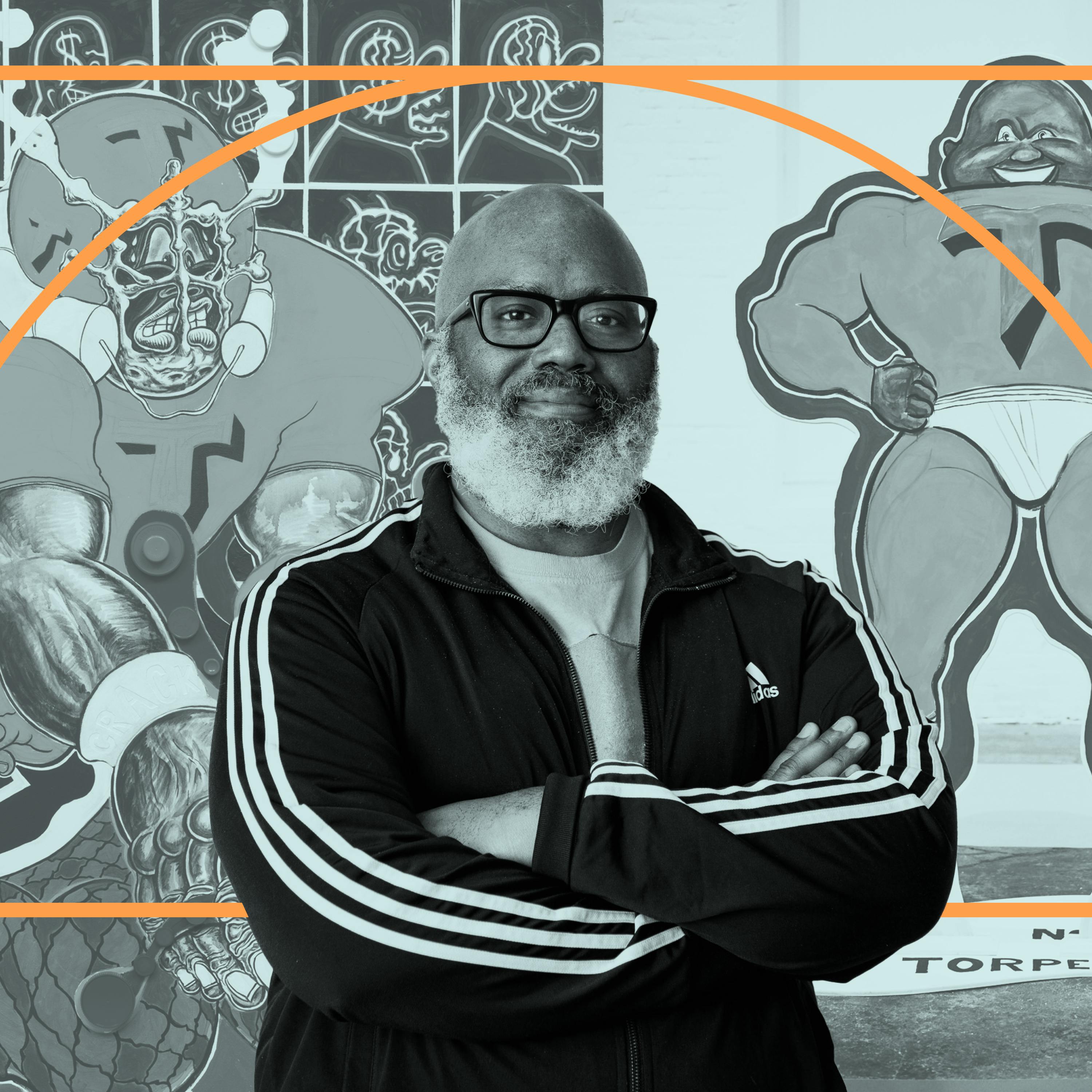
Design Better
Trenton Doyle Hancock: An artist’s process for creating order from chaos
00:26:58
We spoke with artist Trenton Doyle Hancock about his neurodivergent approach to the world, how collecting influences his visual sensibilities, and how chaos becomes precise order in his work.
Loading summary
Transcript55 lines
- [00:02]
Trenton Doyle Hancock
Just get to work because you have to warm those muscles up. You wouldn't ask an athlete to, okay, now just go out on the field and do that thing. It's so magical. But you have to warm up, so just get to work.
- [00:18]
Aaron Walter
My friend Trenton Doyle Hancock did something remarkable when we were both in the graduate painting and drawing program at the Tyler School of Art in Philadelphia. He had work in the Whitney Biennial. It was a bit like winning an Oscar while still being in acting school. It's just, you know, not something that ever happens. Most people would be thrown by early success, but not Trenton. He pressed forward in his studio, where he crafted epic stories in large scale paintings that later expanded into installations and sculptures and performance art. His creative process is very unique. Piles of collected objects, receipts, food wrappers, all of these things find their way into his work, where their color, texture and attitude unfold as the fabric of Trenton's universe of heroes, villains, and ancient mysteries.
- [01:11]
Eli Woolrich
We spoke with Trenton about his neurodivergent approach to the world, how collecting influences his visual sensibilities, and how chaos becomes precise order in his work. At the time of our recording, Trenton had a large show at the Jewish Museum in New York, exploring intersecting themes in his work and that of Philip Dustin. This is Design Better, where we explore creativity at the intersection of design and technology. I'm Eli Woolrich.
- [01:35]
Aaron Walter
And I'm Aaron Walter. If you're hearing this, you're not currently on our Premium subscriber feed. DesignBetter Premium subscribers enjoy weekly episodes. You get four episodes per month rather than just two. All are ad free, and you get invited to our monthly AMAs with the smartest folks in design and tech. You'll hear a preview of this episode, but if you'd like to hear the full conversation, please consider becoming a premium subscriber@designbetterpodcast.com subscribe. That's designbetterpodcast.com subscribe. It's just seven bucks a month and it supports not only your personal growth, it also supports your design community. The podcast is available to everyone through our scholarship program. If you can't afford a subscription right now, just shoot us an email@subscriptionsecuriositydepartment.com and we'll help you out.
- [02:37]
Unknown
We'll return to the conversation after this quick break.
- [02:44]
Design Better is brought to you by wix. Hey web designers, let's talk about creative burnout.
- [02:51]
Aaron Walter
It's a real thing and it happens to a lot of folks. You're working on a site for a really big client, but between Resourcing, feedback.
- [02:58]
Unknown
Tight budgets, and even tighter deadlines, it doesn't make the cut. WIX Studio helps you close the gap so you can deliver your vision with less friction. Built for agencies and enterprises, you get total creative control over every last pixel. With no code, animations, AI powered tools, reusable design assets, advanced intuitive layout tools, and a figma to WIX Studio integration.
- [03:24]
Aaron Walter
Which is very cool.
- [03:25]
Unknown
You can design the way you want to and deliver when you need to. And if you're worried about the learning curve eating into your time, you don't have to. Wix Studio is intuitive by design, so your entire team can hit the ground running for your next project. Check out Wix Studio. That's wixstudio.com w-I X-S-T-U--I-o.com Wix studio.com.
- [03:55]
And.
- [03:55]
Aaron Walter
Now back to the show.
- [04:02]
Unknown
Trenton Doyle. Hancock, I'm so happy to see you here on Design Better.
- [04:07]
Trenton Doyle Hancock
So nice to see you and so honored that you asked me to be part of this. This is awesome.
- [04:12]
Unknown
So, Trent, we're excited to talk to you about your work. You currently have a show up at the Jewish Museum in New York, and we can talk a little bit about that here in a moment. And we also want to dive into storytelling, which is so central to all of your work. But I think we probably need to mention that we've known each other for a long time because we went to grad school together and your studio was right across the hall from my studio.
- [04:38]
Trenton Doyle Hancock
Right, Yeah. I want to say that was 1998 that we met.
- [04:43]
Unknown
That sounds right.
- [04:44]
Trenton Doyle Hancock
I had never been to Philadelphia before. Loaded up my car from Texas and drove all of my belongings up there and happily found a new community, a new family of friends and artists. And, yeah, Tyler was really great.
- [04:58]
Unknown
Yeah. So that's Tyler School of Art in Philadelphia. And right out of the gate that first year, you were in the Whitney Biennial, your first year of grad school, which was pretty amazing. But before we get into that, maybe let's just talk about your origin story. You grew up in small town Texas. Paris, Texas.
- [05:15]
Trenton Doyle Hancock
Right, exactly. Yeah. So I grew up in Paris. The nearest large city is Dallas, and. And that's roughly two hours traveling south. Paris, extreme northeast, near the border of Oklahoma. There was not much to do other than, you know, read comic books and ride your bike and get into rural trouble. But I always knew that I wanted to be, you know, an artist. And that's the kind of actual trouble that I got into, was just honing my Skills and drawing caricatures of people and. And that kind of thing.
- [05:49]
Unknown
One thing that you and I connected on early on was just that we both came from small town. You grew up in a very religious community. In fact, your stepfather was a minister. He had a lot of ministers in your family. You played drums in church. And that was always a big part of your upbringing. And I grew up in small town Iowa, and my experience was that you, you know, growing up in a small town and being an artist, a creative person, it's difficult, you know, because people don't always understand you, your perspective, and there's a push to conform to the norms of your community. Was that something that you experienced growing up?
- [06:31]
Trenton Doyle Hancock
Well, yeah, definitely. But that's not to say that Paris, interestingly, wasn't a supportive community. It's just the type of art making that, you know, you're exposed to in that kind of a bubble is a bit different than, you know, that kind of wider scope of our worldview of what art can be. So, you know, you get a lot of landscape painting and portraiture and things like that. And that was good because there were, you know, county fairs and art fairs and kind of scholastic programs that dealt with art. So there was always a support system there. And luckily my family also was supportive. So I don't really have any complaints there. It's just in terms of how, you know, when art becomes this tool for, like, a revolutionary tool for, you know, critical thinking and really furthering yourself in your worldview, then the misunderstanding can kick in.
- [07:28]
Unknown
Absolutely. And the stories in your work, they're old. You draw upon ancient stories or reference ancient stories, stories that might have biblical allusions. You reference artists who have come before you. And many of your stories, like the core of your story with Mounds, Torpedo Boy, and some of the characters in your work, they've been around for 20 years or even more. Could you walk us into that? And maybe for those who haven't seen your work, give us a gentle introduction into what you're exploring.
- [08:03]
Trenton Doyle Hancock
Yeah. My elevator pitch for what I do, for the uninitiated, is just imagine the Marvel Universe and Lord of the Rings. But then a lot of people have heard of Picasso, maybe. So it's like I kind of try to fuse these ideas of mythology, current mythologies which happen to be, know, fantasy, superhero epics. Those are the entry points that most people have. And biblical, you know, obviously, as well, allegory and stories. So just kind of fishing in that pool of behavior and narrative information, you know, I have a lot to choose From. And then, of course, my work mostly is autobiographical, so I'm also kind of mining my own history of things that have happened, are happening, and things that I would like to happen or maybe not like to happen. So, you know, those things fuel the work. But then, of course, visually mining a whole other esthetic history of design, painting, animation, all of those things kind of come into play.
- [09:14]
Unknown
Trent, you mentioned that you grew up in this small town, riding your bike and getting into maybe some kind of small town trouble sometimes, which resonates with me. I didn't grow up in a really tiny town, but in kind of the countryside, Napa, and had three younger brothers. And, you know, this is the era in the 80s when parents would kick kids out and expect them not to come back till dinner time. So you get a lot of time on your own or with your friends and brothers. And I feel like that, for me at least drove a lot of my kind of imagination and my own creativity. Do you feel like that influenced your work too, that childhood?
- [09:46]
Trenton Doyle Hancock
Totally. It's interesting kind of having that hindsight as to what the 70s and 80s actually was, because I think it's twofold. There were the things that my folks kind of shielded me from, you know, as a middle class kid and just post civil rights, just post a whole lot of horrible things happening. So I felt a bit sheltered from those things that were still hot topics with my parents. They're thinking about that because it just happened, right. As much as they let us loose and just to go out in the woods and go on our adventures. And being a ninja was like super exciting in the 80s. So my brother and I get our nunchucks and whatever and go out in the middle of the woods, you know, and stay there for hours. And so, yeah, they didn't know where we were, but they also, they're like, well, it feels safe right now. There was this sort of kind of bubble of safety, I think for a decade to change that. We were the beneficiaries of that moment where being latchkey kids, in a way, it's like we just walk to school, walk home from school. It all worked out. And yeah, that totally was a fertile ground war in your imagination because, like, oh, well, what's that deserted building? What's going there? And basically terraform that to be our imaginary landscape. And so, yeah, super exciting.
- [11:14]
Unknown
One thing I've always found fascinating about your work, Trenton, is that there's sort of two things. One, you're always looking at a lot of different things and you're looking at Sometimes memories, these experiences you've had, and you're very detailed about, like, specific TV shows or books or things that you've experienced, and you remember and kind of mentally catalog all of that stuff and the collecting just of lots of different stuff. So seeing the things and then collecting those things and all of that is fodder for the creative process in your work. Has that always been the way that your brain works since you were a kid, or is that something that you feel like kind of developed as you got further into your work?
- [12:01]
Trenton Doyle Hancock
It's always the way that my brain has worked kind of this late in life. And understanding of my particular version of neurotypicality has been very important for me to kind of look back and understand, oh, this was a kid that's on the spectrum. And this idea of stemming or your connectivity to object to. And how important that is for someone who is neurotypical. And so that was a great thing for me to. To realize, oh, I was actually just on the path that I was always meant to be on. You know, a little bit of an outcast sometimes in a community where people think there's a certain way that things go socially and otherwise. You know, I always kind of fought against that, being a little bit punk about it as well, trying to protect what I felt was not only me, but it's like, well, this is the way I draw. These are the things I like, and these are the books I like. And I want them near me as kind of, you know, a safety net or kind of a security blanket in a way that you can kind of extend yourself through objecthood. So I think that was the very beginning of this idea of world building for me. It's like if you're at the center of your universe, then they're these kind of heavenly bodies that oscillate around you, orbit around you.
- [13:18]
Unknown
The moment where I started to understand the way that your brain works, we had gone downtown Philadelphia, to Second street, to a gallery, to an opening. You were driving, and you had lots of stuff in your car that you just sort of collected that could make its way into your studio. But I just thought, like, it was a bunch of stuff in your car, and you had dropped the key to your car after we parked and we couldn't find the key. And a friend of ours was going to be taking your car afterwards, and she needed that key to be able to drive. And so I was trying to help her. So I just scooped all the stuff out of the floorboard of the passenger seat and put it in the trash can on the street right next to the car. And I really upset you. You were like, no, that stuff was really important. And you went and you got it out of the trash can and put it back in the car. I couldn't understand it. I was like, why would you do that? And then I realized, oh, this is all Trent's ideas. These are all things that could end up at the base of your painting. Because your studio would always have just a ton of stuff. It would have mounds and mounds of stuff at the bottom of the painting that then finds its way maybe into the painting. You have to have the things around you to then create the universe that you want to create. Do you remember that?
- [14:46]
Trenton Doyle Hancock
No, I don't, but that sounds like me. I apologize if that was.
- [14:51]
Unknown
I'm glad you don't remember it, because.
- [14:53]
Trenton Doyle Hancock
I thought you'd be probably a terrifying moment for you. So I totally apologize about that. But, yeah, that sounds still. I'm still there.
- [15:02]
Unknown
Yeah.
- [15:03]
Trenton Doyle Hancock
Yeah.
- [15:04]
Unknown
Maybe that's sort of a segue. If you could talk to us a little bit about what happens in your studio, what your studio looks like, and how a painting or a sculpture gets made out of all of those things that you've collected.
- [15:17]
Trenton Doyle Hancock
It's like, I generally work alone, but at any given time, I have one assistant. So over the course of the past, I don't know, 15, 18 years, I've had someone, usually just one person, that I, in a way, have to train to not throw things away, to just sort of accept what they might see as chaos. And then over the course of some years, we develop a relationship. Well, they know that mound has this in it, and they know that stuff on the floor there has its purpose, and it may or may not make its way into anything, but just seeing it there and knowing that it's there is the foundation that we have to start at. It's like just having it in your periphery, these things. So, you know, some material is very close to what we would consider just art material you could buy at a store. Paint, paper, and whatever. But then there are other things. Yeah. That you found on the street. Receipts, all kinds of other things. Toys that, whether they make themselves physically present in a finished artwork or it may just be the essence of something. The color, the texture, you know, something about it. An attitude will make its way into a work, and that's not something I try to dictate, but through osmosis, in a way, it will appear over time and manifest the way I could in my hand. Like, through my hand.
- [16:48]
Unknown
So Trent, one thing that we're curious about, because as designers and creatives, we're often thinking of ways that we can organize things that are maybe inspirational to us or our work or other things. And there was a article you were interviewed for a handful of years ago, which we'll link out to, where you talk a bit about how you think about cataloging and organizing things. What's your process around that?
- [17:10]
Trenton Doyle Hancock
Like, my brother is also an artist. My younger brother is an art director. So he's in the design world, and that's where he. He lives. And so there's a different kind of way we organize information over there. But he and I have great overlap in the sense that I also have this, you know, a structured way of thinking about how to design my archive and what that's supposed to look like. You know, I think there's a great efficiency to this idea of the grid and the way that social media has. I took to Instagram because I love the look of it. You know, the look of the grid, and you open it and then you see your thoughts, you see the things you like, like a shelf. So for all the bad things that I think social media has opened up for me, just personally, it's a really great way to kind of archive information. So I kind of retrofitted my computer and everything with the folders to look rear grid like, and I know where things are. And so it's so much more orderly than my actual life. But if I could learn anything from these platforms, is that the grid is good. What is it? The Container Store come back with so many plastic bins? So I feel organized even if I'm not. Like, there's something to that. Once you get a sense of your sense of organization, which is a very intuitive thing, and then you can get to work. But I think there's this idea of order that needs to happen, and it's a different target for everyone. But for me, it's like seeing the things that are important to me, but the act of itemizing and getting them out in front of me is very exciting and crucial to getting to clarity.
- [18:58]
Unknown
That is super interesting because I think you've just articulated something that I've always seen. In the way that you kind of manipulate the world around you, there's what feels like chaotic. It's like all the things that have potential, but you're not quite sure what they can become. And then there's the things that you have identified as, like, this is the canon of the most sacred of sacred objects. And you are super meticulous about organizing those, like the toys, how they get lined up, and you would reorganize them and they'd be like the tall ones in the back, the medium ones, and then the shorter ones, and even move those around from place to place. They're very specific. It's sort of like going from chaos to order in your life.
- [19:48]
Trenton Doyle Hancock
Yeah, I mean, it's funny. Like, you guys, you and Jamie went on a trip once and we were able to stay in your place for, I don't know, it was a month or for one of the summers. And I had just really kind of re. Entered into this stage of collecting. I was very, you know, at the bottom of that hill of being a serious collector. And there was this town near Philly called New Hope that I would go to, and they had a really great toy store called Love Saves the Day. And on the way there, there were also flea markets and things. So a weekend might be just traveling to that town, hitting all the markets and coming back with a carload of stuff. And I remember because you're you. Your place was so manicured and it was so, like, in order. I had never seen so many right angles and like, like so much floor space.
- [20:44]
Unknown
So true.
- [20:45]
Trenton Doyle Hancock
And it was great because I would bring in like this loads of stuff and be able to set them up and we kind of wake up from the futon or whatever, and then the first thing I see are these rows of things that I collected. And it really actually helped. I haven't thought about these in years, but it really helped kind of. Yeah. The sense of organization. Oh, if I can see them, then I can understand.
- [21:09]
Unknown
Yeah, I think this is like core to the creative process. And I think it's just maybe more externalized with the way that you work and see the world. And maybe most folks. Before we started, we were talking a little bit about David Sedaris and he is the consummate collector. He is just always looking, looking, looking at the world and writing stuff down. And a lot of it can end up as garbage or just goes in his archive of journals, but he's always turning those little collected bits, bits into something like an essay. And then that can be presented to an audience and then he can work on that further. It's like this constant touching and reworking of something that I find really interesting. And I think a lot of creative people work this way, but they don't necessarily have the words or the clarity, the self reflectiveness to look at their process.
- [22:11]
Trenton Doyle Hancock
Yeah, to do that work. I mean, it's hard work to, you know, figure out those things that language doesn't quite work with, I guess. So you have to cobble something together, want to tell people about it, but you yourself understand your own methodology and what makes you comfortable, your rhythms. So I think it's very important for any kind of artist, you know, anyone in any discipline, to figure out what your rhythm is and protect that. So it might be incongruent with whatever environment you're in, but I think that's the hard work that one has to do in order to get to the essence of your work and also kind of really develop the speed that you're comfortable with.
- [22:51]
Unknown
A few minutes ago you're talking about your neurodivergence and it's something that's a thing that we've noticed amongst many of our creative guests, have adhd and Aaron's written about this recently in a newsletter. If you could sort of rewind and talk to your younger self, who may not have recognized this quality about the way your mind works, or if you could talk to somebody who's maybe struggling with it, what kind of advice might you give?
- [23:16]
Trenton Doyle Hancock
Just know that there are networks and kind of social groups out there that you're not alone. And it's not like it's a small percentage of us that think differently or just made differently. It's a lot of us and it's a lot of artists. It's a lot of people that end up being musicians, that end up being, you know, painters or performers in some kind of way. Yeah, you just organize information differently than the average person. But just know that it's okay to bring it up. It's okay to advocate for yourself and for the things that you need and research on it and figure out where you fit in. Just develop a community around it and know that there's language out there for these things. Now that didn't exist when I was a kid. It was like, oh, he's just weird. He trash Trent who does weird things.
- [24:10]
Unknown
They're in good company.
- [24:12]
Yeah, that's true. Trent, who's Torpedo Boy.
- [24:17]
Trenton Doyle Hancock
Torpedo Boy is.
- [24:20]
Aaron Walter
If you'd like to continue listening to this conversation, you'll need to subscribe@designbetterpodcast.com subscribe Once you do, you'll get access to.
- [24:30]
Unknown
Every full length episode, all ad free.
- [24:33]
Aaron Walter
Monthly AMAs with inspiring people in design and tech and recordings of all our past AMAs. The podcast is available to everyone through our scholarship program. If you can't afford a subscription, just email us at. Subscriptions the Curiosity department dot and we'll help you out. Your support makes Design Better possible. Invest in yourself and the design community by subscribing@designbetterpodcast.com.
- [25:05]
Unknown
Design Better is supported by Masterclass I'm on a never ending quest to learn. That's really what my life is all about. When I'm not working on Design Better, I'm usually learning something else.
- [25:17]
Aaron Walter
Like how to play the guitar.
- [25:19]
Unknown
I saw Tom Morello has a masterclass on electric guitar. You probably know his work from Rage against the Machine and Audio Slave. I gotta tell you, I learned so much from him. Morello thinks of the guitar as a sound machine and he opened my mind to new, creative ways to play my instrument. Now I can't wait to dive into other music masterclasses with St. Vincent Timbaland, Herbie Hancock and so many others. Whether you're interested in music, cooking, politics, black history, feminism, the future of AI writing, fashion, interior design, or all of it, there is a masterclass waiting to take you deeper, led by the brightest minds humanity can offer. With a masterclass subscription, you get access to all of these amazing people and so many more who cover a vast array of topics that will help you professionally and personally. You can access Masterclass on your phone, your computer, your smart TV, or just listen in audio mode. Right now, DesignBetter listeners get an additional 15% off an annual membership@masterclass.com DesignBetter save 15% on an annual membership@masterclass.communitybetter that's masterclass.com DesignBetter.