← Design Better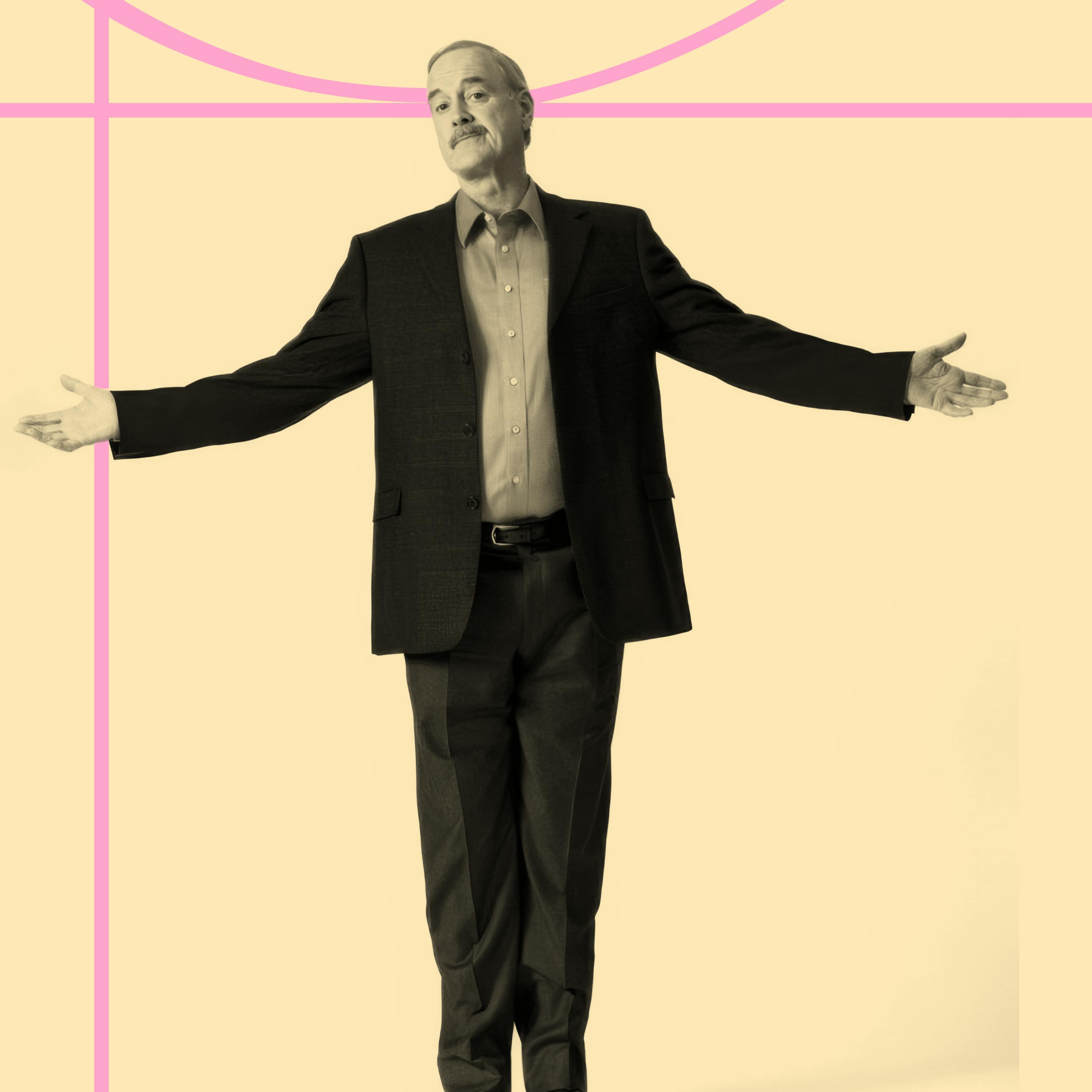
Design Better
Video Rewind: John Cleese: A cheerful guide to creativity
00:37:22
We talk with John about his book, and also about creative collaboration in the midst of friction, how to be comfortable with ambiguity, and creating boundaries of space and time to get in a creative mode.
Loading summary
Transcript64 lines
- [00:00]
Eli Woolery
Hey everyone. We recently surveyed our audience and learned that many of you would like to see more video. So we're kicking off a new run of video episodes beginning with our interview featuring John Cleese, actor, writer, comedian and author of A Short and Cheerful Guide. You can watch the interview on substackesignbetter.com or on YouTube. Enjoy.
- [00:23]
John Cleese
Confidence really comes from doing it a lot. Doing anything a lot. When you first become an actor, the great fear is you're going to forget your lines. And the main reason you forget your lines is you suddenly start thinking, I'm going to forget my lines. There you forget them.
- [00:45]
Eli Woolery
The Ministry of Silly Walks, the Cheese Shop, French Taunting if you haven't seen any of these Monty Python sketches before, do us a favor and go watch one or two of them. You'll discover or rediscover why our guest for this episode is a creative comic legend.
- [01:02]
Aaron Walter
John Cleese starred in and co wrote the award winning series Fawlty Towers. He was nominated for an Academy Award for the screenplay of A Fish Called Wanda and he even has a species of lemur named after him, Kliese's Woolly Lemur, also known as Avahi Klisi. He's also an expert on the creative process. Maybe you already knew that.
- [01:25]
Unknown
So if you're looking for a new.
- [01:27]
Aaron Walter
Framework to level up your own workflow.
- [01:29]
Unknown
His book Creativity is Short and Cheerful.
- [01:31]
Aaron Walter
Guide is a really great resource.
- [01:34]
Eli Woolery
We talk with John about his new book and also about creative collaboration in the midst of friction, how to be comfortable with ambiguity and creating boundaries of space and time to get in a creative mode. We also ask him a question that's been bugging us ever since we first watched Monty Python and the Holy Grail.
- [01:53]
Aaron Walter
We can all use a little more laughter in our lives right now. We hope our interview with John sparks some joy, leaves you with some new creative tools. Thanks for listening. We'll return to the conversation after this quick break.
- [02:16]
Unknown
Eli and I are excited to be joining our pals at User Testing as they hit the road for one day events in San Francisco and New York. It's called this Connect City Tours and we'll be recording Design Better Live on stage in San Francisco May 1 and New York City May 29. This connect city Tours brings together industry leaders to explore topics like AI innovation and the future of the customer experience. It's going to be a ton of fun. These are one day events so don't have to take a ton of time off of work and they're built for visionaries like you don't miss the opportunity to connect with really smart people, learn new things that will help you in your work and shape. What's next? Request your spot @ DBTR Co Utconnect. That's DBTR Co Utconnect. Come see us live on stage.
- [03:15]
Aaron Walter
And now back to the show.
- [03:21]
Eli Woolery
We're very excited to talk about your book, Creativity and Creativity in General.
- [03:26]
John Cleese
I can give you a brief rundown of how I came to write it. I mean, I would say that there are just a small number of very simple principles involved. One is that anything really new comes from the unconscious. And the second is that you can only get in touch with the unconscious if you're in a playful mood, not if you're in a driven, purposive mood. And that we've learned, by and large, not to play, partly because it's not encouraged in schools and partly, as we get older, we have too many responsibilities. So if we want to play, what we need to do is to create a space where we're not interrupted and where for about an hour and a quarter round about that, we just play with the idea and we mustn't be interrupted. So we have to create boundaries of space and then we create a boundary of time, a very fixed period, so that we start here and then we finish there. And then after about 15 minutes, all the worries and things that we ought to be doing start settling. And then we can start getting in contact with our unconscious and seeing what it coughs up. Two other points. What it coughs up is not neatly typed out on bits of paper. It's in the language of dreams, the language of the unconscious. So they're very subtle, very subtle promptings. I mean, Einstein himself said of his own creative process that he could never describe in words what he was thinking during the process that he was thinking. And then finally you come up with something. You've got to allow it to grow because you can't start criticizing it until you really understand what you might be coming up with. Then you have to bring your normal, everyday, critical mind into being to see whether it's a good idea or not. That might not be. It might be. Or maybe you can keep a bit, throw away the rest, and then go back into creative mode to build on what you actually like. So that's really it. There's no need to read the book, and it only takes an hour.
- [05:34]
Eli Woolery
John, you just spoke a lot about play, and we're curious about how your childhood informed the way you think about creativity.
- [05:42]
John Cleese
I remember about 40 years ago, Sammy Davis Jr. Are you too old to remember him?
- [05:48]
Eli Woolery
No, I remember him.
- [05:49]
John Cleese
He said he thought a boring childhood was a boon so far as creativity was concerned. And I was an only child and my parents moved around a lot and I spent a lot of time on my own. So I think I developed a sort of ability just to sit there and amuse myself. But it never occurred to anyone that I was creative, least of all to me, because creative meant you could paint quite well. You see what I mean? That's what it meant in an English school. And I think it's really helpful to people to realize that although they can emerge from school assuming that they're not creative, it's just because the schooling system doesn't bully it out of us. It just doesn't reward any signs of creativity. I tell a story when I was about 16, my English teacher, we were told the form to write an essay about time. And I wrote the whole essay about the fact that I didn't have time to write the essay. I apologized at the end of it. Now that always makes people smile. That's kind of neat. But you know, the teacher said, this isn't a proper essay, Keith. So it's not that he was angry with me, which is this doesn't count. So that a little creative sparks, I think are often not recognized by teachers for the simple reason the teachers aren't themselves very playful or very creative. And how can you see it in someone else if you don't have it yourself? So that's one reason. And the other is that as you grow up you have more responsibilities and play has to be separate from everyday life. So I arrived at Cambridge without any idea that I had anything creative about me. I got into Cambridge on science and it's hard to be a 17 year old scientist who's creative. It was only when I joined the Footlights Club and discovered that I could write stuff that I suddenly thought, oh, and then I noticed strange things happening. Like clearly my mind worked on things when I was asleep. And once I began to realize that, I got very interested in it because my primary interest in psychology. So I built from that.
- [08:02]
Aaron Walter
John, maybe we could talk a little bit about writing, because a lot of people think about writing as a thinking mechanism. Right now you're in a spot and you're doing some writing on a movie script. How do you think about writing as a way to explore ideas that you don't even know that you have yet?
- [08:20]
John Cleese
Well, the whole point about play is it's unpredictable. You see in our culture now what People want more than anything else is clarity. Everybody wants clarity and clarity quickly. And one of the characteristics of creative people is that they can live in confusion quite happily. They quite enjoy it. They don't feel they have to be clear about everything. And I think that's incredibly important, that you don't really know where you're going. And if you listen and keep stopping in time and taking an hour off and just playing. I write everything with a pencil. You suddenly just get an idea. And then if you've got a large block of writing paper, I go to a material sh and get the biggest pads. Then if I get an idea and I think that's interesting, I wonder if that would fit. And I make a note of it about there, because it wouldn't be at the beginning of the film, but it would be in the first half. And then I get another idea and I think, now that could be something to do with the ending. So I just start putting things on that. But that's one particular kind of writing. Sometimes I'm creative in a small sense, which is that I can take a more complicated set of ideas and simplify them. So I'm quite a good popularizer. And I think that that's a slightly similar process because it's very much a question of going to the narrative all the time and saying, well, what follows this, what follows that? Whether it's a logical following or an emotional following or the case of a movie, it's got to be both. The plot's got to be logical, but also the emotions have got to be believable and the characters.
- [09:56]
Eli Woolery
John, we're curious about creative collaboration, and famously with Monty Python you had these wonderful collaborators, but I imagine it wasn't always a smooth process. So how do you go about collaborating with people that maybe you don't always get on with that well or that you have some amount of friction with?
- [10:13]
John Cleese
That's the problem really, when you start writing with one other person, it's a little bit like dating, because the first thing is you want to impress them. You don't want to say stupid things. So you edit stuff a lot. And until you kind of trust each other and realize you like each other, and there's an acceptance, it's hard just to free real and be spontaneous. So that's one thought. Another thought, I really learned by experience, and I can't quite explain it, is that if you have four people trying to write something at the same time, one of them will always not like what's just been suggested. So you can't make any progress with four people seems so random, but it's true. You can make progress with three. Three is okay, but I think, in a way, two is an ideal number for something like comedy in particular, which has got a kind of objective quality to it, because is it funny or is it not funny? You see what I mean? If you're writing a novel or something that's primarily about emotion rather than plot, then you can do that on your own, particularly if it's an autobiography, if it's more personal. But when you're trying to make people laugh, it's very helpful to have a sounding board. And I work with Chapman a lot because he had extraordinary knack. It was very rare, which is if he thought something was funny, the audience would. So he was absolutely invaluable for the first five years. Now I've got to the point where I have a pretty good idea whether it will be amusing, but what I really can't tell, even at my advanced stage, is whether it'll be a little bit amusing or a lot amusing. Sometimes I write things I think are hilarious, and they just get sort of, you know, reasonable amount of laughter. And then I write something that I think is fairly sort of straightforward and obvious, and it gets a huge laugh. So it's very helpful to have another person there to give you a bit of confidence and to bounce things off. And the other thing, of course, is that you build on each other's ideas so you can finish up by getting somewhere that you would never have got on your own. Because, of course, a misunderstanding can lead to something wonderful. So it doesn't really matter when you're creating, there's no such thing as a mistake. And it's easy to remember that when you're on your own. But you have to realize it's true. If you're with someone else, you may mistake completely what the guy says, but it might might put an idea in your mind that you wouldn't have had otherwise. So I would say if you have a big group freewheeling, then the only way it can work is to have someone who's in charge who understands the process. Otherwise, it's just as you were saying, you get clashes of personality. The guy in charge has got to understand the process. He's got to be open to learning and not have some idea at the back of his mind that he's got to get them all to agree to, because creative people spot that in a moment, it makes them very angry. So he has to be open, and he has then to Quieten down. The most dominant people, you know, the pensies who keep on talking, has to be able to shut them up and to encourage the shyer people, the more introverted people, to speak up. And he has to keep that balance going and then keep it open and toss it along and understand the creative process so that he doesn't give them 10 minutes and then something else. He allows the group to get comfortable with each other and then guides them. And. And the sort of very good rule in that in a group is never to criticize someone or only to ask a question. So if you disagree with something, you say, well, what do you mean by that? What have you got in your mind? I discovered with Terry Jones, I very frequently disagree with Terry, but I then decided if I asked him in real detail what he was talking about, I then see what he was getting at. Whereas up to that point it just sounded to be rubbish.
- [13:58]
Aaron Walter
You mentioned the idea of confidence, and I know that's in the framework in your book, that that's one of the five tenets of getting to creativity. Can you talk to us a bit about, especially for thinking about people who are early on in their career and they're kind of like getting their bearings with who they are and their craft. How do you develop that confidence or create space for that confidence to shine?
- [14:22]
John Cleese
I think it really comes. Confidence really comes from doing it a lot, doing anything a lot. When you first become an actor, the great fear is you're going to forget your lines. And the main reason you forget your lines is you suddenly start thinking, I'm going to forget my lines. You forget them. If you've been doing it a few times and not forgotten your lines, that sort of reassures you that maybe you're not going to forget them this time. It's just a question of doing it again and again and again. And of course, if you're on your own, you don't have quite the same fear of failure. But what you do have, you have a voice in your head saying, you're not good enough. You can't do this. You don't have any ability. Everybody gets that. And the thing is, you can't control your thoughts, but you can control the amount of energy you give them. So what you have to know is you'll have good days and bad days, and the bad days are not a waste of time because it's like their preparation for new days. Gregory Bateson once said, you can't have a new idea if you haven't got rid of an old one. So When I. When I'm in an infertile period, I tend to think now, well, maybe something's going on down there. They're clearing a space for a new idea. And I don't panic, I don't beat myself up, because that simply makes it worse. But if you see that the infertile periods are just part of the process and you're going to have some, and then you'll have fertile periods that will encourage you just to sit there and keep going, which is really all you have to do.
- [15:50]
Eli Woolery
You gave a talk back in 2014, I think, to the London Screenwriters Festival, also on creativity, which I thought was wonderful. And you talked there a bit about closed mode versus open mode and design. We talk a lot about divergent thinking, and I think there's some parallels. Could you talk a little bit about that? How you go about going from closed mode to open mode and back?
- [16:11]
John Cleese
Yes, you're quite right. The start of my thinking was this business of closed modes, which is sometimes when you made a decision, you should just go ahead and implement it and not stop every 20 minutes and think, well, was it a good decision? You just have to go ahead with it for some time until you get feedback saying, no, no, no. But you need to keep going and not stop every time you have doubts. So that's the closed mode. Somebody said, if you are attacking a machine gun nest, it doesn't really help to admire the scenery or to try and see the funny side of it. Just attack. And then afterwards you think, well, if we have to do it again, we can do certain things better. But you don't have those thoughts in the middle of it. There are. Sometimes you just implement it. That's a closed mode. But the open mode is very different. Obviously, open mode is listening to feedback from the world and listening to your own thoughts and feelings and saying, well, how do I feel about this? Because it's an awful lot of. It's about feeling. I mean, I can tell you about experiments. There's a very clever Chicago psychologist called Mikhail Csiksetmihalyi, Hungarian. You know him. You're nodding. He wrote Flo. Yeah. And he did an experiment with the Chicago Institute of Art. And they just got a lot of people. They gave him a desk each and there was a table with lots of objects on it. And they had to choose objects and draw a still life. And you could see that the students just fell into two categories. There were people who would go straight up and very quickly would choose the piece and come back and do the ARR and then start drawing it. And from very early on you could see what the composition was going to be. And there were other people who behaved quite differently. They'd go up and instead of just choosing the objects, they'd pick them up and they'd almost toss them in the air or smell them or sort of feel them and then they'd pick up another one. They'd take much longer to choose the original objects that they wanted and then they bring them back to their desk and again they would take much longer to get the configuration right. In fact, they might take a couple of them back to the table and replace them with something else. And then after that they would take longer to get going on the composition, they change it more often and finally they come up with something. And when they showed the two lots of work, because they did, you know, they could sort of divide them into these two ways approaching. They discovered that professional artists said all the good ones were the people who'd taken a long time to feel it out instead of the people who'd done it with the front of the mind. And later on, a follow up study showed that the ones who'd done well in that test, the ones who were making a living, a nice living out in the world doing creative things, and the other ones weren't. So it's very much a question of trusting instinct and feeling and all those things. Like Einstein once said that muscular sensations were part of his way of thinking. It's a question of getting into that feely side, which of course a lot of people are very uncomfortable with because they think it's unscientific. Well, if Einstein says that in the book I talk about Edison, Edison had more patterns than anyone else. He used to think he got his best idea somewhere between being very relaxed and dozing off. And he tried to be in that area, that psychological area when he was looking for ideas. And he used to hold ball bearings in his right hand and put a metal plate on the floor and if he dozed off, he dropped the ball bearings and that would wake him up and he'd go back to that state between pure clarity and sleep. So you see people who think you can only make progress if you're thinking clearly are simply wrong. It's fine if it's something that doesn't need creativity. If you're an accountant, I know about a creative accountancy, something else, probably a Jim. If you're an accountant, you know pretty much how much you can do with the day. So there's very little doubt. Whereas Claude Monet was one of the greatest of all the impressionists as we know. At the age of 80 when he went out to paint, his hand used to shake of nerves because he wasn't sure if he could do it this day. And creative people could never be sure that it's going to happen today because you can't order your unconscious around. You have to just wait and coax it and be nice to it and sometimes trick it like tip of the tongue. If you can't think of a word, you pursue it too hard, you can't get to it, it disappears and then five minutes later it's in your head. You can't control it, hit it with a stick. You have to know how to work with your unconscious.
- [20:58]
Aaron Walter
We'll return to the conversation after this quick break.
- [21:05]
Unknown
DesignBetter is supported by Aqua Tru There are few things more elemental to your health and well being than getting clean water. That's what our pals over at Aquatru are all about. Eli and his family have been using an AquaTru countertop water filter for a while now and they just love the purity of the water that they're getting. They can really taste a difference, especially when compared against the tap water that.
- [21:30]
Aaron Walter
They get just out of their kitchen.
- [21:32]
Unknown
Aqua True removes over 84 of the most harmful contaminants, things like microplastics, chlorine, fluoride, arsenic, nitrates and pfas. These are these forever chemicals that are in so many different things and they find their way into our water. Aqua Tru have water purifiers to fit every type of home from installation free countertop purifiers to those high capacity under sink options which are so nice. They even have a wi fi connected purifier with mineral boost options. That's pretty amazing. Perhaps the most compelling part of Aqua Tru is when compared to other filters. AquaTrue filters are affordable and long lasting. You don't have to change your filter every two to three months. Aquatru filters last six months to two years. You can get 20% off an Aquatrue purifier at aquatru.com that's a Q U-A T R U.com and enter the code designbetter at checkout. Save 20% off an Aqua True water purifier when you go to aquatrue.com and use promo code designbetter. Designbetter is supported by Air Doctor Americans spend on average 90% of their time indoors, but did you know indoor air can be up to 100 times more polluted than outdoor air. There's a lot of things that contribute to that. This is something that I've been tuned into for years as my youngest son has struggled with asthma since he was little. Dust and allergens really aggravate his symptoms. We got him an Air Doctor air filter for his room and we've seen a huge difference in his symptoms. He can sleep better and just not cough as much. Plus, how can I say this delicately? His room smells better too. Unlike other purifiers, Air Doctor captures invisible particles 100 times smaller than standard HEPA filters. Air Doctor was voted best Air Purifier by Newsweek. So it's no surprise that 98% of Air Doctor customers agree their home's air feels cleaner, safer and healthier. I personally can attest to this. Head to airdoctorpro.com and use promo code designbetter to get up to $300 off today. Air Doctor comes with a 30 day money back guarantee plus a 3 year warranty. Get this exclusive podcast only offer right now at airdoctorpro.com that's a I R D O C T-O-R-P-R-O.com using promo code designedbetter. DesignBetter is supported by Masterclass. A successful career and a fulfilling life don't just happen. You need the right resources to get there. One essential resource that we often overlook is wisdom. Whatever skills you want to cultivate, there are experts on this planet whose wisdom can guide you. But those sorts of folks are hard to get access to. But have you heard of Masterclass? It's a streaming platform where the brightest people alive share their wisdom. People like graphic designer David Carson, architect Frank Gehry, entrepreneur and founder of Spanx, Sarah Blakely, interior designer Joanna Gaines, musician Herbie Hancock, filmmaker David lynch, and so many more. Whether you want to learn to write better, improve your public speaking, be a better leader, develop a mindfulness practice, enhance your creativity, or maybe become a better cook. Masterclass has in depth expertise you can tap into anytime and any place. You can access Masterclass on your phone, your computer, smart tv, or even just listen in audio mode, which I often like to do. Eli and I have each been through about 20 of their classes and we are just always impressed by the production quality and a level of talent that they're working with. I just can't understate how impressive the people are on their platform. We think this is something that everyone should get access to and that's why right now design better listeners get an additional 15% off any annual membership@masterclass.com designbetter save 15% off@masterclass.com designbetter masterclass.com designbetter for 15% off.
- [25:53]
Aaron Walter
And now back to the show. John, in your book, you've got this very lucid framework that guides people into understanding the creative process. And you talk a lot about how it's not a thing that we're born with. It's something that if we kind of understand this recipe, we can unpack that and go back to that creative space, that feeling space you just described. It's the sort of thing that it takes a life and a career of experience and failure and success and everything in between to arrive at that final recipe. Were there moments in your life where, like an aha moment where you started to identify, okay, the space thing, this is clearly an important part of my creative process or time.
- [26:37]
John Cleese
The different components, yes, there were some of my own, which is going to bed, not having managed to find a punchline to a sketch, and waking up in the morning making a cup of coffee, sitting at my desk, and suddenly it's obvious. And you think, what was the problem last night? Well, what's happened is your mind's been thinking about it when you were asleep. That was a huge discovery to me. And then I wrote a script with Chapman and lost it and I knew he'd be cross with me, so I rewrote it from memory and then found the original. When I compared them, the rewritten one was much better. And if I hadn't been trying to make it better. You see what I mean? I was just trying to remember it, so my mind must have been working on it. Then I came across some research by a fellow called McKinnon who was particularly interested in professionals and especially architects. And he found that the creative architects were quite simply the ones who could play. Because he asked creative architects and uncreative architects that we didn't tell them why he was talking, what was the difference in their days? And it was just the creative ones could play and they could also sit happily in the middle of confusion and not understanding what was going on in their mind. Whereas the uncreative ones had to have everything much clearer and reach decisions as soon as they could because it made them feel so uncomfortable if they hadn't made the decision. Well, sometimes people say, well, that means you're indecisive. No, because. Because when you have to make a decision is a real world question. It's 2:00 today or November. So make it then. Make it Today or November, that's real world. You don't mess around with that. But once you know when you've got to make the decision, don't make it before then, because you obviously might get new information. But what's more important, creativity is you may get new ideas in the book.
- [28:28]
Eli Woolery
One bit of advice you give is to kill your darlings, which I think you said you learned from William Goldman.
- [28:34]
John Cleese
William Faulkner, but it's absolutely true. But older writers can do that more easily. I've noticed that young writers get enormously attached to everything they've written and they find it hard just to let it go. And old writers simply know it's all right. That's not such a good idea. I'll come up with a better one. And that's a much healthier attitude. And the other great thing to do when you're trying to assess whether what you've written is any good is to get away it from a time, because I don't understand why. But if you get away from it, when you come back to it, there's a real clarity about what works and what doesn't work.
- [29:09]
Aaron Walter
John, you've got a birthday coming up.
- [29:12]
John Cleese
Yes, 81. How about that?
- [29:15]
Aaron Walter
Yeah. And I find that birthdays are always a great time to just take stock of where you've been and what you've been up to and, you know, just observing your career and your life.
- [29:26]
Unknown
You've brought lasting joy to so many.
- [29:28]
Aaron Walter
People around the world for a long time.
- [29:30]
John Cleese
I know it's true, and I'm very happy about it. I used to deny it when I was younger. I thought, well, I'm just a comic. But what you realize is that humor is very important, makes people feel better. And of course, a really good sense of humor is a sense of perspective, which is what I think, notably the woke people don't have.
- [29:49]
Aaron Walter
Yeah. I mentioned to my children this morning, I was talking to Nearly Headless Nick, and they got a big kick out of that. But I wonder, just reflecting on your career and your life, what are you most proud of? Not necessarily the career highlight, but the thing that you personally feel the most proud of.
- [30:05]
John Cleese
Nothing in particular. I mean, I know I've done three or four very good things. Forty Towers, Holy Grail, the best of the Python films, Fish Called Wanda. And I was very, very happy with my autobiography. It was very. Sometimes when you set out, you achieve what you wanted to. Mostly you don't. So those are the things that stand out. But what has always mattered to me more than anything else is the sense of what is the meaning of life. And I've always felt that we don't live just in a materialist, reductionist universe. So I have a lot of interest in psi phenomena, and that's something that I would love before I die to do programs about.
- [30:48]
Eli Woolery
You also speak about how creative people need to be comfortable with a certain amount of ambiguity. How do you develop that?
- [30:55]
John Cleese
I think by experience, I mean, I had a classic left hemisphere education. I got into Cambridge on science, and I then switched to law. Well, it's pretty hard to be Creative if you 20 years of age in either law science. You don't know enough about it, but it was being in the footlights that released it all. And I think what happens is you just get to trust the process. And you trust the process by doing it a lot, by doing it again and again and again, and finding that some of the time it works, not all of the time because you can't bully the unconscious or order it about, but some of the time it works. And then you get used to not being clear about things. And I think Richard Feynman said something to the effect that he said, I'd rather live in a pleasant state of doubt about most things than be certain about a whole lot of things that I know perfectly well I can't be certain about.
- [31:56]
Aaron Walter
In the course of your career, and especially in the early part of your career, kind of developing this creative muscle, was there like a moment where you started to think about it differently? I read some early stories of when you were in school, some mischief about a step statue walking to the toilet and some spray paint and so forth. I'm curious.
- [32:17]
John Cleese
Happened to me when I went to the school. I was told that story about people 20 years before. You get a lot of these sort of apocryphal things attached to you. It was more interesting if it's John Cleese than if it's Brian Nobody who became an accountant. I don't know if there was a particular moment, but actually there was one that is quite interesting. I went to a film festival in Sarajevo and met people who'd been in Sarajevo during the four years they'd been under siege by the Serbs, who'd been up in the hills lobbing shells and shooting pedestrians with telescopic lens rifles. And they told me that after dark they found an underground garage and they set up a little cinema there. And they used to watch Monty Python. They love Monty Python. They have an absurdist sense of humor, that Bosnian. And they said to me, it was terribly touching, but they just said we would come out after having laughed a lot, just feeling better. Nothing had improved, but they felt better. And at that moment, I suddenly saw that laughter was more than just laughing, that it had much more profoundly helpful effects. And of course, then you think, well, it's probably the greatest trove of jokes, a Jewish joke, and they've had as tough a time as anyone. They have this wonderful sense of humor. I think it helps us to get through and feel better about life when there's absolutely no reason to do so. Like, if Trump gets reelected, we simply have to laugh an awful lot.
- [33:52]
Aaron Walter
I mean, the thing about humor is it transforms the human experience. It bends reality, reshapes reality in a positive.
- [34:00]
John Cleese
That's right. I think it comes much more from the right hemisphere than the left hemisphere, and that's where meaning comes from. And I think that if someone has a good sense of humor, it means they have a sense of proportion of what is important and what is not important. And of course, there's some odd things. I mean, if you can get anyone to laugh at an argument, that's the last time you'll ever hear anything in it. It's much better than a front line assault.
- [34:25]
Eli Woolery
That's wonderful. Before we caught you with this interview, you were doing some writing and you talk a lot about creating boundaries of space and time to get in a better creative mode. Could you talk about that a little bit?
- [34:37]
John Cleese
Well, I was talking to Judd Apatow a couple of weeks ago, and he quoted something to me which is, if you're thinking about something and there's an interruption, like the phone rings and you answer it, he said it takes 20 minutes for your mind to get back where it was. I've read a scene of other research saying it takes 12 minutes. But I think people need to realize how incredibly destructive interruptions are if you're trying to be creative. Which is why I am astounded that so many people have to work in open plan offices. I don't know who first thought that was a good idea, but I think they only understood money.
- [35:16]
Aaron Walter
And the work that you're doing right now, are you intentionally, like, setting yourself kind of apart from the world to be able to have focus time right now?
- [35:23]
John Cleese
To the extent that I can. One of the problems about being on holiday is you don't have a pa. The PA is great because he can, or she. But in this case, he can man the telephone and then come in at a certain point of the day and deal with five or six things with you. If you're on your own. You start dealing with them one at a time when the interruptions accumulate and.
- [35:45]
Aaron Walter
Then you've got jokers like us calling you up.
- [35:47]
John Cleese
Yeah, but then you get a good conversation out of it. You say, I like it. I think anytime you connect with someone and put forward ideas that you have and see whether people agree with them or not, anytime you do that, that's a good conversation. That doesn't feel like work.
- [36:03]
Aaron Walter
That's the thing that's really fascinating about your creativity framework and your book, your latest book, is that it feels like it's translatable to any discipline.
- [36:12]
John Cleese
Oh yes, I think business people are probably the people who should read this book or they're really the same at 14 year olds. I think every 14 year old should read this book for one hour before they get on with their life. And I think it could change their lives.
- [36:28]
Eli Woolery
John, I have one final quick question before we let you go. What's the airspeed velocity of a laden swallow?
- [36:35]
John Cleese
32.4Km a second. And here's my dear wife is bringing me cashew nuts. Come and show these lovely people who I live with. Come on. I'm naked. I'm lucky enough to live with this one. Isn't she lovely? I could really make it X rated by dropping my towel. Listen, I gotta go and talk to the next lot of people.
- [37:02]
Eli Woolery
Thank you so much John.
- [37:03]
Aaron Walter
Thanks John.
- [37:04]
Eli Woolery
Everything you've done.
- [37:05]
John Cleese
Thoroughly enjoyed it.
- [37:08]
Aaron Walter
This episode was produced by Eli Woolery and me, Aaron Walter, with engineering and production support from Brian Paik of Pacific Audio. If you found this episode useful, we hope that you'll leave us a review on Apple Podcasts, Spotify or wherever you listen to finer shows. Or simply drop a link to the show in your team slack channel designbetterpodcast.com it'll really help others discover the show. Until next time.
- [37:41]
Eli Woolery
It.