← Design Matters with Debbie Millman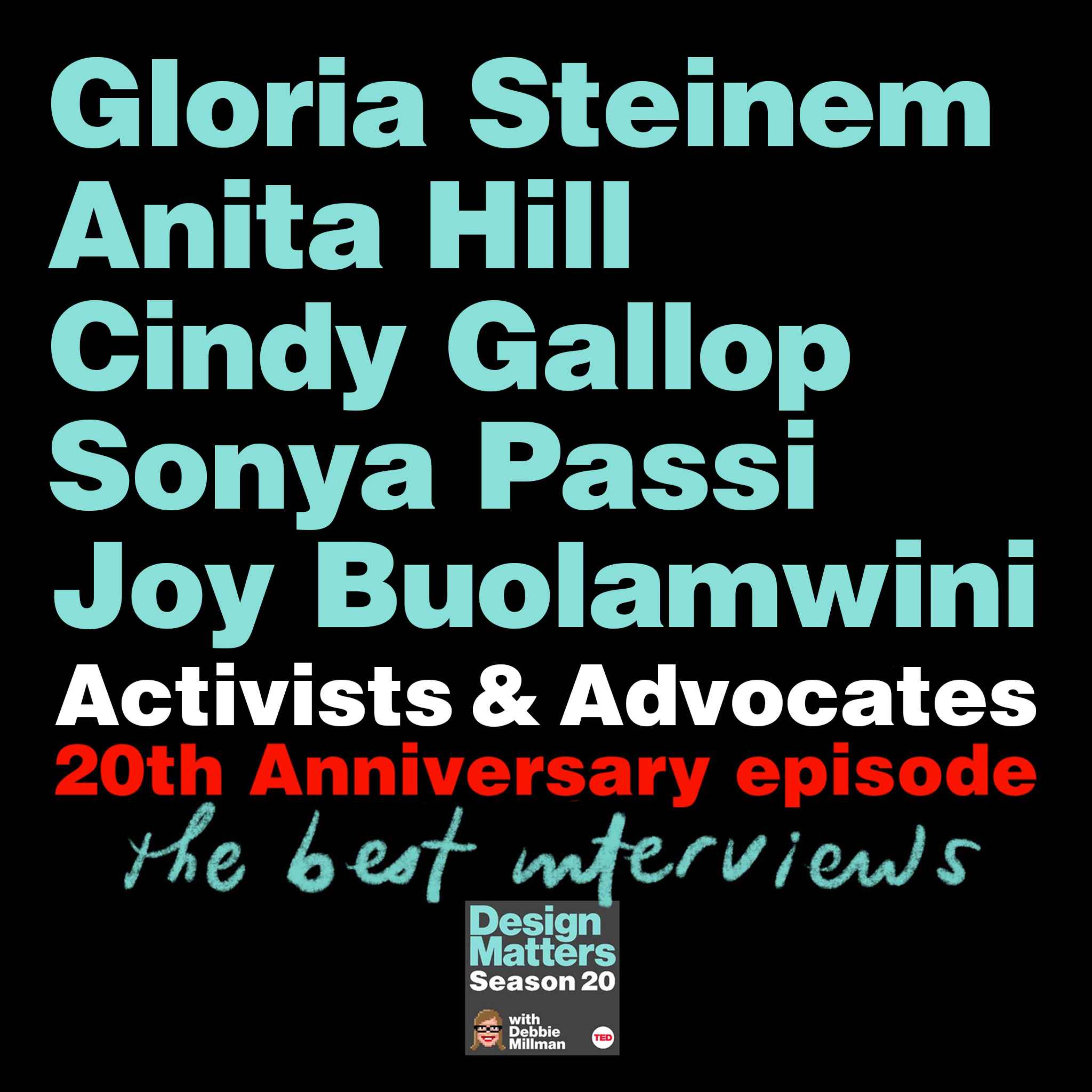
Design Matters with Debbie Millman
20th Anniversary celebration with activists and advocates Gloria Steinem, Anita Hill, Cindy Gallop, Sonya Passi, and Dr. Joy Buolamwini
00:51:54
Loading summary
Transcript114 lines
- [00:01]
Gloria Steinem
I didn't see many examples of women who had married, had children and were happy.
- [00:08]
Anita Hill
What's important is that we keep believing that we can do better, that we deserve better.
- [00:14]
Cindy Gallup
I realized I'd uncovered a huge global social issue.
- [00:20]
Joy Buolamwini
From the TED Audio Collective.
- [00:22]
Debbie Millman
This is Design Matters with Debbie Millman. On Design Matters, Debbie talks with some.
- [00:29]
Gloria Steinem
Of the most creative people in the world about what they do, how they.
- [00:32]
Debbie Millman
Got to be who they are, and what they're thinking about and working on.
- [00:37]
Gloria Steinem
On this episode, in celebration of the 20th anniversary of design Matters, we'll hear from some of the activists Debbie has interviewed over the years.
- [00:45]
Sonia Passi
Gender based violence is so economically devastating.
- [00:48]
Joy Buolamwini
It was kind of a all hands on deck moment. Hey y', all, it's Elise Hu from TED Talks Daily and this show is supported by Northwestern Mutual. Just like all of us Northwestern Mutual financial professionals love a good talk. They'll take the time to ask better.
- [01:08]
Debbie Millman
Questions to get to know you and your unique goals.
- [01:11]
Joy Buolamwini
They'll help you find any financial blind.
- [01:13]
Debbie Millman
Spots you might have and uncover opportunities.
- [01:16]
Joy Buolamwini
That others may miss. Then they'll partner with you to build a personalized financial plan designed to help you reach your short and long term financial goals.
- [01:24]
Debbie Millman
It's a better way to money.
- [01:25]
Joy Buolamwini
Learn more@nm.com the Northwestern Mutual Life Insurance.
- [01:29]
Sponsor/Advertisement Voice
Company Milwaukee, Wisconsin in today's Fast changing digital world, proving your company is trustworthy isn't just important for growth, it's essential. That's why Vanta is here. Vanta helps companies of all sizes get compliant fast and stay that way with industry leading AI, automation and continuous monitoring. So whether you're a startup tackling your first SoC2 or ISO 27001 or an enterprise managing vendor risk, Vanta's trust management platform makes it quicker, easier and more scalable. Vanta also helps you complete security questionnaires up to five times faster so you can win bigger deals sooner. The results According to a recent IDC study, Vanta customers slash over $500,000 a year in costs and are three times more productive. Establishing trust isn't optional. Vanta makes it automatic. 10,000 global companies trust Vanta, including Atlassian, Quora, Chili Piper and factory. Visit vanta.com tedaudio to sign up for a free demo today. That's V a n t a dot com TedAudio hi, this is Sherrell Dorsey.
- [02:35]
Debbie Millman
From the Ted Tech Podcast and today I want to talk to you about Boost Mobile. So you're thinking about upgrading to the amazing new iPhone 17 Pro, the most powerful iPhone yet with 8 times optical zoom. But Are you also thinking about the traffic on your way to the store or transferring all your data? Well, good news. When you order a new phone online with Boost Mobile, they'll send an expert to your home or work to deliver your brand new iPhone 17 Pro and get you all set up on Boost Mobile within minutes. No hassle. Visit boostmobile.com to get started. Delivery available for select devices purchased@boostmobile.com terms apply. For the 20 years I've been interviewing creative people, they've mostly been luminaries working in design and the arts. But creativity is not the exclusive province of designers and artists. I've interviewed so many creative activists and advocates. People have designed their professional and often their personal lives to improve the lives of other people. It's a creativity applied to the real world that begins by imagining a better world and then doing something about it. And these days, we need these people more than ever. This week I'm going to play some excerpts from some of my conversations with activists and advocates in recent years. In 2023, I interviewed Gloria Steinem. It's impossible to summarize what Gloria Steinem has achieved both in her life and in the world, but here at least are some of her job titles. Journalist, magazine editor, author. She is, of course, famous for her activism and her advocacy, but when I interviewed her, I wanted to learn more about her early life. Where does someone as remarkable as Gloria Steinem come from? Your mother suffered from depression and addiction and hallucinations, but you also describe her like your father, kind and loving, with flashes of humor and talent in everything from math to poetry. She had been so ambitious and so capable. How did she lose her confidence? Was that something that women were just expected to give up?
- [05:09]
Gloria Steinem
You know, I'm not sure, because much of it happened before I was born, because, as I was saying, my sister was a decade older and she was trying to be a mother, a wife to an irresponsible, charming man, and also a journalist, all at the same time, which I believe is why she or the atmosphere anyway, around her when she had what was then called a nervous breakdown, which meant that she was too depressed to work, and she spent, I'm not sure how long, at least a year in a sanatorium. When she emerged, she was also addicted to sodium pentothol, which is the or was the tranquilizer of the era, and especially given to women because it was thought that women didn't need to be that alert in order to function as homemakers, or so really to keep them in line.
- [06:12]
Debbie Millman
Homemaking?
- [06:13]
Gloria Steinem
Yes, I Mean, that had happened before I was born. So I did recognize because of her reciting Omar Khayyam to me in the morning when I woke up or because of her affection for short stories, I did recognize who she might have been. And I wonder how many of us, I hope many fewer of us now women, and some men too, are living out the unlived lives of their mothers. But I realized that I was too. I mean, I would have wanted to be a writer anyway. It wasn't as if I was doing something that I didn't want to do, but I did understand it was the unlived life of my mother.
- [07:01]
Debbie Millman
As I was reading about your childhood and your origin stories and the essays that you've written about your mother to Ruth, which is a gorgeous essay included in one of your earlier books, as well as stories about your dad, it struck me more than anyone I've ever read about or interviewed now over 18 years and 500 plus interviews, how the conditions of your origin story really did create the conditions for you to be the activist and the feminist that you are now and have been for 50 years. It could have crushed someone the way you were grown up. It could have. You could have followed in your mother's footsteps very, very easily. What do you think it is about who you are that you were able to take the learnings of both your parents, the kindness, the lovingness that they were able to share and show you to be able to break those patterns and become who you were and are?
- [08:12]
Gloria Steinem
Well, I think your phrase the kindness and the lovingness is the key to it. Because I did experience, always kindness and respect for who I was as an individual. And I did always know that I was loved, which I'm not sure was as true for either of my parents. And yet they somehow managed to create that for me. So that plus I lived in books. I mean, I loved Louisa May Alcott. I read everything she ever wrote, not only for young readers, but her much more depressed older books for older readers. And my father used to sometimes buy a whole house library in order to get a couple of first editions. And then he would dump all the other books in the garage. So I would go out in the garage and end up reading some minute history of World War I don't know, I mean, things I had no business reading. If I was hooked on a book, I would just stay up all night until I finished it. I just entered it.
- [09:21]
Debbie Millman
I used to read books over and over. I also believe that books help save me. I used to sneak copies of the Godfather that my parents had in their library into my room under the covers, and was just titillated by that sex scene. At the beginning. I couldn't believe that people did things like that. I know at one point you asked one of your mother's doctors if her spirit had been broken. And he told you that that was as good a diagnosis as any, and it's hard to mend. And he said, and it's hard to mend anything that's been broken for 20 years. And it reminded me of the mother in Michael Cunningham's the Hours. The difference being that your mother stayed. And I was also wondering if that was also part of what gave you the sense of meaning to keep going.
- [10:16]
Gloria Steinem
Yes, clearly. I mean, I loved my mother and I admired her in many ways, but I definitely didn't want to become her. You know, that was maybe, I'm not sure, part of the reason why I didn't get married. Even though I was engaged at least once to a wonderful guy. I still know. I mean, it wasn't.
- [10:39]
Joy Buolamwini
Oh, I want to ask you about.
- [10:40]
Debbie Millman
That in a bit.
- [10:43]
Gloria Steinem
But I didn't see in front of me, besides my mother, many examples of women who had married, had children and were happy because there were not that many women in the paid labor force. It was mostly a time of very poor families or suburban families. It must have been present somewhere, but I didn't see it now.
- [11:11]
Debbie Millman
You had a number of different jobs as you were growing up. You worked as a sales girl in a women's clothing store after school and on Saturdays, you read scripts. You played records at a local radio station. You worked as a magician's assistant and also a lifeguard. Have you always had a strong work ethic?
- [11:29]
Gloria Steinem
Well, I was just trying to make a little extra money, and I was looking for something. I was answering ads in the newspaper much of the time. For instance, the magician's assistant.
- [11:41]
Debbie Millman
I sort of had this vision of you being on stage in a very sudden, Desperately Seeking Susan kind of environment.
- [11:49]
Gloria Steinem
Well, I did stand there while he threw knives at me. I mean, I was standing against a cork board, you know, and the knives were not that sharp. I mean, you know, painfully. But it was a way of making money, basically. And I used to also dance at supermarket openings. And the.
- [12:14]
Cindy Gallup
Lions Club.
- [12:16]
Gloria Steinem
Yes, the Lions Club. It was a way of making 10 or $20 for a show. And it was also a way out of everyday life.
- [12:28]
Debbie Millman
When you were 17, your mom sold your Toledo house so you would have money to pay for college, so that the house money paid for your College education. You went to live with your sister in Washington, D.C. where she was a jewelry buyer in a department store. And this gave you a carefree senior year of high school. You were elected vice president of the student council and the senior class. What was that experience like for you?
- [12:56]
Gloria Steinem
It was very bizarre for a lot of reasons. One thing was I couldn't understand for a bit why the student body walking around the halls of that high school looked different. And it took me a while to understand they were all white. That this in the District of Columbia was still a time of racial segregation in, in public schools. I was living with my sister because my mother was in a mental hospital. And people would treat me with sympathy, you know, saying, oh, it must be so hard to be away from your parents. And I would say, oh, yes, even though it was the most carefree time I had ever lived in my life. But I didn't want to betray them, I guess. So it was a time of happiness, but pretense.
- [13:46]
Debbie Millman
That was Gloria Steinem from an interview in 2023. Anita Hill will probably always be known for holding Clarence Thomas accountable for sexual harassment during his Senate confirmation hearings in 1991. Since then, Anita Hill has gone on to have a brilliant career as an advocate, a law professor, and an author, and spoke with her in 2021. Aside from sexual harassment before the hearing, sharing any experiences of any gender based violence was taboo. I was told when I was 11 years old that nobody would believe me if I told anybody and that my, the, the person who abused me would kill me if I told anyone. And I believed him. You know, I believed him. And that power structure has stayed in my psyche for decades. You were treated as if you were on trial at that time. You were accused of lying, you received death threats. You still managed to keep your composure in a way that I've never seen anybody be able to do other than maybe Christine Blasey Ford. In many ways, it feels like your testimony was a wake up call for the country. You educated the world really about sexual harassment, and I want to thank you for that. I think that you saved a lot of people from a lot of harm in the process of doing that.
- [15:26]
Anita Hill
Well, thank you. I mean, I do look back on that time and there's so many things that you've said that just continue to haunt me. I mean, I think about the fact that so many people are still told, don't you dare talk. Don't you say anything, because you will be hurt even more or your family is going to be hurt, or your community is going to be hurt. So there is this silencing that goes on. There's a blaming that still goes on where you are told, well, if you hadn't allowed this to happen, it wouldn't have happened. Even for children, they're blamed. And then there's another form of denial which, you know, tells you to think of the pain that you're experiencing is insignificant.
- [16:26]
Debbie Millman
Yeah, walk it off.
- [16:27]
Anita Hill
Not that bad.
- [16:29]
Debbie Millman
Exactly.
- [16:30]
Anita Hill
Yeah, walk it off. You know, shrug it off or, you know, don't make a big deal out of it. Or even these things like, well, I'm sure they were just joking. Or can't you take a joke? You need to lighten up. All of these things which say that you have to suffer from your own abuse and your suffering isn't important to the rest of us. What's important is protecting the abuser. And those are the kinds of things that we grow up with that I don't even think we're cognizant of. And that when we're telling children that's not so bad, or we're telling girls that, you know, boys just do that because they like you.
- [17:17]
Debbie Millman
Right? That's like we're told in second or third grade, oh, if he pulls your hair, it means he likes you.
- [17:23]
Anita Hill
What is that?
- [17:24]
Debbie Millman
We're socializing sexual violence in second grade. But I don't think people fully understand the culture at the time and before. In 1991, you know, when I experienced my abuse, I didn't realize it was so foreign to me. The whole concept of it was so unbelievable to me that I thought I was the only one in the world that was happening to like this just didn't even seem possible. It wasn't until I saw a letter from Dear Ann Landers in the newspaper that I saw that it could happen to other people and cut out the letter and put it under my bed as comfort. But, you know, what you did was so important to the lives of so many people. It's hard to believe that despite your testimony, on October 15, 1991, the Senate voted to confirm Clarence Thomas as an Associate justice of the supreme court by a 52:48 vote. And he's still 30 years later on the court today. One thing that I read about what you would do after was that you thought you. You'd made a deal with yourself that you would go out and talk about sexual harassment for two years, after which the issue would be fixed and you go back to teaching and wondering how that deal with yourself worked out.
- [18:42]
Anita Hill
Well, it's been 30 years, I'm still talking about it. So I guess, you know, that deal, it's like got extended, let's just say. But, you know, you know, one of the things though that and I talk about the hearings from 1991, and all of the things that you brought have brought up all of the different tactics of isolating me. I was made to feel that my experience was really absurd and isolated instead of part of our social fabric. I was made to feel, specifically my oral inspector, that, you know, my problem, what I was talking about wasn't that bad. I mean, all of those tactics that we now know are ways to silence and deny people's experience were full blown during the hearings. They were right there for the public to see. And I think that's why people had this moment where they thought, this is a real issue. This is something that has been happening in my life that I didn't even have a name for. I had an email from an organization that represents girls and the email was about the need for Title ix, protecting girls against sexual harassment and assault in schools. And this one little girl wrote that she had been assaulted, sexually assaulted. Her first experience was when she was in the first grade and she told the teacher about it. And what happened was the teacher ended up suspending her recess privileges because the teacher told the little girl that she was being inappropriate in what she was saying about what had happened to her. And so we still have these things going on. So that two year deal that I made with myself, I honestly thought that if we had the right number of people coming forward, that the laws were going to be sufficient to protect them. And that just is not the truth. It's just not true. I mean, there are so many impediments even to people coming forward, and then even when they do, there are more and more to them actually getting justice.
- [21:10]
Debbie Millman
You outline this in extraordinary detail in your new book, believing our 30 year journey to End Gender Violence. Anita, why the title Believing?
- [21:25]
Anita Hill
I mean, there's so many stages in which. It sounds naive now, but I went to Washington believing that what I had to say was important and that the Senate should consider it in deciding who is going to be on the Supreme Court. I've spent the rest of my life in believing that we had systems in place that could fix it. And I've been disappointed, as you can see, in both cases. But mostly what's important is that we keep believing that we can do better, that we deserve better, that the things that we have been told about our pain and our experiences, we need to stop believing those things and to believe in the integrity of our own bodies and our rights to be safe and secure wherever we are, whether it's in our schools or on the streets or in our homes or in our workplaces.
- [22:23]
Debbie Millman
That was Anita Hill in 2021. Cindy Gallup worked for many years in marketing and advertising before turning her considerable talent and energies to social entrepreneurship. In 2016, I spoke with her about one such project. In your 2009 TED talk, you launched your Make Love Not Porn website and you've stated that the goal of Make Love Not Porn is to provide more realistic information about human sexuality than that provided by hardcore pornography. So talk about what made you decide to do this, how you're doing it now, and what the response has been.
- [23:06]
Cindy Gallup
Make Love Not Porn really was a total accident. It came out of direct personal experience. I date younger men who tend to men in their twenties. And about nine or ten years ago I began realising through dating younger men that I was encountering what happens when today's total freedom of access to hardcore porn online meets our society's equally total reluctance to talk openly and honestly about sex. That results in porn becoming by default the sex education today in not a good way, right? So I decided something about that and eight years ago I put up on no money, this tiny clunky website@makelove notporn.com that is pornworld versus real world. Had the opportunity to launch it at TED. Am the only TED speaker to have uttered the words come on my face on the TED stage six times. Succession Talk went viral instantly.
- [23:56]
Debbie Millman
I wonder why.
- [23:57]
Cindy Gallup
And it drove an extraordinary response to my tiny clunky website that I had never anticipated. I realized I'd uncovered a huge global social issue. And so I saw an opportunity as something that I believe in very strongly, which is that the future of business is doing good and making money simultaneously. I saw the opportunity for a big business solution to this huge untapped global social need. So what I decided to do was I always emphasize making up not porn is not anti porn because the issue isn't porn. The issue is that we don't talk about sex in the real world.
- [24:31]
Debbie Millman
And why not? Why don't we?
- [24:32]
Cindy Gallup
Three reasons actually. The first is centuries of repression, religion, socio cultural dynamics in every country in the world. This issue is same everywhere globally. The second is the patriarchy. Because historically every institution has been male dominated, including religion, government and women have not had the opportunity to bring their lens to bear on sex and sexuality. So 50% of the human experience has been missing from the way we'd operate around it. And thirdly, there aren't enough people like me. And by that I mean society makes it extraordinarily difficult to innovate and disrupt cultural narratives around sex. Many people have tried and given up because of the huge barriers you face. You need people like me who will not stop no matter what.
- [25:17]
Debbie Millman
So what is the type of porn that you think is more conducive to real life?
- [25:24]
Cindy Gallup
I'm doing something that is not porn. So at MakeLoveNotPorn TV, we are building the world's only social sex platform. We are socializing sex to make it socially acceptable and socially shareable. Our tagline at make love not porn is pro sex, Pro porn, pro knowing the difference. And our mission is one thing only, which is to help make it easier for the world to talk about sex. Talk about sex openly and honest in the public domain, by which I mean parents to kids, teachers to schools, you know, everyone to everyone. And equally importantly, talk about sex, open and honestly, private in your intimate relationships. And so what I decided to do, therefore, was take every dynamic that exists out there in social media and apply them to the one area no other social network or platform is going to go in order to socialize sex and to make real world sex and talking about it socially acceptable and therefore ultimately just as socially shareable as anything else we share on Facebook, Tumblr, Twitter, Instagram. So four years ago, my team and I launched the first stage of this vision. We have a whole roadmap for the future. But the first stage is MakeLoveNotPorn TV, which is an entirely user generated, crowd sourced video sharing platform that celebrates real world sex. So anyone from anywhere in the world can submit videos of themselves having real world sex. And we're very clear what we mean by this. We're not porn, we're not amateur. We're building a whole new category online that has never previously existed, social sex. So our competition isn't porn, It's Facebook and YouTube. Or rather it would be if Facebook and YouTube allowed sexual self expression and self identification, which they don't. So social sex videos and Make Love Not Porn are not about performing for the camera. They're just about doing what you do on every other social platform, which is capturing what goes on in the real world as it happens in all its funny, messy, wonderful, beautiful, ridiculous, spontaneous, glorious humanness. We curate to make sure of that. And we have a revenue sharing business model with part of the sharing economy like Uber and Airbnb. You pay to rent and stream social sex. Videos. And half that income goes to our contributors, or as we call them, our make love, not porn stars. Because we want our make love, not porn stars one day to be as famous as YouTube stars for the same reasons. Authenticity, realness, individuality. And we want them to make just as much money.
- [27:44]
Debbie Millman
How do you think watching porn of any sort changes or influences intimacy?
- [27:49]
Cindy Gallup
Again, the issue isn't porn. The issue is that we don't talk about sex. So many things are laid at porn's door that should be laid instead at society's. It is not porn's job to educate about sex. Porn is entertainment. It is society's job to open up to talking openly and honestly about sex in order to encourage and facilitate far better human sexual relationships. Because here's the issue. Because we don't talk about sex, it is an area of rampant insecurity for every single one of us, all around the world, no exception. We all get very vulnerable when we get naked. Sexual ego is very fragile. People therefore find it bizarrely difficult to talk about sex with the people they're actually having it with while they're actually having it. Because you are terrified in that situation that if you say anything at all about what is going on, you will potentially hurt the other person's feelings, you'll put them off you, you'll derail the encounter, you'll potentially derail the entire relationship. But at the same time, you want to please your partner, you want to make them happy. Everybody wants to be good in bed. Nobody knows exactly what that means. And so you will seize your cues on how to do that from any way you can. If the only cues you've ever seen were given from porn because your parents never talked to you, your school didn't speak to you, your friends aren't honest, those are the cues you'll take to not very good effect. And so porn in the abstract is a very useful concept for helping you explore your sexuality, discover there are other people like you. But it is no substitute and never should be for open, honest dialogue around sex. And by the way, what we do at Make Love Not Porn, in socialising sex is more important now than ever before. Because in a world where grabbing women by the pussy is presidentially endorsed, the reason for opening up around sex, talking more freely about sex, is to encourage good sexual values. Many of us, if we're fortunate, are born into families and environments where our parents bring us up to have good manners, a work ethic, a sense of responsibility, accountability. Nobody ever brings us up to behave well in bed, but they should because their empathy, sensitivity, generosity, kindness, honesty are as important as they are in every other area of our lives and our work where we are actively taught to exercise those values. Make Love, not Porn exists to open up the dialogue around sex to encourage and promote good sexual values. When we are open enough to teach children good sexual values from day one, to have the whole of society understand what good sexual values are and that there is a standard of behavior everyone should be adhering to, we cease to bring up Brock Turners, the Stanford Rapist. We end rape culture when we take the shame and embarrassment out of sex as make love, not porn is working to when we normalize sexual we end sexual harassment, sexual abuse, sexual violence, all things where the perpetrators rely on the shame and embarrassment we've imbued sex with to make sure their victims never speak up, are too ashamed and embarrassed to say anything, and will never tell on them.
- [30:51]
Debbie Millman
That was Cindy Gallup in 2016. This episode is sponsored by Gelt, your partner in Taxes if you're a business owner, you probably know that tax season shouldn't be just a once a year scramble. Yet for so many of us, that's exactly what it feels like. A flurry of forums, emails and missed opportunities. G is a modern tax planning and strategy solution for you and your business that takes a smarter approach, pairing real CPAs with AI to help you align your tax strategy to how your business grows. With Gilt, your dedicated CPA team reviews your strategy every quarter so you can optimize things like entity elections, retirement contributions and hidden credits or deductions before it's too late. Late it's proactive, transparent and built for growing businesses, from creative studios and design agencies to consultants and independent practitioners. Make taxes part of the business plan and schedule a call@joingt.com today to learn how your taxes can become a lever for growth.
- [32:01]
Sponsor/Advertisement Voice
In today's fast changing digital world, proving your company is trustworthy isn't just important for growth, and it's essential. That's why Vanta is here. Vanta helps companies of all sizes get compliant fast and stay that way with industry leading AI, automation and continuous monitoring. So whether you're a startup tackling your first SoC2 or ISO 27001 or an enterprise managing vendor risk, Vanta's trust management platform makes it quicker, easier and more scalable. Vanta also helps you complete security questionnaires up to five times faster so you can win bigger deals sooner. The results? According to a recent IDC study, Vanta customers slash over $500,000 a year in costs and are three times more productive. Establishing trust isn't optional. Vanta makes it automatic. 10,000 global companies trust Vanta, including Atlassian, Quora, Chili Piper and factory. Visit vanta.com tedaudio to sign up for a free demo today. That's V A N T a dot com TEDAUDIO this podcast is brought to.
- [33:03]
Joy Buolamwini
You by Wise, the app for international people using money around the globe. With Wise, you can send, spend and receive up to 40 currencies with only a few simple taps and save up to 55% compared to major banks. Plus, wise won't add hidden fees to your transfer. Whether you're buying souvenirs with pesos in Puerto Vallarta or sending Euros to a loved one in Paris, you know you're getting a fair exchange rate with no extra markups. Be Smart Join the 15 million customers who choose WISE. Download the WISE app today or visit WISE.com Learn more by visiting WISE.com US.
- [33:36]
Sponsor/Advertisement Voice
Compare T's and C's Apply Grief doesn't keep a calendar. Anxiety doesn't clock out after five. Depression doesn't care if it's your busy season. But support can still fit into your life. With Grow, you can find a therapist who meets you where you are. They connect you with thousands of independent licensed therapists across the US offering both virtual and in person sessions. You can search by insurance provider, specialty treatment methods and more to find a therapist who works for you. And if it's not the right fit, switching is easy. There are no subscriptions, no long term commitments. You just pay per session. Find therapy on your time, evenings, weekends and Cancel up to 24 hours in advance at no cost. Whatever challenges you're facing, GrowTherapy is here to help. Sessions average about $21 with insurance and some pay as little as $0 depending on their plan. Visit growtherapy.com acast today to get started. That's growtherapy.com acast growtherapy.com acast availability and coverage vary by state and insurance plan.
- [34:49]
Debbie Millman
Sonia Passi is a veteran activist who has founded several organizations addressing gender violence. When I spoke with her in 2024, I wanted to understand where her ambitions originated and how she built the skills to realize them. I read that from a very early age you wanted to be a police officer, but in a complete about face. By the time you were 16, you created an anti violence Amnesty International community group in your high school. What inspired your interest in social justice and human rights at such a young age?
- [35:30]
Sonia Passi
You know, when I was a teenager, Tony Blair was The Prime Minister of England and his wife, Sheree Blair, was a very famous and successful human rights lawyer. I think it was the first time. It was sort of like the equivalent of Hillary Clinton here in the us but it was the first time that a Prime Minister's wife was a powerhouse in her own right. And it was a very public and prominent display of a woman with power and, and leadership. And so it was a model, I think, for a lot of young women in the UK at the time. And so, you know, 12 years old, I'm like learning about what a human rights lawyer is and therefore what human rights are. And the through line between wanting to be a police officer. I think it was a police officer and then it became a teacher, and then it became a pediatrician, and then it became a human rights lawyer. Was, I have known my entire life that. That my life is in service of others. And so it was just sort of finding what that looked like for me.
- [36:38]
Debbie Millman
You went to the University of Cambridge for your undergrad degree and then went on to get a Master's of philosophy. What made you decide to go back to school to pursue a law degree at UC Berkeley at that time? Was it that realization that, yes, I want to be a lawyer? Was it what. What happened in that timeframe between the Masters of Philosophy and than wanting to go on for the law degree?
- [37:03]
Sonia Passi
So at 16, when I started this Amnesty International group, the very first pamphlet that they sent me in the mail was around their campaign that year, which was Global Violence against women. And I remember reading, one in three women globally will experience gender based violence. And I was so utterly shocked. Not by the statistic, but why. This was the first time that I was reading it, and the first time I was reading it was on page two of a pamphlet that I sent away for in the mail. Because it was very clear to me that this was a global crisis and should be breaking news every single day, front page of every newspaper. And in that moment, without having any consciousness as to my own experience, but in that moment, it crystallized for me that this was my life's work. At that age. I started hosting domestic violence awareness weeks at my high school that were intended both to educate people about the issue, but also to raise money for local shelters. I then went on to do similar work at Cambridge. And by then, that point, I knew this was my life's work. I had absolutely no idea what contribution I had to make to it, but because it had been introduced to me as a human rights issue, not as a domestic issue, not as A personal issue, but a human rights issue. I felt clear that understanding law and how you create laws and change laws and policy was going to be critical to my future. And so I actually chose to go to law school. And I had the good fortune to go to law school and be able to afford to go to law school knowing that I didn't want to be a lawyer, but there was a certain piece of education that I needed in order to enact the kind of change that I wanted to.
- [39:04]
Debbie Millman
During your studies, you were also a JD fellow, which meant you were 1 in 12 women law students selected nationally based on leadership potential. You also worked as an intern for the U.S. house of Representatives and were a volunteer for Obama for America before he became president. So at that point, were you considering a career in politics?
- [39:29]
Sonia Passi
I actually was. I had previously interned for a parliamentary member in the UK at that age, I felt very strongly that that politics was a way to create change. And certainly that was a different time politically than it is now. And there was a lot more hope and potential. And I was younger, and then I spent time in D.C. interning for the House of Representatives for a member of Congress, and volunteering nights and weekends for the Obama campaign in Virginia. And what I learned in that time was that, that the real innovation, the real systems change doesn't actually happen in D.C. it happens outside of D.C. and then I went to California to go to UC Berkeley, and I saw some of the most groundbreaking organizing and community work and systems change work happening there. And I understood better that there's a lot more that I could do with the skill set and the vantage point and perspective that I have outside of D.C. than in D.C. when did you.
- [40:42]
Debbie Millman
Work at Morgan Stanley? I know you were an associate at Morgan Stanley, and I was trying to, as I was doing my research and prep for the show, try to fit in exactly when that was. And I was having some difficulty.
- [40:56]
Joy Buolamwini
Yeah.
- [40:57]
Sonia Passi
So during law school, I started my first nonprofit organization in the domestic violence space. It's called the Family Violence Appellate Project. It's still a thriving organization. Oh, yeah.
- [41:08]
Debbie Millman
I want to. I want to talk to you about it. I have that. That's next.
- [41:13]
Sonia Passi
And got really clear in that time period that where my skills and my passion connected was around filling in the gaps in the work that is being done to address gender violence. But when I graduated law school, I was not a citizen and I needed a visa, which meant I needed to work for a big, big corporation or company of sorts to sponsor that visa. And my options were banking, consulting or law and as much as I had loved law school, there was nothing more boring to me than the practice of law.
- [41:52]
Debbie Millman
Why is that? Why is that?
- [41:54]
Sonia Passi
Because at least at a junior level, I have no, no clue what it's like at a senior level, but it's very much research and writing. And one of the hardest things for me in my education, and I had a long education, was feeling so unhelpful because I was sitting in these halls of higher learning thinking, and there was no doing all this skill and all this talent and no one was doing. Everyone was just thinking. And the practice of law as an intern at least felt very much the same.
- [42:35]
Debbie Millman
So the choice to go to Morgan Stanley, did you want to understand money and the business of money better or was it just visa based?
- [42:42]
Sonia Passi
Yeah, it was two things. It was one thing I learned starting my first nonprofit is that nonprofits are businesses and you need the same business rigor to run them well, to be financially be responsible, to have healthy reserves, to, you know, understand budgets and forecasting and all the other sides of running a business. And I didn't have that in my toolbox. And then the other thing that I had learned during law school was gender based violence is an economic issue.
- [43:18]
Debbie Millman
In what way?
- [43:19]
Sonia Passi
So the Family Violence Appellate Project, what we were doing was we were appealing domestic violence cases. So I was talking to potential clients, all of whom had left the abuse and all of whom had lost custody of their children. And the reason they had lost custody of their children was because they didn't have the means to support their children. And these were women who were sometimes three, four, five years out of the abuse, abuse, but they were still homeless and they were living in their car, they were living on someone's couch. And this was a pattern. It wasn't just a one off. And what I was learning through this was gender based violence is so economically devastating, it is not only extremely expensive, but economic abuse is so insidious and pervasive. Not having access to your own cash, having debt in your name that you don't know about that destroys your credit score, having your bank account stolen from or monitored, being forced to sign documents that take away your financial autonomy. It became very clear to me that this is an economic issue. It is not something that we are addressing as an economic issue. And I needed to have a better understanding of economics in order to better address it.
- [44:48]
Debbie Millman
That was sonia passe in 2024. Joy Buolamwini is a computer scientist and a digital activist. In July of 2025, I spoke with her live at the WBUR Festival about one project that exposed the racism built into many AI systems. You signed up for a course that changed the trajectory of your life. Yes, science, fabrication. This was specifically focused on building fantastical, futuristic technologies. What did you begin to build?
- [45:24]
Joy Buolamwini
Yes, this is where I started to explore this idea of shape shifting. Right. And so we mentioned earlier from Ghana, I was inspired by stories of a Nazi, the spider, trickster spider that could also shape shift. And I wanted to do the same, but I had a six week deadline. And so instead of shifting my shape, right, I decided to shift my reflection in a mirror. And so in that process of figuring out how do I make it look like there's a mask on my face through a mirror. That's when I started to experiment with computer vision. So first you have to detect the face. So once I got that going, I started putting different people's faces on my own. So Serena Williams was one, looked like the greatest of all time. Then I thought, okay, this is kind of giving me theme park where you have the cutout hole and you put it through. Wouldn't it be cool if when I moved, it moved just like that? Anyway, so when I was moving, it's moving. So to do that I needed a camera. So I put a camera on top of the mirror. And then I needed software that would actually follow my face in the mirror. So I went online, downloaded some software that was supposed to help me do that, but it wasn't working. Just like my robot, my peekaboo robot wasn't working. I was like, huh, I think something might be off. And at the time I was experimenting, it was around Halloween time and I had a white mask for Halloween party. So when it wasn't working, I started just experimenting with things in my office. I even drew a face on my hand, held it out to the camera, and it detected the face on my my hand. So that's when I was like, okay, anything is possible. So I reached for the white mask and before I even had it all the way over my face, it was already detecting the white mask. So here I was at mit, this epicenter of innovation that I dreamed of coming to since I was a little girl and I'm in white face to be seen coding in a white mask at mit. And so that was when it switched from can I shape shift like a Nazi? The spider to hold up side quest. What is going on here?
- [47:43]
Debbie Millman
You've said that while the white mask episode was disheartening, you didn't want people at the time to think you were making everything about race or being ungrateful for rare and hard won opportunities. And you felt that speaking up had consequences. What kind of consequences did you fear?
- [48:04]
Joy Buolamwini
Retaliation. Being blacklisted, Being kind of marginalized with the way my research was perceived. And so I remember even when I started exploring the research, grad students warned me, they're like, you know, xyz, they try to study bias. Didn't go well. It was like these are the bones of grad students. Pass that shadowy place, it looks like studying discrimination. Right? Like places the light doesn't touch for a career. So I was highly discouraged from doing this sort of work because it was touching on bias and discrimination. So that was part of one thread of being discouraged. But another thread of being discouraged was like this involves AI. AI involves a lot of math.
- [48:53]
Cindy Gallup
Math.
- [48:55]
Joy Buolamwini
I'm like aunt, right? You know, engineering background, all of that. So the math wasn't an impediment to me, but others perception of the type of work I was capable of. I was also seeing that come out in some of other people's perceptions. And so for me to actually pursue this research was going against all of the wisdom that was being passed down. My supervisor, he wasn't against the exploration, but he was really practical. You spent a year working on a completely different project. This is a two year program. You want to do a new project halfway through that might be difficult. Maybe this is a side project. Right. And so I, I think all of the advice was well meaning and everything they warned me about did happen.
- [49:49]
Cindy Gallup
Right.
- [49:49]
Joy Buolamwini
You know, so I guess this is where it helps to be stubborn. But also I think the other thing for me was even though the people around me at the time didn't quite see the vision, it still felt important to me. And I have to commend the media lab for creating a space where I could explore a sandbox. Even if they didn't understand the shapes I was building, they're like you do you, right? We don't know what you're doing, but figure it out. And there are many spaces that I wouldn't have even been able to explore that at all.
- [50:26]
Debbie Millman
You stated that in some ways you went into computer science to escape the messiness of the multi headed isms of racism, sexism, classism and more. And those signs indicated otherwise. You wanted to believe that technology could be apolitical.
- [50:44]
Joy Buolamwini
Oh, 100%.
- [50:46]
Debbie Millman
So what changed your mind about speaking up?
- [50:49]
Joy Buolamwini
When I saw the reaction to the 2016 election, it was kind of all hands on deck moment. And this questioning of what can I do to make a difference in the world. And so when I got to the Future Factory, there were two missions. One, get the PhD family legacy. Third generation I only applied to. I didn't really want to go to grad school again, like by this time, you know, so I kind of did the, well, I'll apply to one place and if it doesn't work out, I did try. So I applied to one grad school. It worked out. So this was the price for getting it.
- [51:35]
Debbie Millman
Did you really think you weren't going to get in to the media Lab?
- [51:38]
Joy Buolamwini
Yeah, you never know for sure. I thought I had a good chance, but it wasn't a hundred percent. And if it didn't work out, I could continue my entrepreneurial dreams. So I was not, I was not heavily invested in getting in. In fact, I was going to be working on an entrepreneurial project until I got a call from my father. It's like, remember who you are. No, I was like, Rhodes Scholarship, Fulbright fellow, daddy. This has to count for something, right? You know, he's like, it is not a terminal degree. Okay, okay, all right, all right. That is true, you know, so I applied to that one place and got it. Yeah.
- [52:18]
Debbie Millman
Your thesis, which you titled the Gender Shade Project, demonstrates the priorities, preferences and biases of those who create code and the algorithmic bias from companies including IBM, Amazon, Microsoft and more. With over 3400 citations, you exposed how AI facial recognition systems had 100% accuracy for white male faces and near coin flip results for dark skinned women. Some labeled Michelle Obama as male, others were labeled as gorillas. What were some of your other findings?
- [53:03]
Joy Buolamwini
Yes, so there are a whole combination of findings when it comes to the mislabeling of faces. So with the Gender Shape Shades project, as I started looking at how computers read faces, I was asking three different kinds of questions when it comes to facial recognition technologies. So the first question is, is there a face? This is face detection. So when I'm putting on a white mask, that's a face detection fail. Right. Another kind of question I like to say you might ask is what kind of face? So what's the gender of the face? What's the age of a face? Maybe what's the emotional expression on the face? And so that's what I focused on for my master's work with gender shades. I was looking at companies guessing binary gender. And in that we tested a number of different companies. So in the case of Microsoft, it was that there was perfection for one group. The lighter males, the pale males, affectionately called. Right. And it wasn't so great for other groups like darker females. But it was also interesting because we tested like a company from China and we found that it actually had best performance on darker male faces. And this was really important because in that research we were doing intersectional analysis borrowing from Kimberly Crenshaw's work on discrimination, right, along multiple axes. I was like, oh, this is being applied in the legal space, but maybe there's something for computer scientists to learn. So instead of just looking, in this case at gender, I also started looking at skin type as well. And so it wasn't just the story of, okay, it works better on male faces than female faces, which was the overall trend. Or it works better on lighter faces than darker skinned faces. But when we did that subgroup analysis, right, lighter males, lighter females, darker males, darker females, that's where we got the stark contrast you were just mentioning. And Microsoft was the good results, right? With IBM, their error gap between their best performing group, lighter males, and their worst performing group, darker females, the highly melanated, like myself, right, was around 34%. So those were the findings that really got me to start exploring what are other ways in which computer vision has failed. Failed, Right. And so you have the gorilla gate example that you just brought up with Google Photos, where what I now call an evocative audit, people in the wild, regular people, were interacting with these systems and seeing issues. Google fixed the problem not by making a better system, but just by removing any label of gorilla. So gorillas were also not labeled gorillas just to be extra safe. I don't know if that's quite the solution, but. So we've seen an evolution of different approaches to addressing some of these misclassifications and mislabeling that comes on. But as I was also doing the work, I realized even if these systems were perfectly accurate, whether we're going from guessing the gender of a face, which that's difficult, right. How does a person identify to figuring out the unique identity? Right. With facial identification, if you have perfect facial identification and cameras everywhere, we have the infrastructure for a surveillance state that tracks your every move, where you go to worship who you see at night or in the morning, whatever your preferences are, right? Where you go and protest. And so that was very interesting tension for me to hold as I was doing this research, because it was as easy as saying, okay, let's make more inclusive data sets. And when we have more inclusive data sets, we'll have more accurate facial recognition. But accurate systems can be abused. And so the analysis had to be not just how well does the technology work? But what kind of technologies do we want in society in the first place?
- [57:21]
Debbie Millman
That was Joy Bulamwin in 2025. You can hear my full interviews and hundreds of other interviews with some of the world's most creative people on our website, designmattersmedia.com or wherever you get your podcasts. We'll be back next week with another special episode called from the Many Years I've been Doing Design Matters. Yes, this is the 20th year we've been podcasting Design Design Matters, and I'd like to thank you for listening. And remember, we can talk about making a difference. We can make a difference, or we can do both. I'm Debbie Millman and I look forward to talking with you again soon. Design Matters is produced by the TED.
- [58:07]
Gloria Steinem
Audio Collective by Curtis Fox Productions. The interviews are usually recorded at the.
- [58:12]
Joy Buolamwini
Masters in Branding program at the School of Visual Arts in New York City.
- [58:16]
Gloria Steinem
The first and longest running branding program in the world. The editor in Chief of Design Matters Media is Emily Weiland.
- [58:27]
Debbie Millman
This episode is sponsored by Gilt, your partner in Taxes if you're a business owner, you probably know that tax season shouldn't be just a once a year scramble. Yet for so many of us, that's exactly what it feels like. A flurry of forms, emails and missed opportunities. G is a modern tax planning and strategy solution for you and your business that takes a smarter approach, pairing real CPAs with AI to help you align your tax strategy to how your business grows. With Gilt, your dedicated CPA team reviews your strategy every quarter so you can optimize things like entity elections, retirement contributions and hidden credits or deductions before it's too late. Late. It's proactive, transparent and built for growing businesses, from creative studios and design agencies to consultants and independent practitioners. Make taxes part of the business plan and schedule a call@joingt.com today to learn how your taxes can become a lever for growth.
- [59:32]
Joy Buolamwini
Boost Mobile is now sending experts nationwide to deliver and set up customers new phone phones. Wait, we're going on tour?
- [59:37]
Cindy Gallup
We're delivering and setting up customers phones?
- [59:39]
Gloria Steinem
It's not a tour, not with that attitude.
- [59:41]
Joy Buolamwini
Introducing store to door switch and get a new device with expert setup and delivery. Delivery available for select devices purchased@boostmobile.com hey, it's Adam Grant from Ted's podcast Work Life, and this episode is brought to you by ServiceNow. AI is only as powerful as the platform it's built into. That's why it's no surprise that more than 85% of the Fortune 500 companies use the ServiceNow AI platform, while other platforms duct tape tools together. ServiceNow seamlessly unifies people data workflows, and AI connecting every corner of your business. And with AI agents working together autonomously, anyone in any department can focus on the work that matters Most. Learn how ServiceNow puts AI to work.
- [60:23]
Debbie Millman
For people@servicenow.com Hannah Berner are those the.
- [60:29]
Sonia Passi
Cozy Tommy John pajamas you're buying?
- [60:31]
Joy Buolamwini
Paige desorbo they are Tommy John.
- [60:34]
Sonia Passi
And yes, I'm stocking up because they make the best holiday gifts so generous.
- [60:39]
Joy Buolamwini
Well, I'm a generous girly, especially when it comes to me, so I'm grabbing the softest sleepwear, comfiest underwear, and best fitting loungewear.
- [60:47]
Sonia Passi
So nothing for your bestie?
- [60:49]
Joy Buolamwini
Of course I'm getting my dad Tommy John. Oh, and you?
- [60:52]
Gloria Steinem
Of course it's giving holiday gifting made easy.
- [60:55]
Joy Buolamwini
Exactly. Cozy, comfy, everyone's happy. Gift everyone on your list, including yourself with Tommy John and get 25% off your first order right now at TommyJohn.com.
- [61:06]
Debbie Millman
Comfort build the perfect holiday meal at Whole Foods Market. From traditional holiday must haves to creative twists, everything must pass their strict ingredient standards grab sales on their impressive centerpiece mains with no antibiotics. Ever aim to please with limited time desserts. Desserts like chocolate, Bourbon Pecan pie and ring in 2026 with sales on quality seafood. Shop for your celebration at Whole Foods Market. With so many ways to save terms apply.